For most non-residents, New Mexico ($50 one-time filing, no annual report) or Wyoming ($100 filing, $60/year minimum) offer the lowest Year-1 costs. Both keep member names off public records.
One thing your state choice does not decide: which banks and payment platforms accept you. Bank eligibility follows where you live, not Wyoming versus Delaware. Mercury, for example, says its restrictions are “based on your country of residence, not your citizenship or nationality.” Stripe asks where the business is registered, and every state gives the same answer: the US. For the full country-by-country breakdown of Mercury, Wise, Stripe, and PayPal access, see our US bank accounts and payment platforms for non-residents guide.
This page covers what the state choice actually changes: real Year-1 costs, privacy, and your federal filing obligations. If you came here for Florida, jump to Florida LLC for non-residents. Our LLC formation overview covers the full process for non-residents. State fees last checked: 17 September 2026, against official state sources.
Quick Answer: Best State for a Non-Resident LLC in 2026
Wyoming and New Mexico are the two strongest choices for non-residents.
Wyoming charges a $100 filing fee and a $60 minimum annual report license tax, per the Wyoming Secretary of State fee schedule effective 1 July 2026. Filing online adds a 2.4% card processing fee, so $102.40 in practice. Its name carries stronger recognition with US banks and payment processors.
New Mexico charges a $50 one-time filing fee with no annual report and no ongoing state fee. That makes it the lowest Year-1 cost option, with identical federal tax treatment.
If you live in the US, form in your home state instead — otherwise you pay foreign-registration fees on top.
Why Non-Residents Choose a Different State Than US Residents
The foreign-registration problem does not apply to non-residents
Most online advice warns about forming an LLC in one state while living in another — that forces US residents to register as a foreign LLC in their home state, doubling fees and paperwork. Non-residents have no US home state. That double-registration problem simply does not exist for them. A founder in Lagos, Karachi, or Manila forms once, in one state, and stops there.
Privacy, not tax savings, is the real driver for non-residents
“No state income tax” is the most repeated selling point for Wyoming, Nevada, and South Dakota. For non-residents, it is almost irrelevant: a non-resident-owned LLC with no US-source income owes no US state or federal income tax regardless of which state it forms in. What does matter is privacy. Some states publish member names in public records.
Wyoming and New Mexico do not require public disclosure of member names — useful for founders who want ownership kept off searchable databases. Already formed elsewhere? How to Move Your LLC to Wyoming walks through the conversion step by step.
No state eliminates your US federal filing obligations
Choosing Wyoming over Delaware does not remove a single federal requirement. A foreign-owned single-member LLC with reportable transactions must file Form 5472 attached to a pro-forma Form 1120, according to the IRS — regardless of state. A multi-member LLC files Form 1065, due March 15, extendable to September 15.
One common confusion: FBAR (FinCEN Form 114) requires US persons to report foreign financial accounts over $10,000. As a non-resident individual, you are generally not a US person, so you personally do not file FBAR. One nuance most guides miss: your US LLC itself is a US entity — if the LLC holds foreign financial accounts exceeding $10,000, the LLC can have its own FBAR obligation even though you do not.
On BOI: under FinCEN’s final rule (issued 11 August 2026, effective 14 August 2026), all entities created in the United States are exempt from Beneficial Ownership Information reporting. Only entities formed under foreign law and registered to do business in a US state still report.
The Rule That Decides Everything: Where Is Your “Nexus”?
If your LLC has a physical office, inventory or employees in a particular US state, you generally must form (or register) there — that is where you have “nexus.” But a fully remote, online business owned from abroad has nexus nowhere in the US, so you can choose a formation-friendly state. That freedom is exactly why Wyoming and New Mexico are so popular when you form an LLC as a non-resident.
If you ever do open a warehouse, office or hire staff in, say, Texas, you would then register your LLC as a “foreign LLC” in Texas too. Until then, your state of formation is a free choice. One practical consequence: when people ask which state has the “best tax” for a non-resident, the honest answer is that the differences between Wyoming, New Mexico and Delaware are about fees and privacy, because none of them imposes state income tax on income that is not earned in that state. So the decision is really about cost and paperwork, not a hidden tax loophole.
What About “Forming in My Customer’s State”?
You do not need to form in a state just because customers live there. Sales-tax obligations can arise from where and how much you sell, but that is separate from where you form the LLC. Forming in Wyoming and selling worldwide is completely normal.
What Non-Residents Should Prioritize When Choosing a State
Annual cost, not just formation cost
The formation fee is only one line in your real budget. Year-1 total — filing fee plus registered agent plus the first annual fee — is the correct comparison number. A $50 filing in New Mexico with no annual report beats a $100 filing plus a $60 annual minimum in Wyoming, once you add the registered agent cost on top.
Banking and payments: decided by your country, not your state
A Wyoming LLC and a New Mexico LLC face identical banking and payment outcomes. Mercury decides by the founder’s country of residence: its prohibited-countries list includes Nigeria, Pakistan, the Philippines, Bangladesh and Nepal, while India and the UAE are not on it (checked September 2026). Relay is stricter in a different way: its required-documents page accepts US businesses owned by non-US residents only if “the business has an operating presence in the U.S.”, and asks every beneficial owner for a “Physical U.S. address (no PO boxes, no virtual mailboxes)” (updated 11 August 2026). Which platforms accept founders from India, Pakistan, Nigeria, the UAE, or the Philippines is covered in full in our country-by-country banking and payments matrix.
Privacy: which states publish member names
Wyoming and New Mexico do not require public disclosure of member names. Delaware does not require it either — but charges a $400 annual LLC tax. Florida’s Articles do not list members, but its annual report must name at least one person with authority to manage the company. If privacy matters and you want minimal ongoing costs, New Mexico or Wyoming is the stronger choice.
Registered agent requirement in every state
Every US LLC must have a registered agent — a person or service with a physical street address in the formation state. Commercial registered agent services typically cost $50–$150 per year (our market estimate, not a state fee); this amount belongs in your total cost calculation.
One overlooked failure point: the IRS Form SS-4 instructions say the “Responsible Party” must be an individual (a natural person), not an entity. Founders who own their new LLC through another company often list that company in the field, and the application fails.
Total Year-1 Cost Table: Wyoming vs Delaware vs New Mexico vs Nevada vs Florida
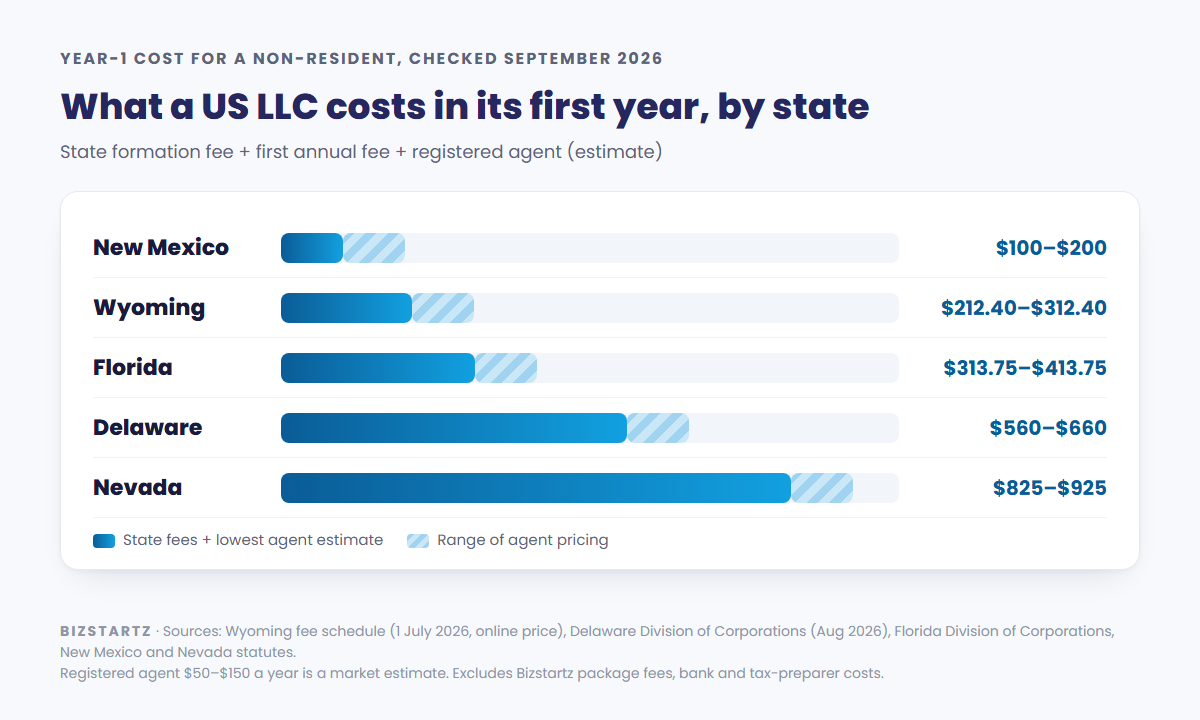
| State | Formation Fee | First Annual Fee | Registered Agent (estimate) | Year-1 Total |
|---|---|---|---|---|
| Wyoming | $100 ($102.40 online) | $60 minimum | $50–$150 | $212.40–$312.40 |
| Delaware | $110 | $400 annual tax | $50–$150 | $560–$660 |
| New Mexico | $50 | $0 | $50–$150 | $100–$200 |
| Nevada | $425 | $350 | $50–$150 | $825–$925 |
| Florida | $125 | $138.75 | $50–$150 | $313.75–$413.75 |
Last checked: 17 September 2026. Sources: Wyoming fee schedule (effective 1 July 2026; online card fee 2.4%, minimum $1), Delaware fee schedule (revised 1 August 2026), Florida Division of Corporations LLC fees, New Mexico statute 53-19-63, and Nevada statutes NRS 86.263 and 76.130. The “first annual fee” is usually paid in your second calendar year, not the month you form. Registered agent range is a market estimate: $50–$150/year.
Warning — Delaware’s annual tax went up: every Delaware LLC pays an annual tax whether or not it earns anything, and corp.delaware.gov now lists it as $400 (it was $300). The tax for each year is due by 1 June of the following year; the higher amount applies from the 2026 tax year, so the first $400 payments fall due by 1 June 2027. Paying late adds a $200 penalty plus 1.5% interest per month. Delaware’s LLC formation fee is also $110, not the $90 many guides still quote.
Nevada is the most expensive commonly recommended state. Forming costs $425 in Year 1 alone ($75 Articles + $150 Initial List + $200 state business license), with $350 per year ongoing ($150 Annual List under NRS 86.263 + $200 business license renewal under NRS 76.130). Nevada does not eliminate a single federal filing obligation for that money.
Florida LLC for Non-Residents: Fees, Deadlines and When It Makes Sense
You can form a Florida LLC from outside the US without an SSN or a visit. Whether you should depends on one question: does the business actually operate in Florida? Here is the Florida-specific detail, checked against the Florida Department of State and Florida Department of Revenue in September 2026.
What Sunbiz charges to form the LLC
Florida’s filing office is the Division of Corporations, which runs Sunbiz. The $125 you see quoted is two required fees, per its LLC fee page:
| Item | Fee | Required? |
|---|---|---|
| Articles of Organization filing fee | $100 | Yes |
| Registered agent designation | $25 | Yes |
| Certificate of Status | $5 | Optional |
| Certified copy of the Articles | $30 | Optional |
| Minimum to form | $125 |
Online filing accepts Visa, MasterCard, American Express or Discover credit cards, Visa or MasterCard debit cards, or a prepaid Sunbiz E-File account. Filings are processed in the order received, and Sunbiz emails you once the document is approved. Florida publishes no guaranteed turnaround.
The registered agent needs a Florida street address
Sunbiz’s Articles instructions say the registered agent must have “a physical street address in Florida” and that you should not list a P.O. box. You can’t act as your own agent from abroad, so non-residents use a commercial agent. The LLC’s mailing address, by contrast, can be a P.O. box.
The same instructions say “Do not list members” on the Articles. Naming a manager or authorized representative there is optional. But Florida statute 605.0212 requires every annual report to give the name and address of at least one person with authority to manage the company, plus the LLC’s federal EIN (or whether one has been applied for). Sunbiz records are publicly searchable, so expect a manager’s name to appear there.
The annual report: $138.75, 1 January to 1 May
- Fee: $138.75 if filed between 1 January and 1 May (Sunbiz fees).
- First report: due between 1 January and 1 May of the year after the calendar year you formed. An LLC formed in September 2026 files its first report in January–May 2027.
- Late fee: after 1 May, a flat $400 late fee is added, making $538.75. It is not scaled by how late you are.
- Dissolution: if no report is filed by the third Friday of September, Florida administratively dissolves the LLC at close of business on the fourth Friday of September (Sunbiz annual report page). In 2026 those dates are 18 September and 25 September.
One timing option: if you file your Articles between 1 October and 31 December, Sunbiz lets you choose a 1 January effective date, which pushes the first annual report back a year. The tradeoff is that the LLC does not legally exist until 1 January, so you can’t get the EIN or open accounts in its name before then.
Florida taxes: no personal income tax, but watch the corporate election
“The State of Florida does not have a personal income tax,” says the Florida Department of Revenue. For a default single-member LLC owned by an individual (a disregarded entity), Florida requires no separate corporate income tax return.
That changes if the LLC is taxed as a corporation. The Department of Revenue’s corporate income tax page says an LLC classified as a corporation for federal and Florida purposes “is subject to the Florida Income Tax Code and must file a Florida corporate income/franchise tax return.” The rate is 5.5%, after a $50,000 exemption. Some non-resident founders elect C-corp treatment on the IRS side without realising it brings a Florida return with it. A multi-member LLC taxed as a partnership files Florida’s partnership information return (F-1065) only if one of its owners is a corporation.
Sales tax is separate. Florida’s general sales tax rate is 6%, and many counties add a surtax (Florida sales tax). It matters if you sell taxable goods or services in Florida, whichever state you form in.
When Florida makes sense for a non-resident, and when it doesn’t
Florida makes sense when the business will really operate there: an office, a warehouse, staff, or a US partner running things from Miami or Orlando. Under the nexus rule above, a Florida-based operation would have to register in Florida anyway. Forming there directly avoids paying for two states.
Florida does not make sense just because your customers are in Florida, or because “no state income tax” sounds good. For a fully remote business run from abroad, compare what you pay every year after formation:
- New Mexico: $0 annual state fee
- Wyoming: $60 minimum
- Florida: $138.75, plus a $400 late fee if you miss 1 May
- Delaware: $400 annual tax
Florida also puts a manager’s name on its annual report, which Wyoming and New Mexico do not require. Neither Florida nor any other state changes your bank options (Mercury and Relay rules above) or your federal filings.
The rest of the process is the same as any state
After Sunbiz approves the Articles, a Florida LLC follows the steps below: EIN by phone, fax or mail without an SSN, then a bank account, then Form 5472 or Form 1065 each year. The only Florida-specific extra is that the annual report asks for the EIN, so get it before your first report is due.
How to File an LLC as a Non-Resident: Step-by-Step
Step 1: Choose your state
Select on total Year-1 cost, privacy, and your plans. Wyoming ($100 filing, $60 annual minimum) and New Mexico ($50, no annual report) work best for most non-residents. Delaware ($110 filing, $400 annual tax) makes sense mainly if you plan to raise US venture capital. Florida ($125 filing, $138.75 annual report) fits businesses that genuinely operate in Florida.
Step 2: Appoint a registered agent
Every US LLC needs a registered agent — a US-based person or company with a physical street address in your formation state that receives legal documents on your behalf. Budget roughly $50–$150 per year for a commercial service.
Step 3: File your Articles of Organization
File directly with the state. State fees: New Mexico $50, Wyoming $100 ($102.40 online), Delaware $110, Florida $125, Nevada $425 total. New Mexico has no annual report. Florida’s fee breakdown and deadlines are in the Florida section above.
Step 4: Obtain your EIN from the IRS
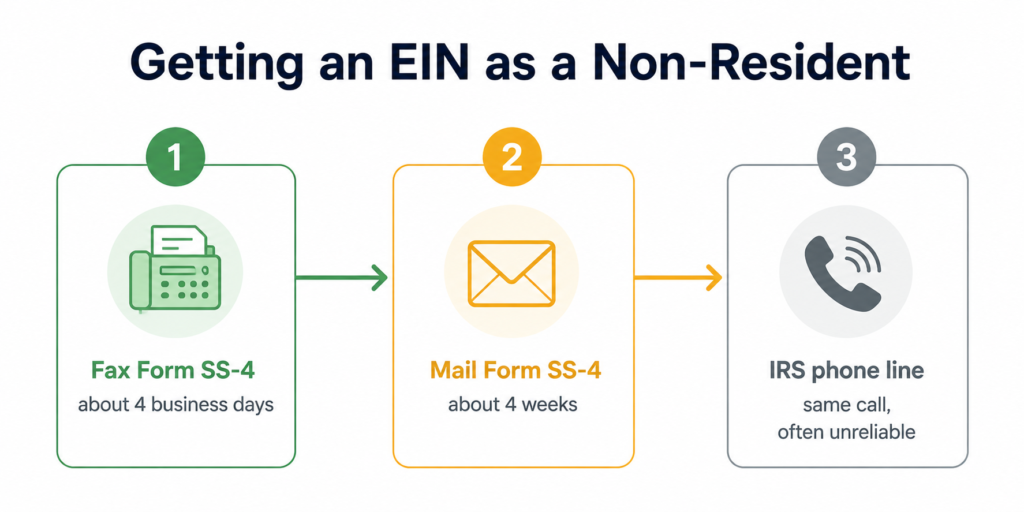
An EIN (your US business tax ID) is free directly from the IRS. The online application needs a US legal residence or principal place of business, so non-residents apply another way (Form SS-4 instructions):
– Fax Form SS-4 with a return fax number: generally within 4 business days
– Mail Form SS-4: approximately 4 weeks
– Phone (267-941-1099, not toll-free, Mon–Fri 6 a.m.–11 p.m. ET): EIN issued during the call, but congestion and disconnects are common — fax is more reliable
An ITIN is NOT required to form an LLC or get an EIN. Formation services charge only for the labor of obtaining your EIN — the IRS charges nothing.
Step 5: Open a US business bank account
Which account you can open depends on where you live, not your state. Mercury will not open accounts for founders living in the countries on its prohibited-countries list, which includes Nigeria, Pakistan, the Philippines, Bangladesh and Nepal (checked September 2026). Relay asks every beneficial owner for a physical US address (no PO boxes or virtual mailboxes) and expects the business to have an operating presence in the US, so a founder living abroad with a remote business should ask Relay in writing before applying. Wise Business is a common route where Mercury declines, subject to its own checks (approval is not guaranteed). Wise asks for an EIN document “filed and returned to you by the IRS”, most commonly the 147C letter or the SS-4, not just the number (Wise help). The complete per-country picture, including Stripe and PayPal, is in the banking and payments matrix linked above.
Step 6: Meet annual compliance obligations
Zero US tax does not mean zero filing. Per the IRS:
– Single-member LLC: Form 5472 attached to a pro-forma Form 1120 if reportable transactions exist. The Form 5472 instructions set a $25,000 penalty for failing to file, plus another $25,000 for each 30-day period the failure continues more than 90 days after IRS notice.
– Multi-member LLC: Form 1065 plus a Schedule K-1 per partner, due March 15, extendable to September 15.
Capital contributions and distributions between you and your LLC count as reportable transactions. Many founders miss this.
What Most State Comparison Guides Don’t Tell You
Most guides pick a winner on filing fees alone. The real differences are smaller — and some popular claims are simply wrong.
New Mexico: lowest cost, identical Stripe and banking access
New Mexico’s zero annual report is a genuine, permanent cost advantage. But some guides imply it affects your banking or payment options — it does not. Stripe asks where the business is registered; Mercury decides by where the founder lives. No state gives you better platform access than another.
Delaware: investor credibility has a real annual cost
Delaware’s annual LLC tax is now $400 and recurs every year whether or not your LLC earns a dollar. Its investor reputation matters mainly if you plan to raise US venture capital. Most non-resident founders running online businesses never need it.
Nevada: high fees, limited upside for non-residents
Guides often claim Nevada “does not share data with the IRS.” That is misleading. Federal obligations — Form 5472, Form 1065 — apply regardless of state. Nevada’s $425 formation and $350/year buy you no federal advantage at all.
Florida: “no income tax” is not the reason to pick it
Florida guides lead with no personal income tax. A non-resident with no US-source income gets the same result in Wyoming or New Mexico for less per year. And if the LLC elects to be taxed as a corporation, Florida’s corporate income tax (5.5% above a $50,000 exemption) applies. Pick Florida for Florida operations, not for tax.
Non-residents cannot elect S-corp status in any state
An S-corporation cannot have nonresident alien shareholders, per the IRS. Non-resident owners cannot make this election in any state. Your options are default treatment (disregarded entity or partnership) or a C-corp election. No state changes this rule.
Frequently Asked Questions
Does the state I choose affect my Stripe or Mercury access as a non-resident?
No. Stripe asks for the country where the business is registered, and every state gives the same answer: the US. Mercury decides by the founder’s country of residence. A Wyoming LLC and a Delaware LLC give identical access. See our banking and payments by country guide for the platform-by-platform breakdown.
Do I need to file a BOI report for my US LLC as a non-resident owner?
No. Under FinCEN’s final rule (issued 11 August 2026, effective 14 August 2026), entities created in the United States are exempt from Beneficial Ownership Information reporting. Only entities formed under foreign law and registered to do business in a US state must file.
What is the difference between an EIN and an ITIN, and which do I need first?
An EIN is the LLC’s 9-digit federal tax ID, required for US banking and Stripe. An ITIN is your personal tax ID as the owner. An ITIN is not required to form an LLC or obtain an EIN, but may be needed later to file a US personal return (Form 1040-NR).
How long does it take to get an EIN as a non-resident without an SSN?
Faxing Form SS-4 with a return fax number generally takes 4 business days. Mailing takes approximately 4 weeks. The IRS international phone line (267-941-1099, not toll-free) can issue an EIN during the call, but congestion and disconnects are common, so fax is the more reliable path. An EIN is free directly from the IRS.
Does New Mexico’s lack of an annual report mean lower banking credibility?
No. Banks and payment processors decide at the federal and platform level. A New Mexico LLC has identical access to a Wyoming or Delaware LLC. Skipping the annual report reduces your ongoing costs — it does not signal lower legitimacy.
What tax forms does a non-resident-owned single-member LLC need to file?
Form 5472 attached to a pro-forma Form 1120, annually, if reportable transactions exist — including capital contributions and distributions. Failure to file carries a $25,000 penalty, plus $25,000 for each 30-day period the failure continues more than 90 days after IRS notice. Zero US tax does not mean zero filing.
Can I elect S-corp status for my US LLC as a non-resident owner?
No. An S corporation cannot have nonresident alien shareholders. Non-residents are limited to default treatment (disregarded entity or partnership) or a C-corp election, in every state.
Is Wyoming or New Mexico better for a non-resident with no US income?
New Mexico has the lower Year-1 cost: $50 to form, no annual report. Wyoming costs $100 to form ($102.40 online) plus a $60 minimum annual report license tax. Both offer member privacy and identical federal treatment. Federal information filings (Form 5472 or Form 1065) still apply in either state.
Is Florida a good state for a non-resident LLC?
Only if the business will operate in Florida, such as an office, warehouse or staff there. Florida charges $125 to form ($100 filing plus $25 registered agent designation) and $138.75 for each annual report, due between January 1 and May 1, with a $400 late fee after May 1. For a remote business run from abroad, New Mexico ($0 annual fee) or Wyoming ($60 minimum) costs less each year, and Florida’s lack of personal income tax makes no difference to a non-resident with no US-source income.
What happens if my Florida LLC misses the annual report deadline?
After May 1, Florida adds a flat $400 late fee, so the report costs $538.75. If no report is filed by the third Friday of September, the LLC is administratively dissolved at close of business on the fourth Friday of September. In 2026 those dates are September 18 and September 25.
What is FBAR and does it apply to me as a non-resident owning a US LLC?
FBAR (FinCEN Form 114) requires US persons to report foreign financial accounts over $10,000. As a non-resident individual you are generally not a US person, so you personally do not file FBAR. But the LLC itself is a US entity — if the LLC holds foreign accounts exceeding $10,000, the LLC can have its own FBAR obligation. FBAR is separate from BOI reporting, which US-formed LLCs are currently exempt from.
Should I choose Wyoming or South Dakota for a non-resident LLC?
Wyoming is the stronger choice for most founders. Wyoming charges $100 to form and $60 per year minimum. South Dakota charges $150 to form ($165 on paper) and $65 for its annual report. Neither has a state income tax, but Wyoming has broader name recognition with US banks and payment processors.
Conclusion
For most non-residents, New Mexico wins on Year-1 cost: $50 to form, no annual report, no annual tax. Wyoming ($100 to form, $60/year minimum) is the stronger choice if bank recognition matters to you. Florida ($125 to form, $138.75 a year) earns its place only when the business actually operates there, and Delaware’s annual tax is now $400. State choice does not affect Stripe or bank eligibility — those follow your country, not your state. And federal filing obligations follow you everywhere: zero tax does not mean zero filing.
Bizstartz forms US LLCs for non-residents in Wyoming, Delaware, or New Mexico. The Basic plan starts at $199 + state fees; the Pro plan ($299 + state fees) includes EIN filing via Form SS-4 on your behalf. No SSN or travel required. Banks and payment platforms make their own approval decisions.
This article is for informational purposes only and is not legal or tax advice. Rules and fees change; verify with the official source or consult a licensed CPA or attorney for your specific situation.
Related Guides
- How to Start an LLC in Wyoming | Step-by-Step Guide
- How to Start an LLC in Delaware | Step-by-Step Guide
- How to Start an LLC in Nevada | Step-by-Step Guide
- How to Start an LLC in New Mexico
- LLC Prices by State 2026: Filing Fees vs. True All-In Cost for Non-Resident Founders
- doola Alternative for Non-Residents: What They Skip (2026)
- How to Form a US Company from Nepal (Step-by-Step Guide)
- How to Form a US LLC From India Without an SSN (2026): EIN, Stripe & FEMA
- How to Form a US LLC from Nigeria (2026): Stripe, Banking & Real Costs
- How to Form a US LLC from Pakistan (And Actually Get Paid)
- How to Start an Ecommerce Business in the USA From India
- How to Start an Ecommerce Business in the USA From Nepal
- How to Get an EIN Without an SSN (2026): A Non-Resident’s Guide
- How to Open a US Business Bank Account as a Non-Resident
- How Bizstartz Helped Khukuri House Expand into the US Market
- Helping Five OutBound Expand into the US with LLC, EIN, Banking & Stripe Setup
- How Easy Grow Solution Expanded to the US with Bizstartz
We have formed US companies for founders across South Asia, West Africa and the Gulf — see how Khukuri House expanded into the US, or start your own.
🎯 Ready to start? Claim your free consultation and we'll map out your US LLC formation strategy — EIN, banking, and the right state for your country.

Ready to start your company?
Bizstartz handles formation, EIN, banking and compliance for founders worldwide.