Opening a US business bank account for non-residents is very achievable in 2026 — and for most foreign founders it no longer requires a flight to the United States. The key is to use the right type of provider with the right documents, in the right order. This guide explains what banks and fintechs actually expect, which providers serve which founders, and what to do when an application is declined.
You’ll need a US company and an EIN first; if you haven’t formed yet, start with our US LLC guide.
Two Paths: Fintech vs Traditional Banks
There are two routes to a US business account, and they suit very different founders.
- Fintech / online banking platforms (such as Mercury, Brex, Wise or Payoneer) are built for remote founders. They onboard you online, with no US visit, and are the realistic option for most non-residents.
- Traditional banks (Chase, Bank of America and similar) usually require the owner to appear in person at a branch with US identification, which makes them impractical from abroad unless you are travelling to the US anyway.
For nearly everyone reading this, a fintech platform is the answer — so the rest of this guide focuses on the online route to a US business bank account for non-residents. The good news is that this route has matured enormously: what once required a US visit, a US address and a personal tax number can now be done from your laptop in your home country, provided your paperwork is in order.
“Is It a Real Bank Account?”
This is the first question most founders ask, and the answer deserves precision. Most of these platforms are not themselves banks — they are financial technology companies that hold your money at partner banks and give you a genuine US account number and routing number on that bank’s rails.
The practical consequences are what matter. Your account number works for ACH, domestic wires, Stripe payouts and Amazon disbursements exactly like a traditional business account, because it is running on a real bank’s infrastructure. Funds held at the partner bank are typically eligible for FDIC insurance on a pass-through basis. What you do not get is a branch, a relationship manager, or the ability to walk in and sort out a problem in person. For a remote software or e-commerce business, that trade is usually irrelevant. If your business genuinely needs cash deposits or in-person service, no amount of remote onboarding will substitute for a traditional bank.
Which Provider Suits Which Founder
These platforms are not interchangeable. They differ in who they will accept, what they are optimised for, and what they cost. Eligibility rules and pricing change frequently, so treat this as a map of the landscape and confirm the current position on each provider’s own site before applying.
| Provider | Best for | Watch out for |
|---|---|---|
| Mercury | Startups and software businesses wanting a primary US operating account with a clean dashboard | Maintains a list of countries and business types it will not serve — the single most common reason a well-prepared non-resident application fails |
| Wise Business | Receiving in several currencies and converting home cheaply | Positioned as a multi-currency account rather than a full operating bank account; some platforms treat it differently for payouts |
| Payoneer | Marketplace sellers — Amazon, Upwork, Fiverr — and founders in countries other platforms decline | Fee structure on conversions; more of a payments account than a bank account |
| Relay | Founders who want multiple sub-accounts for bookkeeping discipline | Narrower feature set than Mercury for financing and treasury |
| Brex | Funded startups with meaningful spend | Historically oriented to venture-backed companies; a small bootstrapped LLC may not be the target customer |
| Airwallex | Cross-border businesses collecting in many currencies | Eligibility varies by region; onboarding expectations can be heavier |
| Chase / Bank of America | Founders who will physically travel to the US | In-person visit, US identification and often a US address; not a remote option |
Most non-resident founders end up with two accounts rather than one: an operating account where revenue lands and expenses are paid, plus a multi-currency tool for converting and sending money home. That pairing is the standard stack, not a sign that something went wrong.
The Country Question — the Thing That Actually Decides This
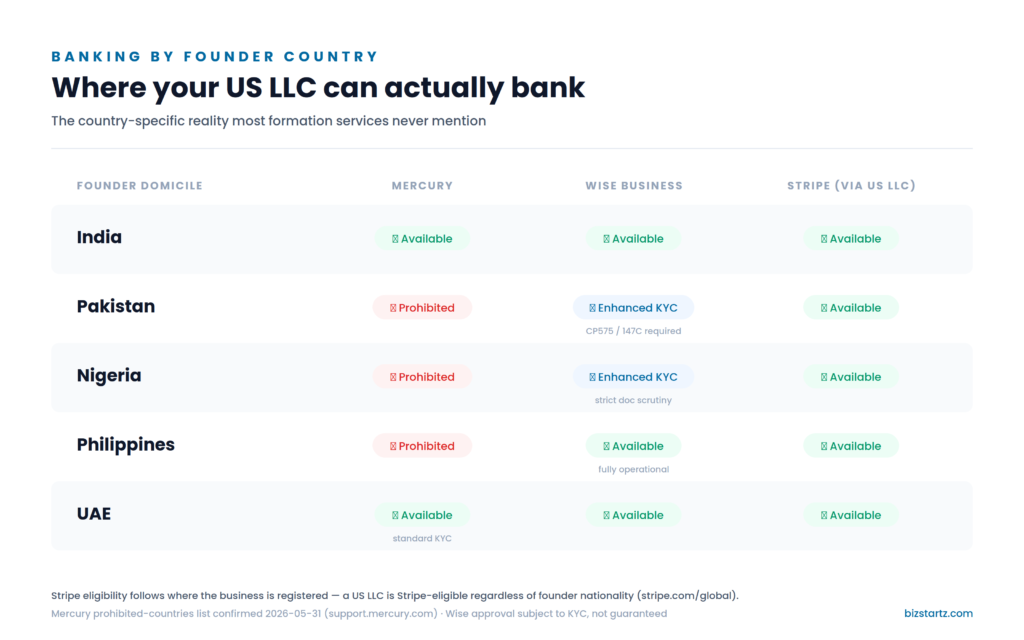
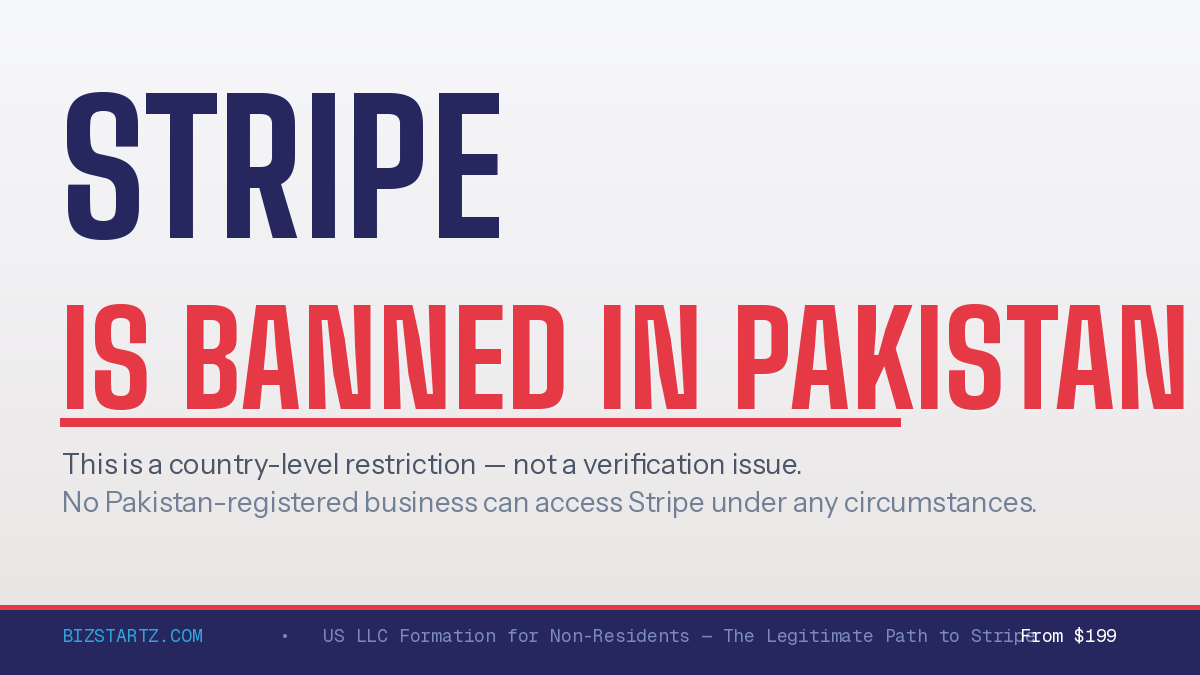
Founders spend days perfecting documents and then get declined for something no document can fix: their nationality or country of residence. Every one of these platforms maintains a list of restricted and prohibited jurisdictions driven by sanctions exposure and anti-money-laundering risk appetite, and those lists are updated without notice.
This is why “my friend in Dubai got approved at Mercury in a day, why was I declined?” has a boring answer that has nothing to do with your business. A founder in one country can be an instant approval and a founder in another an automatic decline, with identical LLCs, identical EINs and identical paperwork.
Two practical rules follow. First, check eligibility before you assemble an application — our breakdown of which US banks and payment platforms non-residents can actually use maps this by country and is the fastest way to avoid a wasted week. Second, when a platform’s list excludes you, that is a routing problem, not a verdict on your company. Payoneer and Wise have historically served a broader set of countries than the startup-focused platforms, which is why they are so often the answer for founders in South Asia and West Africa.
What You Need to Open the Account
Whichever route you take, prepare this paperwork in advance:
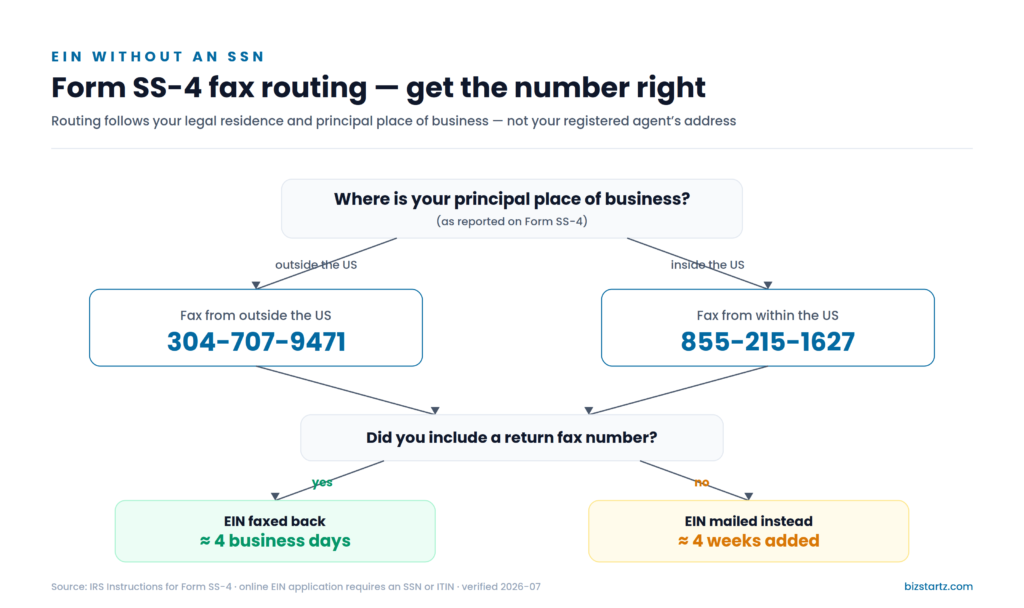
- Your EIN confirmation (the IRS CP 575 letter or the faxed approval). You cannot open a business account without it — see our guide to getting an EIN without an SSN;
- Formation documents — your Articles of Organization (or Certificate of Formation);
- An Operating Agreement showing ownership;
- A valid passport for each owner;
- Proof of address (a utility bill or bank statement, sometimes from your home country);
- A clear description of your business and expected transaction volumes.
Getting Proof of Address Right
Address proof causes more re-submissions than anything else on that list, because founders send whatever they have to hand. What compliance teams want is narrower than that: a document issued by a third party, in your own legal name, showing the address you entered on the application, dated within the last three months.
A utility bill, a bank statement or a government letter normally qualifies. A mobile phone top-up receipt, a screenshot of an app, a bill in a parent’s or spouse’s name, or a document with a different transliteration of your name normally does not. If your utilities are genuinely in a family member’s name — common in a great many countries — a recent bank statement in your own name is the reliable substitute. Send a full-page scan or clear photograph, not a crop, and leave the issuing letterhead and date visible.
Which Address Do You Put on the Application?
This trips up almost everyone. There are three addresses in play and they serve different purposes:
- Your registered agent’s address is for legal service of process. It is not your operating address, and using it as one — with nothing else to support it — is a recognised decline reason;
- A US business address from a mail-forwarding service can serve as your company’s US presence, provided it is a real street address rather than a PO box. Many platforms and banks reject PO boxes outright;
- Your own residential address abroad is what you give as the personal address of the owner, and it is entirely normal for it to be outside the US. Your address proof must match this one.
The consistent pattern that gets approved: a real US street address for the company, your genuine home address for you personally, and documents that match each.
Step-by-Step: Opening From Abroad
- Form your LLC and get your EIN. These are prerequisites for every provider.
- Choose a provider that accepts your country. Fintech eligibility varies by country and changes over time — check the current eligibility list before applying.
- Apply online. Upload your formation documents, EIN letter, passport and address proof.
- Pass identity and compliance checks. Providers run KYC (Know Your Customer) and anti-money-laundering screening; answer business-purpose questions clearly and consistently.
- Fund and start using the account. Once approved you receive account and routing numbers, often within a few business days.
- Connect your payment stack. Add the account to Stripe, PayPal or your marketplace as the payout destination, and only then start driving revenue through it.
The order matters more than it looks. Applying for a payment processor before the bank account exists means Stripe approves you with nowhere to send money, and changing payout details shortly after approval is itself a mild risk signal. Bank account first, processor second.
What These Accounts Cost
Most founder-focused fintech accounts have no monthly fee and no minimum balance, earning money instead on card interchange and currency conversion. Watch for these costs:
- Wire-transfer fees (incoming domestic wires are often free; international wires may carry a fee);
- Currency-conversion spreads when moving money to your home currency;
- Occasional card-issuance or expedited-shipping fees.
Compared with traditional banks — which often impose minimum balances and monthly maintenance charges — the fintech route is usually cheaper for a small remote business. The cost that actually matters to most non-residents is not the monthly fee but the conversion spread, because it applies to every dollar you eventually move home. A platform with no monthly fee and a poor exchange rate can be considerably more expensive than one that charges a small fee and converts near the mid-market rate. Work out the annual cost on your real payout volume rather than comparing headline fees.
A Note on Eligibility
Online banking platforms restrict or prohibit certain countries and business types for compliance reasons, and these lists are updated regularly. If one provider declines or does not serve your country, another may still accept you. Always confirm current eligibility on the provider’s own site rather than relying on older guides — what was open last year may be closed this year, and vice versa.
Business type matters as much as geography. Cryptocurrency trading, gambling, adult content, firearms, pharmaceuticals, money services and multi-level marketing sit on most prohibited lists regardless of where the owner lives. Dropshipping and general e-commerce are usually fine but attract closer scrutiny, so describe them precisely.
Receiving and Sending Money
Many non-resident founders pair a primary business account with a multi-currency tool such as Wise or Payoneer to receive client payments in different currencies and convert at competitive rates. Payment processors like Stripe and PayPal then connect to your US account to collect customer payments and pay out into it. A typical stack looks like: Stripe (collect) → US business account (hold) → Wise (convert and send home).
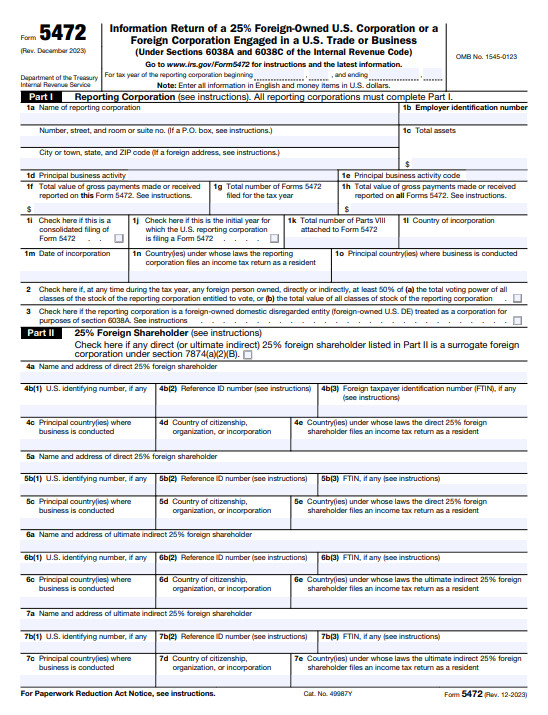
One warning on the last step. Moving money from your company to yourself is a distribution, and for a foreign-owned single-member LLC every such transfer is a reportable transaction on Form 5472. That is not a reason to avoid paying yourself — it is a reason to keep the transfers legible, on a regular schedule rather than as scattered ad-hoc withdrawals.
Personal vs Business Account — Keep Them Separate
Always open a dedicated business account in the LLC’s name, not your personal account. Mixing personal and business money (“commingling”) can undermine the liability protection your LLC is supposed to give you, and it makes your IRS filings — including Form 5472 for foreign-owned LLCs — much harder to prepare. Clean books start with a clean account.
How Long Approval Takes
For a clean application with all documents in order, fintech approval typically takes anywhere from a few minutes (automated) to a few business days (manual review). If a provider asks follow-up questions, answer quickly and precisely — slow or inconsistent replies are the main reason a straightforward application drags on for weeks. Have your formation documents, EIN letter and passport ready as PDFs before you start so you are never the bottleneck.
Five Tips to Get Approved the First Time
- Apply only after the EIN arrives. Trying to open a US business bank account for non-residents without an EIN is the number-one cause of rejection.
- Make every detail match. The legal name, address and ownership must be identical across your formation documents, EIN letter and application.
- Describe your business plainly. “Software development services for European clients” beats a vague “consulting.”
- Use a real, reachable email and phone. Compliance teams may contact you.
- Have a back-up provider in mind. If one declines for country or industry reasons, apply to another rather than arguing.
Common Reasons Applications Get Declined
- No EIN yet — the single most common blocker;
- Mismatched details between your formation documents, EIN letter and application;
- A restricted country or high-risk industry;
- Vague business descriptions that fail compliance review;
- A registered-agent address used as the “operating” address with no other supporting information;
- A PO box given as the business address;
- Address proof in someone else’s name or older than three months;
- Name transliteration differences between your passport and your formation documents.
What to Do When You Are Declined
A decline is common and usually recoverable, but the instinctive responses — reapplying immediately, or arguing — both make things worse. Work through it in order:
- Read what they actually said. Compliance decisions rarely come with detail, but the wording usually distinguishes “we do not serve your country” (final for that provider) from “we could not verify your information” (fixable).
- Do not reapply the same day. A second identical application shortly after a decline is a negative signal in itself. Fix the cause first.
- Check the fixable list. Name mismatch, stale or mismatched address proof, PO box, vague business description, missing operating agreement — these account for the large majority of recoverable declines.
- If it is a country restriction, change provider, not paperwork. No amount of documentation overrides a prohibited-jurisdiction list. Move to a platform that serves your country.
- Never use someone else’s identity to get approved. Putting a US friend or relative on the account as the apparent owner is bank fraud, it contradicts your EIN record, and it typically ends in a frozen account with the funds inside it.
If you have been declined more than once and cannot tell why, the problem is usually a mismatch you cannot see between three documents. That is the point at which a second pair of eyes on the paperwork saves weeks — it is a large part of what our bank account assistance actually does.
After You’re Approved: Keep the Account in Good Standing
Getting approved is the start, not the finish. Fintech and bank compliance teams continue to monitor accounts, and the fastest way to get frozen is to look inconsistent. Use the account only for genuine business activity, keep your incoming and outgoing payments roughly in line with the volumes you described at sign-up, and update the provider if your business model changes materially. If they ask for a follow-up document — an invoice, a contract, a refreshed proof of address — send it promptly.
Three specific patterns trigger reviews on otherwise healthy accounts: a sudden order-of-magnitude jump in volume with no explanation, regular round-number transfers to personal accounts that look like structuring, and a business that quietly changes into something on the prohibited list. All three are avoidable by telling the provider what is happening before it happens. Founders who treat compliance requests as routine keep their accounts open for years; founders who ignore them risk a sudden freeze that is far more disruptive than the original onboarding.
Also keep the company itself alive. A US bank account attached to an LLC that has been administratively dissolved for missing its state annual report is a problem waiting to surface at the next periodic review.
US Business Bank Account for Non-Residents: FAQ
Can I open one without visiting the US? Yes. Remote-friendly fintech platforms onboard non-residents entirely online — no branch visit required.
Do I need an SSN or ITIN? No. An EIN plus your passport and formation documents is the standard set; a personal US tax number is not required.
Is it a “real” bank account? Fintech platforms partner with US banks, so you get genuine US account and routing numbers that work with Stripe, PayPal, ACH and wires.
How much money do I need to start? Most founder accounts have no minimum balance, though keeping a small buffer helps your first transactions clear smoothly.
Can I open an account before forming the LLC? No. Every provider needs the entity and its EIN first.
Do I need a US address? A real US street address helps and is required by some providers. A PO box is generally not accepted; a mail-forwarding street address usually is.
Can I have more than one account? Yes, and most non-resident founders do — an operating account plus a multi-currency account for conversions.
What if my country is restricted everywhere I try? Marketplace-oriented platforms such as Payoneer serve a wider country list than startup-focused ones. Check by country before applying.
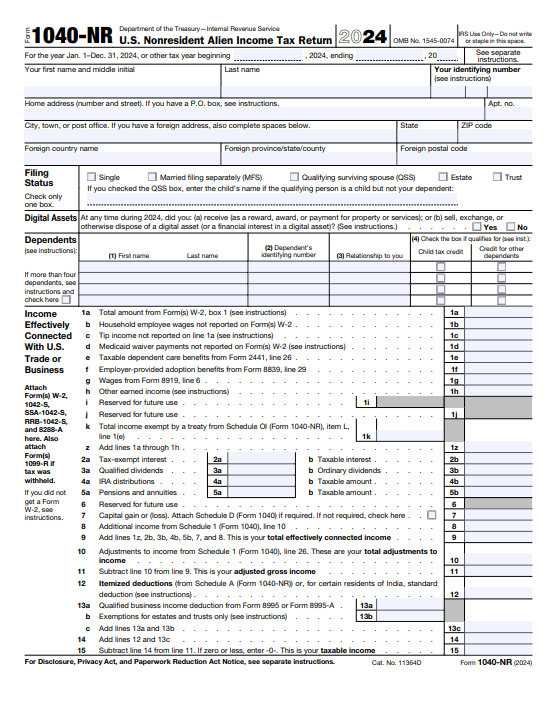
Will opening a US bank account make me liable for US tax? No. A bank account is not what creates US tax liability; where your income is effectively connected is the question that matters.
How long until I can accept payments? With the EIN in hand and clean documents, days rather than weeks — then a further day or two to connect Stripe or your marketplace.
Bottom Line
A US business bank account for non-residents is within reach: form your company, get your EIN, gather documents that match each other, and apply to a remote-friendly platform that actually serves your country. Check the country question before anything else, keep every detail consistent, and you’ll usually be approved within days. Begin with the right foundation in our US LLC guide.
Provider eligibility, country restrictions and fees change frequently and without notice. Confirm the current position on each provider’s own site before applying; nothing here is financial or legal advice.