Owning a US LLC does not by itself create a US income tax bill — but that is only half a sentence, and the other half is what decides your case. As a non-resident, the United States taxes you on two things: income that is effectively connected with a US trade or business, and certain US-source passive income. If your income is neither, you owe no US federal income tax. You still have forms to file, and missing one of them costs more than the tax would have.
This page explains what actually puts income in each bucket, what a tax treaty can and cannot do (and which of the countries our clients live in have no treaty at all), and which returns are due even when the tax is zero. Everything below is checked against irs.gov, with the source linked at each claim.
This is general information, not tax advice. Whether your particular income is effectively connected with a US trade or business is a facts-and-circumstances question, and the IRS publishes no checklist that settles it. Before you rely on any answer — including one you read here — have a CPA or enrolled agent who works in cross-border tax look at your actual facts.
In this guide: The two things the US taxes you on · What counts as a US trade or business · US-source passive income · Treaties, and who doesn’t have one · The forms due even at $0 tax · State obligations are separate · How to work out your own answer · How we help
The two things the US taxes a non-resident on
The IRS splits a non-resident’s income into two categories and taxes them in completely different ways.
| Category | How it’s taxed | Deductions? |
| Effectively Connected Income (ECI) US-source income connected with a US trade or business |
Graduated rates — “the same rates that apply to U.S. citizens and residents” | Yes, taxed on net income after allowable deductions |
| FDAP income fixed, determinable, annual or periodical US-source income not connected with a US trade or business |
Flat 30% (or a lower treaty rate, if you qualify), normally withheld at source by the payer | No — “no deductions are allowed against such income” |
Both quotes are from the IRS’s Taxation of nonresident aliens page (updated 17 February 2026, checked September 2026).
Notice what is not in either category: income from services you perform outside the United States for a company that happens to be registered in Wyoming or Delaware. The state of registration is not a category. That is why the LLC alone doesn’t create the tax.
What counts as a US trade or business
This is the question everything turns on, and it is also where most guides on this topic are wrong.
What irs.gov actually says
The IRS’s Effectively Connected Income page (updated 18 August 2026) puts it this way: “A foreign person generally must be engaged in a U.S. trade or business during the tax year to treat income received in that year as ECI,” and where that is true, “all United States (U.S.) source income connected with the conduct of that trade or business is considered Effectively Connected Income.”
The IRS publishes very little as a positive definition. What it does publish, clearly, is the personal-services rule and where service income comes from:
- “As a general rule, pay received for personal services performed within the U.S. is considered to be income effectively connected with a U.S. trade or business” (IRS: Pay for personal services performed, updated 18 August 2026).
- “The place, where the personal services are performed, generally determines the source of the personal service income, regardless of where the contract was made, or the place of payment, or the residence of the payer” (IRS: Source of income — personal service income, updated 6 February 2026).
Read those two together and you have the single most useful fact on this page for a founder working from Kathmandu, Lagos, Dhaka or Dubai. Where you physically sit when you do the work decides the source of your service income — not where your client is, not where the money lands, not where the LLC is registered. A US client paying a US LLC for design work you performed at your desk in Nepal is paying for foreign-source services.
The IRS also publishes one clear negative: “If your only U.S. business activity is trading in stocks, securities, or commodities (including hedging transactions) through a U.S. resident broker or other agent, you are NOT engaged in a trade or business in the U.S.” (ECI page, same date).
The “dependent agent” test you’ll read elsewhere is not an IRS rule
Search this topic and you will find the same two-part test repeated on dozens of sites, including, until this update, on ours: that you are engaged in a US trade or business only if you have a dependent agent physically in the US who is a material contributor to the income.
We could not find that test anywhere on irs.gov, and we looked for it specifically. “Dependent agent” is a tax treaty concept — it belongs to the permanent-establishment article of a treaty, not to US domestic law. Presenting it as the domestic rule is a real problem for two reasons: it is narrower than the domestic rule, so it makes people feel safer than they are; and it is unavailable to anyone whose country has no treaty with the US, which includes several of the countries we work in most (see the treaty table below).
The domestic definition lives in Internal Revenue Code §864(b), which says the term “trade or business within the United States” includes the performance of personal services within the United States and then lists exceptions. It is an inclusive definition with carve-outs, not a two-box test — which is exactly why the honest answer for a borderline case is “a cross-border CPA has to look at your facts”, not a flowchart.
Two examples, and what actually decides them
- You live in Nepal, own a Wyoming single-member LLC, and write software for US clients from Kathmandu. No US office, no US staff, nobody in the US doing the work. Your service income is sourced where you perform it, so it is foreign-source. The facts point strongly away from a US trade or business, and away from ECI. You still have the Form 5472 filing.
- Same LLC, but you spend two months a year working from a co-working space in Austin, and a contractor in Florida handles client delivery while you sleep. Now services are being performed inside the United States — by you for part of the year, and by someone acting for the business all year. This is the case where a general answer is worthless. Get it reviewed before you file.
What moved the second example was not the state of registration or the bank. It was the physical location of the work.
US-source passive income: the 30% bucket
The second bucket catches people who assumed “no US trade or business” means “no US tax”. FDAP income is US-source passive income — the IRS’s FDAP page (updated 23 July 2026) defines it broadly as all income except gains from property sales and specifically excluded items, and it is taxed on the gross amount at 30% with no deductions and no netting.
Two consequences worth knowing before you build a business model on it:
- The tax is normally collected by withholding at source. The payer holds it back and remits it; you don’t get the choice of filing later and arguing.
- Because there are no deductions, the 30% is charged on revenue, not profit. Rent from a US property, for example, can be taxed on the gross rent even in a year when the property lost money. There is an election under Internal Revenue Code §871(d) to treat income from US real property held for the production of income as effectively connected instead, which allows deductions and graduated rates — but it commits you to filing Form 1040-NR for that year and every year after until it is revoked (IRS: Nonresident aliens — real property located in the U.S.). That election is a CPA conversation, not a blog decision.
Tax treaties: what they do, and who doesn’t have one
This is the part of this article we most needed to fix. The previous version told readers that “more than 65 countries” have treaties with the US and that a treaty may give them “more comfort” on US tax. Neither the count nor the comfort was sourced, and for a large share of our readers a treaty simply does not exist.
Here is the verified position for the countries our clients most often write from, checked against the IRS’s United States income tax treaties — A to Z list (page updated 3 January 2026, checked 18 September 2026):
| Country of residence | US income tax treaty listed by the IRS? |
| Bangladesh | Yes |
| India | Yes |
| Pakistan | Yes |
| Philippines | Yes |
| Sri Lanka | Yes |
| Nepal | No — not on the IRS list |
| Nigeria | No — not on the IRS list |
| United Arab Emirates | No — not on the IRS list |
| Brazil | No — not on the IRS list |
If you live in one of the four countries in the lower half of that table, there is no treaty position for you to take. Any advice that routes you through a “permanent establishment” analysis does not apply to your situation, and a page that tells you otherwise is guessing. Your answer comes entirely from the domestic rules above.
We are deliberately not telling you what any treaty does to your tax. A treaty benefit is not a general shield; it is a specific article of a specific treaty applied to a specific type of income, and the articles differ country by country. Read the treaty text linked from the IRS page, then have it applied by someone who does this for a living.
A treaty claim is a position you file, not a status you have
Two practical conditions catch people out even when a treaty does exist:
- Form W-8BEN and a taxpayer number. You give Form W-8BEN to the US payer, not to the IRS. Its instructions (Rev. October 2021) require an SSN or ITIN to claim treaty benefits, with a narrow exception for dividends and interest on actively traded securities and mutual fund dividends. Line 6a asks for the foreign tax identifying number issued by your country of residence, and line 10 requires you to name the treaty article you are relying on (Instructions for Form W-8BEN). For most non-resident LLC owners that means an ITIN has to exist first.
- Form 8833. Taxpayers use Form 8833 “to make the treaty-based return position disclosure required by Internal Revenue Code section 6114” (About Form 8833, updated 11 August 2026). Taking a treaty position quietly is not an option in the cases where disclosure is required.
The forms that are due even when the tax is zero
This is where non-resident owners actually get hurt. The tax is often nil. The information returns are not optional, and the penalty for skipping one dwarfs the tax you avoided.
Single-member LLC with a foreign owner: pro forma Form 1120 plus Form 5472
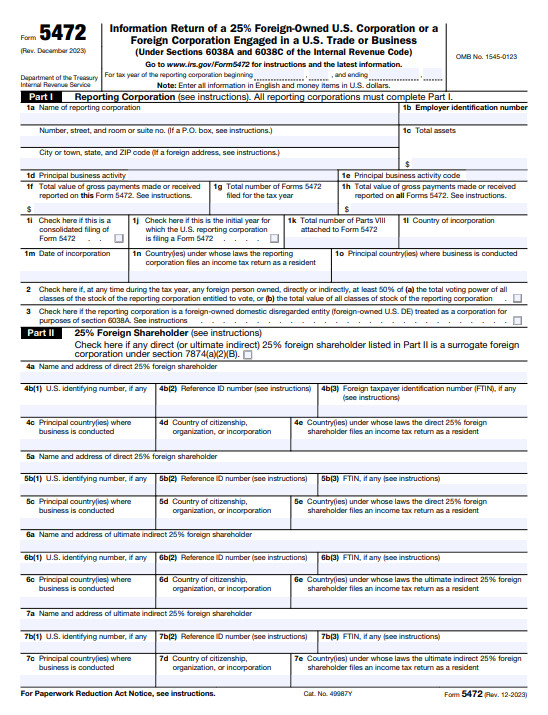
For income tax purposes, “an LLC with only one member is treated as an entity disregarded as separate from its owner, unless it files Form 8832 and affirmatively elects to be treated as a corporation” (IRS: Single member limited liability companies, updated 27 July 2026). Being disregarded for income tax does not make the reporting go away.
The Instructions for Form 5472 (Rev. December 2024) say a reporting corporation must file if it had a reportable transaction with a foreign or domestic related party, and that a reporting corporation includes “a 25% foreign-owned U.S. corporation (including a foreign-owned U.S. disregarded entity (DE))”. A foreign-owned US disregarded entity files “a pro forma Form 1120, U.S. Corporation Income Tax Return, with Form 5472 attached by the due date (including extensions)”, with “Foreign-owned U.S. DE” written across the top of the Form 1120 (Instructions for Form 5472).
Points that matter:
- Reportable transactions include the ordinary movements between you and your own company — money you put in, money you take out. A year with no customers can still be a year with reportable transactions.
- The package goes to a dedicated address, not with an ordinary return: fax to 855-887-7737, or post to Internal Revenue Service, 1973 Rulon White Blvd, M/S 6112, Attn: PIN Unit, Ogden, UT 84201 (same instructions).
- “A penalty of $25,000 will be assessed on any reporting corporation that fails to file Form 5472 when due,” and, if the failure continues for more than 90 days after notification by the IRS, a further $25,000 for each related party, for each 30-day period (or part of one) that the failure continues (same instructions). That is the number to hold in your head when you are deciding whether this filing is worth the effort.
The pro forma 1120 is a real return filed under real instructions. It is called “pro forma” because most of it is left blank — it exists to carry the 5472.
Multi-member LLC: Form 1065, Schedule K-1 and section 1446 withholding
An LLC with two or more members is classified as a partnership by default unless it files Form 8832. The partnership files Form 1065 and issues each member a Schedule K-1 for their share. Where the partnership has income effectively connected with a US trade or business that is allocable to a foreign partner, section 1446 withholding applies and is reported on Forms 8804 and 8805 — and the partnership must withhold whether or not the foreign partner has a US taxpayer number, though a number is needed for the partner to be credited properly (Instructions for Forms 8804, 8805 and 8813).
Form 1040-NR: your return, not the LLC’s
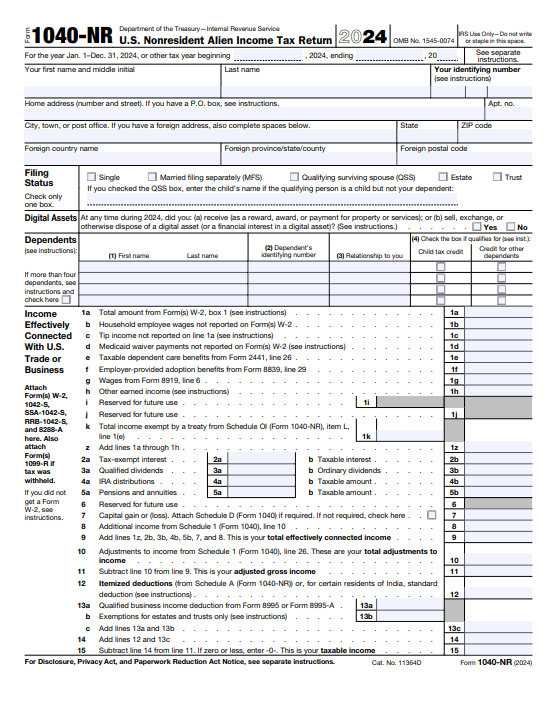
The 2025 Instructions for Form 1040-NR are blunter than most summaries of them. You must file if “you were a nonresident alien engaged in a trade or business in the United States during 2025” — and you must file even if “a. You have no income from a trade or business conducted in the United States, b. You have no U.S. source income, or c. Your income is exempt from U.S. tax under a tax treaty.” You must also file if you were not engaged in a US trade or business but had US-source income reportable on Schedule NEC and not all the US tax you owed was withheld from it (Instructions for Form 1040-NR (2025)).
Read condition (c) again. A treaty exemption is a reason to file, not a reason not to.
We work through that test, and which of the two filing deadlines applies to you, in our guide to Form 1040-NR for non-resident LLC owners.
Deadlines for the 2025 tax year: 15 April 2026 if you were an employee receiving wages subject to US income tax withholding; otherwise the 15th day of the 6th month after your tax year ends — 15 June 2026 for a calendar year (same instructions). If a 1040-NR is due from you, you generally need an ITIN before you can file it. Our US tax filing deadline guide lays the dates out in order.
State obligations are a separate question
Everything above is federal. The state that registered your LLC has its own, unrelated set of requirements: annual reports or franchise taxes, a registered agent that must stay appointed, and in some states a business licence. Those are due because the company exists, not because it earned anything, and a company that stops paying them can lose its good standing.
State income tax is a further question again, decided state by state on where the business has nexus — and it is not answered by whichever state you filed in. Our non-resident state cost breakdown compares what each popular state actually charges each year.
How to work out your own answer
Instead of a checklist that promises zero tax, here is the order a competent adviser will work through with you.
- Where is the income-producing work physically performed? Services are sourced where they are performed. This is usually the fact that decides the case.
- Is anyone performing work for the business inside the United States? You on a trip, a contractor, a warehouse, staff. If yes, stop and get advice before filing.
- Is any of your income US-source passive income? Rent, royalties, certain interest and dividends. That goes in the 30%-withheld bucket regardless of the answer to (1).
- Does your country of residence have a treaty? Check the IRS list, not a blog. If it doesn’t, the domestic rules are the whole answer.
- Which returns are due either way? For most readers of this page: a pro forma 1120 with Form 5472, every year, regardless of income.
- Have a cross-border CPA confirm it in writing before the first filing, and keep the reasoning on file. If the IRS asks in three years, your memory of a blog post is not a position.
How we help
We are a formation and compliance company, not a tax advisory firm, and we will not tell you whether your income is effectively connected — that is a licensed judgement about your facts. What we do handle is the annual reporting that trips up non-resident owners:
- Preparing and filing the pro forma Form 1120 with Form 5472 for foreign-owned single-member LLCs, to the correct address and deadline.
- Tracking which reportable transactions between you and your LLC need to appear on it.
- Keeping the state side alive — registered agent and annual report — so a federal filing isn’t undone by a lapsed company.
- Applying for an ITIN where one is genuinely needed, such as before a 1040-NR or a treaty claim on Form W-8BEN.
Where your situation needs a licensed cross-border CPA, we will say so rather than answer it ourselves. You can see the full scope on our services page, or read US tax filing requirements for international founders for the wider picture.
All IRS sources on this page were checked in September 2026. Tax rules change; check the linked page before you rely on it.
🎯 Ready to start? Claim your free consultation and we'll map out your US LLC formation strategy — EIN, banking, and the right state for your country.

Ready to start your company?
Bizstartz handles formation, EIN, banking and compliance for founders worldwide.