A foreign-owned multi-member LLC does not file Form 5472. By default it is a partnership, and it files Form 1065 with a Schedule K-1 for every partner, including in a year with no profit, no US tax and no money taken out.
The late penalty is charged per partner, per month. Whether section 1446 withholding at 37% also lands on you depends on one question, which is whether the partnership has effectively connected income. Most of the founders who find this page do not, and for them the withholding never arises and the Form 1065 still does.
You can read a dozen articles about foreign-owned US LLCs, several of them on this site, and never meet the form you actually have to file. Almost all of that writing is about Form 5472, because the single-member LLC is the structure that gets sold. Yours is a different structure, with a different return and a differently shaped penalty.
We are going to be careful about one thing throughout. We form US companies; we are not a US tax firm, and nothing here tells you what you owe. Every section ends in your own facts and a US CPA who has handled foreign partners before.
On partnership withholding in particular, competent help costs materially less than the penalty for getting it wrong, and that is not a sales line, the penalty arithmetic is in the sections below and you can do it yourself.
In this guide: Why Form 5472 is not your form · Nobody elected this · Who files what · The question that decides it · If there is no ECI · If there is ECI · What partners do with the K-1 · Electing corporate treatment · State filings · Questions for a CPA · Questions founders ask · Where to start
Start here: Form 5472 is almost certainly not your form
You have probably read a lot about Form 5472 and the $25,000 penalty. Nearly all of it was written for a different company than yours.
The Instructions for Form 5472 put the answer in one definition. It sits under Definitions, not under “Who Must File”, which is part of why so many summaries get it wrong. Verbatim:
“A reporting corporation is either: A 25% foreign-owned U.S. corporation (including a foreign-owned U.S. disregarded entity (DE)), or A foreign corporation engaged in a trade or business within the United States.”
Now place your company against that list. A US-state LLC with two or more members and no entity election is a partnership for federal tax purposes. It is not a 25% foreign-owned US corporation. It is not a disregarded entity, that is the single-member case. It is not a foreign corporation. It is on none of the three limbs.
The instructions do talk about partnerships. Look at what they say when they do, this is a rule about a partnership that a reporting corporation happens to own:
“If the related party transactions occur between a related party and a partnership that is, in whole or in part, owned by a reporting corporation, the reporting corporation reports only the percentage of the value of the transaction(s) equal to the percentage of its partnership interest.”
In that sentence the partnership is the thing being reported about. The filer is the corporation that owns a slice of it. That is the posture a partnership occupies in this form, and it is consistent with the definition: the obligation belongs to reporting corporations, and your LLC is not one while it is a partnership. (Form revision 12/2024; page last reviewed 30 April 2026; read 12 October 2026.)
So where does the confusion come from?
From the single-member rule, which is genuinely unusual and genuinely alarming. A foreign-owned single-member LLC has no income tax return of its own, so the IRS invented a wrapper for it.
From the same instructions: “While a foreign-owned U.S. DE has no income tax return filing requirement, it will now be required to file a pro forma Form 1120 with Form 5472 attached by the due date (including extensions) of that Form 1120.” Only the name, address and items B and E of that 1120 get completed.
That rule exists because a disregarded entity files nothing else. A partnership is not in that position: it has its own return. Our guide to Form 5472 for foreign-owned US LLCs and our page on forming a single-member LLC cover that path properly, and if you have a second LLC that is single-member, both still apply to it.
The one route by which your LLC does end up filing Form 5472
Read the definition again and note the first limb: a 25% foreign-owned U.S. corporation. The instructions define that as a corporation with “at least one direct or indirect 25% foreign shareholder at any time during the tax year.”
If you and your co-founders file Form 8832 and elect corporate treatment, your LLC becomes a US corporation for federal tax purposes, and two foreign founders at 50% each are both 25% foreign shareholders.
At that moment the LLC stops filing Form 1065 and starts filing Form 1120 with Form 5472 attached. The form you were worried about becomes yours by choosing it. More on that trade in the section on electing corporate treatment.
If you are reading this because you think you already missed a 5472 filing, read what happens when you have never filed Form 5472 first, but check your classification before you panic, because a partnership that never filed a 5472 was never required to.
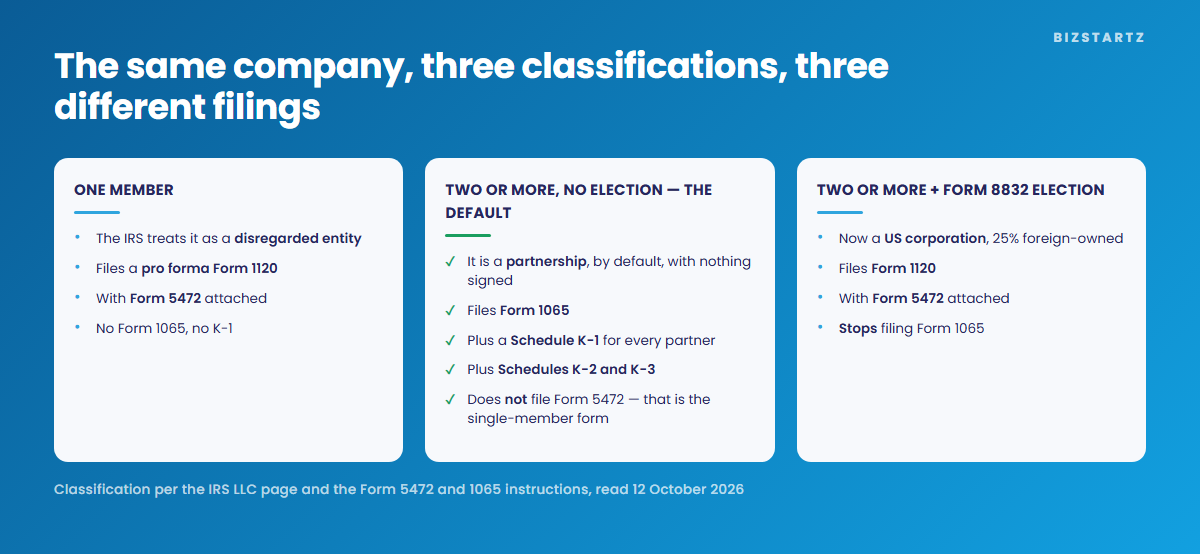
Nobody elected partnership treatment. It is what happens if you do nothing.
Founders regularly ask us when they chose to be taxed as a partnership. They did not choose. The IRS’s LLC classification page states that “a domestic LLC with at least two members is classified as a partnership for federal income tax purposes unless it files Form 8832 and affirmatively elects to be treated as a corporation” (page last reviewed 10 October 2026, read 12 October 2026).
Read the direction of travel there. Partnership status is the default; the election is what takes work. So if you signed an operating agreement, got an EIN and never filed anything beginning with “88”, you are a partnership, and the obligations below attached from day one whether or not anyone told you.
Two members changes the tax return and the reporting. It does not change the LLC itself: the same state formation, the same registered agent, the same annual report, the same liability shield. Our page on how many members an LLC can have and what changes at two covers the state-law side, and there is no federal cap on the number of foreign members.
What it does change, quietly, is that your operating agreement becomes a tax document. The withholding rules below are measured on income “allocable under section 704” to each foreign partner, and your allocations are whatever your agreement says they are. A handshake split that nobody wrote down is a problem that surfaces at filing time, not at argument time.
Who files what: the whole obligation on one table
Most of this article is about two of these rows. The table is near the top anyway, because the thing people most need from a page like this is a list of every form that can land on them, with the condition attached to each one.
| Form | Who files it | Due (calendar-year partnership) | Only if… |
|---|---|---|---|
| Form 1065, US Return of Partnership Income | The LLC | 15th day of the 3rd month after year end. For 2025 that was Monday 16 March 2026; for 2026 it is Monday 15 March 2027. | Always, unless the LLC “neither receives income nor incurs any expenditures treated as deductions or credits” |
| Schedule K-1 (Form 1065) | The LLC, one per partner, filed with the 1065 and furnished to the partner | With the 1065 | Always, for every partner |
| Schedules K-2 and K-3 | The LLC; K-3 furnished to each partner | With the 1065 | Where there are items relevant to partners’ international tax position — which foreign partners create |
| Form 7004 | The LLC | By the regular due date | You want the automatic extension, “generally 6 months” — for 2025 that moved the 1065 to Tuesday 15 September 2026 |
| Form 8804, Annual Return for Partnership Withholding Tax | The LLC | 15th day of the 3rd month after year end — the same day as the 1065 | The partnership has effectively connected gross income allocable to a foreign partner |
| Form 8805, Foreign Partner’s Information Statement | The LLC, one per foreign partner, attached to the 8804 and given to the partner | Furnished “by the due date of the partnership return (including extensions)” | Same trigger as the 8804 — and required “even if no IRC 1446 tax is paid” |
| Form 8813, Withholding Tax Payment Voucher | The LLC | 15th day of the 4th, 6th, 9th and 12th months of the tax year itself | There is section 1446 tax to pay during the year |
| Form 1042 / 1042-S | The LLC, as a withholding agent | See the 1042 instructions — we did not verify these dates | There are payments of US-source income to a foreign person subject to withholding under sections 1441–1443. A separate test from ECI |
| Form 1040-NR | Each foreign partner, personally | For the 2025 year: 15 April 2026 if wages were subject to US withholding; otherwise 15 June 2026 | The partner “was a nonresident alien engaged in a trade or business in the United States” |
| Form 5472 | Not the LLC, while it is a partnership | — | You elect corporate treatment on Form 8832, or you own a separate single-member LLC |
Sources, all read 12 October 2026: the 2025 Instructions for Form 1065; the Instructions for Forms 8804, 8805 and 8813 (rev. 01/2026); the Instructions for Form 7004 (rev. 12/2025); the Instructions for Schedules K-2 and K-3; and the 2025 Instructions for Form 1040-NR.
Where the 15th falls on a weekend or holiday the deadline moves to the next business day, which is why the 2025 Form 1065 landed on Monday 16 March 2026. Our 2026 US tax filing deadline guide has the wider calendar, note that it has no section 1446 row, so the 8804, 8805 and 8813 dates above are not on it.
One deadline worth circling if your books are not in the United States. The 8804 instructions say: “For partnerships that keep their records and books of account outside the United States and Puerto Rico, the due date is the 15th day of the 6th month following the close of the partnership’s tax year.”
For a Kathmandu or Lagos co-founder team doing their own bookkeeping at home, that is a real extension on Forms 8804 and 8805. We found no equivalent rule for Form 1065 in its instructions and we are not assuming one exists, confirm it with your CPA before you rely on a later 1065 date.
The question that decides everything else: is there effectively connected income?
Everything from here forks on one question, so answer it before you read another section. Does the partnership have income effectively connected with a US trade or business?
Get this right and the rest of the article sorts itself into two clean cases. Get it wrong in one direction and you spend a year terrified of a 37% withholding that was never yours. Get it wrong in the other and you miss a quarterly payment voucher.
What the IRS actually says the test is
From the IRS page on effectively connected income (page last reviewed 18 August 2026, read 12 October 2026), the sentence that governs most readers of this page:
“Foreign persons generally are engaged in a U.S. trade or business when personal services are performed in the U.S.”
Read the preposition. The test points at where the work is physically done. As our own ECI page puts it, what decides the source of services is where they are performed, not the client’s location, not where the payment lands, not the LLC’s state of registration.
The same page says a foreign person “generally must be engaged in a U.S. trade or business during the tax year” for income to be effectively connected, and that effectively connected income is “taxed at the graduated rates that apply to U.S. citizens and resident aliens” after allowable deductions.
What we will and will not tell you here
Our position on this is set out at length in whether a non-resident pays US tax on a US LLC, and it is narrower than the version circulating on other sites. That page makes a point worth repeating: the “dependent agent” test you will see quoted as though it were an IRS rule is not one.
It comes from the permanent-establishment article of a tax treaty, not from US domestic law. If someone has told you that you are safe because you have no US office and no dependent agent, ask them which US statute that test lives in.
What we will say plainly: two or three founders who each sit in their own country, do all the work there, have no US premises and send nobody to the United States are, on the IRS’s own sentence, a long way from “personal services performed in the U.S.”
What we will not say is that you have no ECI. That is a determination about your facts, and the facts that break it are mundane — one partner relocating, one partner on a working trip, a US contractor doing part of the delivery, a warehouse, a US-based employee. Our ECI page is explicit that anyone performing work for the business inside the United States, including you on a trip, is the point at which you need advice.
If this is unresolved for you, stop reading and resolve it. It is the single input that changes the answer.
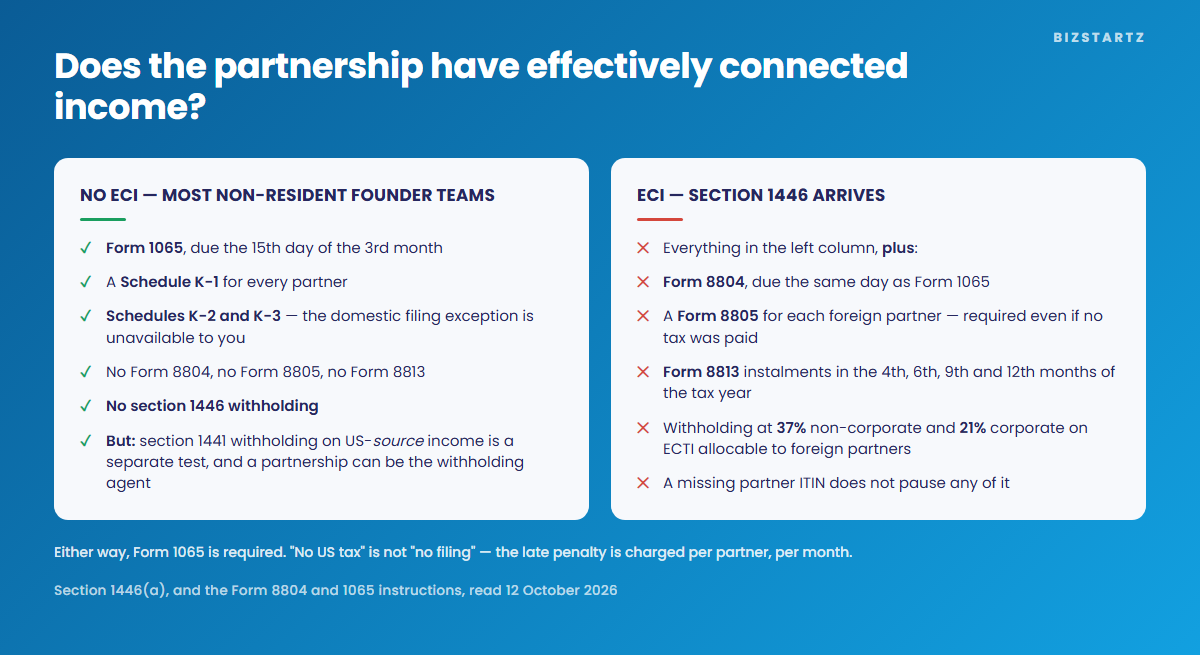
Case one: no effectively connected income, and you still file
This is the common case and it is where the expensive mistake lives. “We owe no US tax” is often true. “So we have nothing to file” does not follow from it, and the gap between those two sentences is where the penalty gets built — a penalty that is charged per partner, per month, and that has nothing to do with how much tax you owed.
The only exception to Form 1065, and it is narrower than you want it to be
The 2025 instructions, verbatim: “Except as provided below, every domestic partnership must file Form 1065, unless it neither receives income nor incurs any expenditures treated as deductions or credits for federal income tax purposes.”
Sit with the word “neither”. The exception is for a partnership that did nothing at all in both directions. It is not “we made no profit.” It is not “we took no distributions.” It is not “we had no US income.”
An LLC that collected a single invoice received income. An LLC that collected nothing but paid its registered agent incurred an expenditure. Either one, on its own, puts you back inside the filing requirement.
In practice, if your LLC has a bank account with movement in it, assume you file. If it genuinely did nothing in a year, formed in December, no account opened, no fees paid from the LLC, that is a conversation to have with your CPA rather than a conclusion to reach from a blog, because the burden of showing “neither” falls on you.
The penalty is per partner, per month, and it does not care that you owed nothing
Here is the mechanism, verbatim from the 2025 instructions for Form 1065:
“The penalty is $255 for each month or part of a month (for a maximum of 12 months) the failure continues, multiplied by the total number of persons who were partners in the partnership during any part of” the tax year.
Three things in that sentence do real damage, and they compound:
- “part of a month.” One day late is a full month.
- “multiplied by the total number of persons who were partners.” Not per return. Per partner. Four partners means four times the figure, every month.
- “during any part of” the tax year. A partner who joined in November and left in December counts.
A partnership return carries no tax of its own, it is an information return, so there is no “tax due” for the penalty to be a percentage of. That is precisely why it is a flat per-partner monthly charge instead, and why a year with zero profit is not a year with zero exposure.
Then the schedules. From the same instructions: “a $340 penalty may be imposed for each Schedule K-1 (and Schedule K-3, if applicable) for which a failure occurs.”
That covers failing to furnish on time and furnishing something incomplete or incorrect. Annual caps are “$4,098,500” for entities with gross receipts over $5,000,000 and “$1,366,000” at or below it, and if the failure is intentional, “each $340 penalty is increased to $680”, or 10% of the aggregate amount required to be reported, whichever is greater, with no cap at all.
Both the $255 and the $340 come from the 2025 instructions, read on 12 October 2026, and we are naming the year deliberately. These amounts are indexed for inflation, which is why you will find older pages quoting lower figures and newer ones quoting higher.
Anyone who prints a penalty figure without the tax year attached is handing you something that rots. Our deadline guide carries the same two figures for the same year.
Reasonable-cause relief exists and the instructions say not to attach an explanation with the return, you respond if and when a notice arrives. That is a conversation for a CPA, not a plan.
Schedules K-2 and K-3: the exception everyone else gets to use and you do not
These two schedules get left out of most write-ups aimed at non-resident founders, and they sit inside the same $340 penalty sentence as the K-1.
The instructions for Schedules K-2 and K-3 state that “any partnership required to file Form 1065 that has items relevant to the determination of the U.S. tax or certain withholding tax or reporting obligations of its partners under the international provisions of the Internal Revenue Code (the Code) must complete the relevant parts of Schedules K-2 and K-3.”
There is a domestic filing exception that lets ordinary US partnerships skip these. Read its second criterion: it requires that during the tax year, “all the direct partners in the domestic partnership are (a) individuals that are U.S. citizens”, continuing through resident aliens and specified domestic entities. The exception is defined by who the partners are. A partnership whose direct partners are foreign individuals cannot satisfy it.
So a K-3 goes to each of your partners alongside their K-1. On the instructions’ own wording the $340 applies “for each Schedule K-1 (and Schedule K-3, if applicable) for which a failure occurs,” so there is a second schedule per partner sitting inside that sentence. Ask your CPA how the two are counted for penalty purposes; we are reading you the words, not computing your exposure. (Read 12 October 2026; the instructions on that page are for the 2025 tax year.)
The withholding that is not section 1446, and that a no-ECI conclusion does not dispose of
This is the trap inside the trap. A reader who has correctly worked out “no ECI, so no section 1446” can still be wrong about this, because it runs on a different test.
Sections 1441 to 1443 impose withholding on US-source income paid to a foreign person. US-source is not the same question as effectively connected. From the IRS page on NRA withholding (page last reviewed 14 March 2026): the regime “requires 30% withholding on a payment of U.S. source income”, and “most types of U.S. source income received by a foreign person are subject to U.S. tax of 30%.” The reporting runs on Forms 1042 and 1042-S.
And who can be on the hook? From the IRS page on withholding agents (page last reviewed 21 March 2026): “A withholding agent may be an individual, corporation, partnership, trust, association, or any other entity.” Then the sentence to take seriously: “As a withholding agent, you are personally liable for any tax required to be withheld.” And even where the foreign person pays their own US tax, “you may still be held liable for interest and penalties for your failure to withhold.”
We are not going to work out whether anything your partnership does produces US-source income subject to this. That depends on the type of income and where it is sourced, it is genuinely technical, and it is the clearest example on this page of why a CPA is cheaper than a guess.
What we are telling you is that it exists, it names partnerships, and “we concluded we have no ECI” is not an answer to it. The W-8BEN and W-9 question is the documentation side of the same machinery, ask your CPA which certificate each of your partners should have on file with the partnership, and get it signed before you need it rather than after.
Case two: there is effectively connected income, and section 1446 arrives
If the partnership does have effectively connected income allocable to a foreign partner, a second set of obligations switches on, and the mechanics are unlike anything in the no-ECI case. The partnership itself becomes the taxpayer for a withholding charge measured on its partners’ shares.
Where 37% and 21% come from
The IRS partnership withholding page (page last reviewed 21 July 2026, read 12 October 2026) states that “under section 1446(a), a partnership (foreign or domestic) that has income effectively connected with a U.S. trade or business must pay a withholding tax on the effectively connected taxable income (ECTI) that is allocable to its foreign partners,” at 37% for non-corporate foreign partners and 21% for corporate foreign partners.
Where those two numbers come from matters more than the numbers. Section 1446(b)(2) does not contain a percentage. It defines the rate as “the highest rate of tax specified in section 1” for non-corporate foreign partners and “the highest rate of tax specified in section 11(b)” for corporate ones. The IRS page says the same thing in plainer words: “in case of foreign partners that are not corporations, the rate is the highest rate of tax specified in IRC 1.”
So 37% and 21% are the current values of a cross-reference, not figures written into section 1446. Check the IRS page on the day you act rather than trusting a percentage you read in an article, including this one.
No distribution is not a defence, and the statute is where you can see that
Founders assume that if no cash leaves the LLC, nothing is withheld. It is a reasonable assumption, that is how most withholding people have met before works — and you can disprove it from the statutory text in a single word.
Section 1446(a) applies where “a partnership has effectively connected taxable income for any taxable year, and any portion of such income is allocable under section 704 to a foreign partner.” Section 1446(b)(1) then sets the tax at “the applicable percentage of the effectively connected taxable income of the partnership which is allocable under section 704 to foreign partners.”
The operative word is allocable. A section 704 allocation happens in the partnership’s books when income is earned and split according to the agreement. It does not require a dollar to move.
The word “distribution” does not appear in subsection (a) or (b) at all. We read the section in two places on 12 October 2026 and they agree word for word: the US Code as published by the Government Publishing Office (2023 edition) and Cornell’s Legal Information Institute, which carries the current text. That they match is itself the check on both.
The IRS says the same thing from the other direction in the 8804 instructions: a Form 8805 is required for each partner on whose behalf section 1446 tax was paid, “regardless of whether the partnership made any distributions during its tax year.”
There is a reason the design works this way. Under section 1446(d)(1), “each foreign partner of a partnership shall be allowed a credit under section 33 for such partner’s share of the withholding tax paid by the partnership.”
The withholding is a prepayment of the partner’s own US tax, credited on their return. It is not a separate tax, and it is not optional because the partners agreed to reinvest.
Forms 8804, 8805 and 8813, and when each one is due
All of the following is from the Instructions for Forms 8804, 8805 and 8813, revision 01/2026, page last reviewed 30 April 2026, read 12 October 2026.
Who files. “Every partnership (other than a publicly traded partnership (PTP)) that has effectively connected gross income allocable to a foreign partner must file a Form 8804, regardless of whether it had ECTI allocable to a foreign partner.” And: the partnership “must file these forms even if the partnership has no withholding tax liability under section 1446.”
Read that trigger carefully, because it is finer than most summaries make it. The trigger is effectively connected gross income allocable to a foreign partner. Gross income with no taxable income left after expenses still means an 8804. No effectively connected income at all means no 8804 — which is the no-ECI case above.
Form 8804 and the 8805s are due the same day as the 1065: “generally, file these forms on or before the 15th day of the 3rd month following the close of the partnership’s tax year.” Not a month later, which is what people assume by analogy with the Form 1120 group. For a calendar-year 2025 partnership that was the same Monday 16 March 2026 as the Form 1065.
Each foreign partner gets their 8805 “by the due date of the partnership return (including extensions)”, and, from the IRS withholding page, the partnership “must provide the foreign partners with a copy of Form 8805 even if no IRC 1446 tax is paid by the partnership.” A zero is still a statement you have to hand over.
Form 8813 is the part that surprises people. The installments are due “on or before the 15th day of the 4th, 6th, 9th, and 12th months of the partnership’s tax year”, during the year the income is being earned, not after it is counted. A calendar-year partnership that discovers in February that last year produced ECI has already missed four payment dates.
Extensions. Form 7004 can be used “to request an extension of time to file Form 8804”, and the automatic extension period is “generally 6 months”. But: “filing a Form 7004 doesn’t extend the time for payment of tax”, which is also the general rule on the Form 7004 instructions, “Form 7004 does not extend the time to pay any tax due.” An extension buys you paperwork time and nothing else.
Penalties. A late Form 8804 “can generally be subject to a penalty of 5% (0.05) of the unpaid tax for each month or part of a month the return is late”, capped at 25% of the unpaid tax, with a minimum penalty if it is “filed more than 60 days late”, and reasonable-cause relief available.
For the 8805: “a penalty can be imposed for each failure to furnish Form 8805 to the recipient when due.” We did not find a dollar figure for that one in the instructions, so we are not going to print one.
One more trigger: a partner selling out
Section 1446 has a second limb that has nothing to do with the annual cycle above, and co-founder teams run into it more often than you would think — because co-founder teams change shape.
From the same IRS partnership withholding page: under section 1446(f), “the final regulations require any transferee to withhold a tax equal to 10% of the amount realized” on certain transfers of partnership interests. So if one of you buys out another, the buyer can be the one with a withholding obligation, measured on the amount realised rather than on anyone’s profit.
We did not research which transfers are caught or what exceptions exist, so treat this as a flag rather than a rule: before any change in the membership of a foreign-owned partnership, including a founder leaving, ask your CPA whether section 1446(f) applies to it. That is a cheap question asked before the transfer and an expensive one asked after.
A missing ITIN pauses nothing
Of everything on this page, this is the item that most often stops a foreign-owned partnership in the week before a deadline. The IRS has already answered it, and the answer is not the one founders expect.
The instructions say “a partnership must provide a U.S. TIN for each foreign partner” and that it “should notify any of its foreign partners without such a number of the necessity of obtaining a U.S. TIN.” Then, on Form 8805 line 1b:
“A partnership must pay the withholding tax for a foreign partner even if it doesn’t have a U.S. TIN for that partner.”
So the sequence most founders imagine — get the ITINs, then deal with the filings — runs the wrong way round. The partnership’s obligation does not wait for the partner’s paperwork.
And the paperwork is slow. The IRS’s own ITIN page (page last reviewed 28 October 2025) says to “allow 7 weeks for us to notify you about your ITIN application status,” and that “it can take 9-11 weeks if it’s tax season (January 15 to April 30) or if you applied from overseas.” Both conditions describe this audience at once: applying from overseas, during tax season. Our guides to who needs an ITIN and why ITIN processing takes weeks cover the application itself.
The practical consequence: if your partnership has any chance of effectively connected income, the ITIN applications start months before the filing season, not during it. The EIN is a separate and much faster thing — see getting an EIN without an SSN.
What each partner actually does with the Schedule K-1
The K-1 is not a filing your partner makes. It is a statement the partnership gives them, and it is also filed with the 1065. What they do next depends on the same ECI question.
From the 2025 Instructions for Form 1040-NR: “you must file Form 1040-NR if … you were a nonresident alien engaged in a trade or business in the United States during 2025.” And then, in the instructions’ own words:
“You must file even if: You have no income from a trade or business conducted in the United States, You have no U.S. source income, or Your income is exempt from U.S. tax under a tax treaty or any section of the Internal Revenue Code.”
Three conditions, each of which a founder would read as a reason not to file, listed by the IRS as reasons that do not excuse filing. “I owe nothing” and “I file nothing” are different propositions, and that is the sentence that proves it. The due dates are the 15th day of the 4th month “if you were an employee and received wages subject to U.S. income tax withholding” — 15 April 2026 for the 2025 year — and otherwise the 15th day of the 6th month, 15 June 2026. Our page on whether a non-resident LLC owner has to file Form 1040-NR works through the cases, and how to file taxes as a non-US resident covers the mechanics.
Where the partnership did withhold under section 1446, the partner’s Form 8805 is what they use to claim the section 33 credit on their 1040-NR. That is the whole purpose of handing it over, and it is why an 8805 the partner never receives costs them money rather than just costing the partnership a penalty.
The ordering problem is worth stating out loud: your partners cannot file a 1040-NR without an ITIN, and they cannot sensibly prepare one without their K-1. Both of those sit downstream of a return the partnership has not filed yet. Build your calendar backwards from 15 June, not forwards from whenever the books get closed. If the books are the bottleneck — and they usually are — our bookkeeping guide for LLC businesses is the place to start.
What changes if you elect corporate treatment on Form 8832
Some foreign-owned partnerships look at the list above and ask whether electing corporate treatment is simpler. It is a real option and it is a genuine trade, not an escape.
What it changes, on the sourcing we have: the LLC stops being a partnership for federal tax purposes, which ends Form 1065, the K-1s and the K-2/K-3 schedules, and ends section 1446 because section 1446 applies to partnerships.
What replaces them is a corporate returnm and, because two foreign founders at 50% each are both “25% foreign shareholders” under the Form 5472 instructions, Form 5472 becomes yours, with the $25,000 penalty that comes with it and a further $25,000 “if the failure continues for more than 90 days after notification by the IRS.”
You would also be moving from a structure where profits are taxed once in the partners’ hands to one where the company is a taxpayer in its own right. We are not going to model that for you; it depends on your numbers and your home country’s treatment. Our pages on an LLC taxed as a C-corp and what it does to your Form 5472 filing and on why a non-resident cannot own an S corp cover what each election does and does not do.
What we did not verify, and will not guess at: the Form 8832 timing and lock-in rules as they apply to a multi-member LLC, and what the election does to your tax position in the countries where the partners live. Both belong in the CPA conversation below.
The honest summary is that the election trades a filing you may not have known about for one you have definitely heard of. It changes which obligations you have rather than how many.
State filings are a separate track entirely
Nothing above touches your state. The Form 1065 obligation and your Wyoming or Delaware annual report are unrelated systems with unrelated deadlines, and satisfying one does nothing for the other. Partnership status also does not change your state obligations relative to a single-member LLC — the annual report and registered agent requirements are the same.
We are not going to re-explain them here. US LLC annual filings by state has what you must file and pay each year, state by state.
Questions to take to a US CPA
Take these in writing to someone who has handled foreign partners before — the phrase to use when you call is “foreign partners and section 1446.” A generalist who does small-business 1065s all day may never have filed an 8804.
- Given exactly where each partner performs their work, does this partnership have effectively connected income? Which facts in what I have told you would change that answer?
- Do we have effectively connected gross income allocable to a foreign partner — the Form 8804 trigger — even in a year with no taxable income?
- Which years are already open? Were we required to file Form 1065 for each of them, and what is the per-partner exposure as it stands today?
- Does the no-income-no-expenditure exception in the Form 1065 instructions apply to any of our years, and can we support that?
- Do we need Schedules K-2 and K-3, and which parts? Confirm we cannot use the domestic filing exception.
- Does the partnership make any payments of US-source income that bring sections 1441 to 1443 and Forms 1042 and 1042-S into play? We understand that is a separate test from ECI.
- If section 1446 applies, what are our Form 8813 installment dates for the current year, and have we already missed any?
- Do our books count as kept outside the United States and Puerto Rico for the 6th-month Form 8804 due date? Does anything equivalent apply to the Form 1065?
- Which partners need ITINs, when should each application go in, and what do we do about the ones who will not have a number by the filing date?
- Do the allocations in our operating agreement actually match how we split the money, and do they hold up for section 704 purposes?
- One of us may leave or be bought out. Does section 1446(f) withholding apply to that transfer, and who is responsible for it?
- Would electing corporate treatment on Form 8832 reduce our total annual compliance or just change its shape, given that it brings Form 5472 with it?
- What will you charge annually for all of the above, and what do you need from us and by when?
That last question is the one that puts the rest in proportion. Compare the quote with $255 per partner per month under the 2025 figure. For a three-partner LLC, one return that is six months late is $4,590 before anything else is counted. A CPA who has done this before is not the expensive option.
Questions foreign-owned partnerships ask
Do we file Form 5472 or Form 1065?
Form 1065, if you are a multi-member LLC that has made no entity election. The Form 5472 instructions define a reporting corporation as a 25% foreign-owned US corporation (including a foreign-owned US disregarded entity) or a foreign corporation engaged in a US trade or business. A partnership is none of those. If you elect corporate treatment on Form 8832, that reverses: Form 1120 with Form 5472, and no Form 1065.
We made no profit and took no money out. Do we still file?
Yes, on the face of the instructions. The only exception is for a partnership that “neither receives income nor incurs any expenditures treated as deductions or credits for federal income tax purposes.” Receiving income and incurring deductible expenditure are separate triggers, and either one is enough. Paying a registered agent is an expenditure.
What is the penalty for filing Form 1065 late?
Under the 2025 instructions, “$255 for each month or part of a month (for a maximum of 12 months) the failure continues,” multiplied by the number of people who were partners during any part of the tax year, with reasonable-cause relief available.
Separately, up to $340 for each Schedule K-1 or K-3 not furnished on time or furnished incorrectly. The figures are indexed for inflation, so check the instructions for your year rather than any article’s number, including ours.
Does the 37% withholding apply to us?
Only if the partnership has effectively connected taxable income allocable to a foreign partner. Where every partner’s services are performed outside the United States and nobody is performing work for the business inside the country, section 1446 generally does not arise — and the Form 1065 and the K-1s are still required. Confirm your own position; this is the one input that changes everything on this page.
We are reinvesting everything. Is there still withholding?
If section 1446 applies, yes. Section 1446(a) and (b)(1) measure the tax on effectively connected taxable income “allocable under section 704 to foreign partners,” and a section 704 allocation happens in the books whether or not cash moves. The IRS also requires a Form 8805 for each partner on whose behalf tax was paid “regardless of whether the partnership made any distributions during its tax year.”
Our partners do not have ITINs yet. Can we wait?
Not for the partnership’s obligations. The instructions for Form 8805 state that “a partnership must pay the withholding tax for a foreign partner even if it doesn’t have a U.S. TIN for that partner.” The IRS asks for 7 weeks to respond to an ITIN application, or 9 to 11 weeks during tax season or from overseas, so start them early rather than at filing time.
When is Form 8804 due?
The 15th day of the 3rd month following the close of the partnership’s tax year — the same day as Form 1065, not a month later. There is a later date, the 15th day of the 6th month, “for partnerships that keep their records and books of account outside the United States and Puerto Rico.” Form 7004 can request an extension to file, but it does not extend the time to pay.
Does a Schedule K-1 mean each partner has to file a US return?
The K-1 does not create the obligation; being engaged in a US trade or business does. The Form 1040-NR instructions require a return from a nonresident alien who “was a nonresident alien engaged in a trade or business in the United States,” and say you must file “even if … you have no U.S. source income, or your income is exempt from U.S. tax under a tax treaty.” Whether your partners are in that position is the same ECI question again.
Is there anything else we might be missing?
Two obligations that get overlooked. Schedules K-2 and K-3, which you cannot avoid with the domestic filing exception because that exception requires all direct partners to be US persons. And withholding under sections 1441 to 1443 on US-source payments to a foreign person, which is a separate test from ECI — the IRS says a withholding agent “may be an individual, corporation, partnership, trust, association, or any other entity” and is “personally liable for any tax required to be withheld.”
Where to start
In this order, because each step is cheap and each one narrows the next.
- Confirm your classification. Two or more members and no Form 8832 on file means partnership. If you are not sure whether an election was ever made, find out before anything else.
- Settle the ECI question against where each partner actually works, not where the clients are.
- List your open years. Every year since formation in which the LLC received income or incurred deductible expenditure is a year with a Form 1065 in it.
- Start the ITIN applications for any partner who will need one, counting back from the filing date with the IRS’s own 9-to-11-week overseas window in hand.
- Get a CPA quote using the questions above, and get it before the filing season rather than inside it.
Bizstartz forms US LLCs and C-corps for non-resident founders and handles the formation, EIN and bank application steps — see our services and pricing, and US tax filing requirements for international founders for the wider picture. The partnership return, the withholding analysis and the 8804 are a US CPA’s work, and on this topic that is not a formality we are passing along.
If you take one thing from this page: a year in which you owed the United States nothing is still a year in which you owed it a Form 1065 and a Schedule K-1 for every partner. The penalty for the second thing does not care about the first.
Checked on 12 October 2026. Every IRS page, set of form instructions and statutory section linked above was read on that date. The penalty amounts are from the 2025 Instructions for Form 1065 and are indexed for inflation; the 37% and 21% rates are the current values of cross-references to sections 1 and 11(b) rather than figures fixed in section 1446. Re-read the IRS page and the instructions for your own tax year on the day you file.
🎯 Ready to start? Claim your free consultation and we'll map out your US LLC formation strategy — EIN, banking, and the right state for your country.

Ready to start your company?
Bizstartz handles formation, EIN, banking and compliance for founders worldwide.