You can form a US LLC from the UAE, and the banking mostly works. But the main reason people form one, getting Stripe, does not apply to you. Stripe lists the United Arab Emirates in its main supported-country list, no preview tag and no extended-network caveat (stripe.com/global, checked 12 October 2026). A Dubai resident already has the thing most of this industry sells.
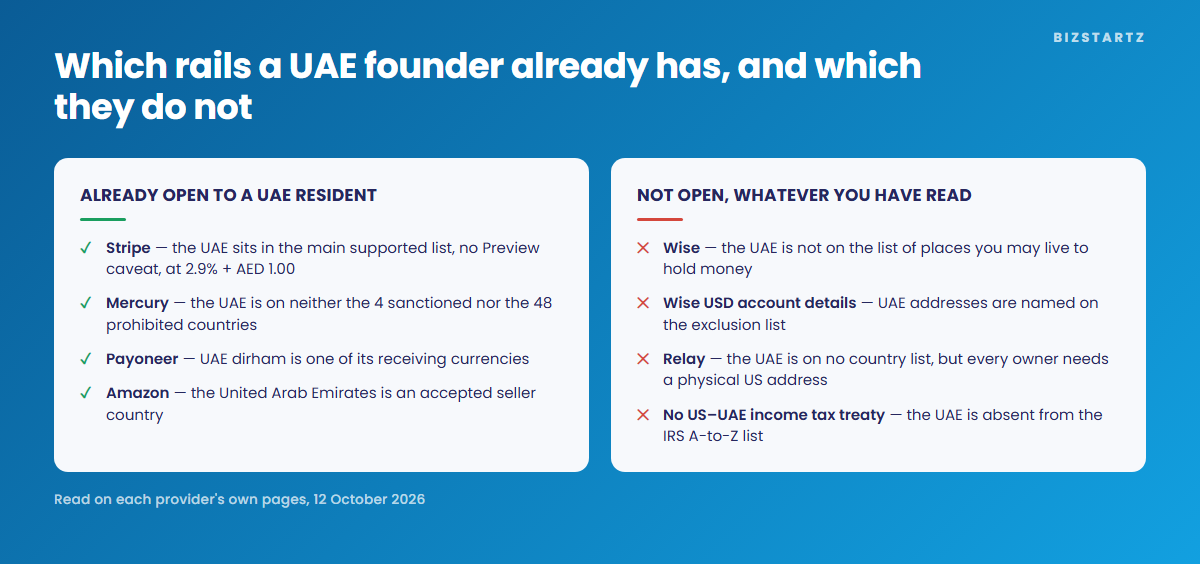
Most guides written for UAE founders sell a Wyoming LLC as an offshore trick. That pitch is built for someone in a country where the payment rails are shut. Yours are not. Stripe is live. Mercury does not prohibit the UAE. Payoneer gives you an AED receiving account. Amazon registers UAE sellers directly. Four of the doors a US LLC is supposed to open are already open.
Two things change the answer, and only two, and neither is the one you were sold.
The first is Wise, where the usual claim is backwards. The UAE is not on Wise’s list of places you can hold money, and it is on Wise’s list of addresses that cannot get USD account details. We had this wrong on one of our own pages until we checked it for this guide.
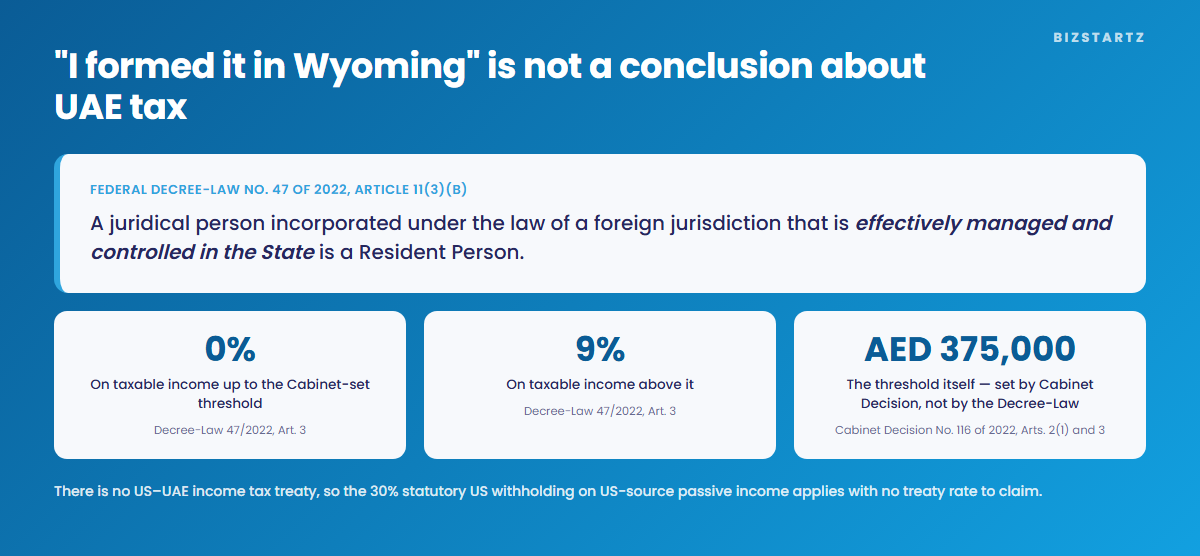
The second is UAE corporate tax, where “I formed it in Wyoming” is not a conclusion about what you owe in Dubai, the law reaches a foreign company that is “effectively managed and controlled in the State”, and that phrase is in the Decree-Law itself.
In this guide: Do you actually need one? · Who it genuinely helps · Banking from the UAE · UAE corporate tax · What it costs · The US side · Questions UAE founders ask · Who this suits
Do you actually need a US LLC from the UAE?
Work through these five before you pay anyone a formation fee. In the UAE, four of them already cover how you get paid, which is a better starting position than almost any country we have written this guide for.
Stripe is fully live in the UAE
The United Arab Emirates sits in the main “Global availability” list on stripe.com/global, under the line “Stripe is currently supported in the following countries/regions, with more to come.” No preview label, no invite-only, no extended network (checked 12 October 2026).
Stripe UAE’s published card pricing is 2.9% + AED 1.00 per successful domestic card transaction, +1% for international cards and +1% where currency conversion is required (Stripe UAE pricing, checked 12 October 2026).
Compare that with the numbers in our guide to opening a Stripe account as a non-US resident. If a US company was going to be how you got Stripe, you can stop reading at this heading.
Mercury does not prohibit the UAE
Mercury’s own page says it is “unable to open accounts for founders who live in, or businesses that operate or do business in, any of the countries and regions listed below”. It then names four sanctioned countries and regions and 48 prohibited ones.
The United Arab Emirates is on neither. In the prohibited list it would fall between Ukraine and Uzbekistan; both are there and neither is the UAE (Mercury: prohibited countries, read 12 October 2026, the full breakdown is in our Mercury prohibited countries list).
Payoneer gives you an AED receiving account
Payoneer’s own receiving-accounts page lists “UAE Dirham” among its local account-detail currencies, alongside USD, EUR, GBP, SGD, HKD, AUD, CAD, JPY and others, and again on its SWIFT list (Payoneer: receiving accounts, checked 12 October 2026). More on how this interacts with a US entity in Payoneer for a US LLC.
Amazon registers UAE sellers directly
“United Arab Emirates” appears on Amazon’s list of countries accepted for seller registration, between Ukraine and the United Kingdom (Seller Central: accepted countries, read 12 October 2026).
This is where our UAE answer diverges from our Malaysia and Thailand guides. In both of those, Amazon registration worked but we could not find the local currency on Amazon’s payout tables, and that gap was a real argument for a US entity.
Here, AED is a Payoneer receiving currency. We looked for the payout gap and did not find one, so we are not going to manufacture one. See Amazon seller account with a US LLC for when the entity does change something.
Wise is the exception, and it runs the opposite way to what you have read
Read this one twice. It is the single most misreported fact about UAE founders and US LLCs, and we were among the people getting it wrong.
Wise’s help page “where do I need to live to hold money with Wise” opens: “You can hold money in your account if you live in one of the following countries and territories:” and then lists 91 places. Bahrain is on it. Kuwait is on it. Qatar is on it.
Saudi Arabia is on it. The United Arab Emirates is not (Wise: where do I need to live to hold money, read 12 October 2026, twice, by two different methods, because an absence is easy to retrieve wrongly).
Separately, Wise publishes a list headed “You can’t get USD account details if your address is in:” — 32 entries, and the United Arab Emirates is one of them, sitting between Türkiye and Ukraine (Wise: can I get USD account details, read 12 October 2026).
Three different questions get collapsed into one here, so separate them:
| What you are asking | Answer on 12 October 2026 |
|---|---|
| Can a UAE resident hold money with Wise, personal or business, in their own name? | No. The UAE is not on the hold-money list. |
| Can a UAE resident send money with Wise? | Yes. “Wise Fintech Network L.L.C” is licensed by the Central Bank of the UAE and “is authorised to offer remittance via digital channels under the Exchange Business Regulation (Category 4)”. |
| Can you get USD account details on a UAE address? | No. The UAE is named on the exclusion list. |
| Can a US LLC hold a Wise Business account while its owner lives in the UAE? | Wise does not publish an answer. All three pages above key on the account’s address, and a US LLC’s address is in the US. Whether Wise’s verification looks through to your UAE residence is decided at verification. |
The distinction that matters: Wise excludes the UAE address, not the UAE founder. That is why the Wise route for UAE founders is usually described as running through the LLC’s US address throughout, and why it is a thing to test rather than a thing to plan around.
Our Wise Business account for a US LLC guide covers the application itself, step by step. The three Wise pages behind the table above were read on 12 October 2026, and Wise revises them without notice, so check the exclusion list on the day you apply rather than relying on any page that quotes it, including this one.
Notice that this is the one check in the section that argues for a US LLC rather than against it. We would rather point that out than bury it.
Who a US LLC genuinely helps from the UAE
Three cases survive that list. A fourth, the one that carries the argument in our Thailand and Malaysia guides, mostly does not survive in the UAE, and it is worth seeing why. None of the four is about tax.
A US client or platform contractually requires a US entity
Some US buyers will only contract with a US company, usually for procurement reasons rather than tax ones. If that is a written requirement from someone already paying you, it is a real reason to form one.
Ask them precisely what they need first. In our experience the actual requirement is very often a US bank account to pay into, or a particular tax form, not a US company.
The form question is the one worth resolving before you spend anything: a US entity signs a Form W-9, while you personally would sign a Form W-8BEN. If their system simply cannot accept a W-8, that is a concrete problem an LLC solves.
A US-only platform or payout rail that will not take a UAE entity
This one is real but it is specific, and it is on you to find it rather than on us to assume it. Some affiliate networks, ad networks and payout providers accept US entities only. If you have hit one, you have your answer, and the payment processors for US LLCs comparison covers what the entity unlocks.
If you have not hit one and are forming the company in case you do, you are paying an annual cost for an option you may never exercise. Price the option before you buy it.
You are taking US investment, in which case it is probably not an LLC
US investors generally expect a US entity. They also generally do not want an LLC. The standard ask is a Delaware C-corporation, because that is what institutional paper, option pools and preferred stock are built around.
So if investment is your reason, read forming in Delaware and an LLC taxed as a C-corp before you file anything, because the cheap Wyoming LLC that solves an invoicing problem is not the vehicle that takes a US seed round.
Holding dollars — the weakest version of this argument anywhere in this series
In our Thailand and Malaysia guides, “hold dollars instead of converting them” is the strongest honest case for a US LLC. Every local rail there ends in baht or ringgit, and converting out and back is a pure loss.
The UAE breaks that argument, because the dirham is pegged to the US dollar. Your conversion exposure is a spread, not a currency view. Whatever your bank charges you to move between AED and USD, you are not carrying the risk that makes dollar-holding valuable elsewhere.
We have deliberately not printed a peg rate here. The Central Bank of the UAE’s monetary policy page did not load for us on 12 October 2026, 403 on a direct read and 404 through a reader proxy, and a rate you plan around should come from the Central Bank rather than from us. The peg itself is not in dispute; the figure is simply not ours to assert.
So size it as arithmetic, not strategy. Multiply what you convert in a year by the spread you actually pay. If that number is smaller than a US entity’s annual running cost plus a UAE tax adviser’s fee, this argument loses, and in the UAE it usually does.
Banking a US LLC from the UAE: two open doors, and one that looks open
Do these checks before you spend anything. An LLC with no bank account cannot receive a cent, and the order you do things in decides how much you waste if an answer comes back no.
Mercury: the UAE is on neither list
Covered above. Not being on a list is not approval, Mercury still runs its own checks and declines for its own reasons, and country policies move. What you have is a good starting position. Ask in writing before you form anything; our guide to opening a US business bank account as a non-resident covers the application itself.
Relay: the country list is clear, and the address requirement is the problem
This is the part of the banking answer that catches UAE founders, precisely because the first half looks so easy.
Relay’s country page says it “cannot open accounts for business owners holding citizenship or residency in certain countries” and names 31. The United Arab Emirates is not among them, and that page adds that “Relay also permits businesses based internationally” (Relay: prohibited countries, read 12 October 2026).
Read on, though, because a different Relay page sets a requirement the country page never mentions. On its required-documents article, Relay asks each beneficial owner for a “Physical U.S. address (no PO boxes, no virtual mailboxes)” and asks an LLC for a “U.S. business address and phone number (physical address, no PO boxes)”.
For verification it will accept documents only “as long as the address is physical (no PO boxes, no virtual mail services)”. And if your legal business address is a registered agent’s, Relay says “you also provide an operational business address” where “actual business activity occurs”, and “that operational address cannot be another Registered Agent address.”
A beneficial owner there is “anyone who owns 25% or more of the business, directly or indirectly” or who “holds significant management responsibility” (Relay: required documents by entity type, read 12 October 2026).
Put those together and the practical answer for a Dubai-resident founder with no US presence is that Relay is not a third easy option. You clear every country list and then fail on an address you do not have. Two of Relay’s own pages pull in different directions here; where that happens we plan on the stricter one, and our Relay prohibited countries guide sets out both pages and why.
If you think your case is an exception, ask Relay before you form anything rather than after.
Wise: the address is the obstacle, not the passport
Also covered above, and worth repeating in the banking context because it changes the sequence. If your plan was LLC first, Wise second, invert it. Establish what Wise will actually give an LLC whose owner is UAE-resident before you have an entity to renew.
Our US payment and banking access by country table compares the providers side by side and has a UAE row.
UAE corporate tax: “I formed it in Wyoming” is not a conclusion about UAE tax
We form US companies. We are not UAE tax advisers, and nothing below tells you what you owe. It sets out what the Ministry of Finance publishes, with sources, so you can take the right questions to someone qualified, and it is explicit about where we ran out of sources.
First, the part that is not in dispute: there is no UAE personal income tax on salary. Nothing in this section claims otherwise. Corporate tax is a separate regime, introduced for financial years beginning on or after 1 June 2023, and the Ministry of Finance states plainly that “The Federal Decree-Law applies to financial years beginning on or after 1 June 2023” (UAE Ministry of Finance: corporate tax, read 12 October 2026).
The rule comes from the law; the number comes from somewhere else
This distinction matters, because almost every article on this subject gets the citation wrong, and we nearly did too.
Article 3 of Federal Decree-Law No. 47 of 2022 on the Taxation of Corporations and Businesses sets the rates as “0% (zero percent) on the portion of the Taxable Income not exceeding the amount specified in a decision issued by the Cabinet” and “9% (nine percent) on Taxable Income that exceeds the amount specified in a decision issued by the Cabinet” (Federal Decree-Law No. 47 of 2022, English text on mof.gov.ae, read 12 October 2026; the document is marked an unofficial translation).
The Decree-Law does not contain the threshold figure. It delegates it. So any guide that cites “AED 375,000, per Federal Decree-Law No. 47 of 2022” is citing a document that does not say that.
The figure is in the Cabinet Decision the law points to. Cabinet Decision No. 116 of 2022 on the annual Taxable Income subject to Corporate Tax, Article 2(1), subjects “the portion of Taxable Income of the Taxable Person not exceeding (375,000) three hundred seventy-five thousand dirhams” to “Corporate Tax at the rate of (0%) zero percent”, and Article 3 applies 9% to “the Taxable Income of a Taxable Person that exceeds the amount of (375,000) three hundred seventy-five thousand dirhams” (Cabinet Decision No. 116 of 2022, on mof.gov.ae, read 12 October 2026).
One honesty note on that figure. The Cabinet Decision is published as a scanned PDF, and we could only extract its text through one route; a direct read returned undecodable binary. We are quoting it because the amount appears four times across two articles in the issuer’s own document, in the doubled numeral-and-words form, on the Ministry of Finance’s own domain. If the threshold is load-bearing for your decision, confirm it with the Federal Tax Authority rather than with us.
That same Decision also carries an anti-fragmentation rule, for businesses artificially split to keep each part under the threshold. The Authority weighs whether there is a legitimate commercial purpose and whether the persons substantially carry on the same business. Two companies where one business sits is not a plan.
Why a Wyoming LLC run from Dubai is not automatically outside the net
Here is the clause the “0% forever” pages skip.
Article 11 of the Decree-Law defines who is a Resident Person. Clause 3 opens “A Resident Person is any of the following Persons:”, and paragraph (b) covers a juridical person incorporated or established under the law of a foreign jurisdiction that is “effectively managed and controlled in the State.”
Read that against what your structure actually is. A Wyoming LLC is a juridical person established under foreign law. If you are its only member and manager, and you make every decision from an apartment in Dubai Marina, the question of where it is effectively managed and controlled is a question of fact — not a question answered by the state on the certificate.
There is a second route in as well. Article 14 provides that a Non-Resident Person has a Permanent Establishment in the UAE where there is “a fixed or permanent place in the State through which the Business, or part thereof, is conducted”, or a person habitually exercising authority to conduct business in the UAE on its behalf, with Clause 2 listing examples including a place of management, a branch and an office, and Clause 3 excluding activities that are only preparatory or auxiliary.
We are not telling you that your LLC owes UAE corporate tax. Whether either route bites depends on facts we cannot see: how you operate, where decisions are made, what else you hold, and whether you are taxed as a natural person or through an entity. What we are telling you is that the question exists, that it is in the law rather than in commentary, and that anyone selling you a company who waves it away has not read Article 11.
Natural persons, and the AED 1,000,000 turnover line
If you are operating as an individual rather than through a UAE entity, there is a threshold before corporate tax touches you at all. Cabinet Decision No. 49 of 2023, Article 2(1), provides that businesses conducted by a natural person “shall be subject to Corporate Tax only where the total Turnover derived from such Businesses” … “exceeds AED 1,000,000 (one million United Arab Emirates dirhams) within a Gregorian calendar year”. Clause 2 excludes income from wages, personal investment and real estate investment from that calculation, whatever the amount (Cabinet Decision No. 49 of 2023, on mof.gov.ae, read 12 October 2026).
That wages exclusion is the cleanest confirmation available of the thing you already believed: salary is not caught.
Free zones: the 0% is conditional, and the condition has a name
People say “free zone means 0%” as though it were unconditional. The law says otherwise, and you can read it in the same Article 3.
Clause 2 sets the rates for a Qualifying Free Zone Person as 0% on Qualifying Income, and 9% on Taxable Income that is not Qualifying Income. So the relief attaches to a category of income, not to an address in a free zone.
What falls inside “Qualifying Income” is set by further decisions that we did not read for this guide, so we are not going to summarise them badly. Take it to an adviser as a question about your specific activities and your specific customers.
Small Business Relief: the rule, without a number
There is a Small Business Relief that lets a resident taxable person below a revenue threshold be treated as having no taxable income for a tax period. It is elective rather than automatic, and it excludes certain persons, including Qualifying Free Zone Persons.
We could not reach a primary source for the revenue figure, so we are not printing one. Every number we found came from accounting-firm commentary rather than from the Ministerial Decision itself; the Ministry of Finance path we tried returned 404, and the Federal Tax Authority’s decisions list is paginated in a way we could not read through. Commentary agreeing with itself is not a source.
So: the relief exists, the threshold is a revenue test, and the figure is one to get from the Federal Tax Authority or your adviser. We would rather leave a hole here than fill it with a number we cannot stand behind.
What it costs, on both sides of the ledger
Cost is the argument for a US LLC that actually survives contact with a UAE founder’s situation. It is also the one most often made with invented numbers, so here are only figures we could source.
The US side
| Item | Amount | Source |
|---|---|---|
| Wyoming formation | $100 — “Articles of Organization*/Continuance/Domestication …$100.00” | WY SOS fee schedule, effective 1 July 2026 |
| Wyoming annual report licence tax | “$60 or two-tenths of one mill on the dollar ($.0002) whichever is greater based on the company’s assets located and employed in the state of Wyoming” | WY SOS fee schedule |
| Delaware annual LLC tax | $400, due 1 June | 6 Del. C. § 18-1107(b) |
| EIN | $0 from the IRS | IRS |
| BOI report | $0 — no longer required for US-formed companies | FinCEN, final rule 11 August 2026 |
| Form 5472 late-filing penalty | $25,000, plus a further $25,000 if uncorrected 90 days after IRS notice | IRS Instructions for Form 5472 |
Wyoming figures from the Wyoming Secretary of State fee schedule, read 12 October 2026. More in what a Wyoming LLC costs and LLC prices by state.
Not priced here, on purpose, because we cannot price them honestly for your case: registered agent renewal, US tax preparation, the wire and conversion cost of moving dollars to the UAE, and a UAE tax adviser’s annual fee. That last one usually decides the whole question, and it is the only one you can get quoted for nothing this week.
The free-zone side, from the free zones’ own sites
This is where the cheap-entity argument lives, so the numbers need to come from the free zones rather than from formation agents. We used only figures published on a free zone’s own domain.
| Free zone | Published figure | What it is |
|---|---|---|
| Sharjah Media City (SHAMS) | “License Cost:AED 6,510”, “Total Cost:AED 8,885” | Cost-calculator sample, “Standard” package, “License Duration: 1 year”. Page states “The prices provided are estimates only.” |
| Meydan Free Zone | “Start Your Dubai Company Online from AED 12,500”; Fawri instant licence “AED 15,000” | “From” prices, not quotes |
Both read 12 October 2026, from shamsfz.ae and meydanfz.ae. So the published first-year range on issuers’ own sites runs roughly AED 6,500 to AED 15,000, depending on free zone and package.
Two caveats we will not let slide, because they are exactly where this comparison is usually rigged in the LLC’s favour:
- Those are first-year licence figures, not renewals. Neither free zone published a renewal price we could read. Do not let anyone — including us — set a first-year UAE figure against a US renewal figure and call it a comparison.
- We could not source IFZA or RAKEZ. IFZA publishes no price on its own site that we could reach, and every IFZA number in search results came from formation agents who do not agree with each other. RAKEZ’s setup pages returned “404 – PAGE NOT FOUND” for us on 12 October 2026. So treat the two-zone range above as a floor on the evidence, not a market survey.
Against that, a Wyoming LLC’s state renewal is $60 a year plus a registered agent. That gap is real and it is the honest core of the case. For a solo founder who needs a company to invoice through rather than a UAE visa or UAE market access, it is the argument that matters.
The part the cheap-entity pitch leaves out
- Form 5472 plus a pro forma Form 1120 every single year, whether or not the LLC owed a cent. See below, and Form 5472 for foreign-owned US LLCs.
- A registered agent and a state renewal, forever. Miss them and the company quietly falls out of good standing. What a registered agent is.
- No UAE visa, no Emirates ID, no UAE residency. A US LLC gives you none of these. A free-zone licence is very often bought precisely for the visa, and if that is any part of why you are comparing, the comparison is not like-for-like.
- A UAE bank will generally not open an account for a US LLC as readily as for a local entity, which is why the Mercury, Relay and Wise questions above come before the formation question.
- A UAE tax adviser’s annual fee, which the US-entity pitch never includes and which Article 11 makes hard to skip.
The US side: steps, filings, and the treaty the UAE does not have
- Confirm the bank and the platform first. It costs nothing and it is the step most likely to change your mind.
- Choose a state. Wyoming’s figures are in the table above; Delaware costs more to keep. We compare the rest in best states to file an LLC as a non-resident.
- Appoint a registered agent and keep the renewal paid.
- Get the EIN without an SSN. Step by step in how to get an EIN without an SSN.
- Open the US account, then apply to the platform you formed the company for.
Form 5472, every year, whether or not you owe anything
A single-member LLC owned by a non-US person is a foreign-owned US disregarded entity. The IRS instructions state it “will now be required to file a pro forma Form 1120, U.S. Corporation Income Tax Return, with Form 5472 attached” — at zero US tax and zero revenue. “A penalty of $25,000 will be assessed on any reporting corporation that fails to file Form 5472 when due” and in the manner prescribed, and “If the failure continues for more than 90 days after notification by the IRS” an “additional penalty of $25,000 will apply” (IRS Instructions for Form 5472, read 12 October 2026).
Put that beside the conversion spread you calculated earlier. A dormant LLC you stop thinking about is not free; it is a $25,000 exposure sitting in a drawer. If you are already behind, read what to do if you never filed Form 5472 rather than hoping. Broader picture in US tax filing requirements for international founders and how to file taxes as a non-US resident with a US business.
There is no US–UAE income tax treaty
The IRS’s own list of US income tax treaty partners runs Ukraine, Union of Soviet Socialist Republics, United Kingdom, United States Model, Uzbekistan. The United Arab Emirates is absent — it would fall between the USSR and United Kingdom entries, and it is not there (IRS: United States income tax treaties A to Z, checked 12 October 2026). This matches the UAE row in our guide to US tax as a non-resident LLC owner.
The absence has consequences, so do not file it away as trivia. Most US-source income paid to a foreign person is “subject to U.S. tax of 30%”, and a reduced rate “including exemption, may apply” only where “there is a tax treaty between the foreign person’s country of residence and the United States” (IRS: NRA withholding, read 12 October 2026).
Three practical effects. There is no reduced treaty rate to claim on a Form W-8BEN, so US-source passive income — US dividends, certain interest, royalties from US payers — faces the statutory 30% with nothing to claim it down to. There is no tie-breaker article and no agreed definition of where profit belongs, which is precisely what you would want when the UAE’s “effectively managed and controlled” test and the US position need reconciling. And advice written for a treaty country does not transfer to you.
Note what this does not mean. If your LLC’s income is not US-source and not effectively connected with a US trade or business, there is no US tax for a treaty to reduce in the first place. The treaty gap bites on US-source income and on reconciliation, not on a services business billing non-US clients.
One filing you can stop worrying about
Beneficial ownership reporting no longer applies to companies formed in the United States. FinCEN states that “U.S. companies are exempt from BOI reporting requirements and therefore, are no longer required to file BOI reports”, in its final rule of 11 August 2026 (FinCEN: beneficial ownership information, checked 12 October 2026). If a provider is still charging you for BOI filing on a US LLC, ask why.
Questions UAE founders ask
Do I need a US LLC to use Stripe in the UAE?
No. The United Arab Emirates is in Stripe’s main supported-country list with no preview or extended-network caveat, at 2.9% + AED 1.00 on domestic cards (checked 12 October 2026). A US Stripe account only starts to make sense if something other than access is driving it.
Can I open a US LLC from Dubai without going to the US?
Yes. You can register the company, get an EIN without an SSN, open a US business account with a provider that accepts UAE-resident owners, and file its US returns without visiting the United States. What you cannot do remotely is make the UAE side go away — Article 11 of the Decree-Law applies to you where you are.
Will Mercury open an account for someone living in the UAE?
The UAE is on neither Mercury’s sanctioned nor its prohibited list, as read on 12 October 2026. That is a good starting position, not an approval — Mercury runs its own checks and declines for its own reasons.
Can I use Wise as a UAE resident?
Partly, and the detail matters. You can send money: Wise Fintech Network L.L.C is licensed by the Central Bank of the UAE for remittance. You cannot hold money as a UAE resident — the UAE is not on Wise’s hold-money list. And you cannot get USD account details on a UAE address, because the UAE is named on Wise’s exclusion list for exactly that. All three read 12 October 2026. Whether Wise Business will onboard a US LLC whose owner lives in the UAE is not something Wise publishes; test it before you rely on it.
Is Relay an option for a UAE founder?
Not straightforwardly. The UAE is on none of Relay’s 31 prohibited countries, but Relay’s required-documents page asks every beneficial owner for a “Physical U.S. address (no PO boxes, no virtual mailboxes)” and the LLC for a physical US business address. A Dubai founder with no US presence passes the country test and fails the address test. Two Relay pages differ on this; we plan on the stricter one.
Does a US LLC get me out of UAE corporate tax?
That is not a question we will answer for you, and you should be wary of anyone who does. Article 11(3)(b) of Federal Decree-Law No. 47 of 2022 treats a juridical person incorporated under foreign law as a Resident Person where it is “effectively managed and controlled in the State”, and Article 14 provides separate permanent-establishment routes. Where your Wyoming LLC is effectively managed and controlled is a question of fact about how you actually operate. Take it to a UAE tax adviser.
What is the UAE corporate tax threshold?
The Decree-Law sets 0% below, and 9% above, an amount “specified in a decision issued by the Cabinet” — the law itself names no figure. Cabinet Decision No. 116 of 2022 sets that amount at “(375,000) three hundred seventy-five thousand dirhams”. We read that Decision on the Ministry of Finance’s own domain on 12 October 2026, but it is a scanned document we could extract only one way, so confirm it with the Federal Tax Authority if it is load-bearing for you.
What is the Small Business Relief revenue threshold?
We could not source the figure from a primary document, so we are not printing one. The relief exists, it is elective, it is tested on revenue, and it excludes Qualifying Free Zone Persons. Get the number from the Federal Tax Authority or your adviser, not from an article — including this one.
Is my free-zone company automatically taxed at 0%?
No. Article 3(2) of the Decree-Law gives a Qualifying Free Zone Person 0% on Qualifying Income and 9% on taxable income that is not Qualifying Income. The relief attaches to the income, not to the address. What counts as Qualifying Income is set by further decisions we did not read, so ask about your actual activities and customers.
Do I still pay UAE personal income tax on my salary?
There is no UAE personal income tax on salary, and nothing in this guide suggests otherwise. Cabinet Decision No. 49 of 2023 reinforces the point from the other direction: income from wages is excluded from the turnover test that brings a natural person’s business inside corporate tax.
Is there a US–UAE tax treaty?
No. The United Arab Emirates does not appear on the IRS’s list of US income tax treaty partners, checked 12 October 2026. The practical effect is that there is no reduced rate to claim against the 30% statutory withholding on US-source passive income, and no tie-breaker article when the US and UAE positions need reconciling.
Is a US LLC cheaper than a UAE free-zone licence?
On state fees alone, yes, and by a wide margin: $60 a year in Wyoming against a first-year free-zone licence published between about AED 6,500 and AED 15,000 on the two free zones’ own sites we could read. But the LLC adds a registered agent, US tax preparation, an annual Form 5472 carrying a $25,000 penalty for non-filing, and a UAE tax adviser you now need because of Article 11. And it gives you no visa and no Emirates ID. Run the whole total, not the headline.
Who this suits, and where to start
It can make sense if a paying US client or platform contractually requires a US entity, or you have hit a US-only payout rail that will not accept a UAE entity, or you are raising US investment and have already worked out that you probably need a Delaware C-corp rather than an LLC. In each of those you should have a UAE tax adviser’s annual fee quote in hand before you file anything.
It probably does not if you came for Stripe, which you already have; or for Mercury, which does not prohibit you; or for AED payouts, which Payoneer already does; or for Amazon, which registers you directly; or because you were told a Wyoming LLC changes what you owe in the UAE, which is a claim about the United States wearing a UAE costume.
The UAE is one of the few countries in this series where the infrastructure to get paid already exists at home. That is a good problem to have, and the right response to it is usually to keep your money.
Start with the checks that cost nothing, in this order. Confirm which platform or client actually requires a US entity, in writing. Ask Mercury whether it will take an owner resident in the UAE, and ask Wise what it will give a US LLC with a UAE-resident owner. Take the questions below to a UAE tax adviser and get an annual fee quote. Register the company last. Everything before it can be undone by walking away; that step cannot.
Questions to take to a UAE tax adviser
- If I own a US LLC that is disregarded for US federal tax purposes, is it “effectively managed and controlled in the State” under Article 11(3)(b) given how I actually operate — and what facts would change your answer?
- If it is a Resident Person, what does that mean in practice: registration, filing, and tax on worldwide income?
- If it is not a Resident Person, could it still have a Permanent Establishment here under Article 14, and does my home office count as “a fixed or permanent place in the State”?
- Am I better off inside the natural-person regime, given the AED 1,000,000 turnover test in Cabinet Decision No. 49 of 2023, or inside an entity?
- What is the current Small Business Relief revenue threshold, is it elective in my case, and would a US LLC in the structure disqualify me?
- If I hold a free-zone licence as well, does this LLC affect my Qualifying Free Zone Person status or my Qualifying Income?
- Given there is no US–UAE income tax treaty, how do we reconcile the UAE and US positions if both claim the profit, and what should I put on a Form W-8BEN?
- What records do I need to keep to support where the company is managed from?
- What will you charge me annually to handle this, and does that cost leave the LLC worth having?
Questions for the provider, before you form anything
- Mercury: will you open an account for an LLC whose sole owner is resident in the UAE?
- Relay: I have no physical US address for myself or the business. Can you open an account, or is that a decline?
- Wise: will Wise Business onboard a US LLC whose beneficial owner’s address is in the UAE, and can that account hold USD account details?
- PayPal: can a UAE account receive commercial card payments, or only send and request money?
- The client or platform that triggered this: do you need a US entity, or do you need a US bank account and a W-9?
If a US company does fit your case, Bizstartz forms US LLCs for non-resident founders and handles the EIN and bank application steps — see our services and pricing. The UAE side needs UAE professionals, and on Article 11 that is not a formality. If it does not fit, we would rather you kept the money.
Checked on 12 October 2026. Every provider list, fee schedule and government document linked above was read on that date. Mercury’s, Relay’s and Wise’s country lists are the ones most likely to have moved since, so re-read all three before you act.
🎯 Ready to start? Claim your free consultation and we'll map out your US LLC formation strategy — EIN, banking, and the right state for your country.

Ready to start your company?
Bizstartz handles formation, EIN, banking and compliance for founders worldwide.