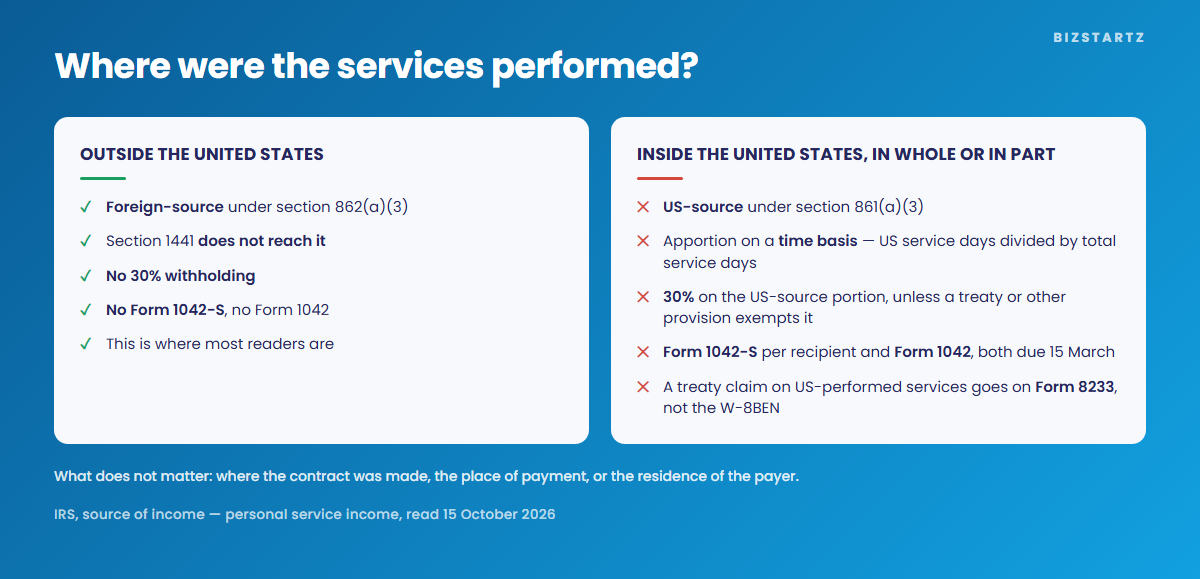
If your US LLC pays a developer in Nepal, a designer in Pakistan or a VA in the Philippines for work they do at home, you withhold nothing and you file no Form 1042-S.
US source income withholding only reaches income from sources within the United States, and the IRS says the source of a services payment is set by the place where the services are performed, not by where the contract was made, where the money was paid from, or where the payer lives.
The same sentence runs the other way with the same force: for the days your contractor works inside the United States, that slice of their pay is US-source, the 30% lands on it unless something exempts it, and your LLC is the one personally liable for the tax it failed to take.
That is the whole answer. What follows is the arithmetic, the forms, the statutory text behind every claim, and the payment types where the rule is not the services rule at all, royalties, software, interest, dividends and rent each run on their own test, and carrying the relief above into one of those is where this goes wrong.
One thing before we start. We form US companies. We are not a US tax firm, nothing here is tax advice, and every substantive section below ends in your own facts and a US CPA. What we can do, and what this page does, is show you the sentence in the IRS’s own material and the paragraph in the statute, so you can tell whether the advice you are getting matches them.
In this guide: The one sentence that decides it · Work done abroad: nothing is due · US-source or not · Work done in the US: the arithmetic · Why the 1099-NEC is the wrong form · Royalties and software · Interest on a loan from a member · Dividends · Forms 1042, 1042-S and 1042-T · Treaties, and who has none · The W-8 you collect · What we could not verify · Questions for a CPA · Questions readers ask · Where to start
The one sentence that decides it
Here is the sentence, from the IRS page on the source of personal service income:
“The place, where the personal services are performed, generally determines the source of the personal service income, regardless of where the contract was made, or the place of payment, or the residence of the payer.”
Read the list of things that make no difference. Where the contract was made. The place of payment. The residence of the payer. Those three items are the three reasons people believe they have a withholding problem. A Delaware-law contract, a wire from a Mercury account, a Wyoming LLC as the payer, the IRS has written all three off in one clause. (Page last reviewed 6 February 2026; read 15 October 2026.)
The statute puts the test in the same place. Section 861(a)(3) sources “compensation for labor or personal services performed in the United States” inside the US. Its mirror, section 862(a)(3), sources “compensation for labor or personal services performed without the United States” outside it. Both read in the US Code on 15 October 2026.
And then the withholding section itself. Section 1441(a) requires “all persons, in whatever capacity acting,” who have “the control, receipt, custody, disposal, or payment” of certain items of income to “deduct and withhold from such items a tax equal to 30 percent thereof”, but only where those items are “from sources within the United States.”
Put the two together and the relief is structural rather than discretionary. Section 862(a)(3) puts your contractor’s fee in foreign-source income. Section 1441 never reaches foreign-source income. You are not claiming an exemption; you are outside the section.
Work done abroad: nothing is withheld, and nothing is filed
Take the ordinary case. Your LLC is registered in Wyoming. You live in Lagos. Your developer lives in Kathmandu and has never been to the United States. You pay her $2,500 a month from a US bank account under a contract that names Delaware law.
Her services are performed in Nepal. Under section 862(a)(3) the income is foreign-source. Section 1441 applies only to US-source items. There is nothing to withhold.
And because there is nothing to withhold, there is nothing to file
This part gets skipped, and it is the part that stops people worrying. The filing obligation is not freestanding, it hangs off the withholding.
The Instructions for Form 1042-S require a withholding agent to “file an information return on Form 1042-S to report amounts paid during the preceding calendar year”, amounts subject to withholding.
And the Instructions for Form 1042 put the trigger for the annual return in these terms: a withholding agent who pays “a withholdable payment … or an amount subject to withholding” “must file an annual return for the preceding calendar year on Form 1042 unless an exception to filing applies,” and separately, you must file Form 1042 if “you are required to file or otherwise file Form(s) 1042-S for purposes of either chapter 3 or 4.”
So the chain runs: no US-source amount subject to withholding, therefore no Form 1042-S for that payment, therefore no Form 1042 off the back of it. Both sets of instructions read 15 October 2026.
Your LLC still deducts the payment as a business expense, still needs the invoice, and still needs the bookkeeping. Nothing here says the payment is invisible, it says the payment is not a withholdable one. If your books are the weak point, our bookkeeping guide for LLC businesses is the place to fix that.
Does Wise, Payoneer or Deel change this?
Not the sourcing, and that is not our opinion, it is the IRS clause quoted above. A payment rail is a “place of payment”, which the IRS has already named as something that does not determine the source. Section 861(a)(3) and section 862(a)(3) both turn on where the services were performed. Neither mentions how the money travelled.
Two honest caveats. First, if the income is US-source, routing it through a platform does not mean the platform handled the withholding, check what your agreement with it actually says, because the IRS definition of a withholding agent turns on who has “control, receipt, custody, disposal, or payment” of the income. Second, we read no platform’s terms for this article, so we cannot tell you whether any particular one takes that role on. We are telling you what does not change, not what does.
Should you still collect a W-8BEN?
We think yes, and we are going to be careful about why. For a payment that is purely foreign-source we did not find a rule requiring you to hold a certificate, and we are not going to invent one. But the form is free and short, and it is the document that evidences the one fact your whole position rests on: that the payee is a foreign person.
Having it on file before a question arises is cheap. Chasing it from a contractor you stopped working with two years ago is not. More on what the form does and does not do below.
US-source or not: a table you can hold your own payments against
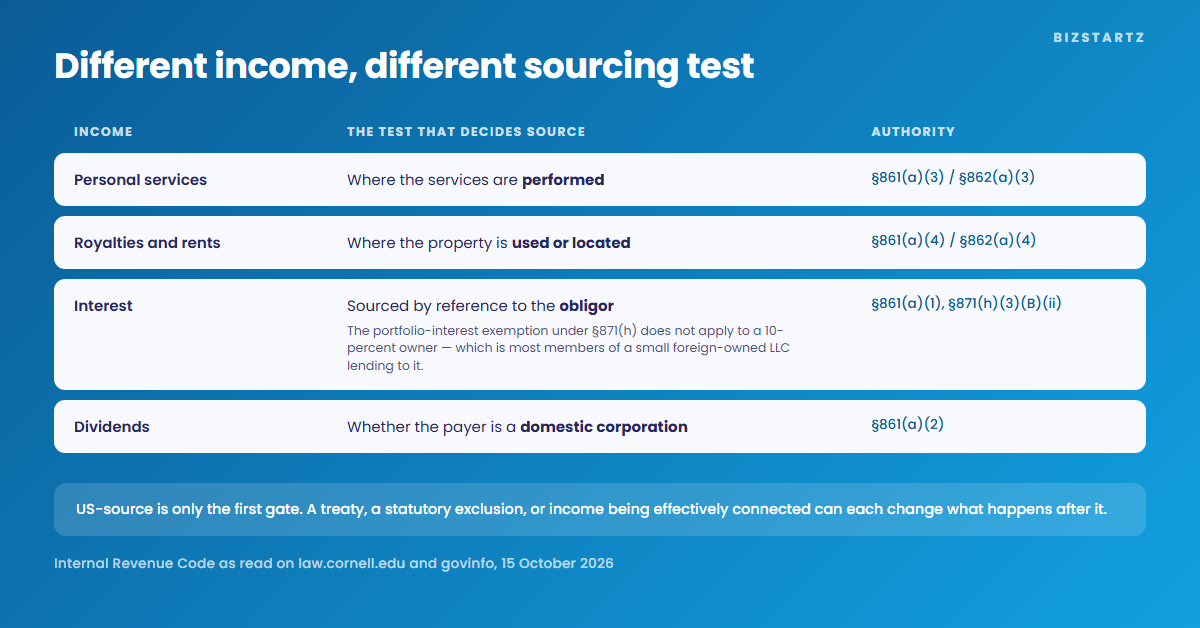
Every row names the rule that decides it, because the rules are genuinely different and carrying one across to another payment type is the mistake this page exists to prevent.
| The payment | What decides its source | US-source? |
|---|---|---|
| Fee to a developer, designer, VA or writer working in their own country | Where the services are performed — §862(a)(3) | No |
| Fee to that same person for the days they worked inside the United States | Same rule, §861(a)(3), apportioned on a time basis | Yes, for the US days only |
| Invoice from a foreign agency whose whole team works abroad | Same services rule — ask whether any part was performed in the US | No, on those facts |
| Royalty for a patent, copyright, trademark, process or franchise used in the United States | Where the property is used — §861(a)(4) | Yes |
| Royalty for the same property used only outside the United States | §862(a)(4) | No |
| Payment for software or other digital content | Depends which of four boxes the transaction falls into under 26 CFR §1.861-18 — see below | Depends |
| Interest your LLC pays on a loan from a member or other foreign lender | Sourced by reference to the obligor — §861(a)(1). And the portfolio interest exemption is switched off for a 10% owner | Treat as yes and read this one |
| Interest a foreign individual earns on a US bank deposit | §871(i)(2)(A) excludes deposit interest from the 30% tax where it is not effectively connected with a US trade or business | US-source, but statutorily excluded |
| Dividend from a US corporation — which an LLC becomes only if it elects corporate treatment | §861(a)(2) | Yes |
| Rent for property located in the United States | §861(a)(4) | Yes |
Sources for the table, all read 15 October 2026: 26 U.S.C. §861, §862, §871 and 26 CFR §1.861-18. Being US-source is the first gate, not the last one: a treaty, a statutory exclusion or an effectively-connected-income analysis can change what happens after it, which is why the right-hand column is a starting point and not a conclusion about your tax.
The same rule in reverse: work performed inside the United States
This is the half that gets left out, and it is the half with the liability attached. The sentence that gives you relief when your contractor works at home hands you an obligation the moment they work in the US. Briefly still counts.
Compensation for personal services is squarely inside this regime by category. The IRS page on fixed, determinable, annual, periodical (FDAP) income lists “Compensation for personal services (such as commissions and gross proceeds from performances)” among its examples, and states that “Tax at a 30% (or lower treaty) rate applies to FDAP income or gains from U.S. sources” (page last reviewed 23 July 2026).
Section 1441(b) says the same from the statutory side: its list of items of income includes “compensations, remunerations, and emoluments”. Your contractor’s invoice is not outside the category. It is outside the source test, until it isn’t.
And on pay for personal services performed (page last reviewed 18 August 2026), the IRS states that payers “must withhold tax at the 30 percent rate” on pay to a nonresident alien for services performed in the US, unless the pay is exempt or subject to graduated withholding, and that pay for services performed by an independent nonresident alien contractor is “subject to 30 percent withholding unless exempt under some provision of law or a tax treaty.”
How the split is calculated: the IRS’s own example
Where services are performed partly inside and partly outside the United States, the IRS page allocates the pay on a time basis, total pay multiplied by US service days over total service days. Its worked example involves John Doe, a Canadian citizen and resident playing professional hockey for a US club. He received $150,000 for 242 days of play, of which 194 days were in the United States and 48 in Canada. The page gives his US-source income as:
(194 ÷ 242) × $150,000 = $120,248
Check it yourself: 194 × 150,000 = 29,100,000, divided by 242 is 120,247.93, which rounds to $120,248. We re-did that multiplication before printing the figure, because a number nobody has multiplied is a number everybody is trusting.
The version that will actually happen to you
A hockey player is not your contractor. Here is the same method on facts that are.
Your Wyoming LLC pays a Nepal-based developer $60,000 for the year. He works 220 days on your project. In March he flies to a client’s office in Austin and works there for 30 of those days.
- US-source portion: (30 ÷ 220) × $60,000 = $8,181.82
- Foreign-source portion: $60,000 − $8,181.82 = $51,818.18 — untouched, nothing withheld, not reportable as a withholdable payment
- Withholding at 30% on the US-source portion: 0.30 × $8,181.82 = $2,454.55
Two things follow that founders get wrong in opposite directions. The trip does not contaminate the whole contract: roughly 86% of that fee stays foreign-source. And the trip does not get ignored because it was short, because the method is days, and days start at one.
The $2,454.55 is money you were supposed to hold back and remit. If you paid the developer the full $60,000, you did not save him anything; you moved his tax onto your own balance sheet. The IRS page on the withholding agent role (page last reviewed 21 March 2026, read 15 October 2026) is unambiguous about who carries it:
“As a withholding agent, you are personally liable for any tax required to be withheld.”
And it closes the obvious escape: “If the foreign person satisfies its U.S. tax liability, you may still be held liable for interest and penalties” for your failure to withhold.
A withholding agent “may be an individual, corporation, partnership, trust, association, or any other entity”, your LLC is on that list whichever way it is classified. The Instructions for Form 1042 carry the same sentence and add that where the foreign payee does not satisfy its own liability, “both you and the foreign person are liable for tax, as well as interest and any applicable penalties.”
The second thing that US trip did
Work performed inside the United States is load-bearing in two regimes at once, and this is the connection worth making before you book the flight.
It makes the worker’s pay US-source, which is this article. It is also the fact pattern that produces effectively connected income for a business, and the IRS page on effectively connected income states that “Foreign persons generally are engaged in a U.S. trade or business when personal services are performed in the U.S.” (page last reviewed 18 August 2026, read 15 October 2026) If a multi-member LLC has effectively connected income allocable to a foreign partner, a completely separate withholding regime switches on under section 1446, at a different rate, on different forms, with different due dates. Our guide to what a foreign-owned multi-member LLC actually files works through that one, and our page on whether a non-resident pays US tax on a US LLC sets out what does and does not decide the question.
They are different tests and they can both be live. “We established we have no effectively connected income” is not an answer to this page, and “we have no US-source payments” is not an answer to that one.
Form 1099-NEC is not the form for a foreign contractor
If you have been issuing Forms 1099-NEC to contractors in Nepal, India or the Philippines, stop and get advice, because you have been filing the wrong form into the wrong regime.
The Instructions for Forms 1099-MISC and 1099-NEC say it inside the box 1a instructions, where the nonemployee compensation goes:
“Use Form 1042-S, Foreign Person’s U.S. Source Income Subject to Withholding, for payments to nonresident aliens.”
The General Instructions for Certain Information Returns point the same way under “Who Must File”, with an item on payments to foreign persons that reads “See the Instructions for Form 1042-S, relating to U.S. source income of foreign persons,”. Both read 15 October 2026; the 1099 instructions are the December 2026 revision.
There is a second tell, and it is the one that should have caught it earlier. A Form 1099 is built on a Form W-9, and the Instructions for Form W-9 (rev. 03/2024) state that a foreign person “may not provide a Form W-9” and tell you to “Advise foreign persons to use the appropriate Form W-8 or Form 8233”.
The certification on a W-9 is that “The payee is a U.S. person”. Your contractor in Kathmandu cannot sign it. If someone did sign it, that is its own problem. Our guide to Form W-9 and our page on which form non-US owners actually sign set out the difference.
Now the part that makes this less alarming than it sounds. For a contractor working abroad, the correct treatment is neither form: no 1099-NEC, because the payee is not a US person, and no 1042-S, because the income is not US-source.
The 1099s you filed reported a payment that was not reportable on them. That is a fixable problem and it is a conversation with a CPA, not a disaster, but it is not nothing, because a 1099-NEC asserts a US taxpayer identification number for a payee who does not have one.
Royalties and software run on a different rule entirely
Here is where the relief above stops travelling. Royalties are not sourced by where anyone worked. They are sourced by where the property is used.
Section 861(a)(4) sources inside the United States “rentals or royalties from property located in the United States or from any interest in such property”, and extends that to royalties for the use of, or the privilege of using, in the United States, patents, copyrights, secret processes and formulas, good will, trademarks, trade brands and franchises. Section 862(a)(4) is the mirror for property used outside the US. We read both on 15 October 2026 — §861 in two places, on Cornell’s Legal Information Institute and in the US Code as published by the Government Publishing Office (2023 edition), which agree.
So a licence fee you pay a foreign developer for a patent or a copyright that your US business uses in the United States can be US-source even though the developer never left home. The services rule does not rescue it, because it is not a services payment.
“Software licence” is not one tax question. It is at least four.
This is the detail that makes the royalty conversation go wrong, and it is in a regulation rather than on a help page. 26 CFR §1.861-18 “provides rules for classifying digital content transactions”, and digital content includes computer programs. A transaction “is treated as being solely one of the following”:
- a transfer of a copyright right in the digital content;
- a transfer of a copy of it — a copyrighted article;
- services for its development or modification; or
- know-how relating to its development.
And each box routes to a different sourcing provision. A licence of copyright rights is sourced “under section 861(a)(4) or 862(a)(4), as appropriate” — the royalty rule, place of use. A sale or exchange of a copyright right goes to section 865. A copyrighted article goes to sections 861(a)(6), 862(a)(6), 863 or 865 if sold, and back to the royalty rule if leased. Paragraph (c)(2) lists the copyright rights; paragraph (f)(1) asks whether “all substantial rights in the copyright” moved, with anything short of that being a licence; paragraph (f)(2) separates a sale from a lease on a benefits-and-burdens test. Read 15 October 2026.
What that means practically: “we pay a monthly licence fee for software” does not tell you your sourcing rule, because it does not tell you which of those four things you bought. Paying a contractor to build you an app is likely box 3, development services, back on the services rule. Paying for the right to reproduce and distribute someone’s code is in copyright-right territory.
We can tell you the boxes exist and that they lead to different places. We cannot tell you which one your agreement is in, and anyone who tells you without reading the agreement is guessing. The regulation also cross-references §1.861-19 on cloud transactions, which covers the obvious SaaS case and which we did not read.
The one that catches founders: interest on a loan from a member
If you put your own money into your LLC as a loan and the LLC pays you interest, read this section twice. It is the sharpest edge on the page, and it is easy to miss because it looks like your own money coming back rather than a payment to a foreign person.
Interest is sourced by reference to the obligor, not to where the lender sits. Section 861(a)(1) sources inside the United States “Interest from the United States or the District of Columbia”, together with interest on bonds, notes and other interest-bearing obligations of noncorporate residents or domestic corporations.
We are going to stop short of telling you your LLC is inside those words. A partnership is not a domestic corporation, and whether it is a “noncorporate resident” for this purpose is worked out in 26 CFR §1.861-2, which we did not read. What we can tell you is that the escape hatch everybody reaches for here is closed.
Here is that escape hatch, and here is where it shuts. Section 871(a)(1) imposes “a tax of 30 percent” on specified US-source amounts received by a nonresident alien individual, and it opens with the words “Except as provided in subsection (h)”. Subsection (h) is the portfolio interest exemption: for portfolio interest, “no tax shall be imposed under paragraph (1)(A) or (1)(C) of subsection (a)”.
Then section 871(h)(3) takes it away again for the people reading this page. Portfolio interest “shall not include any interest described in paragraph (2) which is received by a 10-percent shareholder.” And section 871(h)(3)(B)(ii) defines that, for an obligation issued by a partnership, as a person who “owns 10 percent or more of the capital or profits interest in such partnership.” Read on 15 October 2026.
Ten percent. A two-founder LLC at 50/50 is miles past it. A five-founder LLC at 20% each is past it. The exemption that would protect an arm’s-length foreign lender does not protect the owner, by design — it exists for portfolio investment, and a founder lending to their own company is not that.
We read the section 871 tax rules; we did not read section 1441(c), which is where the withholding exemption that implements portfolio interest sits, and we did not read section 881, which is the equivalent provision where the lender is a foreign company rather than a foreign individual. And the gentler case: section 871(i)(2)(A) excludes interest on deposits from the 30% tax where it is not effectively connected with a US trade or business, so interest your US bank pays is a different and softer question from interest your LLC pays you.
What to do with this: if money has gone into your LLC from a member and anything is coming back out labelled interest, put it in front of a CPA before the next payment. If it is going out as a distribution or owner’s draw instead, that is a different analysis — see how to pay yourself as an LLC owner. The label on the transfer is doing real work here, and labels applied after the fact tend not to hold.
Dividends: only if you elected corporate treatment
Section 861(a)(2) sources dividends by reference to the payer. A dividend from a US corporation is US-source income, and a US-source dividend paid to a foreign person is the textbook section 1441 payment: dividends sit on that section’s list of items of income, second only to interest.
Most readers of this page will never meet it, for a structural reason. An LLC with no entity election does not pay dividends: a single-member LLC is disregarded and a multi-member LLC is a partnership, and what comes out of either is a distribution rather than a dividend. The LLC becomes a dividend-paying US corporation only if its owners elect corporate treatment on Form 8832. Our page on an LLC taxed as a C-corp covers what that election changes, including that it brings Form 5472 with it.
If you are considering that election, add this to the list of what it changes: the company starts being able to pay a kind of income that is US-source by definition, to shareholders who are foreign persons. That is a withholding question you do not currently have.
If you do have a US-source payment: Forms 1042, 1042-S and 1042-T
Our multi-member LLC guide published a table with this cell empty and said so, because the dates had not been read. They have now. Everything below is from the Instructions for Form 1042 (2025) and the Instructions for Form 1042-S (2026), both read 15 October 2026.
| Form | Who does what with it | When |
|---|---|---|
| Form 1042, Annual Withholding Tax Return for U.S. Source Income of Foreign Persons | The withholding agent files one annual return | “Mail Form 1042 by the 15th day of the 3rd month after the end of the calendar year (March 15)” |
| Form 1042-S, Foreign Person’s U.S. Source Income Subject to Withholding | The withholding agent files it with the IRS and gives a copy to the recipient | Both by the same date: “filed with the IRS and be furnished to the recipient of the income by March 15 of the following calendar year” |
| Form 1042-T, Annual Summary and Transmittal of Forms 1042-S | Paper filers only — a cover sheet. “Send all paper Forms 1042-S with Form 1042-T”, one 1042-T per type of form | With the paper Forms 1042-S |
| Form 7004 | Extends the time to file Form 1042. “Form 7004 does not extend the time for payment of tax” | By the regular due date |
| Form 8809 | Gives “an automatic 30-day extension to file Form 1042-S” with the IRS; a second Form 8809 can be submitted before the extended due date | Before the due date |
| Form 15397 | A separate one-time 30-day extension to furnish the recipient copies | Before the furnishing date |
| Form 1099-NEC | Not this. Its own instructions redirect payments to nonresident aliens to Form 1042-S | — |
Three things about that table that are easy to miss. The two 1042-S deadlines, filing with the IRS and furnishing to the recipient, are the same day, so there is no quieter second deadline to fall back on. The extensions are not one extension: Form 7004 for the 1042, Form 8809 for the IRS copy of the 1042-S, Form 15397 for the recipient copy, three forms for three things. And Form 1042-T is not a third obligation; it is the envelope you need only if you are filing on paper.
On the date itself: the instructions print the rule — the 15th day of the 3rd month after the calendar year ends, March 15 — and carry the usual next-business-day rule for a weekend or legal holiday. They do not print a year-specific calendar date, so neither do we. Check the day of the week for your filing year; 15 March 2026 falls on a Sunday. Our 2026 US tax filing deadline guide has the wider calendar, and as of today it carries no Form 1042 row at all — the dates above are not on it yet.
Form 1042 must be filed if you are “required to file or otherwise file Form(s) 1042-S for purposes of either chapter 3 or 4” — and the instructions add the parenthesis that matters: “(whether or not any tax was withheld or was required to be withheld to the extent reporting is required).” A zero does not excuse the return once you are in the regime. Deposits of tax withheld go through EFTPS or IRS Direct Pay; “If you fail to use EFTPS or IRS Direct Pay, you may be subject to a 10% penalty.”
The penalties, with the year attached to every figure
Form 1042. Failure to file when due, including extensions: 5% of the unpaid tax for each month or part of a month the return is late, “up to a maximum of 25% of the unpaid tax”. Failure to pay: usually one-half of 1% of the unpaid tax per month or part of a month, and “The penalty cannot exceed 25% of the unpaid tax”. Both from the 2025 instructions.
Form 1042-S. From the 2026 instructions, late filing of a correct form is tiered by how late it is:
- $60 per form if filed within 30 days of the due date — annual maximum $698,500, or $244,500 for a small business
- $130 per form if more than 30 days late but filed by August 1 — maximum $2,095,500, or $698,500 for a small business
- $340 per form after August 1, or if not filed correctly — maximum $4,191,500, or $1,397,000 for a small business
Failing to furnish a correct Form 1042-S to the recipient is its own penalty, up to $340 for each failure absent reasonable cause, with the same annual maxima. And where the failure is intentional, the per-form penalty becomes the greater of $690 or 10% of the total amount required to be reported, with no maximum at all. A small business for these purposes has average annual gross receipts of $5 million or less over the three most recent tax years.
Every one of those dollar figures is indexed for inflation, which is why each is tagged to the instructions it came from. A penalty figure printed without its tax year rots quietly, and you will find older pages quoting lower amounts and future ones quoting higher. Read the instructions for your own year on the day you act — including against this page.
A treaty can cut the 30%. Nepal, Nigeria, Malaysia, the UAE and Vietnam have none.
The IRS states that “Most types of U.S. source income received by a foreign person are subject to U.S. tax of 30%”, and that the regime, which it calls NRA withholding, covers “withholding required under sections 1441, 1442, and 1443 of the Internal Revenue Code” and runs on “the filing of Form 1042 and related Form 1042-S” (NRA withholding, page last reviewed 14 March 2026, read 15 October 2026). The FDAP page’s phrasing is “a 30% (or lower treaty) rate”.
That parenthesis only helps a payee whose country has a treaty. We re-checked the IRS A-to-Z list of US income tax treaties on 15 October 2026 (page last reviewed 3 January 2026), country by country:
- No US treaty: Nepal, Nigeria, Malaysia, the United Arab Emirates, Vietnam. For a payee in any of these, there is no reduced rate to claim. The statutory 30% is the rate.
- Treaty documents listed: India, Pakistan, Bangladesh, Sri Lanka, the Philippines, Morocco, China, Thailand, Canada, Egypt, Indonesia, Mexico, Turkey, Ukraine.
- Read the page, not a list: it currently flags Belarus and Russia as partially suspended and Hungary as terminated. A treaty you confirmed three years ago is not a fact you can carry forward.
We verified which countries appear on that list and nothing beyond it. We read no treaty article and no reduced rate, and no treaty rate appears anywhere on this page. “There is a treaty with India” and “the treaty rate on your payment is X%” are different claims, and only the first is one we checked. Whether a particular treaty reaches a particular payment, and at what rate, is read in that treaty’s articles — a CPA’s job, on your facts.
The form a treaty claim goes on is probably not the W-8BEN
This is a genuine trap and it is stated on the IRS’s own form. The Instructions for Form W-8BEN (rev. 10/2021, read 15 October 2026) contain a “Do not use Form W-8BEN if” list, and one item on it is a nonresident alien individual who “claims exemption from withholding on compensation” for personal services. The instruction is to “Instead, provide Form 8233 or Form W-4.”
Personal-services compensation is the payment this whole article is about. So if your contractor has treaty-based relief to claim on US-performed work, the certificate is Form 8233, not the W-8BEN you may already have on file. The W-9 instructions point the same way, telling payers to advise foreign persons to use “the appropriate Form W-8 or Form 8233.”
Treaty claims also generally need a number. The W-8BEN instructions say that if you claim treaty benefits “you are generally required to provide an ITIN if you do not provide a tax identifying number” issued by your country of residence. Our guide to who needs an ITIN and how to apply covers that application, and it is slow enough that it cannot be started in the week you need it.
What the W-8 you collect actually does — and what it does not
The Instructions for Form W-8BEN open on the premise: “Foreign persons are subject to U.S. tax at a 30% rate on income they receive from U.S. sources that consists of:” — and the form is how the payee establishes who and what they are.
Three things about it that save arguments later.
It does not go to the IRS. Verbatim: “Do not send Form W-8BEN to the IRS. Instead, give it to the person who is requesting it from you.” It lives in your file. You are the one who has to produce it if asked.
It expires. Generally it stays in effect from the date it is signed until “ending on the last day of the third succeeding calendar year”, and it dies earlier if a change in circumstances makes the information wrong. A certificate signed in 2022 is not doing anything for you in 2026.
It does not decide sourcing. This is the one people get backwards. A W-8BEN establishes that your payee is a foreign person; it says nothing about where they performed the work. Collecting one does not make a payment foreign-source, and failing to collect one does not make a payment US-source. It documents a status, not a conclusion.
Individuals sign the W-8BEN; entities sign the W-8BEN-E. The IRS’s NRA withholding page lists Forms W-8BEN, W-8BEN-E, W-8ECI, W-8EXP and W-8IMY as the documentation set. Our page on Form W-8BEN versus Form W-9 is where to start, and the Form W-9 guide covers the US-person side, including why your foreign contractor cannot sign one.
What we could not verify, stated plainly
A page that claims to have read the sources has to be equally clear about what it did not read.
- Publication 515, the IRS’s own long-form guide to this regime. We did not read it. Everything above comes from the IRS topic pages, the form instructions, the Internal Revenue Code or the regulation named at the point of use.
- Whether the Form 1042 instructions set a minimum penalty for filing more than 60 days late, and what the “exception to filing” cases in the Who Must File section are. The instructions run to roughly 112,000 characters and we read the first 100,000. We did not find either, which is not the same as establishing there is nothing there.
- Section 1441(c) and section 881 — the withholding exemption that implements portfolio interest, and the rules where the foreign lender is a company rather than an individual.
- 26 CFR §1.861-2, which is where the statute’s phrase “noncorporate residents” in section 861(a)(1) is applied to particular payers. So we did not establish that an LLC’s interest payment is US-source; we established that the exemption a member would rely on is unavailable to a 10% owner, which is a different and narrower claim.
- 26 CFR §1.861-19 on cloud transactions, which is the provision that would classify a SaaS subscription.
- Any treaty’s actual text or rate. We checked which countries appear on the IRS treaty list and stopped there.
- Whether Wise, Payoneer, Deel or any similar platform takes on the withholding agent role for payments it processes. We read no platform’s terms.
- Whether a Form 8233 or Form W-8ECI changes the withholding on US-performed services in any given case. We read that the W-8BEN instructions point to Form 8233 for that claim; we did not read the regulations that govern when the claim succeeds.
Questions to take to a US CPA
Take these in writing. The phrase to use when you call is “chapter 3 withholding and Forms 1042 and 1042-S” — it tells you in one sentence whether the person on the other end does this work.
- Here is the list of everyone we paid last year and where each of them was physically located while doing the work. Which of those payments, if any, were US-source?
- Did anyone we pay spend working days inside the United States? If so, what is the apportionment and what should we have withheld?
- We have been issuing Forms 1099-NEC to contractors abroad. What do we do about the ones already filed?
- Do we have any royalty or software licence payments, and which classification under 26 CFR §1.861-18 does each agreement fall into?
- A member lent money to the LLC and is being paid interest. Is that interest US-source under section 861(a)(1) and 26 CFR §1.861-2? Given section 871(h)(3), what is the withholding position, and does section 881 or section 1441(c) change it?
- Do we need to file Form 1042 for any open year, and is there a Form 1042-S we should have issued?
- If a payee’s country has a treaty, which article applies to this payment type, what rate does it give, and do we need a Form 8233 or a W-8BEN?
- Are our withholding certificates current? Which ones expire at the end of the third succeeding calendar year from signature, and when is that for each?
- Does anything we are doing create effectively connected income as well — so that section 1446 is live alongside this?
- What will you charge annually to handle the 1042 and 1042-S cycle, and what do you need from us and by when?
Put that last answer next to the exposure, using the developer who worked thirty days in Austin. The tax not withheld was $2,454.55. One Form 1042-S filed late and furnished late carries two penalties rather than one, at up to $340 each under the 2026 figures, before any question of intentional disregard. That is $3,134.55 arising from one contractor, one trip and one form — and the Form 1042 penalties sit on top as a percentage of the unpaid tax.
Questions readers ask
My developer is in Nepal and has never been to the US. Do I withhold 30%?
No. Her services are performed in Nepal, which makes the income foreign-source under section 862(a)(3), and section 1441 withholding reaches only items of income “from sources within the United States.” The IRS adds that the place of payment, the residence of the payer and where the contract was made do not change the source. So no withholding, and no Form 1042-S for that payment.
Do I file a Form 1042-S anyway, showing zero?
Not for a payment of foreign-source income. Form 1042-S reports amounts subject to withholding, and Form 1042’s own trigger is being “required to file or otherwise file Form(s) 1042-S”. Once you are in the regime, though, the instructions are explicit that a zero does not excuse the annual return — Form 1042 is required “whether or not any tax was withheld or was required to be withheld to the extent reporting is required.”
I have been sending my foreign contractors Form 1099-NEC. Is that a problem?
It is the wrong form and worth cleaning up with a CPA. The 1099-NEC instructions redirect payments to nonresident aliens to Form 1042-S, and the Form W-9 that a 1099 depends on is one a foreign person “may not provide” — its certification is that the payee is a US person. For a contractor working abroad the right answer is neither form.
My contractor came to the US for a two-week project. Does that spoil the whole contract?
No — it splits it. The method is a time basis: total pay times US service days over total service days. Ten working days out of 220 on a $60,000 contract is $2,727.27 of US-source income, not $60,000. But it is not zero either, and the 30% applies to that slice unless a treaty or another provision exempts it.
Does paying through Wise or Payoneer change anything?
Not the sourcing. The IRS sentence that governs this names “the place of payment” as something that does not determine the source of a services payment. If the income is US-source, though, do not assume a platform has withheld on your behalf — read your agreement with it, because the withholding agent is whoever has control, receipt, custody, disposal or payment of the income.
We pay a foreign developer a monthly software licence fee. Same answer?
Different rule, and possibly a different answer. Royalties are sourced by where the property is used, under section 861(a)(4), not by where the licensor sits. And “software licence” splits four ways under 26 CFR §1.861-18 — copyright right, copyrighted article, development services, or know-how — each routing to a different sourcing provision. Which one you are in is read off the agreement.
I lent my own LLC money. Is the interest it pays me subject to withholding?
Treat this as a live issue rather than a safe one. Section 861(a)(1) sources interest by reference to the obligor rather than to where the lender lives. The portfolio interest exemption in section 871(h) is the escape people assume applies, and section 871(h)(3) closes it for interest received by a 10-percent shareholder — for a partnership obligation, anyone who “owns 10 percent or more of the capital or profits interest.” Most members of a small foreign-owned LLC are well over that. Ask before the next interest payment, not after.
My contractor’s country has a treaty. What do I need from them?
Ask the CPA which article applies and what rate it gives — we verified which countries appear on the IRS treaty list and nothing more. On forms: for a treaty exemption on compensation for personal services, the W-8BEN instructions say not to use the W-8BEN and to provide Form 8233 instead. Treaty claims also generally require an ITIN unless a tax identifying number from the country of residence is given.
Is this the same as the 37% withholding I read about?
No. That is section 1446 withholding on effectively connected taxable income allocable to a foreign partner, which is a different test, a different rate and different forms. This page is sections 1441 to 1443 on US-source payments. Both can apply to the same LLC. Our multi-member LLC filing guide handles the other one.
Where to start
In this order, because each step is cheap and each one shrinks the next.
- List everyone you paid last year and, beside each name, the country where they were physically sitting while they did the work. That column is the one that decides everything on this page.
- Flag every US working day. Conferences, client site visits, a founder who spent a month in Miami and kept working. Days, not trips.
- Separate out anything that is not a services payment — royalties, licence fees, interest, rent. Those rows go in a different pile and get a different rule.
- Collect or refresh the W-8BENs and W-8BEN-Es, and check the signature dates against the third-succeeding-calendar-year rule.
- If anything in steps 2 or 3 came back positive, get a CPA before the next payment date — withholding is something you do at payment, and it cannot be done retrospectively without coming out of your own pocket.
Bizstartz forms US LLCs and C-corps for non-resident founders and handles formation, the EIN — including getting one without an SSN — and the bank application. See our services and pricing. For the surrounding obligations, US tax filing requirements for international founders and how to file taxes as a non-US resident give the wider picture, and Form 1040-NR covers the owner’s own return. The withholding analysis itself is a US CPA’s work and we are not pretending otherwise.
If you take one thing from this page: the question is never “am I a US company paying a foreigner.” It is “where was the work done, or where is the property used, or who is the obligor.” Answer that and the forms follow. Guess at it and you are personally liable for the difference.
Checked on 15 October 2026. Every IRS page, set of form instructions, Code section and regulation linked above was read on that date. The Form 1042 penalty rates come from the 2025 instructions and the Form 1042-S dollar penalties from the 2026 instructions; those amounts are indexed for inflation and should be re-read for your own year. The 30% is the statutory rate in section 1441(a) and section 871(a)(1), not a figure we rounded.
🎯 Ready to start? Claim your free consultation and we'll map out your US LLC formation strategy — EIN, banking, and the right state for your country.

Ready to start your company?
Bizstartz handles formation, EIN, banking and compliance for founders worldwide.