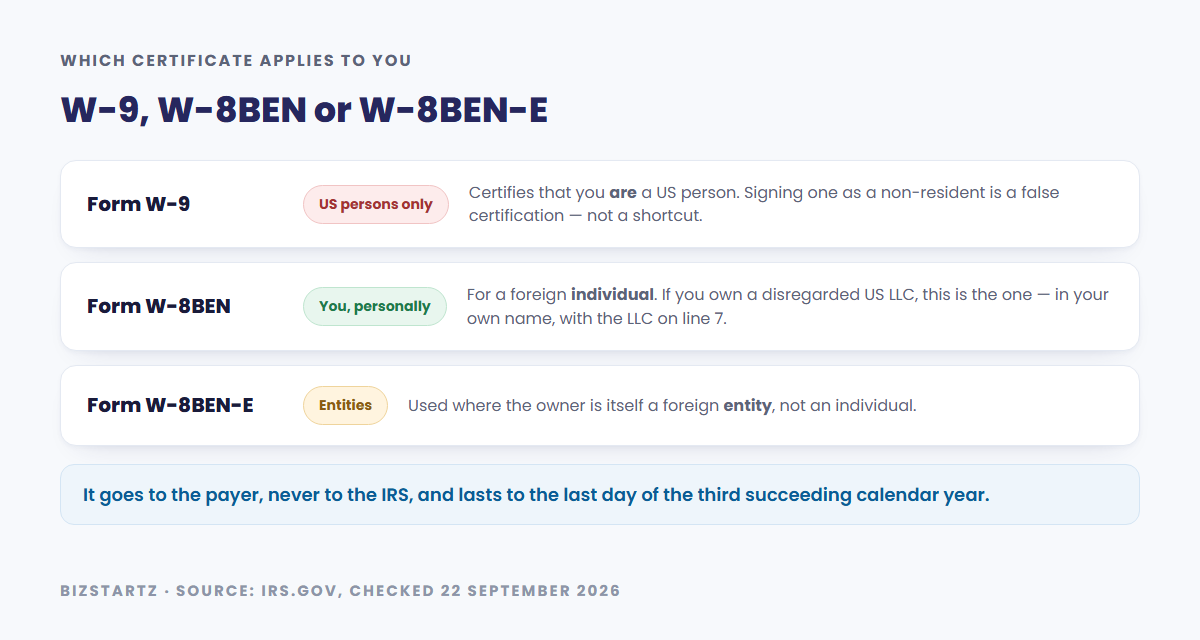
Someone sent you a W-9 and asked you to “fill in the tax form.” If you are not a US person, do not sign it. The certification block on Form W-9, signed under penalties of perjury, contains the line “I am a U.S. citizen or other U.S. person (defined below).” Signing that when it is not true is a false certification. It is not a shortcut, and it is not something a payer can waive for you.
The form you almost certainly need instead is Form W-8BEN.
Form W-9 says so on its own face: “If you are a foreign person or the U.S. branch of a foreign bank…do not use Form W-9. Instead, use the appropriate Form W-8 or Form 8233.” If you want to see who that form is genuinely meant for, our plain guide to Form W-9 covers it. If you are reading this from outside the United States, it is probably not you.
And the stake is a number, not a vague risk. The Instructions for Form W-8BEN put it this way: “Failure to provide a Form W-8BEN when requested may lead to withholding at the foreign-person withholding rate of 30% or the backup withholding rate under section 3406.” Thirty per cent, taken out before the money reaches you.
Sources and check dates are at the foot of this article. Every quotation below was read at its IRS source URL on 22 September 2026.
Which W-8 is yours, read this before you fill in anything
Form W-8BEN carries its own routing table. These are its words, lightly compressed:
| Your situation | The form |
|---|---|
| You are a foreign individual receiving US-source income | W-8BEN |
| “You are NOT an individual” — a foreign company, trust or partnership | W-8BEN-E |
| “You are a U.S. citizen or other U.S. person, including a resident alien individual” | W-9 |
| The income is effectively connected with a US trade or business (other than personal services) | W-8ECI |
| Compensation for personal services you performed inside the United States | Form 8233 or W-4 |
| “You are a person acting as an intermediary” | W-8IMY |
The distinction that trips people up most is the first two rows. W-8BEN is the “Certificate of Foreign Status of Beneficial Owner for United States Tax Withholding and Reporting (Individuals).”
Its entity twin, W-8BEN-E, is the “Certificate of Status of Beneficial Owner for United States Tax Withholding and Reporting (Entities).” One letter, two very different jobs. W-8BEN is a single page. W-8BEN-E runs to thirty numbered parts across eight pages, ending at Part XXX.
Both are at revision 10/2021 as of today. If a payer sends you something with an older revision date, ask for the current one.
Where the form goes
Printed across the top of Form W-8BEN: “Give this form to the withholding agent or payer. Do not send to the IRS.” The instructions repeat it — “Do not send Form W-8BEN to the IRS. Instead, give it to the person who is requesting it from you.”
There is no filing, no receipt, no confirmation number. If you have been waiting to hear back from the IRS about a W-8BEN, you will be waiting a long time.
The hard case: you own a US LLC and Stripe wants “the tax form”
This is the question that sends people in circles, and it is the reason this page exists.
You live in Kathmandu, Kuala Lumpur or São Paulo. You formed a single-member US LLC — Wyoming, New Mexico, Delaware, it does not matter which. You have an EIN. Stripe or a US client now asks for a tax form. Do you give a W-8BEN as an individual, or does the LLC give a W-8BEN-E as an entity?
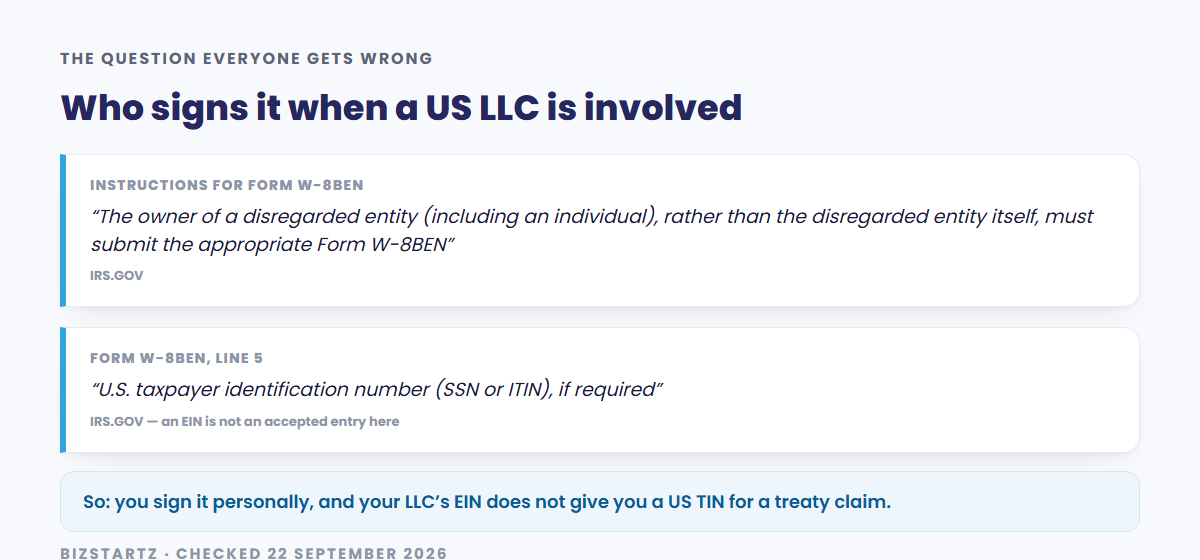
You give the W-8BEN, in your own personal name. The LLC does not file anything here.
That is not an interpretation. The Instructions for Form W-8BEN say it outright:
“The owner of a disregarded entity (including an individual), rather than the disregarded entity itself, must submit the appropriate Form W-8BEN for purposes of section 1446(a) or (f), or for chapter 3 or 4 purposes.”
The Instructions for Form W-8BEN-E approach it from the other side and land in the same place:
“Generally, a disregarded entity does not submit this Form W-8BEN-E to a withholding agent. Instead, the owner of such entity provides the appropriate documentation (for example, a Form W-8BEN-E if the owner is a foreign entity).”
Read that parenthetical carefully. A W-8BEN-E is what the owner provides when the owner is itself a foreign entity — a Nepali private limited company that owns the LLC, say. If the owner is a human being, it is a W-8BEN.
Why is your LLC disregarded in the first place? Because you never told the IRS otherwise. The IRS states the default plainly: “For income tax purposes, an LLC with only one member is treated as an entity disregarded as separate from its owner, unless it files Form 8832 and affirmatively elects to be treated as a corporation.”
So where does the LLC’s name go?
Line 7. Not line 1.
Line 1 of Form W-8BEN reads “Name of individual who is the beneficial owner.” That is you. There is no line anywhere on the form for a disregarded entity’s name, which is exactly why so many people conclude they must be holding the wrong form. They aren’t.
The instructions handle the gap directly. From the Line 1 guidance: “If you are a foreign individual who is the single owner of a disregarded entity that is not claiming treaty benefits as a hybrid entity, with respect to a payment, you should complete this form with your name and information. If the account to which a payment is made or credited is in the name of the disregarded entity, you should inform the withholding agent of this fact.”
And from the Line 7 guidance: “A foreign single owner of a disregarded entity can use line 7 to inform the withholding agent that the account to which a payment is made or credited is in the name of the disregarded entity.”
So the finished form says: your name on line 1, your country of citizenship on line 2, your home address — a real street address, the form specifically bars a P.O. box or in-care-of address — on line 3, and your LLC’s legal name on line 7 so the payer can match the certification to the account it is paying.
Your EIN does not belong on line 5
Line 5 is printed as “U.S. taxpayer identification number (SSN or ITIN), if required.” SSN or ITIN. Those identify people.
Your LLC’s EIN is the entity’s number, and the entity is not the one certifying anything on this form. Having an EIN does not give you a US TIN in the sense line 5 means, and this matters if you plan to claim a treaty benefit — more on that below.
Two places this reasoning stops
It holds where the LLC is genuinely disregarded and the income genuinely is not effectively connected. Both of those can fail:
- If the LLC has elected corporate treatment on Form 8832, or elected S-corporation status, it is no longer disregarded. The analysis above does not apply and the entity becomes the filer. If you are unsure whether an election was ever filed for your LLC, find out before you sign anything.
- If your income is effectively connected with a US trade or business, the right form is W-8ECI, not W-8BEN — the routing table above says so. Whether your income is effectively connected is a facts question about how and where you work, not something an article can decide for you. Our piece on what actually decides US tax for a non-resident LLC owner walks through the factors; a US tax professional should confirm the call before it goes on a signed certification.
What a W-8BEN does not do
It certifies that you are not a US person. Part III of the form is a statement that “The person named on line 1 of this form is not a U.S. person.” That is the whole job of Part I and Part III.
It does not, by itself, reduce any US tax. A reduction is a separate claim, made in Part II, and it only exists if a tax treaty gives you one.
For a lot of our readers, there is no treaty
The IRS publishes the list of countries with a US income tax treaty. Checked on 22 September 2026, Nepal is not on it. Malaysia is not on it. Brazil is not on it.
If your country of residence is one of those, Part II of the form is simply left blank. You still file the W-8BEN — foreign status still needs certifying, and the alternative is the 30% default, but there is no treaty rate to claim and no article number to cite. Anyone who tells you otherwise is selling something.
Several markets we work with are on the list, including India, Pakistan, Bangladesh, Sri Lanka, Indonesia, the Philippines, Thailand and the United Kingdom. Being on the list is not the end of the question.
Each treaty has its own articles, its own rates by income type, and its own limitation-on-benefits conditions. We are not quoting a rate here for any country, because the only honest source for a rate is the treaty text itself, and it has to be read against the specific kind of income you are receiving.
One more trap in that list: Malta has a treaty. Malaysia does not. They are four letters apart and we have seen the two confused.
Claiming a treaty benefit usually needs a US TIN
If you do have a treaty and you want to use it, you generally need a US taxpayer identification number, an SSN or an ITIN, on line 5. The instructions carve out narrow exceptions, mostly for income from actively traded stocks and debt, mutual fund dividends, distributions from publicly offered unit investment trusts, and income from loans of those securities. If you are being paid for services or software, none of those apply to you.
An ITIN takes real time to obtain, so this is worth sorting out before the invoice, not after. We run an ITIN application service through a Certifying Acceptance Agent for exactly this reason.
How long the form lasts, and the change that catches people
The instructions set the clock:
“Generally, a Form W-8BEN will remain in effect for purposes of establishing foreign status for a period starting on the date the form is signed and ending on the last day of the third succeeding calendar year, unless a change in circumstances makes any information on the form incorrect.”
Sign it in March 2026 and, absent a change, it runs to 31 December 2029.
The second half of that sentence is the part that catches people. If something on the form stops being true, the clock stops with it:
“If a change in circumstances makes any information on the Form W-8BEN you have submitted incorrect, you must notify the withholding agent, payer, or FFI with which you hold an account within 30 days of the change in circumstances and you must file a new Form W-8BEN or other appropriate form.”
Thirty days. And the change that most often trips up non-resident founders is not dramatic: changing your address to a US address is itself a change in circumstances. A mail-forwarding address, a virtual office you started using on the form, a move. Becoming a US citizen or resident alien is one too, and that one is obvious. The address one is not.
If you do become a US person, the W-8BEN stops being the right form and a W-9 becomes correct. That is the one direction in which the W-9 advice at the top of this page reverses.
What the platforms actually ask for
Most of the time nobody sends you a PDF. Stripe’s W-8/W-9 collection product describes the certification being completed inside the dashboard — “No more PDFs, emails, or wet-ink signatures needed” — with a W-9 for US residents or citizens and a W-8 for non-US tax residents. (That documentation describes Stripe’s Connect W-8/W-9 product specifically, which Stripe says is limited to preview users, so do not assume every Stripe account works identically.)
One Stripe behaviour is worth knowing about if you are a non-resident running a US LLC, because it describes your exact setup: “Non-US accounts that add US bank accounts or US addresses may be asked to complete a Form W-8/W-9 to establish tax residency.” Stripe’s support page asks that the request be completed within 14 days of notification. Adding the US business bank account is often what triggers the request in the first place — see our guide to opening a Stripe account as a non-US resident.
Upwork collects the same information under Manage finances → Tax information rather than as a paper form, and states that without it “Upwork may be required to withhold up to 30% of your future earnings on Upwork and send it to the IRS.” It also warns that “We cannot give you a refund on taxes that we withhold and send to the IRS, even if you complete the form later.” That last sentence is the practical argument for doing this before the first payout rather than after.
Amazon, PayPal and individual US clients will ask in their own ways. We have not verified how their interviews behave and are not going to describe a process we have not opened, so check inside the account rather than trusting a screenshot from a blog.
Before you sign
- Confirm you are not a US person for tax purposes. You do not need a green card to be treated as a US resident — the IRS substantial presence test can do it on day count alone: 31 days in the current year, and 183 days across the current and two prior years on a weighted basis. If you travel to the US often, count before you certify.
- Line 1 is your name, not your company’s. Line 3 is a real residential address, not a P.O. box.
- If a US LLC receives the payment, put its legal name on line 7 and tell the payer in writing which account the form covers.
- Leave Part II blank unless your country has a treaty and you have read the article you are claiming under.
- Keep a dated copy. You will need to know when the three-year clock started.
- Diarise the expiry and re-file before it lapses, not after a payment is withheld.
Where this article stops
This is general information about which form applies, sourced to the IRS instructions and dated. It is not tax advice, and it cannot be — the two decisions that matter most in a borderline case, whether your income is effectively connected and whether a particular treaty article covers you, both depend on facts we do not have.
What we can tell you with confidence is the thing most people get wrong: if you are not a US person, the answer is never a W-9. Get that part right and the rest is a conversation with an accountant, not a $0.30-on-the-dollar surprise.
Frequently asked questions
I own a US single-member LLC as a non-resident. W-8BEN or W-8BEN-E?
W-8BEN, in your own name. The IRS instructions state that the owner of a disregarded entity, including an individual, rather than the entity itself, submits the appropriate form. The LLC’s name goes on line 7. W-8BEN-E applies where the owner of the LLC is itself a foreign entity.
Do I send Form W-8BEN to the IRS?
No. The form itself says to give it to the withholding agent or payer and not to send it to the IRS. There is nothing to file and no confirmation to wait for.
How long is a Form W-8BEN valid?
Generally from the date it is signed to the last day of the third succeeding calendar year, unless a change in circumstances makes information on it incorrect.
What happens if I do not provide one?
The instructions say failure to provide a Form W-8BEN when requested may lead to withholding at the foreign-person rate of 30%, or at the backup withholding rate under section 3406.
Can I use my LLC’s EIN on line 5?
Line 5 is printed as “U.S. taxpayer identification number (SSN or ITIN), if required.” It asks for an individual’s number. If you need a US TIN to claim a treaty benefit and have no SSN, an ITIN is the route.
My country has no US tax treaty. Should I still file a W-8BEN?
Yes. The form certifies foreign status, which is needed regardless. You simply leave the treaty claim in Part II blank. Nepal, Malaysia and Brazil were not on the IRS treaty list when we checked it on 22 September 2026.
Sources
All opened and quoted on 22 September 2026.
- IRS — About Form W-8 BEN
- IRS — Instructions for Form W-8BEN (rev. 10/2021)
- IRS — Form W-8BEN (rev. October 2021)
- IRS — Instructions for Form W-8BEN-E (rev. 10/2021)
- IRS — Form W-8BEN-E (rev. October 2021)
- IRS — Form W-9 (rev. March 2024)
- IRS — Substantial Presence Test
- IRS — United States income tax treaties, A to Z
- IRS — Single Member Limited Liability Companies
- Stripe — Connect W-8 and W-9
- Stripe — General information about US tax form collection
- Upwork — How to complete Form W-8BEN or W-8BEN-E
🎯 Ready to start? Claim your free consultation and we'll map out your US LLC formation strategy — EIN, banking, and the right state for your country.

Ready to start your company?
Bizstartz handles formation, EIN, banking and compliance for founders worldwide.