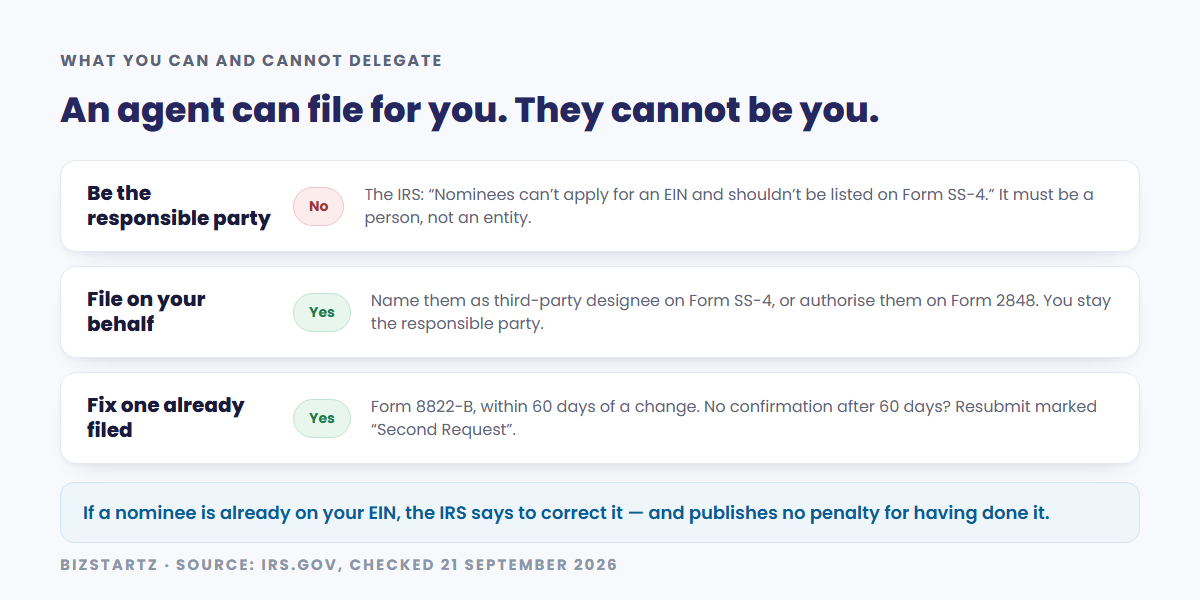
No. If a formation agent has offered to put their own name, a US friend, or a “nominee” on line 7a of your Form SS-4, the answer is no, and the IRS says so in one sentence: “Nominees can’t apply for an EIN and shouldn’t be listed on Form SS-4.”
What you probably need instead is not a nominee at all. It is permission for that agent to file on your behalf, which is a different thing, sits in a different box on the same form, and is entirely legitimate. Most founders who get talked into the first one only ever needed the second.
Here is the difference, and how to fill the form correctly from outside the United States.
What the IRS means by “responsible party”
From the IRS page Responsible parties and nominees, checked 21 September 2026:
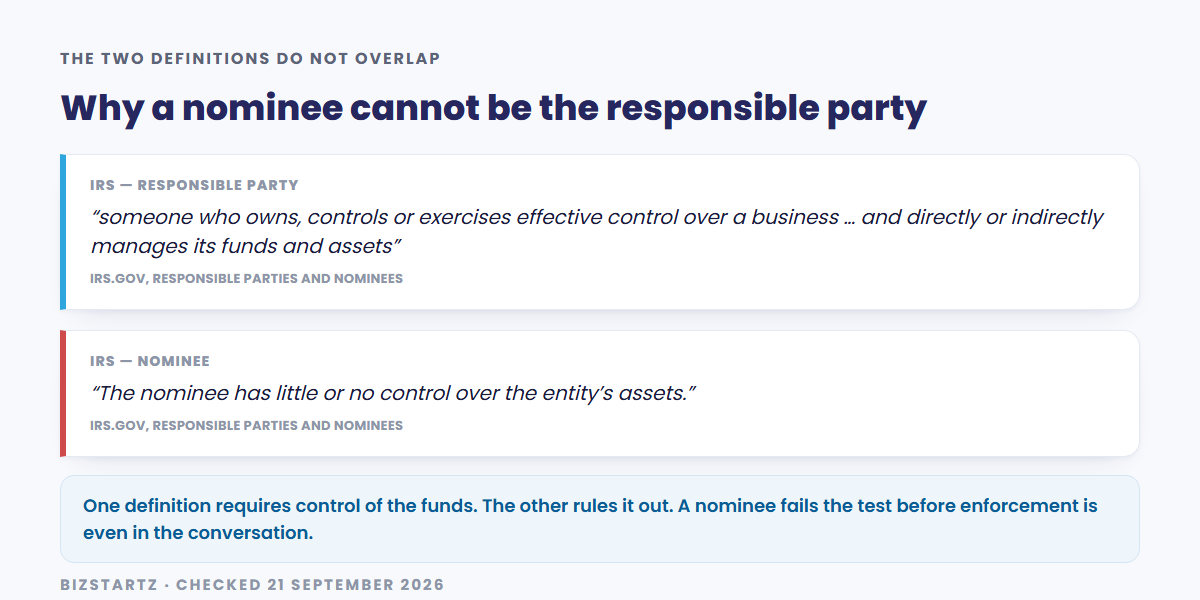
“A responsible party is someone who owns, controls or exercises effective control over a business, nonprofit or other legal entity and directly or indirectly manages its funds and assets.”
And, on the same page:
“Your responsible party must be a person, not an entity. The only exception is for government entities.”
Two things follow immediately. Your LLC cannot be its own responsible party. Neither can your agent’s company, your holding entity, or a trust. It has to be a human being with a name.
And that human has to be the one who controls the money. Not the person who signed the state filing, not the person with a US address, not whoever happens to have an SSN. If you are the founder who can move the funds, the responsible party is you, wherever in the world you live.
Why a nominee can never satisfy that test
This is the part that settles the argument, and it does not require any enforcement story. Read the IRS’s own definition of a nominee, on that same page:
“A nominee is someone you give limited authority to act for your entity during its formation. The nominee has little or no control over the entity’s assets.”
Now put the two definitions next to each other. A responsible party “directly or indirectly manages its funds and assets.” A nominee has “little or no control over the entity’s assets.”
They are opposites. The one quality that makes someone a nominee is the exact quality that disqualifies them from being the responsible party. You do not need to ask whether a nominee arrangement is risky or whether anyone gets caught. A nominee fails the definition by construction. There is no careful version of it.
The IRS also states the practical harm, and it is worth reading literally rather than as boilerplate:
“Listing a nominee could disclose your information to an unauthorized person.”
The responsible party is the person the IRS will talk to about your entity. Put someone else’s name there and you have made a stranger the IRS’s point of contact for your company’s tax affairs.
So why does anyone offer this?
Because of a bottleneck, not because it works.
The IRS’s online EIN application is the fast route, and it issues a number in minutes. But it has two conditions that lock out most non-resident founders.
It requires that “You have the responsible party’s Social Security number (SSN) or individual taxpayer ID number (ITIN),” and it is unavailable if “Your principal place of business is outside the U.S.” In that case the IRS’s own instruction is blunt: “If so, apply by phone, fax or mail.”
An agent with a US person on the form can use the instant tool. An agent doing it properly has to fax or phone, and wait. The nominee is a workaround for the agent’s turnaround time, sold to you as a solution to your problem.
Founders who try the online tool anyway usually meet reference number 101, which for non-residents is almost always a signal that the route is wrong rather than that the name is taken. The fix is the fax or phone route, which we walk through in our guide to applying for an EIN without an SSN.
One more detail worth knowing: the IRS limits applications to “1 EIN per responsible party per day.” An agent who reuses the same nominee across clients is building a queue, and a record, under that one person’s identity. That is a consequence of the rule, not a threat from the IRS.
The thing that is actually allowed: letting someone file for you
You can absolutely have an agent prepare and submit the application. You just authorise them in the right place.
Third-party designee, at the foot of Form SS-4
The Instructions for Form SS-4 describe the block plainly: “Complete this section only if you want to authorize the named individual to answer questions about the completion of Form SS-4 and receive the entity’s newly assigned EIN.”
You sign the form. Your agent is named in the designee block. They can answer the IRS’s questions and receive the EIN. And the authority is deliberately narrow: “The designee’s authority terminates at the time the EIN is assigned and released to the designee.” It ends the moment the number exists.
Form 2848, Power of Attorney
Broader and longer-lived. “Use Form 2848 to authorize an individual to represent you before the IRS,” and that authorisation “will also allow that individual to receive and inspect your confidential tax information.” The representative has to be someone eligible to practise before the IRS, not simply anyone you hire.
The three roles, side by side
| Role | Who it can be | What it lets them do | How long it lasts |
|---|---|---|---|
| Responsible party (line 7a) | Only the real human who owns or effectively controls the entity and manages its funds | It is not a permission. It is a statement of who controls the company | Until control genuinely changes |
| Third-party designee (foot of SS-4) | Anyone you name | Answer IRS questions about the application, receive the EIN | Ends when the EIN is issued |
| Representative (Form 2848) | Someone eligible to practise before the IRS | Represent you before the IRS, receive confidential tax information | Until revoked or expired |
Read across the top row. The responsible party line is not something you grant to a helper. It is a factual answer to the question “who runs this company?” That is why it cannot be delegated, and why offers to “provide a responsible party” are offering you something that does not exist.
How to complete line 7 as a non-resident
Line 7a takes your full name. Line 7b takes your tax ID, and if you have none, the instructions are explicit: “Enter ‘foreign’ or N/A on line 7b if the responsible party doesn’t have and is ineligible to obtain an SSN or ITIN.”
That word is the whole point. The IRS built a way for a responsible party with no US tax number to appear on the form. The existence of line 7b’s “foreign” option is the clearest possible evidence that you were never supposed to borrow someone else’s number.
From there, filing goes by phone or fax. Phone: 267-941-1099, “not a toll-free number,” open “6:00 a.m. to 11:00 p.m. (Eastern time), Monday through Friday.”
Fax numbers depend on where your entity’s principal place of business is, not where you are sitting. If your business has no legal residence or principal place of business in any US state, fax Form SS-4 to 304-707-9471 from outside the United States, or 855-215-1627 if you happen to be faxing from inside it. A business whose principal place of business is in one of the 50 states or DC uses a different number, 855-641-6935, so check which one describes you before you send anything.
If the confirmation goes missing later, you can ask the IRS for a 147C letter rather than applying again. And if you are still working out what an EIN actually is and whether you need one before you have revenue, start there.
If a nominee is already on your EIN
The IRS does not leave this ambiguous: “You must correct the information and identify your responsible party.”
You do that with Form 8822-B, Change of Address or Responsible Party – Business, and the IRS asks for it within 60 days. If no confirmation letter arrives within 60 days of filing it, the instruction is to mail a copy and write “Second Request” on it.
Now the question everyone asks: what happens to me for having done it?
The IRS does not publish an answer. It tells you to correct the record, and it tells you that a nominee listing “could disclose your information to an unauthorized person.”
We could find no published penalty, fine, or stated consequence for having listed one. We are not going to invent one to make this section more dramatic, and you should be sceptical of anyone who quotes you a figure.
What we can say without guessing is that the correction is cheap, it is a single form, and the IRS asks for it. The asymmetry is obvious enough without a scare story attached.
State anonymity and the federal form are different questions
This trips people up constantly, so it is worth separating.
Some states do not publish member names in the public formation record. That is a state filing question, and it is real, though narrower than the marketing suggests. Our breakdown of what an anonymous LLC actually hides goes through it state by state.
The responsible party on Form SS-4 is a federal question, and it is not public. It is disclosed to the IRS, not to a searchable state register. So choosing a privacy-friendly state does not create a reason to name someone else federally, and naming yourself federally does not undo whatever privacy your state filing gives you.
The IRS even anticipates the overlap directly: “If you haven’t identified a responsible party yet and use a nominee to process your entity’s state formation, you must identify the responsible party before you apply for an EIN.” A nominee incorporator at the state level is one thing. Carrying that name onto the SS-4 is where it stops being allowed.
What to ask before you hand over the work
If you are mid-conversation with a provider right now, three questions sort it out fast.
- “Whose name goes on line 7a?” The right answer is yours. Any other answer ends the conversation.
- “What goes in 7b if I have no SSN or ITIN?” The right answer is “foreign” or N/A. If they say they will use their own number, they are putting their person on your company’s federal record.
- “Are you filing as third-party designee?” This is the answer you want. It means they do the work and you stay the responsible party.
That is the whole distinction. An agent can do the filing, take the phone call, receive the number and hand it to you. What no agent can do is be the person who controls your company, because on that line the IRS is not asking for a service provider. It is asking who you are.
If you would rather not deal with the fax queue yourself, we file it for you as your third-party designee, with your name on line 7a where it belongs.
Frequently asked questions
Can my formation agent be the responsible party on my EIN?
No. The IRS states that the responsible party is the person who “owns, controls or exercises effective control” over the entity and “directly or indirectly manages its funds and assets.” An agent who does not control your funds does not meet that definition. They can file on your behalf as a third-party designee instead.
Can a company be the responsible party?
No. “Your responsible party must be a person, not an entity. The only exception is for government entities.” A parent LLC, a holding company or a trust cannot be named.
What do I put on line 7b if I have no SSN or ITIN?
The Form SS-4 instructions say to enter “foreign” or N/A on line 7b if the responsible party does not have, and is not eligible to obtain, an SSN or ITIN.
What is the penalty for listing a nominee as responsible party?
The IRS does not publish one. It states that you must correct the information and identify your responsible party, and warns that listing a nominee “could disclose your information to an unauthorized person.” No fine or specific consequence for having listed one appears in IRS guidance that we could locate, and we will not guess at a figure.
How do I change the responsible party on an existing EIN?
File Form 8822-B, Change of Address or Responsible Party – Business, within 60 days. If you have not received a confirmation letter within 60 days, mail a copy of the form marked “Second Request.”
Is a third-party designee the same as a nominee?
No, and confusing the two is the root of the problem. A third-party designee is explicitly provided for on Form SS-4 and may answer questions about the application and receive the EIN, with authority that terminates once the EIN is assigned. A nominee, in the IRS’s own words, has “little or no control over the entity’s assets” and should not be listed on Form SS-4 at all.
This article explains what the IRS publishes about Form SS-4. It is general information, not legal or tax advice, and it is not a substitute for advice about your own situation. All quotations were checked against irs.gov on 21 September 2026.
🎯 Ready to start? Claim your free consultation and we'll map out your US LLC formation strategy — EIN, banking, and the right state for your country.

Ready to start your company?
Bizstartz handles formation, EIN, banking and compliance for founders worldwide.