You can form a US LLC from Mexico without leaving Mexico, and nothing on the banking side stops you. Mexico is absent from both of Mercury’s exclusion lists, checked 20 September 2026. That is the wall that ends the conversation for founders in Nepal, Nigeria, Pakistan and the Philippines, and it isn’t there for you.
So the interesting question isn’t whether you can. It’s whether you should, and for most people reading this the answer is no. Stripe runs fully in Mexico. PayPal opens Mexican business accounts. Amazon will pay a Mexican bank account in pesos, which it will not do for Brazil or Bangladesh. If you sell to Mexican customers, a Wyoming LLC solves a problem you don’t have.
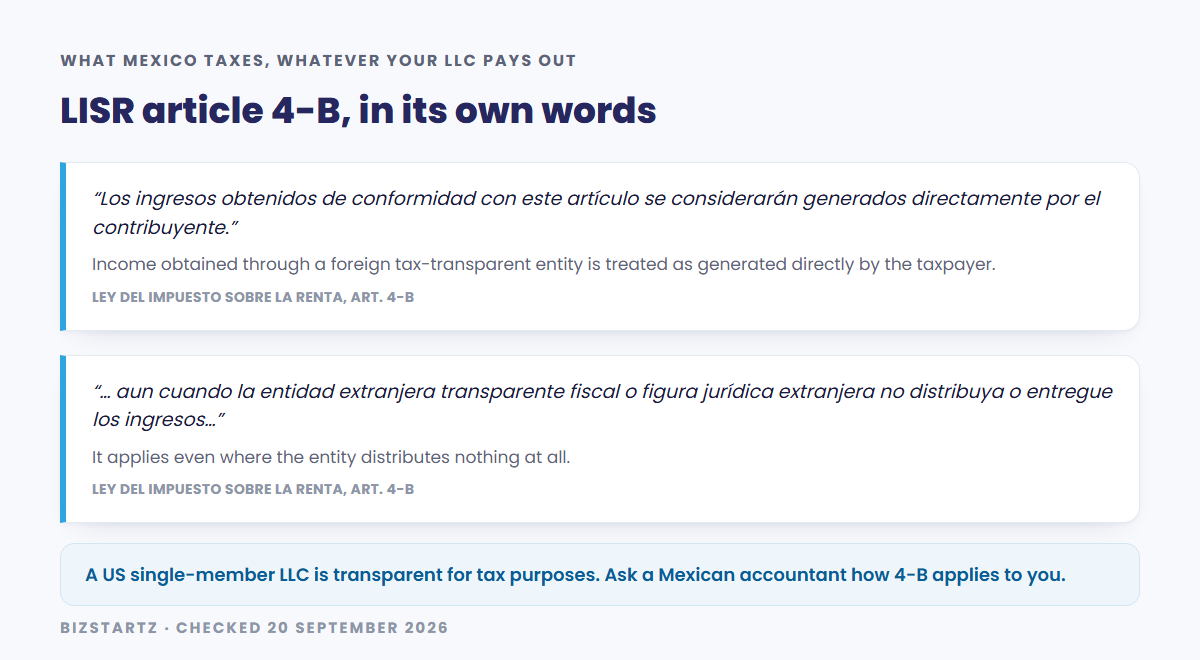
And Mexico has an answer for the people who form one anyway. Articles 4-A and 4-B of the Ley del Impuesto sobre la Renta stop treating a foreign transparent entity as transparent, then hand its income to you as if you had earned it yourself, “aun cuando la entidad extranjera transparente fiscal o figura jurídica extranjera no distribuya o entregue los ingresos”. Whether or not it distributes. That clause is in the law, and it is the part that changes the arithmetic.
In this guide: Do you actually need one? · Where it still earns its keep · Banking from Mexico · What Mexico does about it · The US side · What it costs · Questions Mexican founders ask · Who it suits
Do you actually need a US LLC from Mexico?
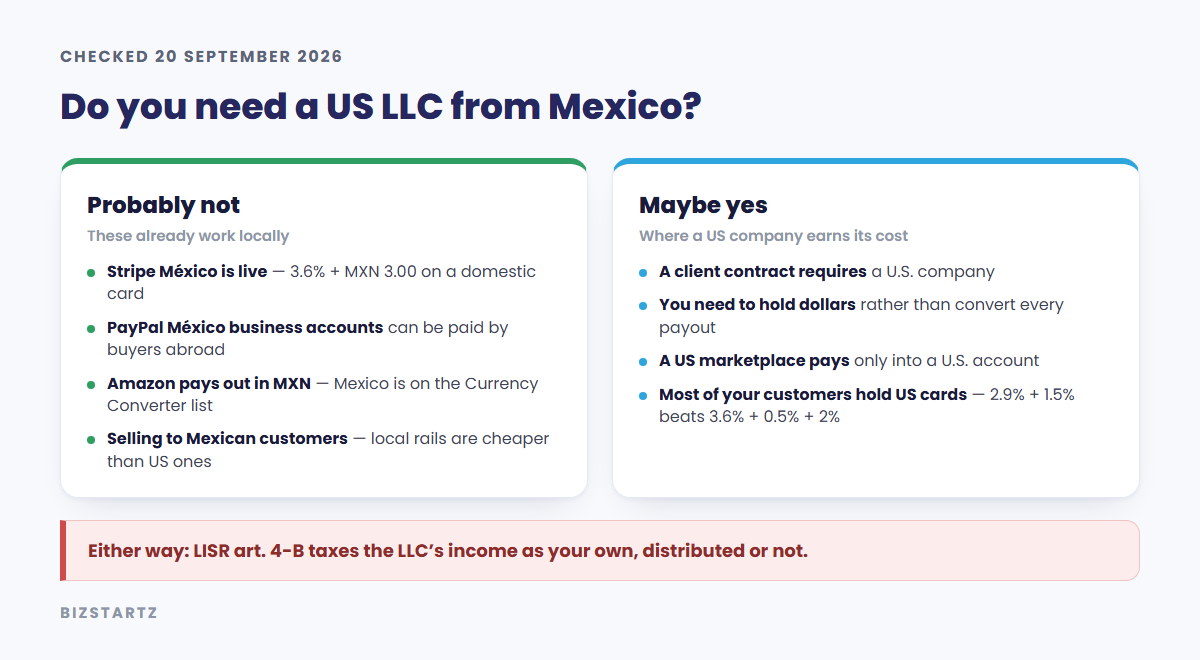
Run these three checks before you spend anything. In Mexico, unusually, all three tend to come back green.
Stripe is fully live in Mexico
Mexico sits in Stripe’s main supported list with a direct registration link. No preview label, no invite-only, no extended network (stripe.com/global, checked 20 September 2026). Nepal, Bangladesh, Pakistan and the Philippines still appear nowhere on that page.
Stripe Mexico’s published standard pricing is 3.6% + MXN 3.00 per successful domestic card transaction, plus 0.5% for international cards and 2% more where currency conversion is required. Bank debits, transfers and the other locally relevant methods are 4% + MXN 3.00 (Stripe México pricing). If you read a guide telling you a US LLC is how you get Stripe, it wasn’t written for Mexico.
PayPal opens Mexican business accounts
PayPal’s Mexican user agreement, last updated 22 January 2026, requires an individual to be “residente en México y tener al menos 18 años”, and a business entity to be constituted in Mexico or resident there (PayPal México, contrato de usuario). Business accounts are the ones PayPal describes as being for selling goods and services or accepting donations, and they can be paid by buyers abroad.
The fees are on the record too: 3.95% plus a fixed fee of MXN 4.00 for a commercial transaction, an extra 0.50% when the buyer is outside Mexico, and “3.50% por encima del tipo de cambio base” if the money has to be converted (PayPal México, comisiones para vendedores, última actualización 15 July 2026). Hold on to that 0.50% cross-border surcharge. It comes back below, and it is low enough to weaken the usual argument for moving your payments to a US entity.
Amazon will pay a Mexican bank account
This is the one that usually forces the issue, and in Mexico it doesn’t. Mexico is on Amazon’s list of countries accepted for seller registration, between Mali and Micronesia (accepted countries). More importantly, “Mexico | MXN” is on the supported bank-account list for the Amazon Currency Converter for Sellers, between Morocco and Norway (supported bank accounts). Both read on 20 September 2026.
Register, sell, get paid in pesos to a Mexican bank. Compare that with the same question asked from Brazil, where a seller can register and then discover Amazon has nowhere to send the money. For Brazilians that gap is the honest reason to form a US company. Mexicans don’t inherit it.
Where a US LLC still earns its keep
Three situations survive that list. None of them is a hard blocker, which is worth saying plainly, because it means every one of them is a cost-benefit call rather than a necessity.
You need to hold dollars, and Wise won’t hold them for you
Wise publishes the countries you must live in to hold a balance. The list runs Mayotte, Monaco, Netherlands. Mexico isn’t on it (Wise: where you need to live to hold money, checked 20 September 2026). Brazil is on that list, with a footnote limiting it to BRL. Mexico doesn’t even get the footnote.
So if you’re paying US suppliers, US contractors or US ad platforms in dollars, the Mexican routes above all push you through a conversion you didn’t want. Converting into pesos and straight back out is a pure loss, and a US account held by a US entity ends it. This is the strongest of the three reasons, and it only applies if you genuinely spend dollars rather than merely receive them.
Your buyers are abroad — but check the gap before you believe it
Take a USD 1,000 sale to a buyer outside Mexico, paid by PayPal.
- Mexican business account: 3.95% + 0.50% cross-border = USD 44.50, plus the MXN 4.00 fixed fee, plus the 3.50% conversion spread if you take the money out in pesos. Around USD 79.50.
- A US LLC’s US account: 3.49% + 1.50% for an international commercial transaction = USD 49.90, plus USD 0.49, and no conversion while the money stays in dollars (PayPal US merchant fees, page dated 1 September 2026). USD 50.39.
That’s our arithmetic from the two published fee pages, and it comes out at roughly USD 29 per USD 1,000. Now deflate it honestly. Most of that gap is the 3.50% conversion spread, and if you live in Mexico and need pesos to eat, you will pay an exchange spread somewhere no matter where the dollars sit.
The LLC moves the conversion; it doesn’t delete it. Add the wire out of the US account, add the Mexican side’s own FX, and the real saving on USD 20,000 a year of cross-border sales is smaller than the headline suggests and can vanish entirely.
Cards tell the same story in the other direction. A foreign card on Stripe Mexico costs 3.6% + 0.5%, rising to 6.1% plus MXN 3.00 if conversion is required; on a US Stripe account, 2.9% + 1.5% = 4.4% plus 30¢, with 1% more if conversion is needed (Stripe US pricing). But a Mexican card on a US Stripe account is an international card: 2.9% + 1.5% + 1% = 5.4%, against 3.6% locally. If your customers are Mexican, the US account makes you poorer.
A client or a platform contractually requires a US entity
Some US buyers will only sign with a US company, and some platforms only onboard US entities. If that requirement is in writing from someone actually paying you, it’s a legitimate reason and none of the arithmetic above applies. Ask them what they need first, though. It often turns out to be a US bank account or a W-9 rather than a US company.
Banking from Mexico: the step that stops other countries doesn’t stop you
Mercury’s help centre says it cannot open accounts for founders living in the countries and regions it lists, and that “this is based on your country of residence, not your citizenship or nationality.”
Mexico appears on neither the sanctioned list nor the prohibited list (Mercury: prohibited countries, read 20 September 2026 through a reader proxy, because the page blocks direct requests). Bangladesh, Indonesia, Nepal, Nigeria, Pakistan, the Philippines and Vietnam are all on it.
Not prohibited is not approved. Mercury runs its own checks and declines applications for its own reasons, and it does not publish them. What you get from Mexico is a normal starting position rather than an automatic refusal, which is more than most of the countries we write about. Do this check before you form anything, an LLC with no account can’t receive a peso.
Our table of which banks and payment platforms non-residents can actually use, country by country compares the providers side by side, and the mechanics of the application are in opening a US bank account as a non-resident.
What Mexico does about it: LISR Articles 4-A and 4-B
We are not Mexican accountants or lawyers, and nothing here tells you what you owe. What follows is what the law says, quoted, so you can take the right questions to someone qualified. On this topic you will need someone qualified. All quotations are from the consolidated text of the Ley del Impuesto sobre la Renta published by the Cámara de Diputados, última reforma DOF 01-04-2024, read on 20 September 2026.
Article 4-A: your LLC stops being transparent
A US single-member LLC that hasn’t elected to be taxed as a corporation is, for US purposes, disregarded. Its income belongs to its owner. Mexico’s Article 4-A refuses to follow that.
Foreign transparent entities and foreign legal figures, it says, “sin importar que la totalidad o parte de sus miembros, socios, accionistas o beneficiarios acumulen los ingresos en su país o jurisdicción de residencia, tributarán como personas morales”, they are taxed as companies, regardless of whether their members pick the income up at home.
The article then defines what counts as transparent, and the definition reads like a description of exactly this structure: an entity that is not a tax resident for income tax purposes where it was set up, nor where it has its principal administration or effective place of management, and whose income is attributed to its members, partners, shareholders or beneficiaries.
Article 4-B: the income is yours whether or not it reaches you
Article 4-B is the operative one. Mexican residents are obliged to pay tax on income they obtain through foreign transparent entities, in proportion to their participation, measured as the entity’s fiscal profit for the calendar year computed under Title II of the law. Two sentences in that article do the real work.
The first: “Los ingresos obtenidos de conformidad con este artículo se considerarán generados directamente por el contribuyente.” The income is treated as generated directly by you. Taxes paid by or through the entity are likewise treated as paid directly by you, in the same proportion, and tax actually paid can be credited under Article 5.
The second: “Lo dispuesto en los párrafos anteriores será aplicable aun cuando la entidad extranjera transparente fiscal o figura jurídica extranjera no distribuya o entregue los ingresos regulados por este artículo.”
It applies even where the entity distributes nothing. The same paragraph says the proportion is worked out “sin importar que las personas obligadas de conformidad con este artículo no tengan control sobre dichas entidades o figuras”, control is not the test.
Read those together and the practical shape is clear enough to state without advising anyone: profit sitting untouched in a Mercury account is not obviously outside Mexico’s reach, and the LLC is a recurring Mexican compliance item rather than a one-off US filing.
The law also requires you to keep a separate account per entity, on the terms of Article 177, so a later distribution isn’t taxed twice, and to keep the entity’s books and expense documentation available to the tax authorities, if you can’t produce them, its expenses and investments aren’t deductible.
Anyone selling you a US LLC as a way to stop paying Mexican tax is selling you Article 4-B and not mentioning it.
The part almost nobody mentions: the LLC itself can become Mexican
Article 4-A’s first paragraph carries a cross-reference that is easy to skim past. Where a foreign transparent entity meets “lo dispuesto por la fracción II del artículo 9 del Código Fiscal de la Federación”, it is considered resident in Mexico.
That fracción reads, in full: “Las personas morales que hayan establecido en México la administración principal del negocio o su sede de dirección efectiva” (Código Fiscal de la Federación, última reforma DOF 09-04-2026). Companies that have established their principal business administration or effective seat of management in Mexico.
Consider what a one-person Wyoming LLC run from a flat in Guadalajara looks like against that test. Every decision is taken in Mexico. The work is done in Mexico. There is no office, no staff and no management anywhere else. We are not going to tell you how SAT would characterise your particular company, because that is a facts-and-circumstances question and it belongs to a Mexican adviser.
We will tell you that the question exists, that it sits in the first paragraph of the article usually quoted for something else, and that it is worth raising before you form the company rather than after.
The treaty doesn’t rescue you from your own country
There is a US–Mexico treaty, and it is easy to reach for. The Convention between the Government of the United States of America and the Government of the United Mexican States for the Avoidance of Double Taxation and the Prevention of Fiscal Evasion with Respect to Taxes on Income was signed at Washington, D.C. on 18 September 1992, with a protocol in 2003 (IRS: Mexico tax treaty documents).
Article 1(3) of that convention says: “Notwithstanding any provision of the Convention except paragraph 4, a Contracting State may tax its residents (as determined under Article 4 (Residence)), and by reason of citizenship may tax its citizens, as if the Convention had not come into effect.” A saving clause. Mexico taxes Mexican residents as though the treaty were not there.
Article 4-A of the LISR has a matching carve-out in the other direction — “Lo dispuesto en este artículo no será aplicable a los tratados para evitar la doble imposición, en cuyo caso, serán aplicables las disposiciones contenidas en los mismos” — so the treaty governs where it applies. But a saving clause is precisely the place where it doesn’t apply to you.
We read Article 1 and confirmed that the limitation-on-benefits provision is Article 17. We did not read the withholding articles, so this guide quotes no treaty rate and you should not infer one. Treaty positions are individual and they are argued with a tax adviser holding the text open, not inherited from a blog.
Questions to take to a Mexican accountant
- Is the LLC I’m describing an “entidad extranjera transparente fiscal” under Article 4-A?
- If it is, does Article 4-B make its profit taxable to me in the year it arises, before any distribution, and in which return do I report it?
- How is that profit computed under Title II, and what records will you need from me each year?
- Given where I actually work and decide, is there a risk the LLC has its “sede de dirección efectiva” in Mexico under Article 9 fracción II of the CFF, and what would that change?
- Can I credit US tax paid, and under what conditions?
- Does Article 178’s February informational return cover income obtained through this entity in my case? We found that stated in the consolidated text of Article 178 but could not open that page of the official PDF, so treat it as a question rather than an answer.
- If the LLC pays me for my services instead of distributing profit, does the answer change?
- What will you charge me each year to handle all of this?
That last question is not filler. Get the number before you form anything, because it is the number that decides whether the fee saving in the previous section survives.
The US side
- Confirm the bank and the platform first. It costs nothing and it’s the step most likely to change your mind.
- Choose a state. Wyoming charges USD 100 for Articles of Organization, and its annual report license tax is “$60 or two-tenths of one mill on the dollar ($.0002) whichever is greater based on the company’s assets located and employed in the state of Wyoming” (Wyoming Secretary of State fee schedule, effective 1 July 2026). Delaware costs more to keep: 6 Del. C. § 18-1107 sets a USD 400 annual tax, “due and payable on the first day of June following the close of the calendar year”, with a USD 200 sum on non-payment and interest of 1½% a month (Delaware Code). The rest are compared in which US state to choose as a non-resident.
- Appoint a registered agent in that state and keep the renewal paid.
- Get the EIN. The IRS says that if “your principal place of business is outside the U.S.”, you “apply by phone, fax or mail” rather than online, and it warns: “Beware of websites that charge for an EIN. You never have to pay a fee for an EIN” (IRS: get an EIN, last reviewed 19 August 2026). Step by step: how to get an EIN without an SSN.
- Open the US account, then apply to the platform you formed the company for.
Form 5472, every year, even at zero
A single-member LLC owned by a non-US person is a foreign-owned US disregarded entity. The IRS instructions are explicit: “A foreign-owned U.S. DE is required to file a pro forma Form 1120, U.S. Corporation Income Tax Return, with Form 5472 attached by the due date (including extensions) of that Form 1120.” It cannot be e-filed. It faxes to 855-887-7737 or goes by mail to 1973 Rulon White Blvd, M/S 6112, Ogden, UT 84201.
“A penalty of $25,000 will be assessed on any reporting corporation that fails to file Form 5472 when due and in the manner prescribed,” and “if the failure continues for more than 90 days after notification by the IRS, an additional penalty of $25,000 will apply” (IRS Instructions for Form 5472, Rev. 12/2024). That is the single largest recurring risk in owning one of these companies casually. More in our guide to Form 5472 for foreign-owned US LLCs.
Form 1040-NR, only if the US side actually reaches you
The IRS requires a return from a nonresident alien “engaged or considered to be engaged in a trade or business in the United States during the year”, and from one who isn’t so engaged but holds US income whose tax wasn’t satisfied by withholding at source.
Effectively connected income “is taxed at graduated rates”; FDAP income “is taxed at a flat 30 percent (or lower treaty rate, if qualify) and no deductions are allowed against such income” (IRS: taxation of nonresident aliens, updated 17 February 2026).
Whether your LLC’s activity makes you engaged in a US trade or business depends on where you work, who does the work and what you sell. Many non-resident owners serving clients from abroad conclude that it doesn’t. That is a conclusion to reach with a US tax adviser, not an assumption to inherit from a sales page.
One filing you can stop worrying about
BOI reporting no longer applies to US-formed companies. FinCEN’s page states that “all entities created in the United States, including those previously known as ‘domestic reporting companies’, and their beneficial owners are now exempt from the requirement to report beneficial ownership information (BOI)”.
The interim final rule was published on 26 March 2025 and the final rule, issued 11 August 2026, took effect on 14 August 2026 (FinCEN: beneficial ownership information). If a provider is still billing you for BOI filing, ask why.
What it costs
| Item | Amount | Source |
|---|---|---|
| Wyoming, to file | USD 100 | WY SoS fee schedule, effective 1 July 2026 |
| Wyoming, each year | USD 60 minimum | Same schedule (or $0.0002 per dollar of Wyoming assets, whichever is greater) |
| Delaware, each year | USD 400, due 1 June | 6 Del. C. § 18-1107 |
| EIN | No IRS fee | IRS, last reviewed 19 August 2026 |
| Formation service | USD 199 / 299 / 699 + state fees | our pricing page |
| Registered agent, each year | Varies by provider | Not a fixed figure; get a quote |
| Form 5472, each year | Your time or a preparer’s fee | Mandatory regardless of income |
| Mexican accountant, each year | Not priced here | Get two quotes before forming |
| Moving dollars to Mexico | Not priced here | Wire fees plus an FX spread |
The bottom four rows are the ones that decide the answer, and they are the four we can’t put a number on. Anyone who gives you a confident total without asking what your Mexican accountant charges is guessing.
Questions Mexican founders ask
Can I open a US LLC from Mexico without living in the US?
Yes. You can register the company, get an EIN by phone, fax or mail, and file its US returns without visiting the United States or holding an SSN. What you cannot do remotely is escape the Mexican side: Articles 4-A and 4-B of the LISR apply to you where you live.
Will Mercury open an account for a founder living in Mexico?
Mexico is on neither of Mercury’s exclusion lists, and Mercury says the lists are based on country of residence rather than citizenship (checked 20 September 2026). That is a far better starting point than Nepal, Nigeria, Pakistan or the Philippines, all of which are prohibited. It is not a guarantee of approval, because Mercury applies its own checks and does not publish them.
Does a US LLC create Mexican tax even if I never take the money out?
Article 4-B of the LISR says its rules apply “aun cuando la entidad extranjera transparente fiscal o figura jurídica extranjera no distribuya o entregue los ingresos”, and that the income is “generados directamente por el contribuyente”. On the face of the statute, not distributing is not a shield. How that lands on your particular facts is a question for a Mexican accountant, and it is the first question to ask.
Do I need a US LLC to sell on Amazon from Mexico?
No. Mexico is accepted for Amazon seller registration, and “Mexico | MXN” is on the supported bank-account list for the Amazon Currency Converter for Sellers, so Amazon can pay a Mexican bank account in pesos (both checked 20 September 2026). That is the opposite of Brazil and Bangladesh, where the payout gap is the real reason to form a US entity.
Who this suits, and where to start
It can make sense if you genuinely need to hold and spend dollars rather than receive them, or a paying client has put a US entity in writing, or you sell to buyers outside Mexico in enough volume that the fee gap covers the US filings, the state tax and a Mexican accountant who understands Article 4-B. In every one of those versions, you have already asked an accountant what the company will cost you each year in Mexico.
It probably doesn’t if your customers are Mexican, Stripe México already handles your checkout, Amazon already pays your Mexican bank account, or your whole case rests on a fee saving you haven’t multiplied by your real volume and then reduced by the conversion you were going to pay anyway.
Start with the checks that cost nothing. Confirm which platform you actually need. Ask Mercury, in writing, whether it will take an owner resident in Mexico. Ask a Mexican accountant the eight questions above and get a yearly fee. Form the company last, because it’s the only step you can’t undo for free.
If it does fit, Bizstartz forms US LLCs for non-resident founders and handles the EIN and the bank application (US company formation). The US side we can do. The Mexican side needs a Mexican adviser, and on Articles 4-A and 4-B that is not a formality.
Researched with the help of AI tools and checked by hand on 20 September 2026. Every legal, fee and availability claim links to the source it came from. Where we could not confirm something, the text says so: we quote no US–Mexico treaty withholding rate, no Mexican tax rate, and no commencement date for Articles 4-A and 4-B, and we flag Article 178’s February informational return as a question rather than an answer because the official PDF would not open at that page. Rules in this area change; check the linked sources again before you act.
🎯 Ready to start? Claim your free consultation and we'll map out your US LLC formation strategy — EIN, banking, and the right state for your country.

Ready to start your company?
Bizstartz handles formation, EIN, banking and compliance for founders worldwide.