No US state makes an LLC owner anonymous. What some states do is leave your name off the formation filing that anyone can pull up for free on a Secretary of State website. That is a real and worthwhile difference — it is just a much narrower one than the phrase “anonymous LLC” suggests, and knowing the boundary matters more than the marketing.
If you are a founder in Kathmandu, Dhaka, Lagos or Karachi, the concern is usually simple and completely legitimate: you do not want your home address published on a US government website that Google indexes. This page tells you exactly which names each state puts on the public record, who learns your identity regardless of state, and what actually controls whether your home address ends up on a filing.
We checked each state against its own Secretary of State form, statute or fee page in September 2026, and every figure below is linked to that source.
On this page: What “public record” actually covers · The four states, compared · Who learns your identity anyway · Your home address is the real problem · Where BOI reporting stands now · Two things not to do · How to choose · How we help
What “public record” actually covers
When someone searches a company on a state website, they see the documents that company filed with the state. For an LLC that is normally two things: the formation document (Articles of Organization, or a Certificate of Formation in Delaware) and whatever periodic filing the state requires afterwards.
So there are four separate questions, and most articles on this topic only answer the first:
- Does the formation filing require member or manager names?
- Does any later filing require them?
- Whose name ends up on the filing anyway — the organizer, the registered agent, the person who signs?
- What addresses does the filing publish?
Question three is the one that catches people. Someone has to sign a formation document, and that signature is part of the public record even in the states with the strongest privacy rules.
The four states, compared
| State | Members/managers on the formation filing? | Names on any later filing? | Who is named anyway |
| New Mexico | No member names. Manager names only if you choose to list them | No — the LLC Act sets no periodic report | Organizer, registered agent |
| Wyoming | No | No — the annual report is about Wyoming assets | Organizer, registered agent |
| Delaware | No | No — LLCs file no annual report at all | Authorised person who signs, registered agent |
| Nevada | Yes — every initial manager, or every initial member if member-managed | Yes — an annual list of managers or managing members | Managers/members, registered agent |
New Mexico: the least on the record, and no annual filing
New Mexico’s LLC Act (NMSA 53-19-8) says the articles of organization must set out the company name, “the street address of the initial registered office and the name of the initial registered agent at that address”, the duration if it is not perpetual, and two statements: “if management of the limited liability company is vested to any extent in a manager, a statement to that effect”, and “if the limited liability company may carry on its business and affairs as a single member limited liability company, a statement to that effect”.
Read that last item carefully, because no other guide mentions it. New Mexico does not publish who owns the company — but if it is a single-member LLC, the public filing says so. Anyone reading it knows there is exactly one owner. New Mexico’s own form also carries an optional manager name and address field, so a manager-managed LLC can end up naming someone if that field is completed.
The other genuine advantage is the absence of a follow-up filing. New Mexico’s LLC Act contains no periodic report requirement for LLCs — the biennial reporting obligation in New Mexico applies to corporations under a different statute. There is no annual document asking “who runs this now”, and no annual state fee. The filing fee is $50.
The flip side is a banking one, and it is real. Because the state holds no ownership record, you cannot point a bank at a state website to prove you own the company. Your operating agreement does that job, so have a proper one before you apply for an account. More in our New Mexico LLC guide.
Wyoming: nothing on the formation filing, and the annual report is about assets
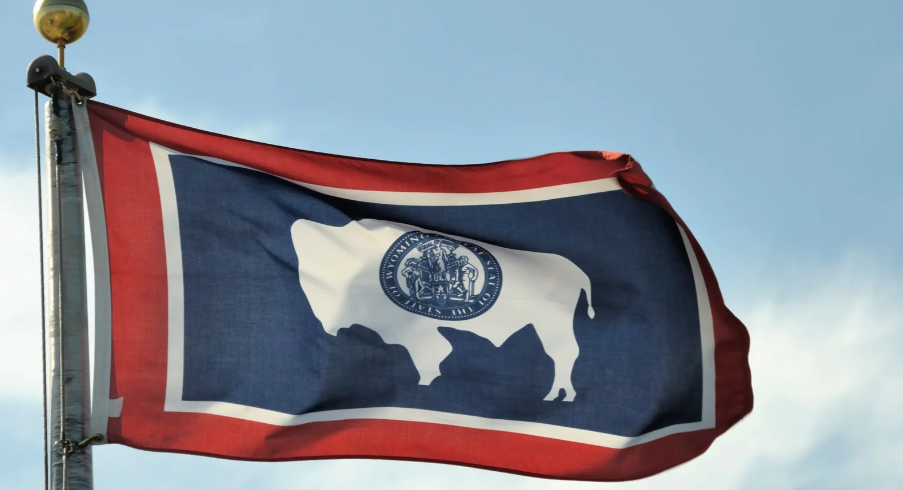
Wyoming’s Articles of Organization form has six fields: the company name, a close-LLC election box, the registered agent’s name and physical address, the LLC’s mailing address, the principal office address, and a certification. There is no member or manager field anywhere on it. The statute (W.S. 17-29-201) asks only for the name, the registered office street address, the registered agent’s name, and the agent’s written consent to the appointment.
The form carries two signature blocks: “(Shall be executed by an organizer.)” and “(Shall be executed by the registered agent.)” That organizer signature is the honest answer to “does my name appear?” If you sign your own articles, your name is on the public filing. If a formation company or attorney signs as organizer, theirs is. Plenty of pages — including the previous version of this one — said “your name never appears in the state database” without that condition attached.
Wyoming’s annual report is not an ownership disclosure. Under W.S. 17-29-209 it reports the company’s “capital, property and assets located and employed in the state of Wyoming” and gives the principal office address. The worksheet you use to work the figure out is headed “Not a Public Record” and states that it “is not a public record under the Public Records Act, W.S. 16-4-203(d)(v)”. Wyoming’s own online annual report guidance asks for the names and addresses of officers and directors for corporations — not for LLCs.
Costs: $100 to file the articles, then an annual report licence tax of $60 or two-tenths of one mill on the dollar of Wyoming assets, whichever is greater. For a company with no assets in Wyoming that is $60. Details in our Wyoming LLC guide.
Delaware: minimal filing, no annual report, and the state tells you what its search shows

Under 6 Del. C. § 18-201(a), a Delaware certificate of formation sets forth the company name, “the address of the registered office and the name and address of the registered agent”, and anything else the members choose to add. Section 18-204(a) says each certificate “shall be executed by 1 or more authorized persons” — the same organizer point as Wyoming, under a different name.
Delaware answers the public-search question itself. Its entity search page states that the entity information provided free of charge “consists of the entity name, file number, incorporation/formation date, registered agent name, address, phone number and residency.” No officers, no members, no managers.
Delaware LLCs also file no annual report at all. What they do pay is an annual tax of $400, due on or before 1 June, with a $200 penalty plus 1.5% interest per month if it is late. The Delaware Code sets the amount: “Every domestic limited liability company … shall pay an annual tax … in the amount of $400” (6 Del. C. § 18-1107(b), checked September 2026). Guides still quoting $300 are out of date, and the $400 minimum you may see on the Division of Corporations’ tax pages is the separate corporation franchise tax. The full picture is in our Delaware LLC guide.
Nevada: this is not a privacy state, and it never was
Nevada belongs on this page for one reason: to correct its reputation. NRS 86.161 requires the articles of organization to set forth the company name and “the name and address, either residence or business, of each initial manager” where the company is manager-managed, or “of each initial member” where it is not.
It does not stop at formation. NRS 86.263 requires an annual list containing the company name, “the names and titles of all of its managers or, if there is no manager, all of its managing members”, and “the address, either residence or business, of each manager or managing member listed”, signed by a person certifying that the list is “true, complete and accurate”. The fee is $150. Nevada’s own filing product is named “Articles of Organization, Initial List of Managers/Managing Members and State Business License” — the disclosure is built into the formation package.
On top of that, Nevada’s state business licence fee is $200 a year for non-corporate entities, due on the last day of the anniversary month alongside the annual list. So Nevada asks for more names than the other three states here and costs more to keep alive. Our Nevada LLC guide covers the rest.
Who learns your identity anyway, in every state
This is the section the old version of this page was missing, and it is the one that decides whether an “anonymous LLC” is worth anything to you.
- Your registered agent. Every state on this page requires one with a physical in-state street address to receive service of process. They hold your real name and contact details by necessity, and they are the door a court process server knocks on.
- The IRS. Form SS-4, the EIN application, requires a named “responsible party”. If your LLC is a foreign-owned single-member LLC, it files Form 5472 with a pro forma Form 1120 every year, and that form reports the direct and ultimate foreign owner. The IRS knows who you are from the first week of the company’s life. Our guide to US tax filing requirements for international founders covers those filings.
- Any bank or payment processor. Under 31 CFR 1010.230, covered financial institutions must “establish and maintain written procedures that are reasonably designed to identify and verify beneficial owners of legal entity customers” — each individual who owns 25% or more of the equity, plus one individual with significant responsibility to control or manage the company. This is the bank customer due diligence rule and it is separate from the FinCEN reporting regime below. No state filing exempts you from it.
- A court, on a subpoena. Whatever the state does not hold, the agent, the bank and the IRS do — and all three can be compelled.
What state-level privacy actually gets you, then, is narrow but not worthless: your name and home address are not sitting in a free, indexed, publicly searchable database that anyone — a competitor, a data broker, a stranger — can query in ten seconds without a reason. That is the whole benefit. It is not invisibility, and anyone selling it as invisibility is selling you something else.
Your home address is the real problem, not your name
For most non-resident founders, the anxiety about “anonymous LLCs” is actually about an address. Look again at what the filings publish. Wyoming’s form asks for the LLC’s mailing address and its principal office address. New Mexico’s asks for the registered office and the principal place of business. Those fields are public, and if you type your house into them, your house is public.
Two things are worth being precise about here.
What is legitimate: using a business address — your registered agent’s service address where they offer it, or a commercial mail-forwarding address — as the company’s mailing and principal office address. That is the company’s address, and companies are entitled to have a business address that is not a director’s kitchen.
What is not: entering a US mailbox on a bank, payment processor or government form as the place you personally live. That is a false statement about you, not a choice about your company, and it is the single fastest way to have an account frozen and closed once the provider verifies it. Some providers will not accept the address at all — Relay, for example, requires each beneficial owner to give a physical US address and states plainly that PO boxes and virtual mailboxes are not accepted. A mail-forwarding address is a solution to the public-record question. It is not a solution to the banking question.
Where BOI reporting stands now
This changed in August 2026 and a lot of pages have not caught up.
The Corporate Transparency Act took effect on 1 January 2024 and initially required most US LLCs to file a Beneficial Ownership Information report with FinCEN. Under FinCEN’s final rule — alert dated 11 August 2026, rule effective 14 August 2026 — that no longer applies to companies formed in the United States. FinCEN’s own page states: “U.S. companies are exempt from the Beneficial Ownership Information (BOI) reporting requirements and therefore, are no longer required to file BOI reports,” and “U.S. persons do not need to provide BOI to reporting companies.”
Reporting still applies to entities formed under foreign law that register to do business in a US state, unless they qualify for an exemption. So if your LLC was formed in Wyoming, New Mexico, Delaware or Nevada — including one owned entirely by non-residents — there is no BOI report to file. Check fincen.gov/boi before you act on this; it is the page that changed, and it can change again.
Note what this does not change: the bank due diligence rule above is a separate regulation aimed at financial institutions, and it is unaffected. Your bank will still ask who owns the company.
Two things this page used to recommend, and no longer does
Both were on this page before September 2026. We are naming them rather than quietly deleting them, because readers who acted on the old version should know why.
Nominee managers in Nevada. The old text suggested paying a nominee service to be listed as your manager on the public record — “a figurehead signer” with no control — while you kept control through a private operating agreement. Nevada’s annual list must be signed by someone certifying that it is “true, complete and accurate” (NRS 86.263). Naming a person as the company’s manager when they do not manage the company is a false statement on a state filing. We will not advise it, and you should be wary of anyone who does.
Privacy as a shield against legal process. The old page described New Mexico as holding no ownership record “to release, even if subpoenaed”. The first half is accurate. The framing is not: your agent, your bank and the IRS all hold the answer, and all three respond to subpoenas. Keeping your address out of a Google-indexed database is a sensible privacy measure. It is not a litigation strategy, and treating it as one is how people end up with genuine problems.
How to choose
- You want the least on the public record and no annual paperwork: New Mexico. Accept that the filing reveals single-member status, and have a solid operating agreement ready for the bank.
- You want nothing on the formation filing plus an established, well-understood jurisdiction: Wyoming. Have a third party act as organizer if you do not want your own name on the signature line.
- You expect outside investors later: Delaware — the privacy position is equivalent to Wyoming’s, and the $400 annual tax buys you a jurisdiction investors already understand.
- You want your name off the record: not Nevada.
One thing the state choice does not decide is whether a US bank or payment processor will approve you. That turns on where you live, not where you filed. Our non-resident state cost breakdown compares the real year-one cost of each state alongside that point.
How we help
We form LLCs in every state on this page for founders who live outside the US. Practically, on the privacy question, that means two things: we can act as organizer so that the signature on your Articles of Organization is ours rather than yours, and our registered agent service gives the company an in-state service address instead of putting a foreign home address on a filing that does not need one.
What we will not do is put a name on a state filing that does not belong there, or tell you an LLC makes you untraceable. See US company formation for what the service covers, or the full list on our services page.
State sources checked September 2026 against each Secretary of State’s own forms, statutes and fee pages. Filing fees and statutes change — confirm with the state before you file.
Related Guides
- Delaware Business Entity Search: A Complete Guide for Entrepreneurs and Investors
- Utah Business Entity Search: A Complete Guide for Entrepreneurs
- How to Start an LLC in Wyoming: Step-by-Step Guide
Compare the real year-one cost of every popular state in our state cost breakdown, then file with us.
🎯 Ready to start? Claim your free consultation and we'll map out your US LLC formation strategy — EIN, banking, and the right state for your country.

Ready to start your company?
Bizstartz handles formation, EIN, banking and compliance for founders worldwide.