An LLC — limited liability company — is a US business entity created under the law of a single US state. It gives the business a legal identity separate from the people who own it, so the company’s debts are the company’s, not yours. The IRS describes it exactly that way: “a Limited Liability Company (LLC) is a business structure allowed by state statute” (IRS, checked 18 September 2026).
You do not have to be American to own one. There is no citizenship or residency requirement, which is why founders in Nepal, Pakistan, India, Bangladesh, Nigeria and the Philippines form them from home every day.
That is the easy half. The harder half is what an LLC isn’t, and that is where most people reading a formation company’s website get misled. It is not a corporation. It is not a tax-free structure. It is not a visa, a US residence, or a way out of your own country’s rules. This guide covers both halves, plainly, with the source for every rule.
In this guide: What an LLC is · What an LLC is not · Limited liability, in plain terms · How it is taxed · Why founders abroad use one · What it costs each year · Your yearly obligations at a glance · Whether it suits you · FAQ
What an LLC is
Four things define it.
- It is created by a state, not by the federal government. There is no such thing as an “American company” in the abstract. You form an LLC in Wyoming, or Delaware, or New Mexico, and that state’s statute governs it. Choosing between them is a real decision with real cost differences — see which US state to file your LLC in.
- Its owners are called members, not shareholders. What they hold is membership interest, not stock. The split is set by your operating agreement rather than by share certificates, and it does not have to be equal.
- Anyone can be a member. The IRS: “Most states do not restrict ownership, so members may include individuals, corporations, other LLCs and foreign entities.” One member or fifty; “there is no maximum number of members.” More on what changes when you add one in how many members a US LLC can have.
- It has to have a registered agent in its state. That is the address where legal papers are served. Delaware’s certificate of formation, for instance, must give “the address of the registered office and the name and address of the registered agent for service of process required to be maintained by § 18-104” (6 Del. C. § 18-201(a)(2)). This is why a formation package always includes one: you cannot have a company in a state where you don’t live without someone there to receive its mail.
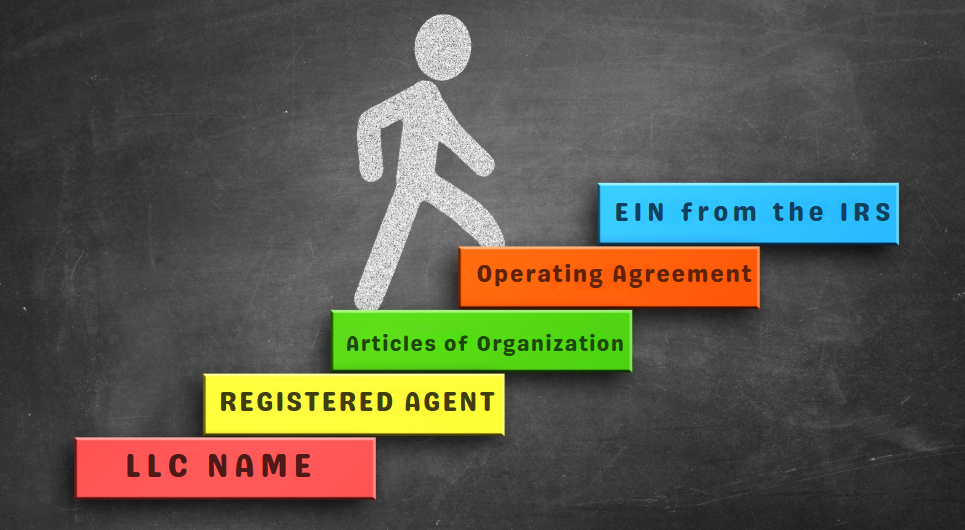
Forming one is short: pick the state, pick a name that isn’t taken, appoint a registered agent, file the Articles of Organization (some states call it a Certificate of Formation), write an operating agreement, and get an EIN from the IRS. The step that catches non-residents is the EIN. The IRS online application needs “the responsible party’s Social Security number (SSN) or individual taxpayer ID number (ITIN)” and is unavailable if “your principal place of business is outside the U.S.” — in which case the IRS itself directs you to “apply by phone, fax or mail” (IRS: apply for an EIN online). Getting an EIN without an SSN covers the route that does work.
What an LLC is not
This is the section worth reading twice.
It is not a corporation
No shares, no shareholders, no board of directors, no annual general meeting. That is the appeal for a small business, and it is a limitation if you ever want outside investment: venture funds buy preferred stock in corporations, and an LLC has none to sell. If US investors are genuinely in your plan, read whether a non-resident can own an S corp — short answer, you cannot, and the article explains what that leaves.
It is not a tax-free structure
An LLC is usually not a separate US taxpayer, and somewhere along the way “not a separate taxpayer” got sold as “no tax and no paperwork.” Neither follows.
A US LLC wholly owned by one foreign person is a disregarded entity, and it must file a pro forma Form 1120 with Form 5472 attached every year, to a dedicated address in Ogden, Utah. The penalty for not filing is $25,000, and, if the failure continues for more than 90 days after notification by the IRS, a further $25,000 for each related party, for each 30-day period (or part of one) that the failure continues (Instructions for Form 5472). That obligation exists whether or not the company made a cent. Our Form 5472 guide walks through it.
Whether you also owe US income tax is a separate question that turns on whether the business has income effectively connected with a US trade or business. It is a genuine question with a genuine answer, and the answer depends on how and where your business actually operates — not on which state you filed in. See filing taxes as a non-US resident with a US business, and take the conclusion to a US tax adviser rather than to a formation company.
It does not give you a visa or make you a US resident
Owning a US company and being allowed to live or work in the United States are unrelated. USCIS publishes the pathways an entrepreneur can use — International Entrepreneur parole, B-1 temporary business visitor, E-2 treaty investor, F-1 optional practical training, H-1B, L-1A intracompany transferee and O-1 (USCIS: nonimmigrant or parole pathways for entrepreneurs). Every one is a separate application with its own eligibility test. “I registered an LLC” is not one of them and does not qualify you for any of them. If a route like the intracompany transfer is relevant to you, the L-1 visa process is a starting point — but that is an immigration matter for an immigration lawyer.
Nor does an LLC make you a US tax resident, which is the good news in the same fact. Residency is decided by the green card test or the substantial presence day count, and no company, address or bank account appears in either (IRS: determining tax residency status).
It does not come with a bank account
Formation and banking are two decisions made by two different parties. US banks must “identify and verify the identity of any individual who owns 25 percent or more of a legal entity, and an individual who controls the legal entity” when accounts are opened (FinCEN: CDD final rule), and providers apply their own country rules on top. Mercury will not open accounts for founders living in a list of countries that includes Nepal, Pakistan, Nigeria, Bangladesh and the Philippines, and says this is based on residence, not citizenship (Mercury: prohibited countries). Relay asks each beneficial owner for a passport and “a physical U.S. address (no PO boxes, no virtual mailboxes)” and requires the business to have a US operating presence (Relay: required documents).
Check the provider you intend to use against your own country of residence before you pay to form anything. Opening a US business bank account as a non-resident goes through the options. And do not solve a closed door by entering a US address as your home address — that is a false statement on a bank application, and it ends with a frozen account holding your money.
It does not switch off the rules where you live
Your own country still has views on a resident owning a company abroad, sending money to it and receiving money from it — exchange control, controlled-foreign-company rules, local tax on foreign income, declaration requirements. These differ enormously between Nepal, India, Pakistan, Nigeria and the UAE, and a US formation company is not the right source for any of them. Ask a professional at home what your obligations are before you commit, not after your first payout.
Limited liability, in plain terms
The LLC signs the contracts, owns the assets, owes the debts. If the business fails owing money, creditors normally pursue the company, not your house.
What it does not cover, and people routinely assume it does:
- Anything you personally guarantee. Sign a personal guarantee on a loan or a lease and you owe it personally. The company structure is irrelevant to that promise.
- Your own wrongful acts. Limited liability shields you from the company’s obligations, not from your own conduct.
- The company’s own tax filings. A $25,000 Form 5472 penalty is the company’s problem, but it is still a bill arriving at your business.
- A company you have not kept separate. Running business income through a personal account, paying household bills from the company, keeping no records — this is what “piercing the veil” arguments are built from. A separate bank account and honest bookkeeping are not administrative fuss; they are the thing that makes the protection real.
How a US LLC is taxed when the owner lives abroad
The federal default depends only on how many members there are. The IRS: “a domestic LLC with at least two members is classified as a partnership for federal income tax purposes unless it files Form 8832 and affirmatively elects to be treated as a corporation,” while “an LLC with only one member is treated as an entity disregarded as separate from its owner.”
| Members | Default treatment | What the LLC files | By when |
| One, foreign-owned | Disregarded entity | Pro forma Form 1120 with Form 5472 attached | 15th day of the 4th month — 15 April for a calendar year |
| Two or more | Partnership | Form 1065 with a Schedule K-1 for each member | 15th day of the 3rd month — 15 March |
| Either, by election | Corporation (Form 8832) | Form 1120, tax at a flat 21% of taxable income | 15th day of the 4th month |
Two footnotes that matter for this audience. An S corporation election is not available to you — the IRS bars nonresident alien shareholders outright. And a multi-member LLC with foreign partners can face withholding at 37% for non-corporate partners on effectively connected income allocated to them, which is the single biggest reason to think before adding a partner casually (IRS: partnership withholding).
Why founders outside the US actually form one
Almost always, it is about getting paid. Not tax.
Stripe’s own country list, checked 18 September 2026, is the clearest illustration: Nepal, Pakistan, Bangladesh and the Philippines are not listed at all. India appears as “Preview” with a contact-sales link rather than open registration. The United Arab Emirates is fully available. Nigeria is reachable through Stripe’s “extended network” via Paystack rather than directly (stripe.com/global). A US LLC applies to Stripe as a US business, which is the whole point.
The same logic runs through PayPal Business, Amazon seller payouts and US-dollar banking: the platform you need is available to a US entity and not to you personally where you live. An LLC is a key to those doors — not a guarantee any of them opens, since each runs its own checks on the owner.
And there are secondary reasons that are real but smaller: contracting with US clients who prefer to pay a US entity, keeping business and personal money separate, and having a structure that can take on a partner later.
If your clients already pay you by bank transfer or through a freelance marketplace, and no platform you need is refusing you, an LLC may be an annual cost solving a problem you do not have. That is a legitimate conclusion to reach.
What it costs each year
Costs are set by the state you file in, and they differ by an order of magnitude. Three worth knowing, all checked 18 September 2026:
| State | To form | Every year | Source |
| Wyoming | $100 for the Articles of Organization | Annual report licence tax of “$60 or two-tenths of one mill on the dollar ($.0002) whichever is greater based on the company’s assets located and employed in the state of Wyoming” | Wyoming SOS fee schedule, effective 1 July 2026 |
| Delaware | State filing fee | $400 annual tax, due 1 June, plus $200 if it is late | 6 Del. C. § 18-1107 |
| California | State filing fee | “Every LLC that is doing business or organized in California must pay an annual tax of $800”, plus an income-based fee starting at $900 above $250,000 of California income | California FTB |
Add a registered agent fee in whichever state you choose, and any accountant you use for the federal filings. Wyoming’s $60 floor against California’s $800 is why nobody forms a California LLC from abroad by choice — though “doing business in California” is defined by California, not by where you filed, so the state you pick does not always settle the question.
Your yearly obligations at a glance
- State annual report and fee — in the state you formed in, on that state’s date. Miss it repeatedly and the state can dissolve the company or strip its good standing, which is usually discovered at the worst moment, when a bank asks for a certificate of good standing.
- Registered agent renewal — required by statute for as long as the company exists.
- Federal return — pro forma Form 1120 plus Form 5472 by 15 April for a single foreign owner, or Form 1065 with Schedules K-1 by 15 March for two or more members.
- Your own US return, if you have one. Depends on whether there is effectively connected income. Settle it with an adviser rather than assuming.
- Home-country filings — whatever your own country requires of a resident who owns a company abroad.
- BOI reporting — no longer required for US companies. Under FinCEN’s final rule issued 11 August 2026 and effective 14 August 2026, US companies “are no longer required to file BOI reports” (FinCEN). Foreign companies registered to do business in a US state are still reporting companies. If a provider is still charging you for BOI filing on a US-formed LLC, ask what you are paying for.
Whether an LLC suits you
A short honest test.
- Is a payment platform or client refusing you because of where you live? If yes, a US LLC is a serious option and the rest of this is detail.
- Will a bank or payment provider accept an owner resident in your country? Check the published lists before you spend anything. This stops more projects than tax does.
- Can you carry the annual cost and the filings? A company that is not filed for is worse than no company, because the penalties are real and they accrue.
- Do you know what your own country expects of you? Ask locally first.
- Are you expecting it to reduce your tax? That is the wrong reason, and it is the reason that gets people into trouble in both countries.
How Bizstartz helps
We form US companies for founders who live outside the United States: the state filing, a registered agent, and the EIN application on the route that works without an SSN. Current scope and pricing are on our US company formation service page. What we file is on us; how a bank, Stripe or Amazon decides is on them, and we will not help anyone misdescribe where they live or who owns a company in order to pass a check.
Frequently asked questions
Can a non-US citizen own an LLC?
Yes, and own all of it. There is no citizenship or residency requirement for LLC membership, and the IRS confirms members may include individuals, corporations, other LLCs and foreign entities. This is the clearest difference from an S corporation, which cannot have nonresident alien shareholders.
Does an LLC mean I pay no US tax?
No. An LLC is usually not a separate US taxpayer, but that is not the same as owing nothing and it is definitely not the same as filing nothing. A foreign-owned single-member LLC must file a pro forma Form 1120 with Form 5472 each year, with a $25,000 penalty for not doing so. Whether US income tax is owed depends on whether the business has effectively connected income, which is a question for a US tax adviser.
Does forming a US LLC help me get a visa?
No. USCIS lists the entrepreneur pathways — International Entrepreneur parole, B-1, E-2, F-1 OPT, H-1B, L-1A and O-1 — and each has its own eligibility requirements. Owning a company is not a pathway and does not qualify you for one. It also does not make you a US tax resident, which is decided by the green card test or the substantial presence day count.
Do I need a US address to form an LLC?
The company needs a registered agent with an address in its state, which a formation service provides. Your personal address stays your own. But some banks ask each beneficial owner for a physical US address — Relay says so explicitly, “no PO boxes, no virtual mailboxes” — so read your intended provider’s requirements before you form, and never enter an address as your residence when it is not.
Do I need an EIN?
In practice yes: it is the company’s federal tax number and every bank and payment platform asks for it. The IRS online tool needs the responsible party’s SSN or ITIN and is unavailable when the principal place of business is outside the US, so non-residents apply by phone, fax or mail instead.
Do I still have to file a BOI report?
Not for a US-formed company. FinCEN’s final rule of 11 August 2026, effective 14 August 2026, means US companies are no longer required to file beneficial ownership information reports. Foreign companies registered to do business in a US state remain reporting companies.
Which state should I form in?
For most non-resident owners the choice comes down to annual cost and simplicity, and Wyoming’s $60 minimum annual licence tax against Delaware’s $400 and California’s $800 shows how wide the range is. What the state cannot decide for you is whether your bank or payment provider accepts an owner in your country, which matters more.
What happens if I stop filing?
The state can penalise the company and eventually dissolve it or move it out of good standing, and the federal penalties continue to accrue separately — $25,000 for a missed Form 5472, then $25,000 per related party per 30-day period once it stays unfiled 90 days past notice. A dormant company you have stopped paying for is not free; if you are finished with it, dissolve it properly.
Sources checked 18 September 2026. General information about US federal tax and state company law, not tax, legal or immigration advice, and it does not address the rules of the country you live in.
Related Guides
- Which US State for Your LLC? Non-Resident Cost Breakdown
- How to Get an EIN Without an SSN: A Non-Resident’s Guide
- Form 5472 for Foreign-Owned US LLCs: Who Files, When and Penalties
- How to Open a US Business Bank Account as a Non-Resident
Ready to form? Our LLC formation service covers filing, registered agent and EIN in one flat fee.
🎯 Ready to start? Claim your free consultation and we'll map out your US LLC formation strategy — EIN, banking, and the right state for your country.

Ready to start your company?
Bizstartz handles formation, EIN, banking and compliance for founders worldwide.