Payoneer for US LLC owners comes down to one distinction, and it is worth getting straight before you rely on it. A Payoneer US receiving account gives you a US routing number and a US account number.
It is not a US business bank account, and Payoneer says so itself: “the Receiving Accounts provided are not bank accounts and you should not attempt to use them as such.” Everything on this page was checked against Payoneer’s own terms and help centre on 24 September 2026.
That distinction sounds like pedantry until it costs you something. Then it turns into three specific problems: your money is not FDIC insured, some senders will be rejected before the payment ever reaches you, and whether a given platform accepts your details as a payout destination is decided by which partner bank Payoneer happened to assign you, not by you, and not by anything you can check in advance.
None of that makes Payoneer a bad choice. For a lot of the founders we work with it is the only provider still open to them, and it does the job it was built for well. But it is a payment-receiving layer, not a bank, and the failures happen where people assume otherwise.
This guide separates the two. It is not a review and it is not a referral pitch, where Payoneer does not publish an answer, we say that instead of filling the gap.
In this guide: What it actually is · Receiving account vs business bank account · What it is genuinely good at · Stripe, Amazon, PayPal and US clients · What Payoneer asks you for · The country list nobody publishes · Fees · What to ask Payoneer in writing
What a Payoneer US receiving account actually is
Start with who you are contracting with. Payoneer’s current terms open by identifying the company: “Payoneer Inc., a Delaware corporation with its principal place of business in New York, New York… is a Money Service Business (‘MSB’) registered with FinCEN and is a licensed money transmitter under the laws of various states in the United States of America.” (Payoneer Terms & Conditions, September 2026, Section 1, read 24 September 2026.)
A licensed money transmitter is a real, regulated thing. It is not a bank. The terms make the consequence explicit rather than leaving you to infer it:
“The Payoneer Services are not a bank account nor do they offer the features and benefits of a traditional bank account.” (Section 3.5)
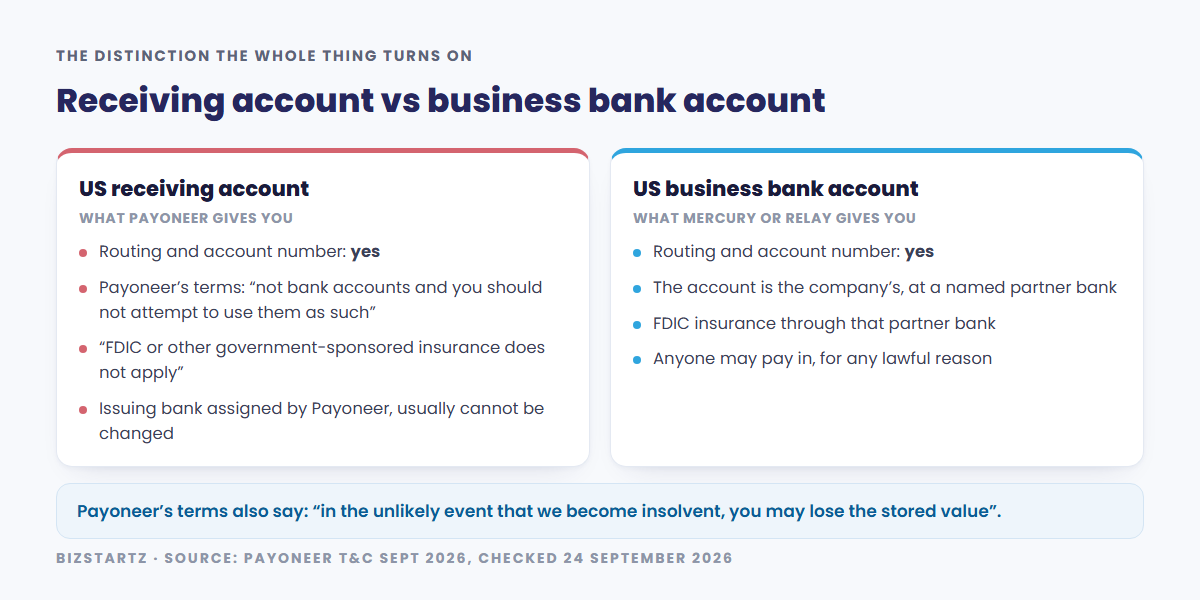
“Please note that the Receiving Accounts provided are not bank accounts and you should not attempt to use them as such.” (Section 5.1)
The help centre says the same thing in softer words: “while a receiving account has some functions of banking, it is not a bank account” (Payoneer: receiving accounts FAQ, read 24 September 2026).
So what is the routing number? It belongs to a partner bank Payoneer works with, and the receiving account sits behind it as a set of credentials pointed at your Payoneer balance.
Payoneer does not name the US partner bank in either its terms or its receiving-accounts FAQ, we looked for it specifically. It does name one elsewhere, incidentally: for GBP receiving accounts the FAQ tells you to give clients “Payoneer Payment Services (UK) Limited” as the bank name. For the US it says nothing equivalent.
The beneficiary name on those details is the account-holder name on your Payoneer profile, your company’s registered name if you registered as a company. The FAQ is insistent that you pass it on unchanged: “Make sure to provide all bank details listed for the receiving account, including the exact beneficiary name as listed there.”
The sentence that should decide whether you read the rest of this page
Payoneer’s terms carry a disclosure that Mercury’s and Relay’s do not, because those two pass deposit insurance through to a partner bank and Payoneer does not:
“By accepting these Terms and Conditions you acknowledge that FDIC or other government-sponsored insurance does not apply to funds held in connection with the Payoneer Services.”
And immediately, the plain-English version:
“In the unlikely event that we become insolvent, you may lose the stored value held in connection with the Payoneer Services.”
Read that twice if you were planning to leave a working balance sitting in Payoneer. This is not an argument against using it, it is an argument against treating it as the place your company’s cash lives. Receive into it, withdraw out of it, keep the resting balance somewhere that is insured. (Both sentences are in the September 2026 Terms & Conditions.)
Receiving account vs business bank account, made concrete
Here is where the difference stops being philosophical.
Who can pay into it is restricted, and the restriction has one exception
Among the guidelines on Payoneer’s receiving-accounts FAQ are two sentences that surprise almost everyone:
“Payments from personal bank accounts will be declined. Payments made from a bank account in your name will be declined.”
The same page states that “only payments for business transactions from business accounts are supported” (Payoneer: receiving accounts FAQ).
Read the notes column beside those rules before you draw the obvious conclusion, because it carves out the case you probably care about most. Against the second rule Payoneer writes: “Transfers from a bank account in your name will be accepted when using a receiving account to add funds from your own bank.” So funding your own balance from your own bank is permitted; what is blocked is a third party paying you from a personal account.
That still rules out something that matters. If you are a freelancer whose biggest client is an individual who pays from a personal checking account, that payment is designed to bounce.
Payoneer also requires that funds “be transferred from a bank account in the same currency as the receiving account”. A US business bank account has neither rule, anyone can send you money, in any currency, for any lawful reason.
This is the clearest illustration of what a receiving account is for. It is an inbound channel for commercial payments, not a place you administer money.
You do not choose the bank behind it, and usually cannot change it
The FAQ is blunt: “Typically, once assigned, your receiving account’s issuing bank cannot be changed. In certain cases, you may be able to request a different issuing bank.”
That matters more than it sounds, and we will come back to it in the platform section, because Payoneer’s own help centre carries a question titled “How do I replace a receiving account with one from an issuing bank that should work with Paypal, Stripe, or other payment providers?” The existence of that question tells you something no marketing page will.
Getting money out has a name-matching rule
Payoneer states: “To sign up to Payoneer, you’ll need to add a bank account whose account holder name matches the name you provide as your Payoneer account holder name (first/last name or company name).” Once the account is approved you may be able to add a recipient bank account under a different name, subject to eligibility.
For a non-resident with a US LLC this is the awkward join. Your Payoneer profile is in the LLC’s name; your home-country bank account is in your personal name. Plan for that at signup rather than discovering it at your first withdrawal.
The terms add a matching rule of their own: “You may only designate a bank account that you are the named holder of, unless such bank account was pre-approved in writing by Payoneer.” The good news in the same section, and it is genuinely good news for this audience, is that “your bank account may be located in any country, except those sanctioned by the U.S. Office of Foreign Assets Control (OFAC).”
What Payoneer for US LLC owners is genuinely good at
All of the above is the fine print. The product underneath it solves a real problem, and for a good share of our readers it solves the only problem that was actually blocking them.
It gives you local details in more places than the marketing suggests. Payoneer’s FAQ lists local-transfer receiving accounts for the United States (USD), the Eurozone (EUR), the United Kingdom (GBP), Japan (JPY), Australia (AUD), Canada (CAD), Hong Kong, Singapore, the United Arab Emirates (AED) and Mexico (MXN). If you had read only the product page you would have come away thinking it was four.
It is built for marketplace and client payouts, which is exactly what most non-resident US LLCs live on. Upwork, Fiverr, Amazon, ad networks, agency clients on invoice, that is the traffic the product is designed around, and it is the traffic where the “business accounts only” rule is a non-issue rather than an obstacle.
It is often open when nothing else is. This is the honest reason Payoneer appears on nearly every country guide on this site. If you are in a country on Mercury’s prohibited-countries list, Nepal, Bangladesh, Indonesia, Vietnam, Pakistan, Nigeria and forty-odd more, Payoneer is frequently the provider still answering. We are going to be careful about that claim below, though, because Payoneer’s position is harder to verify than Mercury’s, not easier.
Will Stripe, Amazon and PayPal accept it? Platform by platform
This is the question everyone actually arrives with, and it has no single answer. So we checked each platform’s own documentation rather than the forums, and where a platform does not address Payoneer we say so instead of reading tea leaves.
One thing to hold in mind throughout: because the issuing bank behind your receiving account is assigned rather than chosen, two people can follow identical steps and get different outcomes. That is not a rumour.
It is the reason Payoneer’s help centre has a page for replacing a receiving account “with one from an issuing bank that should work with Paypal, Stripe, or other payment providers.” The remedy Payoneer offers is to open the receiving account in your dashboard and follow a “solution guide” for the specific provider that rejected it.
Amazon — the one clear yes
Amazon is the only platform here that publishes a direct answer, and it is favourable.
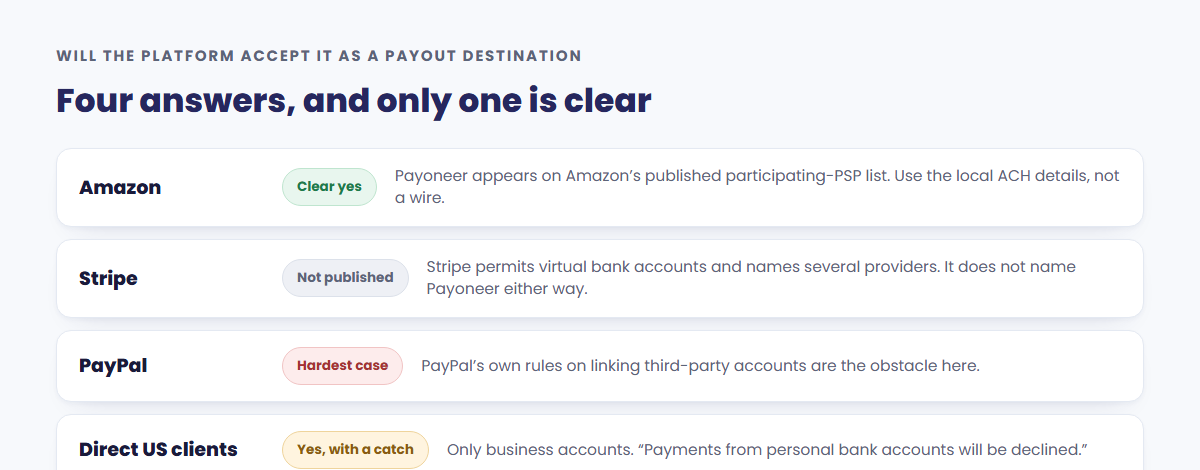
Amazon runs a Payment Service Provider Program. Its Seller Central policy states: “Sellers that choose to use a payment service provider (PSP) to receive their Amazon store sales proceeds must use a PSP participating in the Program,” and that “as of July 15, 2021, we have stopped making disbursements to sellers using non-participating PSPs.” Payoneer appears on Amazon’s published list of participating PSPs (Amazon Seller Central: Payment Service Provider updates, read 24 September 2026).
So this is not a workaround or a grey area, it is the arrangement Amazon built the programme for. If you sell on Amazon with a US LLC and you cannot get a US business bank account, an approved PSP is the sanctioned route.
One practical detail that catches sellers, from Payoneer’s side: “Amazon US does not support funds transfer via USD wire transfers, only via local bank transfers (ACH).” Your receiving account may show both a local/ACH set of details and a wire set. Give Amazon the local ACH details. The wire details will not work, and the failure will look like a Payoneer problem when it is a routing-method mismatch.
Stripe — permitted in principle, not confirmed in particular
Stripe’s payouts documentation has a section called “Supported bank account types”, and it is more permissive than most people expect:
“You can use various types of bank accounts for your Stripe payouts, including traditional accounts offered by established financial institutions (such as checking and savings accounts), virtual bank accounts (such as N26, Revolut, and Wise)…”
Two things follow, and they point in opposite directions.
In Stripe’s favour: Stripe does not have a policy against virtual accounts. It names three of them approvingly. A payout destination that is not a traditional bank is expressly contemplated.
Against reading that as a yes: Stripe does not name Payoneer. We searched its payouts documentation for it specifically, and the three examples given are all providers that issue accounts in the user’s own name. Stripe also attaches a warning in the same section: “Although Stripe supports non-standard bank accounts, you might see higher payout failures for these accounts.” And Payoneer’s own troubleshooting page, quoted above, treats “does not work with Stripe” as a known scenario with a documented remedy.
The honest verdict: neither company publishes a yes or a no. Stripe’s stated policy accommodates the category; neither company confirms this specific pairing; and Payoneer’s own documentation concedes that some receiving accounts get rejected by payment providers and need to be reissued from a different bank.
If Stripe payouts are the whole point of your setup, do not build on this, get a US business bank account, which is what opening a Stripe account as a non-US resident walks through. Treat Payoneer as the fallback you test, not the foundation you plan on.
PayPal — the hardest case
PayPal publishes a list of reasons a bank account cannot be linked, and two of them land squarely on this question. All three quotations below were read on 24 September 2026.
First: “The account must be with a U.S. bank.” A US receiving account gives you US details issued through a partner bank, which is close to that sentence without clearly satisfying it.
Second, and harder: “The bank isn’t compatible with PayPal. This may include most online-only or prepaid bank accounts.” PayPal does not define “online-only” and does not publish the list of institutions it means. That is an unbounded exclusion, and a receiving account issued by a partner bank you cannot identify sits inside its shadow.
Third: “The name on the bank account must match the name on the PayPal account.” That one is manageable — register both under the LLC’s name — but it has to be deliberate.
PayPal does not mention Payoneer anywhere in that article, so this is not a published refusal. But it is the platform where the published rules push hardest against a receiving account, and it is the one Payoneer’s own troubleshooting flow names first. Expect to test it rather than assume it.
Direct payments from US clients — yes, with one condition that disqualifies some clients
This is the use case Payoneer is actually built for, and it works. Your client sends a domestic ACH transfer to your US routing and account number, and it arrives like any other local payment.
Payoneer’s own material makes the point plainly: “anyone with a US bank account can use the same domestic ACH network to make a convenient local bank transfer to your Payoneer USD receiving account” (Payoneer: an alternative to opening a US business bank account).
The condition is the one from earlier, and it is not a minor caveat: the payment has to come from a business account. “Payments from personal bank accounts will be declined.”
So sort your client list before you rely on this. A US company paying supplier invoices from a business checking account is fine. A sole proprietor who pays you from a personal account, or a private individual buying a service, is not, and the rejection happens at Payoneer’s end, after your client has already sent the money and thinks they have paid you. That conversation is worse than the payment delay.
If you want the same question answered across more providers than these four, our comparison of international payment processors for US LLCs covers the wider field, and US payment and banking access by country takes it market by market.
What Payoneer asks a non-resident US LLC owner for
Good news first: a US LLC is an anticipated case, not an edge case. Payoneer’s registration help page lists the entity types it offers, and among them is “Limited liability company (LLC)”, which it describes as “the US-specific form of a limited company, whereby the owners are not personally liable for the company’s debts or liabilities” (Payoneer: choosing the right type of legal entity). You are not squeezing into a form built for someone else.
Payoneer also anticipates that your company is registered somewhere other than where it operates: its signup FAQ says that “if your company’s official address of registration or incorporation is different from the above, select the relevant check box and additionally provide the registration/incorporation address.”
The documents
From Payoneer’s document-verification FAQ, a company may be asked for: “Certificate of Registration, Certificate of Incorporation, Tax document, IRS document including EIN, Business license, Proof of company activity.”
Note what is on that list and what is not. An IRS document showing your EIN is explicitly named, so get the EIN before you apply rather than after. An SSN is not named anywhere. Payoneer does not publish which of those documents are mandatory versus which it “may” request — the wording is discretionary, and a separate help article that used to spell this out has since been retired from its help centre.
The address requirement, which is the real obstacle
This is where non-resident applications actually stall, and it is the same trap Mercury and Wise set.
Payoneer’s signup FAQ: “If you are signing up as a company, enter the physical address of the business. Do no enter a post office box, care-of address, or public address.” (The missing “t” in “Do no” is Payoneer’s, not ours.)
Then the document rule for proving it: “A copy of a recent utility bill (no older than 3 months) stating your Company Name.”
Read those two together and the problem is obvious. A non-resident US LLC has no US utilities. It has a registered agent address and possibly a virtual mailbox — both of which are the kind of address the first sentence rules out, and neither of which generates a utility bill in the company’s name. Founders who bought a formation package specifically to solve this are the ones most likely to be caught by it.
Payoneer does not publish how it resolves that for non-resident applicants, and we are not going to invent a workaround. Two things are true: the “physical address of the business” can legitimately be where you actually work, which for a one-person LLC may be your home abroad; and proof-of-address requests are discretionary, so what you are asked for depends on the review. Ask before you apply — see the questions below.
The country list nobody publishes
Payoneer does not publish a prohibited-countries list. That is a finding, not a gap in our research, and it is worth stating plainly because it is the opposite of what its two main competitors do.
Mercury publishes 48 prohibited countries plus four sanctioned regions. Relay publishes 31. You can open either page, find your country or not, and know where you stand before you spend anything. Payoneer offers nothing equivalent. What it says instead is this:
“We are unable to support direct registrations via the Payoneer website from select countries and territories.” — Payoneer: signing up FAQ
Which countries? The page does not say, and it does not link anywhere that does. We looked.
One trap to avoid while looking yourself. Payoneer’s help centre has an article titled “Supported countries” which is the top result for the obvious searches. It is not a list of countries where you can open a Payoneer account — it covers a separate stablecoin wallet product and names seven countries. If you find it and conclude your country is excluded from Payoneer, you have read the wrong page.
The only country rule Payoneer does state clearly is about withdrawals, and it is permissive: “your bank account may be located in any country, except those sanctioned by the U.S. Office of Foreign Assets Control (OFAC).” That governs where you can send your money, not whether you can open the account.
So the practical position is the inverse of Mercury’s. With Mercury you can check the list and be certain of a no. With Payoneer there is no list to check, which means the only way to find out is to ask or to apply. That is not a reason to avoid it. It is a reason not to build a plan on somebody’s blog post claiming to know its country rules — every such list we found traces back to a vendor or affiliate site, not to Payoneer.
Fees, from Payoneer’s own pricing page
These figures are taken from Payoneer’s published pricing page and were read twice, on 24 September 2026, before being repeated here. Payoneer attaches its own qualifier: “fees depend on sender and recipient locations, payment method, and currencies.” Treat them as the published list rate, not as a quote for your account.
| What happens | Published fee |
|---|---|
| Receive via a receiving account in your local currency | Free |
| Receive via a receiving account in a currency that is not your local currency | 1% (minimum fee of 1.00 USD or equivalent) |
| Receive from a payer using a credit card | Up to 3.99% + 0.49 USD or equivalent |
| Receive from a payer using an ACH bank debit (US only) | 1% |
| Withdraw to a bank account in the same country as yours, in local currency | 1.50 USD |
| Move funds between your Payoneer balances | 0.50% |
| Annual account fee (if the account receives less than 6,000 USD in 12 consecutive months) | 29.95 USD |
The row that matters most is the one you cannot resolve from the page. “Your local currency” is unambiguous for a freelancer in Mexico receiving MXN. It is not obvious for a Nepal-resident owner of a Wyoming LLC receiving USD into a US receiving account — is USD “local” because the account is American, or non-local because you are not? That is the difference between free and 1% on every payment you ever receive, and Payoneer’s pricing page does not settle it. Put it in the email.
Note also the annual fee’s shape: it applies below a threshold, so it lands on dormant and early-stage accounts rather than on busy ones. If you are forming an LLC now and expect revenue in six months, budget for it.
Where it stops working, and what to run alongside it
The shape of a sensible setup falls out of everything above.
Use Payoneer for what it is: an inbound channel. Marketplace payouts, ad-network revenue, invoiced business clients, Amazon disbursements. It is good at all of these and for many founders it is available when nothing else is.
Do not use it as your company’s treasury. The FDIC disclosure and the insolvency sentence in Payoneer’s own terms are the reason. Sweep the balance out to an insured account on a schedule.
Do not assume it substitutes for a US business bank account on an application. And do not describe it as one. If a form asks for your business bank account and you have a receiving account, that is a question to ask the platform, not a box to tick optimistically — a misdescription on a financial application is how accounts get frozen with your money inside them.
Get a real US business account if any provider will have you. Payoneer’s value goes up, not down, when it sits alongside one: the bank holds the balance and satisfies the platforms, and Payoneer collects from the marketplaces and clients that are awkward to collect from directly. Our guide to opening a US bank account as a non-US resident covers who is still eligible, country by country.
What we could not verify, and what to ask Payoneer in writing
Five questions on this topic have no published answer. We tried Payoneer’s terms, its help centre and its pricing page for each of them on 24 September 2026, and for the platform questions we read Stripe’s, Amazon’s and PayPal’s own documentation rather than anyone’s summary of it.
Not published, and we are not guessing:
- Which bank issues US receiving accounts. Payoneer names its UK entity in the FAQ but gives no US equivalent in either the terms or the help centre.
- Whether Stripe accepts a Payoneer US receiving account as a payout destination. Stripe permits virtual bank accounts as a category and names three competitors; it does not name Payoneer, and Payoneer’s own help centre treats provider rejections as a known scenario.
- Which countries Payoneer cannot register users from. It confirms there are “select countries and territories” and publishes no list.
- How a non-resident US LLC satisfies the company proof-of-address requirement when the accepted evidence is a utility bill in the company’s name.
- Whether USD counts as “your local currency” for a US receiving account held by someone who does not live in the US — the difference between free and 1%.
There are no approval rates or processing times on this page either, for the same reason: Payoneer publishes none, and anyone quoting you one is quoting themselves.
So send one email before you commit to anything. It costs ten minutes and it is the only way to get a written answer:
- “I am a resident of [country]. I own a US LLC registered in [state] with an EIN. Can I open a Payoneer business account under the company’s name?”
- “Which address and which proof-of-address document will you accept for a US LLC that has no US premises and no US utility accounts?”
- “For a US receiving account held by a non-US resident, is USD treated as my local currency for the receiving fee, or not?”
- “Is the issuing bank on my US receiving account one that Stripe and PayPal accept as a payout destination? If it is rejected, can it be reissued from a different bank?”
- “Can I withdraw to a bank account in [country] in my personal name while my Payoneer account is in my company’s name?”
Keep the reply. A written answer from the provider outranks every article about the provider, including this one.
Before you act on any of this
Every quotation above comes from Payoneer’s September 2026 terms, its help centre, or its pricing page, or from Stripe’s, Amazon’s and PayPal’s own documentation — each read on 24 September 2026 and linked at the point it is used. Nothing here came from a comparison site or a forum thread, and where the answer was genuinely unpublished we said so rather than filling the space.
These pages change without notice, and Payoneer’s in particular move: one help article we went to check had been retired outright since it was last indexed. Open the sources and check them against your own situation before you spend anything.
If you are still working out whether a US LLC is the right structure at all, or which payment stack your country can actually access, that is the conversation to have first. We help with formation, the EIN and the US bank account application — including telling people when the route they were sold does not exist from where they live.
Sources for this guide were read as primary documents on 24 September 2026 and are linked inline: Payoneer’s Terms & Conditions (September 2026), its receiving-accounts, signup, document-verification and legal-entity help articles, and its pricing page; Stripe’s payouts documentation; Amazon Seller Central’s Payment Service Provider policy; and PayPal’s bank-linking help article. Research and drafting were carried out with AI assistance; every quotation was verified against the source page, load-bearing quotations were confirmed through two independent retrieval routes, and points that could not be confirmed are marked as unverified rather than resolved by inference. This article is general information, not legal, tax or financial advice.
Last checked: 24 September 2026.
🎯 Ready to start? Claim your free consultation and we'll map out your US LLC formation strategy — EIN, banking, and the right state for your country.

Ready to start your company?
Bizstartz handles formation, EIN, banking and compliance for founders worldwide.