How to Dissolve an Colorado LLC

How to dissolve a Colorado LLC is a vital process every business owner must understand when it is time to close their doors, retire, or pivot to a brand-new venture. Simply abandoning your business and walking away is a massive mistake.

If you do not formally and legally shut down your company, the state of Colorado will continue to expect Periodic Reports, and your business will fall into a “Delinquent” status. This leaves you personally exposed to creditors, lawsuits, and potential tax penalties.

If you want to learn how to dissolve a Colorado LLC properly, you must follow the strict legal guidelines established by the Colorado Secretary of State coloradosos and the Colorado Department of Revenue (CDOR). 

In this comprehensive guide by Bizstartz ,we break down exactly what you need to do, the required documents, the state fees, and how to safely and permanently close your business.

1. Vote and Consult Your Operating Agreement

When starting the process of how to dissolve a Colorado LLC, the very first step happens internally. You must review your company’s Operating Agreement. This document contains the specific framework your business must follow to initiate a formal closure.

Generally, your internal process will require you to:

  • Hold a formal meeting with all LLC members (owners).

  • Take a vote to approve the dissolution of the company (usually requiring a majority or unanimous vote, depending on your agreement).

  • Document the final decision in writing through a formal resolution or written consent, and place it safely in your company records.

If your LLC does not have an Operating Agreement, the Colorado Limited Liability Company Act colorado company act dictates that you need the unanimous written consent of all LLC members to dissolve the entity.

2. Wind Up Your Business Operations

The next critical phase of how to dissolve a Colorado LLC involves formally “winding up” your business affairs. Once you vote to dissolve, your LLC continues to exist only for the purpose of shutting down. You can no longer take on new clients or start new projects.

Your winding-up checklist should include:

  • Fulfilling, transferring, or canceling any remaining customer contracts.

  • Liquidating company assets (such as selling off inventory, real estate, or office equipment).

  • Notifying known creditors and settling all outstanding business debts.

  • Distributing any remaining assets or funds to the LLC members based on their capital contributions and ownership percentages.

By law, you must prioritize paying off your creditors before any money goes to the LLC members.

3. Required Documents and State Filing Fees

A major part of understanding how to dissolve a Colorado LLC is knowing exactly which forms to file and how much it will cost. Colorado is unique because it strictly requires digital filings for business closures.

Required Document:

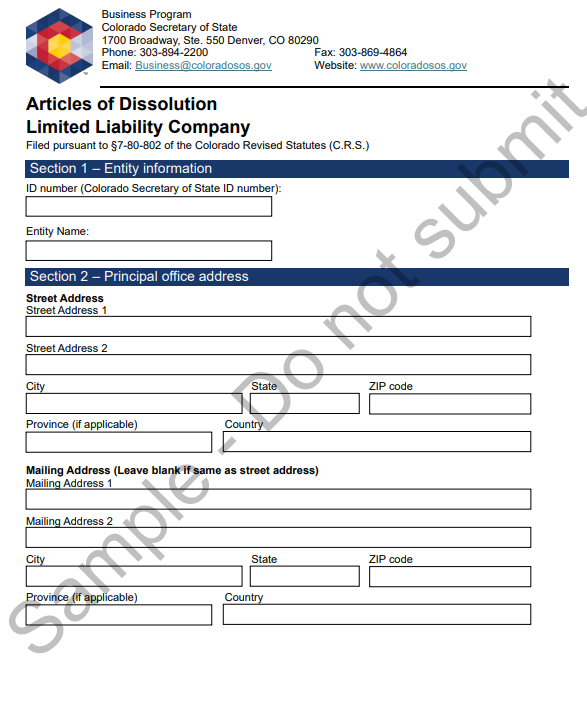
  • Statement of Dissolution: To formally terminate your LLC’s legal existence in Colorado, you must file a “Statement of Dissolution” with the Colorado Secretary of State. This document legally declares your intent to dissolve the business.

State Fees and Charges:

  • Standard Filing Fee: The mandatory fee to file your Statement of Dissolution in Colorado is only $10.00.

  • Filing Method: Colorado operates entirely paperless for this process. You must file the Statement of Dissolution online through the Colorado Secretary of State’s website. Paper forms are not accepted.

4. File the Statement of Dissolution Online

The most official legal step in how to dissolve a Colorado LLC requires submitting your prepared documents to the state government.

To complete this step:

  • Go to the Colorado Secretary of State’s business portal.

  • Search for your LLC’s records using your business name or ID number.

  • Select “File a Form” and choose the “Statement of Dissolution.”

  • Fill out the required prompts, confirming the dissolution.

  • Pay the $10.00 fee via credit or debit card. Because it is filed online, the processing is usually immediate, and your LLC’s status will instantly change to “Dissolved.”

  • how to dissolve an colorado llc
    how to dissolve an colorado llc

5. Close Tax Accounts and Cancel Licenses

An often-overlooked step in how to dissolve a Colorado LLC involves permanently closing your tax and licensing accounts. Even though Colorado does not require a formal “Tax Clearance Certificate” to file your Statement of Dissolution, you still need to handle the IRS and local authorities.

To remain fully compliant, you must:

  • File your final federal, state, and local income tax returns. Ensure you check the box marked “Final Return.”

  • Close your wage withholding and sales tax accounts with the Colorado Department of Revenue (CDOR) by filing a final return and formally closing the account.

  • Cancel any municipal or city business licenses to avoid renewal fees.

  • Write a letter to the IRS to formally close your Employer Identification Number (EIN)ein.gov  account.

  • Close your business bank accounts only after all final debts are paid and all checks have cleared.

6. How Bizstartz Can Help Dissolve Your US LLC 

If figuring out how to dissolve a Colorado LLC feels overwhelming, Bizstartz is here to help!Bizstartz.dissolution 

Navigating state portals and tax compliance can be incredibly stressful. Bizstartz offers expert, done-for-you services to help domestic and international founders officially and legally dissolve their US LLCs.

We ensure your Statement of Dissolution is filed correctly with the state so you can walk away liability-free.

Conclusion

Learning how to dissolve a Colorado LLC protects you from surprise penalties, lingering business debts, and legal liabilities. By voting to close the business, winding up your financial affairs, filing your final tax returns, and submitting the $10 Statement of Dissolution online, you can safely close the chapter on your company.

Whether you are shutting down for good or preparing to launch a new global enterprise with Bizstartz, following these steps ensures a compliant, stress-free exit.

FAQs

1. What are the state fees involved in how to dissolve a Colorado LLC?
The mandatory state filing fee for the Statement of Dissolution with the Colorado Secretary of State is a flat fee of $10.00. This must be paid online via credit or debit card.

2. Can I mail in my Colorado LLC dissolution paperwork?
No. The Colorado Secretary of State requires the Statement of Dissolution to be filed electronically through their online business portal. Paper forms and mailed checks are not accepted for this specific filing.

3. Do I need a tax clearance certificate to dissolve an LLC in Colorado?
No, Colorado does not require you to obtain a formal tax clearance certificate prior to filing your Statement of Dissolution. However, you are still legally required to file final returns and pay any outstanding taxes to the Colorado Department of Revenue.

4. What happens if I just abandon my Colorado LLC?
If you simply stop operating and fail to file your Periodic Reports, the state will change your business status to “Delinquent.” While this stops your ability to legally operate, it does not officially close the business, and you may still be held personally liable for ongoing business debts or legal actions.

How to dissolve a California LLC

How to dissolve a California LLC is a process that requires careful attention to state laws, tax regulations, and internal business agreements. Closing a business in California is notoriously strict.

If you simply abandon the company without formally shutting it down, the California Franchise Tax Board (FTB) will continue to charge you the mandatory $800 annual franchise tax, alongside compounding late fees and penalties.

If you are looking for a clear path on how to dissolve a California LLC the right way, you must follow the statutory rules set by the California Secretary of State (SOS) californiasos and the FTB.

In this comprehensive guide by Bizstartz , we break down the required documents, state fees, tax obligations, and exact steps needed to safely and permanently close your Golden State business.

1. Vote and Consult Your Operating Agreement

When starting the process of how to dissolve a California LLC, the very first step happens internally. You must review your company’s Operating Agreement. This document contains the specific framework your business must follow to initiate a formal closure.

Generally, your internal process will require you to:

  • Hold a formal meeting with all LLC members (owners).

  • Take a vote to approve the dissolution of the company (usually requiring a majority or unanimous vote, depending on your agreement).

  • Document the final decision in writing through a formal resolution or written consent, and place it in your company records.

If your LLC does not have an Operating Agreement, the California Revised Uniform Limited Liability Company Act dictates that you need the vote or consent of the majority of the LLC members to dissolve the entity.

2. Wind Up Business Operations and Settle Debts

The next critical phase of how to dissolve a California LLC involves formally “winding up” your business affairs. Once you vote to dissolve, your LLC continues to exist only for the purpose of shutting down. You can no longer take on new clients or start new projects.

Your winding-up checklist should include:

  • Fulfilling, transferring, or canceling any remaining customer contracts.

  • Liquidating company assets (selling off inventory, real estate, or equipment).

  • Notifying known creditors and settling all outstanding business debts.

  • Distributing any remaining assets or funds to the LLC members based on their capital contributions and ownership percentages.

By law, you must prioritize paying off your creditors before any money goes to the LLC members.

3. Required Documents and State Filing Fees

A major part of understanding how to dissolve a California LLC is knowing exactly which forms to file and how much it will cost. California is unique because the paperwork you file depends on how the dissolution was voted on.

Required Documents:

  • Certificate of Dissolution (Form LLC-3) AND Certificate of Cancellation (Form LLC-4/7): If the vote to dissolve was made by a majority of members (not unanimous), you must file Form LLC-3 first, followed by Form LLC-4/7.

  • Certificate of Cancellation (Form LLC-4/7) ONLY: If the vote to dissolve was unanimous among all members, you can skip Form LLC-3 and only file Form LLC-4/7.

  • Short Form Certificate of Cancellation (Form LLC-4/8): If your LLC was formed less than 12 months ago, has no debts, and has conducted zero business, you can use this single, simplified form.

State Fees and Charges:

  • Filing Fee: There is a $0.00 fee to file the Certificate of Dissolution or Certificate of Cancellation with the California Secretary of State.

  • Processing Time: Filing online through the California bizfileOnline portal is free and is typically processed within a few business days.

dissolve california llc

4. Clear Your California Franchise Tax Board (FTB) Obligations

Navigating the Franchise Tax Board (FTB) ftbgov is arguably the trickiest part of how to dissolve a California LLC. Unlike many states, California requires you to clear your tax obligations to successfully terminate the business.

To remain fully compliant with the FTB and the IRS, you must:

  • File your final federal, state, and local income tax returns. You must check the box marked “Final Return” on your California Form 568.

  • Cease doing business in California after the final taxable year.

  • Pay the final $800 minimum franchise tax for the year you dissolve (unless you qualify for a specific exemption, such as the 12-month short accounting period rule).

  • Write a letter to the IRS to formally close your Employer Identification Number (EIN)ein.gov account.

  • Close your business bank accounts only after all final debts and FTB taxes are paid.

5. How Bizstartz Can Help Dissolve Your US LLC 

If figuring out how to dissolve a California LLC feels overwhelming, Bizstartz is here to help!Bizstartz.dissolution .

Navigating FTB tax compliance and California state bureaucracy is incredibly stressful. Bizstartz offers expert, done-for-you services to help domestic and international founders officially and legally dissolve their US LLCs.

We ensure your Statement of Dissolution is filed correctly with the state so you can walk away liability-free.

Conclusion

Learning how to dissolve a California LLC protects you from the state’s aggressive tax collections, surprise penalties, and lingering legal liabilities. By voting to close the business, winding up your financial affairs, filing your final FTB tax return, and submitting the free Certificate of Cancellation (Form LLC-4/7) to the state, you can safely close the chapter on your company.

We hope this guide on how to dissolve a California LLC helps you achieve a compliant, stress-free exit so you can focus on your next great enterprise with Bizstartz!

FAQs

1. What are the state fees involved in how to dissolve a California LLC?

Filing the Certificate of Dissolution (Form LLC-3) and Certificate of Cancellation (Form LLC-4/7) with the California Secretary of State is entirely free ($0). However, you must ensure your $800 annual franchise tax is paid to the FTB for your final year of operation.

2. Can I file my California LLC cancellation online?

Yes! The fastest and easiest way to dissolve your business is by filing the required cancellation forms online through the California Secretary of State’s bizfileOnline portal.

3. Do I need a tax clearance certificate to dissolve an LLC in California?

California no longer requires LLCs to obtain a formal Tax Clearance Certificate before dissolving. However, the FTB will still hold you personally liable if you fail to file your final tax return (Form 568) and pay any outstanding taxes.

4. What is the Short Form Cancellation (LLC-4/8)?

If your California LLC is less than 12 months old, has conducted no business, has no debts, and has received no investments, you can skip the standard forms and file a single “Short Form Certificate of Cancellation” (Form LLC-4/8) to close the business instantly.

How to Dissolve an Arkansas LLC

How to dissolve an Arkansas LLC is a critical question every business owner faces when it is time to close their doors, retire, or move on to a brand-new entrepreneurial venture.

Simply locking the doors and abandoning the business is never a good idea. If you do not officially terminate your company, the state of Arkansas will continue to charge you an annual franchise tax of $150, and you will rack up late fees and penalties while remaining personally exposed to business creditors.

To properly and legally shut down your company, you must follow the statutory rules set by the Arkansas Secretary of State and the Arkansas Department of Finance and Administration (DFA) Arkanasagov.

In this comprehensive guide by Bizstartz , we will walk you through exactly how to dissolve an Arkansas LLC, including the required paperwork, the state fees, and the exact steps to protect your personal assets.

1. Consult Your Operating Agreement and Vote

When figuring out how to dissolve an Arkansas LLC, the very first step takes place internally. You must review your company’s Operating Agreement. This document contains the specific framework your business must follow to initiate a formal closure.

Generally, you will need to:

  • Call a formal meeting with all LLC members (owners).

  • Take a vote to approve the dissolution of the company.

  • Document the final decision in writing through a formal resolution or written consent, placing it in your company records.

If your LLC does not have an Operating Agreement, Arkansas state law dictates that you must obtain the approval of all members to officially authorize the dissolution.

2. Wind Up Your Business Affairs

A massive part of how to dissolve an Arkansas LLC involves the legal process of “winding up” your business affairs. Once you authorize the dissolution, your LLC continues to exist only for the purpose of shutting down. You cannot take on new clients or start new projects.

Your winding-up checklist should include:

  • Fulfilling, transferring, or canceling any remaining customer contracts.

  • Liquidating company assets (such as selling off inventory, real estate, or equipment).

  • Notifying known creditors and settling all outstanding business debts.

  • Distributing the remaining assets or funds to the LLC members based on their ownership percentages.

Under  Arkanasalaw, you must prioritize paying off your creditors before distributing any remaining profits to the business owners.

3. Required Documents and State Filing Fees

To understand how to dissolve an Arkansas LLC, you must be prepared to submit the correct legal paperwork and pay the mandatory state charges. In Arkansas, you must ensure your franchise taxes are fully up to date before the state will let you leave.

Required Documents:

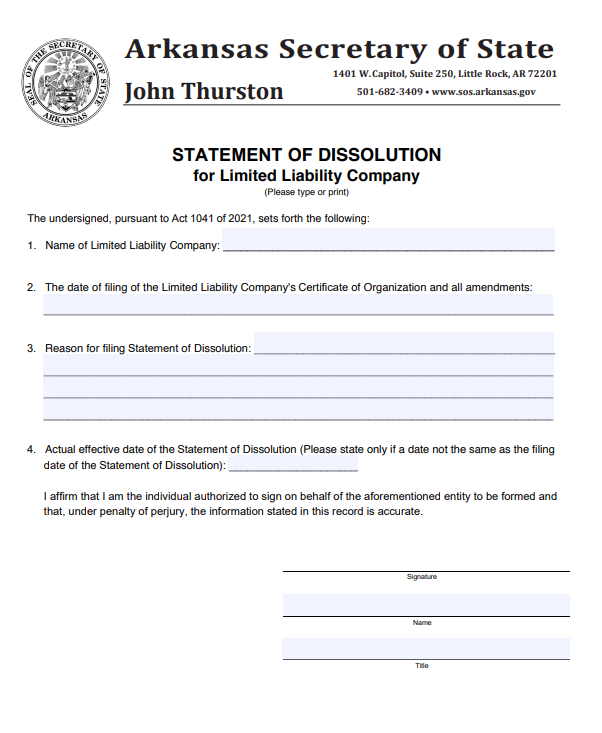
  • Statement of Dissolution (Form LL-04): To formally end your LLC’s legal existence, you must submit a Statement of Dissolution to the Arkansas Secretary of State. This document requires your business name, date of formation, and a signature from an authorized manager or member.

  • Final Franchise Tax Report: Arkansas requires you to file a final franchise tax report and pay any taxes owed for the year in which you are dissolving.

State Fees and Charges:

  • Standard Filing Fee: The mandatory fee to file your Statement of Dissolution in Arkansas is $50.00.

  • Franchise Taxes: You must pay your final annual franchise tax of $150 before the state will approve the dissolution.

    how to dissolve an arkansas llc
    how to dissolve an arkansas llc

4. File the Statement of Dissolution

The most official step in how to dissolve an Arkansas LLC is actually submitting your completed paperwork to the government.

To complete this step:

  • Ensure your Statement of Dissolution form includes your exact business name and is signed by an authorized member.

  • Filing Online: You can file this paperwork easily online through the Arkansas Secretary of State’s business portal. The online system is the fastest and most secure method, and the $50 fee can be paid via credit card.

  • Filing by Mail: Alternatively, you can print the PDF form and mail it, along with a check or money order for $50, to the Secretary of State’s office in Little Rock.

5. Close Tax Accounts and Cancel Licenses

An often-overlooked phase in how to dissolve an Arkansas LLC involves permanently closing your tax and licensing accounts. Even though filing the Statement of Dissolution stops the state franchise tax, you still need to handle the IRS and local authorities.

To remain fully compliant, you must:

  • File your final federal, state, and local income tax returns (checking the “Final Return” box).

  • Close your sales tax and withholding accounts with the Arkansas Department of Finance and Administration (DFA) Arkansasgov.

  • Cancel any municipal or city business licenses to avoid renewal fees.

  • Write a letter to the IRS to formally close your Employer Identification Number (EIN)ein.gov account.

  • Close your business bank accounts only after all final debts are paid and all checks have cleared.

6. How Bizstartz Can Help Dissolve Your US LLC 

If you are feeling overwhelmed by the paperwork of how to dissolve an Arkansas LLC, Bizstartz can help!Bizstartz.dissolution 

Navigating state bureaucracy, franchise taxes, and compliance can be incredibly stressful. Bizstartz offers expert, done-for-you services to help domestic and international founders officially and legally dissolve their US LLCs without the headache.

We ensure your Statement of Dissolution is filed correctly with the state so you can walk away liability-free.

Conclusion

Ultimately, knowing how to dissolve an Arkansas LLC protects you from lingering business debts, surprise tax penalties, and legal liabilities. By voting to close the business, winding up your financial affairs, paying your final franchise taxes, submitting the $50 fee, and filing your Statement of Dissolution, you can safely close the chapter on your company.

Whether you are shutting down for good or preparing to launch a new global empirenBizstartz, can guide you.

We hope this complete guide on dissolving an Alaska LLC gives you the confidence to finalize your company’s closure and successfully move on to your next entrepreneurial journey.

FAQs

1. How much does it cost to learn how to dissolve an Arkansas LLC?

The mandatory state filing fee for the Statement of Dissolution with the Arkansas Secretary of State is $50. However, you must also pay your final $150 annual franchise tax if it has not yet been paid for the current year.

2. Can I file my Arkansas LLC dissolution online?

Yes! The fastest and easiest way to dissolve your business is by filing the Statement of Dissolution online through the Arkansas Secretary of State’s online business portal. You can also mail a paper copy if you prefer.

3. Do I need a tax clearance certificate to dissolve an LLC in Arkansas?

Arkansas does not explicitly require you to request a formal tax clearance certificate from the DFA to dissolve an LLC. However, the Secretary of State will verify that your Franchise Tax account is fully paid and up to date before they accept your dissolution paperwork.

4. What happens if I just abandon my Arkansas LLC?

If you simply stop operating and do not file your Statement of Dissolution, your LLC remains active. The state will continue to assess the $150 annual franchise tax, plus late penalties and interest. Eventually, your LLC’s status will be revoked, leaving you personally exposed to creditors and ongoing legal obligations.

How to Dissolve an Arizona LLC

How to dissolve an Arizona LLC is a critical question for business owners who are ready to close their doors, retire, or transition to an entirely new venture.

Simply abandoning your business and walking away is never a safe strategy. If you do not formally shut down your company with the state, you remain legally exposed to creditors, lawsuits, and potential tax penalties.

If you are wondering how to dissolve an Arizona LLC the right way, you must follow the statutory rules set by the Arizona Corporation Commission (ACC)  arizonasos and the Arizona Department of Revenue  arizonagov .

In this comprehensive guide by Bizstartz, we break down exactly what you need to do, the required documents, the state fees, and how to safely close your business forever.

1. Vote and Consult Your Operating Agreement

When determine  to dissolve an Arizona LLC, the very first step happens internally. You must look at your company’s Operating Agreement. This document contains the specific rules your business must follow to initiate a formal closure.

Generally, you will need to:

  • Hold a formal meeting with all LLC members (owners).

  • Take a vote to approve the dissolution of the company.

  • Document the final decision in writing through a formal resolution or written consent.

If your LLC does not have an Operating Agreement, Arizona state law (A.R.S. § 29-3708) dictates that you must obtain the affirmative vote or consent of all members to officially authorize the dissolution.

2. Wind Up Your Business Affairs

A significant part to dissolve an Arizona LLC requires formally “winding up” your business affairs. Once dissolution is authorized, your LLC continues to exist, but only for the purpose of winding up. You cannot start new projects or take on new business.

Your winding-up checklist should include:

  • Fulfilling, transferring, or canceling any remaining client contracts.

  • Liquidating company assets (selling off inventory, real estate, or office equipment).

  • Notifying known creditors and settling all outstanding business debts.

  • Distributing the remaining assets or funds to the LLC members based on their ownership percentages.

Under  arizona law , you must pay off your creditors before distributing any remaining money to the business owners.

3. Required Documents and State Filing Fees

To understand how to dissolve an Arizona LLC, you must prepare the correct legal paperwork and budget for the mandatory state charges. Unlike some states that use “Articles of Dissolution,” Arizona uses a specific termination document.

Required Document:

  • Articles of Termination: To formally end your LLC’s legal existence in Arizona, you must submit the “Articles of Termination” to the Arizona Corporation Commission (ACC). This document legally declares that all debts have been paid (or adequately provided for) and all remaining assets have been distributed.

State Fees and Charges:

  • Standard Filing Fee: The mandatory fee to file your Articles of Termination in Arizona arizonallc is $35.00.

  • Expedited Processing (Optional): Standard processing can take several weeks. If you want the state to process your document faster, you can pay an additional for expedited service.

4. File the Articles of Termination

how to dissolve an arizona llc

The most official step in how to dissolve an Arizona LLC is actually submitting your completed paperwork to the Arizona Corporation Commission.

To complete this step:

  • Ensure the Articles of Termination form includes your exact business name, your ACC file number, and the signature of an authorized manager or member.

  • You must maintain your Arizona Statutory Agent until the termination is fully processed and approved by the ACC.

  • Filing Online: You can file this paperwork easily online using the ACC’s eCorp portal. This is the fastest and most secure method.

  • Filing by Mail: Alternatively, you can print the form and mail it, along with a check or money order for the $35 fee, to the ACC office in Phoenix.

5. Close Tax Accounts and Cancel Licenses

An often-overlooked step in how to dissolve an Arizona LLC involves closing your tax and licensing accounts. While Arizona does not require you to get a formal “Tax Clearance Certificate” from the Department of Revenue just to file your termination, you are still legally obligated to close your accounts to avoid ongoing tax liabilities.

To remain fully compliant, you must:

  • File your final federal, state, and local income tax returns (checking the “Final Return” box).

  • Close your account with the Arizona Department of Revenue (ADOR) by canceling your Transaction Privilege Tax (TPT) arizonatax license if you sold physical goods.

  • Cancel any municipal or city business licenses.

  • Write a letter to the IRS to formally close your Employer Identification Number (EIN) ein.gov account.

  • Close your business bank accounts only after all final debts are paid and checks have cleared.

6. How Bizstartz Can Help Dissolve Your US LLC 

If you are overwhelmed by the paperwork of how to dissolve an Arizona LLC, Bizstartz can help!Bizstartz.dissolution  

Navigating state bureaucracy and compliance can be incredibly stressful. Bizstartz offers expert, done-for-you services to help domestic and international founders officially and legally dissolve their US LLCs without the headache.

We ensure your Articles of Termination are filed correctly with the state so you can walk away liability-free.

Conclusion

Ultimately, knowing how to dissolve an Arizona LLC protects you from lingering business debts, surprise tax penalties, and legal liabilities. By voting to close the business, winding up your financial affairs, paying the $35 filing fee, and submitting your Articles of Termination to the ACC, you can safely close the chapter on your company. 

We hope this complete guide on dissolving an Alaska LLC gives you the confidence to finalize your company’s closure and successfully move on to your next entrepreneurial journey.

FAQs

1. How much does it cost to dissolve an LLC in Arizona?

The standard filing fee for the Articles of Termination with the Arizona Corporation Commission is $35. If you want the state to process your paperwork faster, you can pay an additional $35 for expedited processing (totaling $70).

2. Can I file my Arizona LLC termination online?

Yes! The fastest and easiest way to dissolve your business is by filing the Articles of Termination online through the Arizona Corporation Commission’s eCorp web portal.

3. Do I need a tax clearance certificate to dissolve an LLC in Arizona?

No. Unlike corporations, Arizona LLCs are not required to obtain a Certificate of Compliance (tax clearance) from the Arizona Department of Revenue before filing their Articles of Termination. However, you are still legally required to pay any outstanding taxes and close your ADOR accounts.

4. What happens if I just abandon my Arizona LLC?

If you simply stop operating and do not file your Articles of Termination, your LLC remains active in the eyes of the state. You will still be responsible for maintaining a Statutory Agent, and you leave yourself personally exposed to lawsuits and ongoing business obligations. It is always safer to file a voluntary termination.

How to Dissolve an Alaska LLC 

How to dissolve an Alaska LLC is a process every business owner must understand when it is time to close their doors, retire, or pivot to a brand-new venture. Simply abandoning your business by walking away is never a good idea.

If you do not formally and legally shut down your company, the State of Alaska will continue to expect biennial reports, and you could face mounting late fees, penalties, and potential legal disputes.

If you are wondering how to dissolve an Alaska LLC properly, you must follow the strict legal guidelines established by the State of Alaska’s Division of Corporations, Business and Professional Licensing.

In this comprehensive guide by Bizstartz , we break down exactly what you need to do, the documents required, and the fees involved to permanently and safely close your business.

1. Consult Your Operating Agreement and Vote

The first internal step to dissolve an Alaska LLC is consulting your company’s Operating Agreement. This internal document dictates the rules your business must follow to initiate a formal shutdown.

Typically, the dissolution process requires you to:

  • Host a formal meeting with all LLC members (owners).

  • Hold a vote to approve the dissolution of the company.

  • Document the final decision in writing through a formal resolution or written consent.

If your LLC does not have an Operating Agreement, Alaska state law dictates that you must follow the default statutory rules, which generally require the approval of all members to officially dissolve the business entity.

2. Wind Up Your Business Affairs

A major part of how to dissolve an Alaska LLC involves formally “winding up” your business affairs. Winding up means concluding all active business operations so the company can be laid to rest. During this phase, your business cannot take on new clients or sign new contracts.

Your winding-up checklist should include:

  • Fulfilling, transferring, or canceling any remaining client contracts.

  • Liquidating company assets, such as selling off inventory, real estate, or office equipment.

  • Paying off all known creditors and settling outstanding business debts.

  • Distributing the remaining assets or funds to the LLC members according to their ownership percentages.

Under alaska.law, you must ensure that all creditors are paid or provisioned for before distributing any remaining money to yourselves.

3. Documents Required and State Filing Fees

When looking into how to dissolve an Alaska LLC, knowing the exact documents and state charges is critical. Here is the factual information you need based on Alaska state requirements:


how to dissolve alaska llc

Required Document:

  • Articles of Dissolution (Form 08-490): To formally terminate your LLC’s legal existence, you must complete the official Articles of Dissolution form provided by the Alaska Department of Commerce. This document requires your business name, Alaska Entity Number, and a statement confirming that the LLC has paid its debts and distributed its assets.

State Fees and Charges:

  • Standard Filing Fee: The mandatory filing fee to process the Articles of Dissolution in Alaska is $25.00.

  • This fee is non-refundable and must be paid to the “State of Alaska” via check, money order, or credit card if filing online or by fax.

4. File the Articles of Dissolution

The most official step in dissolve an Alaska LLC requires submitting your prepared documents to the Alaska Division of Corporations, Business and Professional Licensing.

To complete this step:

  • Ensure the Articles of Dissolution (Form 08-490) are completely filled out and signed by a manager, member, or authorized legal representative.

  • You can file this paperwork online through the state’s web portal, which is highly recommended for faster processing.

  • Alternatively, you can mail the physical form along with your $25 check to their office in Juneau (PO Box 110806, Juneau, AK 99811). Standard processing times for mailed forms typically range from 10 to 15 business days.

5. Close Tax Accounts and Cancel Licenses

A frequently forgotten step in how to dissolve an Alaska LLC is closing your tax and licensing accounts. Even though Alaska does not require a formal “Tax Clearance Certificate” for LLCs to dissolve (unlike corporations), you must still close your accounts to avoid ongoing liabilities.

To remain compliant with the Alaska Department of Revenue (ALDOR) revenue.alaska.gov  and the IRS, you must:

  • File your final federal income tax returns with the IRS (checking the “Final Return” box).

  • Cancel your Alaska state business license and any specific municipal licenses.

  • Notify the IRS to formally close your Employer Identification Number (EIN) ein.gov account.

  • Close your business bank accounts only after all final debts are paid and final checks have cleared.

6. How Bizstartz Can Help Dissolve Your US LLC 

If you are stressed about how to dissolve an Alaska LLC, Bizstartz can help!Bizstartz.dissolution 

Navigating state bureaucracy, tracking down specific forms, and dealing with compliance can be overwhelming. Bizstartz offers expert services to help domestic and international founders officially and legally dissolve their US LLCs without the headache.

We ensure your Articles of Dissolution are filed correctly with the state so you can walk away liability-free.

Conclusion

Ultimately, understanding how to dissolve an Alaska LLC protects you from lingering debts, surprise penalty fees, and legal liabilities. By voting to close, winding up your financial affairs, paying the $25 fee, and officially filing the Articles of Dissolution (Form 08-490), you cleanly and permanently close the chapter on your business.

We hope this complete guide on dissolving an Alaska LLC gives you the confidence to finalize your company’s closure and successfully move on to your next entrepreneurial journey.

FAQs

1. What are the legal costs associated with how to dissolve an Alaska LLC?

The required state fee to file the Articles of Dissolution (Form 08-490) with the State of Alaska is a flat, non-refundable fee of $25.00.

2. Can I file my Alaska LLC dissolution online?

Yes. You can file your Articles of Dissolution entirely online via the State of Alaska’s Division of Corporations web portal. You also have the option to print the PDF, fill it out, and submit it by mail or fax.

3. Do I need a tax clearance certificate to dissolve an LLC in Alaska?

No. While Alaska requires corporations to obtain a tax clearance certificate before dissolving, Limited Liability Companies (LLCs) are exempt from this requirement. However, you are still legally obligated to pay any outstanding taxes and file a final return.

4. What happens if I just abandon my Alaska LLC?

If you stop filing your biennial reports and refuse to pay state fees, your LLC will eventually fall out of “Good Standing” and be administratively dissolved by the state. However, doing this leaves you personally exposed to creditors and ongoing late penalties. It is always safer to file a voluntary dissolution.

How to Dissolve an Alabama LLC

How to dissolve an Alabama LLC is one of the most important questions you will ask when it is time to close your business, retire, or pivot to a brand-new venture. Simply stopping your business operations is not enough.

If you abandon your company without officially shutting it down, the state of Alabama will continue to hold you liable for annual reports, minimum Business Privilege Taxes, and potential legal disputes.

If you want to learn how to dissolve an Alabama LLC properly, you must follow the strict legal guidelines set by the Alabama Secretary of State and the Department of Revenue.

In this comprehensive guide by Bizstartz, we will walk you through the exact steps to permanently and safely close your business.

Step 1: Vote and Consult Your Operating Agreement

The very first step in dissolving an Alabama LLC is checking your company’s Operating Agreement. This internal document dictates the rules your business must follow to initiate a shutdown.

Generally, you will need to:

  • Host a formal meeting with all LLC members.
  • Hold a vote to approve the dissolution of the company.
  • Document the final decision in writing via a formal resolution or written consent.

If your LLC does not have an Operating Agreement, Alabama state law dictates that you must obtain the unanimous written consent of all LLC members to officially approve the dissolution.

Step 2: Wind Up Your Business Affairs

A major phase in the process of to dissolve an Alabama LLC is formally “winding up” your business. Winding up means concluding all active business operations so the company can be laid to rest. During this time, you cannot take on new clients or start new projects.

Your winding-up checklist should include:

  • Fulfilling, transferring, or canceling any remaining client contracts.
  • Liquidating company assets, such as selling off inventory, real estate, or equipment.
  • Paying off all known creditors and settling outstanding business debts.
  • Distributing the remaining assets or funds to the LLC members according to their ownership percentages.

By Alabama law, you must ensure that all creditors are paid before distributing any remaining money to yourselves.

Step 3: File the Articles of Dissolution

The legally binding step to dissolve an Alabama LLC requires filing the official paperwork with the Alabama Secretary of State. This document terminates your business entity’s existence.

how to dissolve alabama llc

Required Documents:

  • Articles of Dissolution: You must complete the official “Domestic Limited Liability Company Articles of Dissolutiongov.dissolution form. This document will require your LLC’s legal name, the date the dissolution was authorized, the Alabama Entity ID number, and an authorized signature.
  • Two (2) Copies of the Form: If you are filing by mail, Alabama requires you to submit two original, signed copies of the Articles of Dissolution. (If you file online through the state’s portal, this is handled digitally).
  • Final Tax Returns: You must file your final returns with the Alabama Department of Revenue (ALDOR) alabama.sos and the IRS.

State Fees and Charges:

  • Standard Filing Fee: The fee to file your Articles of Dissolution with the Secretary of State is $100.
  • Online Processing Fee: If you file online, there is a small additional credit card or convenience fee (typically around $4).
  • Expedited Fees (Optional): If you need it done fast, Alabama offers 24-hour expedited processing for an additional

Step 4: Close Tax Accounts and Cancel Licenses

When figuring out on dissolution of an Alabama LLC, do not forget to close your tax accounts! Many business owners skip this step and end up receiving tax bills for a company that no longer exists.

To remain compliant with the Alabama Department of Revenue (ALDOR) revenue.alabama.gov  and the IRS, you must:

  • File your final federal, state, and local tax returns (make sure to check the box marked “Final Return”).
  • Officially close your Alabama Business Privilege Tax account.
  • Cancel any municipal or county business licenses and permits.
  • Notify the IRS to close your Employer Identification Number (EIN)  ein.gov account.
  • Close your business bank accounts, but only after all final debts are paid and checks have cleared.

How Bizstartz Can Help Dissolve Your Alabama LLC

If you are stressed about dissolving an Alabama LLC, Bizstartz can help! Bizstartz.dissolution

Navigating state bureaucracy can be overwhelming, which is why Bizstartz offers expert services to help domestic and international founders officially and legally dissolve their US LLCs without the headache.

We ensure all your compliance paperwork is filed correctly so you can walk away liability-free.

Conclusion

Ultimately, knowing how to dissolve an Alabama LLC protects you from lingering debts, surprise tax bills, and legal liabilities. By voting to close, winding up your affairs, filing the Articles of Dissolution, and shutting down your tax accounts, you cleanly close the chapter on your business.

We hope this complete guide on dissolving an Alabama LLC gives you the confidence to finalize your company’s closure and successfully move on to your next entrepreneurial journey.

FAQs

1.What are the state fees involved in how to dissolve an Alabama LLC?

The standard filing fee for the Articles of Dissolution with the Alabama Secretary of State is $100. If you choose to file online or request expedited processing, there may be small additional convenience fees.

2.Can I file my dissolution paperwork online in Alabama?

Yes. Alabama allows you to file the Domestic Limited Liability Company Articles of Dissolution easily through the Secretary of State’s online portal. You also have the option to mail physical copies.

3.Do I need a tax clearance certificate as part of the process of how to dissolve an Alabama LLC?

Alabama does not explicitly require you to attach a tax clearance certificate to your dissolution filing. However, you are legally required to file a final return and close your Business Privilege Tax account with the Alabama Department of Revenue to avoid future tax penalties.

4.How long does it take to dissolve an LLC in Alabama?

If you file your Articles of Dissolution online, the state typically processes the request within a 10-15 business days. If you submit the forms by mail, processing can take several weeks depending on the current backlog.

PayPal Scams Every Founder Should Know in 2026 (And How to Protect Your Business)

PayPal scams are evolving rapidly in 2026, targeting new founders, freelancers, and small businesses with highly sophisticated tactics.

As global e-commerce continues to expand, fraudsters are leveraging AI tools and clever social engineering to bypass standard security measures.

Whether you run a SaaS startup, a dropshipping store, or a service based agency, a single successful scam can result in frozen funds, costly chargebacks, and lost inventory. Understanding the latest paypalscam is crucial for protecting your profit margins and keeping your business operational.

Drawing from top security insights from the PayPal Newsroom, Aura, and industry cybersecurity reports, we have compiled the ultimate 2026 guide to the most dangerous scams facing founders today and how to stop them.

1. The Classic “Overpayment” Trap

This is one of the oldest tricks in the book, but it is still highly effective in 2026. A “buyer” purchases an item or service from your business but intentionally sends a payment that is higher than the asking price.

Shortly after, they contact you, apologize for the “mistake,” and ask you to wire the excess funds to a third party (often disguised as a shipping agent or vendor).

If you send the money, the scammer will immediately file a chargeback with their credit card company or claim the original PayPal account was hacked. You lose the product, the refund you wired, and the original payment.

2. Fake Invoices and Phishing Attacks

PayPal scams
PayPal scams

Scammers frequently use PayPal’s legitimate invoicing tool to send fake money requests. Because the email actually comes from service@paypal.com, it bypasses spam filters and looks 100% authentic. The invoice might claim you owe money for a subscription, a domain renewal, or software you never purchased.

Additionally, AI-generated phishing emails are on the rise in 2026. These emails mimic PayPal’s branding perfectly, urging you to click a link to “verify your identity” or “unlock your funds.” Clicking the link takes you to a fake login page designed to steal your credentials.

3. The Shipping Address Re-Routing Trick

One of the most frustrating PayPal scams involves manipulating shipping addresses. A buyer purchases a physical product and provides a valid shipping address during checkout.

However, once you ship the item and provide the tracking number, the buyer contacts the shipping carrier directly to reroute the package to a different address.

Once the package is delivered to the new address, the buyer opens a dispute with PayPal claiming they never received the item. Because the final delivery address doesn’t match the one on the original PayPal Transaction Details page, you lose your Seller Protection and the money.

4. The Fake “Account Suspended” Alert

Founders live in constant fear of having their payment gateways frozen. Scammers exploit this by sending urgent SMS messages or emails stating: “Alert: Your PayPal Business account has been temporarily suspended due to suspicious activity. Click here to resolve.”

To avoid falling victim to these types of PayPal scams, always check your actual PayPal dashboard independently. Never click links in unexpected text messages or emails. If your account is truly restricted, there will be a clear notification inside your official PayPal Resolution Center.

5. Essential Strategies to Protect Your Business

Protecting your business requires a proactive approach. Implement these security measures immediately to safeguard your funds:

  • Only Ship to the Approved Address: Never accept a buyer’s request to ship to an address that is not listed on the PayPal Transaction Details page.

  • Enable 2FA: Turn on Two-Factor Authentication using an authenticator app (not just SMS) for your business account.

  • Never Wire Overpayments: If a customer overpays, cancel the entire transaction, refund the money through PayPal’s official system, and ask them to pay the correct amount.

  • Use Tracked Shipping with Signature: For high-ticket items, always require a signature upon delivery. This provides ironclad proof of receipt to win disputes.

  • Ignore Unsolicited Invoices: Do not pay invoices that randomly appear in your dashboard unless you can verify the vendor.

6. Alternative Solutions: How Bizstartz Can Help You Form Stripe

If you want to reduce your exposure to paypalscam, diversifying your payment gateways is the smartest move you can make in 2026. While PayPal is widely used, many international founders prefer the advanced fraud protection, lower dispute fees, and professional white-label checkout experience offered by Stripe.

However, Stripe is not available in every country. This is exactly where Bizstartz comes in.

At Bizstartz, we help non-US citizens and global founders unlock top-tier US payment processors. Here is how we build your global financial stack:

  • US LLC Formation: We register a compliant US LLC for you in business-friendly states like Wyoming or Delaware.

  • Fast EIN Acquisition: We handle the IRS paperwork to get your Employer Identification Number (EIN) without you needing a US Social Security Number.

  • US Banking & Stripe Setup: We provide a premium US business address and guide you through opening a US digital bank account. Finally, we help you seamlessly form and verify your Stripe account.

With Bizstartz.com you can bypass PayPal’s limitations and process payments globally with Stripe’s industry-leading fraud prevention tools!

Conclusion

Staying ahead of   requires vigilance, strict adherence to Seller Protection policies, and common sense. As fraudsters get smarter in 2026, founders must strictly verify shipping addresses, ignore fake invoices, and secure their accounts with 2FA.

Furthermore, upgrading your business infrastructure by forming a US LLC and integrating Stripe through Bizstartz.com ensures your business remains resilient, secure, and ready to scale globally.

FAQs

1. How do I report PayPal scams to the platform?

If you receive a phishing email or fake invoice, do not click any links. Forward the entire email to phishing@paypal.com and then delete it. You can also report suspicious invoices directly within the PayPal dashboard by clicking “Report this invoice.”

2. Will PayPal cover my losses if I am scammed?

It depends. If you strictly follow PayPal’s Seller Protection Program (e.g., shipping to the exact address on file, providing valid tracking, and responding to disputes quickly), PayPal will often cover the chargeback. However, if you wire money outside of PayPal or ship to a different address, you are unprotected.

3. Why is my business receiving so many fake invoices?

Because anyone with a PayPal account can send a money request to an email address. If your business email is public on your website or social media, scammers will scrape it and mass-send fake invoices hoping you blindly pay them.

4. Can I use Stripe alongside PayPal?

Yes! In fact, it is highly recommended. Offering both Stripe (for credit cards) and PayPal at checkout increases conversion rates while reducing your reliance on a single payment processor.

5. How long does it take Bizstartz to help me get Stripe?

By using Bizstartz to form your US LLC and acquire your EIN, the entire process—from company formation to having a fully active US bank and Stripe account—typically takes just a few weeks, entirely online from your home country.

The Hidden Reasons Behind Amazon Seller Accounts Rejection

If you are currently staring at an Amazon seller account rejection email, you are not alone.

Forums like Reddit, Quora, and Amazon’s own Seller Central are flooded with frustrated entrepreneurs asking the exact same question: “Why was I denied without any details?”

Amazon’s seller verification process is notoriously ruthless. In this comprehensive guide by Bizstartz, we will decode the automated bots, explain exactly why Amazon is rejecting your application, and show you how to get approved.

Starting an Amazon FBA or dropshipping business is one of the most lucrative ways to enter global e-commerce. You’ve done your product research, sourced your inventory, and finally submitted your seller application only to receive a vague, automated email stating that Amazon cannot verify your account.

1. The Infamous “Unable to Verify” Email (The Bot Problem)

When you submit your documents to Amazon, they are rarely reviewed by a human—at least not initially. Amazon uses highly sophisticated AI and optical character recognition (OCR) bots to scan your documents.

These bots are designed to prevent fraud, money laundering, and bad actors from entering the marketplace. However, this means they are incredibly rigid. If a bot flags your account, you will simply receive a boilerplate email stating they are “unable to verify your documents.”

To understand why an Amazon seller account rejection happens, you must realize that Amazon will never tell you exactly what you did wrong. They do this to prevent scammers from learning how to bypass their security systems. It is entirely up to you to find the mismatch.

2. The “Exact Match” Rule: Name and Address Discrepancies

As noted by amazon.com experts on platforms like The Skunk Labs and Seller Forums, the number one reason for application denial is a failure to meet the “Exact Match” rule.

The bots compare the information you typed into Seller Central against your bank statements, utility bills, and government ID. If there is even a single character out of place, you will be rejected.

  • Name Mismatches: If your ID says “John David Smith” but you type “John D. Smith” or just “John Smith” into Amazon, the bot will flag it.

  • Address Abbreviations: If your utility bill says “123 Main Street, Apt 4” but you enter “123 Main St, #4” into Amazon, the system sees these as two different addresses.

  • Language Translation Issues: If your local documents are in a non-supported language, or if the translated names don’t perfectly align with your English inputs, the application will fail.

3. Invalid Credit Cards and Bank Statements

amazon.com strictly requires a valid, internationally chargeable credit card on file to cover subscription fees and potential negative balances.

A massive cause of an Amazon seller account rejection stems from providing the wrong type of financial information:

  • Using a Debit or Prepaid Card: Amazon’s bots can detect card types. Prepaid cards, virtual cards (like standard Payoneer/Wise digital cards), and many local debit cards are routinely rejected. You need a true credit card.

  • Unacceptable Bank Statements: Your bank statement must be issued within the last 90 days. It cannot be a screenshot from your mobile banking app. It must be an official, downloadable PDF that clearly displays your bank’s logo, your exact name, and your exact address.

4. Unacceptable Utility Bills

Amazon asks for a utility bill to prove that you physically reside where you say you do. However, not all bills are treated equally.

To avoid an Amazon seller account rejection, your utility bill MUST meet these strict criteria:

  • Accepted Types: Piped gas, electricity, water, or fixed-line internet.

  • Rejected Types: Cell phone bills, credit card statements, rent agreements, or medical bills.

  • Format: It must be a scanned color copy or a high-quality PDF. If the edges of the document are cut off, or if the image is blurry, the bot will automatically deny it.

5. The “Related Account” Suspension

Sometimes, your documents are perfect, but your account is still instantly suspended. Why? Because Amazon suspects you are associated with an already banned account.

Amazon tracks your IP address, your device’s MAC address, your physical address, and even your Wi-Fi network. If you live in an apartment where the previous tenant had a banned Amazon account, or if you are using a public workspace IP where someone else violated Amazon’s terms, your new account will be flagged and shut down by association.

How Bizstartz Guarantees Your Amazon Account & Forms Your Stripe 

Amazon Seller Accounts Rejection

At Bizstartz, we offer a 100% Guarantee to successfully open your Amazon Seller Account.

Because Amazon is highly favorable to US-based business entities, we build a rock-solid, compliant infrastructure for you from the ground up. Here is how our all-in-one service works:

  • 100% Guaranteed Amazon Approval: We guide you through the exact document formatting, address matching, and application steps. If you follow our precise blueprint, we guarantee your Amazon Seller account will be approved, bypassing the bot rejections.

  • US LLC Formation: We register a compliant US LLC for you in business-friendly states like Wyoming or Delaware.

  • How We Form Your Stripe Account: A major hurdle for international sellers is accessing payment gateways. Bizstartz handles the complex IRS paperwork to get your EIN quickly. With your new LLC and EIN, we set up your US business bank account and seamlessly integrate it to form a fully approved, fully functional Stripe account.

  • Premium US Address: We provide a real US physical business address with a unique suite number (not a PO Box), which satisfies both Stripe and Amazon’s strict location verifications.

With Bizstartz, you get a fully functional US LLC, a Stripe account to take payments globally, and a 100% guaranteed Amazon Seller account!

Conclusion

While an Amazon seller account rejection can be incredibly frustrating, it is rarely the end of the road. By understanding how Amazon’s automated verification bots operate, ensuring an absolute “exact match” on your documents, and providing the correct utility bills and credit cards, you can overcome this hurdle.

Don’t let bureaucratic red tape destroy your e-commerce dreams. Let the experts handle it. Visit Bizstartz,today to claim your 100% guaranteed Amazon Seller account, form your US LLC, and unlock Stripe for global payments!

FAQs

1. Why won’t Amazon tell me exactly why my account was rejected?

Amazon uses automated systems to detect fraud. If they revealed the exact reason your document failed, bad actors and scammers could use that information to bypass the security system. You must self-audit your documents to find the error.

2. Can I reapply after my Amazon seller account is rejected?

Yes. You can usually submit an appeal by clicking the “Submit Additional Information” button in your Seller Central dashboard. Do not try to open a second new account with a different email, as this will trigger a permanent “Related Accounts” ban.

3. Will Amazon accept a mobile phone bill for verification?

No. Amazon strictly requires a utility bill that is tied to a physical property. This includes electricity, piped gas, water, or fixed-line internet. Mobile phone bills are universally rejected.

4. How does Bizstartz guarantee my Amazon account approval?

Bizstartz has deep expertise in Amazon’s compliance requirements. By forming a US LLC, providing a recognized US physical address, setting up US banking, and auditing your documents to ensure the “Exact Match” rule is flawlessly met, we eliminate the variables that trigger bot rejections.

5. How does a US LLC help me get Stripe?

Stripe is only available in a limited number of countries. By using Bizstartz to form a US LLC and acquire an EIN from the IRS, your business is legally recognized as a US entity. This allows us to smoothly set up your Stripe account, even if you live in an unsupported country like Nepal, India, or Latin America.

Which Payment Platform Is Best in 2026? Stripe vs PayPal

As global digital commerce accelerates in 2026, you are likely asking yourself: Stripe Or PayPal

Choosing the right payment infrastructure is one of the most critical decisions you will make for your business. For e-commerce stores, SaaS platforms, and service-based companies, your payment gateway dictates your transaction costs, conversion rates, and global scalability.

Two giants dominate the market: Stripe and PayPal. Both process billions in transactions annually, but their architectures, pricing structures, and ideal use cases differ significantly.

In this comprehensive guide by bizstartz.com,we will break down the ultimate 2026 Stripe VS PayPal comparison, helping international entrepreneurs decide which platform fits their business model and how to access them from anywhere in the world.

1. Global Reach and Accessibility

When it comes to international business, accessibility is the first major hurdle.

  • PayPal: PayPal operates in over 200 countries and supports 25 currencies for holding balances. It is highly accessible for solo entrepreneurs and freelancers in emerging markets who need to accept payments immediately.

  • Stripe: Stripe allows you to accept payments from 135+ currencies, making it an absolute powerhouse for international sales. However, Stripe merchant accounts are only available in 46 countries.

The Catch for International Founders: If you live outside of Stripe’s 46 supported countries, you cannot open a personal Stripe account. However, you can bypass this completely by forming a US LLC (which we will explain in the Bizstartz section below).


2. Pricing and Transaction Fees in 2026

While both platforms have no monthly setup fees for their standard services, their per-transaction costs diverge significantly, especially for online businesses.

Stripe Standard Online Fees stripe.com:

  • Domestic Cards: 2.9% + $0.30 per transaction.

  • International Cards: Additional 1.5%.

  • Currency Conversion: Additional 1%.

  • Chargeback Fee: $15.00 per dispute.

PayPal Standard Online Fees paypal.com:

  • PayPal Checkout: 3.49% + $0.49 per transaction.

  • International Transactions: Additional 1.5% cross-border fee.

  • Currency Conversion: 3% to 4% spread (higher than Stripe).

  • Chargeback Fee: $20.00 per dispute.

The Verdict on Fees:  When evaluating Stripe VS PayPal for your profit margins, Stripe wins on pricing.  PayPal’s $0.49 fixed fee quietly eats your profit margins, especially on low-ticket items. Furthermore, PayPal’s currency conversion spread is notoriously high, making Stripe the far more cost-effective choice for high-volume international businesses.

3. User Experience, Integration, and Developer Tools

The way your checkout looks and functions directly impacts your conversion rates.

  • Stripe (Built for Developers): Stripe is an API-first platform. It allows for a completely “white-label” checkout experience, meaning customers never leave your website, and there is no visible Stripe branding. This seamless experience is highly favored by professional SaaS and enterprise setups.

  • PayPal (Built for Consumer Trust): PayPal is plug-and-play. You can generate a “Pay Now” link or button in minutes without any coding knowledge. However, PayPal redirects customers to its own branded page to complete the checkout. While this adds friction, PayPal boasts over 430 million active accounts. Seeing the recognizable PayPal logo can boost buyer confidence and increase conversions for newer, unknown brands.

4. Recurring Billing and Subscription Management

If you run a SaaS company, a membership community, or a subscription box, the billing logic is critical.

  • Stripe Billing: Stripe is the undisputed king of subscriptions. It supports metered billing (usage-based), hybrid pricing, automated dunning (failed payment recovery), and customized pricing tiers.

  • PayPal Subscriptions: PayPal handles simple, fixed recurring payments well. However, it lacks the flexibility for usage-based billing or sophisticated API-driven pricing models.

5. Security, Fraud Protection, and Data Portability

Both platforms offer PCI DSS Level 1 compliance—the highest security standard available. But they handle data and fraud differently:

  • Fraud Protection: Stripe includes Stripe Radar, an AI-driven fraud monitoring tool, for free on standard accounts. PayPal offers basic fraud detection but charges extra ($10/month + $0.05 per transaction) for its Advanced Fraud Protection services.

  • Data Portability (The Lock-in Effect): This is a crucial difference. Stripe allows you to securely export your customers’ encrypted credit card data if you ever decide to switch to another processor. PayPal blocks card data exports. If you leave PayPal, you lose all saved customer payment info and must ask them to re-enter their cards, which destroys subscription retention.

How Bizstartz Can Help You Form Your Stripe Account

As we mentioned earlier, Stripe is the superior choice for scaling a global online business, but it is heavily restricted by geography. If you live outside of the ~46 supported countries (such as in Nepal, India, or various parts of Latin America and Africa), you are essentially locked out.

But you don’t have to be.

At bizstartz.com, we specialize in breaking down these borders. We help non-US citizens and international founders access US Stripe by forming a legally compliant US business entity.

Here is how Bizstartz helps you get Stripe-ready:

  • US LLC Formation: We register your US LLC in business-friendly states like Wyoming or Delaware.

  • EIN Acquisition: We handle the complex IRS paperwork to get your Employer Identification Number (EIN) quickly, without you needing an SSN.

  • US Business Address & Banking: We set you up with a premium US physical address and guide you in opening a US digital bank account.

  • Stripe Approval: With your LLC, EIN, and US bank account, we help you apply for Stripe US smoothly, ensuring you pass all KYC and compliance checks on your first try.

With Bizstartz, you don’t have to settle for expensive local gateways. We build your global financial infrastructure from the ground up!

stripe vs paypal
which payment platform is best?

Conclusion

When settling the Stripe vs PayPal debate in 2026, the best choice ultimately comes down to your business model.

If you want the fastest possible setup and rely heavily on consumer brand recognition, PayPal is an excellent starting point. However, if you want lower transaction fees, a white-labeled checkout, robust subscription tools, and data ownership, Stripe is the clear winner.

For international founders, geographical limits shouldn’t dictate your business growth. By partnering with Bizstartz.com, you can form your US LLC today and unlock the limitless power of Stripe, no matter where you live!

FAQs

1. Which is cheaper in 2026, Stripe or PayPal

For most online businesses, Stripe is cheaper. Stripe charges 2.9% + $0.30 per transaction, whereas PayPal charges 3.49% + $0.49. PayPal also has higher currency conversion fees, making Stripe much more cost-effective for high volumes.

2. Can I use Stripe if I live in an unsupported country

Yes! While you cannot open a personal Stripe account in an unsupported country, you can use a service like Bizstartz to form a US LLC. Stripe supports US companies regardless of where the founder actually lives.

3. Do I need to be a coder to use Stripe

Not anymore. While Stripe is famous for its developer APIs, it now offers “Stripe Payment Links” and easy integrations with platforms like Shopify and WooCommerce, meaning you can use it with zero coding knowledge.

4. Why do some businesses use both Stripe and PayPal

Many successful e-commerce stores offer both at checkout. They use Stripe as their primary white-labeled credit card processor to save on fees, while keeping a “Pay with PayPal” button as an alternative for customers who highly trust the PayPal brand.

5. Does PayPal or Stripe hold funds longer

Stripe typically pays out directly to your linked business bank account on a 2-day rolling basis (depending on your region). PayPal puts funds into your PayPal balance immediately, but you must manually withdraw them to your bank, which can take 1-3 business days. Both platforms may place temporary holds on funds for new accounts to prevent fraud.

How to File Taxes as a Non-US Resident

Starting a US business as an international founder opens up a world of opportunities, from accessing premium US markets to utilizing top-tier global payment processors.

However, when it comes time to file taxes as a non-US resident, the process can feel overwhelming. Dealing with the IRS, understanding strange tax forms, and figuring out what you actually owe can be confusing.

The good news is that operating a US business (like an LLC) from overseas does not automatically mean you will owe US taxes. However, you are subject to strict IRS reporting requirements.

In this comprehensive guide by Bizstartz.com, we will break down exactly how the IRS views your business, the forms you need to submit, and how to stay 100% compliant.

1. Understanding Your Tax Status: Are You a Nonresident Alien?

Before you file taxes as a non-US resident, you must determine your exact tax classification. The IRS classifies international individuals as “Nonresident Aliens” (NRAs) for tax purposes unless they meet one of two criteria:

  • The Green Card Test: You are a lawful permanent resident of the US.

  • The Substantial Presence Test: You were physically present in the US for at least 31 days during the current year and 183 days during the 3-year period that includes the current year and the two years prior.

If you do not meet these criteria and run your US Limited Liability Company (LLC) entirely from your home country, you are considered a Nonresident Alien. This status significantly limits the type of income the US government can tax you on.

2. ECI vs. FDAP: What Income is Actually Taxable?

File Taxes as a Non-US Resident

According to the IRS, Nonresident Aliens are only taxed on income that has a connection to the United States. This income is divided into two main categories:

  • Effectively Connected Income (ECI): This is income generated from operating a trade or business inside the United States. You generally have ECI if you have “dependent agents” (employees) in the US, physical offices, or a US-based warehouse fulfilling orders. ECI is taxed at the same graduated rates as US citizens.

  • Fixed, Determinable, Annual, or Periodical (FDAP) Income: This includes passive income such as dividends, interest, royalties, and some rents. FDAP is generally taxed at a flat 30% rate, though this can be reduced if your home country has a tax treaty with the US.

Important Note: If you live outside the US, provide services from outside the US, and have no physical US presence, your LLC’s income is typically not considered ECI. Therefore, you may not owe US federal income tax. However, you still have mandatory reporting duties.

3. The Mandatory Tax Forms You Must Know

Even if you owe $0 in US federal income taxes, the IRS requires strict informational reporting. For a standard foreign-owned Single-Member LLC (which the IRS classifies as a “disregarded entity”), you must file the following:

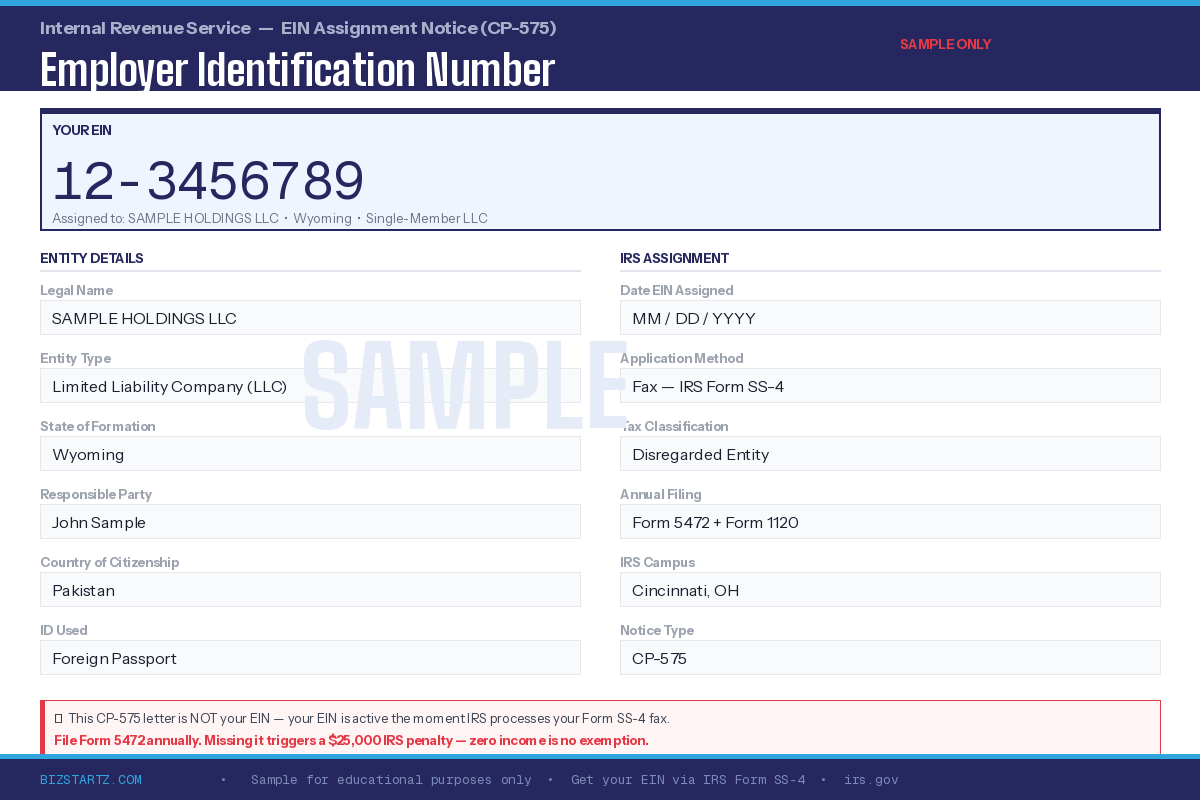
  • Form 5472: This form reports “reportable transactions” between your LLC and its foreign owner (you). Failing to file this form carries a massive penalty starting at $25,000.

  • Form 1120 (Pro-forma): You must submit a basic Form 1120 as a cover sheet to attach to your Form 5472. You only fill out the identifying information of your LLC.

  • Form 1040-NR: If your business does generate Effectively Connected Income (ECI), you must file a Form 1040-NR (U.S. Nonresident Alien Income Tax Return) to report your US-sourced profits and pay the appropriate tax.

If you need to file taxes as a non-US resident, be aware that standard tax software (like TurboTax) typically does not support Form 1040-NR or Form 5472 for foreign-owned LLCs. You will usually need specialized software or the help of a licensed CPA to file these specific documents.

4. Deadlines and Tax Treaties

Missing IRS deadlines can result in thousands of dollars in penalties. Here is what you need to remember:

  • April 15th: This is the standard deadline to file Form 5472 and Form 1120 for your foreign-owned LLC.

  • Tax Treaties: The United States has income tax treaties with over 60 countries. If your home country is on this list, you may be eligible to claim a reduced rate or exemption on certain types of US-sourced income (like FDAP). You claim these benefits by submitting Form W-8BEN to your withholding agents.

5. How Bizstartz Can Help You Form Stripe and Launch Globally

While learning how to file taxes as a non-US resident is crucial, getting your business financially operational is step one. To accept payments globally, you need premium gateways like Stripe, but Stripe requires a US business entity, a US bank account, and an EIN.

This is exactly where Bizstartz comes in Bizstartz.com. We provide end-to-end infrastructure for international founders:

  • US LLC Formation: We register your company in business-friendly, privacy-focused states like Wyoming or Delaware.

  • Fast EIN Processing: We navigate the IRS to secure your Employer Identification Number (EIN) without you needing an SSN or ITIN.

  • US Business Banking: We help you set up a US digital bank account to hold your funds in USD.

  • Seamless Stripe Account Formation: With your new LLC, EIN, and US bank account, we guide you through a flawless Stripe application process. We ensure your documentation matches perfectly so you can bypass geographic restrictions and start accepting credit card payments from customers worldwide.

Conclusion

Preparing to file taxes as a non-US resident doesn’t have to be a nightmare. By understanding your status as a Nonresident Alien, distinguishing between ECI and FDAP, and staying on top of critical forms like the 5472, you can run a 100% compliant, tax-optimized global business.

Don’t let the fear of IRS paperwork stop you from launching your dream company. Visit Bizstartz.com today to form your US LLC, unlock Stripe, and set up a solid foundation for your global enterprise.

FAQs

1. Can I use standard software like TurboTax to file taxes as a non-US resident?

Generally, no. Popular tax preparation software like TurboTax is designed for US citizens and residents filing Form 1040. They typically do not support Form 1040-NR (Nonresident Alien return) or the complex Form 5472 required for foreign-owned LLCs. You will need specialized tax software like Sprintax or a professional CPA.

2. Will I owe US taxes if I sell products online via dropshipping?

If you are a non-resident, your dropshipping suppliers are outside the US, and you have no physical offices or employees in the US, your income is generally not considered Effectively Connected Income (ECI). Therefore, you typically will not owe US federal income tax, though you still must file Form 5472.

3. What happens if I forget to file Form 5472?

The IRS is incredibly strict regarding foreign-owned single-member LLCs. Failing to file Form 5472, or filing it incorrectly, results in an automatic penalty of $25,000.

4. Do I need an ITIN to run my US LLC?

You do not necessarily need an Individual Taxpayer Identification Number (ITIN) to form the LLC or open a business bank account (an EIN is sufficient for the business). However, if you need to file a personal 1040-NR return to report US income, or if you wish to apply for US personal credit cards, you will need to apply for an ITIN.

5. How does a US LLC help me get Stripe?

Stripe requires merchants to have a legally registered business, a tax ID, and a local bank account in a supported country. By using Bizstartz to form a US LLC, get an EIN, and open a US bank account, you fulfill all of Stripe’s requirements, even if you live in an unsupported country.