An ITIN (Individual Taxpayer Identification Number) is a 9-digit number the IRS gives to people who need a U.S. taxpayer number for federal tax purposes but can’t get a Social Security number. If you live outside the U.S., you apply with Form W-7, usually with a U.S. tax return attached. You can do it by post to the IRS in Austin, Texas, or through an IRS-approved acceptance agent in your own country (IRS: ITIN, checked September 2026).
Many guides tell foreign LLC owners they need one. Often they don’t. You don’t need an ITIN to form a U.S. LLC or to get its EIN. It won’t build U.S. credit, and U.S. banking law doesn’t require one. This guide covers who needs one and who doesn’t, the documents, the three ways to apply, when the number expires, and the mistakes that get applications rejected.
In this guide: What an ITIN is and isn’t · Who needs one · Who doesn’t · Real reasons for LLC owners · Claims to ignore · Documents · The tax return rule · Three ways to apply · How long it takes · Why applications get rejected · Expiry and renewal · FAQ
What an ITIN is, and what it isn’t
The IRS describes an ITIN as “a 9-digit number the IRS issues if you need a U.S. taxpayer identification number for federal tax purposes, but you aren’t eligible for a Social Security number (SSN).” It starts with a 9 and is formatted like an SSN: 9XX-XX-XXXX.
The IRS lists four things an ITIN doesn’t do. It doesn’t:
- qualify you for Social Security benefits or the Earned Income Tax Credit
- give you immigration status or change the status you have
- let you work legally in the U.S.
- “serve as identification outside the federal tax system”
(IRS: ITIN, page updated 28 October 2025, checked September 2026.)
An ITIN also isn’t a business number. Your LLC gets an EIN (Employer Identification Number), which identifies the company. An ITIN identifies you, the person. If you can get an SSN, you must use that instead: the W-7 instructions say “Don’t complete Form W-7 if you have an SSN or if you’re eligible to get an SSN.”
Who actually needs an ITIN
You need one when the IRS needs a number for you personally, on a return or a tax form, and you can’t get an SSN. Form W-7 lists the reasons as boxes a to h (Instructions for Form W-7, Rev. December 2024, the current revision as of September 2026):
| Box | Reason on Form W-7 |
|---|---|
| a | Nonresident alien required to get an ITIN to claim a tax treaty benefit |
| b | Nonresident alien filing a U.S. federal tax return |
| c | U.S. resident alien (based on days present in the United States) filing a U.S. federal tax return |
| d | Dependent of a U.S. citizen or resident alien |
| e | Spouse of a U.S. citizen or resident alien |
| f | Nonresident alien student, professor or researcher filing a U.S. federal tax return |
| g | Dependent or spouse of a nonresident alien holding a U.S. visa |
| h | Other (you write the exception number that applies) |
There are eight boxes, not nine, and none of them says “LLC owner.” Most founders living abroad who genuinely need an ITIN tick box b, because they have to file a Form 1040-NR.
Who doesn’t need one
You don’t need an ITIN to get an EIN
This is the most common misunderstanding. Form SS-4, the EIN application, asks for the “responsible party’s” SSN, ITIN or EIN on line 7b. The instructions say: “Enter ‘foreign’ or N/A on line 7b if the responsible party doesn’t have and is ineligible to obtain an SSN or ITIN” (Instructions for Form SS-4, Rev. December 2025, checked September 2026).
Applicants with no U.S. address can’t use the online EIN application. They can call the IRS on 267-941-1099 (not toll-free), 6 a.m. to 11 p.m. Eastern time, Monday to Friday, or apply by fax or mail. Our guide to getting an EIN without an SSN walks through each route.
You don’t need one just to file Form 5472
A single-member LLC owned by a non-resident usually files a pro forma Form 1120 with Form 5472 attached. The Form 5472 instructions allow a “reference ID number” for a foreign owner, and add that it “is required only in cases where no U.S. identifying number was entered.” A foreign-owned disregarded entity also enters the owner’s foreign tax ID, if they have one (Instructions for Form 5472, Rev. December 2024). So Form 5472 doesn’t make you get an ITIN. See our Form 5472 guide for foreign-owned LLCs for the filing itself.
You can’t get one “just in case”
Unless you qualify for one of the exceptions below, the IRS expects a U.S. federal tax return with the application. The return is how you show you need the number. With no return to file, no treaty claim and no withholding agent asking for it, you most likely have no reason on the form to tick.
The real reasons a non-resident LLC owner might need an ITIN
1. You have to file a U.S. personal return (Form 1040-NR)
A nonresident alien who was engaged in a trade or business in the United States during the year must file Form 1040-NR. The instructions say you file “even if” you had no income from that trade or business, no U.S.-source income, or income that a treaty makes exempt. A nonresident who wasn’t engaged in a U.S. trade or business, but had U.S.-source income without enough tax withheld, must also file (Instructions for Form 1040-NR, 2025 tax year).
Whether an LLC you run from Lagos, Lahore or Kathmandu counts as a U.S. trade or business depends on the facts: where the work is done, whether there are U.S. employees, offices or agents, and more. Many online businesses run entirely from abroad aren’t. Ask a U.S. tax professional before you decide either way. If you must file a 1040-NR and have no SSN, you need an ITIN.
2. You’re a member of a multi-member LLC with U.S. business income
An LLC with two or more members is taxed as a partnership by default. If it has income effectively connected with a U.S. business, it must withhold tax for its foreign partners under section 1446. The IRS says the partnership must withhold “even if it doesn’t have a U.S. TIN for that partner”, but “to ensure proper crediting of the withholding tax … a partnership must provide a U.S. TIN for each foreign partner” (Instructions for Forms 8804, 8805 and 8813, Rev. January 2026). Without an ITIN, you may struggle to claim credit for tax already withheld from your share.
3. You want a treaty rate, and the form asks for a U.S. TIN
Form W-8BEN tells a U.S. payer you’re foreign and can claim a lower treaty rate. The instructions require a U.S. TIN for some treaty claims, but not for others. For example, you don’t need one for dividends and interest from actively traded stocks and bonds, or for dividends from U.S. mutual funds. A foreign tax ID can sometimes stand in (Instructions for Form W-8BEN, Rev. October 2021). Check the line 5 instructions for your type of income before you apply.
4. You’re selling U.S. property
When a foreign person sells a U.S. real property interest, the buyer generally withholds 15% under FIRPTA. The IRS says a foreign seller can’t get an ITIN before a binding contract to sell exists, unless they have another valid reason. Once the contract is signed, they can apply (IRS: FIRPTA withholding, updated 21 July 2026). The number is used for the withholding paperwork and for claiming the tax back. This is Exception 4 on Form W-7.
5. A platform or bank asks for one
Some platforms and banks ask the owner for an SSN or ITIN. Their rules vary, so check what each one actually says before you apply. Stripe is a good example. For a U.S. company account, Stripe says owners and representatives outside the U.S. can instead provide “your local non-US tax ID and respective documentation to confirm you aren’t a US taxpayer.” Stripe’s individual and sole-proprietor accounts are different: they need a U.S. individual with an SSN or ITIN (Stripe: Business rep/owner tax ID requirements for US companies, checked September 2026).
If a platform does insist on an ITIN, that alone doesn’t give you a reason on Form W-7. You still need a return to file or an exception that applies.
Four ITIN “benefits” you’ll see elsewhere, and what’s actually true
| Claim | What the primary sources say |
|---|---|
| “You need an ITIN to open a U.S. bank account.” | The federal customer identification rule for banks asks a non-U.S. person for one or more of: a taxpayer identification number, a passport number and country of issue, an alien ID card number, or another government photo ID number (31 CFR 1020.220). A passport satisfies that rule. An individual bank can still set a stricter policy of its own. |
| “An ITIN builds your U.S. credit.” | The IRS issues ITINs for federal tax purposes only, and says an ITIN doesn’t “serve as identification outside the federal tax system.” Some lenders do accept an ITIN on an application, but the number itself creates no credit history. Borrowing and repaying does. |
| “An ITIN speeds up IRS processing.” | There’s no IRS source for this. The application itself takes weeks, and the IRS processes a return you send with a W-7 as part of the application package. You also can’t e-file a return using an ITIN in the calendar year the ITIN is assigned (W-7 instructions). |
| “You need an ITIN to invest in U.S. real estate or stocks.” | Buying doesn’t require one. The need comes later: filing a return on rental income, claiming a treaty rate where W-8BEN asks for a U.S. TIN, or selling property under FIRPTA. The IRS won’t issue one to a foreign seller before a binding sale contract unless there’s another valid reason. |
Documents you need
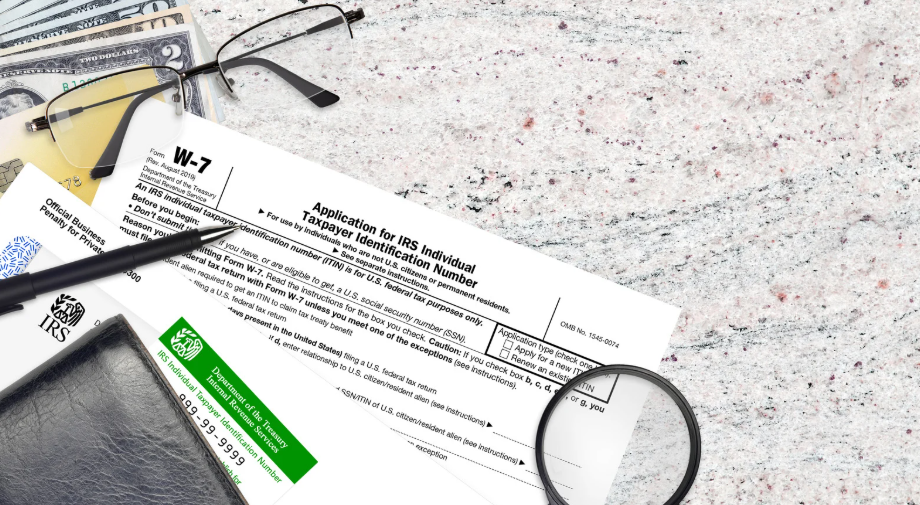
Form W-7
Download the current Form W-7 from irs.gov (revision December 2024 as of September 2026). Your name, date of birth and country of citizenship must match your identity document exactly. If you tick box b, write your full foreign address on line 3. Write country names out in full; the IRS lists abbreviated or missing country of citizenship as a common error.
Proof of identity and foreign status
The IRS accepts 13 kinds of document. A passport is the only one that works on its own, because it proves both who you are and that you’re foreign. The W-7 instructions say: “If you submit an original valid passport or a certified copy from the issuing agency, you don’t need to submit any other documents from the table.” Passports of dependents who must prove U.S. residency are an exception: without a U.S. date of entry, they need extra documents.
Without a passport, you need at least two documents. Between them they must prove identity and foreign status. At least one must have a photo, unless the applicant is under 14 (or under 18 if a student):
| Document | Proves identity | Proves foreign status |
|---|---|---|
| Passport | Yes | Yes (stand-alone) |
| National ID card (must show name, photo, address, date of birth and expiry date) | Yes | Yes |
| Foreign voter registration card | Yes | Yes |
| Foreign military ID card | Yes | Yes |
| U.S. Department of State visa | Yes | Yes |
| USCIS photo ID | Yes | Yes |
| Civil birth certificate | Yes | Yes, if foreign |
| Foreign driver’s licence | Yes | No |
| U.S. driver’s licence, U.S. state ID, U.S. military ID | Yes | No |
| Medical or school records (dependents only) | Yes | Yes, if foreign |
Source: Instructions for Form W-7, supporting documentation table, checked September 2026.
Originals, certified copies and why a notary won’t do
- Originals or certified copies only. A certified copy is one that “the original issuing agency provides and certifies as an exact copy of the original document and contains an official stamped seal from the agency.” For a passport, that means your passport office, not a lawyer, notary or bank. Ordinary photocopies and notarised copies don’t qualify.
- Documents must be current. The instructions say they must be “not expired at the time you submit your application.”
- Originals you post are returned to the mailing address on your W-7. If they aren’t back within 60 days, the IRS says to call.
- Translations: the IRS may later ask for a certified translation of foreign-language documents.
The tax return rule, and its exceptions
The W-7 instructions are direct: “Individuals applying for an ITIN must include a U.S. federal tax return unless they meet an exception.” You staple the W-7 to the front of the return and send both together to the ITIN office, not to the address in the return’s own instructions. The return is processed as part of the application.
If an exception applies, you don’t attach a return. Instead you send evidence that the exception applies. For box a (treaty benefit) or box h, you write the exception number on the form. The exceptions are:
| Exception | Covers | Example evidence the IRS asks for |
|---|---|---|
| 1(a) | Partner in a partnership (including an LLC taxed as one) with income subject to information reporting or withholding | A copy of the part of the partnership or LLC agreement showing the partnership’s EIN and that you’re a partner |
| 1(b) | Interest-bearing business bank account subject to IRS information reporting or withholding | An original signed letter from the bank on its letterhead |
| 1(d) | Distributions such as pensions, annuities, rents, royalties or dividends, where the payer needs an ITIN for withholding | An original document or signed letter from the withholding agent saying an ITIN is required |
| 2 | Treaty benefits on wages or other compensation, scholarships, fellowships and grants, and certain gambling income | For example, an employment letter or contract plus the withholding agent’s part of Form 8233, or a letter from the university |
| 3 | Mortgage interest on U.S. property that is reported by a third party | Relevant information return: Form 1098 (see the instructions for the documents to send) |
| 4 | Sale of a U.S. real property interest subject to FIRPTA withholding | Relevant forms: 8288, 8288-A and 8288-B (see the instructions for the documents to send) |
| 5 | Non-U.S. representative of a foreign corporation who needs an ITIN to meet its e-filing requirement (T.D. 9363) | Supporting documents listed in the instructions |
Exception 1(c) is for resident aliens, so we’ve left it out. Read the full evidence list in the W-7 instructions before you rely on an exception. The wrong evidence is a common reason for a suspended application.
Three ways to apply from outside the U.S.
1. By post to the IRS in Austin
Post the W-7, your return (or exception evidence) and your original or certified documents to (IRS: How do I apply for an ITIN?, updated 22 February 2026, checked September 2026):
By postal service:
Internal Revenue Service
Austin Service Center
ITIN Operation
P.O. Box 149342
Austin, TX 78714-9342
USA
By private courier (DHL, FedEx, UPS and similar):
Internal Revenue Service
ITIN Operation
Mail Stop 6090-AUSC
3651 S. Interregional, Highway 35
Austin, TX 78741-0000
USA
This route costs nothing in IRS fees, but it means your passport, or a certified copy from your passport office, spends weeks in the post and at the IRS.
2. Through a Certifying Acceptance Agent (CAA) in your country
The IRS authorises acceptance agents “in the U.S. or abroad”, and says “fees may vary.” A Certifying Acceptance Agent checks your original passport, certifies a copy and returns the original to you straight away. They then send the W-7 with a Certificate of Accuracy (Form W-7 COA). An ordinary Acceptance Agent reviews and posts your documents but can’t certify them.
The IRS publishes its list of agents by U.S. state and by country, covering dozens of countries (IRS: Acceptance agent program, updated 24 August 2026). One limit to know: according to the IRS, CAAs can certify every document for the main applicant and spouse except a foreign military ID. For dependents, they can’t certify passports or birth certificates (IRS Publication 4857).
3. At an IRS Taxpayer Assistance Center, but only inside the U.S.
The IRS says you can “apply for free at a Taxpayer Assistance Center in the U.S.”, by appointment. There are no Taxpayer Assistance Centers abroad, so this route only helps if you’re travelling to the U.S. anyway. Book ahead on 844-545-5640, the number given in the W-7 instructions.
Choosing a route
| Post to Austin | CAA in your country | Taxpayer Assistance Center | |
|---|---|---|---|
| Usable from abroad | Yes | Yes | No, U.S. only |
| Passport leaves your hands | Yes, unless you get a certified copy from your passport office | No, returned immediately | No |
| Cost | No IRS fee, plus courier | Agent’s fee (varies) | Free |
How long it takes
The IRS says to allow 7 weeks to hear about your application, or 9 to 11 weeks if you apply during tax season (15 January to 30 April) or from overseas (IRS, checked September 2026). Most readers of this page apply from overseas, so plan for 9 to 11 weeks. Using a CAA doesn’t come with an official faster timeline. For what slows applications down and how to check status, see our guide to ITIN processing time.
If the IRS needs more information, it sends notice CP566. You have 45 days from the date of the notice to reply. If you don’t reply, the application is rejected and you have to start again (IRS: CP566, updated 11 August 2026).
Why W-7s get suspended or rejected
The IRS publishes its own list of the ten errors it sees most (Publication 4857). In plain terms:
- Unacceptable documents. The document isn’t on the list of 13, or it has expired.
- No Certificate of Accuracy. A CAA must attach Form W-7 (COA) to every application.
- Not original or certified. A photocopy, a notarised copy or an unauthorised certification.
- Signature missing or invalid. Anyone signing for an adult applicant, other than a court-appointed guardian, needs a Form 2848 power of attorney.
- Missing documents. No passport, and fewer than two documents in its place.
- Line 6d, date of entry into the U.S., is blank where it’s required.
- Line 3, foreign address, is missing. A full foreign address is required if you tick box b.
- Line 6a, country of citizenship, is missing or abbreviated.
- The U.S. person’s name or TIN is missing for spouse or dependent applications (boxes d and e).
- Renewal details don’t match. The old ITIN and the name it was issued under (lines 6e and 6f) don’t match IRS records.
Two more things the W-7 instructions ask for aren’t on that list. If you tick box h, you must write the exception number on the dotted line beside it. And the reason you choose has to match what you send: a return for box b, or the evidence for your exception. There’s no “LLC owner” box.
When an ITIN expires, and how to renew it
The rule: “If your ITIN wasn’t included on at least one U.S. federal tax return for the last 3 consecutive tax years, it expires on December 31 of the third consecutive tax year” (W-7 instructions; IRS: ITIN expiration FAQs, updated 17 November 2025).
- Renew only when you need it. The IRS frames renewal as something you do if your ITIN “expired and you need to file a U.S. income tax return.”
- How: the same Form W-7, with “Renew an existing ITIN” ticked, and your ITIN and the name it was issued under on lines 6e and 6f. If your name has changed, attach proof, such as a marriage certificate or court order.
- If you file with an expired ITIN, the IRS warns that processing of your return may be delayed, and some credits may not be allowed until you renew.
How Bizstartz can help
We form U.S. LLCs for founders who live outside the U.S., and our ITIN application service handles the W-7 side. That covers preparing Form W-7, explaining your certified-copy options so you keep your passport, filing with the IRS, tracking the application until it’s decided, and support with tax-treaty claims. Pricing is on request.
The IRS decides whether to issue an ITIN and how long that takes. No agent can guarantee approval or a faster timeline. Before you pay anyone, read the who doesn’t need one section above.
Frequently asked questions
Can I get an ITIN while living outside the U.S.?
Yes. Post your application to the IRS in Austin, or use an IRS-approved acceptance agent in your country. Taxpayer Assistance Centers are only in the U.S. Expect 9 to 11 weeks if you apply from overseas.
Do I need an ITIN to form a U.S. LLC or get an EIN?
No. Forming the LLC doesn’t involve the IRS, and on the EIN application (Form SS-4) you write “foreign” or “N/A” if you can’t get an SSN or ITIN.
Can I work in the U.S. with an ITIN?
No. The IRS says an ITIN doesn’t authorise work in the U.S. or give you any immigration status.
What’s the difference between an ITIN and an EIN?
An EIN identifies a business, such as your LLC. An ITIN identifies an individual who needs a taxpayer number but can’t get an SSN. A foreign-owned LLC usually needs an EIN. Its owner needs an ITIN only for one of the reasons above.
Do ITINs expire?
Yes. An ITIN expires if it isn’t used on a federal tax return for three consecutive tax years. Renew it with Form W-7 when you next need to file.
Do I need to send my original passport?
Only if you apply by post without a certified copy. Instead, you can get a certified copy from the office that issued your passport, or use a Certifying Acceptance Agent, who checks the original and hands it back.
Related Guides
- How to Get an EIN Without an SSN (2026): A Non-Resident’s Guide
- Form 5472 for Foreign-Owned US LLCs: Who Files, When & Penalties
- ITIN Processing Time Explained: Why It Takes Weeks and How to Avoid Delays
Need the EIN itself sorted? Our EIN application service files it for you, including the non-resident paper route.
🎯 Ready to start? Claim your free consultation and we'll map out your US LLC formation strategy — EIN, banking, and the right state for your country.

Ready to start your company?
Bizstartz handles formation, EIN, banking and compliance for founders worldwide.