Here is the FBAR foreign-owned US LLC rule in one sentence: your LLC is itself a United States person, so if the accounts it holds outside the United States added up to more than $10,000 at any single moment in the calendar year, not on 31 December, at any moment, the LLC owes a FinCEN Form 114.
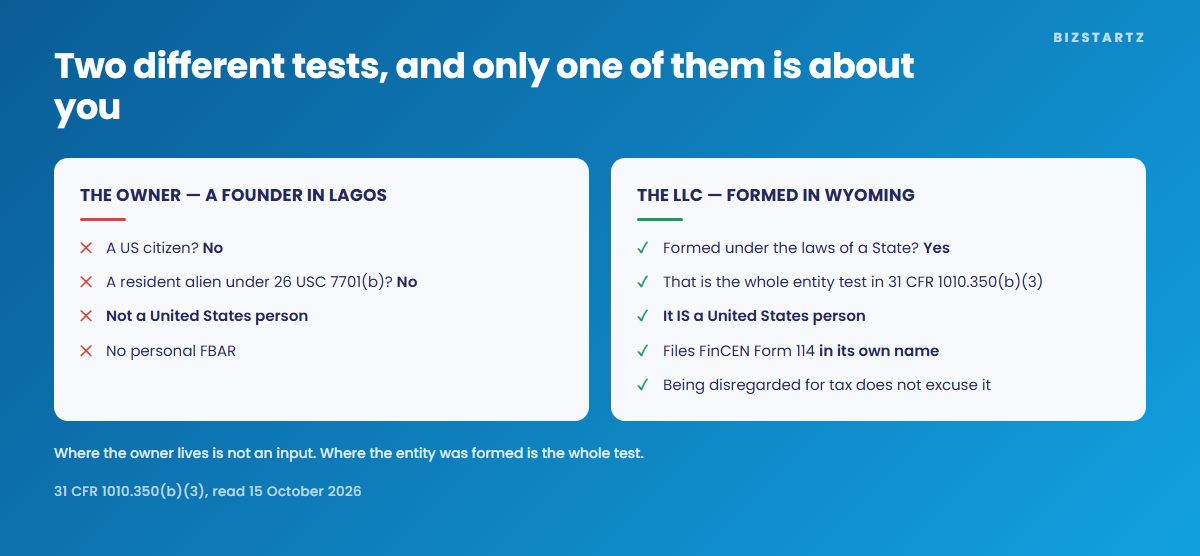
Where you live does not enter into it. A Wyoming LLC owned by one person in Lagos is a US person for this purpose, and you are not, and both of those facts are in the same regulation.
That is the opposite of what almost everyone assumes. The FBAR gets filed under the heading “Americans with offshore accounts,” and a founder in Karachi or Kathmandu who has never been to the United States reads that heading and moves on. The test is not about you. It is about where your company was formed.
Two things before the detail. We form US companies; we are not a US tax firm, and nothing here is a determination about your accounts. And there is one question on this page we could not answer, whether a Wise or Payoneer balance is a foreign financial account, so instead of guessing it we have set out exactly what to ask your provider, in writing, and why. A confident wrong answer there costs you either an unnecessary filing or a penalty, and we are not going to hand you one.
In this guide: Why the LLC is the US person · $10,000 is a high-water mark · Which accounts are “foreign” · Wise, Payoneer and the open question · Where and when it is filed · What the published penalties actually say · Why Form 8938 is probably not yours · If you have missed years · Questions for a US tax professional
The LLC is the US person. You are not.
The IRS page on the Report of Foreign Bank and Financial Accounts lists who files, and the list has an item in it that stops the usual assumption dead:
“A U.S. person, including a citizen, resident, corporation, partnership, limited liability company, trust and estate, must file an FBAR to report:”
A limited liability company. Not the owner of one, the company. But the IRS page only gives you the list. The regulation gives you the test, and the test is the part worth reading. 31 CFR 1010.350(b) defines “United States person” in three limbs: a citizen; a resident (an individual who is “a resident alien under 26 U.S.C. 7701(b)”); and
“An entity, including but not limited to, a corporation, partnership, trust, or limited liability company” … “created, organized, or formed under the laws of the United States, any State, the District of Columbia, the Territories and Insular Possessions of the United States, or the Indian Tribes.”
Created, organized, or formed under the laws of a State. That is the whole test for an entity. Not where it trades, not where it banks, not where its members sit, not whether it has ever had a US customer. You filed articles of organization in Wyoming or Delaware, so the entity was formed under the laws of a State, so the entity is a United States person. There is no residence question to answer because the regulation never asks one about entities.
Now read the same regulation from your own side, because it cuts the other way and most pages never mention it. The limbs that could catch an individual are citizenship and residence, a resident alien under section 7701(b). A founder living in Nigeria or Nepal with no green card and no substantial US presence is on neither limb. So the LLC has a filing obligation and you, personally, generally do not.
The exception is obvious once stated: if you are a US person for some other reason, a green card, enough days in the country, then you have your own FBAR position, and the LLC’s foreign accounts are accounts you have signature authority over. That is a conversation to have, not a conclusion to draw from a page.
A single-member “disregarded” LLC is not excused either
This is the first thing a founder reaches for. My LLC is disregarded, it does not even file its own income tax return, so how can it file anything? FinCEN answered that in the form’s own instructions, and the answer is two sentences long:
“The federal tax treatment of an entity does not determine whether the entity has an FBAR filing requirement.” … “an entity that is disregarded for purposes of Title 26 of the United States Code must file an FBAR”
Title 26 is the Internal Revenue Code. The FBAR lives in Title 31, the Bank Secrecy Act, which is a different body of law with a different purpose, and “disregarded” is a word that only has meaning in the first one.
The form even has a field built for this situation: a disregarded entity “must check box ‘e’ and enter the type of entity followed by ‘(D.E.)’.” You do not argue your way out of a reporting requirement that has a tick-box waiting for you.
If your mental model of foreign-owned LLC compliance is “pro forma Form 1120 with a Form 5472 attached and nothing else,” this is a second, unrelated filing on a different deadline to a different system. If you are a multi-member LLC, it sits alongside the Form 1065 and Schedule K-1 obligations rather than replacing anything.
$10,000 is a combined high-water mark. It is not your year-end balance.
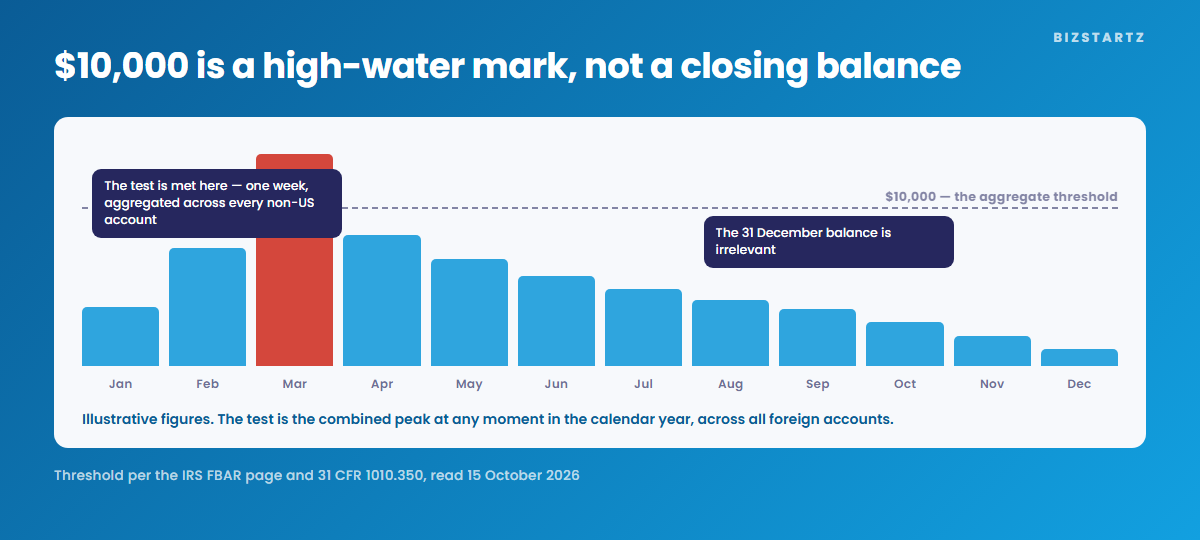
This is where people wrongly let themselves off. They check the balances on 31 December, see $3,000 spread across three accounts, and conclude they are nowhere near the threshold. Both halves of that reasoning are wrong, and the IRS disposes of them in its own words on the comparison of Form 8938 and FBAR requirements:
“Aggregate value of financial accounts exceeds $10,000 at any time during the calendar year.” … “This is a cumulative balance, meaning if you have 2 accounts with a combined account balance greater than $10,000 at any one time, both accounts would have to be reported.”
Two separate instructions in there.
- Aggregate. You add every foreign account together. Three accounts at $4,000 each is $12,000, and the threshold is crossed even though no single account ever held more than $4,000.
- At any one time. The test runs against the highest point the combined figure reached, on any day of the year. A balance that arrived on 3 June and left on 11 June counts exactly as much as one that sat there for twelve months.
And note the sting in the second quoted sentence: once the combined figure crosses, both accounts get reported. Crossing the line puts every foreign account on the form, including the small one that never came close to $10,000 on its own.
Here is the shape of the year that catches people. The LLC collects a $9,000 payment into its home-country account in March while $2,500 is sitting on a platform balance from February invoices.
The combined peak is $11,500, for about a week. By 31 December both accounts are nearly empty and the year’s revenue was modest. The FBAR is due anyway, because the test was satisfied in March and nothing afterwards un-satisfies it.
The figure you report for each account is its own peak, and the instructions ask for exactly that: “The maximum value of an account is a reasonable approximation of the greatest value of currency or nonmonetary assets” in it during the year.
Foreign currency gets converted at the Treasury rate “for the last day of the calendar year,” and amounts are recorded “rounded up to the next whole dollar.”
Reasonable approximation is the standard, which is a relief if your bookkeeping is imperfect and an argument for keeping monthly statements if it is not. Our bookkeeping guide for LLC businesses covers the habit that makes this a ten-minute job instead of a weekend.
Which of your accounts are actually “foreign”?
The threshold only applies to foreign financial accounts, so this is the question that decides whether you file at all. The FinCEN instructions define it plainly, “A foreign financial account is a financial account located outside of the United States”, and then settle “located” with two rules that do all the work:
- “An account maintained with a branch of a United States bank that is physically located outside of the United States” is a foreign financial account.
- “An account maintained with a branch of a foreign bank that is physically located in the United States” is “not a foreign financial account.”
So the test is the physical location of the branch holding the money, and the brand’s nationality is not it. An account at a US bank’s branch in your own city is foreign. An account at a foreign bank’s branch in New York is not. 31 CFR 1010.350(d) makes “foreign country” mean all geographical areas outside the United States, which is as broad as it sounds.
| Where the money sits | Foreign financial account? | Why |
|---|---|---|
| The LLC’s US business banking account — Mercury, for example, whose disclosure our Mercury page quotes: “Banking services provided through Choice Financial Group and Column N.A., Members FDIC” | No | The institution holding the account is physically in the United States |
| A business account in the LLC’s name at a bank in your own country | Yes | An account at a bank physically outside the United States. This is the clear case, and the common one |
| An account at a non-US branch of a US bank | Yes | The instructions name this case specifically |
| An account at a US branch of a foreign bank | No | The instructions name this case specifically too |
| A Wise, Payoneer or similar platform balance | Unresolved — see below | Two questions have to be answered first, and neither provider publishes the answers |
| Your own personal account at home, in your own name | Not the LLC’s | The LLC has no financial interest in it. And you are generally not a US person, so it is not yours to report either — unless you are a US person for another reason |
Why the LLC’s own account is caught is worth a line, because it is not assumed, it is written down. 31 CFR 1010.350(e)(1) gives a US person a financial interest in each foreign account “for which he is the owner of record or has legal title”, “whether the account is maintained for his own benefit or for the benefit of others.” The LLC is on the account as the account holder. That is the whole chain.
Signature authority: the limb that can reach a person rather than a company
There is a second route into the FBAR, and it does not need any ownership at all. Under 31 CFR 1010.350(f)(1), signature or other authority means “the authority of an individual (alone or in conjunction with another) to control” “the disposition of money, funds or other assets held in a financial account by direct communication” “(whether in writing or otherwise) to the person with whom the financial account is maintained.”
Read “an individual.” This limb is about a person who can move the money, and it can oblige that person to file even with no financial interest whatsoever. But the person still has to be a US person to be caught by it. For a non-resident founder, that is the end of it.
For a founder who is a green-card holder, or a co-founder who is a US citizen and is a signatory on the LLC’s home-country account, it is the start of a separate conversation, their own FBAR, in their own name, on the same accounts the LLC is reporting.
One more structural point, since founders ask whether the owner can file once and cover everything. They cannot. The consolidation rule in 31 CFR 1010.350(g)(3) lets “An entity that is a United States person and which owns directly or indirectly more than a 50 percent interest” in other reporting entities file “a consolidated report on behalf of itself and such other entities.” It runs parent entity to subsidiary entity, and the parent has to be a US person itself. A non-resident individual owner is neither. The LLC’s report is the LLC’s.
Wise, Payoneer and the question we could not answer
Most readers of this page keep money on a payment platform rather than at a bank, so this is the section that matters most, and it is the section where we are going to tell you we do not know.
We read both providers’ own current documents on 15 October 2026 and they do not contain the facts the FBAR test needs. Here is what they do say.
Wise. The Wise Customer Agreement on its US site (version 1.5, last updated 25 September 2026) names “Wise US Inc.”, “a company incorporated under the laws of Delaware,” with its registered office at 30 W 26th Street, New York. It is blunt that it is not a bank: “Wise is not a Bank, and your Wise Account is Not a Bank Account,” and “As Wise is not a bank, we use safeguarding to protect your money.”
On where the money goes, it says only this: “Wise keeps your money in the name of Wise in established financial institutions.” Which institutions, and in which countries, the agreement does not say.
A separate Wise help page on how its US entity protects customer funds introduces its list with “where we predominantly hold customer money in the US” and names JPMorgan Chase Bank, N.A. Predominantly in the US is not entirely in the US, and the page says nothing about where non-USD balances sit.
Payoneer. The Payoneer Terms and Conditions dated April 2026 name “Payoneer Inc., a Delaware corporation with its principal place of business in New York, New York,” which, in the document’s own words, is a money services business registered with FinCEN and “is a licensed money transmitter under the laws of various states.”
Funds sit in “a collective collection account held by Payoneer on behalf of yourself and other Payoneer customers.” No bank is named and no country is named. Payoneer also states that “The Payoneer Services are not a bank account nor do they offer the features and benefits of a traditional bank account,” that “FDIC or other government-sponsored insurance does not apply,” and that funds “do not constitute deposits.”
Separate Payoneer entities exist for other markets, an Irish company, a UK company, and our own Payoneer for US LLC owners page records that Payoneer’s documents reference Payoneer Payment Services (UK) Limited in connection with GBP receiving accounts. Which entity holds your balance depends on your registration and the version of the terms you accepted, and no provider page we found publishes that mapping for a US-registered LLC.
The two questions, and why they are not yours to guess
Before a platform balance can be a foreign financial account, two things have to be true, and the providers’ documents establish neither.
- Is it a reportable kind of account at all? 31 CFR 1010.350(c) is a closed list. A “bank account” is one “maintained with a person engaged in the business of banking.” A “securities account” is one with a person in the business of trading securities. “Other financial account” has four items: an account with a person “that is in the business of accepting deposits as a financial agency”; an insurance or annuity policy with cash value; a commodity futures or options dealer account; and a mutual fund or similar pooled fund. No paragraph of that regulation mentions a money transmitter, a money services business, a payment processor or prepaid access. Both providers say in their own terms that they are not banks and that balances are not deposits — which is a statement about them, not a determination under the regulation.
- If it is an account, where is it located? The test is the physical location of the institution holding it. Neither provider publishes that for a given customer’s balance, and “predominantly in the US” does not answer it.
We looked for FinCEN or IRS guidance applying that regulation to payment platforms or e-money balances and found none. So we are telling you plainly: this is unresolved, and we are not going to resolve it for you with an assumption. Getting it wrong in one direction means an unnecessary federal filing. Getting it wrong in the other means a missed one with a penalty regime attached. Neither is a risk worth taking to save an email.
Ask your provider, in writing, and keep the reply:
- Which legal entity holds my balance, and in which country is that entity incorporated?
- In which country is the account that holds my funds maintained? If the answer differs by currency, tell me for each currency I hold.
- If that changes, will you tell me?
Then give the written answer to a US tax professional and let them apply 31 CFR 1010.350(c) to it. That is a fifteen-minute question for someone who does this work, and it is unanswerable by anyone without the facts the provider is holding. Our pages on the Wise Business account for non-resident US LLC owners and opening a US business bank account as a non-resident cover what each option is good for, which is a different question from this one.
Where it is filed, when, and what to keep
The FBAR does not go in with your tax return and it is not part of the LLC’s income tax compliance at all. From the IRS page: “You must file the FBAR electronically through FinCEN’s BSA E-Filing System,” and “You don’t file the FBAR with your federal tax return.” Paper filing needs an exemption requested from FinCEN. The obsolete TD F 90-22.1 and a printed Form 114 are not accepted.
There is a wrinkle in the usual “it goes to FinCEN, not the IRS” summary worth having right, because it explains why IRS pages govern a FinCEN form. The regulation itself, 31 CFR 1010.350(a), requires a US person to “report such relationship to the Commissioner of Internal Revenue.”
The form is submitted through FinCEN’s electronic system; examination and penalty authority sits with the IRS. That is why the authoritative page on the subject is on irs.gov and why the internal guidance quoted further down is in the Internal Revenue Manual.
The dates, from the same IRS page: “The FBAR is an annual report, due April 15 following the calendar year reported,” and “You’re allowed an automatic extension to October 15 if you fail to meet the FBAR annual due date of April 15.”
For calendar year 2026, that is 15 April 2027, with an automatic extension to 15 October 2027. Our 2026 US tax filing deadline guide carries the wider calendar, but note that it has no FBAR row — these two dates are not on it, so put them in your own calendar.
If someone else files for you, the authorisation is FinCEN Form 114a, which you keep and do not submit with the FBAR. And keep records: for each reported account, the name and number, the foreign bank’s name and address, the account type and the maximum value during the year, for five years from the FBAR due date.
What the published penalty figures actually say
Penalty figures are the easiest thing to get wrong on this subject. So here is where each one comes from, and nothing appears below that we have not read in a FinCEN, IRS or statutory source.
The IRS FBAR page gives no figure at all. It says civil and criminal penalties may apply, that whether one is asserted depends on the facts and circumstances, and that civil penalty maximums are “adjusted annually for inflation.” The adjusted amounts live in FinCEN’s own penalty table at 31 CFR 1010.821, set by its rule at 90 FR 5629, effective 17 January 2025:
| Regime | FinCEN’s description | Statutory amount | As adjusted, for penalties assessed on or after 17 January 2025 |
|---|---|---|---|
| Non-wilful 31 U.S.C. 5321(a)(5)(B)(i) |
“Foreign Financial Agency Transaction—Non-Willful Violation of Transaction” | $10,000 | $16,536 |
| Wilful 31 U.S.C. 5321(a)(5)(C)(i)(I) |
“Foreign Financial Agency Transaction—Willful Violation of Transaction” | $100,000 | $165,353 |
Those are the live figures as at 15 October 2026. We checked the Federal Register’s own index of every FinCEN document titled “Inflation Adjustment of Civil Monetary Penalties” on that date: twelve of them, the most recent published 17 January 2025, and none in 2026.
The gap between the two regimes is much wider than the two dollar amounts suggest, and you can see why in the statute. 31 U.S.C. 5321(a)(5) caps the non-wilful penalty at the stated amount and then gives a way out of it: no penalty “if— (I) such violation was due to reasonable cause, and (II) the amount of the transaction or the balance in the account at the time of the transaction was properly reported.”
For a wilful violation, the maximum is “increased to the greater of— (I) $100,000, or (II) 50 percent of the amount determined under subparagraph (D)” — and for a failure to report an account, that amount is “the balance in the account at the time of the violation.” Then subparagraph (C)(ii): for a wilful violation “subparagraph (B)(ii) shall not apply.”
Read together: the non-wilful penalty has a fixed ceiling and a way out of it. The wilful maximum is the greater of two amounts, and one of those amounts is half of whatever was in the account, which puts no number on it at all. The reasonable-cause exception is then removed. That is the real distance between the two regimes, and it is why nobody should be casual with the word “wilful.”
We are not printing a criminal figure. The IRS page points to Publication 5569 for criminal penalties and we did not read it.
Form 8938 is a different form, and it is probably not yours
These two get written about as though they were one obligation reported twice. They are not. Form 8938 is a FATCA form. It is filed with an income tax return, its thresholds start at $50,000 rather than $10,000, and its filer definition probably excludes a foreign-owned LLC altogether.
The mechanism is in the Instructions for Form 8938, and it runs in a chain you can follow in a minute. Form 8938 is filed by specified individuals and specified domestic entities. A specified individual is a US citizen, “A resident alien of the United States for any part of the tax year,” a non-resident alien who elects resident treatment to file jointly, or a non-resident alien who is a bona fide resident of American Samoa or Puerto Rico.
A domestic company is a specified domestic entity only if it is closely held, which means “a specified individual directly, indirectly, or constructively owns at least 80% of the total combined voting power” for a corporation, or 80% of capital or profits for a partnership.
A non-resident founder who has made no US election is not a specified individual, so nobody owns 80% of your LLC who could make it closely held, and it is not a specified domestic entity before the passive income and passive asset tests are even reached.
The inversion is worth sitting with. What puts your LLC inside the FBAR is what keeps it outside Form 8938. The FBAR catches the company because it was formed under the laws of a State.
Form 8938 misses the company because its owner is not a US person. Confirm that against your own facts; we are reading definitions, not certifying anyone’s position, and the Form 8938 instructions we read carry revision date 11/2021 while the IRS comparison page is current to 19 September 2026.
If you have already missed years
Read this section carefully. The IRS changed what it publishes about late FBARs during 2026, and almost everything written about the subject predates that.
The IRS used to publish Delinquent FBAR Submission Procedures: a short, named route for someone whose only failure was the FBAR itself. On 15 October 2026 we requested that page and the IRS returned a 404.
The current IRS FBAR page, last reviewed 30 July 2026, does not name those procedures either. What it says is that filing late or not at all “is a violation and may subject you to penalties”, and that if the IRS has not contacted you about a delinquent FBAR and you are not under civil or criminal investigation, “you should file late FBARs as soon as possible to keep potential penalties to a minimum,” following FinCEN’s late-filing instructions.
Third-party commentary dates the removal to around the end of June 2026. We found no IRS announcement of it, so we are not asserting a date — only the 404 we measured and the absence from the live page.
The IRS page points instead to compliance options “such as the Streamlined filing compliance procedures.” That route is not open to an LLC.
From the IRS’s own streamlined filing compliance procedures page, last reviewed 11 July 2026: the procedures “are designed only for individual taxpayers, including estates of individual taxpayers,” they are for “U.S. individual taxpayers,” and taxpayers “must certify that conduct was not willful.” An LLC is not an individual taxpayer and not the estate of one.
So what is actually left for a foreign-owned LLC with missed FBARs is narrower than the internet suggests: file the late reports electronically through BSA E-Filing, selecting a reason for filing late, and then rely on examiner guidance rather than on a published programme. That guidance is readable. IRM 4.26.16, the IRS’s FBAR manual, the transmittal is dated 26 August 2025, says at 4.26.16.3.11(4):
“A penalty will not be asserted for an account if it is determined that the failure to report the account” “on a timely-filed FBAR was due to reasonable cause, and the account was properly reported on the delinquent FBAR.”
And at 4.26.16.5.4(3), on the non-wilful penalty: “The penalty should not be imposed if:” “The violation was due to reasonable cause, and” “Accurate delinquent or amended FBAR(s) are filed, rectifying prior violation(s).”
The mitigation guidance that follows says that in most cases of non-wilful violations examiners will recommend one $10,000 penalty, adjusted for inflation, with discretion on the facts, and it caps the total of non-wilful penalties across all open years by reference to half of the highest aggregate balance of the accounts involved in the years examined.
Be clear about what the IRM is. It is the IRS’s internal instruction to its own examiners, published on irs.gov. It is a real and quotable statement of how the IRS says it will behave. It is not a safe harbour and it gives you no right to anything. “Reasonable cause” is a determination someone else makes about your facts, and “I did not know the LLC was a US person” is a story that needs telling properly, by someone who has told it before. Do not file years of delinquent reports off the back of a blog post, including this one.
Questions to take to a US tax professional
Take these in writing. The phrase to use when you call is “FBAR for a foreign-owned US LLC”, a generalist who files 1040s all year may never have filed a Form 114 for an entity.
- Across every account outside the United States that the LLC holds, what was the highest combined balance at any single moment in each year since formation? Which years cross $10,000?
- Here is the written answer from my payment provider about which entity holds my balance and where the account is maintained. Applying 31 CFR 1010.350(c), is that balance a reportable foreign financial account?
- Am I personally a US person under 31 CFR 1010.350(b) for any year, including by substantial presence? If so, do I have my own FBAR for the LLC’s accounts as well?
- Is anyone else a signatory on the LLC’s foreign accounts, and is any of them a US person with their own filing obligation?
- Which years are already late, and what is the realistic exposure on each, non-wilful or otherwise?
- Given that the Streamlined procedures are for individuals only and the Delinquent FBAR Submission Procedures page is gone, how should the LLC’s late reports be filed, and what reason should be given?
- Is the LLC a specified domestic entity for Form 8938 purposes? My reading is that it is not, because no specified individual owns 80% of it. Confirm or correct that.
- What do you charge annually for the FBAR alongside the LLC’s income tax filings, and what do you need from me and by when?
That last question puts the rest in proportion. One non-wilful penalty, at FinCEN’s current figure, is $16,536. Almost nobody’s annual compliance quote looks like that.
Where to start
In this order, because each step is cheap and narrows the next.
- List every account the LLC holds outside the United States, including anything a payment platform calls a balance. Do not filter yet.
- Find the highest combined figure for each year, not the closing balance. Monthly statements are enough to approximate it, which is the standard the instructions ask for.
- Email your payment providers the three questions above and save the replies. This is the step everyone skips and it is the one that decides the answer.
- Take the list, the peaks and the replies to a US tax professional before 15 April, not after it.
Bizstartz forms US LLCs and C-corps for non-resident founders and handles formation, EIN, registered agent and bank application — see our services and pricing, and US tax filing requirements for international founders for the wider picture.
Whether you owe US tax at all is a separate question from this one, and the answer to it does not change the FBAR: the FBAR is a report, not a tax, and a year in which the LLC owed the United States nothing can still be a year in which it owed the United States a Form 114.
Checked on 15 October 2026. Every IRS page, regulation, statute, Federal Register rule, Internal Revenue Manual section and provider document linked above was read on that date.
The IRS FBAR page was last reviewed 30 July 2026; the comparison of Form 8938 and FBAR requirements, 19 September 2026; the streamlined procedures page, 11 July 2026. The two penalty figures are FinCEN’s adjusted amounts for penalties assessed on or after 17 January 2025, and we confirmed no later FinCEN adjustment had been published as at 15 October 2026. Re-read the IRS page on the day you act.
Ready to start? Book a free consultation and we will map out your US LLC formation, EIN, banking and the right state for your country.

Ready to start your company?
Bizstartz handles formation, EIN, banking and compliance for founders worldwide.