If your business is run from outside the United States, reference number 101 is usually not a name problem. It is a sign you were filing through a door the IRS never opened to you. Stop resubmitting the online form. File Form SS-4 by fax, or call the international EIN line.
Thirty seconds of triage before anything else:
- Your principal place of business is outside the US (or the responsible party has no SSN or ITIN) → the online application was never available to you. Go to the fax and phone route.
- You are in the US, and the responsible party has an SSN or ITIN → you were eligible, so this is most likely the name conflict everyone writes about. Go to what to do about a name conflict.
One caveat up front, because most pages on this topic skip it: the IRS does not publish a taxpayer-facing list of what these reference numbers mean. We get into who does, and how much weight it carries, below.
First question: was the online EIN application ever open to you?
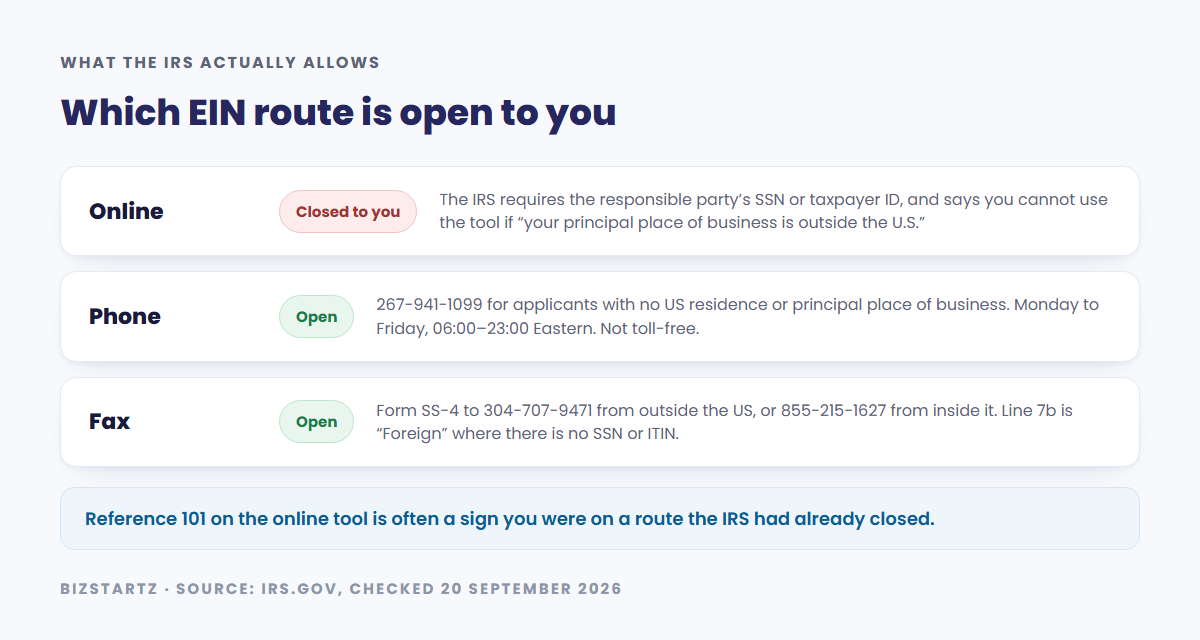
The IRS states two conditions that decide this, and both are on its own page for the online tool. You need Social Security number (SSN) or individual taxpayer ID number (ITIN)
of the responsible party.
And you cannot use the tool at all if Your principal place of business is outside the U.S.
In that case the page sends you elsewhere: If you can’t apply online, find out how to apply by phone, fax or mail.
(IRS, Apply for an EIN online, checked 20 September 2026.)
Read that as a non-resident founder and the picture changes. Your Wyoming or New Mexico LLC is a US entity, but you are running it from Kathmandu, Manila or Lagos, so your principal place of business is not in the US. The online application was closed to you on day one.
This trips up more people than it should, because the failure often happens out of sight. A cheap formation agent runs the online application on your behalf, gets a reference number, and forwards you the screenshot. If that is your situation, ask the agent one direct question: which route did you file through? If the answer is the online tool, the reference number is a symptom of the route, not of your company name.
The route that actually works from outside the US
There are two, both on paper terms rather than instant.
Fax Form SS-4. The Instructions for Form SS-4 tell applicants with no legal residence or principal place of business in any state to fax your form to 855-215-1627 (if within the United States) or 304-707-9471 (if outside the United States)
.
The instructions also mention a fax turnaround of generally within 4 business days
, though that sentence sits with the domestic fax instruction, so do not treat it as a promise for the international number.
Call the international line. The same instructions give 267-941-1099 (not a toll-free number), 6:00 a.m. to 11:00 p.m. (Eastern time), Monday through Friday
for applicants with no legal residence, principal place of business, or principal office in the US. Have the completed SS-4 in front of you; the assistor works through it.
Two details on the form matter more than the rest:
- Line 7b. If your responsible party has no SSN or ITIN, the instructions say to
Enter “foreign” or N/A on line 7b if the responsible party doesn’t have and is ineligible to obtain an SSN or ITIN.
That line exists for you. Nobody needs to lend you their SSN, and nobody should be listed as the responsible party except the person who actually controls the company. - A fax number you can receive on. If you give one, the reply comes back by fax rather than by post. Mail is the slow lane: the IRS says to apply
4 to 5 weeks before you will need an EIN
and thatYou will receive your EIN in the mail in approximately 4 weeks
.
The mechanics of filling in the SS-4 as a non-resident, box by box, are covered in our walkthrough on how to get an EIN without an SSN. If you would rather hand the filing over, that is what our EIN filing service does.
What reference 101 means, and who is actually saying so
Here is the part other articles state with more confidence than the evidence supports.
The codes are real and the IRS does use them. Its Internal Revenue Manual, section 21.7.13 on assigning EINs, points staff to IRM 21.7.13.3.4.1, Modernized Internet EIN (Mod IEIN), for a list of error codes and their meanings
, and its change log names specific codes: Revised handling guidance for reference code 101
and Clarified automated message routing within the online system for reference codes other than 101 or 115.
(IRM 21.7.13, read 20 September 2026.)
What we could not find is any IRS page that tells a taxpayer what 101 means. The manual is an internal procedures document, parts of that very section carried an official use only
designation until recently, and the public pages about applying for an EIN do not mention reference numbers at all.
So where does the familiar definition come from? Practitioners. Clerky’s help centre describes 101 as meaning the IRS system already has a business entity with a name that is either too similar to or the same as your entity’s name
, and LLC University gives the same reading.
They agree with each other and with what founders report back, which is decent evidence. It is not the IRS saying it, and any page that tells you otherwise is guessing on your behalf.
There is a second possibility that the practitioner write-ups do not cover, because they are written for applicants inside the US: when the applicant is outside it, the name is often fine and the route was the problem.
The other reference numbers you might see
Same caveat, in a table. These are the meanings practitioners consistently report, not IRS definitions.
| Code | What practitioners report it means |
|---|---|
| 101 | A name conflict with an entity already in the IRS database |
| 102 | The responsible party’s name and their SSN or ITIN do not match |
| 109, 110, 112, 113 | Technical faults in the online application, sometimes load-related |
| 114 | The responsible party has already been issued an EIN that day |
| 115 | A date-of-death check on the responsible party came back positive |
Source for the table: LLC University’s reference number guide, corroborated for 101 by Clerky. Treat any code meaning here as a working hypothesis to test, not as a rule.
One of those has an IRS fact standing behind it. On the daily limit, the IRS says plainly: You can apply for only 1 EIN per responsible party per day.
(IRS, Get an employer identification number.) If you are the responsible party on several companies, space the filings out.
If you were eligible and still got 101
Then the standard advice applies, and it is sound: the fix is a paper SS-4, not another attempt online. LLC University and Clerky both recommend faxing the form and including your approved formation document, the Articles or Certificate of Organization or Formation that your state returned to you. Clerky adds that the IRS typically asks for a filed copy of your certificate of incorporation
with the fax.
Worth knowing: a name being available in your state of formation says nothing about the IRS. State registers and the IRS entity database are separate systems, and practitioners report that 101 can be triggered by an entity registered in a different state entirely.
That is a reported pattern rather than a documented IRS rule, but it explains why “but the state approved my name” does not resolve anything. If the name really is the sticking point and you have not yet formed, picking it deliberately is part of choosing the state to file your LLC in.
Three things not to do
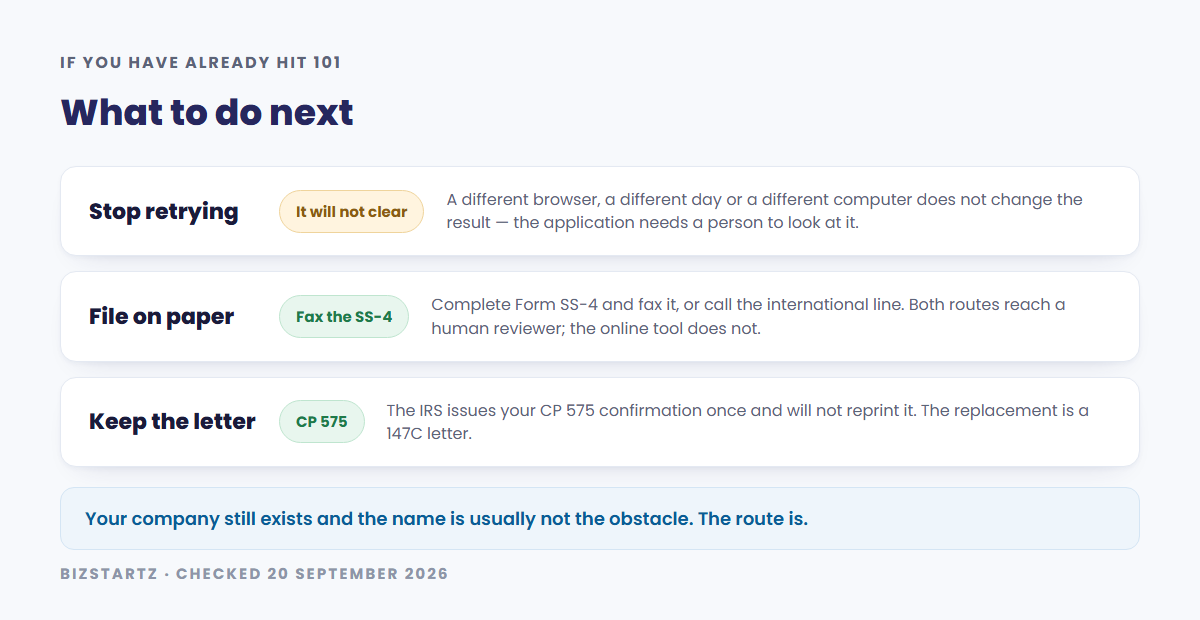
- Do not keep resubmitting. A different browser, a VPN, tomorrow morning — practitioners report none of it clears a 101, and resubmitting does nothing about the eligibility rules quoted above.
- Do not borrow an SSN. Putting a friend, an agent or a US-resident cousin on line 7a and 7b as the responsible party gets the EIN issued to the wrong person and puts the wrong name on your company’s IRS record. Line 7b accepts “foreign” for a reason.
- Do not pay anyone to retry the online tool. If a provider’s answer to 101 is another online attempt, they are repeating the thing that failed. Ask which route they will file through before you pay.
Once the EIN comes through
The IRS issues the CP 575 confirmation notice once and does not reprint it. If you lose it, the replacement is a 147C letter, which you can request from the IRS even from outside the US. Keep the fax confirmation page as well — until the notice arrives, it is your only proof of when you filed.
And the EIN is the start of an obligation, not the end of one. A single-member foreign-owned US LLC files Form 5472 with a pro forma 1120 each year, and the IRS penalty for not filing starts at $25,000. If you are still assembling the wider picture, what an EIN is and what it unlocks covers the basics, and we handle the whole sequence under US company formation.
Questions people ask after a 101
Can I fix reference number 101 online?
No. Practitioners consistently report that resubmitting the online application returns the same code, and if your principal place of business is outside the US the IRS says the online tool is not available to you at all. The route is a paper Form SS-4 by fax, or a call to 267-941-1099.
Does reference 101 mean my company name is rejected?
Not necessarily. Practitioner write-ups tie 101 to a name conflict in the IRS database, but the IRS publishes no taxpayer-facing explanation of the code, and for applicants outside the US the more common cause is having used an application route that was never open to them.
How long does the fax route take?
The Instructions for Form SS-4 mention a fax reply generally within 4 business days
, in the context of the domestic fax number, and say mailed applications take approximately 4 weeks
. The IRS publishes no committed turnaround for the international fax line, so plan around weeks rather than days and do not let anyone promise you a date.
🎯 Ready to start? Claim your free consultation and we'll map out your US LLC formation strategy — EIN, banking, and the right state for your country.

Ready to start your company?
Bizstartz handles formation, EIN, banking and compliance for founders worldwide.