If you formed a US LLC from outside the United States and have never filed Form 5472, here is the short version. The penalty is $25,000 for each year you missed. There is an IRS route for filing late, and it is open to you for as long as the IRS has not contacted you about it. And the part that most pages skip: the tax year you missed does not close on its own. It stays open until the form is actually filed.
That last point is the reason not to wait another year. This page covers what the penalty says, which years you are actually on the hook for, how the catch-up route works, and where the IRS publishes no answer at all. If you need the basics of the form itself (who files, what counts as a reportable transaction), read our guide to Form 5472 for foreign-owned US LLCs first and come back.
What the penalty actually says
From the IRS Instructions for Form 5472, checked 21 September 2026:
“A penalty of $25,000 will be assessed on any reporting corporation that fails to file Form 5472 when due and in the manner prescribed.”
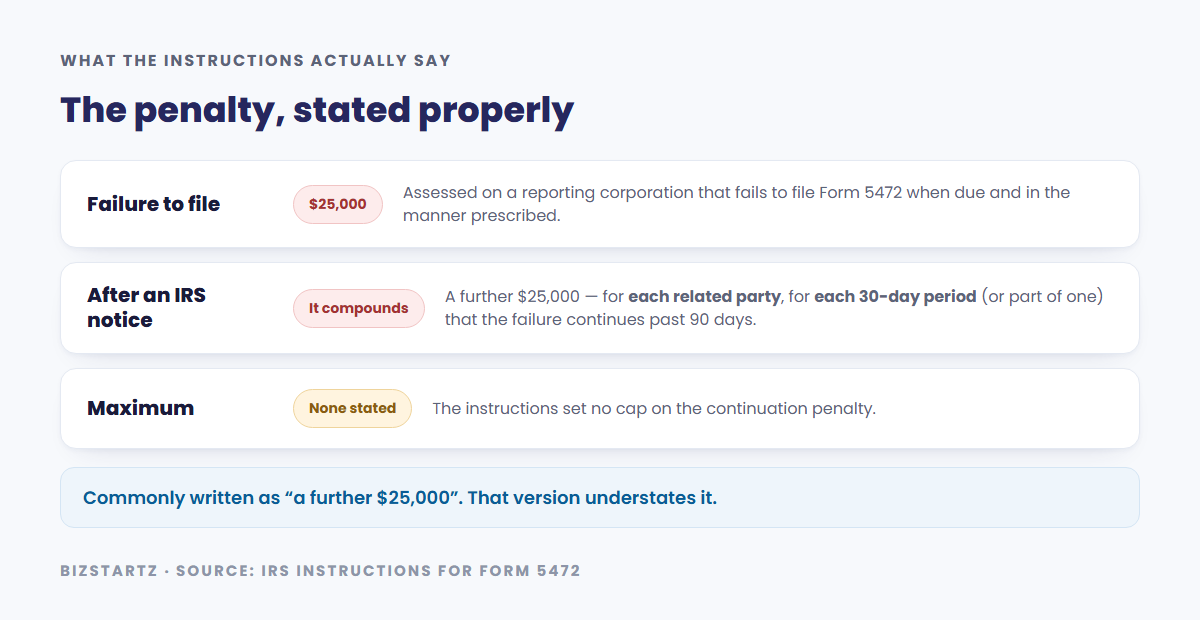
If the failure continues for more than 90 days after the IRS notifies you, a further $25,000 penalty applies. This is where the wording matters. The instructions say the additional penalty applies with respect to each related party for which a failure occurs, for each 30-day period (or part of a 30-day period) during which the failure continues.
Read that clause slowly, because it is routinely reported wrongly:
- $25,000 is per tax year. The regulation at 26 CFR 1.6038A-4(a) puts it as “a penalty of $25,000 shall be assessed for each taxable year with respect to which such failure occurs.” Three missed years is three separate penalties, not one.
- The continuation penalty is per related party. For most single-member LLCs that means the one foreign owner. If your LLC transacted with more than one related party, each one that the missing form should have reported is counted.
- And it repeats every 30 days. Not once. Every 30-day period, or part of one, while the failure continues after the 90 days run out.
- The instructions state no maximum. There is no published ceiling on the continuation penalty.
You will see this written elsewhere as “and a further $25,000 if you ignore the IRS notice,” full stop. That is not what the instruction says, and the gap is not academic. One version is a fixed second penalty.
The other keeps accruing. The same page also notes that criminal penalties under sections 7203, 7206 and 7207 “may also apply for failure to submit information or for filing false or fraudulent information.”
The year you skipped does not close on its own
This is the single most important thing on this page, and almost nobody in the formation industry mentions it.
Normally the IRS has three years from the date you file a return to assess additional tax. People assume the same applies here: miss 2021, wait it out, and by 2025 it is behind you. That is not how it works when an international information return is missing.
IRC 6501(c)(8)(A) says that where information is required to be reported under a list of sections that includes 6038A, the section Form 5472 exists to satisfy — the time for assessing tax:
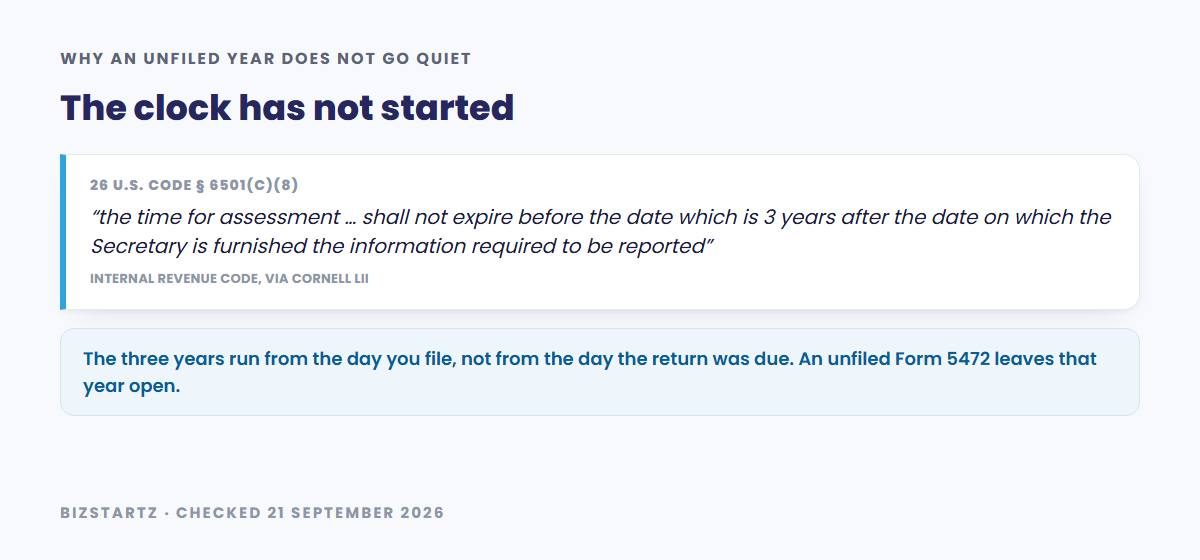
“…shall not expire before the date which is 3 years after the date on which the Secretary is furnished the information required to be reported under such section.”
The clock does not start when the return was due. It starts when you actually furnish the information. An unfiled Form 5472 leaves that tax year open, and it stays open for as long as the form is missing.
There is one narrowing rule worth knowing. Subparagraph (B) says that where the failure was “due to reasonable cause and not willful neglect,” the extension applies “only to the item or items related to such failure” rather than to the whole return. That limits the scope of what stays open. It does not restart the three years.
So the mental model to throw away is “three years and I am safe.” The accurate one is: filing is what starts the clock. Every year you leave it is another year the window stays open, which is also the practical argument for filing late voluntarily rather than hoping.
First, check whether you owed a Form 5472 for that year at all
Before you count up missed years, check each one. Some founders discover they owe fewer returns than they feared. Others discover they owe one for a year they were sure was dormant.
The instructions give an exception from filing where the entity:
“…had no reportable transactions of the types listed in Parts IV and VI of the form and, in the case of a reporting corporation that is a foreign-owned U.S. DE, also had no reportable transactions of the type listed in Part V.”
Part V is the one that catches people. It covers “amounts paid or received in connection with the formation, dissolution, acquisition, and disposition of the entity, including contributions to, and distributions from, the entity.”
In practice:
- The formation year almost always has a reportable transaction. The money you paid to set the company up, or the first funds you moved in, is one.
- Money you put into the LLC’s bank account is a contribution. Money you took out is a distribution. Both are Part V items even if the business earned nothing.
- A genuinely dormant year (no contributions, no distributions, nothing in Parts IV or VI) has no Form 5472 requirement, and therefore no penalty for not filing one.
“We had no income” is not the test. “No reportable transactions” is, and that is a wider net. Go through each year’s bank statements before you decide a year was empty. Note that this is separate from your state obligations, which run on their own calendar. What US LLCs have to file by state each year covers that side.
How many years back do you have to go?
The IRS publishes no lookback limit for delinquent Forms 5472. The streamlined procedures for other filings specify a number of years; the delinquent international information return route does not. If you want a rule of thumb, there is none coming from the IRS, and inventing one would not help you.
What is fixed is the start date. The requirement for a foreign-owned single-member LLC came in with regulations that apply “to taxable years of such reporting corporations beginning after December 31, 2016, and ending on or after December 13, 2017” (26 CFR 1.6038A-1(n)). Nothing before 2017 is in scope.
Between that start date and 6501(c)(8), the working assumption should be that every year from 2017 onward in which your LLC had a reportable transaction is still reachable. How many of those you file, and in what order, is the kind of decision worth paying a US tax professional an hour for.
The IRS route for late filing
The IRS maintains a page called Delinquent international information return submission procedures. It was live when checked on 21 September 2026. Form 5472 is one of the returns it covers.
Who it is for, verbatim:
“Taxpayers who have identified the need to file delinquent international information returns who are not under a civil examination or a criminal investigation by the IRS and have not already been contacted by the IRS about the delinquent information returns should file the delinquent information returns through normal filing procedures.”
Three conditions, and they are the reason timing matters: not under civil examination, not under criminal investigation, and not already contacted about these returns. Acting before a letter arrives is what keeps this route open.
On the reasonable cause statement, the page says:
“Taxpayers may attach a reasonable cause statement to each delinquent information return filed for which reasonable cause is being asserted. During the processing of the delinquent information return, penalties may be assessed without considering the attached reasonable cause statement.”
That second sentence deserves to be read twice. Attaching a statement does not stop a penalty being assessed. A notice can arrive with your reasonable cause argument sitting unread in the same file.
The page elsewhere notes that for Forms 3520 and 3520-A specifically, reasonable cause statements are considered before a penalty is assessed. That carve-out does not extend to Form 5472. It also says plainly that “penalties may be assessed in accordance with existing procedures.”
None of that makes the route pointless. It means you should expect the possibility of a notice, keep your evidence, and be ready to respond, rather than treating the statement as a shield and being blindsided by a notice.
One wrinkle to raise with a professional: the IRS page says delinquent returns other than Forms 3520 and 3520-A “should be attached to an amended income tax return.”
If your LLC never filed an original pro forma Form 1120 at all, there is nothing to amend, and the IRS does not publish guidance on that specific case.
The practical path people take is to file the missing year on the normal pro forma route described below. That is a judgement call, not an IRS instruction, and it is exactly the sort of thing to confirm with someone who will sign their name to it.
What a reasonable cause statement has to do
The standard for Form 5472 sits in 26 CFR 1.6038A-4(b). To show reasonable cause, the reporting corporation:
“…must make an affirmative showing of all the facts alleged as reasonable cause for the failure in a written statement containing a declaration that it is made under penalties of perjury.”
And the test itself: “The determination of whether a taxpayer acted with reasonable cause and in good faith is made on a case-by-case basis, taking into account all pertinent facts and circumstances.” The IRS’s general penalty relief for reasonable cause page uses the same frame, adding that you may qualify “if you demonstrate that you exercised ordinary care and prudence and were nevertheless unable to file your return or pay your taxes on time.”
Two things follow from the actual wording. First, “all the facts” means specifics: dates, what you were told and by whom, what you relied on, when you found out, and what you did in the days after you found out.
A paragraph saying you were unaware of the requirement is not an affirmative showing of facts. Second, it is signed under penalties of perjury, so every sentence in it has to be true and supportable with documents you can produce.
What nobody can tell you is whether it will work. The IRS publishes no acceptance rate for reasonable cause on international information returns, and any firm quoting you one is quoting a feeling. Write the strongest truthful statement you can and plan for the possibility that a penalty is assessed anyway.
Is there a first-time waiver for this?
Probably not, and it is worth being precise about why.
The IRS First Time Abate page lists the penalties the waiver covers: failure to file for tax returns under IRC 6651(a)(1), partnership returns under 6698(a)(1) and S corporation returns under 6699(a)(1), plus failure to pay and failure to deposit.
The section 6038A penalty behind Form 5472 is not on that list. The same page says the relief is not available for “Returns filed once or infrequently (i.e., event-based filing requirements)” or “Information reporting dependent on another filing.”
The IRS does not publish a sentence saying “First Time Abate does not apply to Form 5472.” What it publishes is a list that does not include it. Plan on reasonable cause, not on a first-time waiver.
How to file a missing year
The mechanics are the same as an on-time filing, repeated once per missed year. From the Instructions for Form 5472:
- Prepare a pro forma Form 1120 for that tax year. “The only information required to be completed on Form 1120 is the name and address of the foreign-owned U.S. DE and items B and E on the first page.”
- Write “Foreign-owned U.S. DE” across the top of the Form 1120. The instructions say this in those words.
- Attach the Form 5472 for that year, completed for the related party or parties and the reportable transactions in that year.
- Attach your reasonable cause statement, if you are asserting one, signed under penalties of perjury.
- Use the correct year’s forms. Each tax year is filed on that year’s version of the form, not the current one.
- Send it. A foreign-owned US DE cannot e-file this. Fax to 855-887-7737 at 300 DPI or higher, or mail to Internal Revenue Service, 1973 Rulon White Blvd, M/S 6112, Attn: PIN Unit, Ogden, UT 84201.
- Keep the proof. Save the fax confirmation page or the mailing receipt with the copy of what you sent. If a question comes up two years from now, this is the evidence that fixes the date you furnished the information — which, under 6501(c)(8), is the date that matters.
Going forward, the due date is the same as Form 1120: the 15th day of the fourth month after your tax year ends, so 15 April for a calendar-year LLC.
An extension is available on Form 7004, but it has to be filed by the original due date, so it is not a remedy for a year already missed. The current deadline page has the dates. If you have never obtained an EIN for the LLC, that comes first: how to get an EIN without an SSN walks through it.
If the IRS has already written to you
Two things change.
The delinquent submission route is no longer available for those returns. The IRS page requires that you have “not already been contacted by the IRS about the delinquent information returns.” And the 90-day clock behind the continuation penalty runs from that notification, after which the additional penalty begins accruing per related party per 30-day period.
In that situation, respond by the date on the notice, and get a US tax professional involved before you reply. This page is general information, not advice on your letter.
What the IRS does not publish
An honest list, because the gaps get filled with confident guesses elsewhere:
- How long processing takes. No published timeframe for delinquent international information returns.
- How often reasonable cause is accepted. No published rate. Not for Form 5472, not for international information returns generally.
- How many years back you must file. No lookback number is published for this route.
- Whether a $25,000 penalty assessed on the LLC can be collected from the foreign owner personally. The penalty is assessed on the reporting corporation. We found no IRS publication addressing collection against a non-resident individual owner of a disregarded entity, so we are not going to tell you either way.
- Whether several delinquent years can be sent in one transmission. Neither the instructions nor the delinquent-return page addresses it.
Common questions
I have not filed for three years. Is that three penalties of $25,000?
The regulation says the penalty is assessed “for each taxable year with respect to which such failure occurs,” so each missed year in which you had a reportable transaction is its own penalty. A year with no reportable transactions had no filing requirement, so check each year before counting.
Does the problem go away after three years?
No. Under IRC 6501(c)(8), the assessment period for tax related to the required information “shall not expire before the date which is 3 years after the date on which the Secretary is furnished the information.” The three years run from when you file the missing form, not from when it was due.
My LLC had no income. Do I still have to file?
Income is not the test. Reportable transactions are. Contributions to, and distributions from, the entity are Part V reportable transactions, so a year with no revenue can still require a Form 5472. A year with no reportable transactions in Parts IV, V or VI does not.
Can I file the missing years electronically?
No. A foreign-owned US disregarded entity cannot e-file the pro forma Form 1120 with Form 5472. It goes by fax to 855-887-7737 or by mail to the Ogden, Utah address in the instructions.
Will a reasonable cause statement stop the penalty?
Not automatically. The IRS states that “during the processing of the delinquent information return, penalties may be assessed without considering the attached reasonable cause statement.” Attach one anyway, keep your documentation, and be prepared to respond if a notice arrives.
Where to start
Pull the bank statements for every year since the LLC was formed and mark the years with a contribution, a distribution or any other reportable transaction. Those are the returns you owe. File them on the pro forma route with a reasonable cause statement attached to each, and keep the transmission proof. If more than a year or two is open, or if the IRS has already written to you, bring in a US tax professional before you send anything — the cost of an hour of review is small next to the number in the penalty paragraph.
If you are deciding whether to keep the company at all, note that closing it does not clear this: the final year still needs a Form 5472, which the dissolution guide covers. And if you would rather hand the filings to someone each year, that is what our annual tax filing service exists for.
Every figure and quotation on this page is taken from the IRS instruction, Treasury regulation or statute linked beside it, each checked on 21 September 2026. Where the IRS publishes no answer, this page says so rather than estimating. This is general information about a filing requirement, not tax or legal advice for your situation.
🎯 Ready to start? Claim your free consultation and we'll map out your US LLC formation strategy — EIN, banking, and the right state for your country.

Ready to start your company?
Bizstartz handles formation, EIN, banking and compliance for founders worldwide.