Do I Need an LLC to Start an eCommerce Business?

One of the easiest ways to start an entrepreneurial venture in the modern world is by launching an e-commerce business. All you need is an internet connection and a laptop to start selling goods across the globe on platforms like Shopify, Amazon, Etsy, and eBay.

Many new sellers, however, start with product sourcing and marketing before considering the following question:

“Do I need an LLC to start an e-commerce business?”

Legally speaking, you do not need an LLC in order to start selling anything online. You can work as an individual seller. The long term answer will typically depend on the vision you have for the business, how much you are willing to risk, and how professionally you want to conduct the business.

Let’s explore this in depth.

1. You Can Start Without an LLC

If you will be venturing into e-commerce for the very first time, you can start an online store without registering as an LLC. A lot of entrepreneurs begin as sole proprietors in the U.S and as individuals in other countries.

What this means in practice:

You can simply create an account on Shopify, Amazon, or Etsy under your personal name, list products, and start receiving payments via PayPal, Stripe, or a bank account. It’s fast, cost-effective, and allows you to test the waters before committing to formal structures.

The risks of starting without an LLC:

The downside is that as a sole proprietor, there is no legal separation between you and your business. If a customer sues you over a defective product, or if you run into debt with suppliers, your personal savings, car, or even your home could be at risk.

Practical example:

Imagine you sell phone chargers, and one catches fire and damages a customer’s property. Without an LLC, you could personally be held liable for damages. With an LLC, the business, not you personally, would be responsible. The cycle here indicates that to begin with, every business up to a certain level makes a quick and easy analysis.

2. Why Do Most Entrepreneurs Prefer an LLC

Entrepreneurs

It is not mandatory, but an LLC is relatively beneficial for an e-commerce seller. Here’s why:

Limiting Liability Exposure

Making an LLC helps in distinguishing personal valuables from business valuables. In the case of a lawsuit, no personal assets such as money, a bank account, a car, or even a home is lost. This is very critical for e-commerce sellers dealing with shipping, potential product liabilities and product refunds.

Building a Reputation

Operating under a registered business helps in building a reputation. For instance, “EcoGlow Products, LLC” is better than “John Smith.” This is very important in applying for wholesale accounts or negotiating with suppliers, partners, and manufacturers

Flexible Taxation

An LLC has multiple taxation options available:

  • Taxation as a sole proprietorship by default and a single member LLC, or as a Multi member LLC partnership.
  • Electing an S Corporation status for U.S. residents in order to lessen on self-employment taxes.
  • Electing as a C Corporation if profit reinvestment is the goal,

This provides e-commerce sellers with the ability to tackle any growth in their company as a result of the business expansion.

Easier Banking & Payment Processing

Banks and payment processors prefer and require a defined business structure.

The following steps become easier:

  • Application for business accounts with US banks
  • Approval for PayPal and Stripe accounts
  • Merchant accounts and e-commerce accounts financing.

These services are most easily available to foreign residents or non US residents.

3. When You Might Not Need an LLC

As useful as LLCs can be, do consider these situations to know when to skip LLCs.

  • Hobby sellers: If you craft a few necklaces and sell them on Etsy, or if you dropship as a side gig, not giving too much thought to an LLC makes sense.
  • Low-risk products: Supplements, cosmetics, and electronics are much more exposed to liability than digital products, online courses, and print on demand shirts.
  • Idea validation stage: Many sellers prefer to test a product idea for a few months. Having said that, waiting too long could expose you to unnecessary risk if your sales grow wildly.

Also, in the event that you receive a dispute from a customer, you would be better off having an LLC. When Should You Start Thinking About Setting Up an LLC

4. When an LLC is highly recommended.

E-commerce businesses that have moved past the ‘trial stage’ are more profitable.

Establishing an LLC brings about the following benefits.

  • Physical products that present potential risk are sold: Supplements, beauty products, electronics and baby items are high risk items.
  • Scaling of the brand is easier: Building a company facilitates better relations with manufacturers, influencers and wholesale buyers.
  • Use of Amazon and Walmart for selling is easier: Most of these platforms prefer registered accounts, especially for the Brand Registry.
  • You have partners or investors: Increase in the number of partners and investors also increases the profits, ownership percentages, and decision making powers.

You can grow your business without the fear of losing your personal funds with an LLC.

5. What About Taxes?

Taxes

The taxes associated with operating an online store are not easy to deal with. Setting up an LLC helps to deal with taxes in a more organized manner.

Without LLC: Taxes on income are individually reported on a tax return. American citizens are residents report income on a personal country tax return. There are non-residents that earn income from USA but they only submit taxes in their country.

With LLC:

  • U.S. citizens and residents do not have to pay self-employment taxes do not have to pay self-employment taxes if they elect to be treated in a certain way.
  • Non-residents are able to sell on Amazon and Shopify using a US LLC and are not subject to US tax obligations provided they do not have US businesses. They still have to report taxes in their country.

This is why LLCs are popular among sellers on the rise. The growth in sales is the reason for setting up an LLC then.

6. How to Make a Choice

In order to help with this, we have it framed as a simple decision making process.

Are you a beginner testing a new concept? Start out without an LLC to keep the expenses as low as possible.

Are you consistently selling, while also reinvesting the profits? Then it would be a good idea to form an LLC, as this will help protect your assets, as well as build your reputation.

Do you want to expand your business all over the globe? if this is the case, then an LLC is almost mandatory for tax purposes, banking purposes, and also for global brand recognition.

How Bizstartz Helps

At Bizstartz, we assist entrepreneurs, particularly those living outside the United States, with forming LLCs and providing the necessary tools for further development. This includes:

  • Establishing an LLC in any of the fifty states
  • Acquiring an EIN for tax obligations
  • Opening a U.S. business account (a requirement for merchants on Amazon and Shopify)
  • Approval of payment processing services (via Stripe, PayPal, etc.)
  • Setting up an Amazon seller account
  • Provision of bookkeeping and compliance assistance
  • Filing of BOI

Our goal is to remove the hassle from business formation in the U.S. so you can concentrate on selling and growing your e-commerce business.

Blog CTA

Final Thoughts

While you do not legally require an LLC to operate an e-commerce business, there are many advantages that come with it. These include limited personal liability, business credibility, flexible taxation, and easier access to financial services.

If you are selling as a hobby, you may not need to set up the at once. However, if you plan to establish a sustainable business model, expand internationally, and grow, then the LLC is the way to go.

How Many Members Can Be in a US LLC?

As potential entrepreneurs setting up a Limited Liability Company (LLC) in the United States will most likely ask the question which is “How many members can go in an LLC?”

This is important because the members also determine ownership and the management structure, and also directly influences the taxation and future approach to the business growth.

This applies to individuals, family owned businesses, or any group to foreign entrepreneurs setting up business in the United States. Knowing the LLC rules will enable any foreign businesses to better serve their LLC members.

In this guide, we’ll go deeper into:

  • What an LLC member is
  • The minimum and maximum number of members allowed
  • The difference between single-member and multi-member LLCs
  • Ownership rules for non-U.S. residents
  • How membership affects taxation, liability, and management
  • Common misconceptions about LLC membership

What Is an LLC Member?

To start with, an LLC member is a business owner, and in this scenario, an LLC member is. Unlike a corporation that subdivides their business and issues shares to their stockholders, the LLC assigns a membership interests to their members.

Each member that is a business owner, usually more than one, will own a percentage of the LLC which is determined and agreed upon in the company’s Operating Agreement. Also ownership can in some instances depend on the amount of capital a member contributed.

Members can be:

  • Individuals – with residents such as citizens, green card holders, and foreign nationals.
  • Other business entities – with corporations, other LLCs, or partnerships.
  • Foreign companies – as a non-U.S. business can own part or all of a U.S. LLC.

This flexibility in membership (license) is the reason LLCs are widely used, particularly by international business owners who may be unable to own other entities, such as S-Corporations.

How many members is an LLC allowed to have?

Multimember LLC

Minimum: An LLC is required to have at least one member. Otherwise, the company will be unable to exist legally.

Maximum: An LLC has no restriction as to the number of members it can have.

The lack of restriction makes LLCs one of the most flexible business entities in the US. Start as a one-person business and add many partners, investors, or even family members as co-owners.

For example:

  • S-Corporations are restricted to 100 shareholders, all of whom must be citizens or residents of the US.
  • Partnerships default (do not) offer limited liability, and require at least two partners.
  • C-Corporations have no restriction on the number of shareholders, but the business has stricter compliance and double taxation.

No need to worry about the LLC as you have both the facets of a company (greater than 1 member) and ease of compliance and flexible taxation.

Single-Member LLC (SMLLC) vs. Multi-Member LLC (MMLLC)

1. Single-Member LLC (SMLLC)

Freelancers, consultants, and small business owners looking for liability protection and easy taxation usually opt for a single-member LLC, which is the most common type of LLC.

Key Features:

  • Tax Treatment: Single-member LLCs are disregarded entities for the IRS and the owner’s income has to be reported in a Schedule C. However, owners can elect for s corporation and c corporation taxes if it is beneficial.
  • Control: Owners are free to make any business decisions since they have full ownership.
  • Simplicity: Owners can skip the headaches of complicated agreements with co-owners.
  • Liability Protection: Owners are still protected from personal liability alongside business liability.

Best For: Solo entrepreneurs, small e-commerce business, consultants, and international entrepreneurs without partners looking to penetrate the US market.

2. Multi-Member LLC (MMLLC)

Families, partnerships, and start ups with multiple co-founders usually opt for a Multi-Member LLC, which is a type of business entity with two or more owners. Group of investors can also pool resources to set up a Multi-Member LLC.

Key Features:

  • Tax Treatment: LLC’s are taxed as partnerships by default. Profits and losses are divided and taxed as per the ownership percentage. The LLC doesn’t pay federal income taxes, unless it elects to pay as a C corporation.
  • Flexibility in Ownership: Profits can be split in any way the members agree to (not necessarily equal).
  • Management: Requires an Operating Agreement to define roles, voting rights, and decision-making processes.
  • Growth Potential: Easier to bring in new members or investors.

Most suitable for: international teams, family businesses, startups with co-founders, and companies that intend to expand with multiple investors.

Can Non-U.S. Residents Be LLC Members?

Yes. An LLC can have members that aren’t United States citizens, as there are no ownership restrictions based on citizenship or residency. This makes the LLC the most foreign-friendly entity type in the United States.

  • A foreign national can own a whole or partial stake in an LLC.
  • A foreign entity is able to serve as a member of an LLC.
  • Having an ITIN instead of a Social Security Number is acceptable for tax purposes.

This is especially useful for global entrepreneurs wishing to sell on Amazon, Shopify, or Etsy, or for those wanting access to U.S. payment processors and bank accounts.

Why Does It Matter How Many Members a Business Has?

The number of members in an LLC has a strong impact on various facets of the business:

1. Taxation

  • A Single Member LLC (SMLLC) is automatically taxed as a sole proprietorship and is far easier to deal with at the expense of being less tax-planner friendly.
  • A Multi Member LLC (MMLLC) is taxed as a partnership by default and has an enormous amount of freedom to structure the split of profits and losses.

Both single and multi-member LLCs have the option of being taxed as an S-Corp or a C-Corp if it proves to be more beneficial from a tax standpoint.

2. Management and Decision-Making

  • One member LLCs have an easier time with decisions.
  • Multi-member LLCs have to have an Operating Agreements which help structure the business in a way to avoid conflicts and fulfill the obligations more clearly.

3. Liability Protection

Both SMLLCs and MMLLCs have limited liability. Courts have a tendency of giving more consideration to the protection of a multi-member LLC if it has relevant agreements and proper business practices.

4. Growth and Investment

  • Single Member LLCs are easy to run but often struggle to acquire unsought investments.
  • Multi-member LLCs simplify the business as more partners and investors can be invited easily due to the flexible division of ownership control.

Advantages of No Member Limit in LLCs

  • Scalability: Start small as a single-member LLC and expand as new members join.
  • Attracting Investment: Capital investment by different members can be done without limits and restrictions.
  • Flexible Ownership Structure: Ownership can be split in any ratio as per the agreement by members.
  • International Market Potential: Foreign individuals and entities can own LLCs unlike S corporations.
  • Ease of Transition: A business can begin with a single member and subsequently transform into a multi-member LLC without the need to create a new entity.

LLC Membership – Misconceptions and Misunderstandings

An LLC can have an unlimited number of members.

– Members of an LLC can be an unlimited number of individuals.

Members of an LLC have to be US Citizens.

– Foreign individuals and foreign businesses can also be members of an LLC.

Members of an LLC are required to have equal ownership.

– Members can have ownership percentages of their choosing (e.g., 70/20/10).

It is overly complicated to add new members.

– Adding new members is straightforward although it does involve changes to the Operating Agreement and informing the state in certain instances.

Single-(1) member LLC does not have any protection

– A single-member LLC is managed improperly if it does not protect the member’s personal assets and business finances. Otherwise, full liability protection is afforded.

Blog CTA

Conclusion

An LLC can have an unlimited number of members, and for an owner willing to either work alone, or have multiple partners, bringing in several investors, plenty of flexibility is also provided.

We help international and local business people to open bank accounts and are compliant with US laws. They help in the formation of single-member and multi-member LLCs.

Frequently Asked Questions (FAQs)

1. Is It Possible To Have One Member In An LLC?

Most people have single-member LLCs, and it is legal.

2. How many members are allowed to join an LLC?

There is no limit to how many members can join an LLC.

3. Can a foreign citizen become a member of an LLC in the United States?

Yes. members of an LLC do not have to be citizens or residents.

4. Do all members have the same amount of voting rights?

Not in all situations. Voting rights are defined in the Operating Agreement.

5. How are profits shared among the members of an LLC?

Profits can be shared in equal or agreed upon unequal ratios.

6. Can a corporation or other LLCs become members of an LLC?

Yes. other functionalities can also be members of the LLC.

7. Do single-member and multi-member LLCs attract different taxation?

Yes. By default, single-member LLCs are taxed as sole proprietorships and multi-member LLCs are taxed as partnerships. But, both can decide to choose a different tax classification.

✅ Ready to form your U.S. LLC? Bizstartz helps you every step of the way, from formation to banking, EIN, ITIN, and compliance.

Helping Hippie Clothes Wholesale Expand to the US Market with a US LLC

Hippie Clothes Wholesale is a rising star in the fashion industry focusing in bohemian, hippie and festival styled clothing. They sell to all types of customers, from retailers and boutiques to direct individual customers, in a wide variety of different countries.

The company is well known for the multitude of distinctive designs, vibrant colors, and hand crafted additions they offer to their customers. They sell their designs all over the world due to their easy affordability, originality, and a sprinkle of cultural references in their designs.

While the company is experiencing great success internationally, their founder was able to discover a gap in the U.S. fashion and e-commerce market. There is a wide variety of unique alternative styled clothing and many unique boutiques in the United States which happens to house millions of online shoppers. This is extremely important to companies like Hippie Clothes Wholesale because they sell their clothes on Amazon, a selling platform with a wide consumer base.

But, there are major challenges when trying to enter the US market for the first time. The hoops you have to jump through to form a legal entity, pay the taxes required, and complete Amazon’s document verification are rather confusing. This is why the company reached out to Bizstartz.

Hippie

The Challenge

  • When we were approached by Hippie Clothes Wholesale they already had an idea in mind:
  • Create a legal business entity in the US for better operational credibility.
  • Acquire the required compliance documentation to obtain and pay taxes lawful in the U.S.Create a bank account to receive payments from Amazon for business operational managers.
  • Acquire Amazon Seller Central to unlock direct selling capabilities for the United States business market.

However, the founder had legitimate issues, too:

U.S. Business Formation Complexity

For non US residents, forming a company in the U.S. is a puzzle. Every state has its unique set of rules, documents, and costs. Added to these, unlayering the legal intricacies of remote jurisdiction still felt overwhelming.

IRS Compliance & EIN (Tax ID)

Legally working in the United States is a complicated process for non-citizens, and is near impossible without having an EIN (Employer Identification Number). It’s a foundation for opening a bank account, filing taxes, and even more registering on selling platforms like Amazon. Perhaps the most tough challenge from outside the United States is having to deal with the IRS.

Difficulty in Opening a U.S. Business Bank Account

Many U.S. banks require physically visiting a branch to open an account, and to also complete a number of compliance checks and excessive reports. For non-resident business owners, this seems to be the most difficult process, and is often considered the most complicated part of the entire process of acquiring a U.S. business bank account.

Amazon Seller Account Approval

Amazon has very lengthy procedures to verify sellers from different countries, and many get rejections due to incomplete or incorrect information. Our client was struggling to understand how to prepare documents that articulate the true nature of the client’s business.

Each of these issues could impact business entry in the U.S. market, if not completely stop it. They came to us at Bizstartz to set up the business and all the related processes.

Our Strategy

At Bizstartz, we helped Hippie Clothes Wholesale smoothen their business entry into the U.S. market and ensured all necessary compliances were verified.

1. US LLC Formation

We started with the formation of a Limited Liability Company (LLC) in the United States, as an LLC comes with the following advantages:

  • Protection of personal and business liabilities.
  • Non-residents friendly tax system.
  • Recognition and trust with the Amazon seller, U.S. client, and banks.

We helped the client decide which was the most advantageous state for them to set up their LLC.

2. Applying for an EIN (Tax ID)

After registering the LLC, the other business contour which we define, is applying for an EIN with the IRS. Like for individuals, the business also has to obtain a ” Social Security Number ” which is an Employer Identification Number (EIN) for the purposes of:

  • Opening a U.S. business bank account.
  • Registering on Amazon and with other payment processors.
  • Correct filing and tax reporting.

Bizstartz took complete responsibility of the application process and obtained the EIN which confirmed that Hippie Clothes Wholesale was a legitimate business operating in the US.

3. Opening a U.S. Business Bank Account

Having a bank account in the US is a great challenge for international business owners. During the process, we help the client complete everything to the last detail with maximum convenience.

All the required documents were assembled and we took the client through the process account to make the account seamlessly, fully.

4. Setting Up an Amazon Seller Account

The last step we guided Hippie Clothes Wholesale through was the setting up of an Amazon Seller Central account. Amazon needed legal documents, a proof of the existence of the business, authentic bank documents, and all the business details for account verification. Missing a step in this phase can cause Amazon to suspend the account or deny it altogether.

Bizstartz applied due diligence in preparing the application and advising the client through the steps of account verification, ensuring that all documents were in order. This resulted in instant approval of the account, giving them the ability to immediately start selling and listing products on Amazon U.S.

The Results

Thanks to our assistance, Hippie Clothes Wholesale was able to achieve their goal of establishing a legal entity in the U.S.

Some of the desired outcomes included the following:

✅ A U.S. LLC was fully registered, giving them an added layer of credibility as well as legal protection under U.S. business laws.

✅ A valid EIN able to assist the client in complying with the requisite taxes as well as helping with Amazon account verification.

✅ A functional business bank account in the U.S. that allows seamless transfers and payments from Amazon.

✅ Instant approval of an Amazon Seller Central Account which offers them countless customers in the U.S.

Hippie Clothes Wholesale can now utilize their growth opportunities to scale their operations as well as brand awareness in the U.S, which is one of the most profitable markets for e-commerce.

Client Testimonials

Clothing in Nepal review

Conclusion

To most non-US entrepreneurs, venturing the United States seems to be more like a fairy tale than reality due to the perceived legal and monetary obstacles. However, with appropriate information, even the most overwhelming tasks can be simplified and organized to an attainable goal.

Hippie Clothes Wholesale is a testament to how Bizstartz enables global entities overcome the hurdles and thrive in the US market. It does not matter how complex the task is, from establishing an LLC to getting an Amazon account approved, our team does everything to the highest degree of quality.

If you are a global entrepreneur who is planning to enter the United States market, Bizstartz is here to assist you with the LLC formation, EIN application, US bank account set up, Amazon account registration, and compliance help in an organized and low tension manner.

Build your US business with us today – we are more than willing to help you.

How Bizstartz Helped Khukuri House Expand into the US Market

Client: The Khukuri House (Nepal)

Industry: Kukri Knives & Traditional Handicrafts

Services Provided by Bizstartz: Formation of LLC with EIN, US Bank Account, Amazon Seller Account, US LLC

Khukuri house

Starting in 1991 with a base in Kathmandu, Nepal, The Khukuri House has established itself as a global leader in crafting the Kukri knife that is a knife with a unique shape and is a symbol of Nepal, particularly among the Gurkhas.

All Kukri that the company sells is backed by a unique blend of exquisite craftsmanship and modern hand-forging techniques, a standard that Khukuri House has perfected over the years in meeting customer requirements from all over the globe including collectors, martial artists, and military enthusiasts.

Although the company has earned itself a reputable status in various markets, it still is facing obstacles with the US market. Customers still prefer accessing it on trusted sites like Amazon.

As a result, Khukuri House recognized the pressing need to develop a business foothold within the United States. They started working with Bizstartz, specializing in assisting foreign nationals in establishing their business presence in the United States and providing tools for international business expansion.

Challenges

Khukuri House encountered a number of challenges prior to collaborating with Bizstartz. These challenges hampered their efforts to grow in the United States.

Absence of a US Based Business

Khukuri House’s ability to access and use payment gateways, close contracts with American partners, and open American bank accounts was severely constrained by the absence of a registered American company. Many platform for online retailers, and even Amazon, give preference to businesses with a registered American entity.

Banking and Payment Issues

Payments from American customers were expensive and time-consuming. International wires were unfavorable due to high costs, slow processing, and unfavorable currency exchange. This not only impacted profits, but also the ability to expand operations.

Tax and Compliance Burden

To register and operate on Amazon and similar platforms, Khukuri House was restricted due to the lack of an Employer Identification Number (EIN). This absence of an EIN severely hampered their smooth functioning within the United States.

Amazon Seller Account Approval

Our biggest motivation behind the Khukuri House was selling through Amazon U.S. However, creating a seller account from outside the U.S. Amazon keeps documentation, tax obligations, and banking details at a premium value and fully legitimized, something the Khukuri House was missing before seeking the aid of Bizstartz,

Credibility with U.S. Customers

Having having a brand a robust brand at the international scale did not contract Khukuri House. Even still, a parade of consumers in the U.S. opt to transact with the little blue dot. It was all risk, not reward, to have little to no presence and building faith and credibility in one of the most lucrative and cut-throat landscapes of the business world.

All of this considered, Khukuri House was, it was evident, stepping in to a challenge of complex cross-border barriers and business expansion.

Bizstartz Solution

In order to combat this nightmare, Bizstartz rolled out a comprehensive set of solutions Khukuri House infamously known for when it comes to the U.S. Rather than focusing on a single aspect of the problem, Bizstartz took a total approach toward the legal, tax, banking, and eCommerce marketplace all in one.

Below are some of the results Bizstartz managed to hit:

1. U.S. LLC Formation

Bizstartz helped Khukuri House form a U.S. Limited Liability Company (LLC) in a business-friendly state. This gave the company:

  • A legal identity in the United States, making it easier to operate and scale.
  • Access to business protections and limited liability for its owners.

Eligibility to sign contracts, open bank accounts, and register on U.S. eCommerce platforms.

2. Registration and Application for an EIN

Following, Bizstartz received an Employer Identification Number from the IRS. This was a critical step for these reasons:

  • An Amazon account requires an EIN to confirm compliance with tax requirements.
  • Banking institutions in the US require an EIN for opening a business bank account.
  • Having an EIN permits Khukuri House to abide with US tax regulations and to submit the relevant reports.

3. Opening Bank Accounts in the US

Opening a U.S. bank account is one of the biggest hurdles for non-U.S. residents. Bizstartz simplified the process by:

  • Preparing all necessary documents from the LLC and EIN.
  • Connecting Khukuri House with banking partners who accept non-resident U.S. LLCs.
  • Ensuring smooth onboarding so they could start receiving payments in U.S. dollars directly.

This significantly reduced costs associated with international transactions and improved cash flow for reinvesting in inventory and marketing.

4. Approval for an Amazon Seller Account

In the end, Bizstartz has the US LLC, Bank Account and EIN streamlined the application process for opening an Amazon Seller Account. In record time the accounts were ready. This is mostly due to the fact all the documents were already organized. He instantly gained access to one of the largest online marketplaces in the world.

Results

Working with Bizstartz helped Khukuri House reach important business achievements which influenced their expansion to the United States.

Increased Presence in the United States: Today, Khukuri House carries an American LLC with an EIN, which makes their business operated in the United States, thus establishing more credibility with the customers and platforms.

Reduced Cost and Increased Speed of Payment: Khukuri House is able to retrieve Amazon and direct customer payments in US dollars due to the US bank account, eliminating the hassle of conversion fees.

Gained Access to the Marketplace: Approval of the Amazon Seller Account enables Khukuri House to sell to millions of customers in the United States through a trusted platform.

Increased Credibility: Presence in the US enhances brand reputation and reassures American buyers of their credibility.

Increased Growth Potential: With streamlined operations, Khukuri House is able to scale faster, expand their inventory, and reinvest profits in marketing and logistics in the United States.

Key Takeaways

The important lessons of this case concerning the expansion of international businesses to the United States are underlined with this success:

  • A US LLC adds to and keeps protection, while providing needed financial systems.
  • Marketplace approvals and compliance issues are clarified with EIN registration.
  • A US bank account unclogs the payments and reduces costing.
  • The right U.S. setup makes the approval of Amazon Seller Accounts hassle-free.

Instead of worrying about the paperwork, partnering with an industry expert such as Bizstartz helps streamline the process, ensuring the business focuses on growth.

Client Testimonial

Khukuri review

Conclusion

Kukuri House is an example of how with the right assistance, traditional businesses from any corner of the globe can make headway into the United States. Kukuri House seamlessly integrated the U.S. LLC, EIN, U.S. bank account, Amazon Seller and Expansion strategy and transformed its global growth potential.

Kukuri House has been able to navigate the difficulties associated with a non-U.S. entrepreneur, due to the expert leadership of Bizstartz. U.S. clients can now enjoy the enhanced service offerings of Kukuri House who is now able to scale operations, and protect the valuable heritage of Nepali craftsmanship for the world.

At Bizstartz, we cut the hustle of expansion for international entrepreneurs into the U.S. market.

How Easy Grow Solution Expanded to the US with Bizstartz

Many international businesspeople consider relocating their business to the United States as a sort of unfinished chapter in life. Starting a business and dealing with the seemingly complicated American regulations and setting up a business bank accounts from a different country is challenging.

At BizStartz we understand and appreciate how complicated start ups can be. In this case study we will focus on how we assisted the international company Easy Grow Solution set up their presence in America by forming an LLC and getting an EIN as well as a business bank account.

About Easy Grow Solution

EasyGrow Solutions

Easy Grow Solution is a company is always on the forefront of developing new tools and strategies to aid their customers in growing their business. In an effort to grow their Easy Grow Solution decided to expand to America for the purpose of gaining international clientele and improving global transaction.

The Challenge

Easy Grow Solution like many other international entrepreneurs faced several obstacles when trying to enter the United States.

  • Having to understand American business laws. What type of structure or entity is best for what we are trying to do?
  • What are the necessities and steps to obtain a tax identification number?
  • The third and final obstacle is the most significant and it is trying to open a bank account.

They needed someone who understood the process, and could simplify the process and manage the intricacies, this is where Bizstartz came in.

Our Solution

Bizstartz provided an end to end solution integrating Easy Grow Solution’s requirements.

1. LLC Formation

We assisted Easy Grow Solution in setting up an LLC in the United States, as the LLC is the most flexible and popular entity among foreigners. We took care of the:

  • Name availability search
  • Registration of LLC in a business-friendly state
  • Filing and drafting of the Articles of Organization
  • Provision of Registered Agent service

2. EIN Acquisition

After the LLC was formed, the next step was obtaining an Employer Identification Number (EIN) from the IRS. This is essential for:

  • Tax Filing
  • Bank account opening
  • Employee hiring (if applicable)

Bizstartz managed the entire EIN application process, ensuring Easy Grow Solution received their Tax ID without delays.

3. Application for a United States Bank Account

Undoubtedly the most difficult step for foreigners is opening a business bank account in the United States. Bizstartz assisted Easy Grow Solution in:

  • Determining the most appropriate banking alternative
  • Compiling the needed documents
  • Obtaining and fulfilling the approval of their United States account.

This allowed the company to confidently transact with their United States clients and foster trust in the American market.

The Results

Thanks to the work of Bizstartz, Easy Grow Solution was able to:

  • File a legally compliant U.S. LLC
  • Obtain an EIN (Tax ID Number)
  • Get a U.S. business bank account

As a result, Easy Grow Solution is able to operate with confidence in the U.S., broaden their range of offered services, and enhance their global presence.

Client Testimonial

Durga Dahal Testimonial

Why Choose Bizstartz?

Here we Bizstartz help non U.S. entrepreneurs start and grow their business in the USA. We take care of the entire process from formation of LLC, EIN acquisition, BOI filing, bookkeeping, and U.S. banking.

If U.S. expansion is in your plans then the the Bizstartz team is here to help you.

👉 Take the First Step with Bizstartz

9 Common Mistakes Before Starting an LLC

Like many countries around the globe, the United States allows owners and managers of small businesses to form a limited liability company (LLC) as a preferred company type.

Most entrepreneurs appreciate the limited liability company for the ease of formation and operation, the available options for company structuring, operational liability coverage, and unique taxation attachment for business entities.

No matter whether you live in the US or hail from a foreign country, you can appreciate the fact that an LLC will allow you to enhance your image and protect your other possessions.

But, the reality is that a lot of business people who try to establish a new LLC go off the tracks. They, for instance, underestimate complex issues that can influence your level of success. The reality is that an LLC is not simply a form that you fill in. There is a level of strategy that must be involved along with a clear compliance to state and federal regulations.

This paper will discuss the reasons for not establishing an LLC, the nine most frequent mistakes and how entrepreneurs can avoid them.

1. Not Researching the Right State for Formation

USA States

Selecting the formation state is without a doubt the most critical choice you will make. Most first timers in business form LLC in Delaware, Wyoming, and Nevada, simply because they are called business friendly states. They never wonder if these states are suitable for them.

  • If you are a U.S. resident (business scenario): By law, you are supposed to conduct your primary business activities at the location of the LLC. For example, if you are a resident of California and are doing business as a coffee shop there, going to Wyoming will not cut costs. You will have to register as a foreign LLC and pay additional fees.
  • If you live outside the U.S. (business scenario): For international entrepreneurs, states like Wyoming, Delaware, and New Mexico are beneficial due to their privacy and ease of compliance, and low annual fees.

Why this matters: Failing at the primary step of decision making due to a lack of information can comply compliance and inflate costs due to tax burdens.

How to avoid it: Research the pros and cons of each state. Focus on the location of your potential customers, the location of your business activities, and your long-term plans.

2. Picking a Business Name That is Too Generic

One of the most valued intangible assets of the business is the name of the LLC. However, many entrepreneurs make the error of not properly branding themselves and not checking the name for availability.

Some common errors include:

  • Naming the business as something which is already taken within the states primary LLC register.
  • Ignoring the U.S. Patent and Trademark Office, and assuming the name is not trademarked.
  • Choosing a name for a company that does not align with the product offered and that is difficult to pronounce and understand is a mistake.
  • Forgetting to check to see if the domain name and social media user names have been taken is another mistake.

Why this is important is that a name is too similar to another or too close to a name that is trademarked. Lawsuits could be initiated or rebranding could be necessary which is an extremely costly mistake.

How to avoid it:

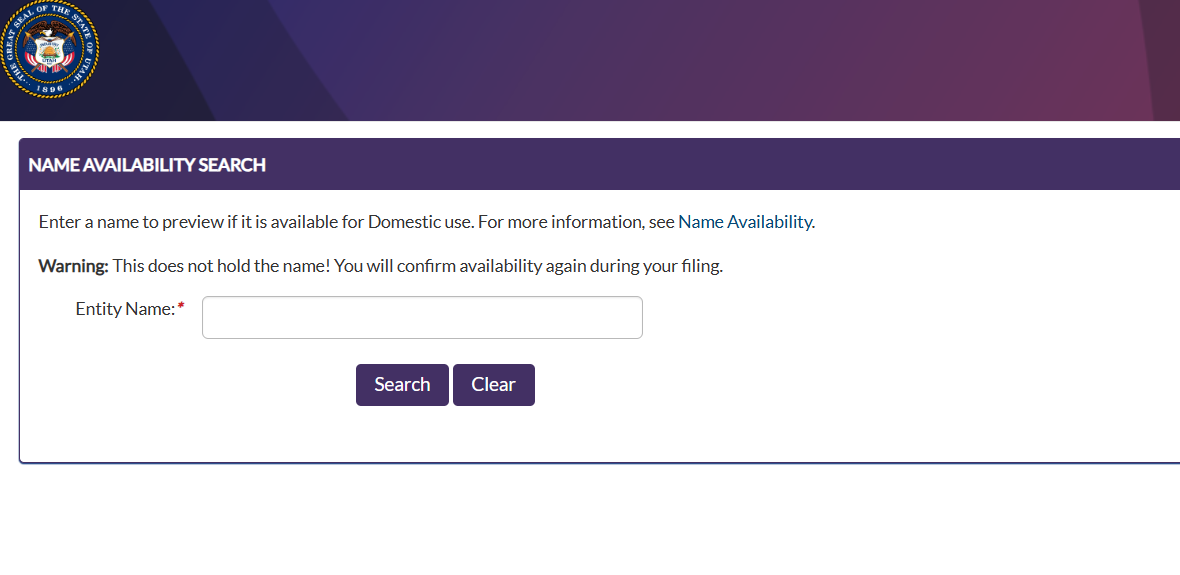
  • Run a state name availability search.
  • Looking through the trademarked companies on the URL.
  • Social media and domain name availability.
  • Pick a name which shows your determine values regarding brand and growth.

3. Not having an Operating Agreement Drafted

Not all states may prescribe an operating agreement. However, operating without one comes with a lot of risks.

An operating agreement will strategically define how the LLC is managed. This will include:

  • Ownership percentages and member contributions
  • Distributing the profits and losses of the LLC.
  • Rules for voting and making important decisions.
  • How members will be added or removed.
  • Rules that will apply to a member that chooses to leave or is deceased.

Why this is important is that absent from the operating agreement, the LLC is governed by the state. This may not be in your best interests. A member could be in a state that mandates all profits be shared equally. This could lead to a lot of unhappiness if one member made a bigger investment.

How to avoid it: Avoid and mitigate disputes and ineffective structures by creating an operating agreement from the outset, even when the company has one member. They can also improve liability insurance’s protective and plaintiff-proof functions.

4. Altering Business and Personal Funds

Efficiency is the primary reason why many entrepreneurs start their business activities from their personal bank accounts. This is a very severe error.

Why this matters:

  • Your personal assets are exposed to loss as a result of the reckless assumption that you are a sole proprietorship.
  • Accounting and taxation become far more sophisticated.
  • You stand to lose the liability protection the court grants, if you are found to have treated your LLC as a disregarded entity.

How to avoid it:

  • Apply to the IRS for an Employer Identification Number.
  • Open a business bank account.
  • For business purchases, use personal credit cards.
  • Thoroughly document all revenues and expenditures.

5. Underestimating Tax Obligations

tax obligation

There is flexibility that can be found with LLCs when running a business, but it is this very freedom that takes unprepared business people by surprise when it comes to taxation.

Common tax misconceptions include:

  • The assumption that LLCs do not pay any taxes.
  • Self-employment taxes are oftentimes ignored.
  • Unresolved matters from previous quarters.
  • Using inappropriate tax classification (i.e. an LLC that has not elected to become an S-Corporation.)

Why this matters: Poor management of taxes can result in penalties from the IRS, unanticipated invoices, as well as cashflow insufficiencies.

How to avoid it:

  • Consult a tax professional before filing your LLC.
  • Learn how federal, state, and local taxes apply to your industry.
  • Understand pass-through taxation vs. corporate taxation.
  • Use accounting software or hire a bookkeeper to stay compliant.

6. Ignoring Required Permits and Licenses

The legality that an LLC provides is not a reason to assume that an LLC can start doing business freely. There is a range of business activities that may require:

  • A federal business license (for the sale of certain regulated products, or operating certain regulated activities like aviation).
  • A state business license (for certain professions such as law, accounting, or the provision of medical services).
  • Local licenses (including, but not limited to, food service licenses, and permits for the collection of municipal sales tax of certain retail operations or for zoning).

Why this matters: The absence of certain permits, or operating within a certain jurisdiction without the proper legal documents, may attract penalties such as fines, restrictions of the business activities, or legal action.

How to avoid it: Look at the federal, state and local requirements for licenses and permits before the business is operational.

7. Neglecting the Protection of Intellectual Property

The assets of a business that are in the form of a name, logo and creative works are critical, and The failure to protect them is an oversight that most budding entrepreneurs are likely to make.

Common mistakes include:

  • Neglecting to trademark a business or registered the logo associated with it.
  • Failing to register a domain name associated with the business.
  • Neglecting original content copyrighting ( blogs, videos, courses, etc.).

How does this impact your brand: Competitors can siphon your brand equity, resulting in expensive rebranding or lawsuits.

How to do this:

  • Apply for a trademark with the USPTO.
  • Purchase the domain names and corresponding social media usernames.
  • Consider copyrighting any original works.
  • Explore patents if you are working on a new product.

8. Ignoring the Follow-Up Compliance Obligations

The initial setup of the LLC may seem to many entrepreneurs as the end of the matter. However, states impose ongoing obligations with respect to the LLC.

  • Ongoing requirements may include:
  • Filing annual or biennial reports.
  • Payment of franchise tax or annual state minimum tax.
  • Keeping a registered agent.
  • Alter the records for the LLC if there is a change in ownership.

What is the impact on your brand: Failing to meet deadlines imposed for the payment of the obligations will result in late fees, fines, or even the administrative dissolution of the LLC.

How to do this:

  • Obtain a compliance calendar.
  • Hire a registered agent service (we can help with this at Bizstartz).
  • Establish deadlines for tax payment and annual filings.

9. The Overestimation of Individual Competence

Considering the possibility of filing the LLC and having the supporting documents prepared yourself, a lot of people do not appreciate the gravity of the situation in the matter of compliance with the tax and licensing.

Why is this an important matter:

  • There are delays in the approval of your entity if any documents are filed incorrectly.
  • Infringement of the imposed compliance requirements can result in penalties and fines.
  • Without assistance, you might not maximize savings on your taxes.

What you can do to prevent this:

  • Engage with Certified Mail and Taxation LLC or similar firms regarding LLC formation, compliance, and taxation.
  • Utilize providers, such as Bizstartz, for LLC Registration, EIN, BOI Filing, Registered Agent services, and recurring compliance.

Blog CTA

Final Thoughts

One of the first and most important steps in starting your own business is forming an LLC. Methinks it is a no-brainer. If, however, you go about it the wrong way, it is a complete waste of time. First understand these nine mistakes in order to save time and money, protect your self and assets and position your business for any future ventures.

You can start right and take the help of Bizstartz. LLC Formation, EIN, Registered agents, BOI filing, Bank Account Set Up and much more is provided by Bizstartz. Their services are tailor made for local and international clients.

FAQs on LLC Formation

1. Do I need to physically reside in the U.S to be able to form an LLC?

No, you do not. Bizstartz helps international clients with the formation of LLCs in Wyoming and Delaware which do not require physical presence.

2. How much does an LLC formation cost?

This depends on the state. The cost falls anywhere between $50 and $500, not including additional recurring yearly fees. Fees for registered agents, EIN, or BOI filing, come at an additional, optional cost.

3. Is it necessary to hire a lawyer for LLC formation?

No. The steps can be simplified without employing a lawyer by getting help from an LLC service provider like Bizstartz.

4. Can one person own an LLC?

It is legal for one person to own an LLC. One-member LLCs are relatively common and provide the same liability protection as an LLC with two or more members.

5. How long does it take to form an LLC?

Each state has its approval times with some states taking a few days and others taking weeks. On average, approval times are a few days to several weeks. Bizstartz helps expedite the approval process by certifying that all documentation is collected and filed in the proper order.
Wyoming vs Delaware Franchise Tax: Which State is Better for Your LLC

Setting up a business in the United States entails some level of strategic thinking. Some of the factors to take into consideration include the company’s operational costs, business strategy, compliance requirements, and more, all of which can be quite crucial to the company’s future.

Entrepreneurs frequently consider the states of Delaware and Wyoming due to the ease of doing business in both. Although both are business friendly, both states have opted to use different approaches to franchising tax and the yearly payment all business have to make.

Tax systems have the ability to make or break a business. Hence, it is worth pondering why a state should be chosen over the other. In the case of merger and acquisition, poorly rationale decisions can cost more over a number of years.

In this essay, i will break down the differences of Delaware and Wyoming’s tax systems and how they operationalize them. Further focus will be placed on the other sector considerations other than taxes that will help choose the most favorable state for your business.

What is a Franchise Tax?

What is the franchise tax and why is it important, are some of the questions that should be clarified first before comparison.

The franchise tax is one of the many taxes some states in the US charge based on the classification of a business. Although the name is slightly misleading, this tax does not only apply to franchised business such as a McDonald’s or Subway, but also to corporations and limited liability companies, irrespective of the size.

Specifically about the Franchise Tax:

  • There are profits and un-profits, which much, relates, determines the profits.
  • There are many states where one might be free from state income tax, but might as well be paying a state franchise tax.
  • There are states where franchise tax might be based on income, authorized shares, and flat rate, company assets.

There are many, these type of taxes, is one of the very first motivators for the location of an entrepreneur. Some states, such as Delaware, charge very high state franchise taxes compared to Wyoming, which has relatively low taxes.

Wyoming Franchise Tax (or Lack Thereof)

Wyoming is known to be the most cheapest, as well as the most entrepreneur friendly state for LLCs and Corporations. This is owes much to his…

Key Details About Wyoming:

  • No franchise tax of any amount
  • No corporate taxes
  • No personal income tax
  • No complicated fee structure

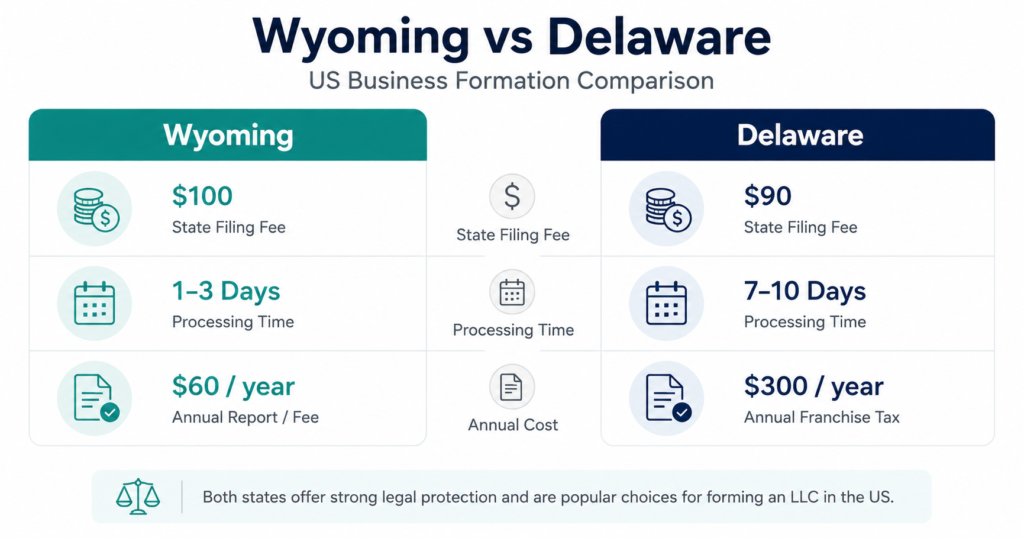
Wyoming does not impose state franchise tax but instead, the Wyoming company pays an Annual Report and License Tax… Wyoming fee is relatively low, as compared to the Delaware Corporations.

Wyoming Annual Report License Tax:

  • Minimum fee: $60 per year
  • Calculation Method Fee: $0.0002 for every $1 of assets registered in Wyoming.

Examples of Fee Payments

  • If your company has $100,000 worth of assets in Wyoming → $20.
  • If your company has $500,000 worth of assets in Wyoming → $100.
  • If your company has no assets in Wyoming (like many businesses operating online or in other countries) → you only pay $60.

👉 This approach creates a unique competitive advantage for online businesses, freelance workers, consultants, and foreign entrepreneurs without a physical presence in the US.

Benefits Of Wyoming No Franchise Tax:

  • Predictable low annual fees ($60 in most cases)
  • No tax bills based on shares or equity split.
  • Basic Compliance and Less Work
  • Easy for bootstrapped companies.

Ultimately, hassle and low costs year after year for maintaining a business in Wyoming are unrivaled.

Delaware Franchise Tax

Delaware remains the most common point of incorporation for corporations and venture-funded companies. Its world-class legal system and developed corporate law framework along with the legal system are highly appreciated by investors. This, however, does not decrease Wyoming’s advantage in franchise tax.”

Franchise Tax for Delaware Corporations:

Delaware computes franchise tax for a corporation in one of two was:

Authorized Shares Method – Taxes authorized shares, not issued shares.

  • $175 for small corporations with limited shares
  • Can go up to $200,000+ per year for large corporations with millions of shares

Assumed Par Value Method – Taxes based on total assigned value of assets and issued shares.

  • Delaware franchise firms are more advantageous to larger companies who do not want to pay exorbitant fees.

Alongside franchise tax, Delaware firms must also pay a yearly report charge of $50.

Within the many obligations Delaware corporations have, the payment of the franchise tax starts at $175 depending on the class.

Franchise Tax for Delaware LLCs:

LLCs in Delaware have it easier compared to corporations, but it’s still more costly than Wyoming.

  • Flat annual tax of $300
  • Due every year by June 1
  • No calculations based on assets or shares

While predictable, this $300 fee is five times more expensive than Wyoming’s minimum $60 license tax.

Wyoming vs Delaware: Side-by-Side Comparison

Here’s a quick breakdown of how the two states compare:

Feature Wyoming Delaware
Franchise Tax (Corporations) None $175–$200,000+ depending on shares/assets
Franchise Tax (LLCs) None Flat $300 annually
Annual Report Fee $60 minimum (based on Wyoming assets) $50 + franchise tax
Corporate Income Tax None None
Personal Income Tax None None
Complexity Simple, low-cost, predictable Can be expensive, more complex
Best for Small businesses, solopreneurs, online businesses, international founders Venture-backed startups, corporations seeking U.S. investors

Which State Should You Select?

Wyoming and Delaware are rather different concerning business missions and objectives.

Wyoming is a great choice if:

  • You are an international business person and wish to set up a US company for Amazon FBA, dropshipping, SaaS, or consulting.
  • You wish to keep costs low and pay little annual fees.
  • You don’t anticipate raising funds with venture capital in the short term.
  • You wish to keep things simple and enjoy no surprise compliances.

👉 Most small businesses and startups find Wyoming affordable and easy to maintain.

Delaware is the right choice if:

  • You are seeking venture capital funding or are planning to raise money from US investors.
  • You wish to go public someday.
  • You appreciate Delaware’s special Court of Chancery for business legal disputes.
  • You are building a startup with high growth potential which will offer stock to employees and investors.

👉 For businesses with primary growth objectives, Delaware’s reputation in the investment world often overshadows the costs.

How Bizstartz Can Help

We assist international founders and non-U.S. residents in the formation of an LLC in the U.S. Whether you have chosen the cost-effective Wyoming or investor appealing Delaware, we have you covered with:

  • Formation of an LLC or corporation
  • Employer Identification Number (EIN)
  • Opening of U.S. bank accounts
  • Registered agent services
  • Filing and compliance of Beneficial Ownership Information (BOI)
  • Bookkeeping, Tax Filing, and Compliance
  • ITIN filing for non-U.S. owners

We will help you start Delaware or Wyoming business quickly. Bizstartz will give you the expert direction you need.

Blog CTA

Final Thoughts

In terms of Wyoming vs Delaware franchise tax, the difference is simple:

  • Wyoming is more economical and charges a small annual report fee beginning at $60.
  • Delaware, however, can be much more costly, especially for corporations with a high number of shares, and can charge upwards of $200,000.

Wyoming tends to be the happier choice for most overseas founders, online business operators, and tiny businesses. However, high-growth companies targeting U.S. investors still prefer Delaware, no matter the price.

Frequently Asked Questions (FAQs)

1. Do foreign (non-U.S.) owners franchise tax in Wyoming or Delaware?

Yes. In Wyoming, you will pay the $60 minimum annual report fee. In Delaware, you will even have to pay $300 annual tax, irrespective of your place of residing, if your LLC is registered in Delaware. Same goes for any foreign, non-U. S. owners.

Franchise tax (or equivalent annual fees) is applied to every single company registered in the territory of the state, irrespective if the owners live in the territory of the state or outside the US.

2. Which state has lower ongoing compliance costs?

For ongoing compliance costs, Wyoming is the established winner. The annual fee for maintaining a Wyoming LLC is set at $60, and every Delaware LLC claim a standard fee of $300. The difference in costs for many corporations can be much larger, in Delaware, it depends on the count of the permitted shares.

3. Why do large corporations still prefer Delaware in spite the higher franchise tax?

Delaware’s reputation, justified or not, is the state that had developed the most favorable conditions for business, and this is the territory in which best developed corporate law, thus having a specialized business court (the Court of Chancery).

Investors, more than any other interested parties, need to fund technologies which Delaware corporations for the most part need. Most like to fund start ups or young competitors in the field of technology.

They fund that kind of technology because lots of them understand the potential that young technologies have for the future. They will often fund formations, since the changes that can result from the technologies in the future can be entirely new and different.

4. Am I able to transfer my company to Wyoming from Delaware in order to avoid paying franchise tax?

Yes. You may transfer your company from Delaware to Wyoming through a process called domestication (if both states allow it, Delaware and Wyoming).

Alternatively, you may decide to close the company in Delaware and open a new limited liability company in Wyoming. In either case, we suggest seeking the advice of an expert so you avoid the legal and tax consequences of an unplanned switch.

5. Which of the two states is more advantageous to an online business and Amazon sellers?

For online business entrepreneurs, drop shippers, consultants, and Amazon FBA sellers, Wyoming is often the best option. Its annual fee of $60 and basic minimalist compliance requirements is a plus for international entrepreneurs and other small business operators who do not require the legal benefits Delaware offers.

How to Legally Change Your LLC Name in 2025: Step-by-Step Guide

Upon the initial establishment of an LLC, there is a thorough consideration of a name for the business which aligns with the business idea, branding, and vision.

Over time however, businesses do change, markets change, industries grow, and in some cases, the name of the business no longer aligns with the future of the company. This is where the legal name change of the LLC comes in.

Unlike the fanciful idea of changing the name of an LLC for the purpose of the website and the business cards, the name of the LLC is in fact, a legal name which changes through a legal procedural system which needs to be registered with the state, the IRS, the banking institutions and the rest in legal compliance in order to maintain compliance with the legal system.

It is a linear process, however an overlooked step can create compliance gaps, tax confusion, and in some situations, loss of liability protection.

This document is going to change every individual’s view on the process of changing an LLC name in 2025 by explaining the step by step reasoning why a name change is necessary, the subsequent actions that follow, the expenses that are incurred, and the necessary changes that are to be done post the approval of the new name.

Why Change the Name of Your LLC?

The reason behind changing the name of the LLC differs from one business owner to another. Here are a few of the more popular reasons:

1. Rebranding for Growth

In the early stages of a business, it is usual to think of a name that will grow with the business. A name like “Denver T-Shirts LLC” for a business with future plans to deal with shoes, bags, and even accessories will seem limiting. A new name and a new business strategy will enhance the perception of the business while also making it more developed in its new offerings.

2. The Business Model has Shifted

A business is said to have shifted its direction once it has stopped offering certain products and is exclusively making new offerings. For example, a local bakery business that has now shifted to offering online baking courses has changed the old made more for a business model that is not outlined to fit with the rest of its offerings. A change in the LLC name will assist in the migration to the new business model.

3. Shifting to a New Level

The name of your business may have worked for the domestic market but will not assist in your plans to go global. The more negative perception a name has in another country, the more ineffective it is to deal with it.

4. Legal Issues

A new name may be needed to mitigate the chances of being sued. The name of the LLC could be in contention with another registered business. Legal problems arise when there is a clash with the trademark of a different business.

5. Updating Your Brand

In some situations, the approach taken is purely aesthetic and rational. It is shown that with a simpler, cleaner, and more contemporary logo, the brand name becomes easier and quicker to remember which translates to more investors, partners, and consumers.

How to Change the Name of an LLC in 2025.

Changing the name of an llc in 2025 will require a couple of steps. Each stage will broken down further down the guide.

1. Confirm with Your State Requirements

Every state has their own nomenclature rules regarding LLC name changes. The majority of states require a name change request to the Secretary of State called Articles of Amendment, while others may have more creative names such as Certificates of Amendment along other variations.

👉 Pro Tip: Confirm with your state’s buck Chapter 3 of the business secretary. Contact the Secretary of State to clarify the form which has to be completed, the cost, and the preferred method of filing: is it electronic or postal.

2. Select and Confirm Your New Name

This is an important step, you want a name that is legally available and branded with a positive image and can survive the test of time.

In the process of selection:

  • Confirm the name is available in the state: Business name search in the state’s database.
  • Trademark clearance: search the USPTO database and ensure that there is no conflict with the national trademarked brands.
  • Check the domain: and ensure there is a matching website domain for your new name.
  • Confirm the name: ensure the name complies with the legal requirement of having the term “LLC” or “Limited Liability Company” as well as other protected terms “Bank”, “Attorney” or “University” without proper proper licensing.

This prevents, in the long run, costly rebranding or lawsuits.

3. Amend Articles of Organization

This is the most vital step, the official filling with your state where the LLC is located to change the legal name of the LLC.

Typical information required includes:

  • Current name of the LLC
  • New name of the LLC
    • When is the change effective (can be immediate or a set date in the future)
  • The state issued LLC ID number for your company
  • An authorized member or a manager’s signature

Filing fees amounting to $20 to $200 depending on the state, some states charge accelerated processing fees.

Once a submission is approved, the confirmation document (for example, stamped Articles of Amendment) will be sent which will prove that the new name is legally accepted.

4. Amend the Operating Agreement

If your LLC has an Operating Agreement, it now must be amended to reflect the new name. Even if your state does not require it, this document is necessary for the clarification of the members and partners of the business. Amend:

  • The LLC name throughout the agreement
  • Any associated particulars such as, company letterheads, and record books

5. Notify the IRS

Once the state has approved your new LLC name, the next steps involve filing the IRS to ensure all tax records align appropriately.

Based on how your LLC is taxed:

  • Single member LLC (disregarded entity): Issue a signed letter to the IRS, enclosing your EIN and new name.
  • Multi member LLC taxed as a partnership: Claim the alteration on your next Form 1065 return.
  • LLC taxed as a corporation (C or S Corp): Claim the alteration on your next Form 1120 or Form 1120-S return.

👉 Note: A name change does not require a new EIN.

6. Amend The Business Licenses and Permits

All your business licenses on local, state, and federal levels must be amended as well. These include:

  • City business licenses
  • Health permits
  • Sales tax permits
  • Professional permits (real estate, medical, etc.)

The failure to update will incur the risk of holding invalid licenses.

7. Update Bank Accounts and Financial Records

  • Business checking and savings accounts
  • Credit cards
  • Merchant accounts (Stripe, Paypal, Square, etc.).

This is important for making sure payment and tax reporting assimiliation does not become muddled.

8. Update Contracts, Leases, and Agreements

All legal documents that have historically been signed under the old name of the LLC have to be modified. This includes:

  • Office or retail leases
  • Supplier contracts
  • Employment contracts
  • Client contracts

This ensures that contracts are able to be enforced under the new name of the LLC.

9. Update Business Branding

This is the last step. Change your brand and also its identity in every possible place. This is the most tedious step, yet the most apparent. Change:

  • Website domain and email addresses
  • Social media accounts and pages
  • Logos, business cards, and physical signage
  • Advertising and other promotional materials
  • Invoice formats and statement headers

How Much Does It Cost to Change an LLC Name?

This is purely based on state laws and your personal approach to rebranding.

  • Costs for filing with the state: Fee of $20–200 depending on the state.
  • Optional name reservation: $10–50 if you reserve the name prior to filing.
  • Additional payment for faster processing in some states: $25–100.
  • Costs to rebrand: these may include a website domain, redesigned logo, and other promotional materials which price ranges from a few hundred to a few thousand.”

How Long Does It Take?

  • Online filings: Typically within a handful of workdays.
  • Mail filings: 2 to 6 weeks based on the efficiency of the state you’re in.
  • Expedited Service: An additional cost. Some states provide same-day or next-day approvals.

Overall, the process takes anywhere from 1 to 3 weeks on average.

Can you just file a DBA instead?

Alternately, a DBA, or Doing Business As, a trade name, or a fictitious name is another option to consider instead of changing the legal name of your LLC.

Pros of a DBA:

  • More economical and quicker.
  • You can conduct business under several different brand names without the need to change the legal name of the LLC.

Cons of a DBA:

  • You do not change the legal name of the LLC with the state.
  • Your LLC name is still a requirement and is used in banking, tax filing with the IRS, and on other legal documents.

If you wish to have the new name as your legal name, you will have to file an amendment. For simple name operation with multiple names, a DBA is more appropriate.

Blog CTA

Concluding Remarks

Changing your LLC name can be a thrilling development whether it be rebranding, expanding, or starting anew. Completing the paperwork is a subtle challenge, however, following the specified steps guarantees a smooth transition.

Updating your headquarter’s record is not the only step. You also have to update the IRS, banks, contractors, and vendors as well as your business’s new name and brand from all of your business’s touchpoints.

If you prefer a hassle free approach, Bizstartz will take care of your work from filing the articles of compliance to the IRS and revising the compliance report so you can focus your energy on expanding the business.

Frequently Asked Questions (FAQs)

1. Am I required to obtain a new EIN after changing an LLC name?

No, you have to inform the IRS otherwise the tax records will be inaccurate.

2. What is the duration for changing an LLC name?

On average it takes close to 1 to 3 weeks depending on how fast the state is and the filing method used.

3. Is “discontinuance of use” relative in any way in the context of the LLC as a legal name?

There is still a possibility of using the name informally as a trademark. However, as a legal name you will have to account for the possibility of registering the name as a DBA if you wish to pursue its use in the future.

4. Within the context of the LLC, explain how a DBA is distinct from a legal name change.

A DBA allows a business to function under a name without changing business legal name that still remains a DBA. An amendment to the record serves as a legal name change to the registered LLC for the state in question.

5. Is it possible that I, as a Bizstartz Associate, could assist you in the Name Change of your LLC?

Absolutely! Bizstartz focuses on the formation of the LLC to the amendment of its name, the issuing of an EIN and ITIN, bookkeeping, filing the BOI, and ensuring compliance services both for US and non-US entrepreneurs. The work is made simple.

How to Pay Yourself as an LLC Owner: Single & Multi-Member Guide

Forming a Limited Liability Company (LLC) in the the US comes with immense benefits like; flexibility, protection, and favorable taxation policies. But when all the t’s and i’s are sorted, and the business is operational, the most important question remains: “How do I get paid?”

Owners of an LLC are not like workers in a conventional company who earn a salary and get tax deductions. The owners’ payment is determined by the business type, the members in the LLC, and the tax category under which the business is registered with the IRS.

Self payment is not only a means of fulfilling taxation requirements. It is essential in establishing a balance between the money paid in tax and the money left in reserve, and avoiding a standoff with the IRS.

In this article, we will help guide you to pay yourself as an LLC Owner in the year 2025, irrespective of whether the LLC is a single or multi member.

Also, we will explore the implications of being taxed as an S-Corp or C-Corp and all other related tax requirements, compliance located on tax policies, and accompanying real-life illustrations.

1. Understanding How LLC Owners Get Paid

Unlike a corporation, LLCs do not have shareholders who receive dividends. Neither do they have employees who receive salaries by default. Rather, LLCs have members who “pay themselves” in some fashion that depends on the LLC’s taxation and structural configuration.

The most common methods in which LLC owners pay themselves are:

  • Owner’s Draw: A withdrawal from the profit of the company. All that happens is that you move some money from the LLC into your personal account. The reason you cannot deduct this from taxable profits is that it is deemed a profit.
  • Distributions: Remuneration set aside to members of the LLC that is proportionate to the share capital that they hold. These are more formal than an owner’s draw and are typical in multi-member LLCs.

These are not the only methods that exist. Under some tax circumstances, you may be obligated to pay yourself a salary, by which LLCs are referred to as “employees.”

The breakdown by tax status is as follows:

For the single-member LLC, which is the default way from which most people operate, the LLC is treated as a sole proprietorship and owner’s draws are the only method of payment.

For the multi-member LLC which is also default, the LLC is treated as a partnership where profits are shared.

For an LLC, S corporation taxation requires you to pay yourself a “reasonable salary” via payroll as well as take distributions.

An LLC, C corporation taxation permits you to receive salary and dividends as a corporate employee and shareholder.

The LLC flexibility in taxation choice is one of its, if not the most, notable features. However, it can, as it often does, lead to confusion. Let’s examine each one a bit closer.

2. How to Pay Yourself as a Single Member LLC

The most uncomplicated form of an LLC is a single-member, which, in most cases, the IRS does not distinguish as a separated taxation entity. This means the IRS does not consider an LLC as a separate taxpayer. All the profits and losses “pass through” directly to your personal tax return.

Steps to Pay Yourself

1. Withdraw money via owner’s draw:

  • Pay yourself through an owner’s draw process. This involves a transfer of funds to your personal account from your business account.
  • The transfer method can include checks, electronic funds transfer, software application, or cash along with the transaction.
  • Record each transaction as an owner’s draw to remain compliant with your bookkeeping.

2. No Taxes Withheld During Withdrawal:

  • Tax is calculated and paid personally and through a tax return which include the following.
  • A unique pay process involves an owner’s draw method, as to which no income, Social Security and tax for Medicare is calculated and withheld.

3. Report Profits on Your Taxes:

  • You are still required to report the total net profit of your LLC even if your take-home pay differs. All of profits from the LLC will be filed on your personal income tax return.
  • You will accomplish this via Form 1040, Schedule C (Profit or Loss from Business).

Tax Obligations

  • Self Employment Tax: Relatively, the owner of the LLC is responsible for paying the Social Security and Medicare (15.3% combined) tax on the net income of the individual.
  • Income Tax: The profits will also be taxed federally, with the obligation to pay state income tax too, for certain states.
  • Quarterly Estimated Taxes: As not withholding any tax, you are required to pay estimated taxes quarterly to stay in compliance.

Example

Let’s consider if your LLC in 2025 makes an estimated profit of 80,000 dollars and you as an owner rack an estimate of 50,000 dollars from the owners draw, you solely owe taxes on the whole 80,000 and not on the 50,000 dollars withdrawn.

New LLC owners are the most surprised, as many believe they pay taxes only based on the amount taken home.

3. How to Pay Yourself as a Multi-Member LLC

Multi-member LLC
Multi-member LLC

However, a multi member LLC is automatically taxed as a partnership unless an election is made otherwise. The profits now are not reported as one person, but instead, the income is distributed amongst the members.

Guidelines for Paying Yourself.

1. Distributions According to Ownership Percentage:

  • Profits are distributed according to ownership share detailed in the operating agreement.
  • Example: If two members maintain respective ownership of 60% and 40% shares, the profits will be divided in the same ratio.

2. Optional Guaranteed Payments:

  • Members may receive guaranteed payments, which are fixed amounts designated to be paid regardless of profits.
  • These are typical in situations where one partner contributes disproportionate time, effort, or money into the business.

3. The Operating Agreement is Central:

  • The operating agreement should detail the processes of disbursing payments to members.
  • Agreements which lack clarity are bound to change, resulting in disputes.

Tax Obligations

  • Form 1065 Filing: The LLC is required to file an information return such as Form 1065.
  • Schedule K-1: Each member receives a K-1 with an allocated share of profits or losses for the business.
  • Personal Tax Filing: Members then declare their share in their individual tax returns.
  • Self-Employment Taxes: Profits are still liable to the Social security dues and Medicare as they are in the case of any single member LLC.

Example

If a multi member LLC is able to make a profit of $120,000 in the year 2025 and has 2 members with a 50/50 split.

Each member must report $60,000 in income regardless of the fact that they only withdrew $30,000 in distributions.

This is another frequent source of misunderstanding: taxes are computed on your portion of gains rather than what you withdraw.

4. Paying Yourself When Electing S-Corp or C-Corp Status

Some LLCs opt to be S Corporations or C Corporations in order to benefit from the different tax treatment.

LLC Taxed as S Corporations

  • Reasonable Salary Requirement: Owners are required to pay themselves a reasonable salary through payroll.
  • Payroll Taxes: These earnings are subject to Social Security and Medicare tax.
  • Distributions Beyond Salary: Salary is no longer the only way to pay yourself. After the salary, you can also take profit distributions, which are not subject to self-employment tax.
  • Tax Advantage: For profit levels of $80,000 and above, the tax liability can significantly reduced.

LLC Taxed as C Corporations

  • Regular Corporations Treatment: You are considered both an employee and owner.
  • Salary plus Dividends: You can pay yourself a salary, which the company can tax deduct, and also receive dividends.
  • Double Taxation Problem: The corporation level profit and those distributed as dividends are double taxed.

Choosing to be taxed as a corporation increases the complexity of the business, however, it remains a useful strategy for business that are trying to expand, reinvest the profits, or gain investment.

5. Best Practices for Paying Yourself as an LLC Owner

Regardless of LLC structure, there are best practices you should follow in 2025 to stay compliant and financially healthy:

1. Keep Business and Personal Finances Separate

  • Do not co-mingle business and personal expenses.
  • Maintain a business savings account.

2. Pay Business Expenses from a Separate Account

  • It is prudent to reserve 25% to 30% of profits for tax obligations.
  • Spend the tax reserve account only for tax obligations.

3. Implement a Business Expense Tracking System

  • Pay attention to every draw, distributable, and salary payment.
  • This will make tax filing easier and decrease tax-filing mistakes.

4. Obtain an Updated Operating Agreement

  • Set payment terms for members from the onset.
  • Modify the contract to reflect new ownership or contribution terms.

5. Consult a Tax Professional

  • Rules from the IRS are frequently revised and might be a bit challenging to grasp for someone without an advanced degree in tax law.
  • Having a CPA or a business advisor is beneficial as they can explain and help structure payments to minimize the tax obligations of the business operating at a loss.

6. Key Differences: Single vs Multi-Member LLC Owner Pay

Feature Single-Member LLC Multi-Member LLC
IRS Default Classification Sole Proprietorship Partnership
Method of Pay Owner’s Draw Distributions + Guaranteed Payments
Tax Forms Schedule C (Form 1040) Form 1065 + Schedule K-1
Self-Employment Tax Yes, on all net profits Yes, on member’s share of profits
Payroll Requirement No (unless taxed as S-Corp/C-Corp) No (unless taxed as S-Corp/C-Corp)
Flexibility Simple, direct, easier to manage Requires more structure & agreements

Register Your LLC in the USA with Bizstartz

At Bizstartz, we assist U.S. residents and foreign entrepreneurs with the rapid and compliant registration of LLCs in the United States. Whatever the nature of your business, be it in e-commerce, consulting, technology, and many more, we provide the following services:

  • Formation of LLC in any U.S. state
  • IRS issued EIN (Employer Identification Number)
  • ITIN (Individual Taxpayer Identification Number) for Non-U.S. Residents
  • Registered Agent
  • Bookkeeping and Accounting
  • BOI Filing Compliance
  • Compliance with U.S. Bank Account Regulations
  • Regulatory Trademark to your brand

Having Bizstartz as your partner means that you can focus on the daily operations of your business because we will take care of the legal and structural compliances of your company, thereby giving you the peace of mind that you rightfully deserve.

👉 Do you want to open your own LLC in the U.S? At Bizstartz, we will set it up for you in as short time as possible.

Blog CTA

Final Reflections

There are many ways to approach self-pay for an LLC member for the year 2025. It can begin with the supposition that an LLC member is the same as an employee. Does that mean one can cut a paycheck as one would to an employee? The answer is no.

It is a more nuanced understanding, dependent first on whether the LLC is a single or multi-member one and second, whether the owner has made an election to get taxed as a corporation.

  • Single-member LLCs utilize owner’s draws and Schedule C for profit reporting.
  • Multi-member LLCs have K-1s and distributions and members make tax payments on their profit share.
  • S-Corporations have allocations of profit as distributions and reasonable scheduled payments to member-owners.
  • C Corporations can pay a member-owner salary and also share a portion of corporation profit as dividends, subject to the corporation being taxed first as an individual taxpayer and then on the dividends.

The most crucial understanding is that taxes are paid on the share of profits and not on the withdrawals made.

Entrepreneurs and small business owners from outside the US can avoid pitfalls if these issues are addressed at the early stages. They are advisable to get the services of a tax advisor or CPA so as to not get tangled sued with restrictive regulations.

Frequently Asked Questions (FAQs)

1. If my LLC is not making any profit, should I start paying myself?

No, if your LLC is not making any profits, you should not take any distributions. But if you accept some distributions, you can pay yourself a guaranteed payment as specified in the operating agreement. If you have an S-Corp LLC and you actually work within the business, you have to pay yourself a reasonable salary.

2. How do I determine the salary to take from my LLC?

Fixing my salary from the LLC business can be done using different methods as there are no predetermined rules. It’s all about the profit margins and the investments that need to be made and the taxes that need to be filed. A common method used by many owners is the 50/30/20 method, where 50% of the profit goes to reinvestment, 30% is used to pay taxes and the remaining 20% is taken as personal salary.

3. What is the range for a “reasonable salary” to be considered for an S-Corp LLC?

A reasonable salary is the amount you would give to someone to do the same work you do. It is also expected that the pay is controlled and monitored based on rules of the IRS. Paying yourself too little is too common and would certainly raise the expectations of the IRS.

4. Is there a possibility of changing the manner in which I pay myself in the future?

Changes can be made in Business Profit taxes by switching from the default LLC to S-Corp taxation. This change can be done if there is business expansion and increase of profits. Completing each change without the consultation of a tax professional is not advisable.

5. Assuming you are not a resident of the United States, do you pay yourself in an LLC in a different manner?

The method is the same, however taxing yourself to pay in tax as a non-resident does require you to pay tax based on treaties with your country of origin. It is common for non-residents of the USA to require the ITIN, which is an Individual Taxpayer Identification Number. We at Bizstartz offer support with acquiring ITINs and also help with compliance matters for international founders.

LLC Business Insurance in 2025: Why It’s Essential for Protecting Your Company

In the United States, starting a limited liability company is the best way to protect personal assets while doing business. When starting an LLC, entrepreneurs are afforded a liability shield, which protects personal finances from business debts and obligations.

Nonetheless, most novice business owners hold the incorrect notion that an LLC offers complete unlimited protection. In actuality, the LLC structure only protects personal assets, not the business from potential risks, such as lawsuits, physical damages, accidents, and even cyberattacks.

This brings us to the need for LLC business insurance. As we approach the year 2025, the business world is developing at a rapid pace, which means enhanced legal issues, technological risks, and operational uncertainties.

In order to survive and flourish in this type of landscape, LLC owners must not only depend on a legal structure, but heavy-line a business in this type of landscape must have more insurance.

This article will discuss why business insurance is needed for LLCs in 2025, the various policies that can be purchased, the importance of the insurance, the general cost of the insurance, and how Bizstartz will assist you in this crucial step of protecting your business.

The Importance of Business Insurance for LLCs in 2025

An LLC is effective at shielding personal liability in the event of business failure, however, it does not replace the need for business insurance. While personal assets like savings, home, or cars may be protected from creditors or lawsuits, business assets like bank accounts, equipment, intellectual property, and revenue remain exposed.

An LLC is still very susceptible to a well placed lawsuit, and without business insurance, the LLC could easily be put out of business. The following developments in 2025 and beyond mean insurance is crucial business consideration today:

Rising Legal Costs and Lawsuits

The frequency of lawsuits, for example, slip and fall injuries in one’s shop, a contract breach with a vendor, or a claim of negligence from an unsatisfied client, is higher today as compared to a decade ago. Lawsuits, as one is aware, can easily run into hundreds of thousand dollars, especially in business. An LLC is designed to protect the personal assets however, the business assets remain exposed in the event one does not have insurance.

Stricter Contractual Requirements

The revenue generating opportunities for an LLC is still very vast, however, many contractors and potential business associates now need the partner or LLC to carry liability insurance. Otherwise, critical business contracts could be lost.

Growing Cybersecurity Risks

Cybercrimes become rampant in 2025, and businesses of any scale and scope become the victims of hacking. Gaining unauthorized access to a business sanctuary doesn’t require a tremendous effort and the financial implications of a breach are devastating to a business.

Lawsuits from the customers become a nuisance in the process of recovering the business. The business can end up in a devastating financial situation if no insurance claim is active.

Operational Risks and Unforeseen Events

There is no end to the threats that a business can face, natural disasters (such as floods, earthquakes, and wildfires), the breakdown of equipment, and supply chain interruptions. Without any claim to an active insurance, your LLC awaits a devastating situation due to a forced shut down that can extend temporally, or permanently.

Protecting Long-Term Growth

Protecting the business from losing value become unattractive to the stakeholders and losing growth. Gaining the right insurance cover transforms the business altogether and makes it easier to regain business value. The growth and expansion of the business become unimpeded and stable.

Types of Insurance Coverage for LLC Owners

LLC insurance

While each LLC may not require the same type of coverage, grasping the the categories of business insurance will help in identifying the unique insurance need of each LLC. Below is an outline of the critical business insurance an LLC would need in the year 2025:

1. General Liability Insurance

This coverage is essential in any small business insurance plans. It addresses unique third party claims on bodily harm, damage to personal properties and personal injury such as slander and certain false advertising injuries. For instance, if you have an employee who is injured while working a particular task in the office, general liability insurance will be the one to cover the medical expenses as well as the legal claims.

2. Errors and Omissions Insurance – Professional Liability Insurance

This form of insurance is essential in an LLC business providing professional services such as consulting, accounting, IT, legal services, etc. It serves as coverage on claims of negligence, blunders and failure to deliver services promised, For Example, if a client believes your guidance lost him money, professional liability insurance would cover the legal costs of defense and any settlements made.

3. Commercial Property Insurance

If you have any type of business, whether a storefront, office or a warehouse, property insurance serves as a shield for your physical assets against fire, theft, vandalism and other damages that might occur as a result of a natural disaster. It may as well protect certain high value business items such as computers, office furniture, or machinery.

4. Workers’ Compensation Insurance

If your LLC employs workers, most states legally require you to carry Workers’ Compensation Insurance. This type of insurance ensures that an employee’s medical expenses, rehabilitation expenses, and lost wages are paid for if the employee sustains an injury in the line of duty. This protects the employees and protects your LLC from exorbitant lawsuits.

5. Business Owner’s Policy (BOP)

Cost efficiency for LLCs stems from A BOP, as it encompasses liability and property insurance. Some insurers extend the offer of adding business interruption coverage. This coverage compensates the insured for the income that will be lost as a result of having to shut the business down temporarily because of an insured event.

6. Cyber Liability Insurance

With the online business boom, cyber liability insurance has become a pivotal aspect of business insurance. Policies in this field cover the expenses of data breaches, ransomware and other forms of online criminality.

For example, suppose the clients of your LLC’s website suffer a data breach and their credit card information is illegally extracted upload. This insurance policy will cover the legal expenses, the cost to inform clients, and the fee to restore the IT system.

7. Commercial Auto Insurance

In the event that your LLC employs vehicles for the purposes of delivering products, holding meetings with clients, or conducting transactions involving physical goods, you cannot rely on personal auto insurance in the case of business related accidents. Commercial auto insurance will cover vehicles that are owned by the LLC and vehicles owned by the employees if these are used for business activities.

8. Umbrella Insurance

Umbrella Insurance policies are designed to cover the extra financial liability expected when other primary policies are inadequate. For high-risk businesses with high assets, Umbrella Insurance helps to avoid being underinsured.

Benefits of Business Insurance for LLC Owners

Apart from compliance and risk management, appropriate kinds of insurance helps a business with several advantages in the longer run.

Peace of Mind: Attending to the business is a more appropriate use of time than worrying about the any impending financial disaster.

Financial Protection: A single accident should not be allowed to endanger the existence of the LLC, and appropriate types of insurance should protect it from any legal claims made.

Professional Credibility: Insured businesses are more professional with their clients, vendors, and investors as compared to the businesses that are not insured.

Legal Compliance: A number of states require certain types of insurance, including for example, auto insurance and workers’ compensation.

Business Continuity: Insurance helps to cover temporary cessation of business operations and thus helps to cover income loss coupled with additional expenses due to business disruption.

What will the costs look like for the LLC for the years, post-2025?

insurance for US LLC

Costs of insurances are generally heavily influenced discriminatorily on the nature of the business, the industry entailed, the geographical area, and the size of the establishment. The following are probable estimations for LLCs of smaller and medium size, with regards to the year of 2025.

  • General liability insurance is predicted to lie between $30-80 monthly
  • Professional liability insurance is predicted to lie between $50-120 monthly
  • Business Owner’s Policy (BOP) is predicted to lie between $60-150 monthly
  • Workers compensation insurance is highly variable depending on the state and the size of the payroll, with an average of $0.25-2.0 for every $100 of the payroll.
  • Cyber liability is insurance is predicted to lie between $75-200 monthly (increasing cyber liability is predicted due to rising cyber threats)
  • Commercial auto insurance is predicted to lie between $100-200 for every vehicle on a monthly basis
  • Umbrella insurance is predicted to lie between $50-100 on a monthly basis (dependent on coverage limits)

Even though the costs of insurances add an additional burden on the fake business, it is a way lesser value than the financial losses that the company will suffer without insurance.

How to Choose the Right Business Insurance for Your LLC

Choosing a policy to cover various contingent risks an LLC might face can initially appear to be an overwhelming task, but focusing on a few core aspects can make it much easier.

Identify Your Business Risks: Risk assessment for a businesses is critical, as it is inherently subjective, a paradigm technology companies might face different risks than a retailer.

Identify your Business Legal Requirements: Business licenses come along geo-centric legal requirements and each company needs to insure itself for what the governing body of the location requires it to insure itself for.

Identify Different Policies: Look for various policy providers and try to gauge which offers the highest coverage for the lowest total value.

Consolidate Policies: Elements of professional policies can be consolidated by vendors as a means to reduce total business insurance costs.

Consult an Insurance Professional: With the unique position of an insurance consultant, they may be able to devise the most advantageous plan based on the LLC’s requirements.

Assess periodically: Knowing that, there is no business which remains static, and due to inevitable evolution, there is a need to update and align insurance coverage plan on a regular basis.

How Bizstartz Can Help LLC Owners

We help those planning to start a business by enabling them to form an LLC and offers services to help them obtain an EIN, BOI, and a registered agent for their business.

A limited liability company is only a starting point for your endeavors. Proper liability insurance is also essential for business protection that concepts as strong as yours need.

Our insurance offerings for your LLC helps you negotiate a plan with insurance providers that is tailored to your unique business needs thanks to a partnership with an insurance company that is in our ever growing business ally network.

Blog CTA

Conclusion

As a business owner, having an LLC does protect your assets from business liabilities to an extend. Some things like the business assets, company reputation, and chances for future growth can still be lost. Business limited liability insurance is perfect for this situation.

In this newfound world of 2025, critical things like legal disputes and cyber security will be prevailing. Because of this, no business can afford to ditch having insurance. The right plans put in place today may be a mouthwatering profitable business or a lost couple months from now.

Do not compromise and have insurance plans that cover your LLC, or the company along with yourself, run the risk of staying in your comfort zone.