Form W-9 Explained in Detail: Complete Guide for Businesses, Freelancers, and LLC Owners

Form W-9, officially known as “Request for Taxpayer Identification Number and Certification,” is a foundational document in the U.S. tax system. Despite being only one page long, it plays a critical role in tax compliance, payment reporting, and financial transparency between businesses and individuals.

Many entrepreneurs, freelancers, and even established companies underestimate the importance of Form W-9, often filling it out incorrectly or misunderstanding when and why it is required.

This comprehensive guide breaks down everything you need to know about Form W-9, including its purpose, legal implications, step-by-step completion instructions, and common pitfalls to avoid.

What Is Form W-9?

Form W-9 is an information-request form used by businesses to collect accurate taxpayer details from U.S. persons or entities they pay. The information collected on Form W-9 allows the payer to correctly report payments to the Internal Revenue Service (IRS).

Unlike many IRS forms:

  • Form W-9 does not calculate taxes

  • It does not require payment

  • It is not filed with the IRS by the person completing it

Instead, the completed W-9 is kept by the requester and used to prepare information returns, such as Form 1099-NEC or Form 1099-MISC.

Why the IRS Requires Form W-9

The IRS uses the data indirectly to:

  • Track income paid to individuals and businesses

  • Match reported income with tax returns

  • Prevent tax evasion and underreporting

Who Needs to Fill Out Form W-9?

Form W-9 must be completed by U.S. persons who receive reportable income. A “U.S. person” includes more than just U.S. citizens.

Individuals and Entities Required to Submit Form W-9

  • U.S. citizens and green card holders

  • U.S. residents for tax purposes

  • Freelancers and independent contractors

  • Consultants and service providers

  • Single-member LLC owners

  • Multi-member LLCs

  • Partnerships

  • S-Corporations and C-Corporations

  • Trusts and estates formed in the U.S.

Non-US Founders with U.S. LLCs

If you are a non-US resident who owns a U.S.-registered LLC, the LLC itself is considered a U.S. entity. In most cases, the LLC will still provide Form W-9, not Form W-8, when dealing with U.S. clients, banks, or platforms.

When Is Form W-9 Required?

Form W-9 is generally requested before payments are issued. It ensures that the payer has correct information on file before reporting income.

Common Situations Where W-9 Is Required

  • You are paid $600 or more in a calendar year for services

  • A company needs to issue you a Form 1099-NEC

  • You open a U.S. business bank account

  • You register with Stripe, PayPal, Amazon, Etsy, or Shopify Payments

  • You receive rental income, referral income, or commissions

  • A business needs to confirm your tax residency status

Failing to provide a W-9 when requested can lead to administrative delays and withholding issues.

What Information Is Included on Form W-9?
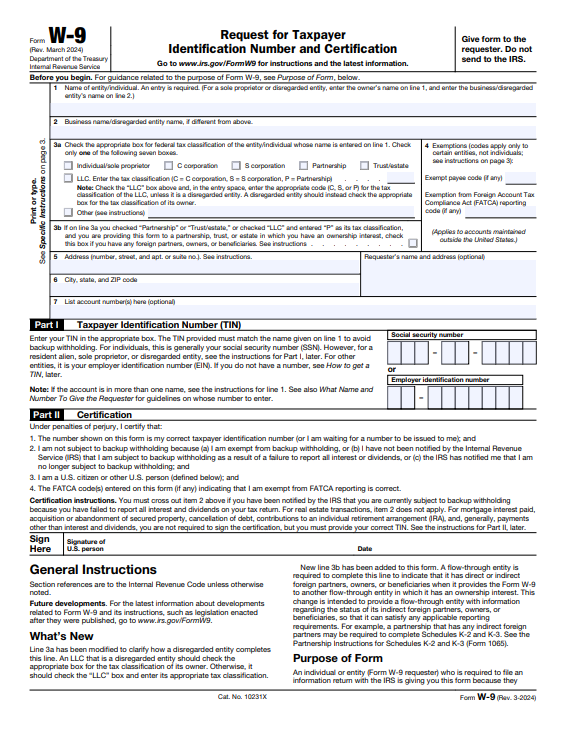
Form W-9
Form W-9

Each section of Form W-9 serves a specific compliance purpose. Filling it out accurately is essential.

Line 1: Name (Legal Name)

This must match the name used on your federal tax return.

  • Individuals → Personal legal name

  • Single-member LLCs → Owner’s legal name

  • Corporations or partnerships → Entity’s legal name

Using a nickname, brand name, or incorrect spelling can cause mismatches in IRS records.

Line 2: Business Name / Disregarded Entity Name

This line is used for:

  • LLC names

  • DBAs (Doing Business As)

  • Trade names

If you operate under a business name different from your legal name, list it here.

Line 3: Federal Tax Classification

Selecting the correct tax classification is one of the most critical parts of Form W-9.

Options include:

  • Individual / Sole Proprietor

  • Single-Member LLC (Disregarded Entity)

  • Partnership

  • C-Corporation

  • S-Corporation

  • Trust / Estate

Incorrect classification can result in:

  • Wrong 1099 forms

  • IRS notices

  • Backup withholding

Line 4: Exemptions

This section applies mainly to:

  • Certain corporations

  • Government entities

  • Tax-exempt organizations

Most individuals, freelancers, and LLC owners leave this blank.

Lines 5 & 6: Address

Enter your current mailing address where tax forms (such as Form 1099) should be sent. This does not need to be a U.S. address, but it must be accurate and up to date.

Line 7: Account Numbers (Optional)

Only complete this if the requester specifically asks for account reference numbers.

Part I: Taxpayer Identification Number (TIN)

You must provide one valid TIN:

  • SSN → Individuals and sole proprietors

  • EIN → LLCs, partnerships, corporations

Providing the wrong number is one of the most common reasons for IRS mismatches.

Part II: Certification and Signature

By signing Form W-9, you legally certify that:

  • The TIN provided is correct

  • You are not subject to backup withholding (unless indicated)

  • You are a U.S. person for tax purposes

An unsigned W-9 is considered invalid.

Form W-9 vs Form W-8: Key Differences Explained

Many international founders confuse these two forms.

Feature Form W-9 Form W-8
Used by U.S. persons/entities Non-U.S. persons/entities
Purpose Provides SSN/EIN Certifies foreign status
Tax reporting 1099 forms FATCA & withholding
Common users LLCs, freelancers Foreign individuals

If your business is a U.S. LLC, you almost always use Form W-9, even if the owner lives abroad.

Is Form W-9 Safe to Share?

Form W-9 contains sensitive data, so caution is essential.

Best Practices for Sharing W-9

  • Share only with verified businesses

  • Avoid public file-sharing links

  • Use encrypted email or secure portals

  • Do not upload to unknown platforms

Never post your W-9 publicly or send it through unsecured messaging apps.

Common Mistakes to Avoid on Form W-9

  • Listing the LLC name on Line 1 instead of the owner’s name

  • Choosing the wrong tax classification

  • Entering an outdated EIN or SSN

  • Forgetting to sign and date the form

  • Using Form W-9 when Form W-8 is required

Even small errors can trigger IRS notices or payment issues.

What Happens If You Don’t Provide a Form W-9?

Failure to submit a valid W-9 can result in serious consequences:

  • 24% backup withholding on payments

  • Delayed or canceled payments

  • Inability to receive 1099 forms

  • Potential IRS penalties

Backup withholding remains in effect until a correct W-9 is provided.

Do You Need Professional Help with Form W-9?

For freelancers and U.S. citizens, Form W-9 is usually straightforward. However, for:

  • Non-US founders

  • Multi-member LLCs

  • Businesses using payment processors

  • Companies operating internationally

Professional guidance can prevent costly compliance mistakes.

Final Thoughts

Form W-9 is a cornerstone of U.S. tax compliance. While it may appear simple, its accuracy directly impacts how income is reported, how payments are processed, and how the IRS views your business.

Understanding Form W-9, and completing it correctly, helps protect you from withholding issues, IRS notices, and administrative delays. For anyone doing business in the United States, mastering this form is not optional, it’s essential.

Contact Bizstartz to file your Form W-9 today.
How to Legally Change Your LLC Name in 2025: Step-by-Step Guide

Upon the initial establishment of an LLC, there is a thorough consideration of a name for the business which aligns with the business idea, branding, and vision.

Over time however, businesses do change, markets change, industries grow, and in some cases, the name of the business no longer aligns with the future of the company. This is where the legal name change of the LLC comes in.

Unlike the fanciful idea of changing the name of an LLC for the purpose of the website and the business cards, the name of the LLC is in fact, a legal name which changes through a legal procedural system which needs to be registered with the state, the IRS, the banking institutions and the rest in legal compliance in order to maintain compliance with the legal system.

It is a linear process, however an overlooked step can create compliance gaps, tax confusion, and in some situations, loss of liability protection.

This document is going to change every individual’s view on the process of changing an LLC name in 2025 by explaining the step by step reasoning why a name change is necessary, the subsequent actions that follow, the expenses that are incurred, and the necessary changes that are to be done post the approval of the new name.

Why Change the Name of Your LLC?

The reason behind changing the name of the LLC differs from one business owner to another. Here are a few of the more popular reasons:

1. Rebranding for Growth

In the early stages of a business, it is usual to think of a name that will grow with the business. A name like “Denver T-Shirts LLC” for a business with future plans to deal with shoes, bags, and even accessories will seem limiting. A new name and a new business strategy will enhance the perception of the business while also making it more developed in its new offerings.

2. The Business Model has Shifted

A business is said to have shifted its direction once it has stopped offering certain products and is exclusively making new offerings. For example, a local bakery business that has now shifted to offering online baking courses has changed the old made more for a business model that is not outlined to fit with the rest of its offerings. A change in the LLC name will assist in the migration to the new business model.

3. Shifting to a New Level

The name of your business may have worked for the domestic market but will not assist in your plans to go global. The more negative perception a name has in another country, the more ineffective it is to deal with it.

4. Legal Issues

A new name may be needed to mitigate the chances of being sued. The name of the LLC could be in contention with another registered business. Legal problems arise when there is a clash with the trademark of a different business.

5. Updating Your Brand

In some situations, the approach taken is purely aesthetic and rational. It is shown that with a simpler, cleaner, and more contemporary logo, the brand name becomes easier and quicker to remember which translates to more investors, partners, and consumers.

How to Change the Name of an LLC in 2025.

Changing the name of an llc in 2025 will require a couple of steps. Each stage will broken down further down the guide.

1. Confirm with Your State Requirements

Every state has their own nomenclature rules regarding LLC name changes. The majority of states require a name change request to the Secretary of State called Articles of Amendment, while others may have more creative names such as Certificates of Amendment along other variations.

👉 Pro Tip: Confirm with your state’s buck Chapter 3 of the business secretary. Contact the Secretary of State to clarify the form which has to be completed, the cost, and the preferred method of filing: is it electronic or postal.

2. Select and Confirm Your New Name

This is an important step, you want a name that is legally available and branded with a positive image and can survive the test of time.

In the process of selection:

  • Confirm the name is available in the state: Business name search in the state’s database.
  • Trademark clearance: search the USPTO database and ensure that there is no conflict with the national trademarked brands.
  • Check the domain: and ensure there is a matching website domain for your new name.
  • Confirm the name: ensure the name complies with the legal requirement of having the term “LLC” or “Limited Liability Company” as well as other protected terms “Bank”, “Attorney” or “University” without proper proper licensing.

This prevents, in the long run, costly rebranding or lawsuits.

3. Amend Articles of Organization

This is the most vital step, the official filling with your state where the LLC is located to change the legal name of the LLC.

Typical information required includes:

  • Current name of the LLC
  • New name of the LLC
    • When is the change effective (can be immediate or a set date in the future)
  • The state issued LLC ID number for your company
  • An authorized member or a manager’s signature

Filing fees amounting to $20 to $200 depending on the state, some states charge accelerated processing fees.

Once a submission is approved, the confirmation document (for example, stamped Articles of Amendment) will be sent which will prove that the new name is legally accepted.

4. Amend the Operating Agreement

If your LLC has an Operating Agreement, it now must be amended to reflect the new name. Even if your state does not require it, this document is necessary for the clarification of the members and partners of the business. Amend:

  • The LLC name throughout the agreement
  • Any associated particulars such as, company letterheads, and record books

5. Notify the IRS

Once the state has approved your new LLC name, the next steps involve filing the IRS to ensure all tax records align appropriately.

Based on how your LLC is taxed:

  • Single member LLC (disregarded entity): Issue a signed letter to the IRS, enclosing your EIN and new name.
  • Multi member LLC taxed as a partnership: Claim the alteration on your next Form 1065 return.
  • LLC taxed as a corporation (C or S Corp): Claim the alteration on your next Form 1120 or Form 1120-S return.

👉 Note: A name change does not require a new EIN.

6. Amend The Business Licenses and Permits

All your business licenses on local, state, and federal levels must be amended as well. These include:

  • City business licenses
  • Health permits
  • Sales tax permits
  • Professional permits (real estate, medical, etc.)

The failure to update will incur the risk of holding invalid licenses.

7. Update Bank Accounts and Financial Records

  • Business checking and savings accounts
  • Credit cards
  • Merchant accounts (Stripe, Paypal, Square, etc.).

This is important for making sure payment and tax reporting assimiliation does not become muddled.

8. Update Contracts, Leases, and Agreements

All legal documents that have historically been signed under the old name of the LLC have to be modified. This includes:

  • Office or retail leases
  • Supplier contracts
  • Employment contracts
  • Client contracts

This ensures that contracts are able to be enforced under the new name of the LLC.

9. Update Business Branding

This is the last step. Change your brand and also its identity in every possible place. This is the most tedious step, yet the most apparent. Change:

  • Website domain and email addresses
  • Social media accounts and pages
  • Logos, business cards, and physical signage
  • Advertising and other promotional materials
  • Invoice formats and statement headers

How Much Does It Cost to Change an LLC Name?

This is purely based on state laws and your personal approach to rebranding.

  • Costs for filing with the state: Fee of $20–200 depending on the state.
  • Optional name reservation: $10–50 if you reserve the name prior to filing.
  • Additional payment for faster processing in some states: $25–100.
  • Costs to rebrand: these may include a website domain, redesigned logo, and other promotional materials which price ranges from a few hundred to a few thousand.”

How Long Does It Take?

  • Online filings: Typically within a handful of workdays.
  • Mail filings: 2 to 6 weeks based on the efficiency of the state you’re in.
  • Expedited Service: An additional cost. Some states provide same-day or next-day approvals.

Overall, the process takes anywhere from 1 to 3 weeks on average.

Can you just file a DBA instead?

Alternately, a DBA, or Doing Business As, a trade name, or a fictitious name is another option to consider instead of changing the legal name of your LLC.

Pros of a DBA:

  • More economical and quicker.
  • You can conduct business under several different brand names without the need to change the legal name of the LLC.

Cons of a DBA:

  • You do not change the legal name of the LLC with the state.
  • Your LLC name is still a requirement and is used in banking, tax filing with the IRS, and on other legal documents.

If you wish to have the new name as your legal name, you will have to file an amendment. For simple name operation with multiple names, a DBA is more appropriate.

Blog CTA

Concluding Remarks

Changing your LLC name can be a thrilling development whether it be rebranding, expanding, or starting anew. Completing the paperwork is a subtle challenge, however, following the specified steps guarantees a smooth transition.

Updating your headquarter’s record is not the only step. You also have to update the IRS, banks, contractors, and vendors as well as your business’s new name and brand from all of your business’s touchpoints.

If you prefer a hassle free approach, Bizstartz will take care of your work from filing the articles of compliance to the IRS and revising the compliance report so you can focus your energy on expanding the business.

Frequently Asked Questions (FAQs)

1. Am I required to obtain a new EIN after changing an LLC name?

No, you have to inform the IRS otherwise the tax records will be inaccurate.

2. What is the duration for changing an LLC name?

On average it takes close to 1 to 3 weeks depending on how fast the state is and the filing method used.

3. Is “discontinuance of use” relative in any way in the context of the LLC as a legal name?

There is still a possibility of using the name informally as a trademark. However, as a legal name you will have to account for the possibility of registering the name as a DBA if you wish to pursue its use in the future.

4. Within the context of the LLC, explain how a DBA is distinct from a legal name change.

A DBA allows a business to function under a name without changing business legal name that still remains a DBA. An amendment to the record serves as a legal name change to the registered LLC for the state in question.

5. Is it possible that I, as a Bizstartz Associate, could assist you in the Name Change of your LLC?

Absolutely! Bizstartz focuses on the formation of the LLC to the amendment of its name, the issuing of an EIN and ITIN, bookkeeping, filing the BOI, and ensuring compliance services both for US and non-US entrepreneurs. The work is made simple.

LLC Business Insurance in 2025: Why It’s Essential for Protecting Your Company

In the United States, starting a limited liability company is the best way to protect personal assets while doing business. When starting an LLC, entrepreneurs are afforded a liability shield, which protects personal finances from business debts and obligations.

Nonetheless, most novice business owners hold the incorrect notion that an LLC offers complete unlimited protection. In actuality, the LLC structure only protects personal assets, not the business from potential risks, such as lawsuits, physical damages, accidents, and even cyberattacks.

This brings us to the need for LLC business insurance. As we approach the year 2025, the business world is developing at a rapid pace, which means enhanced legal issues, technological risks, and operational uncertainties.

In order to survive and flourish in this type of landscape, LLC owners must not only depend on a legal structure, but heavy-line a business in this type of landscape must have more insurance.

This article will discuss why business insurance is needed for LLCs in 2025, the various policies that can be purchased, the importance of the insurance, the general cost of the insurance, and how Bizstartz will assist you in this crucial step of protecting your business.

The Importance of Business Insurance for LLCs in 2025

An LLC is effective at shielding personal liability in the event of business failure, however, it does not replace the need for business insurance. While personal assets like savings, home, or cars may be protected from creditors or lawsuits, business assets like bank accounts, equipment, intellectual property, and revenue remain exposed.

An LLC is still very susceptible to a well placed lawsuit, and without business insurance, the LLC could easily be put out of business. The following developments in 2025 and beyond mean insurance is crucial business consideration today:

Rising Legal Costs and Lawsuits

The frequency of lawsuits, for example, slip and fall injuries in one’s shop, a contract breach with a vendor, or a claim of negligence from an unsatisfied client, is higher today as compared to a decade ago. Lawsuits, as one is aware, can easily run into hundreds of thousand dollars, especially in business. An LLC is designed to protect the personal assets however, the business assets remain exposed in the event one does not have insurance.

Stricter Contractual Requirements

The revenue generating opportunities for an LLC is still very vast, however, many contractors and potential business associates now need the partner or LLC to carry liability insurance. Otherwise, critical business contracts could be lost.

Growing Cybersecurity Risks

Cybercrimes become rampant in 2025, and businesses of any scale and scope become the victims of hacking. Gaining unauthorized access to a business sanctuary doesn’t require a tremendous effort and the financial implications of a breach are devastating to a business.

Lawsuits from the customers become a nuisance in the process of recovering the business. The business can end up in a devastating financial situation if no insurance claim is active.

Operational Risks and Unforeseen Events

There is no end to the threats that a business can face, natural disasters (such as floods, earthquakes, and wildfires), the breakdown of equipment, and supply chain interruptions. Without any claim to an active insurance, your LLC awaits a devastating situation due to a forced shut down that can extend temporally, or permanently.

Protecting Long-Term Growth

Protecting the business from losing value become unattractive to the stakeholders and losing growth. Gaining the right insurance cover transforms the business altogether and makes it easier to regain business value. The growth and expansion of the business become unimpeded and stable.

Types of Insurance Coverage for LLC Owners

LLC insurance

While each LLC may not require the same type of coverage, grasping the the categories of business insurance will help in identifying the unique insurance need of each LLC. Below is an outline of the critical business insurance an LLC would need in the year 2025:

1. General Liability Insurance

This coverage is essential in any small business insurance plans. It addresses unique third party claims on bodily harm, damage to personal properties and personal injury such as slander and certain false advertising injuries. For instance, if you have an employee who is injured while working a particular task in the office, general liability insurance will be the one to cover the medical expenses as well as the legal claims.

2. Errors and Omissions Insurance – Professional Liability Insurance

This form of insurance is essential in an LLC business providing professional services such as consulting, accounting, IT, legal services, etc. It serves as coverage on claims of negligence, blunders and failure to deliver services promised, For Example, if a client believes your guidance lost him money, professional liability insurance would cover the legal costs of defense and any settlements made.

3. Commercial Property Insurance

If you have any type of business, whether a storefront, office or a warehouse, property insurance serves as a shield for your physical assets against fire, theft, vandalism and other damages that might occur as a result of a natural disaster. It may as well protect certain high value business items such as computers, office furniture, or machinery.

4. Workers’ Compensation Insurance

If your LLC employs workers, most states legally require you to carry Workers’ Compensation Insurance. This type of insurance ensures that an employee’s medical expenses, rehabilitation expenses, and lost wages are paid for if the employee sustains an injury in the line of duty. This protects the employees and protects your LLC from exorbitant lawsuits.

5. Business Owner’s Policy (BOP)

Cost efficiency for LLCs stems from A BOP, as it encompasses liability and property insurance. Some insurers extend the offer of adding business interruption coverage. This coverage compensates the insured for the income that will be lost as a result of having to shut the business down temporarily because of an insured event.

6. Cyber Liability Insurance

With the online business boom, cyber liability insurance has become a pivotal aspect of business insurance. Policies in this field cover the expenses of data breaches, ransomware and other forms of online criminality.

For example, suppose the clients of your LLC’s website suffer a data breach and their credit card information is illegally extracted upload. This insurance policy will cover the legal expenses, the cost to inform clients, and the fee to restore the IT system.

7. Commercial Auto Insurance

In the event that your LLC employs vehicles for the purposes of delivering products, holding meetings with clients, or conducting transactions involving physical goods, you cannot rely on personal auto insurance in the case of business related accidents. Commercial auto insurance will cover vehicles that are owned by the LLC and vehicles owned by the employees if these are used for business activities.

8. Umbrella Insurance

Umbrella Insurance policies are designed to cover the extra financial liability expected when other primary policies are inadequate. For high-risk businesses with high assets, Umbrella Insurance helps to avoid being underinsured.

Benefits of Business Insurance for LLC Owners

Apart from compliance and risk management, appropriate kinds of insurance helps a business with several advantages in the longer run.

Peace of Mind: Attending to the business is a more appropriate use of time than worrying about the any impending financial disaster.

Financial Protection: A single accident should not be allowed to endanger the existence of the LLC, and appropriate types of insurance should protect it from any legal claims made.

Professional Credibility: Insured businesses are more professional with their clients, vendors, and investors as compared to the businesses that are not insured.

Legal Compliance: A number of states require certain types of insurance, including for example, auto insurance and workers’ compensation.

Business Continuity: Insurance helps to cover temporary cessation of business operations and thus helps to cover income loss coupled with additional expenses due to business disruption.

What will the costs look like for the LLC for the years, post-2025?

insurance for US LLC

Costs of insurances are generally heavily influenced discriminatorily on the nature of the business, the industry entailed, the geographical area, and the size of the establishment. The following are probable estimations for LLCs of smaller and medium size, with regards to the year of 2025.

  • General liability insurance is predicted to lie between $30-80 monthly
  • Professional liability insurance is predicted to lie between $50-120 monthly
  • Business Owner’s Policy (BOP) is predicted to lie between $60-150 monthly
  • Workers compensation insurance is highly variable depending on the state and the size of the payroll, with an average of $0.25-2.0 for every $100 of the payroll.
  • Cyber liability is insurance is predicted to lie between $75-200 monthly (increasing cyber liability is predicted due to rising cyber threats)
  • Commercial auto insurance is predicted to lie between $100-200 for every vehicle on a monthly basis
  • Umbrella insurance is predicted to lie between $50-100 on a monthly basis (dependent on coverage limits)

Even though the costs of insurances add an additional burden on the fake business, it is a way lesser value than the financial losses that the company will suffer without insurance.

How to Choose the Right Business Insurance for Your LLC

Choosing a policy to cover various contingent risks an LLC might face can initially appear to be an overwhelming task, but focusing on a few core aspects can make it much easier.

Identify Your Business Risks: Risk assessment for a businesses is critical, as it is inherently subjective, a paradigm technology companies might face different risks than a retailer.

Identify your Business Legal Requirements: Business licenses come along geo-centric legal requirements and each company needs to insure itself for what the governing body of the location requires it to insure itself for.

Identify Different Policies: Look for various policy providers and try to gauge which offers the highest coverage for the lowest total value.

Consolidate Policies: Elements of professional policies can be consolidated by vendors as a means to reduce total business insurance costs.

Consult an Insurance Professional: With the unique position of an insurance consultant, they may be able to devise the most advantageous plan based on the LLC’s requirements.

Assess periodically: Knowing that, there is no business which remains static, and due to inevitable evolution, there is a need to update and align insurance coverage plan on a regular basis.

How Bizstartz Can Help LLC Owners

We help those planning to start a business by enabling them to form an LLC and offers services to help them obtain an EIN, BOI, and a registered agent for their business.

A limited liability company is only a starting point for your endeavors. Proper liability insurance is also essential for business protection that concepts as strong as yours need.

Our insurance offerings for your LLC helps you negotiate a plan with insurance providers that is tailored to your unique business needs thanks to a partnership with an insurance company that is in our ever growing business ally network.

Blog CTA

Conclusion

As a business owner, having an LLC does protect your assets from business liabilities to an extend. Some things like the business assets, company reputation, and chances for future growth can still be lost. Business limited liability insurance is perfect for this situation.

In this newfound world of 2025, critical things like legal disputes and cyber security will be prevailing. Because of this, no business can afford to ditch having insurance. The right plans put in place today may be a mouthwatering profitable business or a lost couple months from now.

Do not compromise and have insurance plans that cover your LLC, or the company along with yourself, run the risk of staying in your comfort zone.

Utah Business Entity Search: A Complete Guide for Entrepreneurs

Out of all fifty, Utah is one of the most attractive states for entrepreneurs. Utah has one of the strongest economies in the country and is home to one of the United States’ largest technology centers, the Silicon Slopes.

These characteristics, coupled with a low unemployment rate, has turned the state into a destination for global companies and small businesses starters alike. The state is also well-known for its business friendly taxes, highly skilled workforce, and robust policies encouraging business investment and development.

Filing for a Limited Liability Corporation, or any business entity for that matter, requires that one of the first steps to be taken is to determine if the business name is available is one of the most crucial steps. This can be done through the Utah Business Entity Search, a free online service offered by the state Division of Corporation and Commercial Code.

This guide will be presenting the most crucial steps that are required in performing a Utah Business Entity Search and how to utilize it, including its significance, step-by-step procedures on how to utilize it, and tips on how Bizstartz can assist entrepreneurs in Utah.

What does Utah Business Entity Search Incorporate?

Utah Business Entity Search is a tool on the internet created by the Utah Division of Corporations and Commercial Code, which is under the Department of Commerce, and allows the user to search the Utah’s database of registered entities which include LLC’s, Corporations, Partnerships, and Non-Profits.

These are the actions this tool allows you to perform.

Check Name Availability – Determine if a proposed business name is currently registered to a business, or registered to a business which operates under a similar name.

Verify Business Details – Search for the details of registered entities in the state of Utah which include the business entity type, registration date, and the business status.

Research Competitors – Particularly new entrepreneurs try to find answers to the questions who are under this and that name, and this tool provides the solutions.

Ensure Compliance – Utah Law aims to make certain that the business names and the names of the units are distinguishable, unique, and different, and therefore, provides this search tool as a legal necessity.

All in all, this search provides legal and business protection for people trying to start a business in Utah.

Why is the Utah Business Entity search Important?

Texas Business

Some entrepreneurs tend to forget the conduct a detailed search and its impacts on the filing of their LLC or Corporation. However, this step can save you time, money, and legal problems in the future. This is the reason why the Utah Business Entity search is important.

1. Makes Sure that the Name is Not in Use Before

The most obvious reason to perform the search is to confirm whether your desired business name is available. In in the event that you wish to establish an LLC and name it, Mountain Tech Solutions LLC, the search will illustrate whether there exists another company under that or very similar name.

2. Avoids Name and Legal Disputes

The use of a name that is already in use with or affiliated to another company will automatically embroil you in legal issues and a possible lawsuit or trademark infringement claims. This is the reason you should ensure that your name is as unique as possible in order to shield yourself from untold legal expenses as well as rebranding expenses.

3. Confirms Business Authenticity

Potential investors, partners, and even clients may wish to inquire whether or not a company is registered with the state of Utah. The search provides an effortless way to prove and provides the status of the entity whether in good standing or has been dissolved, expired, or even revoked.

4. Aids in Promotion and Marketing.

Distinctiveness in the name of a business always contributes to its brand identity. If your name is too close to the name of another business, your customers may become confused and you may face marketing issues

5. Assists in Trademark Applications

In the case you wish to trademark your name or logo, the first inquiry you should make is whether the business name is registered or trademarked in the state of Utah. This will save you from spending time and money on a name and brand you will be unable to protect.

Procedure to Perform a Utah Business Entity Search

While a search is relatively simple, particular care should be exercised to avoid the search from being erronneous.

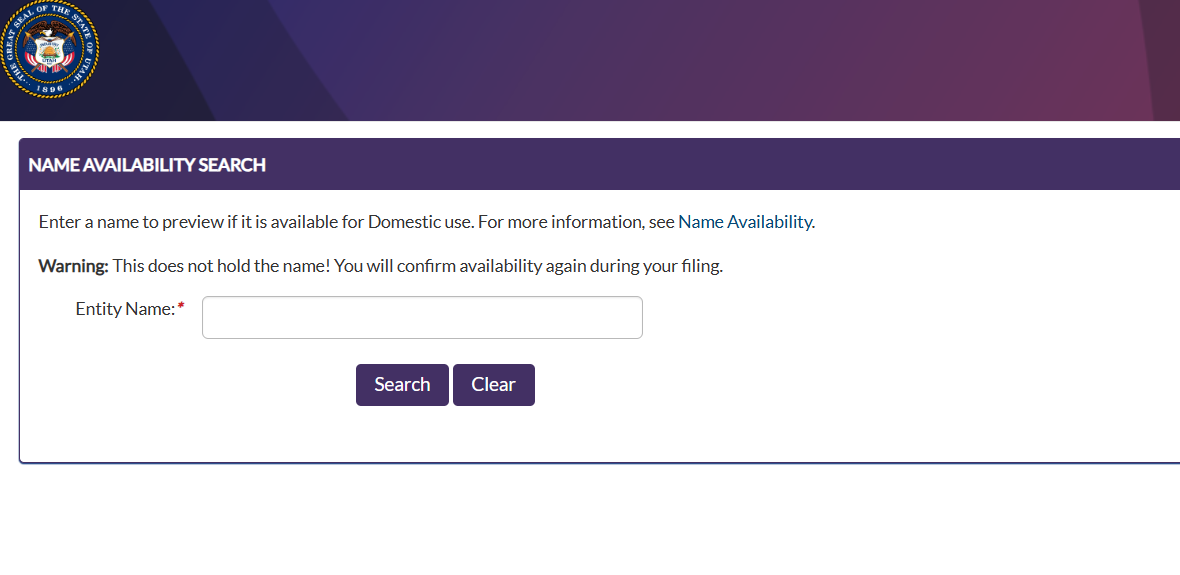
Step 1: Utah Division of Corporations Website

Access the official page of The Utah Department of Commerce – Division of Corporations and Commercial Code. This will provide you with the state entry point to file for business registration as well as conduct business-related searches.

Utah

Step 2: Locate the Business Entity Search Tab

In the initial page, select business entity search as one of the options. This will take you to a page where databases can be accessed.

Step 3: Provide Your Search Parameters

You can perform the search using the following methods:

  • By Entity Name – This is the easiest method. Just type the name of the business in question, and you will get the results.”
  • By Entity Number – If you’ve been assigned an allocation number company number and would like to register a company, you can search using the allocation number.
  • By Executive Name – This search allows you to use the names of company executives, like directors, managers, or registered agents.

Step 4: Check Results of the Search

The system will show you businesses based on the search criteria you provide. Each business displayed will have the following:

  • Name of the business
  • Type of legal entity i.e., LLC, Corporation, Nonprofit, etc.
  • Date of registration
  • Current status of the business, Active, Expired, Dissolved, etc.
  • Principal office address

Step 5: Choose a Name

If the business name you wish to use does not appear in your search results, the name is probably available. However, as per the requirements of the State of Utah, business names must be sufficiently differentiable on record, and even slight differences will not be enough. For example, “Mountain Tech LLC” and “Mountain Technologies LLC” would be considered very similar.

Guidelines for Selecting a Business Name in Utah

Choosing a business name is not simply a matter of stamping a value on an entity to register; it is probably one of the more critical acts of marketing and branding. Some suggestion that ought to be considered include:

Be Innovative and Original

Identify a name that sets you aside from the competitors in your market. If your name is too generic, your potential customers will find it nearly impossible to locate you online.

Use the Correct Business Designators

LLCs must include the legally designated terms: “Limited Liability Company,” “LLC,” or “L.L.C.” and Corporations must include in their legal business name “Corporation,” “Incorporated,” “Company,” or “Limited.”

Avoid The Use of Sensitive Words

For example, use of the word “Bank,” “Insurance,” “University,” and “Attorney,” can trigger more special approvals in the licensing process.

Conduct a Name Search and Check the Trademarks

After doing a name search on the Utah data base, also check with the U.S. Patent and Trademark office (USPTO) to find out if the name is federally trademarked.

Establish a Business Online

It is important that you secure the domain name and relevant social media accounts pertaining to your business name. This is important so that you can further strengthens your brand.

What Next After The Name Search: Steps Forward in Utah

Obtain a Reservation Permit for Your Business Name: If you wish to open an LLC or a Corporation in Utah and have not yet filed the required documents, you can reserve a name for a period not exceeding 120 days.

Obtain a Certificate of Organization: Colorado LLC’s have to obtain a Certificate of Organization along with the Articles of Incorporation that are filed with the Division of Corporations of your choice.

Obtain an Employer Identification Number: This is needed in order to open a business bank account, pay business taxes, or employ staff

Select a Registered Agent: This is a legal requirement in Utah, and each business is expected to appoint a registered agent for all legal papers and taxes.

Submit Reports of Beneficial Ownership Information: As a new requirement comes into effect in 2024, a majority of companies are expected to submit BOI to FinCEN for regulatory compliance, so be ready.

Open a US Business Bank Account: This is an important step needed to handle all the business finances especially for business owners who are not based in the USA.

Register and Protect Your Brand with a Trademark: These will serve as its first and most important step to protect your trademark at the state or federal level.

How Bizstartz Can Help You

We assist clients, provding an streamlined onboarding process for setting up companies for international and u.s.-based clients. By undertaking all the entrepreneurial headaches, we allow you to focus to focus on your firm’s growth and expansion.

Let us outline the various services that we extend to our clients:

  • Conducting a Utah Business Entity Search to determine the availability of a company a name.
  • For the clients our company is willing to denominate an LLC, or incorporate a company with the Utah Division of Corporations.
  • Provide assistance in the proper and timely application of an EIN with the IRS.
  • Registered agent service.
  • Filing reports of beneficial ownership of the company.
  • Administering assistance in the incorporation of a business bank account in the USA and business payment systems.
  • Bookkeeping and compliance assistance.
  • Assisting clients to trademark a business to defend the name and image.

With us helping you, You do not have to worry about the ultra-legal and time consuming process of filing complicated forms. We promise that you business in Utah is redily operational and its filings are in order.

Blog CTA

Final Thoughts

For companies that are establishing a business, the first Utah Business Entity Search, is of extreme importance. Not utalizing your business name can result in unwanted and expensive business name conflicts, thus, providing a strong foundation for the business.

Few states in America are as entrepreneurial as Utah, its flourishing economy, technology markets, and low barriers to doing business all provide an unparalleled atmosphere for business practice innovation. Whether you are forming an LLC, a Corporation, or any other type of entity, permitting all registralls as an unabashed preference of business practice rests at the very tenet of success.

With the assistance of Bizstartz, the Utah business you envisioned will be successful in every aspect, even those that require great registration and compliance.

Florida Corporation Search: A Complete Guide

Florida remains one of the top states in the United States for starting and operating a business. The Sunshine State’s economy, tax structure, and geographic location are among its key advantages. These features make Florida a focal point for entrepreneurs and business people worldwide.

Regardless if you are starting a fresh new business, entering new markets, or purchasing a business, business verification is always critical.

The State of Florida provides its residents with the Florida Corporation Search as part of the Sunbiz.org portal. This portal is a business hub for the state of Florida where one can find useful business information and help. The Florida Corporation Search tool is an essential resource for achieving critical business information in Florida.

The tool allows one to check if a specific business name is registered and if the company is in good standing, among other business verification tasks.

In this guide, I provide all the information related to Florida Corporation Search, its relevance, and its effective usage along with pertinent business decisions you can undertake based on the information you find.

What Is The Florida Corporation Search?

A system that the Florida Department of State, Division of Corporations maintains is The Florida Corporation Search, which is an online public database. The system has information on businesses that are registered in Florida such as the following:

  • Corporations (C-Corps, S-Corps, Professional Corporations)
  • Limited Liability Companies (LLCs)
  • Partnerships (Limited Partnerships and Limited Liability Partnerships)
  • Fictitious Names (DBAs – Doing Business As)
  • Trademarks and Service Marks registered in Florida

Now, to access the information derived from the database is public, and any person could search for information, such as an entrepreneur, investor, lawyer, supplier or even clients. This sort of system aids in ensuring the level of trust and accountability in businesses in Florida.

With the passing of time, Sunbiz has been among the leading state databases in the United States. Today, users can access a wealth of information, such as corporate filings, listed agents, annual reports and other compliance documents, all with a few clicks.

Why Is the Florida Corporation Search Important?

As an instrument of efficiency, the Florida Corporation Search serves as more than a mere convenience, and here’s the reasons as to why this tool is of importance:

1. Check Business Name Availability

While embarking on the new business formation, selecting an appropriate and distinct name is one of the most paramount steps. Florida’s legal framework prohibits the existence of duplicate or confusingly similar names within the state borders.

Conducting a corporation search allows a prospective business owner to see whether his preferred name is available or not, thus guiding towards filing appropriate incorporation paperwork. This helps avoid waste of time, money, and legal disputes.

2. Verify Business Legitimacy

In case you plan to partner, invest or provide services to a company operating in Florida, the search enables you to verify whether or not the entity is registered and is within the bounds of state regulations. This serves to much lower the reality of encountering fraud and thus assists in ensuring the entity being dealt with is a bona fide company.

3. Review Corporate Filings

Every business that is registered has filing obligations. These filings include annual reports, amendments, mergers and reinstatement filings. The tools provide for the reviewing of the filings enabling the prospective users to appreciate the extent of compliance of the company and their activities.

4. Retrieve Registered Agent Details

A registered agent is a company or an individual who receives legal documents on behalf of a business. You can also know how to reach a company’s registered agent through a search. This is crucial when dealing with lawsuits, contracts, or compliance requirements.

5. Monitor Business Activity Status

Not every business remains active within the state of Florida. Some may be dissolved or inactive as a result of noncompliance with state regulations. By checking the status of these businesses, you will not be entering any agreements with entities that no longer exist.

In summary, the Florida Corporation Search provides compliance as well as a risk management strategies.

Using the Florida Corporation Search

We will provide a step-by-step overview to access the Florida Corporation Search as it is intuitive and uncomplicated.

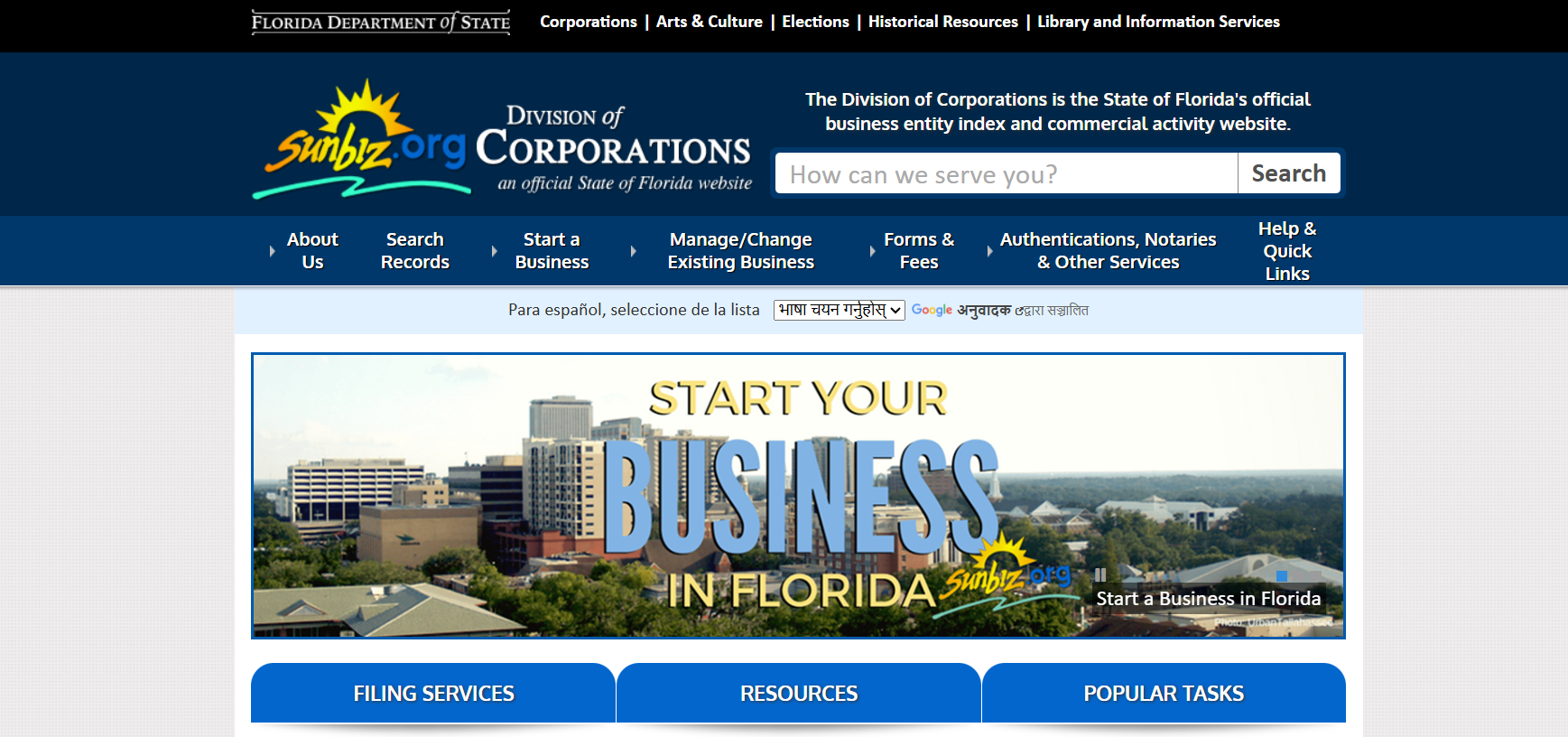
Step 1: Visit the Sunbiz Florida Website

Navigate to www.sunbiz.org, which is the official site for the Florida Department of State, Division of Corporations.

florida

Step 2: Look for “Search Our Records”

On the homepage, there is a section labeled “Search Our Records.” This section provides several search options, including:

  • Corporation/LLC/LP Name: Users can conduct a search using a company’s name.
  • Officer/Registered Agent Name: Users can search using the name of an officer or agent.
  • Trademark/Service Mark Name: Search for all service marks and trademarks that have been issued and are active in Florida.
  • Fictitious Name: Search for all registered Doing Business As (DBA) names for individuals and entities.
  • Document Number: Search results are narrowed down based on the exact filing number given. Entering the exact filing number results in precise matches.

Step 3: Enter Search Criteria

Input any relevant business data. For instance, for “Sunshine Realty LLC,” the officer’s name or the business name can be used and will yield results.

Step 4: Review Search Results

Examine every suggestion the computer gives, as the names can be deceptively alike. The system will list all the businesses corresponding with the given name.

Step 5: Click for Details

The public profile of every business contains the following information, so by clicking the business name, it will be accessible:

  • Official company name
  • Document number
  • Date of filing and incorporation
  • Business type (LLC, Corporation, Partnership, etc.)
  • Principal office and mailing address
  • Registered agent details
  • Status (Active/Inactive/Dissolved)
  • Filed annual reports and corporate documents

With details such as these, researchers are guaranteed to have all relevant information.

When Should You Use Florida Corporation Search?

The tool can be useful in a number of situations:

When initiating a business in Florida → To have an idea of what business name can be used.

Before entering into partnerships or contracts → To validate that your prospective partner runs a business that is operational and legitimate.

Before making an investment → To audit the business and its dealings in compliance corporate records.

For due diligence → This procedure is often used for background investigations by lawyers and accountants, or by investors.

For marketing and competitive research → Companies are able to verify the existence of participants in an industry and analyze their competitors.

For protecting your trademark → Taking steps to confirm that a brand name does not interfere with, or is not conflicted by, a brand in the state of Florida.

Benefits of conducting business in Florida

It is also important to note that Florida is more than a tourist hot spot; the state is an international business center. This is the reason many startups prefer it.

Tax Benefits: For foreign nationals, and for citizens, Florida does not charge a personal income tax.

Geographic Advantage: Florida serves as a major gateway to Latin America and the Caribbean, as well as to the rest the world through its shipping routes.

Broad Range of Industries: Florida has more to offer than just tourism and real estate; it also excels in finance, technology, agriculture, and healthcare.

Highly qualified personnel: These are essential for foreign companies, and Florida’s multiligual workforce is an attractive asset.

Highly qualified geographed: Florida has the international airports and sea ports as well as the modern means of transport for conducting business.

Business-Friendly Legislation: The state promotes entrepreneurial activities through relaxed regulations and simple processes for registration.

These advantages along with access to Sunbiz’s open corporate records make Florida, in my opinion, one of the best states in the US for starting and expanding a business.

How We Help

Here at Bizstartz, we facilitate business start, management, and growth across the US for entrepreneurs from all corners of the globe. Whether you are a US citizen or a non-resident founder, we will guide you on every step from setting up to maintaining the business in Florida.

Our assistance includes:

  • Formation of LLC or Corporation in Florida
  • Application for EIN (Employer Identification Number)
  • Registered agent services
  • Beneficial Ownership Information (BOI) filing
  • Filing annual reports and general compliance
  • Maintaining business records and managing accounts
  • Opening a business bank account in US
  • Bookkeeping and accounting services
  • Trademark filing
  • Advisory services for non-resident business owners

We assist in all aspects of filing Florida Corporation Searches to reserve a business name.

Blog CTA

Final Thoughts

The Florida Corporation Search serves as one of the many tools offered to entrepreneurs, investors, and business professionals looking to establish a presence in the state.

Sunbiz’s services are convenient and accessible for anyone looking for a business’s verification, compliance filing, and even name checks for uniqueness.

When considering the formation of a corporation or LLC in Florida, it is advisable to seek assistance with the process. At Bizstartz, we assist both American citizens and foreign investors in setting up their companies in Florida.

Texas Business Entity Search: A Complete Guide for Entrepreneurs

Texas has historically been one of the most business-friendly states in the country, drawing in entrepreneurs from across the nation and even the world. The Lone Star State offers unparalleled opportunities in business expansion and tourism, with no state income tax, a flourishing economy, and a wide array of industries, including energy and technology.

However, one crucial step to establish a company in Texas is ensuring the selected business name is distinctive and eligible for registration. The Texas Business Entity Search is vital in such scenarios.

The Texas Secretary of State’s search system is vital for entrepreneurs to verify name registrations, ensure compliance, and carryout due diligence for registered businesses. If you are planning to incorporate, form a new LLC, or even research an existing company, this tool is invaluable.

This guide will explain what the Texas Business Entity Search is, why it’s important, how to effectively use it, and what actions to take post search completion.

What is the Texas Business Entity Search?

Texas Business

The Texas Business Entity Search is offered by the Texas Secretary of State’s office as an online search tool to access records of various business types registered in Texas such as Limited Liability Companies (LLCs), Corporations, Limited Partnerships (LPs), Nonprofits, and other business entities.

Through this tool, you can access important details such as:

  • Business name and filing number: The official identifiers of a company.
  • Entity type: Whether it’s an LLC, Corporation, LP, or other structure.
  • Current status: Active, inactive, dissolved, or forfeited.
  • Registered agent: The person or business who receives legal documents on behalf of the company.
  • Filing history: A chronological record of documents submitted or lodged with the filing office, at the state office.

Unlike some states, which allow performing basic business searches at no charge, Texas has such services accessible through a paid system, SOSDirect. Limited information can be accessed free of charge. However, for complete access to records, certificates, copies of documents, and other information, a small fee is charged.

In short, this tool acts as a central database of all legally registered entities operating businesses in Texas.

What is the Significance of the Texas Business Entity Search?

Executing a Texas business search is not a mere administrative chore, but an important activity that can support smooth legal groundwork for your business. Below are the reasons it is important:

1. Prevents Name Conflicts

Every business is required to have a unique name which is not “deceptively similar” to a name that is already registered. Texas name regulations are stringent, and if your business name is close to an existing business, your application will be denied. Performing a search early can save a lot of time.

2. Confirms Legal Compliance

When formation documents are submitted to the Secretary of State, they perform a name-check with the registry and verify if the name is already in use. Doing the search yourself can save you time and help ensure legal compliance for your business and make necessary adjustments to the name if needed.

3. Verifies Legitimacy of Other Businesses

For vendors, clients, or business partners based in Texas, the search tool can confirm if they are active or registered businesses. You can also verify if they are in good standing, suspended, or dissolved, which can help make an informed decision towards the partnership.

4. Safeguards Legal and Financial Interests

When it comes to loans, contracts, or any legal documentation, institutions and banks typically require verification of good standing and registration. Legal verification checks enable access to such records.

5. Conducts Market Studies

Aside from the legal application, the database can offer a glimpse of the competition. You may access the number of businesses within the same industry and operating with identical names.

Steps for Conducting a Business entity search in Texas

Accessing the SOSDirect system is a prerequisite to conducting a Texas Business Entity Search. The process is simple, but it must be broken down into clear steps:

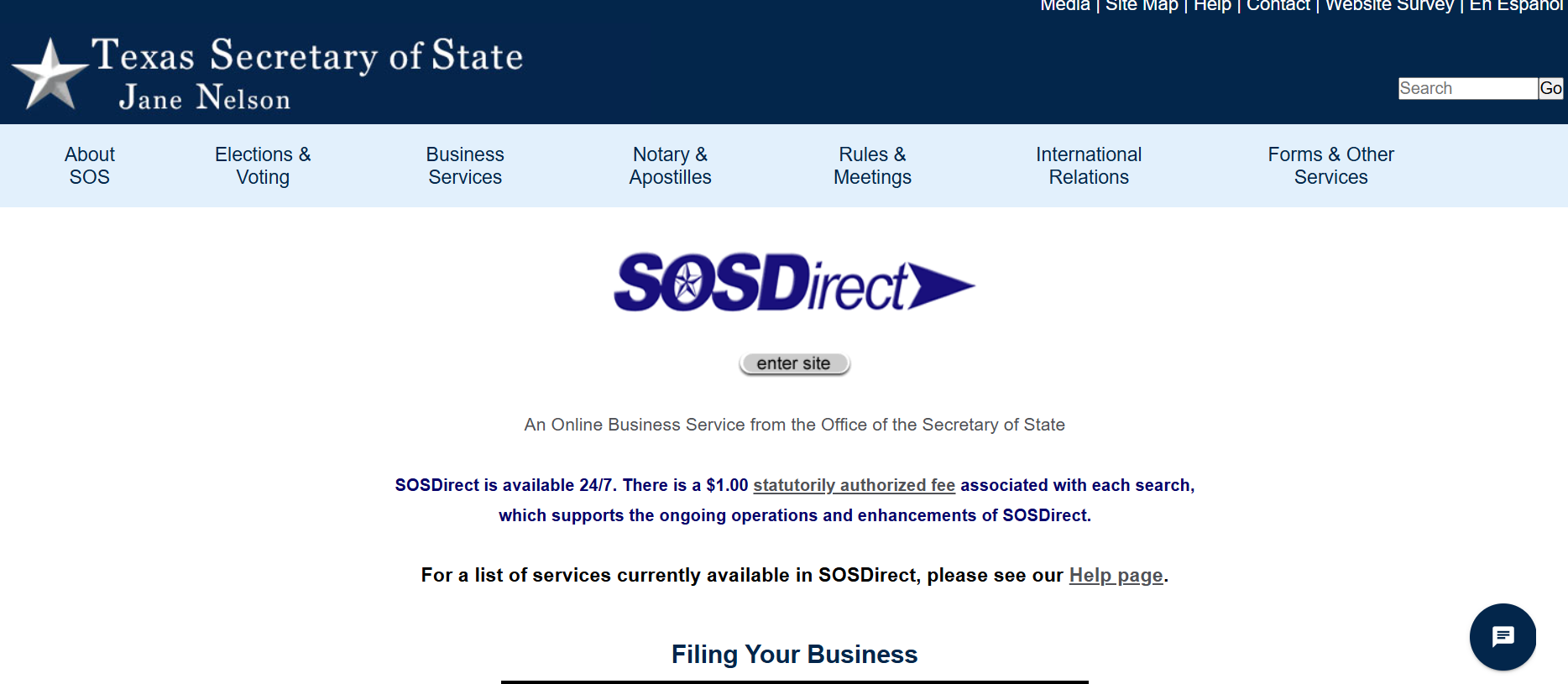
Step 1 Search for the SOSDirect Portal

Visit the Texas SOSDirect page. You can register for a new account or log in as a guest. Make sure to have a credit card on hand as searches and documents incur a small fee.

Texas

Step 2 Choose Your Search Method

Records can be looked up in a number of ways:

  • By Entity Name: Type in the business’s name in whole or in part, this is the most common method to check for name availability.
  • By Filing Number or Tax ID: For those that have the unique number, this method is the quickest way to obtain results.
  • By Registered Agent Name: This is especially useful for attorneys, accountants, or individuals who handle numerous businesses.

Step 3: Review the Results

The system provides a list of entities that correspond with your search criteria. For each business, you would generally find:

  • Official name
  • Filing number
  • Entity type
  • Registered agent name
  • Business status (active, inactive, dissolved, forfeited, etc.)

Step 4: Order Records (Optional)

For users with SOSDirect accounts, the system provides the option to buy official documents considering additional documents are not basic details. Business documents that can be ordered include:

  • Certificate of Formation: Document evidencing the business’s formation.
  • Certificate of Fact: Status (Good Standing Certificate) – Document affirming that the company is not only active, but also compliant with requirements.
  • Certified Copies: Copies of legal filings which hold legal status for legal and financial transactions.

Common Uses of the Texas Business Entity Search

The business entity search serves numerous functions for different users:

For Entrepreneurs Starting a New Business

Prior to creating your LLC or Corporation, it’s essential to check that the name you would want to use as a business is not and has not been in use by any other business.

For Existing Business Owners

Business owners may want to check their business to verify filing history, or to check for pending information updates, or to obtain certificates for banking and compliance.

For Investors and Lenders

Before making an investment, most investors check an organization’s eligibility and standing status to ensure proper registration and to mitigate risks.

For Lawyers and Accountants

Entity records are important to ensure clients are set up and compliant with relevant state regulations, which is why professionals check them frequently.

For Market Research

You can find information on other competitors in the niche or industry you are looking to enter and find out what the key companies are to understand the market better.

What to Do After Performing the Texas Business Entity Search

Your situation dictates the steps you can take after the search, so here are some examples:

If You’re Starting a New Business

  • Reserve your business name with the Secretary of State. This offers protection for the name for up to 120 days.
  • Submit your Certificate of Formation for your structures which can be an LLC, Corporation, or LP.
  • Designate a registered agent residing in Texas.
  • For tax and banking needs, apply for an EIN with the IRS.
  • Establish your processes for compliance on franchise tax and annual submissions.

If You’re Verifying Another Business

  • Issue a Certificate of Fact, Status to confirm they are in good standing.
  • Use their filing history to determine their length of business and compliance maintenance.

If You Already Own a Business

  • Check your entity is active and compliant with any relevant regulations.
  • Acquire the necessary orders concerning documents such as contracts, loans, or licenses.
  • Make necessary changes or renew documents that are outdated.

How Bizstartz Can Assist

At Bizstartz, we aid business owners in dealing with the compliance and legal requirements for business formation in the U.S. For individuals looking to form a business in Texas, we have an all-inclusive approach to assist you.

Here are some of the services we offer:

  • Formation of Texas LLC and Corporations
  • Assistance with Business name availability and reservation
  • Providing Registered Agent services in Texas
  • Assistance with EIN applications for both domestic and foreign founders
  • Compliance for BOI (Beneficial Ownership Information) filing
  • Assist with bookkeeping and tax filing
  • Trademark registration to guard your business name

As an international business owner looking to expand into the US, or a Texas resident, you can rest assured knowing at Bizstartz your company will receive proper formation and compliance for company laws so that it can grow at a healthy pace.

Blog CTA

In Conclusion

Having access to the Texas Business Entity Search can greatly benefit business owners, investors and business associates in Texas. Apart from name availability, it offers important insight into existing companies and the level of competition in the market.

Conducting these searches before registration can not only help save businesses from legal disputes but aid in compliance with state laws, ensuring a smooth start to a new business.

And if you would like to save time and avoid blunders that would lead to unnecessary expenses, you can hire professionals who will help you from the beginning to the end, and that’s where Bizstartz comes to the picture. Whether it’s registering your Texas LLC or handling tax and compliance work, we’re there for you.

California Business Entity Search: A Complete Guide

California boasts one of the largest and intricate economies in the world. Entrepreneurs from every corner of the world readily flock to the Golden State, whether they’re from the production companies in Hollywood, the start ups in Silicon Valley, or even small family businesses.

If you’re looking to start a business in the state, one of the tasks you will need to complete is making sure that your business name is not already taken. You will also need to confirm the legal standing of other companies you plan to collaborate with. For that, the California Business Entity Search is extremely helpful.

In this guide, you will learn everything that you need to know in relation to the California Business Entity Search. The Business Entity Search is a free service, that helps with looking up entity’s name and status in the system, as well as finding the initial formation documents of the business.

The California Business Entity Search is a tool that can save you a ton of legal issues in the future. Makes sure to understand what it entails, even if you are not a first time entrepreneur.

What is the California Business Entity Search?

The California Business Entity Search is a free tool by the SOS or the Secretary of State of California. The SOS office provides various services that helps with looking up entity’s name and status in the system, as well as finding the initial formation documents of the business.

The entities include:

  • Legal entities that are Limited Liability Companies (LLCs)
  • Corporations: both C-Corps and S-Corps, including Professional Corporations.
  • Limited Partnerships (LPs)
  • Limited Liability Partnerships (LLPs)
  • General Partnerships (GPs), if state-registered.
  • Other entities like nonprofit corporations.

The system ensures that California remains open, accountable, and trustworthy while making business information accessible and giving everyone the tools to access California’s business information.

For instance, if you wanted to open a coffee shop named “Golden Bean Café LLC” in Los Angeles, you would be able to use the search tool to check if that business name already exists.

The same goes for contractors, and if you are about to sign a contract, you can check if they are active and in good standing, legally able to do business in California.

Why Is the Business Entity Search Important?

In California, performing a business entity search goes beyond checking if a name is already in use. It has lots of advantages for entrepreneurs, investors, and even consumers.

1. Checking business name availability

In California, every business entity registered in the state has a unique name. This requirement helps avoid unnecessary time spent filing name reservation applications. The entity name search ensures that formation documents are not submitted for already existing business names. It also helps avoid paying unnecessary filing fees.

👉 Example: Imagine you wanted to launch a digital marketing company called “Pacific Growth Marketing LLC.” First, you would check the database to see if the name is taken. If it is, you will have to modify your name, for example, “Pacific Growth Digital Marketing LLC.

2. Confirm Business Legitimacy

The database helps evaluate whether your business partner is legally registered and is in good standing. This helps in escaping untrustworthy or fraudulent businesses.

👉 Example: Before signing a $50,000 supply contract with “Green Earth Logistics,” you can verify if the company is active, suspended or dissolved.

3. Protect Businesses Against Fraud and Scams

Entities sometimes establish non-existent companies to deceive clients or business partners. You can check the official SOS records to confirm if the business is registered and exists, or if it’s just a shell company.

4. Easy Access to Records

The search offers for free critical and sensitive information such as:

  • Entity number
  • Filing date
  • Status (active, suspended, dissolved, merged, canceled)
  • Jurisdiction (California or other state)
  • Registered agent information
  • Business addresses

This kind of openness is good for transparency which helps companies fulfill their responsibilities while making informed decisions.

5. Maintain Regular Compliance Checks

As a business owner, using the search functionality is beneficial to check if your business is in good standing. If your business status is “suspended” or “forfeited,” then you have over missed some filings, tax payments, or other compliance activity.

How to Perform a California Business Entity Search

The California Secretary of State Business Search Tool is easy to navigate. Below is a simple procedure:

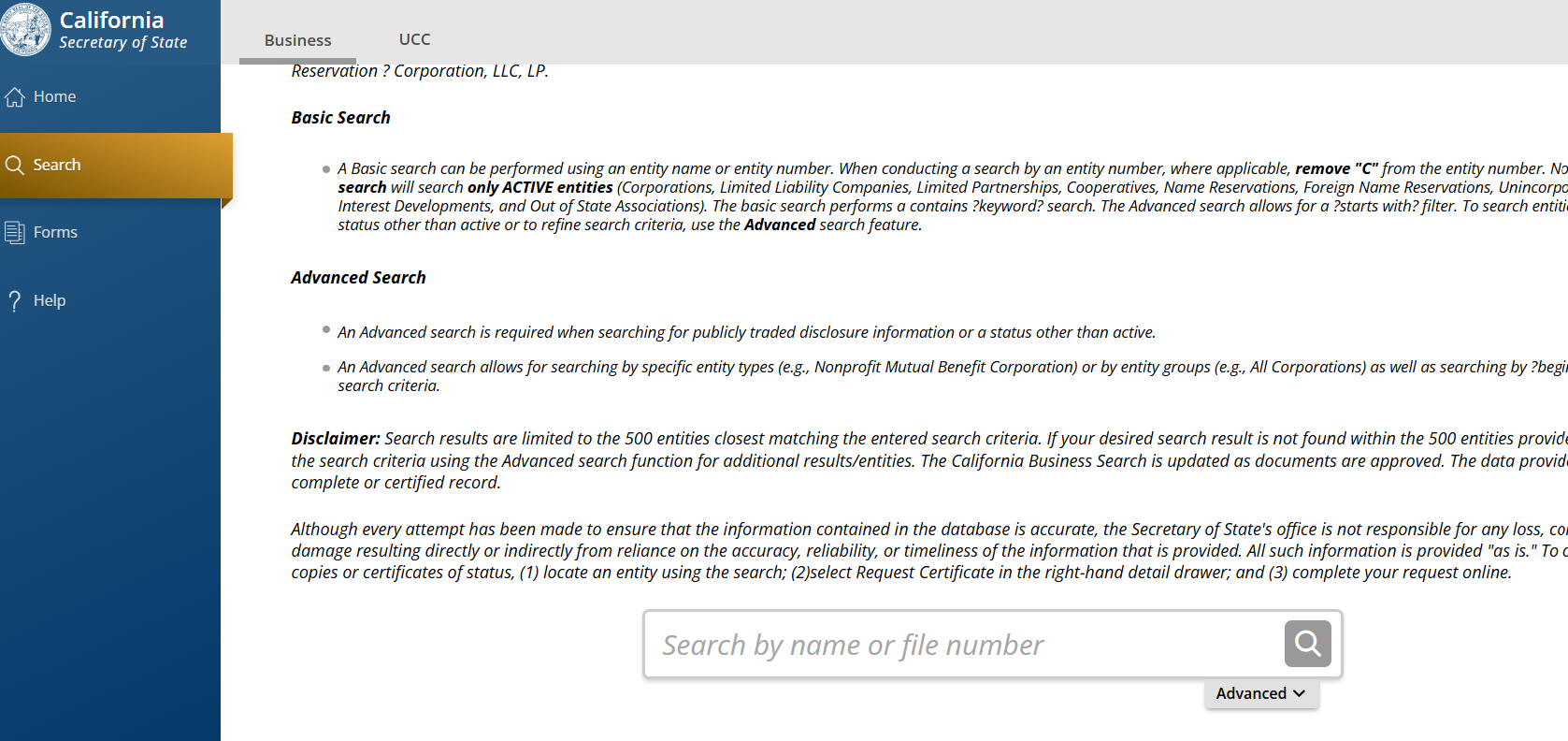
Step 1: The California Secretary of State Business Search Portal

california

Visit the California Secretary of State Business Search Portal. The search is public and free of charge.

Step 2: Select a Search Option

There are various search options available:

  • Entity Name Search: This is the most popular search. You can type the business’s full name or any of its keywords.
  • Entity Number Search: Each business is given a unique identification number by the state. You can use the ID to search.

Step 3: Fill in the Search Parameters

Enter the business name or number. When using the business name search option, you may use the exact legal name or provide part of the name to search for similar business names.

Step 4: Examine the List of Results

You will see a list of entities that correspond to your search. Each result will show:

  • Name of the entity
  • Entity number
  • Registration date
  • Status (active, suspended, dissolved, canceled)
  • Jurisdiction

Step 5: Get More Detailed Information

More detailed records, such as the following, are shown when the entity name is clicked:

  • Business addresses
  • Information on the registered agent
  • Filing history
  • Information on status changes
  • Statements of Information submitted to the state

👉 Pro Tip: If you are still deciding on a business name, search to make sure your preferred option is truly available.

What You Can Learn from a California Business Entity Search

This information is very important for a business that is registered in California. The business status, for example, includes:

  • Business Status: active, suspended (for tax, loss of good standing, or compliance issues), or dissolved.
  • Formation Date: date of establishment.
  • Entity Type: LLC, corporation, nonprofit, LP, or LLP.
  • Jurisdiction: formed in California or registered as a “foreign entity” from another state.
  • Registered Agent Information: the person or entity handling legal documents on behalf of the business.
  • Business Address: The official mailing and business address.
  • Filing History: Access to past filings, including Statements of Information, amendments, and dissolution filings.

Suppose you want to invest in a new company. In that case, an entity record of the business could show how long they have been in business as well as filing mandatory reports and how many reports they have submitted. This would be beneficial for determining the investment amount.

What to Do After Performing the California Business Entity Search

The clarity you obtain after searching business details guides the next steps you take.

1. If You’re Starting Your Own Business

Name Available? if the name you picked is not in use, you are free to submit your Articles of Organization incorporating your LLC or Articles of Incorporation for a corporation. This would be the next step after business formation.

Name Taken? Your brainstorm alternatives would be name modifiers that append ‘Group,’ ‘Services,’ or ‘Solutions’ and are not currently in use. This could help turn a taken name to a unique name.

2. If You’re Verifying Business Partners or Vendors

Active Status: If the business is listed as active, you can proceed with greater confidence.

Dissolved or suspended: A business that is marked in suspended status or in the process of dissolution is not actively authorized to operate out of California which could be a red flag.

3. If You Already Own a Business

Check Your Own Status: If the business shows as suspended, it could be due to missing tax return filings, unpaid fees, or overdue filings of Statements of Information.

Keep Records Updated: Regularly doing business checks with the SOS for the registered agent, addresses, and the business information ensures that the information is up to date.

4. Protecting Your Brand Beyond California

Even if a business is registered with the state of California, competitors from other states could still use the name. This is a good reason to seek federal registration for the trademark.

Blog CTA

How Bizstartz Can Assist You

At Bizstartz, we assist clients, particularly non-U.S. residents, start and grow businesses in the United States. We specialize in:

  • Performing the California Business Entity Search
  • Filing LLC and Corporation formation documents with the California Secretary of State
  • Acting as a Registered Agent for California based LLCs and Corporations
  • Obtaining EINs from the IRS
  • Assisting international founders with obtaining ITINs
  • Filing for BOI compliance with FinCEN
  • Opening U.S. business bank accounts
  • Trademark registration at the federal level
  • Bookkeeping and tax filings with compliance services

Bizstartz can help you whether you are launching a new startup, expanding your existing business, or looking to grow your business in new regions.

Final thoughts

The California Business Entity Search is not simply a name-checking system. It is an important tool for businesses looking for compliance and protective measures in some of the most competitive markets in the world.

Using this tool, you can:

  • Check if your business name is available
  • Validate business opportunities
  • Check state compliance requirements
  • Safeguard your reputation

Bizstartz assists you with every step, ensuring you never feel alone with complex California business formation processes. We serve entrepreneurs around the world with complete solutions, from entity searches, and to the opening of business bank accounts.

Delaware Business Entity Search: A Complete Guide for Entrepreneurs and Investors

Delaware earned global renown as the corporate capital of the United States because more than two-thirds of Fortune 500 companies and over 1.9 million businesses are incorporated in the state, which hosts less than a million residents.

The state’s advanced legal framework, effortless corporate services, and business-friendly policies make it easy to set up a company in the state.

Perhaps the most valuable asset of the state is the Delaware Business Entity Search, a tool offered by the Delaware Division of Corporations, which allows users to search up details of businesses registered in the state.

In this guide, we’ll show you how to navigate the Delaware Business Entity Search and other essential details to help you make the most of it.

Why is Delaware the Go-To State for Business Entities?

Understanding the search tool is crucial, however it is essential understanding it’s advantages starts with knowing why Delaware is the most preferred state for company formation.

1. Advanced Corporate Law

Delaware’s General Corporation Law (DGCL) is regarded as one of the most advanced corporate laws in the U.S. It offers companies immense latitude in the internal governance and operational structure of the corporation. This is beneficial for founders and shareholders.

2. Specialized Business Court

Delaware is home to the Court of Chancery which is a specialized court for corporate and other business disputes. Unlike most other states, these courts are presided over by judges which is a faster, more predictable, and business-friendly process compared to jury trials.

3. Privacy and Anonymity

Delaware stands out as one of the most privacy-friendly states in the U.S. for businesses. For LLCs, there is no requirement to publicly disclose the names of the members or managers, which makes it ideal for entrepreneurs who want to maintain privacy.

4. Tax Benefits

Delaware offers numerous tax advantages:

  • No corporate income tax for businesses operating outside the state.
  • No sales tax.
  • Franchise taxes are relatively low for smaller businesses.
  • Non-residents are not subject to Delaware’s personal income tax if the business is not operated in the state.

5. International Approval

They’re also more likely to attract funding because venture capitalists, banks, and investors alike consider Delaware corporations to hold more value because of the venture capital structures in place. More often than not, they will ask startups to incorporate in Delaware as a prerequisite.

This is the overwhelming reason for people to invest in a Delaware registered US Entity, especially for International Founders.

What is the Delaware Business Entity Search?

This is an official online portal created by the Delaware Division of Corporations for people to search and confirm the information of any business created or registered in Delaware.

The portal is searchable by the following fields:

  • Business Name: The legal name under which the company is registered.
  • Entity Type: The nature of the business if it is an LLC, Corporation, LP, GP or other.
  • File Number: A number that has been allocated to the relevant business by the state to uniquely identify it.
  • Formation Date: The date when the business was created.
  • Business Status: The state of the entity, whether Active, Inactive, Cancelled or Dissolved.
  • Registered Agent Information: The legal and state notice contact for the company.

The search tool can be used at no charge and is important to Delaware’s transparency and ease of doing business systems.

How to Use the Delaware Business Entity Search

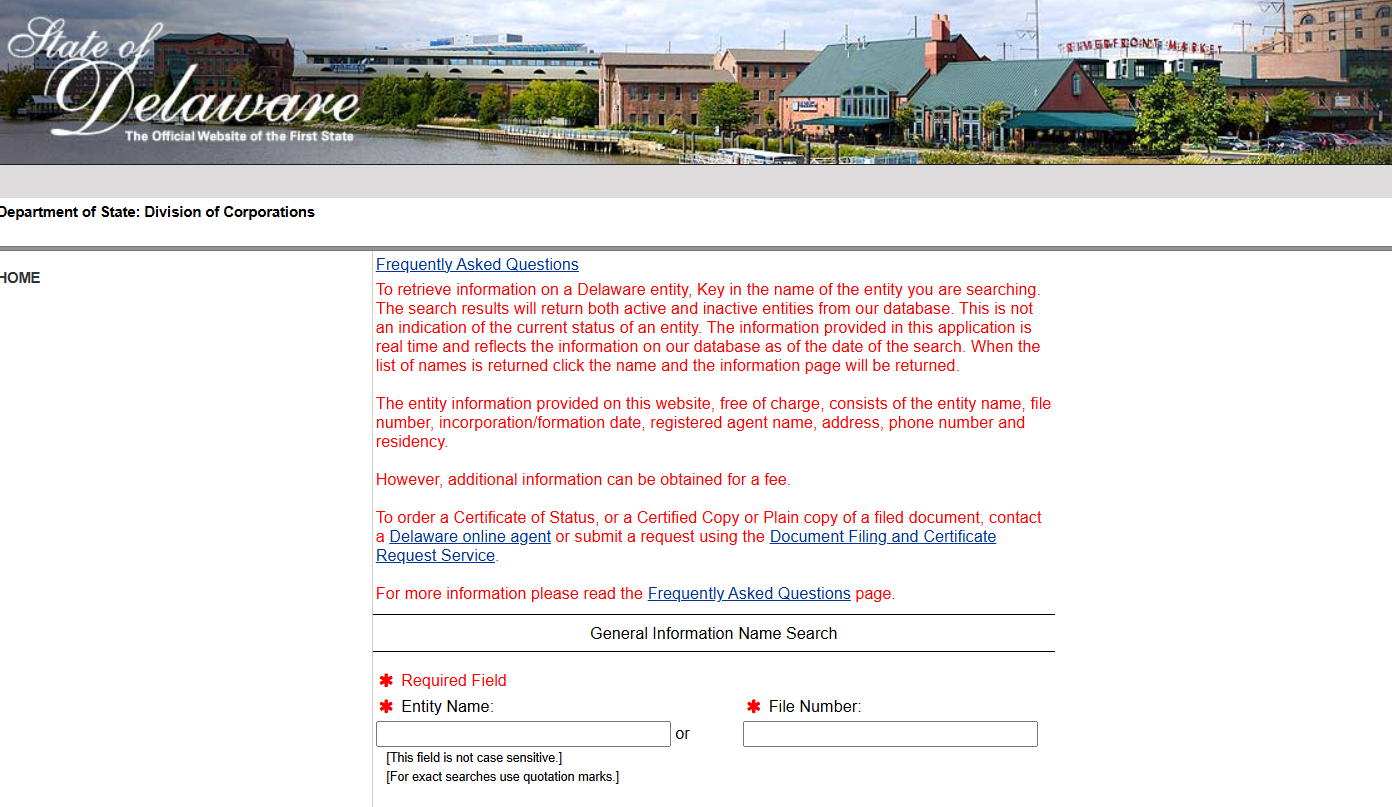
Step 1: Go to the official portal

Visit the portal of the Delaware Division of Corporations Business Entity Search at:

👉 Delaware Entity Search Portal

delaware name search

Step 2: Select Search Method

You can find information using any of the following:

  • By Entity Name: Type the full or half company name.
  • By File Number: Type the specific Delaware file number and get an exact match.

Step 3: Type Search Information

Type the business name or keyword you wish to search. You may try name variations if you are searching for name availability.

Step 4: Check Search Results

The search shows the list of businesses matching your query. You will see listed the entity name, type, file number and current status.

Step 5: Get More Information

By clicking on the entity you can find more information such as the incorporation date and the registered agent. The division of corporations does charge a fee for certain documents like a Good Standing Certificate and certified copies of filings.

Why Use the Delaware Business Entity Search

This tool has many different uses based on what you need.

1. Checking Business Name Availability

If you’re looking to form an LLC or Corporation, one of the first steps is to ensure the name you desire doesn’t already belong to someone else. Delaware’s search tool helps you with that.

2. Verifying the Legitimacy of A Business

If a company is planning to do business with you, you can check to see if the business is registered in Delaware and if they are still an active entity in good standing.

3. Market and Competitor analysis and trends

This is useful for entrepreneurs willing to analyze the market as they can check the business registration history, company formation dates, and business structure.

4. Getting Legal Documents

Businesses can request legal documents such as certified copies of business filings, Certificate of Good Standing, and other business documents that are needed for compliance, banking, or for investors.

✅ 5. Maintaining Compliance

If you currently have a Delaware entity registered, you can check your company’s public status to check if it has lapsed due to unpaid franchise taxes or missed filings.

Next Steps After You Conduct a Delaware Business Entity Search

Conducting a Delaware Business Entity Search is just the beginning. What comes next is entirely contingent on what you hope to accomplish, starting a new business, verifying an existing one, or performing some due diligence. In this article, we share what comes after your search.

For those looking to Start a New Business

  • Confirm Name Availability: When a business name is available, you may register an LLC or Corporation.
  • Reserve the Name (Optional): If you are not ready to file for the corporation immediately, you can reserve a business name for 120 days by submitting a Name Reservation Application for a small fee.
  • Form Your Entity: If you are confident on the chosen name, you can now file for a Certificate of Formation (for LLCs) or Certificate of Incorporation (for Corporations) to Delaware Division of Corporations.

For those looking to Verify Another Company

  • Check the Status: You should be looking up for “Active,” “Cancelled,” “Dissolved,” or “Inactive.” If a business has “Active” status, it is in buena fe (good standing) with the state.
    • Order a Good Standing Certificate: If you need evidence of a business’s legitimacy and compliance, you can order a Certificate of Good Standing from the Delaware Division of Corporations.
  • Confirm The Registered Agent: Firms need to have a listed registered agent for compliance, so confirm that the company has one.

If You’re Doing Market or Competitor Research

  • Note Formation Dates: This helps you understand how long competitors have been operating for.
  • Track Entity Types: Knowing if competitors have LLCs, Corporations, or LPs can give you insights into their structural and tax strategies.
  • Identify Active vs. Inactive Companies: Analyze trends in your industry by identifying which competitors remain active.

If You Already Own a Delaware Entity

  • Verify Your Status: Ensure your company remains “Active.” If not, you might need to pay franchise taxes or annual filings.
  • Update Compliance Filings: If you have pending or overdue reports, you may need to pay your Annual Franchise Tax Report or overdue fees.
  • Consider Ordering Certified Copies: For banking, international trade, or investor relations, you may require certified documents from the Division of Corporations.

Plan the Next Steps With Professional Help

If you are still unsure of what the next steps are after completing your search, that’s where Bizstartz comes in. We take care of any additional technical steps such as filing your Delaware LLC, getting your EIN, setting up your registered agent service, and even opening a U.S. business bank account so you can focus on business growth.

Limitations of the Delaware Business Entity Search

Though it is a strong tool, there are a few noteworthy shortcomings:

Absence of Ownership Information – Delaware does not allow the disclosure of the privacy of LLC members and corporate shareholders, meaning this data will not be available in the results.

Restrained Contact Details – Only registered agent details are present, and thus the actual business owner’s details are private.

Charges for Official Documents – Search results can be accessed free of charge, however, good standing certificates and historical filings require payment.

Many business owners prefer these shortcomings because they emphasize privacy which is appealing for Delaware.

Blog CTA

How Bizstartz Aids with the Formation of Delaware Entities

At Bizstartz, we assist international and local entrepreneurs establish and administer businesses within the US, mostly in Delaware. This is how they assist you:

Entity Formation (LLC or Corporation): With the Delaware Division of Corporations, we take care of the entire filing procedure.

Name Availability Check: Prior to filing, we confirm your preferred business name with the Delaware Business Entity Search.

Registered Agent Services: As a business operating in Delaware, it is legally mandatory to have a registered agent with physical presence in the state. As such, Bizstartz offers this as part of our services.

EIN Registration: We assist you with obtaining an Employer Identification Number (EIN) from the IRS, required for tax and banking purposes.

BOI Filing & Compliance: We ensure the company adheres to the Beneficial Ownership Information (BOI) and IRS Compliance regulations.

Assistance with Opening a US Bank Account: We assist non US residents with the opening of a US business bank account.

Payment Processor Setup: We assist with business verification for Stripe, PayPal, Amazon Seller Accounts and other financials.

As much as possible, we strive to ensure the formation and maintenance of a Delaware entity is as simple, dependable and trouble free as possible.

Final Thoughts

The Delaware Business Entity search is a must use for anyone looking to create, research, or verify businesses in Delaware. This is particularly a go to for entrepreneurs looking to verify name availability, investors doing due diligence, or for business owners ensuring regulatory compliance. This is a free service that offers great value.

Delaware is still the go to state for setting up U.S. companies because of the state’s strong privacy policies, low taxes, and well-regarded corporate law.

If you want to begin your Delaware business setup, reach out to Bizstartz and we will assist you from formation to compliance, banking, and growth. With the right business partner, overcoming barriers to doing business in the U.S. is effortless, regardless of where in the world you are.

Documents Required to Export Products from Nepal to the USA

Exporting goods from Nepal to the United States is more than just loading a container, it involves following a global trade system that emphasizes compliance, transparency, and precision at every step.

The U.S. continues to be among Nepal’s leading export markets, especially for fine products like handmade carpets, luxurious pashmina scarves, intricate handicrafts, specialty teas and coffees, aromatic spices, striking jewelry, and stylish garments.

Before a single product appears on U.S. shelves or online stores, it must clear a pathway marked by strict paperwork and approvals. These documents are vital for U.S. customs, for compliance with foreign-exchange regulations, and for assuring U.S. buyers that the shipment is authentic and up to standard.

This guide will walk you through, document by document, all that’s necessary to export products from Nepal to the USA, step by step.

1. Obtain Nepal Export License

export license

First and foremost, every exporter must secure an Export License, the foundational permit that grants legal permission to ship goods outside national borders. Without this document, customs in Nepal will not authorize your shipment, halting any further processing.

  • Issued by: Department of Customs / Department of Commerce, Supplies, and Consumer Protection
  • Purpose: This license proves that the exporter is recognized by the government and that exit of goods is done legally.
  • Example: Planning to ship Nepali tea or pashmina abroad? Secure this license before letting the shipment leave the dock.

👉 The export license doesn’t just fulfill a legal requirement. It opens doors to tax rebates and export incentives, letting you save real money.

2. Firm/Business Registration Certificate

Every exporter needs a legally registered business. The Firm Registration Certificate is your official proof that the company exists.

  • Issued by: Company Registrar’s Office or by local municipalities, in case you are a sole proprietor.
  • Purpose: This document is necessary to sign export contracts, negotiate rates with freight forwarders, and clear goods with customs.
  • Example: Customs officials will check this certificate before allowing your shipment of handmade jewelry to leave the country.

👉 Without this proof, you can’t enter a contract or negotiate a deal with a buyer in the U.S. or anywhere else.

3. VAT/PAN Registration

Register your business for both VAT (Value Added Tax) and PAN (Permanent Account Number). These registrations are key for staying compliant with Nepali tax laws and for accurate financial reporting.

Purpose:

  • PAN Compliance: Obtaining a Permanent Account Number (PAN) is vital for tax identification, ensuring your business is ranked correctly for income tax in Nepal.
  • VAT Registration: Exporters who register for Value-Added Tax (VAT) can reclaim tax paid on goods leaving Nepal.

Advantage: VAT-registered exporters benefit from discounts and outright returns of tax paid on inputs.

👉 Example: If you send handicrafts worth $20,000, your VAT status lets you apply for a refund, thus keeping more cash in your business and side-stepping double tax.

4. Commercial Invoice

The Commercial Invoice is a must-have for international shipping. Acting as both a sales bill and a binding agreement, it is required by Nepali and U.S. customs for clearance.

Key details to include:

  • Names and addresses of both exporter and importer
  • Harmanized System (HS) code of the goods
  • Unit price plus total value
  • Payment terms (FOB, CIF, etc.)
  • Country of origin of the shipment.

For instance, shipping 500 pashmina shawls means your invoice must list 500 as quantity, set a price per shawl, the HSBC code (6505 for shawls), and the business terms you settled on.

👉 U.S. customs uses this file to calculate import duties and to check if your shipment meets legal import rules.

5. Packing List

While the Commercial Invoice covers the money side, the Packing List lays out the shipment physically.

Shipping documentation can make or break your export success. Here are some key documents that you must have to keep your shipment moving smoothly.

The packing list gives details about your shipment, including:

  • Number of cartons, boxes, or pallets
  • Weight and volume of each package
  • Marks and labels on packages
  • Handling instructions

Example: If you are shipping carpets, list how many rolls you have, their exact dimensions, and both net and gross weight.

👉 Without this document, customs can hold up clearance while they check your shipment physically, costing you time and money.

6. Certificate of Origin (COO)

The Certificate of Origin proves that your goods were manufactured in Nepal. U.S. buyers often request this document to save on tariffs and to confirm product authenticity.

Example: Many U.S. buyers of handmade Nepali carpets ask for a COO to ensure that the products are genuinely Nepal-origin.

👉 The COO is critical: some products from Nepal qualify for duty-free access under U.S. trade preference programs, and without the COO, you lose that benefit.

7. Bill of Lading or Airway Bill

The Bill of Lading (B/L) for sea shipments or the Airway Bill (AWB) for air shipments is the transport contract between you and the carrier. Here’s what you need to remember:

Bill of Lading (Sea): Use this when you’re loading big ocean containers, like those full of carpets or garments.

Airway Bill (Air): Handy when you’re flying smaller, high-value shipments like jewelry or handicrafts.

Purpose:

  • Proves who owns the cargo while it’s on the move.
  • Banks need it so they’ll pay you using a Letter of Credit.
  • Customs in both the origin and destination countries ask for it.

👉 For example, if you’re sending herbal tea by air, you’ll fill out the AWB with shipment weight, consignee info, tracking number, and other key details.

8. Export Declaration Form (ED Form)

The ED Form is a must for the Nepal Rastra Bank, so they can track foreign currency coming in.

  • Issued through: Any commercial bank in Nepal.
  • Purpose: Guarantees that overseas buyers send payment, and that it’s recorded in Nepal’s currency system.
  • Example: If a buyer in the U.S. sends you $30,000 for a handicrafts shipment, the bank fills out the ED form to confirm that this amount is officially counted as foreign currency coming into Nepal.

👉 No ED form means the payment cannot be legally accepted for your export.

9. Insurance Certificate

Insurance Certificate

International cargo is always exposed to risks like theft, fire, or rough handling. An Insurance Certificate limits your losses by covering the shipment while it’s in transit.

  • Purpose: This step keeps both the buyer and seller safe when unexpected events happen during a shipment.
  • Example: Suppose your tea shipment gets damaged while crossing the ocean. An insurance certificate lets you quickly claim the compensation you deserve.

👉 Buyers in the U.S. typically prefer shipments that are insured, especially when the tea’s value is significant.

10. FDA Registration & Compliance (For Certain Products)

When you are shipping food, drinks, herbal items, cosmetics, or dietary supplements to the U.S., you have to follow the rules set by the Food and Drug Administration (FDA).

Requirements

  • Register your facility with the FDA.
  • Send a Prior Notice before food products are shipped.
  • Label the products with the nutrition facts, a list of ingredients, and the country of origin.

Example: For instance, when you are exporting Himalayan herbal tea, you must file a Prior Notice to the FDA before the shipment gets to the U.S.

👉 If you do not follow the rules, the U.S. might reject, destroy, or return your shipment.

11. Extra Certificates (Varies by Product)

Depending on what you’re shipping, you might need one or more extra certificates:

  • Phytosanitary Certificate: Necessary for plant items such as tea, coffee, ginger, cardamom, and herbs.
  • CITES Certificate: Required if your item comes from an endangered species, like leather or bone crafts.
  • Textile Certificates/Quota Permits: Required for clothing and fabric.
  • Handicraft Certification: Needed for cultural or traditional handicrafts.

👉 Example: When you export organic coffee, you need a phytosanitary certificate to show that your shipment is free of pests and safe for U.S. entry.

Step-by-Step Export from Nepal to the USA

1. Register your business with the Company Registrar and get your PAN or VAT number.

2. Apply for an export license and any permits specific to your product.

3. Prepare the main documents: Commercial Invoice, Packing List, Certificate of Origin (COO), and ED Form.

4. Book your shipment by air or sea and get either a Bill of Lading (B/L) or an Air Way Bill (AWB).

5. Purchase insurance for the shipment.

6. Submit documents for customs clearance in Nepal.

7. Make sure to meet U.S. rules and regulations, like FDA or USDA, based on what you are exporting.

8. Deliver the goods to the buyer with tracking, record the payment, and keep copies of all documents.

Why Having the Right Papers Matters

Improper or missing documentation can:

  • Cause customs delays in both Nepal and the U.S.
  • Lead to penalties or storage fees at U.S. ports
  • Result in loss of buyer trust if shipment is held up
  • Even lead to seizure of goods if FDA rules are not followed

👉 Well-prepared documentation builds credibility, speeds up clearance, and ensures long-term success in the export business.

How Bizstartz Can Supercharge Nepali Exporters

Bizstartz is your go-to partner for smooth exporting from Nepal. We know that many Nepalese firms struggle not only with U.S. sales but also with winning the trust of American customers. Our mission is to help you close that gap as painlessly as possible.

Here’s what we do for you:

  • Form a U.S. LLC. This adds a layer of trust, making U.S. buyers more comfortable, and it helps overcome tricky payment hurdles.
  • Handle FDA registration for food items, supplements, and cosmetics, so your products get approved on the first try.
  • Secure EIN and ITIN and ensure you stay compliant with U.S. tax rules, keeping the IRS happy.
  • Walk you through export documents, including COO and ED forms, to clear customs without drama.
  • Open U.S. bank accounts and set up payment platforms like PayPal and Stripe, so your money moves quickly and cheaply.

By working with Bizstartz, Nepali businesses can confidently step into the U.S. market and grow their international sales.

Conclusion

Shipping Nepalese goods to the U.S. is a fantastic opportunity. Yet it comes with a mountain of paperwork, from export licenses to FDA approvals. Each document is not just a box to tick; it’s a chance to impress American customers.

When filed correctly, paperwork ensures smooth transit and bolsters your international standing. With Bizstartz on your side, you can tackle this paperwork with ease and open the door to the enormous U.S. market. Let’s get your products flying across the ocean!

How to Start a Store in Shopify from Nepal

E-commerce has transformed how companies operate worldwide, and Nepal is embracing this change at a rapid pace. More Nepali business owners are turning to online shops to reach customers at home and abroad.

Whether your passion is making handicrafts, designing clothing, crafting jewelry, or selling digital products, Shopify is a proven platform to turn your dream into reality.

For those living in Nepal and ready to create a Shopify store, this guide will break down each step, from picking products to setting up safe payments, smart shipping, and growing your store onto global marketplaces.

Why Choose Shopify for Your Online Store?

Yes, there are other platforms like WooCommerce, Magento, and Wix, but Shopify is the favorite for first-time online sellers. Here’s why it shines for Nepali entrepreneurs:

User-Friendly: You do not have to write code or manage server issues. The store builder is a simple drag-and-drop tool, so you can launch a polished site within a few hours.

Mobile-Ready: More than 70% of online orders happen through smartphones. All of Shopify’s themes are automatically optimized for mobile devices, so your site looks great on every screen.

Sell Anywhere: Shopify is designed for global reach, allowing you to list products for customers from Tokyo to Toronto, not just Kathmandu to Pokhara.

Start a Shopify Store in Nepal: A Quick How-To

Shopify Store from Nepal

All-in-One Solution: Shopify bundles stuff you need, inventory, email, analytics so everything runs like a well-oiled shop without needing extra add-ons.

App Integration: Easily plug in apps for dropshipping, print-on-demand, accounting, or marketing. They’ll power up your store without slowing you down.

Expandable When You Need It: Sell 10 hand-carved khukuris today or scale to 10,000 later. Shopify flexes to any number.

👉 For Nepali Founders: Test products or ideas with less cash up front. Perfect if you want to experiment without a mountain of expense.

Step-by-Step Guide to Launch Shopify from Nepal

1. Pick Your Product

Picking a single standout product gets the cash flowing. A common mistake is cramming “everything Nepali” into one shop. Drill down to a theme that sings.

Ideas that fly:

  • Nepali Handiworks: Pashmina, thangka paintings, hand-carved khukuris.
  • Fashion: Ethnic or south-Asian /modern streetwear.
  • Accessories: Handcrafted silver, wooden beads, or unique mask souvenirs.
  • Home Goods: Local teak chairs or spun cotton kitchen towels.
  • Dropshipping Surprises: Supplying gadgets or weight loss capsules from foreign suppliers.
  • Digital Content: Courses teaching traditional dance or e-books on trekking trails.

Pro Tips for Product Ideas:

Search for demand on Amazon, Etsy, or even the Jungle of our own home on Daraz Nepal. You’ll see what’s selling, what’s getting clicks, and what photos or descriptions made the sale.

Launching Your Ecommerce Store with Shopify

1. Pick Feasible Products First

Choose items that let you earn a good profit after all costs. Pick light products if you want to ship internationally later. Lighter goods shrink delivery charges. Start with a few items, then add more once you understand what shoppers love.

2. Create Your Shopify Account

Setting up your Shopify account is simple and straightforward:

  1. Go to Shopify.com.
  2. Sign up with your email address.
  3. Enter your store name (this will also be your subdomain, e.g., storename.myshopify.com).

Fill in your business details.

👉 Shopify gives you a free 3-day trial to kick the tires. After that, the Basic plan costs $29 a month. That’s a small fee for the tools you receive. You can always link a custom domain like yourstore.com later to make it look more legit.

3. Set Up Your Store

Now it’s time to build your shop’s look and feel. Shopify lets you tweak everything with easy tools.

  • Pick a Theme: Start with the free “Dawn” theme or get a premium look from the Shopify Theme Store or ThemeForest.
  • Customize the Front Page: Upload your logo, change colors, and set up a homepage that echoes your brand’s vibe.
  • Add Your Products: Use high-resolution photos, and write descriptions that explain why the product makes life better (not just what it is).
  • Organize Collections: Sort your store by creating categories like Men’s Fashion, Women’s Accessories, and Handmade Goods.
  • Configure Settings: Set tax rules, pick your currency, and adjust checkout options.

👉 Pro Tip: A simple design and clear menus will convert more visitors than flashy, crowded layouts.

4. Configure Payments

Payment solutions can be tricky for Shopify sellers in Nepal. Since Shopify Payments isn’t an option, you need to use third-party gateways.

Options for Nepali Entrepreneurs:

  • PayPal: A verified PayPal Business account lets you accept global payments. Due to restrictions in Nepal, you may need to open a U.S. LLC to fully use PayPal and Stripe.
  • 2Checkout (now Verifone): Offers global coverage, including Nepal, and accepts credit and debit cards from international buyers.
  • Payoneer: Good for international receipts. It also integrates smoothly with dropshipping suppliers.
  • Cash on Delivery (COD): Nepali shoppers prefer COD. Work with a local courier that offers this option.

👉 Global Scale: Want to ship to the U.S. or Europe? Set up a U.S. LLC to gain access to Stripe, PayPal, and U.S. banking. Bizstartz can handle the paperwork for you.

5. Set Up Shipping and Delivery

Shipping is key to keeping your customers happy.

For sales inside Nepal:

  • Pick local partners like Khalti Delivery, Pathao Courier, Daraz Express, or any neighborhood courier you trust.
  • Add Cash on Delivery to your checkout, lots of local shoppers prefer to pay when the package arrives.

For sales outside Nepal:

  • Contact DHL, FedEx, Aramex, or UPS to handle reliable international shipments.
  • Use Shopify’s built-in shipping calculator so your checkout page shows exact delivery costs.
  • Think about using fulfillment centers or dropshipping to skip dealing with storage.

👉 Pro Tip: Clearly show shipping costs and delivery dates on the product page. It keeps customers calm and builds trust.

6. Launch Your Store

shopify

Before you open for business, run these final checks:

  • Complete a test order from start to finish to catch any checkout glitches.
  • Review your shipping and payment settings with a dummy order.
  • Look at your site on both your phone and a computer to fix any design oddities.
  • Go to “Preferences” and switch off the password to let the public in.

👉 Now shout about your grand opening on social networks, emails, and WhatsApp. It’s the quickest way to get your first order in!

7. Market Your Shopify Store

Even the best Shopify store needs a marketing plan. Here’s how to get people to visit and buy:

  • Social Media Marketing: Post fun content on TikTok, Instagram, and Facebook. Short videos showing products in everyday use get the most views.
  • Influencer Marketing: Team up with micro-influencers in Nepal or abroad who fit your brand. Their honest reviews can reach the right audience.
  • Email Marketing: Use popups to collect visitor emails. Offer a small discount for sign-ups and send monthly newsletters with tips and special deals.
  • SEO Optimization: Add relevant keywords to product titles, descriptions, and blog posts. Think phrases like “Shopify store Nepal” and “buy handicrafts online Nepal.”
  • Paid Ads: Begin with a small budget. Facebook Ads and Google Ads let you target the exact audience you need.
  • Content Marketing: Write blog posts like “Top 10 Nepali Handicrafts for Home Décor” to bring in free, steady traffic.

👉 Remember: Marketing isn’t a one-time job. Keep putting in the effort to see growing sales over the long term.

Challenges of Running a Shopify Store from Nepal

A successful store can be built in Nepal, but there are hurdles:

  • Payment Restrictions: As of now, direct access to Stripe and Shopify Payments isn’t available.
  • High Shipping Costs: Sending bulky items overseas can be costly, cutting into profits.
  • Limited Market Knowledge: Many Nepali entrepreneurs are just starting to learn digital marketing.
  • Internet and shipping problems are getting better, but they’re still a headache for store owners.

To beat these hassles, set up a U.S. LLC for trust and taxes, use global payment services for smooth checkouts, and target light, fast-selling items that don’t cost a lot to ship.

Why U.S. LLCs Are a Smart Move for Your Shopify Store

Many Nepali entrepreneurs who sell internationally create a U.S. LLC for these key reasons:

  • The LLC gets you straight into Stripe and PayPal, two payment gateways that every global seller needs.
  • You’ll be able to open a U.S. business bank account, making handling foreign currencies and transfers smoother.
  • Buyers trust US-registered companies more, giving you a competitive edge.
  • Reporting and compliance become simpler when everything is legally set in the U.S.

👉 At Bizstartz, we specialize in helping Nepali sellers incorporate these LLCs, get EINs and ITINs, and open bank accounts and payment gateways. That way, you can run your Shopify store like a global pro from day one.

Conclusion

Launching a Shopify store from Nepal is not a dream; it’s a fast-growing opportunity to sell to both neighbors and the rest of the world. Shopify’s user-friendly dashboard means you don’t need coding or design skills to create a stunning storefront.

Success hinges on picking the right products, locking in reliable payment processors, planning your shipping strategy, and marketing your brand consistently. When you set up a U.S. LLC, you open the door to global payment solutions while building name credibility.

Online shopping is booming in Nepal, and with the right plan, you can create a money-making store that serves customers everywhere.

Frequently Asked Questions (FAQs)

1. Can I start a Shopify store from Nepal?

Yes, Shopify is fully accessible from Nepal. The biggest hurdle is getting paid, but you can solve that using Payoneer, 2Checkout, or setting up a U.S. LLC to access Stripe and PayPal.

2. Do I need a U.S. company to run a Shopify store?

Not at all, but setting up a U.S. LLC makes it a lot simpler to serve global customers and accept payments without issues.

3. How do I get paid in Nepal from Shopify?

You can receive payments through Payoneer or 2Checkout, or you can offer Cash on Delivery (COD) for customers within Nepal. For payments from abroad, a U.S. LLC with Stripe or PayPal is preferred.

4. What are the costs to run a Shopify store?

The Shopify Basic plan starts at $29/month. You’ll also need to buy a domain (about $10–$15/year), pay for any premium themes you choose, and set aside a budget for marketing.

5. Can I sell globally from Nepal using Shopify?

Yes, you can sell worldwide. You’ll need to partner with international shipping couriers and have a reliable global payment option. That’s why a lot of Nepali entrepreneurs register a U.S. LLC.