Annual Tax Filing for Florida LLC Owners

The Most Detailed Guide for the Founders, US and Overseas, on Opening and Managing LLCs in Florida
Florida is one of the top US States for Entrepreneurs, Investors, Creators, eCommerce sellers and Founders from other countries. Since Florida has no state personal income tax, a low regulatory burden, and a booming ecosystem for business, the state of Florida receives thousands of LLC formations annually.
But LLC formation is just the beginning.
In order for your Florida LLC to remain active, compliant, and in good standing, there are a number of other LLC requirements you must comply with on an annual basis, at the state level (Florida) and federal level (IRS). If you fall short on meeting the requirements, you may face:
  • Hefty fees
  • Penalties from the IRS
  • Loss of your protective business shell
  • Closure of your LLC
  • Difficulties in opening a business bank account or getting a payment processor
This guide covers in detail for every Florida LLC owner (foreign, US and other) the tax and other compliance requirements in the state where the LLC is formed. Because the owner is a foreign national, there are some unique requirements and a difference in the compliance rules we will focus on the Foreign owner of the LLC formation.

1. Understanding How Florida Taxes LLCs: A Complete Overview

Before diving into the annual filing requirements, it’s important to understand how LLCs are taxed in Florida, because there is often confusion among new entrepreneurs.

No Personal State Income Tax:

When it comes to income tax, Florida state tax for individuals is non-existent. This is a great perk for owners of LLCs as the income that is passed through the LLC is also non state income tax.

Who gets to take advantage of this?

  • Single-member LLC owners
  • Multi-member LLC owners
  • Non-U.S. Residents who have Florida LLCs
  • S-Corp owners (only federally)
This standpoint fully explains why Florida is a perfect place to be for a digital business. This stands true for eCommerce sellers, consultants, content creators, and entrepreneurs from all over the world.

2. Does Florida LLC Pay State Corporate Income Tax?

Only certain LLCs must pay Florida Corporate Income Tax, specifically:

A. LLCs Taxed As C Corporations

If your LLC elects to be taxed as a C Corporation, it is treated as a corporation for tax purposes.
Tax Rate: Currently at a flat 5.5% corporate income tax
Filing Required: Florida Form F-1120

B. LLCs with federal corporate taxation

If your LLC does file IRS Form 1120, you also must file Florida Form F-1120, unless you fall under the exempt bill.

Example Scenario

A foreign founder with a software company that has a C-Corp has to consider the following tax obligations for their Florida LLC:
  • Federal tax obligations on corporate income: 21%
  • Florida corporate tax obligations: 5.5%
  • If international profit distribution occurs, a dividend withholding tax applies to foreign dividends.
Most entrepreneurs located outside of the United States do not choose the C-Corp tax option because it is unnecessary unless there is a need for a specific startup structure or for the investors involved.

3. Mandatory Florida Annual Report: A Detailed Breakdown

Every Florida LLC MUST file an annual report each year regardless of:
  • Whether the LLC operated or not
  • Whether the LLC owner is a U.S. or a non-U.S. resident
  • Whether the LLC generated revenue

Purpose of Filling an Annual Report

It is to update changes made to the LLC with the Florida Secretary of State:
  • Principal office address
  • Mailing address
  • Members/managers
  • Registered agent
  • EIN (optional but recommended)
  • Business activity code (NAICS)
Florida utilizes the annual report for the purpose of confirming the LLC is active and maintains a position of “good standing” with the company.

Annual Report Filing Fee

  • $138.75

Deadline

  • Every year by May 1
What Happens; Penalty For Not Filing Reports

Penalty for Missing the Deadline

  • $400 late fee — automatically added
  • No exceptions or waivers
  • If not filed, the LLC is dissolved in September

If Your LLC Is Dissolved

If you wish to reinstate the LLC, you will need to pay:
  • Reinstatement Fee: ~$100
  • Past due annual report fees
  • Late Penalty Fees
Bizstartz assists clients with the filing of reinstatement and the corrections of non-compliance issues.

4. Federal IRS Filing Requirements for Florida LLCs

Federal filing requirements are based on several criteria, such as:
  • The number of owners
  • The members’ nationality: are they U.S. citizens or foreign nationals?
  • Tax election status of the LLC
  • Existence of U.S.-sourced income
This will be explained in detail below.

5. Florida LLC Federal Tax Filing: U.S. Owner vs. Non-U.S. Owner

Case A: Florida LLC Owned by U.S. Residents

1. Single-Member LLC (U.S. Owner)

Default IRS classification: Disregarded Entity

Required Filing:

Form Description
Form 1040 + Schedule C Reports business income and deductions
Schedule SE Self-employment tax (if applicable)

Common Situations:

  • Freelancers
  • Consultants
  • Digital product sellers
  • Amazon/Etsy sellers
  • Online service providers

Why this is simple:

The LLC does not file a separate return. The owner files everything in their personal tax return.

2. Multi-Member LLC (U.S. Owners)

Default classification: Partnership

Required Federal Filings:

Form Description
Form 1065 Partnership tax return
K-1 for each member Shows each member’s share of income

This filing is ALWAYS required even if your LLC earned $0.

3. LLC Electing S-Corporation Taxation

Many U.S. owners choose S-Corp status for reducing self-employment taxes.

Required Filings:

  • Form 1120-S
  • K-1 for each shareholder
  • Quarterly payroll filings if taking salary

4. LLC Electing C-Corporation Taxation

Must file:

  • Form 1120
  • Must also file Florida Form F-1120 (corporate tax)

6. Florida LLC Federal Tax Filing for NON-U.S. OWNERS (Detailed Guide)

This is the most important section for Bizstartz clients since the majority are non-U.S. entrepreneurs.

If you are a non-U.S. founder, your Florida LLC is subject to special IRS rules.

Let’s break it down.

A. Foreign-Owned Single-Member LLC (MOST COMMON STRUCTURE)

If you are a non-U.S. person and you form a single-member LLC in Florida:

The IRS treats your company as a foreign-owned disregarded entity (FDE).

Required IRS Filings:

Form Purpose
Form 5472 Discloses foreign ownership & transactions
Pro forma Form 1120 Filed with Form 5472
FBAR (if applicable) If the owner has foreign accounts >$10,000

Deadline

  • April 15
  • Can be extended to October 15 using Form 7004

Penalty

  • $25,000 minimum for failing to file
  • Additional $25,000 for continued non-filing

Examples of “reportable transactions”:

  • Owner invested money into the LLC
  • LLC paid the owner
  • Owner loaned money to the LLC
  • LLC paid expenses on behalf of owner

Even zero-revenue LLCs must file Form 5472.

Most non-U.S. business founders mistakenly assume they don’t need to file because the LLC made no money, this is incorrect and risky.

Bizstartz handles Form 5472 filing for foreign owners.

B. Foreign-Owned Multi-Member Florida LLC

If your LLC has more than one non-U.S. owner, it is treated as a foreign partnership unless another election is made.

Required Filings:

Form Purpose
Form 1065 Partnership tax return
K-1 for each member Allocates income
Form 8804/8805 Withholding tax on foreign partners
ITIN application Required for foreign owners

Withholding Tax Rule:

Foreign partners are subject to withholding on effectively connected income (ECI) — typically 21% or 37% depending on circumstances.

If LLC earned U.S.-sourced income, this filing is mandatory.

C. Foreign-Owned LLC Electing C-Corporation

If a foreign founder elects C-Corp taxation:

Required filings:

  • Form 1120
  • Florida Form F-1120
  • 30% withholding on U.S. dividends

This structure is commonly used for:

  • Venture-backed startups
  • Businesses planning to raise equity
  • Delaware flip structures

But rarely recommended for eCommerce or service businesses unless strategic.

7. Sales Tax Compliance for Florida LLCs (Complete Guide)

UK Limited Company Compliance Requirements

Florida imposes state sales tax if your business sells:

  • Physical products delivered within Florida
  • Some digital goods
  • Certain services

State Tax Rate

  • 6% base rate
  • Local counties may add up to 2.5%

Who Needs a Florida Sales Tax Permit?

Anyone who:

  • Makes sales of products in Florida.
  • Keeps (or rents) a warehouse in Florida and holds inventory.
  • Uses a fulfillment center in Florida.
  • Has a physical business office in Florida.

Economic nexus

You have economic nexus with Florida if your business exceeds $100,000 is sales in Florida in the previous 12 months. You will then be required to collect, report, and remit sales tax.

Sales Tax Filing Compliance

Florida will assign a filing frequency of either:

  • Monthly
  • Quarterly
  • Annually (but tax is still due every reporting period)

Bizstartz helps clients register and manage sales tax filings.

8. Employer & Payroll Filing Requirements (If Your LLC Hires Workers)

If your Florida LLC has employees, the compliance burden increases:

Required Filings:

  • EIN
  • Form W-4 for employees
  • Payroll tax deposits
  • Quarterly Form 941
  • Annual Form 940 (Federal unemployment)
  • W-2 issuance
  • State reemployment tax filing (Florida RT-6)

Florida Reemployment Tax (State Unemployment Tax)

  • Rate varies from 0.1% to 5.4%
  • Paid quarterly

Required even for small businesses with 1 employee

9. Required Reports (Beneficial Ownership Reporting)

Mandatory for All U.S. and Non-U.S. Florida LLC Owners

Starting January 1, 2024:

  • All Florida LLCs must file a Beneficial Ownership Information (BOI) Report with FinCEN.

What must be reported:

  • Owner name
  • Passport or ID
  • Date of birth
  • Residential address
  • Company details
  • Control persons

Deadline

  • For LLCs formed before 2024: January 1, 2025
  • For LLCs formed in 2024 and later: 30 days from formation

Penalties

  • $500 per day up to $10,000
  • Criminal charges for intentional violations

Bizstartz provides BOI filing for all clients.

10. Full Compliance Checklist for Florida LLC Owners

Annual Requirements:

Requirement Mandatory? Deadline
Florida Annual Report ✔ Yes May 1
IRS Federal Tax Return ✔ Yes March 15 or April 15
Form 5472 (foreign-owned) ✔ Yes April 15
Form 1065 (multi-member) ✔ Yes March 15
BOI Report ✔ Yes 30 days from formation
Sales Tax Filing If applicable Monthly/Quarterly
Payroll Filings If applicable Quarterly

11. Penalties for Non-Compliance in Florida

Action Not Completed Penalty
Late Annual Report $400
Failure to file 5472 $25,000+
Failure to file 1065 $220 per partner per month
Failure to file 1120 Interest + penalties
BOI violations $10,000 + possible jail
Failure to collect sales tax Heavy fines + business suspension
Payroll non-compliance IRS penalties + interest

How Bizstartz Helps Florida LLC Owners Stay Compliant

Bizstartz manages compliance, tax, and filing for both U.S. and non-U.S. founders:
  • Florida LLC formation
  • Foreigners EIN
  • Registered Agent services
  • Filing the Florida Annual Report
  • Filing IRS Form 5472
  • Returns of IRS 1065, 1120, 1120-S
  • Registering and filing sales tax
  • Accounting and bookkeeping
  • Filing the BOI report
  • ITIN assistance
  • Supporting the opening of a bank account
  • eCommerce compliance (Amazon, Shopify, Walmart)
We ensure compliance, whether as a freelancer, SaaS founder, eCommerce seller, or a global entrepreneur.

Conclusion

Despite the fact that Florida is  among the most business-compliant states in the U.S., Florida state compliance, tax obligations, and IRS requirements are still highly complex and demand uncompromising focus. For both U.S. and non-U.S. founders operating their business remotely, it is essential that the compliance requirements be met.
Particularly for foreign-owned LLCs, the missing of compliance regulations and deadlines can cost significant penalties (in $1,000s).
Letting us handle your business compliance requirements during annual filings will allow you to concentrate on your business growth. You will have the peace of mind knowing your filings are being processed correctly.

Annual Tax Filing Guide for Texas LLC Owners (Fully Expanded 2026 Edition)

Most Thorough Compliance Guide for U.S. and Non-U.S. Businesses Forming Texas LLC

Texas opened its arms to and attracted U.S. and international entrepreneurs, small business owners, and investors, and for good reason; a strong economy, business-friendly environment, and no state income tax. Thousands of customers every year form LLCs in Texas because of its favorable legal structures and business-friendly ecosystem.

While Texas is very business-friendly, holding a Texas LLC comes with diligence and care because of ongoing filings and compliance rules. Each LLC, no matter what industry or income level, is required to fulfill a few key annual tax and reporting responsibilities.

This Texas LLC Annual Filing Guide is the most complete in addressing every need of customers. This guide is geared towards startup founders, e-commerce sellers, consultants, Amazon FBA sellers, real estate investors, and international business owners with Texas LLCs to maintain their compliance at state and federal levels.

1. Annual LLC Compliance Requirements in Texas

Texas differs from many states because it does not require a typical “Annual Report.” Instead, Texas uses its own compliance structure, built around:

A. Texas State Requirements

  • Texas Franchise Tax Report
  • Public information report
  • Agent registered information
  • Local (if required) permits

B. US Federal Requirements

  • Tax Return (based on LLC Structure)
  • Employer payroll documents (if required)
  • Form 5472 ( LLC Foreign Owned Compliance)

C. OPTIONAL

  • Register sales tax
  • Accounting
  • Business licenses compliance renewals
  • required renewals in specific industries

It should be noted that regardless of if the LLC had income, clients, or was even operational, all domains and reports that require compliance must be filed if required reports and information required to be submitted

LLC administrative compliance in Texas can be strict and if other documents appropriately to be forfeited and shut down.

2. Franchise Tax Report Texas Deep explanation

For all LLC’s in the state, Franchise Tax Report compliance is the most salient and important part of an LLC’s compliance. The report is dealt (but not) by the IRS, by the Texas Comptroller of Public Accounts.

2.1 What are Franchise Taxes for the State of Texas?

Franchise Taxes for Texas is unlike an income tax because, in this case, it is considered to be:

  • Cumulative revenue taxes
  • Applicable to all businesses operating in Texas
  • Required for all corporations irrespective of profit
  • All LLCs must complete this every year

Most small businesses do not have to pay an actual tax, as the state has a revenue limit above which no tax is required

2.2 Explanation of the ‘No Tax Due’ Limit

Texas modifies its limit every other year. By 2025, the ‘no tax due‘ limit is roughly:

➡️Less than 2.47 million in revenue yearly

  • If the LLC makes less than this amount, you are not required to pay any money toward the franchise tax
  • However, you are still required to complete the Franchise tax report
  • Also, the public information report must be filed

If you do not complete the reports, especially the $0 documents, you may incur substantial fines

2.3 Calculating Franchise Taxes for Companies over the Threshold

When the revenue is over the threshold, you must use the following to calculate your tax:

  • EZ Computation Method
  • Margin Tax Method

EZ Computation is easier,

  • tax rate is about 0.331%, and minimal accounting is necessary.

This method is mostly used by most small and medium-sized businesses.

Margin Tax Method is more complex.

You calculate the margin by taking Your Total Revenue and then subtracting whichever one of the following is the most favorable:

  • Cost of Goods Sold,
  • Compensation,
  • 30\% of the Total Revenue.

This is especially relevant for larger Texas LLCs and e-commerce businesses with significant sales.

2.4 Filing Deadline

Annually by May 15

If you miss this deadline:

  • Immediate Penalties including:
  • “Not in Good Standing”
  • Texas may begin forfeiture proceedings

2.5 Franchise Tax Extensions

You may be able to obtain an extension by filling in:

  • Form 05-164 (for requesting an extension)
  • Estimated tax payment (if one is owed)

You may expect to have filing deadline moved to:

  • November 15 onwards for most entities

2.6 Penalties for Late Franchise Tax Filing

  • $50 minimum penalty for filing after deadline
  • 5% penalty on any tax due (if applicable)
  • 10% additional penalty if filed more than 30 days late
  • Loss of LLC protection if forfeited
  • Reinstatement costs and administrative delays

Texas is strict about compliance, even if you owe $0, late filing still triggers penalties.

3. Texas Public Information Report (PIR) – Fully Expanded

The Texas Public Information Report is submitted at the same time as the Franchise Tax Report.

3.1 Purpose of the PIR

The PIR are Texas’s means to keep some of the most vital details about own business, particularly when it comes to :

  • Legal business name
  • EIN number
  • Registered agent details
  • Principal office address
  • Officer or managerial details
  • Ownership data
  • New or removed member details

This ensures accurate public record keeping on the part of the state.

3.2 PIR Filing Requirements

Irrespective of anything else, it is expected of every Texas LLC to file a PIR every year.

Even if:

  • You had no income
  • Nothing changed
  • Your business is inactive
  • Your business operates outside the U.S.
  • You are a foreign owner

You still must file.

3.3 Does the PIR Cost Anything?

No.

The PIR is filed together with the Franchise Tax Report at no cost.

3.4 What Happens if You Don’t File the PIR?

  • LLC falls “Not in Good Standing”
  • Difficulty opening bank accounts
  • Texas may start forfeiture
  • Reinstatement filings become necessary
  • May affect future financing or permits

Many foreign owners mistakenly skip the PIR, this often leads to forfeiture.

4. Federal Tax Filing Requirements for Texas LLCs (In-Depth Breakdown)

Tax filing

Although Texas has no state income tax, your LLC still must satisfy IRS requirements.

Below is a detailed explanation for each LLC structure.

4.1 U.S.-Owned Single-Member LLC (Disregarded Entity)

This is the most common structure for small businesses.

How Taxes Work:

  • The income from the LLC gets disclosed along with the owner’s personal income
  • No LLC-level federal tax return is required

Required IRS Filing:

  • Schedule C (Profit or Loss from Business Filing) along with
  • Form 1040

Other Schedules:

  • Schedule SE (Self-Employment Tax)
  • Schedule E (Rental
  • Schedule F (Agricultural)

Deadline:

  • April 15
  • October 15 is an option if extensions filed

4.2 Multi Member LLC (Partnership)”)

The IRS treats multi-member LLCs as Business Partnerships by default.

Required IRS Filing:

  • Form 1065 — U.S. Return of Partnership Income along with
  • Schedule K-1 for each member

Taxation:

  • The LLC as an entity does not pay tax
  • The members pay tax on K-1 income individually

Deadline:

  • March 15
  • Extensions available until September 15

4.3 LLC Electing C-Corporation Status

Certain businesses choose corporate taxation by filing Form 8832.

IRS Required Filing:

  • Form 1120 — U.S. Corporation Income Tax Return

Taxation:

  • The corporation is taxed on its profits.
  • The owners may also pay tax on the dividends earned which is an additional tax

Other Requirements:

  • Quarterly estimated tax payments are required
  • Annual corporate minutes are suggested

4.4 Foreign Owned Single Member LLC (MOST COMPLEX)

There are many LLC owners from outside of the U.S. in Texas, and this category is subject to particular IRS rules.

Required Federal Filings:

  • Form 5472
  • Pro Forma Form 1120
  • Record-keeping documentation

Deadline:

  • April 15
  • Extension to October 15 with Form 7004

Penalty for Missing Form 5472:

➡️ $25,000 per year

➡️ Additional $25,000 every 30 days after notice

This is the most common mistake foreign owners make, and the penalties are severe.

Bizstartz helps foreign clients avoid all Form 5472 penalties.

5. Texas Sales Tax Requirements (Extended Guide)

In Texas, you must register for a sales tax permit if you sell any merchandise \* or a taxable service/service (as defined by Texas sales tax law).

5.1 When is Sales Tax Required?

You must collect Texas sales tax if you:

  • sell tangible personal property (physical products),
  • sell taxable digital items (including music, e-books, videos, apps, etc.),
  • offer taxable services,
  • operate any drop-shipping arrangement,
  • sell products via Amazon, Shopify, Etsy, eBay, etc.,
  • have employees or inventory located in Texas, or
  • have economic nexus in Texas.

5.2 Filing Frequency

The Texas Comptroller assigns filing frequency based on revenue:

  • Monthly (high volume sellers)
  • Quarterly (moderate volume sellers)
  • Annually (low volume sellers)

5.3 Sales Tax Rates Explained

  • State Tax (on taxable sales at retail) = 6.25%
  • Local Tax (on taxable sales at retail) = up to 2%
  • Combined Maximum Rate = 8.25%

Automated systems (Shopify, Avalara, TaxJar, etc.) for calculating transaction tax are good to use, considering that different places have different tax rates.

5.4 Penalties for Sales Tax Non-Compliance

  • 5% Penalty for Late Filing
  • 10% Penalty after 30 Days
  • Interest Accrual
  • Risk of Business License Suspension
  • Comptroller Collection

Employer Payroll & Workforce Taxes (Deep Dive)

If your LLC employs workers, you must file the following:

Texas State Requirements:

  • Texas Unemployment Tax (TWC)
  • Reports filed quarterly

Federal Requirements:

  • Form 941 (Quarterly)
  • Form 940 (Annually)
  • W-2 and W-3
  • Employee withholding

Payroll compliance errors are common and can trigger IRS penalties.

Bizstartz can complete payroll for employers based in Texas.

County & City-Level Requirements (Expanded)

Texas does not have a business license that covers the entire state. However, individual jurisdictions may require region-specific business rules.

Local Requirements May Include:

  • County DBA filings
  • City business permits
  • Sales & use tax registrations
  • Licenses for specific industries (food, real estate, construction)
  • Permits for home-based businesses
  • Zoning permits
  • Fire department clearances

Local rules can result in fines and business closure.

Registered Agent Obligations for Texas LLCs (Fully Expanded)

ITIN Agent

Texas requires every LLC to have a registered agent.

The Registered Agent Must:

  • Have a physical address in Texas
  • Be reachable during business hours
  • Receive legal documents (lawsuits, government mail)
  • Inform you of changes to state filings

Consequences of Losing Your Registered Agent:

  • State will mark your LLC as “Not in Good Standing”
  • You may lose liability protection
  • Administrative dissolution of your LLC
  • Bank account freezes
  • Contract disputes

Bizstartz can help with Texas Registered Agent services and will make sure you don’t miss important submissions.

What Happens if Your Texas LLC Had No Activity? (Key Part)

If your LLC had:

  • No revenue
  • No transactions
  • No sales
  • No expenses

You still must file:

  • Franchise Tax Report
  • Public Information Report
  • Federal IRS filings
  • Recorded Agent maintenance

Many inactive LLCs get dissolved because the owner thinks “No income = No filing.” This is wrong. This can make your LLC much more expensive to reactivate in the long run.

Annual Maintenance Costs for Texas LLCs (Expanded Breakdown)

Annual Requirement Estimated Cost
Texas Franchise Tax (below threshold) Free
Public Information Report (PIR) Free
Registered Agent $49–$129/year
Federal Tax Filing (for foreign owners) Varies
CPA / Accounting $350–$1,500+ depending on need
Sales Tax Filing Varies
Local permits $0–$500 depending on county

Texas is affordable compared to states like California or New York, but compliance must still be maintained.

What Are the Penalties for Not Complying with Texas and IRS Filings?

Texas State Penalties include:

  • Late filing fees
  • Tax penalties (up to 20%)
  • Suspension of your business license
  • Forfeiture of the LLC
  • Loss of asset protection

If you are not compliant with the IRS, you can receive:

  • $25,000 penalty for Form 5472
  • Penalties for not filing income taxes
  • Possible Audits
  • A frozen EIN

Long term problems and expensive reinstatements come from ignoring compliance.

How Bizstartz Helps You Maintain Your Texas LLC (Expanded Services)

Business owners around the world can access full compliance services:

✔ Texas LLC Formation

✔ EIN and ITIN Applications

✔ Annual Franchise Tax Report Filing

✔ Public Information Report (PIR) Filing

✔ IRS Tax Filings (1065, 1120, 5472, Schedule C)

✔ Registered Agent Services

✔ Annual Bookkeeping & Accounting

✔ Sales Tax Registration & Filing

✔ Payroll Setup & Management

✔ Amazon / Stripe / PayPal Compliance Support

✔ Business Bank Account Assistance

✔ Ongoing Annual Reminders & Compliance Tracking

We ensure your Texas LLC remains active and in compliance and is free of penalties.

Annual Tax Filing Guide for Nevada LLC Owners (2026 Edition)

Nevada is one of the friendliest states to do business in the United States; it has no state income tax, little regulatory burden, and strong business owner privacy laws.

Every year, thousands of entrepreneurs, both domestic and international, are drawn to Nevada to establish a Limited Liability Company (LLC) in the United States due to these advantages.

Even though Nevada operates in one of the easiest and most tax-friendly environments, LLC owners must still deal with the annual filing and tax obligations to keep their licenses active and in good standing with the state of Nevada and the Internal Revenue Service (IRS).

This comprehensive guide serves to demonstrate, in detail, the annual filings, tax deadlines, federal reporting requirements, and compliance, which is especially targeted to non-U.S. Nevada LLC owners and will provide everything needed to keep compliance in the following years.

1. Why Nevada Is a Top Choice for LLC Formation

Nevada has gained a global reputation as a “business heaven” in the United States. Just like Delaware and Wyoming, it gives entrepreneurs a simple and flexible channel to establish and operate their companies without unnecessary complexities.

Reasons to start an LLC in Nevada:

A. No State Income, Corporate, or Franchise Tax

As Nevada does not have state taxes on personal income, corporate income, or franchise taxes, there is no obligation to pay state taxes on income your LLC makes, no matter how high your revenues are.

B. Strong Privacy Protection

Nevada also protects your LLC business owner’s privacy.

  • Nevada does not require the identification of LLC members and managers to be disclosed in any public filings.
  • Nevada also does not have an information-sharing agreement with the IRS. This means your business’s operating revenue does not get reported federally.

This is particularly beneficial to business owners with global operations.

C. No Requirement for Residency

You also don’t need to be physically located in the USA to own or start an LLC in Nevada. Non-U.S. residents can form a Nevada LLC without a U.S. address as long as they have a Registered Agent with a Nevada address.

D. Simple Maintenance and Flexible Structure

Adjustment in ownership, profit allocation, and internal affairs management is flexible regarding Nevada LLC’s structure.

There is also the option of utilizing online filing systems to streamline the registration and renewal process, making it one of the most accessible states for global entrepreneurs.

Nevada is also the most accessible state for global entrepreneurs, thanks to online registration systems and filing renewals.

2. Annual State Filings for Nevada LLCs

Tax filing Nevada

Once your LLC is established, you still have to complete some annual state filings for Nevada to keep your company active. Failing to complete these filings can lead to penalties, suspension, and even the dissolution of your LLC.

There are two key filings.

A. Annual List of Managers or Managing Members

Under Nevada law, every LLC must file an Annual List of Managers or Managing Members with the Nevada Secretary of State. It should consist of the following:

  • the name and address of the manager(s) or managing member(s)
  • the principal business address of the LLC
  • the registered agent’s information

Filing Fee: $150

Filing Deadline: On or before the last day of the anniversary month of the LLC’s formation.

Example: If your Nevada LLC was formed on August 10, 2024, your annual list is due by August 31, 2025.

When you file the annual list, you confirm the continued activity of your company by actively adjusting management and contact details in the business records of the state.

Consequences of Not Filing

If you do not submit your Annual List, there will be a $75 penalty for being late. If you keep not filing, your LLC may be administratively dissolved. This will cause issues with taxes, contracts, banking.

B. Renewing your Nevada State Business License

As well as the Annual List, each Nevada LLC needs to renew their State Business License every year through the office of the Secretary of State.

Fee: $200

Deadline: Same as your Annual List, by the end of the anniversary month.

How to file: Both filings can be made together through the SilverFlume Business Portal: https://www.nvsilverflume.gov

This license permits your LLC to operate legally in the state. If your LLC works online or outside of Nevada, you still need this license to keep your LLC in good standing.

If you do not renew your business license, there will be a $100 late penalty and your business may be suspended in the state.

C. Renewing and Registered Agents

Every LLC in Nevada needs to have a Registered Agent who will have a physical address in Nevada. This person will receive legal and official documents for your business.

  • Cost Every Year: Usually range between $50–$150 (depending on your provider)
  • Goal: Ensures the business gets the official correspondence and legal documentation from the state, notices about taxes etc.

For convenience, most service providers, including Bizstartz, bundle Registered Agent Renewal with Annual List filing.

3. Getting Federal Tax Filing Requirements for Nevada LLCs

Nevada does not impose a state-level income tax, but your business still has to comply with federal tax filings, just like any other LLC in the U.S. Your business structure determines the IRS tax liability.

A. Single-Member LLC (Disregarded Entity)

If your LLC has one owner, the IRS disregards it and treats it as a single entity. This means the owner will report all the business income and expenses on their individual tax return. LLCs do not pay taxes at the federal level.

For U.S. Residents

  • The income and expenses will be reported using Schedule C (Form 1040) in the owner’s tax return for the tax year.
  • All the profits “pass through” to the owner.

For Non-U.S. Residents

If you are a foreign owner of a single-member LLC, your filing requirements are more complex.

You need to file:

  • Form 5472 – Information Return of a 25% Foreign-Owned U.S. Corporation
  • Pro Forma Form 1120 – A shortened version of the corporate tax return which is used solely to attach Form 5472.

Even if:

  • The LLC has no income,
  • The LLC conducts no business in the U.S., or
  • The LLC only holds an online business or assets.

Deadline: April 15 (or October 15 if an extension is requested via Form 7004)

Penalty for Non-Filing: Minimum $25,000 per year

Important: Compliance for Form 5472 is strict. The LLC has to be inactive and/or have zero income and they still have to file to avoid penalties.

B. Multi-Member LLC (Partnership)

If your Nevada LLC has 2 or more owners (members), the IRS automatically considers it a partnership.

Required filings include:

  • Form 1065 (U.S. Partnership Return of Income) – This shows the LLC’s total income, deductions, and credits.
  • Schedule K-1 for each member – This shows each member’s share of profits and losses.

Filing Deadline: March 15 (or September 15 with extension)*. Each member then reports their share of income on their individual tax return.

C. LLC Taxed as a Corporation

An LLC may elect to be taxed as a C-Corporation or S-Corporation by filing Form 8832 or Form 2553.

If taxed as a:

  • C-Corp: File Form 1120; flat 21% federal tax rate applies.
  • S-Corp: File Form 1120-S; profits pass through to shareholders.

Filing Deadline:

  • March 15 (S-Corp) or April 15 (C-Corp)

Electing corporate taxation can offer benefits like reduced self-employment taxes, but it also comes with additional recordkeeping requirements.

4. Employer and Payroll Tax Requirements

When your Nevada LLC hires employees, you have necessary payroll obligations.

A. Get an Employer Identification Number (EIN)

An EIN is a tax ID your business will need to:

  • Hire employees
  • Open a business bank account
  • File federal tax returns

The IRS provides this for free.

B. Payroll Taxes

As an employer, you’re responsible for:

  • Withholding federal income tax, Social Security, and Medicare payments from employee wages.
  • Filing payroll returns for each quarter and the year on IRS Form 941 and W-2.
  • Sending W-2 and W-3 to the IRS.

C. Nevada Unemployment Insurance (UI)

Every employer provides UI Insurance, and every employer in Nevada needs to have the Nevada Employment Security Division (ESD).

Employers need to pay a tax on employee wages for UI Insurance.

5. Sales Tax and Nevada Commerce Tax

A. Sales Tax

If your LLC in Nevada sells goods or services that qualify for a Sales Tax, you need to:

  • Get a Sales and Use Tax Permit from the Nevada Department of Taxation.
  • Collect and pay sales tax for every taxable transaction.
  • Submit tax returns every month or quarter based on your gross revenue.

The minimum sales tax you need to pay is 6.85%, but it could be more due to county surcharges.

B. Commerce Tax

Though there isn’t a state income tax for Nevada, there is a Commerce Tax for businesses bringing in more than 4 million dollars in gross revenue per year.

  • Tax Rate: 0.051% to 0.331% depending on the kind of business.
  • Due Date: Each year on August 14
  • Filed with: Nevada Department of Taxation

Most small LLCs, startups, and other small businesses will not cross this threshold, so bigger businesses will need to complete this each year.

6. Local Business Licenses and Permits

Apart from the state-level business license, numerous towns and counties in Nevada will require their own.

Examples:

  • Las Vegas – Separate city business license renewals are required.
  • Henderson & Reno – Separate application processes and renewal fees.

Fines and operational suspension will occur for authorization infractions with these local licenses.

7. Annual Compliance Checklist for Non-U.S. Owners

Here’s a simplified summary for foreign-owned Nevada LLCs:

Requirement Form Fee Due Date Notes
Annual List N/A $150 Anniversary Month Filed with Nevada Secretary of State
State Business License N/A $200 Anniversary Month Must be renewed annually
Form 5472 + Pro Forma 1120 IRS $0 April 15 Required for all foreign-owned LLCs
BOI Report (FinCEN) FinCEN Portal Free Within 90 days of formation Must report beneficial owners
Registered Agent Renewal Varies $50–$100 Annual Keeps LLC in good standing

💡 Tip: Keep your bookkeeping updated monthly. Using accounting tools like QuickBooks and working with a CPA ensures accurate annual filings.

8. Penalties and Consequences of Non-Compliance

Failing to file annual reports can result in:

  • IRS Penalties: Form 5472 penalties can reach $25,000+.
  • State Penalties: Annual List and Business License renewals result in late fees.
  • Administrative Dissolution: Your LLC may be suspended or revoked.
  • Loss of Banking Access: Dissolved companies lose access to U.S. bank accounts.
  • Reinstatement Costs: Revoked LLCs require time-consuming reinstatement with more fees.

Restoration of a dissolved company is more costly than remaining compliant from the beginning.

9. How Bizstartz Can Help

At Bizstartz, we help international entrepreneurs manage the lifecycle of their Nevada LLC from formation to compliance.

These are the services we provide:

✅ LLC Formation & Registered Agent setup

✅ Annual List & Business License renewals.

✅ IRS Form 5472 + Pro Forma 1120 filing

✅ Bookkeeping & Accounting Services

✅ BOI Reporting (FinCEN)

✅ U.S. Bank Account and Payment Gateway setup

We keep your LLC compliant and active so you can concentrate on expanding your business internationally.

10. Final Thoughts

Nevada is the best state to form an LLC in the U.S. due to its unmatched benefits: no state income tax, strong asset protection, and privacy.

But, LLC owners must keep doing their annual filing, reporting taxes, and maintaining state compliance to stay penalty free and maintain good standing. Neglecting these things can lose good standing status.

Understanding and completing Nevada LLC annual filing taxes keeps your business reputation and brand safe and ensures long-term success.

Let us help you with your Nevada LLC annual filing and Form 5472 reporting. Wherever you are, Bizstartz is always available to help you.

👉 Call Bizstartz so your Nevada LLC can operate internationally and stay compliant.

Annual Tax Filing for New Mexico LLC Owners

New Mexico is one of the most affordable, flexible, and privacy-oriented states in the United States for forming a Limited Liability Company (LLC). New Mexico is one of the states with the most economic privacy and protective features, and asset protection laws. New Mexico does not require an annual report and has little ongoing maintenance that is perfect for non-U.S. residents and overseas entrepreneurs.

However, with an LLC comes responsibilities. To ensure the company stays active compliant and in good standing with state or federal authorities, one needs to report and fulfill their annual is tax report filing responsibilities.

That is what this guide is for. New Mexico LLC tax filing is comprehensive, covering all remaining state taxes, federal compliance, deadlines, forms, and penalties outlining the guide.

If you are a foreign entrepreneur working online or a U.S. resident, this article helps you to comply with the laws in peace.

How New Mexico LLCs Are Rank and Taxed

Before understanding the filing requirements, one needs to understand how LLCs are taxed.

A Limited Liability Company (LLC) is a “pass-through” entity. That means the company isn’t taxed on its income (unless it chooses to be). Instead, the profits and losses “pass through” to the company members, and they are taxed individually on their income tax returns.

Federal Default Tax Classification

Single-Member LLCs (SMLLCs):

By default, the IRS considers a single-member LLC a disregarded entity. This means that the income and expenses of the LLC are reported and taxed at the owner level on the personal tax return along with Schedule C of Form 1040 while the LLC is not required to file a tax return.

However, if the single member is a foreign individual, the rules are different (discussed later).

Multi-Member LLCs:

A multi-member LLC defaults to a partnership structure. It is required to file Form 1065 (U.S. Return of Partnership Income) and issue a Schedule K-1 to each member, which outlines the share of profits, losses, and tax credits of the LLC attributable to that owner.

Alternative Tax Elections

LLCs can also opt to be taxed as C Corporations or S Corporations by filing the IRS specified forms:

  • Form 8832 – to elect C Corporation taxation.
  • Form 2553 – To choose S Corporation taxation. (Only available to U.S. citizens and residents.)

These options allow certain tax planning opportunities to minimize self-employment tax, and reinvest profits in the business.

State-Level Taxes in New Mexico

Tax in new mexico

Having a New Mexico LLC means no annual report, no franchise tax, and no LLC tax at the state level. This ease in ongoing compliance is considerably cheaper than states like Delaware, Nevada, and California.

Of course, depending on where and how your LLC does business, you may still owe New Mexico state income tax, and gross receipts tax.

a. Gross Receipts Tax (GRT)

GRT is the most common tax that applies to LLCs operating in New Mexico.

New Mexico is unique in that they charge a Gross Receipts Tax instead of a sales tax to the end consumer. Instead, the seller (business) pays the tax.

Important GRT facts:

  • The GRT varies based on where the business is located, generally between 5% and 9%.
  • New Mexico businesses need to register with the New Mexico Taxation and Revenue Department (TRD) to get a CRS (Combined Reporting System) identification number.
  • GRT can be filed and paid online via New Mexico’s Taxpayer Access Point (TAP) system.
  • How often you file will be contingent on the amount of your gross receipts, You will file either monthly, quarterly, or annually.

Your New Mexico LLC might be owned by non-residents and may be operating completely outside of the state. (This includes online businesses aimed at international consumers) and you may not owe any GRT.

However, if you are selling products or services in New Mexico or if your customers are located in New Mexico, you must comply with GRT regulations.

b. State Income Tax.

New Mexico state income tax applies to revenue generated and earned in New Mexico.

If your LLC generates revenue from New Mexico sources (for example, local sales or contracts), you may have to file a state income tax return even if you do not currently reside in New Mexico.

The applicable rates are 1.7% to 5.9% and are based on a taxpayer’s total taxable income.

You can file the return using:

  • Form PIT-1 for individuals, or
  • Form CIT-1 for corporations.

If your LLC does not generate any income in New Mexico, you normally do not need to file a New Mexico state income tax return.

Federal Tax Filing Requirements for New Mexico LLCs

Every U.S. entity must file with the IRS regardless of whether the LLC is operating within the U.S. borders.

a. U.S. Resident-Owned Single-Member LLC

  • In the case of Single-Member LLCs, the owner will report the LLC activities on Schedule C of their personal Form 1040 if the owner is a U.S. citizen or a resident.
  • Further, if the LLC does not earn income, the owner can file a zero-income report.
  • If net earnings are greater than $400, self-employment taxes are due.

b. Multi-Member LLC

If on the other hand, you have a Multi-Member LLC, you are required to file Form 1065 (U.S. Return of Partnership Income) every year for that LLC and Schedule K-1 for each member, whereby each member receives their profit/loss share.

This is how the IRS gets to know how the income is allocated to each member, even though the LLC does not have to directly pay income taxes.

c. Foreign-Owned Single-Member LLC

This is one of the most critical categories for non-U.S. entrepreneurs.

If you have an LLC in New Mexico and it has only one owner and that owner is not a U.S. resident or citizen, you have to submit:

  • Pro Forma Form 1120 (identify your LLC to the IRS)
  • Form 5472 (report the LLC’s transactions with its foreign owner or other related parties)

The IRS utilizes Form 5472 to validate the transaction transparency of U.S. entities and foreign owners.

Deadlines and Penalties:

Due each year on April 15 (extended to October 15 with Form 7004).

You have a $25,000 penalty each year for not filing Form 5472 on time, even if your LLC is inactive.

Every foreign entrepreneur has to treat this ruling with the highest priority.

Employer and Payroll Tax Obligations

payroll tax

If your New Mexico LLC has employees, including remote employees, it must have a New Mexico Payroll Tax Account in addition to other state and federal employment and payroll tax obligations.

Federal Employer Obligations

  • Obtain an EIN (Employer Identification Number) from the IRS.
  • Withhold and pay FICA taxes (Social Security and Medicare).
  • Report payroll taxes using Form 941 (quarterly) and Form 940 (annually).
  • Provide employees with Form W-2 at the year’s end.

Employer Requirements by State

In New Mexico:

  • You have to obtain a Withholding Tax Account from the Tax & Revenue Department (TRD).
  • You have to file and pay withholding taxes on employees on a consistent basis (monthly or quarterly).
  • Register with the Department of Workforce Solutions (DWS) for unemployment insurance taxes.
  • You must file quarterly reports regarding employee wages.

You must give a Form 1099-NEC to report payments of $600 or more for the year, even if your LLC only contracts out to people and does not have any full-time employees.

Annual Maintenance & Compliance Requirements

New Mexico is unique in that there’s no need for an annual report or franchise tax assessment when it comes to LLCs. This significantly lowers your annual upkeep costs and saves you some management duties.

That said, there are some minimum compliance steps you need to complete for every LLC.

  • Maintain a Registered Agent – Every LLC in New Mexico requires an Agent. There must be a physical location in New Mexico. This Agent receives all the governmental and legally required notices on behalf of your company.
  • Renew Your Registered Agent Service – If you have a 3rd party Registered Agent like Bizstartz, be sure to renew it every year.
  • File Federal Tax Forms Every Year – There are no state report obligations but the IRS requires it.
  • Keep Financial Records – You have to keep complete and accurate records of your LLC including income and expenses, invoices, and all transactions.

If these minimum expectations are not met, your LLC may face administrative penalties including dissolution, or you may be subject to IRS penalties.

Common Mistakes to Avoid

For a non-resident owner, the U.S. LLC can be a little tricky, and minor infractions can result in steep penalties.

For New Mexico LLC owners, the compliance mistakes New Mexico LLC owners routinely overlook are most often the IRS-required filings.

  • Ignoring IRS obligations of filings of Form 5472, 1065, or 1040 Schedule C.
  • Thinking No Taxes Are Due Because the LLC is Based Overseas.
    Yet, even foreign-owned LLCs are required to file Informational returns annually.
  • Failing to Maintain an Active Registered Agent in New Mexico.
    Your LLC can be revoked if an agent resigns or if the LLC office address changes.
  • Missing Federal Filing Deadlines (particularly April 15)
  • Failing to Maintain Proper Books, Records, or Accounting

Accurate books with the assistance of a trusted adviser can ensure full compliance during active status maintenance and compliance protects the legal standing of your company.

How Bizstartz Assists New Mexico LLC Owners in Compliance

We assist U.S. and non-U.S. entrepreneurs in New Mexico LLC compliance.

We will control the Bizstartz compliance process and manage compliance to ensure you never miss a deadline or avoid a tax misunderstanding.

Our Compliance Practice Includes:

  • Annual IRS tax return filing (Form 5472, 1065, 1040)
  • EIN application for new LLCs
  • Registered Agent service renewal and compliance reminders
  • Beneficial Ownership Information (BOI) report filing with FinCEN
  • Construction of bookkeeping and accounting for the purposeful maintenance of records
  • Business bank account assistance for your US company
  • Consultation for tax optimization for non-resident entrepreneurs

We will maintain your New Mexico LLC compliance in an active status, without penalties, regardless of the location of your business operations.

Summary of Filing Deadlines and Forms

Filing Type Form Due Date Applies To
Federal Tax (Single-Member, U.S. Owner) Schedule C (Form 1040) April 15 U.S. residents
Federal Partnership Return Form 1065 + Schedule K-1 March 15 Multi-member LLCs
Foreign-Owned LLC Filing Form 5472 + Pro Forma 1120 April 15 Non-U.S. residents
State Income Tax PIT-1 / CIT-1 April 15 NM-sourced income
Gross Receipts Tax Online (TAP System) Monthly / Quarterly Businesses operating in NM
Payroll Tax Filings Form 941 / 940 Quarterly / Annually LLCs with employees

Final Thoughts

For entrepreneurs both domestically and abroad, forming an LLC in New Mexico offers great benefits when also considering affordability, compliance, privacy, and minimal.

The absence of an annual report and franchise tax makes New Mexico a low-maintenance, long-term option, but that does not mean your LLC is exempt from all filings.

To keep your company in good standing, federal tax requirements must be met, reports are filed timely, and your financial records must be maintained.

Trust is also earned with banks, partners, and government agencies, but more importantly, a properly managed LLC avoids penalties.

At Bizstartz, hundreds of entrepreneurs manage New Mexico LLC filings, EINs, tax returns, BOI reports, and bookkeeping, allowing them to concentrate on expanding their businesses while we handle compliance in the background.

Annual Tax Filing for Delaware LLC Owners (2026 Full Guide)

Delaware remains the absolute friendliest-American business enclave even among the most business-adjusted states of the country inviting numerous global business people to start building firms in the favorable environment of stability, transparency, and friendliness to investors.

Every year, thousands of foreign company founders choose to register their new Delaware Limited Liability Company (LLC) due to the state’s highly favorable business legal environment, relatively easy corporate laws, and low maintenance requirements. But forming the company is the starting point.

To keep the Delaware LLC in the positive legal status, you must file and pay your LLC’s annual tax and information returns and maintain compliance with US laws. If you don’t, you risk fines, forfeiting your positive legal status in the US, and even the suspension or breaking of your business entity.

With this guide, Bizstartz LLC aims to assist Delaware LLC owners, especially non-US business incorporators, in IRS compliance, annual taxes, franchise fees, and franchise tax deadlines for the 2025 tax year.

Understanding Delaware LLC Tax Structure

The LLC tax structure offered in Delaware is one of the most flexible in the world because, unlike corporations, LLCs are “pass-through entities.” This means the company itself does not pay state income tax.

The profits and losses are allocated to the members, or owners, and reported on their personal or corporate tax returns.

The benefits of this tax structure are threefold.

  1. Avoidance of double taxation – Profits are taxed only once, at the member level.
  2. Flexibility in classification – LLCs can choose to be taxed as a disregarded entity, partnership, or corporation.
  3. No state income tax for out-of-state operations – If your Delaware LLC conducts business outside Delaware, you typically pay no Delaware state income tax.

That said, there are mandatory compliance obligations for all Delaware LLCs to fulfill, regardless of where they are doing business.

  • Paying the Delaware Annual Franchise Tax, and
  • Filing federal tax returns with the IRS.

Let’s examine the requirements in detail.

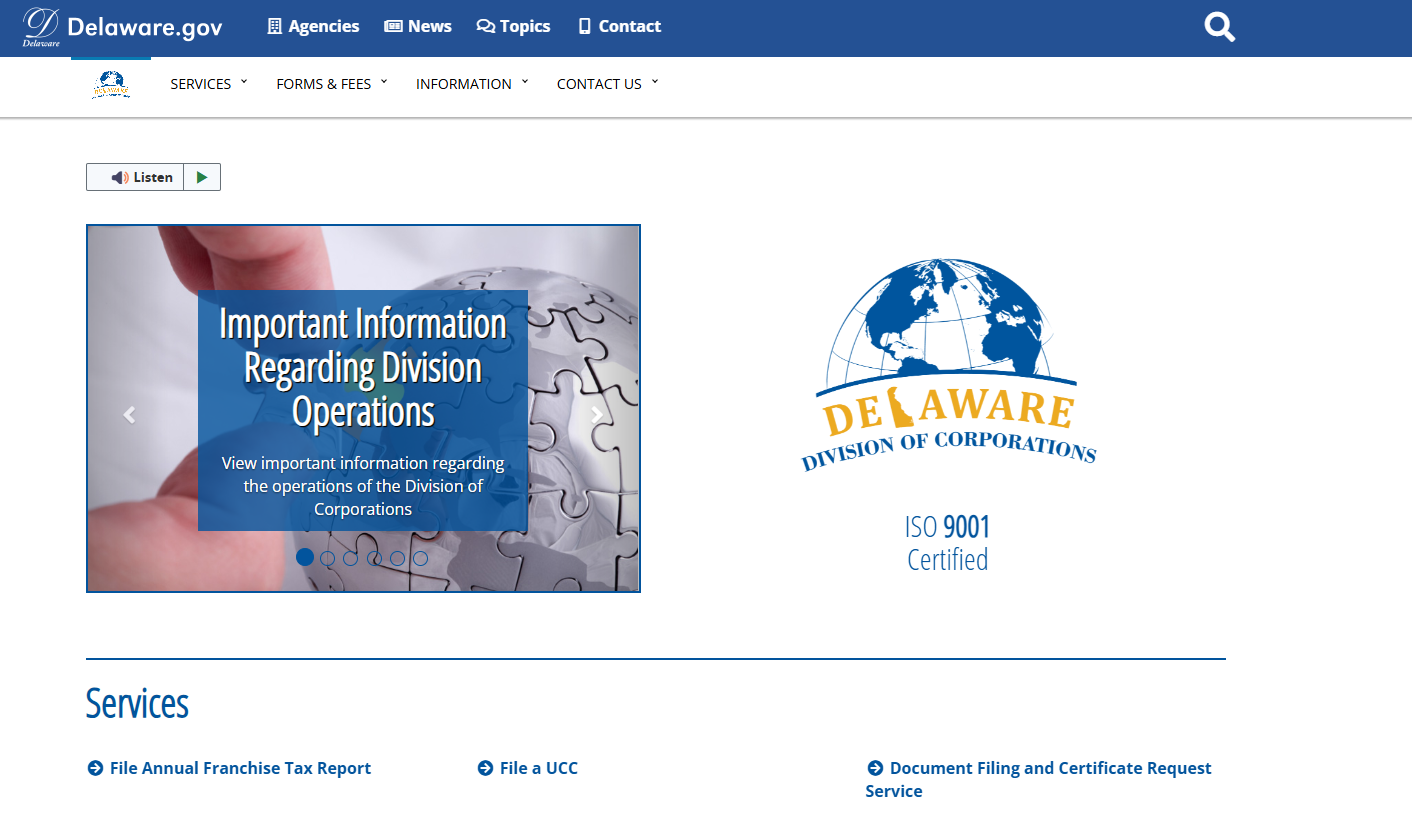
Delaware Annual Franchise Tax

Delaware

What Is It?

This is a statutory obligation maintenance fee imposed by the Delaware Division of Corporations on every active LLC in Delaware. It is a flat-rate fee of $300 and is not dependent on income or the size of the business. payment is just to keep your business legally active on state records.

Payment Details

  • Amount: $300 (fixed for all LLCs)
  • Due Date: every June 1st.
  • Payable To: Delaware Division of Corporations (division of corporations)
  • Filing Method: Online payment (division of corporations website)

Delaware LLCs unlike corporations do not need to file an annual report. LLCs only have to pay the annual franchise tax.

Consequences of Missing the Deadline

For payments not made by June 1st there is:

  • An Automatic penalty of $200, and
  • 1.5% of the unpaid amount every month.

Your business will also be flagged as “Not in Good Standing” by the state. This will:

  • Restrict you from getting a Certificate of Good Standing,
  • Complicate bank account verification, payment processor approval, and
  • Trigger administrative dissolution after a few years of being unresolved.

As advised by Bizstartz:

Make sure to pay your Delaware franchise tax early or allow Bizstartz to manage your annual compliance, and we’ll ensure you never miss your franchise tax deadline!

Filing Requirements for Taxes (IRS Compliance)

Every Delaware LLC has tax responsibilities on a federal level. This is true for LLCs that are wholly owned by non-U.S. residents. Basically, you will have to file some tax documents with the IRS on the LLC business structure and the taxation of the LLC.

To the extent possible, we will discuss.

A. Single-Member LLC (a disregarded entity owned by a foreign individual or foreign company)

If your Delaware LLC is owned by a single member and does not have a U.S. trade or business, you will still file:

These are used to report transactions that your LLC has with its foreign owner, including fuels, payments, and loans.

Due Date: April 15 each year (you can extend it to October 15).

Penalty: Failure to file Form 5472 results in a penalty of $25,000, even if your LLC has no revenue.

If your LLC does business in the U.S., you’ll probably need Form 1040-NR (if you are an individual) or Form 1120-F (if you are a foreign corporation) to report U.S.-sourced income.

B. Multi-Member LLC (Partnership Tax Classification)

If your Delaware LLC has 2 or more members, the IRS automatically considers it a partnership unless you state otherwise. In such a case:

  • You are to submit Form 1065 (U.S. Partnership Return), and
  • You are to give each member a Schedule K-1 that summarizes the member’s portion of the company’s income, deductions, and credits, as well as any taxes paid.

Even if your LLC has no income, you must file it every year to avoid compliance problems.

Due Date: March 15 (or September 15 if an extension is requested).

If the LLC has foreign partners, it must also deal with withholding taxes using Forms 8804 and 8805 for payments that are passed out to them.

C. LLC Electing to be Taxed as a Corporation

LLCs particularly the ones that are seeking to invest venture capital, or profit reinvestment, often elect to be taxed as a C-Corporation.

Here, the LLC submits:

  • Form 1120 (U.S. Corporation Income Tax Return) and
  • It pays a 21% corporate income tax on net taxable income, which is a flat rate corporate income tax.

This structure may work better for businesses that are scaling up, are planning to raise capital, or for businesses that want to keep profits within the business.

Other Important Federal Filings

BOI Filing

Besides income tax, owners of Delaware LLCs will also need to submit:

a. BOI Report (Beneficial Ownership Information)

Every U.S. LLC must, starting 2024 submit a Beneficial Ownership Information Report to FinCEN. This falls under the Corporate Transparency Act (CTA).

This report shows who the actual owners and controllers of the business are.

  • When is it due? Within 90 days of starting the LLC, or for pre-existing LLCs, by January 1, 2025.
  • What is the penalty for not filing? Up to $500 for every day the report is late.

b. FBAR (Foreign Bank Account Report)

Your Delaware LLC must file FinCEN Form 114 (FBAR) by April 15 if during the year it holds foreign bank accounts and the total of those accounts is over $10,000.

c. Form 1040-NR

Non-U.S. members that receive income from a U.S. source must file Form 1040-NR declaring the income that they earned through the LLC.

Delaware State Income Tax Considerations

A primary advantage to forming an LLC in Delaware, is that if your business does not operate in Delaware, you won’t have to pay any state income tax.

Nonetheless, if your business meets any of the following conditions:

  • Has employees in Delaware,
  • Has business facilities in Delaware or
  • Has customers located in Delaware,

Your business may be responsible for Delaware:

  • State Income Tax and
  • Delaware Gross Receipts Tax (on total sales revenue your business earns).

Most foreign LLCs that conduct business outside the U.S, or operate over the Internet, do not have to worry about paying taxes, and for that reason, Delaware is seen as a cost effective and economically favorable jurisdiction.

Compliance and Good Standing

Access to U.S. banking, merchant accounts, and investors’ trust depends on the good standing of your Delaware LLC. Good standing of your LLC is also a requirement for maintaining your business’s ongoing operational status.

Here is a checklist that will help you remain compliant:

  • You must pay the annual franchise tax of $300 before June 1.
  • You must file IRS returns (Form 5472, 1065, or 1120).
  • If applicable, file your BOI Report.
  • Keep your Registered Agent service to the LLC, and have the service for every LLC.
  • If inactive, renew your EIN, and if ownership of the business changes, inform the IRS of business changes.
  • Keep all records of income and expenses.
  • File your annual tax returns even if you earned zero income as this will keep your LLC active and penalty free.

Consequences of Non-Compliance

  • In the event of late filing, the penalties can build to $25,000 for each IRS form.
  • Delaware can take away your company’s good standing status.
  • Your company’s accounts can be suspended or rejected during bank KYC updates.
  • Delaware Division of Corporations can administratively dissolve your company.

Maintaining international trust and operational status for your company is a benefit of proactive compliance.

How Bizstartz Aids You in Filing and Keeping Your Delaware LLC Compliant

For the majority of people not living in the U.S., U.S. taxes and compliance rules are very complicated and confusing. This is the gap that Bizstartz addresses.

We take care of everything, from the formation of your Delaware LLC to maintenance, and take the stress of compliance off your shoulders every year.

Our professionals take care of the:

🏛️ LLC Formation in Delaware and other U.S. states

🧾 Annual Franchise Tax Payment

📄 Federal Tax Filing (Forms 5472, 1065, 1120)

🔐 FinCEN BOI Report Submission

💼 Registered Agent Services

💰 Bookkeeping & Accounting Services

🪪 EIN & ITIN Application Services

It doesn’t matter if your LLC is active or if you are just setting it up, Bizstartz guarantees that your compliance filings are accurate, timely, and stress-free.

Delaware LLC Annual Filing Checklist (Summary Table)

Requirement Form / Payment Due Date Applies To Penalty for Missing
Delaware Franchise Tax $300 Flat Fee June 1 All LLCs $200 + 1.5% monthly interest
Federal Tax Return Form 5472 / 1065 / 1120 March 15 or April 15 Based on LLC type $25,000+ per form
BOI Report FinCEN Online Portal Within 90 days of formation All LLCs $500/day
FBAR FinCEN Form 114 April 15 LLCs with foreign accounts >$10,000 Civil/Criminal penalties
Registered Agent Annual Renewal Yearly All LLCs LLC becomes inactive

Conclusion: Stay Compliant, Stay Protected

Delaware is the number one choice for entrepreneurs across the globe because of its privacy, efficient taxation and compliance world-class corporate laws.

This is only possible if your company stays compliant with the required annual filings and payments. Maintaining your registered agent, paying your $300 Franchise Tax, and filing your federal returns are essential steps to keep your LLC in good standing.

Non-U.S. founders often underestimate the importance of these filings—until it’s too late. This is where working with a compliance expert such as Bizstartz can save you significant fines and protect the ongoing U.S. reputation of your business.

📩 Ready to File Your Delaware LLC Annual Tax?

Let Bizstartz take care of your Delaware LLC Annual Tax Filing from beginning to end.

We will make sure that the filings you need to submit to the Delaware Division of Corporations, the IRS, and FinCEN are done timely and done correctly.

✅ Easy.

✅ Economical.

✅ Full Assurance of Compliance.

👉 Reach out to Bizstartz today so that your Delaware LLC can stay compliant and will maintain active status for 2025 and the years to follow.

Annual Tax Filing for Wyoming LLC Owners: The Complete 2026 Guide

Wyoming remains one of the most business-friendly states in the U.S. This is why non-U.S. residents along with entrepreneurs from around the globe choose to establish their Limited Liability Company (LLC) in Wyoming. It is inexpensive, easy to form, and has great levels of privacy.

Even with the easy formation process, every LLC owner in Wyoming has to pay some sort of tax and compliance filings every year. This ensures the company remains in good standing. If there is no filing done, or if there is some misunderstanding regarding filings, penalties could occur, or administrative dissolution could occur.

In this article, we will provide you with everything you will need to understand annual tax filing for Wyoming LLC Owners. This includes state requirements, federal tax filings, deadlines, and any specifics for non-U.S. residents.

1. The LLC Tax Basics in Wyoming.

What’s the reason for LLC Formation Popularity in Wyoming?

Wyoming is described to be the “Delaware of the West,” for the business friendly environment. There is no state income tax for individuals or corporations, and therefore your LLC will never be charged state income tax, whether your business is in Wyoming or operated from abroad.

There are reasons besides the absence of income tax as to why people establish LLCs in Wyoming:

  • LLC statute provides Lifetime anonymity for members and managers, no public disclosure.
  • Every Wyoming LLC pays low annual renewal fees, starting at just $60.
  • There are no franchise or business privilege taxes.
  • Renewals and compliance are simple to manage through the online filing system.
  • There are strong asset protection laws and separation of personal and business liabilities.

Federal vs. State Tax Obligations

It’s important to distinguish between state compliance and federal tax obligations:

  • State filings are submitted to the Wyoming Secretary of State.
  • Federal filings are submitted to the Internal Revenue Service (IRS).

While there are no taxes at the state level, you must still file annual reports and, for most, a federal tax return. This is especially true for non-resident foreign owners.

2. Wyoming State Level Filings and Compliance

Wyoming Tax

While Wyoming is pro-business, the state still requires each LLC to remain compliant by filing an Annual Report and managing an active Registered Agent.

a. Wyoming Annual Report

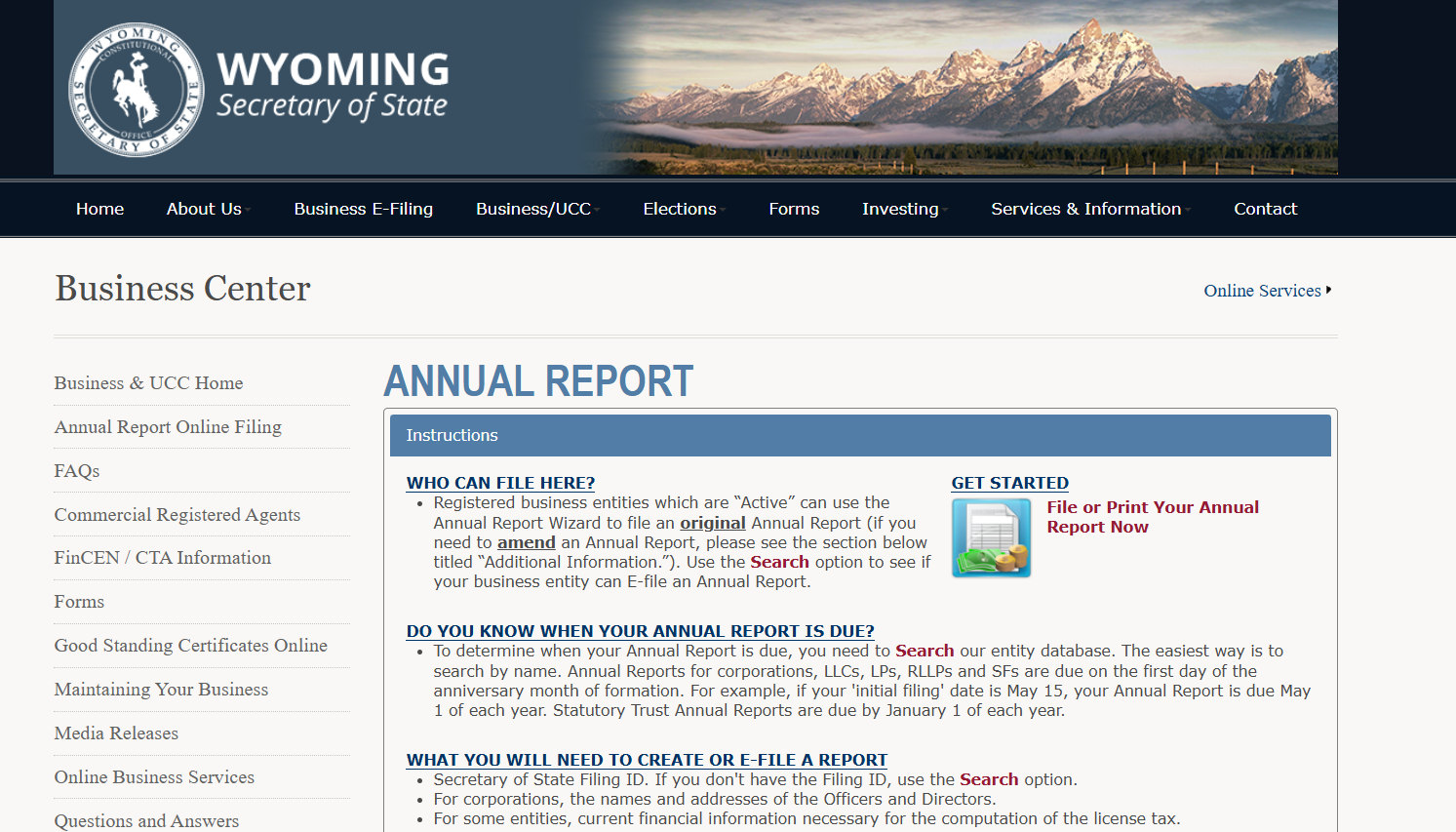
The Wyoming Annual Report confirms your company’s ongoing existence and reports the total value of assets located within the state. It’s a basic document, but you must file it.

Key details:

Due dates: On or before the first day of your LLC’s anniversary month every year. If your LLC was created on May 10, 2024, your first annual report will be due on May 1, 2025.

Filing Fees:

  • If your LLC has Wyoming-based assets under $250,000, the fee is $60 minimum.
  • If your LLC has property, inventory, or other assets physically in Wyoming and those assets are worth over $250,000, the fee will be $0.0002 per dollar of those assets.

Filing Method:

Steps

1. Go to the official filing portal.

2. Enter your business name or filing ID.

3. Confirm your registered agent and address.

4. State your total assets in Wyoming.

5. Pay the fee and submit your report.

Penalty for Non-Compliance

If the report is not filed, your LLC will go into a delinquent status. After 60 days, the LLC can be administratively dissolved, meaning the company will be legally dead until it is reinstated with penalties.

b. Registered Agent Renewal

Every Wyoming LLC has to keep a registered agent with a physical address in Wyoming to receive official correspondence and legal documents.

  • Renewal: Your Registered Agent service needs to be renewed every year.
  • Cost: This typically costs between $50-$150 per year, depending on the company.
  • Tip: Bizstartz offers Registered Agent renewal services and makes sure your annual report is submitted on time.

3. Federal Tax Filing Requirements

For tax purposes, Wyoming does not impose tax on your LLC. This d

oes not mean that the IRS does not require annual tax reporting, and that depends on your company’s structure and ownership.

a. Single-Member LLC (Disregarded Entity)

If your LLC has one owner, it is treated as a disregarded entity for federal tax purposes unless you elect corporate status.

For U.S. residents:

  • Report LLC income on Schedule C of Form 1040.

For non-U.S. residents:

  • Report U.S.-sourced income (if any) on Form 1040-NR.
  • File Form 5472 plus pro forma Form 1120 every year, even if you earned no income.
    • These forms show the transactions that the foreign owner has with the LLC.
    • The IRS imposes a $25,000 penalty for failing to file.

Example:

If your foreign-owned Wyoming LLC has a U.S. bank account without U.S. clients, you still must file Form 5472 every year.

b. Multi-Member LLC (Partnership)

If your Wyoming LLC has two or more members, it is treated as a partnership by default.

  • File Form 1065 (U.S. Return of Partnership Income) annually.
  • You should send each partner a Schedule K-1 that details their portion of the profits or losses.
  • For partners abroad, you may have to withhold and pay U.S. taxes via Forms 8804 and 8805.

Due: March 15 for each year (or submit form 7004 for a 6 months extension

c. LLC Taxed as a Corporation

If you have elected for corporate taxation:

  • For a C Corporation: You will file a Form 1120 by April 15.
  • For an S Corporation (for U.S. owners only): You will file a Form 1120-S by March 15.

As to taxation, corporation is subject to a flat 21% federal income tax rate on net income and any other tax that may be owed by the corporation to the shareholders.

4. Wyoming LLC Tax Filing Deadlines

Filing Type Form Due Date Responsible Agency Notes
Wyoming Annual Report Anniversary month WY Secretary of State $60 minimum fee
Registered Agent Renewal Anniversary month WY Secretary of State Required for good standing
Single-Member (Foreign-Owned) Form 5472 + Form 1120 April 15 IRS Mandatory even if no income
Multi-Member LLC Form 1065 + K-1s March 15 IRS Partnership filing
C Corporation Form 1120 April 15 IRS Flat 21% tax rate
S Corporation Form 1120-S March 15 IRS U.S. citizens only

5. Taxes on Wyoming LLCs Owned by Non-U.S. Residents

Some foreign business owners think they don’t need to file any paperwork as long as their LLC isn’t ‘doing business’ in the U.S. That’s not true.

Foreign single-member LLC owners must submit annually:

  • Form 5472 + pro forma 1120, every year.
  • EIN (Employer Identification Number) to identify your company.

If your LLC has income that’s connected to U.S. trade, such as sales to customers in the U.S., you have to file Form 1040-NR and pay taxes on that income.

Note: LLCs from Wyoming that don’t have U.S.-source income don’t pay federal taxes, but they still owe the info forms for federal tax requirements.

6. Mistakes of Wyoming LLC Owners

  • Not filing an Annual Report can result in administrative dissolution.
  • Ignoring Form 5472 can result in penalties.
  • Using a virtual address instead of a registered agent’s physical address violates state rules.
  • Failing to keep basic bookkeeping means that your filings and proof of taxes not owed in the U.S. become a lot harder to prepare.
  • Neglecting to renew Registered Agent information on a yearly basis may seem small, but it is a crucial part of compliance.

7. Annual Compliance Checklist for Wyoming LLC Owners

Task Frequency Deadline Responsible Party
Renew Registered Agent Annual Anniversary month Owner / Bizstartz
File Wyoming Annual Report Annual Anniversary month Owner / Bizstartz
File Federal Tax Return (IRS) Annual March–April Accountant / Bizstartz
File Form 5472 (if foreign-owned) Annual April 15 Owner / Bizstartz
Maintain Accounting Records Monthly Ongoing Bookkeeper
Renew Business Licenses Annual Varies Owner

8. How Bizstartz Assists Owners of Wyoming LLCs

At Bizstartz, we assist both U.S. citizens and international entrepreneurs with all aspects of Wyoming LLC compliance.

We offer:

  • Compliance with federal and state tax filings (Forms 1040-NR, 1065, 5472, 1120, etc.)
  • Submission of annual reports and state renewal tracking
  • Registered Agent services and renewal reminders
  • Bookkeeping and accounting service
  • BOI (Beneficial Ownership Information) filing compliance
  • Assistance with EIN and ITIN applications

Bizstartz works to guarantee that each year, without hassle and confusion, your LLC is fully compliant and maintains a good standing whether you are operating an e-commerce store, a consulting company, or a SaaS business.

9. Frequently Asked Questions (FAQs)

1. Does my Wyoming LLC have to file taxes even if it didn’t make any money?

Yes. If your LLC is foreign owned, it didn’t generate income, and you fail to file necessary documents (Form 5472 + pro forma 1120), you would incur a penalty of at least $25,000.

2. Can a non-U.S. resident file Wyoming LLC taxes online?

Absolutely. Each federal form is fileable online (inclusive of Form 5472, 1120, 1065, etc.), or through a U.S. accountant. Bizstartz assists non-residents in filing these forms properly.

3. What happens if I miss my Wyoming Annual Report deadline?

Your LLC will be classified as delinquent, and after 60 days, it will most likely be dissolved. Paying a late fee and additional paperwork will allow you to reinstate your LLC.

4. Do I need to pay franchise or privilege tax in Wyoming?

The answer is no. Wyoming is franchise and privilege tax free and does not require business licenses.

5. How much does it cost to maintain a Wyoming LLC annually?

Estimated yearly costs consist of the following:

  • $60 annual report fee
  • $50–$150 registered agent renewal
  • Optional accounting and tax filing services (varies based on activity)

If you engage in no elaborate operations, the average yearly cost to maintain your Wyoming LLC is $150–$300.

10. Final Thoughts

The state of Wyoming is a great location for business owners who want ease, privacy, and low taxes. Regardless of how relaxed Wyoming’s systems are, no annual filings are optional. Each LLC is required to submit both state and federal reports to keep their business legal.

Keeping an Annual Report, IRS filings, and Registered Agent renewals up to date will ensure that your company remains in good standing, protects your privacy, and maintains your limited liability coverage.

With Bizstartz, you can relax knowing your filings are handled professionally, from bookkeeping, and tax filings, to renewals.

👉 Ready to file your Wyoming LLC taxes or annual report?

Bizstartz will help you confidently stay compliant.

It is simple, secure, and seamless for global entrepreneurs to manage their companies in the U.S. with us.

US LLC or UK LTD? Which One Should You Choose?

Selecting a suitable business structure is among the first considerations for any entrepreneur looking to expand internationally.

Freelancers, e-commerce sellers, founders of SaaS companies, and worldwide investors all encounter variations of this consideration. The business structure you choose helps shape the taxes you will incur, the degree of credibility you will attain, and the business interactions you will draw.

International founders often attracted to the U.S. Limited Liability Company (LLC) and the UK Private Limited Company (LTD) options.

Both U.S. LLC and UK LTD offer limited liability, significant dependence internationally, and remote registration for non-residents, but they significantly differ in compliance, privacy, structure, and taxation.

This guide will assess the structure in detail, contrasts their facets, and assist in deciding on the most appropriate business vision.

1. Overview: US LLC vs. UK LTD

Before diving deep, let’s understand what these two structures represent and how they differ at a glance.

Criteria U.S. LLC UK LTD
Full Form Limited Liability Company Private Limited Company
Jurisdiction State-level (each U.S. state has different rules) Nationwide (governed by Companies House)
Legal System Common Law (state-specific statutes) Common Law (Companies Act 2006)
Reputation Highly respected globally, especially in tech and e-commerce Strong credibility across Europe, Middle East, and Asia
Ownership Type Members (can be individuals or companies) Shareholders (issue shares upon incorporation)
Management Member-managed or manager-managed Director-managed
Formation Time 1–3 business days 1–2 business days
Formation Cost $100–$300 (depending on state) £12–£100 (depending on filing method)
Annual Compliance Low to moderate (varies by state) Moderate (accounts + confirmation statement)
Taxation Model Pass-through (profits taxed at owner level) Corporate tax system
Public Disclosure Some states allow privacy All directors and shareholders public
Banking Access Easy access to U.S. fintechs and international banks Excellent access to UK/EU banking and fintech services

Both structures serve global founders well—but choosing the right one depends on where your clients are, how you plan to withdraw profits, and what level of compliance you’re comfortable with.

2. What is a US LLC?

US LLC

A US Limited Liability Company (LLC) serves as a hybrid, flexible, and simple structure business design that permits one to operate commercially like a sole proprietor while providing corporate liability protection.

While it is true that each LLC is subject to the laws of the state in which it is incorporated—Wyoming, Delaware, Florida, New Mexico, etc.—the benefits of each remain largely the same.

​Core Features of U.S. LLCs​

  • Limited Liability Protection: Members of the LLC are protected from any personal liability for debts of the company. Their liability is limited to what they personally invested in the business.
  • Pass-Through Taxation: LLCs do not pay taxes on profits made, nor do they pay taxes on revenue generated for the business. Instead the profits and losses “pass through” to the members where they are reported on each member’s tax return. Non-U.S. members that qualify will not owe U.S. taxes if their income is not “effectively connected.”
  • Operational Flexibility: LLCs are not required to have a board of directors, annual meetings, or any of the other bureaucratic structures that other business entities must have.
  • Privacy: In states such as Wyoming and New Mexico, you can have anonymous ownership which means you can conceal your identity from public record.
  • Ease of Formation: You can form an LLC on the internet and in as little as 1-3 business days, you can have an LLC with very little paperwork.

Advantages of Forming a U.S. LLC

  • Tax Efficiency for Non Residents: Non-U.S. residents that conduct their business outside of the U.S. and do not have U.S. employees can be exempt from U.S. federal taxes.
  • Worldwide Trust: Having a U.S.-registered business gives you trust and credibility in global markets, especially for U.S-based customers and even for payment processors and marketplaces like Amazon and Stripe.
  • Access to Premium Payment Solutions: Setting up a U.S. LLC and integrating with Stripe, Wise, PayPal and other U.S. fintech companies becomes a straightforward process.
  • Minimal Upkeep: Compared to other corporate structures, countries do not give you corporate structures.
  • Suitable for Digital Enterprises: The LLC and its tax system focus on providing flexibility and simplicity to American e-commerce, SaaS, and online service businesses.

Most Applicable To:

  • Amazon sellers, dropshippers, and Shopify store owners.
  • Freelancers and consultants serving U.S. or international clients.
  • SaaS and tech startups.
  • Non-U.S. residents looking to access payment gateways in the U.S.
  • Entrepreneurs seeking limited liability and reduced tax exposure.

3. What Is a UK LTD?

UK LTD

A UK Private Limited Company (LTD) is a separate legal entity registered under the Companies Act 2006, which means the company itself is legally responsible for its debts and obligations, not its owners.

UK LTDs are widely used by entrepreneurs in the UK, Europe, Asia, and Africa, and are particularly favored for their credibility, structured accounting, and strong legal protection.

Key Features of a UK LTD

  • Independent Legal Entity: The company is separate from its shareholders and directors. It can own properties, open bank accounts, and sign contracts in its own name.
  • Corporate Structure: In a UK LTD, there are shareholders and directors. One person can take on both roles.
  • Fixed Corporate Tax System: Profits are taxed at a flat rate of 25% and dividends can be paid out afterward.
  • Public Transparency: The UK maintains a transparent registry. Company information, including directors and shareholders, is publicly accessible at Companies House.
  • Professional Reputation: A UK LTD offers a strong corporate image. This is especially important in industries such as consulting, finance, and other service-based businesses that rely on professionalism and trust.

Advantages of a UK LTD

  • Global Trust: The UK offers a stable legal system and strong regulatory environment, which boosts the international credibility of its companies.
  • Access to UK and EU Banking: UK LTDs can open accounts with traditional banks such as HSBC and Barclays, as well as with fintech platforms like Wise, Revolut, and Monzo.
  • Double Tax Treaties: The UK has a tax treaty with over 130 countries, which helps reduce or eliminate double taxation on cross-border business activities.
  • Easy and Fast Registration: A company can be incorporated online through Companies House in as little as 24 hours.
  • Ideal for European Operations: Although the UK withdrew from the EU, UK entities are maintaining strong business relations with EU clients and suppliers.

Best Suited For

  • Consulting and professional service companies.
  • Businesses operating or targeting customers in the UK, or the EU.
  • Businesses requiring VAT registration.
  • Entrepreneurs reinvesting profits within the company.
  • Founders seeking corporate credibility and a structured legal framework.

4. Taxation Comparison: US LLC vs. UK LTD

Understanding taxation is critical, especially for non-resident founders who want to minimize double taxation and optimize profit retention.

Tax Aspect U.S. LLC UK LTD
Corporate Tax None (pass-through) 25% Corporation Tax
Owner-Level Tax Personal tax on distributed profits (if any) Dividend tax applies to distributed profits
Double Tax Treaties Limited (LLCs are not always recognized as treaty entities) Over 130 tax treaties globally
VAT / Sales Tax State-based sales tax (if applicable) VAT applicable if turnover > £90,000
Accounting Method Simple cash or accrual-based Formal accounting with audited statements for large companies
Tax Reporting IRS filing optional for disregarded entities Annual tax filing mandatory with HMRC

Tax Example

If a non-U.S. resident forms a Wyoming LLC that earns $100,000 from clients in Europe or Asia with no U.S. presence, they may owe no U.S. federal or state tax.

In contrast, a UK LTD earning £100,000 will pay 25% corporate tax (£25,000) before distributing dividends. However, the LTD can deduct business expenses, salaries, and reinvestments before calculating tax, offering flexibility for growth-focused entrepreneurs.

5. Compliance & Maintenance

Compliance refers to the ongoing legal responsibilities after formation. While both entities are simple to manage, the UK LTD requires more structured reporting.

Requirement U.S. LLC UK LTD
Annual Reports State-level report (cost $50–$300) Confirmation Statement (£13)
Financial Accounts Not required for small LLCs Annual accounts to Companies House
Registered Agent / Office Required in the state of formation UK address required as registered office
Public Disclosure Optional (depends on state) Mandatory (public record)
Bank Account Opening Fintech and U.S. banks supported UK/EU banks and fintech supported
BOI / PSC Filing BOI report mandatory (for U.S. LLCs) PSC register required (for UK LTDs)

For non-residents, companies like Bizstartz simplify this process by offering registered agent services, compliance monitoring, EIN/UTR assistance, and bank account setup.

6. When to Go for a U.S. LLC

You will want to opt for a U.S. LLC if you:

  • Run a digital or online business with international customers.
  • Want uncomplicated access to U.S. payment processors like Stripe or PayPal.
  • Seek lower taxes with little to no tax reporting.
  • Don’t plan to relocate to the U.S. or employ people there.
  • Want operational privacy and flexibility.

Perfect Use Cases:

  • Amazon FBA, SaaS, affiliate marketing, dropshipping with Shopify.
  • Remote services or consulting.
  • Any online software, crypto, or fintech business.

Best States:

Wyoming, New Mexico, Florida and Delaware are all non-resident-friendly, have low business fees, and maintain business privacy.

7. When to Go for a UK LTD

You will want to go with a UK LTD if you:

  • Plan to target the UK or EU market.
  • Want to obtain a VAT registration and trade with EU partners.
  • Plan to open bank accounts in the UK or EU.
  • Want a formal, corporate persona for B2B engagements.
  • Plan to employ local staff or subcontractors.

Perfect Use Cases:

  • Consulting, IT, and professional service agencies
  • UK/EU-based e-commerce and import-export businesses
  • Businesses that reinvest profits for growth

Bonus:

Multi-director ownership works seamlessly with UK LTDs, making them great for co-founders and investors.

8. Cost Summary

Expense U.S. LLC UK LTD
Formation $100–$300 (depending on state) £12–£100
Registered Agent $49–$100/year £50–£150/year (virtual office)
Annual Report $50–$200 £13
Accounting & Tax Filing $0–$300 (varies) £150–£500 (with accountant)
EIN / Tax ID $0–$95 Automatically provided (UTR)
Bank Account Setup Free with fintechs Free or low-cost with fintechs

Overall, both are cost-effective for international entrepreneurs, but the U.S. LLC generally has lower ongoing costs and simpler management.

9. Conclusion: Which One Is Right for You?

In the end, whether to set up a U.S. LLC or a UK LTD is a matter of the area of your client base, the way you want to manage your business taxes, and the location of your prospective customer base.

✅ Choose a U.S. LLC if:

  • You work with clients all over the world, particularly the U.S., or have an online business.
  • You want to have a business and have less tax obligations and less compliance.
  • You want to access U.S. payment methods and want world customers to trust you.

✅ Choose a UK LTD if:

  • You work with customers located in the UK or in the European Union.
  • You want to have a business and obtain a VAT number or need local trust.
  • You prefer having orderly corporate books and legal esteem.

💼 Need Expert Help Choosing?

Bizstartz is the very best. We will help you because you probably need help with U.S. LLC formation. We also assist with UK LTD formation, and all the way through to the end, company registration, bank account setup, bookkeeping, and more.

🌍 We help you with compliance so you can focus on your UK consulting business or U.S.-based e-commerce business.

👉 Start with us at Bizstartz.com! We can help you reach your business goals.

How to Get a Certificate of Good Standing for Your U.S. LLC

LLCs in the US offer flexibility, liability protection, and global business respect. Yet, to remain legitimate and active, the company must comply with the law, and, in particular, the state law.

The most important document that states your company is active is the Certificate of Good Standing. Banks, foreign authorities, prospective business partners, and even investors demand this document to show that your company exists and appropriately complies with the law.

In this post, I will describe what the document is, what its components are, the reasons it is important, who specifically needs it, and how to get it if you run your company outside the US.

What is a Certificate of Good Standing?

A Certificate of Good Standing (or, in some states, Certificate of Existence, Certificate of Status, Certificate of Authorization) is a document issued by the Secretary of State or relevant state authority of the state where your LLC is registered.

This confirms that your business:

  • Was legally incorporated under that state’s laws,
  • Has met all yearly filing obligations,
  • Has settled all applicable fees and state taxes,
  • Is permitted to operate, and
  • Is not suspended, revoked, or dissolved.

In a nutshell, this shows that your business remains active, compliant, and in good standing.

For instance, certificates provided to businesses that registered their LLCs in Delaware would come from the Delaware Division of Corporations. In Wyoming, it comes from the Wyoming Secretary of State, and so on.

This document indicates to the world, including potential financial institutions, customers, and collaborators, that your business is orderly and operational.

Why You Might Need a Certificate of Good Standing

Certificate

Although this may not be essential for your day-to-day functions, it may be necessary for certain business transactions and compliance checks. Below are the scenarios when you would need a Certificate of Good Standing.

1. Opening a U.S. Bank Account

Most U.S. and foreign banks will ask for a current Certificate of Good Standing when an LLC is trying to open a business community bank account.

This document assures the bank that your business is legally registered and in good standing with all state requirements.

For business owners that live in another country, this may be required during verification with banks, whether you are doing it online, in person, or using other methods.

2. Registering Your LLC in Another State

If your business wants to operate in another state, you need to get foreign qualification. The new state will ask you to provide a Certificate of Good Standing from your home state before they approve your registration.

3. Applying for Loans, Credit, or Business Funding

When deciding whether to provide a loan or other corporate financing, lenders, investors, and banks check if your company holds a Certificate of Good Standing to confirm it is legally recognized and financially stable.

4. Renewing Business Licenses or Permits

If you have certain government contracts and professional licenses, or local business permits, you will need to show that your LLC is current with state filings and taxes.

5. Mergers, Acquisitions, or Selling Your Company

In case of a business sale or merger, the purchaser’s counsel will ask for a Certificate of Good Standing to make sure the LLC is valid and there’s no legal issue.

6. Building Business Credibility

When you have a Certificate of Good Standing, it shows your clients, investors, and business partners that you are legally compliant, and operate your business professionally and transparently. This is especially important to trust-based relationships with clients in other countries.

Who Can Request a Certificate of Good Standing?

These individuals are generally permitted to make a request:

  • The LLC’s owner or member
  • An appointed manager who can represent the LLC
  • A designated third party, like a registered agent, accountant, or Bizstartz

Remote operation of LLCs by US entrepreneurs often involves the need for professional help.

At Bizstartz, we manage verifying your compliance, applying for the certificate, and electronically delivering the certificate to you, all without the need for a US address or your physical presence.

Steps to Obtain a Certificate of Good Standing

While different states have a few variations, the steps for obtaining a certificate of good standing are generally the same. Here’s how you can do that:

Step 1: Check Compliance Status

Before you can apply for the certificate, it is vital to determine whether your LLC is eligible to apply for a certificate of good standing. That involves confirming:

  • An Annual Report, if your state mandates it, has been filed.
  • All taxes and business entity fees have been paid.
  • All filed documents have up-to-date Registered Agent details.
  • You are free from all administrative actions, penalties, and enforcement actions.

If your LLC has compliance issues, the state will not issue the certificate and you must address those issues first.

Check your compliance status on the Secretary of State’s business search portal, or let Bizstartz do it for you.

Step 2: Go to the Secretary of State’s Website

Business registrations and certificates for your specific state as well as registrations by business type, are managed by the business registrations and certificates managing divisions of the Secretary of State.

For example, you can do the following to find the correct website for your state:

  • Delaware: Division of Corporations
  • Wyoming: Secretary of State – Business Division
  • Florida: Department of State – Division of Corporations (Sunbiz.org)
  • Texas: Texas Secretary of State

These sites allow you to search for business records, order documents, and certificates.

Step 3: Look for Your LLC

Type your LLC’s name or entity number in the business search area. Once you’ve located your company listing, you should see an option to “Order Certificate of Good Standing,” “Request Certificate of Existence,” or “Order Status Certificate.”

Before continuing, confirm that the company status displays Active, Good Standing, or Current.

If it displays “Inactive,” “Dissolved,” or “Not in Good Standing,” you must address compliance issues first.

Step 4: Place the Order

After deciding which form of the certificate you need, you can go ahead and place the order. Usually, for this, you need to:

  • Decide which certificate you need, the Certificate of Good Standing or Certificate of Status.
  • Give the name of your LLC or your filing number.
  • Process payment of a small fee (which ranges anywhere between $10 to $50, depending on your state).
  • Choose how you’d like to receive your certificate (digitally through your email or through regular mail).

States like Wyoming and Delaware let you download your certificates instantly in PDF format. California and Texas take this time to process your order, which is typically 2-5 business days.

Step 5: Receive the Certificate

After your order has been approved, you will receive a state-sealed CC from your LLC which states:

  • Your LLC’s legal name
  • Your state entity number
  • Date of formation
  • A statement which expresses that your LLC is in Good Standing
  • A good standing Certificate signed with the Secretary of State’s official seal.

This certificate is the one that satisfies proof of compliance and can be required by many institutions.

How Long Is a Certificate of Good Standing Valid?

Certificate of GS

A Certificate of Good Standing has no expiration, the only thing is that it reflects the status of your company the moment it was issued.

A certificate is often required to be issued within the last 30 to 90 days.

This is especially true if you are applying for a business bank account or expanding to another state. In this case, it’s best to request a new certificate just prior to submission.

What If Your LLC Is Not in Good Standing?

If your LLC is no longer in good standing, don’t worry, it can be reinstated.

Here are some important issues along with ways to fix and reinstate LLC.

Common Issues:

  • Failure to file annual reports
  • Non-payment of state filing fees or franchise taxes
  • Expired Registered Agent
  • Administrative dissolution by the state

How to Fix It:

  • File any missing annual reports
  • Pay any outstanding fees or penalties
  • Update your Registered Agent
  • Reinstatement Application if dissolved.

Once LLC compliance is reinstated, apply for the Certificate of Good Standing.

The process can be confusing for non-residents. At Bizstartz, we can complete every step: checking your company records, reinstating your company with the state, and ordering your certificate.

How Bizstartz Can Help You Obtain a Certificate of Good Standing

At Bizstartz, we help international and domestic entrepreneurs integrate and managed their US LLCs, which also includes compliance documentation to complete the business certificate of good standing..

What Our Team Can Do

  • Assess the LLC’s compliance status as shown in the state registry.
  • File overdue annual reports and reinstate inactive LLCs as necessary.
  • Directly request the certificate from the Secretary of State.
  • Send you an official digital copy of the certificate you can give to banks and other partners.

You don’t need a U.S. address or presence. We’ll take care of everything online.

Conclusion

In the U.S., a Certificate of Good Standing document is necessary to validate the legality and compliance of your business in all values.

You don’t just gain credibility from a Certificate of Good Standing; you open several important business doors. Some of the doors you open include the ability to open business accounts and even expand internationally.

As long as you remain compliant, your LLC will remain active, preventing penalties, dissolution, and administrative delays.

From startup founders and eCommerce sellers to international entrepreneurs managing their U.S. business from abroad, Bizstartz can streamline the process.

🚀 Obtain Your Certificate of Good Standing from Bizstartz

Let Bizstartz deal with all compliance and paperwork and let you get back to your business where you belong.

✅ We assess your company’s status.
✅ We file any overdue reports.
✅ We request your certificate and send it to you.

📞 Contact Bizstartz.com to get started.

How to Form an LLC in West Virginia

West Virginia is well-known for its Appalachian scenery, but for business people, there is something else, too: How the state assists small businesses is exemplary. It is efficient, cost-effective, and focused on growth.

If you are an American, or if you would like to start doing business in the United States as an international entrepreneur, opening an LLC (Limited Liability Company) in West Virginia is a good idea.

The Bizstartz guide on the formation of an LLC in West Virginia goes in depth on every aspect: Naming your business, filing fees, tax registration, getting your EIN, and all the compliance you will need to continue running your business.

Why Form an LLC in West Virginia

Before we talk about the business formation, it is good to look at all the reasons and advantages you may see if you conduct your business in West Virginia.

1. Setting Up is Cheap and Affordable to Keep Up

In West Virginia, the LLC filing fee is among the lowest in the United States: it costs only $100 to file the Articles of Organization, and the annual report fee is only $25. This is a great help to small business owners, helping them keep monthly costs low and manageable.

2. Strong Liability Protection

When an LLC is formed in West Virginia, personal assets are shielded from business liabilities and lawsuits. Therefore, if legal actions are taken against a business, the founder’s home, automobile, and private accounts wouldn’t be affected. This is a primary reason why most entrepreneurs are drawn to LLCs over sole proprietorships.

3. Flexible Tax Options

By default, LLC’s in West Virginia provide what is called “pass-through taxation” which means the business’s profits go directly to the members and are reported on their individual tax returns. However, depending on the situation, LLC’s can also elect to be taxed as an S-Corporation or C-Corporation with the IRS, which can be a beneficial tax strategy.

4. Supportive for Small Businesses

West Virginia’s Small Business Development Center (SBDC) has ideal policies, as well as, protection business legislations, and streamlined online filing. The SBDC also provides support to entrepreneurs in the form of mentoring, direct funding, and resources.

5. Non-Residents Welcome

Non-U.S. citizens can also establish an LLC in West Virginia. There’s no U.S. citizenship or residency requirement. As long as you have a registered agent in West Virginia, you can be anywhere in the world and operate legally.

Step 1: Choose a Name for Your West Virginia LLC

Choosing a business name isn’t solely a matter of creativity, but a legal and strategic consideration as well. As such, West Virginia has specific naming regulations to follow.

Naming Rules

  • Choose any name that includes “Limited Liability Company,” “Limited Company,” “LLC,” “L.L.C.,” “LC,” or “L.C.
  • Your name must be unique and distinguishable.
  • You may not use names with restricted wording such as “bank,” “insurance” or “trust” unless you are licensed. Moreover, do not use names that could be misleading or suggest illegal activity.

You can search the West Virginia Business Entity Database to check if the name you want is taken. If you don’t plan to file right away, you can submit a Name Reservation Application to the Secretary of State for a $15 fee to protect the name for 120 days.

Pro Tip:

It is easier to work if your brand and name is the same across platforms. Matching your LLC name with your website and social handles boosts credibility.

Step 2: Appoint a Registered Agent in West Virginia

Every LLC must appoint a registered agent, a person or business entity that receives legal documents, service of process, and compliance notices on behalf of your company.

Requirements for a Registered Agent

Must have a physical street address in West Virginia (no P.O. Boxes). Must be available during normal business hours. You may be registered as an individual or use a registered agent service.

Why it Matters

Having a registered agent helps ensure that you don’t miss critical deadlines or legal notifications. Many business owners, particularly those based outside the U.S., choose a professional registered agent service, such as Bizstartz, for privacy and compliance reasons.

If you relocate your business or switch your registered agent, you need to submit an Agent/Office Change Form with the Secretary of State. This is to ensure that your records stay up to date.

Step 3: File the Articles of Organization

The legal document that formally creates your LLC in West Virginia is the Articles of Organization. You can submit this document online or by mail through the West Virginia One Stop Business Portal.

Information Required

Your Articles must include:

  • The LLC’s legal name
  • Principal office address and mailing address.
  • Registered agent’s name and street address.
  • Management structure (member-managed or manager-managed).
  • Names and addresses of the members or managers.
  • Effective date of formation (immediate or future date up to a max of 90 days).
  • Organizer’s name, address and signature.

Filing Fee & Processing

  • Fee: $100 (payable to the West Virginia Secretary of State).
  • Processing Time: Typically 5-10 business days for regular processing (faster with expedited processing available).

Filing Options:

  • You can use the WV One Stop Portal to file online.
  • You can also file by mail to the West Virginia Secretary of State Business & Licensing Division.
  • You can also drop off the filings in person in Charleston, Clarksburg, and Martinsburg.

After the filings are approved, you will get the Certificate of Formation, which shows that your LLC legally exists.

Step 4 Register with the West Virginia State Tax Department

After you file with the Secretary of State, you must also register with the West Virginia State Tax Department to get your Business Registration Certificate to legally do any business activities.

Key Details

  • File the BUS-APP form (Business Registration Application).
  • Pay a $30 (non-refundable) fee.
  • You must register for the required taxes:
    • Sales and Use Tax (if selling goods).
    • Employer Withholding Tax (if you are hiring employees).
    • Unemployment Insurance (if applicable).

The Business Registration Certificate is your business license for the state, and you must hang it where your business is located.

Step 5 Create an Operating Agreement

An Operating Agreement is not required by law, but it is encouraged to have it for your LLC in West Virginia. This document is for internal use and it outlines the ownership, management, and the way the business will operate.

Reasons You Need One

If you don’t create an operating agreement, your LLC will be governed by default state laws. These laws may not be what you want. A custom operating agreement clarifies potential misunderstandings between members while reinforcing your liability protection.

Elements of an Operating Agreement

  • Ownership structure and what each member contributes financially.
  • Voting rights and how decisions will be made.
  • How profits and losses will be shared.
  • Duties and powers of the members and managers.
  • How members will be added or removed.
  • How the LLC will be dissolved or how members will exit.

Crafting an operating agreement, even as the sole member of the LLC, will show credibility and help legally create your business entity. This entity is crucial for liability protection.

Step 6: Get an EIN

What is 147c letter

An LLC has to get an EIN to open bank accounts, handle payroll, and pay taxes due to its Federal Tax ID Number.

How to Get One

Go to the IRS’s website.

  • Members of the LLC living in the U.S. can apply for an EIN online.
  • Non-U.S. residents can apply using Form SS-4 and fax or mail it.

Why You Need an EIN

  • To obtain a business account in the U.S.
  • To submit your taxes to the IRS.
  • To hire staff.
  • To create accounts on payment platforms such as Stripe, PayPal, and Shopify.

Obtain an EIN with Bizstartz

Even for international founders without a social security number, Bizstartz can help you obtain an EIN.

Step 7: Open a U.S. Business Bank Account

In order to avoid losing your LLC’s limited liability protection, personal and business finances must be kept separated.

Required Documents

  • Approved Articles of Organization
  • EIN Confirmation Letter (CP 575) from IRS
  • Operating Agreement
  • Passport or photo ID (for non-U.S. owners)

If you are outside of the U.S., Bizstartz works with online banks and fintech platforms that enable non-residents to remotely open a U.S. business account.

Step 8: Acquire Licenses and Permits

Depending on what your business does, you will need to get some type of license at the state, county, or local levels.

Here are some examples of what to obtain:

  • Your business will need health and food permits if you will be serving food to the public.
  • Construction businesses will need contractor licenses.
  • Businesses that operate from home need home occupation permits.
  • Businesses that have a physical location need zoning and signage permits.

Remember to speak to your local city or county clerk’s office and also the West Virginia Department of Commerce to get the exact permits and licenses for your business type.

Step 9: File Annual Reports

To keep your LLC’s active status, you will also need to file Annual Reports on a yearly basis.

  • Deadline: By July 1 each year.
  • Fee: $25.
  • Method: File online at the Secretary of State’s site.
  • Penalty: Your LLC will be administratively dissolved.

To avoid missing any deadlines, Bizstartz suggests setting up reminders. Compliance management tools also work for this.

Step 10: Keep Compliance

To keep your LLC compliant and in good standing, you still need to:

  • Pay your state taxes and your annual report dues on time.
  • Keep your registered agent info current.
  • Keep business permits and licenses current.
  • Keep detailed books of account for the business.
  • Maintain a clear separation of business and personal finances.

Regular compliance minimizes costly sanctions and preserves the protective liability shield of your business.

What Taxation Looks Like In West Virginia

The West Virginia taxation structure is a bit lenient on LLCs.

  • For Single-Member LLCs, taxation is simply a sole proprietorship.
  • For Multi-Member LLCs, taxation works as a partnership.
  • For Multi-Member LLCs, you can as well opt for S-Corporation or C-Corporation status by filling up IRS Form 2553 or Form 8832.

At a State level, you can as well expect:

  • 6% sales and use tax on retail sales.
  • And for income tax, you can expect taxes between 2.36% – 5.12%.
  • Then for employer taxes, you can expect withholding, unemployment, and workers’ compensation for businesses that have employees.

Starting An Business LLC In West Virginia Without Being A U.S. Resident

International entrepreneurs can also legally form an LLC in West Virginia without visiting the U.S.

Requirements

  • By LLC regulations, you must have a registered agent in West Virginia.
  • Then provide a U.S. mailing address, which is supplied by Bizstartz.
  • Apply for an EIN without an SSN using Form SS-4.
  • And you can also open a U.S. business bank account online through partner banks.
  • And be sure to comply with all State and Federal tax obligations.

This will allow foreign residents to legally operate a U.S. business and sell on Amazon, Etsy, Shopify, or any other online platform.

West Virginia LLC Formation Cost Overview (2025)

Service Fee
Name Reservation $15
Articles of Organization $100
Business Registration Certificate $30
Annual Report $25
Registered Agent (optional service) $50–$150/year
EIN Application Free
Operating Agreement Free (DIY) / $50–$150 (professional)

Timeline to Form an LLC in West Virginia

Step Estimated Time
Name search and reservation 1–2 days
File Articles of Organization 5–10 business days
Obtain Business Registration Certificate 1–2 days
Apply for EIN Same day (online)
Open business bank account 1–3 days
File annual report (ongoing) Yearly by July 1

Most Common Things People Get Wrong

  • Not ever mixing up or personal and business or losing track to go add up to which account gives a lot of stress and creates a lot of unnecessary work.
  • Missing the annual report deadline means the business is void and being operational without an agreement in place makes it so that you can easily to be sued.
  • Ignoring local permits or zoning laws can lead to legal penalties.
  • Not properly registering for state taxes can lead to penalties or a business losing its good standing.

Blog CTA

Final Thoughts

Forming an LLC in West Virginia is a great option for both U.S.-based and foreign founders. It is low-cost, straightforward, and effective in providing strong liability protection.

In combination with its strong liability protection, low-cost, and straightforward nature, West Virginia is a great state to begin and grow your U.S. business.

Whether you’re a consultant, an eCommerce seller, a freelancer, or a startup founder, the right West Virginia LLC setup will put you on the right path through compliance, effective taxation, and growth.

Ready to Start Your West Virginia LLC?

Bizstartz LLC formation, EIN application, and Registered Agent Service. Bank Account Opening, and BOI filing with bookkeeping makes the entire process easy.

We give you the time and peace of mind to work on your business.

👉 Start your West Virginia LLC with Bizstartz today!

How to Form a US LLC in Vermont

For entrepreneurs who cherish transparency, simplicity, and flexibility, Vermont may be a small, but powerful state. While it is usually admired for its landscapes and eco-friendly way of life, Vermont is also one of the most business-friendly states in the U.S. for small business owners, entrepreneurs, and overseas founders who want to establish a business presence in the U.S.

As an online seller, a consultant, or a technology business owner, forming an LLC in Vermont guarantees that you can operate your business efficiently and gives you legal, business, and structural protection.

For people from other countries, a Vermont LLC is the key to the U.S. market, a business checking account, and working with payment services such as Stripe, PayPal and Amazon, and other global payment processors.

In this comprehensive guide, Bizstartz provides a step-by-step approach to form a US LLC in Vermont, from name selection and document filing to EIN acquisition, compliance, and tax obligations.

Why Establish an LLC in Vermont?

When Compared to LLC friendly states like Delaware or Wyoming, Vermont is seen by many as an underrated state to do business in. However, Vermont is becoming an increasingly great option for both domestic and overseas business owners.

✅ Low Cost to Start and Maintain Business

Vermont is one of the most affordable states to start up and maintain a business. Other states have a much higher initial formation fee and Vermont’s annual reporting is painless and inexpensive as well. Low formation and annual fees offer new business owners and the self employed the opportunity to allocate most of their funds to growing their business instead of high recurring fees.

✅ Strong Legal Protection, No Liability

The first and most important reason to form an LLC is to assign the responsibility of business debts to the LLC and protect the members’ personal assets. Vermont’s LLC statutes make it perfectly clear that business owners do not owe personal liability for the debts of the LLC. This means your personal assets, savings, and property will not be affected by any weighty legal issues that flow through your business.

✅ Flexibility for Non-US Residents

Vermont allows you to form an LLC even if you are not a U.S. citizen or resident. This makes it an ideal state for non resident entrepreneurs wishing to enter the U.S. market, open a U.S. bank account, and perform global business operations with a legit U.S. entity.

✅ Strong Privacy and Transparency Standards

Vermont appreciates privacy while allowing a transparent business atmosphere. It does not require the public to disclose all the members and managers, and this degree of confidentiality is attractive to foreign founders.

✅ Tax Advantages

Vermont LLCs have pass-through taxation. That is, the LLC does not pay federal income tax. Instead, profits and losses are given to the LLC members, who report them on their personal tax return. This removes the issue of “double taxation” that corporations complain about.

Step 1 Vermont LLC

The first step is to choose a name that fits your brand, while also meeting the state of Vermonts naming requirements. This is to ensure the name is unique, and distinguishable from other businesses registered within the state.

LLC Name Guidelines

  • Your business name must contain “Limited Liability Company”, “LLC“, or “L.L.C.
  • Your business name can’t contain words that would fool clients such as “bank” or “insurance” unless you have permission.
  • Your business name can’t violate trademarks or be an exact duplicate of an already registered name.

To check to see if your name has been registered, visit Vermont Business Name Search. If your name is available and you are ready to file your LLC, you can reserve the name for 120 days by submitting a Name Reservation Application and a $20 fee if you are not ready to file your LLC.

Tip: Choose a name that suits your business. “GreenMountainTech LLC” would fit Vermont’s character while conveying professionalism if you are an IT consultant.

Step 2: Designate an Agent for Service of Process

Every LLC in Vermont must designate a registered agent, who will accept legal papers, tax documents, and official communications for your LLC.

Your registered agent must:

  • have a physical street address in Vermont (no P.O. Boxes)
  • be available during business hours
  • agree to be your registered agent.

You can choose a person or use a registered agent professional service.

For Non-U.S. Residents:

If you live outside the United States, you are required to have a Registered Agent in Vermont to receive state correspondence. Even abroad, you can have Bizstartz provide a Registered Agent service for your Vermont LLC, and you will still stay legally compliant.

Step 3: File the Articles of Organization.

This is the first official step to legally constituting your LLC in Vermont. The Articles of Organization must be submitted to the Vermont Secretary of State. You can submit the forms online or send them through the mail.

This will require:

  • The LLC’s name and the principal office’s address.
  • The name and address of the Registered Agent.
  • The business purpose.
  • The business management structure: member-managed or manager-managed.
  • The organizer’s details.

The Filing Fee is $125, with a Processing Time of 1-2 business days if filed online.

You’ll gain a Certificate of Organization once the state approves your submission. This is your official proof that your LLC is legally in existence.

Pro Tip from Bizstartz: We do the entire service for you to prevent unnecessary filing feasible issues and delays.

Step 4: Create an Operating Agreement.

You still want to have an Operating Agreement even if Vermont law does not require it. This is even more important for multi-member LLCs.

This internal agreement outlines how your company runs, how decisions are made, how profits are shared, and how disputes are settled. It serves as a handbook, providing a framework for efficient functioning of your business and safeguarding the LLC’s limited liability.

Your Operating Agreement should include:

  • Ownership percentages and capital contributions
  • Rights and responsibilities of each member
  • Voting and decision-making procedures
  • Distribution of profits and losses
  • Process for adding or removing members
  • Dissolution and exit terms

Operating Agreements are an essential component for maintaining the legal liability protection of an entity, even for single-member LLCs.

For single-member and multi-member Vermont LLCs, Bizstartz has customized Operating Agreement templates.

Step 5: Apply for an Employer Identification Number (EIN)

What is 147c letter

An Employer Identification Number (EIN) is your business’s Social Security Number. It is issued by the Internal Revenue Service (IRS) and it needed for:

  • Opening a U.S. bank account
  • Hiring employees
  • Filing federal taxes
  • Applying for payment processors such as PayPal, Stripe, and Amazon

EINs can be obtained for free through the IRS website as long as you have a U.S. Social Security Number (SSN) or an Individual Taxpayer Identification Number (ITIN).

If you’re a non-U.S. resident without an SSN or ITIN, Bizstartz can help you get your EIN by manually filing (Form SS-4) with the IRS. We manage this entire process so that you can concentrate on your business.

Processing Time: 1-2 Weeks (for non-US founders)

Step 6: Opening a U.S. Business Bank Account

You need a business U.S. bank account to carry out your business, get paid, and build trust financially. It is also helpful in segregating personal and business dealings, which is necessary for accurate bookkeeping and protection against liabilities.

Generally, to open a business bank account in the U.S., you need:

  • Your LLC’s Articles of Organization
  • EIN confirmation letter from the IRS
  • Operating Agreement
  • Identification Passport
  • Proof of Address

There is no need to change your plans if you are a non-U.S. founder: Bizstartz cooperates with multiple U.S. banks and fintech companies that permit non-residents to open accounts remotely. You don’t need to come to the U.S. We will take care of everything for you.

Step 7: Keep Complying

Creating your LLC is only the first step. To keep your Vermont LLC active and properly registered, you’ll need to keep up with ongoing compliance.

1. Fill Out the Vermont Annual Report

Every Vermont LLC needs to submit an annual report to the Secretary of State.

  • Cost: $35
  • Deadline: Within 3 months of the end of your LLC’s fiscal year
  • Where to Submit: Vermont Annual Report Portal

This report serves as an update on key business details like your address, Registered Agent, and members. Not submitting this report on time could lead to fines, and if it’s really overdue, the state can dissolve your LLC.

2. Keep Bookkeeping Accurate and Tax Records

Even with pass-through taxation, you won’t get a tax holiday, so keep your Vermont LLC business and tax records up to date. Depending on your business, you may need to file:

  • Federal Income Tax with the IRS
  • Vermont State Income Tax
  • Sales Tax (if you’re selling goods/services in Vermont)
  • Employer Taxes (if you have employees)

Bizstartz offers bookkeeping and tax filing services for U.S. LLCs to international founders.

3. Refresh/Replace Your Business Licenses

Some sectors, such as retail, food, and consulting, need business licenses for operation. Make sure to refresh and replace your licenses as required to prevent issues.

Vermont LLC Formation and Maintenance Costs

Service Estimated Fee
Name Reservation (optional) $20
Articles of Organization $125
Annual Report Filing $35
Registered Agent Service $100–$150/year
EIN Application (via Bizstartz) $95
Operating Agreement (optional) $50–$100

Bizstartz offers all-in-one LLC formation packages that include formation, Registered Agent, EIN, BOI filing, and more — ideal for international entrepreneurs.

Taxes for Vermont LLCs

Defaults for Vermont LLCs are pass-through entities which means profits and losses are passed on to the members and are reported on their individual returns.

However, you may choose for the LLC to be taxed as an S or C Corporation if it aligns better with your business model.

Vermont LLC Taxes:

  • State Income: Taxed on members who earn income in Vermont.
  • Sales and Use: 6% Vermont sales and use tax on the retail sale of tangible personal property and certain services.
  • Employer Taxes: If you hire employees you will need to obtain employer licenses, and withhold and pay unemployment taxes.

Bizstartz is responsible for US tax compliance for international entrepreneurs which allows your LLC to optimize taxes while ensuring it remains active.

Why select Bizstartz for your Vermont LLC

Non-US entrepreneurs forming a US LLC is complicated with all the tax, banking, and compliance obligations. Bizstartz takes the challenge away.

With Bizstartz, you get:

✅ LLC Formation in all 50 U.S. states

✅ EIN and ITIN Application Support

✅ Registered Agent Services

✅ U.S. Business Bank Account Opening

✅ Bookkeeping, Tax Filing & Compliance

✅ BOI (Beneficial Ownership Information) Filing

✅ Trademark Registration & Brand Protection

We take care of everything so you can focus on expanding your business worldwide.

Blog CTA

Conclusion

For those interested in Vermont LLC, It is one of the best decisions for entrepreneurs because of the ease, flexibility, and low cost. Vermont has all the business resources in the world for people from other countries so long as you want to start, expand, or safeguard your business.

By choosing Bizstartz, your Vermont LLC will be formed in a seamless, secure, and completely online manner. We will register your business, assist you in getting your EIN, comply, open your U.S. business bank account, and avoid you having to be present in the U.S.

🌐 Begin your Vermont LLC with Bizstartz

This is the move to global business success.

💼 Visit Bizstartz.com to form your U.S. company today.