Yes, you can form a US LLC from the Philippines while living there (checked 17 September 2026). The U.S. side is built for foreign owners. The IRS tells applicants whose principal place of business is outside the U.S. to apply for an EIN by phone, fax or mail, and it says “You never have to pay a fee for an EIN” (IRS: Get an EIN). No SSN is needed.
The harder question is whether you need one. The Philippines isn’t Nepal or Bangladesh. PayPal Business works locally and withdraws to Philippine banks and GCash. Amazon pays sellers out in pesos. Wise lets Philippine residents hold money and get USD account details. PayMongo takes international cards for Philippine-registered businesses. Against that, Mercury, the bank most LLC guides assume you’ll use, refuses founders who live in the Philippines, and Stripe still doesn’t list the country.
So plenty of Filipino freelancers and sellers don’t need a U.S. company at all. This guide sets out what already works without one, the cases where an LLC earns its cost, what the BSP’s foreign exchange rules and the BIR’s worldwide-income rule mean for you, and what the whole thing costs.
In this guide: Can you form one? · What already works without one · Who actually benefits · The U.S. steps · Banking: check this first · What the BSP rules say · Philippine tax · U.S. tax and the treaty · Getting the money home · What it costs · Who it suits and where to start
Can you form a US LLC from the Philippines?
On the U.S. side, yes. You can register the company, get an EIN and file its U.S. returns without living in the United States or visiting.
Three other questions decide whether it’s worth doing, and the state that registers your company answers none of them:
- Does the payment route you need actually require a U.S. company? From the Philippines, often it doesn’t. The next section goes through what works locally.
- Will a U.S. bank or payment account open for an owner who lives in the Philippines? Mercury won’t. Without an account, the LLC can’t receive anything.
- How does the Philippines treat it? The BSP’s foreign exchange rules cover a resident investing in a company abroad, and the BIR taxes resident citizens on income from everywhere.
- US LLC from Indonesia (2026): do you need one?
- US LLC from Vietnam (2026): do you need one?
What already works from the Philippines without a U.S. company
This is where the Philippines differs from most countries we write about. Before paying for a company, check whether one of these already covers you.
PayPal Business
PayPal runs a Philippine business sign-up with a local phone line and says you can “accept payments from around the world” (PayPal PH Business). Its Philippine merchant fee page, last updated 28 May 2026, lists 3.40% plus a fixed fee of PHP 15 for domestic commercial payments. Payments from abroad cost more: the default row of its international table is 4.40% plus the fixed fee, and some buyer-country combinations are higher (PayPal PH merchant fees). Check the table for where your buyers are.
Getting the money out is straightforward. Withdrawing to a Philippine bank is free when the amount is over PHP 7,000 and no currency conversion is involved, and PHP 50 below that (PayPal PH fees, updated 28 May 2026). You can also withdraw to GCash if you have a fully verified GCash account and a verified Philippines-based PayPal account. The minimum is PHP 500, and PayPal says funds “typically arrive within 2 hours to 3 calendar days” (PayPal: GCash withdrawal service).
If PayPal is why you were looking at an LLC, you probably don’t need one.
Amazon
The Philippines is on Amazon’s list of countries accepted for seller registration, so you can sell as a Philippine resident. Unlike Nepal or Bangladesh, you can also be paid at home. The Philippines (PHP) is on the list of countries where Seller Wallet can transfer to your own bank account, and on the supported bank-account list for the Amazon Currency Converter for Sellers (accepted countries, Seller Wallet, supported bank accounts). We checked all three on 16 September 2026 while writing our guide to selling on Amazon from Nepal, where the missing payout route is the whole problem.
Wise
The Philippines is on Wise’s list of countries where you can hold money (Wise Help). Wise offers USD account details, with a routing and account number clients can pay into, to personal and business customers “if your address is in a country where you can open a currency”. The Philippines isn’t on that page’s list of exclusions (Wise: USD account details, checked 17 September 2026).
There are limits. Wise says “because of how we’re regulated in the Philippines” it caps sending or converting PHP at USD 10,000 per transfer or conversion and USD 50,000 per calendar month, and receiving PHP at PHP 10 million a month for personal and freelancer business accounts. There’s no limit on how much you can hold (Wise: limits in the Philippines).
Local card processors
PayMongo accepts cards, GCash and Maya for Philippine businesses. Its published rates are 3.125% plus PHP 13.39 for domestic cards, 4.02% plus PHP 13.39 for international cards, 2.23% for GCash and 1.79% for Maya (PayMongo pricing, checked 17 September 2026). The page doesn’t say whether VAT is included. PayMongo’s account types are Philippine sole proprietorships, partnerships, corporations and one person corporations. A sole proprietor needs a DTI business name certificate, a government ID and a BIR Certificate of Registration (Form 2303) (PayMongo: Philippine entities).
Xendit is another Philippine processor. Its pricing page blocked our checks, so we can’t quote its rates.
The point: a DTI-registered sole proprietor can take international card payments at home. For a lot of small Philippine businesses, that’s cheaper and simpler than a U.S. company plus a U.S. bank plus two countries’ filings.
Who actually benefits from a U.S. LLC
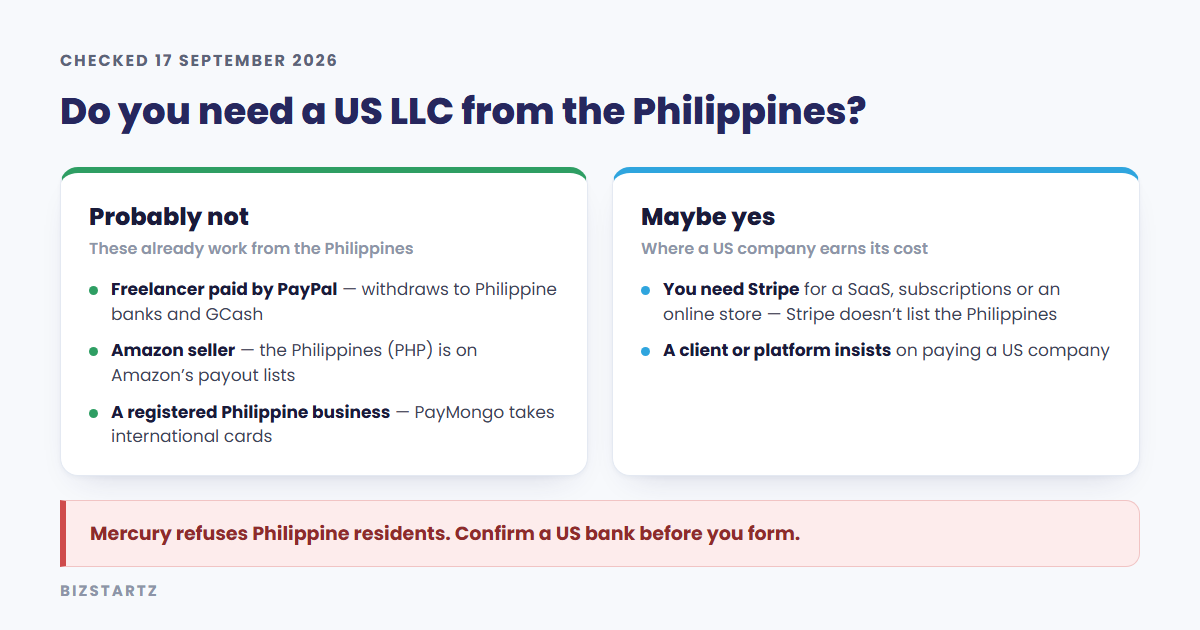
With PayPal, Amazon, Wise and PayMongo available, the case for an LLC narrows to a few situations.
You need Stripe
Stripe doesn’t list the Philippines on its global availability page. Thailand and Malaysia are listed as available, and India and Indonesia are in preview (stripe.com/global, checked 17 September 2026). Stripe’s own guide to payments in the Philippines, dated 21 August 2026, says that “Stripe merchant account availability for local Philippine entities remains subject to regional onboarding rollout” (Stripe: Payment methods in the Philippines).
If you’re building a subscription product, a SaaS, or a store whose checkout, billing tools or app integrations assume Stripe, that’s the strongest reason for a U.S. LLC. The LLC applies to Stripe as a U.S. business, and Stripe still verifies the people behind it. Our guide to opening a U.S. Stripe account as a non-resident covers the application.
A client or platform insists on a U.S. company
Some buyers want to contract with and pay a U.S. entity. If that’s a real requirement from someone paying you, not a hunch, it’s a legitimate reason. Ask them exactly what they need first. Sometimes it’s a U.S. bank account rather than a U.S. company.
Who it probably doesn’t help
- Freelancers whose clients already pay by PayPal, bank transfer or a freelance marketplace.
- Amazon sellers whose only problem was payouts. Pesos are already supported.
- Businesses selling mainly to Philippine customers, who can use PayMongo or another local processor.
- Anyone counting on Mercury.
The U.S. steps, briefly
We’ve written each step up in detail, so here’s the order and the Philippine notes.
- Confirm a bank first. Read the next section before anything else. It’s the step most likely to fail, and checking costs nothing.
- Choose a state. We use Wyoming as the example: filing Articles of Organization costs USD 100, and the annual report license tax is USD 60 or two-tenths of a mill on the company’s Wyoming assets, whichever is greater (Wyoming Secretary of State fee schedule, effective 1 July 2026). Compare states in which U.S. state to choose as a non-resident.
- Appoint a registered agent in that state. Wyoming charges USD 350 to reinstate an LLC that lost its registered agent, so keep it renewed.
- Get the EIN without an SSN, by phone, fax or mail. See how to get an EIN without an SSN.
- Open the U.S. account, then apply to Stripe or whichever platform you formed the company for.
Banking from the Philippines: check this before you form
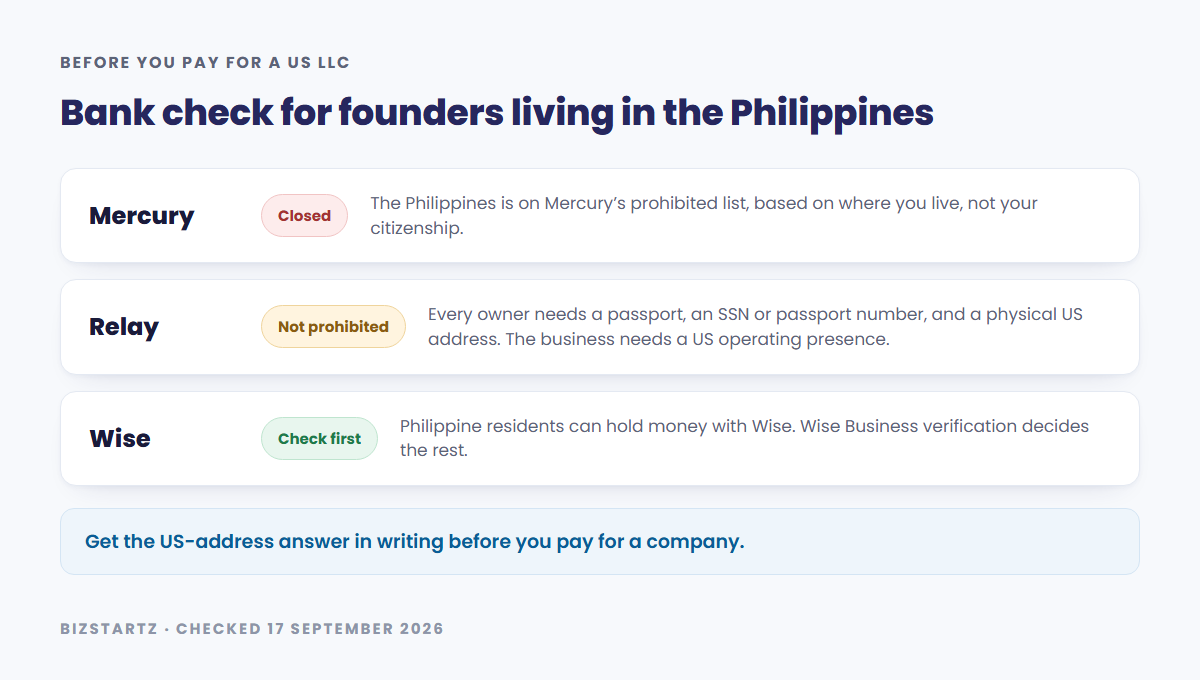
Mercury is closed to founders living in the Philippines
Mercury’s help centre says it is “unable to open accounts for founders living in any of the countries and regions listed below,” and that “this is based on your country of residence, not your citizenship or nationality.” The Philippines is on the list (Mercury: Prohibited countries, checked 17 September 2026).
A Filipino citizen living in, say, Singapore is judged on Singapore. A founder in Cebu is not getting a Mercury account, whatever a formation package promises.
Relay: not banned, but read the requirements
The Philippines isn’t on Relay’s prohibited-countries list (Relay: Prohibited countries, updated 11 August 2026). Relay’s documents page says it accepts U.S. businesses owned by non-U.S. citizens or residents “provided the business has an operating presence in the U.S.,” and asks every beneficial owner for a passport, an “SSN or passport number,” and a “physical U.S. address (no PO boxes, no virtual mailboxes)” (Relay: Required documents, updated 11 August 2026).
The page doesn’t explain how an owner who lives in Manila meets the U.S. address line. Ask Relay in writing before you form the company.
Wise Business
Wise accepts Philippine residents for personal accounts, as above. Whether Wise Business accepts a U.S. LLC owned by someone in the Philippines is decided at verification, and we found no Wise page that answers it directly.
What to check before you pay for a company
- Which bank or payment account will the LLC use, and does its published policy accept an owner living in the Philippines?
- Does it need a U.S. address for you personally, and would a registered-agent or mail-forwarding address count?
- Does Stripe, or whichever platform you formed the company for, accept that account for payouts?
- What’s your second option if the first application is declined?
Our U.S. payment and banking access by country table compares these providers side by side.
What the BSP’s foreign exchange rules say
This is the part U.S. formation services skip. We’re not Philippine lawyers, and nothing here says the route is legal or illegal for you. It sets out what the Bangko Sentral ng Pilipinas has published, with links, so you can take the right questions to someone qualified.
You’re probably a “resident” and your LLC is not
The BSP defines a resident as including “an individual citizen of the Philippines residing therein,” a non-citizen “permanently residing therein or has resided in the Philippines for a year or longer,” and a corporation organised under Philippine law. Anyone else is a non-resident (BSP: FAQs on FX regulations, March 2026). On that definition a Wyoming LLC is a non-resident, which puts your stake in it within the BSP’s rules on outward investment.
Outward investment: no prior BSP approval below USD 60 million a year
The BSP’s FAQ on inward and outward investments (March 2026) explains Sections 43 and 44 of its Manual of Regulations on Foreign Exchange Transactions (BSP: Inward and outward investment FAQs):
- The outward investment rules apply “only if the issuer of the investment instrument is a non-resident.”
- Residents may fund investments in instruments “issued/created offshore by non-residents” with foreign currency bought from banks, “provided these are not contrary to applicable Philippine laws, rules and regulations.”
- To buy that foreign currency, you give the bank an Application to Purchase FX (Annex A) and the documents in Appendix 1.4, “evidencing, among others, the outward investment to be made under the name of the resident investor.”
- Buying more than USD 60 million in a calendar year still needs no prior approval, but you must send the BSP a notification (Annex U).
Search results also quote a BSP foreign investment guide page as saying residents may invest without prior approval when the money is their own foreign currency or comes from sources other than banks. That page returned an error when we tried to open it, and we couldn’t read Section 43 of the manual itself, so treat that point as unconfirmed.
For a small LLC, the practical effect is paperwork. If you buy dollars from a Philippine bank to pay the formation fee or fund the company, expect the bank to ask what it’s for and to want documents in your name. The BSP’s FAQ also says banks can ask for more than the manual requires as part of their know-your-customer checks.
That’s a much lighter framework than in Bangladesh, where the published route is for exporting companies only. It still doesn’t settle whether your particular setup is compliant, and it says nothing about tax.
Questions to take to a Philippine lawyer or CPA
- Am I a “resident” under the BSP definition, and does owning a U.S. LLC count as an outward investment under Sections 43 and 44?
- What documents will my bank want if I buy dollars to form or fund the LLC, and what if I fund it from dollars I already hold abroad?
- If the LLC pays me for my services, is that a service payment to me or a return on my investment, and does the difference matter for the BSP or the BIR?
- How does the BIR treat a single-member U.S. LLC owned by a Philippine resident: as a separate company, or as me?
- Do I need to register the business activity with the BIR, and which tax option fits?
- How do I claim credit in the Philippines for any U.S. tax paid?
Philippine tax: worldwide income and BIR registration
Section 23(A) of the National Internal Revenue Code says “a citizen of the Philippines residing therein is taxable on all income derived from sources within and without the Philippines” (NIRC, RA 8424). Money that reaches you from a U.S. company is income from outside the Philippines, which that rule covers.
The BIR’s Revenue Memorandum Circular 60-2020, issued 10 June 2020, tells people “conducting business through any forms of electronic media” to register their business with the BIR. It lists the obligations that follow: registered invoices or receipts, books of accounts, withholding where applicable, tax returns and payment on time (BIR: RMC 60-2020 digest).
For self-employed individuals, the TRAIN law (RA 10963) added an option to pay 8% on gross sales or receipts above PHP 250,000, instead of graduated rates and percentage tax, where gross sales don’t exceed the PHP 3,000,000 VAT threshold (RA 10963). We haven’t checked whether later laws changed those figures, so confirm them with a CPA.
What we couldn’t find: any BIR guidance on how a Philippine resident’s single-member U.S. LLC is treated, including whether its profit is taxed when earned or only when paid out to you. That question decides your Philippine tax, and it’s one for a Philippine CPA.
U.S. tax: Form 5472 every year, and the treaty
A single-member LLC owned by a non-U.S. person is a “foreign-owned U.S. disregarded entity” for this filing. Every year it files a pro forma Form 1120 with Form 5472 attached and “Foreign-owned U.S. DE” written across the top, even if it owes no U.S. tax. It can’t file electronically. It faxes to 855-887-7737 or mails to the IRS in Ogden, Utah. The penalty for not filing is USD 25,000, with another USD 25,000 if the failure continues more than 90 days after an IRS notice (IRS Instructions for Form 5472, Rev. 12/2024). More in our guide to Form 5472 for foreign-owned LLCs.
When a U.S. client or platform asks for a tax form, the IRS instructions say “the owner of a disregarded entity (including an individual), rather than the disregarded entity itself, must submit the appropriate Form W-8BEN” (IRS Instructions for Form W-8BEN, Rev. 10/2021). That’s you, not the LLC.
The Philippines has an income tax treaty with the United States. It’s on the IRS list (IRS: treaties A to Z, updated 3 January 2026). It was signed in Manila on 1 October 1976 and entered into force on 16 October 1982 (treaty text on irs.gov). Article 8 covers business profits, and Article 23(2) has the Philippines allow its citizens and residents a credit for U.S. tax paid, within Philippine law’s limits. The treaty doesn’t remove the Form 5472 filing. How it applies to your income is a question for a U.S. tax adviser, and the Philippine side is a question for your CPA.
Getting the money home
From the LLC’s U.S. account, the usual routes to the Philippines are an international wire to your Philippine bank, or a transfer through Wise to your personal Wise account and then to your bank. We haven’t verified wire fees, which vary by bank.
The BSP doesn’t approve incoming transfers. Its FAQ says “BSP does not issue any approval or clearance for transfer of funds,” and that incoming foreign currency is subject to your bank’s know-your-customer checks and the Anti-Money Laundering Act. Banks may hold a remittance whose purpose isn’t declared (BSP: FAQs on FX regulations, March 2026). Keep invoices and your LLC’s records ready.
The same FAQ says a resident’s foreign currency receipts “from non-trade sources” may be “sold for pesos, retained or deposited in foreign currency accounts (whether in the Philippines or abroad).” The FAQ treats trade as merchandise, so service income looks like it falls under non-trade, but that’s our reading, not the BSP’s wording. Confirm it before you leave earnings abroad for long.
What the money is matters as much as how it travels. A payment from your LLC for work you did looks like service income. A distribution of the LLC’s profit is a return on a company you own abroad. Settle which fits your setup with your CPA before the first transfer.
What it costs
Only figures we could source:
- Wyoming filing: USD 100 to file, then an annual report license tax of at least USD 60 a year (Wyoming fee schedule, effective 1 July 2026).
- Formation service: Bizstartz packages are USD 199, USD 299 or USD 699, plus the state fee (our pricing page). Other providers charge differently.
- EIN: free from the IRS.
- Every year: the state’s annual tax, registered agent renewal, and the Form 5472 filing, whether you prepare it yourself or pay someone to.
- Payment fees: for comparison, PayPal’s Philippine and PayMongo’s rates are quoted above. A U.S. Stripe account has its own pricing, which we haven’t quoted here.
- Not priced here: registered agent renewal, bank and wire fees, and advice from a Philippine CPA or lawyer. Get quotes. Set the total against what PayPal, Amazon, Wise or PayMongo would cost you with no company at all.
Who this suits, and where to start
It can make sense if you need Stripe for a subscription product, SaaS or online store, or a client genuinely requires a U.S. company. Your revenue should cover the yearly filings and fees, you should have a bank that accepts an owner living in the Philippines confirmed in writing, and a Philippine CPA should have looked at how the income will be taxed.
It probably doesn’t if PayPal, Amazon payouts, Wise or a local processor already covers how you get paid, or you were counting on Mercury.
Start with the cheap checks. Find out which platform you actually need, confirm a bank, and ask a Philippine CPA the questions above. Form the company last.
If you decide a U.S. company fits, Bizstartz forms U.S. LLCs for non-resident founders and handles the EIN and bank application steps (U.S. company formation). A free 30-minute consultation is a good place to check the U.S. side, including which bank is realistic for you, before you spend anything. The Philippine side needs a Philippine CPA or lawyer.
This guide was researched with the help of AI tools. Each legal, fee and availability claim links to the source it came from, and the sources were checked on 17 September 2026. Where we couldn’t confirm something, the text says so. Rules in this area change often, so check the linked sources again before you act.
🎯 Ready to start? Claim your free consultation and we'll map out your US LLC formation strategy — EIN, banking, and the right state for your country.

Ready to start your company?
Bizstartz handles formation, EIN, banking and compliance for founders worldwide.