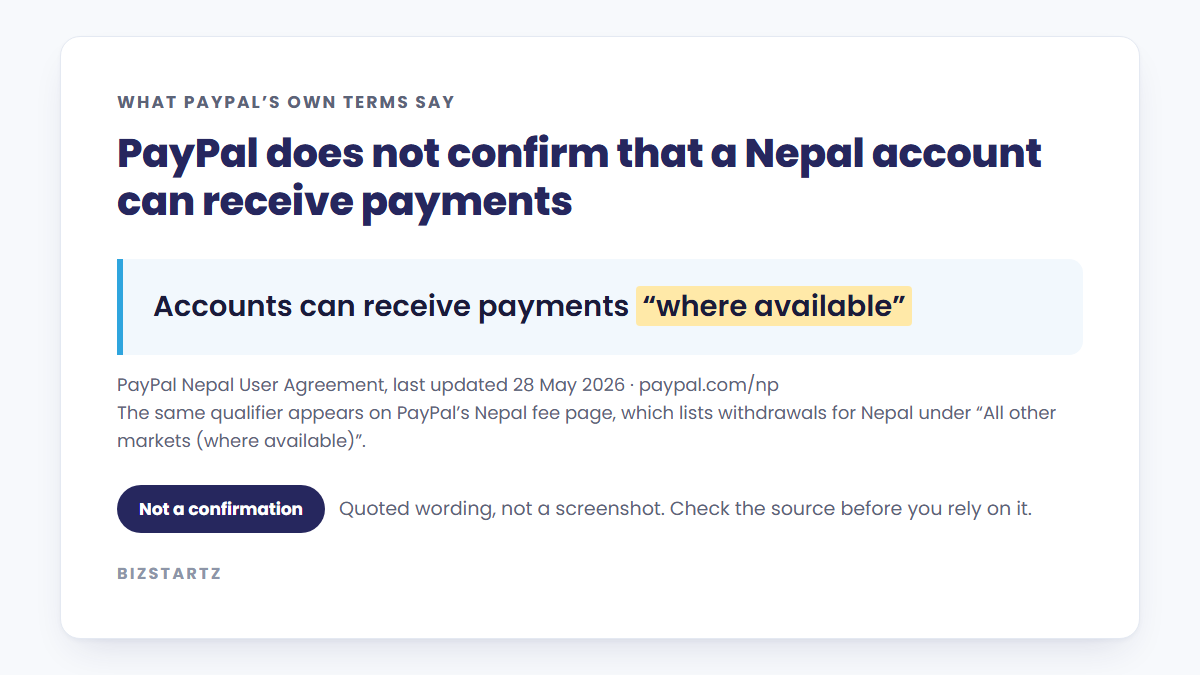
The short answer on using PayPal in Nepal (checked 14 September 2026): not in a way you can rely on to get paid. PayPal runs a Nepal website with its own Nepal user agreement, but that agreement, last updated 28 May 2026, only says accounts can receive payments “where available”.
Nothing on PayPal’s Nepal pages confirms that an account registered in Nepal can receive client payments or withdraw to a Nepali bank. Nepal Rastra Bank (NRB) has been working on bringing PayPal in since 2024, and has asked Fonepay and Standard Chartered to help. PayPal itself has announced nothing.
So when a client abroad asks “can I pay you by PayPal?”, the honest answer from Nepal today is “not directly”. This guide covers what does work: a bank transfer, Payoneer, Khalti’s new Stripe-powered payment request, or a U.S. company with its own PayPal Business account. It also covers what most guides leave out, which is what Nepal’s law says about owning that U.S. company, and what each route costs.
In this guide: Is PayPal available in Nepal? · What works today · The U.S. LLC route · Is it legal from Nepal? · Getting the money home · The routes compared · Where to start
Is PayPal available in Nepal right now?
Start with PayPal’s own pages, because they are the only source that can settle this.
- The PayPal Nepal home page is about paying: sending money, shopping and buyer protection. It says nothing about getting paid for your work.
- The Nepal user agreement (last updated 28 May 2026) says accounts can receive payments “where available”. It never says receiving is available in Nepal.
- The Nepal fee page (same date) lists withdrawals for Nepal under “All other markets (where available)”. The same qualifier again.
PayPal does not write “not available”. But when a company’s legal terms stop at “where available” and every other page is about spending, you should not build a business on the assumption that Nepali clients’ money will come through.
The NRB plan to bring PayPal to Nepal, with dates
- 17 September 2024: Banking News reported that NRB was planning to introduce PayPal for cross-border payments. The report named no official.
- 20 February 2025: NRB Deputy Governor Bam Bahadur Mishra said the central bank had sought to connect with PayPal and had asked Fonepay and Standard Chartered Bank to get in contact with it (Nepali Telecom).
- April 2026: still not launched, and still no announcement from PayPal. Nepali tech sites projected a launch somewhere between mid-2026 and early 2027 (Merokalam). That window is their estimate. Neither NRB nor PayPal has given a date.
- 14 September 2026: we found no launch announcement from PayPal or NRB.
Until PayPal publishes terms that say a Nepal account can receive business payments and withdraw to a Nepali bank, plan as if it can’t.
How people in Nepal get paid from abroad today
Three routes are in common use, and none of them involves owning a company abroad.
A bank transfer (SWIFT) straight to your Nepali bank
The oldest route still works. Nepal’s larger commercial banks have SWIFT codes (Standard Chartered Nepal is SCBLNPKAXXX, NIC Asia is NICENPKAXXX), so a client abroad can wire money to your account the way they would pay any overseas supplier.
If you want to hold dollars instead of having them converted on arrival, you need a foreign currency (FCY) account. These are open to people with foreign income, and banks ask you to prove it. Nabil Bank’s USD savings account, for example, is for “individuals having FCY income source and are eligible for maintaining FCY accounts”. It asks for foreign income source documents and holds a USD 500 minimum balance as a lien (Nabil Bank). Standard Chartered’s FCY savings account asks for Nepali residency and a citizenship certificate or passport.
The catch is cost and convenience. The sending bank, any intermediary bank and your own bank can each take a fee, and those fees vary too much for us to quote a figure. Ask your bank what it charges on an inward SWIFT transfer before you send a client your details. It also doesn’t help a client who wants to pay by card.
Best for: agencies and anyone invoicing businesses that already pay overseas suppliers by wire.
Payoneer
Payoneer gives you receiving account details, such as a U.S. account number, so clients and marketplaces can pay you as if you were local to them. You then withdraw to your own bank. Its published pricing (last updated 1 January 2026):
- Client pays by credit card: up to 3.99% + USD 0.49
- Client pays by ACH bank debit (U.S. only): 1%
- Payments from marketplaces: varies by marketplace
- Withdrawal to a bank account with currency conversion: 1.2% to 4%
- Annual account fee: USD 29.95, charged only if the account receives less than USD 6,000 in 12 consecutive months
Payoneer adds that “different prices and fees may be applied in different territories”, so treat those as the standard rates, not a quote for Nepal.
Nepali freelancer guides describe withdrawing Payoneer balances to a Nepali bank account in rupees (for example Amarnepal’s guide, verified 25 July 2026), and it is the tool you’ll hear about most. We could not find Nepal-specific terms on Payoneer’s own public pages, though. Its Nepal page is a generic landing page. Check the fees and the withdrawal options inside Payoneer’s sign-up before you give clients your receiving details.
Payoneer isn’t PayPal. A buyer who expects a PayPal button at checkout won’t see one.
Khalti’s Stripe-powered payment request
Since 20 April 2026, Khalti (by IME) has let you request an international payment from inside the Khalti app. You enter the sender’s country, currency, amount and purpose, plus your own PAN, and send them a link; they pay by card, Apple Pay, Google Pay or an international bank transfer on a Stripe-powered page, after a one-time identity check. The money arrives in your Khalti wallet in rupees (Khalti: receive international payments via Stripe, 20 April 2026).
- Cost: a 2% service fee, and 5% advance tax (TDS) deducted before payout and recorded against your PAN (Khalti’s FAQ for the service, 21 April 2026).
- What it can’t do: it is a payment request sent to one person, not a checkout button, and it does not do subscriptions. It is inward only — you cannot send money out of Nepal with it.
- Unanswered: Khalti’s published transaction limits and charges pages don’t mention this service at all, while the general wallet rules say you may not hold more than Rs 50,000 overnight. Ask Khalti before you invoice a large amount.
Best for: freelancers and creators being paid by a client, where no company abroad is needed. Full detail in our guide to getting Stripe from Nepal.
What NRB and the tax rules expect when the money arrives
Whichever route you use, the money reaches you through a Nepali bank, and a few rules follow it in:
- Proof of source. Expect your bank to ask where foreign money came from. Nabil’s requirement for “foreign income source documents” is typical. Keep invoices and contracts for every client payment.
- Spending your earnings on tools. An NRB circular in April 2026 (10/2082/83) lets Nepali citizens who earn foreign currency online pay up to USD 25,000 a year through the banking channel for IT services they buy, a facility previously limited to institutions. (Source: PKF T R Upadhya & Co.’s summary of the circular, 8 April 2026. NRB lists its circulars on its Foreign Exchange Management Department page.)
- Tax. Nepal’s budget for FY 2025/26 set a 5% final tax on income that Nepal-resident individuals earn by providing IT-related services abroad (SAR Associates’ budget highlights, 31 May 2025). The FY 2026/27 budget then announced a 50% income tax exemption on income from exporting IT services (ICAN budget highlights, June 2026). How the two apply to an individual freelancer this year is a question for a tax adviser or the Inland Revenue Department.
You’ll also read on Nepali forums that banks deduct the 5% automatically, that foreign earnings must be converted to rupees within a set number of days, and that you can keep a fixed share in dollars. We couldn’t confirm any of these in an NRB document, so ask your bank rather than relying on a forum post.
Using someone else’s PayPal account
Plenty of people get paid through a relative’s or friend’s PayPal account abroad. Look at who holds what. The account belongs to them, the money lands in their bank, and the income sits in their name and tax record. You have no contract with PayPal and no way to get the money back if the account is limited or the relationship sours.
The U.S. LLC route: how it gets you PayPal Business
This is the route people mean when they say “get PayPal from Nepal”. You form a U.S. LLC, get it an EIN (the company’s U.S. tax number, which doesn’t need an SSN), open a U.S. bank account in the company’s name, then open a PayPal Business account for the company and link that bank account. Your clients pay the LLC, not you. Our step-by-step guide to opening PayPal Business with a U.S. LLC covers the sign-up screens. The first two steps are covered in forming a U.S. company from Nepal and getting an EIN without an SSN.
The same structure is how people from Nepal use Stripe, which doesn’t list Nepal as a supported country on its global availability page. See getting Stripe from Nepal.
What PayPal requires of a non-resident owner
Here is what PayPal publishes, and where it goes quiet.
- The business must be American, not you. PayPal’s U.S. user agreement (last updated 1 September 2026) says a business “must be organized in, operating in, or a resident of, the United States”. A U.S. LLC meets that. Nothing in that sentence requires the owner to live in the U.S. (PayPal U.S. User Agreement)
- Foreign owners identify with a passport. PayPal collects details of every person who owns 25% or more of the business, plus one person with control: name, address, date of birth and Social Security Number, “or passport number or other similar information in case of foreign persons” (PayPal Help).
- The tax number is the unsettled part. An LLC with one owner is “disregarded” for U.S. income tax by default (IRS). For that kind of LLC, PayPal says you must provide “your owner’s TIN”, and gives an SSN as its example. PayPal also says non-U.S. tax residents complete a Form W-8 instead (PayPal Help).
What PayPal does not publish is which of those it will accept from a Nepal-resident owner of a single-member LLC: the LLC’s EIN alone, a W-8BEN, or a personal U.S. tax number. If PayPal asks for a personal number, the one a non-resident can get is an ITIN. This matters because PayPal says that failing to give requested tax information can lead to “tax holds” and “24% backup withholding”. Our advice is to have your answer ready before the account gets busy, not after a hold.
The bank account is the hard part from Nepal
PayPal pays out to a linked bank account or an eligible debit card (PayPal Help), so in practice the LLC needs a U.S. business bank account. This is where living in Nepal narrows your options:
- Mercury won’t open accounts for founders who live in Nepal. The rule is based on where you live, not your passport (Mercury Help, checked 14 September 2026). Older guides that recommend Mercury to Nepal founders are out of date.
- Relay doesn’t list Nepal on its prohibited countries page. Not being on that list isn’t the same as approval: Relay’s document requirements ask every owner for a physical US address (no PO boxes or virtual mailboxes) and expect the business to have an operating presence in the US.
- Wise doesn’t include Nepal in its list of countries where you can hold money. Whether Wise Business accepts a U.S. LLC owned by someone in Nepal is decided at verification.
Have a second bank in mind before you start. Our guide to opening a U.S. business bank account from Nepal covers the application itself.
What the LLC route costs
- Forming the company: a service fee plus the state filing fee. In Wyoming, filing Articles of Organization costs USD 100 and the annual report license tax is at least USD 60 a year (Wyoming Secretary of State fee schedule, effective 1 July 2026). Bizstartz’s packages are USD 199 to USD 699 plus the state fee (our pricing page). Other providers charge differently.
- PayPal fees: 3.49% + USD 0.49 per PayPal Checkout payment, an extra 1.50% when the payment crosses borders, and a 4.00% spread when PayPal converts currency (PayPal merchant fees). On a USD 1,000 payment from a client outside the U.S., that works out to USD 50.39 before any conversion (our arithmetic from those rates).
- Every year after: registered agent renewal, the state’s annual fee, and a Form 5472 with a pro forma Form 1120. A foreign-owned single-member LLC files these even when it owes no U.S. tax, and the penalty for not filing is USD 25,000 (IRS Instructions for Form 5472). More in our guide to Form 5472 for foreign-owned LLCs.
Is the U.S. LLC route legal if you live in Nepal?
Nepal has a law about this, and it’s the reason we won’t call the U.S. LLC route “completely legal” for people who live in Nepal.
The Act Restricting Investment Abroad, 2021 B.S. (1964) is short. Section 3 says: “No one shall make any kind of investment abroad after the commencement of this Act.” Section 2 defines investment to include foreign securities, “partnership of a foreign firm”, a “foreign bank account”, real estate abroad, and “any other kind of cash or in-kind investment whatsoever made abroad”. Section 4 sets the penalty: a fine equal to the amount involved, up to six months’ imprisonment, or both.
Owning a U.S. LLC is owning a stake in a foreign company. Keeping money in its U.S. bank account is holding money abroad. Read plainly, both fall inside that definition. The Act was still in force as of July 2026, and we found no sign of its replacement passing by 14 September 2026.
The exceptions that exist
The Act lets the government exempt investments by notice in the Nepal Gazette, and later rules have opened some doors (Law Bhandari & Associates, 18 August 2025):
- Nepali IT companies with a track record. A company registered in Nepal that has exported IT services for at least three fiscal years may invest in IT businesses abroad with NRB approval, up to half of its average foreign-currency earnings or USD 1 million, whichever is lower (ekantipur, 12 January 2025).
- Technology-transfer earnings can be reinvested abroad.
- Non-Resident Nepalis, including people of Nepali origin who hold foreign passports, may invest using money earned abroad.
- Industries exempted by Gazette notice.
The first one is worth noticing if you run an agency. Register a Nepali IT company, build three years of export earnings, and a U.S. subsidiary with NRB approval becomes possible. It’s slower, but it is a route the law actually describes.
What we could not find is an exception for an individual who lives in Nepal and forms a U.S. company for their own freelance or online business. That isn’t the same as saying it’s definitely illegal for you: your facts may fit one of the exceptions, and we aren’t Nepal-qualified lawyers. It does mean you shouldn’t treat the route as “fully legal” by default.
The law is changing, but hasn’t changed yet
In July 2026 the Ministry of Finance put a draft foreign exchange bill out for public comment. It would repeal both the 1964 Act and the Foreign Exchange (Regulation) Act of 1962 and replace a near-total ban with regulated outward investment. As of 23 July 2026 it was still at consultation and had not reached the Council of Ministers or Parliament (Review Nepal). The FY 2026/27 budget also promised to ease investment abroad by Nepali citizens (ICAN).
Don’t read the draft as a free pass. As reported, it would still require Nepali citizens to get central bank approval before opening accounts with foreign banks, and would let only specific categories invest abroad (Nepal News). Until something passes, the 1964 Act is the law.
Questions to take to a Nepal-qualified lawyer
Book time with a lawyer who practises Nepali foreign exchange law, and take these questions:
- Do I fit any existing exception: an IT company with three years of exports, NRN status, technology-transfer earnings?
- In my situation, does forming and funding a U.S. LLC count as investment abroad?
- Can money sit in the LLC’s U.S. bank account, and if so, for how long?
- Can I keep a balance in Payoneer, or should I withdraw each payment as it arrives?
- How should payments from the LLC to me be documented and taxed in Nepal?
- If I already own a U.S. company, what should I do about it now?
Getting the money home from a U.S. account
Once PayPal pays your LLC, you move the balance to the LLC’s linked U.S. bank account. From there, you have two ways to get it to Nepal:
- An international wire from the U.S. bank to your Nepali account. It arrives through SWIFT like any other overseas payment, with the same fee caveats as above.
- Wise. Wise sends U.S. dollars as rupees to bank accounts in Nepal, up to 1,000,000 NPR per transfer and 2,000,000 NPR per day per recipient and per sender. It can only pay individuals, not businesses, in Nepal (Wise’s guide to NPR transfers). You’ll need a Wise account on the sending side, and for a Nepal-resident owner that approval isn’t guaranteed.
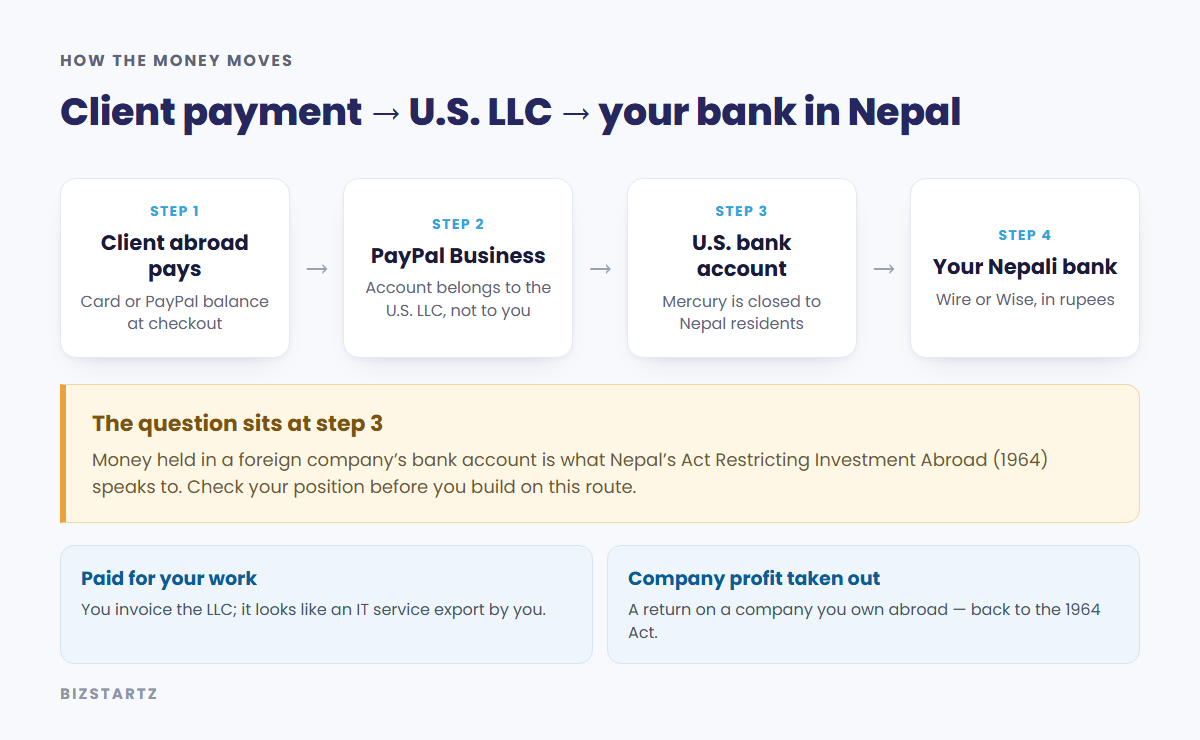
The harder question is what that money is when it lands. Your Nepali bank will ask, and there are two different answers:
- Payment for your work. You invoice your LLC for services you provided, and it pays you. That looks like an IT service export by you, which is the kind of income the tax and NRB rules above describe.
- A distribution of company profit. The LLC earned the money and you’re taking the profit out. That is a return on a company you own abroad, which brings you back to the 1964 Act.
The paperwork, the tax treatment and the legal exposure can all differ between the two. Which fits your setup is exactly what to settle with your lawyer and tax adviser before the first transfer, not after the tenth.
The routes side by side
| Route | Who it suits | Cost signals (sourced) | What it can’t do | Status in Nepal |
|---|---|---|---|---|
| PayPal with a Nepal account | Paying for things online | No fee on purchases without currency conversion (PayPal Nepal fee page, 28 May 2026) | PayPal doesn’t confirm receiving or withdrawing to a Nepali bank | NRB-led launch discussed since 2024; not launched and no PayPal announcement as of 14 September 2026 |
| SWIFT transfer to a Nepali bank | Agencies and freelancers invoicing businesses | Bank and intermediary fees vary; ask your bank | Card payments; clients who insist on PayPal | Standard banking channel; expect source-of-funds questions |
| Payoneer | Marketplace freelancers; clients paying by card or U.S. bank debit | Card up to 3.99% + USD 0.49; ACH 1%; withdrawal with conversion 1.2%–4%; USD 29.95 a year if under USD 6,000 received (Payoneer, 1 January 2026; may vary by territory) | A PayPal button at checkout; Nepal-specific terms aren’t on Payoneer’s public pages | Widely used by Nepali freelancers; not named in the 1964 Act; we found no NRB rule naming it |
| U.S. LLC + PayPal Business | Businesses whose buyers expect PayPal checkout | Formation fee + state fee (Wyoming USD 100, then USD 60+ a year); PayPal 3.49% + USD 0.49, +1.50% cross-border, 4.00% conversion; yearly Form 5472 | Guarantee a U.S. bank (Mercury is closed to Nepal residents); PayPal’s tax-ID rule for a foreign single owner isn’t published | A Nepal resident owning it falls under the 1964 Act; limited exceptions; get Nepal legal advice first |
| Someone else’s PayPal abroad | No one, long term | Nothing on paper | Give you ownership, control or recourse | Your income sits in another person’s legal name |
| Khalti’s Stripe-powered payment request | Freelancers and creators invoicing one client at a time | 2% service fee plus 5% advance tax deducted before payout (Khalti FAQ, 21 April 2026) | No checkout button, no subscriptions, and no sending money out of Nepal | Live since 20 April 2026; Khalti publishes no limit for it, and its wallet rules cap overnight balance at Rs 50,000 |
Where to start with PayPal in Nepal
If you’re a solo freelancer, an FCY account at a Nepali bank plus Payoneer handles clients who pay by bank transfer, by card or through a marketplace, without a company abroad. When a client asks for PayPal, offer those two instead.
If your buyers genuinely need PayPal checkout and your volume justifies the yearly costs, speak to a Nepal-qualified lawyer first, then decide on the U.S. company. If you already run a Nepali IT company with export history, ask that lawyer about the NRB-approved route to a U.S. subsidiary. It is the version the law spells out.
If you decide a U.S. company fits your situation, Bizstartz forms U.S. LLCs for non-resident founders and handles the EIN and bank application steps. A free 30-minute consultation is a good place to check the U.S. side before you spend anything. The Nepal side needs a Nepali lawyer.
This guide was researched with the help of AI tools. Each legal, fee and availability claim links to the source it came from, and the sources were checked on 14 September 2026. Where we couldn’t confirm something, the text says so. Rules in this area change often, so check the linked sources again before you act.
🎯 Ready to start? Claim your free consultation and we'll map out your US LLC formation strategy — EIN, banking, and the right state for your country.

Ready to start your company?
Bizstartz handles formation, EIN, banking and compliance for founders worldwide.