Yes. Amazon accepts sellers who live in Nepal. Nepal sits on Amazon’s own list of countries accepted for seller registration (checked 16 September 2026), alongside India, Bangladesh, Pakistan and Sri Lanka. You do not need a U.S. company to be eligible.
That is the part almost every guide on this topic gets wrong. The problem is not the front door. It is what happens after you walk through it: Amazon has nowhere in Nepal to send your money, the tax interview has a gap that affects Nepali sellers specifically, and getting stock into a U.S. fulfilment centre is a customs job you own from end to end.
This guide walks through each of those, with Amazon’s own pages as the source, and says plainly where a U.S. LLC changes the answer and where it changes nothing.
In this guide: Can you sell from Nepal? · What Amazon asks for · Getting paid — the real blocker · The tax interview · Amazon.com or Amazon.in · Shipping, FBA and customs · Does a U.S. LLC help? · Nepal’s side · What it costs · Where to start
Can you sell on Amazon from Nepal?
You can register. Amazon’s accepted-countries page states the test in one sentence: “you must be resident in one of the following countries, have a valid phone number, and have an internationally chargeable credit card.” Nepal is in the list that follows.
Note what is absent from that sentence. There is no requirement to hold a company anywhere. There is no requirement that your bank account be in any particular country — the page is silent on bank location, and that silence is where most people’s plans quietly fall apart later.
It is worth comparing this with the payment platforms Nepali founders usually hit first. Stripe does not list Nepal at all, although Khalti now runs a Stripe-powered payment request for inward client payments — which is not a way to take Amazon payouts. PayPal’s Nepal user agreement never confirms that receiving works there — we went through that in detail in Is PayPal available in Nepal?. Amazon is the outlier here: it says yes at the door.
What Amazon asks for at registration
Amazon’s registration requirements by marketplace page lists, for Amazon.com, a “valid credit card, bank account, phone number, and tax information”, plus an online tax interview. It then adds that you “might also be required to provide additional documentation such as scanned copies of a passport, national ID, bank account statement, or credit card statement.”
Two practical points about that list.
First, “internationally chargeable credit card” is a real hurdle in Nepal, not a formality. Amazon charges the card and needs it to work in USD. A card that only functions domestically will fail the check.
Second, the documents you upload have to match each other exactly — the same legal name, the same address, in the same script. Mismatches are the most common cause of rejection, and we covered the specific failure patterns in the hidden reasons behind Amazon seller account rejections.
Amazon does not publish a document-age limit or a language rule for the U.S. marketplace on that page. If you have read elsewhere that documents must be “issued within 90 days”, that figure is not on Amazon’s help page — treat it as unconfirmed.
Getting paid: the real blocker
This is the section that decides whether an Amazon business in Nepal is viable, and it comes down to a detail almost nobody notices.
Amazon’s Seller Wallet page carries two different country lists
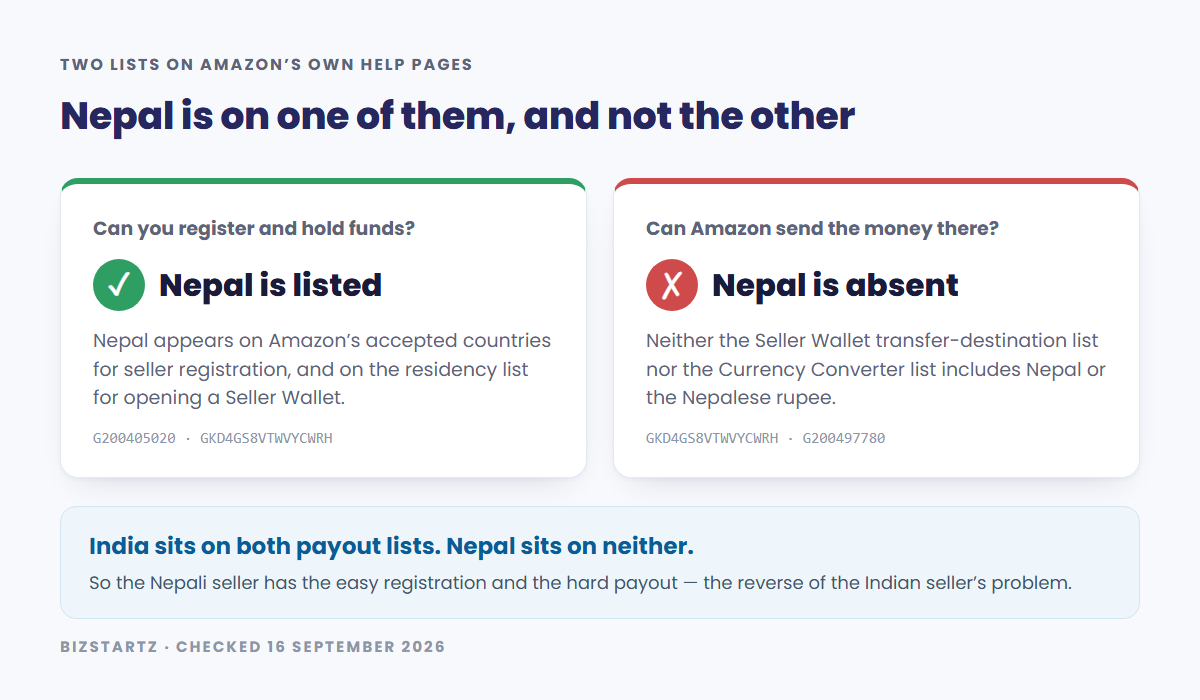
The Seller Wallet supported countries page (checked 16 September 2026) has one list of countries where you may be resident in order to open a Seller Wallet, and a separate, much shorter list of countries you may transfer money to. Amazon’s wording on the second: “Transfers to your bank account from Seller Wallet can only be made to bank accounts in the supported countries and regions listed below.”
Nepal is in the first list and not in the second. You can be eligible to hold a Seller Wallet and still have nowhere to withdraw it to.
The transfer list is short — the eurozone, the U.K., the U.S., Australia, Bulgaria, Canada, Switzerland and Liechtenstein, China, the Czech Republic, Denmark, Hong Kong, Hungary, India, Morocco, Mexico, Norway, New Zealand, the Philippines, Poland, Romania, Singapore, Sweden, Taiwan and the U.A.E. No Nepal, and no Nepalese rupee.
The standard disbursement route says the same thing
Seller Wallet is not the only payout path, so we checked the other one. Amazon Currency Converter for Sellers publishes its own supported countries and currencies list. It is slightly longer — it adds Argentina, Japan, South Korea and Türkiye — and Nepal and NPR are absent from that one too.
Two independent Amazon pages agree. Amazon will not send money to a bank account in Nepal.
So what do sellers in Nepal actually do?
Amazon’s answer is the Payment Service Provider Program, which governs any third-party account you use to receive Amazon money. The clearest published version of it is Amazon’s KDP help page, which says the program “limits the types of bank accounts that we accept for the disbursement” and that, as of 1 August 2026, Amazon has “stopped making payments to KDP accounts that are using a PSP that is not participating in the Payment Service Provider Program, or have not completed the know-your-customer verification (KYC)”. The instruction is to “switch to a participating PSP or use an account which you opened directly with a deposit-taking bank.”
That wording is from the KDP side of the program — the Seller Central copy of the page would not render for us — but the program itself runs across Amazon, and the list of providers is the same. Providers named as participating include Payoneer, Wise, WorldFirst, PingPong and Airwallex.
That narrows things to two realistic routes, and both need checking before you commit:
- A participating payment service provider. Payoneer is the one Nepali sellers reach for. It is on Amazon’s participating list. What we could not confirm is Payoneer’s own position on Nepal: its “where we operate” page returns a 404, its Nepal URL serves the generic global homepage with no Nepal content, and its withdraw-to-bank FAQ says only that the feature is “subject to availability” with fees “displayed in the withdrawal summary page”. Forum posts quoting Nepali withdrawal limits and fees are not a source we will repeat. Ask Payoneer directly, in writing, before you build on it.
- A bank account in one of Amazon’s supported countries. For most people reading this that means a U.S. account, which in practice means a U.S. entity. That is the honest reason the LLC conversation exists — see below.
Wise is on Amazon’s participating list, but Nepal is not on Wise’s list of countries where you can hold money, so it does not solve the same problem.
The tax interview, and the gap that hits Nepal specifically
Amazon requires this of everyone: “All sellers on Amazon.com and merchants on Amazon Pay, regardless of the number of transactions they have in a calendar year, are required to complete the Tax Information Interview” (Amazon Pay help). A non-U.S. individual ends up on a W-8BEN; a non-U.S. entity on a W-8BEN-E. A U.S. LLC with an EIN goes down a different branch of the same interview.
It is not a formality you can defer. Amazon’s page states that “failure to maintain a current Form W-8 will result in suspension of your selling privileges”, and that invalid tax information left uncorrected for 30 days leads to the same place.
Here is the part that is specific to Nepal. Part II of a W-8BEN is where you claim benefits under an income tax treaty. Nepal has no income tax treaty with the United States. The IRS A-to-Z treaty list (last updated 3 January 2026) runs from Morocco straight to the Netherlands. A seller resident in India can point at a treaty. A seller resident in Nepal has nothing to point at.
Whether your particular Amazon activity creates a U.S. filing obligation is a question about your facts — where inventory sits, who does what and where — and Amazon’s help pages do not decide it. We are not going to pretend otherwise. What is settled is that the treaty fallback other South Asian sellers rely on is not available to you, so the U.S. tax question deserves a real answer from a U.S. tax adviser rather than a guess.
Amazon.com or Amazon.in?
People in Nepal often assume Amazon.in is the easier target because it is next door and the shipping is short. The registration requirements point the other way.
Amazon’s Indian seller site asks for “your proprietorship details, contact details, bank account, PAN Number and GST”, and states flatly: “You need to have GST to Sell on Amazon.” PAN and GSTIN are Indian tax registrations, and the bank account is an Indian one. Amazon.in does not publish a rule about foreign nationals that we could find, so we will not claim it bans anyone — but its published requirements are a set of Indian registrations that a Nepal resident does not have.
Amazon.com asks for none of that. It asks for residency in an accepted country, which you have.
There is an irony worth noting. India is on both of Amazon’s payout lists, in INR. Nepal is on neither. So an Indian seller has the harder registration and the easy payout; a Nepali seller has the easy registration and the hard payout.
Shipping, FBA and customs from Nepal
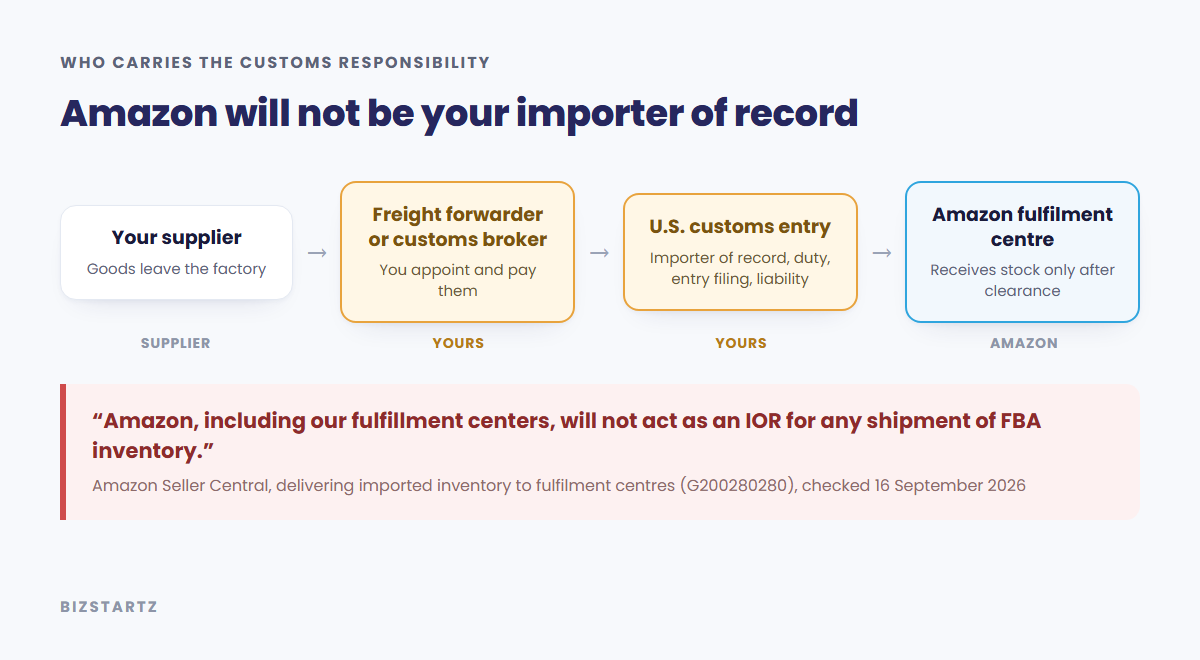
FBA is open to you. Nothing on Amazon’s eligibility or registration pages requires a U.S. entity to use it. What FBA does not do is handle the import.
Amazon’s page on delivering imported inventory to fulfilment centres is unusually direct: “Amazon, including our fulfillment centers, will not act as an IOR for any shipment of FBA inventory.” It adds that “attempting to list Amazon as the PGA importer or consignee, or using an Amazon DUNS number, may result in detentions and seizures at the border.” Amazon can appear as ultimate consignee, but “only if in care of FBA is listed before the name of the Amazon entity.”
Importer of record is a real legal role, with duties, entry filing and liability attached. You take it on, or you appoint someone who will. Amazon’s own advice is to “contact your freight forwarder, courier, or customs broker in advance of shipping any inventory in order to understand their fees.” Whether a Nepali individual can hold that role directly, and on what bond, is a customs question we did not verify and will not guess at.
The $800 shortcut is gone
If your plan was built on shipping small parcels under the $800 de minimis threshold, that plan is out of date. U.S. Customs and Border Protection announced “the suspension of de minimis globally, effective August 29” in a release dated 29 August 2025, under Executive Order 14324. Low-value parcels no longer walk in duty-free.
Returns
If you fulfil orders yourself from Nepal, Amazon’s seller-fulfilled returns page gives you three options, not one: provide a prepaid label “within 2 days of the return request”, “provide a returnless refund”, or set “a valid US domestic return address” in your return settings.
A U.S. return address is the sane choice for most sellers, because the other two options cost you either international return freight or the whole item. It is not, strictly, a requirement. If you go that route, our guide to a physical address for Amazon sellers covers what kinds of address Amazon accepts.
Does a U.S. LLC help? An honest answer
We form U.S. companies for a living, so treat this section with appropriate suspicion and check it against the sources above.
What an LLC does not change
- Eligibility. You were already accepted. Nepal is on Amazon’s list. Anyone telling you that you need an LLC to open an Amazon seller account is wrong.
- The tax interview. It still happens. You fill in a different form, not no form.
- Customs. Someone still has to be importer of record and pay the duty. An LLC gives you an entity that can hold the role; it does not remove the role.
- Nepal’s side. Owning a U.S. company is a question under Nepali law. Selling on Amazon is not. Forming the company creates the question rather than answering it — see the next section.
What it does change
- Payouts. A U.S. business bank account puts you in a country that is on both of Amazon’s disbursement lists. This is the substantive reason people form one.
- Everything off Amazon. Stripe and PayPal Business for your own storefront, which a Nepal-resident individual cannot get today.
- A U.S. return address and a U.S. business identity on your listings.
What to check before you assume it works
An LLC is only useful here if the bank account at the end of it actually opens. That is not automatic. Mercury, the default recommendation in most online guides, will not open accounts for founders living in Nepal — the rule is based on where you live, not your citizenship. Relay does not list Nepal on its prohibited-countries page, but approval is case by case. Ask about banking before you pay for a company, not after.
The mechanics of running an Amazon account under a U.S. entity are a separate topic, covered in getting an Amazon seller account with a US LLC, and the broader setup in starting an e-commerce business in the USA from Nepal.
Nepal’s side: two questions, not one
Keep these apart, because conflating them is how people end up either paranoid or careless.
Selling on Amazon as a Nepal resident. We found no source treating a marketplace seller account as “investment abroad”. It looks like exporting goods to the U.S. and getting paid for them.
Owning a U.S. LLC as a Nepal resident. This one is genuinely contested. The Act Restricting Investment Abroad, 2021 B.S. (1964) still generally prohibits Nepali residents from investing abroad, and secondary legal sources describe its scope as covering stakes in foreign firms and foreign bank accounts. Limited exceptions exist, including NRB-approved IT exporters and Non-Resident Nepalis using money earned abroad. A reform bill was at public consultation as of July 2026 and had not reached Parliament. We are not Nepal-qualified lawyers, and we will not tell you a U.S. LLC is “completely legal” from Nepal or that it is definitely illegal for everyone. Get an hour with a Nepali lawyer first.
Tax at home. Nepal’s Income Tax Act, 2058 charges a resident person on income from employment, business or investment “irrespective of the place of his source of income”. Amazon profit earned by a Nepal tax resident falls inside that charge wherever the money sits. We found no NRB circular or IRD guidance dealing specifically with marketplace proceeds, so this is a question for a Nepali tax practitioner rather than something you can settle from a help page.
What it costs, using Amazon’s published figures
All of the following is from Amazon’s pricing page, checked 16 September 2026. It is the U.S. marketplace, in USD.
| Individual selling plan | $0.99 per item sold |
| Professional selling plan | $39.99 per month |
| Referral fee | Varies by category, from 5% (clothing, on a sales price of $15.00 or less) up to 45% (Amazon device accessories). Computers 8%, home and kitchen 15%, jewellery 20% up to $250.00 then 5% above it. |
| Minimum referral fee | Generally $0.30; fine art $1.00; some categories have none |
| Media closing fee | $1.80 per item on books, DVD, music, software and video |
| Currency conversion (ACCS) | 1.50% falling to 0.75% at higher volume |
FBA storage and fulfilment fees depend on product size and season and are not included above. Neither is anything on the Nepal side: freight, duty, your payment provider’s cut, or a company if you form one. Anyone quoting you a single all-in number for selling on Amazon from Nepal is guessing.
Where to start
In this order, because each step can kill the one after it:
- Solve the payout first. Before listing anything, get a written answer from a participating payment service provider about whether it will onboard you in Nepal and withdraw to your bank — or decide you are going the U.S. account route. Everything else is wasted effort if the money has nowhere to land.
- Check your card. An internationally chargeable credit card in your own name, working in USD.
- Get your documents consistent. One legal name, one address, matching across passport, statements and your application.
- Do the tax interview properly. W-8BEN as an individual, and no treaty claim in Part II, because Nepal has no treaty.
- Price the landed cost. Duty applies to small parcels now. Work it out before you pick products, not after your first shipment is held.
If the payout step is where you get stuck, and a U.S. company looks like the answer, the thing worth checking before you spend anything is whether a U.S. bank account will actually open for someone living in Nepal. Bizstartz forms U.S. LLCs for non-resident founders and handles the EIN and bank application steps; a free 30-minute consultation is a reasonable place to test that before you commit.
This guide was researched with the help of AI tools. Each eligibility, fee, tax and customs claim links to the source it came from, and the sources were checked on 16 September 2026.
🎯 Ready to start? Claim your free consultation and we'll map out your US LLC formation strategy — EIN, banking, and the right state for your country.

Ready to start your company?
Bizstartz handles formation, EIN, banking and compliance for founders worldwide.