You can form a US LLC while living in Malaysia, and the banking works — Malaysia is on neither Mercury’s sanctioned nor its prohibited list (checked 20 September 2026). That already puts you ahead of founders in Indonesia and Vietnam, who are both blocked outright.
Which makes the useful question a different one. Not “can I?” but “should I?” Stripe is fully live in Malaysia. PayPal pays a Malaysian account out to a Malaysian bank in ringgit. Google Play registers and pays Malaysian developers. For a large share of Malaysian freelancers, agencies and app developers, a Wyoming LLC solves a problem they do not have.
And there is one Malaysian detail that the generic “form a US LLC” guides skip entirely. Malaysia’s tax exemption on foreign-sourced income received by resident individuals is conditional, and one of those conditions is that the income was subject to tax where it arose.
A US LLC’s usual selling point is that it pays no US tax. Whether those two things sit together is a real question, and it is one to put to a Malaysian tax agent before you form anything — not after.
In this guide: Do you actually need one? · Who it genuinely helps · Banking from Malaysia · The Malaysian side · The US side · What it costs · Questions Malaysian founders ask · Who this suits
Do you actually need a US LLC from Malaysia?
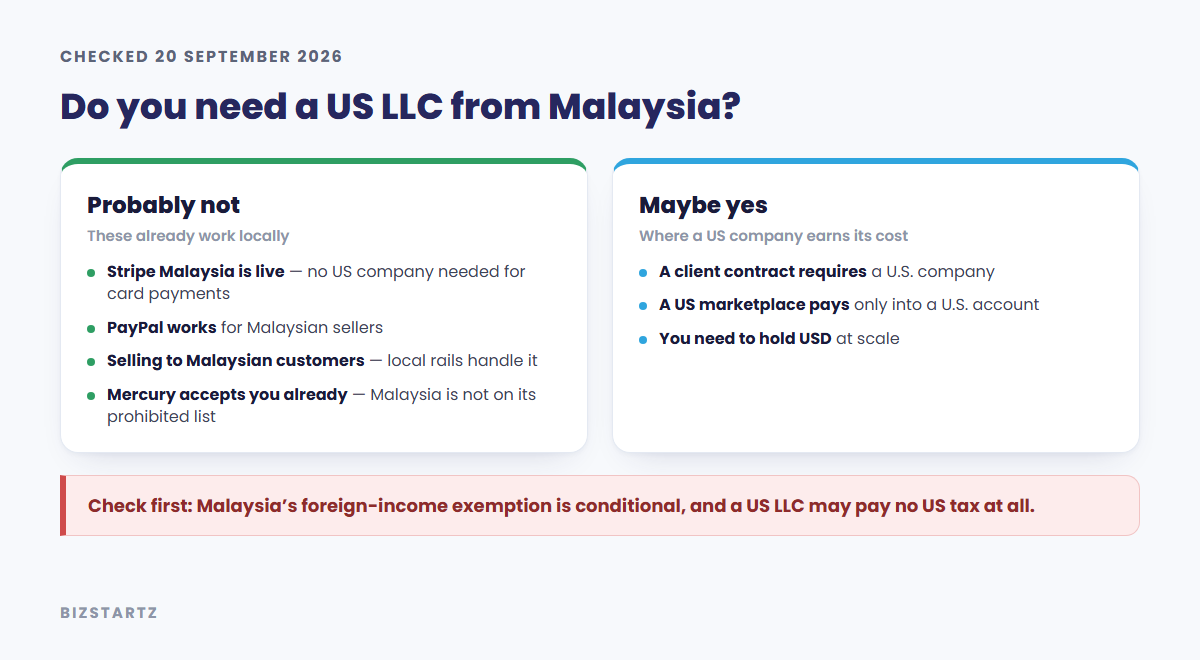
For most people reading this, no. Work through these four first, because in Malaysia several of them already cover how you get paid.
Stripe is fully live in Malaysia
Malaysia sits in Stripe’s main supported list with a direct sign-up link. No “preview” label, no invite-only, no extended network (stripe.com/global, checked 20 September 2026). If you have read a guide telling you that a US company is how you get Stripe, it was not written for Malaysia.
Stripe Malaysia’s published standard pricing is 3% + RM1.00 per successful card charge, with an extra 1% for international cards and a further 2% where currency conversion is required. FPX is 3% + RM1.00, GrabPay 3%, Alipay 2.9% + RM1.00 (Stripe Malaysia pricing, checked 20 September 2026). FPX matters here: if your buyers are Malaysian, a US Stripe account cannot accept it at all.
PayPal Malaysia withdraws to a Malaysian bank, in ringgit
A Malaysian PayPal account transfers its balance to a local bank account in MYR. PayPal’s Malaysian fee schedule states “No Fee (when no currency conversion is involved) where MYR withdrawal amount is greater than 400.00 MYR”, and MYR 3.00 where the withdrawal is below that (PayPal Malaysia fees, checked 20 September 2026). Converting a balance into another currency costs an additional 2.5% for Malaysia-based conversion.
So the money reaches your bank. What it does not do is stay in dollars, and that is the distinction that actually decides whether a US entity is worth it — more on that below.
Google Play pays Malaysian developers
Malaysia is ticked for both developer registration and merchant registration on Google Play, with MYR as the developer default currency (Google Play: supported locations for distribution and payouts, checked 20 September 2026). If publishing an Android app was your reason for wanting a US company, you have one less reason.
Wise: personal accounts only
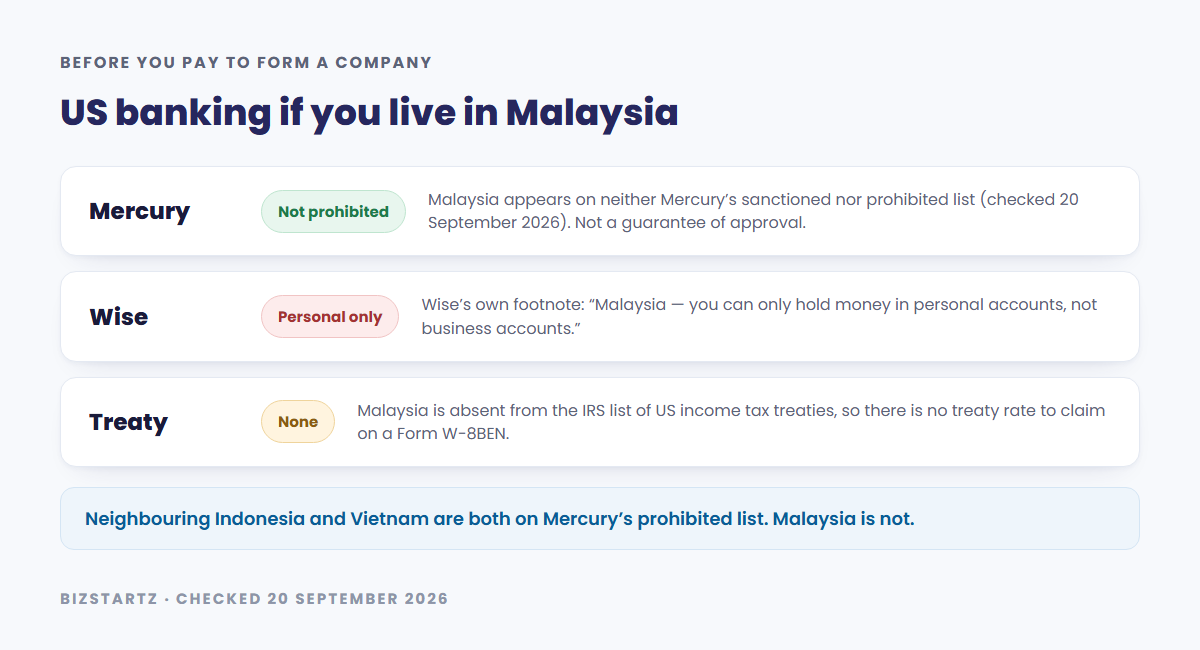
This one is worth reading twice, because it is often quoted the wrong way round. Malaysia is on Wise’s list of countries where you can hold money, but with an explicit footnote: “Malaysia — you can only hold money in personal accounts, not business accounts” (Wise: where you need to live to hold money, checked 20 September 2026).
Read that carefully before you plan around it. It speaks to holding money as a Malaysian resident. Whether Wise Business will onboard a US LLC whose owner lives in Malaysia is settled at verification, and we found no Wise page that answers it directly. Treat Wise Business as a second option to test, not a plan to rely on.
Who a US LLC genuinely helps
Three situations survive the list above.
Amazon sellers: registered in Malaysia, but MYR is not on the payout lists
Malaysia is accepted for Amazon seller registration — the M entries on Amazon’s accepted-countries list run “Madagascar Malawi Malaysia Mali Malta Marshall Islands…” (Seller Central: accepted countries).
The payout side reads differently. Malaysia and MYR do not appear on Amazon Seller Wallet’s list of countries it can transfer to your own bank account (Seller Wallet), and MYR is not among the supported bank-account currencies for the Amazon Currency Converter for Sellers (supported bank accounts). All three checked 20 September 2026; the only M entries on those two payout tables are Mexico and Morocco.
We are not going to turn that into “Amazon cannot pay you”, because third-party payment providers exist and Amazon’s tables change. But it is the one place where the answer plausibly flips, so ask Amazon directly how a Malaysia-registered seller receives disbursements before you decide either way.
You need to hold dollars, not convert them
Every Malaysian route above ends in ringgit. PayPal charges 2.5% to convert. Stripe adds 2% where conversion is needed. Wise will hold currency for you personally, not for your business. If you pay US suppliers, US contractors or US ad platforms in dollars, converting into ringgit and straight back out again is a pure loss, and a US bank account in the LLC’s name ends it.
That is the strongest honest case for a US LLC from Malaysia. It is a treasury argument, not a tax one.
A client or platform contractually requires a US entity
Some US buyers will only contract with a US company. If that is a written requirement from someone who is actually paying you, it is a legitimate reason to form one. Ask them exactly what they need first — the real requirement often turns out to be a US bank account or a W-9, not a US company.
Banking from Malaysia: the step that stops your neighbours does not stop you
Do this check anyway, before you spend anything. An LLC with no bank account cannot receive a cent.
Mercury’s help centre says it is “unable to open accounts for founders living in any of the countries and regions listed below”, and that “this is based on your country of residence, not your citizenship or nationality”. Malaysia appears on neither the sanctioned nor the prohibited list (Mercury: prohibited countries, checked 20 September 2026).
The contrast with the neighbourhood is stark. Indonesia and Vietnam are both on that prohibited list, which is why those two guides spend most of their length on workarounds and this one does not.
Not being prohibited is not approval. Mercury still runs its own checks and declines applications for its own reasons, and a residence-based policy can change without notice. But a founder in Petaling Jaya starts from a much better position than one in Jakarta. Our US payment and banking access by country table compares the providers side by side, and opening a US bank account as a non-resident covers the application itself.
The Malaysian side: the part other guides leave out
We form US companies; we are not Malaysian tax agents or licensed advisers, and nothing below tells you what you owe or what you are permitted to do. It sets out what BNM and LHDN have published, with sources, so that you can take the right questions to someone qualified. On the second of these two, you will need someone qualified.
Bank Negara’s foreign exchange policy: it turns on whether you have ringgit borrowing
Most country guides either ignore exchange-control rules or repeat a bank’s summary of them. Here is what BNM itself publishes.
For a resident investing in foreign currency assets, Bank Negara Malaysia states: “A resident without domestic ringgit borrowing is free to invest any amount in foreign currency (FC) assets onshore and abroad.”
A resident with domestic ringgit borrowing, funding the investment from conversion of ringgit or from a Trade FCA, is limited to:
- up to RM1 million equivalent in aggregate per calendar year on an individual basis, or
- up to RM50 million equivalent per calendar year in aggregate on a corporate group basis.
Both from BNM’s own rules page, Investing in Foreign Currency Assets (checked 20 September 2026), which points to Notice 3 – Investment in Foreign Currency Asset for the detail.
Two honest caveats. First, “domestic ringgit borrowing” is a defined term in BNM’s policy with its own scope and exclusions; we did not verify which of a housing loan, a hire-purchase facility or a credit card falls inside that definition, so check Notice 3 or ask your bank rather than assuming. Second, BNM’s page frames these as limits on converting ringgit into foreign currency to invest — which is a different question from whether you may own the company at all. On the page we read, the constraint is on the funding, not on the ownership.
Foreign-sourced income: the exemption is conditional, and the condition is the whole question
Foreign income received in Malaysia by a resident individual is exempt from income tax under the Income Tax (Exemption) (No. 5) Order 2022 [P.U.(A) 234/2022]. The original window ran to 31 December 2026; P.U.(A) 451/2024, gazetted in December 2024, substituted 31 December 2036, extending it by ten years.
People stop reading there. The exemption is not automatic, and LHDN’s own guideline sets out what goes with it (Garis Panduan Layanan Cukai Berhubung Pendapatan Yang Diterima Dari Luar Negara (Pindaan), dated 20 June 2024, listed on LHDN’s guidelines page):
- It covers income received in Malaysia from outside Malaysia — so remittance is what triggers the question, not the earning.
- Income from a partnership business in Malaysia is excluded from the individual exemption.
- There is a “subject to tax” condition attached to the country the income arose in.
- You must still declare it in your return — income type, amount, source country, the foreign tax rate and the foreign tax paid — and keep supporting documents under sections 82 and 82A of the Income Tax Act 1967. Exempt is not the same as invisible.
Now the part that concerns a US LLC specifically.
A single-member LLC owned by a non-US person is disregarded for US federal tax purposes. Whether it owes US tax turns on whether its income is effectively connected with a US trade or business; many non-resident owners serving clients from outside the United States conclude that it is not (IRS: taxation of nonresident aliens). That conclusion is the entire basis of the “zero US tax” pitch you see on formation websites.
So a Malaysian resident can end up holding two claims at once: my LLC pays no US tax, and my foreign income is exempt in Malaysia. Those may not be compatible claims, because the Malaysian exemption carries a subject-to-tax condition and the US side of the structure is built on paying no tax.
We are not going to tell you how that resolves, and you should be sceptical of anyone selling you a company who does. LHDN’s June 2024 guideline does deal with situations where no foreign tax was imposed. What we could not establish, reading the guideline through a text proxy, in Malay, is how far those carve-outs reach. A PwC Malaysia summary of that same guideline reads them more narrowly, as applying to foreign dividend income for individuals, with the alternative economic-substance route available to companies and LLPs rather than individuals. Two readings of one document is exactly the situation in which you pay a professional rather than a blog.
Questions to take to a Malaysian tax agent
- If my US LLC’s profit is not taxed in the United States, does income I remit to Malaysia from it meet the subject-to-tax condition in the FSI exemption?
- Which LHDN paragraph applies to my facts, and is there a ruling or guidance on US LLCs specifically?
- Does it change the answer if the LLC pays me for services rather than distributing profit?
- Does it change the answer if the money stays in the US account and is never remitted?
- What do I need to declare and retain each year to support the position you recommend?
- Do I have domestic ringgit borrowing as BNM defines it, and does the RM1 million limit apply to how I intend to fund this?
- What will you charge me annually to handle this, and does that cost leave the LLC worth having?
Labuan structures and LHDN e-invoicing come up constantly in this conversation. Both are outside what we could source properly for this guide, so we are not going to summarise them badly — raise them with your tax agent too.
The US side: steps, filings and the missing treaty
- Confirm the bank and the platform first. It is free, and it is the step most likely to change your mind.
- Choose a state. Wyoming charges $100 to file Articles of Organization, and its annual report licence tax is “$60 or two-tenths of one mill on the dollar ($.0002) whichever is greater based on the company’s assets located and employed in the state of Wyoming” (Wyoming Secretary of State fee schedule, effective 1 July 2026). Annual reports are due on the first day of the anniversary month of formation. Delaware is the usual alternative and costs more to keep: 6 Del. C. § 18-1107(b) sets a flat $400 annual tax due 1 June. Compare the rest in choosing a US state as a non-resident.
- Appoint a registered agent in that state, and keep the renewal paid.
- Get the EIN without an SSN. Step by step in how to get an EIN without an SSN.
- Open the US account, then apply to the platform you formed the company for.
Form 5472, every year, whether or not you owe anything
A single-member LLC owned by a non-US person is a foreign-owned US disregarded entity. Each year it files a pro forma Form 1120 with Form 5472 attached, even at zero US tax and zero revenue.
“A penalty of $25,000 will be assessed on any reporting corporation that fails to file Form 5472 when due and in the manner prescribed”, with a further $25,000 if the failure continues more than 90 days after IRS notification (IRS Instructions for Form 5472). An extension is requested on Form 7004. Our guide to Form 5472 for foreign-owned US LLCs covers the filing itself.
There is no US–Malaysia income tax treaty
The IRS’s own list of US income tax treaties runs Malta, Mexico, Moldova, Morocco. Malaysia is absent (IRS: United States income tax treaties A to Z, checked 20 September 2026).
That has two practical effects. There is no reduced treaty rate to claim on a Form W-8BEN against US-source income. And there is no treaty to lean on when the Malaysian and US positions need to be reconciled, no tie-breaker article, no agreed definition of where profit belongs. Raise it explicitly with whoever advises you on each side, because advice written for a treaty country will not transfer.
One filing you can stop worrying about
Beneficial ownership information reporting no longer applies to entities formed in the United States, FinCEN exempted domestic reporting companies (FinCEN: beneficial ownership information). If a provider is still charging you for BOI filing on a US LLC, ask why.
What it costs
Only figures we could source today:
| Item | Amount | Source |
|---|---|---|
| Wyoming formation | $100 | WY SOS fee schedule, effective 1 July 2026 |
| Wyoming annual report licence tax | $60 minimum, or $.0002 per dollar of Wyoming assets, whichever is greater | WY SOS fee schedule |
| Delaware annual LLC tax | $400, due 1 June | 6 Del. C. § 18-1107(b) |
| Form 5472 late-filing penalty | $25,000, plus $25,000 if uncorrected 90 days after IRS notice | IRS Instructions for Form 5472 |
Not priced here, deliberately: registered agent renewal, US tax preparation, wire and conversion costs moving dollars to Malaysia, and a Malaysian tax agent’s annual fee. That last one is the number that decides whether any of this is worth doing, and it is the one you can get quoted for free this week. Get two quotes before you form anything.
Questions Malaysian founders ask
Can I open a US LLC from Malaysia without living in the US?
Yes. You can register the company, obtain an EIN without an SSN, and file its US returns without visiting the United States. What you cannot do remotely is skip the Malaysian side — BNM’s foreign exchange policy and LHDN’s conditions apply to you where you live.
Will Mercury open an account for a founder living in Malaysia?
Malaysia is on neither Mercury’s sanctioned nor its prohibited list, and that list is based on country of residence rather than citizenship (checked 20 September 2026). That is a far better starting point than Indonesia or Vietnam, which are both prohibited. It is not a guarantee of approval — Mercury still applies its own checks.
Do I need a US LLC to use Stripe in Malaysia?
No. Malaysia is in Stripe’s main supported list with a direct sign-up link, and Stripe Malaysia also handles FPX and GrabPay, which a US Stripe account cannot. A US account only makes sense if your customers are mostly outside Malaysia or you need to settle in dollars.
Is my US LLC’s income exempt from Malaysian tax?
That is the question to put to a Malaysian tax agent, not one we will answer. The exemption for foreign-sourced income received by resident individuals runs to 31 December 2036, but it is conditional — including a condition about the income having been subject to tax where it arose, and a continuing requirement to declare it and keep records. A US LLC owned by a non-resident frequently pays no US tax, which is precisely why the interaction needs professional advice rather than a blog’s conclusion.
Does Malaysia allow me to own a company abroad?
Bank Negara Malaysia states that a resident without domestic ringgit borrowing is free to invest any amount in foreign currency assets onshore and abroad. A resident with domestic ringgit borrowing who is converting ringgit to fund the investment is limited to RM1 million equivalent in aggregate per calendar year on an individual basis. Check BNM’s Notice 3 for how “domestic ringgit borrowing” is defined before applying either to yourself.
Who this suits, and where to start
It can make sense if you genuinely need to hold and spend dollars rather than convert them, a paying US client contractually requires a US entity, or you sell on Amazon and have confirmed with Amazon that a Malaysian bank account cannot receive your disbursements. In each of those, a Malaysian tax agent has already told you what the LLC costs you every year.
It probably does not if your customers are Malaysian, Stripe Malaysia and FPX already handle your checkout, Google Play already pays you, or your case rests on a tax outcome nobody qualified has confirmed for your facts.
Start with the free checks, in this order. Confirm which platform you actually need. Ask Mercury in writing whether it will take an owner resident in Malaysia. Take the seven questions above to a Malaysian tax agent and get an annual fee quote. Form the company last — it is the only step you cannot undo for free.
If a US company does fit, Bizstartz forms US LLCs for non-resident founders and handles the EIN and bank application steps (US company formation). The Malaysian side needs a Malaysian tax agent, and on the foreign-sourced income question that is not a formality.
This guide was researched with the help of AI tools. Every fee, legal and availability claim links to the source it came from, and those sources were checked on 20 September 2026. Where we could not confirm something — including how far LHDN’s June 2024 guideline carries the subject-to-tax condition for a case like this — the text says so instead of guessing. Rules in this area change; check the linked sources again before you act.
🎯 Ready to start? Claim your free consultation and we'll map out your US LLC formation strategy — EIN, banking, and the right state for your country.

Ready to start your company?
Bizstartz handles formation, EIN, banking and compliance for founders worldwide.