Mercury will not open an account for a founder living in any of 48 prohibited countries, plus four sanctioned countries and regions. The full list is below, checked on 23 September 2026.
Before you scroll to find your country, read the sentence that decides your case. Mercury’s help centre says it is “unable to open accounts for founders living in any of the countries and regions listed below,” and then adds the part most articles about this leave out:
“This is based on your country of residence, not your citizenship or nationality. If you’re a citizen of one of the countries below but currently reside elsewhere, your application may still be eligible, pending application review.”
So a Nepali passport is not what blocks you. Living in Nepal is. A Nigerian citizen who has lived in Dubai for three years is not on this list at all, and reads it as a bystander.
The other thing to know before the list: your company being a US LLC does not help here. The country rule sits on top of the US-entity requirement, not instead of it. A Wyoming LLC, a US registered agent address, an EIN and a clean business description do not move a country from one list to the other. We will come back to why that matters, because it is the single most expensive misunderstanding in this topic.
In this guide: The full list · What “prohibited” actually means · Citizen of a listed country, living elsewhere · The cards lists are different · Eligibility beyond your country · If you are on the list · Questions
Mercury’s prohibited countries, in full
Mercury publishes two separate groups. Both stop an account application, but they are listed apart and it is worth knowing which one you are in.
Sanctioned countries and regions
- Cuba (Republic of Cuba)
- Iran (Islamic Republic of Iran)
- North Korea (DPRK – Democratic People’s Republic of Korea)
- Russian-occupied regions of Ukraine, including Crimea, Donetsk, Kherson, Luhansk, and Zaporizhzhia
Prohibited countries
48 countries, reproduced exactly as Mercury names them:
- Afghanistan
- Albania
- Angola
- Bangladesh
- Belarus (Republic of Belarus)
- Bhutan
- Bosnia & Herzegovina
- Burkina Faso
- Burundi
- Cambodia
- Cameroon
- Central African Republic
- Congo (the Democratic Republic of the)
- Congo (the)
- Croatia
- Eritrea
- Gambia
- Haiti
- Indonesia
- Iraq
- Kyrgyzstan
- Latvia
- Lebanon
- Lesotho
- Liberia
- Libya
- Maldives
- Mali
- Mozambique
- Myanmar (Burma)
- Nepal
- Nicaragua
- Nigeria
- Pakistan
- Palestine (State of)
- Philippines
- Russia (Russian Federation)
- Somalia
- South Sudan
- Sudan (the)
- Syria (Syrian Arab Republic)
- Ukraine
- Uzbekistan
- Vanuatu
- Venezuela (Bolivarian Republic of)
- Vietnam
- Yemen
- Zimbabwe
Source: Mercury Help Centre — Prohibited countries, transcribed in full on 23 September 2026.
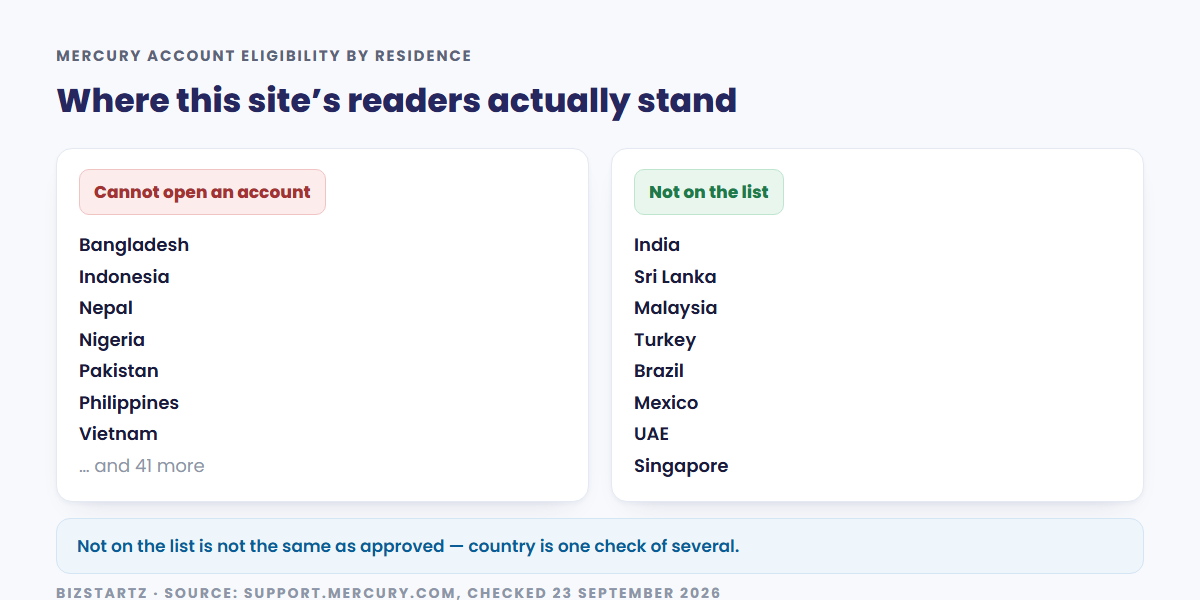
Two entries reliably surprise people. Croatia and Latvia are on it, and both are EU member states. So is Albania, and so is Bosnia & Herzegovina. If you assumed this list was a sanctions list with a few extras, it is not — Mercury does not explain its criteria beyond “regional and international regulations, policies, and sanctions,” and the membership does not map cleanly onto any sanctions programme you can look up.
For the founders this site usually works with, the entries that matter are Bangladesh, Bhutan, Indonesia, Maldives, Nepal, Nigeria, Pakistan, the Philippines and Vietnam. If you are reading this from South Asia or Southeast Asia, the odds are high that your answer is no.
And two that are not on it, which comes up constantly: India and Sri Lanka are absent from both lists. So is Malaysia, Turkey, Brazil, Mexico, Egypt, Kenya, the UAE and Singapore. Absence is not approval — Mercury still runs its own review and declines for its own reasons — but it means the door is open rather than shut. Read the cards section before you celebrate if you are in India or Sri Lanka, because there is a second list you are on.
What “prohibited” actually means, and what it does not
This is a country-level rule applied at the account level. It is not a scoring factor, not a flag on your file, and not something a stronger application overcomes.
Which means none of the following changes the answer:
- Forming the LLC in a different state. Wyoming, Delaware, New Mexico — the state is irrelevant to a rule about where you live.
- Having an EIN. You need one to apply at all, but it is a prerequisite, not a counterweight. Our guide to what an EIN number is and what it unlocks covers where it genuinely matters.
- A US registered agent or virtual mailbox address. This one is worth stating twice, because it is the workaround people reach for first. Mercury’s own eligibility page requires the business to “have a U.S. or international address for its principal place of business” and says plainly that “residential addresses are accepted, but registered agent addresses, P.O. boxes, and UPS Store addresses are not.” The exact kind of address a formation package sells you is the exact kind Mercury names as unacceptable.
- A better business description, a real website, or revenue. All good things. None of them are the country you live in.
- A US co-founder. This changes the facts rather than the rule, and it changes them a lot — but only if that person is genuinely a founder with genuine ownership and control, disclosed honestly. Mercury requires anyone holding 25% or more of the company to be identified. Adding a nominal US “owner” to get past a country rule is not a structure, it is a misrepresentation with a paper trail.
And the thing we will not help you do: do not give an address or country of residence that is not yours. A bank application is not a form, it is a sworn statement about who you are. Misrepresenting your residence on one is fraud. The realistic outcome is not that you get away with it — it is that the account is frozen at the first review, with your money inside it, and getting that money back becomes a legal problem in a country you do not live in. There is no version of this where the risk is worth it.
A rejection also is not free. It creates a record you will be asked about, and it costs you the time you could have spent opening something that would actually have worked.
Citizen of a listed country, living somewhere else
This is the case the list is most often read wrong on, and it goes in your favour.
Mercury: “If you’re a citizen of one of the countries below but currently reside elsewhere, your application may still be eligible, pending application review.”
So if you hold a Pakistani, Nigerian, Bangladeshi or Nepali passport and you actually live in Dubai, Lisbon, Toronto or Kuala Lumpur, you are not on this list. You apply as a resident of where you live. Mercury’s eligibility page is explicit on the broader point too: “You do not need to be a U.S. citizen or resident to apply.”
Read “pending application review” as exactly what it says. It is not a promise. Expect a closer look at your identity documents, your proof of address and your source of funds, and expect to have to evidence the residence you are claiming. Have a document that proves where you live before you start, not after they ask.
The reverse case is equally true and less welcome: a US citizen living in Kathmandu is on the list. Residence decides both directions.
The cards lists are different lists — and India and Sri Lanka are on one
Almost every article about Mercury’s country rules treats this as one list. It is three, they are published on three separate pages, and the memberships do not match. If you stop at the account list you will get a surprise after you have already been approved.
Alongside prohibited countries, Mercury publishes restricted countries for card issuance — “we are unable to mail physical cards and/or issue virtual cards to residents of certain countries” — and countries where Mercury cards are restricted, which is about where a card can be used: “if you attempt to make a card purchase within one of the below listed countries, or an online card purchase with a merchant whose legal address is in one of the below listed countries, the transaction will be declined.”
Here is the practical consequence, and as far as we can tell no other guide states it.
Seven countries are fine for a Mercury account but appear on Mercury’s “restricted countries for mailing cards” list:
- Algeria
- China
- India
- Kosovo
- Kuwait
- Morocco
- Sri Lanka
If you live in India or Sri Lanka, that is your situation: the account is available to you, the physical card mailed to your home is not. Plan for virtual cards and for paying US vendors by ACH and wire rather than by plastic. Ask Mercury directly what card options remain open to you before you build a process around one.
The two card lists also cut the other way. Croatia, Albania, Cambodia, Pakistan, the Philippines and Somalia are prohibited for accounts but do not appear on the list of countries where a Mercury card cannot be used at merchants. That is academic if you cannot open the account — but it matters if you are, say, a Portuguese-resident founder whose contractor is in Manila, or if you travel.
Both card lists were transcribed on 23 September 2026. One older detail worth flagging: search results still circulate a line about card shipments to Bahrain, Israel, Kuwait, Oman, Qatar, Saudi Arabia and the UAE being paused “due to the ongoing conflict in the region.” That sentence is not on Mercury’s page today. We read the raw text of the card-issuance article on 23 September 2026 and it is absent. Kuwait remains on the mailing-restricted list; the other six are not on any of the three lists. If you are in the Gulf, ask Mercury rather than trusting a cached snippet — including this one.
Eligibility beyond your country
Clearing the country lists gets you to the start line, not past it. Four more things decide the application, all from Mercury’s own eligibility page, read 23 September 2026.
The company must be American
“To open a Mercury account, your company must be formed and registered in the United States or a U.S. territory.” Your home-country company does not qualify, however established it is. That is the problem forming a US LLC exists to solve. It is also why forming one solves nothing if you live in a prohibited country.
Mercury also requires the business to “have existing or planned operations in the U.S.” Note the word “planned,” which is doing a lot of work in that sentence — but do not read it as decorative.
Some industries are out regardless of where you live
Mercury says it cannot support “money services businesses (MSBs) and crypto exchanges,” “businesses operating in adult entertainment, cannabis, or internet gambling,” and “trusts.” Read that first one carefully if you are anywhere near payments or remittances, because “money services business” covers more than founders assume.
It is not a blanket crypto ban. The same page says Mercury works with “crypto and Web3 businesses, including startups, DAOs, and funds.” The line sits at exchanges and MSBs, not at the sector.
The address requirement, which catches almost everyone
Mercury requires “a U.S. or international address for its principal place of business — residential addresses are accepted, but registered agent addresses, P.O. boxes, and UPS Store addresses are not.”
Read that twice if a formation package sold you a US virtual address. Your actual home address abroad is acceptable to Mercury. Your registered agent’s address is not. Founders get this precisely backwards, enter the agent’s address because it looks more American, and then cannot work out why the application stalled.
Ownership disclosure
Anyone holding 25% or more of the company must be identified, and ownership held through a holding company has to be traced through to the individuals behind it. Everyone named must be at least 18. Mercury also asks for the business’s legal name, industry and description, source of funds, details of current or planned US operations, and supporting business documents.
One thing to know about where your money actually sits
Mercury is not a bank, and says so itself: “Mercury is a fintech company, not an FDIC insured bank. Banking services provided through Choice Financial Group and Column N.A., Members FDIC.”
That is not pedantry. Deposit insurance attaches at the partner bank, not at the fintech in front of it, and the gap between those two things has cost real depositors real money in the last few years. If you expect to hold a meaningful balance, know which institution is holding it and what happens if the layer in between fails. This is a reason to understand your setup, not a reason to avoid Mercury — the same caveat applies to most of its competitors, Relay included.
If you are on the list: what actually works
Here is the part we are going to be careful about, because “just use Wise instead” is the standard advice and for several countries on Mercury’s list it is wrong.
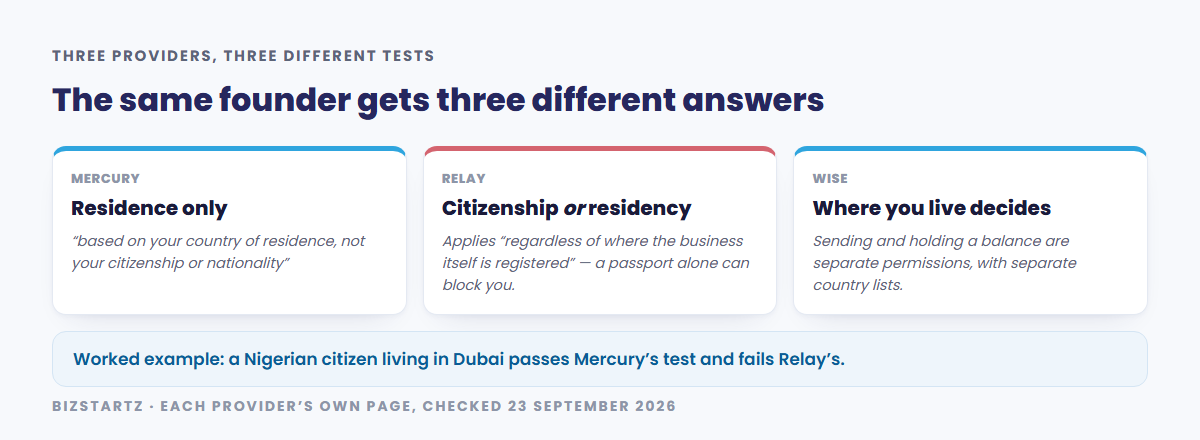
Every provider publishes a different list, and they are built on different rules. Mercury asks where you live. Relay asks where you live and what passport you hold. Wise asks where you live, and splits the answer into what you can send versus what you can hold. Three questions, three answers, and the country that blocks you at one may not exist on another’s list at all.
Relay: a different list, and a different test
Relay’s prohibited-countries page states: “Relay cannot open accounts for business owners holding citizenship or residency in certain countries due to Thread Bank policy, U.S. sanctions, and federal law,” and that “if a required owner holds citizenship or residency in a listed country, Relay cannot open the account, regardless of where the business itself is registered.” The restriction covers every owner named on the application, including beneficial owners. Relay adds that “exceptions can apply based on Thread Bank’s case-by-case review” (Relay: prohibited countries, read 23 September 2026).
That rule cuts both ways against Mercury’s.
Worse than Mercury if you hold the passport but live elsewhere. A Nigerian or Pakistani citizen living in Dubai passes Mercury’s residence test and fails Relay’s citizenship test. Mercury is explicitly the more open of the two on that exact fact pattern.
Better than Mercury for a large slice of this site’s readers. Relay’s list is 31 countries against Mercury’s 48 plus four, and several countries that stop a Mercury application do not appear on Relay’s list at all — including Bangladesh, Bhutan, Indonesia, the Maldives, Nepal, the Philippines and Vietnam, and also Croatia, Latvia, Albania, Angola, Kyrgyzstan and Uzbekistan.
Not being on a prohibited list is not approval, and Relay still runs its own checks through Thread Bank. But if you are in Kathmandu, Dhaka, Jakarta, Manila or Hanoi and you have been told US business banking is closed to you, that is not what Relay publishes. It is worth an application.
Two countries run the other way: Ethiopia and Guinea-Bissau are on Relay’s list and not on Mercury’s.
Relay also notes its list “reflects current Thread Bank policy and applicable U.S. sanctions, and it can change without notice.”
Wise: sending and holding are different permissions
This is the one to get right, because “just use Wise instead” is the most common advice given to people in the countries above, and it is neither as safe nor as hopeless as the two camps claim. Wise publishes several different country lists and they do different jobs, which is where almost everyone goes wrong.
Wise says “you can register and send money with Wise from most countries around the world,” but holding money is narrower: “you can hold money in your account if you live in one of the following countries and territories,” followed by a specific list (Wise: where do I need to live to hold money with Wise, read 23 September 2026).
Bangladesh, Indonesia, Nepal, Nigeria, Pakistan and Vietnam do not appear on that hold-money list. India is not in the main list either; it appears in the notes beneath it, with the qualifier “you can hold money in your account when travelling overseas.” The Philippines does appear. So does Croatia, and so does Latvia.
Wise also publishes per-country account-type limits: “Bahrain, Israel, Malaysia — you can only hold money in personal accounts, not business accounts,” and for Hong Kong the reverse. Thailand is flagged as temporarily paused for issuing currencies and account details, and in the US, Nevada residents cannot hold money.
Read that list carefully, because it is easy to draw the wrong conclusion from it — we nearly did. It governs whether you, living where you live, can hold a balance in your own Wise account. It is not the test Wise applies to a US company.
Two separate Wise pages settle that. First, the countries where Wise says it does not operate at all are a much shorter list: Afghanistan, Belarus, Burundi, the Central African Republic, Chad, Congo, the Democratic Republic of the Congo, Cuba, Eritrea, Iran, Iraq, North Korea, Libya, Myanmar, Somalia, South Sudan, Russia, Sudan, Syria, Yemen, Venezuela and the occupied Ukrainian regions. Bangladesh, India, Indonesia, Nepal, Nigeria, Pakistan, Sri Lanka, Turkey and Vietnam are on none of it. Second, when Wise verifies a US business it asks for “the SSN of the beneficial owners that reside in the US or have a US passport” and, for “the non-US beneficial owners”, only “a copy of a photo ID”. A foreign owner is an anticipated case, not an obstacle.
The real obstacle is the address, and it is the one nobody warns you about. Wise asks for a business trading address — “your primary place of business, the place where you work every day” — and states it “has to be a physical location”. It explicitly cannot be a PO box, a registration agency, a mail forwarding service, or a virtual address. That rules out the registered-agent address and the virtual mailbox that come bundled with most US formation packages, including the ones sold as solving exactly this problem. Our guide to setting up a Wise Business account for a US LLC covers the application itself.
Payoneer
We could not retrieve a current, official Payoneer page listing supported or unsupported countries for this use case on 23 September 2026 — its help centre returned a server error. Everything ranking for the question is third-party commentary, and we are not going to launder somebody’s blog post into a country rule. If Payoneer is your plan, ask Payoneer directly, in writing, before you form anything.
What this looks like for four common cases
| You live in | Mercury account | Relay (citizenship or residency) | Wise: personal hold-money list (not the business test) |
|---|---|---|---|
| Nepal | Prohibited | Not on Relay’s list | Not on Wise’s hold list |
| Philippines | Prohibited | Not on Relay’s list | On Wise’s hold list |
| Nigeria | Prohibited | Prohibited | Not on Wise’s hold list |
| India | Not prohibited (no mailed card) | Not on Relay’s list | Only while travelling overseas |
All four rows read from the providers’ own published pages on 23 September 2026. “Not on the list” means exactly that and nothing more — it is permission to apply, not a prediction of the outcome.
That Nigeria row deserves a sentence of its own, because it is the hardest one on this page. A founder resident in Nigeria is prohibited by Mercury and prohibited by Relay on both of its tests. Wise is a different matter and we want to be careful not to imply a third refusal: Nigeria is not on the list of countries where Wise says it does not operate, and Wise’s US business verification explicitly accommodates non-US owners. What it will not accept is the address most formation packages hand you — see the Wise section above. There is no easy US banking route from Lagos, but there is a narrower one than this table alone suggests. Our guide to forming a US LLC from Nigeria goes through what is left.
The two things that are actually worth doing first
Both are free, and both are faster than any workaround.
Ask the provider, in writing, before you spend anything. Send one email describing your residence, your citizenship, your entity and your industry, and ask whether they can open an account. A written no costs you ten minutes. A rejected application costs you a record.
Work out whether you need a US account at all. A surprising share of founders form a US LLC to solve a payment problem their own country already solves. If your customers pay by card and your local Stripe or PayPal is live, the US entity may be solving nothing. Our US payment and banking access by country table compares the providers side by side, and opening a US bank account as a non-US resident covers the application itself, country by country.
Questions founders ask about this list
Can I open a Mercury account if I am a citizen of a prohibited country?
Yes, potentially, if you live somewhere that is not on the list. Mercury states the rule is “based on your country of residence, not your citizenship or nationality,” and that a citizen of a listed country residing elsewhere “may still be eligible, pending application review.” Be ready to evidence where you actually live.
Will forming my LLC in Wyoming or Delaware change the answer?
No. The state you file in has nothing to do with a rule about where you live. Neither does having an EIN, a registered agent or a US phone number.
Can I use a US virtual address to get around it?
No, and it is worse than ineffective. Mercury’s eligibility page names “registered agent addresses, P.O. boxes, and UPS Store addresses” as addresses it does not accept for your principal place of business. Beyond that, stating a residence that is not yours on a financial application is a misrepresentation, and the usual consequence is a frozen account with your money in it.
Is Mercury a bank?
No. “Mercury is a fintech company, not an FDIC insured bank. Banking services provided through Choice Financial Group and Column N.A., Members FDIC.” Your deposits sit at those partner banks.
My country is not on the list. Am I approved?
No. Absence from the prohibited list removes one obstacle. Mercury still reviews your industry, your documents, your source of funds and your US operations, and declines applications for its own reasons.
Can Bizstartz get me a Mercury account if I live in a prohibited country?
No, and nobody legitimately can. We form US companies and help with the US bank account application, but a country-level prohibition is not something a formation agent can work around. What we can do is tell you which providers still have a route open from where you live before you pay for anything.
How often does this list change?
Often enough that a dated version is the only honest one. Mercury does not publish a changelog or a last-updated date on the page. Relay says outright that its list “can change without notice.” Check the source links before you act on anything here.
Before you use anything on this page
Every list above was transcribed from the provider’s own help centre on 23 September 2026. Not from a comparison site, not from a cached search snippet, and not from memory. We found one widely circulating detail about paused Gulf card shipments that is no longer on Mercury’s page, which is a fair illustration of how quickly this rots.
So do the thing that costs nothing: open the three Mercury links and the Relay link above and check your own country before you spend a dollar. If your country has moved, the provider’s page is right and this page is out of date.
If US banking is open to you from where you live and a US company is genuinely the right structure, forming the LLC and getting the EIN are the two steps that come first. If it is not open to you, we would rather tell you that now than take your money and find out later.
Country lists in this guide were transcribed from Mercury’s, Relay’s and Wise’s own help centres on 23 September 2026, and each is linked at the point it is used. Research was carried out with AI assistance; every country list was read as raw page text rather than from a summary, and where a source could not be retrieved — Payoneer’s — the text says so instead of guessing. These lists change without notice. Check the linked sources again before you act.
🎯 Ready to start? Claim your free consultation and we'll map out your US LLC formation strategy — EIN, banking, and the right state for your country.

Ready to start your company?
Bizstartz handles formation, EIN, banking and compliance for founders worldwide.