If you own a US LLC from outside the United States and sell everything through Amazon, Etsy or eBay, the most likely answer is that you register nowhere and remit nothing, because the marketplace is already collecting the sales tax and sending it to the state. That is not a loophole. It is what state marketplace facilitator laws require the platform to do.
The second thing to know is that your residence and your citizenship have nothing to do with it. Sales tax is a state tax driven by where your customers are and where your goods are. Living in Kathmandu, Lagos or Lisbon neither exempts you nor protects you. A US LLC owned by someone who has never set foot in America can have a sales tax registration obligation in a state, and an LLC owned by a New Yorker can have none.
The people who genuinely have a problem are narrower than the internet suggests: sellers with inventory sitting in a US warehouse, and sellers pushing real volume in taxable goods through their own Shopify or WooCommerce store. If neither describes you, the checklist below will probably settle it in a minute and you can stop there.
This page was checked against state revenue department sources on 23 September 2026. Sales tax in the US is 45 separate state regimes plus the District of Columbia, plus local jurisdictions that run their own tax in several states, including Alaska, which has no state sales tax at all.
Nobody can give you a complete answer in one article, and this one does not pretend to. What it can do is tell you which questions actually apply to you, what the current published rules say, and exactly where the rule is unsettled or differs state by state, because in several places that is the answer.
The short version, as a decision
Work down this list. Stop at the first one that describes you.
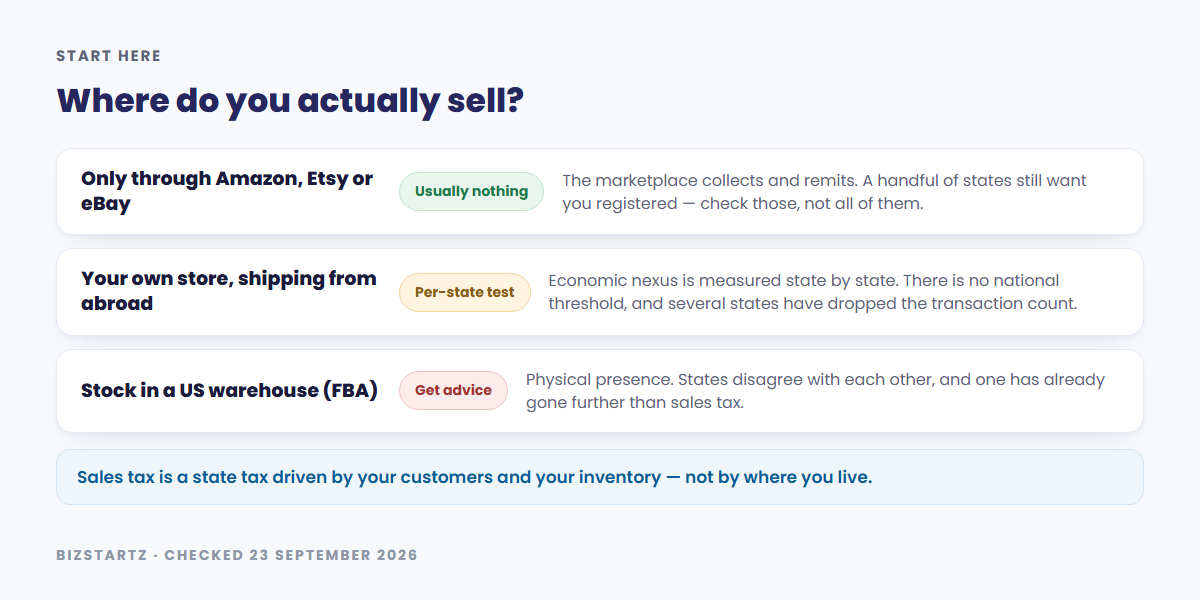
- You sell only through Amazon, Etsy, eBay, Walmart or a similar marketplace, and you have no inventory or people in the US. In most states you have nothing to register for. The marketplace collects and remits. A handful of states still want a registration anyway — see the exceptions below.
- You sell only digital products or services, worldwide, from your own site. Whether that is even taxable varies enormously by state and by exactly what you sell. This is the messiest category in the article and you need to read that section rather than assume either answer.
- You sell physical goods from your own store and ship from outside the US. You owe nothing until your sales into a particular state cross that state’s economic nexus threshold. The thresholds differ. There is no single national number.
- You hold inventory in a US warehouse, a 3PL, or Amazon FBA. This is the case most likely to create a real obligation, and it is also the case where the law is genuinely contested. Read that section carefully.
- You have a US employee, office, or agent. That is physical presence. Talk to a US sales tax professional before you do anything else.
Sales tax is not the tax you have been reading about
Almost every confused question we get on this topic is actually four different taxes wearing the same coat. They run on different calendars, go to different governments, and being liable for one tells you nothing about the others.
| What it is | Who collects it | What triggers it | Related to your non-residency? |
|---|---|---|---|
| Sales tax | A US state (and sometimes a city or borough) | Where your customers are, and where your goods are | No. Irrelevant. |
| Federal income tax | The IRS | Whether the LLC has US-source income effectively connected with a US trade or business | Yes, heavily. This is the one where non-residency matters. |
| Franchise tax / annual report | The state where the LLC is registered | Simply existing as a registered entity there | No. You pay it whether you trade or not. |
| Form 5472 and the pro forma 1120 | The IRS | Being a foreign-owned single-member LLC with reportable transactions | Yes — the requirement exists because you are foreign-owned |
The combination that surprises people: you can owe zero US federal income tax, have no US trade or business at all, and file nothing with the IRS except Form 5472 with a pro forma Form 1120, and still be required to register for sales tax in a state. The two questions are decided by completely different rules. Answering one does not answer the other.
Equally, your Wyoming or New Mexico annual report has nothing to do with sales tax. Filing it does not register you for sales tax, and registering for sales tax somewhere does not replace it. What US LLCs have to file by state each year covers that side separately.
Nexus: the only word that matters
A state can require you to collect its sales tax only if you have nexus there. There are two kinds, and you can have either one on its own.
Physical nexus
Something of yours is physically in the state: an office, an employee, a contractor, equipment, or inventory. Inventory is the one that catches ecommerce sellers, and it is covered in its own section below because it is not as settled as most articles claim.
Economic nexus
You sell enough into the state, from anywhere in the world, that the state treats you as present for tax purposes. This exists because of South Dakota v. Wayfair, Inc. in 2018, in which the Supreme Court held:
“Because the physical presence rule of Quill is unsound and incorrect, Quill Corp. v. North Dakota, 504 U.S. 298, and National Bellas Hess, Inc. v. Department of Revenue of Ill., 386 U.S. 753, are overruled.”
Before that decision, a seller with nothing physically in a state could not be made to collect its sales tax. After it, they can. The respondents in the case were, in the Court’s own description, “merchants with no employees or real estate in South Dakota.”
The South Dakota law the Court was looking at applied to sellers who “on an annual basis, deliver more than $100,000 of goods or services into the State or engage in 200 or more separate transactions for the delivery of goods or services into the State.” That $100,000-or-200-transactions pairing got copied into dozens of state laws afterwards, which is why you see it quoted everywhere as if it were a national rule.
It is not a national rule, and it is not even South Dakota’s rule any more. South Dakota’s own Department of Revenue now states the test as gross revenue from sales into South Dakota exceeding $100,000, with no transaction count (SD DOR, Sales & Use Tax, checked 23 September 2026). Several states have dropped their transaction-count test the same way.
Three real examples of how far apart the thresholds sit:
- California — “the total combined sales of tangible personal property for delivery in California by the retailer and all persons related to the retailer exceed $500,000 in the preceding or current calendar year” (CDTFA). No transaction count.
- Texas — “total Texas revenue greater than $500,000 in the preceding 12 calendar months” (Texas Comptroller, publication 94-108). No transaction count.
- New Jersey — gross revenue “exceeds $100,000; or … 200 or more separate transactions” in the current or prior calendar year (NJ Division of Taxation). Both tests still live.
Same business, same sales, three different answers. That is the shape of this whole subject, and it is why any article that hands you one number to remember is overselling what it knows. Check the state.
One more thing about thresholds that almost nobody mentions: several states measure the threshold over the current or prior calendar year, so you can cross it mid-year on the strength of last year’s numbers. Read the state’s wording, not a summary of it.
The rule that gets most readers off the hook
A marketplace facilitator law moves the collection obligation from you to the platform. If Amazon facilitates the sale, Amazon is treated as the retailer for sales tax purposes, and Amazon collects the tax from the buyer and remits it to the state. You are not in the chain.
The Streamlined Sales Tax Governing Board, a body of state revenue departments, not a vendor, defines a marketplace facilitator as:
“a business or person who owns, operates or otherwise controls a physical or electronic marketplace and facilitates the sale of a third-party Seller’s products … either directly or indirectly through contracts, agreements, or other arrangements with third parties, collects the payment from the purchaser and transmits all or part of the payment to the Seller.”
Amazon, eBay, Etsy, Walmart Marketplace and similar platforms all fall inside that. Your own Shopify store does not — you are the seller there, not a third-party seller on someone else’s marketplace. That distinction is the whole game.
The strongest version of the rule is in the District of Columbia’s statute, which says facilitators must collect and remit on facilitated sales:
“…regardless of whether the marketplace seller for whom sales are facilitated would have been required to collect sales tax had the sale not been facilitated.”
Read that carefully. The marketplace collects even if you personally were nowhere near any threshold. Your size, your location and your nexus are all irrelevant to whether the tax gets collected on those sales. (D.C. Code § 47–2002.01a.)
And the states then say, mostly, that you do not need to register:
- California: a marketplace seller is “not required to be registered with CDTFA for a seller’s permit or a Certificate of Registration – Use Tax if all of your retail sales of merchandise will be facilitated by a marketplace facilitator that is registered as a retailer with CDTFA” (CDTFA).
- Nevada: “if all the Marketplace Facilitators used by the seller are registered to collect and remit Nevada Sales Tax, the seller does not need to register with the Department of Taxation” (Nevada Department of Taxation).
- Arizona: “No, you are not required to obtain a transaction privilege tax (TPT) license if you only sell through a marketplace facilitator” (Arizona Department of Revenue).
- Ohio: “As long as all of the sales made by the marketplace seller are reported by and the Ohio tax collected by the marketplace facilitator, the marketplace seller does not need to register” (Ohio’s answer in the SSTGB marketplace seller chart).
Missouri’s version is the most recent to start: facilitators there have had to register and collect since 1 January 2023 (Missouri DOR FAQs). We could not find one official document listing every state’s law in a single table.
The SSTGB chart covers 28 states, not all of them. So treat “every sales-tax state has one” as a conclusion drawn from checking states individually rather than a sentence you can cite, and for any state that matters to your numbers, check that state.
Four ways the marketplace does not cover you
This is where readers get caught, and where the confident one-line answers on other pages fall apart.
1. Sales through your own website are yours
Obvious once stated, missed constantly. If you sell the same product on Amazon and on your own Shopify store, Amazon handles Amazon. The Shopify sales are yours alone, and they are measured against each state’s economic nexus threshold on their own.
Missouri’s guidance describes exactly this split: a seller making independent sales alongside marketplace sales registers and collects on the independent sales, while the facilitator handles the marketplace side.
2. Some states want you registered anyway
“The marketplace collects, so I register nowhere” is true in most states and false in several. From the state revenue departments’ own answers in the SSTGB chart:
| State | Does a marketplace-only seller still have to register? |
|---|---|
| South Dakota | Yes |
| Nebraska | “Yes, all remote sellers who exceed a filing threshold must file a Nebraska and Local Sales and Use Tax Return, Form 10.” |
| New Jersey | “…must register, but may request to be placed on a non-reporting basis” |
| Washington | “Yes, if the marketplace seller has nexus requiring it to register and file returns for B&O tax.” |
| Rhode Island | Required to register if it has physical presence in the state |
| Most other states | No |
New Jersey’s own page spells out the mechanism: a remote seller over the threshold selling solely through marketplaces “must register, but may request to be placed on a non-reporting basis for Sales Tax, since the marketplace is required to collect the tax on all marketplace transactions”, done by filing Form C-6205-ST (NJ Division of Taxation). So there is a registration, a form, and then no returns. Not nothing, but not a monthly filing either.
3. Washington’s B&O tax is a separate obligation entirely
This one deserves its own line because it is not a sales tax point at all. Washington’s Department of Revenue tells marketplace sellers: “You do not need to collect and submit retail sales tax if you have proof that the facilitator is doing so on your behalf.”
And then, immediately: “You will still file and pay your B&O and other taxes if you meet a registration threshold” — with the registration threshold stated as more than $100,000 in combined gross receipts sourced or attributed to Washington (Washington DOR, Marketplace sellers).
Business and occupation tax is a gross receipts tax. It is not sales tax, the marketplace does not remit it for you, and it applies to a non-resident-owned LLC on the same terms as anyone else. If you sell over $100,000 a year into Washington through Amazon, the marketplace facilitator rule does not make Washington go away.
4. Whether marketplace sales count toward your own threshold varies, genuinely
Suppose you do $400,000 on Amazon into a state and $30,000 through your own store. Does the $400,000 count when working out whether you crossed that state’s threshold on your direct sales?
There is no national answer. From the same SSTGB chart, the states split roughly down the middle:
- Counts (marketplace sales included): Iowa, Kansas, Kentucky, Michigan, Nebraska, New Jersey, North Carolina (“provided the sales are sourced to NC”), Ohio, Pennsylvania, Rhode Island, South Dakota, Vermont, Washington, West Virginia.
- Does not count: Georgia, Indiana, North Dakota, Texas, Wyoming, and Oklahoma, whose answer reads “if the marketplace facilitator is collecting Oklahoma tax on behalf of the marketplace seller, the marketplace facilitator sales are not included in the marketplace seller’s threshold calculation.”
Same facts, opposite outcomes. In a “counts” state your Amazon volume can drag your small direct-sales business over the line and oblige you to register and collect on those direct sales. In a “does not count” state it cannot.
This is the single most under-explained mechanic in the whole topic, and it is the reason a seller who “only does a bit on their own site” can still end up registered in Ohio or Pennsylvania.
That list covers the 28 states in the SSTGB chart. The other sales-tax states each have their own answer and are not in it. The chart is compiled from the states’ own submissions and states revise their answers, so confirm anything you are about to act on with that state’s revenue department directly.
Inventory in a US warehouse: the contested part
If you use Amazon FBA or a third-party logistics provider, your goods are sitting in states you have never visited, in buildings you did not choose. Does that give those states a claim on you?
The honest answer is that states disagree, at least one court has disagreed with a state, and you should not trust any article that gives you a clean yes or no. Here is the actual spread.
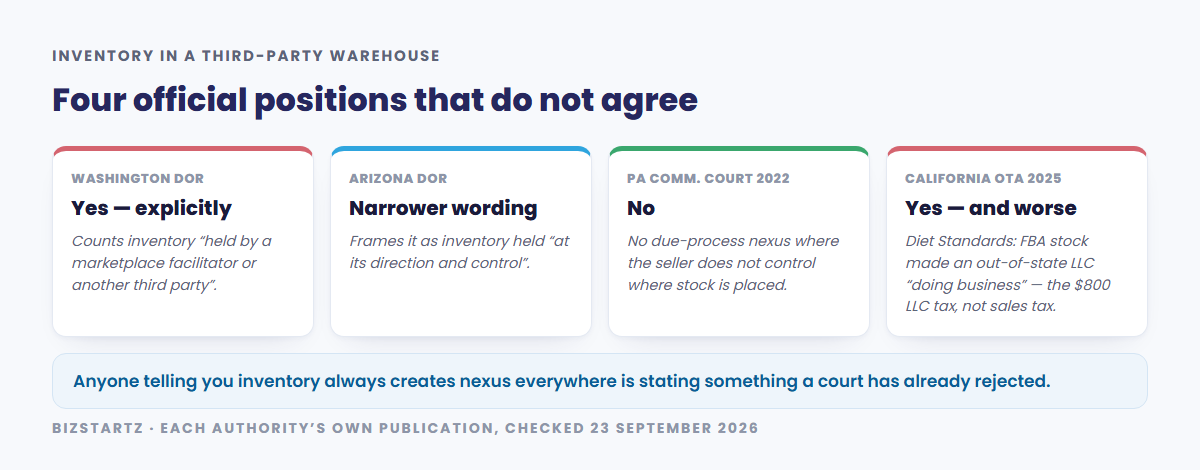
Washington says yes, explicitly including third-party inventory
Washington’s Department of Revenue lists, among the things that create physical presence nexus:
“Having a stock of goods in Washington, including inventory held by a marketplace facilitator or another third party representative.”
(Washington DOR, Physical presence nexus.) That is about as direct as a state gets. FBA stock in a Washington fulfilment centre is your stock of goods in Washington.
Arizona’s wording is narrower
Arizona’s Department of Revenue describes the physical-presence trigger as: “The retailer maintains an inventory of products in Arizona at its direction and control.” The italics are ours; the qualifier is theirs. That phrasing invites the argument that goods Amazon moved to Arizona on its own initiative are not held at your direction and control. We are not aware of Arizona publishing a ruling that settles the FBA case one way or the other, and a draft ruling on physical presence circulated in 2024 does not address third-party storage. So: a narrower rule than Washington’s, with an unanswered question inside it.
A Pennsylvania court said no
In Online Merchants Guild v. Hassell, No. 179 M.D. 2021, decided 9 September 2022, the Commonwealth Court of Pennsylvania considered out-of-state Amazon sellers whose only connection to Pennsylvania was merchandise stored in an Amazon warehouse. The court found the record did not support the Department of Revenue’s position, and its reasoning turned on a detail every FBA seller will recognise:
“The record reflects that Amazon determines the location to which goods are shipped by an FBA Merchant. Even where an FBA Merchant has paid to participate in Amazon’s ‘inventory placement service,’ an FBA Merchant has no control over its merchandise once Amazon receives it.”
The constitutional hook was the Due Process Clause rather than Wayfair’s Commerce Clause analysis. Due process requires “some definitive link, some minimal connection, between the state and the person, property[,] or transaction it seeks to tax,” and “some act” by which the taxpayer “purposefully avails itself of the privilege of conducting activities within the forum [s]tate.” The court’s conclusion was blunt:
“The record fails to disclose what, if anything, the Commonwealth has given the FBA Merchants ‘for which it can ask [in] return.'”
The order granted the sellers’ application for summary relief and denied the Department’s. (Opinion, Commonwealth Court of Pennsylvania.)
Do not over-read that. It is one state court, on one record, about that department’s attempt to compel answers to nexus questionnaires. It is not a national rule, it does not bind California or Washington, and it does not mean inventory is safe anywhere. What it does mean is that anyone telling you “inventory always creates nexus, everywhere, full stop” is stating something a court has already rejected in at least one state.
California will tax you on inventory you did not place there — but not the tax you expect
This is the part worth reading twice, because it catches the exact reader this page is written for.
In Appeal of Diet Standards LLC, OTA Case No. 230613542, decided 7 October 2025, California’s Office of Tax Appeals looked at a Delaware LLC based in Florida that “participated in Amazon’s Fulfillment by Amazon (FBA) program” and “owned inventory at Amazon warehouses (fulfillment centers) located in California.” Its California sales, property and payroll were all below California’s bright-line nexus thresholds.
The OTA held it was nonetheless “doing business” in California under Revenue and Taxation Code section 23101(a), and owed the $800 annual LLC tax for 2019, plus a demand penalty and interest. (OTA opinion.)
Note what that case was not about. It was not a sales tax case. The $800 is California’s annual LLC tax, administered by the Franchise Tax Board — a different agency from the CDTFA, which handles sales tax. So an FBA seller can have every sales tax dollar collected and remitted by Amazon, owe the CDTFA nothing, and still pick up an $800-a-year California obligation plus filing requirements, purely because Amazon routed some of their pallets into a Californian fulfilment centre.
If you are running FBA at any scale, that is the single most expensive thing on this page, and it has nothing to do with sales tax at all.
The practical read
- Nexus and a collection obligation are not the same thing. You can have physical nexus in a state and still collect nothing, because the marketplace is collecting on every sale you make. Nevada says so directly: if “your only connection to Nevada is inventory in a third-party’s fulfillment center” and your facilitator already collects, “you don’t need to register for a Sales Tax Permit with the Department.”
- The moment you also sell direct, the inventory matters much more. Physical nexus removes the threshold question entirely for those direct sales. There is no minimum to cross.
- Find out where your stock actually is. Seller Central’s FBA inventory reports are where the fulfilment-centre detail lives. You cannot evaluate any of this without knowing which states have held your units, and most sellers have never looked.
- Other state taxes ride along. California’s $800 is the clearest example. Washington’s B&O is another. Sales tax may be the least of it.
If you are weighing FBA against shipping direct from your own country, this is a real cost input, not a footnote. Our guide to getting an Amazon seller account with a US LLC covers the account side; the warehouse side is the part that generates tax filings.
Digital products, SaaS and services: nobody can give you one rule
A lot of our readers do not sell goods at all. They sell a course, a template pack, an app subscription, a design service. The question “is that taxable?” has no national answer, and the honest version of this section is a set of decision points rather than a rule.
Look at how far apart three states are on the same product — a SaaS subscription sold to a US customer:
| State | Position on software you do not ship on a disc | Source |
|---|---|---|
| Texas | Taxable as a data processing service. “Internet hosting … is a taxable data processing service when the user stores data on the service provider’s hardware, or processes data on software that is owned, licensed, or leased by the user or provider.” But “Twenty percent of the total amount charged for data processing services is exempted from tax” — so the tax lands on 80% of the charge. | 34 Tex. Admin. Code § 3.330 |
| Washington | Taxable. “Digital automated services” are services that “use one or more software applications and are transferred electronically,” and from 1 October 2025 sales and use tax applies to digital products “regardless of how they are accessed (downloaded, streamed, subscription service, networking, etc.)” | WA DOR, Digital products |
| California | Not taxable today, taxable from 1 January 2027. Regulation 1502 currently says a prewritten program “is not a taxable transaction if the program is transferred by remote telecommunications … and the purchaser does not obtain possession of any tangible personal property.” That changes under SB 122. | CDTFA Reg. 1502 · CDTFA digital products guide |
California’s change is worth flagging because it is imminent and it is not yet fully written. The CDTFA states: “Beginning January 1, 2027, sales and use tax generally applies to the retail sale of a digital product,” under Senate Bill 122 (Stats. 2026, Ch. 23), with tangible personal property redefined to include digital products transferred on media, transferred electronically, or accessed remotely.
As at 23 September 2026 the CDTFA is still working through implementing regulations, so the detail of what is in and out is not settled. If you sell software or a subscription into California, this is on your calendar.
Beyond that, four things reliably make digital taxability messier than goods:
- The label does not decide it. Whether you call it software, a service or a subscription matters less than how the state classifies the activity. Texas gets to SaaS through “data processing services,” not through “software.”
- Who the customer is can change the answer. Washington exempts a business purchase of a digital good — but that exemption “does not apply to digital automated services or remote access software.” Same buyer, different product, different result.
- Services are usually not taxable, until they are. Most states tax goods by default and services by exception. Which services are in the exception list is a state-by-state list with no pattern you can generalise.
- The rules are changing faster here than anywhere else in sales tax. Washington moved on 1 October 2025. California moves on 1 January 2027. Anything you read that is two years old on digital taxability should be treated as out of date until confirmed.
We are not going to give you a taxable/not-taxable table for 45 states and DC on digital products, because any such table is wrong somewhere, and being wrong is worse than being incomplete. If your digital sales into any single US state are getting large, that state’s rule is a specific question with a specific answer, and it is worth paying someone to answer it once.
If you do have to register, what actually happens
Registration is per state. There is no federal sales tax and no national registration. You apply to that state’s revenue department, get a permit or licence number, then file returns on the schedule they assign you, including returns for periods when you sold nothing. That last part is the cost people underestimate. A registration is a recurring obligation, not a one-off.
The permit itself is usually free. California states it plainly in its seller’s permit publication: “No. The permit is free.” The Texas Comptroller’s permit page lists no application fee either. The expense is the filing, and the penalty risk if you stop filing.
The identification problem, and where it is solved
Here is a real obstacle the formation industry rarely mentions: several state registration forms are built around a US person’s identity documents.
Texas lists, among the things you need for a sales and use tax permit, “Sole owner’s Social Security number,” “Partnership Social Security numbers or federal employer’s identification numbers for each partner,” and “Social Security number for each officer or director of a corporation” (Texas Comptroller). California’s publication lists “Social security number (corporate officers excluded). Driver’s license or state identification number … Federal Employer Identification Number (FEIN).”
If you have never lived in the United States you have none of those personal numbers. Your LLC has an EIN; you personally have no SSN and quite possibly no ITIN. Whether a given state’s online portal will complete an application without one is a question we cannot answer for 45 states, and we are not going to guess. Ask the state, or ask someone who registers in that state regularly.
What we can point at is one route where the answer is published and unambiguous. The Streamlined Sales Tax Registration System — run by the member states themselves — says in its registration FAQ:
“Yes, The SSTRS allows foreign sellers that have no FEIN or ITIN and no address in the United States to register.”
(SSTGB registration FAQ.) One application covers any or all of the 24 Streamlined member states, and “There is no fee to register through the SSTRS.”
Two warnings before you treat that as the easy button. First, it covers 24 states — not California, not Texas, not New York, not Florida. Second, the Governing Board is explicit that registration has teeth: “Returns must be filed even if you have no sales in that state,” and “All states in which you are registered expect you to file returns each reporting period even if you have no tax to report.” Registering in all 24 because it is one form is how you acquire two dozen recurring filings you did not need.
Local jurisdictions are their own problem
State-level registration does not always finish the job.
- Alaska has no statewide sales tax but its municipalities do, and remote sellers register with the Alaska Remote Seller Sales Tax Commission: “Remote Sellers and Market Place Facilitators who meet the statewide threshold of $100,000 gross sales (the 200 transaction threshold was removed effective 1/1/2025) annually into Alaska either last year or this year, regardless of destination or taxability status of end buyer, must register with ARSSTC.” If everything you sell goes through a marketplace, ARSSTC says: “If ALL sales are made through a Marketplace Facilitator, the Marketplace Seller does not need to register. They must fill out the Marketplace Seller Affidavit (please contact administrator for the form) and submit.” (ARSSTC.)
- Colorado has home-rule municipalities that administer their own sales tax and set their own tax base. The state’s Sales & Use Tax System is “a one-stop portal” for filing with “state, state-collected, and participating home-rule self-collecting taxation jurisdictions” — note participating. A seller can be correctly registered with Colorado and still be unregistered in a city (Colorado DOR, SUTS).
- Louisiana taxes at parish level, and built a body to stop remote sellers having to file with each one: “The Commission serves as the single entity in Louisiana to require Remote Sellers to collect from customers and remit to the Commission” (Louisiana Sales and Use Tax Commission for Remote Sellers). One registration, one return, distributed onward.
Alaska is worth pausing on if you have read that it is a “no sales tax state.” It has no state sales tax. It has an entire parallel local regime with its own registration and its own threshold. A US LLC registered in Wyoming that has never touched Alaska can still be required to register there.
Dropshipping has a second sales tax problem
If your supplier is in the US and ships direct to your US customer, sales tax can land on you from the supply side rather than the customer side — and it is not obvious until it shows up on an invoice.
California is the cleanest illustration. Under Regulation 1706, “A drop shipper that is a retailer engaged in business in this state is reclassified as the retailer and is liable for tax as provided in this regulation.”
Your US supplier normally escapes that by taking a resale certificate from you. If you have no California seller’s permit number to put on it, the CDTFA’s position is direct: “The drop shipper is responsible for reporting and paying the tax.”
Your supplier will then pass that cost to you, and the amount is not necessarily your cost price. Where the drop shipper does not know what you charged the end customer, Regulation 1706 lets it “calculate the retail selling price of its drop shipments of property based on its selling price of the property to the true retailer plus a mark-up of 10 percent (10%).” So tax is computed on a number invented by the rule, on a sale you did not report, because you were not registered.
The CDTFA also notes what your supplier may not do: it can seek reimbursement from you, but cannot label the charge “California sales tax” — the permitted wording is along the lines of “California tax paid to California drop shipper” (CDTFA, Drop shippers and resale certificates; Regulation 1706).
That is one state. The general shape holds more widely: a resale certificate is how you avoid paying sales tax on goods you are buying to resell, and some states will only accept a certificate carrying a registration number they issued. If you are building a US supply chain around a US LLC for dropshipping, ask your supplier which states they are registered in and what certificate they will accept, before you price anything.
Penalties: what we will and will not tell you
You will find articles quoting a single penalty rate for “US sales tax.” There isn’t one. Penalties are set by each state, differ by state, and change. We are not going to invent a figure, and you should distrust any page that gives you one without naming the state and citing it.
What is worth understanding is the structural risk, which is the same everywhere: sales tax is money you were supposed to collect from your customer. If you did not collect it and the state later says you should have, you generally cannot go back and bill customers from two years ago.
The tax comes out of your margin, retroactively, plus whatever that state adds for interest and penalties. That is why the exposure grows quietly rather than announcing itself, and why the FBA-plus-direct-store seller is the profile that gets hurt.
Several states operate voluntary disclosure programmes for sellers who come forward before being contacted. Terms vary by state. If you think you are already behind in a specific state, that is a conversation to have with a US sales tax professional in that state, not something to research yourself from blog posts.
When you genuinely need a specialist — and what to ask
You probably do not need one if you sell only through marketplaces, hold no US inventory, and have no US people. Most of our clients in that position spend nothing on sales tax advice and are correct not to.
You probably do need one if any of these are true:
- You hold inventory in the US — FBA, a 3PL, or anything else.
- Your own-store sales into any single state are approaching six figures.
- You sell software, SaaS or digital products at volume into the US.
- You sell into Colorado, Louisiana or Alaska, where local jurisdictions matter as much as the state.
- You already suspect you should have been registered somewhere and were not.
Questions worth putting to them, in this order:
- Given where my inventory actually sat last year, in which states do I have physical nexus?
- In those states, does the marketplace collecting on my behalf still leave me with a registration or a filing?
- Do my marketplace sales count toward my economic nexus threshold in each state that matters to me?
- Is what I sell taxable in those states — specifically what I sell, not “digital products” in general?
- Can this state’s portal register an LLC whose only owner has no SSN and no ITIN, and if not, what is the workaround?
- Does registering here create any obligation beyond sales tax — a franchise tax, a gross receipts tax, an income tax filing?
Question 6 is the one that catches people, and the California $800 LLC tax case above is exactly why it belongs on the list.
The honest limits of this page
Checked 23 September 2026 against the sources linked throughout. Some things we deliberately did not do:
- No 50-state threshold table. Thresholds change, several states have dropped their transaction-count test in the last few years, and a stale table is worse than no table. Check the state’s own revenue department.
- No single national figure of any kind — threshold, rate or penalty. There isn’t one to give.
- No claim that inventory always creates nexus. Washington says it does, including third-party inventory. A Pennsylvania court said it did not on the record before it. That disagreement is real and we have not resolved it for you.
- No taxability verdict on digital products by state. Washington changed on 1 October 2025; California changes on 1 January 2027 and the implementing regulations are not final. Anyone giving you a settled answer here is out of date or guessing.
- No enumeration of every state’s marketplace facilitator law from one source. We could not find an official document that does it, so we checked states individually.
- No reliance on any vendor’s state table. Avalara, TaxJar and similar guides were useful for finding which rule to look up. Every rule stated above is cited to the state, the court, the statute or the Governing Board instead.
None of this is tax advice, and we are not a US sales tax firm. Bizstartz forms US LLCs for people who live outside the United States and handles the federal and state filings that come with the entity itself — the annual state filings, the Form 5472 side, and the annual tax filing. Sales tax registration in a specific state is a specialist job and we will tell you when you need one rather than sell you one.
If you have not formed yet and are still weighing where to register, note that your formation state has almost nothing to do with your sales tax position, choosing a state for your LLC is decided on cost, privacy and filing burden, not on where your customers are.
A Wyoming LLC and a Delaware LLC have identical sales tax obligations in Ohio. That surprises people, and it is a good note to end on: for this tax, nothing about your company’s paperwork matters. Only where your customers and your goods are.
🎯 Ready to start? Claim your free consultation and we'll map out your US LLC formation strategy — EIN, banking, and the right state for your country.

Ready to start your company?
Bizstartz handles formation, EIN, banking and compliance for founders worldwide.