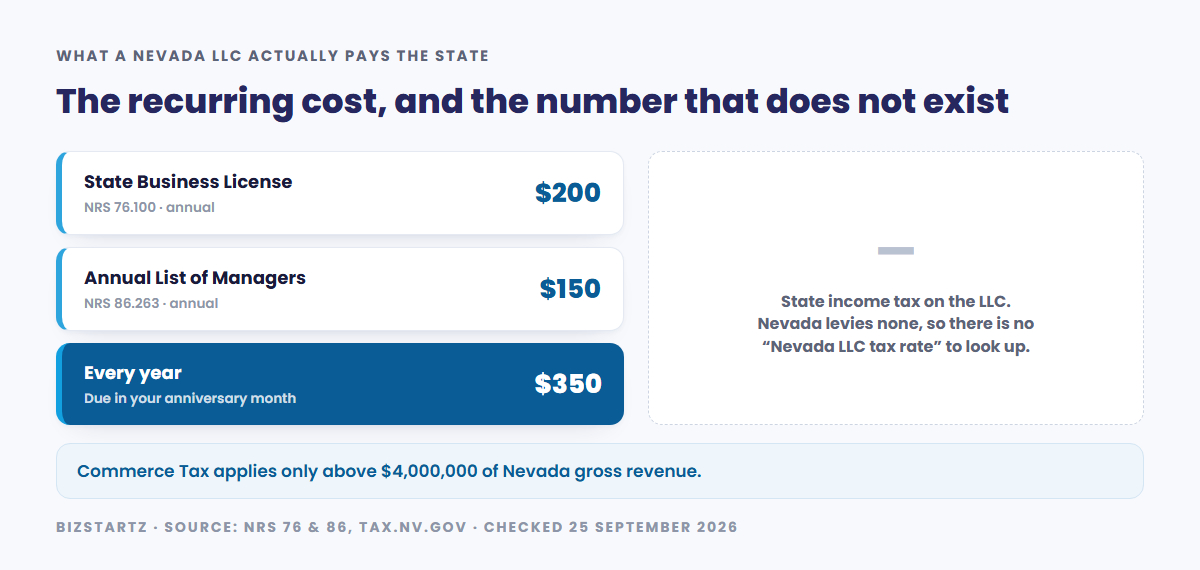
A Nevada LLC costs $350 a year to keep alive, and that is before anyone has earned a dollar. It is $200 for the State Business License and $150 for the Annual List of Managers or Managing Members, and both are due every year for as long as the company exists.
The second thing to know is that there is no Nevada LLC tax rate. Not a low one, none. Nevada levies no personal income tax and no corporate income tax, so there is no state percentage to apply to your profit.
If you came here looking for a number to multiply your income by, the number does not exist in the form you are expecting. What Nevada charges instead are flat annual fees that you owe whether the business made $0 or $400,000.
That distinction is the whole point of this page. “No income tax” and “cheap to run” are different claims, and for a non-resident with a small online business, Nevada is one of the more expensive states to maintain. The cost is annual, not one-off.
Every figure below is taken from the Nevada Secretary of State, the Nevada Department of Taxation, or the Nevada Revised Statutes, and each one is linked where it appears. Checked on 25 September 2026. State fees change; if you are reading this much later, click the source links.
This page covers what a Nevada LLC costs and what it owes each year. If you are still deciding how to set one up, the Nevada LLC formation guide covers the filing process itself.
Why “Nevada LLC tax rate” is the wrong question
Nevada has no individual income tax and no corporate income tax. An LLC is also, by default, a pass-through for federal purposes: the entity itself does not pay federal income tax; its profit lands on its owner’s return. Put those two facts together and people reasonably conclude there is nothing to pay. Then the renewal notice arrives.
What a Nevada LLC actually pays falls into four buckets, and only one of them is a tax on income at all:
| What it is | Who charges it | What triggers it | Does a small non-resident LLC pay it? |
|---|---|---|---|
| State Business License | Nevada Secretary of State | Simply being a registered entity | Yes. $200, every year, regardless of revenue |
| Annual List | Nevada Secretary of State | Simply being a registered entity | Yes. $150, every year, regardless of revenue |
| Commerce Tax | Nevada Department of Taxation | Nevada gross revenue above $4,000,000 | Almost certainly not, and below the threshold there is nothing to file |
| Modified Business Tax | Nevada Department of Taxation | Paying wages to employees in Nevada | No, if you have no Nevada payroll |
Notice what is missing from that table: anything resembling a rate applied to your profit. The two items you will certainly pay are fixed dollar amounts attached to the entity’s existence, not to its performance. An LLC that traded nothing all year owes the same $350 as one that cleared six figures.
The two fees you pay every year
State Business License — $200
Every Nevada business entity must hold a State Business License, and it is renewed annually. The Secretary of State’s State Business License FAQ puts it plainly: “The annual renewal fee is $500 for Corporations, and $200 for all other business entity types.”
An LLC is one of those other entity types, so the figure is $200. The same amounts appear in NRS Chapter 76, which sets the fee at $500 for entities organized under chapters 78, 78A and 78B and $200 for everyone else.
A single-member LLC is not exempt. The statutory exemptions exist for specific categories such as certain non-profit and religious organizations, and an entity claiming one has to file a declaration of eligibility to do it. Being small, being new, or being dormant is not on the list.
Annual List of Managers or Managing Members — $150
This is Nevada’s version of what most states call an annual report. It names the company’s managers or managing members and is filed with a fee of $150, under NRS 86.263. The same list is also required once at the start: NRS 86.263 requires the initial list at the time the articles of organization are filed, which is why the first year costs more than the years that follow.
Together that is $350 a year, indefinitely. Formation-year costs sit on top of it, and those are covered in the Nevada formation guide.
The deadline is your anniversary month, not a date on the calendar
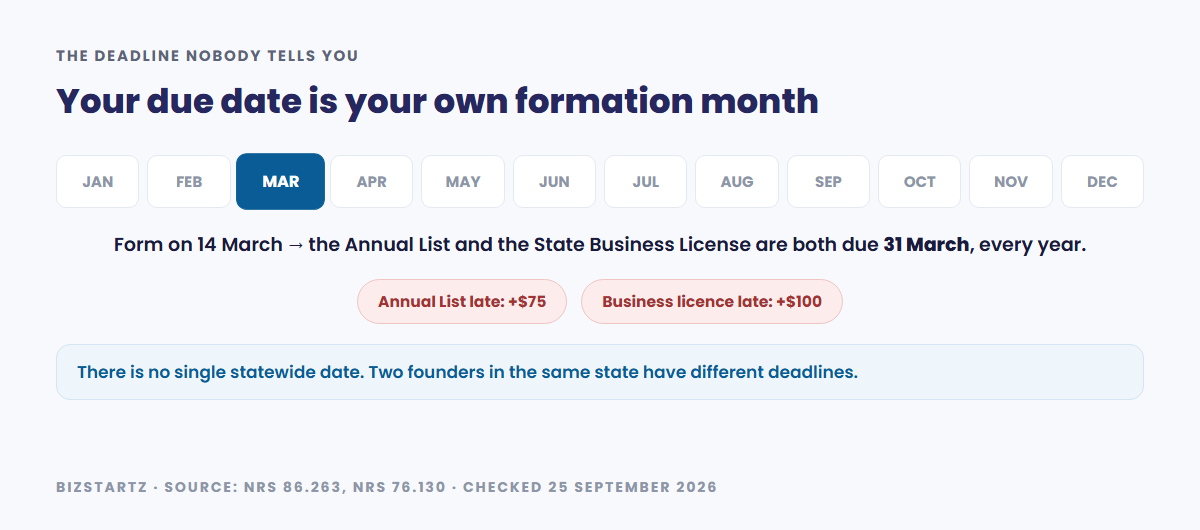
This is where non-resident owners get caught, and it is worth reading twice. Nevada does not use a fixed national-style deadline. Both obligations run off your company’s own anniversary month.
- Annual List: due “on or before the last day of the month in which the anniversary date of its organization occurs”, per NRS 86.263. Form the LLC on 14 March and your list is due by 31 March every year.
- State Business License: renews on the last day of the anniversary month in which the license was originally issued, per NRS 76.130 and the Secretary of State’s FAQ.
In practice the two land in the same month and are filed together, which is why people talk about a single $350 renewal. The consequence of the anniversary rule is that no article, including this one, can tell you your deadline. Nobody can. It depends on the day you filed, and it is the single most useful thing to put in your calendar the week you form the company.
Miss it and both charges carry their own penalty:
| Missed filing | Penalty | Source |
|---|---|---|
| Annual List | $75 added to the fee | NRS 86.272 |
| State Business License renewal | $100 in addition to the annual fee | NRS 76.130 |
So a forgotten renewal turns $350 into $525, and the entity falls into default status until it is put right. Nothing about the business changed. You simply missed a month.
Commerce Tax: the threshold almost nobody reaches
Commerce Tax is the closest thing Nevada has to a business tax on revenue, and it is the one item on this page most likely to be misrepresented elsewhere. It applies to Nevada gross revenue above $4,000,000 in a taxable year.
The part that saves most readers a filing is this, from the Department of Taxation’s Commerce Tax FAQ: “Starting 2018-2019 tax year there is no Commerce Tax filing requirement for the businesses with the Nevada gross revenue of $4,000,000 or less during the taxable year.”
Read that carefully, because it answers a question people ask constantly. Below the threshold you do not owe Commerce Tax and you do not file a return saying so. There is no zero return to remember. If you are running an online business from outside the United States with modest revenue, this tax is simply not part of your year.
Two details worth keeping if you are growing:
- The measure is Nevada gross revenue, not worldwide revenue. Revenue is attributed to Nevada under the Department’s rules, so a large business with little Nevada activity is a different question from a large business based there.
- The Commerce Tax year ends 30 June, and the return is due 45 days later, generally 14 August, per the Department of Taxation. It does not follow the calendar year or your federal year.
Modified Business Tax: a payroll tax, not an LLC tax
Modified Business Tax appears in a lot of “Nevada LLC taxes” lists without the qualification that matters. It is a payroll tax. The Department of Taxation levies it on “total gross wages less employee health care benefits paid by the employer”, at 1.17% for most general businesses, with the first $50,000 of quarterly wages not taxable. It applies to employers subject to Nevada’s Unemployment Compensation Law.
If your LLC has no employees on a Nevada payroll, which describes most non-resident-owned companies, where the owner is not a US employee and any help is contracted overseas, there is no wage base for this tax to attach to. It becomes relevant the day you hire in Nevada, not before.
What Nevada does not change: your federal filings
This needs saying once, clearly, because it is the most expensive misconception in the category. Choosing Nevada changes nothing about what you owe the IRS.
A foreign-owned single-member LLC registered in Nevada files exactly the same Form 5472 with a pro forma Form 1120 as an identical company registered in Wyoming, Delaware or New Mexico. The penalty for not filing it is the same too, and it is not small.
Nevada’s lack of a state income tax is a statement about Nevada. It is not a statement about the federal government, and no state can legislate an IRS form away.
If a page implies that forming in a no-income-tax state reduces your US federal obligations, that page is wrong, and following it is how people end up with a penalty notice for a form they were told did not apply to them.
The registered agent, and other costs that are not state fees
Nevada requires every LLC to keep a registered agent with a physical Nevada street address, which effectively rules out doing it yourself from abroad.
That is a real recurring cost, but it is not a state fee, it is a commercial service, and the price depends on who you buy it from rather than on anything Nevada publishes. Any article quoting a registered agent price as though it were a Nevada government charge is blurring two different things.
The same goes for bookkeeping, a US bank account, and preparing the federal filings. None of that is set by the Secretary of State. When you compare states, compare the state’s own charges first, then add your service costs separately, otherwise you are comparing two vendors’ price lists and calling it a comparison of states.
Nevada compared with the states non-residents usually shortlist
Nevada’s recurring $350 is two separate charges, a business license and a list filing, and you pay both simply for the entity to exist. What it buys you is a registration in a state with no income tax.
The catch in the sales pitch is that no income tax is not a Nevada exclusive, several states a non-resident would consider are in exactly the same position on income tax, so it cannot be the deciding factor.
The decision usually comes down to three questions, and none of them is about tax rates:
- Do you have any actual connection to Nevada? Customers there, staff there, property there, a physical operation there. If yes, Nevada stops being an arbitrary choice and starts being the correct one.
- Are you paying for a feature you will use? If the answer to the first question is no, the annual fee is buying a registration, not an advantage.
- What is the total, every year, forever? Not the formation quote. The renewal, times the number of years you expect to run the company.
Other states’ fees are not restated here, because this page only carries figures checked against the charging state’s own source, and Nevada is the state it checked. The side-by-side with the numbers sits on our comparison of which US state to file your LLC in, and what US LLCs have to file by state each year sets out the annual obligations state by state.
Our standing position is that Wyoming is the better default for a non-resident with no US footprint. The reason is cost and administrative simplicity, not a tax advantage, on state income tax there is no advantage to have, because neither state charges any.
Who Nevada genuinely suits
Nevada is not a bad state. It is a bad default. It earns its fee when there is a reason for the entity to be there:
- You operate in Nevada. An office, staff, inventory, a storefront, or customers concentrated in the state. Registering where you actually do business avoids the cost and paperwork of registering as a foreign entity in your real state anyway.
- You are already inside the Nevada system. Existing entities, an established relationship with counsel or an accountant there, or a partner who insists on it.
- The $350 is immaterial to you. For a business with real revenue, this is a rounding error and the choice can be made on other grounds. For a founder testing an idea with a few hundred dollars, it is a meaningful share of year one.
What should not be on that list: forming in Nevada to lower a federal tax bill, to avoid a filing, or because a page told you it has no taxes. It has no state income tax. It has fees, and they arrive every year on the anniversary of the day you signed up.
What to do this week if you already have a Nevada LLC
Three things, in order:
- Find your formation date and put a recurring reminder in the middle of that month, every year. Both filings are due by the last day of it.
- Check your current standing with the Secretary of State before assuming you are current. Default is easier to fall into than to notice.
- Keep the federal side separate in your head. The Nevada filings and the IRS filings share nothing except your attention — we handle the federal side through annual tax filing if you would rather not track both.
Fees and rules on this page were checked against Nevada state sources on 25 September 2026. The Secretary of State and the Department of Taxation publish the current figures at the links above, and they take precedence over anything written here. This page explains Nevada’s published fees and filing rules; it is not tax advice for your situation.
🎯 Ready to start? Claim your free consultation and we'll map out your US LLC formation strategy — EIN, banking, and the right state for your country.

Ready to start your company?
Bizstartz handles formation, EIN, banking and compliance for founders worldwide.