BOI filing was a report of a company’s beneficial owners to FinCEN, the US Treasury’s financial crimes bureau. Since FinCEN’s final rule of August 2026, companies formed in the United States don’t file it (checked September 2026). That includes a US LLC owned by someone who lives in Pakistan, Nigeria, India or anywhere else. The only companies still reporting are companies formed under another country’s law that have registered to do business in a US state, and even they don’t report owners who are US persons.
FinCEN announced the final rule on 11 August 2026, and it was published in the Federal Register and took effect on 14 August 2026 (FinCEN: Beneficial Ownership Information; Federal Register 2026-16576). It made permanent an interim rule from March 2025.
If you read an earlier version of this page, or any guide from 2024 or early 2025, that says your LLC must file a BOI report, it’s out of date. This page explains what BOI reporting was, what changed, who still files, and what a non-resident with a US LLC should actually do now.
In this guide: What BOI filing was · What changed · Who still has to file · The US-person exemption · Deadlines and penalties · If you own a US LLC from abroad · State rules · FAQ
What BOI filing is
BOI stands for beneficial ownership information. The Corporate Transparency Act (31 U.S.C. 5336) set up a federal register of who really owns and controls companies, to make it harder to hide behind shell companies. Companies covered by it file a Beneficial Ownership Information Report (BOIR) with FinCEN online.
FinCEN defines a beneficial owner as an individual who, directly or indirectly, either exercises substantial control over the company or “owns or controls at least 25% of the reporting company’s ownership interests.” Substantial control covers senior officers, anyone who can appoint or remove officers or directors, important decision-makers, and “any other form of substantial control” (FinCEN BOI FAQs, D.1 and D.2).
A report includes:
- The company: legal name, trade names, principal business address, jurisdiction of formation or registration, and tax ID.
- Each beneficial owner: name, date of birth, residential address, an identifying number from an acceptable ID document, and an image of that document.
- Company applicants, the people who filed or directed the filing that created or registered the company: the same personal details. A company created or registered before 1 January 2024 reports that fact instead.
FinCEN doesn’t charge a fee to file (FAQ B.4).
What changed: from almost every company to foreign companies only
As first written, the rules covered corporations, LLCs and similar entities created by filing with a US state, plus foreign companies registered to do business in one. That’s what most BOI guides, including the earlier version of this page, still describe. Two rules changed it.
| Date | What happened |
|---|---|
| 26 March 2025 | FinCEN issued an interim final rule redefining “reporting company” to mean only entities formed under foreign law and registered to do business in the US. Companies created in the US were exempted. |
| 25 April 2025 | Deadline for foreign reporting companies already registered before 26 March 2025 to file. |
| 11 August 2026 | FinCEN announced its final rule, which “permanently removes the requirement for U.S. companies and U.S. persons to report” (FinCEN press release). |
| 14 August 2026 | Final rule published in the Federal Register and effective the same day (RIN 1506-AB67). |
The final rule adopts the March 2025 rule “with certain limited changes.” According to the rule text, the main ones are that US persons who were company applicants no longer have to be reported, and US persons who hold a FinCEN ID no longer have to update or correct the information behind it. FinCEN also says it will delete information previously reported by US persons from its database.
Who still has to file a BOI report
Under the current regulation, a reporting company is a corporation, LLC or other entity that is “formed under the law of a foreign country” and registered to do business in a US state or tribal jurisdiction by filing a document with a secretary of state or similar office (31 CFR 1010.380, as updated through August 2026).
In practice:
- A Wyoming, Delaware, New Mexico or any other US-state LLC: not a reporting company. No BOI report, whoever owns it and wherever they live.
- A company formed in your own country, such as a Pakistani private limited company or a UK Ltd, that has registered in a US state to do business there: a reporting company, unless an exemption applies.
- A foreign company that hasn’t registered in any US state (for example, it just sells to US customers online): not a reporting company under that definition, because the trigger is the state registration.
The exemptions in the Corporate Transparency Act, such as those for large operating companies and regulated financial institutions, still apply to foreign reporting companies. Check the list in the regulation before assuming you’re covered.
What the “US persons” exemption means for owners
A foreign reporting company doesn’t report beneficial owners or company applicants who are US persons (31 CFR 1010.380(b)(5)(i)). The regulation takes the meaning of “United States person” from the tax code, which includes “a citizen or resident of the United States,” domestic partnerships and corporations, and certain estates and trusts (26 U.S.C. 7701(a)(30)).
So for a foreign company registered in a US state:
- Owners who are not US citizens or US residents, such as a founder living in Lagos or Dhaka, are reported. FinCEN’s release says foreign reporting companies “will still be required to report beneficial ownership information for foreign individuals.”
- Owners who are US citizens or residents are left out of the report.
- If every beneficial owner is a US person, the company still files, but the report carries no beneficial owner information. The final rule says these companies “are still obligated to file reports, but those reports do not have to include any BOI.”
“Resident” here is a tax-law term, not the same as where you happen to be living this month. If you’re unsure whether you count as a US resident, that’s a question for a US tax adviser.
Deadlines and penalties for companies that still report
From 31 CFR 1010.380 and FinCEN’s BOI page (checked September 2026):
| Report | Deadline |
|---|---|
| Initial report, foreign company registered in a US state before 26 March 2025 | By 25 April 2025 (already passed) |
| Initial report, registered on or after 26 March 2025 | Within 30 calendar days of the earlier of actual notice that the registration is effective, or the state first giving public notice of it |
| Updated report, when reported information changes | Within 30 calendar days of the change |
| Corrected report, when a filed report was wrong | Within 30 calendar days of becoming aware of the error |
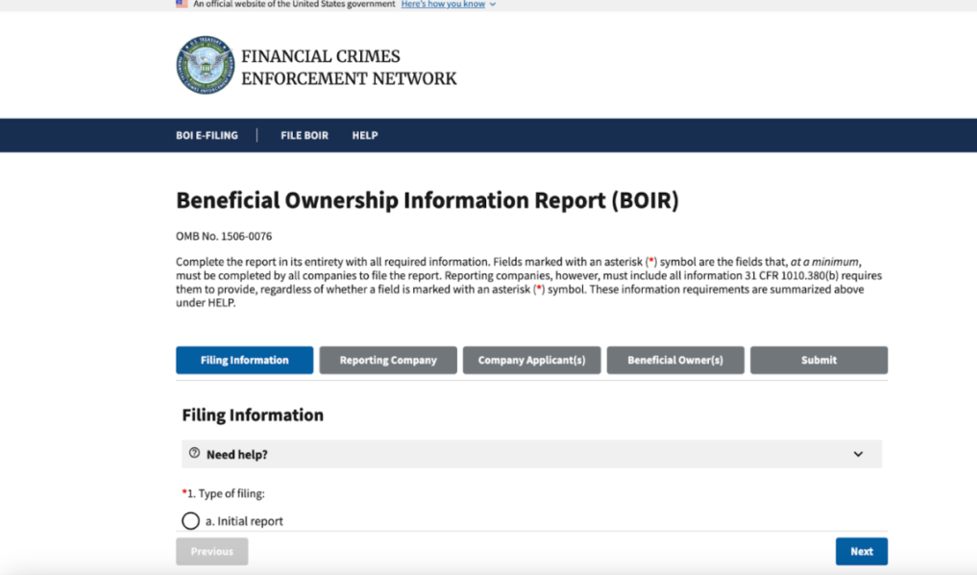
Reports are filed online through FinCEN’s BOI E-Filing system.
The Corporate Transparency Act makes it unlawful to willfully give false beneficial ownership information or willfully fail to report complete or updated information. The statute sets a civil penalty of up to USD 500 for each day the violation continues, and criminal penalties of up to USD 10,000, up to two years in prison, or both (31 U.S.C. 5336(h)). Those penalties matter now only to companies that still have to report.
If you own a US LLC and live outside the US: what to do now
For BOI: nothing. Your LLC was created by filing in a US state, so it’s a US company, and FinCEN says “U.S. companies are exempt from BOI reporting requirements and therefore, are no longer required to file BOI reports” (FinCEN BOI FAQs, notice dated 11 August 2026). Where the owner lives doesn’t change that.
- Don’t pay for a BOI filing for a US LLC. If a formation provider, bank or emailer tells you one is required, ask them to point to the rule, and check fincen.gov/boi yourself.
- If you already filed in 2024 or early 2025, you don’t need to update that report: the requirement no longer applies to US companies. FinCEN has said it will delete information previously reported by US persons. We didn’t find a FinCEN statement on what happens to earlier reports that named foreign owners of US companies, so we can’t tell you whether yours will be deleted.
- If you also own a company in your home country that is registered in a US state, that company is the one that may have to report.
The filings that do still apply to your LLC
The one most non-resident owners miss is with the IRS, not FinCEN. A single-member LLC owned by a non-US person files a pro forma Form 1120 with Form 5472 attached every year, even with no income. It can’t be e-filed, and the penalty for not filing is USD 25,000, plus another USD 25,000 for each 30 days the failure continues more than 90 days after an IRS notice (IRS Instructions for Form 5472, Rev. December 2024). Our guide to Form 5472 for foreign-owned US LLCs explains who files, what counts as a reportable transaction and how to send it.
On top of that, your state has its own yearly filing or fee (for example, Wyoming’s annual report or Delaware’s annual LLC tax), and you need to keep a registered agent. The dates are in our US tax filing deadline guide.
State ownership rules are separate
FinCEN’s rule doesn’t stop a state from running its own disclosure law. New York’s LLC Transparency Act is the one founders ask about. The New York Department of State says its disclosure requirement applies to LLCs “formed under the law of a foreign country” that are authorized to do business in New York, and that LLCs formed in New York, another US state or a US territory “are exempt from reporting requirements” (New York DOS: Beneficial Ownership Disclosure FAQs, checked September 2026). We haven’t checked every state, so if your LLC is registered in a state other than the one it was formed in, look at that state’s rules too.
How Bizstartz can help
Bizstartz forms US LLCs for founders who live outside the US and helps with the yearly federal filing that does apply to them. Our US tax filing service covers the Form 5472 side. If you’re not sure whether any report applies to your company, a free consultation is a sensible first step.
Frequently asked questions
Does my US LLC need to file a BOI report in 2026?
No. Under FinCEN’s final rule, effective 14 August 2026, companies created in the United States are exempt from BOI reporting, including LLCs owned by people who live abroad.
Who still has to file a BOI report?
Companies formed under the law of another country that have registered to do business in a US state, unless an exemption applies. They report their beneficial owners who aren’t US persons.
I filed a BOI report for my LLC in 2024. Do I need to update it?
No. US companies are no longer required to file BOI reports, and that includes updated reports.
Does a foreign company with only US owners still file?
Yes, if it’s registered to do business in a US state and not otherwise exempt. The final rule says it still files a report, but the report doesn’t include any beneficial owner information.
What is a beneficial owner?
An individual who directly or indirectly owns or controls at least 25% of the company, or exercises substantial control over it, for example as a senior officer or key decision-maker.
Is there a fee to file a BOI report?
No. FinCEN doesn’t charge to file. Any fee you’re quoted is a provider’s service charge.
Is Form 5472 the same thing as a BOI report?
No. BOI reports went to FinCEN and no longer apply to US companies. Form 5472 goes to the IRS with a pro forma Form 1120, and a single-member US LLC owned by a non-US person still has to file it every year.
This page was rewritten with the help of AI tools and checked against FinCEN, the Federal Register, the US Code, the IRS and the New York Department of State on 17 September 2026. The rules on beneficial ownership reporting have changed several times since 2024, so check fincen.gov/boi before you act.
Related Guides
- Form 5472 for Foreign-Owned US LLCs: Who Files, When & Penalties
- US Tax Filing Requirements for International Founders
- ITIN for Foreigners: Who Needs One, Who Doesn’t, and How to Apply
Missing a federal deadline is expensive: Form 5472 alone carries a USD 25,000 penalty. Our US tax filing service keeps non-resident owners compliant.
🎯 Ready to start? Claim your free consultation and we'll map out your US LLC formation strategy — EIN, banking, and the right state for your country.

Ready to start your company?
Bizstartz handles formation, EIN, banking and compliance for founders worldwide.