How to Create a Business PayPal Account with a US LLC

Setting up a PayPal Business Account is a crucial step to take after you’ve formed your U.S. LLC. It professionally accepts global payments, manages your funds, and allows you to operate as a legitimate U.S. business in the global marketplace.

Nevertheless, confusion often arise from non U.S founders about how to open a PayPal Business Account with their U.S. company, especially those living outside the U.S.

This guide covers everything you need to and addresses your concerns, including eligibility and requirements, the complete setup process, and how to expedite the approval of your account.

🏢 Why You Need a PayPal Business Account for Your U.S. LLC

With a business you operate in the digital sphere, a reliable and universally accepted payment option is essential. PayPal is the most trusted payment system and works with millions of businesses around the globe.

Here’s why every U.S. LLC owner–especially those that are non-U.S. residents–should set up a PayPal Business Account:

1. PayPal Business Account Ownership and Display

Having a PayPal Business Account contributes to your company’s legitimacy and registration. With the Business Account, clients will see your LLC’s name and not a personal name. This builds trust and impartial credibility to your brand.

2. Worldwide Operation.

PayPal functions in more than 200 countries and handles more than 20 different currencies. This means that your customers to make payments from every corner of the world and avoid frustrating foreign transaction structures.

3. Easy Integration.

PayPal works with major eCommerce sites, including Shopify, WooCommerce, BigCommerce, and others. This is a great convenience to those having a digital business that aims to collect payments online.

4. Secure and Compliant

Equipped with advanced PayPal fraud protection, dispute resolution, and encrypting tech, your transactions and attained business compliance to U.S. financial regulations are ensured.

5. Invoicing and Financial Management.

PayPal creates customizable invoices and monitors transactions. This makes tracking of sales, and finances, really effective and streamlined to save time for bookkeeping, and make the tax filing process manageable.

6. Multi-Currency Functions

Having multiple balances on your account, currency conversion, and withdrawing USD straight to your business U.S. bank account, offers you flexibility and command on your international income.

🪪 U.S. LLC PayPal Business Account Requirements

paypal

Prior to creating the account, business clients LLC PayPal accounts, ensure your U.S. LLC is fully and compliant. Account restrictions and delays might occur, owing to incomplete prerequisites.

Here’s the information you need:

1. Registered U.S. LLC

You need a Limited Liability Company registered in a State of the U.S. as in Delaware, Wyoming, New Mexico, or Florida. Your Proof of Business formation i.e. articles of organization confirms your registration.

If you wish to form your LLC, then it can be done at Bizstartz, and it can be done while you are outside the U.S.

2. Employer Identification Number (EIN)

An EIN is issued by the IRS as a Tax ID for your business. PayPal needs to verify business accounts, hence it is crucial. Your account can be flagged for incompleteness on business verification if you do not provide an EIN.

3. U.S. Business Address

To register and verify your business, you want to provide a valid U.S. address. This can be:

  • Your LLC’s registered address
  • A virtual office address from a provider that allows business mail forwarding

Just make sure this address is the one that is listed in your LLC documents.

4. U.S. Business Phone Number

For security verification, PayPal may request a U.S. number. This can easily be obtained through apps and services such as OpenPhone, Grasshopper, Google Voice, and Skype Business.

5. U.S. Business Bank Account

To actually receive and withdraw money from your PayPal account, you will need a U.S. bank account. Suggested online banks for non-U.S. residents include:

  • Mercury Bank
  • Relay Financial
  • Wise Business

These banks accept international founders and will easily integrate with PayPal.

6. Business Email Address

Use a professional domain-based email address such as info@yourcompany.com. Avoid using Gmail and Yahoo emails as they can look unprofessional and may cause problems during the verification process.

7. Website or Online Store

If you have an active website, include a clear explanation of your products and services as this will help PayPal verify your business. If you have an eCommerce store, make sure that your product listings and terms of service are easily accessible.

🧭 Step-by-Step Guide: How to Create a U.S. PayPal Business Account

Alright! We can now go ahead to opening your U.S. PayPal Business Account. Here’s a list of actions to take.

1. Open PayPal’s Business Page
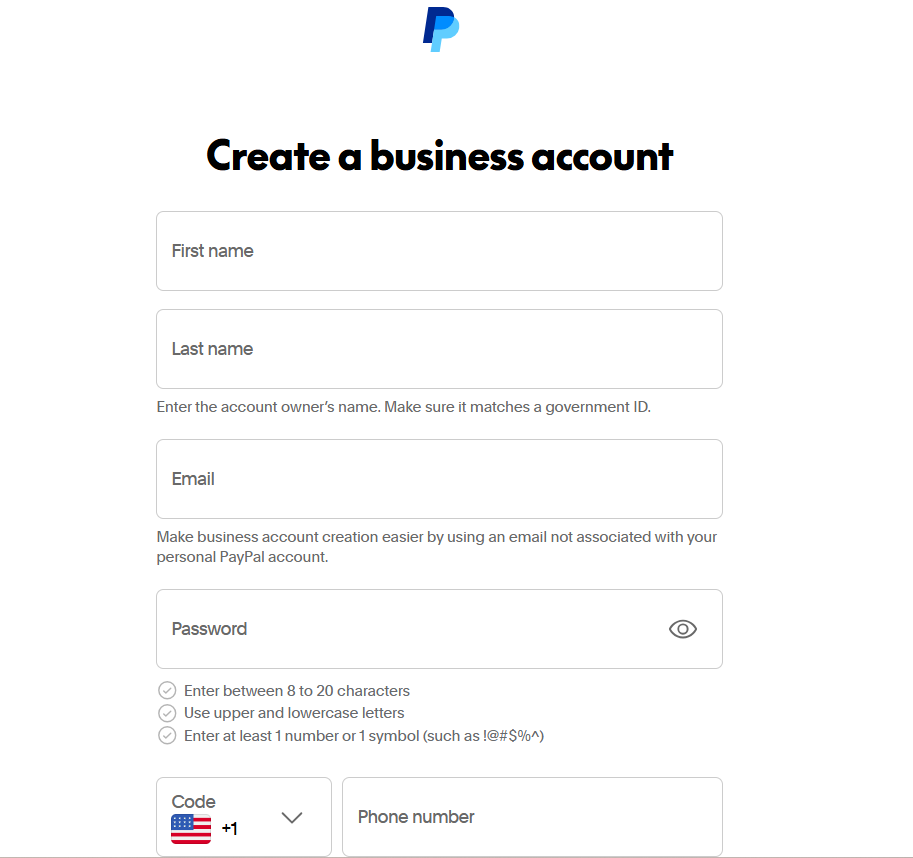
paypal signup

Head to PayPal.com/business. When the page fully loads, look for a button that says “Sign Up,” and click it.

From the page opened, choose “Business Account” before you can proceed.

After that, you can proceeds to the registration page for opening your PayPal account.

2. Type In Your Business Email

By now, you should have created an email account for your LLC, and that should be the email you use for this PayPal account for now (for example: set up email as info@yourcompany.com).

That email will be your main contact for all emails and notifications PayPal will send you for all your business transactions.

3. Fill In Business Details

Now, you need to provide:

  • Business Name as per your legal documents, LLC.
  • Business Address should be your U.S. LLC Address.
  • Business Phone: Your U.S. business phone number.
  • For Business Type, choose “LLC” (Limited Liability Company).
  • For the last item, EIN, put your LLC’s Employer Identification Number.

Check and crosscheck that every item is as per your business registration. No discrepancies.

4. Type In Your Personal Details

For this, you have to provide the information for the owner or the managing member of the LLC.

Please provide the following:

  • Complete legal name
  • Date of birth
  • Country of residence (your home country is acceptable)
  • Passport or national ID (for identity verification)
  • Personal address (can be non-U.S.)

This is part of PayPal’s KYC (Know Your Customer) compliance.

Step 5: Add Business Description

Describe your business, including:

  • Business category and subcategory
  • Product/service type
  • Average transaction size and volume

Example:

We operate an eCommerce store selling home and lifestyle products globally through an online platform.”

Ensure your description is consistent with your business website or online store.

Step 6: Link Your U.S. Bank Account

After creating your PayPal account, go to your Wallet and click “Link a Bank Account.

You can link accounts from these banks:

PayPal will make at least two small (usually under $1) deposits to your account.

Check the precise amounts in your banking dashboard and enter them in PayPal to finish verification.

Step 7: Verify and Activate Your Account

Confirm your email address and finish any other verification steps requested by PayPal.

After verification, you have the ability to:

  • Send and receive business payments.
  • Create and send invoices.
  • Withdraw funds to your U.S. bank account.

🌍 Can Someone Who Doesn’t Live in The U.S. Get a U.S. PayPal Business Account?

Bookkeeping for Dropshipping

Of course!

You just need a few important steps in business for them to get a U.S. PayPal Business Account.

You have to have:

✅ A registered U.S. LLC

✅ An EIN (Tax ID)

✅ A U.S. business address

✅ A U.S. business bank account

After that, you can get to your PayPal Business Account from anywhere.

Many entrepreneurs from other countries get in touch with Bizstartz for help with everything. First forming their LLC, then getting a U.S. bank account, EIN, helping with PayPal and Stripe verification, then everything else after that.

💡 Tips to Keep Your PayPal Account Balanced

Getting a PayPal account is one step, but for it to remain balanced, there are some things that need to be done first. Here are some things to avoid PayPal account limits:

Stick to Your Business Model

Make sure you accurately describe the business you are doing. Not doing so might lead PayPal to limit your account.

Be Sure to Have Business Email and Domain

A business website and a domain increases the trust PayPal has in your business.

Minimize Multiple Login Locations

PayPal scans account activity for odd logins. Use a reliable VPN that shares your business address region.

Do Not Mix Personal with Business Accounts

Do not ever combine account activities on PayPal. Keep all transactions, funds, and banking activities separate.

Do Not Keep Large Balances

Do not keep large PayPal account balances for a long time. Frequent withdrawals lower the chances of your account being flagged.

Be Timely with PayPal

If PayPal requests supporting docs, such as invoices, supplier details, and business proof, respond quickly.

Keep Business Docs Current

If your LLC address or ownership changes, be sure to keep PayPal updated to maintain compliance.

How Bizstartz Assists Non-U.S. Founders in Building and Operating U.S. Businesses

Bizstartz simplifies the process for non-U.S. entrepreneurs to legally establish and operate a U.S business, no U.S. travel required.

Here’s how we help:

LLC Formation in Any U.S. State: Delaware, Wyoming, Florida, Texas & more

EIN (Tax ID) Application: Fast EIN setup, even for non-U.S. residents

Registered Agent & Business Address: To receive U.S. mail and legal documents.

U.S. Bank Account Setup: Mercury, Relay, or Wise account for global founders

PayPal & Stripe Account Assistance: Guidance for smooth approval and compliance.

BOI Filing, Bookkeeping & Taxes: To help your LLC stay compliant year-round.

We handle all the paperwork, compliance, and setup, so you can focus on running and growing your business.

Final Thoughts

Being able to Create a U.S. PayPal Business Account with your LLC is one of the smartest steps you can take for scaling your business internationally. It allows you to receive payments from anywhere in the world, that increases trust from your clients, and makes you operate as though you’re a U.S. based company.

While the setup requires a few essential documents, LLC, EIN, address, and bank account, the rest is pretty straightforward.

PayPal is a vital tool for bridging the gap between your U.S. business and your international customers, no matter the type of business you have, whether it’s an eCommerce store, a freelance agency, a SaaS product, or a service-based company.

And since we have Bizstartz as your reliable partner, you won’t have to worry about complicated documentation or compliance, as we handle everything!

💼 Prepared to Make Your PayPal Business Account?

Begin the process by setting up your U.S. LLC with Bizstartz.

We will assist you with all aspects, including LLC registration, EIN, setting up your U.S. bank account, and activating your PayPal.

👉 Start with Bizstartz

How to Form an LLC in Oregon

Oregon remains one of the best states to do business in the U.S. as it has great small business owner legal protections, easy regulations, and no state sales tax.

Oregon is a great state to form a Limited Liability Company (LLC) whether you are a foreign business owner penetrating the U.S. market, or a U.S. citizen starting your first business.

Every step from name selection, document submission, and acquisition of your EIN to compliance maintenance is included in this all-inclusive guide to forming your LLC in Oregon. Keep reading to see how to form an LLC in Oregon.

Why Choose Oregon for Your LLC?

Business owners who are starting new businesses have flocked to Oregon and it is important to understand why. While many business owners wish to incorporate in Wyoming or Delaware, Oregon has plenty of benefits with LLC formation to qualify as a best kept secret.

1. State Sales Tax

Oregon has no sales tax. Customers won’t have to pay sales tax on purchases. This gives products and services no sales tax. This makes products and services more competitive. E-commerce businesses could have higher profit margins with greater pricing flexibility.

2. Cost to Form and Maintain an LLC

Oregon has one of the more reasonable prices to form and maintain an LLC. The filing fee is $100 and the annual renewal fee is $100 with no hidden charges. Oregon is a practical choice for small businesses and solo entrepreneurs to operate efficiently with minimal administrative overhead.

3. Legal and Business Environment

Oregon has a modern and simplified legal environment that is supportive of entrepreneurs. Members of an LLC in Oregon have strong liability shields. This means the personal assets of the members are separate and protected from the business and its debts.

4. Privacy and Flexibility

According to public records, Oregon LLC member details are not needed. All that is needed is to list the name and address of your registered agent. This is great for entrepreneurs who are private and wish to keep their LLC to themselves.

5. Ideal for Both U.S. and Foreign Founders

Oregon is an excellent choice for founders, whether they are US citizens or not. Given that there are no citizenship or residency requirements, for international founders it is a great option to set up a legal US entity to obtain a US bank account and payment processors.

Step 1: Choose a Name for Your Oregon LLC

The first and most imaginative step for your Oregon LLC is having your business name chosen. Your business name is the first info your potential clients/customers will come across, so it should leave a lasting impression – it has to be professional and comply with Oregon state guidelines.

Oregon LLC Naming Rules:

  • State guidelines mandate that “Limited Liability Company” or the abbreviation “LLC” or “L.L.C.” be included or attached to the name.
  • The name must be original and distinguishable: no name may be registered in Oregon.
  • Names may not contain certain “restricted” words such as “bank”, “insurance” or “corporation” without the required documents.
  • Don’t use names that might make people think your business is a government agency. Stay away from words like “FBI,” “Treasury,” or “State Department.”

You can find out if a business name is available by using the Oregon Secretary of State’s Business Name Search feature.

If you’re not quite ready to form your LLC instantly, Oregon enables you to reserve your LLC name for 120 days by submitting a Name Reservation request. This service is available for a fee of $100.

Pro tip:

Before you finalize the name for your LLC, be sure to check if the corresponding domain name (.com) and social media handles are available. This makes it easier to market your LLC online.

Step 2: Choose a Registered Agent

Form an LLC in Kentucky

Each LLC in Oregon is needed to appoint a Registered Agent. This individual or business acts as your official link to the state; they receive legal and official documents, as well as service of process, on your behalf.

You can also take on the role of Registered Agent, as long as you meet these requirements:

  • There must be a real, physical location in Oregon; not a P.O. Box.
  • The Registered Agent can be a business entity or a single individual that resides in Oregon.
  • They must be reachable during standard business hours to receive documents.

Bizstartz can also assist entrepreneurs that are outside of Oregon or that are globally based. We make sure that your business continues being compliant and that your legal notices are received and forwarded appropriately and timely.

Step 3: File your Articles of Organization

These Articles of Organization are essential to registering your LLC with the Oregon Secretary of State. This registration step permits the business to be recognized legally in the state.

How to File

You can file Articles of Organization in the following ways:

  • Online: Through the Oregon Business Registry (recommended as you can get faster approval).
  • By Mail: You can download the form below, fill the form, and send it to the Secretary of State’s office.

Filing Fee

  • The filing fee is $100 (one-time).

The following information will be needed:

  • The LLC name and principal address
  • The registered agent’s name and the address (physical)
  • The duration of the LLC
  • The management structure
  • The Organizer’s name and signature

The state will then issue you a Certificate of Formation confirming that your LLC legally exists. This is the approval you will be looking for.

Step 4: Create an Operating Agreement

Although an Operating Agreement is an internal document outlining how your LLC will run, in Oregon, it is not mandatory, but it’s highly suggested, especially for multi-member LLCs or if you want to avoid issues later on regarding clearly defined operations.

Why This is Important

Without an Operating Agreement, your LLCs lacks governance control and will be run under Oregon state default laws, which may not perfectly fit your business model. You can write it in a way to make your own governance rules on your LLC to control your state laws wrt: decision making, ownership, or profit and loss distribution.

Elements To Consider:

  • Ownership percentages and member roles
  • Capital contributions
  • Voting rights and major decision making process
  • Distribution of profits and losses
  • How to add and remove members
  • Dissolution process

An Operating Agreement protects your business as a single-member LLC by strengthening your liability defense because it shows a pronounced separation and outlines the distinct business entity.

Bizstartz can help you draft a customized Operating Agreement tailored specifically to your business structure and goals.

Step 5: Obtain an EIN (Employer Identification Number)

What is 147c letter

An EIN is an Employers Identification Number. It is your business social security number issued by the IRS for tax purposes, banking purposes, or hiring employees.

Reasons You Need an EIN:

  • Opening a business bank account in the U.S.
  • Filing federal and state taxes.
  • Getting payment gateways like Stripe, PayPal, and Amazon.
  • Legally employing people.

How to Apply

The easiest and fastest way is to apply directly through the IRS EIN application page.

If you are a non-U.S. resident and do not have a Social Security Number (SSN), you can request an EIN through a paper application or Bizstartz EIN filing service. Our specialists will efficiently and accurately complete the application, allowing you to concentrate on setting up your business.

Step 6: File Your Oregon Annual Report

To maintain your LLC’s active status and good standing, every year you will have to file an Annual Report to the Oregon Secretary of State.

Details:

  • Due Date: The anniversary date of your LLC’s formation.
  • Filing Fee: $100 each year.
  • Where to File: Oregon Secretary of State’s website (online).

Your Annual Report will include reconfirming or updating the addresses, registered agents, members, and any other info pertinent to your business. If you don’t file an Annual Report, you will incur a late fee and could have your business administratively dissolved, so don’t miss your deadline.

As a registered agent, Bizstartz will streamline your compliance annual monitoring to make sure you have no interruptions of your services.

Step 7: Open a U.S. Business Bank Account

Once your LLC is formed and you’ve received your EIN (Employer Identification Number), you will need to open a U.S. business bank account. This is a crucial step to keep your personal and business accounts separate, which is necessary for personal liability protection and for building business credit.

Required Documents:

  • Articles of Organization
  • EIN confirmation letter
  • Operating Agreement
  • Passport (for non-U.S. residents)
  • Proof of address (in some cases)

Bizstartz helps international clients open U.S. bank accounts remotely, no need to visit the U.S. in person. We also help set up payment processors like Stripe, Wise, and Payoneer to help you receive payments anywhere in the world.

Step 8. Stay Compliant with Oregon Laws

Setting up an LLC is just the first step. To keep your business up and running, you should continue to comply with law requirements at the State and Federal levels.

Ongoing Compliance Checklist:

  • File Annual Reports
  • Keep accurate and complete records
  • File your taxes every year with the State and Federal Government
  • Renew your business licenses and permits
  • Keep a Registered Agent at an Oregon address.

Remaining compliant will keep your LLC legally active and help you build goodwill with customers, investors, and banks.

How Bizstartz Helps You Form and Manage Your Oregon LLC

Bizstartz helps you LLC in any U.S. state. We help you seamlessly navigate all the requirements no matter if you are a U.S. resident or international.

You won’t have to worry about compliance and cumbersome paperwork because our entire formation packages take care of every detail.

Every Oregon LLC Package Comes With:

✅ Formation of LLC (Articles of Organization)

✅ Application for an EIN (Federal Tax ID Number)

✅ Registered Agent Service

✅ Drafting Operating Agreements

✅ Setting Up a U.S. Business Bank Account

✅ ITIN Application (if needed)

✅ Filing of BOI (Beneficial Ownership Information)

✅ Continued Compliance Help

No matter if it’s an e-commerce enterprise, consulting agency, SaaS tech company, or a digital service, Bizstartz will ensure you establish and run your Oregon LLC in a legal and seamless manner.

Blog CTA

Conclusion

For small business owners, Oregon provides an unrivaled combination of affordability, privacy, and simplicity. With strong legal protection, and no sales tax, and low filing fees, it’s a wise choice to establish an LLC in Oregon if you want to maintain a viable and legitimate business in the U.S.

Let Bizstartz take care of every paperwork, compliance, and even the setup of your business and a U.S. bank account, so you can fully focus on expanding your Oregon LLC and business into the global market.

Ready to Form Your Oregon LLC

👉 Start Now with Bizstartz

Fast and reliable. Professional and trusted by business owners all over the world.

How to Form an LLC in Maine

When considering new locations for business formation, Maine probably isn’t top of mind. However, that’s because it’s a best kept secret for those who appreciate simplicity, affordability, and strong legal protections for their business.

Regardless if you are a U.S. resident starting your first business, or a foreign business owner wanting to set up a legal business in the U.S. Maine LLCs are a great option. They provide great LLC formation options that are flexible, and protective and enhance your business’s credibility.

In this guide, we will explain the process of forming an LLC in Maine, and break down the requirements, costs, obligations, and steps that will ensure compliance and keep your business moving.

Why Form an LLC in Maine?

Maine has a great advantage for small and mid-sized businesses and it is their low cost of doing business combined with Maine’s strong liability protections and low friction state filing system.

Maine LLC formation is a great step for businesses looking for:

Affordable Formation Costs

While Maine charges $175 for filing in comparison to California and Massachusetts whose filing fees are $500+, this is very cheap from the perspective of new business owners and start ups.

Limited Liability Protection

With an LLC, your personal assets will not be affected by your Maine LLC. If your business is faced with lawsuits or debt, your possessions will not be targeted.

Simplified Compliance

Maine LLCs have minimal ongoing requirements. Most importantly, an LLC has to file an Annual Report to remain in good standing status.

Flexibility for Non-U.S. Owners

Maine LLCs do not have citizenship requirements. Therefore, foreign business owners can register, as well as manage, a Maine LLC regardless of their residency status in the United States.

Business-Friendly Environment

Maine has modern business laws that are welcoming to remote businesses, eCommerce businesses, and consultants that cater to U.S. consumers, no matter their location.

If you are planning on using eCommerce tools like Amazon, Shopify, Stripe, or Upwork, having a Maine LLC will enhance the business’s professionalism.

Step 1: Select a Name for Your Maine LLC

Picking a name is the first step as it is the first part of the identity of your Maine LLC. All business LLC name in Maine must follow the following standards:

Naming Rules:

  • Contains the words “Limited Liability Company,” “LLC,” or “L.L.C.
  • Does not contain the words “bank,” “insurance,” or “corporation” unless licensed.
  • Differs from all Maine business name registries.
  • Does not describe illegal activity or suggest a government affiliation.

You can find registered business names using the Maine Secretary of State Business Entity Database.

If you will not immediately file your LLC, you can reserve your name for 120 days by filing an Application for Reservation of Name and paying a $20 fee.

💡 Strategy: Use names in line with your business model and brand. For Maine based or remote service businesses LLC names work well are “Pinewave Consulting LLC” or “Atlantic Digital LLC.”

Step 2: Choose a Registered Agent in Maine

registered agent

A Registered Agent is a person or corporation which receives official correspondence from the government, legal documents, and other compliance papers in the name of your LLC.

To qualify, the Registered Agent must:

  • Have a physical street address in Maine (no P.O. boxes).
  • Be available to receive legal papers during business hours.
  • A Registered Agent can also be a business or member of your LLC, or a Maine friend.

If you own a business in another country and don’t have an address in the U.S., you must have a local Registered Agent. For Maine, you can use Bizstartz. They will help your LLC remain compliant and help you receive legal documents.

💡 Why it matters: If your Registered Agent doesn’t receive important documents (like a lawsuit or government notice), your LLC could lose good standing or face other penalties.

Step 3: File the Maine Certificate of Formation

The Certificate of Formation is the official document which legally creates your LLC with the Maine Secretary of State.

Things You Need To Include:

  • LLC Name
  • Registered Agent Name and Address
  • Principal Business Address
  • Type of Management: Member-managed (owners run the company) or manager-managed (you hire a manager)
  • Duration of the LLC: Most choose “perpetual,” meaning it doesn’t automatically dissolve.

Filing Options:

  • Online filing: Fast and convenient through the Maine Secretary of State portal

By mail:

Department of the Secretary of State
Division of Corporations, UCC, and Commissions
101 State House Station, Augusta, ME 04333-0101

Fee:

  • $175 (payable to “Secretary of State”)

Once your filing is approved, you’ll receive a Certificate of Formation confirmation, your LLC is now legally registered in Maine!

Tip: Bizstartz can handle this entire step for you, ensuring your forms are correctly completed and approved faster.

Step 4: Create an Operating Agreement

While Maine does not require an LLC to have an Operating Agreement, it’s one of the most important internal documents for your company.

What Is An Operating Agreement?

This is a formal document which describes how your LLC will function. It will describe:

  • The holdings of each owner (who owns what percentage)
  • The duties of each member, their rights, and the responsibilities of each member
  • The distribution of profits and the responsibility for losses
  • The provisions for voting on the allocation of profits, and the responsibility for losses
  • The addition and removal of members (and how they can be added)
  • The closure of the LLC and the provisions for dissolving the LLC

An Operating Agreement will help avoid conflicts between members, and provide proof that your LLC is legally recognized as a separate entity. This increases your liability protection.

💡 Single-member LLCs: Even when you are the lone owner, an Operating Agreement will be advantageous when establishing a U.S. bank account, or in other dealings with banking institutions.

As part of our LLC packages, Bizstartz provides professionally drafted Operating Agreements tailored to your ownership structure.

Step 5 Obtain An EIN (Employer Identification Number)

What is 147c letter

An EIN (employer Identification Number) is an identifier that the IRS issues to your business and is also a tax ID. It is used when:

  • Filing U.S. taxes
  • Opening a U.S. business bank account
  • Hiring employees
  • Registering for payment processors (ex. Stripe, PayPal, and Shopify Payments)

How to Get an EIN

You can apply for an EIN through the IRS website, if you are a U.S. citizen.

But if you’re a foreign national and you don’t have a Social Security Number (SSN), it’s a different story for you. You’re going to have to manually send Form SS-4 by fax or mail. This could take weeks!

This is where Bizstartz comes in. We take care of the entire EIN process for foreign-owned LLCs to guarantee your EIN is issued properly even if you don’t have an SSN.

Step 6: Submit the Annual Report to the State of Maine.

To keep your LLC in good standing with the state of Maine, you must submit an Annual Report.

Important information to note:

  • Due Date: June 1 every year
  • Cost: $85
  • Method of Submission: Online or by mail

The report includes changes to your company’s information, including your address and information of your Registered Agent.

Failure to submit your report on time can result in a late fee or even have your company dissolved by the state.

Bizstartz has compliance reminders and filing services to keep your Maine LLC in good standing and avoid penalties.

Step 7: Open a U.S. Business Bank Account

After you’ve received your LLC and EIN, your next step is to get a U.S. business bank account. This is necessary to keep your business and personal finances separate.

Required Documents:

  • Certificate of Formation
  • EIN Confirmation Letter
  • Operating Agreement
  • LLC Member Passport or ID
  • Business address and Registered Agent details

Many U.S. Banks offer remote account opening to non residents through partners like Mercury, Relay, and Wise.

Bizstartz helps you with U.S. Bank account opening, even if you don’t live in the U.S. This includes account, verification and documentation submission.

Step 8: Register for Taxes and Business Licenses

You might also need to register for state and federal taxes or business licenses based on your business activity. LLCs in Maine, for example, need to take these actions:

  • Register for federal taxes with the IRS and your EIN.
  • Register for Maine income tax and/or sales tax if you need to collect Maine state taxes.
  • Get a sales tax permit if you sell goods in Maine or to Maine customers.
  • You can register for these on the Maine Revenue Services (MRS) website.

Also, consider local permitting and licensing requirements which may apply to industries like construction, retail, or consulting.

💡 Tip: Before launching any business, it’s wise to identify all state and federal tax obligations and obtain the necessary permits, as Bizstartz does for its clients.

Step 9: Apply for an ITIN (For Non-U.S. Owners)

W7 Form

As a foreign entrepreneur without a Social Security Number, you will most likely need an ITIN (Individual Taxpayer Identification Number).

An ITIN allows you to:

  • File federal tax returns
  • Report income earned through an LLC in the United States
  • Open bank accounts and receive payments from American payment processors

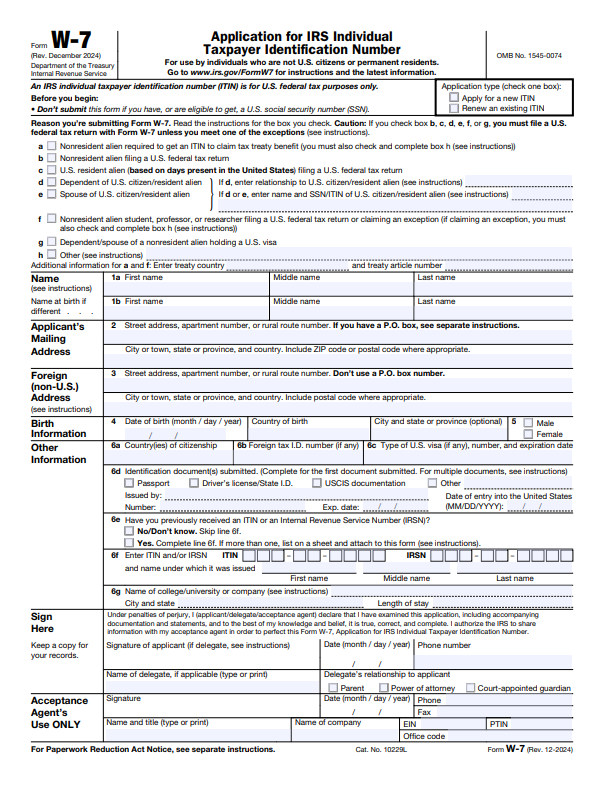
To apply for an ITIN, you need to fill out Form W-7 for the IRS and submit it with documents for identity verification. Even if you are abroad, Bizstartz assists clients internationally with all steps in the ITIN application in a timely and correct manner.

Step 10: Maintain Ongoing LLC Compliance

Developing your LLC in Maine does not exempt you from additional future responsibilities as your business develops. You are still required to fulfill federal and state obligations every year to maintain good standing.

You must do the following:

  • File your Annual Report
  • Keep your Registered Agent active
  • Keep a business bank account separate from your personal account
  • File taxes on a federal and state level
  • Maintain business records and minutes of meetings

If you do not obey, you will incur penalties, lose liability protection, or face administrative dissolution.

Bizstartz provides ongoing compliance management, so you can grow your business while we handle the paperwork.

Cost Summary: Maine LLC Formation Overview

Step Description Cost
Name Reservation (optional) 120-day reservation $20
Certificate of Formation State filing fee $175
Registered Agent Service Annual $50–$150
Annual Report Yearly filing $85
EIN Application (via Bizstartz) For non-U.S. founders Included in package
ITIN Application (if needed) Optional Additional service

Why Choose Bizstartz to Form Your Maine LLC?

Unlike most LLC management companies, Bizstartz does not limit its clientele to U.S. residents. We help global entrepreneurs to set up and manage LLCs anywhere in the U.S., including Maine.

We offer,

  • LLC Formation and State Filing
  • Registered Agent Service
  • EIN Application (without SSN)
  • Operating Agreement Preparation
  • Beneficial Ownership Information (BOI) Filing
  • Individual Taxpayer Identification Number (ITIN)
  • U.S. Bank Account Setup
  • Bookkeeping and Tax Filing Support

We offer 100% remote, transparent, and stress-free service, so you can focus on growing your business.

Blog CTA

Final Thoughts

Establishing an LLC in Maine is one of the most efficient and effective ways to create a legitimate business presence in the U.S. Maine is incredibly business-friendly. Entrepreneurs can benefit from low compliance requirements, strong asset protection, and low fees.

If you are starting a consulting business, SaaS, or e-commerce, you can enjoy the structural advantages a Maine LLC provides.

Ready to get started?

👉 We Got You Covered with LLC Setup. Bizstartz will handle everything from state filing to EIN and bank account setup. Everything you need is in one place!

How to Form an LLC in Kansas

Establishing a Limited Liability Company (LLC) in Kansas is a brilliant choice for your business.

Kansas is hassle-free and inexpensive for U.S. and foreign entrepreneurs interested in doing business in the U.S. Kansas also provides solid legal protections, which is a plus.

This comprehensive guide goes step by step on naming your business, completing the necessary paperwork for an LLC, securing your tax ID (EIN), opening a bank account in the U.S., and ensuring your business complies with the law.

Why a Kansas LLC?

Out of the U.S., most entrepreneurs forming an LLC think of Wyoming, Florida, and Delaware. Kansas is also regarded as highly business-friendly, in particular for small and medium enterprises, and for this reason is a great choice for many.

1. Affordable and Transparent Costs

Setting up an LLC in Kansas is inexpensive with online submissions costing only $160. Unlike some states, Kansas does not impose hefty franchise taxes, surprise hidden taxes, or unreasonable taxes. This makes Kansas an excellent choice for small businesses.

2. Easy Compliance Requirements

Among all the U.S. states, Kansas has the most simple and straightforward compliance systems. Business owners in Kansas need only submit one Annual Report each year and face no intricate, state-level business taxes. The uncomplicated business taxation system provides ease to new business owners in administrative compliance stress.

3. Business Management Freedom

Kansas LLCs uniquely permit the greatest flexibility. You can set up your LLC as either “member-managed,” meaning it is run directly by the owners, or “manager-managed,” meaning it is run by appointed managers. For international entrepreneurs, this can be a great advantage, as they may want to assign local representatives.

4. Strong Legal Protections

Having an LLC means that your personal assets remain as a buffer from business liabilities. Business debts or lawsuits are the business’s problems. In the state of Kansas, your personal savings, home, and cars are safe from liability claims while your business is operating.

5. Best for International LLC Registrants

Kansas does not require American citizenship or residency to register an LLC. This is great for entrepreneurs in Asia, Europe, or Africa to enter the U.S. market.

Step by step process to form an LLC in Kansas

Here is a detailed explanation of everything you need to do to form your Kansas LLC.

Step 1: Choose a Name for Your Kansas LLC

The first thing you need to do to form your LLC is to come up with a name that is acceptable under Kansas law, and is unique.

Your LLC’s name must:

  • Include the words “Limited Liability Company” or the abbreviation “LLC” or “L.L.C.”.
  • Avoid restricted words like “Bank,” “Insurance,” or “Corporation” unless you have proper licensing.
  • Be distinguishable from all other registered Kansas businesses.

Also, be sure that all other registered Kansas businesses do not have the name you intend to use. You may use the Kansas Business Entity Search on the Kansas Secretary of State website to verify.

If you find an available name but you do not intend to register the LLC shortly, you may reserve the name for 120 days by submitting a Name Reservation Form and a name reservation fee of $30.

💡 Tip from Bizstartz: Choose a name that is consistent with your business and is memorable. If you plan to sell online, you may want buy the matching domain name (.com).

Step 2: Appoint a Kansas Registered Agent

All LLCs in Kansas are required to have a Registered Agent. The Registered Agent is a person or company you appoint that will accept legal documents, government mail, and compliance documents for your business.

Your Registered Agent needs to:

  • Be a Kansas resident or a registered business in Kansas.
  • Have a physical Kansas address (no P.O. boxes please).
  • Be reachable during normal business hours to receive legal mail.

For international founders, you can’t be your own Registered Agent. Professional service will be needed.

✅ Bizstartz Registered Agent Service:

We offer Registered Agent services anywhere in the United States, Kansas included. We’ll keep your business compliant, handle all official mail, and ensure you never miss any important legal correspondence.

Step 3: File the Articles of Organization

The Articles of Organization is an important document that makes your LLC official in Kansas. It has important information about your business.

You can submit this document to the Kansas Secretary of State:

  • Online through the Kansas Business Filing Center, or
  • By Mail, if you choose the paper form.

Filing Fees

  • Online: $160
  • By Mail: $165

Required Information Includes

  • LLC name and business address
  • Registered Agent’s name and address
  • Organizer’s name and signature
  • Duration of the LLC (perpetual or limited)
  • Optional: Business purpose

Once the state approves your filing, you’ll receive a Certificate of Organization, which confirms your LLC legal existence.

Processing Time

Online filings are processed within 1–2 business days. Mails submissions may take up to 7–10 business days.

Step 4: Draft an Operating Agreement

An Operating Agreement is not mandatory in Kansas, but it’s one of the most important documents for your LLC.

This agreement is for your LLC’s internal business documents which will cover:

  • Member ownership percentages
  • Voting rights and responsibilities
  • Profit and loss distribution
  • Management structure
  • Rules for admitting or removing members
  • Dissolution process

Even single-member LLCs should have an Operating Agreement. It helps demonstrates that your business is a separate legal entity, which is important for limited liability shields.

Bizstartz helps create a customized Operating Agreement based on your LLC’s size and structure as well as member arrangements to ensure it meets U.S. legal standards and international business requirements.

Step 5: Get Your EIN

What is 147c letter

An Employer Identification Number (EIN) is issued by the IRS and is considered your business’s Social Security Number. It is fundamental in several activities like:

  • Opening a U.S. business bank account
  • Hiring employees
  • Filing business tax returns
  • Signing up for payment processors (Stripe, PayPal, Shopify, etc.)
  • Gaining trust from vendors or customers

You can obtain your EIN for free from the IRS website. However, if you are a non-U.S. resident and do not have a Social Security Number (SSN), you will not be able to complete the online application. You will need to fill out and send in Form SS-4 by mail or fax.

📩 Bizstartz EIN Service: We assist international clients acquiring an EIN without an SSN or ITIN. We take care of everything, including communicating with the IRS, so you can complete the other components of your business setup.

Step 6: Complete Your Kansas Annual Report

To keep your LLC in good standing, the Secretary of State requires you to file an Annual Report.

Key Details:

  • Due Date: Every Year April 15th
  • Filing Fee: $50 if filing online $55 if filing by mail

Required Information:

  • Name of your LLC and ID number
  • Members’/Managers’ names and addresses
  • Principal office address

If you do not file your Annual Report on time you will incur penalties and your LLC may be administratively dissolved.

💡 Pro Tip: Set a reminder or have Bizstartz manage your compliance calendar to avoid missing deadlines.

Step 7: Enroll for State Taxes and Business Licenses

Certain business types necessitate state tax registration and/or local business licenses. Taxes and business licenses might be required for:

  • Sales Taxes: If you are selling physical items or providing taxable services in Kansas, you need to register for sales taxes.
  • Withholding Taxes: If you hire employees, you need to register taxes on employee wages.
  • Local Business Licenses: In Kansas, some cities and counties demand extra licenses for retail shops, food businesses, and specific services.

Most state taxes can be registered online through the Kansas Department of Revenue.

Step 8: Open Your Business Bank Account in the U.S.

After you received your LLC and EIN, the next step for your business is getting a U.S. business bank account. This would be the first step in actually separating personal and business finances, which is vital for maintaining liability protection.

Most U.S. banks will ask the following documentation:

  • Verified and Approved Articles of Organization
  • EIN Confirmation Letter
  • Operating Agreement
  • Some form of Identification

Most banks in the U.S. need at least one member to be there in person. However, Bizstartz works with Fintech banks that lets you open your business bank account remotely, which is great for international business owners. You can open your account online through Bizstartz.

💳 Bizstartz Bank Account Setup:

Without having to travel to the U.S., we assist non-U.S. founders in getting verified U.S. business bank accounts through reputable providers, like Mercury, Relay, or Wise.

Kansas LLC Cost Breakdown

Item Cost
State Filing Fee (Online) $160
Registered Agent (Annual) $99–$150
Name Reservation (Optional) $30
Annual Report $50
EIN for Non-U.S. Owners (via Bizstartz) $95
Operating Agreement Drafting $50–$75

💰 Estimated Total (First Year): Around $350–$500, depending on whether you use professional services.

Foreign Entrepreneurs: How to Form a Kansas LLC from Outside the U.S.

International founders can form and own a Kansas LLC 100% remotely. There is no need to be present in the U.S., or have a U.S. Social Security Number.

You will need the following:

  • A Registered Agent with a Kansas address.
  • A Business Name that is state-approved.
  • A Valid Passport for identification.
  • An EIN for tax and banking purposes.
  • Optionally, a U.S. business address for mail forwarding.

With Bizstartz, international entrepreneurs can manage all steps for their LLC formation online. This includes the registration of the name, application for the EIN, setup of the bank account, and tax guidance.

Maintaining Your Kansas LLC

After the LLC is formed, ongoing compliance is needed to keep the business in good standing. To stay compliant, you must:

  • File Annual Reports by April 15th every year.
  • Keep a Registered Agent and Registered Office for the LLC.
  • Financial records must be kept and business banking must be separated.
  • Notify the Secretary of State of address or ownership changes.
  • Stay informed about and fully comply with all federal and state tax filings.

To ensure clients avoid compliance pitfalls, especially international clients, Bizstartz offers ongoing compliance services.

How Bizstartz Assists You in Establishing a Kansas LLC

At Bizstartz, we make it easy for both U.S. and non-U.S. business owners to Start and manage U.S. businesses.

What Our Kansas LLC Formation Package Includes:

  • Submission of your Articles of Organization
  • Kansas Registered Agent services
  • EIN (Tax ID) application for U.S. and non-U.S. owners
  • Operating Agreement
  • Beneficial Ownership Information (BOI) with FinCEN
  • U.S. bank account opening assistance
  • Compliance and tax guidance

You focus on business expansion and let Bizstartz handle the compliance and all the paperwork.

Blog CTA

Final Thoughts

An LLC in Kansas provides inexpensive simplicity and flexibility with robust legal protections. Kansas is a wonderful state for your business, whether you are a freelance seller, an international entrepreneur, a small business owner, or an eCommerce seller.

Bizstartz is here to provide you the Kansas LLC formation services you need, taking you through the process in a straightforward manner, from the registration to compliance.

🚀 Begin Your LLC Journey with Bizstartz

Set up your LLC in Kansas in a fast, stress-free, and compliant manner.

👉 Start today by going to Bizstartz.com or calling one of our professionals.

How to File Business Taxes for the First Time: A Complete Guide for New Entrepreneurs

Seeing businesses grow, especially your own, can be an empowering feeling. However, tax season can be an extremely stressful.

Especially for new business owners, the tax filing process can seem extremely complicated, especially when trying to understand how the process works or when the business is newly registered in the USA.

The positive side is that the filing process isn’t complicated or stressful. After being organized, the required documentation is submitted, and your filing time is well guided, the process is actually pretty simple.

This guide is prepared in a detailed manner, aimed to simplify the process from preparing your financial records to filing the necessary forms and making sure to eliminate mistakes that may cost you.

The Importance of Your Initial Tax Filing

Filing taxes does not only comply to legally required criteria, establishing the credibility and financial responsibility as a business are even more crucial.

Your first business tax return is important because it sets the tone for the years that follow. The IRS and the state would use this to assess how your company is performing and the compliance level.

Errors like value misreporting, missing deadlines, and the mixing of business and personal expenses would lead to penalties and restrictions on future filings.

From the credibility of the business and tax perspective, the following are the benefits of accurate tax filings:

  • Improve range of reputational relationships like banks, investors, and processors like Stripe and PayPal.
  • Business in good standing position with state and federal agencies.
  • Eligibility for loans, grants, and credit.

Your first filing is the foundation of your long-term financial health.

Step 1: Organize Your Financial Records

Your business finances have to be organized. The value of clean bookkeeping cannot be overstated in the filing process.

Begin by reviewing and reconciling all your records for the year for tax purposes. That means all your records need to include:

  • Bank and credit card account statements
  • Issued customer invoices
  • Business expense receipts
  • Payroll information
  • Profit and loss statements
  • Balances sheets

In addition:

  • Automate your bookkeeping and account transaction categorizations with programs like QuickBooks, Wave, or Xero.
  • Keep and maintain separate bank accounts for business and personal finances.
  • Digitally archive all your receipts and invoices for the last 3 to 7 years.

Note: Poor bookkeeping is a leading cause for a small business tax overpayment and lost deductions. Take time to organize your books. It will save you more time and money afterward.

Step 2: Determine Your Business Structure and Tax Classification

Tax filing

The way your business is structured determines how your taxes are filed and which forms you’ll use. If you’re operating in the U.S., you’ll typically fall under one of these categories:

Business Type Tax Form to File Taxed As
Sole Proprietorship Schedule C (Form 1040) Personal income tax
Single-Member LLC Schedule C (Form 1040) Pass-through to owner
Multi-Member LLC Form 1065 + K-1s Partnership (pass-through)
S Corporation Form 1120-S + K-1s Pass-through with salary option
C Corporation Form 1120 Separate corporate entity

Understanding this classification is essential because it affects:

  • How much tax you’ll pay
  • What deductions you can claim
  • How you handle self-employment tax
  • Whether you qualify for certain tax credits

An example of this is Bizstartz where non-U.S. Entrepreneurs opt for the Single-Member LLC structure. This is a “disregarded entity” for tax purposes meaning income “passes through” to the owner and shows up on the owner’s personal tax return.

An LLC with multiple owners is automatically treated as a partnership unless another option like S-Corp taxation is elected.

📌 Pro Tip: Always consult a tax professional to choose the optimal tax position before filing. It’s best to understand the how the position affects net income.

Step 3: Choose the Right Accounting Method

Your accounting method controls when income and expenses are recorded. The two main types are:

1. Cash Method: Income and expenses are recorded when money is received or paid.

→ This is best for small businesses, freelancers, and service-based LLCs.

2. Accrual Method: Income is recorded when earned and expenses when incurred, regardless of payment.

→ This method is used by larger companies with inventory, or more complex transactions.

Once you choose an accounting method, you are expected to follow it consistently year after year, unless changed with IRS approval.

The cash method of accounting is simpler, more intuitive, tax-efficient, and very preferred by new business owners, particularly by non-U.S. residents with new LLCs.

Step 4: Complete the Appropriate Tax Forms.

Now that you’ve organized your documents, classified them, and kept all your records for the year, you can proceed to actually file your forms. Depending on what type of business entity you have, the requirements for filing may differ, but generally you will:

1. Fill your biz info: Name, address, EIN, and classify your business entity.

2. Report your income: Total sales, service fees, and any other forms of revenue earned.

3. List your business expenses: Advertising, software subscriptions, business travel, rent, utilities, professional services, etc.

4. Report your business deductions: Common deductions to track are depreciation, startup costs, and home office.

5. Report any tax credits, such as the Qualified Business Income (QBI) deduction for pass-through entities.

If you have employees,

  • Fill W-2 and 1099-NEC for contractors.
  • Report employment taxes using 941 or 940 for unemployment tax.

Once you’ve completed all the required forms and schedules, take time to review them. Mistakes can lead to processing delays or trigger an audit. Even minor mistakes, such as an incorrect EIN or misreported expenses, can create problems.

Step 5: Know About Estimated Taxes and When to Pay Them

The IRS requires you to make quarterly estimated tax payments (Form 1040-ES) if you think your business will owe more than $1,000 in tax for the year.

These payments are generally due on:

  • April 15
  • June 15
  • September 15
  • January 15 of the following year

Even if you file your tax return on time, you will face penalties for not making estimated payments.

As a first-time filer you should probably:

  • Figure your yearly income and save about 25-30% of your profits for taxes.
  • Use accounting programs to help you, or work with a tax professional to help you determine your quarterly payments.
  • Save all your tax payment receipts.

Step 6: File and Pay on Time

Tax filing time

In the U.S, business taxes are due on March 15 for S Corps and partnerships, and on April 15 for C Corps and sole proprietorships.

To file for extensions, you can use:

Remember, extensions give you more time to file, not more time to pay. You have to estimate and pay what you owe on or before the deadline to avoid interest and penalties.

💡 Example: You owe 2,000 dollars in taxes and you wait to pay the taxes after the deadline, you will owe interest and late-payment penalties.

Step 7: Pay taxes and submit you return

Once you you filled the forms:

  • Are you filing taxes electronically? You can use the IRS e-file or the tax preparer’s software.
  • Pay taxes due using IRS Direct Pay, EFTPS, or for non-residents, wire transfer.
  • Make sure to save a record of the filing and payment confirmation

If you don’t the full amount due, interest and penalties will still accrue until the IRS payments are complete. You can apply for an IRS installment payment plan.

Step 8: Keep Organized and Audit-Ready

Once you file your taxes, you should keep records and track:

  • Tax returns and schedules
  • Proof of payments, receipts, and invoices
  • Payroll documents and contractor records
  • Bank statements and financial reports

Although the IRS usually audits your returns within a three-year-window, they can do so for longer if they identify you as underreporting. For this reason, the safest option is to keep records for a figure of 7 years.

An internal review may help you in:

  • Finding out if you accurately maximized your deductions.
  • Reconciling your bank and reported income for the period to confirm your income reporting consistency.
  • Determining how you will make next years’ taxes better for you.

Mistakes to Avoid as a First-Time Filer

  • Not separating your business and personal expenses. Always use a dedicated business account.
  • Not making estimated payments for the quarter which may result in penalties.
  • Choosing the correct business entity as your business structure will dictate the taxes you will pay.
  • Filing your taxes past the deadline will result in penalties.
  • Ignoring state or local taxes as separate filing may be required in states like California, Texas, and New York.
  • Missing records and receipts can result in legitimate deductions and should be replaced as poor recordkeeping.

Avoid these issues by automating reminders, setting up a tax calendar, and using reliable accounting software or professional services.

Step 9: Collaborate With a Tax Specialist or Business Formation Professional

Although it’s possible to do your own taxes, first time business owners gain from having their own professional help.

Here’s what a tax professional or business formation service like Bizstartz can help you do:

  • Use the right tax forms.
  • Identify potential industry-specific deductions and credits.
  • Accurately file your taxes on both federal and state levels.
  • Assist U.S. tax residents to fulfill foreign tax compliance and treaty benefits.

Think of hiring a professional as an investment. They could save you a lot more than you will pay them in taxes and other penalties.

Step 10: Keep on Planning for the Following Year

After filing your first taxes, you could plan for the next tax season.

  • Identify what worked and what didn’t.
  • Schedule quarterly reviews to update your books.
  • Revise your tax plan every year as your company expands.

Having a solid system in place will make the tax filing process significantly easier, and the first year is where that system begins.

Tax Penalties

Conclusion

Truly, filing business taxes for the first time is an important step in your journey as a credible and responsible entrepreneur.

Being organized, maintaining good records, and knowing filing requirements will help you file your first return confidently. Whether you’re a U.S. citizen, or an international founder running a U.S. LLC, these steps will help you avoid crises during tax season.

And if you’re not sure about something, don’t try to handle it by yourself.

Bizstartz can assist you in bookkeeping, setting up EIN, applying for ITIN, and filing U.S. taxes to keep your business compliant and profitable.

How to Apply for an ITIN Number (Complete Guide for Non-US Residents)

If you’re outside the U.S. but making money from American sources or running a business in the U.S., you might have heard the abbreviation ITIN. That means Individual Taxpayer Identification Number, a key element in fulfilling tax obligations in the U.S.

Lots of international business people, especially those who have a U.S. LLC, come across the ITIN when they need to file taxes, open a U.S. bank account, access payments through services like Stripe or PayPal, and follow IRS regulations.

For those applying from outside the country, the ITIN application can certainly feel a bit daunting.

That’s why we’ve created this guide to answer your questions about how to apply for the ITIN number, who needs it, and how Bizstartz can guide you through it seamlessly.

Understanding ITIN

A tax ID and number comes in the form of a series of 9 digits, issued by the IRS to U.S. Tax Payees. The ITIN is issued to those who need to meet tax obligations in the U.S. but do not qualify for a Social Security Number and must comply with U.S. tax regulations.

Format example: 9XX-XX-XXXX

An Individual Taxpayer Identification Number (ITIN) does not provide legal immigration status, authorization to work in the U.S., or Social Security benefits. It literally only assists the U.S. government in tax processing and reporting.

ITIN Important Features:

  • Only the IRS issues them.
  • They are used for tax filing, reporting, and compliance.
  • They are needed for non-U.S. citizens, resident aliens, or foreign nationals with a U.S. tax filing requirement.
  • They help ensure that everyone, regardless of immigration status, can pay taxes legally in the country.

For example, foreign business owners with U.S. tax obligations, such as an LLC, must file U.S. tax returns and will need an ITIN to be identified by the IRS for tax purposes.

Who Needs an ITIN?

ITIN

You will need an ITIN if you are a foreign individual and you need to file or report taxes to the U.S., but you are not eligible for an SSN.

Some common scenarios where an ITIN is needed are:

1. Non-U.S. Residents Owning a U.S. LLC or Corporation

  • If you have formed a U.S. LLC through Bizstartz, you need to file annual tax reports with the IRS.
  • An ITIN allows you, as a non-resident owner, to file your personal tax return (Form 1040-NR) and account for your income share.

2. Nonresident Aliens Earning U.S. Income

If you are a non-resident alien earning income directly from the U.S. (this includes rent, royalties, dividends, and payments for services), you must obtain ITIN to report that income to the IRS.

3. The dependents and spouses of U.S. citizens or residents.

If a foreign spouse or dependent does not have an SSN and is listed on a U.S. tax return, they must apply for an ITIN.

4. Foreign investors or real estate owners.

Foreigners buying and selling properties in the U.S. must obtain an ITIN to pay and reclaim taxes under the Foreign Investment in Real Property Tax Act (FIRPTA).

5. Internationals students and researchers.

International students or researchers receiving taxable scholarships or grants from U.S. institutions will also need an ITIN.

6. Freelancers and Remote Workers Serving U.S. Clients

If you are a freelance professional based outside the U.S. and providing services to U.S. clients paid via U.S. payment systems, you may also need an ITIN for tax purposes.

In all, If you are a non-U.S. individual involved in income and tax matters here in the U.S., you will need an ITIN.

Why Is An ITIN Important?

An ITIN is more than just a tax number. It opens multiple avenues for non-U.S. residents to handle finances and conduct business. Here is a breakdown on its importance:

1. Assures IRS Tax Compliance

U.S. tax obligations require all income to be reported. You may not be in the U.S., but your business activities might create income tax obligations. An ITIN allows the non-resident to file tax returns and pay taxes to the U.S. government. This helps in avoiding IRS penalties and audits.

2. Assist in Opening A U.S. Bank Account.

Opening a business or personal account in U.S. banks and fintech platforms often requires an ITIN or SSN. Without one, it may be difficult to manage the finances of your LLC.

3. Enables Payment Processor Verification.

Payment processors such as Stripe, PayPal, and Amazon require tax identification numbers to verify your account. An ITIN allows for an unobstructed payment gateway.

4. Enables Claiming Tax Treaty Benefits.

An ITIN lets you claim benefits from tax treaties between the U.S. and your country. Tax treaties often prevent double taxation. Without an ITIN, you cannot avoid double taxation.

5. Refund and Tax Credit Support

You can only get a refund for overpaid taxes through your ITIN, and this also lets you access a few credits, including the Child Tax Credit if you qualify.

6. Compliance Support for LLCs

The ITIN is also a compliance requisite for foreign entrepreneurs starting a U.S. LLC as they will need to file an annual tax return and connect the owner to the company’s EIN.

Documents You Need to Get an ITIN

Prior to getting your ITIN, you should consolidate all the required documentation. Accurate and verifiable documentation will help reduce the chances of delays.

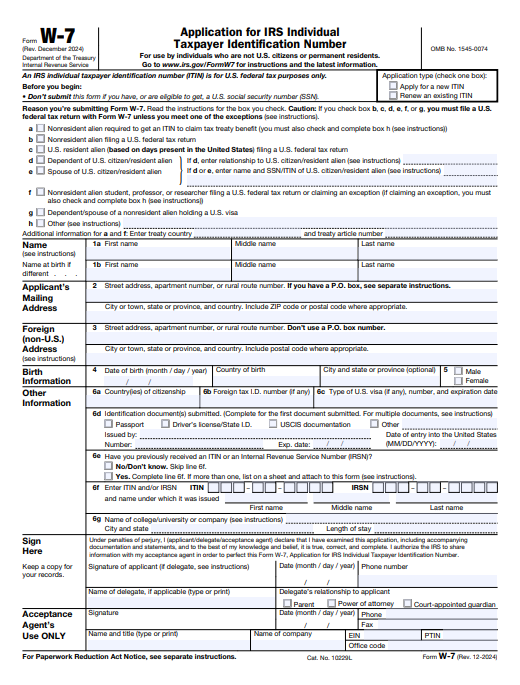
1. Form W-7 (IRS Application for ITIN)

This is the primary form you need to fill out to apply for an ITIN. It asks for:

  • Your name, address, and birthdate
  • Citizenship
  • Type of US visa (if applicable)
  • Reason for applying (the form has 9 reason codes)

2. Proof of Identity and Foreign Status

The IRS recognizes 13 different document types, but your passport remains the more trustworthy option as it can serve both identification and foreign status purposes.

If you choose not to provide your passport, you need to provide at least 2 more documents from the IRS-approved list, including:

  • National ID card (photo, name, current address, date of birth, expiration date)
  • U.S. visa
  • Birth certificate
  • Foreign driver’s license
  • School records (for dependents under 18)

3. U.S. Federal Tax Return

As long as you do not qualify for an exception, the U.S. tax return (Form 1040, 1040-NR, or 1065) must be included with the ITIN application. This lets the IRS confirm that you actually need an ITIN.

4. Supporting Documents (if applicable)

These can be:

  • LLC formation certificate or EIN confirmation letter
  • U.S. business contracts or invoices
  • Letter from a withholding agent
  • Scholarship or grant documentation (for students)

How to Apply for an ITIN: Breakdown of the ITIN Application Process

W7 Form
W7 Form

Three different methods can be used to apply for an ITIN. Each has different advantages based on your location.

Option 1: Apply by Mail to the IRS

This is the most traditional method that most people still use.

Step 1. Complete Form W-7.

Make sure that your name, your reason code, your address, and the other fields are completely filled and correct.

Step 2. Attach Supporting Documents.

Send your passport (or certified copy of the passport) and your U.S. tax return.

Step 3. Mail your Application.

Send your complete application to:

U.S. IRS

ITIN Operations,

P.O. Box 149342,

Austin, TX 78714-9342,

USA

Step 4. Wait for Processing.

ITIN processing generally takes 8-12 weeks and can take longer during tax season.

Option 2: Apply Through a Certified Acceptance Agent (CAA)

Certified Acceptance Agents (CAA) are approved by the IRS to verify your documents and apply for the ITIN in your behalf.

Advantages of using a CAA:

  • You don’t have to mail your original passport to the IRS.
  • The CAA can validate your identity documents.
  • The process is more secure and quicker.
  • Processing is more efficient.
  • Best suited for applicants living outside the U.S.

At Bizstartz, we work with IRS approved CAAs and assist clients apply for ITINs safely, without needing to send original documents overseas.

Option 3: Apply In Person at an IRS Taxpayer Assistance Center (TAC)

If you’re in the U.S., you can also book an appointment at a Taxpayer Assistance Center.

For this, you’ll need to bring:

  • Your completed W-7
  • Proof of identity and foreign status
  • Your U.S. tax return

An IRS officer will inspect your documents and proceed with your ITIN request.

How Long Does It Take to Get an ITIN?

The processing time depends on your method of application:

Method Estimated Processing Time
By Mail 8–12 weeks
Through CAA 4–6 weeks
In Person at TAC 3–6 weeks

Once your application is approved, you’ll get your ITIN letter directly from the IRS.

If something is missing or IRS documents do not match, the IRS will send you a letter for clarification.

Common Mistakes to Avoid When Applying for ITIN

1. Sending Your Original Passport When Certified Copies Are Required

Many applicants send original passports to avoid the delays of a certified CAA, which can result in losing or delaying the application.

2. Incorrect Reason Codes On Form W-7

There are 9 reason codes, and you’ll need to make sure to select the one that correctly applies to your situation (like “nonresident alien filing a U.S. tax return” or “owner of a U.S. LLC”).

3. Not Completing the Application Properly

If you leave any fields blank, don’t sign, or forget to send your tax return, the application is likely to be rejected.

4. Expired Documents

Every passport or ID must be valid and not expired at the time of submission.

5. Incorrect Mailing Address

Please confirm that your mailing address is accurate. The IRS sends your ITIN approval notice in the mail directly, so make sure your address can reliably receive international mail.

How Bizstartz Can Help You Get Your ITIN

Bizstartz simplify the ITIN application process for international entrepreneurs and international business owners.

We offer:

✅ Document preparation (Form W-7 and tax return)

✅ Document certification by our CAA partners

✅ Submission tracking and status updates

✅ Support for LLC owners and foreign individuals applying from overseas

Bizstartz ensures that your ITIN application meets the requirement so you can use it for tax filing, banking, or LLC compliance.

Our clients from over 70+ countries have successfully obtained their ITINs from us. They didn’t have to send us original passports or deal with confusing IRS paperwork.

Frequently Asked Questions (FAQ)

1. Can I request an ITIN if I do not have a U.S. tax return?

Yes, but only if you have an exception, such as being the owner of a U.S. LLC, and you are applying to open a bank account or tax treaty benefits. Bizstartz can help you determine what exception fits your situation.

2. Is my ITIN permanent?

Your ITIN will not expire, but if it is not used for three consecutive years it will go inactive. After this time, you can renew it with a simple application.

3. Can I use my ITIN instead of an SSN?

You can use your ITIN for tax purposes, but not for employment and social benefits.

4. What is the difference between an EIN and an ITIN?

  • EIN (Employer Identification Number): Used for businesses (LLCs, corporations).
  • ITIN (Individual Taxpayer Identification Number): Used for individuals, such as nonresident owners or partners.

5. Can Bizstartz apply for an ITIN on my behalf?

Yes. Bizstartz partners with IRS-certified acceptance agents to file your ITIN application properly and securely from any part of the world.

Final Thoughts

If you’re not a U.S. citizen and want to do business in the U.S., getting an ITIN is a huge first step. This helps you comply with IRS regulations, gain access to U.S. bank accounts, get paid by customers, and enhances the credibility of your business in the U.S.

If you’re not in the U.S., applying for an ITIN can be a long, complex process if you try to do it on your own. That’s why we offer the service to ensure the process is seamless, accurate, compliant, and gives you the peace of mind you deserve.

🚀 Start Your ITIN Application Today with Bizstartz
We assist non-U.S. residents in obtaining their ITIN and EIN and completing their business registration.

No confusion, no holdup, just expertly crafted service tailored to the needs of international businesspersons.

🌐 Check us out at www.bizstartz.com

📩 Or reach out to us so you can start your ITIN application.

Helping Five OutBound Expand into the US with LLC, EIN, Banking & Stripe Setup

Background & Challenge

Client: Five OutBound

Industry: IT Consulting & Business Solutions (Data Engineering, Cloud Solutions, Staffing, and Advisory Services)

Location: International (outside the U.S.)

Today, Five OutBound is a growing IT and consulting company, providing a wide variety of cloud adoption, data engineering, software consulting, and staffing solutions to clients across the globe. With the digital transformation that is occurring in various industries, companies in the United States are among the most consumers of such services.

Despite their international presence, the company still faced challenges in establishing a credible presence in the United States. Some of the challenges included:

  • Difficulty in signing contracts with U.S. clients who prefer working with domestic entities.
  • High chance of losing clients due to the lack a U.S. business bank account
  • Non compliance with U.S. tax law due to lack of the U.S. EIN (Employer Identification Number)
  • Restricted to payment processors such as Stripe

In order to remove these vulnerabilities, Five OutBound removed these vulnerabilities by letting Bizstartz set the U.S. business infrastructure.

fiveoutbound

The Problems

The problems that Five OutBound faced are problems many other international founders and service providers face when trying to break into the United States market.

Deep rooted Restrictions

Many states across the United States are open to foreign LLCs. But the licensing process and additional documentation can get illusive without professional help.

IRS EIN Application for Foreign Owners

However frustrating it may be, there are numerous processes that need to be undertaken when trying to get EIN, especially as a non-resident foreigner. Oftentimes, people are required to file IRS form SS-4 and people get confused due to the lack of SSN or ITIN. Any minor blunder can result in weeks or even months of delays.

Obtaining payment gateways (especially Stripe)

Payments from Stripe can be a little tricky because you have to have a business form, and a bank account registered for a Foreign LLC in the United States in order to get approval. Many people who apply for it, only face rejection.

Obtaining a bank account

Obtaining a Bank account is tricky because foreign LLCs or non interstate companies need to follow KYC and AML checks which is along the lines of more traditional banking approaches. Sometimes foreign owners are required to be in the country to get a Foreign LLC which can be troublesome.

Time Sensitivity

Time is a major issue Five OutBound was trying to address. Every minute spent waiting, could be a minute lost in making use of an opportunity in the United States market.

The problems we solved

At BizStartz, we help clients from other countries establish and expand their businesses in the US from the ground up. For Five OutBound, we created a tailored strategy.

1. Formation of the LLC

  • We help Five OutBound strategize on which state to register their LLC out of the rest and takes in factors like cost, ease of compliant, and approval rates for bank accounts.
  • All legal formation documents once and for all prepared and filed and then an approval was granted without unnecessary delays.
  • A reliable registered agent was appointed to make sure the company meets all the legal requirements for U.S. state regulations.
  • The company documents and the LLC Official Certificate of Formation along with the rest of the client documents were sent to the client.

2. Application for EIN

  • For the company, we filled out and submitted IRS Form SS-4 and made sure all the information was in synch with the documents used to register the LLC.
  • Because the owners were foreign nationals. we processed the additional documentation requirements (such as identity verification).
  • Since Five OutBound can operate, hire, and pay US taxes, they were successfully issued the EIN.

3. Opening a US bank account

  • We used our affiliations and fillings with other banks and influencer techniques to help ease the process.
  • We walked the client through the KYC procedures and notarizations and identity checks, and achieved all “compliance” objectives.
  • In a few weeks, Five Outbound had a fully functional US business checking account capable of receiving payments in USD directly from the client.

4. Stripe account approval

  • With the LLC, EIN, and US bank account, we then moved to apply for a Stripe account.
  • We made sure all documents, like the LLC registration, EIN and bank paperwork, were aligned as best as possible. This is an important step, even small discrepancies like the company name or address can cause a denial.
  • We supported them with Stripe’s verification x requests did compliance check as well.
  • The account was successfully approved, and Five Outbound could now also receive credit card payments from clients within the USA and overseas.

Along with the account came certain expectations. Five Outbound was to pay due fees on time and in full. Five Outbound was also liable for accounting and financial reporting compliance within the Stripe system.

Timeline & Milestones

  • Weeks one and two. Planning, consultation and LLC formation were all completed at the end of week 2.
  • Week three. The application for an EIN was approved after submission.
  • Weeks four and five. Account opened after KYC compliance checks.
  • Week six. Stripe account approved and company’s financial setup integrated.

A process which would normally take months of processing and repetitive attempts, was successfully completed in a few weeks due to the step-by-step ensured and organized framework.

Results & Benefits

Upon completion of the requirements, Five OutBound was able to achieve:

1. U.S Legal Entity (LLC)

Gained full access to the U.S. market with an established reputable legal business framework which facilitates trust with American clients.

2. EIN (Tax Identity Number)

Gained access to U.S legal tax identity enabling smooth processing of tax returns to the IRS.

3. U.S. Business Bank Account

Gained direct access to American Financial system which eases client payments, and enhances financial management.

4. With Stripe, Five Outbound has

the ability to instantly approve payments with real-time wiring to U.S. Bank accounts.

5. Better Brand Image

With an established presence in the U.S. Five Outbound was able to gain more clients easily, thus strengthening the company’s credibility and business opportunities.

6. Growth Opportunities

Having completed these initial steps, the company is now able to grow rapidly in the U.S market.

Key Takeaways & Best Practices

  • Select the appropriate state: Not all American states are the same for foreign-owned LLCs. Choosing the appropriate state can save time and resources.
  • Maintain uniform documentation: Bank and Stripe approvals require legal document approvals with no discrepancies, or else there will be delays.
  • Be Ready for IRS Compliance: Rest assured, IRS will always ask for additional documents. Prepare to submit supporting documentation, which will save time.
  • Collaborate with professionals: DIY strategies run the risk of rejection or simply wasted time. Expert help guarantees smoother approvals.

Client Testimonials

Krishna Kalal

Conclusion

For overseas businesses, moving into the U.S can feel like a herculean task. However, with the right partner, the whole process can feel easy, streamlined, and completely stress-free.

Setting up a LLC, applying for an EIN, opening a bank account, and even integrating payment systems don’t have to mean hours of painstaking work.

We at Bizstartz help entrepreneurs like Five OutBound from overseas take advantage of the U.S. market. We help them expand their business globally.

👉 Advance your expansion and get in touch with Bizstartz to get your process started.

Do I Need an LLC to Start an eCommerce Business?

One of the easiest ways to start an entrepreneurial venture in the modern world is by launching an e-commerce business. All you need is an internet connection and a laptop to start selling goods across the globe on platforms like Shopify, Amazon, Etsy, and eBay.

Many new sellers, however, start with product sourcing and marketing before considering the following question:

“Do I need an LLC to start an e-commerce business?”

Legally speaking, you do not need an LLC in order to start selling anything online. You can work as an individual seller. The long term answer will typically depend on the vision you have for the business, how much you are willing to risk, and how professionally you want to conduct the business.

Let’s explore this in depth.

1. You Can Start Without an LLC

If you will be venturing into e-commerce for the very first time, you can start an online store without registering as an LLC. A lot of entrepreneurs begin as sole proprietors in the U.S and as individuals in other countries.

What this means in practice:

You can simply create an account on Shopify, Amazon, or Etsy under your personal name, list products, and start receiving payments via PayPal, Stripe, or a bank account. It’s fast, cost-effective, and allows you to test the waters before committing to formal structures.

The risks of starting without an LLC:

The downside is that as a sole proprietor, there is no legal separation between you and your business. If a customer sues you over a defective product, or if you run into debt with suppliers, your personal savings, car, or even your home could be at risk.

Practical example:

Imagine you sell phone chargers, and one catches fire and damages a customer’s property. Without an LLC, you could personally be held liable for damages. With an LLC, the business, not you personally, would be responsible. The cycle here indicates that to begin with, every business up to a certain level makes a quick and easy analysis.

2. Why Do Most Entrepreneurs Prefer an LLC

Entrepreneurs

It is not mandatory, but an LLC is relatively beneficial for an e-commerce seller. Here’s why:

Limiting Liability Exposure

Making an LLC helps in distinguishing personal valuables from business valuables. In the case of a lawsuit, no personal assets such as money, a bank account, a car, or even a home is lost. This is very critical for e-commerce sellers dealing with shipping, potential product liabilities and product refunds.

Building a Reputation

Operating under a registered business helps in building a reputation. For instance, “EcoGlow Products, LLC” is better than “John Smith.” This is very important in applying for wholesale accounts or negotiating with suppliers, partners, and manufacturers

Flexible Taxation

An LLC has multiple taxation options available:

  • Taxation as a sole proprietorship by default and a single member LLC, or as a Multi member LLC partnership.
  • Electing an S Corporation status for U.S. residents in order to lessen on self-employment taxes.
  • Electing as a C Corporation if profit reinvestment is the goal,

This provides e-commerce sellers with the ability to tackle any growth in their company as a result of the business expansion.

Easier Banking & Payment Processing

Banks and payment processors prefer and require a defined business structure.

The following steps become easier:

  • Application for business accounts with US banks
  • Approval for PayPal and Stripe accounts
  • Merchant accounts and e-commerce accounts financing.

These services are most easily available to foreign residents or non US residents.

3. When You Might Not Need an LLC

As useful as LLCs can be, do consider these situations to know when to skip LLCs.

  • Hobby sellers: If you craft a few necklaces and sell them on Etsy, or if you dropship as a side gig, not giving too much thought to an LLC makes sense.
  • Low-risk products: Supplements, cosmetics, and electronics are much more exposed to liability than digital products, online courses, and print on demand shirts.
  • Idea validation stage: Many sellers prefer to test a product idea for a few months. Having said that, waiting too long could expose you to unnecessary risk if your sales grow wildly.

Also, in the event that you receive a dispute from a customer, you would be better off having an LLC. When Should You Start Thinking About Setting Up an LLC

4. When an LLC is highly recommended.

E-commerce businesses that have moved past the ‘trial stage’ are more profitable.

Establishing an LLC brings about the following benefits.

  • Physical products that present potential risk are sold: Supplements, beauty products, electronics and baby items are high risk items.
  • Scaling of the brand is easier: Building a company facilitates better relations with manufacturers, influencers and wholesale buyers.
  • Use of Amazon and Walmart for selling is easier: Most of these platforms prefer registered accounts, especially for the Brand Registry.
  • You have partners or investors: Increase in the number of partners and investors also increases the profits, ownership percentages, and decision making powers.

You can grow your business without the fear of losing your personal funds with an LLC.

5. What About Taxes?

Taxes

The taxes associated with operating an online store are not easy to deal with. Setting up an LLC helps to deal with taxes in a more organized manner.

Without LLC: Taxes on income are individually reported on a tax return. American citizens are residents report income on a personal country tax return. There are non-residents that earn income from USA but they only submit taxes in their country.

With LLC:

  • U.S. citizens and residents do not have to pay self-employment taxes do not have to pay self-employment taxes if they elect to be treated in a certain way.
  • Non-residents are able to sell on Amazon and Shopify using a US LLC and are not subject to US tax obligations provided they do not have US businesses. They still have to report taxes in their country.

This is why LLCs are popular among sellers on the rise. The growth in sales is the reason for setting up an LLC then.

6. How to Make a Choice

In order to help with this, we have it framed as a simple decision making process.

Are you a beginner testing a new concept? Start out without an LLC to keep the expenses as low as possible.

Are you consistently selling, while also reinvesting the profits? Then it would be a good idea to form an LLC, as this will help protect your assets, as well as build your reputation.

Do you want to expand your business all over the globe? if this is the case, then an LLC is almost mandatory for tax purposes, banking purposes, and also for global brand recognition.

How Bizstartz Helps

At Bizstartz, we assist entrepreneurs, particularly those living outside the United States, with forming LLCs and providing the necessary tools for further development. This includes:

  • Establishing an LLC in any of the fifty states
  • Acquiring an EIN for tax obligations
  • Opening a U.S. business account (a requirement for merchants on Amazon and Shopify)
  • Approval of payment processing services (via Stripe, PayPal, etc.)
  • Setting up an Amazon seller account
  • Provision of bookkeeping and compliance assistance
  • Filing of BOI

Our goal is to remove the hassle from business formation in the U.S. so you can concentrate on selling and growing your e-commerce business.

Blog CTA

Final Thoughts

While you do not legally require an LLC to operate an e-commerce business, there are many advantages that come with it. These include limited personal liability, business credibility, flexible taxation, and easier access to financial services.

If you are selling as a hobby, you may not need to set up the at once. However, if you plan to establish a sustainable business model, expand internationally, and grow, then the LLC is the way to go.

How Many Members Can Be in a US LLC?

As potential entrepreneurs setting up a Limited Liability Company (LLC) in the United States will most likely ask the question which is “How many members can go in an LLC?”

This is important because the members also determine ownership and the management structure, and also directly influences the taxation and future approach to the business growth.

This applies to individuals, family owned businesses, or any group to foreign entrepreneurs setting up business in the United States. Knowing the LLC rules will enable any foreign businesses to better serve their LLC members.

In this guide, we’ll go deeper into:

  • What an LLC member is
  • The minimum and maximum number of members allowed
  • The difference between single-member and multi-member LLCs
  • Ownership rules for non-U.S. residents
  • How membership affects taxation, liability, and management
  • Common misconceptions about LLC membership

What Is an LLC Member?

To start with, an LLC member is a business owner, and in this scenario, an LLC member is. Unlike a corporation that subdivides their business and issues shares to their stockholders, the LLC assigns a membership interests to their members.

Each member that is a business owner, usually more than one, will own a percentage of the LLC which is determined and agreed upon in the company’s Operating Agreement. Also ownership can in some instances depend on the amount of capital a member contributed.

Members can be:

  • Individuals – with residents such as citizens, green card holders, and foreign nationals.
  • Other business entities – with corporations, other LLCs, or partnerships.
  • Foreign companies – as a non-U.S. business can own part or all of a U.S. LLC.

This flexibility in membership (license) is the reason LLCs are widely used, particularly by international business owners who may be unable to own other entities, such as S-Corporations.

How many members is an LLC allowed to have?

Multimember LLC

Minimum: An LLC is required to have at least one member. Otherwise, the company will be unable to exist legally.

Maximum: An LLC has no restriction as to the number of members it can have.

The lack of restriction makes LLCs one of the most flexible business entities in the US. Start as a one-person business and add many partners, investors, or even family members as co-owners.

For example:

  • S-Corporations are restricted to 100 shareholders, all of whom must be citizens or residents of the US.
  • Partnerships default (do not) offer limited liability, and require at least two partners.
  • C-Corporations have no restriction on the number of shareholders, but the business has stricter compliance and double taxation.

No need to worry about the LLC as you have both the facets of a company (greater than 1 member) and ease of compliance and flexible taxation.

Single-Member LLC (SMLLC) vs. Multi-Member LLC (MMLLC)

1. Single-Member LLC (SMLLC)

Freelancers, consultants, and small business owners looking for liability protection and easy taxation usually opt for a single-member LLC, which is the most common type of LLC.

Key Features:

  • Tax Treatment: Single-member LLCs are disregarded entities for the IRS and the owner’s income has to be reported in a Schedule C. However, owners can elect for s corporation and c corporation taxes if it is beneficial.
  • Control: Owners are free to make any business decisions since they have full ownership.
  • Simplicity: Owners can skip the headaches of complicated agreements with co-owners.
  • Liability Protection: Owners are still protected from personal liability alongside business liability.

Best For: Solo entrepreneurs, small e-commerce business, consultants, and international entrepreneurs without partners looking to penetrate the US market.

2. Multi-Member LLC (MMLLC)

Families, partnerships, and start ups with multiple co-founders usually opt for a Multi-Member LLC, which is a type of business entity with two or more owners. Group of investors can also pool resources to set up a Multi-Member LLC.

Key Features:

  • Tax Treatment: LLC’s are taxed as partnerships by default. Profits and losses are divided and taxed as per the ownership percentage. The LLC doesn’t pay federal income taxes, unless it elects to pay as a C corporation.
  • Flexibility in Ownership: Profits can be split in any way the members agree to (not necessarily equal).
  • Management: Requires an Operating Agreement to define roles, voting rights, and decision-making processes.
  • Growth Potential: Easier to bring in new members or investors.

Most suitable for: international teams, family businesses, startups with co-founders, and companies that intend to expand with multiple investors.

Can Non-U.S. Residents Be LLC Members?

Yes. An LLC can have members that aren’t United States citizens, as there are no ownership restrictions based on citizenship or residency. This makes the LLC the most foreign-friendly entity type in the United States.

  • A foreign national can own a whole or partial stake in an LLC.
  • A foreign entity is able to serve as a member of an LLC.
  • Having an ITIN instead of a Social Security Number is acceptable for tax purposes.

This is especially useful for global entrepreneurs wishing to sell on Amazon, Shopify, or Etsy, or for those wanting access to U.S. payment processors and bank accounts.

Why Does It Matter How Many Members a Business Has?

The number of members in an LLC has a strong impact on various facets of the business:

1. Taxation

  • A Single Member LLC (SMLLC) is automatically taxed as a sole proprietorship and is far easier to deal with at the expense of being less tax-planner friendly.
  • A Multi Member LLC (MMLLC) is taxed as a partnership by default and has an enormous amount of freedom to structure the split of profits and losses.

Both single and multi-member LLCs have the option of being taxed as an S-Corp or a C-Corp if it proves to be more beneficial from a tax standpoint.

2. Management and Decision-Making

  • One member LLCs have an easier time with decisions.
  • Multi-member LLCs have to have an Operating Agreements which help structure the business in a way to avoid conflicts and fulfill the obligations more clearly.

3. Liability Protection

Both SMLLCs and MMLLCs have limited liability. Courts have a tendency of giving more consideration to the protection of a multi-member LLC if it has relevant agreements and proper business practices.

4. Growth and Investment

  • Single Member LLCs are easy to run but often struggle to acquire unsought investments.
  • Multi-member LLCs simplify the business as more partners and investors can be invited easily due to the flexible division of ownership control.

Advantages of No Member Limit in LLCs

  • Scalability: Start small as a single-member LLC and expand as new members join.
  • Attracting Investment: Capital investment by different members can be done without limits and restrictions.
  • Flexible Ownership Structure: Ownership can be split in any ratio as per the agreement by members.
  • International Market Potential: Foreign individuals and entities can own LLCs unlike S corporations.
  • Ease of Transition: A business can begin with a single member and subsequently transform into a multi-member LLC without the need to create a new entity.

LLC Membership – Misconceptions and Misunderstandings

An LLC can have an unlimited number of members.

– Members of an LLC can be an unlimited number of individuals.

Members of an LLC have to be US Citizens.

– Foreign individuals and foreign businesses can also be members of an LLC.

Members of an LLC are required to have equal ownership.

– Members can have ownership percentages of their choosing (e.g., 70/20/10).

It is overly complicated to add new members.

– Adding new members is straightforward although it does involve changes to the Operating Agreement and informing the state in certain instances.

Single-(1) member LLC does not have any protection

– A single-member LLC is managed improperly if it does not protect the member’s personal assets and business finances. Otherwise, full liability protection is afforded.

Blog CTA

Conclusion

An LLC can have an unlimited number of members, and for an owner willing to either work alone, or have multiple partners, bringing in several investors, plenty of flexibility is also provided.

We help international and local business people to open bank accounts and are compliant with US laws. They help in the formation of single-member and multi-member LLCs.

Frequently Asked Questions (FAQs)

1. Is It Possible To Have One Member In An LLC?

Most people have single-member LLCs, and it is legal.

2. How many members are allowed to join an LLC?

There is no limit to how many members can join an LLC.

3. Can a foreign citizen become a member of an LLC in the United States?

Yes. members of an LLC do not have to be citizens or residents.

4. Do all members have the same amount of voting rights?

Not in all situations. Voting rights are defined in the Operating Agreement.

5. How are profits shared among the members of an LLC?

Profits can be shared in equal or agreed upon unequal ratios.

6. Can a corporation or other LLCs become members of an LLC?

Yes. other functionalities can also be members of the LLC.

7. Do single-member and multi-member LLCs attract different taxation?

Yes. By default, single-member LLCs are taxed as sole proprietorships and multi-member LLCs are taxed as partnerships. But, both can decide to choose a different tax classification.

✅ Ready to form your U.S. LLC? Bizstartz helps you every step of the way, from formation to banking, EIN, ITIN, and compliance.

Helping Hippie Clothes Wholesale Expand to the US Market with a US LLC

Hippie Clothes Wholesale is a rising star in the fashion industry focusing in bohemian, hippie and festival styled clothing. They sell to all types of customers, from retailers and boutiques to direct individual customers, in a wide variety of different countries.

The company is well known for the multitude of distinctive designs, vibrant colors, and hand crafted additions they offer to their customers. They sell their designs all over the world due to their easy affordability, originality, and a sprinkle of cultural references in their designs.

While the company is experiencing great success internationally, their founder was able to discover a gap in the U.S. fashion and e-commerce market. There is a wide variety of unique alternative styled clothing and many unique boutiques in the United States which happens to house millions of online shoppers. This is extremely important to companies like Hippie Clothes Wholesale because they sell their clothes on Amazon, a selling platform with a wide consumer base.

But, there are major challenges when trying to enter the US market for the first time. The hoops you have to jump through to form a legal entity, pay the taxes required, and complete Amazon’s document verification are rather confusing. This is why the company reached out to Bizstartz.

Hippie

The Challenge

  • When we were approached by Hippie Clothes Wholesale they already had an idea in mind:
  • Create a legal business entity in the US for better operational credibility.
  • Acquire the required compliance documentation to obtain and pay taxes lawful in the U.S.Create a bank account to receive payments from Amazon for business operational managers.
  • Acquire Amazon Seller Central to unlock direct selling capabilities for the United States business market.

However, the founder had legitimate issues, too:

U.S. Business Formation Complexity

For non US residents, forming a company in the U.S. is a puzzle. Every state has its unique set of rules, documents, and costs. Added to these, unlayering the legal intricacies of remote jurisdiction still felt overwhelming.

IRS Compliance & EIN (Tax ID)

Legally working in the United States is a complicated process for non-citizens, and is near impossible without having an EIN (Employer Identification Number). It’s a foundation for opening a bank account, filing taxes, and even more registering on selling platforms like Amazon. Perhaps the most tough challenge from outside the United States is having to deal with the IRS.

Difficulty in Opening a U.S. Business Bank Account

Many U.S. banks require physically visiting a branch to open an account, and to also complete a number of compliance checks and excessive reports. For non-resident business owners, this seems to be the most difficult process, and is often considered the most complicated part of the entire process of acquiring a U.S. business bank account.

Amazon Seller Account Approval

Amazon has very lengthy procedures to verify sellers from different countries, and many get rejections due to incomplete or incorrect information. Our client was struggling to understand how to prepare documents that articulate the true nature of the client’s business.

Each of these issues could impact business entry in the U.S. market, if not completely stop it. They came to us at Bizstartz to set up the business and all the related processes.

Our Strategy

At Bizstartz, we helped Hippie Clothes Wholesale smoothen their business entry into the U.S. market and ensured all necessary compliances were verified.

1. US LLC Formation

We started with the formation of a Limited Liability Company (LLC) in the United States, as an LLC comes with the following advantages:

  • Protection of personal and business liabilities.
  • Non-residents friendly tax system.
  • Recognition and trust with the Amazon seller, U.S. client, and banks.

We helped the client decide which was the most advantageous state for them to set up their LLC.

2. Applying for an EIN (Tax ID)

After registering the LLC, the other business contour which we define, is applying for an EIN with the IRS. Like for individuals, the business also has to obtain a ” Social Security Number ” which is an Employer Identification Number (EIN) for the purposes of:

  • Opening a U.S. business bank account.
  • Registering on Amazon and with other payment processors.
  • Correct filing and tax reporting.

Bizstartz took complete responsibility of the application process and obtained the EIN which confirmed that Hippie Clothes Wholesale was a legitimate business operating in the US.

3. Opening a U.S. Business Bank Account

Having a bank account in the US is a great challenge for international business owners. During the process, we help the client complete everything to the last detail with maximum convenience.

All the required documents were assembled and we took the client through the process account to make the account seamlessly, fully.

4. Setting Up an Amazon Seller Account

The last step we guided Hippie Clothes Wholesale through was the setting up of an Amazon Seller Central account. Amazon needed legal documents, a proof of the existence of the business, authentic bank documents, and all the business details for account verification. Missing a step in this phase can cause Amazon to suspend the account or deny it altogether.

Bizstartz applied due diligence in preparing the application and advising the client through the steps of account verification, ensuring that all documents were in order. This resulted in instant approval of the account, giving them the ability to immediately start selling and listing products on Amazon U.S.

The Results

Thanks to our assistance, Hippie Clothes Wholesale was able to achieve their goal of establishing a legal entity in the U.S.

Some of the desired outcomes included the following:

✅ A U.S. LLC was fully registered, giving them an added layer of credibility as well as legal protection under U.S. business laws.

✅ A valid EIN able to assist the client in complying with the requisite taxes as well as helping with Amazon account verification.

✅ A functional business bank account in the U.S. that allows seamless transfers and payments from Amazon.

✅ Instant approval of an Amazon Seller Central Account which offers them countless customers in the U.S.

Hippie Clothes Wholesale can now utilize their growth opportunities to scale their operations as well as brand awareness in the U.S, which is one of the most profitable markets for e-commerce.

Client Testimonials

Clothing in Nepal review

Conclusion

To most non-US entrepreneurs, venturing the United States seems to be more like a fairy tale than reality due to the perceived legal and monetary obstacles. However, with appropriate information, even the most overwhelming tasks can be simplified and organized to an attainable goal.

Hippie Clothes Wholesale is a testament to how Bizstartz enables global entities overcome the hurdles and thrive in the US market. It does not matter how complex the task is, from establishing an LLC to getting an Amazon account approved, our team does everything to the highest degree of quality.

If you are a global entrepreneur who is planning to enter the United States market, Bizstartz is here to assist you with the LLC formation, EIN application, US bank account set up, Amazon account registration, and compliance help in an organized and low tension manner.

Build your US business with us today – we are more than willing to help you.