New York Business Entity Search: A Complete Guide for Entrepreneurs

New York is among the most active states within the United States for doing business. The state has always attracted businesspeople from different parts of the world due to its diverse economy, which includes finance, healthcare, media, technology, and tourism. However, one of the prerequisites for registering an LLC or corporation is to confirm the availability of the business name.

This is the reason why the New York Business Entity Search is so important. Doing an appropriate search not only prevents unnecessary delays in the company registration process, but it also ensures you are building your brand on a legally sound business structure.

This article aims to cover everything you need to do the New York Business Entity Search, its importance, how to do it, and how Bizstartz can assist you throughout the whole process.

What is the New York Business Entity Search?

It is an online tool offered by the New York Department of State, Division of Corporations. Essentially, it serves as a public repository of all registered business entities within the state, which includes:

  • Corporations (C-Corp, S-Corp, Professional Corporations)
  • Limited Liability Companies (LLCs)
  • Limited Partnerships (LPs)
  • Limited Liability Partnerships (LLPs)
  • Nonprofit Organizations
  • Foreign Entities (companies registered in another state but permitted to operate in New York)

This public repository contains:

  • Official company name
  • Business entity type
  • Filing date and registration number
  • Current legal status (active, inactive, dissolved, or merged)
  • Address and jurisdiction details

With this information, business owners can validate the distinctiveness of their proposed business name and gain insights into competitors and similar-named companies operating in the state.

What Considerations Make Business Entity Search Necessary?

Within the context of starting a business, undertaking a business entity search is far more critical than many would envision, especially in New York. The following points elucidate the reasons such an undertaking holds significance:

1. Issues Related to Naming a Business

Distinctiveness is a prerequisite for business names in New York to be registered. The business entity search assists to eliminate names which clash with an existing registered business. For example, if “Empire Consulting Inc.” is registered, “Empire Consulting LLC” would be ineligible.

2. Issues Related to Vocabulary Compliance

There are certain lexemes, and affixes which are termed as state controlled and require permission. For example:

  • Banking and Insurance, as domains, require specific legal documents.
  • Certain names which relate to the government, such as “Education” and “Education” propose a misleading association.

3. Trademark and Brand Related Issues

Underutilization of a name in New York does not guarantee evasion from national trademark issues. While local businesses are covered via business entity search, additional measures, such as trademark search with USPTO, are required to safeguard against federal trademark issues.

4. Research on Businesses and the Market

The search tool not only helps with identifying registered companies, but also works as a competitor and market research tool. Entrepreneurs can also find the formation dates and study the competitors to evaluate the duration of their business operations.

5. Smoother Registration Process

Running a name search has become one of the most frequent causes for rejected or delayed business filings. A name search will save you both time and money during the registration process.

How to Perform A New York Business Entity Search

While the New York Business Entity Search is straightforward, meticulous attention to detail is very important. Below is a systematic guide:

Step 1: Access the Official Website

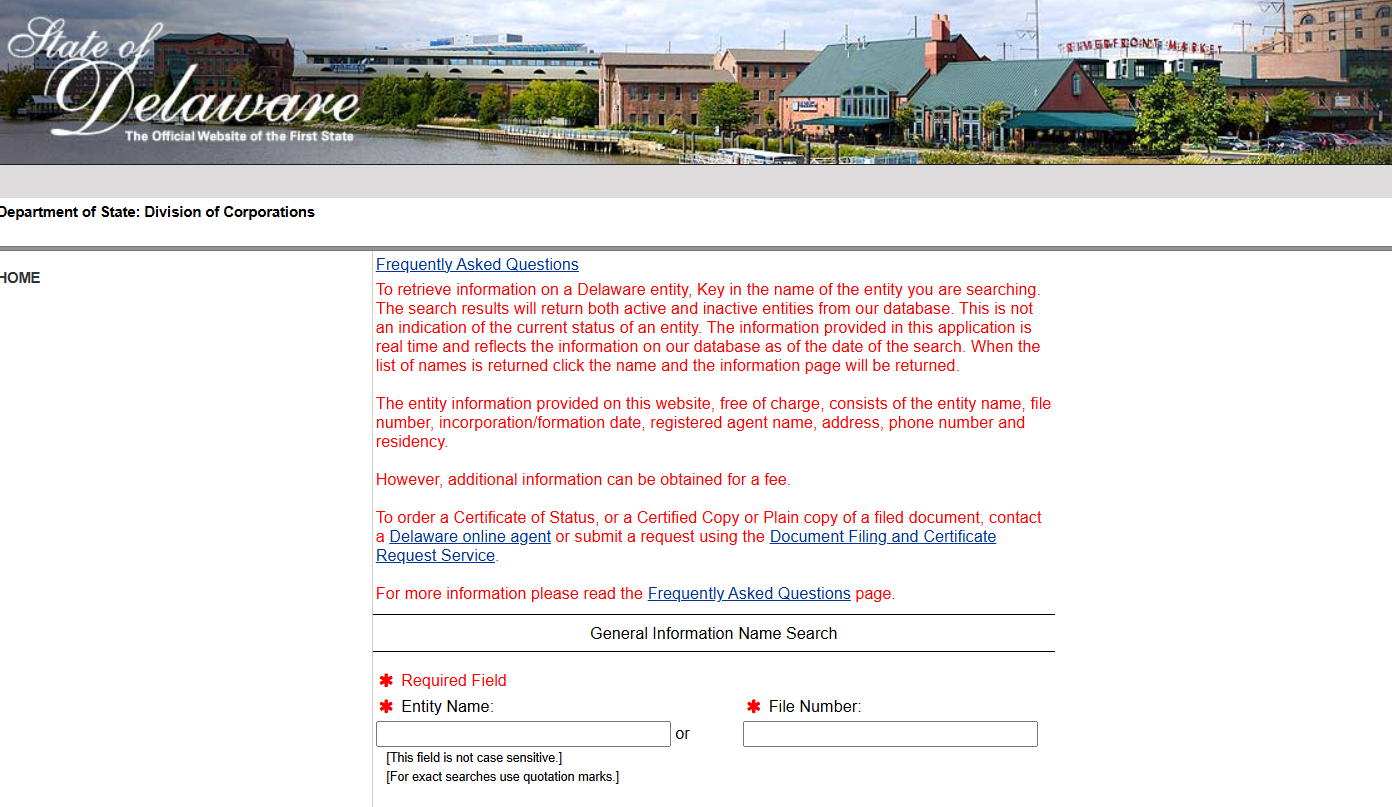
Proceed to the New York Department of State Division of Corporations website. The business search functionality is located under “Corporation & Business Entity Database.”
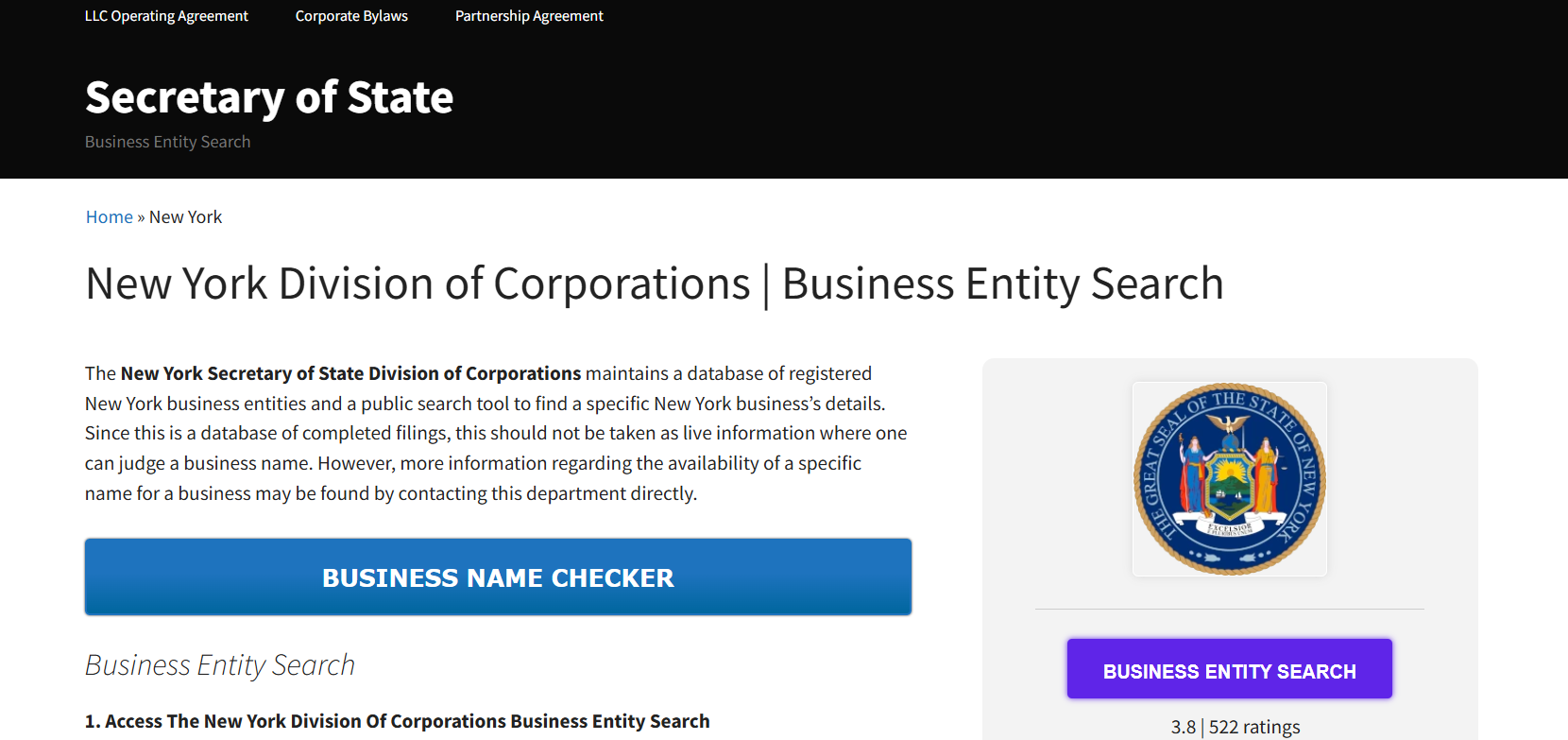
New York Business Entity Search

Step 2: Choose the Search Criteria

You can search in two ways:

  • By Entity Name: You can enter either fully or partially, thus checking its existence.
  • By Entity ID Number: This is applicable if the unique identification number of the business is already in one’s possession.

Step 3: Enter the Name and Search

You can now enter your desired business name and search. Be very careful with spaces, punctuation, and capitalization as even the smallest difference can yield vastly different results.

Step 4: Analyze the Output

The system offers a list of companies that match your search query or closely fit your search parameters. For each of the results, the system will provide:

  • Entity Name
  • Type of Business Entity (LLC, Corporation, Nonprofit, etc.)
  • Date of Registration
  • Current Status (active, dissolved, or inactive)
  • Geographical Information

Step 5: Assess the Business Name

In the event that your business name is listed as identical, or closely resembles an existing business entity, you will have to select an alternative. It is usually possible to modify the name by appending an additional word, abbreviation, or phrase. For example:

  • “Empire Holdings LLC” can be modified to “Empire Global Holdings LLC.”

Tips for Selecting a Business Name in New York

The process of selecting a name goes beyond just availability—it also concerns marketing and long term viability. The following is a suggestion:

Avoid Generic Names: Using a name that is commonplace among competitors can hurt you.

Consider the Long-Term: Try to aim for not overly specific names that do not overly constrain expansion in the future.

Confirm Domain Name Availability: The name of the business and the online presence should match.

Check Social Media Handles for Consistency: Consistency strengthens branding and recognition.

Conduct a Federal Trademark Search: Avoid issues outside of New York.

Maintain a Formal Image: Avoid slang, difficult to pronounce words, or confusing abbreviations.

Additional Applications of the Business Entity Search

The search tool is not exclusively for prospective business owners. Its applications extend to the following:

Confirming Legitimacy: Validate a business interactions for proper registration.

Checking Partner or Vendor Status: Verify if a prospective partner is marked as active or if they are dissolved.

Researching Competitors: Determine the duration of operation for industry peers.

Obtaining Business Certificates: Request for business documents including Certificates of Status and certified copies of filings using the database.

How Bizstartz Can Assist You

Here at Bizstartz, we do not limit our services to name searching. We offer comprehensive and seamless services to not only U.S. citizens, but also to foreign entrepreneurs. Some of our services are:

  • LLC Formation in New York: We assist in the preparation and submission of the documents to the state.
  • Name Availability Check: We perform thorough searches for business entities to make sure that the name is not taken.
  • EIN (Employer Identification Number): Required for taxation, business banking, and employee management.
  • Registered Agent Services: Required for compliance and legal documents in New York.
  • BOI (Beneficial Ownership Information) Filing: Assisting compliance with the new FinCEN reporting obligations.
  • Bank Account Setup: Assists with opening a U.S. business bank account for non-resident applicants.
  • Ongoing Compliance: Corporate renewals, filings, and maintenance. Annual report filings.

In collaboration with Bizstartz, you do not merely register a company. You acquire a dependable partner who ensures your business is compliant and prepares for growth.

Blog CTA

Conclusions

The New York Business Entity Search is the primary and vital step when establishing your business in one of the most powerful states in America. It confirms name availability, compliance with the law, and mitigates future conflicts.

Locals and overseas are encouraged to register. Founders looking to expand into America should complete the preliminary search to avoid costly mistakes.

Bizstartz is ready when you are. Focus on your dream business while we do the heavy lifting, company formation, compliance, and opening bank accounts.


How to Form an LLC in New Hampshire – Step-by-Step Guide

New Hampshire is one of the most business-friendly states given it does not levy a state income tax on net business profits. For entrepreneurs throughout the country, New Hampshire emerges as a top contender to do business, as it has no income tax on wages, no sales tax, and a lenient economic framework.

Establishing a Limited Liability Company (LLC) in New Hampshire can be beneficial for both small and large businesses as it allows for tax efficiency, limited liability, and flexibility in management structure.

In this comprehensive guide, we will walk you through the necessary steps, costs and ongoing compliance of maintaining an LLC in New Hampshire to help the reader understand its various benefits.

Step 1: Name your LLC in New Hampshire

Choosing a name is imperative as it depicts what the business will be known for and where it will position itself in the minds of the consumers. Furthermore, the name must be in accordance with New Hampshire state regulations.

New Hampshire LLC naming requirements:

  • The name of the entity must contain the words “Limited Liability Company” and can be abbreviated as “LLC” or “L.L.C.”.
  • The name should not be similar or identical to any entity name on record in New Hampshire. For instance, if “Granite Builders LLC” exists, “Granite Builderz LLC” will be refused because it is too similar.
  • Restricted words, including “Bank,” “University,” or “Insurance,” may not be included in names unless permission from the appropriate state department is granted.

Inaccurate representations of the business are not permitted.

👉 To check if the name is free, you may check the New Hampshire Secretary of State’s QuickStart Business Name Search tool.

Name Reservation (Optional):

If you are not ready to file the LLC paperwork but are ready to set the business name, you may reserve it for 120 days with an Application for Reservation of Name. The fee is $15.

Pro Tip: Consistency is key in branding, so it’s best to check if the website URL, domain, and social media handles are free too.

Step 2: Designate a Registered Agent

Form an LLC in Kentucky

In New Hampshire, all LLCs are required to get a Registered Agent for the business, whose responsibilities will include receiving legal and government documents on behalf of the business. These documents include but are not limited to service of process (lawsuit documents), tax documents, compliance notices, and other official mail.

Who can be a Registered Agent?

  • Any person residing in New Hampshire with a verifiable physical street address.
  • An entity such as a professional registered agent service is permitted to conduct business in New Hampshire.

Requirements:

  • Must have a physical address in New Hampshire (cannot be a PO Box).
  • Must be reachable for document service during standard business hours.

For international entrepreneurs, or those without a local presence, this hiring a professional registered agent service is optimal, as it guarantees compliance with local regulations while ensuring all critical communications are received.

Step 3: Submit the Certificate of Formation

Your LLC is legally formed in New Hampshire once you file the Certificate of Formation and is granted a Certificate of Formation, which is the official document that establishes your LLC. You’ll file this with the Secretary of State and it contains details of your company.

Information required in the Certificate of Formation:

  • Name of LLC and the principal business address.
  • Name and address of registered agent.
  • Management structure of the business (whether member-managed or manager-managed).
  • Purpose of the business (typically, a broad description suffices).
  • Duration of the LLC (whether perpetual or for a limited timeframe).

Filing Methods & Fees:

  • Filing Online via NH QuickStart Portal: $100 filing fee, and faster approval (3-7 business days).
  • Mail: $100 filing fee, may take slightly longer to process.

After your filing is approved, you will receive a Certificate of Formation that confirms your LLC is registered with the state.

Step 4: Draft an Operating Agreement

While an Operating Agreement may not be a legal requirement in New Hampshire, it is suggested for every LLC, particularly for those with multiple members.

An Operating Agreement serves as an internal document detailing entitlement, duties, and ownership of the LLC. In absence of an Operating Agreement, the business is subject to governing state default laws, which may not align with the desired operational framework.

Operating Agreement Key Sections:

  • Ownership structure: percentage of ownership for every member.
  • Profit and loss distribution: allocation of finances among members.
  • Management: members run the business or it is run by managers whom they appoint.
  • Decision making: the voting system for major issues.
  • Member changes: adding or removing members procedures.
  • Dissolution: closing a business and the procedures to be followed, if need be.

Well-drafted Operating Agreements enhance business reputation while opening bank accounts and dealing with potential investors. In addition to reputation, the Operating Agreements increases protection against other members while disputes reduce.

Step 5: Apply for an EIN (Employer Identification Number)

The IRS issues an Employer Identification Number (EIN). The EIN serves as a tax identification number for the business and is crucial in managing the business’s finances and filing taxes on federal level.

Reasons your LLC requires an EIN:

  • For filing federal tax returns for your business
  • For recruiting employees
  • For establishing a business bank account in the United States
  • For dealing with American payment processors including Stripe, PayPal, and Amazon
  • For establishing business credit

Where to get an EIN:

For Americans, applications can be made through the IRS website and will be generated instantly.

For Non-U.S. residents without a Social Security Number, application can be made using Form SS-4. This form needs to be sent to IRS via mail or fax. This step is important for obtaining a US bank account and can take a few weeks.

Step 06: Annual Report Submission

To maintain your LLC in compliance and good standing with the law, New Hampshire mandates the filing of Annual Report on the regular basis not less than annually.

Details:

  • Deadline for submission: every 1st april
  • Cost for submission: One hundred dollars
  • Method for submission: Through Secretary of State QuickStart Portal, filing is conducted electronically.

Through the Annual Report, the LLC is able to update the State of New Hampshire on the contact details, ownership, and Registered Agent of the LLC.

Inability to file Annual Report in a timely manner has consequences that include but are not limited to penalties, and loss of good standing and possible administrative dissolution of your LLC.

Step 7: Managing Licenses, Permits, Taxes, and Compliance

Even though there is no sales tax and no state income tax on wages in New Hampshire, there may be additional tax and compliance obligations related to your LLC.

These may include:

  • Business Profits Tax (BPT): This tax is incurred by LLCs exceeding a specified gross income threshold.
  • Business Enterprise Tax (BET): This tax applies to businesses with an enterprise value of a specified threshold.
  • Specific licenses or permits related to certain businesses: If your business deals with health, construction, food, or financial services, additional state or federal licenses may be acquired.
  • Local business licenses: These licenses may be required on a city or county level, depending on where your business is located.

For businesses operating in New Hampshire, consulting with a tax expert and maintaining accurate financial records, in addition to proper bookkeeping, is essential to remain compliant with IRS and state regulations.

Benefits of Forming an LLC in New Hampshire

New Hampshire has certain key benefits for people intending to form an LLC.

No state income tax on wages and salaries: Retains a larger portion of their personal income for entrepreneurs.

No general sales tax: Particularly advantageous for eCommerce and retail enterprises selling goods in New Hampshire.

Cost-effective filing fees: In comparison to most other jurisdictions, LLCs have a lower formation fee, as well as lower annual maintenance fees.

Maintaining a competitive advantage: Illinois encourages entrepreneurial growth which benefits the state’s economy, therefore LLCs are not subjected to excessive restrictions.

Flexible management: The owners of the business have the option of appointing managers to handle day to day operations or they can choose to manage it themselves, allowing owners greater flexibility.

How Bizstartz Can Help You Form an LLC in New Hampshire

Starting a business in a new country or a new state can be overwhelming. This is where Bizstartz comes in. We assist both U.S. and foreign entrepreneurs in setting up their businesses in New Hampshire and throughout the United States.

Here at Bizstartz, we have New Hampshire LLC formation services which entail:

  • Searching and reserving business name
  • Filling your Certificate of formation with the Secretary of state
  • Professional registered agent services in New Hampshire
  • EIN application services, including support for foreign residents without SSN or ITIN
  • Custom drafted operating agreements
  • Annual report filing and compliance monitoring
  • Sustained good standing bookkeeping and tax filing

With us at Bizstartz, you will notice that the pain points of the process are simplified and expedited, giving you your time and peace of mind.

Blog CTA

Concluding Your Thoughts

New Hampshire is among the very best state LLC, with powerful buisness legal protections, low taxes, and ease of filing. As an LLC, you will enjoy limited liability, and heightened business trust, whilst laying the groundwork for expansion.

Should you wish to establish your New Hampshire LLC today, allow us to manage the entire process, from filing the necessary documents to maintaining regulatory compliance.

How to Form an LLC in Michigan: Step-by-Step Guide

The Great Lakes State, Michigan, has one of the most economically diverse regions in the country. While the automotive industry has long centered Detroit in the world’s eyes, the state has grown far beyond its car manufacturing roots.

Today, Michigan serves as a hub for advanced manufacturing, healthcare, information technology, biotechnology, tourism, and even agriculture. This diverse economy makes the state a magnet for new entrepreneurs who are in need of sound infrastructure, skilled workforce, and positive state policies.

The most critical and the first decision for new business owners is usually selecting the correct business structure. Many entrepreneurs prefer to form a Limited Liability Company (LLC) as it combines the ease of a sole proprietorship and the protective features of a corporation. For foreign founders, Michigan has a strategic advantage due to its central location, lower costs, and easy to navigate filing processes.

The purpose of this guide is to explain the documents needed, the fees associated, and the steps required, along with compliance steps to be taken post-formation, to legally form an LLC in Michigan.

Benefits of Forming an LLC in Michigan

Most LLCs are a favorite during incorporation due to an easier compliance burden and reduced taxes. An increasing number of Michigan entrepreneurs, ranging from small family-run businesses to global startups, are turning to form LLCs.

Business Entity Protection

Your personal assets such as savings, cars, and homes are protected when you own an LLC and are sued over business debts. They will be isolated from mortgages and other business loans, owing to an LLC structure. For example, an LLC member could be sued for breach of contract. In that case, only the business assets and not personal wealth would be at risk.

Taxation Benefits

LLCs are treated as pass-through entities by default. They are taxed on profits and losses which are recorded on the members’ personal tax return, relieving them of the double taxation burden faced by corporations. LLCs in Michigan can also make an election for S-Corp or C-Corp taxation which might be more advantageous.

Operational Flexibility

Members of LLCs are not subject to the strict board member requirements that corporations must follow. This is an advantage of LLCs that is useful to small businesses, as the founders can retain their active role.

Affordable Establishment and Maintenance

Filing the Articles of Organization costs a mere $50 which is one of the lowest in the country. Maintenance is also inexpensive; an annual report only costs $25.

Improved Corporate Image

Branding as “XYZ LLC” helps in projecting a more professional image to clients, vendors, and financial institutions. It is also noted that most investors and business partners prefer engaging with LLCs compared to a sole proprietor business.

Step-by-Step Process to Form an LLC in Michigan

Texas Business

1. Choose a Name for Your Michigan LLC

Carefully selecting the name for your LLC should promote an appealing first impression. It also has to be compliant with the law. Michigan has specific criteria as follows:

  • Must include LLC designation: The name should conclude with “Limited Liability Company”, “LLC” or “L.L.C” to be compliant.
  • Must be distinguishable: The name should not be the same or deceptively similar to any registered business within Michigan. As an example, “Detroit Auto LLC” cannot be registered if “Detroit Autos, Inc.” is already incorporated.
  • Restricted words: Insurance, attorney, trust or bank could be deemed as requiring special charter or approval from the state.

To avoid rejection, use the Michigan LARA Business Entity Search tool to verify that your desired name is not already in use.

👉 Pro tip: If your name reservation is not the same as the formation date, the name can be reserved for a period of six months through filing an Application for Reservation of Name which is accompanied with a processing fee of twenty-five dollars.

2. Designate a Registered Agent

Every LLC is legally obligated to appoint a Registered Agent within the state of Michigan. This individual or entity on record will receive state documents, suit papers, and other relevant compliance materials on your behalf.

Registered agent prerequisites include:

  • A legal office within Michigan (not a P.O. box).
  • A physical office within Michigan.
  • Must be reachable during regular work hours.
  • Individual licensees of Michigan, LLC members, or professional registrants can fill the position.

For foreign company owners who do not reside in the U.S., the most straightforward solution is to purchase the services of a professional registered agent. This way, your LLC will receive essential legal documents without delays.

3. Submit Articles of Organization

Legally establishing your LLC now requires submitting the incorporation documents to formal and state agencies. Form 700: Articles of Organization must be submitted to LARA (Licensing and Regulatory Affairs of Michigan).

You will need the following:

  • The incorporation certificate (the legal name of the company).
  • The purpose of the business (can be broad, such as “any legal business activities”).
  • The period of existence (if not stated, LLC’s are perpetual).
  • Registered Agent’s details as named above.
  • Organizer details (the one who files the form).

Pay a fee of $50.

You will receive the documents within 3 to 10 business days. You also have the option to pay an additional fee of $50 to $1,000 for faster processing.

You may submit your application:

👉 Example: To form “Lakeview Consulting LLC,” you would submit Form 700 with the LLC information, name a registered agent in Michigan, and pay the $50 fee.

4. Formulate an Operating Agreement

In Michigan, an Operating Agreement is not required, but it is advisable, particularly for LLCs with multiple members.

This document internally regulates the functions of your company and contains the following:

  • Member contributions (who invested what)
  • Profit-sharing rules
  • Decision-making authority
  • Procedures for admitting or removing members
  • Dissolution of the company process

Absence of an Operating Agreement means assuming the generic Michigan provisions, which may not be suitable for your business. State law might provide for equal profit sharing, irrespective of the 80% investment by one member.

5. Applying for an EIN (Employer Identification Number)

The IRS issues an EIN, which is an Employer Identification Number, to businesses akin to how Social Security Number is issued to individuals. The EIN is essential to:

  • Hiring employees
  • Opening a business bank account
  • Filing business taxes
  • For multi-member LLCs, it’s mandatory.

Applications for an EIN can be made:

  • For residents of the US, applications can be sent through the IRS website (instant approval).
  • For non-residents, applications can be made via form SS-4 through post or fax.

NOTE: In cases where businesses do not intend to hire employees, an EIN is still recommended due to its necessity during bank dealings and payment processing.

6. Creating an Account for State Taxes

Depending on your business type, you may also need to register with the State of Michigan for local taxes with the Department of Treasury.

  • Sales Tax License: For selling physical goods or taxable services.
  • Withholding Tax: If you hire employees.
  • Unemployment Insurance Tax: If you have employees, this is required.

Furthermore, certain industries also need to have professional licenses for Michigan. Contractors, healthcare providers, and food service businesses need to check with local city or county requirements along with the state, as some have their own permits.

7. Submitting Annual Reports

In Michigan, you may need to submit Annual Reports to LARA to maintain your LLCs standing. Thus, you at this will maintain good standing by submitting the required documents.

  • Due date: Each year on February 15th
  • Fee: $25
  • Filing method: Via LARA portal

Neglecting to file may result in late fees initially and could escalate to state dissolution of your LLC with continued neglect.

8. Maintain Compliance

LLCs face strict compliance requirements after formation. Follow these steps:

  • Timely submission of annual reports
  • Registered Agent remains in good standing
  • Detailed records of revenue, expenditures, and member meetings are kept.
  • Obligation for federal, state, and municipal taxes
  • Renew any required business licenses.

Compliance with these requirements helps ensure your LLC’s good standing, credibility, and liability shield persists.

Cost of Forming an LLC in Michigan

Below is the anticipated cost breakdown:

  • Articles of Organization filing fee: $50
  • Name reservation (optional): $25
  • Annual Report fee: $25
  • Registered Agent service: $100–300 annually
  • Expedited filing: $50–1000 depending on urgency of service

Unlike California with its annual fees exceeding $800, Michigan is a no brainer in terms of LLC formation and holds an edge in maintenance costs as well.

How Bizstartz Can Assist You in Forming a Michigan LLC

We, at Bizstartz, aid in U.S. company formation for foreign entrepreneurs. We understand international founders ascribe to a U.S. system, which at face value, seems cumbersome when grappling with EIN applications, banking needs, and compliance filings. That’s where we step in.

We provide end-to-end support, including:

  • LLC Formation: We handle all Michigan state filings.
  • Registered Agent Services: Reliable, compliant representation in Michigan.
  • EIN Application: For both U.S. and non-U.S. residents.
  • Bank Account Setup: Opening U.S. business bank accounts.
  • BOI Filing: Comply with FinCEN’s Beneficial Ownership Information regulations.
  • ITIN Application: Available to non-residents for U.S. tax obligations.
  • Ongoing Support: Annual reports, bookkeeping, and tax compliance.

Here at Bizstartz, we strive to support U.S. business growth with LLC formation.

Blog CTA

Concluding Remarks

Beyond being the hub for the automotive industry, Michigan is teeming with business prospects for entrepreneurs from all industries. Forming an LLC in Michigan strategically positions you for a competitive advantage as you enjoy liability protection, tax flexibility, and enhanced credibility all at a remarkably low cost compared to the rest of the country.

This guide will help both Michigan locals setting up a new shop and foreign founders venturing into the US market to properly set up an LLC. If you are looking for professional help every step of the way, you can work with Bizstartz to streamline the entire process.

Florida Corporation Search: A Complete Guide

Florida remains one of the top states in the United States for starting and operating a business. The Sunshine State’s economy, tax structure, and geographic location are among its key advantages. These features make Florida a focal point for entrepreneurs and business people worldwide.

Regardless if you are starting a fresh new business, entering new markets, or purchasing a business, business verification is always critical.

The State of Florida provides its residents with the Florida Corporation Search as part of the Sunbiz.org portal. This portal is a business hub for the state of Florida where one can find useful business information and help. The Florida Corporation Search tool is an essential resource for achieving critical business information in Florida.

The tool allows one to check if a specific business name is registered and if the company is in good standing, among other business verification tasks.

In this guide, I provide all the information related to Florida Corporation Search, its relevance, and its effective usage along with pertinent business decisions you can undertake based on the information you find.

What Is The Florida Corporation Search?

A system that the Florida Department of State, Division of Corporations maintains is The Florida Corporation Search, which is an online public database. The system has information on businesses that are registered in Florida such as the following:

  • Corporations (C-Corps, S-Corps, Professional Corporations)
  • Limited Liability Companies (LLCs)
  • Partnerships (Limited Partnerships and Limited Liability Partnerships)
  • Fictitious Names (DBAs – Doing Business As)
  • Trademarks and Service Marks registered in Florida

Now, to access the information derived from the database is public, and any person could search for information, such as an entrepreneur, investor, lawyer, supplier or even clients. This sort of system aids in ensuring the level of trust and accountability in businesses in Florida.

With the passing of time, Sunbiz has been among the leading state databases in the United States. Today, users can access a wealth of information, such as corporate filings, listed agents, annual reports and other compliance documents, all with a few clicks.

Why Is the Florida Corporation Search Important?

As an instrument of efficiency, the Florida Corporation Search serves as more than a mere convenience, and here’s the reasons as to why this tool is of importance:

1. Check Business Name Availability

While embarking on the new business formation, selecting an appropriate and distinct name is one of the most paramount steps. Florida’s legal framework prohibits the existence of duplicate or confusingly similar names within the state borders.

Conducting a corporation search allows a prospective business owner to see whether his preferred name is available or not, thus guiding towards filing appropriate incorporation paperwork. This helps avoid waste of time, money, and legal disputes.

2. Verify Business Legitimacy

In case you plan to partner, invest or provide services to a company operating in Florida, the search enables you to verify whether or not the entity is registered and is within the bounds of state regulations. This serves to much lower the reality of encountering fraud and thus assists in ensuring the entity being dealt with is a bona fide company.

3. Review Corporate Filings

Every business that is registered has filing obligations. These filings include annual reports, amendments, mergers and reinstatement filings. The tools provide for the reviewing of the filings enabling the prospective users to appreciate the extent of compliance of the company and their activities.

4. Retrieve Registered Agent Details

A registered agent is a company or an individual who receives legal documents on behalf of a business. You can also know how to reach a company’s registered agent through a search. This is crucial when dealing with lawsuits, contracts, or compliance requirements.

5. Monitor Business Activity Status

Not every business remains active within the state of Florida. Some may be dissolved or inactive as a result of noncompliance with state regulations. By checking the status of these businesses, you will not be entering any agreements with entities that no longer exist.

In summary, the Florida Corporation Search provides compliance as well as a risk management strategies.

Using the Florida Corporation Search

We will provide a step-by-step overview to access the Florida Corporation Search as it is intuitive and uncomplicated.

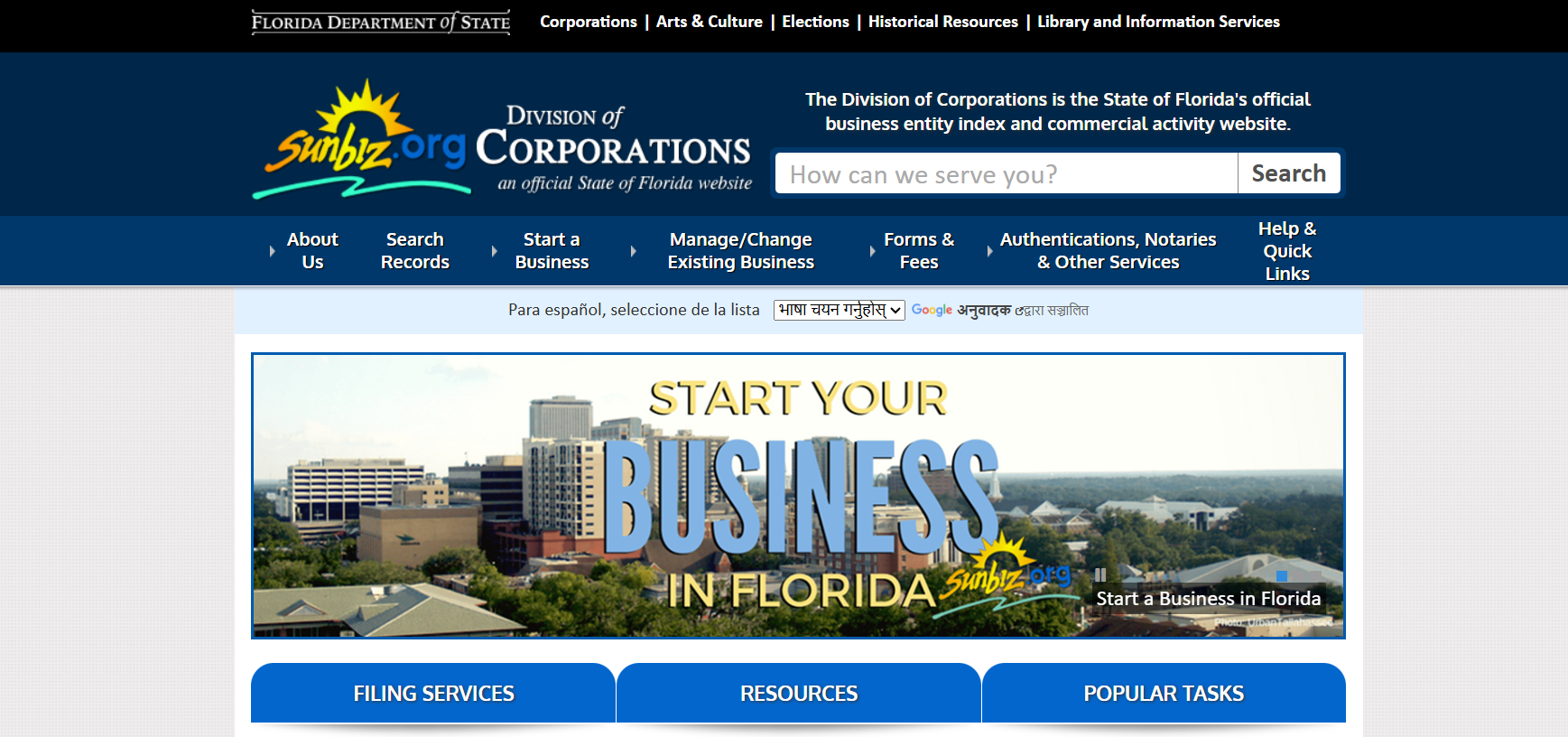
Step 1: Visit the Sunbiz Florida Website

Navigate to www.sunbiz.org, which is the official site for the Florida Department of State, Division of Corporations.

florida

Step 2: Look for “Search Our Records”

On the homepage, there is a section labeled “Search Our Records.” This section provides several search options, including:

  • Corporation/LLC/LP Name: Users can conduct a search using a company’s name.
  • Officer/Registered Agent Name: Users can search using the name of an officer or agent.
  • Trademark/Service Mark Name: Search for all service marks and trademarks that have been issued and are active in Florida.
  • Fictitious Name: Search for all registered Doing Business As (DBA) names for individuals and entities.
  • Document Number: Search results are narrowed down based on the exact filing number given. Entering the exact filing number results in precise matches.

Step 3: Enter Search Criteria

Input any relevant business data. For instance, for “Sunshine Realty LLC,” the officer’s name or the business name can be used and will yield results.

Step 4: Review Search Results

Examine every suggestion the computer gives, as the names can be deceptively alike. The system will list all the businesses corresponding with the given name.

Step 5: Click for Details

The public profile of every business contains the following information, so by clicking the business name, it will be accessible:

  • Official company name
  • Document number
  • Date of filing and incorporation
  • Business type (LLC, Corporation, Partnership, etc.)
  • Principal office and mailing address
  • Registered agent details
  • Status (Active/Inactive/Dissolved)
  • Filed annual reports and corporate documents

With details such as these, researchers are guaranteed to have all relevant information.

When Should You Use Florida Corporation Search?

The tool can be useful in a number of situations:

When initiating a business in Florida → To have an idea of what business name can be used.

Before entering into partnerships or contracts → To validate that your prospective partner runs a business that is operational and legitimate.

Before making an investment → To audit the business and its dealings in compliance corporate records.

For due diligence → This procedure is often used for background investigations by lawyers and accountants, or by investors.

For marketing and competitive research → Companies are able to verify the existence of participants in an industry and analyze their competitors.

For protecting your trademark → Taking steps to confirm that a brand name does not interfere with, or is not conflicted by, a brand in the state of Florida.

Benefits of conducting business in Florida

It is also important to note that Florida is more than a tourist hot spot; the state is an international business center. This is the reason many startups prefer it.

Tax Benefits: For foreign nationals, and for citizens, Florida does not charge a personal income tax.

Geographic Advantage: Florida serves as a major gateway to Latin America and the Caribbean, as well as to the rest the world through its shipping routes.

Broad Range of Industries: Florida has more to offer than just tourism and real estate; it also excels in finance, technology, agriculture, and healthcare.

Highly qualified personnel: These are essential for foreign companies, and Florida’s multiligual workforce is an attractive asset.

Highly qualified geographed: Florida has the international airports and sea ports as well as the modern means of transport for conducting business.

Business-Friendly Legislation: The state promotes entrepreneurial activities through relaxed regulations and simple processes for registration.

These advantages along with access to Sunbiz’s open corporate records make Florida, in my opinion, one of the best states in the US for starting and expanding a business.

How We Help

Here at Bizstartz, we facilitate business start, management, and growth across the US for entrepreneurs from all corners of the globe. Whether you are a US citizen or a non-resident founder, we will guide you on every step from setting up to maintaining the business in Florida.

Our assistance includes:

  • Formation of LLC or Corporation in Florida
  • Application for EIN (Employer Identification Number)
  • Registered agent services
  • Beneficial Ownership Information (BOI) filing
  • Filing annual reports and general compliance
  • Maintaining business records and managing accounts
  • Opening a business bank account in US
  • Bookkeeping and accounting services
  • Trademark filing
  • Advisory services for non-resident business owners

We assist in all aspects of filing Florida Corporation Searches to reserve a business name.

Blog CTA

Final Thoughts

The Florida Corporation Search serves as one of the many tools offered to entrepreneurs, investors, and business professionals looking to establish a presence in the state.

Sunbiz’s services are convenient and accessible for anyone looking for a business’s verification, compliance filing, and even name checks for uniqueness.

When considering the formation of a corporation or LLC in Florida, it is advisable to seek assistance with the process. At Bizstartz, we assist both American citizens and foreign investors in setting up their companies in Florida.

Texas Business Entity Search: A Complete Guide for Entrepreneurs

Texas has historically been one of the most business-friendly states in the country, drawing in entrepreneurs from across the nation and even the world. The Lone Star State offers unparalleled opportunities in business expansion and tourism, with no state income tax, a flourishing economy, and a wide array of industries, including energy and technology.

However, one crucial step to establish a company in Texas is ensuring the selected business name is distinctive and eligible for registration. The Texas Business Entity Search is vital in such scenarios.

The Texas Secretary of State’s search system is vital for entrepreneurs to verify name registrations, ensure compliance, and carryout due diligence for registered businesses. If you are planning to incorporate, form a new LLC, or even research an existing company, this tool is invaluable.

This guide will explain what the Texas Business Entity Search is, why it’s important, how to effectively use it, and what actions to take post search completion.

What is the Texas Business Entity Search?

Texas Business

The Texas Business Entity Search is offered by the Texas Secretary of State’s office as an online search tool to access records of various business types registered in Texas such as Limited Liability Companies (LLCs), Corporations, Limited Partnerships (LPs), Nonprofits, and other business entities.

Through this tool, you can access important details such as:

  • Business name and filing number: The official identifiers of a company.
  • Entity type: Whether it’s an LLC, Corporation, LP, or other structure.
  • Current status: Active, inactive, dissolved, or forfeited.
  • Registered agent: The person or business who receives legal documents on behalf of the company.
  • Filing history: A chronological record of documents submitted or lodged with the filing office, at the state office.

Unlike some states, which allow performing basic business searches at no charge, Texas has such services accessible through a paid system, SOSDirect. Limited information can be accessed free of charge. However, for complete access to records, certificates, copies of documents, and other information, a small fee is charged.

In short, this tool acts as a central database of all legally registered entities operating businesses in Texas.

What is the Significance of the Texas Business Entity Search?

Executing a Texas business search is not a mere administrative chore, but an important activity that can support smooth legal groundwork for your business. Below are the reasons it is important:

1. Prevents Name Conflicts

Every business is required to have a unique name which is not “deceptively similar” to a name that is already registered. Texas name regulations are stringent, and if your business name is close to an existing business, your application will be denied. Performing a search early can save a lot of time.

2. Confirms Legal Compliance

When formation documents are submitted to the Secretary of State, they perform a name-check with the registry and verify if the name is already in use. Doing the search yourself can save you time and help ensure legal compliance for your business and make necessary adjustments to the name if needed.

3. Verifies Legitimacy of Other Businesses

For vendors, clients, or business partners based in Texas, the search tool can confirm if they are active or registered businesses. You can also verify if they are in good standing, suspended, or dissolved, which can help make an informed decision towards the partnership.

4. Safeguards Legal and Financial Interests

When it comes to loans, contracts, or any legal documentation, institutions and banks typically require verification of good standing and registration. Legal verification checks enable access to such records.

5. Conducts Market Studies

Aside from the legal application, the database can offer a glimpse of the competition. You may access the number of businesses within the same industry and operating with identical names.

Steps for Conducting a Business entity search in Texas

Accessing the SOSDirect system is a prerequisite to conducting a Texas Business Entity Search. The process is simple, but it must be broken down into clear steps:

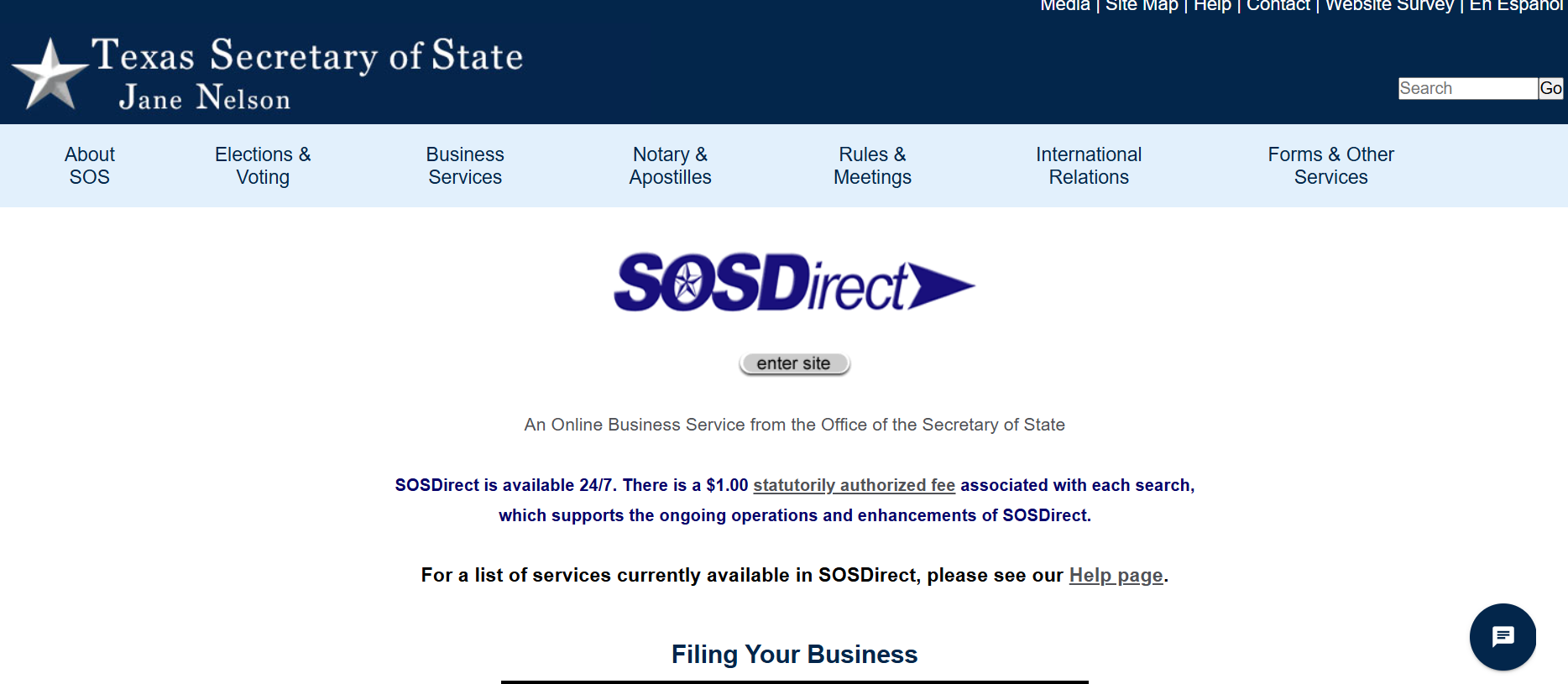
Step 1 Search for the SOSDirect Portal

Visit the Texas SOSDirect page. You can register for a new account or log in as a guest. Make sure to have a credit card on hand as searches and documents incur a small fee.

Texas

Step 2 Choose Your Search Method

Records can be looked up in a number of ways:

  • By Entity Name: Type in the business’s name in whole or in part, this is the most common method to check for name availability.
  • By Filing Number or Tax ID: For those that have the unique number, this method is the quickest way to obtain results.
  • By Registered Agent Name: This is especially useful for attorneys, accountants, or individuals who handle numerous businesses.

Step 3: Review the Results

The system provides a list of entities that correspond with your search criteria. For each business, you would generally find:

  • Official name
  • Filing number
  • Entity type
  • Registered agent name
  • Business status (active, inactive, dissolved, forfeited, etc.)

Step 4: Order Records (Optional)

For users with SOSDirect accounts, the system provides the option to buy official documents considering additional documents are not basic details. Business documents that can be ordered include:

  • Certificate of Formation: Document evidencing the business’s formation.
  • Certificate of Fact: Status (Good Standing Certificate) – Document affirming that the company is not only active, but also compliant with requirements.
  • Certified Copies: Copies of legal filings which hold legal status for legal and financial transactions.

Common Uses of the Texas Business Entity Search

The business entity search serves numerous functions for different users:

For Entrepreneurs Starting a New Business

Prior to creating your LLC or Corporation, it’s essential to check that the name you would want to use as a business is not and has not been in use by any other business.

For Existing Business Owners

Business owners may want to check their business to verify filing history, or to check for pending information updates, or to obtain certificates for banking and compliance.

For Investors and Lenders

Before making an investment, most investors check an organization’s eligibility and standing status to ensure proper registration and to mitigate risks.

For Lawyers and Accountants

Entity records are important to ensure clients are set up and compliant with relevant state regulations, which is why professionals check them frequently.

For Market Research

You can find information on other competitors in the niche or industry you are looking to enter and find out what the key companies are to understand the market better.

What to Do After Performing the Texas Business Entity Search

Your situation dictates the steps you can take after the search, so here are some examples:

If You’re Starting a New Business

  • Reserve your business name with the Secretary of State. This offers protection for the name for up to 120 days.
  • Submit your Certificate of Formation for your structures which can be an LLC, Corporation, or LP.
  • Designate a registered agent residing in Texas.
  • For tax and banking needs, apply for an EIN with the IRS.
  • Establish your processes for compliance on franchise tax and annual submissions.

If You’re Verifying Another Business

  • Issue a Certificate of Fact, Status to confirm they are in good standing.
  • Use their filing history to determine their length of business and compliance maintenance.

If You Already Own a Business

  • Check your entity is active and compliant with any relevant regulations.
  • Acquire the necessary orders concerning documents such as contracts, loans, or licenses.
  • Make necessary changes or renew documents that are outdated.

How Bizstartz Can Assist

At Bizstartz, we aid business owners in dealing with the compliance and legal requirements for business formation in the U.S. For individuals looking to form a business in Texas, we have an all-inclusive approach to assist you.

Here are some of the services we offer:

  • Formation of Texas LLC and Corporations
  • Assistance with Business name availability and reservation
  • Providing Registered Agent services in Texas
  • Assistance with EIN applications for both domestic and foreign founders
  • Compliance for BOI (Beneficial Ownership Information) filing
  • Assist with bookkeeping and tax filing
  • Trademark registration to guard your business name

As an international business owner looking to expand into the US, or a Texas resident, you can rest assured knowing at Bizstartz your company will receive proper formation and compliance for company laws so that it can grow at a healthy pace.

Blog CTA

In Conclusion

Having access to the Texas Business Entity Search can greatly benefit business owners, investors and business associates in Texas. Apart from name availability, it offers important insight into existing companies and the level of competition in the market.

Conducting these searches before registration can not only help save businesses from legal disputes but aid in compliance with state laws, ensuring a smooth start to a new business.

And if you would like to save time and avoid blunders that would lead to unnecessary expenses, you can hire professionals who will help you from the beginning to the end, and that’s where Bizstartz comes to the picture. Whether it’s registering your Texas LLC or handling tax and compliance work, we’re there for you.

How to Form an LLC in Louisiana: Step-by-Step Guide

Establishing a business in Louisiana is not just an opportunity but an avenue to explore one of the most culturally rich, diverse, and vibrant states in the U.S economy. Louisiana is known globally for its industries in energy, agriculture, shipping, tourism, and film production.

Creating a new venture through here is best done by forming a Limited Liability Company (LLC). An LLC provides the combination of flexibility along with simple management akin to a sole proprietorship, and protection of liability common to a corporation.

Whether you’re an international entrepreneur entering the U.S market, or a local resident of Baton Rouge and New Orleans, form an LLC in Louisiana with highly beneficials.

In this article, you will gain insight on selecting an LLC name to compliance requirements, and through it, understand how Bizstartz assists in a seamless process.

Why Would You Select an LLC in Louisiana?

The LLC structure has become the most popular choice for entrepreneurs in Louisiana and throughout the U.S. Here’s why:

Protection From Liability

In the unfortunate event that your business faces litigation or goes into debt, your private assets such as a home, vehicle, or savings would remain unaffected. For instance, in the case of a customer lawsuit against your LLC, they would only be entitled to the business assets, and your personal finances would remain untouched.

Flexible Tax Options

By default, LLCs are classified as “pass-through” entities, where members report profits or losses on personal tax returns. In addition, Louisiana LLCs may opt to be taxed as S Corporations or C Corporations which may reduce self-employment tax liabilities or taxes on retained profits.

Less Administrative Burden

Without the requirement for annual meetings and record-keeping of extensive minutes as with corporations, LLC’s are easier to maintain. This reduces the time and money required to complete administrative tasks.

Your Clients and Investors are More Likely to Trust You

Your business gains legal registration credibility and a stronger commitment to professionalism upon the addition of LLC. This is advantageous during contract negotiations and financing applications.

Louisiana-Specific Benefits

Louisiana espouses certain tax credit systems and incentive schemas in specific sectors such as shipping, manufacturing, film, and renewable energy. In addition, Louisiana ranks favorably among U.S. states in terms of port systems, giving it a strategic position in international trade.

LLC from Nigeria

Step 1: Choose a Name for Your LLC

As an entrepreneur, your business name is your primary branding asset. The rules associated with LLC names in Louisiana may be simple, but they are critical.

  • Your title should be unique and distinguishable from all registered entities in Louisiana. You cannot use a name that is taken or is too similar to an existing name.
  • Your title must contain one of the following: “Limited Liability Company,” “L.L.C.,” or “LLC.”
  • Restricted terms such as “Bank,” “Attorney,” or “Insurance” need to be vetted and authorized by appropriate regulatory bodies.

👉 Example: Assume you want to start a Cajun cuisine business. You could register “Bayou Bites LLC” instead of “Bayou Bites” to make it more appealing.

To validate your name, use the Louisiana Secretary of State’s Business Search tool. If you aren’t able to immediately file your LLC but want to secure your preferred name, it can be reserved for 60 days using the Name Reservation form and a small fee.

💡 Pro Tip: To further secure your brand identity, consider registering a matching domain name and social media handles at the same time.

Step 2: Designate a Registered Agent

Every LLC in Louisiana must appoint a Registered Agent. This is the person or entity that receives legal and governmental communication on behalf of the business, which includes lawsuits, tax notices, and compliance reminders.

Qualifications of a Registered Agent for Louisiana:

  • The individual must be a legal resident of Louisiana or a business entity licensed to conduct business in the state.
  • Must have a street address in Louisiana. No P.O. boxes.
  • Must be reachable during standard business hours.

👉 Example: In the event of a lawsuit, your company’s Registered Agent would be served the court papers and would coordinate the legal representation on your behalf.

If you’re overseas or would like to keep your address private, you would need to utilize a professional Registered Agent service. Doesn’t Worry offers Registered Agent services and can mitigate the risk of losing important legal documents on your behalf.

Step 3: Submit Articles of Organization

The Articles of Organization are a legal document that your LLC is formed, issued by the Louisiana Secretary of State.

The document shall comprise of the following:

  • The name of your LLC company and the physical address
  • The Registered Agent’s name and address
  • The members or managers of the LLC with their respective names and addresses
  • Whether your LLC will be member-managed (run by owners) or manager-managed (run by appoined managers)

👉 Filing Fee: $100 (effective 2025)

👉 Filing Options: Online through the Louisiana Secretary of State’s page (most efficient) or through paper forms sent by mail.

👉 Processing Time: 1-3 business days online, longer by mail.

Your LLC will be legally recognized by the state of Louisiana once your Articles of Organization have been approved. You will receive a notification alongside the certificate of organization.

Step 4: Formulate an Operating Agreement

While Louisiana does not require LLC’s to have an Operating Agreement, it does serve as a vital internal document that can be formulated.

An Operating Agreement defines:

  • The ownership structure and respective ownership stakes of the LLC.
  • The allocation of the profits and losses of the LLC.
  • Voting authorities and the procedures for making decisions.
  • The admission, removal and resignation of members.
  • The procedures regarding the dissolution of the company.

👉 Example: Consider the case of two partners who open an LLC coffee shop in New Orleans. One of the partners becomes an investor and the other becomes an active manager. The Operating Agreement will provide definitions for the allocation of profits so that the partners do not have disagreements later on.

Failure to create an operating agreement means that default provisions of Louisiana’s LLC law will be applicable, which could be different from what you prefer.

Step 5: Obtaining an EIN for your Business

Like a Social Security Number, EINs are issued by the IRS and serve as a Social Security Number for your business. An EIN is necessary should you wish to:

  • Open a U.S. business bank account
  • Hire employees
  • File federal and state taxes
  • Apply for licenses or permits

The application for EIN is free of charge from the IRS. Residents of the U.S. are eligible to apply online whereas non-residents apply for the SS-4 form via fax or mail.

If you are a non-resident business owner and do not have a Social Security Number, your application for an EIN via Bizstartz will be smooth.

Step 6: Louisiana State Business Taxes and Licenses

With the formation of your LLC, you might also have to register for state taxes with the Louisiana Department of Revenue. Business type determines requirements:

  • Sales Tax: Collecting Louisiana sales tax is mandatory for sellers.
  • Employer Taxes: Employers are also responsible for the applicable withholding tax and unemployment insurance.
  • Franchise Tax: Louisiana requires certain businesses to pay a minimum franchise tax.

Furthermore, depending on the sector and geographical area, you may need some local permits:

  • Restaurants often require health permits along with a food service license.
  • Contractors may require building permits or trade licenses.
  • Retail shop operators may require local (parish or county) permits.

As a best practice, always verify with your local parish clerk’s office and the Louisiana Secretary of State’s GeauxBiz portal for regulatory compliance concerning licenses.

Step 7: Additional Steps to Consider in Upkeeping Your Louisiana LLC

In this seventh step, we will be reviewing the maintenance activities for your LLC, this includes filing the correct documentation and reporting:

Filing Requirements

A copy of the LLC bylaws and Annual Operating Plan should be submitted to the Department of State Development and filed for Louisiana LLCs. Confirm reporting requirements for every constituent in business along with the business’s Registered Agent.

  • Retention Duration: 2 Years
  • Filing Fee: 30
  • Filing Fee Deadline: on the anniversary of the LLC

Maintain Accurate Financial Records

Sedulously track your finances, especially during tax periods and audits.

Business Accounts

Prior to filing for state and federal tax rebates, make sure your filing accounts are separate from your business accounts. LLCs and business owners often make this common error.

Expiration: Duration of the corporation’s, LLC’s, or LLC member’s ownership

Overlooking these requirements could result in fines, tax complaints, or even the administrative cancelation of your LLC.

How Bizstartz can help on LLC Applications in Louisiana

We understand that most foreign LLC owners face the challenge of the perception of having to shoulder the worry of the filing of the LLC alone. Here is how Bizstartz aids LLC owners in Louisiana.

We provide comprehensive support for entrepreneurs which includes:

  • Submitting your Louisiana LLC application to the Secretary of State
  • Acting as a Registered Agent
  • Assisting in obtaining an EIN (with or without an SSN/ITIN)
  • Opening a U.S. business bank account
  • Managing BOI (Beneficial Ownership Information) filings
  • Tax and compliance services

With us at Bizstartz, you can concentrate on growing your business as you build it, while we manage the legal and administrative work.

Blog CTA

Concluding Remarks

Louisiana offers one of the most favorable business climates in the country, with opportunities in shipping, oil and gas, tourism, and the creative industries. Forming an LLC or corporation will not only safeguard your personal assets but also enhance your business’s credibility and provide you the flexibility to manage and expand it as you choose.

The process may appear long and tedious, but with a trusted partner like Bizstartz, you can be assured that all milestones will be met—from LLC name registration to annual report filings.

Contact Bizstartz and gain the confidence to successfully start your U.S. business today. Louisiana awaits you.

How to Form an LLC in Hawaii: Complete Step-by-Step Guide

It’s true that Hawaii’s beaches are mesmerizing and its tourism industry is thriving, but there’s even more business potential that’s greatly appealing. Hawaii is a promising place to do business because it’s embedded with local culture while also possessing global potential.

For starters, Hawaii is welcoming to entrepreneurs, both local and overseas. The state offers asset protection and flexible tax options, which is a huge plus. These factors also highlight that Hawaii is great for family businesses and even international undertakings.

If you are planning to start a business then Hawaii is the place for you. An option that is guaranteed to benefit you while still giving you personal liability protection is the formation of a Limited Liability Company, also known as LLC. LLCs are known to merge the benefits of a corporation and a sole proprietorship.

In the following sections, we will detail the process to form an LLC in Hawaii. Additionally, we will cover the costs, compliance requirements, and other relevant information.

Why Consider Hawaii for Your LLC?

Hawaii isn’t just a hotspot for visitors; it is also a place with many opportunities for entrepreneurs. Despite the logistical issues with the state’s remoteness, it also presents opportunities for businesses in tourism, hospitality, agriculture, renewable energy, and technology. Some of the main benefits of starting an LLC in Hawaii include:

Asset Protection

An LLC acts like a fence protecting your personal finances and your business debts. Your personal assets like your home, car, and savings will not be at risk in case of debts or lawsuits against the business.

Flexible Taxation

In Hawaii, LLCs have the option to choose their taxation method. By default, single-member LLCs are taxed as sole proprietors, and multi-member LLCs as partnerships. LLCs have the option to elect S-Corp or C-Corp taxation if it is beneficial.

Thriving Business Sectors

Hawaii is famous for its tourism as well real estate. The state also has a well developed agriculture sector, specializing in coffee, macadamia nuts, and other tropical fruits, as well as renewable energy. This allows for a wide range of business opportunities for the entrepreneurs.

Government Support

Hawaii has training programs, tax incentives, and resources targeted at specific industries making the state useful for small businesses.

Geographic Advantages – Hawaii connects the U.S. mainland and Asia and is an international trade and travel hub.

Form an LLC in Kentucky

Step 1: Choose a Name for Your Hawaii LLC

Your brand starts with the business name, and picking the right one is critical. Hawaii’s LLC name regulations are:

  • Must contain “Limited Liability Company” in full, “LLC,” “L.L.C.,” or related abbreviations.
  • Shall not represent government affiliation (examples: FBI, Treasury).
  • Must not be identical or too similar to other registered business names in Hawaii.

The Department of Commerce and Consumer Affairs (DCCA) now allows us to check registered names through the Hawaii Business Entity Search tool.

💡 Tip: If immediate filings are not in plans, a Name Reservation Application allows for a 120-day hold for a $10 fee.

Always check domain name availability for business websites. Having matching business and domain names boosts credibility.

Step 2: Appoint a Registered Agent

Each LLC in Hawaii is legally required to have a Registered Agent. This is an individual, or business entity, with a physical address in Hawaii who can accept correspondence on behalf of the LLC and receives state and legal documents.

  • The registered agent ensures that you don’t miss important notices such as compliance reminders and tax forms.
  • The agent must be accessible to the registered business during normal business hours.
  • Living in Hawaii allows you to be your own registered agent. However, most business owners, particularly those outside the state, hire a registered agent professional service.

💡 If you’re an international founder or don’t live in Hawaii, using a professional registered agent service is the most reliable way to stay complain.

Step 3: File the Articles of Organization

The Articles of Organization (Form LLC-1) is an official document that legally ramps up an LLC in Hawaii. As with other states, it must be filed with the Department of Commerce and Consumer Affairs (Business Registration Division).

Fundamental components highlighted in the Articles of Organization are:

  • Legal name of the LLC
  • Mailing address and physical location of the business
  • Phone number and physical location of the business
  • Registered agent’s name and address
  • Business Management Organization parent company, including Management Type
  • Organizer’s Name and Address Of LLC

Filing Methods and Costs:

  • Filing Fee: $50 plus a $1 state archive fee
  • Processing Time: 3–5 business days (expedited processing available for an additional $25)
  • You can file online, by mail, or in person

Receiving of the Certificate of Organization confirms that the filing of the LLC is officially accepted in Hawaii for LLCs business operations.

Steps 4: Create an Operating Agreement

Though Hawaii hasn’t indicated the need for an Operating Agreement, filing of one is advisable for the LLCs.

Specifics of the Operating Agreement describe business relations and scope, describing in details the member accounts, member enrollments, and membership workloads, including:

  • Ownership percentages of each member
  • Voting rights and responsibilities
  • Distribution of profits and losses
  • Procedures for adding or removing members
  • Dissolution guidelines

💡 If the members are more than 1, the filing of the Operating Agreement is crucial disregarding the voting limit of 1 member. Having the document contest strengthens limited liability protections defensively on the legal combats.

Step 5: Apply for an EIN (Employer Identification Number)

Your LLC will need an EIN (Federal Tax ID Number) from the IRS if you wish to:

  • Hire employees
  • Open a business bank account in the United States
  • File for federal taxes
  • Apply for business licenses and permits

You can acquire an EIN through the IRS website at no cost.

For foreigners who do not posses a Social Security Number (SSN), an EIN is applied for through Form SS-4, which must be mailed or faxed to the IRS. If needed, Bizstartz can assist you in this process.

Step 6: Set Up Accounts for State Taxes in Hawaii

Hawaii State tax registration is mandatory for some businesses including the General Excise Tax (GET), which for the most part, is unique to Hawaii and is charged to nearly all business activities.

  • General Excise Tax (GET): Most businesses in Hawaii must register for the GET. While the tax is set at 4% for most counties, some counties like Honolulu have a surcharge of 0.5% making the tax for those counties 4.5%.
  • Withholding Tax: If you have employees, this tax is applicable.
  • Transient Accommodations Tax (TAT): Occupied by rental and lodging businesses, this tax is slapped on to vacation rentals, hotels, or bed and breakfasts.

For GET, taxes can be registered for through Hawaii Tax Online, the state’s tax website.

Step 7: Get Licenses and Permits

Your LLC may need certain permissions, depending on the field of work. In Hawaii, the following industries are often regulated:

  • Tourism and hospitality services
  • Restaurants and food vendors
  • Construction and real estate
  • Professional services such as medicine, law, and financial advising

Licenses for regulated industries are issued by the Hawaii Professional & Vocational Licensing Division. Local county offices may have additional requirements.

Step 8: Get a Business Bank Account

Meeting the limited liability criteria for your LLC will be easier if you open a separate business bank account.

This offers the following advantages:

  • Protecting personal and business finances.
  • Earning business credit.
  • Easing the process of bookkeeping and filing taxes.
  • Enhancing professional credibility with clients and vendors.

Some banks in Hawaii require you to be physically present for the account opening process. However, there are banks that offer this service to non-residents.

Step 9: Continue Complying with Hawaii’s Regulations

Your responsibilities do not end after the LLC formation. Hawaii also has additional criteria that need to be followed for the business to be considered fully compliant, such as:

Annual Report

  • Every LLC based in Hawaii must submit an annual report.Filing Fee: $15
  • Due: At the end of the quarter your LLC was created. If your LLC was approved in March, you must submit your report by June 30 each year.
  • Reports are submitted through the DCCA website.

State Taxes:

  • Continue to pay GET, TAT and other applicable state taxes.
  • Ensure all federal tax filings are submitted by the deadline.

Business Licenses:

  • Renew any industry-specific licenses or county permits as required.

Cost Breakdown of Setting Up an LLC in Hawaii

Here’s a summary of the typical costs involved in forming and maintaining an LLC in Hawaii:

  • Articles of Organization Filing Fee: $50
  • State Archive Fee: $1
  • Expedited Service (optional): $25
  • Name Reservation (optional): $10
  • Annual Report Filing Fee: $15

Total Initial Formation Cost: $51–$76 (depending on optional services)

How Bizstartz Can Assist in LLC Registration in Hawaii

If you’re a foreign individual or someone new to the U.S. business procedures, LLC formation in Hawaii LLC could seem a bit tricky and complicated. Bizstartz aims to make your life easier by managing the entire procedure so you can concentrate on your business instead.

Here’s the breakdown of our services:

LLC Registration Submission

  • Articles of Organization are submitted to DCCA, Hawaii’s Department of Commerce and Consumer Affairs.
  • All documents are checked for compliance so that the LLC can be formed without avoidable wait periods.

Registered Agent Services

In case you don’t reside in Hawaii, you need a professional registered agent. For Hawaii, Bizstartz professional registered agent services ensure that you will not miss any important legal or taxation documents.

EIN (Employer Identification Number) Application

We can get your EIN even if you do not have a Social Security Number (SSN). This is important for taxation, banking, and even hiring employees.

Business Bank Account Setup

We help both international and U.S. based business owners set up a bank account for the business, making sure that your LLC has a powerful financial base from the beginning.

Operating Agreement Drafting

We can help create an Operating Agreement customized for your LLC which includes the owners and management to help you avoid disputes in the future.

Hawaii State Tax Registration

We assist you in registering for Hawaii’s General Excise Tax (GET) and any other state or local taxes that may apply to keep your business compliant.

Ongoing Compliance Support

From filing your annual reports and dealing with renewals, Bizstartz is there to help ensure your LLC remains in good standing every year.

Additional Services

Other services are bookkeeping and accounting, filing for Beneficial Ownership Information (BOI) and applying for an ITIN for foreign owners, applying for business licenses, and trademark registration for brand protection.

💡 Here at Bizstartz, we help both international and U.S. entrepreneurs set up and expand their businesses in America. You can count on us to take care of the paperwork, compliance, or legal issues—because we take care of all of that for you.

Blog CTA

Final Thoughts

An LLC in Hawaii helps business owners gain legal shielding, tailored taxation options, and enter lucrative sectors driven by Hawaii’s distinctive economy.

Your business will be positioned for success if you follow the steps of business name selection, Articles of Organization submission, Operating Agreement drafting, taxation registration, and tax registration.

With so many steps, including creating an LLC, applying for an EIN, opening a bank account, and bookkeeping, registration can be overwhelming for busy entrepreneurs and international founders.

For them, we offer a full-service solution through Bizstartz, where we manage LLC registration, EIN applications, bank account setup, bookkeeping, and compliance oversight.

California Business Entity Search: A Complete Guide

California boasts one of the largest and intricate economies in the world. Entrepreneurs from every corner of the world readily flock to the Golden State, whether they’re from the production companies in Hollywood, the start ups in Silicon Valley, or even small family businesses.

If you’re looking to start a business in the state, one of the tasks you will need to complete is making sure that your business name is not already taken. You will also need to confirm the legal standing of other companies you plan to collaborate with. For that, the California Business Entity Search is extremely helpful.

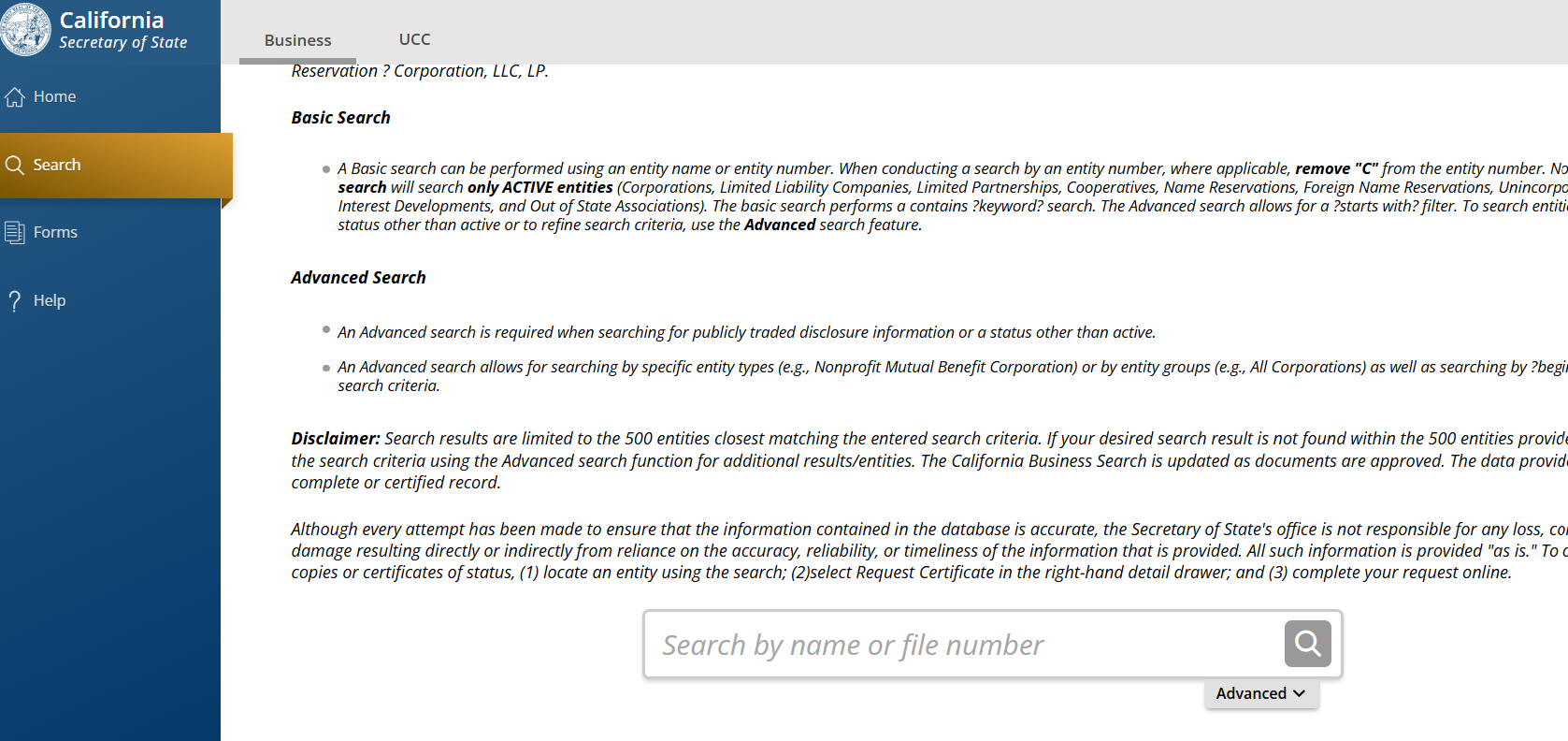
In this guide, you will learn everything that you need to know in relation to the California Business Entity Search. The Business Entity Search is a free service, that helps with looking up entity’s name and status in the system, as well as finding the initial formation documents of the business.

The California Business Entity Search is a tool that can save you a ton of legal issues in the future. Makes sure to understand what it entails, even if you are not a first time entrepreneur.

What is the California Business Entity Search?

The California Business Entity Search is a free tool by the SOS or the Secretary of State of California. The SOS office provides various services that helps with looking up entity’s name and status in the system, as well as finding the initial formation documents of the business.

The entities include:

  • Legal entities that are Limited Liability Companies (LLCs)
  • Corporations: both C-Corps and S-Corps, including Professional Corporations.
  • Limited Partnerships (LPs)
  • Limited Liability Partnerships (LLPs)
  • General Partnerships (GPs), if state-registered.
  • Other entities like nonprofit corporations.

The system ensures that California remains open, accountable, and trustworthy while making business information accessible and giving everyone the tools to access California’s business information.

For instance, if you wanted to open a coffee shop named “Golden Bean Café LLC” in Los Angeles, you would be able to use the search tool to check if that business name already exists.

The same goes for contractors, and if you are about to sign a contract, you can check if they are active and in good standing, legally able to do business in California.

Why Is the Business Entity Search Important?

In California, performing a business entity search goes beyond checking if a name is already in use. It has lots of advantages for entrepreneurs, investors, and even consumers.

1. Checking business name availability

In California, every business entity registered in the state has a unique name. This requirement helps avoid unnecessary time spent filing name reservation applications. The entity name search ensures that formation documents are not submitted for already existing business names. It also helps avoid paying unnecessary filing fees.

👉 Example: Imagine you wanted to launch a digital marketing company called “Pacific Growth Marketing LLC.” First, you would check the database to see if the name is taken. If it is, you will have to modify your name, for example, “Pacific Growth Digital Marketing LLC.

2. Confirm Business Legitimacy

The database helps evaluate whether your business partner is legally registered and is in good standing. This helps in escaping untrustworthy or fraudulent businesses.

👉 Example: Before signing a $50,000 supply contract with “Green Earth Logistics,” you can verify if the company is active, suspended or dissolved.

3. Protect Businesses Against Fraud and Scams

Entities sometimes establish non-existent companies to deceive clients or business partners. You can check the official SOS records to confirm if the business is registered and exists, or if it’s just a shell company.

4. Easy Access to Records

The search offers for free critical and sensitive information such as:

  • Entity number
  • Filing date
  • Status (active, suspended, dissolved, merged, canceled)
  • Jurisdiction (California or other state)
  • Registered agent information
  • Business addresses

This kind of openness is good for transparency which helps companies fulfill their responsibilities while making informed decisions.

5. Maintain Regular Compliance Checks

As a business owner, using the search functionality is beneficial to check if your business is in good standing. If your business status is “suspended” or “forfeited,” then you have over missed some filings, tax payments, or other compliance activity.

How to Perform a California Business Entity Search

The California Secretary of State Business Search Tool is easy to navigate. Below is a simple procedure:

Step 1: The California Secretary of State Business Search Portal

california

Visit the California Secretary of State Business Search Portal. The search is public and free of charge.

Step 2: Select a Search Option

There are various search options available:

  • Entity Name Search: This is the most popular search. You can type the business’s full name or any of its keywords.
  • Entity Number Search: Each business is given a unique identification number by the state. You can use the ID to search.

Step 3: Fill in the Search Parameters

Enter the business name or number. When using the business name search option, you may use the exact legal name or provide part of the name to search for similar business names.

Step 4: Examine the List of Results

You will see a list of entities that correspond to your search. Each result will show:

  • Name of the entity
  • Entity number
  • Registration date
  • Status (active, suspended, dissolved, canceled)
  • Jurisdiction

Step 5: Get More Detailed Information

More detailed records, such as the following, are shown when the entity name is clicked:

  • Business addresses
  • Information on the registered agent
  • Filing history
  • Information on status changes
  • Statements of Information submitted to the state

👉 Pro Tip: If you are still deciding on a business name, search to make sure your preferred option is truly available.

What You Can Learn from a California Business Entity Search

This information is very important for a business that is registered in California. The business status, for example, includes:

  • Business Status: active, suspended (for tax, loss of good standing, or compliance issues), or dissolved.
  • Formation Date: date of establishment.
  • Entity Type: LLC, corporation, nonprofit, LP, or LLP.
  • Jurisdiction: formed in California or registered as a “foreign entity” from another state.
  • Registered Agent Information: the person or entity handling legal documents on behalf of the business.
  • Business Address: The official mailing and business address.
  • Filing History: Access to past filings, including Statements of Information, amendments, and dissolution filings.

Suppose you want to invest in a new company. In that case, an entity record of the business could show how long they have been in business as well as filing mandatory reports and how many reports they have submitted. This would be beneficial for determining the investment amount.

What to Do After Performing the California Business Entity Search

The clarity you obtain after searching business details guides the next steps you take.

1. If You’re Starting Your Own Business

Name Available? if the name you picked is not in use, you are free to submit your Articles of Organization incorporating your LLC or Articles of Incorporation for a corporation. This would be the next step after business formation.

Name Taken? Your brainstorm alternatives would be name modifiers that append ‘Group,’ ‘Services,’ or ‘Solutions’ and are not currently in use. This could help turn a taken name to a unique name.

2. If You’re Verifying Business Partners or Vendors

Active Status: If the business is listed as active, you can proceed with greater confidence.

Dissolved or suspended: A business that is marked in suspended status or in the process of dissolution is not actively authorized to operate out of California which could be a red flag.

3. If You Already Own a Business

Check Your Own Status: If the business shows as suspended, it could be due to missing tax return filings, unpaid fees, or overdue filings of Statements of Information.

Keep Records Updated: Regularly doing business checks with the SOS for the registered agent, addresses, and the business information ensures that the information is up to date.

4. Protecting Your Brand Beyond California

Even if a business is registered with the state of California, competitors from other states could still use the name. This is a good reason to seek federal registration for the trademark.

Blog CTA

How Bizstartz Can Assist You

At Bizstartz, we assist clients, particularly non-U.S. residents, start and grow businesses in the United States. We specialize in:

  • Performing the California Business Entity Search
  • Filing LLC and Corporation formation documents with the California Secretary of State
  • Acting as a Registered Agent for California based LLCs and Corporations
  • Obtaining EINs from the IRS
  • Assisting international founders with obtaining ITINs
  • Filing for BOI compliance with FinCEN
  • Opening U.S. business bank accounts
  • Trademark registration at the federal level
  • Bookkeeping and tax filings with compliance services

Bizstartz can help you whether you are launching a new startup, expanding your existing business, or looking to grow your business in new regions.

Final thoughts

The California Business Entity Search is not simply a name-checking system. It is an important tool for businesses looking for compliance and protective measures in some of the most competitive markets in the world.

Using this tool, you can:

  • Check if your business name is available
  • Validate business opportunities
  • Check state compliance requirements
  • Safeguard your reputation

Bizstartz assists you with every step, ensuring you never feel alone with complex California business formation processes. We serve entrepreneurs around the world with complete solutions, from entity searches, and to the opening of business bank accounts.

Delaware Business Entity Search: A Complete Guide for Entrepreneurs and Investors

Delaware earned global renown as the corporate capital of the United States because more than two-thirds of Fortune 500 companies and over 1.9 million businesses are incorporated in the state, which hosts less than a million residents.

The state’s advanced legal framework, effortless corporate services, and business-friendly policies make it easy to set up a company in the state.

Perhaps the most valuable asset of the state is the Delaware Business Entity Search, a tool offered by the Delaware Division of Corporations, which allows users to search up details of businesses registered in the state.

In this guide, we’ll show you how to navigate the Delaware Business Entity Search and other essential details to help you make the most of it.

Why is Delaware the Go-To State for Business Entities?

Understanding the search tool is crucial, however it is essential understanding it’s advantages starts with knowing why Delaware is the most preferred state for company formation.

1. Advanced Corporate Law

Delaware’s General Corporation Law (DGCL) is regarded as one of the most advanced corporate laws in the U.S. It offers companies immense latitude in the internal governance and operational structure of the corporation. This is beneficial for founders and shareholders.

2. Specialized Business Court

Delaware is home to the Court of Chancery which is a specialized court for corporate and other business disputes. Unlike most other states, these courts are presided over by judges which is a faster, more predictable, and business-friendly process compared to jury trials.

3. Privacy and Anonymity

Delaware stands out as one of the most privacy-friendly states in the U.S. for businesses. For LLCs, there is no requirement to publicly disclose the names of the members or managers, which makes it ideal for entrepreneurs who want to maintain privacy.

4. Tax Benefits

Delaware offers numerous tax advantages:

  • No corporate income tax for businesses operating outside the state.
  • No sales tax.
  • Franchise taxes are relatively low for smaller businesses.
  • Non-residents are not subject to Delaware’s personal income tax if the business is not operated in the state.

5. International Approval

They’re also more likely to attract funding because venture capitalists, banks, and investors alike consider Delaware corporations to hold more value because of the venture capital structures in place. More often than not, they will ask startups to incorporate in Delaware as a prerequisite.

This is the overwhelming reason for people to invest in a Delaware registered US Entity, especially for International Founders.

What is the Delaware Business Entity Search?

This is an official online portal created by the Delaware Division of Corporations for people to search and confirm the information of any business created or registered in Delaware.

The portal is searchable by the following fields:

  • Business Name: The legal name under which the company is registered.
  • Entity Type: The nature of the business if it is an LLC, Corporation, LP, GP or other.
  • File Number: A number that has been allocated to the relevant business by the state to uniquely identify it.
  • Formation Date: The date when the business was created.
  • Business Status: The state of the entity, whether Active, Inactive, Cancelled or Dissolved.
  • Registered Agent Information: The legal and state notice contact for the company.

The search tool can be used at no charge and is important to Delaware’s transparency and ease of doing business systems.

How to Use the Delaware Business Entity Search

Step 1: Go to the official portal

Visit the portal of the Delaware Division of Corporations Business Entity Search at:

👉 Delaware Entity Search Portal

delaware name search

Step 2: Select Search Method

You can find information using any of the following:

  • By Entity Name: Type the full or half company name.
  • By File Number: Type the specific Delaware file number and get an exact match.

Step 3: Type Search Information

Type the business name or keyword you wish to search. You may try name variations if you are searching for name availability.

Step 4: Check Search Results

The search shows the list of businesses matching your query. You will see listed the entity name, type, file number and current status.

Step 5: Get More Information

By clicking on the entity you can find more information such as the incorporation date and the registered agent. The division of corporations does charge a fee for certain documents like a Good Standing Certificate and certified copies of filings.

Why Use the Delaware Business Entity Search

This tool has many different uses based on what you need.

1. Checking Business Name Availability

If you’re looking to form an LLC or Corporation, one of the first steps is to ensure the name you desire doesn’t already belong to someone else. Delaware’s search tool helps you with that.

2. Verifying the Legitimacy of A Business

If a company is planning to do business with you, you can check to see if the business is registered in Delaware and if they are still an active entity in good standing.

3. Market and Competitor analysis and trends

This is useful for entrepreneurs willing to analyze the market as they can check the business registration history, company formation dates, and business structure.

4. Getting Legal Documents

Businesses can request legal documents such as certified copies of business filings, Certificate of Good Standing, and other business documents that are needed for compliance, banking, or for investors.

✅ 5. Maintaining Compliance

If you currently have a Delaware entity registered, you can check your company’s public status to check if it has lapsed due to unpaid franchise taxes or missed filings.

Next Steps After You Conduct a Delaware Business Entity Search

Conducting a Delaware Business Entity Search is just the beginning. What comes next is entirely contingent on what you hope to accomplish, starting a new business, verifying an existing one, or performing some due diligence. In this article, we share what comes after your search.

For those looking to Start a New Business

  • Confirm Name Availability: When a business name is available, you may register an LLC or Corporation.
  • Reserve the Name (Optional): If you are not ready to file for the corporation immediately, you can reserve a business name for 120 days by submitting a Name Reservation Application for a small fee.
  • Form Your Entity: If you are confident on the chosen name, you can now file for a Certificate of Formation (for LLCs) or Certificate of Incorporation (for Corporations) to Delaware Division of Corporations.

For those looking to Verify Another Company

  • Check the Status: You should be looking up for “Active,” “Cancelled,” “Dissolved,” or “Inactive.” If a business has “Active” status, it is in buena fe (good standing) with the state.
    • Order a Good Standing Certificate: If you need evidence of a business’s legitimacy and compliance, you can order a Certificate of Good Standing from the Delaware Division of Corporations.
  • Confirm The Registered Agent: Firms need to have a listed registered agent for compliance, so confirm that the company has one.

If You’re Doing Market or Competitor Research

  • Note Formation Dates: This helps you understand how long competitors have been operating for.
  • Track Entity Types: Knowing if competitors have LLCs, Corporations, or LPs can give you insights into their structural and tax strategies.
  • Identify Active vs. Inactive Companies: Analyze trends in your industry by identifying which competitors remain active.

If You Already Own a Delaware Entity

  • Verify Your Status: Ensure your company remains “Active.” If not, you might need to pay franchise taxes or annual filings.
  • Update Compliance Filings: If you have pending or overdue reports, you may need to pay your Annual Franchise Tax Report or overdue fees.
  • Consider Ordering Certified Copies: For banking, international trade, or investor relations, you may require certified documents from the Division of Corporations.

Plan the Next Steps With Professional Help

If you are still unsure of what the next steps are after completing your search, that’s where Bizstartz comes in. We take care of any additional technical steps such as filing your Delaware LLC, getting your EIN, setting up your registered agent service, and even opening a U.S. business bank account so you can focus on business growth.

Limitations of the Delaware Business Entity Search

Though it is a strong tool, there are a few noteworthy shortcomings:

Absence of Ownership Information – Delaware does not allow the disclosure of the privacy of LLC members and corporate shareholders, meaning this data will not be available in the results.

Restrained Contact Details – Only registered agent details are present, and thus the actual business owner’s details are private.

Charges for Official Documents – Search results can be accessed free of charge, however, good standing certificates and historical filings require payment.

Many business owners prefer these shortcomings because they emphasize privacy which is appealing for Delaware.

Blog CTA

How Bizstartz Aids with the Formation of Delaware Entities

At Bizstartz, we assist international and local entrepreneurs establish and administer businesses within the US, mostly in Delaware. This is how they assist you:

Entity Formation (LLC or Corporation): With the Delaware Division of Corporations, we take care of the entire filing procedure.

Name Availability Check: Prior to filing, we confirm your preferred business name with the Delaware Business Entity Search.

Registered Agent Services: As a business operating in Delaware, it is legally mandatory to have a registered agent with physical presence in the state. As such, Bizstartz offers this as part of our services.

EIN Registration: We assist you with obtaining an Employer Identification Number (EIN) from the IRS, required for tax and banking purposes.

BOI Filing & Compliance: We ensure the company adheres to the Beneficial Ownership Information (BOI) and IRS Compliance regulations.

Assistance with Opening a US Bank Account: We assist non US residents with the opening of a US business bank account.

Payment Processor Setup: We assist with business verification for Stripe, PayPal, Amazon Seller Accounts and other financials.

As much as possible, we strive to ensure the formation and maintenance of a Delaware entity is as simple, dependable and trouble free as possible.

Final Thoughts

The Delaware Business Entity search is a must use for anyone looking to create, research, or verify businesses in Delaware. This is particularly a go to for entrepreneurs looking to verify name availability, investors doing due diligence, or for business owners ensuring regulatory compliance. This is a free service that offers great value.

Delaware is still the go to state for setting up U.S. companies because of the state’s strong privacy policies, low taxes, and well-regarded corporate law.

If you want to begin your Delaware business setup, reach out to Bizstartz and we will assist you from formation to compliance, banking, and growth. With the right business partner, overcoming barriers to doing business in the U.S. is effortless, regardless of where in the world you are.

How to Form an LLC in Connecticut: A Complete Guide for Entrepreneurs

Starting a business can be a delight and a struggle at the same time. An essential part of every business is its structure, and a Limited Liability Corporation is favorable among entrepreneurs, small business owners, and foreign nationals.

Connecticut is the Constitution State and is a great place for all sizes of business. The presence of NYC and Boston as financial centers, along with the presence of a well educated population and the infrastructure of the state makes it a good place to form your LLC.

In case you missed it, this is a comprehensive guide on how to form an LLC in Connecticut, including useful reminders, compliance alerts, and professional opinions.

Why Form an LLC in Connecticut?

Limited Liability Protection

One of the biggest benefits of an LLC is protecting your personal assets. If your business is sued or incurs debt, your personal property (home, savings, vehicles) remains protected.

Tax Flexibility

By default, LLCs are “pass-through entities.” This means profit is filed on the owner’s personal return, effectively avoiding the double taxation issue that corporations deal with. In addition, an LLC has the option of being taxed as an S-Corp or C-Corp if it is advantageous to do so.

Operational Flexibility

With the exception of corporations, an LLC does not need to have a board of directors, hold mandatory meetings, or maintain elaborate books. This means that the LLC does not need to have as much structure or operate under as much red tape.

Credibility with Clients and Partners

Having “LLC” in your business name enhances the reputation of your company and helps in interacting with vendors, prospective investors, and banking institutions.

Strategic Location

Connecticut is sandwiched between New York and Boston, giving companies a foothold to two of the most important business regions in the United States, while still benefiting from local business incentives.

Step 1: Choose a Name for Your Connecticut LLC

Connecticut law has specific requirements for naming an LLC.

  • It must include “Limited Liability Company,” or LLC, or L.L.C. Your LLC’s name is your first impression and how you name it will matter.
  • It must be distinguishable from other businesses listed with the Connecticut Secretary of State, which means identical spellings and slight punctuation variations are not enough.
  • The name also shouldn’t include “bank,” “insurance,” or “corporation,” without special permission.

How to Verify Your Business Name

To confirm whether your desired business name is available, you can check it on the Connecticut Business Registry Search located on the Secretary of the State’s website.

Keeping Your Business Name Reserved

To secure your business name, you may file an Application for Reservation of Name even if you are not able to file for registration right away.

  • Filing Fee: $60
  • Valid for 120 days

💡 Tip: Selecting an impactful business name during the formation process that is consistent with your brand can strengthen marketing efforts and build customer confidence over time.

Step 2: Designate a Registered Agent in Connecticut

Every LLC registered in Connecticut is required to have a Registered Agent. This is the person or business who will receive legal documents on behalf of the LLC. A registered agent can also be an independent agent to the LLC.

Duties of a Registered Agent:

  • Accepts legal documents and government correspondence on behalf of your LLC.
  • Notifies you of critical compliance updates or court documents.
  • Maintains a physical presence in Connecticut.

Requirements:

  • Must be a resident of Connecticut or a business entity authorized to do business in the state.
  • Must have a physical street address (P.O. boxes not accepted).

You can choose:

  • Yourself – If you are a Connecticut resident and do not mind using your address as a home address.
  • An employee or a business partner can be categorized as a trusted person.
  • A professional registered agent makes sure that all communication with government agencies is done with privacy and legal requirements in mind.

💡 Many business professionals utilize registered agent services to make sure that privacy is not lost and that no important document is ignored.

Step 3: Filing the Certificate of Organization

The Certificate of Organization is the official document that legally establishes your LLC with the Connecticut Secretary of the State.

Filing Details:

  • Filing Fee: 120 dollars, which is not refundable.
  • Processing Time: Online submissions are processed quicker than mailed applications.

Information Required:

  • LLC name and address
  • Registered Agent name and address
  • Management structure which can be member-managed or manager-managed.
  • An email address for correspondence.
  • Business purpose in some cases.

Filing is available through Connecticut Business Services portal.

Upon approval, the LLC is legally recognized.

Step 4: Create an Operating Agreement

Connecticut does not require an Operating Agreement. However, it is prudent that one be drafted.

Why You Need An Operating Agreement:

  • Sets out standard policies for the business
  • Specifies the percentage of shares held by each stakeholder
  • Avoids conflicts between members
  • Enhances liability protections by demonstrating the business is separate from personal matters

Key Provisions in an Operating Agreement:

  • Member contributions and ownership stakes
  • Allocation of profits and losses
  • Voting and decision-making rights
  • Processes for member entry and exit
  • Termination of the company

💡 An Operating Agreement adds credibility and facilitates banking and legal compliance even for single-member LLCs.

Step 5: Apply for EIN (Employer Identification Number)

The IRS issues the EIN, and in your business’s case, it is akin to a Social Security Number.

Why You Need An EIN:

  • For filing federal taxes
  • For employing personnel
  • For setting up a business bank account
  • For some licenses and permits

The IRS issues EIN for free if you apply through their site.

For non-US residents without an SSN, the process is sending SS-4 form via fax or mail to the IRS.

Step 6: Register for state taxes for Connecticut

For some business activities, there is a need to register to the Connecticut Department of Revenue Services (DRS).

Common Tax Registrations:

  • Sales and Use Tax Permit – Necessary for merchants dealing in taxable goods and services.
  • Withholding Tax – Necessary if there are employees to be paid.
  • Taxes for a specific type of business, e.g., fuel, tobacco and alcohol taxes.

Registration can be completed through CT DRS Taxpayer Service Center.

💡 It’s important to understand your obligations as failing to register can attract penalties.

Step 7: Get Business Licenses and Permits

No general business license is issued for Connecticut but your business may still require other local or industry specific permits.

Possible Requirements:

  • Local business licenses for the city or county
  • Permits from the health department (for food or medical businesses)
  • Professional licenses ( for contractors, accountants, legal services and other professionals)
  • Business zoning clearances for your business location

Check with the Connecticut Department of Consumer Protection and your local city hall for requirements.

Step 8: Set up a Business Bank Account

Separating personal and business finances is important for financial management and to protect from liability.

Advantages of Having a Business Bank Account:

  • Safeguards the limited liability shield of your business.
  • Building business credit is easier.
  • Simplified bookkeeping and tax reporting.
  • Boosts company image during client and vendor interactions.

Most banks will request:

  • Certificate of Organization.
  • EIN.
  • Operating Agreement, particularly for multi-member LLCs.

Step 9: Adhere to Ongoing Requirements

Once the LLC is formed, there are ongoing responsibilities to ensure it remains active and compliant. In Connecticut, these responsibilities include:

Annual Reports

Active and compliant LLCs are required to submit:

  • Deadlines: By March 31 each year.
  • Annual fee of: $80.
  • Submission method: Digital through the Secretary of the State’s portal.

State Taxes

  • Adhere to deadlines relative to filing and pay as per your business needs.

Licenses and Permits

  • Renew any local or industry-specific licenses as required.

Noncompliance can lead to penalties or even the voluntary or involuntary administrative dissolution of your LLC.

How Bizstartz Can Assist You in Forming a Connecticut LLC

As a non-U.S. resident, I know that getting an EIN, ITIN, or a U.S. bank account can make forming an LLC in Connecticut seem complicated. This is where Bizstartz can assist you.

We offer comprehensive services:

  • Forming Connecticut LLCs and all other states, forming LLCs in all 50 states, Connecticut included
  • Acting as a registered agent
  • Helping non-US citizens obtain EINs and ITINs
  • Beneficial Ownership Information (BOI) filing compliance
  • Account opening for businesses in the US
  • Tax and bookkeeping services
  • Filing for trademarks to prevent brand infringement

With us, Bizstartz, you won’t have to bother with dealing with forms, deadlines, or compliance matters, you can leave it all to us while you grow and focus on your business.

Blog CTA

Final Thoughts

LLCs in the US provide a great deal of flexibility in regards to taxation, offer significant market reach, as well as protecting business owners from liability. This makes them a great option for many entrepreneurs.

Remember that choosing a name, appointing a registered agent, filing certificate of organization, drafting operating agreements, applying for EINs, and maintaining compliance all contribute to a great business foundation.

👉 Let us know if you’re interested in forming your Connecticut LLC and we can assist you with the entire process, till compliance is ensured.