Yes, you can form a US LLC from Turkey while living there (checked 18 September 2026). The U.S. side is built for foreign owners. The IRS tells applicants whose principal place of business is outside the U.S. to “apply by phone, fax or mail,” and warns readers to “beware of websites that charge for an EIN. You never have to pay a fee for an EIN” (IRS: Get an EIN, updated 19 August 2026). No SSN is needed.
The more useful question is whether you need one, and Turkey gives a sharper answer than almost any country we write about. In most of these guides we end up telling people to save their money, because PayPal or Wise or a local processor already does the job.
From Turkey, that advice doesn’t hold. PayPal left in 2016 and says so on its own Turkish page. Stripe doesn’t list Turkey. Wise names Türkiye in its exclusions for USD account details. Three of the four things a freelancer or online seller normally reaches for are simply not there.
And there’s a second difference that matters more than most people realise: Mercury does not prohibit Turkey, and neither does Relay. In our guides to the Philippines and Vietnam, the whole plan dies at the bank. From Turkey it doesn’t die there. That’s what makes this case real rather than theoretical.
What no formation company will tell you is the Turkish half: worldwide taxation, a controlled foreign company article that names individuals by name, a capital-movements circular that says what you may and may not send abroad, and an 80% tax deduction you might be throwing away by routing your income through a U.S. company at all. That last one is the section to read before you spend anything.
In this guide: Can you form one? · The hole in Turkey’s payment stack · What still works from Turkey · Who actually benefits · Banking: the part that works here · Turkey’s own rules · Turkish tax, and the 80% deduction · The U.S. steps · U.S. tax and the treaty · What it costs · Who it suits and where to start
Can you form a US LLC from Turkey?
On the U.S. side, yes. You can register the company, get its EIN and file its U.S. returns without living in the United States or visiting.
Three other questions decide whether it’s worth doing, and the state that registers your company answers none of them:
- Does the payment route you need actually require a U.S. company? From Turkey, more often than from most countries, it genuinely does. The next two sections show what’s missing and what isn’t.
- Will a U.S. bank or payment account open for an owner who lives in Turkey? Mercury’s and Relay’s published country lists don’t rule you out. That is not the same as approval, but it’s a far better starting position than most of our readers have.
- How does Turkey treat it? Turkey taxes residents on worldwide income, has a controlled foreign company rule that reaches individuals, and regulates capital sent abroad. None of that is a reason not to proceed. All of it is a reason to ask a Turkish lawyer or YMM first.
The hole in Turkey’s payment stack
Start here, because it’s the reason this page reads differently from our other country guides.
PayPal has been closed to Turkey since 2016
This is the central fact, and it comes from PayPal itself rather than from a news story. PayPal’s Turkish page is not a sign-up page. It is a notice. It reads: “PayPal olarak Haziran 2016 tarihinden itibaren Türkiye’deki faaliyetlerimizi durdurduğumuzu üzülerek bildirmiştik” — we regretfully announced that we stopped our operations in Turkey as of June 2016.
The operative sentence is the next one: “PayPal’ın Türkiye’deki müşterileri para gönderemez veya alamaz, hesaplarına erişemez ya da tanımlı banka hesaplarına para çekemezler” — PayPal’s customers in Turkey cannot send or receive money, cannot access their accounts, and cannot withdraw to their linked bank accounts (PayPal Türkiye, read 18 September 2026).
So the plain answer to the question people actually type: no, a person in Turkey cannot receive money into a Turkey-registered PayPal account today. Ten years on, PayPal’s own page still says so, and there is no Turkish PayPal product to sign up for.
The background is a licensing decision. Turkey’s banking regulator, the BDDK, declined to license PayPal as a payment institution, and PayPal suspended Turkish operations in June 2016 rather than meet the local data-localisation requirement. We were not able to open a BDDK announcement confirming this in its own words, so we’re describing the reason as reported rather than as verified — but the outcome needs no second source, because PayPal publishes it.
Stripe doesn’t list Turkey
Stripe’s availability page lists neither Turkey nor Türkiye, not as supported, not in preview, not in the extended network. What makes this conspicuous is the company Turkey isn’t keeping: Greece, Bulgaria, Romania and Cyprus are all listed as fully supported, and so is the UAE (stripe.com/global, checked 18 September 2026).
If your product bills subscriptions, or your store’s checkout and app integrations assume Stripe, there is no Turkish route to it. That is the single strongest reason for a U.S. LLC on this page.
Wise names Türkiye in its exclusions
This one surprises people, because Wise is the fallback in most of our guides. Turkey is not on Wise’s list of countries where you can hold money (Wise: where do I need to live to hold money).
Worse, Wise’s page on USD account details says you can get them “if your address is in a country where you can open a currency,” and then lists the countries where that isn’t available. Türkiye is named on that exclusion list, between Syria and the United Arab Emirates (Wise: can I get USD account details, both checked 18 September 2026).
So the Wise workaround that Filipino and Sri Lankan founders lean on, hold dollars personally, get USD account details, have clients pay into them — is closed to a Turkish address.
Three closed doors in a row is unusual. In the Philippines, PayPal, Wise and a local card processor all work, and our honest conclusion there was that most people don’t need a U.S. company. We can’t write that sentence about Turkey.
What still works from Turkey
The hole is real, but it isn’t total. Check these before you conclude you need a company.
Payoneer
Payoneer is the route Turkish freelancers and sellers most commonly report using: a receiving account abroad, then a withdrawal to a Turkish bank. Payoneer’s own withdrawal page says you can “link personal or business accounts, in 190+ countries and territories” with “70+ currencies available,” and that there are “no setup fees, no monthly fees” (Payoneer: withdraw funds, read 18 September 2026).
What that page does not do is publish a country list or name Turkey, and we found no Payoneer page that does. Turkish blogs and forums describe TRY withdrawals working; that isn’t a source we’ll quote figures from. Confirm availability and the exact fees inside your own Payoneer account before you plan around it, and note that a receiving account is not a bank account and some platforms treat the two differently.
Upwork — with a restriction worth knowing about
Upwork lists Turkey (TRY) among the countries supported for Direct to Local Bank withdrawals, at “$0.99 USD per Direct to Local Bank withdrawal.” So a Turkish freelancer can be paid into a Turkish bank in lira without any company at all.
The same page carries a restriction almost nobody mentions: “Upwork cannot accommodate company registrations for TRY and PKR bank accounts. Adding a company bank account may result in failed/rejected withdrawals” (Upwork: Direct to Local Bank, read 18 September 2026). If your plan was to convert your Upwork account to a company and keep withdrawing to a Turkish lira account, read that sentence twice and ask Upwork before you restructure anything.
Fiverr
Fiverr’s payout methods are PayPal (no fee), Bank Transfer via Payoneer (USD 1), a Payoneer account (USD 3) and the Fiverr Revenue Card. The page names no countries at all, saying only that “each withdrawal method may have different location restrictions. Check directly with your provider to confirm coverage in your area” (Fiverr: withdrawing your earnings, read 18 September 2026).
For Turkey, the PayPal row is not an option — that follows from PayPal’s own notice, not from anything Fiverr says. The Payoneer rows are the ones to check.
Local card processors: fine for Turkish customers, unproven for foreign ones
iyzico, PayTR and Param are the names that come up. They are real, large and useful, iyzico says it serves “over 110,000 merchants and more than 1 million daily transactions” (iyzico). PayTR advertises virtual POS, payment links, subscription management and marketplace collection, and applies without a website: “PayTR does not require a website for application; you can apply using your business’s social media accounts” (PayTR).
Here is where we have to be straight with you. We could not verify on any of their own pages that these processors onboard a merchant to accept international cards and settle the proceeds, and none of them publishes standard rates.
PayTR says outright that “for commission rates, factors such as your monthly transaction volume/annual revenue target and your website’s business model are evaluated,” and names only Turkish domestic card programmes, Bonus, Maximum, World, Axess, CardFinans and the rest. iyzico’s English pricing URL returns a 404.
We’re not going to guess on your behalf, because guessing here costs you a business decision. Ask each of them directly, in writing, whether they will settle foreign-issued card payments for your business model.
One current fact you should know before choosing: a TMSF receiver was appointed on 13 July 2026 to Türk Elektronik Para A.Ş. (Param) and its group companies.
Param’s own press statement of 5 August 2026 said matured ParamPOS receivables would be paid up to TRY 100,000 per merchant and that “gelişmelerin şeffaf bir şekilde paylaşılmasına devam edilecektir”, developments will continue to be shared transparently (Param companies’ press statement). We take no view on Param. We’d simply rather you knew.
The honest summary: if your customers are in Turkey, a Turkish processor is the obvious answer and a U.S. company is beside the point. If your customers are abroad and pay by card on a checkout page, nothing we could verify in Turkey covers you.
Bank wires in foreign currency
The oldest route still works. A client abroad can wire dollars or euros to a foreign-currency account at a Turkish bank. It’s slow, it costs whatever your bank charges, and it’s impractical for many small invoices or a consumer checkout, but for a handful of large B2B invoices a year, it may be all you need, and it involves no company, no U.S. filing and no second jurisdiction.
Who actually benefits from a U.S. LLC
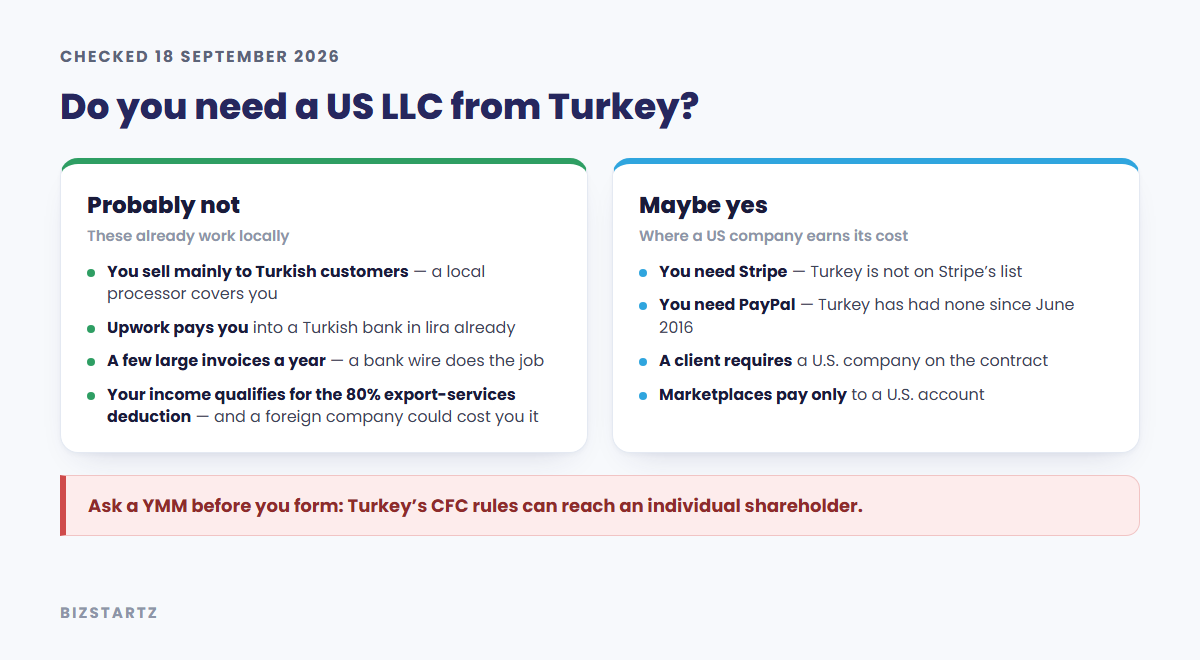
Given the gaps above, the case for a U.S. LLC from Turkey is stronger than in most of the countries we cover. It still isn’t universal.
You need Stripe
There is no Turkish Stripe account to open, and no sign of one. A U.S. LLC applies to Stripe as a U.S. business, and Stripe still verifies the people behind it. Our guide to opening a U.S. Stripe account as a non-resident covers the application.
You need PayPal
In most of our guides this heading doesn’t exist, because PayPal works locally. For Turkey it’s one of the two strongest reasons on the page. If your buyers, your marketplace or your donors expect PayPal, a U.S. company with a U.S. PayPal account is the route people take, see a PayPal business account with a US LLC and no SSN.
Read it with one caution in mind: PayPal decides who it onboards, and where you live is part of what it looks at. Nobody can promise you approval, and you should not answer a PayPal or bank question about where you live with anything other than the truth.
A client or platform insists on a U.S. company
Some buyers will only contract with and pay a U.S. entity. If that’s a written requirement from someone actually paying you, it’s a legitimate reason. Ask them precisely what they need first, it’s often a U.S. bank account to pay into rather than a U.S. company to contract with. And note that a U.S. LLC does not make you a U.S. taxpayer on their paperwork; see the W-8BEN note below.
Who it probably doesn’t help
- Anyone selling mainly to Turkish customers, who should be looking at a Turkish processor.
- Upwork freelancers. Turkey is on the local-bank payout list at USD 0.99.
- Anyone invoicing a few large B2B clients a year who are happy to wire.
- Anyone whose income qualifies for Turkey’s 80% deduction on exported services and who would forfeit it by leaving the money abroad. This is the one most people miss, see below.
- Anyone hoping a U.S. company puts their income outside Turkey’s tax net. It doesn’t.
Banking from Turkey: the part that usually breaks, and here doesn’t
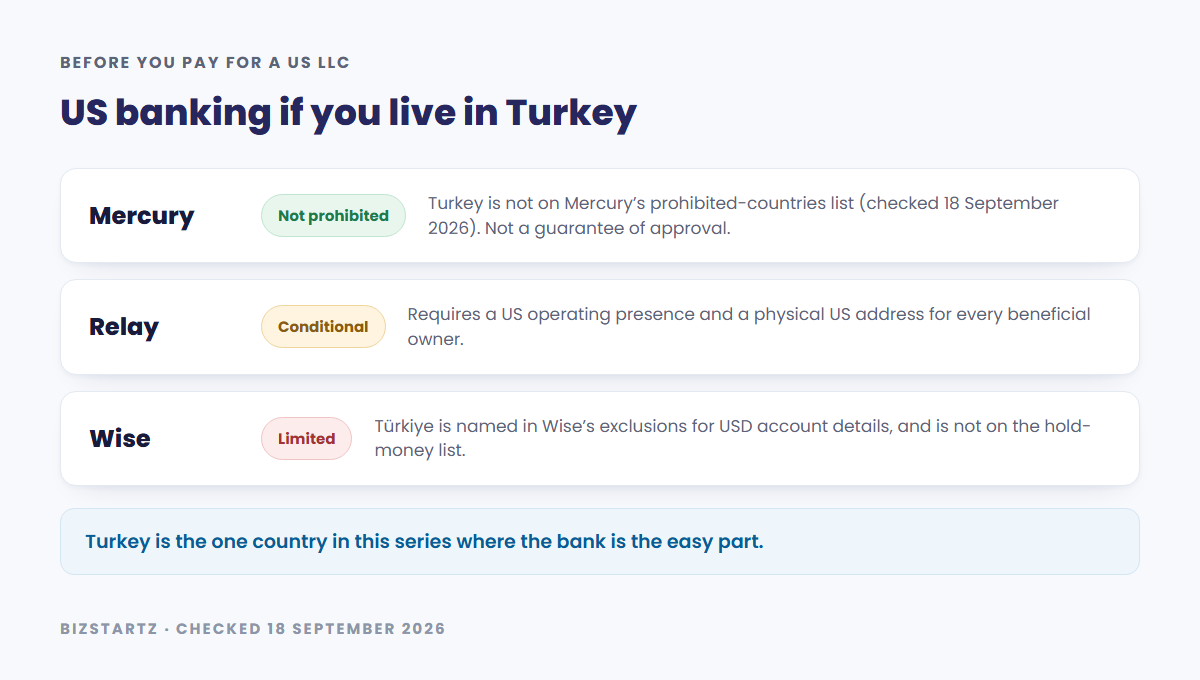
In every other guide in this series, this is the section where the plan collapses. Not here.
Mercury does not prohibit Turkey
Mercury’s help centre says it is unable to open accounts for founders living in the countries it lists, and that “this is based on your country of residence, not your citizenship or nationality.” The list runs from Afghanistan to Zimbabwe and includes Bangladesh, Indonesia, Nepal, Nigeria, Pakistan, the Philippines and Vietnam. Turkey is not on it (Mercury: Prohibited countries, checked 18 September 2026).
Read that for exactly what it says. It means you are not excluded by published policy. It is not an approval, and it is not a promise. Mercury still runs its own checks on you and your business, and it can decline for reasons that have nothing to do with a country list. Anyone selling you a package on the strength of a guaranteed Mercury account is selling you something they don’t control.
Relay: not prohibited, but read the requirements
Relay says it “cannot open a Relay Account for any business owner who holds citizenship or residency in one of the following countries,” and Turkey is not among the thirty-odd listed (Relay: Prohibited countries, updated 11 August 2026).
Not being banned isn’t the same as qualifying. Relay’s documents page says it accepts U.S.-registered businesses owned by non-U.S. citizens or residents “provided the business has an operating presence in the U.S.,” and asks every beneficial owner for a passport, an “SSN or passport number,” and a “physical U.S. address (no PO boxes, no virtual mailboxes)” (Relay: Required documents, updated 11 August 2026).
The page doesn’t explain how an owner who lives in Istanbul meets the U.S. address line, and we won’t guess. Ask Relay in writing before you form the company. Do not answer it by putting an address you don’t live at on a bank application.
Wise
Covered above, and it’s the negative here: Türkiye is excluded from USD account details and absent from the hold-money list. Whether Wise Business will accept a U.S. LLC whose owner lives in Turkey is decided at verification, and we found no Wise page that answers it.
What to check before you pay for a company
- Which bank or payment account will the LLC use, and does its published policy accept an owner living in Turkey? (For Mercury and Relay, today, it does.)
- Does it need a U.S. address for you personally, and would a registered-agent or mail-forwarding address count? Get that answer in writing, from them.
- Does Stripe, or PayPal, or whichever platform you formed the company for, accept that account for payouts?
- What’s your second option if the first application is declined?
Our U.S. payment and banking access by country table compares these providers side by side. It doesn’t yet carry a Turkey row; the checks above are the Turkey row.
Turkey’s own rules — the part competitors skip
We are not Turkish lawyers or YMMs, and nothing here says the route is legal or illegal for you. What follows is what we could read in the published instruments, quoted and linked, with the gaps marked, so you can take precise questions to someone qualified instead of vague ones.
Sending capital abroad: Decree No. 32 and the Capital Movements Circular
Decree No. 32 on the Protection of the Value of Turkish Currency is the framework. The operating detail sits in the Capital Movements Circular (Sermaye Hareketleri Genelgesi) issued under it, published by the Central Bank of the Republic of Türkiye. Article 10 is the one that covers you.
Article 10(1) reads: “Türkiye’de yerleşik kişiler, yurt dışında veya Türkiye’deki serbest bölgelerde şirket kurmak, ortaklığa katılmak veya şube açmak için nakdi sermayeyi bankalar aracılığı ile ayni sermayeyi ise gümrük mevzuatı çerçevesinde ihraç edebilir”, persons resident in Turkey may export cash capital, through banks, in order to establish a company, participate in a partnership or open a branch abroad, and capital in kind under the customs legislation (TCMB: Sermaye Hareketleri Genelgesi, Ankara, 2 May 2018, read 18 September 2026).
That is a permission, not a prohibition. Article 10 sets out no prior-approval requirement and no monetary threshold. Compare that with Bangladesh, where the published route abroad is for exporting companies only, and the difference is stark.
Article 10(2) is the reporting duty, and note carefully whose duty it is. The head offices of banks that transfer capital abroad must complete the “Türkiye’den Sermaye İhracı Formu” (Capital Export from Turkey Form, Annex 1) and send the transfer details to the Ministry of Treasury and Finance and the Ministry of Trade within 30 days of each transaction, and notify the Central Bank’s statistics directorate.
So on the face of the circular: the notification runs from your bank, not from you, and it is triggered by a capital transfer made through a bank. Two things follow that we flag rather than resolve:
- What about a USD 100 state filing fee paid on a personal credit card? That isn’t a bank capital export, and Article 10 doesn’t obviously describe it. Whether that means no formality applies, or whether it means the capital export was made outside the prescribed channel, is precisely the question for a Turkish lawyer. We have no source that settles it and we will not invent one.
- The circular is dated 2 May 2018 and has been amended repeatedly since. We read the version published on tcmb.gov.tr and cross-checked it against a second copy of the same circular on the same site. Confirm the current consolidated text before relying on it.
The controlled foreign company rule does reach individuals
This is the question most guides either skip or get wrong, and the answer is in the statute. Article 7 of Corporate Tax Law No. 5520 opens: “Tam mükellef gerçek kişi ve kurumların doğrudan veya dolaylı olarak ayrı ayrı ya da birlikte sermayesinin, kâr payının veya oy kullanma hakkının en az % 50’sine sahip olmak suretiyle kontrol ettikleri yurt dışı iştiraklerinin kurum kazançları, dağıtılsın veya dağıtılmasın… Türkiye’de kurumlar vergisine tâbidir” (Kurumlar Vergisi Kanunu No. 5520, Art. 7, read 18 September 2026).
Translated: where fully liable real persons — resident individuals — and companies control, directly or indirectly, alone or together, at least 50% of the capital, dividend rights or voting rights of a foreign participation, that foreign entity’s earnings are taxable in Turkey whether or not they are distributed.
So the answer to “can Turkey’s CFC rule reach an individual shareholder?” is yes, the article names individuals. A single-member Wyoming LLC is 100% controlled by one resident individual, which clears the 50% test on day one.
It does not stop there. Three further conditions must be met together (“şartların birlikte gerçekleşmesi halinde”):
- At least 25% of the foreign entity’s gross revenue is passive — broadly dividends, interest, rents, licence fees and income from marketable securities, as opposed to active trading or service income.
- The entity bears an effective tax burden of less than 10%.
- Its gross revenue exceeds the equivalent of TRY 100,000 for the year.
PwC’s summary, last reviewed 9 September 2026, states the same three conditions and confirms that “Turkish shareholders (individual or corporation) are subject to Turkish taxation on their pro rata share of a CFC’s undistributed earnings” (PwC: Turkey group taxation).
Now the part where we stop short. A consultant’s or developer’s LLC earns active service income, not passive income, so on a plain reading the first condition would fail and Article 7 would not apply. A holding company sitting on royalties or investments looks very different.
We are not going to tell you which side of that line you fall on, and there’s a second wrinkle: Article 7 imposes kurumlar vergisi, corporate tax, while naming individuals as controllers, and how that is assessed in practice on a real person is exactly the kind of thing a YMM answers and a formation company should not. Take it to one.
Questions to take to a Turkish lawyer or YMM
- Is my forming and owning a single-member U.S. LLC a “sermaye ihracı” under Article 10 of the Capital Movements Circular, and if I never send capital through a Turkish bank, what applies instead?
- If I do fund it through a bank, what will the bank ask me for, and does the 30-day form create any obligation on me?
- Does Article 7 of the Corporate Tax Law catch my LLC? Specifically, is my income passive for the 25% test, and how is the tax assessed on me as a real person?
- When the LLC pays me, is that service income, a dividend, or business income under the Income Tax Law, and which rate schedule applies?
- Would routing my export income through a U.S. company cost me the GVK 89/13 deduction, and by how much?
- How do I claim credit in Turkey for U.S. tax paid, under Article 23 of the treaty?
- Do I need to register a Turkish business (şahıs şirketi or otherwise) for this activity regardless of the U.S. company?
Turkish tax: worldwide income, and the 80% deduction you might be forfeiting
A U.S. company does not move your income outside Turkey’s tax net.
You are taxed on worldwide income
Turkish tax residents are full taxpayers on income from everywhere. Residence is established by legal residence in Turkey, or by staying in Turkey more than six months in a calendar year, with narrow exceptions for temporary assignments and circumstances beyond your control (PwC: Turkey individual residence, last reviewed 9 September 2026).
The 2026 rates
The Revenue Administration publishes the tariff under Article 103 of Income Tax Law No. 193. For 2026, on income other than employment income (GİB: 2026 gelir vergisi tarifesi, read 18 September 2026):
| Taxable income (TRY) | Tax |
|---|---|
| Up to 190,000 | 15% |
| 190,000 – 400,000 | 28,500 + 20% of the excess over 190,000 |
| 400,000 – 1,000,000 | 70,500 + 27% of the excess over 400,000 |
| 1,000,000 – 5,300,000 | 232,500 + 35% of the excess over 1,000,000 |
| Over 5,300,000 | 1,737,500 + 40% of the excess over 5,300,000 |
Employment income runs on a slightly different schedule, the 27% band extends to TRY 1,500,000 rather than 1,000,000. Which schedule your LLC income falls under is a question for your accountant, not a detail to assume.
The 80% deduction for exported services — read this before you form anything
Here is the argument against a U.S. LLC that we have not seen on a single competing page.
Article 89(13) of the Income Tax Law gives resident individuals a deduction against declared income for earnings from services provided from Turkey to persons not resident in Turkey and used exclusively abroad, in a defined list of fields: architecture, engineering, design, software, medical reporting, bookkeeping, call centre, data storage and processing, product testing and certification, and certain education and health services. The deduction rate is 80% of those earnings, applied to income earned from 1 January 2023 (it was 50% before that).
There is a condition that decides everything for this article’s readers: the whole of that income must be transferred to Turkey by the deadline for filing the annual return for the period in which it was earned, a requirement added by Law No. 7491. Miss it and the deduction goes (Doğan Çengel and Volkan Demircioğlu, YMMs: “Yurt Dışı Mukimlere Verilen Hizmetlerde Kazanç İndirimi”, 20 April 2026).
Think about what that means. A Turkish software developer invoicing foreign clients from Turkey may be able to knock 80% off the taxable amount of that income.
Route the same work through a Wyoming LLC, and you are no longer a Turkish business providing a service from Turkey to a non-resident, you’re an individual with a foreign company. Leave the money in a U.S. bank account, and even if the deduction were otherwise available you would have failed the transfer condition.
We are not saying the deduction is definitely lost. We are saying it is a large number and nobody is putting it on the other side of your arithmetic. If your work is in one of those listed fields, price this properly with a YMM before you pay a formation fee. It may be worth more than Stripe.
One caveat on our own sourcing: every route we tried to the statute text of Article 89 on mevzuat.gov.tr returned an error, so the 80% rate and the transfer condition above come from a jointly authored article by two YMMs rather than from the law itself, and some Turkish commentary suggests the rate may have moved again. Confirm the current rate with your own adviser.
The U.S. steps, briefly
We’ve written each step up in detail, so here’s the order and the Turkey-specific notes.
- Price the Turkish side first. Unusually for this series, the step most likely to change your mind isn’t the bank — it’s the 80% deduction question above. Ask a YMM before you spend anything.
- Confirm a bank. Mercury and Relay don’t exclude Turkey, which puts you ahead of most readers. Confirm anyway, in writing, and have a second option.
- Choose a state. Wyoming is our usual example: Articles of Organization cost USD 100, and the annual report license tax is “$60 or two-tenths of one mill on the dollar ($.0002) whichever is greater” (Wyoming Secretary of State fee schedule, effective 1 July 2026). Delaware is the other name people arrive with, and its LLC annual tax is fixed at USD 400 by statute, payable on 1 June (6 Del. C. § 18-1107). Compare properly in which U.S. state to choose as a non-resident.
- Appoint a registered agent in that state. Wyoming charges USD 350 to reinstate an LLC that lost its registered agent, so keep it renewed.
- Get the EIN without an SSN, by phone, fax or mail rather than the online tool, and pay nobody for it. See how to get an EIN without an SSN.
- Open the U.S. account, then apply to Stripe or PayPal or whichever platform you formed the company for.
One thing you no longer have to do: beneficial ownership reporting. FinCEN’s final rule, issued 11 August 2026 and effective 14 August 2026, says “U.S. companies are exempt from the Beneficial Ownership Information (BOI) reporting requirements and therefore, are no longer required to file BOI reports” (FinCEN: Beneficial Ownership Information, checked 18 September 2026). Any package still charging you for a BOI filing on a U.S.-formed LLC is charging for nothing.
U.S. tax: Form 5472 every year, and the treaty
A single-member LLC owned by a non-U.S. person is a “foreign-owned U.S. disregarded entity.” Every year it files a pro forma Form 1120 with Form 5472 attached and “Foreign-owned U.S. DE” written across the top, even when it owes no U.S. tax and even when it earned nothing.
It can’t e-file: it faxes to 855-887-7737 or mails to the IRS in Ogden, Utah. The penalty for failing to file is USD 25,000, with a further USD 25,000 if the failure continues more than 90 days after IRS notification (IRS Instructions for Form 5472, Rev. 12/2024). More in our guide to Form 5472 for foreign-owned LLCs.
You file a personal U.S. return, Form 1040-NR, only where you have U.S. income that requires it. The IRS taxes a non-resident alien’s income effectively connected with a U.S. trade or business “at graduated rates… the same rates that apply to U.S. citizens and residents,” after allowable deductions, and FDAP income at “a flat 30 percent (or lower treaty rate, if qualify)” with no deductions allowed (IRS: Taxation of nonresident aliens, updated 17 February 2026).
Whether serving foreign clients through a U.S. LLC from a desk in Ankara creates effectively connected income is a real question with a real answer for your facts. Get it from a U.S. tax preparer.
When a U.S. client or platform asks for a tax form, it’s yours to give, not the company’s. The IRS instructions say “the owner of a disregarded entity (including an individual), rather than the disregarded entity itself, must submit the appropriate Form W-8BEN” (IRS Instructions for Form W-8BEN, Rev. 10/2021). That’s you, in Turkey, signing as a non-U.S. person.
The treaty, and what you need to claim it
Turkey is on the IRS list of U.S. income tax treaties (IRS: treaties A to Z, updated 3 January 2026, checked 18 September 2026). That is a genuine advantage over, say, Vietnam, which has a signed agreement that never entered into force.
The instrument is the “Agreement Between the Government of the United States of America and the Government of the Republic of Turkey for the Avoidance of Double Taxation and the Prevention of Fiscal Evasion with Respect to Taxes on Income,” signed 28 March 1996, with effect from 1 January 1998 (treaty text on irs.gov). Three articles matter to you:
- Article 7 (Business Profits): “The profits of an enterprise of a Contracting State shall be taxable only in that State unless the enterprise carries on business in the other Contracting State through a permanent establishment situated therein.”
- Article 5 (Permanent Establishment): “a fixed place of business through which the business of an enterprise is wholly or partly carried on.”
- Article 23(2): Turkey allows a resident a deduction for U.S. income tax paid, subject to Turkish law’s limits and capped at the Turkish tax attributable to the U.S.-source income.
Two practical conditions. First, the form: a U.S. payer wanting to apply a treaty rate needs your Form W-8BEN, signed by you personally as the disregarded entity’s owner.
Second, the number: to claim a reduced rate on most income types, the form calls for a U.S. taxpayer identification number, for an individual that means an ITIN, which is a separate application with its own requirements, and your LLC’s EIN does not substitute for it.
Some income types can be claimed with a foreign tax identifying number instead. Which applies to you depends on what you’re being paid for; ask the payer what they need on the form before you assume you need an ITIN.
The treaty does not remove the Form 5472 filing. Nothing does.
What it costs
Only figures we could source:
- Wyoming filing: USD 100 to file, then an annual report license tax of at least USD 60 a year (Wyoming fee schedule, effective 1 July 2026). We saw no online convenience fee on the schedule.
- Delaware, if you go that way: USD 400 a year, due 1 June, by statute (6 Del. C. § 18-1107).
- EIN: free from the IRS.
- BOI reporting: nothing. U.S.-formed companies are exempt as of 14 August 2026.
- Formation service: Bizstartz packages are USD 199, USD 299 or USD 699, plus the state fee (our pricing page). Other providers charge differently.
- Every year: the state’s annual tax, registered agent renewal, and the Form 5472 filing, whether you prepare it or pay someone.
- What we haven’t priced: registered agent renewal, wire fees, Stripe and PayPal pricing, Payoneer’s fees, iyzico and PayTR rates (neither publishes them), and the fees of a Turkish lawyer and YMM.
Set that total against the alternative, and for Turkey the alternative column is thinner than usual, no PayPal, no Stripe, no Wise USD details. But put the 80% export-services deduction in the same column before you decide. For a software developer billing foreign clients, that deduction can be worth more than every fee on this list combined.
Who this suits, and where to start
It can make sense if you need Stripe, or you need PayPal and have had no Turkish route to it since 2016, or a client genuinely requires a U.S. company. Your revenue should cover the yearly filings and fees, you should have confirmed that your bank of choice accepts an owner living in Turkey, and on published policy today, Mercury and Relay both do, and a YMM should have told you what it costs you on the Turkish side.
It probably doesn’t if your customers are in Turkey, Upwork or Payoneer already covers how you get paid, a few wires a year is all you need, or your export income qualifies for the 80% deduction and the LLC would put it out of reach. And it never makes sense as a way to stop Turkey taxing income it already taxes, Article 7 of the Corporate Tax Law names resident individuals directly.
Start with the cheap checks, in this order. Ask a YMM what the 80% deduction is worth to you. Work out which platform you actually need. Confirm a bank in writing. Then form the company. It’s the easy part, and it’s the part that’s hardest to undo cleanly.
If you decide a U.S. company fits, Bizstartz forms U.S. LLCs for non-resident founders and handles the state filing, operating agreement, first-year registered agent and EIN application (U.S. company formation). A free 30-minute consultation is a sensible place to test the U.S. side, including which bank is realistic for you, before you spend anything. We can’t advise on Turkish law or Turkish tax, and you shouldn’t take that from a formation company anyway.
This guide was researched with the help of AI tools. Every legal, fee and availability claim links to the source it came from, and the sources were checked on 18 September 2026. Where we couldn’t confirm something, the BDDK’s own wording on PayPal, the statute text of Income Tax Law Article 89(13), and whether Turkish card processors settle foreign-issued cards — the text says so. Rules in this area change often, so check the linked sources again before you act.
🎯 Ready to start? Claim your free consultation and we'll map out your US LLC formation strategy — EIN, banking, and the right state for your country.

Ready to start your company?
Bizstartz handles formation, EIN, banking and compliance for founders worldwide.