Yes, you can form a US LLC from Vietnam while living there (checked 18 September 2026). The U.S. side is built for foreign owners. The IRS tells applicants whose principal place of business is outside the U.S. to “apply by phone, fax or mail,” and warns readers to “beware of websites that charge for an EIN. You never have to pay a fee for an EIN” (IRS: Get an EIN, updated 19 August 2026). No SSN is needed.
Whether you need one is a different question, and Vietnam gives an unusually mixed answer. PayPal runs a Vietnamese business sign-up and publishes a Vietnamese fee table that includes a rate for receiving international payments and a fee for withdrawing to a Vietnamese bank. Payoneer’s Vietnamese site offers the same in different words.
Upwork pays into Vietnamese bank accounts in dong. Against that: Mercury will not open an account for anyone living in Vietnam, Stripe still doesn’t list the country, Wise won’t let a Vietnamese resident hold money, and Amazon accepts Vietnamese sellers but won’t pay them into a Vietnamese bank.
And there is a part almost every English-language guide skips entirely. Vietnam regulates its own residents investing abroad, and that regime was rewritten right through 2026: a new Law on Investment in March, a new decree in April, and a new State Bank circular at the end of July. This guide sets out what we could verify, what we could not, and where a Vietnamese lawyer has to take over.
In this guide: Can you form one? · What already works without one · Who actually benefits · The U.S. steps · Banking: check this first · What Vietnam’s rules say · Vietnamese tax · U.S. tax, and the treaty that isn’t in force · Getting the money home · What it costs · Who it suits and where to start
Can you form a US LLC from Vietnam?
On the U.S. side, yes. You can register the company, get its EIN and file its U.S. returns without living in the United States or visiting.
Three other questions decide whether it’s worth doing, and the state that registers your company answers none of them:
- Does the payment route you need actually require a U.S. company? From Vietnam, often it doesn’t. The next section goes through what works locally.
- Will a U.S. bank or payment account open for an owner who lives in Vietnam? Mercury won’t. Without an account, the LLC can’t receive anything.
- How does Vietnam treat it? Owning a company abroad falls under Vietnam’s outward investment rules, and Vietnam taxes residents on income arising inside and outside the country.
What already works from Vietnam without a U.S. company
Before paying for a company, check whether one of these already covers you.
PayPal Business
PayPal runs a Vietnamese business sign-up that promises you can “chấp nhận thanh toán từ khắp nơi trên thế giới” — accept payments from everywhere in the world — across 200+ markets and 130+ currencies (PayPal Vietnam for business).
The fee table is the more useful proof, because it prices exactly the two things a Vietnamese freelancer cares about. PayPal’s Vietnamese merchant fee page, last updated 28 May 2026, charges 4.40% plus a fixed fee for commercial transactions received from outside Vietnam (the fixed fee is USD 0.30 for dollars, EUR 0.35 for euros), a 4.00% markup on the base exchange rate for standard currency conversion, 3.00% for some others, and 60,000 VND to withdraw to a Vietnamese bank account, with 70,000 VND charged if the transfer fails (PayPal Vietnam merchant fees).
Those are not cheap numbers. Roughly 4.4% to take the money plus 4% to convert it is a meaningful bite. But the route exists, it’s published, and it doesn’t require a company on another continent. If PayPal is the only reason you were looking at an LLC, you probably don’t need one.
Payoneer
Payoneer’s Vietnamese site offers exactly the two functions that matter: “nhận thanh toán từ khách hàng” and “nhận thanh toán từ thị trường buôn bán trực tuyến”, receive payments from clients and from online marketplaces, then withdraw “về tài khoản ngân hàng địa phương của bạn,” to your local bank account (Payoneer Vietnam, read 18 September 2026). We didn’t read Payoneer’s pricing, so we’re quoting no fees here. Get them from Payoneer before you compare.
Freelance marketplaces
Upwork lists Vietnam (VND) among the countries supported for Direct to Local Bank withdrawals, at USD 0.99 per withdrawal (Upwork: Direct to Local Bank).
Fiverr pays out through PayPal (no fee), bank transfer via Payoneer (USD 1) or a Payoneer account (USD 3), and says each method “may have different location restrictions” without naming countries (Fiverr: withdrawing your earnings). Since both PayPal and Payoneer operate in Vietnam, a Vietnamese Fiverr seller has a route, but confirm it inside your own account rather than taking our word for it.
Local wallets and gateways
This is where expectations need managing. MoMo, ZaloPay and VNPAY are Vietnam’s dominant consumer rails, and Visa announced a partnership with all three on 24 May 2024 under which “Visa cardholders will be able to use their Visa card as a source of funds when making purchases at merchants currently offering payments via the three e-wallets’ QR” (Visa Vietnam press release).
Read that carefully. It’s about a Visa card funding a QR payment at a Vietnamese merchant: domestic acceptance. It is not the same thing as a global online checkout that bills a customer in Toronto in Canadian dollars every month.
We could not open VNPAY’s own payment gateway product page to check its merchant requirements or its handling of international cards, so we’re not claiming either way. If you sell to Vietnamese customers, these rails are the obvious answer and a U.S. LLC is beside the point. If your customers are abroad, they don’t solve your problem.
Amazon: accepted to sell, not paid out
Vietnam is on Amazon’s list of countries accepted for seller registration; it sits between Venezuela and Yemen on the list (Amazon: accepted countries). So you don’t need a company to sell.
Getting paid is the gap. Vietnam and VND appear on neither Amazon’s Seller Wallet transfer list nor its supported disbursement currency table (Amazon: Seller Wallet, Amazon: supported bank accounts, both read 18 September 2026). That puts Vietnam closer to Bangladesh than to the Philippines, where pesos are supported and the payout question never arises.
You need a bank account in a country Amazon does pay out to. A U.S. LLC with a U.S. account is one answer. A receiving account from a provider like Payoneer is another, and it’s the cheaper one, but we found no Amazon page naming Payoneer, so ask Amazon whether your specific account is acceptable before you build a business on the assumption.
Who actually benefits from a U.S. LLC
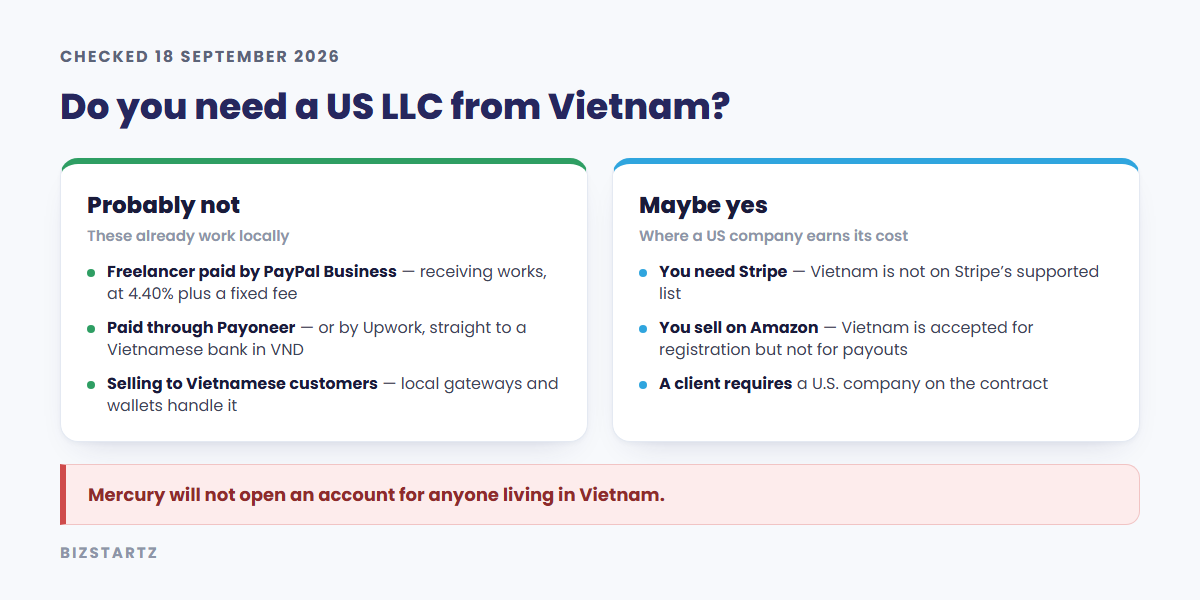
With PayPal, Payoneer and Upwork all working locally, the case for an LLC narrows to three situations.
You need Stripe
Stripe doesn’t list Vietnam anywhere on its global availability page: not as supported, not in preview, not in the extended network. In Southeast Asia it lists Malaysia, Singapore and Thailand as supported, with India and Indonesia in preview (stripe.com/global, checked 18 September 2026).
If you’re building a subscription product, a SaaS, or a store whose checkout, billing tooling or app integrations assume Stripe, that’s the strongest reason for a U.S. company. The LLC applies to Stripe as a U.S. business, and Stripe still verifies the people behind it. Our guide to opening a U.S. Stripe account as a non-resident covers the application.
You sell on Amazon and need somewhere to be paid
Covered above. This is Vietnam’s clearest LLC case, and it’s a payout problem rather than an eligibility problem. See running an Amazon seller account with a U.S. LLC, but read it alongside the fact that you can already register as a Vietnamese seller.
A client or platform insists on a U.S. company
Some buyers will only contract with and pay a U.S. entity. If that’s a written requirement from someone actually paying you, not a hunch, it’s a legitimate reason. Ask them precisely what they need first.
Often it turns out to be a U.S. bank account to pay into, rather than a U.S. company to contract with. Be aware that a U.S. LLC doesn’t turn you into a U.S. taxpayer on their paperwork either; see the tax form note below.
Who it probably doesn’t help
- Freelancers whose clients already pay through PayPal, Payoneer or a marketplace.
- Upwork freelancers. Vietnam is on the local-bank payout list.
- Anyone selling mainly to Vietnamese customers.
- Anyone counting on Mercury.
- Anyone hoping a U.S. company puts their income outside Vietnam’s tax net. It doesn’t; see below.
The U.S. steps, briefly
We’ve written each step up in detail, so here’s the order and the Vietnam-specific notes.
- Confirm a bank first. Read the next section before anything else. It’s the step most likely to fail, and checking costs nothing.
- Choose a state. Wyoming is our usual example: Articles of Organization cost USD 100, and the annual report license tax is USD 60 or two-tenths of a mill on the company’s Wyoming assets, whichever is greater (Wyoming Secretary of State fee schedule, effective 1 July 2026). Delaware is the other name people arrive with, and its LLC annual tax is fixed at USD 400 by statute, due on 1 June (6 Del. C. § 18-1107). Compare properly in which U.S. state to choose as a non-resident.
- Appoint a registered agent in that state. Wyoming charges USD 350 to reinstate an LLC that lost its registered agent, so keep it renewed.
- Get the EIN without an SSN, by phone, fax or mail rather than the online tool. See how to get an EIN without an SSN.
- Open the U.S. account, then apply to Stripe or Amazon or whichever platform you formed the company for.
One thing you no longer have to do: beneficial ownership reporting. FinCEN’s final rule, effective 14 August 2026, says “U.S. companies are exempt from BOI reporting requirements and therefore, are no longer required to file BOI reports” (FinCEN: Beneficial Ownership Information). Guides and formation packages still charging for BOI filing on a U.S.-formed LLC are selling you nothing.
Banking from Vietnam: check this before you form
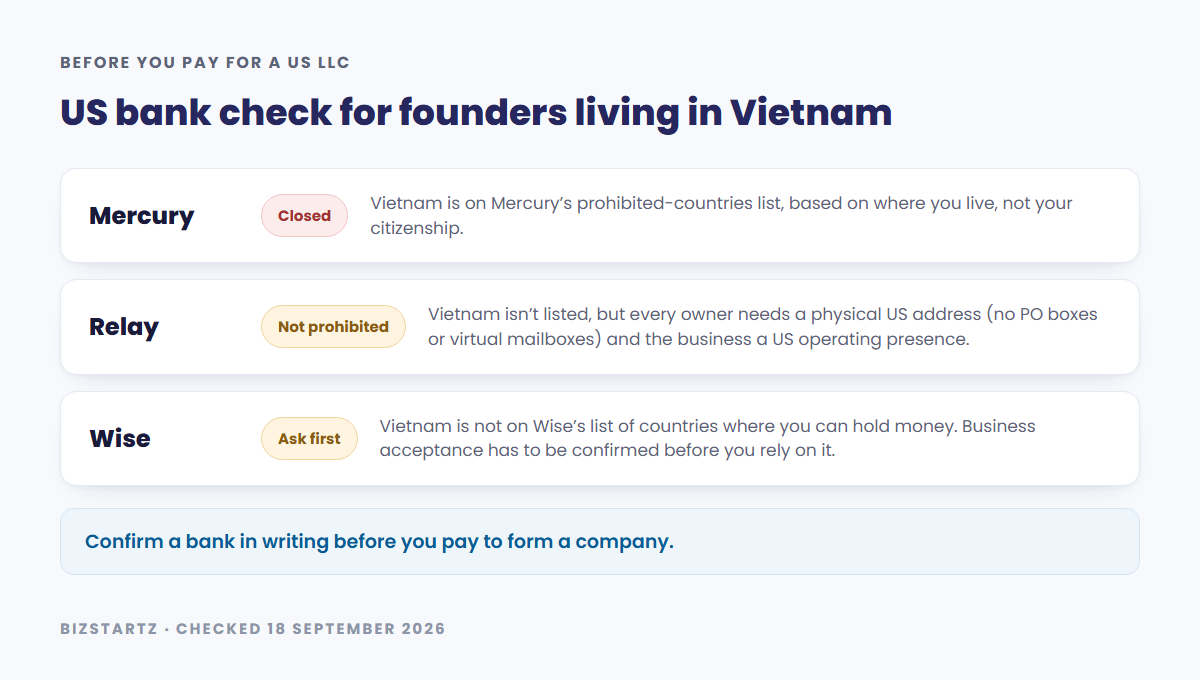
Mercury is closed to founders living in Vietnam
Mercury’s help centre says it is unable to open accounts for founders living in the countries it lists, and that “this is based on your country of residence, not your citizenship or nationality.” Vietnam is on that list, alongside Cambodia, Indonesia, the Philippines, Bangladesh and Nepal (Mercury: Prohibited countries, checked 18 September 2026).
A Vietnamese citizen genuinely living in Singapore is judged on Singapore. A founder in Ho Chi Minh City is not getting a Mercury account, whatever a formation package implies. Note also which of Vietnam’s neighbours are not on the list. Thailand, Malaysia and Singapore are absent, which is exactly why so much LLC advice written for the region doesn’t transfer.
Relay: not banned, but read the requirements
Vietnam isn’t on Relay’s prohibited-countries list, which Relay applies to “any business owner named on the Relay Account application, including beneficial owners,” by citizenship or residency (Relay: Prohibited countries, updated 11 August 2026).
Not being banned isn’t the same as qualifying. Relay’s documents page says it “accepts U.S.-registered businesses owned by non-U.S. citizens or residents, provided the business has an operating presence in the U.S.,” and asks for a “Physical U.S. address (no PO boxes, no virtual mailboxes),” plus each owner’s passport, an SSN or passport number, source of initial business income, annual personal income and the countries the business operates in (Relay: Required documents, updated 11 August 2026).
The page doesn’t explain how an owner who lives in Hanoi meets the U.S. address line, and we won’t guess. Ask Relay in writing before you form the company. And don’t answer it by putting an address you don’t live at on a bank application.
Wise
Vietnam is not on Wise’s list of countries where you can hold money, and Wise’s own regulatory-permissions page doesn’t list Vietnam either (Wise: where do I need to live to hold money, checked 18 September 2026). So the personal Wise account that Filipino and Sri Lankan founders lean on isn’t available to you. Whether Wise Business will accept a U.S. LLC whose owner lives in Vietnam is decided at verification, and we found no Wise page that answers it.
What to check before you pay for a company
- Which bank or payment account will the LLC use, and does its published policy accept an owner living in Vietnam?
- Does it need a U.S. address for you personally, and would a registered-agent or mail-forwarding address count? Get the answer in writing, from them.
- Does Stripe, or Amazon, or whichever platform you formed the company for, accept that account for payouts?
- What’s your second option if the first application is declined?
Our U.S. payment and banking access by country table compares these providers side by side. It doesn’t yet carry a Vietnam row; the checks above are the Vietnam row.
What Vietnam’s own rules say about owning a company abroad
This is the part U.S. formation services skip, and it’s the part that changed most in 2026. We are not Vietnamese lawyers, and nothing here says the route is legal or illegal for you. It sets out what we could verify, marks what we couldn’t, and gives you the questions to take to someone qualified.
Owning a foreign company is “outward investment,” and it’s regulated
Vietnam has a formal outward investment regime. Under the Law on Investment, “outward investment” covers transferring capital abroad to carry on business, and one of its listed forms is the “establishment of a business organization in accordance with the law of the host country”, which is what forming a Wyoming LLC is.
The law also treats individuals as investors. The definition reads: “‘investor’ means an organization or individual that carries out business investment activities. Investors include domestic investors, foreign investors and foreign-invested business organizations.”
An important caveat about those quotes. They come from the English text of Law on Investment No. 61/2020/QH14 hosted by FAOLEX. That law has been replaced by Law on Investment No. 143/2025/QH15, passed on 11 December 2025 and in force from 1 March 2026 (DFDL: key highlights of the Law on Investment 2025).
We could not obtain an English text of the 2025 law, so treat the wording above as the shape of the regime rather than the current letter of it, and have a lawyer confirm the equivalent provisions.
The 2026 change that matters most: a VND 7 billion threshold
Until this year, outward investment meant applying for an outward investment registration certificate. Decree 103/2026/ND-CP, issued 31 March 2026 and effective 3 April 2026, changed that to a tiered system.
Projects with outward investment capital below VND 7 billion that aren’t in a conditional sector no longer need the certificate; instead the investor registers the project on the national investment information system and completes foreign exchange registration with the State Bank (Viet An Law on Decree 103/2026, VietnamPlus).
VND 7 billion is hundreds of thousands of dollars. Nobody forming a small LLC is anywhere near it. On its face, that is a meaningful liberalisation for exactly the person reading this page.
Two things stop us calling it a green light:
- Exempt from the certificate is not exempt from the regime. The foreign exchange registration still applies, and the State Bank’s Circular 34/2026/TT-NHNN, effective 31 July 2026, replaced the decade-old Circular 12/2016/TT-NHNN with 38 articles covering outward investment capital accounts, initial and amended foreign exchange registration, pre-investment transfers and profit repatriation (LexNovum on Circular 34/2026). Sources report the issue date differently — some 30 June, one 21 July — so check the circular itself.
- We could not read either instrument’s text. Vietnam’s main legal database blocks automated access. The threshold above rests on two independent Vietnamese sources that agree, not on the decree itself. Whether a commercial bank will open an outward investment capital account for an individual forming a small overseas company, and whether the State Bank will confirm that registration, is not something we can answer from published pages.
There is also a repatriation clock. Decree 103 requires profits and other income from outward investment to be transferred back to Vietnam within 12 months of distribution, with a possible 12-month extension on advance notice (LuatVietnam: what’s new in Decree 103/2026). If you were planning to leave earnings in a U.S. account indefinitely, that’s the rule to ask about.
For comparison: Bangladesh’s published route is for exporting companies only, and Sri Lanka tightened its limits on investing abroad in June 2026. Vietnam’s 2026 direction is the opposite one. That doesn’t make your particular setup compliant. It means the questions are answerable, by a Vietnamese lawyer, in a way they often aren’t elsewhere.
Foreign currency inside Vietnam
One rule shapes everything about how the money arrives. Vietnam’s Ordinance on Foreign Exchange says that “within the territory of Vietnam, all transactions, payments, quotations, pricing, advertisements by resident and non-residents shall not be conducted in foreign exchange except for transactions with authorized credit institutions, payments made through intermediary including on-behalf collection, by agent and other exceptional cases permitted by the Prime Minister.”
The same Ordinance does let individuals keep what arrives: foreign currency income from current transfers of resident individuals “can be used for personal store, carrying, and depositing in foreign currency accounts opened at authorized credit institutions or selling to authorized credit institutions” (Ordinance on Foreign Exchange No. 28/2005/PL-UBTVQH11, official English text hosted by the WTO). Note the date: that Ordinance was amended in 2013, and we quote the 2005 text, so confirm the current wording.
The practical reading, and it is our reading rather than the Ordinance’s wording, is that dollars can reach you and sit in a foreign currency account at a Vietnamese bank, but you spend dong at home.
Questions to take to a Vietnamese lawyer
- Is forming and owning a small U.S. LLC “outward investment” for me as an individual, and does the sub-VND 7 billion exemption from the registration certificate apply to individuals?
- What exactly must I register with the State Bank under Circular 34/2026/TT-NHNN, and will a bank open an outward investment capital account for an individual?
- Can I pay the formation fee on a personal card, or does it have to move through that account? What if the company is already formed?
- When the LLC pays me, is that a service export or a return on an outward investment, and does the 12-month repatriation rule then apply to me?
- What happens if an outward investment was never registered? Administrative penalty, or something more serious?
Vietnamese tax: worldwide income, and a new law from July 2026
A U.S. company does not move your income outside Vietnam’s tax net. Vietnam taxes resident individuals on income arising both inside and outside its territory, and residence is generally established by 183 days’ presence or a permanent residence in Vietnam.
The rules changed this year. Law No. 109/2025/QH15 on Personal Income Tax was passed on 10 December 2025 and took effect on 1 July 2026, with the provisions on employment and business income of residents applying from the 2026 tax year.
It cut the number of progressive brackets from seven to five, kept the top rate at 35% but moved its starting point up to monthly income above VND 100 million (previously VND 80 million), set the bottom band at 5% on income up to VND 10 million a month, raised the personal deduction from VND 11 million to VND 15.5 million a month, and lifted the revenue threshold at which an individual’s business income becomes taxable from VND 200 million to VND 500 million a year (KPMG GMS Flash Alert 2026-040, EY Vietnam tax alert). Guidance followed in Decree 253/2026/ND-CP, issued 30 June 2026.
Our sources agree on the first and last bands and on the deduction; they differ on the middle three, so confirm those with an accountant rather than planning around a number you read here.
What we could not find is the thing that decides your bill: any Vietnamese guidance on how a resident’s single-member U.S. LLC is treated. Is it a separate company, or is it you? Is its profit taxed when the LLC earns it, or when it reaches you? That is a question for a Vietnamese accountant, and it is worth paying for before you form anything.
U.S. tax: Form 5472 every year, and a treaty that isn’t in force
A single-member LLC owned by a non-U.S. person is a “foreign-owned U.S. disregarded entity.” Every year it files a pro forma Form 1120 with Form 5472 attached and “Foreign-owned U.S. DE” written across the top, even when it owes no U.S. tax and even when it earned nothing. It can’t e-file: it faxes to 855-887-7737 or mails to the IRS in Ogden, Utah.
The penalty for failing to file is USD 25,000, with a further USD 25,000 if the failure continues more than 90 days after an IRS notice (IRS Instructions for Form 5472, Rev. 12/2024). More in our guide to Form 5472 for foreign-owned LLCs.
You file a personal U.S. return, Form 1040-NR, only if you have U.S. income that requires it. The IRS taxes a non-resident alien’s income effectively connected with a U.S. trade or business at graduated rates after deductions, and FDAP income at a flat 30% with no deductions (IRS: Taxation of nonresident aliens, updated 17 February 2026).
Whether serving foreign clients through a U.S. LLC from a desk in Da Nang creates effectively connected income is a real question with a real answer for your facts. Get it from a U.S. tax preparer, not from a formation company.
When a U.S. client or platform asks for a tax form, it’s yours to give, not the company’s. The IRS instructions say “the owner of a disregarded entity (including an individual), rather than the disregarded entity itself, must submit the appropriate Form W-8BEN” (IRS Instructions for Form W-8BEN, Rev. 10/2021). That’s you, in Vietnam, signing as a non-U.S. person. Anyone who told you an LLC makes you look American on paperwork was wrong.
The treaty
Here is the part that catches people out. Vietnam is not on the IRS list of U.S. income tax treaties (IRS: treaties A to Z, updated 3 January 2026, checked 18 September 2026). The “V” entries stop before it.
A treaty was signed. The U.S. Treasury lists an “Agreement US and Vietnam… Respect to Taxes on Income, July 7 2015” among its treaty documents, and the same page notes that treaty documents are posted “upon signature and prior to ratification and entry into force” (U.S. Treasury: tax treaty documents).
Signed is not in force. Since it isn’t on the IRS list, any relief from double taxation has to come from Vietnamese domestic law rather than a treaty — which is a different conversation with your accountant, and a harder one.
Bangladesh, the Philippines and Sri Lanka all appear on that same IRS list. Vietnam doesn’t. If you’ve been reading our guides to the Philippines or Sri Lanka for comparison, that’s a real difference between them and you.
Getting the money home
From the LLC’s U.S. account, the realistic routes to Vietnam are an international wire to a Vietnamese bank, or a transfer through a provider like Payoneer into your local account. The Wise route that works from the Philippines doesn’t: Vietnam isn’t on Wise’s hold-money list, so you can’t park it in a Wise balance of your own. We haven’t verified wire fees, which vary by bank.
Expect your Vietnamese bank to ask what the money is for, and have invoices, a contract or the LLC’s records ready. That’s ordinary anti-money-laundering practice, not a Vietnam quirk.
What the money is matters as much as how it travels, and in Vietnam it matters more than most places. A payment from your LLC for work you did looks like income from services.
A distribution of the LLC’s profit is a return on a company you own abroad, which puts it inside the outward investment regime, including the 12-month repatriation rule. Those are different animals with different paperwork. Settle which one fits before the first transfer, not after the fifth.
What it costs
Only figures we could source:
- Wyoming filing: USD 100 to file, then an annual report license tax of at least USD 60 a year (Wyoming fee schedule, effective 1 July 2026).
- Delaware, if you go that way: USD 400 a year in LLC annual tax, due 1 June, by statute (6 Del. C. § 18-1107).
- EIN: free from the IRS.
- Formation service: Bizstartz packages are USD 199, USD 299 or USD 699, plus the state fee (our pricing page). Other providers charge differently.
- BOI reporting: nothing. U.S.-formed companies are exempt as of 14 August 2026.
- Every year: the state’s annual tax, registered agent renewal, and the Form 5472 filing, whether you prepare it or pay someone.
- What we haven’t priced: registered agent renewal, bank and wire fees, Stripe’s pricing, Payoneer’s fees, and advice from a Vietnamese lawyer and accountant. Get quotes for all of them. The advice is the line most people leave out of the comparison, and in Vietnam it’s the one doing the most work.
Set that total against the alternative: PayPal at 4.40% plus a fixed fee to receive, 4.00% to convert and 60,000 VND to withdraw, with no company, no registration and no annual U.S. filing. At low volume, PayPal wins on arithmetic alone. At high volume, or when Stripe is the point, it doesn’t.
Who this suits, and where to start
It can make sense if you need Stripe for a subscription product, SaaS or online store; or you sell on Amazon and Vietnam’s absence from the payout lists is blocking you; or a client genuinely requires a U.S. company.
Your revenue should cover the yearly filings and fees, you should have a bank that accepts an owner living in Vietnam confirmed in writing, and a Vietnamese lawyer and accountant should have looked at the outward investment registration and the tax treatment.
It probably doesn’t if PayPal Business, Payoneer or Upwork already covers how you get paid, your customers are in Vietnam, or you were counting on Mercury. And it never makes sense as a way to stop Vietnam taxing income it already taxes.
Start with the cheap checks. Work out which platform you actually need. Confirm a bank in writing. Ask a Vietnamese lawyer the five questions above and an accountant the one about how your LLC’s profit is treated. Form the company last. It’s the easy part, and it’s the part that’s hardest to undo cleanly.
If you decide a U.S. company fits, Bizstartz forms U.S. LLCs for non-resident founders and handles the state filing, operating agreement, first-year registered agent and EIN application (U.S. company formation).
A free 30-minute consultation is a sensible place to test the U.S. side, including which bank is realistic for you, before you spend anything. We can’t advise on Vietnamese law or Vietnamese tax, and you shouldn’t take that from a formation company anyway.
This guide was researched with the help of AI tools. Every legal, fee and availability claim links to the source it came from, and the sources were checked on 18 September 2026. Where we couldn’t confirm something, and on Vietnam’s outward investment rules there is a lot we couldn’t, the text says so. Rules in this area change often, and Vietnam’s changed three times in 2026, so check the linked sources again before you act.
🎯 Ready to start? Claim your free consultation and we'll map out your US LLC formation strategy — EIN, banking, and the right state for your country.

Ready to start your company?
Bizstartz handles formation, EIN, banking and compliance for founders worldwide.