Yes, you can form a US LLC from Sri Lanka while living there (checked 17 September 2026). The U.S. side is built for foreign owners: when the business is run from outside the United States, the IRS has you apply for the EIN by phone, fax or mail instead of online, and it never charges a fee for one (IRS: Get an EIN).
Sri Lanka is the odd one out in South Asia. Mercury, the bank that turns away founders living in Nepal, Bangladesh and Pakistan, doesn’t list Sri Lanka. Stripe still doesn’t support Sri Lanka, so a U.S. company is still the usual way to get Stripe. But two things changed in 2026 that most guides haven’t caught up with.
PayPal started letting personal accounts in Sri Lanka receive money from abroad in May 2026. And on 20 June 2026 new overseas investment regulations came into force, alongside a fresh six-month Order restricting money leaving the country, and together they spell out what a Sri Lankan resident may and may not put into a company abroad.
This guide takes each of those with the primary source linked, then covers the U.S. tax filing you can’t skip, how money gets home, what it costs, and who this route actually suits.
In this guide: Can you form one from Sri Lanka? · Why founders do it, and what changed · The U.S. steps · Banking from Sri Lanka · What Sri Lanka’s rules say · U.S. tax and the treaty · Getting the money home · What it costs · Who it suits and where to start
Can you form a US LLC from Sri Lanka?
On the U.S. side, yes. You can register the company, get an EIN and file its U.S. returns without living in the United States.
Two other questions decide whether the company is any use to you, and the state that registers it answers neither:
- Will a U.S. bank or payment account actually open for an owner who lives in Sri Lanka? From Sri Lanka the answer is more hopeful than from its neighbours, but “not banned” still isn’t “approved”.
- What do Sri Lanka’s foreign exchange rules say about a resident owning and funding a company abroad? That depends on Sri Lankan law, not U.S. law, and it’s the harder question of the two.
- US LLC from Indonesia (2026): do you need one?
- US LLC from Turkey (2026): PayPal, banking and Turkish rules
Check both before you pay anyone to form the company.
Why Sri Lankan founders want a U.S. LLC, and what changed in 2026
Almost always, it’s about getting paid. The picture has shifted this year, though.
- Stripe doesn’t list Sri Lanka among its supported countries. India is listed as “Preview”; Sri Lanka isn’t listed at all (stripe.com/global, checked 17 September 2026). A U.S. LLC applies to Stripe as a U.S. business. Our guide to opening a U.S. Stripe account as a non-resident covers that application. This is still the strongest reason to form one.
- PayPal now works for receiving, with limits. PayPal’s Sri Lanka site says: “To receive and withdraw funds, link your PayPal account to a local partner bank” (PayPal LK). Its partner-bank page names Sampath Bank, Commercial Bank and Bank of Ceylon. With Sampath and Commercial, receiving money for goods and services and withdrawing are “Live for Personal Accounts”. Business accounts, invoicing and PayPal Checkout are “coming soon”, and Bank of Ceylon is “coming soon” across the board. Only payments from abroad are supported: “customers in Sri Lanka can receive money from PayPal customers from abroad but not locally” (PayPal LK partner banks, both checked 17 September 2026). The partnership was announced in May 2026, and Sampath Bank’s own release of 26 May 2026 says customers can withdraw in LKR or USD (Sampath Bank). If PayPal was your only reason for an LLC, you may no longer need one.
- Amazon accepts sellers who live in Sri Lanka, so you don’t need a company to sell. Payouts are the problem. Sri Lanka isn’t on the list of countries where Seller Wallet can transfer to your own bank account, and neither Sri Lanka nor LKR appears on Amazon’s supported bank-account list (accepted countries, Seller Wallet, supported bank accounts, all checked 17 September 2026). India is on the bank-account list. More in getting an Amazon seller account with a U.S. LLC.
If your clients already pay you by bank transfer, through a marketplace, or now through PayPal, an LLC may add cost without solving anything. It earns its keep when a buyer or platform insists on Stripe, PayPal checkout, or a U.S. payout account.
The U.S. steps, briefly
Each of these has its own detailed guide, so here’s only the order and the Sri Lanka-specific notes.
- Read the Sri Lanka law section first. How you’re allowed to fund the company decides whether it’s worth forming at all.
- Confirm a bank. Mercury doesn’t list Sri Lanka, but check the requirements below before you rely on any one bank.
- Choose a state. Wyoming is a common choice: filing costs USD 100, and the annual report license tax is USD 60 or two-tenths of a mill on Wyoming assets, whichever is greater (Wyoming Secretary of State fee schedule, effective 1 July 2026, checked 16 September 2026). Compare states in which U.S. state to choose as a non-resident.
- Appoint a registered agent in that state to receive legal mail, and keep it renewed.
- Get the EIN without an SSN, by the IRS phone, fax or mail route. See how to get an EIN without an SSN.
- Open the U.S. account, then apply to Stripe or Amazon in the LLC’s name. Our guide to a U.S. business bank account for non-residents covers the application itself.
Banking from Sri Lanka: where it differs from its neighbours
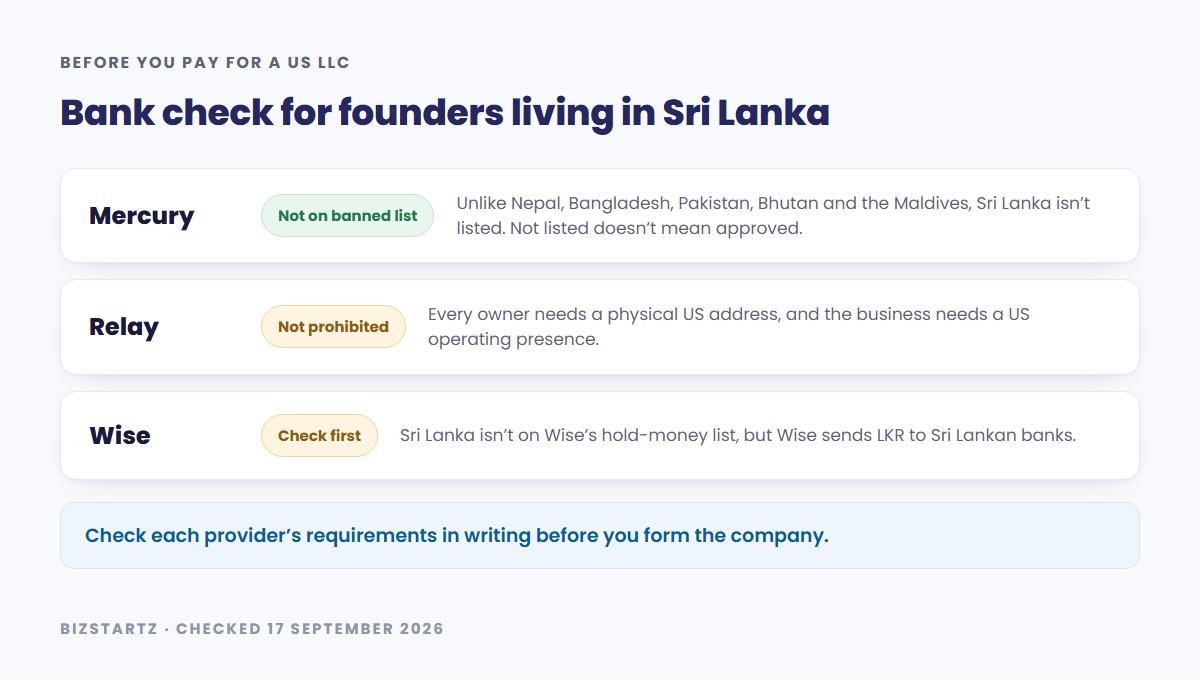
Mercury doesn’t list Sri Lanka
Mercury’s help centre says it is unable to open accounts for founders living in the countries it lists, and “this is based on your country of residence, not your citizenship or nationality.” Nepal, Bangladesh, Pakistan, Bhutan and the Maldives are on that list. Sri Lanka and India aren’t (Mercury: Prohibited countries, checked 17 September 2026).
That’s the real contrast with the rest of the region, and it’s why the Mercury advice that’s out of date for Dhaka or Kathmandu can still be a starting point from Colombo. Not being on the list isn’t approval. Mercury still decides each application, and we found no Mercury page describing its approval criteria for Sri Lankan residents.
Relay: not banned, but read the requirements
Sri Lanka isn’t on Relay’s prohibited-countries list, which applies to “any business owner named on the Relay Account application, including beneficial owners” by citizenship or residency (Relay: Prohibited countries, updated 11 August 2026).
Relay’s documents page says it “accepts U.S.-registered businesses owned by non-U.S. citizens or residents, provided the business has an operating presence in the U.S.”
It asks each beneficial owner for a passport, an “SSN or passport number,” and a “physical U.S. address (no PO boxes, no virtual mailboxes)” (Relay: Required documents, updated 11 August 2026). The page doesn’t explain how the U.S. address line works for an owner who lives abroad. Ask Relay in writing before you form the company.
Wise
Sri Lanka isn’t on Wise’s list of countries where you can hold money (Wise Help). That list covers personal accounts. Whether Wise Business accepts a U.S. LLC owned by someone in Sri Lanka is decided at verification, and we found no Wise page that answers it. Wise can send rupees into Sri Lanka, which is covered under getting the money home.
What to check before you pay for a company
- Which bank will the LLC use, and does its published policy accept an owner living in Sri Lanka?
- Does it need a U.S. address for you personally, and would a registered-agent or mail-forwarding address count? Get the answer in writing.
- Does the platform you need (usually Stripe) accept that account for payouts?
- Do you have a second bank if the first application is declined?
What Sri Lanka’s exchange control rules say
This is the part U.S. formation services skip. We’re not Sri Lankan lawyers, and nothing below says the route is legal or illegal for you. It sets out what the rules say, with the text linked, so you can take the right questions to a Sri Lanka-qualified lawyer.
The crisis-era restrictions haven’t ended. They’ve been reissued
Section 22 of the Foreign Exchange Act, No. 12 of 2017 lets the Minister, on the Central Bank’s advice, restrict remittances out of Sri Lanka by Order “for such period not exceeding six months” (Foreign Exchange Act).
The Central Bank’s Department of Foreign Exchange lists a new section 22 Order roughly every six months, including December 2023, June 2024, December 2024, June 2025, December 2025 and June 2026 (Department of Foreign Exchange: Regulations and Orders, checked 17 September 2026). So if you’ve read that the restrictions were “relaxed”, that’s partly true. They haven’t been lifted.
The Order in force now is Gazette Extraordinary No. 2493/38 of 18 June 2026. It says: “This Order is valid for a period of six (06) months from June 20, 2026,” which takes it to about 20 December 2026 (Order 2493/38). Check whether it has been replaced before you act on anything below.
June 2026: new overseas investment regulations
On the same day, the Minister issued the Foreign Exchange (Overseas Investments Made by Persons Resident in Sri Lanka) Regulations No. 1 of 2026, Gazette Extraordinary No. 2493/36, in operation from 20 June 2026. They replaced the 2021 regulations (Regulations No. 1 of 2026). They set out two routes that matter here.
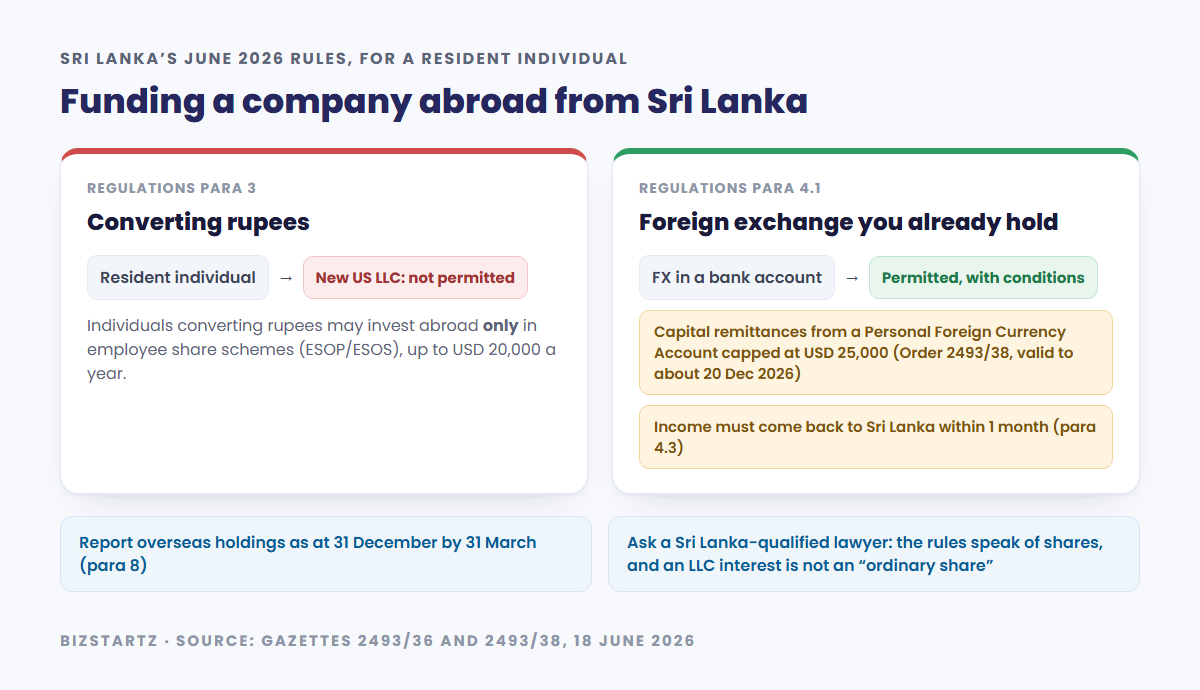
Route 1: converting rupees. Paragraph 3 covers investing abroad by converting Sri Lanka Rupees. For individuals it is short: “Resident individuals, excluding emigrants and non-nationals, are permitted to make investments only in overseas Employee Share Ownership Plans or Employees Share Option Schemes.”
Buying a controlling stake in a foreign company is permitted for partnerships, Sri Lankan companies and provident funds, within limits, through an Outward Investment Account and with a clearance letter from the Head of the Department of Foreign Exchange.
The June 2026 Order narrows that further for the next six months. For an unlisted Sri Lankan company expanding its existing business abroad, the cap is USD 200,000 or 20% of net assets, whichever is lower. For individuals, the only exception is again employee share schemes.
Read plainly, a resident individual converting rupees to fund a new U.S. LLC doesn’t fit either text.
Route 2: foreign exchange you already hold. Paragraph 4.1 is different: “Any resident may acquire overseas assets from any non-resident or make overseas investments utilizing any foreign assets or foreign exchange held in a bank account in Sri Lanka or outside Sri Lanka without being subject to paragraph 3 of these Regulations.” Section 5 of the Act says something similar about using foreign exchange you already hold. Two limits sit on top of this:
- The June 2026 Order limits “outward remittances on capital transactions through Personal Foreign Currency Accounts held by a person resident in Sri Lanka, up to USD 25,000,” and through Business Foreign Currency Accounts, for expanding a business overseas, up to USD 500,000. The Order doesn’t say over what period.
- Any income or capital proceeds from an investment made this way “shall be brought back to Sri Lanka to the credit of an eligible bank account … within one (1) month from the date of such receipts” (paragraph 4.3).
Whether a freelancer’s foreign earnings count as foreign exchange you can use under paragraph 4.1 isn’t settled by the text. Section 8(2) of the Act says a resident may acquire a foreign asset from foreign exchange derived from “provision of any service in or from Sri Lanka” only as regulations allow. How section 5, section 8(2) and paragraph 4.1 fit together for your earnings is exactly the question to ask a lawyer.
Reporting every year
Residents holding overseas investments must report them as at 31 December, by 31 March of the following year: what the investment is, when it was acquired, its cost, current value, income, and income brought back.
The report goes through the bank that made the remittance, or, where no remittance was made, directly to the Department of Foreign Exchange and the Commissioner General of Inland Revenue by self-declaration (Regulations No. 1 of 2026, paragraphs 8.3 and 8.4).
A gap the rules don’t address
Both the Regulations and the Order describe company investments as “ordinary shares issued by companies incorporated outside Sri Lanka.” A U.S. LLC doesn’t issue shares. Its owners hold membership interests. We found nothing in either text on how an LLC is treated. That’s a question for your lawyer, not something to assume either way.
Penalties
Under section 11(5) of the Act, the Central Bank may, after a hearing, require a person who breaches the Act, a regulation or an Order to pay a penalty “not exceeding rupees one million or … not exceeding the amount or value of such current transaction or capital transaction or value of such foreign asset,” plus its investigation costs.
Section 26 sets a penalty of up to one million rupees where no other penalty is prescribed. Appeals go to a Board of Inquiry (Foreign Exchange Act, as published in 2017; we didn’t find an amending Act, but check).
Questions to take to a Sri Lanka-qualified lawyer
- Am I a “person resident in Sri Lanka” under the Minister’s Order defining it?
- Can I fund a U.S. LLC from foreign exchange I already hold under paragraph 4.1 of Regulations No. 1 of 2026, and does the USD 25,000 PFCA limit in the current Order apply to it?
- Do my service earnings count as foreign exchange I can use that way, given section 8(2) of the Act?
- Does an LLC membership interest count as “ordinary shares” or as some other overseas asset?
- If the LLC earns money, when does the one-month rule for bringing income back apply, and to what?
- If I already run a Sri Lankan company that exports, should that company own the U.S. entity instead of me?
- What do I report by 31 March each year, and to whom?
U.S. tax: Form 5472 every year, and the treaty
A single-member LLC owned by a non-U.S. person files a pro forma Form 1120 with Form 5472 attached every year, marked “Foreign-owned U.S. DE”, even when it owes no U.S. tax. It can’t e-file this return.
The penalty for not filing is USD 25,000, plus another USD 25,000 for each 30-day period the failure continues after 90 days from an IRS notice (IRS Instructions for Form 5472, Rev. 12/2024, checked 16 September 2026). More in our guide to Form 5472 for foreign-owned LLCs.
Sri Lanka has an income tax treaty with the United States. It’s on the IRS list of U.S. income tax treaties (IRS: treaties A to Z, updated 3 January 2026). The convention was signed in Colombo on 14 March 1985, amended by a protocol signed in Washington on 20 September 2002, and entered into force on 12 July 2004 (U.S. State Department, 04-712). Nepal has no U.S. treaty; Sri Lanka, India, Pakistan and Bangladesh do.
If you claim treaty benefits, it’s done on Form W-8BEN. Line 9 asks for “the country where you claim to be a resident for income tax treaty purposes,” and a foreign individual who is the single owner of a disregarded entity completes the form “with your name and information” (IRS Instructions for Form W-8BEN, Rev. 10/2021). The treaty doesn’t remove the Form 5472 filing. What it changes for your income is a question for a U.S. tax adviser.
Getting the money home, and Sri Lanka’s tax on it
The 180-day rule for service exporters
Sri Lanka requires export earnings to come home. The Central Bank’s Repatriation of Export Proceeds into Sri Lanka Rules No. 01 of 2024 say every exporter of goods or services “shall … mandatorily receive the export proceeds in Sri Lanka … within one hundred and eighty (180) days from the date of shipment or provisioning of services.”
Export proceeds include “payments received in foreign exchange by a person resident in Sri Lanka for the services provided including professional, vocational, occupational or business services provided to a person resident outside Sri Lanka” (Rules No. 01 of 2024, effective 4 September 2024).
The rules were amended twice in 2026. The January amendment (Rules No. 01 of 2026) changed what exporters may invest their proceeds in; the June one (Rules No. 2 of 2026, effective 10 June 2026) tightened the deadline for goods exporters to convert proceeds into rupees to the 10th of the following month. The 180-day receipt rule for services didn’t change, and the conversion rule is written for exporters of goods (Rules No. 2 of 2026).
The rules don’t say what happens when a client pays your own U.S. LLC rather than you. Leaving earnings in the LLC’s account for months is the everyday situation a lawyer would test against the 180-day rule and the one-month rule in the investment regulations.
How the money moves
- An international wire from the LLC’s U.S. account to your bank in Sri Lanka. Keep invoices and the contract ready; your bank will ask what the money is. We haven’t verified fees.
- Wise. Wise sends LKR to any bank account in Sri Lanka, up to 4.98 million LKR per transfer and 5 million LKR a day, usually the same working day once converted (Wise: Guide to LKR transfers, checked 17 September 2026). Unlike Wise’s Bangladesh page, it says nothing about business transfers. Note that the money arrives already converted to rupees, which matters for tax (next section).
- PayPal, for payments you receive personally from abroad, withdrawn through Sampath Bank or Commercial Bank as described above.
Sri Lanka’s income tax on service exports
Service export income used to be exempt. From 1 April 2025 it isn’t. The Inland Revenue Department’s notice on the Inland Revenue (Amendment) Act, No. 02 of 2025 says: “Effective from April 1st 2025, income tax exemptions on service exports and foreign sources income have been removed.”
For individuals, the maximum rate is 15% on gains and profits from services “to be utilized outside Sri Lanka, where the payment for such services is received in foreign currency and remitted through a bank to Sri Lanka,” and on foreign-source income meeting the same conditions. Otherwise, individual rates run from 6% to 36% (IRD notice PN/IT/2025-01, 26 March 2025).
The 15% cap depends on the money being received in foreign currency and remitted through a bank to Sri Lanka. Profits kept in a U.S. account, or a payment that arrives already converted to rupees, may not meet that wording. We didn’t find IRD guidance on single-member U.S. LLCs, and we didn’t find a later change to these rates, though we can’t rule one out. Ask a Sri Lankan tax adviser before you decide where the money sits.
What it costs
Only figures we could source:
- Wyoming filing: USD 100 to file, then an annual report license tax of at least USD 60 a year (Wyoming fee schedule, effective 1 July 2026).
- Formation service: Bizstartz packages are USD 199, USD 299 or USD 699, plus the state fee (our pricing page, checked 17 September 2026). Other providers charge differently.
- EIN: the IRS doesn’t charge for one.
- Every year: the state’s annual fee, registered agent renewal, the Form 5472 filing, and Sri Lanka’s 31 March overseas investment report.
- Not priced here: registered agent renewal, bank and wire fees, and advice from a Sri Lankan lawyer and tax adviser. The legal advice is the cost people most often leave out, and it’s the one that protects you.
Who this suits, and where to start
It can make sense if your buyers need Stripe checkout or you need a U.S. payout account for Amazon, your volume covers the yearly filings, you’ve confirmed a bank that will take an owner in Sri Lanka, and a Sri Lanka-qualified lawyer has looked at how you’ll fund the company and bring money home under the June 2026 rules.
It probably doesn’t if you only needed PayPal to receive payments from abroad, which now works through Sampath and Commercial Bank for personal accounts, or your clients already pay by bank transfer or a marketplace, or you’d be funding the company by converting rupees.
If you already run an exporting Sri Lankan company, ask your lawyer about having that company invest under the Regulations. That’s the version the rules spell out, within the current Order’s limits.
For comparison, we’ve run the same analysis for forming a U.S. LLC from Bangladesh, where Mercury is closed, and for Nepal, where a 1964 Act restricts investing abroad: PayPal in Nepal and the U.S. LLC route. Our country-by-country view of U.S. banks and payment platforms covers the rest.
If a U.S. company fits, Bizstartz handles U.S. company formation for non-resident founders, including the EIN and bank application steps. A free 30-minute consultation is a good place to check the U.S. side, including which bank is realistic for you, before you spend anything. The Sri Lanka side needs a Sri Lankan lawyer.
This guide was researched with the help of AI tools. Each legal, fee and availability claim links to the source it came from, and the sources were checked on 17 September 2026. Where we couldn’t confirm something, the text says so. Rules in this area change often, so check the linked sources again before you act.
🎯 Ready to start? Claim your free consultation and we'll map out your US LLC formation strategy — EIN, banking, and the right state for your country.

Ready to start your company?
Bizstartz handles formation, EIN, banking and compliance for founders worldwide.