You can form a US LLC from Brazil while living there, and unlike most countries we write about, the banking works too (checked 18 September 2026). Brazil is on neither Mercury’s nor Relay’s prohibited-countries list. That removes the obstacle that stops founders in Nepal, Bangladesh, Pakistan, Nigeria and the Philippines.
Which makes the honest question a different one. Not “can I?” but “why would I?” Stripe is fully live in Brazil. PayPal runs Brazilian business accounts on a CPF or CNPJ. Pix settles in seconds. Google Play pays Brazilian developers in reais. For a large share of Brazilian freelancers and small businesses, a Wyoming LLC solves a problem they don’t have.
And Brazil, unlike the Philippines or Sri Lanka, doesn’t mainly restrict you from owning a company abroad. It taxes you for it. In April 2026 the Receita Federal published a ruling that treats exactly this structure, a US LLC transparent for US tax and owned by people who aren’t US residents, as a “regime fiscal privilegiado”.
Combined with Lei nº 14.754/2023, that points at 15% a year on the LLC’s profit whether or not a single dollar reaches Brazil. We rarely see that covered in English, and it’s the part that changes the maths.
In this guide: Do you actually need one? · Who it genuinely helps · Banking from Brazil · What Brazil asks of you · The US side · What it costs · Questions Brazilian founders ask · Who it suits
Do you actually need a US LLC from Brazil?
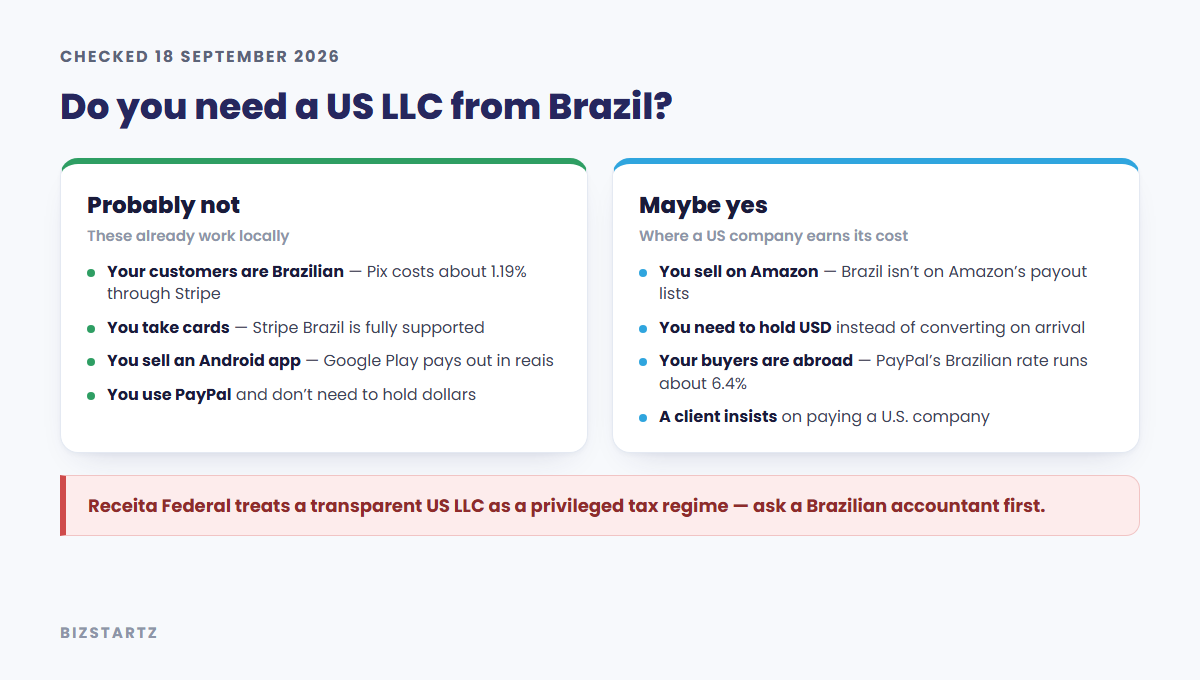
For most people reading this, no. Start by checking whether one of these already covers how you get paid, because in Brazil several of them do.
PayPal Business works on a CPF or CNPJ
PayPal’s Brazilian user agreement says an individual must be “residente no Brasil”, at least 18, and hold a CPF; a company must be resident in Brazil and hold a valid CNPJ (PayPal Brazil user agreement, last updated 13 January 2025). A Brazilian account can be paid by buyers abroad.
Two things about that money are worth knowing before you plan around it. PayPal’s help centre says that if the payment arrives in a foreign currency, “a conversão para Real ocorrerá automaticamente”. You don’t get to sit on dollars (PayPal Brazil: receiving funds).
And the payout bank has to be Brazilian and in the same name: “Somente contas bancárias brasileiras podem ser adicionadas a uma conta do PayPal brasileira”, and “A conta bancária deve ter a mesma titularidade (CPF/CNPJ) que a conta do PayPal” (PayPal Brazil: transferring your balance).
The user agreement adds a deadline most people never read: if you haven’t registered a bank or payment account in your own name within 30 days of receiving an international payment, PayPal reverses the transaction and returns the money to the buyer.
Stripe is fully live in Brazil
Brazil sits in Stripe’s main supported list, with a direct link to open an account. No “preview” label, no invite-only, no extended network (stripe.com/global, checked 18 September 2026). Nepal, Bangladesh, Pakistan and the Philippines still aren’t listed anywhere on that page. If you’ve read a guide saying you need a US LLC to use Stripe, it wasn’t written for Brazil.
Stripe Brazil’s published standard pricing is “3,99% + R$0,39 por transação realizada para cartões nacionais”, plus “2% para transações com cartões internacionais”, “1,19% por PIX pago” and “R$ 3,45 Boleto bancário por boleto pago” (Stripe Brasil pricing).
Pix, for Brazilian customers
If your buyers are in Brazil, nothing a US company can offer competes with Pix. On the price list just quoted, Stripe charges 1.19% per Pix paid against 3.99% plus R$0.39 for a Brazilian card. A US Stripe account can’t accept Pix at all.
Google Play pays Brazilian developers
Brazil is listed for both developer registration and merchant registration on Google Play, with BRL as the default currency (Google Play: supported locations, checked 18 September 2026). If selling an Android app was your reason, you have one less reason.
Wise
Brazil is on Wise’s list of countries where you can hold money, with one footnote: “Brazil — you can only hold BRL if you reside in Brazil” (Wise: where you need to live to hold money). Useful to you as a Brazilian resident, then, but not a route to a dollar balance.
Who a US LLC genuinely helps
Four situations survive the list above. Only the first is a hard blocker.
Amazon sellers: Brazil is accepted, but not paid
This is the real gap, and it’s the one most guides get backwards. Brazil is on Amazon’s list of countries accepted for seller registration (accepted countries).
But Brazil is not on the list of countries where Seller Wallet can transfer to your own bank account (Seller Wallet), and neither Brazil nor BRL appears on the supported bank-account list for the Amazon Currency Converter for Sellers (supported bank accounts). All three checked 18 September 2026; the tables run straight from Brunei Darussalam to Bulgaria.
So you can register and sell, and then have nowhere for Amazon to send the money. It’s the same wall we found in Bangladesh, and the opposite of the Philippines, where pesos are supported.
If you sell on Amazon from Brazil, a US entity with a US bank account is the mainstream answer. Our guide to getting an Amazon seller account with a US LLC covers the registration itself.
You need to hold dollars, not convert them
Every Brazilian route above converts. PayPal converts automatically on arrival, and Wise will only hold BRL for a resident. If you’re paying US suppliers, US contractors or US ad platforms in dollars, converting into reais and straight back out again is a pure loss, and a US account in the LLC’s name ends it.
Your buyers are abroad, and the fee gap is real
Here the numbers do the arguing. Take a USD 1,000 sale to a buyer outside Brazil, paid through PayPal.
- Brazilian PayPal account: a commercial transaction is “4,79% + tarifa fixa” (BRL 0,60), an international commercial transaction adds “1,61%”, and converting a payment received in another currency costs “3,50% acima da taxa de câmbio base” (PayPal Brazil seller fees, page dated 16 July 2025). That’s 6.40% plus a 3.50% conversion spread — roughly USD 99 on a USD 1,000 sale.
- A US LLC’s US PayPal account: 3.49% + USD 0.49 for a commercial transaction, plus 1.50% for an international one, and no conversion if you’re paid and paid out in dollars (PayPal US merchant fees, page dated 1 September 2026). That’s USD 50.39.
About USD 49 a thousand, by our arithmetic from the two published fee pages. At USD 20,000 a year of that kind of sale you’d keep roughly USD 980 more, before the LLC’s own yearly costs, before the cost of getting the dollars to Brazil, and before the Brazilian tax described below.
Run your own number against your real volume, not the headline percentages. The PayPal Business account for a US LLC without an SSN guide covers the application itself.
Stripe’s gap is narrower and cuts both ways. A foreign card on Stripe Brazil costs 3.99% + 2% = 5.99%; on a US Stripe account, 2.9% + 1.5% = 4.4% plus 30¢, with another 1% if currency conversion is needed (Stripe US pricing).
But a Brazilian card on a US account is an international card: 2.9% + 1.5% + 1% = 5.4%, worse than the 3.99% you’d pay locally, and you lose Pix and Boleto entirely. Again, our arithmetic from the two price lists. If your customers are mostly Brazilian, the US account makes you poorer. Our guide to opening a US Stripe account as a non-resident covers that route if you decide you want it.
A client or platform contractually requires a US entity
Some US buyers will only contract with a US company. If that’s a written requirement from someone actually paying you, it’s a legitimate reason. Ask them exactly what they need first. Sometimes the real requirement turns out to be a US bank account or a W-9, not a US company.
Banking from Brazil: the step that blocks other countries doesn’t block you
Do this check first anyway. Policies change, and an LLC with no account can’t receive anything.
Mercury does not prohibit Brazil
Mercury’s help centre says it is “unable to open accounts for founders living in any of the countries and regions listed below,” and that “this is based on your country of residence, not your citizenship or nationality.” Brazil is not on that list (Mercury: Prohibited countries, checked 18 September 2026). Nepal, Bangladesh, Pakistan, Nigeria and the Philippines all are.
Not being prohibited isn’t approval. Mercury still runs its own checks and declines applications for its own reasons. But a founder in São Paulo starts from a very different place than one in Manila. Compare the Philippines guide, where Mercury is a flat no.
Relay: not prohibited either, but read the US address requirement
Brazil isn’t on Relay’s prohibited-countries list, which covers “any business owner named on the Relay Account application, including beneficial owners” by citizenship or residency (Relay: Prohibited countries, updated 11 August 2026).
The requirements page is the harder read. Relay accepts US businesses owned by non-US citizens or residents “provided the business has an operating presence in the U.S.”, and asks every beneficial owner for a passport, an “SSN or passport number”, and a “physical U.S. address (no PO boxes, no virtual mailboxes)” (Relay: Required documents, updated 11 August 2026). Nothing on that page explains how someone who lives in Curitiba satisfies the US address line, and you should not answer it by giving an address that isn’t where you live. Ask Relay in writing before you form anything.
Wise Business
Wise accepts Brazilian residents personally, and runs a Brazilian business onboarding flow for companies with a CNPJ. Whether Wise Business will onboard a US LLC owned by someone living in Brazil is decided at verification, and we found no Wise page that answers it directly. Treat it as a second option to test, not a plan.
Our US payment and banking access by country table compares these providers side by side, and opening a US business bank account as a non-resident covers the application itself.
What Brazil asks of you, every year
We’re not Brazilian accountants or lawyers, and nothing here tells you what you owe. It sets out what has been published, with sources, so you can take the right questions to someone qualified. On this topic you will need someone qualified.
Solução de Consulta Cosit nº 56, of 9 April 2026
In April 2026 the Receita Federal’s Coordenação-Geral de Tributação published a binding answer to a taxpayer’s question about a US LLC. Its ementa reads “REGIMES FISCAIS PRIVILEGIADOS. ESTADOS UNIDOS DA AMÉRICA. LIMITED LIABILITY COMPANY. NÃO RESIDENTES”, and it cites Lei 9.430/1996 arts. 24 and 24-A and Instrução Normativa RFB nº 1.037/2010, art. 2º, VII. The holding: an LLC whose members are all non-residents of the United States, and which is transparent for US tax purposes, is a privileged tax regime.
That describes the ordinary single-member Wyoming or Delaware LLC this guide is about. It is the same structure formation services sell as “no US tax”.
An honest note on sourcing. The Receita’s own database at normas.receita.fazenda.gov.br would not open for us from outside Brazil; it returns a redirect notice and no document. We read the official text on LegisWeb’s copy and corroborated the date, the ementa and the holding against Conjur’s analysis of 29 April 2026. Conjur adds two things worth knowing.
The consulta concerned a California LLC held by Brazilian residents and their family. And Brazilian tax practitioners are actively criticising the reasoning, on the argument that transparency alone shouldn’t make a regime privileged. Have your accountant pull the ruling at source and check whether it has been reformed before you rely on either reading.
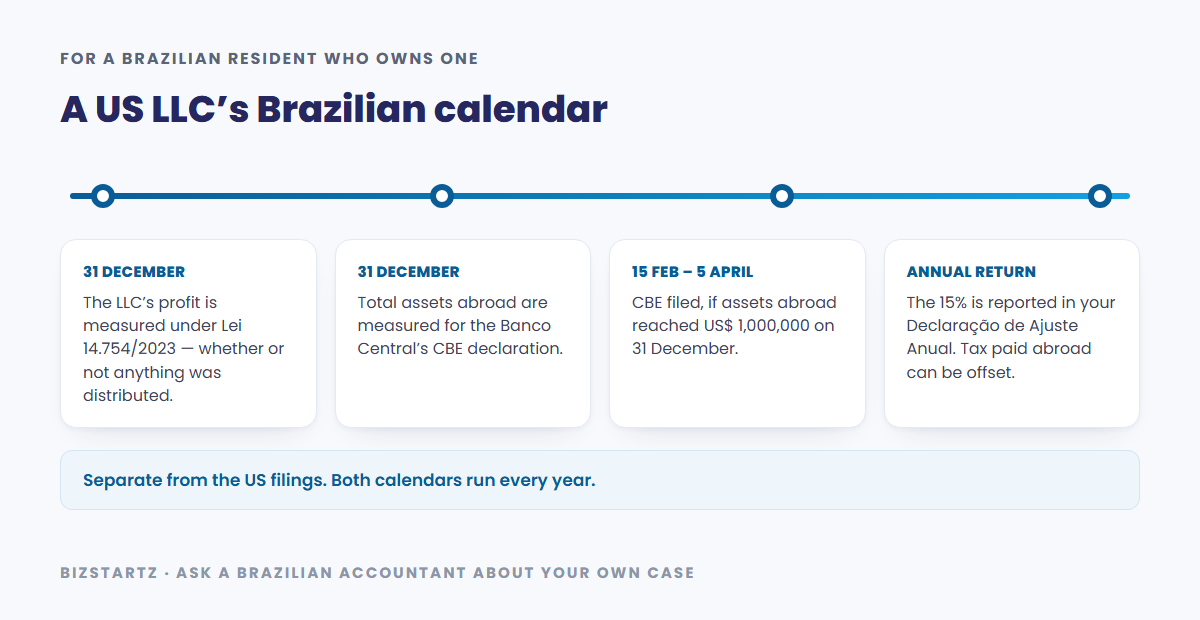
Lei nº 14.754/2023: 15% a year, measured on 31 December, distribution or not
The relevant law taxes income from capital held abroad in the annual adjustment “à alíquota de 15% (quinze por cento)”. For entities you control abroad, it computes the profit on 31 December of each year and taxes it regardless of whether anything was distributed.
That applies where the entity sits in a favoured-taxation jurisdiction or enjoys a privileged tax regime under arts. 24/24-A of Lei 9.430, or where its own active income is below 60% of total income. Tax paid abroad may be offset, subject to reciprocity or an agreement and capped at the Brazilian tax (Lei nº 14.754, de 12 de dezembro de 2023).
Read those two documents together and the picture is uncomfortable: the privileged-regime trigger is met by the ruling, so the profit may be taxable in Brazil each 31 December even if it sits untouched in a Mercury account.
And the offset for US tax is conditional, which matters more for Brazil than for most countries, because there is no US–Brazil income tax treaty at all (see below). Whether that offset is available to you is a question for your accountant, not something we’ll assert.
The practical consequence is simple enough to state: a US LLC is a recurring Brazilian tax and compliance item, not a one-off US filing. Price a Brazilian accountant into the decision before you form anything, and price them in every year after.
The CBE: a threshold most readers won’t reach
Brazilian residents holding assets abroad file a Declaração de Capitais Brasileiros no Exterior with the Banco Central when the total reaches US$1,000,000 on 31 December, filed between 15 February and 5 April of the following year.
There’s a separate quarterly declaration at US$100,000,000 for 31 March, 30 June and 30 September (BCB: CBE Manual do Declarante; thresholds and base dates also on the gov.br service page).
Your stake in the LLC counts towards that total, because the manual lists capital participation in companies abroad among declarable assets, and so does the balance in its US account.
For most people reading this a US$1m total is a long way off, and the CBE is a box to remember rather than a problem. Late, incomplete or incorrect declarations carry fines under Resolução BCB 279/2022. We have not read the resolution’s penalty clause ourselves, so we’re not quoting a figure.
Worth saying plainly: Brazil does not stop a resident from owning a company abroad. That’s a real difference from Sri Lanka, where 2026 rules restrict investing abroad. Brazil’s answer is reporting and tax, not permission.
Questions to take to a Brazilian accountant
- Does Solução de Consulta Cosit nº 56/2026 apply to the LLC I’m describing, and is it still in force?
- If it does, is the LLC a “controlada” under Lei 14.754/2023, and is its profit taxed to me on 31 December each year?
- How is that profit computed, and in which return do I report it?
- Can I offset any US tax paid, given there is no US–Brazil income tax treaty?
- If the LLC pays me for my services rather than distributing profit, does that change the answer?
- Do my LLC quotas plus its bank balance take me near the CBE’s US$1m threshold?
- What will you charge me each year to handle this, and does the fee gap I calculated above still leave anything?
The US side: steps, filings and the missing treaty
- Confirm your bank and platform first. It’s free, and it’s the step most likely to change your mind.
- Choose a state. Wyoming charges USD 100 to file Articles of Organization, and its annual report license tax is “$60 or two-tenths of one mill on the dollar ($.0002) whichever is greater based on the company’s assets located and employed in the state of Wyoming” (Wyoming Secretary of State fee schedule, effective 1 July 2026). Filing online adds “a credit card processing fee of 2.4% (minimum $1) of the filing fee” (WyoBiz registration instructions), so USD 102.40 in practice. Delaware is the usual alternative and costs more to keep: 6 Del. C. § 18-1107(b) sets an annual tax of USD 400, due 1 June, with a USD 200 penalty plus 1.5% interest a month if it’s late (Delaware Code, confirmed on the Division of Corporations’ tax instructions). Compare the rest in which US state to choose as a non-resident.
- Appoint a registered agent in that state. Wyoming charges USD 350 to reinstate a company that lost its agent, so keep the renewal paid.
- Get the EIN without an SSN. The IRS says that if “your principal place of business is outside the U.S.”, you apply by phone, fax or mail rather than online, and it doesn’t charge for an EIN (IRS: Get an Employer Identification Number, last reviewed 19 August 2026). Step by step: how to get an EIN without an SSN.
- Open the US account, then apply to the platform you formed the company for.
Form 5472 every year, whether or not you owe anything
A single-member LLC owned by a non-US person is a “foreign-owned US disregarded entity”. Each year it files a pro forma Form 1120 with Form 5472 attached, even with zero US tax due, and it can’t be filed electronically.
It faxes to 855-887-7737 or mails to the IRS at 1973 Rulon White Blvd, M/S 6112, Ogden, UT 84201. “A penalty of $25,000 will be assessed on any reporting corporation that fails to file Form 5472 when due and in the manner prescribed,” with a further USD 25,000 if the failure continues more than 90 days after IRS notification (IRS Instructions for Form 5472, Rev. 12/2024). More in our guide to Form 5472 for foreign-owned US LLCs.
Form 1040-NR: only when the US side actually reaches you
The IRS says a nonresident alien files a return if “engaged or considered to be engaged in a trade or business in the United States during the year”, or if not so engaged but holding US income whose tax wasn’t satisfied by withholding at source.
Income effectively connected with a US trade or business is taxed at graduated rates; FDAP income is taxed at a flat 30%, or a lower treaty rate where one applies (IRS: Taxation of nonresident aliens, updated 17 February 2026).
Whether your LLC’s activity makes you engaged in a US trade or business is a question of facts, where you work from, who does the work, what you sell. Plenty of non-resident owners serving clients from abroad conclude they are not, but that’s a conclusion to reach with a US tax adviser, not an assumption to inherit from a formation service’s sales page.
There is no US–Brazil income tax treaty
The IRS’s own list of US income tax treaties runs Bangladesh, Barbados, Belarus, Belgium, Bulgaria. Brazil is absent (IRS: United States income tax treaties A to Z, updated 3 January 2026).
That matters twice over. There’s no treaty article to reduce US withholding on US-source income, and no treaty to lean on when Brazil asks whether tax paid in the US can be offset under Lei 14.754/2023. Founders in Bangladesh, India and the Philippines all have a treaty to work with. You don’t. Bring this up explicitly with whoever advises you on both sides.
One filing you can stop worrying about
BOI reporting no longer applies to companies formed in the United States. FinCEN’s final rule was issued on 11 August 2026 and took effect on 14 August 2026, making permanent the exemption for domestic entities introduced by the interim final rule of 26 March 2025 (FinCEN: Beneficial Ownership Information). If a provider is still charging you for BOI filing on a US LLC, ask why.
What it costs
Only figures we could source:
- Wyoming: USD 100 to file (USD 102.40 online with the 2.4% card fee), then at least USD 60 a year.
- Delaware: USD 400 a year, due 1 June, before any filing fee.
- EIN: the IRS doesn’t charge for one.
- Formation service: Bizstartz packages are USD 199, USD 299 and USD 699 plus the state fee (our pricing page). Other providers price differently.
- Every year, US side: the state’s annual tax, registered agent renewal, and the Form 5472 filing, whether you prepare it or pay someone.
- Every year, Brazilian side: an accountant who can handle Lei 14.754/2023 and, above the threshold, the CBE. We haven’t priced this and you shouldn’t guess. Get two quotes before you form the company, because it’s the cost that decides whether the fee saving above is real.
- Not priced here: wire and conversion costs getting dollars to Brazil, and US tax advice.
Questions Brazilian founders ask
Can I open a US LLC from Brazil without living in the US?
Yes. You can register the company, get an EIN by phone, fax or mail, and file its US returns without visiting the United States or holding an SSN. What you can’t do remotely is skip the Brazilian side: Lei 14.754/2023 and the Receita’s 2026 ruling on LLCs apply to you where you live.
Will Mercury open an account for a founder living in Brazil?
Brazil is not on Mercury’s prohibited-countries list, which is based on country of residence rather than citizenship (checked 18 September 2026). That’s a much better starting point than Nepal, Bangladesh, Pakistan, Nigeria or the Philippines, all of which are prohibited. It isn’t a guarantee of approval — Mercury still applies its own checks.
Is Stripe available in Brazil without a US company?
Yes. Brazil is in Stripe’s main supported list with a direct sign-up link, and Stripe Brazil also handles Pix and Boleto, which a US Stripe account can’t. A US account is only cheaper if your customers are outside Brazil.
Does a US LLC create Brazilian tax even if I never take the money out?
That’s what the combination of Solução de Consulta Cosit nº 56/2026 and Lei nº 14.754/2023 points to: profit measured on 31 December and taxed at 15% in the annual adjustment, distribution or not. The ruling is being argued over by Brazilian tax practitioners, and we could not open the Receita’s own database from outside Brazil, so confirm it with a Brazilian accountant at source before you plan around either answer.
Who this suits, and where to start
It can make sense if you sell on Amazon and can’t get paid in Brazil, you genuinely need to hold and spend dollars, or enough of your revenue comes from buyers outside Brazil that the PayPal fee gap covers both sets of yearly costs. In every version of that, a Brazilian accountant has already told you what the LLC will cost you each year under Lei 14.754/2023.
It probably doesn’t if your customers are Brazilian, Stripe Brazil and Pix already handle your checkout, Google Play already pays you, or your whole case rests on a fee saving you haven’t multiplied by your actual volume.
Start with the free checks. Confirm which platform you actually need. Ask Mercury or Relay, in writing, whether they’ll take an owner resident in Brazil. Ask a Brazilian accountant the seven questions above and get a yearly fee quote. Form the company last — it’s the only step you can’t undo for free.
If a US company does fit, Bizstartz forms US LLCs for non-resident founders and handles the EIN and bank application steps (US company formation). A free 30-minute consultation is a sensible place to test the US side before spending anything. The Brazilian side needs a Brazilian accountant, and on this topic that isn’t a formality.
This guide was researched with the help of AI tools. Each legal, fee and availability claim links to the source it came from, and the sources were checked on 18 September 2026. Where we couldn’t confirm something — including the Receita Federal’s own copy of Solução de Consulta Cosit nº 56/2026 — the text says so. Rules in this area change often, so check the linked sources again before you act.
🎯 Ready to start? Claim your free consultation and we'll map out your US LLC formation strategy — EIN, banking, and the right state for your country.

Ready to start your company?
Bizstartz handles formation, EIN, banking and compliance for founders worldwide.