Here is the short version, and then the test, because the test is what actually decides it.
Your foreign-owned US LLC has a filing obligation of its own. That obligation is a pro forma Form 1120 with a Form 5472 attached, and it exists whether or not the company earned anything. That is the company’s return, not yours. Filing it does not answer the separate question of whether you, the human being who owns the company, have to put a US personal income tax return in as well.
For most non-resident owners reading this, the answer to the personal question is no. But “most” is not “all”, and the people who do have to file are usually the ones most confident that they don’t.
So this page gives you the actual IRS rule, quoted, plus both filing deadlines, plus an honest account of where the rule runs out and nobody can give you a clean answer.
Two filings, and only one of them is about you
This is the confusion the rest of the page exists to prevent, so it goes first.
| The LLC’s filing | Your personal filing | |
|---|---|---|
| What | Pro forma Form 1120 with Form 5472 attached | Form 1040-NR |
| Who it’s about | The company and its transactions with you | You, as an individual |
| When it applies | Foreign-owned single-member LLC with reportable transactions, income or not | Only if you personally meet one of the tests below |
| Does the other one cover it? | No | No |
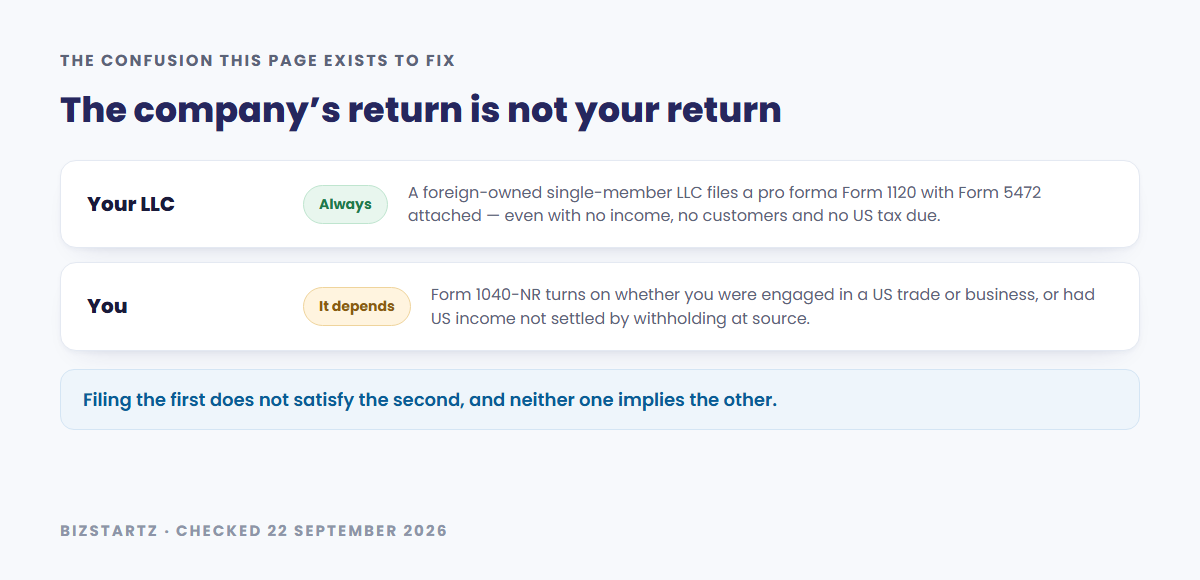
The Instructions for Form 5472 put the company side plainly. A foreign-owned US disregarded entity, despite having no income tax return to file, must file a pro forma Form 1120, U.S. Corporation Income Tax Return, with Form 5472 attached by the due date (including extensions) of that Form 1120.
If that part is new to you, start with our guide to Form 5472 for foreign-owned US LLCs, and if you have already missed a year, the catch-up route is here.
One thing worth getting right while we are on it, because the understated version circulates widely. The penalty is $25,000. And per the instructions, if the failure continues for more than 90 days after the IRS notifies you, a further $25,000 applies with respect to each related party for which a failure occurs, for each 30-day period (or part of a 30-day period) the failure continues. Not one additional $25,000. One per related party, per 30 days.
None of that has anything to do with Form 1040-NR. Different form, different filer, different rule.
The rule for your personal return
There are two separate triggers, and you only need to hit one.
The IRS states the first this way:
“You must file a return if you are a nonresident alien engaged or considered to be engaged in a trade or business in the United States during the year.”
And the second:
“Even if you are not engaged in a trade or business in the United States, you must file a return if you have U.S. income on which the tax liability was not satisfied by the withholding of tax at the source.”
Everything else on this page is an attempt to make those two sentences usable. Note what is not in them: no revenue threshold, no mention of where your company is registered, no mention of your nationality, and nothing about whether your country has a tax treaty with the United States.
All of this assumes you are a nonresident alien to begin with. The instructions say you are considered a nonresident alien for the year if you’re not a U.S. resident under either of these tests
the green card test and the substantial presence test.
Substantial presence means at least 31 days in the US this year and 183 days across three years, counting all of this year’s days, a third of last year’s and a sixth of the year before that. If you spend real time in the United States, work through that arithmetic before anything else on this page applies, and our overview of filing as a non-US resident covers the status question in more detail.
“Engaged in a trade or business in the United States” is the whole test
This phrase decides the first trigger, and it is where most of the confident advice you will read online is worth nothing. The honest starting point: there is no clean definition to give you. That is not evasiveness on our part. It is what the law says about itself.
The statute defines it by exclusion, not inclusion
26 U.S.C. § 864(b) opens like this:
“For purposes of this part, part II, and chapter 3, the term ‘trade or business within the United States’ includes the performance of personal services within the United States at any time within the taxable year, but does not include—”
Then it lists two carve-outs and stops. It never says what the term is in general. The two exclusions:
- Personal services for a foreign employer. A nonresident alien temporarily present in the US for not more than 90 days in the tax year, whose compensation for those services does not exceed $3,000 in aggregate, working for a foreign employer that is not engaged in US business (or for a foreign office of a US person).
- Trading in stocks, securities or commodities through an independent broker or agent, or for your own account, provided you have no fixed US office directing the transactions. Dealers are restricted, and commodities have to be traded on an organised exchange.
Those are narrow. If neither describes you, the statute has told you nothing either way.
The regulation says outright that it depends on the facts
26 CFR § 1.864-2(e) says it in one sentence:
“Whether or not such person is engaged in trade or business within the United States shall be determined on the basis of the facts and circumstances in each case.”
The same paragraph adds a point that cuts in the other direction, and it is the one people miss: falling outside one of the safe harbours is not a finding that you are engaged in a US trade or business. The exclusions are exclusions. They are not a checklist whose failure convicts you.
What the IRS does say in plain language
The IRS’s Effectively Connected Income page is the closest thing to usable guidance. It gives examples rather than a definition:
Foreign persons generally are engaged in a U.S. trade or business when personal services are performed in the U.S.
— with the qualifier that the activities have to beconsiderable, continuous and regular
. Three words doing an enormous amount of work, and the IRS does not quantify any of them.- Owning and operating a business in the US selling services, products or merchandise,
with certain exceptions
. If a foreign person is a member of a partnership that at any time during the tax year is engaged in a trade or business in the U.S., then the foreign person is considered to be engaged in a trade or business in the U.S.
This is the “considered to be engaged” limb, and it matters if your LLC has more than one member.- Gains and losses on US real property interests are taxed as though you were engaged in a US trade or business, and rental income from US real property can be treated that way by election.
- The exclusion again, in readable form:
If your only U.S. business activity is trading in stocks, securities, or commodities (including hedging transactions) through a U.S. resident broker or other agent, you are NOT engaged in a trade or business in the U.S.
Read those together and a rough shape emerges. The test is about operating in the United States, not selling to it. Where you physically sit while you do the work carries weight.
Having US customers, a US bank account, a US-registered LLC or a Stripe account is not, on its own, what the guidance is describing. But “rough shape” is as far as the published material goes, and anyone who hands you a rule sharper than that has invented it.
About the “dependent agent” rule you will see quoted
A lot of advice for non-resident founders leans on a dependent-agent test: if nobody in the US acts for you with authority to conclude contracts, you are safe. Treat that carefully.
That language comes from the permanent establishment articles of tax treaties, not from the domestic rules above, and the domestic standard is the broader of the two. If your country has no US treaty, the treaty concept is not available to you at all.
We work through what that means for the tax you actually owe in our piece on whether a non-resident pays US tax on a US LLC, which is the companion to this one: that page is about the tax, this page is about the return.
Your LLC is disregarded, so the question gets asked about you
A reasonable objection at this point: the LLC is a US company doing whatever it does, so surely it is the LLC that is engaged in a US trade or business, not me.
That is not how a single-member LLC works. The IRS treats an SMLLC that has not elected corporate treatment as a disregarded entity, and says the LLC’s activities should be reflected on its owner’s federal tax return
.
There is no separate taxpayer sitting between you and the business activity. So the question the two IRS sentences ask is asked about you, and the LLC’s registration in Wyoming or Delaware does not answer it.
Being straight about the limits of that: the IRS page making the disregarded-entity point is written for US owners and frames it around Form 1040 and its schedules.
It says nothing about a foreign owner, and we have not found IRS guidance that spells out the look-through specifically for a non-resident’s ETBUS analysis. The structural logic is sound and it is how the analysis is conventionally done, but we are telling you it is a reading rather than a quotation.
If your LLC has more than one member, the analysis is different again, and less forgiving: the ECI page’s partnership rule means a foreign member of a partnership that is engaged in a US trade or business is considered to be engaged in one too.
The second trigger: US income the withholding did not settle
You can owe a return without being engaged in a US trade or business at all. That is the second sentence quoted above, and it turns on withholding.
Certain US-source passive income, the IRS category is FDAP, is generally taxed at a flat 30% (or a lower treaty rate, where one applies), with no deductions, and that tax is normally collected by the payer withholding it before the money reaches you. Where the withholding fully covers the liability, there is typically nothing left to settle on a return. Where it does not, the second trigger fires.
It also cuts the other way. The IRS notes that a return is how you claim a refund of excess withholding or want to claim the benefit of any deductions or credits
. If too much was withheld, filing is the only way to get it back, whether or not anyone is making you file.
Which income is FDAP, which is effectively connected, and what rate applies to each is a question about your liability rather than your filing obligation, and it is covered on the companion page rather than repeated here.
You have to file even when you owe nothing
If you take one sentence away from this page, take this one. The Instructions for Form 1040-NR, listing who must file as a nonresident alien engaged in a US trade or business, say you must file even if:
“a. You have no income from a trade or business conducted in the United States, b. You have no U.S. source income, or c. Your income is exempt from U.S. tax under a tax treaty or any section of the Internal Revenue Code.”
Three of the most common reasons founders give for not filing, listed by the IRS as reasons that do not excuse it. Zero revenue is not a defence. No US-source income is not a defence. Treaty exemption is not a defence, in fact a treaty position is something you claim on a return, which is difficult to do without filing one.
The obligation attaches to the activity, not to the profit.
When it is due: 15 April or 15 June
Both dates are real, and which one applies to you is decided by a single question. From the “When To File” section of the Instructions for Form 1040-NR:
“If you were an employee and received wages subject to U.S. income tax withholding, file Form 1040-NR by the 15th day of the 4th month after your tax year ends. A return for the 2025 calendar year is due by April 15, 2026.”
“If you didn’t receive wages as an employee subject to U.S. income tax withholding, file Form 1040-NR by the 15th day of the 6th month after your tax year ends. A return for the 2025 calendar year is due by June 15, 2026.”
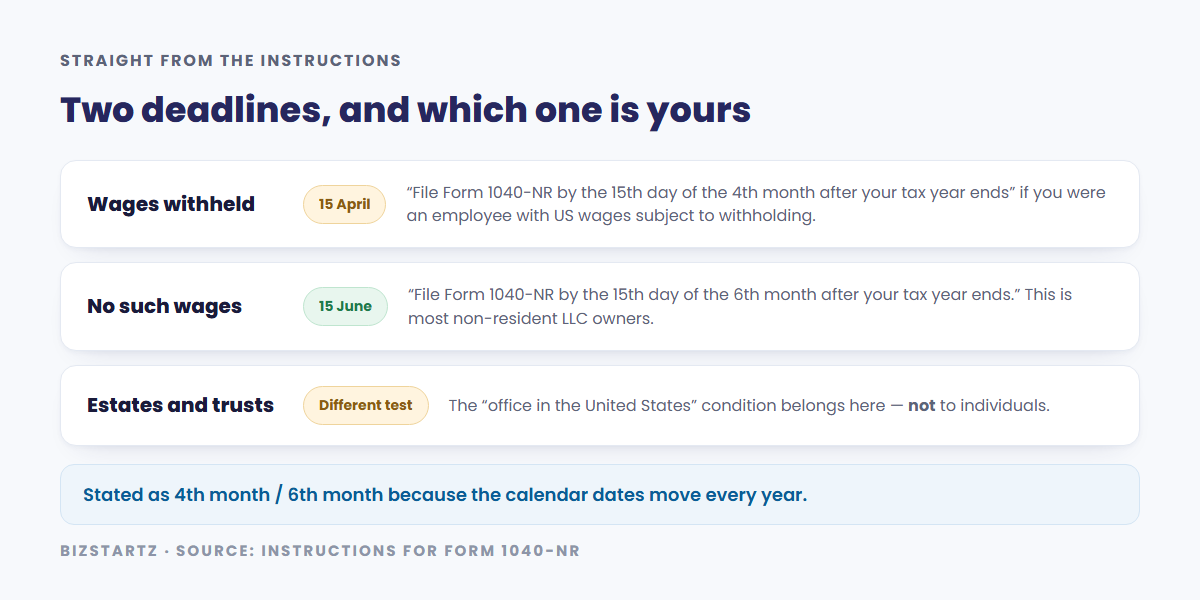
So the test is not whether you have a US office, and not whether you are self-employed. It is whether you received wages as an employee subject to US income tax withholding.
A non-resident who owns an LLC and pays themselves distributions rather than payroll is, on the face of that wording, in the second group and looking at the 6th month. Read your own facts against the sentence rather than against that generalisation.
Two riders from the same section. If the due date lands on a Saturday, Sunday or legal holiday, file by the next business day
. And nonresident alien estates and trusts follow their own 4th-month or 6th-month split, decided by whether the estate or trust has an office in the United States, that office condition belongs to estates and trusts, not to individuals, which is a distinction that gets blurred a lot.
For an extension, Form 4868 is the right form and it names your return explicitly: Use Form 4868 to apply for 6 more months … to file Form 1040, 1040-SR, 1040-NR, or 1040-SS.
One limit to be clear about, in the form’s own words: Although you aren’t required to make a payment of the tax you estimate as due, Form 4868 doesn’t extend the time to pay taxes.
More time to file is not more time to pay.
Your LLC’s pro forma 1120 with Form 5472 runs on the corporate calendar instead, generally the 15th day of the 4th month after the tax year ends, so 15 April for a calendar-year company. Two filings, potentially two different dates, two months apart. Our deadline page lays the season out.
You will need an ITIN before you can file
A practical obstacle that catches people at the worst moment. A Form 1040-NR needs a taxpayer identification number, and a non-resident with no SSN needs an ITIN. Your LLC’s EIN is the company’s number and does not work for your personal return.
ITIN applications are not instant, and the usual route is to file the application together with the return it is needed for. If you have worked through this page and landed on “yes, I have to file”, sort the ITIN in the same motion rather than in April. Our ITIN guide covers who genuinely needs one and who has been told they need one by someone selling them.
Working out your own answer
An honest sequence, not a decision tree that pretends to be conclusive.
- Confirm you are a nonresident alien. Green card test, then substantial presence. If you fail either, this page is the wrong one and you are filing a Form 1040.
- Write down where you physically were when the work was done, for the whole year. Days in the US doing the work of the business are the single fact that most often turns an easy answer into a hard one.
- List anything or anyone you have in the United States. Staff, contractors acting for you, an office, inventory held there, a warehouse you control. Not a registered agent, not a virtual mailbox, not the state of registration.
- Check for US-source income that had tax withheld, and whether the withholding covered it. Then check whether too much was withheld, because that is a refund you can only claim by filing.
- If your LLC has more than one member, stop and get advice. The partnership limb changes the question.
- File the company’s return regardless. Nothing in your personal analysis removes the pro forma 1120 and Form 5472.
Get a US tax professional involved if you spent meaningful time in the US during the year, if anyone worked for you inside the US, if you hold US real property, if the LLC has multiple members, or if you are about to claim a treaty position. Those are the fact patterns where the published guidance stops and judgement starts, and an hour of review is cheap against the cost of guessing.
Common questions
My LLC made no money. Do I still have to file a 1040-NR?
Income is not the test for the first trigger. The Instructions for Form 1040-NR say a nonresident alien engaged in a US trade or business must file even if “you have no income from a trade or business conducted in the United States”. The question is whether you were engaged in a US trade or business, not whether it was profitable. Separately, your LLC’s Form 5472 obligation turns on reportable transactions, not income, so a zero-revenue year can still require that filing.
I filed Form 5472 with a pro forma 1120. Does that cover my personal return?
No. They are different returns with different filers. The pro forma 1120 with Form 5472 is an information filing about the company and its transactions with you. Form 1040-NR is your personal income tax return. Filing one has no effect on whether the other is due.
Is my deadline 15 April or 15 June?
The instructions split on one question: whether you were an employee who received wages subject to US income tax withholding. If you were, it is the 15th day of the 4th month after your tax year ends. If you were not, it is the 15th day of the 6th month. For the 2025 calendar year the instructions give those as April 15, 2026 and June 15, 2026. If the date falls on a weekend or legal holiday, the next business day applies.
My country has no tax treaty with the United States. Does that change whether I have to file?
Not the filing question. A treaty can change how much tax you owe and can give you a position to claim, but the filing triggers quoted above make no reference to treaties. The instructions go further and say you must file even if “your income is exempt from U.S. tax under a tax treaty”, so a treaty is not an exemption from filing either.
Can someone give me a rule that settles this without professional advice?
Not honestly. The regulation says whether a person is engaged in a US trade or business “shall be determined on the basis of the facts and circumstances in each case”, and the statute defines the term only by listing two narrow things it excludes. Anyone offering you a threshold, a customer count or a bright line for this is offering you something the IRS has not published.
Where that leaves you
Most readers of this page run a single-member LLC from outside the United States, do the work wherever they live, have no US staff and no US premises. They file the company’s pro forma 1120 with Form 5472 every year and, on the guidance as published, do not have a personal return to file. That is a common outcome and a legitimate one.
What we are not going to do is tell you that is your answer. The test is fact-specific by design, the facts that move it are things only you know, and the cost of being wrong is not symmetrical: a return filed unnecessarily is an inconvenience, a return missed is a penalty on a year that stays open.
If the sequence above put you anywhere near the line, spend the hour with someone who can look at your actual year. If you would rather hand the annual filings over entirely, that is what our annual tax filing service is for.
Every quotation, figure and date on this page was read from the IRS instruction, US Code section or Treasury regulation linked beside it, each checked on 22 September 2026. The filing dates quoted are those given in the Instructions for Form 1040-NR for the 2025 tax year; the underlying rule is expressed as the 15th day of the 4th or 6th month after your tax year ends. Where the IRS publishes no answer, this page says so instead of estimating. This is general information about a filing requirement, not tax or legal advice about your situation. This article was drafted with AI assistance and fact-checked against the primary sources linked throughout.
🎯 Ready to start? Claim your free consultation and we'll map out your US LLC formation strategy — EIN, banking, and the right state for your country.

Ready to start your company?
Bizstartz handles formation, EIN, banking and compliance for founders worldwide.