Somebody has told you to file Form 8832 and have your US LLC taxed as a corporation. Usually the pitch comes with one of three promises: it gets you out of Form 5472, it makes you fundable, or it swaps your tax rate for a flat 21%.
Here is the short version, and the rest of this page is the working.
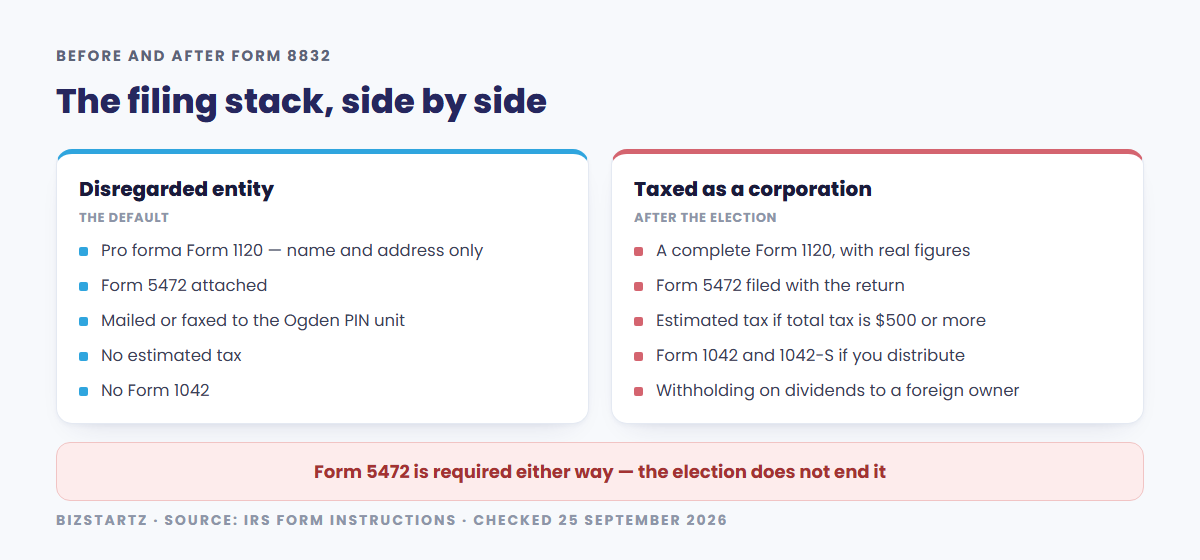
- It does not remove your Form 5472 obligation. It moves that form from a near-empty cover sheet onto a real corporate tax return.
- It does not turn your LLC into a corporation. Your LLC is still an LLC in the state that chartered it, with the same filings and the same fees.
- 21% is the first layer of tax, not the total. What you keep depends on what happens when money leaves the company and reaches you.
- You generally cannot undo it for 60 months — with one exception, below, that is worth knowing before you file rather than after.
None of that makes the election wrong. It makes it a decision with a price tag, and the price is usually not the one being quoted.
What the election is, and what it is not
An LLC is a creature of state law, not federal tax law. The IRS puts it plainly: “A Limited Liability Company (LLC) is a business structure allowed by state statute,” and the federal government does not treat “LLC” as a tax classification at all. It classifies your company by how many members it has and what it has elected.
Left alone, the defaults do the work. Per the IRS, “an LLC with only one member is treated as an entity disregarded as separate from its owner, unless it files Form 8832 and elects to be treated as a corporation,” and “a domestic LLC with at least two members is classified as a partnership for federal income tax purposes unless it files Form 8832.”
Form 8832 is how you override that default. The IRS describes it as the form “an eligible entity uses … to elect how it will be classified for federal tax purposes, as: A corporation. A partnership. An entity disregarded as separate from its owner.” The choice people mean by “taxed as a C-corp” is the first one — in the regulations’ language, an association taxable as a corporation.
Three things that election does not do:
- It does not change your legal entity. You do not become a corporation. You do not acquire stock, a board, or bylaws. You own membership interests in an LLC that the IRS now taxes like a corporation.
- It is not a form you can file casually. The election “will not be accepted if the eligible entity does not provide an EIN,” and it must be signed by each member who owns an interest when it is filed, or by an authorized officer, manager or member.
- It is not free of tax consequences at the moment you file. Under Regulations section 301.7701-3(g)(1)(iv), when a disregarded entity elects association status, “the owner of the eligible entity contributes all of the assets and liabilities of the entity to the association in exchange for stock.” That deemed incorporation is normally uneventful for a small business with no appreciated assets and no debt. It is not automatically uneventful. If your LLC holds anything of value that cost you less than it is now worth, or carries liabilities, ask a professional before you file.
Form 8832 goes to a service center by state: Ogden, Utah for Wyoming and most western states, Cincinnati, Ohio for Delaware and most eastern ones, and Ogden again for entities with a foreign address.
The IRS says the entity “should generally receive a determination on its election within 60 days after it has filed Form 8832.” Put that date in your calendar. Silence is not approval.
If you are still deciding between entity types rather than tax treatments, start with what an LLC actually is under state law — the two questions get tangled constantly.
Claim 1: “Elect C-corp and you escape Form 5472”
Of the three, this is the one that costs real money to get wrong. Work it from the regulation rather than the sales pitch and it comes apart in two steps.
Why a disregarded LLC files 5472 in the first place
Section 6038A imposes reporting on a reporting corporation. A single-member LLC that is disregarded is not a corporation, so on a plain reading the section would never touch it.
Treasury closed that with a deeming rule. Regulations section 1.6038A-1(c)(1) says a domestic business entity “that is wholly owned by one foreign person and that is otherwise classified under § 301.7701-3(b)(1)(ii) of this chapter as disregarded as an entity separate from its owner is treated as an entity separate from its owner and classified as a domestic corporation for purposes of section 6038A.”
That rule applies to tax years beginning after December 31, 2016 and ending on or after December 13, 2017.
The Form 5472 instructions spell out the odd consequence: “While a foreign-owned U.S. DE has no income tax return filing requirement, as a result of final regulations under section 6038A, it will now be required to file a pro forma Form 1120, U.S. Corporation Income Tax Return, with Form 5472 attached.”
That pro forma return is deliberately almost empty, “the only information required to be completed on Form 1120 is the name and address of the foreign-owned U.S. DE and items B and E on the first page.”
We cover that filing in detail in the Form 5472 guide for foreign-owned US LLCs, including what counts as a reportable transaction.
What happens to that obligation after the election
Once you elect association status, the deeming rule stops mattering, because you no longer need to be deemed anything. Your LLC is now classified as a domestic corporation for federal tax purposes, full stop. So you go back to the front of the same regulation, which defines a reporting corporation as “a domestic corporation that is 25-percent foreign-owned.”
And “a corporation is 25-percent foreign-owned if it has at least one direct or indirect 25-percent foreign shareholder at any time during the taxable year.”
The Form 5472 instructions define that shareholder: “a foreign person is a 25% foreign shareholder if the person owns, directly or indirectly, at least 25% of either: The total voting power of all classes of stock entitled to vote, or The total value of all classes of stock of the corporation.”
You own all of it, which is comfortably more than 25%. You are still a reporting corporation, and Form 5472 is still due. The election changed the route to the obligation. It did not change the obligation.
The one thing that would genuinely end it is foreign ownership falling below 25%, and filing Form 8832 does not move a single membership interest.
What does change
Three real differences, none of them a saving:
- The cover sheet becomes a tax return. The Form 1120 instructions are explicit: “A domestic entity electing to be classified as an association taxable as a corporation must file Form 1120, unless it is required to or elects to file a special return.” Not a name and address — income, deductions, balance sheet, the lot. And there is no low-activity excuse: “all domestic corporations in existence for any part of a tax year (including corporations in bankruptcy) must file an income tax return whether or not they have taxable income.”
- The form travels differently. A disregarded entity sends its pro forma 1120 and 5472 to a dedicated Ogden address — the PIN Unit at 1973 Rulon White Blvd, M/S 6112 — by mail or fax. A reporting corporation files Form 5472 “as an attachment to the reporting corporation’s income tax return by the due date (including extensions) of that return.”
- The transaction categories shift. The instruction that sweeps contributions to and distributions from the entity into Part V is written specifically for foreign-owned disregarded entities. How the same money movements are reported once you are an actual corporation is a question for whoever prepares the return — put it on the list in the last section.
The penalty does not move. “A penalty of $25,000 will be assessed on any reporting corporation that fails to file Form 5472 when due and in the manner prescribed.” If anything, the exposure widens, because you now have a real return that can also be late.
Claim 2: “C-corp is better for raising investment”
Often true — about a C corporation. Almost never about an LLC that ticked a box on Form 8832. These get conflated because both get called “C-corp”, and the difference is legal, not semantic.
Delaware makes the point in cash. The state’s own tax instructions say limited liability companies “are required to pay an annual tax of $400.00,” due “on or before June 1st,” and that for those entities “there is no requirement to file an Annual Report.”
Corporations are on a different track entirely: annual reports and franchise taxes are “due annually on or before March 1st,” and “the minimum tax is currently $175.00, using the Authorized Shares Method and the Minimum Tax using the Assumed Par Value Capital Method is $400.00.”
File Form 8832 on a Delaware LLC and you stay on the LLC track. Same $400, same June 1, still no annual report. Delaware does not know or care what you told the IRS.
That matters beyond the fee. An investor buying into a Delaware C corporation buys shares of stock issued under a certificate of incorporation. Your LLC has neither. It has membership interests and an operating agreement.
Financing paperwork is built around the former. If a real investor is actually at the table, what they usually want is a statutory conversion of the LLC into a corporation, a state-law filing with its own cost, its own tax analysis and its own lawyer, not an entity classification election.
There is a smaller practical wrinkle too. The federal rules you now sit under are written in the language of stock: the 25% foreign shareholder test measures “voting power of all classes of stock” and “value of all classes of stock.”
You do not have classes of stock under Delaware or Wyoming law. Make sure whoever prepares your return knows they are filing for an LLC that elected corporate treatment, not for a corporation. It changes which state filings they should expect to see.
Claim 3: “It’s a flat 21% instead of my own rate”
21% is real. IRS Publication 542 states that corporations “figure their tax by multiplying taxable income by 21% (0.21).” It is also the first of two layers, and for a non-resident owner the second layer is the one that decides whether this was a good idea.
The second layer
Money sitting inside the company has been taxed once. Getting it to you triggers the second charge. Section 871(a)(1)(A) applies the 30% tax on US-source income of non-resident alien individuals to a list that expressly includes “dividends”, and the IRS states the general rule bluntly: “Most types of U.S. source income received by a foreign person are subject to U.S. tax of 30%.”
That 30% can come down, but only by treaty: “A reduced rate, including exemption, may apply if an Internal Revenue Code Section provides for a lower rate, or there is a tax treaty between the foreign person’s country of residence and the United States.” Two things founders get wrong here, and both are checkable in minutes:
- Your country may not have a treaty at all. Nepal does not appear on the IRS list of United States income tax treaties. Bangladesh, India, Pakistan and Sri Lanka do.
- Having a treaty does not mean getting the headline rate. The US–India treaty is the clearest example. Article 10(2) caps source-state tax at “15 per cent of the gross amount of the dividends if the beneficial owner is a company which owns at least 10 per cent of the voting stock”, and at “25 per cent of the gross amount of the dividends in all other cases.” You are a person, not a company. The rate widely quoted as “15% under the India treaty” is the corporate-shareholder rate. An individual founder reads the second line.
Claiming any treaty rate also means producing a certificate. Our guide to Form W-8BEN and when you need it covers the mechanics, including the US taxpayer identification number a treaty claim generally requires on line 5, a real obstacle if you do not already have an ITIN.
An illustration, with every assumption on the table
This is an arithmetic example, not advice, and it does not describe your situation. Assume: $100 of taxable income in the corporation, no deductions beyond what is already in that figure, the full after-tax amount distributed in the same year, the distribution properly treated as a dividend, no state tax, and an individual shareholder.
| Shareholder | Corporate tax at 21% | Withholding on the distribution | Reaches the owner |
|---|---|---|---|
| Resident of a country with no US treaty (e.g. Nepal) | $21.00 | 30% of $79.00 = $23.70 | $55.30 |
| Individual resident in India, treaty claimed | $21.00 | 25% of $79.00 = $19.75 | $59.25 |
Set that against the “flat 21%” you were quoted. The gap is the whole argument.
One question always follows: if corporate taxation is the problem, why not elect S corporation status instead? Because you cannot. The IRS requires an S corporation to “have only allowable shareholders”, which “may not be partnerships, corporations or non-resident alien shareholders”, and Form 2553 has to be “signed by all the shareholders”, so there is no version of that election a non-resident owner can complete. Our comparison of S corp vs C corp for non-residents works through that rule and the double-taxation mechanics in more depth.
Two costs nobody mentions
You become a withholding agent. The IRS definition is wide: “You are a withholding agent if you are a U.S. or foreign person that has control, receipt, custody, disposal, or payment of any item of income of a foreign person that is subject to withholding.”
And the liability is personal: “As a withholding agent, you are personally liable for any tax required to be withheld. This liability is independent of the tax liability of the foreign person to whom the payment is made.”
That comes with its own reporting, the IRS names “the filing of Form 1042 and related Form 1042-S.” Your company now has to withhold tax on payments to you, and file forms about doing it.
“I just won’t distribute” has a tax of its own. Publication 542: “if a corporation allows earnings to accumulate beyond the reasonable needs of the business, it may be subject to an accumulated earnings tax of 20%.”
The publication treats “an accumulation of $250,000 or less generally as within the reasonable needs of most businesses,” dropping to $150,000 for a corporation whose principal function is services in fields including accounting, consulting, engineering, law, health and architecture. A profitable consultancy parking cash indefinitely is exactly the fact pattern that rule was written for.
What actually lands on your desk the following year
| Foreign-owned disregarded LLC | LLC taxed as a corporation | |
|---|---|---|
| Federal return | Pro forma Form 1120 — “name and address … and items B and E on the first page” | A complete Form 1120 |
| Form 5472 | Required, attached to the pro forma return | Required, attached to the real return |
| Where it goes | IRS PIN Unit, 1973 Rulon White Blvd M/S 6112, Ogden UT 84201 — mail or fax | With the income tax return |
| Due date | The Form 1120 deadline, since that is the return it attaches to | “The 15th day of the 4th month after the end of its tax year” — the 15th day of the 3rd month if the tax year ends June 30 |
| Extension | Form 7004 | Form 7004 |
| Estimated tax | No entity-level income tax to pay | Installments required “if it expects its total tax for the year (less applicable credits) to be $500 or more”; Form 2220 computes any penalty |
| If you take money out | Reportable on Form 5472 as a transaction with the owner | Reportable, and a dividend distribution brings withholding plus Form 1042 and Form 1042-S |
| Return required with no income? | Yes | Yes |
Every line in the right-hand column is more work than the line beside it. That is the honest cost picture: the election does not swap one filing for another, it adds a return, a payment schedule and a withholding regime. For the calendar dates these fall on, see our US tax filing deadlines, and if you would rather hand the whole stack over, that is what our annual tax filing service does.
Timing, and the five-year lock
There is no deadline tied to forming your LLC. There is a window tied to the filing date. Form 8832: “An election specifying an eligible entity’s classification cannot take effect more than 75 days prior to the date the election is filed, nor can it take effect later than 12 months after the date the election is filed.”
Read that backwards and it produces the only date that matters at formation: if you want the election effective from the day your LLC was formed, the form has to be filed within 75 days of that day. Miss it and the earliest available effective date starts sliding forward.
Missing it is survivable. Form 8832 points to late election relief under Rev. Proc. 2009-41, which requires among other things that “3 years and 75 days from the requested effective date of the eligible entity’s classification election have not passed”, and that the entity “timely filed all required federal tax returns and information returns consistent with its requested classification for all of the years the entity intended the requested election to be effective.”
That second condition is the one that trips people: you cannot file returns as a disregarded entity and then ask for retroactive corporate treatment.
The 60-month rule — read this before you file, not after
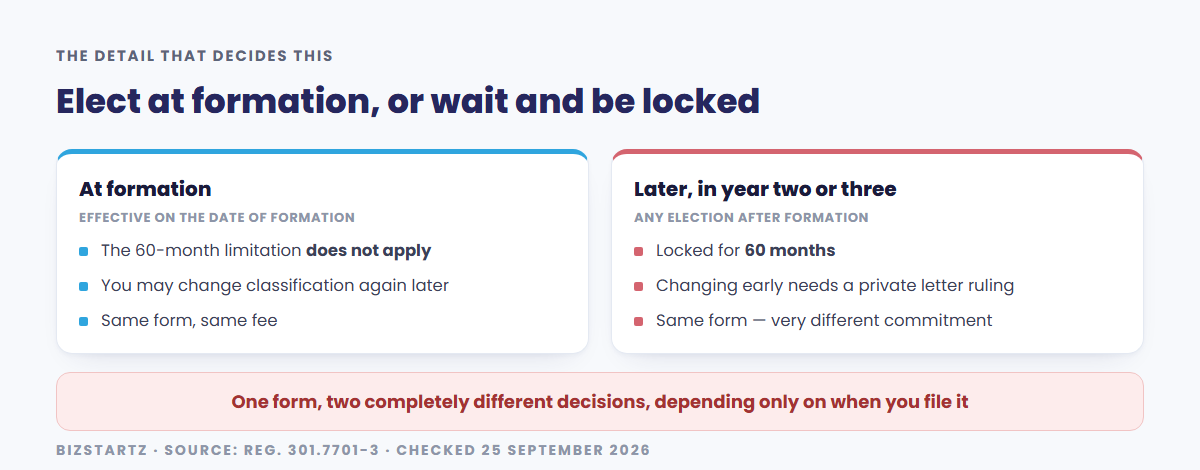
Form 8832 states that once an eligible entity elects to change its classification, “the entity generally cannot change its classification by election again during the 60 months after the effective date of the election.”
The escape is narrow: the IRS may permit an earlier change by private letter ruling “if more than 50% of the ownership interests in the entity, as of the effective date of the election, are owned by persons that did not own any interests in the entity on the effective date or the filing date of the entity’s prior election.” A private letter ruling is a formal, paid request, not a phone call.
Then comes the sentence that changes the decision, and that almost nothing written for non-residents mentions: “The 60-month limitation does not apply if the previous election was made by a newly formed eligible entity and was effective on the date of formation.”
So the same election carries two very different risk profiles:
- Elected at formation, effective from the formation date. The five-year lock does not apply to the change away from it. Getting it wrong is recoverable.
- Elected in year two, three or four of trading. You are changing an existing classification. Five years, or a ruling request. Getting it wrong is expensive.
If you are already trading as a disregarded entity and someone is telling you to elect corporate treatment now, that is the version with the lock on it. Price the decision accordingly.
The state question, honestly
A federal classification election does not change what your entity is under state law, and state charges generally follow the entity, not the election. Delaware bills an LLC $400 by June 1 whether or not it filed Form 8832. What a state does for income tax is a separate question, and the answers differ enough that a general article cannot give you one.
Some states tax corporations on a different basis than pass-through entities, and some impose taxes or minimum fees that a pass-through does not pay. Check the formation state and any state where you have a filing obligation, individually, before you file the election rather than after. This page does not attempt fifty states and you should distrust any that does.
Who the election genuinely suits
It is not a bad tool. It is a specific one. The fact patterns where it tends to earn its cost:
- You are retaining profit inside the business, not extracting it. The second layer of tax only fires when money comes out. A company genuinely reinvesting in inventory, staff or product, with a business reason it could state out loud, and mindful of the $250,000 accumulated earnings threshold, never pays the withholding in the illustration above.
- A counterparty specifically requires corporate tax treatment and has told you so in writing. Check what they actually require first. “C-corp” in an email often means an actual corporation, which this is not.
- You are electing at formation, where the 60-month lock does not bite and a mistake stays reversible.
The fact patterns where it is usually noise, or worse:
- You were told it removes Form 5472. It does not.
- You want to take the profit out each year, and you live somewhere with no US tax treaty.
- You are pre-revenue and a formation agent offered it as an upsell. You would be buying a full corporate return to shelter nothing.
- You want it because it “looks more serious to a bank.” Banks look at the operating agreement and the EIN letter. This changes neither.
Where this stops being general, and what to ask
Everything above is public IRS text applied to a common fact pattern. Your fact pattern is not the common one the moment any of these are true: you hold appreciated assets, you have US-source income, you have more than one owner, you have a US treaty to interpret, or you already have a year of filings behind you.
Take these questions to a US tax professional, a CPA or enrolled agent who works with non-resident owners, and expect specific answers:
- On my facts, does the deemed contribution under Regulations section 301.7701-3(g)(1)(iv) produce any tax at the moment I file, and what in the LLC drives that?
- After the election, which of my transactions with the company land on Form 5472, and does that list differ from the disregarded-entity list I was filing under?
- What is my treaty position on dividends — or confirm that no treaty applies — and can I substantiate it on a W-8BEN without a US TIN?
- Will the corporation owe estimated tax installments, and from which quarter?
- If I retain profit rather than distribute it, is the accumulated earnings tax a live risk on my facts, and what would I need to document to show a reasonable business need?
- What does my formation state, and any other state I file in, charge a corporation that it does not charge an LLC?
- Does the 60-month limitation apply to my entity, given when it was formed and whether it has elected before?
- If we are doing this for an incoming investor, should this be an election at all, or a statutory conversion?
- What will preparing this return cost each year, compared with what I pay now?
If a formation agent recommends the election and cannot answer the ones about the deemed contribution, Form 5472 after the election, and the 60-month limitation, they are selling a form, not advice. We are a formation company and we will say the same about ourselves: the entity work is ours, the tax opinion on your specific facts is not.
The one-line version
Electing corporate taxation adds a real tax return, a withholding regime and a five-year commitment, and it does not remove the filing obligation most non-residents are trying to escape when they ask about it. It earns its place when profit stays in the company. It rarely earns its place when profit comes out.
Every IRS rule, rate, threshold and quotation on this page was checked against the primary source on September 25, 2026. Source list: Form 8832 and its instructions; Form 1120 instructions; Form 5472 instructions; IRS Publication 542; Regulations sections 1.6038A-1 and 301.7701-3; 26 U.S.C. 871; Rev. Proc. 2009-41; the IRS income tax treaty index and the US–India treaty; and the Delaware Division of Corporations. Tax rules change and none of this is advice on your circumstances.
How this was made: research and drafting were assisted by AI, with every quoted rule, rate and threshold verified by a human against the IRS or state source named above before publication. No figure appears here that we could not trace to one of those documents.
🎯 Ready to start? Claim your free consultation and we'll map out your US LLC formation strategy — EIN, banking, and the right state for your country.

Ready to start your company?
Bizstartz handles formation, EIN, banking and compliance for founders worldwide.