10 Benefits of Forming an LLC in the US

It’s clear that forming a business in the United States comes with a plethora of opportunities, both as a legal citizen of the country or even as a foreign national. The United States has the most developed consumer market, provides a multitude of legal seals of protection, supplies capital, all which serves as a foundation for creating and expanding a business.

United States possesses many forms of business structures, of which the most common is Limited Liability Company or LLC. There are a multitude of operational, tax related, and legal benefits of forming an LLC which together make it the most suitable option for startups and businesses that are looking for growth.

In this article, we will discuss the concept of an LLC, summarize its 10 benefits of forming an LLC in the US.

What Is an LLC?

In essence, an LLC is a type of legal business organization that marries together the liability shield of a corporation with tax benefits of a sole proprietorship or a partnership, which are easier to manage. This means that, you as an individual, do not lose your personal valuables, but at the same time, running the business remains simple.

Unlike corporations, LLCs do not require extensive record keeping, formal operating agreements, or annual meetings. At the same time, they provide robust personal liability protection for lawsuits, debts, and other legal issues concerning the business.

Want to save money and pay as little tax as possible? LLCs also have a lot of flexibility when it comes to taxation. In its default state, an LLC is a pass-through entity, which means profits and losses are passed to the owners and declared via personal tax returns.

To benefit from certain tax strategies, however, LLCs can also choose to be taxed as an S Corporation or C Corporation.

LLCs are perfect for online entrepreneurs, international founders wishing to do business in the United States, freelancers, and small business owners.

10 Key Benefits of Forming an LLC

1. Limited Personal Liability

One of the top reasons that entrepreneurs decide to have an LLC is the limited liability it has to offer. If your business ever gets sued or goes into debt, legally speaking, your personal assets such as your house, savings, car and investments are usually protected and not at risk.

This is due to the fact that LLCs offer limited liability. A without a doubt claim cannot be made on your personal belongings in accordance to settle business debts. This is very critical for businesses with clients, customers, employees, or sensitive information to protect.

On the other hand, sole proprietorships, along with general partners, bear the financial responsibility for business-related debts, which may completely obliterate their financial stability.

2. Greater Tax Flexibility

Tax Flexibility

LLCs are regarded as one of the most flexible taxation structures available. By default, an LLC with one member is taxed as a sole proprietorship and LLC with more than one member will be taxed as a partnership.

In both situations, the company does not incur any tax liability at the entity level. Rather, the profits and losses flow to the members’ tax returns and not the other way around.

Furthermore, LLCs have the option of being taxed as a C or S Corporations by filing IRS Form 8832 or 2553 respectively. This could decrease self-employment taxes or allow more efficient reinvestment of profits depending on the structure and income of the business.

This versatility is a powerful asset overlooked by corporations and sole proprietorships, giving prime reason why LLC’s are usefully strategized for optimal tax purposes.

3. Easy and Affordable Formation

Forming an LLC is usually easy and inexpensive. The procedure usually requires the following steps:

The process in most states allows you to complete the steps online within a few business days. There is less paperwork compared to forming a corporation, and there is less maintenance workload after the LLC is established.

For LLCs, annual state fees are typically lower than those for corporations, and there is no need to issue stock or conduct shareholder meetings.

4. No Citizenship or Residency Requirement

An LLC can be formed by virtually anyone, regardless of their geographical location, which is one of the greatest benefits of an LLC. Forming an LLC in the United States does not require one to be a citizen or resident.

The flexibility provided makes LLCs appealing to international entrepreneurs, freelancers, e-commerce merchants, and service providers seeking to enter new markets, utilize US payment gateways, or establish themselves in the global economy.

A non-resident can set up an LLC, procure an EIN, establish a U.S. business account, and manage everything from overseas with sufficient support.

5.Credibility and Professionalism

A limited liability company enhances your business esteem. Customers, vendor and partners look at you as a contracted person rather than a freelancer or non-formal business because of the registered business “LLC” affixed at the tail of your company name.

This professional image can assist you:

  • Earn trust with clients and customers
  • Gain vendor accounts or wholesale contracts
  • Obtain collaborators, investors or partners
  • Open accounts with merchant and payment processors.

Service providing entrepreneurs and online shops reported improved trust and customer inflow after registering themselves as LLC.

6. Flexible Ownership Structure

LLC’s provide the finest flexibility concerning ownership and control. You may have:

  • Single owner (single-member LLC)
  • Multiple owners (multi-member LLC)
  • People, corporations, or other LLCs can be registered as members.

The type of structure chosen, member managed or manager managed governs control; each member is entitled to a vote based on the passed operating agreement.

This flexibility is ideal for family businesses, start-ups, and investment groups who want more complicated division of ownership or profit sharing.

7. Privacy Protection in Some States

Particular states in the U.S like Wyoming, Delaware and New Mexico permit the creation of LLCs without disclosing the owners’ identities.

Such anonymity is beneficial if;

  • You want to separate work and personal life
  • You currently live in a country where entrepreneurship is discouraged
  • You prefer to keep your business activity to yourself
  • You want to protect one’s intellectual property or digital assets

At Bizstartz, our clients are privacy-oriented owners which prefer having their details concealed while legally protecting them under U.S. jurisdiction. Therefore, we helped them form LLCs in privacy-friendly states.

8. Access to the U.S. Financial System

Having an LLC formed allows you to tap into the entire financial ecosystem of the U.S which includes, but is not limited to:

  • U.S. business bank accounts
  • Credit cards and loans
  • Payment processors (Stripe, PayPal, Square)
  • Accounting software and merchant tools

This is particularly crucial for international entrepreneurs and online businesses that actively need to receive payments in U.S. dollars, pay for services from subcontractors, and build a business credit profile.

Possessing an EIN along with a U.S. LLC allows you to easily obtain a bank account in the US, improving the accessibility to ‘scalable’ tools for your growing business.

9. Reduced Compliance Burdens

LLCs Have Many Advantages Over Other Types of Business Organizations Compared To Corporations, They Have Lighter Formalities And Compliance Requirements That Include:

  • Conducting annual meetings is optional
  • Issuance of stocks is not mandatory
  • Complex corporate by laws are not required
  • Minimal reporting every year in most states

These factors reduce the administrative workload for small business owners and entrepreneurs. These individuals tend to prefer an LLC as it enables them to focus on actually running their business with minimal red tape.

Though some states impose an annual fee or franchise tax, the compliance burden is light, especially with the help of professional services like Bizstartz.

10. Drawbacks to Investors and Business Associates

Many angel investors and strategic partners are more than willing to invest in or partner with LLCs, particularly at an early stage, despite the fact that venture capital firms prefer to work with incorporated companies due to their equity structuring.

An LLC offers you a legal framework which you can scale into, and later switch to a C Corporation when the need arises. It also allows you to establish custom agreements amongst the partners, thereby facilitating the inclusion of other co-founders or advisors.

An LLC can, if correctly structured, serve as an effective platform for scaling in the long term and raising capital.
Final Considerations

Final Thoughts

An entrepreneur or a freelance worker will greatly benefit from a US based LLC, as it provides ease of taxation, legal protection, added credibility, and access to some of the largest financial systems in the world.

No matter if you are an American freelancer or a global entrepreneur, this structure can drastically change how you launch, grow, and protect your business.

At Bizstartz, we simplify U.S. LLC formation for residents and non-residents, ensuring it is done accurately and within the legal framework. Our packages come complete with:

  • LLC Formation
  • EIN Application
  • Registered Agent Services
  • ITIN Assistance
  • Beneficial Ownership Information (BOI) Filing
  • U.S. Business Bank Account Setup
  • Bookkeeping & Compliance Support
  • Trademark Registration

Want to kick start your U.S. business today?

👉Go ahead and book a free consultation or simply get started now with Bizstartz.

Blog CTA

Frequently Asked Questions (FAQs)

1. Is it possible for a non-U.S. resident to set up an LLC?

Absolutely. You don’t have to be a citizen or resident of the U.S. to set up an LLC. With proper documentation, you can set up an LLC from almost any part of the world, provided you have a registered agent in the U.S. At Bizstartz, we help international entrepreneurs set up compliant US LLCs, so you can focus on other important tasks.

2. Am I required to live in the U.S. to operate an LLC?

No. An LLC can be operated from anywhere around the world. Numerous overseas owners if an LLC manage their businesses remotely through emails, video conferences, and cloud software. They can market their products and services globally, employ remote staff, and manage everything from their home country.

3. Who is a registered agent and do I need one?

Yes, a registered agent is required for the formation of an LLC in the U.S. This is an individual or a business that can accept service of process and other communications from the government on behalf of your LLC. Bizstartz offers registered agent services in all states which makes them great partners for LLC that operate in multiple states.

4. Am I required to pay U.S. taxes if I am a foreign LLC owner?

It depends whether each of your LLC’s activities gives rise to income sourced from the United States or has a fixed place of business in America. If your LLC has no customers, employees, or even a physical presence in the U.S., you might not pay taxes. That said, there are some forms that need to be submitted to the IRS. Personally, I can assess your situation and provide the right advice with the help of our tax advisors.

5. Is it true that having an LLC qualifies me to open a bank account in the US?

That is correct. Opening a business bank account with a U.S. bank requires an EIN and some form of legal business entity, such as an LLC. Having an LLC allows you to open bank accounts with U.S. banks and fintechs that work with non-US founders, which allows access to ACH transfers, cards, and credit lines.
How Much Does It Cost to Start an LLC in 2025

Creating a Limited Liability Company (LLC) is one of the most popular business structures in the United States as it offers a unique combination of flexibility, personal liability protection, and simpler operational setup compared to a corporation.

Nonetheless, the overall cost of setting up an LLC and subsequently maintaining it differs according to the state, the service providers, and the individual business requirements.

For efficient budgeting with no unexpected expenses, this article details all the potential cost to start an LLC in 2025.

1. State Filing Fees (Mandatory, One-Time)

Every business entity proposed by law requires a fixed initial investment before commencement, and in the case of an LLC starting it is the State Filing Fee, which ranges from $35 in Montana to around $500 in Massachusetts.

This fee is a one-off payment made to the state government by an entrepreneur in the initial stage of business formation as part of registering a business in his/her name.

📍 Cost Range:

  • Low end: $35 (Montana)
  • High end: $500 (Massachusetts)
  • National average: ~$130 – $132

📝 Notes:

  • Every state sets its own fee, and the amount does not necessarily reflect the quality of service received or one’s expected speed of processing.
  • Additional fees of $25-100 may also be added due to rushed filing requests in certain states called expedited processing.
  • Regardless of whether an LLC application is rejected, later decisions by an applicant to alter the primary offered structures of an LLC, alongside universally accepted foundational assumptions, lead to irrevocable final expenditures.

If you were to start an LLC in Kentucky instead of Texas, you’d pay $300 in Texas and only $40 in Kentucky. This demonstrates how the state you form your LLC in can impact your costs significantly.

2. Annual/Biennial Report Fees (Mandatory, Recurring)

Most states have an ongoing compliance requirement where an LLC has to file annual or biennial reports to maintain good standing as a business entity. Reports minimally confirm information such as the business address, members, or registered agent.

💵 Cost Range:

  • Low end: $0 (e.g., Arizona, Ohio)
  • High end: $800 (California franchise tax)
  • Typical range: $20–200 annually

💡 Things to Know:

  • There could be a late filing penalty.
  • Some jurisdictions will suspend or dissolve your LLC for non-compliance.
  • Nevada needs both a business license and an annual report which increases your cost.

These repetitive and recurring expenses, just like initial filing fees, are vital to maintaining your LLC and if overlooked, may mean penalties or loss of status.

3. Registered Agent Fees

registered agent

A registered agent is an individual or service that must receive official correspondence like mail, legal notices, and other business-related correspondence intended for the LLC. Every LLC is legally mandated to have a registered agent. Although, it is possible to be one’s own registered agent, a lot of business owners prefer hiring professionals.

💵 Cost Range:

  • $0 (If you opt to be your own agent)
  • $200-$300 each year for professional services

✅ Reasons for paying for a registered agent:

  • Prevents your private address from appearing in public databases.
  • Provides assurances in the legal handling of mail and monitoring legal compliance.
  • Enables flexible working hours. No need to be available during standard business hours 9 am-5 pm.
  • Useful for in-state or out-of state residents who conduct business in multiple states or those living abroad.

There is often other mail sent that professionals handle, and they take care of compliance alerts, document storage, and mail forwarding, making these services smart investments for many entrepreneurs.

4. Optional Startup Costs and Add-Ons

Other than state filing fees, compliance costs, and additional optional incurred fees may be encountered depending on the business structure and who assists you.

📌 Name Reservation:

  • A few states grant the right to individuals seeking to file an LLC permit to block allocation of the company name in advance.
  • Cost: $10-$50
  • Advantages: Makes sure the selected are ready for the document drafting process.

📄 Operating Agreement:

  • The document formalizing the framework, responsibilities, and governing principles for your LLC.
  • Cost: $0 for DIY or $50-$300+ if you hire someone.
  • Not legally required but all too often advisable, including for single-member LLCs.

🆔 EIN (Employer Identification Number):

  • Needed by the IRS for tax reporting and when opening bank accounts.
  • Cost: Obtaining through IRS.gov is free.
  • Service fees: Formation companies charge $50-$100.

⚖️ Legal or Formation Service:

  • Companies such as LegalZoom, ZenBusiness, Bizstartz, and Incfile can file on your behalf.
  • Cost Range: $0-$350, not including state fees.
  • Filing, operating agreements, and EINs as well as compliance alerts and other services may be offered.
  • Some give out registered agent services free for the first year.

🧑‍⚖️ Attorney Help:

  • A small business attorney can assist with custom legal recommendations or contracts.
  • Cost Range: $1,000-$2,500+, depending on the complexity of work and where the work is done.

5. Business Licenses And Permits

You may need local or state business licenses to complement your LLC depending on the industry and their location. A restaurant or contractor or even a daycare may, for example, need extra permits.

💵 Cost Range:

  • $50-$500+, based on industry and location.
  • Recurring license renewal and inspections may be needed for some industries.

Note: Forming an LLC does not in itself guarantee that you have the right to operate. Check with your local city or county government for local licensing requirements.

6. Publication Requirement (State-Specific)

LLCs currently forming in Arizona and Nebraska remain as the only states to still require the publication of a legal notice in local newspapers.

🧾 Typical Cost:

  • Between $30-150 dependent on the newspaper and county fees.

This may not be one of the most well known costs, however, it is a cost that must be taken into account if you are forming in one of the states that requires this. Other services can take care of this requirement for you.

7. Typical Cost Scenarios for Year 1

Different methods of forming an LLC incur differing costs.

Type of LLC Formation Estimated Year 1 Cost
DIY Only $130–$300
DIY + Registered Agent + Licenses $300–$600
Professional Formation + Registered Agent $500–$900
Full Legal/Attorney Assistance $1,000–$2,500+

These estimates have been provided alongside a full legal, first year of compliance, operating agreement, and EIN.

8. Annual Costs Starting Year 2

The completion of the formation of an LLC marks the beginning of perpetual and recurrent fines for a company who’s strive for absolute compliance has been non stop.

Expected Annual Costs:

As dictated by the regulations of whichever state the LLC first registers:

  • Annual report/biennial fee: $20-$800 depending on the state.
  • Registered agent (if applicable): $100-300/yr.
  • Business licenses renewal: $50–$200 depending on locality.
  • Franchise taxes (such as in CA, DE, NY): Varies, can be significant.

Just as important are recurring costs that put the LLC out of compliance.

9. Best & Worst States for LLC Formation (Cost-Wise)

🟢 Low-Cost States:

  • Montana: $35 filing and $0 annual report
  • Kentucky: $40 filing and $15 annual report
  • Arizona: $50 filing with no annual report

These states are favorable to entrepreneurs focused on decreasing initial and ongoing expenses.

🔴 High-Cost States:

  • California: $70 filing plus $20 biennial and $800 franchise tax
  • Massachusetts: $500 filing and $500 annual report
  • Illinois: $150 filing, $75 annual report, and other fees

These states tend to be the most logical for local businesses but less so for remote entrepreneurs.

10. Cost-Saving Tips

DIY: File directly with the Secretary of State’s office and skip formation service fees.

Act as your own registered agent: Saves $100 to $300 per year, provided availability is maintained and an address is publicly listed.

Compare formation companies: Some charge as little as $0 + state fees (e.g., IncFile or Bizstartz).

Do not pay for additional services: Skip things like LLC seals and deluxe binders for documents unless absolutely essential.

Protect yourself: Ensure to pay the annual payment on time to avoid late fees or higher grievance costs.

Blog CTA

✅ Conclusion: What Should You Budget?

Expense Type Estimated Cost Range
Filing fee (one-time) $35–$500
Registered agent (optional) $0–$300/year
Annual report $0–$800/year
EIN (IRS) Free (or $50–$100 via service)
Legal help (if needed) $1,000–$2,500
Formation service (optional) $0–$350+
Licenses & permits $50–$500+

Total first-year costs:

  • Basic DIY: ~$130–$300
  • Standard LLC with some services: $300–$900
  • Full-service legal route: $1,000–$2,500+

If you’re considering completing your LLC in 2025, our prices are unmatched. Bizstartz completes your LLC formation with fast processing, expert assistance, and ancillary services all in one location like EIN procuring, BOI filings, and Acting as a Registered Agent.

👉 Contact us today so we can schedule your free consultation and get the ball rolling!

Tax Filing Deadline for LLC | Avoid Penalties Now

An LLC has a lot of advantages like flexibility, limited liability, pass-through taxation, etc, but each owner must understand their specific responsibilities by law. One of the major responsibilities is to file taxes in a timely manner.

Filing taxes late can incur hefty fines, interest penalties, and worst-case scenario, losing your LLC status with your state or the IRS.

In this article, we will cover tax filing deadline for LLC based on their organizational structure, what happens if one doesn’t follow the deadline, how to avoid penalties, and everything else you need to know.

Why are tax deadlines important for an LLC?

In the USA, every business, regardless of its size, is required to pay taxes. Interestingly, many LLC owners don’t even recognize tax deadlines which is the reason they predominantly miss it. The IRS lacking a sympathy policy, the LLC can’t afford to make excuses.

Filing obligations need to be met, let’s look at some overdue penalty filing setbacks.

Avoid Penalties: Preventing rapid issuing penalties is feasible by ensuring deadlines are met. These failures impact members irrefutably as they personally bear the burden, and worse yet, multi-member and multi-LLC corporations face the most dire ramifications as it is assessed based on each LLC or S Corp member.

Prevent Interest Accrual: The IRS starts applying interest on any outstanding taxes from the day following the deadline. Postponing payment increases the tax dues.

Maintain Good Standing: Filings that are late or not submitted can lead to your LLC being marked as not in good standing at federal or state levels, thereby hindering your operational, borrowing, or license renewal capabilities.

Avoid Business Interruptions: Evidence of tax filings will be required when applying for business loans, grants, or new contracts. Most lenders and partners set this as a prerequisite.

These examples illustrate the importance of proactive tax filing, underscoring the fact that it goes beyond good financial discretion – it is a matter of business compliance.

How Is Your LLC Taxed?

Tax filing for LLC

The fact that the IRS does not designate a particular tax bracket to LLCs is one of their peculiar traits. Rather, the extent of taxation on your LLC depends on what member it has and if you opt to be taxed as a corporation. Let us examine the different tax classifications:

A. Single-Member LLC (Disregarded Entity)

The IRS categorizes your LLC as a disregarded entity for tax purposes if it has a single member.

  • Tax Treatment: Your personal return includes your LLC Business Income. A separate tax return does not need to be filed for your LLC as it is included with your personal tax return.
  • Filing Requirements: Accomplish Form 1040 and Schedule C demographic segmentation along with Social Security Number and list of Income and Expense.
  • Filing Deadline: The customary deadline is April 15 unless it is on a weekend or holiday.

In that case, the deadline is moved to the next business day. If for whatever reason, the requested extension is not granted, there is an option of 30-day additional option available.

💡 Note: LLC’s have no activity or income, you a Schedule C along with the 1040 tax becomes mandatory regardless of outcome.

B. Multi-Member LLC (Partnership)

A partnership with or without two members is an automatic classification unless you select an option for an incorporated tax.

  • Tax Treatment: Unlike other companies, an LLC does not pay income taxes; rather, the company files an informational return on Form 1065. Profits and losses are then conveyed to each of the members in his or her Schedule K-1.
  • Filing Requirements: Prepare Forms 1065 and K-1s for distribution to the members.
  • Deadline: Schedule K – 1’s with Final 1065 are 15 March.

⛔ Important: Regardless of the income position of the LLC or the activity performed over the course of the year, submission is mandatory.

C. LLC Electing Corporate Taxation

You may also select for your LLC to be taxed as a C Corporation or an S Corporation for which you would need to complete C Corporation or S Corporation special IRS forms.

LLC Taxed as C Corporation

Tax Treatment: The LLC is subjected to a corporate tax rate, causing a potential tax burden known as double taxation, where the corporation incurs a tax, and subsequently shareholders pay taxes on dividends received.

LLC Taxed as S Corporation

Tax Treatment: Similar to partnerships in terms of taxation, this entity benefits from pass-through taxation. Owners receive income through K-1s issued by the entity.

To elect S-Corp status submit Form 2553 no later than 2 months and 15 days after the start of the tax year that you wish the election to take effect.

What Happens When You Miss the Deadline?

The Internal Revenue Service is known for having strict rules concerning overdue deadlines that attract financial penalties. Depending on the LLC’s form of taxation, the penalties change.

A. Single-Member LLC

  • As the owner uses the individual tax return system, missing the deadline of April 15 results in paying personal penalty fees.
  • Late Filing Penalty: Generally 5% of the unpaid tax for each month up to a cumulative 25%.
  • Late Payment Penalty: 0.5% charged every month on unpaid tax.

B. Multi-Member LLCs (Form 1065)

  • A fine of $220 per each member of the LLC per month, capped at 12 months.
  • For instance, an LLC with two members that files four months late will incur a penalty of $1,760.
  • The LLC is still eligible for these penalties, even if they had no income or tax to pay.

C. S Corporation (Form 1120S)

  • Identical penalties to form 1065: $220 per shareholders for every month, up to 12 months.
  • In addition, failure to deliver Schedule K-1s has the potential to incur extra penalties.

D. C Corporation (Form 1120)

  • 5% of tax that has not been paid monthly, capped at 25%.
  • The unpaid tax incurs interest starting from the original due date at the rate of daily compounding interest.

How to Avoid Penalties

✅ Know Your Deadline

Start by finding out how your LLC is classified and monitor the respective deadlines:

  • March 15th: Multi-member LLCs and S Corporations
  • April 15th: Single-member LLCs and C corporations

Make the relevant entries in your calendar and set reminders to complete your filings well in advance, especially if you use a CPA or tax preparer, as they tend to be busiest approaching a deadline.

✅ Applying Form 7004 for an Extension

If organizational matters have not been completed by the deadline to file, you can automatically receive an additional 6-months extension via Form 7004. However, make note of the following:

  • Your time period to pay is still the same.
  • All unpaid taxes which owed and accrued through April 15, must be paid on or before the due date of filing.

✅ Organize Any Relevant Documentation

Inadequate recordkeeping is one of the major causes for late submissions by small business owners. Stay ahead of the curve with:

  • Profit and loss statements
  • Receipts pertaining to expenditures
  • Employee and contractor payroll files
  • Prior year K-1s alongside tax returns

✅ Work With a Tax Professional

A professional tax consultant ensures that obfuscated obligations such as deductions on tax return for LLCs are properly optimized and administered so that the customer is able to:

  • Submit all relevant documents within deadlines
  • Take all allowable offsets
  • Satisfy the pertinent jurisdictional or legal authority governing both federal and state taxation

This allows for enhanced attention towards successfully managing a business while avoiding unnecessary risk and blunders.

Pro Tip: File Even If You Made No Income

Many entrepreneurs have an idea that if there was no activity on the LLC or the income was zero, there is no tax return. This is actually a prevalent mistake that is very costly.

Even when deriving no income, the IRS anticipates a return for the following:

  • Multi-member LLCs (Form 1065)
  • S-Corp (Form 1120S)
  • C-Corps (Form 1120)

Filing a return with zero revenue indicates that the business is operational and adheres to regulations. Not filing can incur identical fines as if income is reported, in addition to drawing attention from the IRS.

How We Can Help

As Bizstartz, we appreciate how complicated tax season is for a small business owner, particularly when based outside the U.S. That is why we offer unparalleled tax filing services for LLCs to ensure your business remains compliant and does not incur any penalties.

Here is how our services can benefit you:

LLC Tax Filings – All classifications of federal and state returns are included

Form 7004 Filing – Obtain your 6-month extension if preferred

BOI Report Filing – Remain compliant with FinCEN reporting rule obligations

Bookkeeping Services – Ensure clean, audit-ready financials

ITIN/EIN Support – These are vital for foreign founders and non-U.S. residents

📩 With LLC compliance coming up, reach out to Bizstartz today and speak to a compliance professional regarding your tax needs.

Tax Penalties

Closing Remarks

Safeguarding your business from incurring extra costs requires prompt attention to the compliance deadline for annual LLC tax filings.

Proper organization of tax deadlines, regardless of tax citizenship or status, can save any founder, domestic or foreign, thousands of dollars in penalties, and enhance the credibility of the business.

Incorporate a strategy which includes not postponing until the last minute, getting organized, filing early, and seeking help when needed. Every step of the way will be guided by Bizstartz.

S Corp vs C Corp: Which One is Better

When launching or revising a U.S. business, selecting an appropriate corporate structure is one of the most important decisions to take early on in the process.

The S Corporation (S Corp) and C Corporation (C Corp) are two of the most common options available for entrepreneurs and business owners.

While both provide some level of liability limitation and room for development, they vary significantly in their taxation, ownership structures, corporate governance, and funding capabilities.

We will analyze every structure in detail, compare the differences and similarities, highlight the advantages and disadvantages, and explain each structure’s relevance in relation to your business objectives.

What is a C Corporation?

A C Corporation, or C Corp, is the default type of corporation recognized under federal law. A business automatically becomes C Corp after incorporating by filing Articles of Incorporation with the state unless it opts to be S Corp.

C Corps are one of the business entities that can be set up in the United States. A distinguishing feature of C Corps is that they are treated as separate legal entities from their owners (their shareholders).

This implies that the corporation itself can contract, acquire and sell property, commence legal proceedings, and bear the obligations of its own debts and liabilities.

Key Features of a C Corp:

  • Separate Legal Entity: Owners are not personally liable for the business debts or lawsuits.
  • Unlimited Shareholders: Unlimited number of shareholders which suites large or rapidly growing companies best.
  • Foreign Ownership Allowed: Has the advantage of having foreign or non-resident shareholders which makes C Corps more attractive to global investors.
  • Multiple Classes of Stock: Venture capital becomes easier because different classes of shares (common and preferred) with more flexible ownership structures can be issued.
  • Double Taxation: These business entities pay tax on corporate income. Shareholder profits (dividends) are also taxed personally, leading to double taxation.

C Corporations are often preferable for both startups and larger companies due to the adaptability, capital market accessibility, and equity incentives for employees or investors.

What does ‘S Corporation’ mean?

An S Corporation isn’t a form of business organization. Instead, it’s a tax status something classification that may appeal to some corporations and LLCs.

A business can elect S Corp status by submitting Form 2553 to the IRS after incorporation and after fulfilling certain prerequisites. The primary benefit of an S Corp is that it allows for incorporation without the double taxation typically associated with corporations.

S Corps Key Characteristics:

  • Pass-Through Taxation: There are no taxes at the corporate level and profits/losses are distributed to shareholders, which are then reported on their individual tax returns.
  • Ownership Constraints: S Corps are limited to a maximum of 100 shareholders and all should be citizens or permanent residents of the United States.
  • Single Class of Stock: Issuance of one class of stock only which may limit appeal to to issue securities or provide equity incentives.
  • Limited Liability: Just as C Corps do, S Corps offer personal liability shields for shareholders.
  • Operational Formalities: S Corps are subjected to similar formalities as C Corps such as Annual General Meetings, Bylaws, and Board Minutes.

An S Corp is particularly valuable to small and medium sized domestic corporations seeking an uncomplicated ownership framework while also minimizing tax liabilities.

Key Differences Between S Corp and C Corp

To help clarify how these two corporate structures compare, here is a detailed side-by-side breakdown:

Feature S Corporation C Corporation
Taxation Pass-through taxation – no federal corporate income tax Subject to double taxation – corporate tax and personal tax on dividends
Number of Shareholders Limited to 100 Unlimited
Shareholder Requirements Must be U.S. citizens or residents Can include foreign individuals or entities
Stock Classes Only one class of stock allowed Multiple classes of stock permitted
Filing Requirements Must file Form 2553 to elect S status Default upon incorporation
Tax Forms IRS Form 1120S; Schedule K-1 for shareholders IRS Form 1120
Best For Small to medium U.S.-based businesses Startups, large businesses, and companies seeking outside investment

Understanding these distinctions is essential because the choice you make can affect your taxes, growth opportunities, and compliance obligations for years to come.

Pros and Cons for S Corporations

Corporation

✅ S Corporations Benefits:

1. Tax Benefits Due To Pass-Through Taxation S Corps:

S Corps forgo double taxation by permitting the income and losses to be passed through to the shareholders’ personal tax returns, which can lead to considerable savings in taxes; especially for business entities that have moderate profits.

2. Reduced Self Employment Taxes:

Shareholder-employees only incur self-employment tax on wages. This reduction in taxable income allows the S Corp to lower its overall tax burden.

3. Liability Protection:

Just like C Corps, S Corps have limited liability protection from personal exposure to lawsuits.

4. Enhanced Professional Image:

A corporation can improve a company’s professional image before clients, investors, and business partners.

❌ S Corporations Disadvantages:

1. Ownership Limitations:

Cannot exceed 100 shareholders, who also need to be U.S. citizens or residents, which makes it hard to attract foreign investors.

2. Limited Stock Options:

Unable to issue more than one class of stock, which makes it more difficult for entities to develop capital or design flexible ownership structures.

3. Strict IRS Guidelines:

An S Corp may lose its S Corp status due to noncompliance with S Corp rules such as unintentionally issuing a second class of stock.

4. More Rigorous Revenue Sharing Rules:

Compensation for shareholders must be reasonable. Like with all S Corporations rules, this one comes under significant scrutiny which has the IRS auditing these corporations for allegedly not paying sufficient employment tax.

Pros and Cons of C Corporations

✅ Advantages of a C Corporation:

1. Attracting Investors:

C Corps’ unlimited number of shareholders and stock classes is important for their appeal to institutional and venture capital investors.

2. Foreign Ownership:

C Corporations can have foreign shareholders unlike S Corporations making these entities better suited for international expansion or foreign investment.

3. Perpetual Existence:

Shareholder departures or selling their shares does not affect a C Corps existence which is essential for publicly traded companies.

4. Employee Benefits:

With C Corporations Bearing the full cost of health care and retirement plans, recruitment becomes easier.

❌ Disadvantages of a C Corporation:

1. Double Taxation:

Profits are taxed at the corporate level and again when distributed as dividends to shareholders.

2. Complex Compliance:

C Corps must comply with more stringent state and federal reporting requirements, including detailed financial statements and annual meetings.

3. Higher Administrative Costs:

Ongoing compliance, legal, and accounting fees are typically higher compared to S Corps or LLCs.

Determining Which Structure Suits Your Business Needs Best

There is no one size fits all approach, consider the following options depending on your specific business objectives and requirements:

Choose an S Corporation if:

  • Your business is based in the United States and has less than 100 shareholders.
  • You are interested in avoiding double taxation.
  • There is no need for venture capital or foreign investment.
  • Acquiring a simple structure with personal tax benefits is advantageous.
  • Your comfort level is high in relation to restrictions on ownership and classes of stock.

Choose a C Corporation if:

  • There is Capital from investors readily available to quickly scale the business.
  • Plans to attract foreign investment or going public in the future is welcome.
  • Business needs profit reinvestment rather than distribution.
  • Having ownership and stock structure flexibility is fundamental.
  • Prepared for double taxation in the interest of long-term growth opportunities.

Concluding Remarks

S Corps and C Corps offer different benefits based on the business goals of the company, the expected growth, and the financial status of the business.

For U.S. business owners, an S Corp is a better option for small businesses since it is more tax-efficient. On the other hand, businesses that seek major expansion or outside funding will be able to reap the benefits of scalability and flexibility that a C Corp offers.

Keeping in mind the right choice from the start will eliminate stress, time, expenses, and make things simpler in the future. A final choice should be made after consulting with a tax advisor or legal specialist which is highly recommended.

Bizstartz aids entrepreneurs in forming corporations, applying for S Corp status, achieving compliance with state and federal requirements, and refining the corporate structure to maximize growth and reduce taxes.

No matter if you need help in launching a startup or restructuring an existing entity, our team is here to guide you every step of the way.

💼 Prepared To Establish Your S Corp Or C Corp?

Reach out to Bizstartz to help best assist you in structuring your business, whether as an S or C Corp. We provide business formation, acquiring an EIN, serving as a registered agent, filing BOI documents, bookkeeping, and various other services.

S Corp CTA

🧠 Frequently Asked Questions (FAQs)

1. Can I switch from S Corp to C Corp and vice versa?

Yes, but you must complete appropriate IRS filings. To change from a C Corp to an S Corp you have to submit Form 2553. If you want to change back, you need to revoke the S election. Remember that there are waiting times, potential tax consequences, and periods that could be involved.

2. Which is better for raising capital, S Corp or C Corp?

C Corps are more effective in raising capital. They are able to have limitless shareholders and may issue numerous classes of stocks. They are better preferred by investors such as VCs. The ownership and stock restrictions imposed on S Corps makes them weaker and less appealing for fundraising.

3. Do both provide limited liability protection?

Yes, they do. Both S Corps and C Corps will protect your assets from your business’s debt, being sued, as long as the company is abiding and observing the corporate formalities.

4. Can an LLC elect to be taxed as an S Corp or C Corp?

Yes. An LLC can select either of the tax statuses by filling the relevant forms and providing them to the IRS (*Form 2553 for S Corp, Form 8832 for C Corp*). This gives control on the method income is taxed.

5. What is the taxation on salaries and dividends?

For S corporations, salaries are taxed in the usual way but distributions are not self-employment taxed. For C corporations, salaries are taxed, then dividends paid to shareholders are also taxed, resulting in double taxation.

How to Invest in US Stocks from Nepal: A Complete Guide for 2025

Due to the growing zeal for international investment, numerous citizens from Nepal seek the best avenues to invest in the stock market of the US. Companies like Apple, Microsoft, Amazon, Google, and Tesla are from or have market shares in the US and are some of the most dominant and lucrative companies known globally.

Other than having a stable economy, the powerful and well-organized US financial system provides a good incentive to globally based investors.

If you are in Nepal and are searching for legal procedures to invest in US stocks, this article will guide you step by step and help navigate investing US stocks, including using strategies like establishing a US LLC makes the process far more efficient.

Why Invest in US Stocks?

The targeted return, as well as the rewarding possibilities associated with US stocks, makes them compelling. It is no wonder more and more Nepali investors are shifting their focus to Wall Street:

1. Accessibility of High-Growth Firms

They’re the world’s primary sources of cutting-edge technology, innovative healthcare, consumer goods, and energy, and the US boasts some of the most iconic brands with Apple, Amazon, Nvidia, and Meta Platforms leading the way as highly influential and consistently growing international businesses.

2. Portfolio diversification

Horizon West Investment, your company on the other hand, offers equity investment portfolios that are benchmarked against the Standard and Poor’s 500 index fund on the basis of sectors and volume. Investing in the US stock market also allows for currency diversification.

3. Efficient Structure and Stable Banking System

Merrill Lynch organizes its accounting, data storage, and customer relations in a sophisticated manner. In combination with information technology, this enables the company to process a huge volume of transactions within a short period of time.

4. Analysis and Stock Trading Convenience

Online databases allow for the analyzing of numerous technical indicators for each share through various programs. These programs assist investors by automatically processing the analytics, making it easier to monitor share prices.

5. Significant Factors Influencing Market Growth

Stock investments’ main driving force is share re-grants. Other factors are investments made as target returns from shares, real-estate developments, and converting assets into repayable liabilities.

Is It Legal for Nepali Citizens to Invest in US Stocks?

Invest in US Stocks

This remains an important inquiry with regard to prospective investors. Legally, foreign persons are permitted to participate in the US stock exchange freely. Ownership of shares in American companies is open to non-residents and non-citizens.

But some restrictions do apply in Nepal that can be complex:

  • As per NRB regulations, one can not remit funds for investment outside the country without prior sanction.
  • This makes it difficult, and rather dissuasive, to personally make investments in foreign stock exchanges directly from Nepal due to the existing laws.
  • Moreover, Nepal has very little to no developed international investment infrastructure via banks or other financial institutions.

Nonetheless, a lot of Nepali investors have found ways around these obstacles, the most notable being the formation of Limited Liability Companies in the USA which makes it legal and simple to use US brokerage accounts.

Options to Invest in US Stocks from Nepal

Now, let’s discuss what options a resident of Nepal has for buying shares of American companies.

Option 1: Employ International Brokerage Firms (In Individual Capacity)

Some international brokers offer accounts to foreign individuals enabling them to trade in US securities. Examples include:

  • Interactive Brokers
  • TD Ameritrade
  • Zerodha (through Vested or INDmoney) – Easier access for Indians, but may assist Nepalis with cross-border presence.
  • Charles Schwab

These brokers frequently cater to a large number of countries where they offer US equities, ETFs, Mutual funds, and Options trading.

Challenges:

  • Verification Problems: Certain brokers might ask for a US address alongside a Social Security Number (SSN) for verification.
  • Funding Restrictions: Transferring funds from Nepal to an external broker account is complicated due to NRB regulatory policies.
  • Compliance Risk: Investing in foreign markets without NRB approval could pose compliance risk.
  • Limited Assistance for Nepali Nationals: Due to restrictive regulations, many international brokers do not support Nepal directly.

All in all, while this route is possible, it does create obstacles. A US LLC solves this problem with a better, compliant structure.

Option 2: Start a US LLC – The Strategic Solution for Nepali Investors

For Nepali nationals looking to invest in the American stock market, forming a Limited Liability Company (LLC) in the United States serves as one of the most practical approaches.

What is a US LLC?

A Limited Liability Company (LLC) is a legal form of doing business in the US that blends the benefits of sole proprietorships with the asset protection offered by a corporation. One of the advantages of an LLC is that it can be formed by non-resident aliens. An LLC can be entirely owned and managed by foreigners.

Why Form A LLC is Beneficial For Investing:

1. Gaining Access to U.S. Brokerage Accounts is Simple

Many brokers are more willing to work with registered US businesses than foreign nationals. An LLC is able to apply for a business account with major brokers such as Interactive Brokers, Charles Schwab, and Alpaca.

2. No Residency is Necessary

An individual does not need to reside in the United States or possess a Social Security Number in order to form or manage a LLC in the U.S. It is perfect for citizens of Nepal living in Nepal or abroad.

3. International Transfer Simplification

LLCs can open U.S business bank accounts making it easier to conduct international wire transfers, receive payments, and add funds to brokerage accounts.

4. Tax Benefits

An LLC with no effectively connected income in the US is unlikely to need federal income taxes. Also, pass-through taxation helps eliminate double taxation.

5. Business Identity and Asset Protection

One of the advantages of LLC is that it offers you a business identity that functions on a single proprietorship and shields your personal assets from liability and enhances your credibility.

6. Multi Use Structure

On top of investing in stocks, the LLC can also be used for freelancing, consulting, and other online businesses.

How to Start a US LLC from Nepal (Step-by-Step)

If you have never business in the US before, here is how you can set up an LLC in the US from Nepal:

Step 1: Select a State

The following are some of the most popular states for LLC formation:

  • Delaware: Broadly recognized for its most business-friendly laws and ease of investor relations.
  • Wyoming: Absence of state-own income taxes, high levels of privacy, and minimal annual corporate fees.
  • New Mexico: Private owners and low price. Wyoming also offers.

Step 2: Register Your LLC

You can use drawing services to take care of the process for you, such as bizstartz. For this you have to provide:

  • A distinctive name for the LLC.
  • One registered in the state of selection.
  • Articles of Organization to be filed.

Step 3: Get an EIN

You will also need to obtain an Employer Identification Number (EIN) which serves as social security number to companies. It is essential for any business looking to open a banking or business trading account. This service can be sponsored by bizstartz for you.

Step 4: Get a business bank account

A US based bank account is essential to receive or send money virtual account opening from any mercury or relay documents validating your identity may enable you to open an account remotely.

Step 5: Creating a Brokerage Account

Following the creation of the LLC and the bank account, apply for a business investment account with the following platforms:

  • Interactive Brokers
  • Alpaca
  • Charles Schwab (Business Account)

Step 6: Allocate Resources

As noted previously, ensure to fund the brokerage account. Once that is conducted, research the available options on the US market, and invest in equities, ETFs or other tradable securities.

Taxes and Compliance for Nepali Owners of an LLC

Understanding both the American and Nepali tax implications is critical when investing through a US LLC.

In the United States:

An LLC owned by a foreigner, with no offices or employees in the US, might qualify for an exemption from federal income taxation.

It’s very likely that you will have to complete one or more of the following filings:

  • File Form 5472 and Form 1120 every year.
  • Claim the tax treaty benefits and reduced dividend withholding by filing W-8BEN-E with your broker.

A withholding tax of about 30% is levied on dividends, but under the US-Nepal tax treaty, holders residing in Nepal could benefit from a 15% rate.

For Nepali Residents:

  • Some remittances require approval from the NRB.
  • Repaying the income to Nepal makes one liable to account for it with the tax authorities.
  • Consider hiring a local Chartered Accountant to ease compliance.

Risks and Considerations

Investment in US stocks presents many benefits like ease of access and liquid markets; however, these need to be counterbalanced with:

  • Risk of Currency Exchange: The exchange rate between Nepalese Rupee and US Dollar could move unfavorably.
  • Market Risk: Comes as inherent volatility associated with all investments; US markets could demonstrate short-term volatility.
  • Regulatory Risk: There can be changes over time in the laws governing foreign investment into Nepal.
  • Tax Obligation: These liabilities across countries can complicate international taxation, due to the multi-jurisdictional responsibility.

Proper forethought and collaborating with professionals like Bizstartz can significantly reduce these risks.

Final Remarks

There are immense benefits of long-term wealth, portfolio diversification, and exposure to some of the world’s most innovative companies by investing in the US stock market. However, as a Nepali investor, you need to address the regulatory and logistical hurdles very meticulously.

While direct investments are exceedingly challenging because of remittance restrictions, forming a US LLC emerges as a potent model to legally and flexibly invest in US stocks. A US LLC not only simplifies broker and bank access, but also provides various online business avenues.

Blog CTA

Get Started with Bizstartz

Here at Bizstartz, we assist Nepali investors in forming US LLCs, obtaining EINs, opening business bank accounts, and creating brokerage accounts with investment-ready status, all remotely and effortlessly.

🔹 Business Account and Brokerage Account Setup

🔹 LLC Formation within a Few Hours

🔹 EIN Provision and Registered Agent Services

🔹 Tax Support, BOI Filing and More

👉 Begin Your Journey for US Investment With Bizstartz Today

Best EasyFiling Alternative in 2025: Why Bizstartz Is the Ultimate Choice

By the year 2025, the landscape of business formation services will undergo rapid shifts, as entrepreneurs have already begun leveraging digital services for starting and managing their companies.

With such simple LLC formation services, EasyFiling has gained some notoriety. But a whole new wave of founder-focused platforms that offer more services is now leading the charge.

Bizstartz, which is regarded as the most complete and holistic competitor to EasyFiling, has now risen in the ranks as the most trusted EasyFiling alternative in 2025.

Whether you are a U.S. citizen or an international founder seeking entry into the U.S. market, there is unparalleled service, better value, and best-in-class customer service waiting on Bizstartz.

🔍 The Shift Away From EasyFiling

Hidden Fees and Limited Packages

Because of the claimed low entry price, EasyFiling supports customers at the very beginning of their entrepreneurial journey. But once inside, users are shocked to learn critical services such as Operating Agreements, Registered Agent services, EIN acquisition, and others are sold as high-priced add-ons. A simple package of $49 often ends up turning into hundreds of dollars by “payment time”.

Lack of Global Founder Support

As it stands, EasyFiling focuses primarily on U.S. domestic customers. For international founders, the absence of help with applying for an ITIN, setting up a U.S. bank account, or guidance on non-resident tax filing makes it next-to-impossible to run a business in the U.S smoothly.

Basic Compliance and No Growth Services

In 2025, simply establishing a business will be insufficient. Most platforms do not go beyond formation and are ill equipped to assist with ongoing compliance, bookkeeping, trademark protection, or BOI (Beneficial Ownership Information) reporting. EasyFiling does not provide an avenue for nurturing and managing long-term business growth.

🚀 Bizstartz: The Best EasyFiling Alternative in 2025

Not only is Bizstartz a business formation service, but also a comprehensive emerging entrepreneur’s startup launcher. Here is what distinguishes it from EasyFiling this year:

🌐 Designed for International Entrepreneurs

In contrast to most U.S. based platforms, Bizstartz is accommodating to international non-resident founders. Indian, Nigerian, UK, Canadian and UAE entrepreneurs, along with anyone else are welcome.

From forming your US company, to acquiring a US bank account, Bizstartz ensures you have an EIN and ITIN.

International clients receive:

  • Guidance on the best US state to form a company (Delaware, Wyoming, Florida, etc.)
  • Assistance with U.S. address and mail forwarding for businesses.
  • FinCEN BOI Compliance.
  • Introduction to banks with Stripe/Paypal compatibility.
  • Tax filing with ITIN assistance.

No other EasyFiling competitor in 2025 offers this level of support for global founders.

🧾 Comprehensive Business Launch Solutions

Bizstartz saves you the hassle of dealing with multiple service providers. We offer a comprehensive list of services you require to start, grow, and maintain a business in the U.S, including:

  • LLC and Corporation Formation in all 50 states
  • EIN (Employer Identification Number) application
  • Nationwide Registered Agent Services
  • BOI filing compliance under the Corporate Transparency Act
  • U.S. Business Bank Account Setup with partners banks and fintech
  • ITIN Application Support for taxation and compliance
  • Annual Reporting & State Filings
  • Ongoing Bookkeeping & Federal Tax Filing
  • Trademark Registration for brand protection
  • Consultations for Stripe Atlas Alternatives and E-Commerce Growth

This is a whole lot more than what EasyFiling offers and it all comes in simple, affordable packages.

💼 No Surprises Pricing

One of Bizstartz’s most appreciated features is the straightforward, flat-fee pricing policy. Everything is reasonably priced and what you see is what you pay. There are no hidden upsells, renewal fees, or fine print that is likely to trap you later.

Or, you can select articulated packages that offer formation to post-launch support to help the founders budget and plan effectively.

🤝 Personalized Support from Real Experts

Don’t bother with standard support customer service chats. Non-resident founders are treated especially for students first-part Bizstartz offers tailored help from business professionals.

Whether you’re setting up a single-member LLC or fully preparing for venture funding, Bizstartz advisors assist you at every step.

You can:

  • Attend live sessions.
  • Opt-in for instant email or WhatsApp notification.
  • Strategic consultation on tax, compliance, or even growth.

This value of support is very hard to find in the industry, but almost nonexistent at EasyFiling.

🔐 100% Compliance with U.S. Regulations

Due to the increased policing of FinCEN’s Corporate Transparency Act in 2025, BOI filing is now a requirement for most U.S. companies. A lot of platforms, EasyFiling included, are still advancing.

Bizstartz is compliant with these policies by providing:

  • BOI filing services with guaranteed accuracy,
  • state filing and annual report reminder services,
  • access tax and compliance advisors,
  • accounting and book keeping all year package.

All of these help ensure regulatory protection and avoidance of penalties.

📊 EasyFiling vs. Bizstartz: A Detailed Comparison

Feature EasyFiling Bizstartz
LLC/Corp Formation ✅ Basic Packages ✅ All-Inclusive Plans
EIN Application ❌ Often extra ✅ Included
Registered Agent ❌ Add-on ✅ Included in most packages
BOI Filing ❌ Not offered ✅ Fully compliant service
Bank Account Support ❌ None ✅ With U.S. banks & fintechs
ITIN Application ❌ Not supported ✅ Full assistance
Trademark Registration ❌ No ✅ Included
Bookkeeping & Tax Filing ❌ Not available ✅ Optional add-ons
International Founder Support ❌ Very limited ✅ Full-service support
Transparent Pricing ⚠️ Hidden fees ✅ Flat-fee, no surprises
Personalized Support ❌ Basic chat/email ✅ 1-on-1 business advisors

🏆 Conclusion: Bizstartz Over EasyFiling

With the rise of entrepreneurs in 2025, there is a growing need of effortless LLC formation services from partners who help launch, scale and maintain compliance with confidence. Bizstartz surpasses EasyFiling by providing:

  • Full service business formation and compliance
  • Supporting founders from around the globe.
  • Pricing that is transparent and driven by value.
  • Expert help tailored for the individual.
  • From business formation to tax filing, services are provided in a comprehensive manner.

Regardless of whether you plan to establish a U.S. tech startup, Amazon store, digital agency, or holding company, Bizstartz equips you with the necessary resources and services.

👉 Are you prepared to establish your business in the U.S.?

Thousands of entrepreneurs who have successfully established their businesses in America trust Bizstartz for its seamless management. You won’t face any hassle whether you are starting from scratch or migrating from EasyFiling.

Blog CTA

Frequently Asked Questions (FAQs)

1. What makes Bizstartz better than EasyFiling for non-U.S. residents?

Bizstartz is focused on focusing international business founders to ease for running American businesses. This is in contrast to EasyFiling, which mainly serves citizens and residents of the U.S. Bizstartz offers services designed for those who are not residents, which includes:

  • Aid with ITIN applications
  • Assistance for opening U.S. bank accounts.
  • BOI compliance for foreign-owned LLCs.
  • Tax guidance concerning non-residents.
  • State and federal filings designed for non-citizens.

This kind of Integration helps international entrepreneurs save time, money, and legal issues, which could be complicated.

2. After my company is formed, does Bizstartz take care of everything?

Certainly. Beyond forming an LLC or corporation, Bizstartz takes care of everything concerning your business. You will receive assistance in:

  • Funding your business conveniently through a business bank account.
  • EIN and ITIN filings.
  • Annual compliance filings.
  • Beneficial Ownership Information (BOI) reporting.
  • Bookkeeping and tax preparation.
  • Trademark registration.
  • It includes so much more.

This not only distinguishes Bizstartz from any other filing service, but also makes them a long term business ally.

3. Is Bizstartz more expensive than EasyFiling?

Not at all. Bizstartz is sometimes more affordable when you include what is offered. EasyFiling with its lower starting prices does not take into account the hidden costs such as Operating Agreements, EINs, or Registered Agent services which can be hundreds of dollars.

With transparent pricing offered by Bizstartz there’s no surprises due to a flat-fee structure.

4. Does using Bizstartz allow me to open a U.S. business bank account if I am not located within the US?

Yes. Bizstartz provides guidance on the following thus allowing remote account opening for non-residents:

  • Document formulation.
  • Video verification calls.
  • Connecting with Stripe, Payoneer, and PayPal.
  • Meeting the conditions set by the bank regarding the company’s and EIN’s setup.

This service is favored amongst aftermarket entrepreneurs and freelancers.

5. What is the duration for my company to be formed from Bizstartz?

The average turnaround time is:

  • 2–3 business days for LLC or corporation formation
  • 7–10 business days for EIN issuance (same day with SSN, longer without)
  • 4–6 weeks for ITIN application approval
  • 1–2 weeks for U.S. bank account setup (depending on provider)

Bizstartz also offers expedited services if you need your business launched faster.

Which US State for Your LLC? Non-Resident Cost Breakdown

For most non-residents, New Mexico ($50 one-time filing, no annual fee) or Wyoming ($100 filing, $60/year minimum) offer the lowest Year-1 costs. Both allow member privacy.

State choice does not determine Stripe eligibility. According to Stripe, eligibility depends on where the business is legally registered, a US LLC qualifies regardless of state.

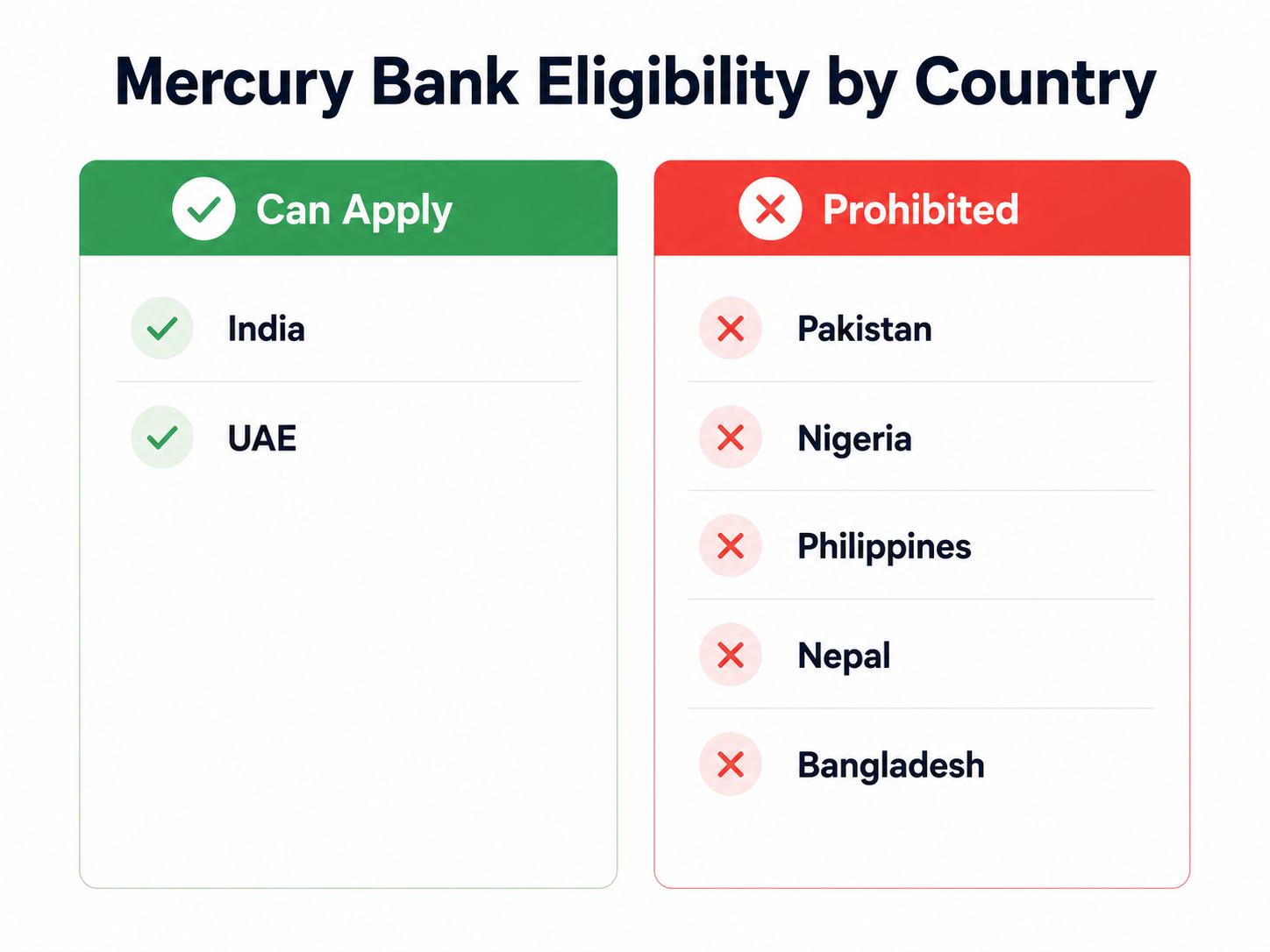
Banking access depends on your nationality, not your LLC’s state. According to Mercury’s prohibited-countries list (confirmed as of 2026-05-31), founders domiciled in Pakistan, Nigeria, the Philippines, Nepal, and Bangladesh cannot open a Mercury account, no matter which state their LLC is formed in.

Before choosing a state, understand your real constraints: annual costs, federal filing obligations (Form 5472 applies to most single-member foreign-owned LLCs), and which banks will accept you. Our LLC page covers the full formation process for non-residents in detail.

Quick Answer: Best State for a Non-Resident LLC in 2026

Wyoming and New Mexico are the two strongest choices for non-residents.

Wyoming charges a $100 one-time filing fee and a $60 minimum annual report fee, according to the Wyoming Secretary of State (as of 2026). Its name carries stronger recognition with US banks and payment processors.

New Mexico charges a $50 one-time filing fee with no annual report and no ongoing state fee, according to the New Mexico Secretary of State (as of 2026). This makes it the lowest Year-1 cost option, with identical federal tax treatment.

Stripe eligibility is determined by the country where the business is registered, not the state. A US LLC qualifies regardless of formation state, according to Stripe.

If you live in the US, form in your home state to avoid foreign-registration fees.

Last verified: 2026-05-31

As of 2026, non-residents forming a US LLC face two cost-competitive choices: Wyoming ($100 formation fee plus a $60 minimum annual report, per the Wyoming Secretary of State) and New Mexico ($50 formation fee, zero annual report fee, per the New Mexico Secretary of State).

Both states protect member privacy by not requiring public disclosure of member names. Neither formation state affects Stripe or Mercury eligibility those decisions are made at the federal and platform level, not the state level.

Why Non-Residents Choose a Different State Than US Residents

The foreign-registration problem does not apply to non-residents

Most online advice warns about forming an LLC in one state while living in another, that forces US residents to register as a foreign LLC in their home state, doubling fees and paperwork. Non-residents have no US home state. That double-registration problem simply does not exist for them. A founder in Lagos, Karachi, or Manila forms once, in one state, and stops there.

Privacy, not tax savings, is the real driver for non-residents

‘No state income tax’ is the most repeated selling point for Wyoming, Nevada, and South Dakota. For non-residents, it is almost irrelevant. A non-resident-owned LLC with no US-source income owes no US state or federal income tax regardless of which state it forms in. What does matter is privacy. Some states publish member names in public records.

Wyoming and New Mexico do not require public disclosure of member names useful for founders who want ownership kept off searchable databases. If you already have an LLC registered elsewhere and want to take advantage of Wyoming’s privacy protections, How to Move Your LLC to Wyoming walks through the conversion process step by step.

No state eliminates your US federal tax filing obligations

Choosing Wyoming over Delaware does not remove a single federal filing requirement. A foreign-owned single-member LLC with reportable transactions must file Form 5472 (information return for foreign-owned US corporations) plus a pro-forma Form 1120, according to the IRS  regardless of state. A multi-member LLC files Form 1065 (partnership return), due March 15 with an extension to September 15, per IRS rules.

One common confusion: FBAR (FinCEN Form 114) requires US persons to report foreign financial accounts. Non-resident owners of US LLCs are not US persons  FBAR does not apply to them.

On BOI (Beneficial Ownership Information reporting: according to FinCEN’s interim final rule effective March 26, 2025, US-formed LLCs are fully exempt from BOI reporting requirements. Zero filing obligation, zero penalty exposure for domestic entities.

What Non-Residents Should Prioritize When Choosing a State

Annual cost, not just formation cost

The formation fee is only one line in your real budget. Year-1 total, filing fee plus registered agent plus any annual report, is the correct comparison number. A $50 filing fee in New Mexico with no annual report beats a $100 filing fee plus a $60 annual minimum elsewhere, once you add the registered agent cost on top.

Banking compatibility by nationality

Your state choice does not determine which banks will accept you. According to Mercury‘s prohibited-countries list (confirmed 2026-05-31), Mercury prohibits founders domiciled in Pakistan, Nigeria, the Philippines, Nepal, and Bangladesh regardless of which US state the LLC is formed in.

Stripe eligibility works differently: according to Stripe, eligibility is determined by the country where the business is legally registered, not the founder’s nationality. A US LLC qualifies for Stripe whether it is formed in Wyoming or Florida.

Privacy: which states publish member names

Wyoming and New Mexico do not require public disclosure of member names. Delaware does not require it either, but carries a $300 flat annual franchise tax. If privacy matters and you want to minimize ongoing costs, New Mexico or Wyoming is the stronger choice.

Registered agent requirement in every state

Every US LLC must have a registered agent (RA)  a person or service with a physical street address in the state of formation. PO boxes are not accepted in any US state. Third-party RA services typically cost $50–$150 per year; this amount must appear in your total cost calculation.

One overlooked failure point: the IRS Form SS-4 Responsible Party field must name a natural person, not an entity, since 2018. Listing another LLC in that field is the leading cause of EIN (Employer Identification Number, US business tax ID) rejection for non-residents forming multiple LLCs.

Total Year-1 Cost Table: Wyoming vs Delaware vs New Mexico vs Nevada vs Florida

Year-1 LLC cost comparison Wyoming Delaware New Mexico Nevada Florida

No competitor,  including doola, ZenBusiness, Northwest Registered Agent, Bizee, or Firstbase, publishes a complete Year-1 cost including registered agent. This table does.

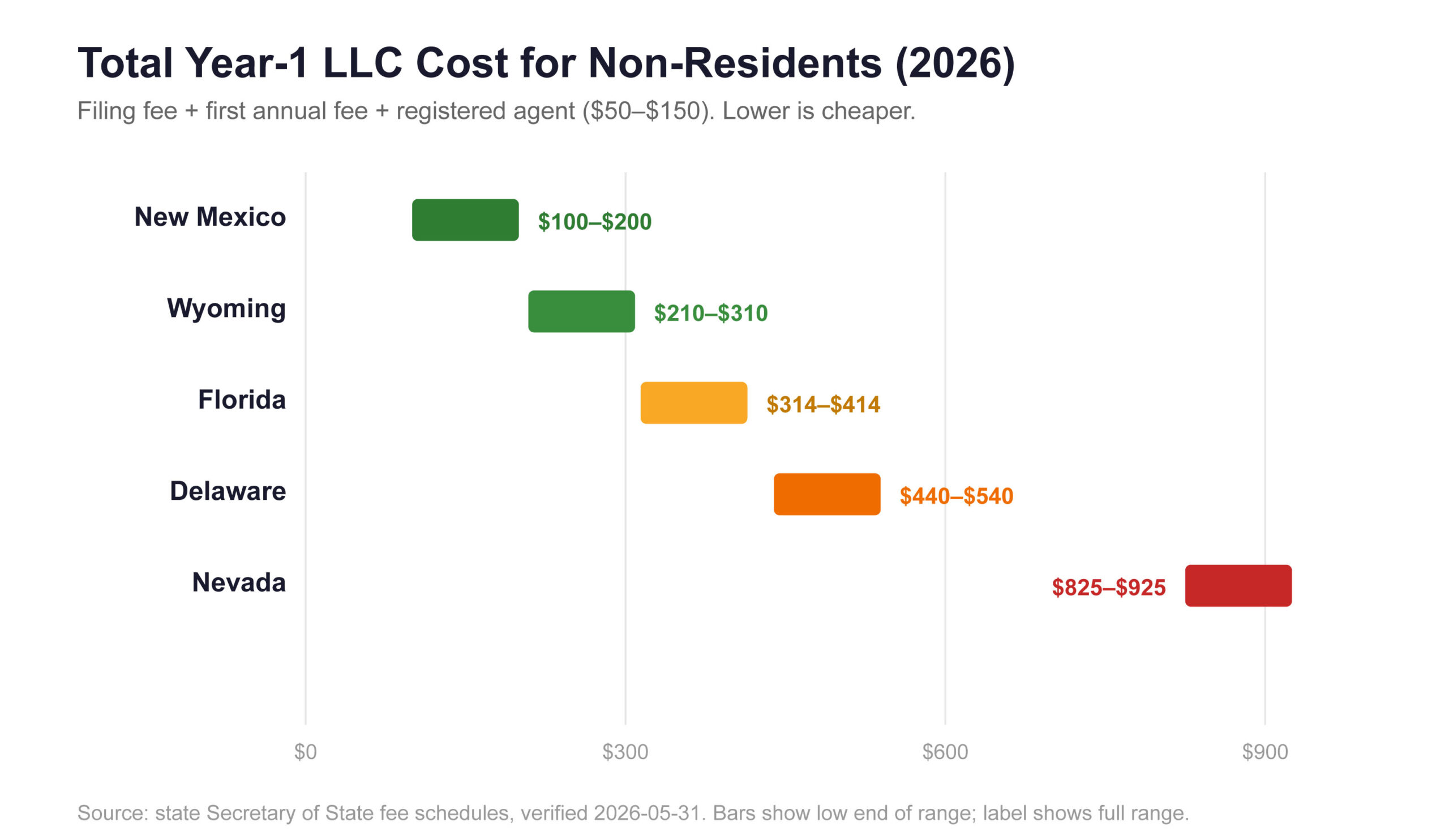
State Formation Fee First Annual Fee* Registered Agent Year-1 Total
Wyoming $100 $60 minimum $50–$150 $210–$310
Delaware $90 $300 franchise tax $50–$150 $440–$540
New Mexico $50 $0 $50–$150 $100–$200
Nevada $425 $350 $50–$150 $825–$925
Florida $125 $138.75 $50–$150 $313.75–$413.75

Last verified: 2026-05-31. State fees per official Secretary of State sources. Registered agent market range: $50–$150/year.

Warning — Delaware hidden cost: Delaware’s $300 annual franchise tax applies every year, regardless of revenue or business activity. Many services that recommend Delaware for non-residents omit this. It is not a one-time fee.

New Mexico has the lowest Year-1 cost of the five states. Its $50 formation fee and zero annual fees make it the most affordable starting point for non-residents watching early costs.

However, New Mexico’s lack of an annual report does not affect Stripe or Mercury eligibility. Both platforms make decisions at the federal level, your EIN and LLC registration matter, not your state’s reporting schedule.

Nevada’s $825–$925 Year-1 total is the highest of the five states. That cost reflects mandatory state business licensing fees on top of formation and annual list requirements, not just filing paperwork.

As of 2026, Nevada is the most expensive commonly recommended state for non-resident LLC formation. According to the Nevada Secretary of State, forming an LLC requires $75 for Articles of Organization, $150 for the Initial List of Managers/Members, and a $200 state business license fee, totaling $425 in Year-1 formation costs alone.

The ongoing annual cost is $350 (Annual List $150 + license renewal $200), making Nevada’s 5-year cumulative cost significantly higher than Wyoming or New Mexico. Nevada does not eliminate a single federal tax filing obligation, including Form 5472 or Form 1065.

How to File an LLC as a Non-Resident: Step-by-Step

Step 1: Choose your state

Select based on total Year-1 cost, privacy needs, and banking compatibility. Wyoming ($100 filing, $60 annual minimum) and New Mexico ($50 filing, no annual fee) work best for most non-residents. Delaware ($90 filing, $300 annual franchise tax) makes sense only if you plan to raise venture capital from US investors.

Step 2: Appoint a registered agent

Every US LLC needs a registered agent, a US-based person or company that receives legal documents on your behalf. A physical street address in your formation state is required. PO boxes are not accepted in any US state. Budget $50–$150 per year for this service.

Step 3: File your Articles of Organization

File directly with the state. Fees: New Mexico $50, Wyoming $100, Delaware $90, Florida $125, Nevada $425 total (articles + initial list + state business license). New Mexico has no annual report. Nevada has the highest Year-1 cost of these five states. If Florida’s combination of low formation cost and strong banking infrastructure appeals to you, How to Form an LLC in Florida covers the full filing process for non-residents.

Step 4: Obtain your EIN from the IRS

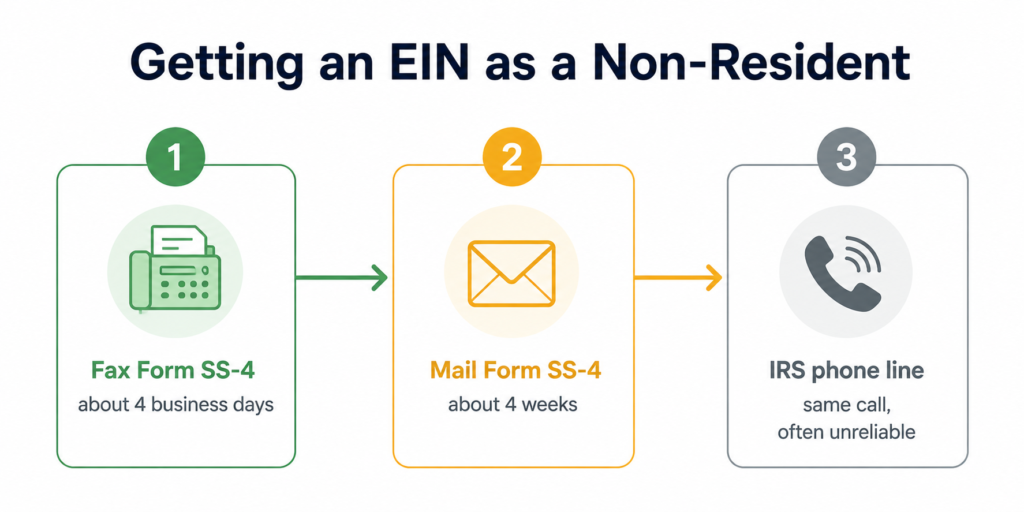
An EIN (Employer Identification Number, your US business tax ID) is free directly from the IRS. According to the IRS, non-residents without a Social Security Number cannot use the online application. Three options exist:

– Fax Form SS-4 with a return fax number: EIN returned in approximately 4 business days
– Mail Form SS-4: approximately 4 weeks
– Phone at 267-941-1099, Monday–Friday 6 a.m.–11 p.m. Eastern: EIN issued during the call, but line congestion and disconnects are common  fax is more reliable

Getting an EIN as a non-resident: fax SS-4 about 4 business days, mail about 4 weeks, IRS phone line unreliable

An ITIN (Individual Taxpayer Identification Number) is NOT required to form an LLC or get an EIN. Formation services charge only for the labor of obtaining your EIN,  the IRS charges nothing.

Step 5: Open a US business bank account

According toMercury‘s prohibited-countries list (confirmed 2026-05-31), founders domiciled in Pakistan, Nigeria, Philippines, Nepal, or Bangladesh cannot open a Mercury account. Wise Business is the primary alternative for those founders. Wise accepts applications with an EIN, subject to enhanced KYC approval is not guaranteed and verification can take days to weeks.

Founders from India and the UAE may apply to Mercury under standard KYC review.

Step 6: Meet annual compliance obligations

Zero US tax does not mean zero filing. According to the IRS:

– Single-member LLC: File Form 5472 attached to a pro-forma Form 1120 if reportable transactions exist. Failure to file carries a $25,000 penalty per form per year under IRC Section 6038A,  with no maximum cap after 90 days.
– Multi-member LLC: File Form 1065 plus a Schedule K-1 per partner, due March 15, extendable to September 15.

Capital contributions and distributions between you and your LLC count as reportable transactions. Many founders miss this.

Country-Specific Guidance: Banking and Stripe Access by Nationality


Which US State for Your LLC? Non-Resident Cost Breakdown

Your state choice does not affect Stripe or Mercury eligibility. Both platforms decide based on founder nationality and business registration country, not Wyoming vs. Delaware.

 India

Mercury does not list India as prohibited (confirmed 2026-05-31); Indian founders may apply subject to standard KYC. According to Stripe, Stripe India moved to invite-only in May 2024. A US LLC gives full USD Stripe access with self-serve signup.

Pakistan

Mercury prohibits Pakistan-domiciled founders, according to support.mercury.com (confirmed 2026-05-31). Wise Business accepts Pakistan-resident owners of US LLCs with an EIN, subject to enhanced KYC approval is not guaranteed. Stripe is not directly available to Pakistan-registered businesses; a US LLC is the standard route.

Pakistan was removed from the FATF grey list in October 2022, per fatf-gafi.org  Mercury’s prohibition is an internal platform policy, not an OFAC requirement.

Nigeria

Mercury  prohibits Nigeria-domiciled founders (confirmed 2026-05-31). According to wise.com, Wise Business generally accepts Nigeria-resident owners of US LLCs with an EIN, subject to enhanced KYC; address and business-evidence scrutiny is reportedly strict.

Nigeria was removed from the FATF grey list on October 24, 2025, per fatf-gafi.org, Mercury’s ban remains an internal policy decision. Stripe does not directly support Nigerian-registered businesses; a US LLC gives full USD Stripe access.

 Bangladesh

Mercury prohibits Bangladesh-domiciled founders (confirmed 2026-05-31). Wise Business is available subject to KYC review. Stripe is accessible via a US LLC.

Philippines

Mercury prohibits Philippines-domiciled founders (confirmed 2026-05-31). According to wise.com, Wise Business accepts Philippines-resident owners subject to standard KYC. Wise operates fully in the Philippines , local account and card since May 2024, making it the strongest banking path for Filipino founders. Stripe is accessible via a US LLC.

South Africa, Kenya, Mexico, Colombia

Stripe is accessible via a US LLC for founders in all four countries. Wise Business is available subject to KYC review. Confirm current Mercury eligibility at mercury.com/help/prohibited-countries before applying , these countries are not on Mercury’s confirmed prohibited list as of 2026-05-31, but Mercury’s list changes.

Important note on Wise KYC: Wise may require an official IRS EIN confirmation document,  CP575, 147C, or IRS-stamped SS-4. An EIN number alone may not satisfy Wise compliance review.

Mercury prohibited-countries data last verified: 2026-05-31.

As of 2026, founders domiciled in Pakistan, Nigeria, the Philippines, Nepal, and Bangladesh cannot open a Mercury business bank account, according to Mercury’s prohibited-countries policy Mercury, confirmed 2026-05-31). This restriction applies regardless of which US state the LLC is formed in  a Wyoming LLC and a New Mexico LLC face identical Mercury eligibility outcomes.

Wise Business is the primary US banking alternative for founders in these countries, accepting applications with a valid EIN (Employer Identification Number) subject to enhanced KYC review. Approval is not guaranteed.

What Most State Comparison Guides Don’t Tell You

Most state comparison guides pick a winner based on filing fees alone. The real differences are smaller — and some popular claims are simply wrong.

New Mexico: lowest cost, same Stripe and banking access

New Mexico has no annual report and no ongoing state fee. That is a genuine, permanent cost advantage. But some guides imply this affects your banking or payment options, it does not. According to Stripe, Stripe eligibility is determined by where the business is registered, not which state. Mercury and Stripe make decisions at the federal and platform level. No state gives you better Stripe access than another.

Delaware: investor credibility has a real annual cost

According to corp.delaware.gov, Delaware charges a flat $300 annual franchise tax every year, regardless of whether your LLC earns a single dollar. That cost recurs indefinitely. Delaware’s investor reputation matters only if you plan to raise US venture capital. Most non-resident founders running online businesses will never need it.

Nevada: high fees, limited upside for non-residents

According to nvsos.gov, Nevada costs $425 to form and $350 per year ongoing  the highest of any commonly recommended state. Guides often claim Nevada ‘does not share data with the IRS.’ That is misleading. Federal tax obligations  including Form 5472 and Form 1065  apply regardless of which state you form in. Nevada does not eliminate a single federal filing requirement.

Non-residents cannot elect S-corp status in any state

According to irs.gov, an S-corporation requires all shareholders to be US persons. Non-resident owners cannot make this election in any US state. Your options are the default pass-through treatment  disregarded entity or partnership  or a C-corp election. No state changes this rule.

Frequently Asked Questions

Does the state I choose affect my Stripe or Mercury access as a non-resident?

No. According to Stripe, Stripe eligibility depends on the country where the business is registered  the US  not which state. Mercury eligibility depends on the founder’s country of domicile, not the state of formation. A Wyoming LLC and a Delaware LLC give identical Stripe and Mercury access.

Can I open a Mercury account if I am from Pakistan, Nigeria, or Bangladesh?

No. According to support.mercury.com (confirmed 2026-05-31), Mercury prohibits founders domiciled in Pakistan, Nigeria, Bangladesh, the Philippines, and Nepal regardless of which US state the LLC is formed in.

Wise Business is the primary alternative — it accepts founders from these countries with an EIN (Employer Identification Number  the LLC’s federal tax ID), subject to enhanced KYC review. Approval is not guaranteed.

Do I need to file a BOI report for my US LLC as a non-resident owner?

No. According to FinCEN, under FinCEN’s interim final rule effective March 26, 2025, US-formed LLCs owned entirely by non-residents are exempt from BOI (Beneficial Ownership Information) reporting. Only LLCs formed under foreign law and registered to do business in a US state must file. Verify current status at fincen.gov before assuming this exemption applies.

What is the difference between an EIN and an ITIN, and which do I need first?

An EIN (Employer Identification Number) is the LLC’s 9-digit federal tax ID, required to open a US bank account and activate Stripe. An ITIN (Individual Taxpayer Identification Number) is your personal tax ID as the owner. According to irs.gov, an ITIN is not required to form an LLC or obtain an EIN, but may be needed later to file a US personal tax return (Form 1040-NR).

How long does it take to get an EIN as a non-resident without an SSN?

According to irs.gov, non-residents without an SSN cannot use the IRS online application. Faxing Form SS-4 with a return fax number takes approximately 4 business days. Mailing takes approximately 4 weeks. Calling the IRS international line at 267-941-1099 can produce an EIN during the call, but line congestion and disconnects are common, fax is the more reliable path. An EIN is free directly from the IRS.

Does New Mexico’s lack of an annual report mean lower banking credibility?

No. Mercury and Stripe make eligibility decisions at the federal and platform level, not the state level. A New Mexico LLC has identical banking and payment processing access to a Wyoming or Delaware LLC. Skipping the annual report reduces your ongoing costs, it does not signal lower legitimacy to US banks or payment processors.

What tax forms does a non-resident-owned single-member LLC need to file?

According to irs.gov/instructions/i5472, a foreign-owned single-member LLC must file Form 5472 attached to a pro-forma Form 1120 annually if it had reportable transactions including capital contributions or distributions. Failure to file carries a $25,000 penalty per form per year under IRC Section 6038A. Zero US tax does not mean zero filing obligation.

Can I elect S-corp status for my US LLC as a non-resident owner?

No. According to irs.gov, S-corp status requires all shareholders to be US persons. Non-resident owners cannot make an S-corp election in any US state. Non-residents are limited to the default pass-through treatment  disregarded entity for single-member LLCs, partnership for multi-member LLCs  or a C-corp election.

Is Wyoming or New Mexico better for a non-resident with no US income?

New Mexico has the lower Year-1 cost: $50 to form, no annual fee. Wyoming costs $100 to form plus a $60 minimum annual report fee. Both states offer member privacy and identical federal tax treatment. With no US-source income, neither state imposes state-level tax, but federal information filing obligations (Form 5472 for single-member LLCs, Form 1065 for multi-member LLCs) still apply regardless of state.

I am from India, can I use Mercury and Stripe with a US LLC?

Yes. According to support.mercury.com (confirmed 2026-05-31), India is not on Mercury’s prohibited-countries list — Indian founders may apply subject to standard KYC. According to Stripe, Stripe India moved to invite-only in May 2024, but a US LLC gives full USD Stripe access with self-serve signup regardless of where the founder lives.

What is FBAR and does it apply to me as a non-resident owning a US LLC?

FBAR (FinCEN Form 114) requires US persons to report foreign financial accounts exceeding $10,000. As a non-resident owner of a US LLC, you are not a US person, FBAR does not apply to you. FBAR is frequently confused with BOI reporting, which is also currently exempt for US-formed LLCs under FinCEN’s interim final rule effective March 26, 2025.

Should I choose Wyoming or South Dakota for a non-resident LLC?

Wyoming is the stronger choice for non-residents. Wyoming charges $100 to form and $60 per year minimum, per the Wyoming Secretary of State (as of 2026). South Dakota charges $150 to form and $50 per year, per the South Dakota Secretary of State (as of 2026).

Both offer privacy and no state income tax,  but Wyoming has broader name recognition with US banks and payment processors. Neither state changes your federal filing obligations.

 Conclusion

For most non-residents, New Mexico wins on Year-1 cost: $50 to form, no annual fee, no franchise tax. Wyoming ($100 formation, $60/year minimum) is the stronger choice if bank recognition matters to you.

State choice does not affect Stripe or Mercury eligibility. Both are platform-level decisions. According to support.mercury.com (confirmed 2026-05-31), Mercury prohibits founders domiciled in Pakistan, Nigeria, Philippines, Nepal, and Bangladesh, regardless of which state your LLC is formed in.

Federal filing obligations follow you everywhere. Form 5472 and Form 1065 requirements apply no matter which state you choose. Zero tax does not mean zero filing.

Bizstartz forms US LLCs for non-residents in Wyoming, Delaware, or New Mexico. The Basic plan starts at $199 + state fees. The Pro plan ($299 + state fees) includes EIN filing via Form SS-4 on your behalf. No SSN, US address, or travel required.


Is it Possible to Open a PayPal Business Account for Non-Residents

It’s 2023, and digital payment options are the backbone of international trade. As such, having an e-payment solution is critical for entrepreneurs, especially those operating internationally.

Every business owner today, including freelancers in India, eCommerce merchants in Nigeria, and even agency owners in Brazil, needs to access a reliable payment system.

Of all the payment systems, PayPal continues to be amongst the most recognized and utilized. But what happens if you’re not a resident of the US? Can you still open a US PayPal Business account?

The answer is yes, PayPal gives this opportunity to everyone, but it comes with having a specific set of requirements. This article will detail everything non-residents need to know in order to legally open a PayPal Business account in the United States.

What are the motivations for non-residents opening a U.S. PayPal Business Account?

Many entrepreneurs outside the US are keen on opening a U.S.-based PayPal Business account for the following reasons:

1. U.S. represents true global trust and credibility.

Many international clients/customers perceive businesses operating from U.S., and having a U.S. PayPal account, as more professional and more trustworthy. Thus, a PayPal Business account located in the U.S. increases legitimacy, and reduces hesitancy for customers making online payments.

2. Access To More Relavant Features

Merchants with a U.S. PayPal account have access to more functions than merchants operating from other countries. Such functions include recurring billing, shop integrations with Shopify and WooCommerce, developer API integration, and simplified payment receiving.

3. Access To Higher Account Limit

Most non US PayPal accounts have very low initial limits, or are very easy to flag for “suspicious activity”. On the other hand, U.S. PayPal Business accounts are known for offering higher limits on sending, receiving, and withdrawal after going through the verification process.

4. PayPal Accounts Eliminate Extra Fees

Generally, business U.S. PayPal accounts incur also significantly lower transaction fees, especially on payments made in United States dollars, or for funds linked via a U.S. business bank account. This difference can result in considerable savings over time due to lower operating costs.

5. Connecting Other Financial Tools With PayPal

There are multiple platforms such as Stripe, Square, Amazon, and Etsy that require US PayPal or Bank accounts, or would work better with one. A U.S. PayPal Business account opens opportunities to connect your business with some of the most advanced U.S. services and platforms.

Is It Really Possible for Non-Residents to Open a U.S. PayPal Business Account?

Yes. It is indeed possible for non-U.S. residents to legally open a PayPal Business account. However, they cannot do so as individuals. You will need to set up a U.S business with the appropriate documents and ensure that PayPal can verify your identity and your business.

PayPal enforces rigorous KYC (Know Your Customer) and AML (Anti-Money Laundering) rules. That means your account must meet U.S. compliance standards irrespective of your nationality.

This is very possible, and non-resident business people achieve this every year as long as they follow the right procedures.

What You Need: Requirements for Non-Residents

Paypal Business Account

This is a comprehensive checklist of requirements that you need to open a PayPal Business account as a non-resident:

1. Form a U.S. Company (LLC or Corporation)

The first step is to formally incorporate a business in the U.S, which is usually a Limited Liability Company (LLC). You do not have to reside in the U.S. to possess a U.S company. States like Delaware, Wyoming and New Mexico are especially welcoming to non-resident incorporators.

  • Delaware is known for its expeditious processing of LLCs (Limited Liability Companies) as well as it’s wide array of business friendly laws.
  • Wyoming’s claim to fame is the anonymity it provides as well as low annual fees.
  • New Mexico is a cost-effective state that does not need annual report filings.

The next step after forming a business entity is the issuance of Articles of Organization, which serves as evidence of the business’s existence.

2. Obtaining an EIN or Employer Identification Number (EIN)

The business equivalent of a Social Security Number, an EIN, is issued by the Internal Revenue Service (IRS). The following require an EIN:

  • Opening a U.S. business bank account.
  • Filing taxes, even if the amount is zero.
  • Registering for business accounts with Paypal and Stripe.

Foreign business owners can submit applications by fax, postal mail, or through a service provider. This process can be expedited by Bizstartz.

3. USPS Business Address

A physical office is not a requirement. A virtual business address, or that of the registered agent in the state of formation, is sufficient. This address will be used for all official business communication and for verifying the business with Paypal.

Note: Avoid using PO boxes. PayPal typically requires that a real street address be used, as opposed to a PO box.

4. Needed US Phone Number Services

A US phone number is required to set up two factor authentications, for notification from PayPal, and for customer service communications. Services where you can acquire numbers are:

  • Google Voice (when used with VPN)
  • VoIP providers like Grasshopper also provide phone numbers.
  • Skype Number
  • Twilio

5. US Business Bank Account

To withdraw funds from PayPal, a US checking account is mandated. Fintech companies such as:

allow non residents to open business accounts without having to step foot in the US. Free of charge, these firms, along with others, provide business bank accounts that are backed by the FDIC and have seamless payment integration with PayPal.

6. ID of Government with Validity

To validate your identity on PayPal, some form of accountable identification is needed. Usually a passport or a drivers license or a national identification issued by the country of one’s residence suffices.

Identification must bear name of profile in PayPal with no changes at all.

Step-by-Step Guide: How to Open a U.S. PayPal Business Account as a Non-Resident

This is the sequence crafted within the preceding steps in order to attain the goal:

Step 1: Build Your Company Based in The States

Settle on a state like Delaware or Wyoming then proceed to draft Articles of organization go solo or enlist the assistance of formation companies like Bizstartz who do the paperwork along with compliances for you.

Step 2: Apply for Your EIN

Once your LLC is set up, apply for your EIN with the IRS. Currently, processing with fax applications takes anywhere from 2-5 weeks, while filing agents can expedite this to 1-3 business days.

Step 3: Open a U.S. Business Bank Account

With your EIN, you can now obtain a business checking account from a digital bank like Mercury or Relay, which supports foreign owners. This account will be connected to your PayPal for withdrawal purposes.

Step 4: Register for PayPal Business

Go to paypal.com and do the following:

  • Choose “United States” from the dropdown menu.
  • Type in your business name in the U.S along with the EIN and business address.
  • Input your phone number and email associated with the U.S.
  • Fill in your personal details (Full name, country of citizenship, passport ID).
  • Choose your payment preferences and finish the first verification steps.

Step 5: Submit Verification Documents

These documents will most likely be requested by Paypal:

  • Articles of Organization (proof of business)
  • EIN confirmation letter (Form CP 575)
  • Valid ID (passport)
  • Proof of address (utility bill, lease, or virtual office confirmation)

You will be able to submit these documents over the PayPal Resolution Center once you are prompted.

Step 6: Link Your U.S. Bank Account

Once your account has been confirmed, move to ‘Wallet‘ and select ‘Link a Bank Account‘ to add your U.S. business account. As a means of verification, PayPal will initiate two nominal payment deposits.

Common Problems Non-Residents Face (And How to Avoid Them)

1. Knowing Payment Verification

It is possible that PayPal does take some time to review documentation. It is wise to submit clear scans, complete all processes, and align your documents with your business as well as ID records.

2. Limitation Of Accounts

PayPal has the right to place a hold on an account if they believe that large transactions are being processed or some documents do not align during the initial stages. One way to mitigate this risk is to begin transacting on a more intimate level that allows for the building of trust.

3. Misinformation

Make sure that the name of the business, its address, the EIN and banking information is the same on PayPal, the bank, as well as on the documents used to set the business up.

4. Unsupported Regions

If you are from a high-risk region or PayPal banned region such as (Iran, North Korea and certain parts of Africa) you could face restraining obstacles. Nevertheless, if you form a U.S compliant company with compliant documents this gives you a way to facilitate the legal opening and business management.

Alternatives If PayPal Isn’t an Option in Your Country

If you’d like alternatives as to how to deal with PayPal not being an optional tool in your region, I suggest:

  • Stripe Atlas: Incorporate your U.S. company and gain access to Stripe’s payment gateway.
  • Payoneer: Offers global payment solutions and integrates with Amazon, Fiverr, and other platforms.
  • Wise Business: Allows local currency withdrawals from USD with low conversion fees.
  • Revolut Business: Operates in Europe and globally, offering multi-currency accounts.
  • Skrill: E-wallet alternative with more accessible country restrictions.

paypal business

Final Thoughts

It’s 100% feasible to start a non-residents’ PayPal Business account, but the process isn’t casual or quick.

Creating a legitimate U.S. business, compiling appropriate documents, and ensuring compliance with PayPal’s procedures have to be meticulously followed.

Nevertheless, you’ll have powerful tools after the setup: sending, receiving, and managing payments internationally under a trusted U.S. business brand.

Want to Skip the Hassle?

At Bizstartz, we assist clients in forming U.S. companies, obtaining EINs, opening business bank accounts, and setting up compliant PayPal Business accounts for entrepreneurs worldwide.

From freelancers and startup founders to e-commerce sellers, we can guide you through every step.

👉 Start your U.S. business journey with Bizstartz today!

Get Started Now

How to Open a Stripe Account as a Non-US Resident (2026 Guide)

Stripe determines eligibility by the country where your business is legally registered, not your nationality or where you live. A US LLC (Limited Liability Company a flexible US business structure) is US-registered, so it qualifies for Stripe regardless of the founder’s passport.

Forming a US LLC costs as little as $50 in state filing fees in low-cost states like New Mexico and Wyoming (fees vary widely by state, Texas charges $300). You then obtain a free EIN (Employer Identification Number,  your business’s federal tax ID) from the IRS via fax in roughly 4 business days. Add a US bank account for payouts, and your Stripe account is ready to activate.

Everything from LLC formation to banking falls under the Bank Account category of decisions you’ll need to work through as a non-resident founder.

Founders from India, Pakistan, Nigeria, the Philippines, and the UAE all use this same pathway. The registration country  not your home country, is what Stripe checks.

According to Stripe’s support documentation, US Stripe account eligibility is determined by the country where a business is legally registered, not where the founder lives or holds citizenship.

A US LLC (Limited Liability Company), registered in the United States, qualifies for a US Stripe account regardless of whether the owner resides in India, Pakistan, Nigeria, the Philippines, or the UAE. As of 2026, Stripe’s global availability page at Stripe is the only authoritative source for supported countries.

Can Non-US Residents Use Stripe?

Stripe determines account eligibility by the country where the business is legally registered, not where the founder lives. A US LLC registered in the United States qualifies for Stripe regardless of whether the owner lives in Lagos, Karachi, Manila, or Dubai.

This is the gap Stripe’s own support page creates. Stripe states that unregistered businesses need a physically present US owner. It does not explain that a registered US LLC removes that requirement entirely for non-residents.

What You Do Not Need

You do not need a US visa, a US address, or physical presence in the United States. You do not need an SSN (Social Security Number) or an ITIN (Individual Taxpayer Identification Number) to open a Stripe account on a US LLC. If you’re unfamiliar with the ITIN and how it differs from an EIN, What is an ITIN Number breaks down the distinction clearly.

What you do need:

– A verified EIN (Employer Identification Number,  the 9-digit federal tax ID issued by the IRS). According to Stripe, a  verified EIN is required to fully activate payment processing on a US LLC account.
– A US bank account for payouts
– A valid government-issued ID

For founders in markets where Stripe is unavailable or restricted locally, including Pakistan, Nigeria, and India, a US LLC is the standard route to full USD Stripe access. Always verify current supported countries at Stripe, as Stripe updates that list without notice.

Step-by-Step: How to Open a US Stripe Account as a Non-US Resident

Stripe Account

Step 1: Form a US LLC

Any non-US resident can legally own a US LLC. No citizenship or US residency is required, and the entire process is done remotely.

Choose your state based on cost. Wyoming costs $100 to file and $60 per year minimum. Delaware costs $90 to file and $300 per year in flat franchise tax. New Mexico costs $50 to file with no annual report and no ongoing state fee.

Every LLC must have a Registered Agent, a US-based person or company with a physical street address in the formation state. PO boxes are not accepted in any state. Bizstartz  handles LLC formation and EIN filing for non-residents the How to Open a US Business Bank Account from Nepal guide shows how the full setup works end-to-end for founders outside the US.

Step 2: Obtain Your EIN from the IRS

An EIN (Employer Identification Number, your US business tax ID) is free directly from the IRS. Non-residents without an SSN cannot use the IRS online application. Use Form SS-4 instead.

Three methods exist: By fax with a return fax number: approximately 4 business days. By mail: approximately 4 weeks. By phone at 267-941-1099, Monday–Friday 6 a.m.–11 p.m. Eastern: EIN issued during the call, but line congestion is common. Fax is the most reliable method for non-residents.

Note: the CP-575 paper confirmation letter arrives separately by mail 2–6 weeks later. That letter is not the EIN itself,  the EIN is valid as soon as the IRS issues it.

According to the IRS, non-residents applying for an EIN (Employer Identification Number) cannot use the IRS online portal that tool requires an SSN (Social Security Number). As of 2026, non-residents must apply via Form SS-4 by fax (approximately 4 business days with a return fax number), by mail (approximately 4 weeks), or by the IRS international phone line at 267-941-1099, Monday–Friday 6 a.m.–11 p.m. Eastern.

The EIN is free; formation services charge only for the labor of filing on your behalf.

Step 3: Open a US Business Bank Account

Stripe requires a US bank account for payouts. Two primary options exist for non-residents.

Mercury requires an EIN and LLC, no SSN needed, but prohibits founders domiciled in Nigeria, Pakistan, and the Philippines, among others. Wise Business requires an EIN and LLC, with a one-time fee of approximately $31 for US routing and account numbers. Section 4 covers country-specific restrictions in full.

Step 4: Create and Verify Your Stripe Account

Sign up at Stripe using your LLC’s legal name, EIN, and US bank account details. Stripe requires a verified EIN to fully activate payment processing. Complete Stripe Identity verification if prompted.

One compliance note: according to FinCEN, US-formed LLCs   including those owned by non-residents,  are currently exempt from BOI (Beneficial Ownership Information) reporting under the interim final rule effective March 26, 2025. BOI is the federal disclosure requirement for business ownership; FinCEN is the US Treasury bureau that enforces it.

What It Costs to Form a US LLC for Stripe Access

State filing fees start at $50 in low-cost states, but vary widely, Texas charges $300, Massachusetts $500. Annual ongoing costs differ by as much as $250 per year between the popular non-resident states a difference that compounds permanently.

State Filing Fees and Annual Costs Compared

State One-Time Filing Fee Annual State Fee Annual Report Required Registered Agent Required
Wyoming $100 $60 minimum Yes Yes
Delaware $90 $300 flat franchise tax No Yes
New Mexico $50 None No Yes

According to sos.nm.gov, New Mexico charges $50 to file and nothing ongoing  the lowest total cost for non-residents who want to keep annual overhead minimal. According to sos.wyo.gov, Wyoming charges $100 to file plus a $60 minimum annual fee.

According to Corp.delaware.gov, Delaware charges $90 to file but a flat $300 franchise tax every year.

Delaware’s prestige rarely benefits a solo non-resident founder using Stripe. New Mexico or Wyoming covers the same use case for far less.

EIN, Registered Agent, and Service Fees

An EIN (Employer Identification Number, your LLC’s federal tax ID) is free when you obtain it directly from the IRS. Formation services charge only for the labor of obtaining it on your behalf.

Every state requires a registered agent,a US-based person or service that receives legal documents for your LLC. Third-party registered agent services typically run $50–$150/yr; verify current pricing with specific providers before committing.

Bizstartz plans (all prices plus state fees):

Basic  $199: LLC formation and EIN obtainment
Pro  $299: Adds registered agent service for year one
Premium $699: Full-service formation

👉 Click here to launch your U.S. company and Stripe account now

Stripe

First-year cost examples:
– New Mexico via Basic: $199 + $50 state filing + registered agent fee
– Wyoming via Pro: $299 + $100 state filing = $399 total (registered agent included year one)

Banking Options for Your US Stripe Account

Stripe requires a US bank account to receive payouts, this is a hard requirement, not a preference. Your choice of bank does not affect Stripe eligibility. According to Stripe, Stripe eligibility is determined by where the business is legally registered, not by the founder’s nationality or banking provider.

Provider FDIC Status SSN Required Prohibited Countries Key Requirement
Mercury FDIC insurance through partner banks (Choice Financial Group & Column N.A.) No Pakistan, Nigeria, Philippines, Nepal, Bangladesh US LLC + EIN
Wise Business Not FDIC-insured; funds are safeguarded in segregated accounts No Generally accepts Pakistan, Nigeria, and Philippines subject to enhanced KYC review US LLC + EIN + one-time setup fee (varies by country)
Relay FDIC insurance through Thread Bank No Check current eligibility requirements directly with Relay US LLC + EIN
Brex Cash accounts offered through partner institutions; not a traditional FDIC-insured business checking account No N/A US LLC + EIN + at least one US-based founder, executive, or investor

Mercury: Best for Most Non-Residents

Mercury is a fintech, not a bank  deposits are FDIC-insured (Federal Deposit Insurance Corporation) through partner banks Choice Financial Group and Column N.A. Mercury requires a US LLC plus an EIN (Employer Identification Number your US business tax ID). No SSN is needed.

However, Mercury prohibits founders domiciled in Pakistan, Nigeria, Philippines, Nepal, and Bangladesh, confirmed as of May 31, 2026, per Mercury . Declines are often permanent. Mercury does not list India or UAE as prohibited; founders from those countries may apply under standard KYC (Know Your Customer identity verification).

As of May 31, 2026, according to Mercury, Mercury prohibits account applications from founders domiciled in Pakistan, Nigeria, Philippines, Nepal, and Bangladesh. Mercury requires a US LLC and EIN (Employer Identification Number), no SSN is needed.

Deposits are FDIC-insured through partner banks Choice Financial Group and Column N.A. Founders from India and the UAE are not listed as prohibited and may apply under standard KYC review.

Wise Business: Best When Mercury Is Unavailable

Wise is a licensed MSB (Money Services Business), not a bank. Standard balances are safeguarded in segregated accounts and are not FDIC-insured by default, according to wise.

Activating US routing and account numbers costs a one-time fee of approximately $31 USD. According to wise.com, Wise accepts Pakistan, Philippines, and Nigeria residents subject to enhanced KYC, approval is not guaranteed.

Wise may require an official IRS EIN confirmation document (CP575, 147C, or IRS-stamped SS-4) during verification. The EIN number alone may not satisfy compliance review.

Relay and Brex: Additional Context

Relay holds deposits at Thread Bank (FDIC-insured) and offers multi-account features, a solid additional option for non-residents. Brex requires at least one US-based founder or investor; most non-resident sole owners do not qualify.

Stripe Availability by Country: What Non-Residents Need to Know

Stripe eligibility is determined by where your business is legally registered  not where you live. That single rule explains why founders across South Asia, Africa, and the Middle East form US LLCs to access Stripe.

South Asia: India, Pakistan

India-registered businesses moved to invite-only in May 2024, according to Stripe . Self-serve signup is unavailable. Local Indian Stripe accounts are INR-only with restricted features. A US LLC gives full USD Stripe access. Mercury does not list India as prohibited  India-domiciled founders may apply subject to standard KYC.

Pakistan is a starker constraint. According to Stripe , Stripe is not officially available to Pakistan-registered businesses. A US LLC is the standard route to full USD Stripe.

Note: Mercury prohibits Pakistan-domiciled founders (confirmed 2026-05-31), so Wise Business becomes the primary banking path alongside that US LLC. For e-commerce founders specifically, understanding whether Do I Need an EIN for Dropshipping applies to your business model is a useful next step before setting up Stripe.

According to Stripe, Stripe is not available to Pakistan-registered businesses as of 2026. Stripe moved India-registered businesses to invite-only in May 2024, making self-serve signup unavailable; local Indian accounts are INR-only with restricted features.

Founders from both countries use a US LLC as the standard route to a fully functional USD Stripe account. Mercury prohibits Pakistan-domiciled founders (confirmed May 31, 2026, per Mercury ); Wise Business is the primary banking alternative for Pakistan-resident LLC owners.

Africa: Nigeria

According to Stripe, Stripe does not directly support Nigerian-registered businesses. In-country access runs through Paystack, which Stripe owns, but Paystack is not a USD Stripe account. A US LLC gives full USD Stripe. Mercury also prohibits Nigeria-domiciled founders (confirmed 2026-05-31), making Wise Business the primary banking option.

Middle East: UAE

According to Stripe, Stripe is available in the UAE. UAE-registered businesses can use Stripe directly without a US LLC. Mercury does not list UAE as prohibited. A US LLC remains optional, some UAE founders form one for additional banking flexibility with providers like Mercury or Brex, but it is not the access requirement it is elsewhere.

How to Check Your Country’s Current Stripe Status

Stripe updates its supported-countries list without advance notice. Verify your country’s current status at Stripe  that page is the only authoritative source. No third-party article, including this one, should be treated as current for countries not covered above.

Tax and Compliance Obligations for Non-Resident US LLC Owners

Owning a US LLC and accepting payments through Stripe is fully legal for non-residents. Annual compliance obligations apply regardless of whether you owe US tax.

Form 5472: The Filing Non-Residents Miss Most Often

Form 5472 is the compliance obligation that costs non-resident LLC owners the most, not because it is complex, but because it is invisible until the IRS issues a penalty.

According to the IRS, a foreign-owned single-member US LLC must file Form 5472 with a pro-forma Form 1120 annually if there are reportable transactions. Reportable transactions include capital contributions and distributions between the LLC and its foreign owner  not just revenue.

The IRS penalty for failing to file is $25,000 per form per year. An additional $25,000 applies per 30-day period after 90 days from IRS notice, with no maximum cap. A substantially incomplete form counts as failure to file.

Zero US tax does not mean zero filing. Many non-resident founders skip this form because they owe nothing that is the mistake.

According to the IRS, a foreign-owned single-member US LLC must file Form 5472 with a pro-forma Form 1120 annually if reportable transactions occurred  including capital contributions and distributions between the LLC and its non-resident owner.

As of 2026, the IRS penalty for failing to file Form 5472 is $25,000 per form per year, with an additional $25,000 per 30-day period after 90 days from IRS notice and no maximum cap. Zero US-source income does not eliminate this filing requirement.

When You Owe US Tax on Stripe Income

A non-resident-owned US LLC owes US federal income tax only on two income types. The first is ECI (Effectively Connected Income revenue from a US trade or business). The second is FDAP (Fixed, Determinable, Annual, or Periodic income, such as dividends, royalties, or passive US-source payments), which is generally subject to 30% withholding unless a tax treaty reduces it.

According to the IRS, US self-employment tax does not apply to non-resident aliens whose services are performed outside the US. Foreign-sourced income is generally not subject to US federal income tax, though information filings still apply.

If you receive US-source income subject to withholding, you may need to submit Form W-8BEN (for individuals) or W-8BEN-E (for entities) to certify your foreign status and claim any applicable treaty benefit. Stripe may also request a completed Form W-9 Explained in Detail if it needs to verify your US tax classification during account review.

BOI Reporting: Current Exemption Status

According to FinCEN, all US-formed LLCs,  including those owned entirely by non-residents,  are currently exempt from BOI (Beneficial Ownership Information) reporting under the interim final rule effective March 26, 2025. The filing requirement applies only to entities formed under foreign law that register to do business in a US state. A US LLC is a domestic entity and therefore exempt.

This status is subject to change pending FinCEN’s final rule. Consult a qualified US tax professional for your specific circumstances. This section is not legal or tax advice.

Frequently Asked Questions

Can I open a Stripe account without a US Social Security Number?

Yes. A US LLC with an EIN (Employer Identification Number, the 9-digit federal tax ID issued by the IRS) is sufficient. According to the IRS, non-residents without an SSN must apply via Form SS-4 by fax (~4 business days with a return fax number), mail (~4 weeks), or the IRS international phone line at 267-941-1099. The IRS online EIN application requires an SSN and is not available to non-residents.

Does Stripe work for businesses in Pakistan?

Stripe is not available to Pakistan-registered businesses as of 2026, according to Stripe. A US LLC gives a Pakistan-resident founder a fully supported US Stripe account. According to Mercury  (confirmed 2026-05-31), Mercury prohibits Pakistan-domiciled founders. Wise Business is the primary banking alternative, subject to enhanced KYC.

Does Stripe work for businesses in Nigeria?

Stripe does not support Nigerian-registered businesses directly; in-country access is via Paystack (Stripe-owned), which is not a USD Stripe account. A US LLC gives full USD Stripe access. According to Mercury (confirmed 2026-05-31), Mercury prohibits Nigeria-domiciled founders. Wise Business is the primary banking path, subject to enhanced KYC.

How long does it take to get an EIN as a non-resident?

According to the IRS, non-residents applying for an EIN have 3 options. By fax with a return fax number: approximately 4 business days. By mail: approximately 4 weeks. By IRS international phone (267-941-1099, Mon–Fri 6 a.m.–11 p.m. Eastern): potentially the same day, but line congestion and disconnects are common. Fax is the most reliable method for non-residents.

What bank account do I need for Stripe payouts as a non-resident

Stripe. requires a US bank account for USD payouts. Mercury  (EIN + LLC, no SSN required) and Wise Business (EIN + LLC, ~$31 one-time fee for US account details) are the primary options. According to support.mercury.com (confirmed 2026-05-31), Mercury prohibits founders domiciled in Pakistan, Nigeria, Philippines, Nepal, and Bangladesh. Wise accepts these countries subject to enhanced KYC.

Is it legal for a non-US resident to own a US LLC and use Stripe?

Yes. According to the IRS and state Secretaries of State, any non-US resident can legally own a US LLC  no citizenship or US residency required, and formation is possible remotely. According to Stripe, Stripe eligibility is determined by where the business is registered, not where the founder lives. Annual compliance obligations apply, including Form 5472 and state fees.

Do I need to file US taxes if I use Stripe through a US LLC?

Filing obligations and tax liability are separate. According to the IRS, a foreign-owned single-member US LLC must file Form 5472 with a pro-forma Form 1120 annually if there are reportable transactions, even with zero US-source income. The IRS penalty for failing to file is $25,000 per form per year, with no maximum cap after a 90-day notice period.

What is the cheapest US state to form an LLC for Stripe access?

New Mexico has the lowest ongoing cost: a $50 one-time filing fee, no annual report, and no annual state fee, according to sos.nm.gov. According to sos.wyo.gov, Wyoming costs $100 to file and $60 per year minimum. According to corp.delaware.gov, Delaware costs $90 to file and $300 per year in flat franchise tax. All three states allow non-resident ownership and remote formation.

Does Stripe work for businesses in India?

According to Stripe, Stripe moved India-registered businesses to invite-only in May 2024; self-serve signup is unavailable and local accounts are INR-only with restricted features. A US LLC gives an India-resident founder full USD Stripe access. According to Mercury (confirmed 2026-05-31), Mercury does not list India as prohibited, India-domiciled founders may apply subject to standard KYC.

What is BOI reporting and does it apply to my US LLC?

BOI (Beneficial Ownership Information) reporting is a federal requirement administered by FinCEN under the Corporate Transparency Act. According to FinCEN, under the interim final rule effective March 26, 2025, US-formed LLCs, including those owned by non-residents, are currently exempt. Only entities formed under foreign law that register to do business in a US state must file.

Conclusion

Stripe eligibility follows where your business is registered, not where you live. A US LLC qualifies regardless of your nationality.

New Mexico costs $50 to form with no annual fee. Wyoming costs $100 to form plus $60 per year. Delaware costs $90 to form plus $300 per year. Your EIN is free from the IRS,  approximately 4 business days by fax.

For banking: as of 2026, Mercury prohibits founders from Pakistan, Nigeria, Philippines, Nepal, and Bangladesh. Wise Business is the primary alternative for those countries. Verify current restrictions at Mercury countries before forming.

File Form 5472 annually if your LLC had reportable transactions. Missing it costs $25,000 per form per year, per the IRS.

Bizstartz forms your US LLC and obtains your EIN, the two things Stripe requires to activate. Basic plan: $199 + state fees. Pro plan: $299 + state fees (includes registered agent service, first year).

How to Start an LLC in Nevada | Step-by-Step Guide

Starting a Limited Liability Company (LLC) in Nevada is ideal for business owners due to the strong privacy that it provides, state tax benefits, and comprehensive asset protection.

Whether you’re a domestic citizen or a non-resident entrepreneur, the Formation Policies of Nevada in conjunction with the legal framework of the state and the nurturing ecosystem for business allow for effortless establishment and growth of new ventures in the state.

This tailored guideline provides an all-inclusive insight into the processes involved in forming an LLC in Nevada with clear instructions pertaining to name selection, post-formation compliance, and other pertinent tasks.

Why form an LLC in Nevada?

Nevada is widely regarded as one of the most favorable regions for doing business due to their absence of vaulted state taxes combined with unparalleled levels of privacy, and great entrepreneurship policies that the state offers.

In detail, the reasoning why the State of Nevada is able to draw in so many new LLC’s during the year.

1. There is no State Income Tax

Along with a handful of other states, Nevada does not levy taxes income or business profit tax on individuals or corporations. A business ultimately gets to pocket a larger portion of its revenue which is beneficialagdagan sa. This proves useful to entities such as LLC’s that file under the owner’s individual tax return.

2. Strong Privacy Protections

In contrast with other states, Nevada does not mandate including the names of members or managers of the LLC in the Articles of Organization. This means you can establish and run your business with a high level of anonymity, particularly beneficial for investors, online entrepreneurs, or public figures who value privacy.

3. Comprehensive Asset Protection Laws

Nevada represents one of the most protective jurisdictions in the United States in relation to personal liability. For instance, as far as charging orders are concerned, they are the only recourse available to creditors seeking to pursue an LLC’s member’s interest. This secures personal properties from business obligations or litigation.

4. Absence of Minimum Capital Requirements

A single founder, side-hustler, or self-funded startups will find it easy to establish a Nevada LLC since there are no capital restrictions.

5. Easy Business Administration

You can design how you want to run your company because a Nevada LLC can either be member-managed or manager-managed. Ownership is also less restrictive, thus allowing any individual, corporation, or even foreign nationals to be members.

6. No Operating Agreement Filing Requirement

In Nevada, you can draft your Operating Agreement and does not have to submit it to the Secretary of State. This gives you the option to privately tailor the internal governance document without worrying about public disclosure.

Step-by-Step Guide to Starting a Nevada LLC

Nevada LLC

Step 1: Select an Appropriate Name for the LLC.

Getting the name right is the first step in your process; it is equally critical for marketing purposes, legal compliance checks, and branding.

🧾 LLC Name Guidelines for the State of Nevada

  • Your LLC name must end with “Limited Liability Company” or the abbreviations “LLC” or “L.L.C.
  • The name must be distinguishable and not deceptively similar to other names in the states’ databases.
  • As with any existing business, terms such as “Bank,” “Insurance,” “Trust,” or “Attorney” cannot be included without explicit licenses or permission.
  • Any misleading references like “federally affiliated” or “state affiliated” should not be present.

🔎 Name Availability Checking Procedures:

By visiting the Nevada Business Name Search Tool, you can easily conduct a name search free of charge.

📌 Optional: Reservation of the Name

If documents cannot be filed immediately, names can be reserved for 90 days at a fee of $25. This helps secure claims over business names while documents are being drafted.

Procedure 2: Designate a Registered Agent in Nevada

A Registered Agent is an individual or business that will accept service of process, legal documents and other government correspondence on behalf your LLC.

✅ Registered Agent Requirements:

  • Possesses a physical street address in Nevada (No P.O. Boxes)
  • Must be reachable during standard working hours
  • Can be a resident or a commercial Registered Agent service

🛡️ Why This Role is Critical:

Inability to keep a Registered Agent continuously may cause problems for your LLC in good standing, missing notices, legal documents, or worse scenario be administratively dissolved. If you don’t have a Nevada address, use of a professional Registered Agent services is necessary.

The average cost of a Registered Agent ranges from $50 to $150 annually and may include compliance and document scanning.

Step 3: Complete the Articles of Organization

These are the documents that legally formalizes your LLC by stating it with the Secretary of State of Nevada.

📝 What to Include in the Articles:

  • Title for your LLC
  • Full legal name and address of the Registered Agent in Nevada
  • Decide if LLC will be managed by members or managers.
  • Full legal name and address of each manager or managing member.
  • Dissolution date if: (i) not perpetual.
  • Purpose of the business (generally optional, but good to have)
  • Include and/or business contact email and physical address.

📤 Filing Methods:

  • Over the Internet using the Nevada SilverFlume Portal.
  • By mail or by hand to:

Secretary of State

202 North Carson Street

Carson City, NV 89701

💵 Filing Fee: $75

Ordinary processing runs 5-7 business days, but can be expedited at an additional cost.

Step 4: Initial List and Apply for a State Business License

Nevada, unlike many other states, requires two additional documents at the time of setup:

📄 Initial Managers or Members List

  • Names and addresses of all managers or members must be provided.
  • Must be completed within 30 days of filing the Articles of Organization.
  • Fee: $150

📜 Application for Nevada State Business License

  • Only needed for most businesses operating in Nevada.
  • Renew annually.
  • Fee: $200

Both documents can be filed online with your Articles of Organization.

🚨 Note Well: Your LLC status will remain inactive until both the Initial List and the Business License fees are submitted and paid.

Step 5: Formulate an Operating Agreement

Although not mandatory, it is sensible for every LLC, particularly those with several members, to draft an Operating Agreement due to its practical value.

📃 Sections to Include in an Operating Agreement:

  • Various ownership interests and their Voting power
  • Responsibilities assigned to members and managers
  • Allocation of income and losses
  • Voting procedures and scheduling of meetings
  • Member addition or removal procedure
  • Exit or dissolution strategy

⚖️ Legal Protection:

An Operating agreement provides proof for the existence of an LLC separate from its owners marking a shield against personal liability. It may also serve as a control device for future disputes among members.

Step 6: Register for an EIN (Employer Identification Number)

Most LLCs are required to obtain an EIN or Federal Tax ID from the IRS.

Tasks Accomplished with an EIN:

  • Set up a United States business bank account.
  • Submit federal tax documents.
  • Request personal credit.
  • Employ staff.
  • Engage with payment management systems such as Stripe and PayPal.

💡 How to Submit an Application:

  • Residents of the US: IRS provides an online application portal that offers immediate access to services (free).
  • Non-Residents of the US: Form SS-4 must be submitted via fax or post. No need for a SSN or ITIN.

Step 7: Set up a Business Bank Account.

Separating personal from business finances helps you utilize legal protections and manage your money in a sophisticated manner.

🏦 Additional Requirements:

  • EIN Confirmation Letter
  • Business Documents
  • A valid passport issued by a government agency or a non-expired identification card
  • A passport or driver’s license issued by the government
  • An invite to a business launch in Nevada.
  • Nevada business license.

Some online banks such as Mercury, Relay and Wise permit international grantees to open accounts without needing them to be physically present in the country. Others prefer that you visit a US branch in person.

Step 8: Maintain Compliance with State Regulations

After forming your LLC, ensure you complete ongoing yearly requirements to maintain good standing.

✅ Ongoing requirements:

1. Update the Annual List of Managers or Members

  • Complete with the anniversary of your LLC registration.
  • Fee: $150

2. Nevada State Business License Renewal

  • Renewed every year.
  • Fee: $200

3. Registered Agent Maintenance

  • Make sure your agents are current and active.

4. BOI Report (FinCEN Requirement)

  • Beginning January 1, 2024, the majority of newly established LLCs will be required to submit a Beneficial Ownership Information (BOI) report to FinCEN within a period of 90 days following the formation of the company.
  • No payment is required to file the documents, but noncompliance incurs fiscal penalties.

5. LLC Capitals and Taxes

  • Though Nevada does not impose an income tax, as a business owner, you will incur federal tax obligations. In addition, you may be required to collect sales tax if you provide taxable goods or services.

🚀 Are You Ready to Start Your LLC In Nevada?

An LLC in Nevada comes with a lot of legal protection, great privacy, and flexibility, although the compliance and paperwork require considerable effort.

In Bizstartz, we help both domestic and foreign clients design and manage their LLCs in Nevada and across USA.

Our all-inclusive package for a Nevada LLC consists of:

✅ Bizstartz helps with forming an LLC in Nevada.

✅ Business License.

✅ Bank Account (U.S Bank) Setup.

✅ Resume agent.

✅ Obtain an EIN (Federal ID).

✅ Filing of the BOI Report.

✅ Drafting the operating agreement.

✅ Assisting with the business license application.

👉 Get Started With Your Nevada LLC Today

📞 Free Consultation With Our Professionals.

Blog CTA

Frequently Asked Questions (FAQs)

Can non-U.S. residents start a Nevada LLC?

Of course. Foreign citizens and corporations can fully own (100%) a Nevada limited liability company (LLC). It is not necessary for you to have a U.S. address, citizenship or residency.

Does a Nevada LLC protect personal assets?

Indeed. One key benefit of a Nevada LLC is the legal entity separation between the business and the owners personal items. Usually, creditors will not have any access to your personal belongings to meet business debts.

Is Nevada more preferable than Wyoming or Delaware?

It depends on your goals:

  • Nevada: Great for privacy, strong asset protection, and no income taxes.
  • Delaware: Ideal for startups planning to raise venture capital.
  • Wyoming: Cheaper than Nevada with similar privacy benefits.

Is it possible to manage a Nevada LLC from another state or even another country?

Absolutely. Your Nevada LLC may be managed from anywhere on the planet. Keep in mind though, if you are doing business in another state, you might have to apply for foreign LLC status in that state.