Bookkeeping Guide for LLC Businesses

Mastering Your LLC Finances: Stay Compliant and Boost Profits

Starting and running a Limited Liability Company (LLC) gives you great perks, like easier taxes, personal asset protection, and the freedom to run your business your way.

Yet to truly tap into these rewards, every LLC-whether owned by U.S. residents or foreign founders-needs to keep neat, honest, and steady money records.

This easy-to-read bookkeeping guide for LLC Businesses walks you through what bookkeeping means for an LLC, why it matters, the best tools, and simple steps to track daily finances so your business thrives for years.

Why Bookkeeping is a Must for LLCs

Bookkeeping is more than busy work; it is the backbone of a strong, money-smart company. When records are kept correctly, LLC owners can see where cash comes from, where it goes, spot room to grow, and meet all the rules set by tax agencies.

Key Reasons Why Bookkeeping Matters:

Legal and Tax Compliance: By law, every U.S. business must keep money records. You need them to file federal and state taxes and to show the IRS or state auditors that everything is above board. Missing or sloppy paperwork can cost you fines and even chip away at the personal liability shield the LLC was meant to give you.

Keeping Your LLC Shield Strong: The phrase limited liability only holds water if you treat your company and your personal money as two separate pools. Solid bookkeeping shows that boundary and keeps your home, car, and savings at a safe distance.

Real-Time Financial Insights: Knowing exactly where your cash stands lets you decide on the fly-whether to hire a new hand, lift prices, or trim a few bills.

Investor and Lender Confidence: Neat, up-to-date records make banks smile, draw in backers, or polish your LLCs image for the sale or merger you secretly dream about.

Tax Deduction Maximization: When receipts sit in a drawer and never make it into the books, legit write-offs vanish and so does extra money you could have kept in your pocket come April.

Choose the Right Bookkeeping Method

Bookkeeping

Before you jot down a sale or pay a bill, pick the system you will use to track every dollar. Your choice shapes how you log income, wire out costs, and talk to the tax folks in the spring.

1. Cash-Basis Accounting

Under this setup, you record a sale once the cash lands in your account and note an expense as soon as the bill gets paid.

Best for: Solo freelancers, tiny LLCs, or any shop that never worries about shelves full of stock.

Pros:

  • Easy enough for the owner to handle without training.
  • Lets you see real cash on hand before chasing big plans.

Cons:

  • Ignores bills that have been invoiced but not yet paid, so profits can look prettier than they really are.
  • That gap may leave you short when planning a payday or asking a lender for a line of credit.

2. Accrual-Basis Accounting

Income shows up on the books as soon as you earn it-even if the customer hasn’t paid-yet and expenses are logged the moment you commit to them.

Best for: Larger LLCs, companies with stock on the shelves, or any venture chasing outside investors.

Pros:

  • Gives a clearer long-term view of how the business is really doing.
  • The IRS expects it from certain kinds of companies.

Cons:

  • Set-up and upkeep can get tricky, so many owners wind up hiring a pro.
  • Bank balances may not match profits because income and costs are recorded on different days.

Pro Tip: Stuck on which system suits you? A good tax adviser can point you in the right direction. Bizstartz offers tailored sessions for U.S. and non-resident LLC owners.

Open a Separate Business Bank Account

The day your LLC gets official approval, open a dedicated company checking account. Its not just a nice-to-have; its crucial for shielding your personal assets and keeping your books tidy.

Why a Separate Bank Account Is Non-Negotiable:

  • Liability Protection: Mix personal and business money, and a judge could ignore the LLC shield and hold you personally responsible for debts.
  • Simplified Bookkeeping: Every business dollar-in and dollar-out lives in one spot.
  • Clean Audit Trail: A stand-alone account makes it easy for you or your bookkeeper to spot deductible expenses and file accurate, stress-free tax returns.
  • Keep a Professional Image: Paying vendors or receiving client payments through a business account boosts your companies credibility and separates personal transactions from business money.

At Bizstartz, we help clients, even those living outside the U.S., open American business accounts with online banks such as Mercury and Relay.

Choose Bookkeeping Software or Hire a Professional

Whether you tackle your own bookkeeping or hire a pro depends on your companies size, how many transactions you process each month, and how comfortable you feel with numbers.

Top Bookkeeping Tools for LLC Owners:

QuickBooks Online: The industry standard used by millions. It handles invoicing, bank reconciliation, payroll, and tax tracking.

Xero: Cloud-based, easy to use, and links with hundreds of other apps-ideal for tech-savvy owners.

Wave Accounting: Free software perfect for solo entrepreneurs and freelancers. It offers simple invoicing and payment tracking.

Zoho Books: Wallet-friendly yet powerful, with automated workflows and built-in tax tools.

FreshBooks: Excellent for service businesses, featuring time tracking and project billing right in the app.

Hiring a Bookkeeper

Bringing in a bookkeeper might feel like another expense, but it can save you hours, headache, and costly mistakes. Consider this route if:

  • You are too busy running your company or chasing growth.
  • Your transactions happen at a fast pace or involve complex entries.
  • You want pro advice when tax season hits or you need clear financial reports.
  • You plan to seek loans, pitch investors, or file with regulators.

Bizstartz has pocket-friendly bookkeeping plans that range from simple monthly reconciliations all the way to complete financial stewardship-ideal for non-resident LLCs.

Key Bookkeeping Tasks for LLCs

Doing a few basic tasks on a steady basis will keep your books tidy and ready for the IRS.

1. Track Income and Expenses

Put every dollar that comes in or goes out into the right slot. Use labels like these to stay organized:

  • Sales income
  • Advertising
  • Rent
  • Office supplies
  • Travel expenses
  • Software subscriptions

Good accounting apps learn your habits, so they sort most items for you after the first few times.

2. Reconcile Your Bank Statements

Do this at least once a month: line up your own records with the statement from your business account. It lets you:

  • Catch mistakes and double entries
  • Spot fake charges or fees you didn’t approve
  • Confirm you really received every client payment

3. Invoice Management

  • Write and send invoices quickly, then keep an eye on bills that are still unpaid.
  • Chase overdue invoices with a polite nudge.
  • Mark each bill as paid as soon as the money lands.

4. Track Accounts Payable

  • Keep a list of every cent your LLC owes, from one-off vendor bills to monthly services, and pay on time to stay friendly and dodge late fees.

5. Manage Payroll (if applicable)

If your LLC has workers or contractors:

  • Run payroll the right way each period.
  • Withhold taxes, then send them to the government on schedule.
  • File all important tax forms (W-2, 1099, and so on).

6. Keep Your Financial Reports Up to Date

These reports show how your business is doing and let you prepare early for tax time:

  • Profit & Loss Statement: Lists income, expenses, and the profit left over.
  • Balance Sheet: Shows what your LLC owns, what it owes, and the owners share.
  • Cash Flow Statement: Tracks cash coming in and going out month by month.

Don’t Forget About Taxes

Bookkeeping and taxes go together. If records are messy, you might pay too much tax-or too little and get hit with fines.

Common Tax Bills for LLCs:

  • Federal Income Tax: By default, single-member LLCs file like sole owners; multi-member LLCs file as partnerships.
  • Self-Employment Tax: Owners who work in the business pay this (currently 15.3% in the United States).
  • State Taxes: Your state may charge income tax, franchise tax, or an annual report fee.
  • Sales Tax: If you sell taxable goods or services, collect and forward sales tax where you have a link.
  • Estimated Taxes: Expect to owe more than $1,000? Pay quarterly estimates so you don’t face penalties.

Bizstartz guides LLC owners, especially founders from abroad, through tricky U.S. federal and state tax rules so they feel secure.

Bookkeeping Tips for LLC Success

  • Schedule Regular Bookkeeping Time: Pick a weekly or monthly block to add new entries and check the big picture.
  • Go Digital: Cloud software cuts paper mess and speeds up every task.
  • Keep All Receipts and Invoices: Snap photos or scan documents, then file them with clear names and tags.
  • Backup Your Records: Save copies in the cloud with services like Google Drive, Dropbox, or OneDrive.
  • Review Reports Monthly: Hunt for patterns, set budgets, and watch profits grow.
  • Stay Informed: Tax rules shift; read updates or lean on pros like Bizstartz.

Final Thoughts

Bookkeeping is more than a box to tick; it shows you where your money comes from and where it goes, helping you spot trouble early. Build that solid base and your business will not only survive but also reach goals you once thought were far away.

Whether you’re a U.S.-based entrepreneur or an international founder with a U.S. LLC, staying on top of your books ensures your business remains compliant, profitable, and scalable.

Need help managing your LLC’s books, filing taxes, or setting up accounting software?
👉 Bizstartz offers expert bookkeeping services tailored to startups, solopreneurs, and non-U.S. residents forming U.S. businesses. Let us handle the numbers—so you can focus on growth.


Top 10 Benefits of Professional Bookkeeping for Your Business

The smart move every founder should embrace

Bookkeeping works like a quiet engine under the hood of every winning company. It keeps day-to-day tasks in line, guards your cash flow, and gives your business the solid ground it needs to expand.

Still, many founders and small firms-especially foreign owners of U.S. LLCs-put off or skip pro bookkeeping, discovering its true worth only when messiness erupts or tax dates loom.

In this guide, we share ten clear benefits of professional bookkeeping, grounded in real-world examples and long-range strategy.

1. Accurate Financial Records: Build a Reliable Business Foundation

Bookkeeping is simply the art of logging, sorting, and storing every money move your business makes. A skilled bookkeeper makes certain each sale, bill, and expense lands in the right place, ready for review, analysis, or audit.

What this really means for your books is simple:

  • Every bit of income-for clients, Stripe, affiliates, or anyone else-is logged the right way.
  • Every cent you spend is put where it belongs: marketing, operations, payroll, software, and so on.
  • Your assets (equipment, cash on hand, unpaid invoices) and liabilities (loans, subscriptions, credit-card debt) show an honest picture.
  • Bank accounts and cards are checked against your records on a set schedule, so nothing slips through the cracks.

Long-Term Impact

Clean, accurate books do more than keep the tax man happy; they prove your business is alive and strong. You’ll lean on those numbers when you ask a bank for money, line up a new partner, plan for growth, or stare down an IRS audit.

Go without them, and your company is like a car with a blindfolded driver.

2. Time-Saving: Get Back Hours Every Week

Time Saving

In the startups early days, founders juggle sales, marketing, product design, support, and yes, the dreaded books. Burning hours each week hunting down receipts and piecing together spreadsheets isn’t a smart play.

Let a pro handle the numbers, and you’ll:

  • Cut out mind-numbing data entry again and again
  • Sync every transaction with your accounting software automatically
  • Get tidy monthly reports without even asking
  • Sleep easy instead of stressing over numbers the night before taxes

For instance, rather than spending 6 to 8 hours a month sorting receipts, a good bookkeeper using QuickBooks Online can automate roughly 80 percent of those moves.

That’s a pile of time you can pump back into big-picture plans, training your team, or simply enjoying some well-earned downtime.

3. Cash Flow Management: Know Where Your Money Goes

Many companies sink not because they lose sales, but because cash slips away faster than it arrives.

You may send invoices on schedule, yet late payments or surprise costs can suddenly leave your business short on funds.

A Bookkeeper Helps You

  • Keep an eye on unpaid invoices and nudge clients to pay
  • Track regular bills and hidden subscriptions
  • Leave enough money in the bank for payroll or quick supplier orders
  • Create simple monthly cash reports

When a pro handles the books, you see in real time

  • How much cash is in the account right now
  • What payments will land next week
  • Which bills show up in the next thirty days

That clear picture lets you decide whether to hurry a purchase, pause on new gadgets, or ask suppliers for friendlier terms.

4. Tax-Ready Financials: Eliminate Stress During Tax Season

When taxes knock, the last thing you need is a messy stack of receipts, missing income slips, or muddled expenses-especially if you must follow U.S. IRS rules from abroad.

With an experienced bookkeeper, your books stay tidy and tax-ready every single month.

You’ll Receive:

  • Year-end Profit & Loss reports so you can see profits at a glance
  • Balance sheets that give a clear picture of what you own and what you owe
  • All expenses filed under IRS deduction boxes
  • Summaries of Form 1099s if you sent any
  • Direct chat with your CPA to make sure numbers match

This set helps:

  • LLCs that turn in Form 5472 and Form 1120
  • Single-owner foreign LLCs
  • State franchise tax returns
  • Sales tax schedules if they apply

Benefit: Sidestep big late fees, catch hidden write-offs, and stay on the right side of the law-no scramble at midnight.

5. Smarter Decisions with Real Financial Insights

Good calls come from numbers, not hunches. Whether you’re thinking about extra ads, a new staff hand, or a leap into another city, you have to know the business can carry the cost. Pulling fresh reports, trained bookkeepers show facts in real time.

Questions they answer for you are:

  • What’s my profit margin today?
  • What took the biggest bite out of cash this month?
  • Are sales rising, falling, or just flat?
  • Which item or service earns the most per hour?

Key Reports You’ll Receive:

  • Income Statement (P&L): Spot revenue beside every dollar spent
  • Balance Sheet: See what you own and what you owe
  • Cash Flow Statement: Measure money in, money out
  • Monthly trend analysis: Watch patterns walk up or down

With this kind of clarity, you run your company like a CEO instead of reacting like a freelancer caught by surprise.

6. Legal Compliance and Audit Protection

Every business must keep up with legal and money rules. That list usually includes tax returns, yearly reports, IRS papers, and any extra forms your state demands.

A skilled bookkeeper makes sure:

  • Every deal gets the right paperwork for legal eyes.
  • Annual compliance files sit in a secure spot.
  • You have solid backup ready when an audit knocks.
  • Deadlines for franchise tax, BOI, and the rest are met.

Picture this: the IRS walks in and you cant prove a big expense. They toss it out, and suddenly you owe extra tax, interest, and maybe a penalty.

A pro bookkeeper puts armor between you and those troubles.

7. Visibility Into Profitability and Business Performance

Sales do not equal profit. Owners cheer rising revenue, then wince when margins shrink because of higher costs, hidden fees, or plain waste.

With steady bookkeeping, you learn:

  • The real net profit after every line is paid.
  • Clients or products that drain money instead of boost it.
  • Expenses creeping up for no good reason (think subscriptions or agency bills).
  • Marketing pushes that give you the biggest bang for each buck.

These clear snapshots let you tweak your plan and lift profits-without burning more hours.

8. Early Fraud Detection and Financial Controls

No business is too small to get burned by fraud, and trouble often slips in when money isn’t watched closely. The thief might be an insider, a trusted partner, or even an outside hacker.

Experienced bookkeepers spot:

  • Duplicate charges or payments made without permission
  • Vendors that bill more than they agreed to
  • Payroll entries that favor a workers pocket
  • Fake expense claims or cash that disappears

When you pair regular reviews, monthly bank checks, and clear sign-off steps, criminals have far fewer openings.

And even if you run the show alone, bringing in a second pair of eyes adds huge peace of mind.

9. Better Access to Funding and Investment Opportunities

Thinking about a business loan? Trying to lure angels? Eyeing a government grant?

Every lender or investor will ask for:

  • Profit-and-loss forms from the last year or two
  • Up-to-date balance sheets
  • Realistic cash-flow forecasts
  • An annual budget that adds up

Without solid bookkeeping, you end up racing against the clock to pull these together.

When the numbers are already organized, you can:

  • Hand over clear reports on the spot
  • Show that your business is low-risk
  • Bargain for friendlier rates and terms

Keep in mind: Investors love tidy books. If your records look like a jumbled mess, they will simply walk away.

10. Scalable and Sellable Business Structure

If you dream of growing fast, adding co-founders, selling your company, or even going public, your financial records and internal controls have to be spotless.

Clean books provide:

  • Smooth due-diligence checks during mergers and acquisitions
  • Quicker onboarding for new accountants and CFOs
  • Higher company valuations built on true financial results
  • Greater appeal to institutional buyers

A firm with years of tidy, professional records carries real market value. One lacking them looks risky and is usually sold for much less.

✅ Additional Topics Every Business Owner Should Know:

➤ Accrual vs. Cash Accounting

  • With cash accounting, you log income when it hits the bank; accrual logs it when you earn it, even if the money is still in the customers pocket.
  • For growing firms, accrual gives a clearer snapshot of income and expenses.

➤ Top Bookkeeping Software Tools:

  • QuickBooks Online the go-to in the United States.
  • Xero easy to use, perfect for freelancers on the move.
  • Zoho Books popular with Indian founders and small exporters.
  • Wave Accounting totally free and straightforward for basics.
  • FreshBooks built around fast invoices and client-friendly reports.

➤ Bookkeeping vs. Accounting:

  • Bookkeeping is hands-on: recording every sale, bill, and payment every single day.
  • Accounting steps back, reads the numbers, files taxes, and helps you plan ahead.

Most owners gain when a bookkeeper and CPA team up; so at Bizstartz we offer both in-house.

🧾 How Bizstartz Helps Founders with Professional Bookkeeping

Bizstartz supports U.S. founders and overseas entrepreneurs at every stage of their business journey.

Our bookkeeping package includes:

  • Daily and monthly transaction tracking
  • Real-time categorization of income and expenses
  • Bank and card reconciliation Custom financial reports P&L, Balance Sheet, Cash Flow
  • End-of-year tax documents
  • Coordination with CPAs for tax filing
  • Catch-up bookkeeping for missed months

Whether you run a SaaS startup, e-commerce brand, marketing agency, or remote service business-we’ve got a system tailored to you.

🚀 Final Thoughts

Your books tell your company story, so make sure it reads clear, tidy, and hopeful.

Keeping your books in order is’nt just a nice perk; it-s the first solid block under your business. When the numbers are right, you can:

  • Make smart, calm choices when plans change
  • File taxes on time and dodge costly fines
  • Build steady growth without wild money swings
  • Walk into meetings and show lenders, investors, or partners real confidence

At Bizstartz, we do more than crunch numbers we work with you to spark growth. If you-re set to build a thriving company, let-s start with bookkeeping that really works.

👉 Reach out to Bizstartz today for a free chat or to jump on a monthly plan.

How to Set Up an E-Commerce LLC in the US as a Non-Resident

The United States e-commerce market is huge and always on the move. Statista reports that U.S. online shoppers spent over $1.1 trillion in 2024, and everything points to even more growth ahead.

For sellers based outside America, this scene looks like a golden chance to plug into an advanced internet network, a huge pool of buyers, and banking you can trust.

Yet, to play here using popular payment services like Stripe, PayPal, or even local U.S. banks, you must set up a solid business home. Usually that home is a Limited Liability Company, or LLC, formed right in the United States.

An LLC gives your brand its own legal standing, and in return it opens doors to accepting American payments, teaming up with U.S. marketplaces, and raising your global reputation.

If you are a non-resident entrepreneur ready to launch a U.S. e-commerce LLC, this step-by-step guide explains everything you have to tackle.

Why Form a U.S. LLC for Your E-Commerce Business?

Setting up an LLC in America brings powerful perks, especially for online or product-based ventures that crave a dependable payment system and clear legal rules.

Key Benefits:

1. Global Payment Access

Many people in South Asia, Africa, and Latin America still find it tough to log into top online payment gateways. Opening a U.S. LLC gives you the keys to Stripe, PayPal, Square, and the rest, so you can swipe cards from almost anywhere.

2. Professional U.S. Brand Identity

A business address and legal paperwork from the United States automatically signals trust. Customers tend to place more faith in a U.S.-registered store than in a personal or overseas account.

3. Limited Personal Liability

An LLC acts like a shield, so debts or lawsuits aimed at the business rarely touch your house, car, or savings. By keeping your personal assets separate, you lower your overall risk.

4. Low Taxes for Non-Residents

Set things up the right way, skip U.S. staff, offices, and stock, and you could pay nothing in federal income tax. Even when a small amount is due, the bill is usually lighter than in many home countries.

5. Easy to Start and Maintain

Forming the company costs only a few hundred dollars, takes just days, and can be done entirely online. Services like Bizstartz walk you through each step, so you never need to set foot in America.

Step-by-Step: How to Set Up an E-Commerce LLC as a Non-Resident

E-commerce LLC

1. Choose a Business-Friendly State

Not every U.S. state rolls out the welcome mat for new businesses. Some make you pay high taxes, file mountains of paperwork, or follow tough rules.

Recommended States for Non-Residents:

  • Wyoming: Lowest yearly fees, no state income tax, solid privacy, and quick filings.
  • Delaware: Famous for a fast business court and friendly laws for investors.
  • Florida/Texas: Strong picks if you want a southern base or plan to grow there.

At Bizstartz, we usually nudge first-time non-residents toward Wyoming because its process is easy and cheap.

2. Select a Unique Name for Your LLC

Your LLC name must:

  • Be different from any other business in your chosen state.
  • End with LLC or Limited Liability Company.
  • Skip sensitive words like Bank, Attorney, or Corporation unless you have a license.
  • Ideally match the web address or brand you plan to use.

Tip: Check that the .com domain you want is free. A linked name boosts your e-commerce image.

Bizstartz can quickly search and hold your LLC name in any state you choose.

3. Appoint a Registered Agent

Every U.S. LLC must name a Registered Agent, a go-to person who accepts official mail. This agent needs a real street address in the state where you set up the company-no P.O. Box.

They handle mail such as:

  • State and federal notices
  • Tax bills
  • Lawsuits and other legal papers

Because you don’t live in the U.S. and probably lack an office, you should hire a good Registered Agent service. Bizstartz includes this service, with no extra charge, in every LLC package we offer.

4. File the Articles of Organization

The Articles of Organization is the basic form that officially creates your LLC. The document usually asks for:

  • Your LLC name and purpose
  • Registered Agent details
  • Organizers name and address
  • Management plan (member-managed or manager-managed)

Once the state approves your filing, it issues a Certificate of Formation or Articles of Organization-your companys birth certificate.

Bizstartz takes care of the entire filing so you are registered in one to two business days.

5. Get an EIN (Employer Identification Number)

An EIN is a nine-digit number issued by the IRS. You need it to:

  • Open a U.S. bank account
  • Set up Stripe, PayPal, and e-commerce tools
  • File taxes and handle payroll, if required

You can still apply even without a Social Security Number or a U.S. address by using Form SS-4.

Bizstartz files the form for you, so you skip long phone waits and get your number fast.

6. Obtain a U.S. Business Address (Virtual Office)

Most banks and payment services insist on a real U.S. address, not just a Registered Agent box.

A Virtual Office gives you:

  • A street mailing address
  • Mail scanning or forwarding
  • Added credibility with Stripe, Amazon, and others

Bizstartz provides compliant addresses in key states that meet every rule.

7. Open a U.S. Business Bank Account

Without a U.S. account, your online store can lose sales and pay extra currency fees.

Top online banks for non-residents:

  • Mercury Bank: Get an account quickly, no monthly charge.
  • Relay: Create several accounts and link with popular bookkeeping apps.
  • Wise Business: Hold and swap many currencies for global founders.

Bizstartz lets you open a bank account 100% online-no trip or local office needed.

8. Set Up Stripe and PayPal for Payment Processing

With your LLC, EIN, bank account, and business address ready, you can open a Stripe or PayPal profile.

These services let you:

  • Accept Visa, Mastercard, Amex, and almost any card
  • Sell around the globe in dozens of currencies
  • Plug into Shopify, WooCommerce, Etsy, and many more apps

Bizstartz walks you through verification so your account stays live.

9. Build Your Online Store

After the back-end is ready, turn your focus to the front end. Arrange your storefront.

Popular e-commerce platforms:

  • Shopify: Simplified all-in-one website and checkout.
  • WooCommerce: Flexible WordPress plug-in great for tailoring.
  • BigCommerce: Built to handle large catalogs and fast growth.

While you build, don t forget to:

  • Add secure payment links through Stripe or PayPal
  • Set shipping zones and clear tax rules
  • Hive marketing tools such as email automations and upsell plugins

How Bizstartz Helps You Launch Your U.S. E-Commerce LLC

Bizstartz takes the guesswork out of starting an online store in America for non-residents, digital nomads, and globe-hopping founders.

Our Services Include:

✅ LLC formation in every state

✅ Free registered agent for your first year

✅ Get an Employer ID Number-no SSN needed

✅ Virtual U.S. business address

✅ Open a U.S. bank account-100% online

✅ Help with Stripe and PayPal

✅ File the FinCEN BOI form if needed

✅ ITIN support and U.S. tax returns

From Nepal to Nigeria, India to Latin America, we keep the process quick, easy, and fully legal.

Blog CTA

5 Common Questions About U.S. E-Commerce LLCs for Non-Residents

1. Can I create a U.S. LLC if I never live there?

Absolutely. The law does not demand U.S. citizenship or residency. Anyone, even from a banking-restricted country, can own a U.S. LLC. Bizstartz runs the whole setup online for you.

2. What papers must I provide to begin?

Usually we ask for:

  • A clear copy of your passport
  • An address where you actually live
  • A name for your business

Bizstartz takes these details, files the forms, and talks with the IRS so you dont have to.

3. Do I need to travel to the U.S. to open a business bank account?

No, you can set up a U.S. business bank account from abroad. Bizstartz works with partner banks like Mercury to handle the process online, so you never have to leave home or visit a branch.

4. Will I have to pay U.S. taxes?

If your LLC is entirely foreign-owned, has no U.S office or staff, and sells only digital goods, federal income tax might not apply. You still need to file Form 5472 and a pro forma 1120. Bizstartz can prepare those forms and help you get an ITIN if needed.

5. How long does the full setup take?

  • LLC registration: 1-2 business days
  • EIN: 7-10 business days
  • Bank account: 2-3 days after EIN
  • Stripe setup: within 24-48 hours after banking

With everything moving smoothly, you could be selling in under 14 days.

Final Thoughts: Build Your Global Brand from Anywhere

Forming a U.S. LLC for your online store gives you access to reliable payment gateways, trusted branding, and fast banking tools. That legal edge lets you scale your business confidently, without the delays or limits of local payment systems.

With solid step-by-step help, you can open a store in the worlds biggest online marketplace-no matter where you sleep at night.

🌍 Dreaming of running a U.S. e-commerce brand while living overseas?

Let Bizstartz take care of formation, tax papers, and even your Stripe account.

👉 Get Started Now

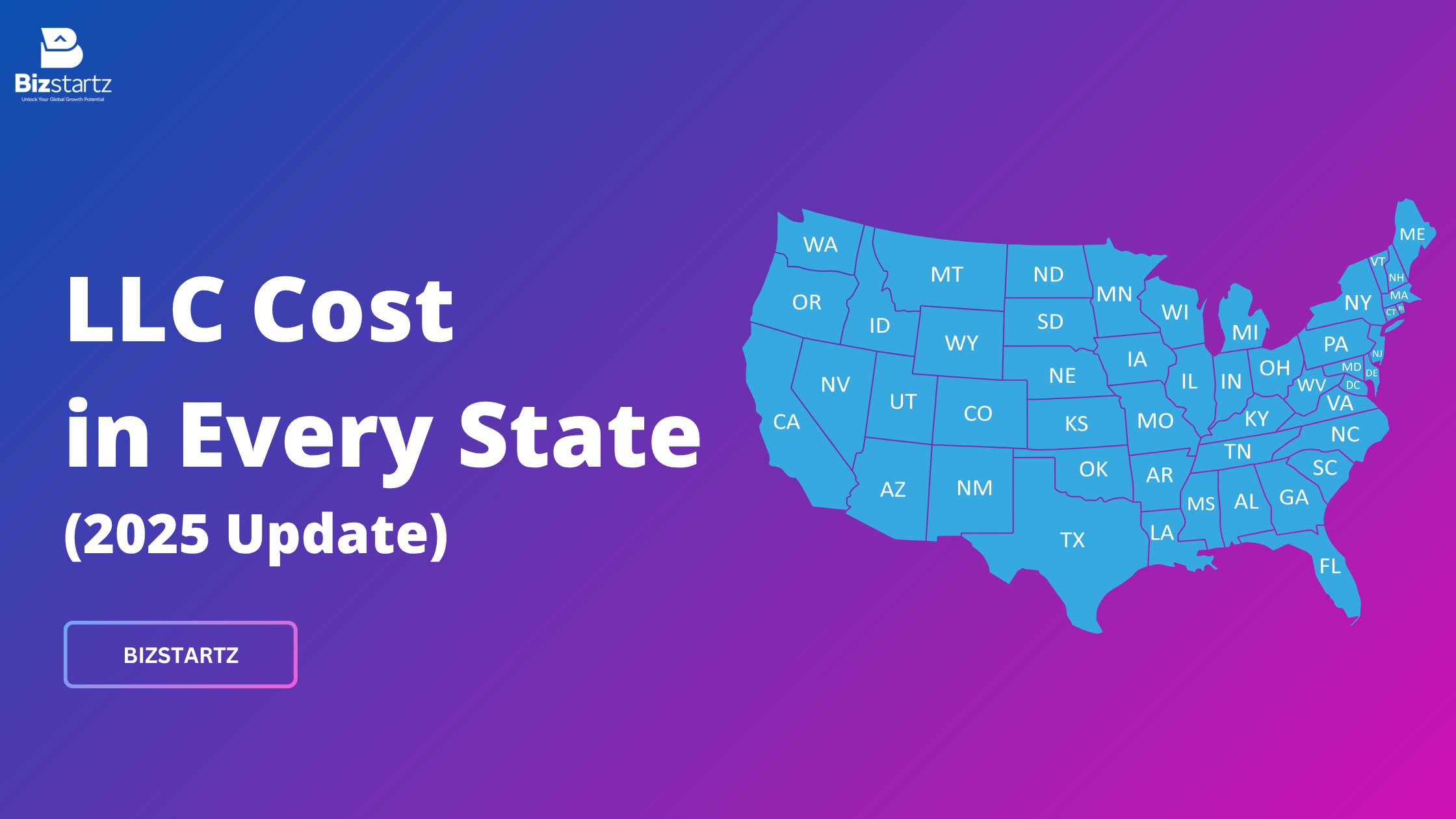
How Much Does an LLC Cost in Every State (2025 Guide)

If you plan to launch a Limited Liability Company (LLC) in the U.S. during 2025, money matters right from the start. You need to count both the one-time filing fee and the yearly upkeep bill that keeps your business legal.

Each state sets its own price tag, so knowing all the possible costs lets you plan your budget, stay in good standing, and even decide whether to form in your home state or somewhere else that offers a better deal.

In this handy guide, we explain LLC Cost in Every State including:

  • One-time filing fees for every state
  • Yearly or every-other-year maintenance and franchise taxes
  • What to expect in 2025
  • How to pick the best state
  • Why costs matter for staying compliant and planning ahead

📊 LLC Filing Fees & Annual Costs by State (2025 Updated Table)

Here is the full breakdown of LLC costs per state, showing formation filing fees and recurring annual or biennial fees (such as annual reports, franchise taxes, or renewal costs).

State LLC Formation Fee Annual/Biennial Fee Notes
Alabama $200 $100/year Annual report required
Alaska $250 $100/2 years Biennial report due Jan 2
Arizona $85 $0 Annual report not required
Arkansas $45 $150/year Annual report + franchise tax
California $70 $800/year + SOI biennially One of the highest recurring fees
Colorado $50 $10/year Cheapest recurring cost
Connecticut $120 $80/year Annual report mandatory
Delaware $160 $300/year Annual franchise tax only
Florida $125 $138.75/year Due May 1 annually
Georgia $100 $50/year Late fees apply after April 1
Hawaii $50 $15/year Due on LLC anniversary
Idaho $100 $0 Only informational report required
Illinois $150 $75/year Includes annual report
Indiana $97 $30/2 years Online filing is cheaper
Iowa $50 $45/2 years Biennial report required
Kansas $160 $50/year Due by 15th day of 4th month after fiscal year-end
Kentucky $40 $15/year Annual report required
Louisiana $100 $35/year Must include updated agent info
Maine $175 $85/year Annual report due June 1
Maryland $100 $300/year Personal property return also required
Massachusetts $500 $500/year Highest cost in the country
Michigan $50 $25/year Simple online renewal
Minnesota $50 $0 No fee but annual info update required
Mississippi $50 $0 Just a simple info report required
Missouri $50 $0 No annual report at all
Montana $35 $20/year Low-cost and minimal compliance
Nebraska $105 $10/2 years Due on odd-numbered years
Nevada $425 $350/year Includes business license
New Hampshire $100 $100/year Due annually April 1
New Jersey $125 $75/year Annual report required
New Mexico $50 $0 No annual reporting required
New York $205 $9/2 years Must also fulfill publication requirement
North Carolina $125 $200/year Annual report + fees
North Dakota $135 $50/year Annual report needed
Ohio $99 $0 No report or annual fees
Oklahoma $100 $25/year Simple filing each year
Oregon $100 $100/year Due on anniversary date
Pennsylvania $125 $7/year Annual report reinstated in 2025
Rhode Island $150 $50/year Due on March 1 annually
South Carolina $110 $0 No annual report unless taxed as a corp
South Dakota $150 $50/year Annual report required
Tennessee $300 $300/year Franchise tax based on members
Texas $300 $0 Franchise tax may apply if revenue exceeds threshold
Utah $70 $20/year One of the lowest total costs
Vermont $125 $35/year Easy online compliance
Virginia $100 $50/year Annual report due each year
Washington $200 $60/year Due each year, includes state biz license
Washington D.C. $99 $300/2 years Biennial report every 2 years
West Virginia $100 $25/year Due July 1 each year
Wisconsin $130 $25/year Easy online renewal
Wyoming $103.75 $60/year Also requires annual report

📌 2025 Cost Highlights

  • Formation fees can stretch from $35 in Montana to $500 in Massachusetts.
  • Ongoing charges jump even more; a few states ask for nothing, yet California and Nevada can bill you $300 to $800 each year.
  • Don’t forget hidden fees like publication fees in New York, business permits in Nevada, and Delaware’s franchise tax can pile on quick.
  • No-repeat-cost states: Missouri, New Mexico, Mississippi, and Ohio; these charge nothing after the first filing.
  • Budget-friendly options: Colorado, Hawaii, Michigan, and Utah keep expenses low while still offering solid support.
  • High-cost states: Four states often mentioned as pricey-but-popular homes for LLCs are Massachusetts, California, Nevada, and Delaware. Each attracts founders for its legal perks and investment climate.

How to Choose the Best State for Your LLC

Cost is important, but forming your LLC isn’t just about the filing fee.

✅ Form in Your Home State (If Operating Locally)

If you sell locally, hire help, or keep an office in your state, file there. Doing so spares you foreign-registration fees and the hassle of a second state s rules.

✅ Consider Business-Friendly States

Working online or from abroad? States like Wyoming, Delaware, and Florida welcome remote founders with strong privacy, solid asset shields, and easy compliance.

✅ Understand Ongoing Responsibilities

Remember, repeat fees come with paperwork, due dates, and legal upkeep. Miss an annual report and you might face late fines or even lose your LLC.

Why These Fees Matter to Founders

🎯 Startup Planning

Knowing both launch costs and recurring charges helps you sketch a realistic cash-flow plan.

🧾 Compliance & Penalties

States hit you with fines when filings or payments lag. For instance, Florida slaps on a $400 surcharge for a late annual report, while California automatically suspends active status.

🛡️ Legal Protection

Keeping up with state rules lets your LLC stay in good standing and keeps its shield of liability protection working for its owners.

🛠️ How Bizstartz Can Help

At Bizstartz, we guide new business owners-whether U.S. citizens or overseas founders-through the set-up and day-to-day care of U.S. LLCs, letting you focus on growth.

Here is how we make that easy:

✅ LLC Formation in All 50 States

From Wyoming to Florida or Delaware to Alaska, we prepare the forms, file with the right office, and check that you meet the newest state rules.

✅ Registered Agent Service

Every LLC must name a dependable registered agent. We fill that role so your company stays compliant and you never overlook important letters or deadlines.

✅ EIN & Tax Compliance Support

We walk you through the IRS request for an Employer Identification Number and explain the U.S. tax duties you will-and will not-have, making it easier for founders outside America.

✅ BOI Reporting, Annual Report & Renewals

Our team watches your states due dates, files annual reports, Beneficial Ownership Information forms, and franchise taxes, so your business stays in good standing.

✅ Honest Pricing & Real Help

There are no secret charges and no messy do-it-yourself puzzles. We lay out every dollar up front and stay at your side long after the paperwork is done.

➡️ Whether you’re launching your very first venture or taking an existing brand to new states, Bizstartz cuts wasted time, keeps you out of costly fines, and lets you put your energy where it really counts-growing your company.

🚀 Final Thoughts: Budgeting for Success in 2025

Launching an LLC is a smart move-but only if you plan for both the one-time and recurring costs. This guide has shown you what to expect, which states give you the biggest bang for your buck, and how to keep your company in good standing for years to come.

When you form your LLC with Bizstartz, you get

  • No surprises
  • Full compliance
  • Friendly support-every step of the way

📞 Ready to start your U.S. business journey? Contact Bizstartz today and let us help you launch the right way.

Blog CTA

❓ Frequently Asked Questions (FAQs)

1. What state charges the least to start an LLC?

Montana, Arkansas, and Colorado rank near the bottom thanks to small filing and renewal bills. Still, make sure you pick the place where you actually work, or you’ll end up paying for two registrations.

2. Which state is best if I am living overseas?

Wyoming usually tops the list for non-residents, offering low fees, strong privacy, no state income tax, and clear rules. Delaware remains a favorite when outside investors are in the mix.

3. What if I miss the yearly fee?

Your LLC loses good standing, the state slaps late penalties, and in some cases the business is wiped off the books without warning. Fixing that later can be tricky and expensive.

4. Can I form an LLC without being a U.S. citizen?

Absolutely! People who are not U.S. citizens can still set up an LLC entirely online. As long as you have a U.S. mailing address, a registered agent, and an Employer Identification Number (EIN), you can run your business from anywhere, open a U.S. bank account, and accept payments via Stripe or PayPal.

5. Is it better to use a company like Bizstartz or do it myself?

Sure, you can complete the paperwork yourself, but many new owners, especially non-residents, save time and headaches by hiring a service like Bizstartz. This way, you reduce the risk of missed deadlines, costly errors, or surprise legal problems.

US Tax Filing Requirements for International Founders

The United States attracts entrepreneurs from around the globe because the economy is huge, the law protects investors, and its payment networks are top-notch.

When founders outside the U.S. create an American company-whether a Limited Liability Company (LLC) or a C-Corporation-they gain instant credibility and powerful business flexibility.

Yet starting a U.S. firm as a non-resident also brings special tax duties that owners cannot ignore.

This plain-language guide spells out the key filing rules every international founder needs to know so the IRS stays happy and costly fines are kept at bay.

1. Filing Requirements for a Foreign-Owned Single-Member LLC (Disregarded Entity)

An LLC with just one owner who lives outside America is a so-called single-member LLC (SMLLC) and by IRS rules it is treated as a disregarded entity. You might think that title means almost no paperwork, yet the opposite is true. Foreign SMLLCs face some of the toughest IRS reporting demands because the Service wants full transparency about every dollar coming in and going out.

So what exactly is a disregarded entity?

Put simply, the IRS ignores any legal wall between the company and its owner for tax purposes. All profits, losses, and other tax items are meant to be reported right on the owners return-if one exists.

Key Filings Required:

  • Form 5472: This must be filed to reveal reportable transactions such as funding the LLC, paying vendors, issuing reimbursements, and similar activities. Missing or filing this form late can trigger steep penalties, so many foreign owners find it useful to work with a tax pro who knows the rules inside out.
  • Pro Forma Form 1120: Your LLC might not be taxed like a corporation, but you still need to file a blank Form 1120 so you can attach Form 5472.
  • Form 1040-NR: This form is needed only if the foreign owner has income that is effectively connected to a U.S. trade or business.

When is it required?

You must file these forms if:

  • Your LLC had any financial transactions with its foreign owner.
  • Your LLC received or paid funds to any foreign entity (even yourself).
  • You had income that came from U.S. sources or from U.S. business activity.

Penalties for Non-Compliance:

  • $25,000 per year for failure to file Form 5472.
  • Extra fines for giving incorrect information or for filing late.
  • You could lose your U.S. business bank accounts or Stripe/PayPal access because of compliance problems.

Pro Tips:

  • Even a zero-revenue LLC must file Form 5472 if the owner paid expenses or made a capital contribution.
  • Get expert help to prepare 5472-it is one of the IRS forms that trips up non-residents most often.

2. Tax Filings for Multi-Member LLCs or Partnerships with Foreign Partners

When a U.S. limited liability company (LLC) has more than one owner, the Internal Revenue Service treats it like a partnership for federal tax purposes, unless the group elects corporate status. This partnership label triggers detailed reporting duties, especially whenever one or more of the owners lives outside the United States.

Key Filings Required:

  • Form 1065: This main partnership return outlines revenue, expenses, and how profits or losses are shared among members.
  • Schedule K-1: The LLC gives each owner a K-1 showing their exact slice of income or loss to report on their personal return.
  • Forms 8804, 8805, and 8813: If any earnings count as Effectively Connected Income (ECI), the company must withhold tax and forward it to the IRS on behalf of the foreign partner.
  • Form 1040-NR: Each non-resident partner uses this return to declare their share of U.S. earnings.

Deadlines:

  • March 15: Form 1065 and all K-1s are due one month after the calendar year ends.
  • Extensions: The filing window can stretch to September 15 by requesting extra time using Form 7004.

Withholding Obligations:

  • The partnership must usually hold back about 37 percent of any ECI allocation to a foreign owner, unless a treaty cuts or eliminates the rate.
  • Payments go in quarterly with Form 8813 and the total gets summed up on Form 8805 at year-end.

Penalties

  • Your partnership pays $220 each month for every partner when Form 1065 is filed late. The fee can keep adding up for a full 12 months.
  • Extra fines may kick in if the LLC forgets to withhold or report ECI for any foreign partner.

Pro Tips

  • If a non-U.S. founder teams up with an American, the IRS usually views the LLC as a partnership. Be ready for hefty paperwork.
  • Hire a U.S. tax advisor who knows forms 8805 and K-2/K-3 inside out or you’ll waste time and money.

3. Tax Filing for a Foreign-Owned U.S. C-Corporation

Many founders pick a C-Corp, often in Delaware, to lure in investors or hand out stock. A foreign owner is fine, but the IRS then watches closely.

Key Filings Required

  • Form 1120: The yearly corporate return that lists income and deductions plus the tax you owe.
  • Form 5472: Needed when an owner holds 25% or more or the company trades with a related foreign party.
  • State Corporate Tax Returns: Must file where the business operates or is registered, whether Delaware, Florida, or California.
  • Delaware Franchise Tax Report: Required no matter how much money the company brings in.

Tax Obligations

  • Expect a straight 21% federal tax on net taxable income.
  • State taxes for corporations vary quite a bit. For instance, Delaware charges no corporate income tax, while California hits businesses hard.
  • If your company hands out dividends to foreign stockholders, a blanket 30% withholding tax pops up. You can slash that rate if a treaty-for example, with Canada or Japan-says so.

Important Deadlines:

  • Form 1120 and Form 5472: Both are due by April 15 each year.
  • Delaware Franchise Tax: Pay this fee by March 1 every year.
  • Extensions: Use Form 7004 for a full six-month delay.

Pro Tips:

  • Keep solid records of any loans, fees, or reimbursements sent to the foreign owner; you must list them on Form 5472.
  • And don’t skip hiring a tax pro to steer your C Corp books and strategy, especially if you plan to raise money or hire staff.

4. Withholding and Reporting Requirements for Foreign Payees

When your U.S. business pays money to foreign people or firms, you face tight IRS rules on withholding and reporting. Missing these can trigger pricey fines and audits, so watch the details.

When Withholding Is Required:

Most payouts-dividends, royalties, interest, or even service fees-go out taxed at the full 30% rate. That rule softens or disappears if a tax treaty-with India, the U.K., the UAE, or another partner-says it can.

Key Filings:

  • Form 1042: The annual return that shows and summarizes all withholding tax due on payments to foreign persons.
  • 1042-S Form: Send one to every foreign payee so they can see what they were paid and how much tax was held back.
  • W-8BEN or W-8BEN-E: Grab this from every foreign payee to prove they aren’t in the U.S. and to let them use any tax treaty.

Deadlines:

  • Forms 1042 and 1042-S are due March 15 every year.
  • W-8BEN forms expire after three years, so update and store them.

Pro Tips:

  • Services like Stripe and PayPal may ask for the W-8BEN to confirm foreign ownership and set the right tax rate.
  • For a complete list of withholding rules and exceptions, read IRS Publication 515.

5. Other International Reporting Requirements (FBAR, FATCA, etc.)

The IRS keeps a close eye on overseas money, so holding foreign accounts or shares can trigger extra paperwork.

FATCA (Form 8938):

  • U.S. persons-residents and citizens-must report foreign financial assets when their total hits $50,000. The limit changes with filing status.
  • This covers overseas bank accounts, stock, partnerships, or any trust you own.

FBAR (FinCEN Form 114):

  • You must file this if the total balance of all your foreign bank accounts ever reaches $10,000 during the year.
  • Submit it electronically through FinCEN, not the IRS.

Penalties:

  • Forgetting to file the FBAR without willful intent can cost you as much as $10,000 for each account each year.
  • If the failure is judged willful, the fine may hit $100,000 or 50 percent of the accounts value-whichever stings more.

6. 2025 U.S. Tax Deadlines for International Founders

Date What’s Due
Jan 15, 2025 Q4 2024 estimated tax payments (individuals)
Jan 31, 2025 1099s and W-2s due to contractors and employees
Mar 1, 2025 Delaware Franchise Tax return and payment
Mar 15, 2025 Form 1065 (LLCs with multiple members) and Form 1120S (S-corps)
Apr 15, 2025 Form 1120, 1040, 1040-NR, 5472 due
Jun 15, 2025 Q2 2025 estimated tax payment
Sep 15, 2025 Extended deadline for 1065 and 1120S
Oct 15, 2025 Extended deadline for 1040 and 1120

Tax Penalties

Final Thoughts

Dealing with U.S. taxes is tricky, especially for founders living elsewhere and running a business online. Still, the IRS wants every form in on time-even if your company has not yet earned a dollar.

Miss one piece of paperwork, say Form 5472, and you could lose thousands in fines, have your EIN frozen, or watch your U.S. bank account shut down.

What You Can Do:

  • Pick the right business setup (LLC, C-Corp) from day one.
  • Know your tax status and check duties each year.
  • Save clear records of owners, revenue, and cross-border payments.
  • Hire a reliable tax pro or turn to Bizstartz for worry-free filings.

Wyoming LLC vs Delaware LLC: Where Should You Incorporate

Are you thinking about starting a business in the U.S. as a solopreneur, a digital nomad, an overseas founder, or even as a member of a new startup team? One of the first questions you’ll have to answer is which state you will form your LLC in.

Many states offer a more business-friendly approach, but Wyoming and Delaware are always ranked as the first two options.

While both states have their unique strengths, the right state for you will depend on your business objectives, financial strategies, and future plans.

In this guide, we will thoroughly discuss the key differences between forming LLCs in Wyoming and Delaware to assist you in deciding where to incorporate.

Why Are Wyoming and Delaware So Popular for LLCs

Let us first look at the reasons that make these two states popular with businessmen around the world.

Delaware: The Corporate Capital of America

It has taken many years for Delaware to establish itself as the preferred destination for corporates and new businesses. It hosts over 66% of Fortune 500 companies and nearly 1.9 million business entities, many of which are created solely for the legal benefits. The state offers:

  • Favors complex investment structures and business-friendly rules for venture-backed startups.
  • Business-friendly judges and fast legal resolution to disputes.
  • A dedicated Court of Chancery for any business disputes.
  • Advisable and predictable body of corporate law.

Wyoming: The Hidden Gem for Entrepreneurs

Wyoming is a state that is frequently overlooked but is a favorite for small business owners, individual entrepreneurs, and overseas business people because of low fees, complete privacy, and little regulatory burden. It was the first US state to adopt LLCs in 1977, which now offers:

  • Low filing and maintenance charges.
  • No state income tax.
  • Fast and simple online filing.
  • Strong privacy for LLC members.

💰 Cost Comparison: Formation and Maintenance Fees

One of the biggest differences between Wyoming and Delaware LLCs lies in their cost structure. For bootstrapped businesses or early-stage founders, these costs can significantly impact your bottom line.

Wyoming LLC Costs

  • Formation Fee: $100 (one-time)
  • Annual Report Fee: $60
  • Registered Agent: ~$25 to $100/year (varies by provider)
  • Franchise Tax: None

Delaware’s Disclosure Rules

  • Formation Fee: $90 (one-time)
  • Annual Franchise Tax: $300 flat
  • Registered Agent: ~$50 to $150/year
  • Annual Report Fee: None for LLCs, but tax is mandatory

Key Insight:

Wyoming stands out for offering unmatched privacy for those wanting to keep their identity and assets protected like digital entrepreneurs, crypto businesses, or anyone working in high-risk fields.

Verdict: Wyoming leads in privacy and asset protection.

🔒 Asset Security and Protection of Privacy

The consideration of anonymity and asset protection drives entrepreneurs to seek states with robust privacy regulations.

Wyoming’s Privacy Advantage

  • Does not require the member or manager names to be listed in filings.
  • Offers charging order protection for single member LLCs, which prevents personal creditor claims on your LLC assets.
  • Supports nominee services, thus simplifying the concealment of ownership identity.

Delaware’s Disclosure Rules

  • Requires contact person and business address disclosure.
  • While member/manager names may not be publicly available, state records may contain them more easily.
  • Offers charging order protection but it is weaker for single member LLCs.

Key Insight:

For digital entrepreneurs, crypto businesses, or participants in high-risk industries, needing to safeguard identity and assets, Wyoming leads with unmatched privacy.

✅ Verdict: Leading states for privacy and asset protection is Wyoming.

⚖️ Legal System and Business-Friendly Courts

Legal matters are important for companies looking to raise capital, issue shares, or engage in complex legal contracts.

Delaware’s Court of Chancery

  • A unique, separate court that deals only with business matters.
  • Judges (called Chancellors) are highly experienced in corporate law.
  • Decisions are fast, and legal precedents are clear and well-documented.
  • The best option if you expect legal disputes or investor litigation.

Wyoming’s Legal System

  • Reliable and straightforward but does not have a specialized business court.
  • Court decisions may take longer and be less predictable.
  • Best suited for simpler legal needs and small business operations.

Key Insight:

It’s easy to see why large established companies and investor-backed startups incorporate in Delaware, its legal ecosystem offers confidence and predictability.

Verdict: Delaware wins for legal infrastructure and investor-friendliness.

🧾 Tax Benefits and State Compliance

Both states have tax benefits, but differences exist with LLC taxes and enforcement of compliance.

Wyoming Tax Profile

  • No state income tax (corporate or personal)
  • No franchise tax
  • Low $60 annual report based on in-state assets (if any)
  • Fewer bureaucratic obligations

Delaware Tax Profile

  • No sales tax or personal income tax on non-residents
  • Flat $300 annual franchise tax for LLCs
  • No income tax if your company doesn’t operate physically in Delaware
  • May be subject to more complex filings depending on your structure

Key Insight:

Both states avoid personal income tax, but Wyoming offers lower and simpler tax compliance for small business owners.

✅ Verdict: Wyoming is the clear winner on taxes for small and remote businesses.

Which Businesses Should Choose Which State?

Here’s a breakdown based on business model, goals, and structure:

Business Type / Scenario Best State Why?
Solo entrepreneurs / freelancers Wyoming Low cost, privacy, simple filing
Bootstrapped startups Wyoming Lower annual fees, fewer regulations
Tech startups raising VC funding Delaware Preferred by investors and VCs
E-commerce / Dropshipping stores Wyoming Cost-effective and privacy-friendly
SaaS or C-Corp conversion planned Delaware Legal infrastructure for equity
Crypto, Web3, or high-risk niches Wyoming Better privacy and asset protection

Bizstartz Tip: If you’re not raising capital soon and want to keep things simple and private, start with Wyoming.

🌐 International Entrepreneurs: Wyoming vs Delaware

If you live outside the U.S. and want to open a U.S. company, both states are open to you. But there are practical differences:

Wyoming for Non-Residents

  • Easier to maintain with fewer reporting obligations
  • Low startup and ongoing costs
  • Simple EIN, bank account, and ITIN setup
  • Better for passive income and eCommerce models

Delaware for Non-Residents

  • Slightly more paperwork
  • Preferred for startups seeking global investment or entering U.S. markets
  • Higher annual tax obligations

✅ Verdict for Non-U.S. Founders: Wyoming is the easier and more affordable option.

What Bizstartz Recommends

As experts in helping founders from around the world start their U.S. companies, Bizstartz provides complete guidance based on your unique goals.

Here’s our general recommendation:

Type of Founder Recommended State
Small business / remote team ✅ Wyoming
Startup with future fundraising ✅ Delaware
International freelancer ✅ Wyoming
First-time entrepreneur ✅ Wyoming
SaaS founder or C-Corp planner ✅ Delaware

We handle everything from LLC formation, EIN, ITIN, banking setup, BOI filing, and more, 100% online.

✅ Final Thoughts: Wyoming or Delaware?

Here is the simplified analysis:

  • Select Wyoming for remote management and affordability’s privacy and simplicity.
  • Select Delaware for fundraising, issuing shares, or developing a venture-backed startup.

Regardless of your choice, Bizstartz will assist you at every stage while forming your U.S. LLC from any corner of the globe.

Business LLC registrations in the US are done in record time with Bizstartz.

👉 Form Your U.S. LLC with Bizstartz, 100% Online, Fast, and Reliable

Blog CTA

📚 FAQs About Wyoming vs Delaware LLCs

1. Can I open a U.S. bank account with either type of LLC?

Yes. Both Wyoming and Delaware LLCs can be used to open U.S. bank accounts. Bizstartz provides end-to-end assistance for this.

2. Do I need a U.S. address to form an LLC?

No. Both states allow foreign residents to form LLCs without a U.S. address or Social Security Number (SSN).

3. Is Wyoming or Delaware better for Stripe and PayPal?

Both are accepted by Stripe, PayPal, and other major platforms. Your approval depends more on your documentation and website rather than the state.

4. Is it possible to transfer my LLC to a new state later on?

You can, but it requires “domestication” or starting a new LLC. It’s easier to make the right decision from the onset.

5. Are Wyoming entities compliant with FinCEN’s BOI Reporting requirements effective 2024?

Yes. Wyoming LLCs are subject to BOI reporting just like every other LLC in the US. We can take care of this filing for you.

7 Benefits of Forming an LLC in Wyoming

Determining which state to enter for business registration in the United States can greatly determine your company success in the long run.

While people are often concerned with states such as Delaware and Nevada; Wyoming has garnered the attention of smart founders with international backgrounds, digital nomads, and small business owners quietly.

With the lack of a state income tax, strong legal protections, and the low ongoing costs across the country, the state of Wyoming stands to benefit small business owners with its growing LLC formation.

In my detailed article below, I hope to state 7 benefits of forming an LLC in Wyoming in 2025 and the years to come.

1. No State Income Tax – Keep More of Your Profits

The absence of state taxation is one the most famous benefits of relocating an LLC to Wyoming. Personal income tax as well as corporate tax is absent at the state, thus making only federal tax relevant.

Why This Matters:

  • Your post tax earnings are retained, hence the net profit increases.
  • Provided you’re a U.S. taxpayer, your liability for pass-through taxation will enable you to report the profit of your LLC on your personal tax return.
  • If you are a non-U.S. resident and your LLC doesn’t have any effectively connected U.S. income, you might not owe federal income tax.
  • This is especially advantageous for high-revenue or high-margin businesses, including software startups, content creators, consultants, and online sellers.

This can amount to thousands or even tens of thousands of dollars annually compared to California or New York.

2. Strong Privacy and Asset Protection – Safeguarding Your Identity and Wealth

Wyoming is recognized as a state that prioritizes business owner privacy and asset protection, two concerns for both U.S. and international entrepreneurs.

Key Features:

  • Anonymous LLCs: In Wyoming, member names are not required to be part of public records. Therefore, your name won’t appear in state databases, safeguarding your identity from the public, competitors, or any other nosy people.
  • Charging Order Protection: Even single-member LLCs (SMLLCs) in Wyoming receive this powerful legal safeguard. If you’re sued personally, creditors can’t claim the company’s assets. They can only receive distributions if and when you choose to issue them.
  • No disclosure of ownership in annual reports, ensuring compliance while maintaining a low profile.

Such level of anonymity and protection shields real estate investors, freelancers from sensitive fields, or anyone worried about potential lawsuits, data breaches, or personal security threats.

3. Low Annual Fees and Simple Compliance Requirements

For LLCs, Wyoming is one of the most affordable and least burdensome in terms of compliance.

What to Expect:

  • Paying the Annual Report Filing Fee of $60.00 or 0.02% of assets held in Wyoming.
  • No annual business license fee at the state level (unlike Nevada).
  • No hidden compliance burdens beyond annual reporting and maintaining a registered agent.

Compare this to New York’s costly publication requirement or California’s $800 minimum annual franchise tax and it is easy to understand why so many founders prefer Wyoming.

For foreign entrepreneurs, compliance can be handled entirely online, even through services like Bizstartz.

4. Lifetime Proxy: Ultimate Privacy and Voting Rights

A striking feature offered by Wyoming is the lifetime proxy, which allows an individual to maintain anonymity while retaining control over certain aspects of their company.

How It Works:

You can designate a person to vote on your behalf in all shareholder or member matters, and your name remains entirely off the public documents. This enables you to:

  • Retain control of your business without revealing your identity.
  • Work quietly, even if you are dealing with sensitive projects or political issues.
  • Shield yourself from personal risks or business-related threats.

For international clients, politically exposed persons (PEPs), or founders in intensely competitive fields, this feature is especially useful.

5. Business-Friendly Legal Environment

Due to its straightforward and pro-business legal system, Wyoming remains one of the top three states in the U.S. for business.

Key Legal Advantages:

  • Business-friendly courts that favor the protections afforded to LLCs and abide by the operating agreements made.
  • Established legal precedents offer strong limited liability and asset protection for LLC owners.
  • A well-run Secretary of State office that processes filings efficiently and reliably.

Wyoming’s privacy regarding the non-filing of LLC operating agreements is beneficial. The laws are clear, welcoming, and nurture small businesses.

Whether you own a tech startup, an e-commerce store, or a digital agency, the legal climate in Wyoming allows for the growth and running of your business without hindrance.

6. No Minimum Capital Requirement – Start with Just an Idea

In Wyoming, starting a business doesn’t mean needing to have a lot of money.

Why This Is Great:

  • Starting an LLC has no minimum capital requirement. It can be $1 or any amount of your choice.
  • This is great for freelancers, bootstrapped entrepreneurs, or founders who are developing an MVP (minimum viable product).
  • You can scale your business without being forced to over-capitalize.

Wyoming welcomes businesses at any level, be it freelancers or growing teams. You don’t need a U.S. visa, SSN, or even a physical office, just your business idea and a partner for formation like Bizstartz.

7. For Foreign Entrepreneurs, It’s Easy To Form A Business Remotely

This is easily the most popular reason why people around the world associate Wyoming with business: the simplicity of forming and managing an LLC from virtually anywhere.

Here’s what makes it possible:

  • No U.S. residency or address required
  • No need to visit the U.S. in person
  • Complete registration with e-signatures
  • Available Registered Agent services (like those offered by Bizstartz)
  • Remote acquisition of Employer Identification Number (EIN)
  • Assistance with U.S. bank accounts and payment processors like Stripe and PayPal

At Bizstartz, we are proud to have supported clients from over 40 countries such as Nigeria, India, Pakistan, UAE, UK, and Bangladesh to set up U.S. businesses using Wyoming LLCs while still in the comfort of their homes.

For startup owners aiming at global reach, digital creators requiring Stripe, or an eCommerce seller expanding overseas, Wyoming works best offering fast, smooth, and cost-effective solutions.

Blog CTA

Final Thoughts: Why Choose a Wyoming LLC?

As one of the best states to form an LLC in 2025, Wyoming stands out for its low cost, high privacy, strong asset protection, and ease of setup.

A Wyoming LLC comes with several perks for digital entrepreneurs, overseas freelancers, startup founders, and investors such as:

  • No state income tax
  • Anonymous ownership,
  • Minimal paperwork and low annual fees
  • Full remote setup options
  • Strong legal protections

Ready to Launch Your Wyoming LLC?

We assist business owners across the globe form and manage U.S. LLCs with our specialized services like:

  • Company Formation
  • EIN Registration
  • U.S. Mailing Address & Registered Agent
  • Business Bank Account Setup
  • Stripe/PayPal Guidance
  • Ongoing Compliance & BOI Filing

📩 Book a free consultation or start your LLC online in just 24 hours.

👉 Get Started with Your Wyoming LLC Now

How to Form a US LLC from Nigeria in 2025

Are you a Nigerian entrepreneur, freelancer, or startup founder aiming to grow your business internationally?

Setting up a Limited Liability Company (LLC) in the United States is one of the simplest ways to gain international credibility, receive payments via Stripe and PayPal, open a US business bank account, and receive global clients.

The good news is that you don’t need to live in the US, hold a US passport, or even need a visa to open a US LLC. Everything is 100% remote and we are here to help you out.

In this blog, we’ll discuss how one can form a US LLC from Nigeria, the documentation required, thorough step-by-step instructions, ideal states for registration, expenses, taxes, and compliance.

What US LLC Benefits are there for Nigerians?

Living in Nigeria does not limit the perks one can get when opening a US LLC. Here are some reasons to consider:

1. Global Business Identity

A business registered in the US provides undeniable trust and credibility to potential clients from different parts of the world. US businesses are seen as reputable and trustworthy, especially for online service providers, SaaS companies, eCommerce businesses, and agencies.

2. Availability of US Payment System

Having a US LLC comes with benefits such as:

  • Stripe: which allows you to accept credit and debit payments from practically anywhere in the world.
  • PayPal Business: a verified US business account.
  • Mercury & Relay: US bank accounts tailored for remote business founders.
  • Wise: offers international transfers in USD without any unnecessary complications.

These businesses tend to blacklist Nigerian companies because of local restrictions, but they accept US LLCs.

3. Access to International Selling Platforms

Having a US LLC allows you to conveniently sell on platforms such as Amazon, Etsy, Shopify, and Upwork without the hassle of needing a US business account or bank.

4. Tax Optimization

LLC’s offer pass-through taxation which is advantageous because foreign-owned LLCs will not be subjected to US taxes unless they have US sourced revenue.

5. Investor-Friendly

If funding needs to be raised, investment companies and venture capitalists from the US prefer these companies that are formed in Wyoming or Delaware.

Step-by-Step: How to Create a U.S. LLC from Nigeria

LLC from Nigeria

Let’s simplify the entire process into easy steps:

1. Selecting the Best State for Your LLC Registration

As a foreigner doing business in the U.S., not all states will be beneficial for you. We recommend the following states for Nigerian entrepreneurs:

Wyoming

  • Low startup cost ($100 filing fee)
  • No state income tax
  • High privacy protection
  • Minimal reporting requirements

Delaware

  • Preferred by tech startups and venture capitalists
  • Excellent legal framework for corporations and LLCs
  • Higher annual fees but ideal for raising funds

Florida

  • Great for e-commerce or service businesses
  • Popular among non-residents due to straightforward laws

💡 Bizstartz Tip: If you don’t plan to raise VC money, Wyoming is the most cost-effective and easiest state to maintain.

2. Choosing a Business Name for Your LLC

The name of your LLC must be unique and satisfy the following criteria:

  • It is not already in use in your chosen state.
  • It includes “LLC,” “L.L.C.,” or “Limited Liability Company.”
  • It does not contain restricted words like “bank,” “insurance,” etc.

You can check name availability through the Secretary of State’s website, or you can leave it to Bizstartz to do the checks and reserve the name for you.

3. Choose a Registered Agent

A Registered Agent is a person or company based in the U.S. that:

  • Receives official greetings and legal correspondence for your LLC
  • Holds an office location in the state of formation

As a Nigerian resident, you cannot act as your own registered agent, so you will have to make use of one.

Bizstartz offer reliable Registered Agent services in all 50 states and these are included in our LLC formation packages.

4. Submit Articles of Organization

This document officially establishes your LLC. It contains:

  • LLC name and address
  • Profile of the Registered Agent
  • Allocation of roles (member-managed or manager-managed)

We complete the filing with the state government. Upon approval, you will be issued a Certificate of Formation (or Certificate of Organization) which confirms your business registration.

Here is the processing time based on region.

  • Wyoming: 1–2 business days
  • Delaware: 3–5 business days
  • Florida: 2–3 business days

5. Obtain an EIN (Employer Identification Number)

An EIN is like a business tax ID issued by the IRS (Internal Revenue Service). It’s required to:

  • Open a U.S. business bank account
  • File tax returns
  • Hire employees
  • Apply for Stripe, PayPal, or Amazon Seller account

As a non-resident, applying for form SS-4 via fax or mail is necessary. Don’t worry, Bizstartz can handle the EIN process for non-U.S. residents.

The IRS no longer issues EINs instantly online for foreigners; processing time is around 7–15 business days.

6. Open a U.S. Business Bank Account

To set up a U.S. business bank account, you will need to provide the following:

  • LLC Certificate
  • EIN Letter
  • (Optional) Business address
  • Valid passport

Remote friendly banks have eliminated the need to travel to open US business accounts. Businesses in Nigeria can use the following banks without the need of traveling:

  • Mercury: Ideal for startups and e-commerce
  • Relay: Free account, great for small businesses
  • Wise: Multi-currency account, low conversion fees

Bizstartz assists clients in setting up these accounts within Nigeria.

7. Obtain a U.S. Business Address (Optional)

Payment processors and marketplaces sometimes require real U.S. addresses and not just a Registered Agent.

A virtual address in the U.S. can:

  • Receive and forward mail to Nigeria.
  • Increase trustworthiness on invoicing and business listings.
  • Serve as the bank and billing address.

We offer U.S. virtual business addresses as optional add-ons.

8. Ensure Compliance is Up to Date

Staying compliant with U.S. regulations is a must even after forming the LLC. These are some of the items that need attention:

📅 Annual Report

Most States mandate filing an Annual Report for a fee to keep the LLC active.

  • Wyoming: $60/year
  • Delaware: $300/year
  • Florida: $138.75/year

💵 Franchise Tax

Some states levy an annual franchise tax, for example Delaware does even if no profits are reported.

📝 BOI Report Filing

  • Starting January 1, 2024 all LLCs are required to electronically submit a Beneficial Ownership Information (BOI) Report to FinCEN.
  • This is a one-time report unless ownership changes.

🧾 Federal Tax Filing (Form 5472 + 1120)

If you have a single-member foreign-owned LLC, you need to file:

  • Form 5472 plus Pro Forma 1120 annually with the IRS
  • Regardless of whether your LLC had zero income.
  • Deadline: April 15 every year.

Bizstartz offers compliance services so you don’t incur fines and penalties.

📄 Documents You Need to Start from Nigeria

You don’t need a visa, SSN, or U.S. address. Just these:

Requirement Details
Passport Valid Nigerian international passport
Company Name Must be unique
Business Description Brief summary of your activity
Nigerian Address & Email For correspondence
Funds To cover registration and service fees

That’s it! We handle the rest.

💰 Cost to Form a U.S. LLC from Nigeria

Here’s a breakdown of estimated costs for Nigerian founders in 2025:

Service Cost (USD)
State Filing Fee (e.g., Wyoming) $100
Registered Agent (1 year) $50 – $100
EIN Application $95 – $150
BOI Report Filing $50
U.S. Virtual Address (optional) $60 – $120
Bizstartz LLC Formation Package Starting at $199

We offer all-in-one packages to save time and money, no hidden fees, no confusion.

Ready to Start Your U.S. Business from Nigeria?

It’s now your turn because thousands of Nigerian entrepreneurs have already built global brands leveraging U.S. LLCs.

A U.S. LLC enables you to expand your business and earn in USD whether you are launching a SaaS product, selling online, freelancing, or running an agency.

Contact Bizstartz today so we can walk you through the entire process including formation, EIN, compliance, banking and allow you to concentrate on growing your business.

Blog CTA

🙋‍♂️ Frequently Asked Questions (FAQs)

1. Can I form a U.S. LLC from Nigeria without traveling?

Yes! Registration and banking can both be done remotely.

2. Can I use my LLC to open Stripe, PayPal, and Amazon?

Absolutely. Verified accounts can be created post EIN and bank setup so payments can be accessed.

3. Am I required to have a U.S. address in order to open a U.S. business bank account?

Not exactly. Foreign founders can open accounts at Mercury and Relay with the use of Registered Agent information and other required documentation.

4. Which taxes will I be liable to pay?

  • No U.S. taxes if there is no U.S. sourced income
  • You are still required to submit Form 5472 and BOI report
  • You could be taxed in Nigeria according to local laws concerning foreign earnings.

5. Full process done take how long?

  • LLC registration: 1-5 days (depends on the state)
  • EIN: 1-2 weeks (for non-U.S. citizens)
  • Bank account: 2-5 days after EIN

Total time: 2-3 weeks on average.

5 US States Without Sales Tax in 2025

Sales tax is one of the basic forms of collecting revenue in the United States. While most states have both a State tax and Local tax on goods and services, there are five states that do not charge a state level sales tax in 2025.

These states are Alaska, Oregon, Montana, New Hampshire, and Delaware. These states offer various benefits to businesses and consumers.

If you are a shopper hoping to save money or an Entrepreneur picking a state for incorporation, knowing these states will help a lot.

🏔️ 1. Alaska

  • Statewide Sales Tax: ❌ None
  • Local Sales Tax: ✅ Yes, up to 7.5% depending on the municipality
  • Other Relevant Taxes: Excise taxes (fuel, alcohol, tobacco), hotel/lodging taxes

Overview

Alaska

Alaska, similar to Wyoming, is often considered a tax haven. While there is no state level sales tax, there are many boroughs and municipalities that enforce local sales taxes.

Around 89 jurisdictions in Alaska do so, with 1% to 7.5% rates.

Why It Matters

For consumers, certain areas in Alaska can feel like a tax-free zone whereas other areas still resemble a sales-tax state. Tourists can also encounter taxes related to lodging and alcohol in places that cater to tourists.

From a business perspective, Alaska may be appealing because the state has no income or sales tax. However, businesses operating in multiple jurisdictions face the challenge of local tax tracking which is often complicated and riddled with more variety than standardization seen in other regions.

Key Consideration

Businesses must take into consideration economic nexus. Selling into other states as a tax-free Alaska based company comes at the cost of having to collect and remit sales taxes.

💼 2. Delaware

  • Statewide Sales Tax: ❌ None
  • Local Sales Tax: ❌ None
  • Business Taxation: ✅ Gross Receipts Tax on business revenue

Overview

Delaware


Delaware enjoys the perk of having no state or local sales tax which makes it a shopper’s dream and a preferred state for business incorporation.

However, instead of traditional sales tax, the state imposes gross receipts tax on businesses which is essentially a tax on total sales revenue of a company regardless of whether it turns a profit or not.

Why It Matters

Purchasing goods in Delaware offers consumers tax-free purchases which is a big advantage for high-ticket items like electronics, vehicles, or jewelry. Many individuals from bordering states travel to Delaware specifically for tax-free shopping.

Delaware’s legal environment for businesses, ease of formation, strong privacy protections, and over 60% of Fortune 500 companies being incorporated there makes it very attractive for businesses.

Key Consideration

The lack of sales tax could be beneficial, but gross receipts tax could be a concerning factor for high revenue, low margin businesses such as wholesalers or retailers. Before incorporating or expanding to Delaware, it is important to understand how this tax will influence business operations.

🏞️ 3. Montana

  • Statewide Sales Tax: ❌ None
  • Local Sales Tax: ✅ Only in designated resort areas capped at 3%
  • Other Relevant Taxes: Income tax, property tax, fuel tax

Overview

Montana

Montana is one of the few states that do not have a general sales tax and does not plan on adopting one. However, certain resort towns that are frequented by tourists are allowed to charge a local option sales tax which ranges from 1% to 3% depending on the locality.

Why It Matters

For most residents and businesses, Montana has a retail environment that is truly tax-free. It is a great state for shoppers in the market for something big. Not having a sales tax minimizes the workload for local businesses as well.

However, tourists in areas like Whitefish or Big Sky may encounter resort taxes on lodging, prepared meals, or recreational activities.

Key Consideration

If you are a business located in or around a resort area, you will have to incorporate the resort sales tax into your pricing and reporting. For eCommerce businesses, selling from Montana does not exempt you from collecting taxes on out of state customers if economic nexus thresholds are reached in their states.

🗻 4. New Hampshire

  • Statewide Sales Tax: ❌ None
  • Local Sales Tax: ❌ None
  • Other Relevant Taxes:
    • 8.5% Meals & Rentals Tax
    • 5% Interest & Dividends Tax (phasing out)
    • Excise taxes on gasoline, tobacco, etc.

Overview

New Hampshire

New Hampshire takes pride in having no sales tax or income tax. This reputation has served as a lasting benefit for both shoppers and small business owners. However, the state does collect revenue through certain taxes like the Meals and Rentals Tax that applies to hotel and restaurant meals.

Why It Matters

Residents from Massachusetts and Maine frequently travel across the border to New Hampshire for tax-free shopping, making it an economic win for them. Retailers also have to pay lower total transaction costs.

New Hampshire is appealing to businesses because it has a straightforward tax system, although some service providers are burdened with collecting the Meals & Rentals Tax.

Key Consideration

New Hampshire’s no income and sales tax reputation is even bolstered by the fact that the 5% Interest & Dividends Tax is being phased out and will be eliminated by 2027. New Hampshire is still burdened with some industry specific taxes that can be quite high depending on the line of business.

🌲 5. Oregon

  • Statewide Sales Tax: ❌ None
  • Local Sales Tax: ❌ None (with very rare exceptions)
  • Other Relevant Taxes:
    • Corporate Activity Tax (CAT)
    • Excise taxes on fuel, alcohol, cannabis

Overview

Oregon

Oregon stands out for having no state or local sales tax, and voters have rejected attempts to implement one nine times. Instead, the state has to rely on income taxes and the newly introduced Corporate Activity Tax (CAT) from 2020.

Why It Matters

For major purchases, Oregon is a true retail paradise and has positioned itself as a shopping hub for tourists from neighboring states like Washington, which is one of the highest sales tax states in the country.

Businesses in Oregon no longer have to deal with the complex issues of sales tax collection, which greatly eases operations, particularly for smaller retailers and service providers. However, the Corporate Activity Tax applies to businesses with over $1 million in Oregon-sourced revenue and is charged a flat plus marginal rate.

Key Consideration

While retail shopping may be easier, the corporate retail tax remains a burden, as does the high state income tax.

🧾 Understanding the Broader Impact

✅ For Consumers

Lower Total Costs: Notably on high-value items such as electronics, appliances, and vehicles.

Shopping Tourism: People frequently travel to these states for the specific purpose of shopping tax free.

Budget Tracking: No hidden fees or surcharges, what you see is what you pay.

✅ For Businesses

Easier Compliance: No need to deal with confusing state sales tax regulations.

Competitive Pricing: Businesses are able to pass savings to customers or keep better margins.

Delaware and New Hampshire are especially attractive for legal and tax strategies regarding incorporation.

🚨 Main Warning Remarks

No sales tax doesn’t mean no taxes, gross receipts, excise, income, and other targeted taxes may apply.

Due to the economic nexus laws after the Wayfair decision in 2018, even businesses in these tax-free states might have to collect sales tax from customers in other states.

📊 Quick Comparison Table (Expanded)

State State Sales Tax Local Sales Tax Notable Additional Taxes Best For
Alaska No Yes (1%–7.5%) Excise, lodging, fuel Nature-focused businesses, remote work
Delaware No No Gross receipts tax Incorporation, holding companies
Montana No Yes (Resort-only) Resort tax, fuel tax Retail, outdoor recreation
New Hampshire No No Meals & rental tax, excise Border retail, ecommerce
Oregon No No Corporate Activity Tax, excise taxes Retail, high-margin businesses

✏️ Final Thoughts

Living, shopping, or doing business in one of the five states without a sales tax in 2025 can be helpful, but there are pros and cons to consider.

Consumers will have an easier time saving money during purchases and businesses will be able to operate more efficiently. However, these states still pay for services with gross receipts, income, and excise taxes.

Be it an individual contemplating a large purchase or a business owner planning key initiatives, grasping the complete tax landscape is important.

Blog CTA

❓ Frequently Asked Questions (FAQs)

1. Are these five states completely tax-free?

No, as these states do not have a sales tax, it doesn’t make them tax free. For instance:

  • Delaware has a gross receipts tax on businesses.
  • Alaska has local sales taxes and excise taxes.
  • Montana has resort-area taxes in certain tourist towns.
  • New Hampshire has meals and rental taxes.
  • Oregon has a Corporate Activity Tax on businesses.

Each state has its unique tax system to provide public services.

2. Can I shop from these states and not pay sales tax?

Not really. Most states have what is called an economic nexus tax. This was put in place after the Supreme Court ruling of Wayfair vs. South Dakota in 2018. This means:

  • For online sellers, it didn’t matter where the seller was located. They now have to collect taxes based on where the buyer lives.
  • Even if the seller is located in a tax-free state, like Oregon or Montana, if the buyer lives in a state that charges sales tax, then taxes will be charged.

3. Which state is best for incorporating a business if I want to avoid sales tax?

This answer varies, depending on your business model.

  • If you are looking for good legal protections along with flexible corporate laws, your best option will be Delaware.
  • New Hampshire and Oregon are great options for retail or service based businesses that operate locally.
  • Montana is great for people selling physical products or needing to register a vehicle.
  • Remote or resource based businesses may do well in Alaska, although it is very remote.

However, you must consider other factors like where your customers are, nexus limits, and income taxes.

4. Do tourists get any perks in these states for no sales tax?

Yes, but with some exceptions.

In these five states, tourists can shop and save a lot of money. But:

  • Some towns in Alaska and Montana have local or resort-area taxes.
  • In New Hampshire, meals and lodging are taxed at an 8.5% rate.
  • In Oregon, businesses might raise their prices due to the Corporate Activity Tax which means they could be using tax-free prices.

Tourists will still find these states very appealing when shopping for big items like electronics and jewelry.

5. What about these states in the future?

As of 2025, there is no serious legislative movement in any of these five states to implement a statewide sales tax. In fact:

  • Oregon voters have rejected sales tax proposals nine times.
  • New Hampshire’s political culture strongly opposes broad-based taxes.
  • Montana and Delaware have also consistently resisted sales tax measures.

It is possible that Oregon’s voters might change their minds in the future, but as of now, these states are unlikely to adopt a sales tax anytime soon.

Top 7 Best Stripe Alternatives in 2025

Stripe has been making life easier for accepting payments online for a long time. It’s famous for its easy to use APIs, quick onboarding, and supports subscription billing and international payments.

But it is not the ideal choice for everyone. Business owners may find Stripe’s documentation-heavy approach difficult to navigate. Account freezes, limited support for certain sectors, regions, or industries, and sparse customer service can all pose challenges for businesses.

With more and more impressive features like flexible pricing and better niche support, 2025 is shaping up to be a stronger year for competition against Stripe.

In this guide, we break down the Top 7 Best Stripe Alternatives in 2025, looking at everything from geography and use cases to pricing and integrations.

1. PayPal

Best for: Small businesses, freelancers and marketplaces.

Overview: PayPal started out as a simple peer-to-peer payment tool and has transformed into one of the largest online payment processors. Its wide acceptance, ease of use, and trust from millions makes it easy for consumers around the globe to use PayPal.

PayPal can act as a payment processor, invoicing platform, and checkout system all at once due to its wide range of business tools.

Why Consider It Over Stripe: With PayPal, the setup process is usually faster and less complicated because it doesn’t need a lot of developer work to start accepting payments. It does tend to be more forgiving with some high-risk sectors, and the buyer and seller protection features are helpful if disputes come up.

Key Features:

  • Receive funds through PayPal, credit cards, Venmo, or Pay Later.
  • Transfers to bank accounts are instant (in supported regions).
  • All-in-one invoicing.
  • Integration with Shopify, WooCommerce, and thousands of other shopping carts and platforms.

Pros:

  • Recognized brand with good user trust.
  • Quick and easy to set up.
  • Decent coverage in most countries.

Cons:

  • Higher fees for transactions involving cross-border or currency conversion.
  • Less flexibility to tailor the system to your needs compared to other more developer-focused systems.
  • Some accounts may be suspended in high-risk situations, causing sudden account freezes.

2. Square

Best for: Physical stores like retail shops, resturants, and other service providers.

Overview: Square is recognized as one of the largest in-person payment processors. They offer popular sleek hardware as well as Point of Sale (POS) software that doesn’t charge a monthly fee. This makes Square ideal for hybrid businesses operating online and offline.

They also offer additional services like staff management, appointment booking, and comprehensive sales reporting.

Why Think About It Instead of Stripe: If you have a business that is primarily offline or does a mix of in-person and online sales, Square has a stronger ecosystem than Stripe. It serves as an all-in-one solution for business management, instead of just a payment processor.

Key Features:

  • Free POS app and a simplified business overview.
  • E-commerce integrated sales features.
  • Customer engagement tools and loyalty programs, including gift cards.
  • Bank deposits with zero friction and reporting in real-time.

Pros:

  • Very straightforward and easy to use.
  • Great for individual entrepreneurs and small businesses.
  • No setup fees or long-term contracts.

Cons:

  • Mostly supported in the US, Canada, Australia, the UK, and Japan (limited international support).
  • Not suitable for high volume purely online or digital businesses.

3. Adyen

Best for: Global e-commerce, enterprise solutions, and large-scale businesses.

Overview: Used by some of the world’s largest companies, Uber, Spotify, and Microsoft, Adyen is a global payments platform.

It offers fully integrated payment processing for every channel a sale occurs; online, in-app, or in-store, and provides unified commerce optimization. Businesses that need to grow internationally will benefit the most from Adyen due to its extensive customization options and global acquiring capabilities.

Why Adyen Is Better Than Stripe: Adyen allows companies to use one payment provider across different regions, enabling businesses to streamline operations.

For fast-growing companies, Adyen’s fraud detection, support for local payment methods, and clear pricing structure make it a better option than Stripe.

Main Features:

  • Over 150 currencies can be paid in.
  • Risk management and fraud controls built in.
  • Real-time analytics and reporting.
  • Cards, wallets, bank transfers and local payment methods supported.

Pros:

  • Business specific needs can be adjusted significantly.
  • Outstanding coverage for doing business internationally.
  • Complete support for compliance and security requirements.

Cons:

  • Need technical assistance for setup.
  • Better for high volume transactions.
  • Setup may take longer than average.

4. Wise (formerly TransferWise)

Best For: International freelancers, global businesses, and remote teams

Overview: Wise is not a traditional competitor to stripe, and stripe does not compete with wise, but wise is a powerful tool for facilitating cross border payments.

Freelancers, contractors, and businesses that operate internationally require services that help them send and receive payments easily and without exorbitant conversion costs. Wise meets these needs with its low fee structure and transparent exchange rates.

Why Consider It Over Stripe: For certain regions, Stripe’s international payouts can take a long time and come with high fees. Wise has a better approach for handling multi-currency payments and global banking.

Key Features:

  • Charges the real exchange rate (no markup).
  • Get multi-currency accounts to obtain local bank details in USD, EUR, GBP, and others.
  • Business accounts with batch payment as well as expense tracking features.
  • Direct integration with accounting tools like Xero.

Pros:

  • Low fees and fast transfers.
  • Transparent pricing.
  • Great for global payroll and supplier payments.

Cons:

  • Lack of support for credit card processing or payment gateways.
  • Inappropriate for e-commerce checkout.

5. Braintree (A PayPal Company)

Best for: SaaS, mobile apps, and recurring billing

Overview: Braintree provides advanced payment solutions for businesses that require more than what PayPal offers. It is designed specifically for subscription services, mobile applications, and platforms needing multi-currency payment processing.

Why Consider It Over Stripe: Provides wider native support for digital wallets and advanced features like smart fraud prevention, secure tokenization, and customer vaults.

Key Features:

  • Payments via cards, PayPal, Venmo, Apple Pay, and Google Pay are accepted.
  • Global currencies and local payment methods are supported.
  • Recurring billing and a customer vault for subscription-based businesses.
  • Strong developer documentation and SDKs.

Pros:

  • Ideal for mobile and subscription-focused businesses.
  • PayPal’s infrastructure backs them.
  • Compliant with PCI DSS and has strong fraud prevention tools.

Cons:

  • Somewhat harder to integrate than Stripe.
  • May need additional developer resources.

6. Razorpay

Ideal Users: Startups in India, SaaS Companies, and online merchants.

Overview: Razorpay, one of India’s leading payment gateways, equips businesses with comprehensive tools for payment processing, subscriptions, automation, and capital. It supports more than 100 payment methods which makes it easier for Startups and digital businesses to thrive in India.

Why Consider It Over Stripe: Stripe’s services in India are still rudimentary. Razorpay’s extensive integration with UPI, local wallets, and Indian banking makes it a more useful option for businesses within the country.

Key Features:

  • UPI, credit/debit card, EMI, net banking, and wallet payments accepted.
  • Instant settlements alongside split payments and route APIs.
  • Subscription management with auto-renew.
  • Integrations including Shopify and WooCommerce.

Pros:

  • Designed specifically for Indian companies.
  • Advanced financial tools alongside a comprehensive dashboard.
  • Streamlined onboarding for startups.

Cons:

  • Currently only available in India.
  • Customer support tends to be less responsive during busy times.

7. Authorize.Net (A Visa Solution)

Best for: Nonprofits and B2B businesses, established companies

Overview: Authorize.net is an older payment processing system with many years of experience. It is great for conventional businesses that need consistent service, fraud protection, and recurring billing. Its acceptance of ACH, eChecks, and credit cards makes it great for B2B and nonprofit organizations.

Why Consider It Over Stripe: For businesses with older systems or complex billing needs, Authorize.Net is the best option since it provides ACH payment support and recurring billing that is more flexible than Stripe.

Key Features:

  • Automatic billing and invoicing.
  • Fraud detection and address verification tools.
  • Virtual terminal for manual entries.
  • PCI DSS compliance and secure data handling.

Pros:

  • Trusted brand with extensive track record.
  • Strong support for online and offline payments.
  • Excellent fraud detection tools.

Cons:

  • Monthly gateway fees and setup charges.
  • Outdated UI compared to modern platforms.

Final Thoughts: Which Stripe Alternative Is Right for You?

The best Stripe alternative ultimately depends on your specific needs, whether it’s global payouts, in-person sales, recurring billing, or high-risk industry support. Here’s a quick comparison to help you decide:

Platform Best For Unique Benefit
PayPal Freelancers & marketplaces Fast setup and global reach
Square Local retailers and service providers In-person + online commerce integration
Adyen Enterprises & global brands Unified global payments & fraud tools
Wise Global freelancers & remote teams Low-cost international transfers
Braintree SaaS & mobile apps Advanced developer tools & wallet support
Razorpay Indian startups Localized payment support with instant payouts
Authorize.Net B2B & traditional businesses ACH & invoicing with legacy support

Choosing the right payment processor is more than just comparing fees, it’s about finding a solution that aligns with your business model, geographic footprint, and long-term goals.

Need Help Picking the Right Payment Gateway?

At Bizstartz, we assist entrepreneurs from all over the world establish US companies, open bank accounts, set up Stripe accounts, and even PayPal, Adyen, and more. If you’re lost choosing the right platform, our experts can guide you step by step through the process.

👉 Reach out to us today and take your payment processing to the next level in 2025 and the years to come!