How to Start an LLC in Delaware | Step-by-Step Guide

The Formation of a Limited Liability Company (LLC) in Delaware would strategically benefit many entrepreneurs, business owners, and even international business investors, owing to the pro-business laws, flexible structure, and privacy policies the state provides.

Whether you wish to develop a U.S. based eCommerce brand or plan to launch a tech startup, the formation of an LLC in Delaware is considered the, “golden standard”.

In this extensive guide, I will take you through the entire process along with the reason to start an LLC in Delaware with legal requirements, and other administrative details that every business owner must be informed about.

Why Choose Delaware for Your LLC?

Delaware is famous as the go to state to create an LLC as well as a Corporation. This is not just some rumor that is going around for some hype purposes. In fact, there are federally acknowledged benefits that differ for both U.S citizens and non U.S citizens. Here’s some of the reasons:

1. Business Friendly Laws:

Delaware provides you with one of a kind court services to address your issues. The Court of Chancery deals with business disputes and is extremely efficient at it. Businesses do not use juries which makes the proceedings much easier. Judges, who are known as Chancellors, are also known for their incredible skills in corporate law. This allows for faster solutions and trustworthy legal decisions.

2. Anonymity And Privacy:

Delaware as a state does not allow the members or managers of the LLC to disclose their names publicly. This feature is astonishing for business owners Wishing to keep the ownership undisclosed.

3. No Minimum Capital Requirement

Delaware is more flexible than other legal jurisdictions because it does not impose any minimum charges for starting an LLC. You can establish your business without any significant initial investment.

4. Favorable Tax Policies

  • No income tax levied on LLCs that do business outside Delaware
  • No sales tax collected in Delaware
  • No tax levied on trademarks or patents.

5. Global Recognition

Delaware is known to have well developed business laws. In relations to doing business with Delaware entities, investors, banks, and venture capitals are familiar with Delaware corporate structures and this may facilitate ease in funding and expansion.

Step-by-Step Guide to Starting an LLC in Delaware

Start an LLC in Delaware

In this part of the document, we describe how a US citizen, a foreign citizen residing outside of the US, or a digital nomad LLC can set up an LLC in Delaware without physically going to the state.

Step 1: Choose a Name for Your LLC

The first step which is also the easiest task to accomplish is to ensure that you have an LLC title that no other LLC company is registered under in Delaware.

✅ Conditions for an LLC Name in Delaware:

  • Includes the phrase “Limited Liability Company” or its abbreviations “LLC” or “L.L.C.
  • Shall not include any word suggesting a linkage to a governmental monitoring agency “FBI”, “Treasury”.
  • Name should not be identical to any other active registered entities in the state of Delaware.

🔍 Instructions for determining the availability of a name:

Delaware Entity Name Search tool helps in confirming if the desired name is already taken or not. Consider matching domain name if there are plans for online dealings.

📝 Pro Tip:

If you want to hold off on filing, you can reserve your name for up to 120 days for a small fee.

Step 2: Designate a Delaware Registered Agent Manager

A Delaware registered agent picks up any legal and government documents regarding Delaware LLC.

✅ Considerations:

  • Users must register in Delaware with a street address.
  • Must be present during usual office hours.
  • Cannot make use of a P.O. Box.

Physically based registered agents are only permitted if they have a business address in Delaware. Most business owners buy professional registered agents at a rate of $50-150 annually.

🛡️ Importance:

A business could lose its good standing status or miss important milestones if a legal document is not forwarded or a registered agent is unreachable.

Step 3: Submit the Certificate of Formation

Delaware requires the filing of a Certificate of Formation with the Division of Corporations to create an LLC.

🧾 Required Information Includes:

  • The name of the LLC
  • Name and address of the registered agent
  • (Optional) Purpose, duration, and date of formation and emergence of the LLC in question.

📤 How to file:

  • Online via the Delaware Document Upload Service
  • By mail to:

Delaware Division of Corporations
401 Federal Street, Suite 4
Dover, Delaware 19901

💵 Filling Fee: $90 (2025)

The estimate is 3-5 business days for standard processing but expedited services are available.

Step 4: Draft an Operating Agreement

An operating agreement is not required for a Delaware based LLC but it is vital for an internal governance document.

What It Covers:

  • Roles and responsibilities of members and managers
  • Voting procedures and decision-making rules
  • Profit-sharing and capital contributions
  • Procedures for adding/removing members
  • Rules for dissolution or exit

Why Its Important:

An Operating Agreement reduces chances of conflicts by providing internal controls within members of the LLC. It may be needed by banks or investors for either account opening or credit extension.

Even solo members of the LLC will find it handsomely on this document in order to differentiate business assets and personal assets.

Step 5: Obtain an EIN from the IRS

An Employer Identification Number (EIN) is a number that identifies your business for tax purposes. It’s issued by the IRS, which is similar to how people have Social Security Numbers- so does each company have one.

Why You Need an EIN:

  • To open a business bank account in any US state.
  • If you intend to hire.
  • For filing taxes at the federal level.
  • When applying for business credit.

How to Apply:

  • For citizens of the United States: Apply online at the IRS EIN Portal.
  • For non citizens: Must fill out Form SS-4. Submitting it by fax or mail. Foreign individuals do not have access to the online system.

Delays aren’t uncommon, but the IRS usually provides an EIN same day for applications made online. If you’re submitting it through fax or mail, expect it to take a few weeks.

Step 6: Stay Compliant with Delaware Annual Requirements

As soon as you form your LLC, ensure that you do not lose good standing with the LLC by meeting its ongoing obligations in a timely manner.

🧾 Annual Franchise Tax:

  • Flat fee of $300
  • Due by June 1 each year
  • No annual report is required for LLCs (unlike corporations)

🏢 Registered Agent Maintenance:

  • Keep your Registered Agent and their address current.

Failure to pay the franchise tax or maintain an agent will lead to losing good standing and incurring penalties, or the worst losing the LLC all together.

Step 7: Open a U.S. Business Bank Account

Having a business bank account for a company helps in personal liability protection as well as building business credit while separating personal finances from the business.

📄 What You’ll Need:

  • Certificate of Formation
  • EIN (IRS letter)
  • Operating Agreement
  • Valid identification (passport or driver’s license)
  • Proof of Address (for non-US residents, a utility bill or similar may be required).

Some US banks require in-person visits while others like Mercury and Relay allow international founders to remotely open business accounts.

Steps That Are Optional But Recommended

🔒 Submit a BOI Report (FinCEN Requirement)

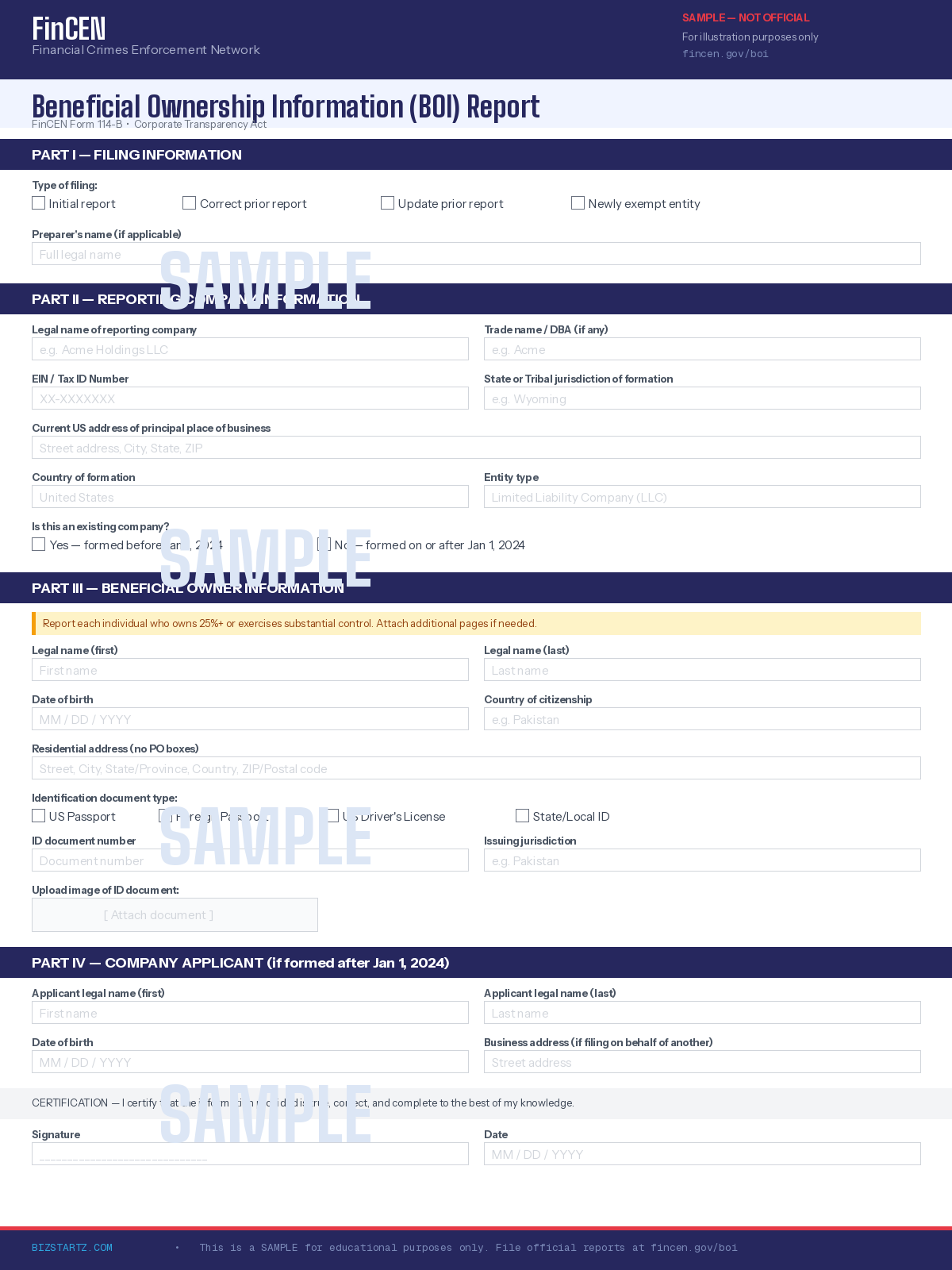
According to the Corporate Transparency Act, starting January 1, 2024, Limited Liability Companies (LLCs) must submit a report of beneficial ownership information (BOI) to FinCEN within 90 days of formation.

The report incorporates:

  • The personal information of all beneficial owners
  • Details of the company applicant
  • Identification (passport, driver’s license, etc.)

Non-compliance penalties can be severe – up to $500 for each day of violation.

📜 Apply for Business Licenses

If your LLC is going to operate in Delaware or the rest of the United States, you might require:

  • State and local business licenses
  • Sales tax permits
  • Foreign qualification if the business is outside of Delaware

Need Expert Help Starting Your Delaware LLC?

Bizstartz has been helping entrepreneurs from all over the world start and maintain their Delaware LLCs. We specialize in assisting with EINs, providing registered agent services, and BOI reporting and banking services.

These are some of the services we offer:

✅ Formation of a Delaware LLC

✅ Providing Registered Agent Services

✅ Assisting in Filing for an EIN Application (for domestic and foreign founders)

✅ Drafting Operating Agreements

✅ Filing BOI Reports

✅ Opening a Business Bank Account in the U.S.

✅ Sending Reminders for Annual Compliance

✅ Receive Personalized Service For Your Delaware LLC Today.

📞 Or schedule a no-cost initial discussion with our specialists.

Blog CTA

Frequently Asked Questions (FAQs)

Is A Foreigner Able To Apply For A Delaware LLC?

Of Course. The state of Delaware is very foreigner friendly as it does not restrict ownership. There is no requirement of citizenship or even a US address.

Is There A Requirement Of Having An Address And Social Security Number From The US?

Not At All. LLCs may utilize the address of a registered agent and SSNs for obtaining EINs are not mandatory, only an application through Form SS-4 is the requirement.

Does Delaware have advantages over other states regarding LLCs?

Delaware is best suited for holding companies, online businesses, and startups where privacy and legal flexibility is a concern. Delaware is not the only business-friendly state.

If you operate a business in another state, such as California or New York, you’d have to register your Delaware LLC there as well, adding more costs and paperwork.

How to Start an LLC in Wyoming | Step-by-Step Guide

Forming an LLC in Wyoming remains among the best in the entire United States. Entrepreneurs all over the world are looking forward to setting up an LLC in Wyoming due to the additional features like low fees, privacy guarantees, and a favorable atmosphere for setting up and operating businesses.

As a freelancer or even a fully fledged business owner, setting up your LLC in Wyoming can be beneficial for you in a myriad of ways.

This guide comprehensively covers everything you need from choosing a name to maintaining compliance in order to form an LLC in Wyoming so that you can successfully start your business.

Why Consider Wyoming for Your LLC?

For those considering forming an LLC, Wyoming is one of the best places due to the unparalleled features they offer. Here is why we think Wyoming is the perfect state for LLC formation:

1. Zero State Income Tax

State tax doesn’t affect individuals and corporations in Wyoming. This implies that LLCs are not taxed on income at the state level, which means significant profits for the business. Entrepreneurs are always looking for ways to avoid taxes, and this feature is greatly beneficial.

2. Strong Asset Protection Laws

The law governing Limited Liability Companies (LLC) in Wyoming have adequate asset protection for the members as well as the managers. For instance, Wyoming has “Charging Order” protection which limits creditors to obtaining only a distribution owed to the LLC member, rather than the able to seize LLC assets completely. This protection enables the shielding of assets from business debts and lawsuits, which is beneficial.

3. Low Fees and Minimal Paperwork

With a very low incorporation fee of $100, Wyoming is a very favorable state for starting a LLC compared to other states within the US. This fee, coupled with reasonable annual fees, makes maintaining a LLC in Wyoming conducive for startups and smaller businesses.

4. Superior Privacy Protections

Wyoming has the unique feature of not requiring the disclosure of names for members or managers of the LLC included in the formation documents. This is unlike several other states that require business owner information, which is later transformed into public records.

5. Easy Access for Non-Residents

One does not need to be a resident or citizen of the US in order to form a Wyoming LLC, thus making it extremely popular amongst non-American entrepreneurs as well as international travelers. The accommodating policies and services of Wyoming aid a foreign business person looking to start a company in America.

6. Flexible Management Structure

With the lack of restriction on member an manager structure, Wyoming LLCs have the benefit of member-managed or manager-managed structure where you control how you wish to operate your company.

Guide to Setting Up a Wyoming LLC

LLC in Wyoming

Step 1: Elaborate your LLC

The name of your Wyoming LLC is not only the cornerstone of your brand, but also serves legal as well as marketing functions. Therefore, it must be chosen wisely.

  • Uniqueness: Wyoming requires your LLC’s name to be distinct from all existing business entities registered in the state. This avoids confusion and protects your brand.
  • Naming Laws: It is mandatory to use the words ” Limited Liability Company“, “LLC” or “L.L.C.” at the end of your name. Names that suggest any form of government agency, L.L.C. provide misleading information to the general public without proper founding documents cannot be lawfully accepted.
  • Checking Availability: You are advised to first conduct a business name availability check on Secretary of State of Wyoming’s website using its business name search tool.
  • Business name registration: Wyoming allows you to reserve the name free of charge for a period of a hundred and twenty (120) days through the name reservation application form after paying a 50 dollar fee.

Social Media and Branding: Check if your LLC has its mems domain name and social media handles available to the public which will ensure that all marketing material will now be consistent.

Step 2: Designate an Agent in Wyoming

This is any entity or single individual in charge of receiving legal documents such as service of process, tax notices and any other compliance documents needing legal attention as they become due and require action.

  • Physical Presence: A Street address (no P.O. boxes) is required of the registered agent in Wyoming.
  • Who Can Be an Agent: A registered agent can either be an individual residing in Wyoming, a member of the LLC, or a professional registered agent.
  • Benefits of Hiring a Service: Registered agents are convenient because they provide confidentiality (your address is not available to the public) and help you stay organized by ensuring that no important documents are overlooked.
  • Service Fees: Registered agents charge between $100 and $300 annually on average.

Step 3: Articles of Organization Associated with the LLC

This is the legal documentation that constitutes your LLC.

Filing Methods: You may file your Articles of Organization with the Secretary of State of Wyoming online, or submit a hard copy by post.

Required Information:

  • Title of LLC
  • Registered agent’s name and address
  • Address of the principal office (outside Wyoming is acceptable)
  • Organizer’s declaration (II of the filing) is a signature form and ID of the person filing.

Filing Fee is $100 if done online and $102 if done by post.

Processing Time: If filings are done online, they will take one working day, otherwise, submissions posted may take around 5-10 working days.

Tip: Ensure accuracy and completeness of submission to avoid complications like delays and rejection of applications.

Step 4: Develop an Operating Agreement (Greatly Suggested)

As an internal document, an Operating Agreement is important, even if it legally isn’t required in Wyoming.

Goals: It outlines governance for your LLC, divides ownership shares, divides profit, and assigns member responsibilities, among others. It also specifies how new members may be added or existing members removed.

Benefits:

  • Clearly outlines expectations, helping prevent conflicts.
  • Strengthens your LLC’s standing with lenders, clients, investors, and other business partners.
  • Supports maintaining personal asset protection by proving business and member separation.

Customization: Operating agreements can be as complicated or as straightforward as necessary for multi-member and single-member LLCs.

Step 5: Secure an EIN (Employer Identification Number)

An LLC’s federal ID is its EIN, which is issued by the IRS.

Reasons:

  • For business bank account registration.
  • For employee recruitment and payroll management.
  • For administration of federal taxes or merchant account registration.

Application Process:

  • U.S. residents can apply for free through the IRS website.
  • Non-U.S. residents must submit IRS Form SS-4 via fax or mail.

Free: There are no charges for issuing an EIN.

Step 6: Meet Additional Compliance Obligations

To keep your LLC in good standing, you’ll have to complete the following tasks each year:

Annual Report:

  • Deadline: By the first of the month in which your LLC was founded.
  • Filing Method: Online via the Wyoming Secretary of State’s Portal.
  • Fee: Minimum $60 or 0.0002 of your Wyoming assets (whichever is more).
  • Goal: Maintains current Wyoming state record for your LLC.

Registered Agent Updates

  • Update the contact information for your registered agent.
  • If there’s an agent change, submit a Statement of Change to the state.

Business licenses & permits

  • You might require additional licenses or permits from the state or municipality based on your business operations. Verify prerequisites with local government offices.

Optional Considerations

Open a Business US Bank Account

Keeping business and personal finances separate is crucial for liability protection and accurate record-keeping.

  • Documents Needed: Articles of Organization, EIN, Operating Agreement.
  • US Banking Institutions: Most of them require personal presence, but some grant remote account opening for LLCs registered in Wyoming.
  • Non-local Business Owners: Additional documents such as an ITIN may be required from some banks.

Apply for a Virtual Address or Mail Forwarding Service

A virtual office or a mail forwarding service can assist you if you don’t reside in Wyoming and wish to keep your personal address concealed by:

  • Offering you a sophisticated professional business address.
  • Safeguarding the receipt of your mail and packages.
  • Sending your correspondence to any location of your choice anywhere around the globe.

How We Simplify Wyoming LLC Formation at Bizstartz

Both existing and aspiring entrepreneurs can easily start their businesses in Wyoming with the help of Bizstartz, which assists clients in the US and across the globe.

Here’s everything we manage for your Wyoming LLC:

  • Filing for LLC Formation
  • Registered Agent Services
  • EIN Application (SSN optional)
  • Operating Agreement Templates
  • Virtual Address and Mail Forwarding Services
  • Annual Report Fling & Reminders
  • Tax and Bookkeeping Services
  • Non-Resident ITIN Applications

Having a Bizstartz consultant enables you to set up your Wyoming LLC digitally, irrespective of whether you are a nomad, an eCommerce entrepreneur, a tech startup founder, or a business consultant.

👉 Get started with your LLC today at Bizstartz or reach out for a complimentary consultation!

Blog CTA

Conclusion

The combination of affordability, legal protections, strong privacy measures, and low asset-protecting costs makes starting an LLC in Wyoming particularly enticing.

From eCommerce and consulting to technology startups, businesses from all sectors will find ample opportunities in Wyoming.

If you wish to receive unparalleled pro support from the initial filing through gaining an EIN and maintenance compliance for your Wyoming LLC.

Bizstartz is ready to assist you. Let us take care of the bureaucracy and paperwork while you shift your focus on expanding your new Wyoming LLC business.

Frequently Asked Questions (FAQs)

Can I form a Wyoming LLC if I don’t live in the U.S.?

Absolutely. Wyoming is friendly towards non-residents and does not require US residency or citizenship to set up an LLC.

How long does it take to form an LLC in Wyoming?

Online submissions are usually accepted on the spot or within one business day. Postal applications take about 5 to 10 days for processing.

What are the annual fees for maintaining a Wyoming LLC?

$60 minimum annual report fee or based on the value of the assets in Wyoming. Additional fees for registered agents apply.

Does Wyoming protect my privacy as an LLC owner?

Yes indeed, there is no requirement to publicly disclose LLC members and managers in Wyoming, therefore your privacy remains protected.

Can I convert my existing business to a Wyoming LLC?

This is possible, you can file for conversion or create a new LLC and obtain the assets, it is best to speak to a tax or legal consultant for the best advice.

Navigating the L1 Visa Process: What You Need to Know

Expanding a business internationally is very ambitious, for it offers a world of new opportunities to take advantage of. Once companies have a global presence, the ability to relocate essential personnel from one location to another becomes crucial for business continuity, expansion, and efficiency.

An ideal example of such a pathway is the L1 visa, which is designed specifically for this purpose. This non-immigrant visa permits employers to transfer employees at their company’s foreign office to a U.S. branch, affiliate, or subsidiary.

The major challenge lies in having adequate knowledge about processes accompanying relocation of employees, for example, the relocation of HR specialists and managers changes the company’s operational focus.

This is a sophisticated overview of what must be done to Accomplish L1 Visa by the time one relocates to America, be sure to check all the provided rules concerning eligible applicants for each section needed to ensure best practices.

What is an L1 Visa?

L1 Visa is one of the employment-based visa categories issued to non-U.S. citizens. It is aimed at intra-company transferees as they need face-to-face interaction with their American counterparts.

In the review of best trades to pick for doing investment in America, you notice L1 to be most attractive for subsidiaries already housed in the country because of the competition around them.

There are two principal types of L1 Visa categories:

L1A Visa – Managers and Executives

The L1A visa is reserved for upper-level employees who funnel direct report upwards such as department heads, team leaders and strategists, or visionary decision-makers. This visa type is popular among business owners and executives who are moving to the United States to manage operations or open a new branch office.

L1B Visa – Employees with Specialized Knowledge

This L1B Visa applies to employees with specialized or proprietary wisdom pertaining to the company’s products, services, methodologies, and systems. These workers are not merely employees, they possess knowledge that, is skillfully advanced and indispensable for the organization’s success.

Who qualifies for an L1 visa?

L1 Visa

When it comes to acquiring an L1 visa, the foreign corporation and the employee must both meet specific requirements outlined by the U.S. Citizenship and Immigration Services (USCIS) in order to successfully qualify for the visa.

Responsibilities of the Employer:

Qualifying Relationship: A legal corporate relationship must exist between the U.S. entity and the foreign entity. This corporate relationship can be that of a sponsor company, subsidiary, affiliate, or branch office.

Active Business Operations: Both the foreign entity as well as the U.S. office need to be really active doing business, not just existing on paper. This also encapsulates routine, predominant, and ongoing commercial activities.

Employee Requirements:

Work History: The applicant is required to have been employed with the foreign entities without interruption for a minimum of a year within the last three years prior to submitting the application.

Role Requirements:

For L1A, the applicant must be traveling to the U.S. to work as appointed under the executive or managerial category and must have the necessary control and command of other employees or crucial functions.

For L1B, the applicant should possess specialized knowledge of highly differentiated skills specific to the company’s operations, procedures, technologies, or products which are not widespread amongst practitioners in the field.

Why Apply for an L1 Visa?

The L1 visa comes with a number of unique benefits, making it one of the most sought after for business and international experts.

1. No Annual Limit Cap

Unlike the H-1B visa which has a fixed yearly limit and requires a lottery, the L1 visa has no limits and any company can apply whenever they wish during the calendar year.

2. Dual Intent

The L1 visa allows for dual intent which indicates that the visa holder may apply for permanent residency (a green card) without losing their L1 status. This facilitates long-term career planning as well as immigration objectives.

3. Inclusion of Dependents and Employment

The dependents (spouse and children below the age of 21) of the L1 visa holders can travel with the primary visa holder to the U.S. on an L2 visa. The spouse of an L1 holder is permitted to petition for work authorization and may work in any field in the U.S. This enhanced flexibility allows families to stabilize economically.

4. Opportunity for Permanent Residency

The holders of the L1A visa face relatively less challenges when transitioning to a green card through the EB-1C immigrant visa category because it does not require PERM labor certification. This helps streamline the process for acquiring permanent residency.

5. Opening a New Office

Educated foreigners and businesses which do not have a presence in the U.S. can apply the L1A visa to open a new office in the U.S. if they fulfill certain conditions such as having a business location and having a reasonable business plan.

Obtaining an L1 Visa: Step-By-Step

Acquiring an L1 visa requires a particular approach, in addition to the steps necessary to acquire one, and ample paperwork needs to be gathered as well. As such, I will highlight the more detailed steps needed to complete the process advertised in this form.

Step 1: Assessment of the Criteria

Make sure that the employee and the employer are ready to apply, make the application as easily accessible as possible in order to speed the process up. Both the employer and employee need to ensure that they fall under the relavent categorization of L1 VISA either L1A or L1B. Under this check also include the structure of the company, its employment history, the duties performed by the person, and the role he intends to take on in the USA.

Step 2: Filing the Petition

An employer need to fill out Form I-129 and submit it devoid of the L Supplement to the USCIS. Along with the submission, photographs that shed light on the nature of the business, the relationship, the head and shoulders of their work will also need to be submitted.

This entails:

  • Corporate documentation
  • Organizational layouts
  • Job showcases
  • Financial documents
  • Lease contracts (for new offices set up in the USA)

Step 3: USCIS Review

After sending out the paperwork, Make sure to wait for a set amount of time which is usually made sure to be followed. After made sure, USCIS are able to accept or decline the offered paperwork but the timeframe quote given can differ based on non-urgency or surgical aid offered by the customer.

Step 4: U.S. Visa Interview at the Embassy

After completion, the employee is to fill out Form DS-160 and book an interview with the relevant consulate or embassy in their country. The interview aims to authenticate the details of the petition and the intended employment to be undertaken in the U.S. by the employee.

Step 5: Employment and Travel to the U.S.

With the issuance of the visa, the employee is free to travel to the United States and commence work at the assigned office in the U.S. Newly established offices are granted L1A visas for up to one year, while existing offices are granted 3-year L1A visas. This can be extended up to 7 years for L1A and 5 years for L1B.

Required Documentation

All components must be in order for a successful L1 petition, including a comprehensive impersonation strategy. Below are the requirements that are needed:

Company Documents:

  • Incorporation documents (foreign and US)
  • Business permits/registrations
  • Corporate tax documentation
  • Management organizational charts detailing lines of reporting
  • Lease agreements or proof of having an office

Employee Documents:

  • Resume/CV demonstrating relevant experience
  • Documents proving employment with the foreign company, for example, pay stub, contract, or offer letter
  • Comprehensive job description draft (US past and proposed roles)
  • Relevant degrees and or certifications (if applicable to the position)

Supporting Evidence:

  • Proof of specialized knowledge (for L1B)
  • Proof of executive or managerial duties (for L1A)
  • Others include business plans and their projected finances (in cases of new office offers)
  • Completeness in preparing the given documentation increases chances of approval as well as reduces the time needed to process the petition.

L1 Blanket Petition: A Streamlined Option for Larger Companies

Businesses that regularly make use of international transfers find the L1 Blanket Petition process more convenient. Instead of filing an I-129 for each employee, the company can seek blanket approval.

Benefits of Blanket Petition:

  • Less paperwork for each transfer
  • Faster issuance of visas
  • Permit direct applications of qualified employees at consulates

A company needs to meet the following conditions to qualify for blanket petition:

  • Engaged in trade or services
  • Possess an active office in the U.S. for 1 year
  • Possess 3 or more domestic/foreign branches, or subsidiaries, or affiliates
  • Transferring 10 L1 employees in the last year, or having at least $25 million in combined annual sales, or 1,000 employees

Common Challenges and How to Overcome Them

Even though the L1 visa process is fairly straightforward for established companies, there are some challenges that can come up. Here are some common issues with suggested solutions.

1. Enough Evidence of Business Operations

Claiming a non existent business entity of a USCIS foreign entity and a US counterpart activates a scrutiny dungeon. Send in the file of business activity documents, contracts, invoices, detailed marketing materials, rosters of employees, etc.

2 . Descriptions of Positions Vaguely Defined.

As for L1A, the job should as much as possible consider executive and managerial functions. Do not use broad titles, think about commanding authority over the staff, supervision, budgets, and particularly strategic control.

3. The Misinterpretation of Specialized Knowledge.

It is very important for L1B cases to demonstrate that the employee’s knowledge is proprietary and not easily mimicked. Include technical manuals of the crafts, training records, and senior management testimonials to prove leaves out other scholars.

4. Obstacles with a New Branch Office.

It is possible to open a new branch office with an L1A visa but other documents are necessary, such as the lease of property, a plan of the personnel, and projections are to be met financially alongside a business growth strategy.

5. Not Utilizing Legal Expertise.

Considerable challenges created by the ever-changing nature of immigration policy mean that legal expertise is very useful, ensuring compliance as well as increasing the chances of approval. Steer clear from the ambiguous routes that result into expensive hold ups or refusals.

Final thoughts.

This visa grants flexibility in its use to multinational corporations and citizens and employees of other countries. It allows internal movements of personnel to be done without hindrance, helps in business growth in the US, and clearly setup the prerequisites for permanent dwelling for qualified individuals.

But that’s a lot of paperwork, eligibility requirements, and detailed prior processes. If you’re an executive, employee, or an entrepreneur starting a business in the U.S., the L1 visa provides an excellent option, though ample foresight is critical.

Prepared to embark on the L1 visa journey?

At Bizstartz, we enable international entrepreneurs and businesses to navigate through the L1 visa application process. We ensure your success by preparing compelling petitions, establishing business entities in the U.S., guiding you through compliance interviews, and much more.

Book a free consultation with us and let us help you take the first steps toward establishing your presence in the U.S.

Blog CTA

Most Commonly Asked Questions About the L1 Visa

1. What is the processing time for an L1 visa?

An L1 visa has a variable processing time based on the workload at the service center, the case’s complexity, and selection of premium processing. Typically, the L1 visa takes:

  • Regular processing: 2 to 6 months
  • Premium processing: 15 calendar days (for a fee paid to the USCIS)

If you’re applying from outside the country, you have to consider the waiting time for the visa appointment at the consulate or embassy.

2. Is it possible to change from an L1 visa to a green card?

Certainly. The L1 visa has dual intent which permits a holder to take seek a green card while on an L1 status. For example, those who possess an L1A visa usually tend to move to a green card through the EB-1C category for multinational executives or managers.

This is a quicker path because it avoids the need for a labor certification (PERM). Those with L1B visas may qualify for other employment-based green card categories such as EB-2 or EB-3, but the process may take longer and more complicated steps.

3. Is it possible to set up a business in the U.S. on an L1 visa?

With certain restrictions yes. For instance, the L1A visa seems to best advantage business entrepreneurs or owners who wish to relocate their branch office from overseas to the USA. As a rule, USCIS demands proof that:

  • The new U.S. entity has secured physical office space
  • The foreign company continues operations
  • An L1A holder will be working on an executive or managerial role.

This is one of the most popular strategies for international business development and is also one of the rare approaches available for business owners to non-immigrant visa.

4. What happens if my L1 visa runs out? Can it be renewed?

Of course, the L1 visa may be renewed if you are eligible:

  • L1A: Given for a period of up to 1 year (new office) or 3 years (existing office), with extensions permitted totaling 7 years.
  • L1B: Originally assigned for up to 3 years, with extensions totaling 5 years.

After the maximum period, you have to either exit the U.S. or change to another category of visa or green card if you qualify.

5. Can I work with a different employer while using L1 Visa sponsorship?:

No. The L1 visa is specific to an employer, meaning you are restricted to work for the U.S. entity that sponsored your visa & affiliated with your foreign employer.

You are not allowed to work for another company, whether on a part-time or freelance basis, while under the umbrella of an L1 visa. Working under those conditions violates the terms of the L1 visa and can lead to losing your visa status along with the loss of immigration benefits.

How to Form a Single-Member LLC (SMLLC): A Complete Guide

From freelancers and e-commerce sellers to solo-founders, all benefit from the legal protection and simplicity of a Single-Member Limited Liability Company (SMLLC).

With this guide, you can get started with the definition of SMLLC and insights on its formation and maintenance along with tax implications.

What Is A Single-Member LLC?

A Single-Member LLC or Single-Member Limited Liability Company (SMLLC) is a type of LLC owned by a single individual, known as a “member.” SMLLC affords the owner the benefit of limited liability and enjoys the independence of an individual business owner, functioning much like a multi-member LLC.

The SMLLC is a hybrid business structure that merges the liability protection of a corporation with the tax benefits and ease of doing business as a sole proprietor.

They are among the most common business entity options in the United States, especially for small business owners, solopreneurs, and non-U.S. residents wanting to open U.S. branches.

Why Choose a Single-Member LLC? (Benefits)

Knowing the benefits associated with a Single Member LLC (SMLLC) is crucial before forming one. Here are a few advantages:

1. Limited Liability Protection

In the face of business debts or lawsuits, your personal assets like a house, car, or bank accounts are safe. In case of an SMLLC lawsuit or debts, the business assets at most risk are only those belonging to the business itself.

2. Pass-Through Taxation

The IRS regards a Single-Member LLC as a disregarded entity. This allows business income and expenses to funnel directly into your personal income tax return. Unlike corporations, this structure avoids the burden of double taxation.

3. Simple Structure and Management

Boards, shareholders, and bylaws are parts of a corporation. An SMLLC has few formalities to abide by. You, as the sole decision maker, are able to run operations swiftly and efficiently.

4. Professional Credibility

Customers, investors, and banks, like business partners, regard an LLC after your business name adds legitimacy. It gives more trust in you, allowing for better dealing with people when seeking funds or opening a business bank account.

5. Business Continuity

While a sole proprietorship ceases to exist upon the owner’s death, an LLC continues operating as long as it is well structured. Also, you can easily change ownership or introduce new members later on.

Steps to Form a Single-Member LLC

Single Member LLC

Let’s outline the procedure in a series of steps.

Step 1: Decide on the State of Formation

You’re free to choose any US state, or even one you do not live in, to start your LLC. Here’s how to choose:

  • Home State: Preferred if you are physically present in the U.S. and intend to operate within the state or region.
  • Delaware: Popular due to their advanced business regulations, confidentiality, and overall legal climate.
  • Wyoming: No state income tax, very low costs, and privacy are some of the advantages offered.
  • Nevada: The state does not levy corporate or franchise taxes, making it business-friendly.

⚠️ Note: Forming your LLC in one state, but operating in another could mean that you have to register as a foreign LLC in the state where you are based, which adds costs.

Step 2: Choose a Legally Compliant and Distinctive Business Name

The name of your LLC must comply with the following requirements:

  • Be unique within the state of incorporation.
  • Have an ending designator such as “LLC,” “L.L.C.,” or “Limited Liability Company.”
  • Not include restricted terms like “Bank,” “Insurance,” or “Corporation” without obtaining the requisite permits.

✅ Ensure you haven’t overlooked your Secretary of State’s website prior to taking these next steps. You might also want to pigeonhole a name if you’re not prepared to make a filing right away.

💡 Tip: For brand coherence, consider claiming the corresponding website and social media accounts.

Step 3: Choose a Registered Agent

A Registered Agent Designates an Individual or Business Who Will Be Responsible for Receiving the Following:

  • Legal documents (lawsuits).
  • Government mailbox.
  • Compliance documents.

The agent must fulfill the following criteria notified.

  • Possess a physical address in the state of formation (No P.O. Boxes).
  • Maintain regular operating hours.

Every U.S resident can appoint themselves as their own registered agent, or opt to utilize Registered Agent Services for discretion and convenience, which is especially useful for those living abroad.

Step 4: Articles of Organization Fill Out

Filing Articles of Organization and having them approved is what fully forms your LLC with the state as an officially recognized entity.

Items you traditionally need to submit include:

  • Name of the LLC and principal address of your business.
  • Details of the Registered Agent.
  • Specify the type of management.
  • Specify the term of the LLC.
  • Sign the Organizer’s document.

Filing fees also differ by state, ranging anywhere from $40 in Kentucky to $500 in Massachusetts. Some states also offer expedited filing for an additional cost.

The majority of states allow for applications to be submitted:

  • Online: the fastest and most popular method.
  • Via postal service.
  • In person: least common.

Step 5: Write a Single Member Operating Agreement Draft.

A single member operating agreement serves as the governing document of the company and dictates its internal workings. An operating agreement may not be mandated for amending a business license in your region, but it is always recommended.

Some recommended sections to include are:

  • Member’s ownership and role
  • Procedures for adding members or transferring ownership
  • Banking and financial protocols
  • Dissolution terms
  • Liability clauses

Defaulting to state law dictates that a business defaults to state law undermines the affiliation without an operating agreement. It’s imperative to provide a business with legal name separation while enabling for claiming defaulting by the business itself alongside controlling the state legislation in openly switching the law.

Step 6: Acquire an Employer Identification Number (EIN)

An EIN or a Federal Tax ID, as referred to by the IRS, is critical when:

  • Paying taxes
  • Opening a business bank account
  • Hiring staff
  • Applying for a business license

Application can be done in two ways:

  • Online via a secured SSN or ITIN
  • By mail or fax via Form SS-4 for Non-US residents

⚠️ Non-residents of the US lacking an SSN or an ITIN can only apply via mail/ fax. It could take several weeks.

Step 7: Open a Business Bank Account

The personal and business bank accounts must be kept separate in order to maintain your LLC’s limited liability protection. This is a crucial step.

Documents needed:

  • EIN confirmation letter issued from the IRS CP 575
  • Articles of Organization
  • Operating Agreement
  • ID (Government issued like passport or Driver’s license)

With a business bank account, based in the US, you are able to:

  • Issue invoices to clients
  • Record and monitor the cash inflow and outflow
  • Safeguard and maintain the Limited liability protection
  • Establish company credit

For those who do not reside in the United States, some banks, virtual banking systems and service providers offer remote account setup.

Step 8: Obtain Business Licenses and Permits

Depending on the state and city where the business is located, the following may be needed:

  • General business license
  • Home occupation permit
  • Sales tax permit (if the business offers taxable goods and services)
  • Professional or occupational licenses (such as for contractors, medical professionals, or legal professionals)

Consult your local:

  • State Department of Revenue
  • City or county offices

Paying fines or having one’s business suspended can occur when operating without proper licenses.

Step 9: Stay Compliant with Ongoing Requirements

Compliance, as the primary ongoing requirement, ensure an SMLLC maintains legal standing after formation.

The following are common requirements:

  • Annual Reports: Submitted yearly (or every other year) with a nominal fee attached
  • Franchise Tax: Required in states like Delaware, California, and Texas
  • BOI Reporting: Starting 2024, FinCEN must receive the Beneficial Ownership Information Report
  • Bookkeeping and accounting: Clear maintenance of all business transactions
  • Registered Agent Renewal: Confirm that the agent remains active and in good standing

Failure to comply can lead to administrative dissolution or penalties.

How Are Single-Member LLCs Taxed?

Assumed to be the default option, an SMLLC gets taxed as a sole proprietorship:

  • Business income and expenditure is recorded in the Schedule C section of the IRS Form 1040
  • Self-employment tax, usually around 15.3%, will be applied to profits.

But you can choose to be taxed as:

S Corporation: To possibly reduce self-employment taxes

C Corporation: In case you wish to reinvest in the business for a long term or if you want to draw in some new investors

💡 For optimal setups pertaining to your income level and business objectives, consult with a tax professional.

Can Single-Member LLCs Be Established By Non-U.S. Residents?

Absolutely! Non-U.S. residents can set up and fully control a U.S. LLC without residing in the United States.

However, there are these additional considerations:

  • Apply for an EIN through Form SS-4 (no SSN available)
  • File a BOI Report with FinCEN
  • Privately opt for an ITIN to assist with tax returns
  • Engage the right specialists to set up a U.S. bank account

The United States is one of the few countries that hospitably accepts non-U.S. entrepreneurs, thus it ranks highly among international e-commerce sellers, consultants, and investors.

Let Bizstartz Help You Launch Your SMLLC

At Bizstartz, we have assisted entrepreneurs across the globe in confidently and swiftly starting their U.S. LLCs. We provide:

  • LLC formation in all 50 states
  • EIN application (available for non-U.S. residents too)
  • Drafting of the Operating Agreement
  • Compliance of BOI filing
  • Registered Agent services
  • Assistance in opening business bank accounts
  • Ongoing compliance support

👉 Want to get started? Create your LLC with Bizstartz today

Blog CTA

Frequently Asked Questions (FAQs)

1. Do I require a lawyer to establish a Single-Member LLC?

No. You can go without one as the entire process can be undertaken by yourself online on your Secretary of State’s website. However, if your business has complex operations involving legal contracts, foreign ownership, or other intricate factors, enlisting professionals or attorneys can ensure everything is executed lawfully and properly.

2. Can I switch from Single Member LLC to Multi Member LLC later on?

Certainly. You can change your Single Member LLC into a Multi-Member LLC anytime by revising your Operating Agreement and informing your state’s business office. Additionally, you might have to submit an amendment to your Articles of Organization. It can adapt as your business expands due to its flexibility.

3. Do I need to pay myself a salary for being the only owner of an SMLLC?

If your LLC is untaxed and classified as a disregarded entity, traditional salary-like payments are not made. Instead, you pay yourself by way of owner’s draws, which means moving money from the business account to your personal account. If your LLC is taxed as an S-Corporation, you will need to designate a portion of your income as a reasonable salary and will be required to, as an employee, subject to payroll taxes.

4. Is an SMLLC more advantageous compared to sole proprietorship?

In very many cases, yes. Both options are easy to manage, but unlike sole proprietorship, Single Member LLC comes with limited liability protection, which ensures that personal assets are kept separate from business debts, obligations and legal issues. On the other hand, sole proprietorship accepts personal liability for business-related risks.

5. What is the timeline for forming a Single-Member LLC?

The timeline changes according to each of the jurisdictions:

  • Delaware and Wyoming, for example, offer same or 1-2 day processing (often with expedited fees).
  • In other regions, the time frame can be 1-3 weeks depending on how busy the office is and how the form was submitted (online versus mail).

Filing through a professional service such as Bizstartz will save time significantly and guarantee accuracy along the way.

LLC Operating Agreement: Why Do You Need One?

Forming an LLC remains one of the most popular business structures in the United States for its flexibility, protective features, and favorable tax treatment. However, many entrepreneurs forget the all-important Operating Agreement.

An LLC Operating Agreement is a company’s blueprint that provides organizational structure along with the rules necessary to run the company smoothly, including ownership shares, roles, daily tasks, and conflict resolution methods. Despite operating without one being a lawful option in many states, an Operating Agreement enhances efficiency and minimizes discord in any business set up.

Today, we delve deeper into the definition of Operating Agreement, the necessity for each LLC to have one, and highlight essential elements that will safeguard your business while keeping operations streamlined.

What is an LLC Operating Agreement?

An LLC operating agreement is a comprehensive document that describes the details of ownership, management features, and procedures for a limited liability company.

It acts as a constitutional document of the LLC in question where constituents freely negotiate what is referred to as an Operating Agreement, setting forth terms that stipulate all the members’ rights and duties.

When the state processes the registration of the LLC, Articles of Organization are accompanied by an Operating Agreement which does not require submission to any public entity; it remains confidential. Nonetheless, it is essential for our purposes in establishing the functioning of the LLC and ensuring that its members interests are safeguarded.

Operating Agreements are versatile legal documents because they can be used with single-member LLCs as well as multi-member LLCs; depending on how intricate the business is, level of detail can be simple or extensive.

Why You Need an LLC Operating Agreement

Operating Agreement
Operating Agreement

Even if not compulsory, each and every LLC ought to have an Operating Agreement as there are compelling reasons to do so.

1. Clarifies Ownership and Management Structure

An Operating Agreement constitutes a legally binding contract between the members of the LLC that delineates how the company will be run. As such, it is essential for every working business to keep accurate records of their management structure to protect themselves against unnecessary conflicts brought on by unfulfilled expectations.

This is critical when there are many members because if there is ambiguity around ownership interests or the management scope granted, that can lead to the nasty outcome of significant conflicts later on.

Take for instance two partners starting a business together without documenting their initial contributions. They might continue under the assumption that both of them hold a 50% share. But what if one of them contributed significantly greater amounts of time or money?

As we discussed in the previous unit, an Operating Agreement avoids such misunderstandings by detailing the decision-making processes and ownership splits along with certain voting mechanisms.

Moreover, the Operating Agreement specifies if the LLC will be member-managed (by the owners) or manager-managed (by hired managers) and allocates the tasks for each defined role.

2. Prevents Internal Disputes

Sustaining a harmonious workplace is crucial, given the potential conflicts between business partners that can arise from profit sharing, unequal distribution of workload, or a difference of opinion on company strategy. An Operating Agreement formulates steps designed to address these concerns, which prevents problems and addresses issues from both a business and legal perspective.

The Operating Agreement accomplishes that by outlining procedures for assigning decision rights and voting mechanisms along with outlining conflict resolution methods. It details the following policies to encourage a positive business atmosphere:

  • Business meeting attendance
  • Voting limits for the decision-making process, for example, majority or unanimous votes
  • Assigning resolution methods, such as mediation or arbitration, after a conflict has arisen
  • Termination of an ineffective or disruptive member

Documenting these policies not only preserves relationships but also protects the operations of the business.

3. Maintains the Limited Liability Status

An essential reason for forming an LLC is to ensure that your personal assets are separate from the liabilities of your business. In order to maintain this form of protection, states require an LLC to function as a legally distinct entity, which sometimes is not enough after forming an LLC.

These things may occur if:

  • Business and personal accounts are mixed
  • Business protocols aren’t professionally followed
  • A lack of basic foundational documents like the Operating Agreement for an LLC

Having an endorsed Operating Agreement in place is the best defense for your claim that an LLC is a separate legal entity that must have defined governance structures. This is especially important in situations where legal proceedings could endanger your limited liability protection in court.

4. Takes Precedence Over State Rules

All states have pre-established rules for LLCs without an Operating Agreement that run the risk of oversimplifying and missing out on custom details unique to your preferences and business goals.

For instance, in many states:

  • Profits and losses are divided equally, regardless of the amount each member invested.
  • Each member is entitled to the same range of voting rights without considering the value of their capital contribution.
  • There could be procedures listed for the addition or removal of members that may not cater to your specific tastes.

An Operating Agreement enables you to tailor the corporate governance of your company and its business organization to suit your strategies. You control how your business is managed instead of having to follow state default statutes.

5. Assists with Banking and Legal Issues

A business bank account is opened after presenting the LLC’s Operating Agreement. Banks need to know who the business’s owners are, who is entitled to make payments, and how the whole thing operates.

Also, when you seek money from other people in the form of investors or apply for a business loan, an Operating Agreement that is well detailed makes it seem like the business is being run and organized professionally. This will also aid in clearing any legal issues concerning ownership or authority that may come up during contract negotiations or disputes.

All of this proves how Operating Agreements have both internal and external advantages to businesses and why they enhance the credibility of third parties.

6. Business Continuity Management

Each business needs to be prepared for the most severe circumstances. What if one of the members dies, becomes sick and unable to work, files for bankruptcy, or wants to walk away entirely.

An Operating Agreement can outline these issues with buy-sell provisions, succession plans, and rules for transferring membership interests. These clauses help ensure that the business will continue even after major changes.

In the absence of such provisions, your LLC may have to dissolve or ownership may change hands in a manner that is detrimental to the firm. With proper planning, you guarantee your business will endure throughout the years.

Key Elements to Include in an LLC Operating Agreement

While an Operating Agreement must be fit for your business, the following items should be taken under consideration:

Basic Information:

  • Name under which the LLC will legally operate
  • Main Business Address
  • Objects or Purpose of the LLC
  • Limits set on the life of the LLC (perpetual or limited)

Members and Ownership

  • Addresses with respective names of the members
  • Capital floats through current accounts
  • Shares of ownership or ownership percentages
  • Contribution to the future assets of the company.

Management Structure

  • Member-managed vs. manager-managed
  • Roles and responsibilities of members and/or managers
  • Protocols for appointing or removing of the managers.

Voting Rights and Administrative Actions

  • Power of vote each member shall hold
  • Setting of limits to the shareholders for important decisions
  • Who must participate in meetings as established and the low limits of participants to the meeting.

Profits and Loss Ratio

  • Payments for the distribution of profits or losses
  • Disbursement schedules for payments.

Change of membership

  • Participations for new members
  • Removing or retiring of pre-existent members
  • Change their controls of shares ownership
  • Buy shares and sell shares as a company.

Dissolving the company and winding up

  • Terms set to close the company.
  • Setting rules and limits of who gets what assets
  • Sessions of the company set to report internal tax charges and finalize paperwork.

Remaining passages

  • Provisions for unauthorized changes as a company.
  • Whose rules do we operate under
  • Providing securities for the actions of the company.

Do Single Member LLCs Need An Operating Agreement?

Not at all. Single-member LLC owners are mistaken when they think they do not need an Operating Agreement since they are the only owners. Regardless, having one has several benefits:

  • Structures and decorates your business to add credibility to it for dependability purposes.
  • It bolsters your limited liability by formalizing the division you and your business.
  • Defender mark maintains compliance with bankers, lenders, and other investors that might request the document.
  • It can provide a basis to establish predefined rules pertaining future expansion like business partners or managers.
  • In case of demise, having an Operating Agreement provides one or more concepts of instruction on how the business should operate.

With the Multipurpose Operating Agreements available in the market, even a single member LLC comes across as professionally managed while assisting with business durability.

Blog CTA

In Conclusion

It’s critical to avoid embarrassment or shock, dragging associates and numerous consultants finalizing how it should be structured. In relations to an LLC Operating Agreement’s reality, it certainly is more than just a subtle custom request it is a guide for controlling the formation and restructuring the entire business core to ensure condensing redundant and over versed chaos in the future spending company’s resources.

Don’t leave your business unprotected.

At Bizstartz, we assist entrepreneurs globally in the formation of U.S. LLCs and the preparation of Operating Agreements that strategically align with their aspirations. From solo founders to team members, we make it possible for you to establish the right structure from the very beginning.

✅ Don’t know how to draft your Operating Agreement?

Get in touch with us today or browse our LLC packages that come with an Operating Agreement, EIN, Registered Agent, and other services.

Frequently Asked Questions (FAQs)

1. Is there a legal requirement for an LLC Operating Agreement?

It varies by state. Some states like California, New York, Missouri, and Delaware require LLCs to have an Operating Agreement, particularly for multi-member LLCs. Most other states do not require one legally. Regardless of the legal obligations, it is advisable to have one as it will help to protect the business structure and provide internal guidance.

2. Can a lawyer be omitted from the process of formulating an LLC Operating Agreement?

Of course, business owners have the freedom to design an Operating Agreement on their own with add-ons available online. Nevertheless, it would be wise to reach out to a professional if your business has multiple members, complex ownership frameworks, or particular business requirements.

Templates often do not include important clauses and could put you in a legally vulnerable position. Bizstartz creates Operating Agreements for the specific needs of the client through their personalized plans.

3. Is it possible to make revisions to my Operating Agreement in the future?

Operating Agreements can be modified at any time, but the method changes must be done needs to be followed as dictated within the document itself. The majority of operating agreements need at least a majority of the members to agree to the changes. Keeping the amendments in sync with the growth of the business is essential.

4. In what location can a signed document for Operating Agreement be stored most effectively?

Because it is not a public document, you’re not required to submit the Operating Agreement to the State. That said, having a directory of copies is helpful as banks, prospective investors, and accountants will come asking for copies. Having them stored in both digital and physical formats guarantees easy access when it is needed.

5. What occurs in the absence of an Operating Agreement?

If you do not have an Operating Agreement, then your LLC will be managed under the default operating procedures for LLCs which are set by the region where the business is located. These default customs may fail to meet the necessary requirements for your business.

This may result in some profit splits that are not ideal, lack of clear roles for major business functions, or problems arising from conflicts with no easy resolution.

Furthermore, if there is no Operating Agreement, it is likely that your business will lose its limited liability protection under a court’s perspective, particularly in the situation of a lawsuit.

US Stripe Account Without SSN for Non-Residents (2026)

Non-residents can open a US business bank account remotely – no branch visit or US address required. You need a US LLC and an EIN (Employer Identification Number the IRS tax ID for businesses). No SSN is needed. Our Bank Account hub covers every pathway in detail.

According to the IRS, non-residents applying for an EIN via fax receive it in approximately 4 business days. Total time from LLC formation to an active account is typically 2–6 weeks.

Not every platform is available to every nationality. According to support.mercury.com, Mercury prohibits founders domiciled in Nigeria, Pakistan, and the Philippines. According to OFAC, US banking is prohibited for nationals of Iran, Cuba, North Korea, and Syria.

This guide covers business and personal pathways, real costs, and which platforms your nationality can actually access.

What a Non-Resident Needs to Open a US Bank Account

Bank Account as non-us resident

You do not need an SSN (Social Security Number) or a US address to open a US bank account as a non-resident. What you need depends entirely on whether you are opening a business or personal account.

For a US Business Bank Account

The practical path is a US LLC plus an EIN (Employer Identification Number the IRS-issued 9-digit federal tax ID for businesses). Mercury, for example, requires your EIN, passport, and LLC formation documents  no US address required.

The EIN is free directly from the IRS. Non-residents cannot use the online application. You must apply by fax or mail using Form SS-4. Fax with a return fax number takes approximately 4 business days. Mail takes approximately 4 weeks.

One critical note: nationals of Iran, Cuba, North Korea, and Syria cannot open any US bank account. OFAC prohibitions apply regardless of business structure.

For a US Personal Bank Account

Traditional banks Chase, Bank of America, Wells Fargo  require an in-person branch visit. Bank of America requires two forms of ID, a foreign tax ID, and proof of both a foreign and a US address.

Fintech alternatives accept remote applications. For personal accounts, an ITIN (Individual Taxpayer Identification Number the IRS tax ID for individuals without an SSN) or a foreign tax ID is typically required alongside your passport.

An ITIN is applied for via IRS Form W-7. Processing takes 7–11 weeks when filed directly with the IRS up to 11 weeks from abroad or during peak season (January 15–April 30). Understanding Form W-9 Explained in Detail can also help clarify how US tax identification works across different account types.

Step-by-Step: Open a US Business Bank Account as a Non-Resident

OFAC restriction:Nationals of Iran, Cuba, North Korea, and Syria cannot legally open US bank or fintech accounts. This guide does not apply to those nationalities.

US BANK ACCOUNT

 Step 1: Form a US LLC

Any non-US resident can form a US LLC remotely no visit required. Wyoming charges a $100 state filing fee; Delaware charges $90 ($110 incl. county fee). Both states are standard choices for non-residents.

Every LLC must appoint a registered agent (RA)  a person or company with a physical street address in the state who receives legal documents on your behalf. PO boxes are not accepted.

Step 2: Obtain Your EIN

An EIN (Employer Identification Number US business tax ID) is issued by the IRS at no cost. Non-residents without an SSN must submit IRS Form SS-4 by fax or mail. Fax returns an EIN in approximately 4 business days. Mail takes approximately 4 weeks.

The CP-575 the paper confirmation letter the IRS mails separately arrives 2–6 weeks after EIN issuance. It confirms your EIN but is not EIN issuance itself. Banks accept the EIN number directly; waiting for the CP-575 is not required.

Step 3: Gather Required Documents

You need four items: LLC formation certificate, EIN confirmation, passport, and operating agreement. Missing any one of these causes application delays at Mercury or Wise Business.

Step 4: Apply to Mercury or Wise Business

Both platforms accept fully remote applications. Mercury deposits are FDIC-insured via partner banks Choice Financial Group and Column N.A. Mercury itself is not a bank. Mercury approval timelines vary; verify current timelines at mercury.com.

Wise Business provides US routing and account numbers usable for receiving USD payments. Wise is a licensed Money Services Business (MSB)  standard balances are NOT FDIC-insured.

Note: Mercury prohibits founders domiciled in Pakistan, Nigeria, and the Philippines. Wise Business is the practical alternative for those countries. If you also need to accept card payments, understanding How to Create a US Stripe Account  will help you connect your new account to Stripe’s payment infrastructure.

Step 5: Note on BOI Filing

BOI (Beneficial Ownership Information) reporting was a federal requirement under the Corporate Transparency Act. Per FinCEN’s interim final rule effective 2025-03-26, US-formed LLCs are currently exemp from BOI reporting. This is an interim rule pending finalization  verify current status at fincen.gov before acting.

Fintech vs. Traditional Banks: Which Option Works for Non-Residents

The right choice depends on your nationality, whether you have a US LLC, and which payment processors you need to receive from. The table below covers the critical facts competitors omit.

Provider Remote Opening EIN Required LLC Required Monthly Fee FDIC-Insured Key Limitation
Mercury Yes Yes Yes $0 Yes (via partner banks including Choice Financial Group and Column N.A.) Does not support founders residing in certain countries, including Nepal, Pakistan, Bangladesh, Nigeria, and the Philippines
Wise Business Yes No No $0 monthly; one-time setup/account-details fee varies by business location (typically around $31–$50 USD equivalent) (Wise) No (Electronic Money Institution; funds are safeguarded but not FDIC-insured) (jurisdb.org) Not a bank; no deposit insurance
Relay Yes Yes Yes $0 Yes (via Thread Bank, Member FDIC) Fewer international features and integrations compared to Mercury
Brex Yes Yes Yes $0 Funds are swept through partner banks rather than held in a traditional FDIC checking account Generally unavailable to most non-resident founders without significant US business presence, investors, or venture backing
Chase / Bank of America No No No Varies by account type Yes Usually requires an in-person visit and US business documentation

For founders from Pakistan, Nigeria, Philippines, Nepal, or Bangladesh: Mercury is not an option. Wise Business provides US routing and account numbers sufficient for receiving Stripe payouts and USD wire transfers.

On Stripe eligibility: According to stipe.com global, Stripe eligibility is determined by where the business is legally registered not the founder’s nationality or which bank holds the account. A US LLC qualifies for Stripe regardless of whether you bank with Mercury or Wise Business.

Brex is the most commonly misunderstood option. According to brex.com, it requires at least one US-based founder or investor. A non-resident sole owner of a US LLC almost certainly does not qualify  applying wastes time and triggers a hard review.

Country-by-Country Banking Reality for Non-Residents

Your country of domicile, not your passport determines which US banking platforms will accept you.

India

Mercury does not list India as prohibited (confirmed 2026-05-31). Indian founders can apply subject to standard KYC.

Stripe moved to invite-only for India-registered businesses in May 2024 self-serve signup is unavailable for India-local entities. A US LLC is US-registered, so it accesses full USD Stripe without restriction.

Nigeria

According to mercury.com , Mercury prohibits Nigeria-domiciled founders (confirmed 2026-05-31). Wise Business is the primary alternative for receiving USD.

According to  Stripe.com, Stripe does not directly support Nigerian-registered businesses  in-country access is via Paystack (Stripe-owned).

A US LLC gives full USD Stripe access. Positive context: Nigeria was removed from the FATF grey list on October 24, 2025, which may ease KYC friction over time.

Pakistan

According to mercury.com , Mercury prohibits Pakistan-domiciled founders (confirmed 2026-05-31). Wise Business is the standard alternative for Pakistan-based founders; confirm current availability at wise.com.

A US LLC paired with Wise Business is the standard route to USD payment processing. According to Stripe.com, Stripe is not available for Pakistan-registered businesses a US LLC is the only Stripe pathway.

UAE

Mercury does not list UAE as prohibited (confirmed 2026-05-31). Stripe is available in the UAE. UAE-based founders face the fewest platform restrictions among the major non-resident markets covered here.

Philippines

According to  Mercury.com, Mercury prohibits Philippines-domiciled founders (confirmed 2026-05-31). Stripe is available in the Philippines. Wise Business is the primary Mercury alternative for Filipino founders.

Sanctioned Countries: Iran, Cuba, North Korea, Syria

According to treasury.gov , OFAC comprehensively prohibits US financial institutions from providing services to these nationals. No US bank account is possible regardless of LLC status or documentation.

Russia

Russia is NOT comprehensively banned by OFAC. Sectoral sanctions and SDN-list restrictions apply. Most US institutions decline Russian applicants as a risk management decision not because a blanket legal prohibition exists.

Costs and Timelines: What to Expect

Every cost below is verified. No estimates, no ranges invented.

EIN and ITIN Costs

The IRS charges $0 to issue an EIN (Employer Identification Number  your US business tax ID). According to irs.gov, non-residents apply via Form SS-4 by fax (~4 business days) or mail (~4 weeks). The online application is not available for non-US addresses.

The CP-575 paper confirmation letter arrives by mail 2–6 weeks after your EIN is issued. Mercury requires your EIN number, not this letter. Founders who wait for the physical letter before applying lose weeks for no reason.

Fax access is a real barrier for founders in India, Pakistan, Nigeria, and the Philippines. Bizstart.com Pro ($299 + state fees) handles fax submission on your behalf.

ITIN (Individual Taxpayer Identification Number) is applied for via IRS Form W-7. According to irs.gov : standard processing is ~7 weeks; up to 11 weeks from abroad or during peak season (January 15–April 30). A Certifying Acceptance Agent (CAA) an IRS-authorized agent who verifies your documents locally reduces delay risk.

LLC Formation Costs

Item Wyoming Delaware
State filing fee $100 ($102 online) $90 filing fee + $20 county fee = $110
Annual state cost $60 minimum annual report/license tax* $300 annual franchise tax
Annual report required Yes No
Due date First day of anniversary month Franchise tax due June 1
Franchise tax None $300 flat fee

According to sos.wyo.gov , Wyoming’s $60 minimum applies to LLCs with assets ≤ $300K. According to  corp.delaware.gov, Delaware’s $300 franchise tax is flat, due June 1.

Bank Account Setup Costs by Provider

Provider Setup Fee Monthly Fee FDIC-Insured?
Mercury $0 $0 Yes — through partner banks including Choice Financial Group and Column N.A.
Relay $0 $0 (standard business checking) Yes — via Thread Bank, Member FDIC
Wise Business Varies by country (typically $31–$50 USD equivalent) $0 No — funds are safeguarded but not FDIC-insured
Brex $0 $0 Funds are held through program banks and may be eligible for FDIC pass-through insurance; not a traditional FDIC-insured bank account

Note: Mercury prohibits founders domiciled in Pakistan, Nigeria, and the Philippines. Wise Business is the primary alternative for those countries.

Bizstartz Package Summary

– Basic $199 + state fees: LLC formation only
– Pro $299 + state fees: LLC + EIN via fax (~4 business days)
– Premium $699 + state fees: LLC + EIN + additional compliance services

Total timeline from LLC formation to active account: approximately 2–6 weeks, depending on EIN method. Founders based in Nepal can find a tailored walkthrough in our guide on How to Open a US Business Bank Account from Nepal, which covers the exact documents and platforms available from that country.

What Most US Banking Guides Don’t Tell Non-Residents

Mercury  tightened its approval process in 2025. Declines are often permanent  a rejected application cannot simply be resubmitted. Submit complete, accurate documents on your first attempt.

Many guides, including widely shared ones claim Mercury accepts founders from Pakistan, Nigeria, and the Philippines. That is wrong. According to Mercury’s support documentation, founders domiciled in Pakistan, Nigeria, the Philippines, Nepal, and Bangladesh are prohibited. Wise Business is the correct alternative for these founders.

The CP-575 EIN confirmation letter arrives by mail 2–6 weeks after your EIN is issued. Mercury requires your EIN number, not the letter. Founders who wait for the physical letter before applying lose weeks for no reason.

Wise Business is a licensed Money Services Business not a bank. Its standard balances are held in segregated accounts and are not FDIC-insured by default. According to Wise’s own disclosures, FDIC pass-through coverage applies only via the opt-in Interest feature, which most non-residents cannot access.

Platforms that require a US bank account specifically may not accept Wise Business, Mercury or Relay are stronger options for platform compliance.

For Russian founders: Russia is not comprehensively banned under OFAC. According to the US Treasury, sectoral sanctions and SDN-list restrictions apply most US institutions decline Russian applicants as internal risk management, but there is no blanket legal prohibition.

Finally, per FinCEN’s interim final rule effective March 26, 2025, US-formed LLCs are currently exempt from BOI (Beneficial Ownership Information) reporting. Guides advising mandatory BOI filing for US LLCs are now incorrect. Verify before acting this rule is interim and pending finalization.

Frequently Asked Questions

Can I open a US bank account without visiting the United States?

Yes. Mercury, Wise Business, and Relay all allow fully remote account opening for non-residents who have a US LLC and an EIN (Employer Identification Number  US federal tax ID). Traditional banks like Chase and Bank of America require an in-person branch visit. No travel is needed if you use a fintech provider.

How long does it take to open a US bank account as a non-resident?

The main delay is EIN acquisition. According to the IRS, fax applications take approximately 4 business days; mail takes approximately 4 weeks. After receiving your EIN, account review time varies by platform. Budget 2–6 weeks total from LLC formation to an active account.

Do I need an SSN to open a US business bank account?

No. An EIN replaces the SSN (Social Security Number) for business accounts. Mercury requires only an EIN  no SSN, no ITIN (Individual Taxpayer Identification Number), no US address. For personal accounts at traditional banks, an ITIN can substitute at many institutions.

Can I open a US bank account from Nigeria or Pakistan?

According to Mercury’s prohibited-countries list (confirmed May 2026), founders domiciled in Nigeria and Pakistan are both prohibited from opening Mercury accounts. Wise Business is the primary alternative  it provides US routing and account numbers usable for USD payments with a US LLC and EIN.

Can I open a US bank account from India or UAE?

Yes. Mercury does not list India or UAE as prohibited countries (confirmed May 2026), so founders from both may apply subject to standard KYC checks. UAE founders face the fewest restrictions among the five countries covered here.

Can residents of Iran, Cuba, or Russia open a US bank account?

According to OFAC, Iran, Cuba, North Korea, and Syria face comprehensive prohibitions  no US banking pathway exists regardless of LLC status. Russia faces sectoral sanctions, not a comprehensive ban; most US institutions decline Russian applicants as a risk management decision, but it is not a blanket legal prohibition.

Is Mercury safe for non-residents? Is it FDIC-insured?

Mercury is a fintech, not a bank. According to Mercury, deposits are held at FDIC-insured partner banks  Choice Financial Group and Column N.A.  up to $250,000. Wise Business is a licensed Money Services Business; standard balances are safeguarded in segregated accounts and are not FDIC-insured.

How do I get an EIN as a non-resident without a US address?

Apply via IRS Form SS-4 by fax  the IRS issues EINs by fax in approximately 4 business days for international applicants. The online EIN application is unavailable for non-US addresses. Fax is more reliable than the international phone line, which can disconnect during hold times.

Can I use Wise Business instead of a US bank account?

Wise Business provides a US routing number and account number  sufficient for receiving USD and activating Stripe on a US LLC. It is not a bank and is not FDIC-insured. Some platforms that explicitly require a “US bank account” may require Mercury or Relay instead.

Founders who also need to understand whether their business model requires an EIN can review Do I Need an EIN for Dropshipping for a practical breakdown.

Do I need to file BOI before opening a US bank account?

Per FinCEN’s interim final rule effective March 26, 2025, US-formed LLCs are currently exempt from BOI (Beneficial Ownership Information) reporting. BOI filing is separate from account opening and is not required by Mercury or Wise Business as a condition of approval.This is an interim rule verify current status before acting.

Conclusion

Non-residents can open a US business bank account remotely  but the prerequisites come first: a US LLC and an EIN (Employer Identification Number US business tax ID).

For most founders, Mercury works if your country is not on its prohibited list. Founders from Pakistan, Nigeria, the Philippines, Nepal, or Bangladesh cannot use Mercury  Wise Business is the practical alternative.

India and UAE founders may apply to Mercury subject to standard KYC checks.

OFAC comprehensively prohibits accounts for nationals of Iran, Cuba, North Korea, and Syria. Bizstartz cannot assist residents of those countries.

The total timeline from LLC formation to active account is typically 2–6 weeks. Bizstartz handles LLC formation and EIN filing  everything Mercury and Wise Business require to review your application. You apply to the bank directly. Approval decisions rest with the financial institution, not Bizstartz.com.

Blog CTA

How to Open a US Business Bank Account from Nepal

In the modern digital economy, having international banking capabilities is not simply a preferable addition; it is a fundamental component.

Having the ability to open a U.S. business bank account is instrumental for Nepal-based entrepreneurs and startups because it grants access to a wider global market, simplifies international transactions, and enhances their reputation in the global business arena.

If you’re contemplating how to open a US business bank account from Nepal, you are not in the minority. Many entrepreneurs from Nepal are currently entering the U.S. market without physically traveling there, and so can you.

Why Do You Need a US Business Bank Account as a Nepali Entrepreneur?

Undoubtedly, these are some of the strongest reasons to open a U.S. business bank account while operating from Nepal:

1. Availability of International Payment Systems

In case you wish to work with PayPal, Stripe, Amazon, or Shopify, you may require a U.S. business bank account. Most of these services only operate with bank accounts from a few selected countries and Nepal is usually not included. Having a U.S. business account gives you unrestricted access.

2. Increased Trust and Credibility:

Are you dealing with U.S. clients or have international partners? A U.S business bank account shows that you mean business, are legitimate, and adhere to international banking standards. It improves your brand image and strengthens trust from customers around the world.

3. Swift Global Payments:

Having a U.S. business account simplifies the receipt of payments around the world, making processing much quicker. Additionally, you are able to send and receive ACH transfers and domestic U.S. wires which are quicker and cheaper than international wires.

4. Better Expense Management and Tools:

United States based banks offer powerful integrations with accounting and financial tools like QuickBooks, Xero, Wave, and others. This allows for the issuance of business debit and credit cards, further helping to separate personal and business finances.

5. The Starting Point For Expansion:

Are you looking to expand your business, acquire funding, or partner with investors residing in the U.S? If yes, the U.S. bank account will significantly enhance your attractiveness as a candidate while providing a foundation for potential U.S. residency down the line.

Can a Nepali Citizen Open a U.S. Business Bank Account Without Visiting the U.S.?

Absolutely as you may know, a Nepali citizen or a resident can open a U.S. business bank account without having the need to travel to the United States.

While most traditional U.S. banks still prefer some face-to-face interaction, the U.S. is witnessing an increase in Fintech as well as digital banks looking to establish branches abroad. Most of these institutions allow for remote account opening legally and practically.

U.S. laws, such as the PATRIOT Act and Know Your Customer (KYC) policies, dictate that financial institutions obtain certain personal and business information pertaining to the customer. However, they do not need to meet you as a client in person which is beneficial if you are working with overseas banks designed for international founders.

Step-by-Step: How to Open a U.S. Business Bank Account from Nepal

Bank Account

There is a certain procedure that needs to be followed in order to open a business bank account in the U.S. I have compiled a detailed step by step guide for business owners in Nepal below:

Step 1: Create A U.S. Business Entity. (LLC or Corporation)

To open a business bank account in the U.S, the first thing you will need is to form a business in the country in question. Most of the NCP entrepreneurs opt for forming a Limited Liability Company (LLC) because of the ease this structure provides along with its tax benefits.

Best Locations to Open an Office:

  • Delaware: Best for start up businesses and tech companies.
  • Wyoming: Cost effective and private with no income tax.
  • Florida: Ideal for eCommerce and service-based businesses.

What You’ll Need:

  • Distinct business name
  • Registered Agent in the US
  • Business address in the US (can be a virtual office)
  • Business structure (LLC or Corporation)

Bizstartz enables company registration in the U.S. from Nepal within 1-2 working days.

Step 2: Getting an EIN or Employer Identification Number.

An EIN, or Employer Identification Number, functions as a business’s tax ID and is issued by the Internal Revenue Service (IRS). These are essential for:

  • Opening a bank account in the U.S.
  • Hiring new staff.
  • Meeting tax obligations in the U.S.
  • Filing tax returns.

For residents, applying online is straightforward, but foreign founders from Nepal need to fax or mail Form SS-4. This can take several weeks. To mitigate delays, we advise using reputable service providers, like Bizstartz, who streamline the EIN application process.

Step 3: Collecting Relevant Documents

Most banks and fintech platforms will need the following documents in order to open a U.S. business bank account remotely:

Business Documents:

  • Articles of Organization or Certificate of Incorporation
  • EIN Letter (CP 575 or 147C from IRS)
  • Operating Agreement (for LLCs) or Corporate Bylaws

Personal Documents:

  • A valid passport of the business owner
  • Proof of address (Nepal utility bill or government ID)

Other Documents:

  • Virtual address in the U.S.
  • Business description
  • Business website, LinkedIn, or portfolio link
  • Projected monthly income

Some banks require video verification calls for high-risk or high-volume accounts, but most accounts may not need this step.

Step 4: Select A Bank or Fintech Platform

While in Nepal, these are the two options available for opening a U.S. business account:

A. Traditional U.S. Banks

Examples: Chase, Bank of America, Wells Fargo, Citibank

✅ Pros:

  • Physical branches available
  • Wide service coverage in the U.S.

❌ Cons:

  • Most require in-person meetings
  • Numerous forms to fill out
  • Non-residents without a U.S. visa may not be supported

Visit traditional banks if you are planning to travel to the U.S. soon or have an existing presence in the U.S.

B. Online Business Banks/Fintech Platforms

These are modern non-traditional banks designed for remote business founders.

Best Online Options:

  • Mercury: Best suited for remote business founders and tech startups. No monthly fees.
  • Relay: Tailored to small businesses and agencies. Supports multiple users and integrations.
  • Wise (Formerly TransferWise): Best for receiving international payments and holding multi-currency balances.
  • Payoneer: Great for receiving payments internationally from freelancers and eCommerce sellers.

✅ Benefits:

  • No visits to the U.S. required.
  • 100% remote setup.
  • Expedited onboarding, global access.

Direct access to platform partners like Mercury and Relay allows seamless application processes with Bizstartz.

Step 5: Submit Your Application, and Await Approval

You will proceed to finalize your application after gathering all necessary documents.

The steps for the process are as follows:

  • Complete the required sections in the application form.
  • Upload the verification documents.
  • Fill in the business and company registration details in the United States.
  • Participate in a video interview, if applicable.
  • Wait for the account to be approved, which takes between 3-10 business days.

When the process is completed, you will receive:

  • A U.S international business account.
  • A routing number.
  • A virtual debit card.
  • An option to obtain a physical card through post.

Why Choose Bizstartz?

At Bizstartz, we focus on easing the pain of managing a U.S business for international founders, especially those from Nepal and South Asia. From assisting in forming the LLC to standing compliant with the IRS, we help with everything, including opening a U.S bank account.

Our services include the following:

  • U.S. Company Formation (LLC or Corporation)
  • Acquisition of EIN and ITIN.
  • Beneficial ownership information filing BOI.
  • Opening of an international business bank account.
  • Providing a U.S residential address and mail forwarding services.
  • Bookkeeping and tax compliance services.
  • Registration of trademarks.
  • Integration of payment gateways including Stripe and PayPal.

Get in line and join more than 1000 international entrepreneurs we have worked with from Nepal, India, Pakistan and beyond.

Blog CTA

Conclusion

It is within reach to open a US business bank account from Nepal. With innovations in digital banking and remote company registration, aspiring entrepreneurs from Nepal are uniquely positioned to expand internationally.

✅ All these possibilities can be unlocked with the right partner, and Bizstartz will be with you at every step of the way.

Are you prepared to open your US business bank account while residing in Nepal?

👉 Contact Bizstartz now or book a free consultation to get started.

Frequently Asked Questions (FAQs)

❓ Is it necessary for me to travel to the US to open a bank account?

No. Several contemporary US banks and fintech companies permit remote registration of a business account through digital verification.

❓ Am I able to use my Nepali residential address for the application?

Not for the business address. You must use a US business address. However, your personal residential address can be in Nepal.

❓ What if I do not have an SSN or ITIN?

That is not a problem. An SSN is not required for non-residents. If needed for tax purposes, Bizstartz can assist with ITIN application.

❓ Am I able to get paid through Stripe and PayPal?

Certainly, you can apply for Stripe, PayPal Business, and other US based platforms if you have a US business bank account and IRS issued EIN.

How to Dissolve an LLC in 2025

Dissolving a Limited Liability Company (LLC) is an intricate step that outlines the shutting down of your business in the legal system.

The implications of proper dissolution alongside retirement, business relaunching, or repossession due to financial constraints reduce penalties, debts, and future payment obligations while fulfilling tax and legal responsibilities.

This guide covers all that concern LLC dissolution and outlines the steps, pitfalls, state-specific issues, and aid offered by Bizstartz.

What Does It Mean to Dissolve an LLC?

Dissolving an LLC encompasses the deliberate action of canceling the registration of an LLC with a state authority. Unlike simply shutting down, dissolution goes an extra step in expunging records of elevation and tax registrations while relieving the obligation of periodic regulatory submissions, thus rendering the business a non-entity.

Lack of compliance with legal requirements, filing annual returns and paying levies can lead to involuntary dissolution by a state authority. Deliberate dissolution on the other hand stems from internal decision-making and external filing of business intentions and plans. This initiated dissolution constitutes a remarkable formal meticulous exercise.

Fundamental factors of LLC dissolution:

  • Closes up the company’s activities: Assets are sold or distributed, debts settled and accounts are closed.
  • Cease tax responsibilities: The company has to settle tax balance and submit a final return.
  • Dissolutions leads to removed liability: The corporation legally ceases its existence, thus is no longer subject to reporting or fees.

How to Dissolve an LLC: A Comprehensive Overview

Company Dissolution

Dissolution of LLC consists of dealing a number of legal and administrative functions. Each individual step is essential and leaving some can result in tax obligations, receiving fines, or legal issues. In the detailed glance below, we provide the fundamental steps:

Step 1: Hold a Dissolution Vote

Thoroughly check your Operating Agreement and the Articles of its Organization. Find out what voting mechanism needs to be followed to reach a decision.

In some cases documents may specify only majority votes by the members, however, in some situations full agreement must be obtained. Conduct an official meeting and document all proceedings with meeting minutes or submit a decision in a form of written resolution.

State default laws will take control over the other gaps in the agreement with no Operating Agreement.

Step 2: File Articles of Dissolution

Subsequently, we proceed to submit Articles of Dissolution (or whichever applicable form your state demands) to either the Secretary of State or the pertinent business authority. This document serves the purpose of informing the state that the LLC wishes to close down. Usually, the following information is required:

  • LLC name
  • Date of dissolution
  • Reason for dissolution (this is optional in some states)
  • Signature of authorized members or managers

Most states, along with a filing fee, additional cost for tax clearance will be required prior to approval.

Step 3: Settle Debts and Notify Creditors

In the event that the LLC has assets, those will only be distributed after all liabilities are settled. Inform all creditors concerning the dissolution of the business and give them a time limit for claim submissions. legally mandated for fair treatment as well as preventing future legal troubles.

  • Cancel business insurance, business licenses, and permits.
  • Terminate leases, and contractual obligations.
  • Disburse all wages to company employees alongside final payroll reports.

Step 4: Submit required Federal and State Tax Returns

Submit a tax return with the IRS stating it as your last return for the business. Remember to:

  • Submit all required state tax return(s).
  • Clear any remaining employment, sales, or franchise tax dues.
  • Cancel your EIN (Employer Identification Number) with the IRS.

Not completing this step may lead to your state or the IRS assuming the business is still operating.

Step 5: Cancel all Business Bank Accounts and Subscriptions

After settling your financial obligations, cancel all business bank accounts, as well as any services or subscriptions that relate to the LLC. Don’t forget to:

  • Gather any unpaid receivables.
  • Terminate merchant accounts or credit card payment processors.
  • Inform vendors, and clients that the business is closing.

Step 6: Important Records Retention

Dissolution-related documents should be kept for a minimum of 3—7 years depending on your state. This includes:

  • Final tax returns.
  • Articles of Dissolution.
  • Meeting minutes.
  • Proof of debt settlements.
  • Asset distribution records.

These documents may come in handy later on if you deal with audits, legal claims, or if you want to restart the business.

State-Specific LLC Dissolution Processes

While the procedure for dissolving an LLC is mostly the same in the country, every state has its unique guidelines and procedures.

Take note of the following variations:

  • Different Terminology: Some states refer to the document as Articles of Dissolution whereas the rest call it Certificate of Cancellation.
  • Tax Requirements: An entity that desires dissolution may need to acquire a tax clearance in advance of the dissolution’s permission in states like New Jersey and Pennsylvania.
  • Advertising Requirements: New York and Arizona are some of the states that require you to advertise the dissolution in a local periodical.
  • Costs and Time Limits: The range in time and money needed is extensive. Certain states require days to process the filings while other states take weeks.

For efficiency, go to your Secretary of State’s website, or reach out to a service like Bizstartz to make certain you fulfill all the requirements.

State-by-State LLC Dissolution Costs

Here is a breakdown of approximate filing fees to dissolve an LLC in popular U.S. states. These costs vary and are subject to change.

State Dissolution Fee Tax Clearance Required?
California $0 (if filed online) No
Texas $40 No
Florida $25 No
New York $60 No (but publication may be required)
Delaware $204 Yes
Pennsylvania $70 Yes
New Jersey $100 Yes
Illinois $5 No
Georgia $10 No
Arizona $0 No (but notice publication required)

Note: Always confirm costs and procedures on your state’s official government website or work with a dissolution expert.

Common Mistakes to Avoid While Dissolving an LLC

The improper dissolution of LLC’s can result in unwanted tax fines, lawsuits, or the business’s credit being hurt. The most common blunders owners make include:

  • Skipping the formal vote: You still need to make an official record even if all the power lies in a single member.
  • Failure to file Articles of Dissolution: Exhibition of operations is not sufficient. The state needs to be formally notified about the dissolution.
  • Ignoring tax filings: Final returns can never be bypassed. Not submitting these can incur scrutiny or additional charges.
  • Failure of notifying creditors: You can face litigation from creditors if they were not notified during the dissolution.
  • Distributing assets too early: Always pay debts and taxes before dividing leftover assets among members.

Avoiding these mistakes will save you additional expenses.

What Happens After You Dissolve an LLC?

Post dissolution, LLCs are marked as inactive or terminated in government records. This is a point where members still have responsibilities, which includes:

  • Important document retention: This refers to final correspondence with state agencies, tax records, and final financial statements.
  • Legal or tax matters: These documents will be required if conflict arises post dissolution.
  • Reinvestment or adjustment of assets: These can be decided by the members where they can be put towards personal use or new business ventures.

In the case where the LLC’s assets include domains, trademarks and other forms of intellectual property, their cancellation or transfer will be needed too.

How LLC Dissolution is Done using Bizstartz

The multidisciplinary compliance, tax filing, creditor notification, and even simple LLC dissolution can be incredibly stressful and tedious to accomplish in a single sitting. In a rush like that, Bizstartz comes in handy.

We provide an all-inclusive service for LLC dissolution that features:

✅ Filling in the Dissolution Articles with the appropriate state.

✅ EIN, licenses, and permit cancellation.

✅ Interaction with relevant state taxation agencies for clearance and other permits.

✅ Notice and board resolution writing.

✅ Checklist outline enabling coverage of all the steps.

Our experts follow procedures associated guidelines configure and state laws which are filed in specific2 gaps.

Let us take the stress out of shutting down your LLC. Contact Bizstartz today and we’ll handle it for you.

Dissolve an LLC

Final thoughts

Mistakes made when dissolving your LLC can be legally and financially detrimental, so it is best to take extra care. Avoid harsher penalties, ensure proper handling, and sidestep unwanted surprises in the future, whether that be from the IRS, the state, or creditors.

From the start, Bizstartz provides tailored services to your state’s requirements, ensuring the entire process is smooth. Reach out to our team today to get started.

With Bizstartz by your side, rest easy knowing the dissolution of your LLC will be compliant, fast, and stress-free. That way, you can confidently close your business knowing you’ve done it right.

Frequently Asked Questions (FAQs)

Am I able to dissolve the LLC in case where I am in tax or debt?

That is true. All debts will need to be cleared prior to allocating any assets. There is a need to engage with tax on the creditors alongside taxes in the closing process.

What time will the dissolution of an LLC take depending on the state’s time?

For the majority of states, it takes around one to four weeks. However, if there are any tax clearances, it can extend.

Are there any repercussions for not dissolving my LLC?

Certainly. Depending on the state, maintaining your LLC without formally dissolving it may result in ongoing taxes, annual report fees, and penalties—even if you have ceased operating your business.

Am I required to file a final tax return for my LLC?

Absolutely. It is necessary to file both federal and state tax returns marked as “final.” Not doing so runs the risk of receiving tax notices or being audited later.

Is it possible to revive a previously dissolved LLC?

Some states permit the reinstatement of a dissolved LLC for a set period of time, often incurring fees. So long as your name remains available, it is possible to take on new business, but otherwise, you’d have to form a new entity.

What is a Registered Agent? Do You Need One?

In the United States, setting up a new business comes with various legal requirements, and one of the important steps is to designate a registered agent.

Failure to designate an agent can result in negative legal or governmental ramifications for your LLC or Corporation, which can easily be avoided by adhering to basic state laws.

We’ll delve into the primary functions of a registered agent and detail the ways they operate, as well as present arguments for and against the necessity of an agent for your business.

We’ll also cover the consequences of running without an agent, how to assign or change the agent, and what factors to consider when choosing a registered agent service.

What is a Registered Agent?

Legal entities, such as businesses, receive a lot of legal and governmental documents during their lifetime. A registered agent or statutory agent is an individual or third party assigned to receive said documents, including but not limited to the following:

  • Legal notices (suits and subpoenas)
  • Tax documents
  • Annual report reminders
  • Official correspondence from the Secretary of State
  • Compliance notifications

A registered agent should also be available during business hours and have a registered office in the same state as your company. A P.O. Box does not constitute a physical address.

Registered Agent vs. Resident Agent or Statutory Agent

Depending on the state you are filing your business in, you might come across the phrases: registered agent, resident agent or statutory agent. While all of these are different phrases, the meaning and function remains exactly the same.

As an example, registered agents are usually referred to as people, or businesses that take care of the legal and governmental documents for businesses.

The following is the variation of the term used in different states:

  • The most general phrase used is ‘registered agent
  • In regions such as Maryland and Michigan, ‘Resident agent” can often be heard.
  • In places like Arizona and Ohio, “Statutory agent” tends to be the most common phrase.

Regardless of the term, the purpose remains the same across the board, which is to guarantee that the business has a dependable contact to receive important documents.

Who Needs a Registered Agent?

Registered Agent US

Almost every formal business structure across the United States has to, by law, have a registered agent in the state where they are incorporated or where they plan to do business. This covers:

  • Limited Liability Companies (LLCs)
  • C Corporations and S Corporations
  • Charities and non profit organizations
  • Foreign corporations from other states that are permitted to do business in your state

Even if you are an individual, single-member LLC or a small corporation, the rule still stands. Sole proprietorships and general partnerships do not have registered agents, however they are not legally registered structures.

In the event that your business grows and expands into multiple states, you are required to have a registered agent in every state where you are registered to do business.

What Does a Registered Agent Do?

A registered agent’s principal duty is to act as your business’s official point of contact for receiving and managing important documents, which includes the following:

  • Court action documents such as service of process (lawsuits or summonses)
  • Official mail sent from a governmental office like the state or court system
  • Tax documents from the Internal Revenue Service and/or state tax office
  • Annual report and renewal reminders
  • Regulatory compliance notices

Aside from these documents, a professional registered agent takes on the responsibility to send these materials securely and swiftly—typically by email, dashboard, or standard mail—to their designated contact, usually the owner or manager of the business.

The registered agent ought to:

  • Possess a physical street address (P.O. Box will not suffice)
  • Reside in the territory where the business is registered
  • Be present to receive documents during normal business working hours

Documents that are not answered or replied to in a timely manner can have disastrous legal and financial repercussions, which is why a registered agent is imperative.

What Services Do Processes Include?

Services of processes deal with serving legal paperwork to deliver specific legal documents such as complaints, subpoenas, or summonses regarding a business that is undergoing some legal proceeding.

Your registered agent acts as the primary point of contact with your business for legal notification. This protects:

  • The state knows how to reach your business in a legal matter.
  • You are informed quickly about any pending legal action.
  • Your right to respond in court is protected.

If your appointed agent does not receive or pass on a service of process, it is possible for you to be totally unaware of a lawsuit filed against you, which could result in a default judgment having dire financial consequences, asset forfeiture, or other serious ramifications.

For this reason, selecting an agent with good reputation becomes a strategic business decision instead of merely a legal procedural requirement.

What Other Documents Are Served on a Registered Agent?

Lawsuits aside, a plethora of documents may also be sent to your registered agent, which include, but are not limited to:

  • Annual report notifications issued by the Secretary of State
  • State or federal agency tax forms or delinquent notices
  • Licensing and Compliance Notifications
  • Wage garnishment orders for employees
  • Summons or subpoena advices for businesses and court hearings
  • Business audit advisories
  • Administrative action advisories and notices: suspension or dissolution of business

Disregarding or neglecting all these documents may result in penalties, interruption or suspension of the business, legal standing and loss of reputation. Neglect ignoring or failing to act on any of these documents that may eterm are time sensitive to though deadlines and trigger these outcomes.

How Is a Registered Agent Appointed or Changed?

Appointment of Registered Agent

In your business formation documentation, which includes Articles of Organization for LLCs or Articles of Incorporation for corporations, you must specify the registered agent. This applies in every state without exception.

Changing a Registered Agent

To change your registered agent, you typically will need to:

  • Submit a Change of Registered Agent application with the Secretary of State or other relevant state department.
  • Apply with a minor, state-specific fee.
  • Obtain consent from the new agent willing to take on the role.

Most professional registered agent services manage this process for you, streamlining what is often seen as a lengthy process.

Remember to notify all relevant business documents if the address of the registered agent changes, even if they are with the same provider.

What Happens If You Don’t Have a Registered Agent?

Failing to have a designated registered agent or having one who neglects their duties can result in dire consequences to your business, including:

  • Administrative dissolution: Your business may be involuntarily closed by the state.
  • Loss of good standing: This can affect your ability to get loans, contracts, or permits.
  • Missed legal notices: This may lead to lawsuits you can’t defend against.
  • Fines and penalties: There might be financial implications for your breach of contract.

To summarize, operating without a registered agent in a certain state means your company is not compliant with the state’s jurisdiction laws. It is more than a best practice; it is a requirement.

Who Can Be a Registered Agent?

You have a few options for registered agents.

Yourself: Provided that you have a physical address within the state and are accessible during office hours.

Business Associate: A business partner or employee can also serve as registered agents as long as they comply with the aforementioned criteria.

Registered Agent Service: These are independent businesses that handle compliance or legal documentation on your behalf.

Important to remember:

  • They must be 18 or older in order to qualify.
  • They should reside in the said region.
  • They should be present during weekdays, from 9am to 5pm.

Though choosing a friend or family member may be tempting, it is often best to opt for a professional service for enhanced security and long-term dependability.

What Are the Benefits of Using a Professional Registered Agent?

For remote business owners and entrepreneurs, using a professional registered agent service is strategically appealing for a number of reasons. Some benefits are the following:

Anonymity: This keeps your address off public records which protects you from being a target of privacy breaches or unwanted solicitations.

Reliability: For someone who travels often, a registered agent serves as a constant point of contact.

Deadline Management: Compliance with regulations is often termed as ‘compliance tracking’ and is offered by several services accompanied by alerts and dashboards that help in filing annual reports and meeting deadlines.

Support in More Than One State: Helpful for business owners who want to expand or already operate in more than one state.

Legal Clarity: Eliminates the worry of default judgments and gaps in legal coverage as you are always notified in case there are lawsuits or legal actions taken.

In short, registered agent services give assurance that is hard to match with do-it yourself options.

When to Use a Professional Registered Agent

Considering acting as one’s own registered agent is common among small business owners. However, several situations call for hiring a professional. Here are a few:

  • You prefer not to disclose your address while working from home.
  • In the event where your business is registered in one state yet you have no physical office for your business, this applies to you.
  • Those who travel frequently or have an irregular schedule fall under this category.
  • For those who operate in more than one state, this applies to you.
  • You are looking to maintain schedules and deadlines for legal work and court filings.

If any of these apply to you, you might want to save time, stress, and legal complications from filing, which is why hiring a professional registered agent might be worth it.

What to Look for When Choosing a Registered Agent

There Document delivery is correct. You might also want to check the speed of delivery, the same applies for email and secure online portals.

  • Statewide and national coverage if you plan to expand operations.
  • Fast document delivery, often through email or a secure online portal.
  • Compliance management tools, such as reminders and automatic filings.
  • Transparent pricing with no surprise fees.
  • Experience and reliability, especially if legal matters arise.

In light of these shortcomings, Bizstartz registered agent services were designed with small businesses and global entrepreneurs in mind. We focus on fast service delivery, compliance support, complete pricing, and more—all aimed at keeping your business safe.

How Bizstartz Can Help You Get a Registered Agent

No matter where you decide to register your business in the USA, Bizstartz makes fulfilling registered agent responsibilities easy and stress free.

Here’s how we help:

Registered Agent in All 50 States: You can hire us to be your professional registered agent whether you are forming an LLC or Corporation since we offer services in every state.

Fast & Easy Setup: When you form your company with us, we include registered agent service in your package, eliminating the need for extra paperwork or hassle.

Secure Document Delivery: We scan and send all official documents to your email and client dashboard, ensuring that you are not missing any critical notice.

Compliance Monitoring: We remind you of annual reports, renewals, and other filings so that you can maintain good standing with the state.

Privacy Protection: Your personal address does not appear on public record as it is replaced with our commercial address thereby ensuring your privacy.

One-Stop Service: Bizstartz can also help you get an EIN, open a U.S. bank account, apply for an ITIN, register trademarks, etc.

If you are an entrepreneur based in the US, or an international founder looking to start a business in America, we take care of everything so that you get to focus on what really matters-greatly growing your business.

Would you like to switch from an existing provider or looking for one where you can hire a registered agent?

Get started today with Bizstartz or contact us to get a no-obligation consultation with our consultants.

Registered Agent

Frequently Asked Questions (FAQs)

1. Can I be my own registered agent?

Yes, you have the right to act as your own registered agent provided you satisfy the following conditions:

  • You are at least 18 years old
  • You possess a physical street address in the state of formation (no P.O. Boxes)
  • You are present during normal business hours (Monday to Friday)

However, most business owners tend to hire a professional service for privacy, convenience, and compliance assistance.

2. How much does a registered agent service cost?

The cost of a registered agent service typically ranges from $50 to $150 per year based on the provider and what features are provided. At Bizstartz, our registered agent service is affordable and is often included in our company formation packages at no additional cost.

3. Can I change my registered agent after starting my business?

Yes. You can change your registered agent anytime by submitting a form – usually referred to as Change of Registered Agent, to your state’s Secretary of State. Bizstartz can help with this procedure to guarantee there are no gaps in compliance.

4. Do I need a registered agent in every state where I do business?

Yes. If an LLC or corporation is conducting business in multiple states, they must have a registered agent for each of the states where they are doing business. This applies to foreign LLCs or corporations doing business outside their state of formation.

5. What If my registered agent is out of the office?

If it is the case that your registered agent does not attend to any of the documents sent out (be it a lawsuit, a tax notice, etc.), then your company will be exposed to foreclosure while incurring several expensive liabilities such as:

  • Blended verdicts
  • Monetary penalties or tardy payments
  • Voluntary cancellation of business registration
  • Disqualification as a company in other jurisdictions

As for never missing crucial documents, professional services like Bizstartz guarantee your business will never miss important documents.

7 Different Ways to Get a US Address

Access to a US address can be very helpful even if someone doesn’t reside in America, owing to the current state of the global economy.

A U.S. address can be really helpful as a logistics and credibility asset for business owners, digital nomads, tourists, and even students looking to study abroad.

The following is a customizable list of 7 different ways to get a US address suitable for both personal and professional use:

1. Virtual Mailbox Services

Best for: Individuals working remotely for global companies and businesses that wish to digitally access their U.S. mail.

For the reasonable price of a virtual mailbox, you get a physical as well as an actual address in America. It is not a Post Office Box. Major mail carriers such as USPS, FedEx, and UPS can deliver letters and parcels to these addresses. All incoming mail gets scanned and uploaded to a secure online portal enabling you to view, forward, shred, or store it.

People who do not reside in America but need a permanent address for critical document legal correspondence or packages will find this most helpful.

Notable providers include:

  • iPostal1 (more than 2,500 locations)
  • Anytime Mailbox (broad city/state coverage)
  • Traveling Mailbox (check deposit and other features)
  • Earth Class Mail (often used by new businesses)

Benefits:

  • View your mail from anywhere on the globe,
  • Able to forward packages to your physical location,
  • Some services permit check deposit, document scanning, and even storage,
  • Enable overseas users to show a U.S. presence.

Pricing: Usually varies from $10 to $50/month depending on location and services.

2. U.S. Company Formation

Ideal for: Businesspersons, new businesses, and foreign business owners needing legal presence in the U.S.

When you register a business entity (LLC or Corporation) in the U.S., there is a legal requirement to provide a U.S. address for state filings and government correspondence. Formation services often include a business address within the package. With this, the address can be used as the U.S. business mailing address.

Forwarding of documents, EIN acquisition, and even assisting with a U.S. bank account opening are further offered.

Where to get it:

Bizstartz: Specializes in non-resident LLC formation and comprehensive business services.

Incfile: Offers basic formation package with free registered agent service.

Northwest Registered Agent: Known for privacy and premium mail forwarding.

Benefits:

  • Represent clients legally in U.S.
  • Apply the address from invoices, websites, and business cards.
  • Gain access to U.S. banking services, Stripe, PayPal, and other financial services.
  • Improve brand presence with U.S. clients and vendors.

Non residents frequently set up businesses in Delaware, Wyoming, or Florida because of favorable policies, low operational costs, and tax benefits.

3. U.S. Based Friends or Family

Best for: For personal use, receiving an occasional package, or for short stays.

A friend or family member you trust can serve as your US mailing address. This is a popular option among students and travelers who need a temporary address to receive correspondence or parcels.

There are some important things to note. Therefore, I suggest avoiding using this address for formal business registration or legal filing purposes unless the homeowner is aware and consents.

Points to consider:

  • Always obtain permission in writing to set boundaries and avoid misunderstandings.
  • Do not use this address for registering a business unless legally documented.
  • Expect your mail to blend with theirs if not properly labeled.

Pros:

  • Virtually no expenses involved.
  • Straightforward procedures when obtaining.
  • Great for those planning short term stays, personal deliveries.

Cons: Poor long term compliance termed business use.

4. Package Forwarding Services

Best For: Customers who wish to purchase from US retailers.

A large majority of US based e-commerce stores either do not ship internationally or have exorbitant fees for international shipping. Package forwarding services address these issues by offering you a local shipping address in the US. For a low fee, you can send your purchases there, and the service forwards them to your international location—often consolidating multiple purchases into a single package to save on shipping.

Popular Providers:

  • Shipito: Known for their cost-effective rates and flexible services.
  • MyUS: Offers personal shopper services and provides reliable shipping.
  • Stackry: Best known for package consolidation and forwarding.
  • Borderlinx: Provides tax guidance along with real-time shipping estimates.

Benefits:

  • Access to deals and products available only to US residents.
  • Lower shipping costs by consolidating packages.
  • Support with customs documentation.
  • Return and repacking available through some services.

Ideal for: International shopping users, Amazon users, eBay buyers, and dropshippers.

5. Coworking Spaces or Virtual Offices

Best For: Professionals, remote teams, and businesses who are looking for premium US representation.

Coworking spaces and virtual office service providers sell premium addresses located in commercial zones that are perfect for branding and legitimacy. These spaces often have optional mail handling, receptionist services, and even conference room access if needed.

Popular providers include:

  • Regus: Professional mailing address providers within an international network of office spaces.
  • WeWork: Operates in major cities and provides flexible space and mailing options.
  • Davinci Virtual: Operates virtual offices and specializes in office solutions across the country.

Benefits include:

  • Possession of a prestigious address like New York, San Francisco, or Miami boosts brand credibility and trustworthiness.
  • Access to office amenities and meeting rooms when needed enhance brand credibility.
  • Great for and receiving official correspondence makes brand registration easy.

Pricing: From $50 to $200/month depending on location and features.

6. Post Office Box from USPS

Best for: Domestic mail receipt and simple mail handling within the U.S.

A P.O. Box is a secured lockable mailbox within a post office. It allows receipt of letters and small parcels but does not provide a real street address, meaning that some couriers like Fedex and UPS do not deliver to it.

To set up a P.O. Box, a visit to a U.S. post office is necessary. An in person visit along with ID, proof of address, and a small rental fee are also required.

Guidelines for Obtaining a Rental Mailbox:

  • Visit the official USPS website or a local post office
  • Select a duration of 3, 6, or 12 months
  • The cost differs by location and box size

Alongside Benefits:

  • Offers secure and private storage for mail
  • Aiding those located in the US and outside visiting
  • Cost-effective option for receiving mail regularly

Along with Limitations:

  • Less suitable for receiving packages that need a specified location
  • Not appropriate for business registration or international mail forwarding

7. Mail Forwarding via Registered Agent Services

Best for: People located outside the United States who want to form a company or manage a US-based company remotely.

A registered agent is legally mandated when you are forming an LLC or Corporation in most states of the USA. The majority of registered agents provide mail services to their clients. This enables your business to have a reliable postal address in the USA where legal and state documents are issued and sent to you electronically or physically.

Recommended Providers:

  • Bizstartz: Full-service support for international founders
  • Northwest Registered Agent: Privacy-focused, excellent support
  • LegalZoom: Trusted provider for legal and compliance services

Benefits:

  • Registered address suitable for all state contacts
  • Receipt and forwarding of legal documents is done safely
  • Convenient for dealing with a US company from overseas

Pro Tip: Verify that your registered agent stipulates unrestricted forwarding of materials or defines forwarding costs.

Why One Needs a U.S. Address?

US Address

A person or an organization can benefit in myriad ways using a U.S. address. Here are the reasons why this is needed:

📦 E-commerce Accessibility

International customers can access package forwarding services from US merchants like Walmart, Target, and Best Buy, which is not available to international customers. Therefore, having a US address helps shoppers from these countries who want to shop from these stores.

🧾 Business Formation & Compliance

You require a US business address for LLC or Corporation formation, which allows for receipt of legal notices and correspondence. Without this, your company could be non-compliant or face business delays.

Bother Stripe or PayPal accounts require a US business address. Once that is provided, payments including eCommerce, SaaS, and freelancing businesses can be received hassle-free.

📬 Mail and Package Retrieval

Students wishing to join US institutions, expatriates, and digital nomads can receive documents like legal ones using a US address and international forwarding.

💼 Elevating Your Business Image

An address in the US, such as one on your website, business card, or invoices can establish trust and credibility with American clients. It demonstrates that you have a real business in the country.

🎯 Expansion of the Market

If you are targeting the US market, having a Delaware, Wyoming, or Florida business. These areas aid in the expansion of consumer reach and targeting.

How Bizstartz Can Help You Get a U.S. Address

At Bizstartz, we have years of experience assisting individuals as well as businesses, especially non-U.S. residents, in cultivating a strong online presence for their businesses in the US, in compliance with every federal guideline.

Here’s how we help you get a US address that meets your needs:

🔹 Formation of LLCs with Registered US Addresses

When forming an LLC with Bizstartz, we offer you a US business address as part of the package. The address can be utilized for state registration, banking, and receipt of legal documents.

🔹 Virtual Mailbox

Do you want a US address but have no company? That’s not an issue anymore. Bizstartz provides virtual mailboxes that include mail scanning, forwarding, and package handling, perfect for digital nomads, freelancers, and remote workers.

🔹 Registered

Let us serve as your registered agent in your state of formation. We provide a compliance-ready address that helps keep your business in good standing with authorities in the U.S.

🔹 Mail Scanning and Management

We provide mail forwarding services. All your U.S. mail, whether business or personal, can be scanned, kept, or sent to your secure international location.

🔹 Comprehensive Business Formation

At Bizstartz, we make sure that your U.S. address becomes part of a fully functional business system by offering additional services, such as acquiring an EIN, setting up a U.S. bank account, applying for an ITIN, and even filing BOI documents.

🔹 Straightforward & Competitive Pricing

Our pricing is designed for entrepreneurs, small businesses, and freelancers. There are no hidden costs and everything is clearly stated from the beginning.

🌍 Bizstartz makes it easy to acquire a U.S. address and establish your presence in America without visiting the country. We are trusted by clients from over 50 countries across the globe.

Blog CTA

Conclusion

Getting a U.S. address has never been so simple. If you’re looking to set up a business as an international entrepreneur, shop for American goods, or need a mail handling service while traveling overseas, there is a solution for you.

Consider your objectives and financial plan along with whether a personal or commercial address is needed to make the best selection from the seven options provided above. Each method, ranging from virtual mailboxes to formal business registrations, offers distinct advantages and optimal use cases.