US Tax Filing Deadline 2026: Everything You Need to Know

Filing U.S. taxes can feel overwhelming, especially with changing rules, multiple deadlines, and different requirements for individuals and businesses. As the 2026 tax filing season approaches, understanding the US tax filing deadline for the 2025 tax year is essential to avoid penalties, reduce stress, and stay fully compliant with IRS regulations.

This comprehensive guide explains all key tax deadlines, who needs to file, extensions, penalties, business obligations, and preparation tips, so you can file with confidence and plan ahead.

Key US Tax Filing Deadlines for the 2025 Tax Year (Filed in 2026)

The IRS sets different deadlines depending on your filing status and business structure. Missing the correct date can lead to penalties, interest, and unnecessary complications.

Federal Tax Deadlines Overview

  • Individual taxpayers (Form 1040): April 15, 2026
  • Partnerships (Form 1065): March 15, 2026
  • S Corporations (Form 1120-S): March 15, 2026
  • C Corporations (Form 1120): April 15, 2026

If the deadline falls on a weekend or federal holiday, the IRS automatically shifts it to the next business day.

Extended Deadlines

Taxpayers who file for an extension receive additional time:

  • Individuals: October 15, 2026
  • Partnerships & S Corps: September 15, 2026
  • C Corporations: October 15, 2026

⚠️ Important: An extension gives you more time to file paperwork, not more time to pay taxes owed.

When Does the 2026 Tax Filing Season Start?

Tax filing time

The IRS officially opens the 2026 tax filing season on January 26, 2026. From this date, taxpayers can begin electronically filing their 2025 tax returns.

Filing early has several advantages:

  • Faster tax refunds
  • More time to fix errors
  • Reduced risk of identity theft
  • Less last-minute stress

Most e-filed returns with direct deposit receive refunds within 21 days, making early filing highly beneficial.

Who Is Required to File a US Tax Return?

Whether you must file depends on your income level, filing status, age, and source of income.

Common Filing Thresholds

  • Single filers: Income above approximately $13,850
  • Married filing jointly: Income above approximately $27,700
  • Head of household: Income above approximately $20,800
  • Self-employed individuals: Net income of $400 or more

Even if you are below these thresholds, filing may still be beneficial if you qualify for:

  • Earned Income Tax Credit (EITC)
  • Child Tax Credit
  • Education credits
  • Refunds from withheld taxes

Non‑U.S. residents with U.S. income, LLC owners, and foreign entrepreneurs may also have filing obligations.

Business Tax Filing Deadlines Explained

Business owners must comply with different deadlines depending on entity type. Missing business tax deadlines can affect owners, partners, and shareholders.

Business Entity Deadlines

  • Sole Proprietors: April 15, 2026 (filed with personal return)
  • Partnerships: March 15, 2026
  • S Corporations: March 15, 2026
  • C Corporations: April 15, 2026

Partnerships and S Corporations must also issue Schedule K-1 forms to owners by March 15, reporting each person’s share of income, deductions, and credits.

Tax Filing Extensions: What You Should Know

If you’re unable to meet the April or March deadlines, the IRS allows taxpayers to request a six-month filing extension.

How to File an Extension

These forms must be submitted on or before the original due date.

Key Extension Rules

  • Extensions do not delay tax payments
  • Interest accrues on unpaid balances
  • Partial payments reduce penalties

Special extensions may apply for:

  • Taxpayers living abroad
  • U.S. military personnel
  • Disaster-affected regions

Penalties for Late Filing or Late Payment

Failing to file or pay taxes on time can be costly.

Common IRS Penalties

  • Failure-to-file penalty: Up to 5% per month (maximum 25%)
  • Failure-to-pay penalty: 0.5% per month
  • Interest: Accrues daily until balance is paid

If you cannot pay in full, filing on time and setting up an IRS payment plan can significantly reduce penalties.

Essential Tax Forms for the 2025 Tax Year

Individual Tax Forms

  • Form 1040: Main individual tax return
  • Schedule A: Itemized deductions
  • Schedule B: Interest & dividends
  • Schedule C: Business income (sole proprietors)
  • Schedule SE: Self-employment tax

Business Tax Forms

  • Form 1065: Partnership return
  • Form 1120: C Corporation return
  • Form 1120-S: S Corporation return
  • Schedule K-1: Owner income reporting

Accurate form selection is critical to avoid audits or processing delays.

IRS Tools and Resources for the 2026 Filing Season

The IRS provides several tools to help taxpayers file efficiently:

  • IRS Online Account: View balances, notices, and payment history
  • IRS Free File: Free software for eligible taxpayers
  • VITA & TCE Programs: Free tax help for qualifying individuals
  • Interactive Tax Assistant (ITA): Automated answers to tax questions

Using IRS-approved e-file providers reduces errors and speeds up processing.

How to Prepare for the 2026 Tax Filing Season

Preparation is the key to a smooth tax season. Consider these steps:

  1. Gather W-2s, 1099s, and income records early
  2. Track deductible expenses throughout the year
  3. Reconcile bank statements and bookkeeping records
  4. Review estimated tax payments
  5. Secure your identity with an IRS IP PIN
  6. Consult a tax professional if you own a business or LLC

Early planning helps maximize deductions and avoid surprises.

How Bizstartz Helps You File US Taxes Easily

Filing US taxes, especially as a business owner or non-US resident—can be confusing, risky, and time-consuming. Bizstartz simplifies the entire process by offering end-to-end US tax filing and compliance support.

How Bizstartz Supports Your US Tax Filing

  • Individual & Business Tax Filing: Accurate filing of Form 1040, Schedule C, partnership returns, and corporate tax returns
  • Foreign-Owned LLC Compliance: Handling Form 5472, pro forma Form 1120, and other IRS requirements
  • Bookkeeping & Financial Preparation: Clean, IRS-ready books to ensure accurate reporting
  • EIN & ITIN Assistance: Support with obtaining required tax identification numbers
  • Annual Compliance Management: Reminders and filing support for annual reports, BOI filings, and tax deadlines
  • Dedicated Expert Support: Guidance from professionals familiar with IRS rules and international founders

By working with Bizstartz, you avoid costly mistakes, late penalties, and unnecessary stress—allowing you to focus on growing your business while staying fully compliant with US tax laws.

Final Thoughts

The US tax filing deadline for the 2025 tax year is a critical date for individuals and businesses alike. Most taxpayers must file by April 15, 2026, while partnerships and S Corporations face an earlier March 15, 2026 deadline.

Filing early, understanding extension rules, and staying organized can save time, money, and stress. Whether you’re an employee, entrepreneur, or international business owner, proper planning ensures full IRS compliance and peace of mind.

If you need professional assistance with US tax filing, LLC compliance, or business taxation, working with experts can make the entire process simple and hassle‑free.

Frequently Asked Questions (FAQs)

1. What is the official US tax filing deadline for 2025 income?

For most individual taxpayers, the official deadline to file 2025 income tax returns is April 15, 2026. Businesses such as partnerships and S Corporations must file earlier, by March 15, 2026. If the deadline falls on a weekend or federal holiday, it is automatically extended to the next business day.

2. Can I file my US taxes late if I apply for an extension?

Yes. You can request a six-month filing extension by submitting Form 4868 (individuals) or Form 7004 (businesses) by the original due date. This extends the filing deadline to October 15, 2026 for individuals. However, extensions do not extend the time to pay taxes owed.

3. What happens if I miss the tax filing deadline?

Missing the filing deadline can result in failure-to-file penalties, failure-to-pay penalties, and interest charges. The failure-to-file penalty can be as high as 25% of unpaid taxes. Filing as soon as possible—even late—helps reduce penalties and protects your refund if one is due.

4. Do non-US residents with a US LLC need to file US taxes?

Yes. Non-US residents who own a US LLC may have filing obligations depending on business activity, income source, and LLC structure. Even single-member LLCs with no income may need to file informational returns such as Form 5472 and a pro forma Form 1120. Compliance is mandatory to avoid heavy IRS penalties.

5. Is it better to file taxes early or wait until the deadline?

Filing early is generally recommended. Early filers receive faster refunds, have more time to resolve issues, and reduce the risk of tax identity theft. Filing early also helps business owners plan cash flow and avoid last-minute errors.
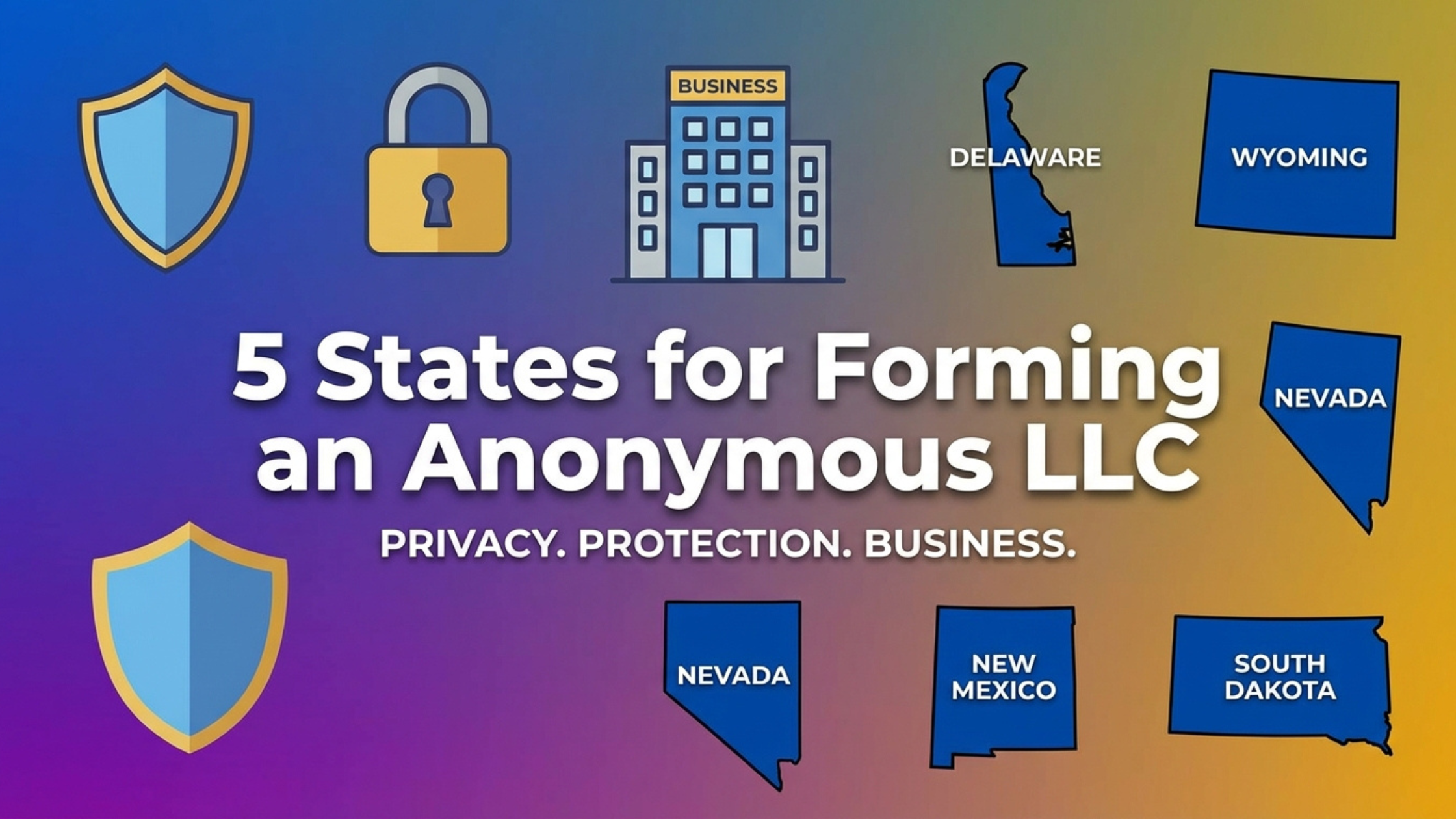

Top 5 States for Forming an Anonymous LLC

In an era of easy digital surveillance, data scraping, and aggressive litigation, privacy has become a luxury asset. For business owners, real estate investors, and public figures, having your home address and full name plastered on a public Secretary of State database is a liability. It invites junk mail, stalkers, unhappy customers, and predatory lawyers looking for deep pockets.

Fortunately, the US legal system offers a solution: the Anonymous LLC.

While most states require the disclosure of “Members” (owners) and “Managers” on public filings, a select few jurisdictions allow you to legally omit this information from the public record. Below is an in-depth analysis of the top 5 states where you can do business under the radar.

CRITICAL UPDATE: The Corporate Transparency Act (CTA)

Before reviewing the states, you must understand the current federal landscape.

As of January 1, 2024, the Corporate Transparency Act changed the game for privacy in the United States. This federal law requires almost all LLCs (regardless of the state of formation) to file a Beneficial Ownership Information (BOI) report with the Financial Crimes Enforcement Network (FinCEN), a bureau of the US Department of Treasury.

What does this mean for your anonymous LLC?

  1. You cannot hide from the Federal Government: You must legally disclose your identity (name, date of birth, address, and ID) to FinCEN.

  2. Privacy is still possible publicly: The FinCEN database is strictly confidential. It is not searchable by the public, the media, or your nosey neighbors. It is only accessible to law enforcement, national security agencies, and (with your consent) banks.

  3. The “Anonymous LLC” is not dead: The goal of an anonymous LLC is to keep your name off the public web—Secretary of State websites, Google searches, and data aggregators. The states below still allow you to achieve 100% public anonymity.

1. Wyoming: The “Gold Standard” for Privacy

Wyoming invented the Limited Liability Company in 1977. Since then, it has aggressively maintained its reputation as the most business-friendly and privacy-centric jurisdiction in America. It is the preferred choice for e-commerce, digital assets, and holding companies.

How the Anonymity Works

When you file the “Articles of Organization” in Wyoming, the state does not provide a field to list the members or managers of the company. They only require the name of the Registered Agent and the Organizer.

  • The Strategy: You hire a formation service or an attorney to act as the “Organizer.” They sign the paper, file it, and then resign, handing control over to you via a private Operating Agreement. Your name never appears in the state database.

Deep Dive: Pros

  • Charging Order Protection: Wyoming offers statutory protection stating that a creditor cannot force the sale of your LLC assets to pay a personal debt. They can only put a lien on distributions (which you can choose not to make).

  • Domestication Laws: Wyoming makes it incredibly easy to move an existing LLC from another state to Wyoming without starting over, a process called “Continuance.”

  • Zero State Income Tax: Wyoming has no personal or corporate income tax, making it a tax-neutral entity for pass-through taxation.

  • Blockchain Friendly: Wyoming was the first state to create specific laws recognizing DAOs (Decentralized Autonomous Organizations) as LLCs.

Deep Dive: Cons

  • The “High Risk” Label: Because Wyoming is so popular for privacy, some banks classify Wyoming LLCs as “high risk,” occasionally requiring extra paperwork to open a business checking account if you do not physically reside there.

Total Estimated Cost: ~

$100 Filing Fee

50–$100/year (Annual Report & Agent Fee).

2. New Mexico: The “No-Paperwork” Ghost

New Mexico is frequently cited as the best state for those who want to “set it and forget it.” It is the only state on this list that does not require an annual report, meaning you don’t have to verify your information with the state every year.

How the Anonymity Works

New Mexico’s privacy is derived from its lack of data collection. The state statutes simply do not ask for member names on the Articles of Organization. Because there is no annual report, there is never a follow-up document asking, “Who owns this now?” The state literally possesses no record of the ownership to release, even if subpoenaed.

Deep Dive: Pros

  • Absolute Lowest Maintenance: Once you pay the filing fee, the state never asks you for money or paperwork again. You only need to pay your Registered Agent fee.

  • Cost Effective: It is arguably the cheapest LLC to maintain in the country over a 10-year period due to the $0 annual state fee.

  • Simplicity: The lack of administrative burden makes it perfect for holding passive assets, like trademarks or copyright titles.

Deep Dive: Cons

  • Weaker Asset Protection: New Mexico does not have the aggressive asset protection statutes that Wyoming and Nevada have. It is a “standard” LLC state in terms of legal shielding.

  • Banking Difficulties: Because the state has no record of ownership, banks sometimes struggle to verify who you are. You will need a rock-solid, notarized Operating Agreement and a Banking Resolution to prove to a banker that you actually own the company.

Total Estimated Cost: ~$50 Filing Fee + $0 Annual State Fees.

3. Delaware: The Corporate Heavyweight

Delaware is the prestige option. Over 65% of Fortune 500 companies are incorporated here. If you plan to seek Venture Capital, sell shares, or eventually take your company public, Delaware is the only logical choice.

How the Anonymity Works

Like Wyoming, Delaware does not require member names on the Certificate of Formation. The state requires a “Cover Letter” with contact info, but this is for internal state use only and is not released to the public.

Deep Dive: Pros

  • The Court of Chancery: Delaware has a unique court system that uses judges experienced in corporate law rather than juries. This leads to predictable, fair, and fast legal outcomes for business disputes.

  • Credibility: A Delaware LLC carries a level of professionalism that New Mexico or Wyoming LLCs do not. It signals to investors that you are serious about business structure.

  • Series LLC Availability: Delaware allows for “Series LLCs,” where one parent LLC can hold unlimited “child” cells (series) with segregated liability. (e.g., Property A is in Series 1, Property B is in Series 2).

Deep Dive: Cons

  • The Franchise Tax: Unlike other states that charge small fees, Delaware charges a flat $300 annual franchise tax. If you are late, the penalty is $200 plus interest.

  • Registered Agent Costs: Because of the volume of businesses, registered agents in Delaware often charge higher premiums than in rural states.

Total Estimated Cost: ~$90 Filing Fee + $300/year Franchise Tax.

4. Nevada: The “Fort Knox” of Asset Protection

Nevada markets itself as a luxury jurisdiction. It is expensive, but in return, it offers protection that borders on bulletproof. It is designed for high-net-worth individuals who are at high risk of being sued (e.g., surgeons, real estate tycoons).

How the Anonymity Works

Nevada is tricky. They do require a list of officers (managers) to be filed annually. However, they allow the use of Nominee Managers.

  • The Strategy: You pay a Nominee Service to be listed as the manager on public records. This person has no control over your money; they are simply a figurehead signer. You retain control through the private Operating Agreement.

Deep Dive: Pros

  • Piercing the Corporate Veil: Nevada has arguably the toughest laws in the US against “piercing the corporate veil.” To hold an owner personally liable for business debts, a creditor must prove fraud, not just negligence. This is a very high legal bar to clear.

  • Data Sharing: Historically, Nevada has been very resistant to sharing data with other agencies (though they fully comply with federal FinCEN requirements).

  • Business Court: Like Delaware, Nevada has established business courts to handle complex litigation quickly.

Deep Dive: Cons

  • Extremely Expensive:

    • Filing Fee: $75

    • Initial List of Officers: $150

    • State Business License: $200

    • Total Startup: ~$425

    • Annual Fees: ~$350+ every year.

  • Commerce Tax: If your Nevada entity grosses over $4 million, you are subject to a gross receipts tax.

Total Estimated Cost: ~

425Startup+ 

350/year.

5. Missouri: The Hidden Gem

Missouri is rarely mentioned in “offshore” or privacy conversations, which is exactly why it is effective. It is a “flyover state” solution that offers great statutes without the “shady” reputation that sometimes accompanies Wyoming or Nevada entities.

How the Anonymity Works

Missouri statutes regarding LLC formation do not require the members or managers to be listed on the Articles of Organization. Furthermore, unlike corporations, Missouri LLCs are not required to file an annual report.

Deep Dive: Pros

  • Obscurity: If someone sees a Wyoming LLC, they immediately suspect you are hiding assets. If they see a Missouri LLC, they assume you are just doing business in the Midwest. It acts as “camouflage.”

  • Cost: The filing fees are very low ($50 online), and maintenance costs are non-existent due to the lack of an annual report.

  • Decent Asset Protection: While not as famous as Nevada, Missouri has strong charging order protections for LLCs.

Deep Dive: Cons

  • Income Tax: Missouri has a state income tax. If your business is physically operating within Missouri, or if the income is “Missouri-sourced,” you will have tax obligations there. This option works best for holding companies that do not transact active business within the state.

Total Estimated Cost: ~$50 Filing Fee + $0 Annual State Fees.

The “Double LLC” Strategy: How to be Anonymous in Public States

A common question arises: “I live in California/Florida/Texas/New York. I have to register there to do business. How can I be anonymous?”

You cannot form an anonymous LLC directly in states like California or Florida because they require you to list the owners. However, you can use a Holding Company Strategy:

  1. Step 1: Form an Anonymous LLC in Wyoming (e.g., “Jupiter Holdings LLC”).

  2. Step 2: Form your operating LLC in your home state (e.g., Florida).

  3. Step 3: On the Florida application, when asked for the “Manager/Member,” do not write your name. Instead, write “Jupiter Holdings LLC.”

The Result: When the public searches your Florida business, they see it is owned by a Wyoming company. When they search the Wyoming company, they see… nothing. You have created a privacy firewall.

Final Verdict

  • Choose Wyoming if: You want the best balance of low cost, high privacy, and strong asset protection.

  • Choose New Mexico if: You want the cheapest option with zero annual paperwork for a passive holding company.

  • Choose Delaware if: You are building a startup that plans to raise capital or scale massively.

  • Choose Nevada if: You are wealthy, work in a high-liability profession, and budget is not an issue.

  • Choose Missouri if: You want a low-profile, “boring” jurisdiction that doesn’t raise eyebrows.

How to Stop Paying US Tax as a Non-Resident LLC Owner

Are you a non-US resident with a US Limited Liability Company (LLC)? Do you find yourself dealing with the intricate world of US taxes? Do not worry, you are not the only one. The good news? Simply owning a US LLC does not mean you owe US income taxes.

As a non-resident, the US taxes you owe rely on where your income is received, not where your LLC is registered. Below are some key concepts every non-resident LLC owner should know in order to legally eliminate or minimize your US income tax exposure.

🚨 Disclaimer: This article is for informational purposes only and does not constitutes tax or legal advice. International tax law is complicated. You should consult with a qualified US international tax professional to achieve compliance and properly structure your business.

🔑 The Core Concept: Effectively Connected Income (ECI)

If you are a non-resident LLC owner, the single most critical factor determining your US income tax exposure is whether your income is considered Effectively Connected Income (ECI).

Remember: non-resident aliens (NRAs) are only taxed on income that is Effectively Connected with a U.S. Trade or Business (ETBUS).

What Exactly Is a U.S. Trade or Business (ETBUS)?

Your LLC is considered engaged in U.S. trade or business if you have:

  • 1. A dependent agent (e.g. an employee or an independent contractor) who is physically present in the United States, AND
  • 2. That dependent agent performs services that are, or are expected to be, a material contributor to the LLC’s income.

How to Avoid ETBUS and ECI:

The primary strategy to avoid U.S. income tax is to ensure your business activities do not meet the ETBUS definition. This means:

  • No U.S. Physical Presence: do not have an office or a fixed place of business in the United States
  • No U.S. Employees: do not hire employees in the United States
  • No Dependent Agents: make sure that any contractors or third-party service providers in the U.S. are genuinely independent agents (which has a legal definition and requires careful structuring to avoid penalties)
  • Location of Services: you, the non-resident owner, should perform the income-producing activity (e.g. selling digital products, remote consulting, etc.) entirely outside the United States.

Example: Owning a U.S. LLC while a resident in France and selling digital courses globally, with all course development and competencies from France, in most situations will not have ECI and thus will not pay U.S. taxes.

🗺️ Using U.S. Tax Treaties

If you live in a country with a U.S. income tax treaty (more than 65 countries), you may get further protection.

Tax treaties may overrule the statutory ECI rules stating that U.S. business income is only taxable if you have a “Permanent Establishment” (PE) in the United States. The definition of a PE is frequently more restrictive than the IRS’s ETBUS rule, thus providing more comfort on no U.S. tax liability.

What you should do: Speak with a tax advisor regarding the applicable Business Profits Article from the tax treaty between your country and the U.S.

📑 Knowing your Filing Requirements (even if you owe $0 tax)

Importantly, just because you will not owe tax to the United States does not mean you do not have copies of taxpayer returns that must be filed.

1. The Single-Member LLC Trap: Form 5472

Form 5472

A U.S. Single-Member LLC (SMLLC) owned by a non-resident alien is, most times, a “disregarded entity” for tax reason.

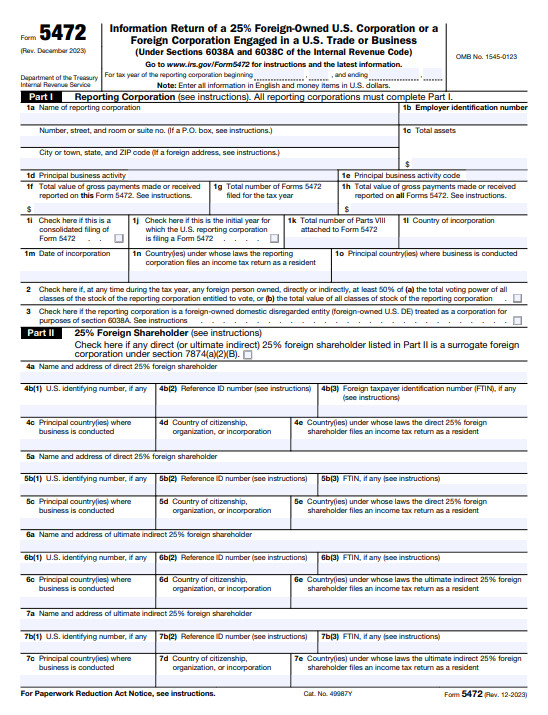
  • Form 5472 (Information Return of a 25% Foreign-Owned U.S. Corporation or a Foreign Corporation Engaged in a U.S. Trade or Business):
    • This form, filed along with a Pro Forma Form 1120, is an annual requirement for your LLC to report transactions with its foreign owner (e.g., capital contributions, withdrawals).
    • This form is required even if the LLC has no income or no ECI.
    • Penalty for Failure to File: The minimum penalty for failure to file or filing an incorrect Form 5472 is a staggering $25,000.

2. Case of Multi Member LLCs, Form 1065 and Schedule K- 1

If the LLC has several partners, each of whom is a foreign entity, the IRS regards that as a Partnership.

  • In that case, the LLC is required to file the US tax return 1065 which is the US return of Partnership income .
  • The K – 1 tax Schedule must also be issued to the partners to account for their individual income share which must be included in the personal tax return.
  • Also, if the Partnership has effectively connected income ( ECI), then the foreign partners will be subjected to withholding income requirements as per Forms 8804 and 8805.

3. Personal Income Tax Return 1040-NR

Form 1040NR

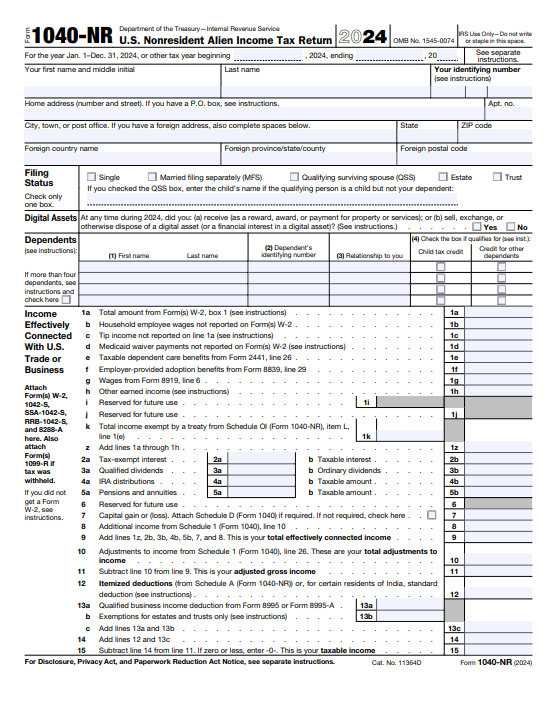
In the case that your LLC is making money and the income is considered to be effectively connected income (ECI), then you, as the foreign owner, are required to submit form 1040-NR (U.S. Nonresident Alien Income Tax Return) and must pay taxes on that income.

Taxes must be paid at the U.S. progressive rate too. Additionally, you will need to get an Individual Taxpayer Identification Number (ITIN) prior to submitting this form.

✅ Summary of the Tax-Free Strategy

To have a US LLC but legally pay $0 US income tax on your profits, you must ensure the following are true:

Condition Description
1. No ECI Your LLC is not engaged in a U.S. Trade or Business (ETBUS). All income-generating services are performed outside the U.S., and you have no dependent agents in the U.S.
2. Passive Income If the income is passive (e.g., real estate rental), ensure proper withholding compliance for FDAP (Fixed, Determinable, Annual, or Periodical) income.
3. Treaty Benefit (Optional but helpful) You can leverage an applicable US tax treaty to confirm that your business lacks a Permanent Establishment (PE) in the U.S.

📌 Next Steps: Don’t Risk the Penalties

The premise of No ETBUS = No ECI = No US Income Tax seems simple, yet, the reporting requirements for this premise are extensive. Simply ignoring these forms, even if you owe no tax, can create huge penalties.

Therefore, your next step is to:

Consult a U.S. International Tax CPA: It is essential you get a tax professional to make sure that you get all structure your business properly and that you get all the necessary forms and documentation filed by the due dates, as the requirements for reporting are strict, with no exceptions.

How Bizstartz can help?

Bizstartz, as a business formation and compliance service, helps non-resident LLC owners satisfy their annual U.S. tax reporting obligations (not necessarily tax payment) by concentrating on the complex informational forms that the IRS requires.

Their help usually falls within three waters that most outsiders do not understand:

Preparation and Filing of Form 5472

This is the most important and most dangerous form of filing from the perspective of penalties for a non-resident owner of a Single Member LLC (SMLLC).

The compliance requirement: A single-member LLC is considered a “disregarded entity” by default for tax purposes.

However, the IRS considers it a corporation, but for reporting purposes only under IRC 6038A. This requires that Form 5472 (Information Return of a 25% Foreign-Owned U.S. Corporation or Foreign Corporation Engaged in a U.S. Trade or Business) be filed annually.

Bizstartz’s Contributions: Bizstartz’s contractors help with the completing and filing of the timely due:

  • Pro Forma Form 1120: Filing a blank or pro forma (fake) U.S. Corporation Income Tax Return with the legend written across the top “Foreign-owned U.S. DE” as the cover sheet.
  • Form 5472: Filling out Form 5472 and attaching it, which is a form that reports “reportable transactions” (like capital contributions and withdrawals) that occur between the LLC and its foreign owner.

Avoiding penalties: By doing all the precise and mandatory filing due annually, the service saves the non-resident from the filing of Form 5472 which comes with an unduly harsh (but automatic) minimum penalty of $25,000 for failure to file.

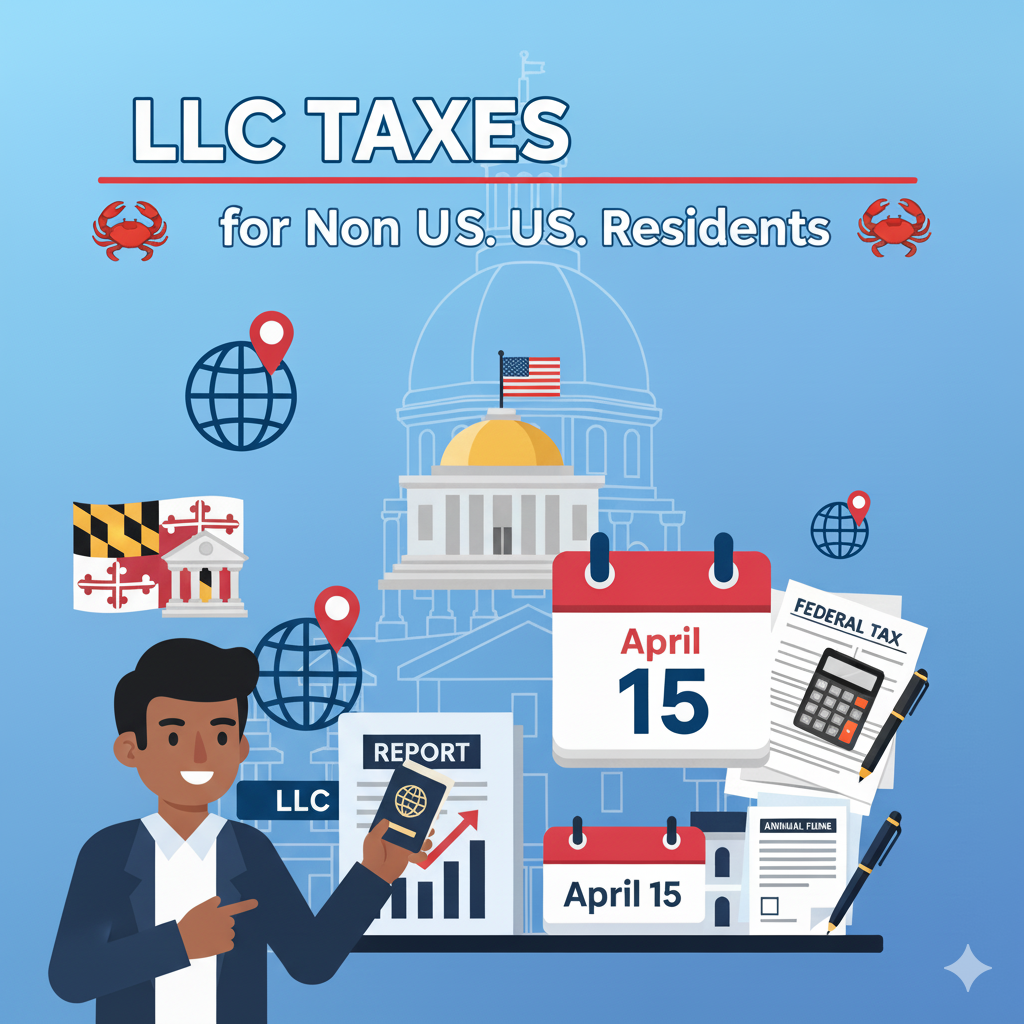
Annual Tax Filing for Maryland LLC Owners: The Complete 2026 Guide

Maryland has one of the most robust economies along the Eastern Seaboard, due in large part to an educated workforce, accessible regulatory policies, proximity to the capital, and proximity to the capital. These are all major benefits of operating a Maryland LLC.

Of course, once the LLC is formed, there are many compliance issues that the LLC owner needs to understand to avoid penalties, including:

  • Annual state filing compliance
  • Other tax compliance
  • Federal obligations
  • Ongoing compliance

This guide covers every Maryland LLC owner’s annual tax liabilities, including:

  • Pass-through taxation
  • Franchise tax
  • Personal taxation obligations
  • Non-residents’ requirements when operating an LLC in Maryland

1. Overview of Taxation for a Maryland LLC

Importantly, Maryland LLCs are considered to be pass-through entities. This means:

  • An LLC does not, as a business entity, pay income tax;
  • Any profits are distributed to the members (owners); and.
  • Each owner is then responsible for tax payments on their portion of the income, which is ultimately reported as part of their personal income tax filings (or corporate filings, if applicable).

Unlike most other states, Maryland has the following requirements:

✅ Each LLC must submit an Annual Report

✅ Each LLC must submit a Personal Property Tax Return (if applicable)

✅ Each member must file a State Income Tax Return (if they live in Maryland or have MD-sourced income)

✅ Each member must submit Federal Tax Returns

✅ Employer filings (if applicable)

Maryland LLC requirements must be complied with by all U.S. residents and foreign business owners to avoid penalties and/or loss of good standing and avoid administrative dissolution.

2. Annual Report in Maryland (All LLCs must file)

Maryland Annual Report

Every LLC in the State of Maryland must file Annual Reports with the Maryland Department of Assessments and Taxation (SDAT).

Due Date:

Every year by April 15 .

Annual Report Filing Costs:

It is $300 to file the Annual Report.

Annual Report Includes:

The Annual Report confirms:

  • Business address
  • Registered agent information
  • Member or manager information
  • Confirmation of business activity
  • Total gross sales reported in Maryland

How to file:

  • 1. Use the Maryland Business Express Portal. (OPTION PREFERRED)
  • 2. Fill out a Report and submit it by paper email. (OPTION NOT PREFERRED DUE TO DELAYS)

Penalties for Late Filing:

  • Loss of good standing
  • Additional fees
  • Risk of LLC forfeiture by the state

Once forfeited, the company cannot operate legally or file documents and must be reinstated to do so.

3. Maryland Personal Property Tax Return

(Required for various LLCs)

If your LLC possesses, leases, or utilizes personal property in Maryland — like:

  • Office furniture
  • Equipment
  • Computers
  • Machinery
  • Tools
  • Inventory

— you must submit a Personal Property Tax Return along with the Annual Report.

Due Date:

Also on April 15.

Filing Fee:

Part of the $300 annual report fee.

If the LLC Has No Personal Property?

You only submit the Annual Report omitting the property return.

Penalty for Not Filing When Required:

  • Higher tax assessment
  • More penalties
  • No good standing

4. Maryland State Income Tax for LLC Members

Since LLCs have a pass-through tax structure, owners’ personal tax compliance depends on their state of residence.

a) Maryland Residents (U.S. citizens or residents)

If you reside in Maryland, you have to file state income tax on all income earned through the LLC, regardless of whether it was earned in Maryland.

b) Non-Residents (Living in another U.S. state)

You must file a Maryland non-resident income tax return for Maryland-sourced income only.

c) International (Non-U.S. Residents)

If you are an international founder operating a Maryland LLC from another country:

  • Your LLC’s income will likely be considered foreign-sourced, meaning you won’t have to pay any Maryland personal income tax, provided the LLC does not have any office, employees, or physical presence in the U.S.
  • If your LLC does have Maryland-sourced income (customers, operations, warehouse, etc.), you must file Maryland non-resident tax returns.

Maryland Individual Tax Forms:

  • Form 502 (resident)
  • Form 505 (non-resident)
  • Pass-through entity K-1 documents

5. Maryland Pass-Through Entity Tax (PTE Tax)

Maryland allows LLCs to elect to pay Pass-Through Entity (PTE) Tax on behalf of their members.

This can help members claim a credit on their personal tax returns and reduce the impact of the federal SALT cap limitation.

PTE Tax Is Useful If:

  • The LLC has high income
  • Members want the LLC to pay the tax instead of paying individually
  • Members want to maximize deductible tax payments

Filing Requirements:

  • Form 510
  • Form 511 (PTE tax return, if applicable)

6. Federal Tax Filing for Maryland LLCs

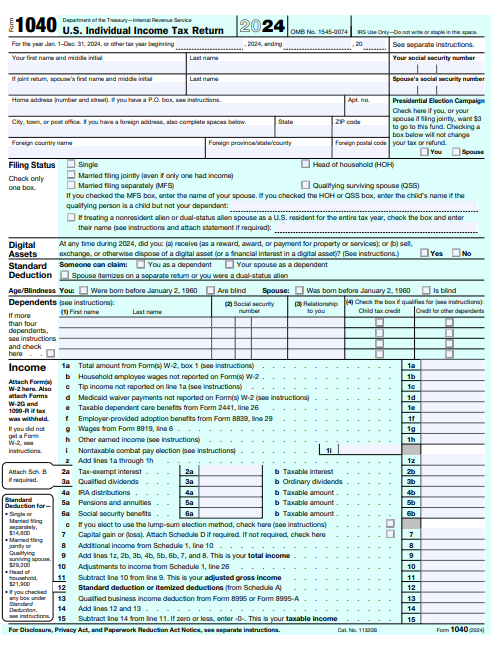
form 1040

Even though Maryland LLCs are taxed at state and federal levels separately, federal tax filing is always required.

Single-Member LLCs

Multi-Member LLCs

  • Form 1065 (Partnership Returns)
  • Due: March 15
  • Presumably Receives Schedule K-1

As LLCs Elected S-Corporations

  • Form 1120-S
  • Due: March 15

As LLCs Elected C-Corporations

  • Form 1120
  • Due: April 15

For Non-US Owners

If you are a foreign owner of a Maryland LLC:

You may need:

  • Form 5472
  • Pro-Forma 1120
  • Form 1040-NR (If effectively connected U.S. income)

Foreign-owned LLCs also face $25,000 penalties for missing Form 5472 filings, so accuracy is crucial.

7. Maryland Sales & Use Tax (If Applicable)

If your LLC sells tangible goods, digital products, or taxable services in Maryland:

You must register for a (Maryland Sales & Use Tax License)

Filing Frequency:

  • Monthly, Quarterly, or Annually (depending on sales volume)

Tax Rate:

  • (Statewide) 6%

Businesses with warehouse facilities or inventory stored in Maryland are also responsible for filing.

8. Employer Tax Filing Obligations for LLCs with Employees

Maryland LLCs are required to manage the following with their employees:

Maryland State Requirements:

  • Payroll tax registration
  • Tax withholdings
  • Unemployment insurance

Federal Requirements:

  • Form 941: Quarterly Payroll Tax Return
  • Form 940: Federal Unemployment
  • Filing W-2s
  • Filing payroll tax withholding deposits

9. Other County or City Tax Obligations

Certain counties in Maryland impose additional personal property or local business taxes. Examples are as follows:

  • Business personal property tax for Baltimore City
  • Property Assessments for Montgomery County

Make sure to check your County’s business tax office for any local administrative obligations.

10. Compliance Checklist for Maryland LLC Owners

Maryland State Filings

  • Annual report due April 15
  • Personal Property Tax Return (if any)
  • PTE Tax Election (optional)

Federal Filings

  • 1040 + Schedule C for Single Member
  • 1065 for Multi-Member
  • 1120 or 1120-S if elected
  • 5472 if foreign owners

Other Requirements

  • Sales tax returns
  • Employer tax returns
  • Business County Taxes
  • Registered Agent Renewal
  • Operating Agreement Maintenance

11. What Are the Consequences for Missing Maryland Deadlines?

Your filings missing the stated deadlines may result in the following:

  • Late fees, which can accrue via interest penalties
  • Loss of good standing status or status in general
  • Impeded capabilities, such as
  • Bank account openings
  • Obtaining Licenses
  • LLC Forfeiture, where the Company is shutdown by the State

You may need to pay all your previous fees and missing reports in order to have your business reinstated.

12. Maryland LLC Taxes for Non-U.S. Residents (Important)

Maryland LLC

International founders often pose the question of how Maryland taxes come into play if they operate the business from outside the United States.

Allow us to oversimplify:

If your LLC has NO United States presence – no employees, no office, no warehouse – then:

  • You may not owe Maryland income tax
  • File the Annual Report
  • File the Federal 5472 and 1120-NR (depending on activities)

If your LLC DOES have presence in the United States or Maryland-sourced income:

  • You must file Maryland non-resident returns
  • You may owe Maryland state tax
  • You must comply with Federal filings

Bizstartz assists Non-U.S. Residents with managing these filings to help avoid penalties from the IRS.

13. How Bizstartz Helps Maryland LLC Owners Stay Compliant

Bizstartz completes the work with:

✅ Annual Report Filing (Maryland SDAT)

✅ Personal Property Tax Return

✅ Obtaining the EIN + ITIN

✅ Preparation and filing of Federal taxes (1065, 1120-S, 1040-NR, 5472)

✅ Sales & Use tax filing

✅ Bookkeeping & payroll

✅ Renewal of Registered Agent

✅ Reminders for IRS & state deadlines

Bizstartz will handle all of your compliance so you can go on and grow your business, whether you are a U.S. entrepreneur or a non-U.S. resident running a Maryland LLC remotely.

Conclusion, This Section, This is how it is concluded

Everybody, also LLC owners in Maryland, need to comply to both state and federal laws to remain in good standing and so, avoid being penalized. The further you stay away from these laws, the more trouble you will be in.

  • Filling in the Annual Report every year on April 15
  • Finishing the Personal Property Tax Return (if needed)
  • Paying state income tax to Maryland (if you need to)
  • Filling in all the federal IRS documentation depending on the structure of the LLC
  • Satisfying sales tax or employer requirements

Not complying will bring in expensive penalties, administrative shut down, and legal trouble.

Should you want assistance when it comes to annual filings, we at Bizstartz are more than happy to assist you.

The “EIN Only” Trap: Why Your US PayPal Business Account Needs an ITIN

Thinking of running a US LLC outside of the US? That’s likely what a lot of Wyoming, Delaware, and New Mexico LLC holders do. It’s likely you’ve completed the following steps:

  • You’ve formed your LLC.
  • You’ve obtained an IRS EIN.
  • You’ve opened a US business bank account (Mercury, Relay, Wise, etc).

At this point you probably feel like you’ve completed the most difficult step. Now you need to open a US PayPal Business account to get paid by customers everywhere.

But then the confusion starts.

At this point, you may ask, “Do I need an ITIN to open a PayPal Business account? I have an EIN, isn’t that enough?

Most people have to learn this too late: you can get a PayPal account with an EIN, but you can’t sustain the account long term without an ITIN. In this comprehensive guide, you will learn:

✓ Why you cannot use just your EIN for Paypal

✓ Why does Paypal freeze your account without an ITIN?

✓ What does the law say? (Patriot Act + IRS Reporting Rules)

✓ Why the vast majority of EIN-only “success stories” end in tragedy

✓ A bulletproof method for protecting your Paypal account

✓ If you want absolutely nothing to do with Paypal, here are the best alternatives

So, let’s jump right in.

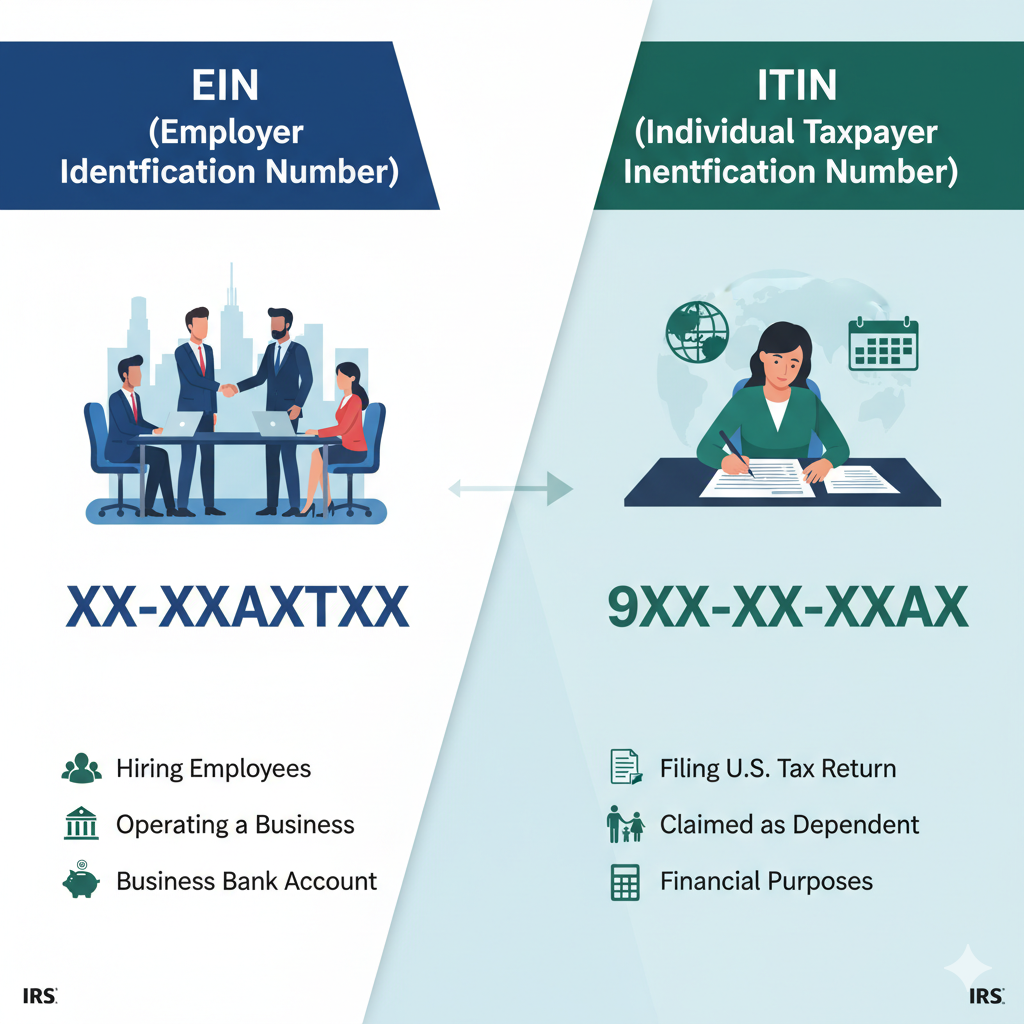
Difference Between EIN and ITIN, and Why Paypal Wants Both

EIN or ITIN

Many international founders think that once they have an EIN, all USA financial systems will recognize them as a “validated business.”

This misconception accounts for 95% of PayPal account limitations for overseas business owners.

Here’s the full breakdown:

1. What EIN Actually Is (And Isn’t)

An Employer Identification Number (EIN) is:

  • A tax ID provided to your LLC
  • Required for federal business tax obligations
  • Required to open business bank accounts
  • Required to set up payment processors to receive business income
  • The “SSN equivalent” for your business, not you

What EIN is not:

  • Is NOT proof of identity of the owner
  • Does NOT provide proof of the physical person behind the business
  • Is NOT sufficient on its own for deep KYC verification

To summarize, your EIN is to verify your LLC exists, but you as a person do not.

2. What ITIN Is (And Why It’s Mandatory)

An Individual Taxpayer Identification Number (ITIN) is:

  • A tax ID for foreign individuals
  • Required for individuals who do not qualify for a Social Security Number (SSN)
  • Mandatory for any personal-level IRS reporting
  • A tax ID used by financial institutions to verify your identity
  • A tax ID used by PayPal, Stripe, banks, and fintechs to comply with legal obligations to prove the beneficial owner is a verified, real person.

U.S. federal law (Patriot Act + AML rules) requires financial institutions to verify:

  • Your identity
  • Your country of residence
  • Your tax compliance status

For non US founders, since you cannot provide an SSN the only substitute is the ITIN.

Why PayPal Cannot Rely on Your EIN Alone

Since an EIN is assigned to a business entity and not an individual, PayPal cannot ascertain:

  • Who controls an LLC
  • Who is the payment receiver
  • Whether the user needs to report to the IRS
  • Whether the user is on any sanctioned or restricted list

Therefore, all accounts must eventually KYC. This is why PayPal needs an SSN or Taxpayer Identification Number.

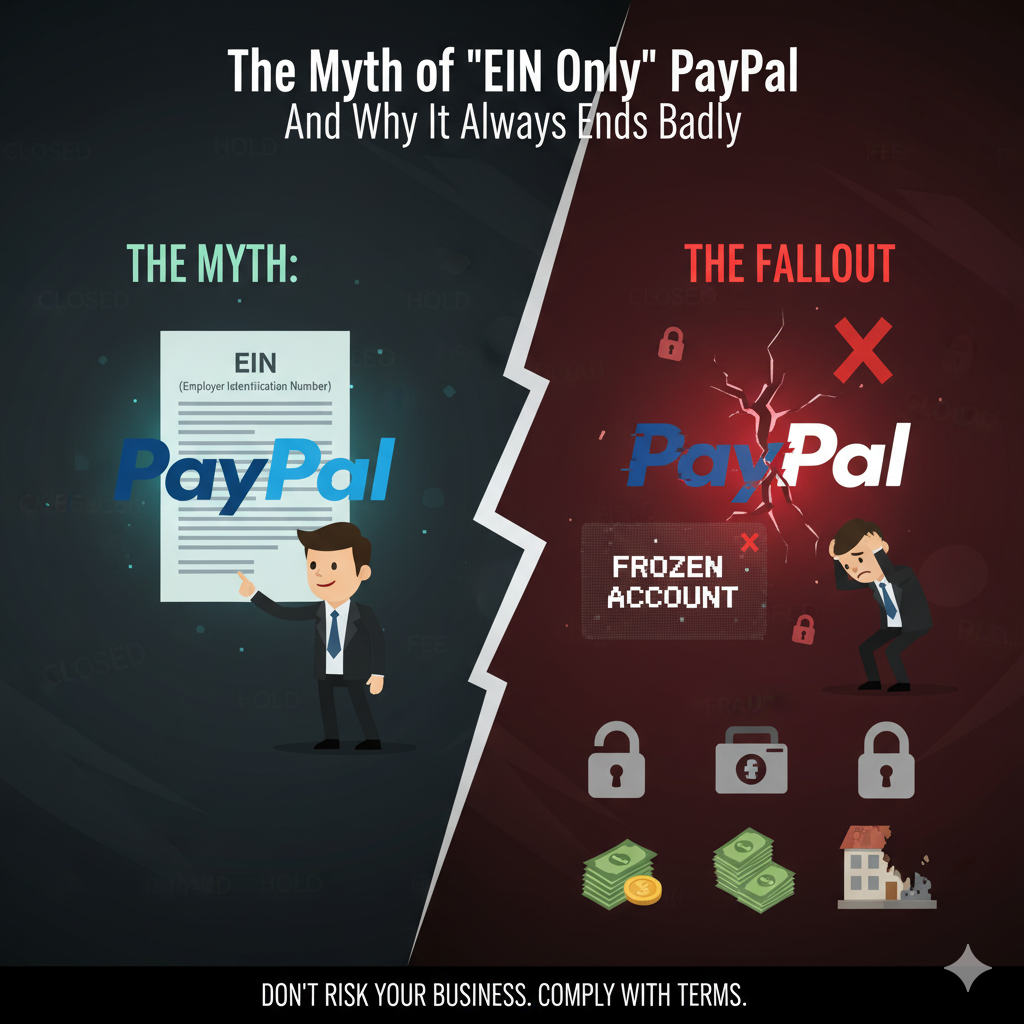
The Myth Of “EIN Only” PayPal And Why It Always Ends Badly

EIN is a Myth

On multiple forums, social media platforms, and outdated blogs, it is common to see statements as below:

“I signed up for a Paypal US business account, and all I needed was an EIN. I did not need to provide an ITIN!”

In a technically correct, albeit a misleading way, they are completely skipping the ending of the story.

The Normal Life Cycle Of An EIN Only PayPal Account

Phase 1: Singing Up Successfully (Ascending False Security)

PayPal’s automated onboarding system enables you to key in the details of:

  • Your business name
  • Your EIN
  • Your business address
  • Your bank account

Everything is seamless and you think to yourself:

This is a walk in the park. All those cautions were far from the truth.

In the meantime, the internal risk score is likely to be on the rise unnoticed in the background.

Phase 2: First Few Deals (Entering A Rough Start)

Receipts of fund transfers are on the rise in your newly created account. Deals made can vary from a few hundred to a few thousand.

No alerts, limits, or notifications.

This part is a trap.

Phase 3: Enabled Constraints (This is where the actual work begins)

Eventually the PayPal accounts get the routine security review because of:

  1. High transaction volume
  2. Multiple withdrawals
  3. Logging in to a different country
  4. Customers filing disputes
  5. Random automated reviews

Then comes the mail you hate to see:

Your account has been limited. We need additional information to confirm your id.

They will request:

  • A government-issued id (passport)
  • Proof of address
  • Business docs
  • And Personal Tax Identification Number (SSN or ITIN)

This is where the EIN-only users get stuck.

Phase 4: Account Limitation + Funds Frozen

They try to provide the EIN but you can’t get past the form.

They need a personal tax id number. PayPal has made it clear they need a personal id number.

Without an ITIN you can’t complete verification.

So what happens? Permanent limitation.

Your money is frozen for 180 days.

You are unable to:

  • Withdraw
  • Transfer
  • Access the balance
  • Close the account

Because of this, the PayPal accounts where users have EIN-only accounts are called ‘ticking time bombs.’

Why has PayPal been more strict? The IRS Reporting Crackdown

PayPal likes limiting accounts as much as you enjoy it but they have to do it because of the us law.

IRS Rule: Form 1099-K Reporting

Because of IRS rules, payment processors such as PayPal MUST report your business income to the IRS using Form 1099-K.

In the past, reporting payments received was triggered if all of the following were true:

  • $20,000 in payments AND
  • 200+ transactions

However, the U.S. government has been tightening this reporting threshold.

New Reporting Reality:

  • With the IRS now having a $600 threshold (which has been delayed several times, but this rule is coming soon).
  • Many payment processors are already using a $5,000 or lower payment threshold triggers.

In order to file Form 1099-K, PayPal is required to have a verifiable tax ID for both:

  • The Business (EIN)
  • The Owner (SSN or ITIN)

If PayPal is required to file the report and they do not, they are breaking federal tax law.

However, PayPal is not willing to take that risk, and as a result, they freeze the account instead.

Fixing The Problem: The Definitive Action Plan for Non-US LLC Owners

If your priority is keeping your U.S. financial infrastructure compliant, your priority is to complete the steps below.

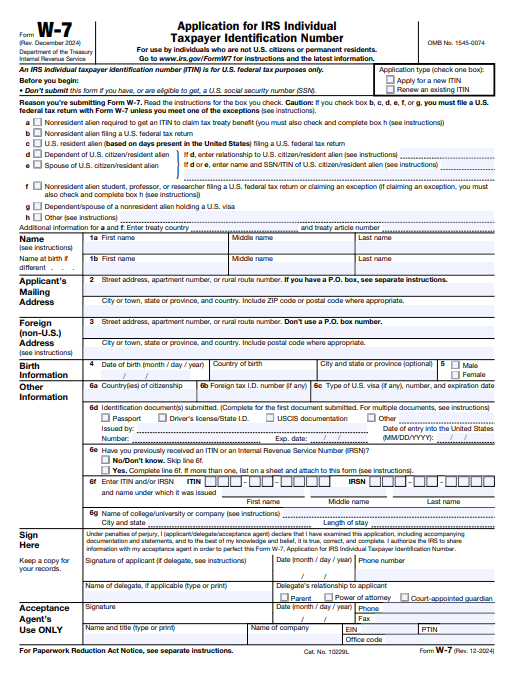
Step 1: Apply for an ITIN (Form W-7)

Form W7

You can apply one of two ways:

Option A: The Hard Way (Not Recommended)

  • Manually fill out Form W-7
  • Mail this to the IRS
  • Include your original passport
  • Wait around 3-4 months
  • Risk having your passport lost

Option B: The Secure and Fast Way (Recommended)

This is to use a Certifying Acceptance Agent (CAA).

CAA can:

  • Verify your passport via Zoom/video call
  • Submit applications on your behalf
  • Eliminate mailing your passport
  • Dramatically speed up the process

Bizstartz can link you with reliable CAAs if needed.

Step 2: Use the “Warm-Up Strategy” While Waiting

If you have to use PayPal before the ITIN comes:

  • Open the account with your EIN
  • Pull out funds daily
  • Maintain low balances
  • Do not leave funds stagnant in PayPal
  • Do not make sudden large payments

You are buying time—not stability.

Step 3: Update PayPal When You Get the ITIN

When PayPal asks for verification:

  • ITIN
  • Passport
  • Address proof
  • LLC docs

Boom! Your account is fully verified and free from arbitrary limits.

Are There Alternatives to PayPal? (Yes, But With Conditions)

PayPal is notorious for having aggressive limitations for international owners.

If you want more stability, you can consider:

1. Stripe

  • Best for non-US founders
  • Fast onboarding
  • Accepts passport + EIN

They may ask for the ITIN later, but not until much later than PayPal.

2. Paddle (Merchant of Record)

  • They handle sales tax, VAT, fraud, and chargebacks
  • Much easier onboarding
  • Slightly higher fees
  • No need for your own merchant setup

3. Payoneer

  • Works well for international founders
  • Good for marketplace payouts
  • Less strict than PayPal

Final Verdict: Can You Open a PayPal Account with Just an EIN? Yes.

Should You? Absolutely Not.

The EIN-only method is not a “hack,” nor is it a shortcut. It’s a temporary loophole that will eventually:

  • Freeze your account.
  • Lock your business.
  • Hold your funds for 6 months.
  • Damage your customers’ trust.

If you are serious about building a long-term U.S. business, treat the ITIN as a standard and unavoidable requirement—not an optional upgrade.

Success in U.S. business compliance is simple:

  • Follow the law.
  • Meet IRS requirements.
  • Verify your identity properly.
  • Protect your money.

If you need help with your ITIN application, PayPal setup, or U.S. LLC compliance, Bizstartz can guide you step-by-step and ensure your business stays compliant and secure.

Annual Tax Filing for Massachusetts LLC Owners: The Complete 2026 Guide

Massachusetts is one of the most business-friendly states in the northeastern United States. It boasts a strong economy and a supportive legal framework. It is also a top state for tech, eCommerce, consulting, real estate, and service-based businesses.

However, when an entrepreneur forms an LLC, that is only the start. To keep the LLC active and in good standing with the state of Massachusetts, there is a host of compliance and state and federal filing requirements that the entrepreneur needs to understand and complete.

This guide applies to:

  • U.S. residents, and
  • Non-U.S. residents that remotely manage a U.S. LLC, and
  • International entrepreneurs that utilize a Massachusetts LLC for running online businesses for Amazon, eCommerce, SaaS, marketing, consulting, etc.

This guide is intended to inform you of your obligations in the state of Massachusetts.

The guide covers annual filing requirements, dues, fees, tax classifications, and state obligations as we include our Bizstartz branded guidance as a business for founders to rely on for compliance support, bookkeeping, and tax filing support.

1. How Massachusetts LLCs Are Taxed: The Full Breakdown

Before we discuss annual filings, you need to understand some important facts about LLCs as business structures in the United States. An LLC is considered a flexible business structure, as the taxation of the LLC depends on how an entrepreneur has classified the business for tax purposes.

1.1 Default Federal Tax Classifications for LLCs

Single-Member LLC (SMLLC)

When you register an LLC with one owner, the IRS implies that the LLC is a disregarded entity, therefore:

  • The LLC is not required to file a separate return.
  • The owner needs to report the income earned on a personal return, either on Schedule C, E, or F, depending on the income type.

This represents the simplest tax setup, and is typical for:

  • consultants,
  • freelancers,
  • eCommerce dropshippers,
  • Amazon FBA sellers,
  • SaaS founders, and
  • international entrepreneurs.

Non-U.S. owners have a slight variation in income reporting rules, as they have to file a non-resident tax return.

Multi-Member LLC

If the LLC has 2 or more owners, the IRS requires that it is classified as a partnership, unless an alternative is elected.

This involves:

  • Completing and filing Form 1065,
  • issuing a Schedule K-1 for each member, and
  • each member reporting the income on the personal tax return.

This structure works well for business partners, couple-owned companies, and U.S.-international joint ventures.

1.2 Optional Tax Classifications (Electing S-Corp or C-Corp)

LLCs have the option of choosing how they will be taxed by putting in the appropriate elections:

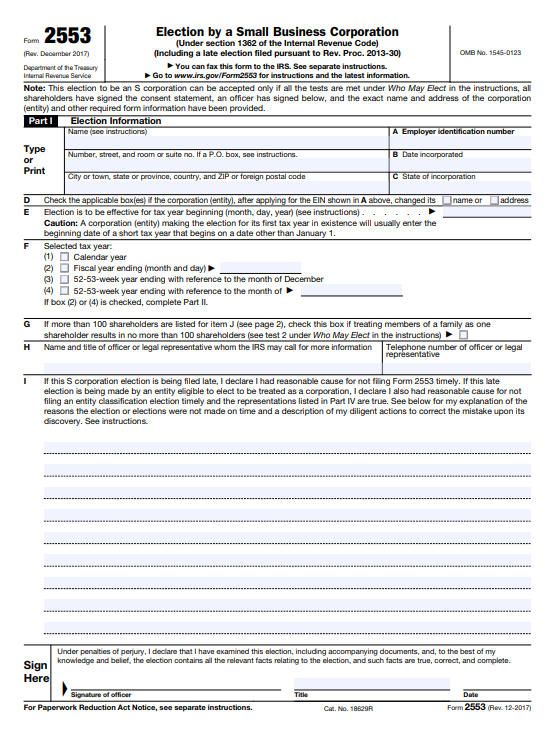
S Corporation (Form 2553)

Form 2553

Owners of LLCs tend to choose S-Corp taxation when the business starts to pull in 60k–100k of profit annually because it reduces self-employment tax by allowing to divide the income into:

  • Salary (subject to taxes)
  • Distribution (not taxed for self-employment)

Yet S-Corps need to account for:

  • Managing payroll
  • Managing accounting
  • More complicated tax requirements

Bizstartz help founders determine if the S-Corp designation is beneficial for their business.

C Corporation (Form 8832)

Electing C-Corp taxation is less common for small businesses but useful for:

  • Venture-backed companies
  • Startups seeking investment
  • Businesses reinvesting profits

C-Corps pay:

  • 21% federal corporate tax
  • Additional state corporate taxes

Then, owners pay taxes again on dividends, known as double taxation.

2. Annual State Filing Requirements for Massachusetts LLCs

Massachusetts requires several filings each year in order to keep your LLC active and compliant.

The two most important state requirements are:

  • Annual Report Filing
  • State Taxes based on your classification

Let’s go over each of them in more detail.

3. Massachusetts Annual Report: Detailed Requirements (Mandatory Every Year)

Every LLC that is registered in Massachusetts is obligated to submit an Annual Report through the Secretary of the Commonwealth.

3.1 What Is the Annual Report?

The Annual Report confirms or updates details such as();

  • Legal name of the LLC
  • Principal business address
  • Manager/member information
  • Registered Agent details
  • Business activity description

Massachusetts uses this filing to verify that your LLC is still active and correctly configured.

3.2 Annual Report Fee and Deadline

  • Fee: $500
  • Due: Annually by your formation anniversary date
  • How To File: Through the Secretary of State’s website.

The fee is significantly higher than in many states, which is why compliance is critical to avoid incurring reinstatement costs.

3.3 Consequences of Missing the Annual Report

Missing or delaying this filing can lead to the following:

❌ Loss of good standing

❌ Late filing penalties

❌ Administrative dissolution

❌ Loss of ability to open or maintain bank accounts

❌ Delays in tax filing and compliance

❌ Problems with payment processors like Stripe and PayPal

Bizstartz clients often rely on us to handle these filings automatically, ensuring no deadlines are missed.

4. Massachusetts State Taxes for LLCs: Full Overview

Massachusetts does not charge a general franchise tax like California or Delaware, but depending on your IRS classification, your LLC may be responsible for specific state-level taxes.

Let’s look at LLC type.

5. State Tax Obligations by LLC Classification

5.1 Single-Member LLC (Disregarded Entity)

In this case:

  • This LLC does not pay state level income tax.
  • The owner must report the income on his or her personal tax return in Massachusetts.

5.1.1 Personal Massachusetts Income Tax Rates

In Massachusetts, the income tax rates are as follows:

  • 5% on most tax income
  • 12% on short-term capital gains and certain interest income

If the owner does not live in Massachusetts, the income tax will depend on sourcing the income to Massachusetts.

For instance:

  • Income derived from an online business that has no customers or employees in MA is usually not MA sourced.
  • Nonetheless, real estate and business consulting, or even active business presence in Massachusetts, may result in tax obligations.

Bizstartz assists non-U.S. entrepreneurs in determining whether their actions create a Massachusetts tax nexus.

5.2 Multi-Member LLC (Partnership)

A Massachusetts multi-member LLC is required to file:

  • MA Form 3 (Partnership Return)

Each full partner gets:

  • Schedule K-1 (MA-NR)
  • This K-1 is for filing Massachusetts individual tax return, if required.

Even if there is no MA-sourced income, the informational return still needs to be filed.

5.3 LLC Taxed as S-Corp

If you opt for S-Corp tax status for your LLC, you will owe and file the following in Massachusetts

  • Form 355S.
  • As for the taxes, you will owe
    • 1) The Income Tax, 3%.
    • 2) For the property/net worth, the excise is between 0.56% -2.75%.

If you S-Corp you will also

  • Pay payroll taxes on salaries that they take as employees.
  • Keep books and payroll.
  • Issue W2 and 1099 forms.

For S-Corp clients, Bizstartz offers monthly payroll and bookkeeping services.

5.4 LLC Taxed as a C Corporation

In Massachusetts, if your LLC chooses C-Corp taxes, you will file

  • MA Form 355.
  • As for the corporate excise tax, you will owe
    • 8% tax on income.
    • $456 minimum excise tax, applicable even if there is no profit.

C-Corps also have to keep comprehensive records, and with our monthly bookkeeping services, Bizstartz can assist with that.

6. Federal Tax Filing Requirements for Massachusetts LLCs

As required by law, you must file federal tax returns with the IRS, regardless of your obligations in your home state. We expand on this below.

6.1 Single-Member LLC — Federal Obligations

As a single-member LLC, you must file as the sole owner of the LLC by using:

  • Schedule C – Business income
  • Schedule SE – Self-employment tax
  • Schedule E or F (if applicable)

6.1.1 Self-Employment Tax

An owner must pay net profits of self-employment tax, which is 15.3%.

6.1.2 Non-US Resident Owners

A non-US owner must file:

  • Form 1040-NR
  • An ITIN may be required.

For international LLC owners, Bizstartz provides ITIN filing and federal tax preparation.

6.2 Multi-Member LLC — Federal Obligations

The LLC must file:

  • Form 1065 (Partnership Return)

And then issue:

  • Schedule K-1 to each member.

Each member must report their share of income on their federal return.

6.3 S Corporation LLC — Federal Obligations

An S-Corp must file:

  • Form 1120-S
  • And issue K-1 to the shareholders.
  • Payroll must be run for owners who work in the business.

While this provides tax savings, it also increases compliance responsibilities.

6.4 C Corporation LLC — Federal Obligations

A C-Corp must file:

  • Form 1120
  • Pay 21% federal corporate tax

Dividends paid to owners are taxed again.

7. Sales Tax Requirements (If Applicable)

File Business Taxes for the First Time

Your LLC is liable to collect and remit sales tax if you sell taxable goods and/or services in Massachusetts.

7.1 Sales Tax Rate

  • 6.25% is the rate for the entire state.

7.2 Sales Tax Filing Frequency

Based on sales volume:

  • Monthly
  • Quarterly
  • Annually

7.3 Massachusetts Sales Tax Applies TO

  • Tangible products
  • Certain digital goods
  • Certain Software as a Service (SaaS)
  • Rentals and/or leases

Bizstartz assists in determining nexus and applying for a Sales Tax Permit if needed.

8. Employer Tax Responsibilities (If You Hire Staff)

If you have employees in your LLC, the following is a list of mandatory obligations that are your responsibility:

8.1 Withholding Tax Registration

Businesses are required to register with MassTaxConnect to:

  • Withhold state income tax
  • File withholding tax returns

8.2 Unemployment Insurance (UI) Contributions

Paid to MA Department of Unemployment Assistance.

8.3 Workers’ Compensation Insurance

Required in most cases for all businesses.

8.4 Payroll Taxes

Filing with the IRS is required using:

  • Form 941
  • Form 940
  • For employees, W-2 forms
  • W-3 for the summary

Bizstartz provides payroll services for LLCs that are taxed as S Corporations or C Corporations.

9. BOI Filing Requirements (New 2024 Law)

As required under the Corporate Transparency Act, all US LLCs must file a BOI (Beneficial Ownership Information) Report with FinCEN.

9.1 When BOI Must Be Filed

  • LLCs with a beginning date in 2024 must file within 30 days of your formation date.
  • LLCs without a formation date of 2024 must file by January 1, 2025.

9.2 Updates

Updates to the BOI are only needed if:

  • There are changes in ownership
  • The address changes
  • The identification document expires
  • A member exits or joins

Bizstartz is responsible for BOI filing for all new and existing clients.

10. Deadlines Summary Table (Fully Expanded)

Filing Requirement Who Must File Due Date Fee
Annual Report All MA LLCs Anniversary date $500
Federal SMLLC Return Single-member LLC April 15 Varies
Form 1065 Multi-member LLC March 15
Form 1120-S S-Corp LLC March 15
Form 1120 C-Corp LLC April 15
MA Form 3 Partnerships March 15
MA Form 355 or 355S S-Corp / C-Corp March 15 / April 15 $456 minimum
Sales Tax Returns Businesses with nexus Monthly/Quarterly/Annually

11. Penalties for Missing MA Tax or Annual Filings

This is the expanded list of the penalties.

11.1 Annual Report Penalties

  • Loss of good standing status
  • State penalties
  • Dissolution of the business
  • Fees for filing overdue reports
  • Issues with banking and payment processing

11.2 State Tax Penalties

Massachusetts imposes the following for unpaid taxes:

  • 1% interest/month
  • Failure to file adds additional penalties
  • severe penalties may include legal action

11.3 Federal Tax Penalties

The IRS imposes the following tax penalties:

  • Failure to file
  • Failure to pay
  • Tax interest
  • Incorrect returns
  • Form 1065 penalties of $205 for each member for late submissions

12. Massachusetts Requirements for Non-U.S. Residents (Expanded)

Non-U.S. founders may:

  • Form a Massachusetts LLC
  • Be the sole owner
  • No residency or citizenship is required
  • Open U.S. bank accounts (if eligible)
  • Conduct business worldwide

Tax obligations depend on:

  • Whether the LLC has U.S. Effectively Connected Income
  • The location of the customers
  • Employment or presence physically in Massachusetts
  • Taxable Sales

Additional things that may apply to Non-U.S. Owners include:

  • An Individual Taxpayer Identification Number (ITIN)
  • Beneficial Ownership Information (BOI) filing
  • a Federal tax return
  • Massachusetts informational return

Bizstartz specializes in compliance for foreign-owned LLCs, particularly in eCommerce, Amazon FBA, mentoring/coaching, SaaS, digital services, and marketing.

How Bizstartz Helps Massachusetts LLC Owners Stay Compliant

Massachusetts LLC Owners Entrepreneurs forming a business in the United States as a non-U.S. business founder worldwide tend to go to Bizstartz. Bizstartz is one of the first incorporation and compliance service providers.

For Massachusetts LLC Bizstartz offers:

  • Bizstartz Massachusetts LLC formation
  • EIN ( IRS)
  • Registered Agent Service
  • BOI filing ( FinCEN)
  • Operating Agreement

Annual Compliance

  • Annual Report filing
  • State tax return filing
  • Federal tax return preparation and filing
  • Sales tax registration and filings
  • Payroll setup
  • Bookkeeping and accounting

International Support

  • ITIN filing
  • Bank account opening assistance
  • Stripe, PayPal, Wise, Mercury support
  • Amazon Seller approval support

We specialize in assisting you with the government requirements, compliance, and taxes so you can focus on growing your business.

Conclusion: Stay Compliant, Stay Protected, and Grow with Confidence

Massachusetts is a great state LLC but keeping compliant is not easy. You have to understand:

  • Annual state filings
  • Federal tax obligations
  • Classification-based tax rules
  • BOI obligations
  • Sales tax and payroll requirements

Completing state filings late can disrupt your business, trigger penalties, or even cause total business dissolution. It can also disrupt your business, trigger penalties, or even cause total business to dissolve.

Missing deadlines can disrupt your business, trigger penalties, or even cause total business dissolution. Bizstartz helps entrepreneurs to stay fully compliant with zero stress, especially for non-U.S. founders.

UK LTD Identity Verification Update (2025)

The business environment of the UK has entered a significant transition due to the new Economic Crime and Corporate Transparency Act (ECCTA). It is the first of many changes in the policy of Companies House after a long time.

The changes focus heavily on a new technology-based policy requiring identity verification of all persons who form and control a UK Limited Company (LTD).

The aim is to ensure that all companies in the UK are associated with real individuals to improve transparency and reduce the incidence of financial crime.

For founders, international business owners, who manage their companies from abroad, these changes are significant in terms of incorporation, banking, compliance, and legal protection on a continual basis.

This is an all-encompassing guide from Bizstartz to cover everything pertaining to the changes with a guide on verification and who is supposed to get it, the required documents as well as how Bizstartz supports entrepreneurs globally in the transition.

1. Why the UK Implemented Necessary ID Checks in the First Place

Up until this point, the UK has had the easiest and quickest company formation process, for which, on completion, there were no follow-ups. This process, while having several positive effects on the economy, has led to the following issues:

1.1 Increase in Fraudulent Registrations

Abuse of the UK company formation process has also led to:

  • Criminal and shell companies
  • Tax evaders
  • Identity thieves
  • False names
  • Voluntary directors
  • Misleading addresses
  • Proxy persons

This has been a UK global reputation risk problem for years.

1.2 Increasing Concerns From Banks, Authorities, and International Organizations

Financial institutions and payment processors repeatedly raised concerns about:

  • Fake ownership structures
  • Hidden beneficial owners
  • High-risk transactions
  • Inability to confirm the identity of company controllers

International regulatory bodies such as the FATF (Financial Action Task Force) also urged the UK to tighten corporate verification rules to match global anti-money-laundering standards.

1.3 Enhancing Transparency & Trust in the UK Economy

Tying each position of power in a UK corporation to a verified individual strengthens:

  • Trust in UK corporations
  • Customer and investor safety
  • International trade reliability
  • Bank and fintech confidence

1.4 Modernising the Companies House System

Companies House is being turned from a passive registry to an active regulator. The identity verification is only one of the improvements and upgrades to the system. We are building capacity to:

  • Detect fraud using automation
  • Implement biometric verification
  • Monitor for suspicious changes in filing
  • Track changes in ownership

The combination of these improvements will help position the UK as one of the most transparent and trusted for doing business.

2. Who Must Complete Identity Verification? (Expanded)

Identify Verification

Those that are managing, controlling, owning, or filing for a UK LTD will trigger the identity verification requirement for all. The following groups are obligated to complete verification:

2.1 Directors

Directors have to complete their identity verification before the company can incorporate legally. A director that has not verified their identity is not able to take office.

For companies that exist, every director must finish the verification process by the deadline given by Companies House. If a director does not verify in time, it may…

  • Prevent the company from submitting any required documents.
  • Stop the company from appointing or resigning any directors.
  • Result in the company getting penalties.

2.2 Persons With Significant Control (PSC)

A PSC is someone who has:

  • 25% or more of the company’s shares, or
  • 25% or more of the company’s voting rights, or
  • Authority to appoint or dismiss directors, or
  • Substantial power or authority over the company.

All PSCs must verify their identity, including those who do not reside in the UK.

In circumstances where a company has overseas shareholders, silent investors, or corporate shareholders who, in turn, have individual stakeholders, every individual within that chain of control may need to be verified.

2.3 Shareholders (When Required)

Generally, small stakeholders (who have less than a 25% stake in the company) do not have to verify their identity.

However, identity verification is required if the individual:

  • Becomes a PSC
  • Obtains filing powers
  • Exerts any of the specific powers of decision-making

For all founders, tracking ownership changes is important to help assess when such changes in verification requirements arise.

2.4 Company Secretaries & Officers

If a company secretary is a holder of filing powers or has administrative control, they too must complete ID verification.

2.5 Any Individuals Submitting Documents for the Company

This includes:

  • Accountants
  • Formation agents
  • Filing agents
  • Administrative personnel
  • Internal staff members submitting confirmations or accounts

If an individual submits filings for several entities, they only need to complete verification once, however, to all actions that they perform, their name will be associated.

3. Consequences Of Not Verifying (Expanded Penalties And Outcomes)

Compliance is not voluntary, and Companies House has been granted greater powers to enforce compliance.

Here are the consequences expanded:

3.1 Financial Penalties And Charges

Companies House has the ability to impose:

  • Financial Penalties to the individual who hasn’t verified
  • Financial penalties on the corporation for allowing unverified persons to act.
  • Daily financial penalties can be placed on the corporation so long as the corporation continues to be operationally Non-Compliant.

The penalties can stack.

3.2 If Filing If Not Verified

Companies House may refuse filings and unverified individuals must be required.

  • Confirmation Statements
  • Annual Accounts
  • Change of Director or PSC
  • Change of registered office
  • Change of Share
  • Change of Company name

This can greatly hinder the ability to conduct business.

3.3 Publicly Mark as “Unverified” Company

A business with unverified officers will likely be publicly noted as such in the Companies House register.

These signals indicate:

  • Deter investment.
  • Heightened bank scrutiny.
  • Protracted delays.
  • Erosion of reputation.

3.4 Potential Criminal Liability

You may incur criminal liability for:

  • Willfully ignoring verification.
  • Fraudulently completing documents.
  • Non-compliance attempts.

3.5 Risk of Company Strike-Off:

When a company continues to fall short of verification standards, Companies House may:

  • Classify the company as non-compliant.
  • Restrict all business operations.
  • Initiate mandatory company strike-off.
  • Liquidate the business.

Though this represents the highest degree of risk, it can apply in instances of ongoing compliance deficiency.

4. When Should You Do Identity Verification? (Extended Timeline and Requirements)

The deadlines for identity verification will depend on whether you are setting up a new UK LTD or if you already have one.

4.1 New UK LTD Formations (Starts Right Away Once The System Is Released)

In the case of new incorporations:

  • All directors have to verify their identities before incorporation is complete.
  • PSCs must verify their identities shortly after incorporation.
  • If verification is overdue or not completed, Companies House may block the formation or cancel it.
  • Formation agents must adhere to new guidelines and cannot complete a formation if none of the individuals in the formation are verified.

4.2 For Existing UK LTD Companies (Rolling Out in 2025)

For existing companies,

  • Companies House will be implementing a phased verification system.
  • All directors, PSCs, and individuals filing on behalf of the company will be set a deadline to complete verification.
  • Companies that do not comply with the deadlines will incur more severe penalties.

Companies House may offer other contact reminders in addition to the primary methods of:

  • Government Gateway accounts
  • Email notifications
  • Companies House filings portal

It is critical for companies to keep their registered office address current to ensure that they will receive these notifications.

4.3. Early Verification Requirements for High Risk Companies.

Companies that have:

  • Frequent changes of ownership
  • Numerous foreign owners
  • Nominee arrangements
  • Complex structures of shareholdings

May have to comply with additional verification requirements sooner.

5. How Identity Verification Works (2–3× Expanded Process)

Verification

There are two official methods through which identity verification can be completed. This section has additional descriptions for each step.

Method 1: Direct Verification Through Companies House

Step 1 — Create a Companies House Account

Accounts must be manually created for each individual user.

Step 2 — Upload a Government-Approved ID

Here are some of the documents accepted by IDCheck:

  • Passport (preferred)
  • National ID Card,
  • UK Driving Licence,
  • Residence Permit

The system checks for:

  • Document validity
  • Expiry date
  • Machine readable zone (MRZ)
  • Security markings

Step 3 — Biometric & Facial Recognition Check

This includes:

  • Selfie video
  • Matching the submitted document
  • Presence detection (to prevent spoofing)

Step 4 — Verification Decision

This can be:

  • Instant result (fully automated)
  • Review (may take 2 business days)
  • Rejections (new documents must be submitted)

Step 5 — Linking ID to Roles & Companies

Once verified, your identity is connected to:

  • All your directorships and PSCs
  • All your submissions

Method 2: Verification Through an Authorised Agent

This is the Suggested Alternative for Founders Based Outside of the UK.

Authorised Agents have simplified the process for customers who are not residents of the United Kingdom.

Benefits Include:

  • Recognition of foreign documents
  • Expert manual assessment
  • Quicker processing
  • Support with resubmissions
  • Increased success for documents not in English
  • Comprehensive assistance

Steps Involved:

  • Send agent your scanned documents
  • Do a live selfie or video ID check
  • Agent checks documents and certifies them as real
  • Agent submits documents to Companies House
  • A reference number for verification is generated

This method eliminates hold ups related to language issues, document issues, or overseas verification issues.

6. Documentation Required for International Entrepreneurs (Expanded Guide)

Entrepreneurs living outside of the UK do tend to have more cross-border additional verification requirements, and so here is an expanded breakdown.

6.1 Primary Identity Documents

Must be authentic and issued by a government.

  • Passport (best umbrella document)
  • National ID with a photo
  • Residency or citizenship document

6.2 Secondary Proof of Address (If Required)

These documents should be recent (within 90 days):

  • Any Utility Bill
  • A Bank Statement
  • Internet or telephone Bill
  • Letter from a government that assesses tax
  • Any document from the government

Documents requiring a translation must be certified.

6.3 Biometric Requirements

  • Live video capture.
  • Facial recognition match.
  • Liveness verification.
  • Profile photo consistency.

6.4 Special Requirements for Certain Countries

Some high-risk jurisdictions require:

  • Notarized documents.
  • Embassy attestation.
  • Additional verification checks.

Using an Authorised Agent is highly recommended for entrepreneurs in such regions.

7. Impact on Banking, Payment Gateways & Financial Compliance (Expanded)

Identity verification is now fully embedded in the UK’s financial architecture.

7.1 Faster Banking Approvals

Banks such as:

  • HSBC
  • Barclays
  • NatWest
  • Lloyds

And fintechs such as:

  • Wise
  • Revolut Business
  • Payoneer
  • Tide

are increasingly dependent on Companies House verification to authenticate ownership.
Onboarded verified companies will enjoy seamless on-boarding.

7.2 Reduced Risk of Account Freezing

Unverified companies can be classified as higher risk. This results in:

  • Delayed transfers.
  • Additional due diligence.
  • Account freezes.
  • Re-submission of KYC documents.

Verification dramatically lowers these risks.

7.3 Payment Gateways Now Require Verified Ownership

Platforms like:

  • Stripe
  • PayPal
  • Shopify Payments
  • Square

Validate Companies House data for:

  • Company ownership.
  • Director identity.
  • Legal status.

Non-verified companies may experience delays or outright rejection.

How Bizstartz Helps With UK LTD Identity Verification (Fully Expanded)

Bizstartz provides exceptional and complete assistance for UK LTD compliance and identity verification especially for foreign founders.

Our new services are the following:

  • Help with the preparation of all requested identity documents.
  • Authorised agent verification for quicker approvals.
  • Assistance on the foreign ID verification.
  • Help on the submission of flagged or rejected documents.
  • Correct structuring of PSC and shareholders.
  • Helping with the easy incorporation of the company with the new changes.
  • Ongoing support for the annual compliance and filing.

Bizstartz remains with you as a trusted partner through your compliance continual process, and your UK LTD remains active, legal, and ready for banking.

Frequently Asked Questions (Expanded Responses)

1. Is identity verification applicable to founders who are based outside the UK?

Yes. This rule applies without exception to all locations.

2. Am I able to form a company in the UK without going through the identity verification?

No. You are not able to complete the incorporation process without going through verification.

3. Is there a timeframe for verification to expire?

No, verification does not expire.

4. How long does the process of verification take?

  • Direct verification from Companies House: Minutes to 48 hours.
  • Agent verification: 1 to 3 business days.

5. What should I do if I keep failing to get verified?

Consider working with an authorized agent who would do a manual review of your documents to provide the needed compliance.

Final Thoughts: Moving to a More Open UK Business Practice

Identity verification is more than just an administrative process, it signifies the UK is becoming more transparent and more secure with a better international standing.

For founders who do not reside in the UK, compliance fits the following:

  • Complete legal protection
  • Seamless banking and payment authorizations
  • Lowered risk of payment account problems
  • Improved confidence of customers and investors
  • Sustained stability of the business

Bizstartz provides that all processes and procedures will be professional and efficient, for global entrepreneurs, throughout the complete stream beyond entity formation to verification to annual compliance.

Annual Tax Filing for Illinois LLC Owners

The Ultimate 2025 Compliance Guide for U.S. Founders & International Entrepreneurs Doing Business in Illinois

Thanks to its well-rounded economy encompassing sectors such as finance, healthcare, tech, logistics, real estate, retail, hospitality, consulting, professional services, and even manufacturing, Illinois is one of the most economically diverse states in the USA. On its own, the city of Chicago pours billions into the U.S economy and hosts thousands of domestic and international LLCs.

However, Illinois’ strong economic activity is paralleled by equally strict compliance requirements.

Every LLC registered or doing business in Illinois must meet yearly tax, reporting, and federal filing requirements, even if the owners reside abroad.

The goal of this article is to provide a comprehensive breakdown of all the taxes, forms, fees, and deadlines your Illinois LLC is required to comply with, so we are going to discuss in detail:

  • State-level reporting requirements
  • Illinois taxes for all entity types
  • Federal filing obligations
  • The foreign founder rule
  • Penalties
  • Sales tax nexus
  • Replacement tax
  • Employers’ tax obligations
  • BOI/FinCEN requirements
  • Reinstatement provisions
  • Compliance checklist

Even if you are a non-US resident running an LLC remotely, this guide still applies. Bizstartz specializes in managing your yearly compliance and filings from A to Z.

1. Does an Illinois LLC Have Annual Filing Requirements?

Annual Report

All Illinois LLCs are required to do the following each year.

These are the requirements to keep your LLC active and in good standing and protect your legal liability.

For Illinois LLCs, annual obligations are in three categories:

A. Mandatory State-Level Requirements

These apply to every Illinois LLC:

  • Illinois Annual Report
  • Annual Report Filing Fee ($75)
  • Registered Agent maintenance
  • Replace Tax (for specific types of LLCs)
  • Sales Tax filings (if required)
  • Employer payroll filings (if you hire)

B. Mandatory Federal Requirements

  • IRS annual income tax return (single-member, multi-member, S-Corp, C-Corp)
  • FBAR/foreign account reporting (if required)
  • payroll taxes (for employers)

C. Mandatory BOI Reporting:

  • Required for every LLC formed in or operating in the United States.
  • Applies to both domestic and international founders.

If any piece of these requirements are ignored, this can cause:

  • Late fees
  • Loss of good standing
  • Bank accounts frozen
  • Loan applications denied
  • Inability to open payment processors
  • Administrative dissolution
  • Loss of liability protection

2. Illinois LLC Annual Report- Complete Breakdown

For all Illinois LLC’s the Annual Report is the most important of the annual obligations.

It ensures to the Secretary of State that your:

  • LLC is in good standing
  • Contact details are correct
  • Registered agent is current
  • Manager/member details are updated

2.1 When Are You Required To Submit An Annual Report?

  • Due every year before the first of your LLC anniversary month.

Example:

  • LLC started on July 12, 2024 → Annual Report due before July 1 every year.

Illinois is NOT sending notification letters to international founders, so it is very easy to miss.

Bizstartz takes care of automatic filing and reminders for you.

2.2 Annual report filing fee

  • $75 standard fee
  • $100 late fee
  • Additional fines for falling out of good standing

2.3 How to file the Illinois Annual report

You can file in 3 ways:

A) Online Filing

Fastest method

  • Processing: 1–5 business days
  • Immediate confirmation
  • Credit/debit card payment

B) By Mail

Slower method

  • Processing: 3–6 weeks
  • Risk of delays
  • Must include check or money order

C) Through Bizstartz (Recommended for International Founders)

  • No U.S. presence required
  • No SSN needed
  • We manage deadlines, filings, and compliance

Includes reminders and recordkeeping

2.4 Information to included in the annual report

You must include:

  • LLC name (exact legal name)
  • Illinois file number
  • Principal business address
  • Registered agent name & office address
  • Names and addresses of managers/members
  • Signature (owner, manager, or authorized agent)

Even if your LLC did no business, the Annual Report is still required.

3. Illinois taxes for LLC – full detailed guide

There is no taxes LLC in Illinois.

Instead, the tax is based on how the LLC is classified.

Available Federal Tax Classifications for an Illinois LLC

  • Single-Member LLC → Disregarded Entity
  • Multi-Member LLC → Partnership
  • LLC Opting for S-Corp Election
  • LLC Opting for C-Corp Election

Each of these classifications is subject to slightly different filing instructions, filing dates, and tax liabilities.

3.1 Tax for Single-Member LLCs (Default Class Disregarded Entity)

Federal Tax

  • With this structure, you will file Schedule C, E, or F with Form 1040.
  • This LLC will not file a return on its own.
  • All the profits will be distributed to the owner immediately.

Illinois State Tax

  • If you are not a U.S. resident and do not have a U.S. presence, you typically do not owe Illinois income tax.
  • If you are physically located in Illinois, or if you have employees, you may owe Illinois Individual Income Tax.

Important Notes for International Founders

  • Though it may be zero income, you still have to file a federal tax return.
  • It is also a requirement to obtain an EIN (This is provided by Bizstartz).
  • For filing, if you are not eligible for an SSN, an ITIN is required.

3.2 Tax for Multi-Member LLCs (Default Class Partnership)

Federal Requirement

  • For this classification, Form 1065 must be filed each year.
  • It is also a requirement for the LLC to distribute K-1 statements to all its members.
  • Each member will report their income on a different tax return.

Illinois State Requirement

  • Income will be taxed based on the state of origin.
  • Therefore, income is subject to Illinois tax if it is earned from Illinois sources.
  • Non-resident members are also subject to Illinois taxation on income earned from Illinois sources

3.3, Illinois Replacement Tax (Applies to Certain LLC Types)

Certain pass-through entities are subject to a peculiar business tax in Illinois which substitutes for the corporate income tax.

Who Must Pay Replacement Tax?

  • Multi-member LLCs
  • LLC taxed as S-Corp
  • LLC taxed as C-Corp

Rates

  • 1.5% for S-Corps and Partnerships
  • 2.5% for C-Corps

What Income is Taxed?

Only the net earnings derived from Illinois are taxed.

Example:

If your LLC is netting $60,000 in Illinois, the tax for your LLC would be:

Replacement Tax = 1.5% of $60,000 = $900

3.4 LLC Taxed as an S-Corporation

Federal Filing

  • 1120-S
  • Issue K-1 to each member

Illinois Filing

  • IL-1120-ST (Small Business Corporation Replacement Tax Return)
  • 1.5% Replacement Tax

Why Some Illinois LLCs Choose S-Corp Status

  • Saves self-employment tax
  • More tax-efficient for businesses with $40k–$80k+ profit
  • Requires payroll setup

Bizstartz handles S-Corp election, payroll, and tax filing for international clients too.

3.5 LLC Taxed as a C-Corporation

Federal Filing

  • Form 1120, which comes with a 21% Corporate Tax at the federal level.

Illinois Filing

  • IL-1120
  • 2.5% Replacement Tax

This is the less common structure for small business owners, but it is probably the best for start-ups aiming for in the business for venture capital.

4. Your Illinois Sales Tax Responsibilities

If you sell taxable goods, services, or digital products, you have to:

Register for Sales Tax

  • MyTax Illinois, or
  • Bizstartz setup services

Sales Tax Filing Frequency

This is based on how much revenue you generate as follows:

  • Monthly
  • Quarterly
  • Annually

Economic Nexus Regulations

You still have to remit sales tax even without a physical presence, and you must collect it if:

  • your sales total is $100,000 or more in Illinois sales, or
  • you have 200+ transactions in Illinois in a year

This is especially true for Online foreign-owned LLCs and dropshippers.

5. Tax Duties as an Employer if You Hired in Illinois or Remotely

As long as your LLC has employees anywhere in the USA, you must comply with:

Illinois Employer Tax Responsibilities

  • Withholding Income Tax
  • Unemployment Insurance Contributions
  • Workers’ Compensation Insurance

Federal Employer Tax Duties

  • Form 941 (quarterly payroll tax)
  • Form 940 (annual unemployment tax)
  • W-2 and W-3 filings
  • Payroll reporting and Withholding

Bizstartz offers a full service payroll setup, including ongoing compliance.

6. Federal Income Tax Requirements for Illinois LLC Owners

Every Illinois LLC must file annual federal tax returns with the IRS.

Filing Requirements Summary

LLC Type Federal Filing Due Date
Single-member LLC Schedule C/E + 1040 April 15
Multi-member LLC Form 1065 + K-1s March 15
S-Corp LLC Form 1120-S March 15
C-Corp LLC Form 1120 April 15

Additional Requirements for International Founders

  • ITIN required (Bizstartz handles this)
  • FATCA reporting if owning foreign assets
  • FBAR filing if bank balance > $10,000 globally
  • Must keep clean bookkeeping records

Bizstartz provides bookkeeping + tax filing for non-US residents.

7. FinCEN BOI Reporting for LLCs is Required

In the United States, all LLCs will be required to complete FinCEN Beneficial Ownership Information Reporting for the LLC starting January 1, 2024.

Deadlines for Reporting

  • For Newly Formed LLCs (2024 and After): Within the first 90 days after the LLC is formed.
  • For Existing/Previously Formed LLCs: Due ONE time (before January 1, 2025).
  • For Address, Name Ownership Changes: Within 30 days of the change.

Fines

  • Fines of $500 PER DAY (civil fines)
  • Possible criminal fines for failing to comply willfully

For all of our clientele, Bizstartz does all the work for BOI reporting

8. Consequences for Ignoring and Not Reporting Your Illinois Annual Reporting Requirements

Illinois has some of the most unfavorable consequences for failing to comply with reporting requirements.

These include things such as:

  • Loss of good standing
  • $100 late reporting fees
  • Ineligibility for loans, grants, and government contracts
  • Possible account suspension by payment processors
  • Freezing of bank accounts
  • Administrative dissolution of the Illinois LLC

Cost to Reinstate

  • All overdue annual reports
  • Reinstatement fee of $200 to $500
  • Updates to registered agent
  • Possible identity verification

Bizstartz is able to fully reinstate your dissolved Illinois LLC without problems.

9. Complete Compliance Checklist For Illinois LLC Owners

STATE LEVEL

✔ Illinois Annual Report ($75)

✔ Change Your Registered Agent

✔ Replacement Tax (if applicable)

✔ Sales Tax Returns (if applicable)

✔ Keep Your Books

FEDERAL LEVEL

✔ Your Annual Return

✔ Payroll Taxes (if you are an employer)

✔ Estimated Taxes (if applicable, you pay them quarterly)

BOI/OTHERS

✔ BOI filing (required)

✔ BOI Update within 30 days after any change

✔ Renew Your Business Licenses (if any are required for your industry)

Bizstartz can take care of the entire process for you.

Tax Penalties

Conclusion

Illinois is an amazing place to do business, but the compliance system is strict. Missing deadlines, Notes of Compliance such as Taxes or your Annual Report can damage your LLC.

Bizstartz Services include but are not limited to:

  • Annual Report Filing
  • Taxes (Illinois State)
  • Taxes (Federal)
  • BOI Submission
  • ITIN/EIN (setup)
  • Compliance (Bookkeeping)
  • Payroll
  • Complete Compliance Management for Founders Outside the US

Frequently Asked Questions (FAQ)

1: Do all Illinois LLCs need to file an Annual Report?

Yes. Every Illinois LLC must file an Annual Report once every year, preceding the month of the LLC anniversary. Neglecting to do so results in a $100 penalty and not being in good standings.

2. What are the consequences of missing the Annual Report deadline?

Your LLC will:

  • no longer be in good standing.
  • lose access to state contracts and bank loans.
  • get dissolved by the state.

In the event of state dissolution, you will be required to pay the fee, as well as submit a reinstatement form.

3. Do international owners of an LLC in Illinois have to file taxes?

Yes. Every LLC registered in the state, regardless of ownership, must submit a federal tax filing.

Depending on how the business is structured, you may also have an Illinois tax obligation if you have income from an Illinois source.

4. What is meant by the Replacement Tax in Illinois?

This is an additional tax that applies to certain business entities.

You have to pay it if your LLC is any of the following:

  • a multi-member LLC
  • C-Corp for tax purposes
  •  S-Corp for tax purposes

The rates may vary, commencing from 1.5% to 2.5% of net income.

5. Are single-member LLCs subject to the Replacement Tax in Illinois?

No. Single-member LLCs that are classified as disregarded entities are not subject to the Replacement Tax.

6. Is it necessary to collect sales tax in Illinois?

If you sell services or goods that are taxable in Illinois or you satisfy economic nexus criteria:

If you have sales of at least $100,000, or you have 200 or more transactions with Illinois.

7. Which federal tax form do I file with my Illinois LLC?

It depends on your LLC type:

  • Single-Member → Schedule C
  • Multi-Member → Form 1065
  • S-Corp → 1120-S
  • C-Corp → 1120

Annual Tax Filing Guide for Washington LLC Owners

The Most Comprehensive Regulatory Compliance Guide for Founders in the U.S. and Abroad in 2025

The absence of personal state income tax and the robust technology sector, alongside the streamlined digital information systems, the state of Washington stands out as a destination for entrepreneurs, ecommerce sellers, consultants, and global founders seeking a business-friendly environment within the US and abroad. Washington has a leading tech sector and strong overall economic expansion.

The LLC formation process, whilst simple in nature, does require some comprehension of annual obligations required of the client.

Most business owners fail to take something seriously and face penalties, suspension of their business license, frozen tax accounts, and even administrative dissolution of their businesses. Missing something is often the main reason why individuals find themselves in such situations.

The objective of this guide is to provide non-U.S. founders with a thorough understanding of what LLC owners in Washington state must know about compliance, taxes and compliance and tax maintenance obligations for the renewals and continuing obligations required for streamlined administrative compliance.

1. Learning About Washington LLC Annual Requirements

Not unlike other states, Washington does not have an income tax but they have a unique compliance structure that reinforces business obligations in accounting.

Below is a detailed explanation of all requirements:

1.1. Core Annual Requirements (Mandatory for All LLCs)

Every LLC in Washington State must complete:

  • Washington LLC Annual Report
  • Renew Business License (through DOR)
  • File B&O (Business Occupation) taxes
  • File Sales tax (if applicable)
  • File taxes with Federal IRS
  • Keep a registered agent with a Washington Address
  • Complete BOI filing under FinCEN rules (at formation/change only)

All requirements must be complete in their entirety in one (1) calendar year to keep your company in active status. They all must be repeated annually.

1.2. Additional Requirements (Depending on City, Industry, or Employees)

Depending on your LLC, you may also be required to comply with:

  • Business licenses from the local city
  • City B&O taxes ( for instance, Seattle, Tacoma)
  • Endorsements for specific industries
  • Employment taxes and/or payroll filings
  • Quarterly wage reports
  • Workers compensation and/or unemployment insurance
  • Occupational permits or regulatory filings

To determine if your LLC is subject to any of these, you must look at your Business Location, Business Activity, and Customer base

2. Washington LLC Annual Report (EXTENDED)

Annual Report

This filing is the most important one for the owners of Washington LLC to complete annually.

2.1. Purpose of the Annual Report

This Annual Report enables the Washington Secretary of State to keep business information current.

It is important for the state to know all owners, managers, and representatives of the business in order to keep their records accurate.

This covers requirements for/related to:

  • Liability Tracking
  • Public Records
  • Registered Agent Compliance
  • Government Verification
  • Business Legitimacy

2.2. Filing Due Date

This annual report is due every year on the anniversary date of your LLC’s formation.

Example:

If your LLC was formed on August 5, 2024, your report is due every year on August 5.

There is no grace period, and no reminders get sent, which can be problematic for international owners.

2.3. Filing Fee

The cost is:

  • $69 (Flat fee for all LLCs)

This means Washington is on the more affordable side for annual reporting.

2.4. Information Required in the Report

You must update or confirm the following:

  • Legal business name
  • Washington UBI number
  • Principal office address
  • Mailing address
  • Registered agent info
  • Member/manager names & addresses
  • Nature of business activities
  • Contact information for official notices

If your LLC has foreign owners outside the U.S., their international addresses must be included.

2.5. Penalties for Late or Missing Filing

Neglecting to send the filings on time can result in the following:

  • late fees
  • loss of “active business” status
  • inability to renew business license
  • frozen tax accounts with the DOR
  • potential administrative dissolution

Restoring a dissolved LLC can cost hundreds of dollars and may involve reinstatement filings.

3. Washington Business License Renewal (EXTENDED)

The Department of Revenue (DOR) oversees the Washington business license system. Almost every LLC based in or doing business in Washington is required to renew their state business license on an annual basis.

3.1. What is the Washington Business License?

It is an umbrella license applicable to:

  • Washington-based physical business
  • E-commerce/e-business
  • Service providers
  • Consultants
  • Out-of-state businesses having Washington economic nexus

Out-of-state business are also subject to the requirement if they are registered in Washington.

3.2. Fees

The renewal business license fee is:

  • $10 to $90 per year, depending on the endorsements; and
  • Additional fees may apply for certain endorsements at the city level.
  • Additional license fees may apply for certain services.

3.3. Renewals for City Endorsements

If your business sells to or operates in:

  • Seattle
  • Tacoma
  • Bellevue
  • Spokane
  • Olympia

You may need an city business endorsement, which must be renewed on an annual basis.

Each city has the discretion to set their own fees, tax rates, and revenue thresholds.

3.4. Consequences for Not Renewing

  • Your business license will become inactive
  • Fines start to add up
  • You will not be allowed to operate legally in Washington
  • Your tax account may get flagged or be put on hold
  • You may get charged transactions by vendors and payment processors or they may decline your transactions

4. Washington State Taxes for LLCs (FULLY EXPANDED)

Though Washington has no personal income tax, there are still excise taxes for businesses, and the most common is the B&O tax.

4.1. Washington B&O Tax (Business & Occupation Tax)

Washington has a unique system for the B&O tax. Instead of taxing the profit, they tax the gross revenue meaning:

  • You are required to pay tax even in the event that your business is not making any profit
  • Deductions for expenses are not allowed (unless there are some specific credits or exemptions)

4.1.1. Types of B&O Tax Classifications

Your business will be classified into one or more of the following list, as they each will have a different tax rate:

  • Retailing
  • Wholesaling
  • Service and other activities
  • Manufacturing
  • Apportionable income (for businesses that operate in multiple states or countries)

Service businesses like consulting, design, and digital services usually will fall under the service classification, which typically has one of the highest rates for the B&O tax.

4.1.2. B&O Filing Frequency

The amount of money coming into your business is what determines what period of time you will have to file with the Washington DOR:

  • Monthly (High-volume businesses)
  • Quarterly (Most LLCs)
  • Annually (Small businesses)

If you are from another country and are an international founder with little revenue coming from the United States, you will most likely be placed on annual filing.

4.1.3. Zero Returns Are Mandatory

This is mandatory filing EVEN if your LLC:

  • Failed to earn money
  • Has no American clientele
  • Could not operate in the given year

You will still have to file a zero B&O return.

If you do not file for a zero B&O return, you can incur penalties and have your account suspended.

4.2. Washington Sales Tax

The state of Washington possesses one of the highest sales tax rates in the country.

Who Must Collect Sales Tax?

You must collect and remit sales tax if your LLC:

  • Sells items
  • Sells certain digital items
  • Sells services that are taxable
  • Has economical nexus in Washington
  • Has clientele in Washington

Sales Tax Filing Frequency

Like B&O, this is based on your revenue:

  • Monthly
  • Quarterly
  • Annually

Marketplace Sellers

If you are a seller through Amazon, Etsy, Walmart, and the like, the sales tax is often collected for you. However, you may still have to:

  • File a return that states no tax is due
  • Keep your DOR registration
  • Complete requirements to renew your business license

5. Federal Tax Filing Requirements for Washington LLCs EXTRA DETAILED

The federal tax obligations of the LLC depends on the tax classification of the LLC as well as entity owners being U.S. or non-U.S. owners.

5.1. Single-Member LLC Default Disregarded Entity

If owned by a U.S. Person:

  • File Schedule C with Form 1040
  • Declare U.S.-source and worldwide business income
  • Deduct expenses, depreciation, etc.

If owned by a non-U.S. Person

The following must be filed:

  • Form 5472 and Pro Forma Form 1120
  • An FBAR/FinCEN filing may be required.
  • Form 1040-NR must be filed only if the LLC has income from U.S. sources.

Common Requirement for Foreign Owners:

Every foreign-owned single-member LLC must file Form 5472, even when there is no income.

5.2. Multi-Member LLC Partnership

A multi-member LLC must file the:

  • Form 1065 Partnership Return
  • Schedule K-1 for each partner

In addition, each of the owners must file their own income tax return reporting income, which will be passed through to them.

5.3. LLC Taxed as S-Corporation

To file:

  • Form 1120-S
  • K-1 Tax Documents must be issued to owners
  • Owners must be on a company payroll

5.4. LLC Taxed as a C-Corporation

To file:

  • Form 1120
  • Includes a 21% Federal Corporate Income Tax
  • May be additional taxes for dividends and distributions

6. Additional Washington filings and obligations (extended)

6.1. City Level Taxes

Seattle and a few smaller cities impose their own.

  • Local B&O Taxes
  • Local business license fees
  • Miscellaneous Industry taxes (hospitality and transportation for instance)

In Seattle, a business must register once it expects to earn over $100,000 within the city limits.

6.2. Employment-related Compliance

If your LLC hires employees (even remote ones in Washington), you must comply with the:

  • Employment Security Department (ESD) filings
  • Quarterly wage reports
  • Workers’ Compensation Insurance
  • Paid Family and Medical Leave Contributions
  • Compliance with Labor and Industries
  • Payroll Tax Withholdings

Washington is stricter than most states, even for small businesses, when it comes to Employment Compliance.

7. Registered Agent Requirements (Detailed)

Washington requires:

  • A physical Washington Address
  • Someone from 8 am to 5 pm, Mon-Fri
  • Acceptance of legal notices including lawsuits and other documents from the State

If your registered agent resigns:

  • The state marks your LLC as “non-compliant”
  • You have 30 days to appoint a new agent
  • Your LLC may be dissolved if ignored

For international owners, maintaining a reliable registered agent is crucial.

8. Consequences of Failing to File Annual Taxes & Reports (Expanded)

Ignoring annual filings can lead to:

Immediate Consequences

  • Late fees
  • Tax penalties
  • Business license cancellation
  • Notices from the DOR

Serious Consequences

  • “Delinquent” LLC status
  • Inability to operate legally
  • Frozen tax and sales tax accounts
  • Loss of state contracts or permits
  • Banks flagging or freezing accounts

Worst-Case Scenario

  • Administrative dissolution of your LLC
  • Loss of liability protection
  • Requirement to re-register, repay, and restart compliance

A dissolved LLC cannot legally conduct business, apply for loans, or maintain contracts.

9. Washington LLC Annual Compliance Checklist (EXTENDED)

Annual Requirement Description When Due
Annual Report Update business info with the Secretary of State Anniversary date
Business License Renewal Renew state license + city endorsements Annually (based on issuance month)
B&O Tax Return Based on revenue classification Monthly / Quarterly / Annually
Sales Tax Return If you sell taxable goods/services Monthly / Quarterly / Annually
Federal Tax Filing Based on LLC tax classification Mar 15 or Apr 15
Registered Agent Must remain valid year-round Continuous
Payroll & Employment Taxes For businesses with employees Quarterly
City Taxes & Licenses For cities with local business rules Annually

10. How Bizstartz Helps You Stay Fully Compliant

Bizstartz provides end-to-end compliance services to ensure your Washington LLC never misses a deadline.

Our Services Include

  • Preparing & filing the Annual Report
  • Renewing business licenses
  • DOR registration & account maintenance
  • B&O & Sales tax return support
  • EIN & ITIN processing
  • Bookkeeping & accounting
  • Federal tax filing (1040-NR, 5472, 1065, 1120-S, etc.)
  • Registered agent services
  • BOI (Beneficial Ownership Information) filing
  • Compliance reminders & deadline tracking

This is especially valuable for international founders who operate from abroad and cannot monitor U.S. deadlines.

Conclusion

When you know the state tax systems and filing requirements, keeping your Washington LLC in good standing is simple enough.

Plus, the overall structure is business-friendly. However, missing paperwork will easily lead to steep fines or immediate business dissolution.

From Miami to Seattle and even across the globe to Dubai or Kathmandu, your Washington LLC will need to file paperwork every year in order to be active.

Annual Tax Filing for California LLC Owners (Ultimate 2026 Guide)

The Most Complete Compliance Guide for U.S. and International Founders with a California LLC

California has a strong and diverse economy. It has a lot of entertainment, technology, corporate headquarters, services, creative industries, wellness, and Silicon Valley. There are a lot of entrepreneurs and technology companies.

Because of this economic activity, California has the most highly structured and complex tax filing requirements of any state for LLC owners.

California has a rigid set of yearly obligations whether you are a U.S. based founder or a Non-U.S. resident forming a California LLC.

You cannot file or file properly and incur fines, lose the ability to legally do business, have business status “grounded’, lose business financial access and get legally threatened.

This guide by Bizstartz explains, founder friendly but thorough and detailed – the what you have to file for a California LLC, the why, the when, the cost, the examples, the compliance.

1. Understand California LLC Annual Requirements

There is a lot involved with running a California LLC once it is formed, and there is formation running. Each year there are 3 core of these obligations for all LLCs, and they are a three.

1. California Franchise Tax ($800 Minimum Tax)

This is an income tax levied on most LLCs registered or doing business within the state, and it cannot be avoided.

2. LLC Income Tax Return (Form 568)

This tax return encompasses your LLC’s income, your deductions, revenues sourced from California, members, and taxes owed.

3. Statement of Information (Form LLC-12)

This is a business update report that is filed every 2 years, however, is required to be filed within 90 days of formation at first.

On top of these, there may be:

  • Sales tax obligations
  • Payroll tax filings
  • Renewals of business licenses at the city level
  • More franchise taxes if revenue exceeds certain limits
  • Federal tax returns

California is strict concerning compliance through the Franchise Tax Board (FTB), Secretary of State (SOS), and California Department of Tax and Fee Administration (CDTFA). It is good to know these obligations.

2. California Franchise Tax – $800 Annual Minimum

California Tax filing

(Most Important Requirement for All LLCs)

The California Franchise Tax is the most fundamental annual requirement for LLCs. Almost every LLC has to pay $800 a year, no matter if there is:

  • Income
  • Loss
  • No activity
  • Inactive LLC
  • LLC was formed late in the year
  • LLC has not started operations yet

California will consider the LLC to be “active” the moment you have formed it legally, not when you begin doing business.

2.1 Why Does California Charge the $800 Minimum Tax?

The $800 isn’t an income tax. It is a privilege tax for being allowed to do business in California.

The tax is required even if the LLC does not earn any revenue or profit because the LLC is a legally protected business entity.

2.2 Who Must Pay the Franchise Tax?

The following must pay:

  • California domestic LLCs
  • Foreign LLCs registered to operate in California
  • LLCs physically operating in California
  • LLCs selling or servicing customers in California
  • California LLCs owned by non-U.S. citizens

If your LLC is “doing business” in California, even from outside the state, you must pay.

Here are some examples of “conducting business”:

  • Employing individuals located in California
  • Operating a CA based physical location or storing goods in a CA based warehouse
  • Selling goods or services to CA based customers
  • Offering services to a business located in California
  • Having a virtual California based office or presence
  • Contracting workers from California
  • Keeping business funds in California

2.3 When Is The $800 Franchise Tax Due?

First Tax Year

Tax payment is due on or before the 15th of the 4th month after the formation of the LLC.

For example, assuming your LLC formation is on July 20. Tax payment due date will be on November 15.

Subsequent Years

  • Tax payment is due every year on or before April 15

2.4 What Happens if You Don’t Pay the Franchise Tax?

California imposes:

  • Penalties
  • Interest, compounded daily
  • Your LLC may be suspended
  • You may lose your limited liability protection
  • Your business bank account may be frozen
  • You may be prohibited from operating your business legally

If your LLC is suspended you may not:

  • Contract
  • Enforce contracts
  • Exercise legal rights
  • Sue
  • Claim a tax refund
  • Obtain permits
  • Renew licenses
  • Maintain any legal protection

We strongly suggest that you schedule this tax payment every year, or if you prefer, you may instruct us to take care of compliance on your behalf.

3. Statement of Information (Form LLC-12)

(A Mandatory Secretary of State Filing)

The Statement of Information is California’s way of keeping your business details updated. You must file it:

  • Within 90 days of forming the LLC
  • Every 2 years after that

This applies whether your LLC has one owner, multiple owners, or is owned by a non-U.S. resident.

3.1 What Information Does LLC-12 Require?

The form includes:

  • Legal business name
  • Business address
  • Mailing address
  • Management structure (manager-managed or member-managed)
  • Names and addresses of managers or members
  • Registered agent information
  • Business activity description

3.2 Fee and Timeline

  • Filing fee: $20
  • Due: Every two years (biennial)
  • Late penalty: $250

If you dont file, the Secretary of State can shut down your LLC, and you can also get penalties from the Franchise Tax Board even.

3.3 Who Must File It?

All LLCs:

  • California domestic LLCs
  • Foreign LLCs registered in California
  • LLCs owned by Non-U.S. persons
  • LLCs with no income
  • Inactive LLCs

4. Annual California LLC Income Tax Return (Form 568)

California 568 Form

Most Detailed Tax Filing for California LLCs

Form 568 is California’s annual LLC tax return. It is a report on the LLC’s:

  • Income
  • Losses
  • Expenses
  • Members
  • Allocation of California-source income
  • Taxes and fees owed
  • Gross receipts fee (if applicable)

You will need to file Form 568 even if your LLC had no income.

4.1 Who Must file Form 568?

You are required to file if:

  • You formed your LLC in California
  • You registered your LLC to conduct business in California
  • You LLC is actively doing business in California
  • You are the Non-U.S. owner of a California LLC
  • You received income from customers in California

4.2. Purpose of Form 568

Form 568 has several purposes:

  • Determine amount of tax that is owed by the LLC
  • Confirm the level of activity of the LLC
  • Confirm payment of the $800 franchise tax
  • Determine if the gross receipts fee is applicable
  • Correct the amount of allocated distributions
  • Adjust taxation on non-resident members

Form 568 is especially important for Non-U.S. founders because released income allocated to foreign owners is heavily scrutinized.

4.3 Due Date of Form 568

  • Due every year on April 15.
  • Extensions are available, but tax payments must still be made on time

If the return is late, California charges a per-member penalty.

5. California LLC Gross Receipts Fee

(Additional Annual Fee Based on California-Sourced Revenue)

As an LLC earns over $250,000 in CA-sourced revenue, you will incur a Gross Receipts Fee.

This fee applies even if total revenue is significant, but profits are minimal.

Examples of California-Sourced Income:

  • Sales to customers in California
  • Services offered to companies in California
  • Contracts based in California
  • Business activities performed in California

5.1 Fee Structure

CA Revenue Range LLC Fee
$250,000–499,999 $900
$500,000–999,999 $2,500
$1,000,000–4,999,999 $6,000
$5,000,000+ $11,790

This is different from the $800 franchise tax.

5.2 When Must the Gross Receipts Fee Be Paid?

With the filing of Form 568, Gross Receipts Fee is paid.

6. Sales Tax Requirements (CDTFA)

(For LLCs Selling Products or Taxable Digital Goods)

For LLCs selling physical merchandise or taxable digital commodities, California mandates:

  • To obtain a Seller’s Permit from CDTFA
  • To collect the sales tax from the customers
  • To submit regular sales tax returns

Depending on sales, you may file:

  • Monthly
  • Quarterly
  • Yearly

Bizstartz can assist with setting up CDTFA accounts for sellers outside the U.S.

7. Payroll Tax Responsibilities (When You Have Employees)

(California Has Complicated Payroll Regulations)

When your LLC has employees, you need to:

  • Register with the Employment Development Department (EDD)
  • Withhold employee taxes
  • Pay for unemployment insurance
  • Submit payroll returns every quarter

Remote employees and contractors are the ones California audits for payroll filings the most.

8. Local Business License and City Tax

Depending on your LLCs location, you may need to do the following:

  • Business License Renewals
  • Local Tax Filings
  • Zoning Compliance

Examples:

  • Los Angeles: Business Tax (annually)
  • San Francisco: Business Registration Fee + Gross Receipts Tax

Many online-only businesses are required to register as well.

9. Federal Tax Filing Requirements of California LLCs

Your federal requirements are based on how your LLC is organized.

9.1 Single-Member LLC (SMLLC)

(Default Classification with the IRS)

If the owner is from the U.S. → Taxed as a disregarded entity.

If the owner is not from the U.S. → Foreign-owned SMLLC regulations apply.

U.S. Owners Submit:

  • 1040 Form Schedule C

Non-U.S. Owners Submit:

  • Pro Forma 1120 + 5472

This is a required submission for disregarded entities that are foreign-owned.

9.2 Multi-Member LLC

Multi-member LLCs fill out

  • IRS Form 1065
  • Each member will also receive a K-1 tax form

Foreign business partners must also fill out

  • Form W-8BEN
  • Form 1040-NR (if there are income sources in the U.S.)

9.3 S-Corp Election

If your LLC elects to be S-Corp:

  • Form 1120-S must be submitted.
  • Business owners must receive a reasonable income.
  • Rules regarding payroll taxes will also apply.

Bizstartz assists in determining if the S-Corp elections are beneficial for California-based enterprises (most of the time they are not because CA still assesses taxes on LLCs).

10. Penalties and Consequences for Missing Filings

California has to be the most strict.

10.1 Franchise Tax Penalties

  • Incurs interest for late payments
  • Eventually LLC suspension will occur

10.2 Form 568 Penalties

  • $18 per month, per member for a maximum of 12 months.

10.3 Statement of Information Penalties

  • $250 late fee
  • Business could also be suspended

10.4 Suspension Consequences

If an LLC is suspended, it means:

  • They cannot operate legally
  • Restrained from legal action
  • Cannot renew any licenses
  • Cannot open bank accounts
  • May lose liability protection

Bizstartz can restore suspended LLCs through SOS + FTB reinstatement.

11. Annual Checklist for California LLC Owners

(Bizstartz recommends compliance calendar)

Every year:

  • Pay $800 Franchise Tax
  • Submit Form 568
  • Pay gross receipts fee (if applicable)
  • Renew City Business Licenses
  • Submit Sales Tax Returns
  • Submit Federal Taxes
  • Maintain Bookkeeping

Every two years:

  • Submit Statement of Information (LLC-12)

Throughout the year:

  • Update Registered Agent
  • Update Business Addresses
  • Maintain Accurate Records
  • Retain Compliance Documents

12. How Bizstartz Help CA LLC Owners

For Bizstartz, compliance tasks for international and U.S. founders are managed as a whole.

Our services include:

  • Complete California Annual Compliance
  • Filing of Franchise Tax Annually
  • Preparation of Form 568
  • Submission of Form 5472 for Non-U.S. Owners
  • BOI Submission
  • Registered Agent
  • Bookkeeping and Accounting in the U.S.
  • Setup of Payroll
  • Sales Tax Setup
  • Compliance in Multiple States
  • Formation of LLC and Issuance of EIN

We make sure your LLC is fully compliant in:

  • IRS
  • California Franchise Tax Board
  • Secretary of State
  • CDTFA
  • Local County/City Authorities