What is an S Corp? How to Set-Up a S Corp

Selecting a business structure is a crucial consideration for any American entrepreneur. As a business owner, you will face taxation, legal liability, capital acquisition, and profit distribution issues that depend on the legal structure you implement.

Incorporation as a S Corporation or S Corp is fairly common in small and mid-market businesses because of the optimal stratification of taxation and legal shield combined with operational laxity it provides.

In this step-by-step guide, we set forth the process of establishing an S Corporation, its definition, advantages and limitations for comprehensive understanding.

What is an S Corporation or S Corp?

An S Corporation, or Subchapter S Corporation, is an IRS tax differentiation allocated to a given corporation or limited liability company (LLC) that meets certain requirements.

While it is used often as synonym for type of business entity, it is worthy to add that “S Corporation” is a business tax classification rather than a legally recognized entity.

How it Operates:

When a corporation or LLC chooses to be taxed as an S Corp, it is classified as a pass-through entity for federal tax purposes. This indicates that the business is exempt from paying corporate income taxes.

However, income, losses, deductions, and credits “pass through” to shareholders which means they are claimed on their respective individual tax returns.

How the S Corp Started:

The S Corporation came into existence with the 1958 Small Business Act. The aim was to provide a business formation that would enable ownership of a corporation while having its income and losses “passed through” to the owners to avert taxation’s redundancy.

Overview of S Corp Attributes:

  • Not subject to taxes on a corporate level
  • Shareholders submit income in personal tax filings
  • Must adhere to the IRS qualifying guidelines
  • Can be a corporation or an LLC that opts for S Corp election

S Corporation Advantages

Constructing an S Corporation enables a plethora of advantages especially to small-scale business proprietors aiming for optimal tax deductions while safeguarding personal liabilities.

1. Pass-Through Taxation

An S Corporation does not incur an entity level tax like a C Corporation does (which results in double taxation- one at the corporate level and the second when profits are distributed to shareholders). An S Corp permits the income (or losses) to pass through to the shareholder’s personal tax return. That extra layer of taxation is avoided which, in most scenarios, is beneficial.

2. Self-Employment Tax Savings

A major benefit that most people find appealing is the ability to divide payment into salary and distributions. Each shareholder working for the corporation must receive a “reasonable salary”, part of which is payroll taxed. The remaining profits can, however, be taken in the form of dividends which are not payable in self-employment tax, making tax savings possible.

3. Limited Liability Protection

An S Corp limits the legal liability of its shareholders because they are not personally liable for the corporation’s debts or legal responsibilities. Stated differently, creditors do not have the right to claim the private possessions of the shareholders such as their homes, cars, savings, etc., in order to settle the debts of the business.

4. Improved Credibility and Brand Image

With the inclusion of “Inc.” or “Corporation” in your business name, there is an improvement in credibility concerning banks, business investors, suppliers, and even potential customers. It gives the perception of an organization that is well established and offers greater industry structure.

5. Convenience of Business Ownership Transfer

The sale or transfer of S Corp shares can easily be done without any taxation or dissolving the entity. This greatly facilitates the selling of the business in the future or the addition of new owners.

Disadvantages of an S Corporation

An S Corporation provides many advantages, but is not suitable for all types of businesses. The following points are some notable restrictions and possible disadvantages that should be noted.

1. An Eligibility Requirement that is Too Restrictive

The S Corp status comes with a number of eligibility criteria that must be satisfied.

  • There should be no more than 100 shareholders
  • All shareholders of the corporation should be citizens or permanent residents of the United States.
  • The corporation may only issue one class of stock.
  • Must be a domestic corporation or LLC.

Failure to satisfy any of these conditions will result in loosing S Corp status.

2. Closer Surveillance of S IRS Corporation

Since S Corps provide the ability to save taxes through distributions, the IRS tends to scrutinize how much of salary is paid to the shareholder-employee. Excessively low salaries which give distributions leave the company vulnerable to penalties for underpayment of employment taxes.

3. Heightened Administrative Responsibilities

S Corporations have more formal requirements than Limited Liability Companies (LLCs) or sole proprietorships. These include:

  • The keeping of corporate bylaws
  • The conducting of annual meetings
  • The documenting of minutes for meetings
  • The submission of detailed annual reports

All of these requirements can pose challenges, especially for solo entrepreneurs.

4. Restriction on Raising Capital

S Corporations are unable to have foreign or institutional investors and can only issue one class of stock. Unlike S Corporations, C Corporations are able to issue multiple classes of stocks and seek venture capital or private equity funding.

How to Set-Up an S Corporation

S Corporation

An S corporation needs a multi-step approach, which includes creating a business entity with the state, alongside opting to have S Corp tax treatment with the IRS.

Step 1: Picking Your Business Name

Your business name should be original and not conflict with any other names that have already been registered in your state. You must also follow state naming conventions, which usually include a “Corp” or “Inc.”

Tip: Remember to use the Secretary of State’s website for the name search. For marketing purposes, you may also want to check if the domain name is available.

Step 2: Appoint A Registered Agent

A registered agent can be an individual or a business entity that is legally recognized to accept legal papers and other governmental correspondence on behalf of your business. The agent must have a physical address in the state where you’ll be forming the corporation.

Of course, you have this option as well, but it is generally advisable to hire a professional registered agent service, as it provides privacy and is more convenient.

Step 3: Submit Articles of Incorporation

Articles of Incorporation (also known as a Certificate of Incorporation), which is a legal document need to be created and filed with an appropriate state agency responsible for business registration in order to set up a corporation. This document typically includes:

  • Business name and address
  • Purpose of the business
  • Registered agent information
  • Names and addresses of incorporators
  • Number and type of authorized shares

Filling fees typically differ from one state to another and range between $50 and $500.

Step 4: Write Corporate Bylaws

These corporate bylaws are rules within the company for governing certain matters such as the internal organization of the corporation. Corporate bylaws are not required to be filed with the state, but a company will typically need them for compliance and practical reasons.

Bylaws should cover:

  • Shareholder rights
  • How to elect directors
  • Voting procedures
  • Meeting schedules
  • Officer responsibilities

Step 5: Obtain an EIN (Employer Identification Number)

An EIN or Federal Tax ID is obtained through the IRS and is obligatory for:

  • Opening a business bank account
  • Employing individuals
  • Tax filing

You may apply for an EIN at no charge through the IRS website.

Step 6: Submit IRS Form 2553 if you wish to choose S Corp status

If you wish to elect S Corporation tax treatment, you need to submit Form 2553: Election by a Small Business Corporation to the IRS. The form requires signatures from all shareholders.

Deadline: You are required to submit it within 75 days of incorporation, or by March 15 for that tax year to grant S Corp status for that year.

Missing the deadline means your company will automatically be taxed as a C Corporation (or LLC) until the next tax year comes around.

Step 7: Make Sure Ongoing Requirements Are Met

Once your S Corp is operational, make sure to satisfy all pertinent federal and state requirements, including but not limited to:

  • Filing all annual reports and franchise taxes (where applicable)
  • Conducting annual meetings for shareholders and directors
  • Keeping records of decisions made along with meeting minutes and books
  • Paying estimated quarterly tax obligations

Failure to comply with required corporate governance procedures could result in administrative dissolution or forfeiture of S Corp privileges.

Who Can Form an S Corp?

Not all businesses qualify for S Corporation status. Here’s a breakdown of the IRS requirements:

Requirement Details
Entity Type Must be a domestic corporation or LLC
Shareholder Limit No more than 100 shareholders
Residency Shareholders must be U.S. citizens or permanent residents
Stock Class Only one class of stock allowed
Eligible Shareholders Individuals, certain trusts, and estates (not partnerships or corporations)
Business Type Restrictions Some financial institutions, insurance companies, and domestic international sales corporations (DISCs) are not eligible

Key Considerations When Choosing an S Corporation

S Corporations provide an appealing option for small business owners seeking a balance between tax efficiency and liability shielding, but they do have some limitations.

Best suited for:

  • Individual contractors or small business owners with a reasonable income.
  • Professionals like freelancers, consultants, or agencies.
  • Businesses that do not plan to seek venture capital.
  • Domestic businesses with individual shareholders.

Least suited for:

  • Businesses controlled by foreign shareholders.
  • Startups targeting institutional investors.
  • Businesses that require different types of shares.
  • Businesses that desire minimal operational limitations while organized in multiple states.

Make sure to seek professional advice from an accountant or business lawyer before proceeding with any decisions.

Conclusion

Establishing an S Corporation is one of the best options available for small business owners looking to reduce tax liabilities, lessen tax burdens on personal assets, and create an enduring firm.

Provided that S Corporations are aligned to a business’s unique structures and ongoing compliance requirements, the business will be able to access the benefits of pass-through taxation and corporate protection.

Need to Set Up an S Corporation?

Bizstartz simplifies the process of setting up U.S. businesses for clients across the globe. We take care of everything including incorporating your S Corp and maintaining compliance.

✅ Business Formation

✅ Submission of Application for Employer Identification Number (EIN)

✅ Filing of Form 2553 at the Internal Revenue Services (IRS)

✅ Services of a Registered Agent

✅ Support with Compliance for the Year

👉 Get in touch with us to set up your S Corp today with minimal hassle!

S Corp CTA

Frequently Asked Questions (FAQs)

1. Can single-member LLCs choose S Corp status?

That’s right, provided the single-member LLC meets the IRS enrollment prerequisites, it can be categorized as an S Corporation with the submission of Form 2553. This is a popular option for LLC sole proprietors due to the reduced self-employment taxes offered while still having limited liability protection.

2. How to determine ‘reasonable salary’ for owners of S Corp?

It is required by IRS that S Corp shareholders who actively work in the company must pay themselves an appropriate salary before distributions are given out. A reasonable salary follows the industry standard for the position so it poses no risk of IRS audit or other penalties which could arise from not adhering to typical earning thresholds in an individual’s field or position.

3. Is it possible for another business entity to own an S Corporation?

No. S Corps are not permitted to be owned by other corporations, LLCs, partnerships, and even non-resident aliens. Shareholders must be U.S citizens or permanent residents and these individuals, not entities. Certain types of trusts and estates might also be considered shareholders.

4. In what ways can S Corp owners pay themselves?

Payment can be done through:

  • As an S Corp owner-employee, you pay yourself through:
  • A salary (which is paid through payroll along with tax withholdings)
  • Dividends or distributions (profit shares that are not subject to self-employment tax)

IRS regulations require that both methods of payment be used in the correct ratio in order to remain compliant with IRS regulations and avoid tax penalties.

5. What is the effect of my business no longer qualifying for S Corp status?

Your business is at risk of losing S Corporation status if you violate any of the following rules: have over 100 shareholders, have more than one class of stock, or allow foreign ownership. S Corp status can also be revoked if the IRS finds any of these violations.

Your business would then be taxed as a C Corporation and at risk of paying additional tax fines or penalties. Maintaining compliance is strongly advised, so consider monitoring compliance changes continuously.
What is a C Corp? How to Set-Up a C Corp?

If you’re looking to establish a business in the United States, selecting the appropriate legal structure is one of the primary decisions that will affect your taxes, liability, how you intend on raising funds and more.

One of the most powerful and commonly used business structures is the C Corporation, or C Corps.

This article will detail what a C Corp is, the reasons why you might choose one, its advantages and disadvantages, along with an extensive checklist of instructions on how to set one up.

What is a C Corporation?

C Corporation (C Corp) or simply C Corp is perhaps best explained as a separate legal business entity that comprises owners that are shareholders. It is formed under particular state law, it affords limited liability protection while also having a structure that supports growth and finances.

C Corps are taxed independently, paying corporate income tax on profit. If profit is distributed as dividends, then shareholders equally pay tax on that income which is called ‘double tax’. In saying this, a lot of C Corps choose to reinvest profits to reduce tax implications.

By default, all corporations are classified as C Corps unless they file to become S Corps with the IRS.

Key Features of a C Corporation

C Corporations are distinct from other form of business organization in the following manners:

1. Limited Liability Protection

C Corps have limited liability features which is one of their primary characteristics. This suggests that shareholders are not individually responsible for the debts or legal actions taken against the business.

If the corporation is being sued or goes into debt, the shareholders do not risk losing their personal assets, including their homes, cars, or personal bank accounts.

2. Separate Legal Entity

A C Corp is an entity which is legally recognized. It may own and manage its assets, property, sign contracts, initiate legal action or face lawsuits, and maintain its own financial responsibilities such as debts.

3. Perpetual Existence

C Corporations also outlive shareholders and do not cease to exist due to death or retirement of shareholders. Additionally, the shares can be sold and ownership provided further enhancing business continuity. These features greatly support business planning, and stability and help gain investor confidence.

4. Formal Structure and Governance

C Corporations, bind by law, have to comply with forms of governance comprising of shareholders, a board of directors, and corporate officers. The shareholders nominate the board from among themselves. The board makes the major policy decisions and supervises day-to-day operations which are the duties of the officers that are selected.

5. Double Taxation

C Corps exhibit double taxation as they are taxed for profit at the corporate level via Form 1120 and then again individually at the shareholder level should dividends be issued. This is fundamental to understanding their difference from S Corps or LLCs, which are pass-through entities for tax purposes.

Advantages of a C Corp

C Corporation
C Corporation

The complexity of C Corporations aside, they do offer several advantages, particularly for firms that are high growth prospective:

1. Attracting Investors

Venture capital firms, angel investors, and top institutional investors are more comfortable doing business with C Corporations. Unlike other corporation types, they do not cap shareholders, which provide a better investment opportunity with an equity based financing structure.

2. Issuing Multiple Classes of Stock

Capitol raised S Corporations are capped at one class of stock, unlike C Corps which can issue common stock and preferred stock and thus form multiple classes of stock for better capital achievement and ownership formation.

3. Employee Incentives

With benefits such as stock options, equity compensation, and employee stock purchase plans (ESPPs), C Corps are in a good position to attract top class talent and help retain them.

4. Perpetual Existence and Stability

With changing ownership not affecting the status of the C Corps legal entity, they maintain continuity through mergers and acquisitions for superior estate planning.

5. Possible Tax Profits

While concern for C Corps revolves around double taxation, they can deduct a wider variety of business expenses related to fringe benefits, health care plans, and retirement allocated spending.

Furthermore, after the 2017 Tax Cuts and Jobs Act, there was a change to corporate tax and it’s now set to a flat 21%. Lower than the individual tax rate in some situations.

Disadvantages of a C Corp

While the advantages are worthwhile, C Corporations also come with clear downsides:

1. Double Taxation

As previously stated, there’s tax on profit at the corporate level and a second tax when dividend payments are issued to shareholders. This reduces the net earnings distributed to shareholders significantly.

2. Complex Erection and Adherence

C Cops face strict regulation on both state and federal levels. They are required to:

  • Conduct yearly meetings
  • Store corporate minutes;
  • File annual reports;
  • Keep structured corporate legers;
  • Hold of a board of directors.

Due to these administrative policies, greater time is needed alongside legal and accounting experts.

3. Maintaining Expenses

C Corps are relatively more costly to maintain opposed to other business types such as LLCs or sole proprietorships. Filing charges, legal, and accounting services are additional expenses that add up.

4. Challenge in Having More Flexibility for Owners of Small Businesses

C Corps require all the managers to conform to a specific set of policies which can be very frustrating for small business owners who prefer simple and easier method of having more precision and mastery.

How to Set-Up a C Corporation: Step-by-Step Guide

A C Corporation cannot be established without legally and officially registering it, which is accompanied by some administrative work. Each step needs to be executed in the right way as narrated:

1. Choose a state of Incorporation

Your other operational region does not determine the state where you choose to register as a corporation within the United States. Although this is the case, each of the states has its own system of laws to account for as well as taxes and associated costs.

Some of the most popular regions include:

Delawares: This place is famous for being friendly to new businesses with corporate court system and laws.

Wyoming: No taxes on business income, other low cost fees and protection of personal information as well.

Nevada: No business or personal income tax, strong protection for personal properties.

Your home state: This is often cited as the best because if you live in another state and operate primarily there, you will not be required to register as a foreign entity.

2. Select a Unique Business Name

One of the main features of C corporation is that it is registered at a state hence business name must not look the same or similar to the other registered companies around that state and in this case Wyoming. A number of states need to be marked like the following for it to be recognized.

  • Inc.
  • Corp.
  • Corporation
  • Ltd.

Additional requirements to be fulfilled include:

  • Doing a name search through the Secretary of State’s page.
  • Registering a website or checking to see if the website you want to register is still available.
  • Think about filing a trademark application to protect your brand.

3. Get a Registered Agent

registered agent

A registered agent handles legal and government documents, as well as service of process for the company. They must have physical presence in the State where the business is incorporated and keep regular business hours.

Any individual can serve as their own agent. However, most businesses opt for a registered agent service to safeguard privacy and ensure compliance.

4. Incorporation Documents

These are the constituent documents that incorporate your company. It typically contains the following information:

  • Company name and business address
  • Agent’s name and address
  • Class of Shares and issued share capital
  • Particulars of the incorporators

Submission is done with the Secretary of State, and usually payment of 50 to 500 dollars, depending on state, is incurred.

5. Formulate Company Bylaws

Bylaws are the internal rules that govern the operation of your corporation. They define:

  • The roles and powers of officers and directors
  • Voting procedures
  • Shareholder meeting rules
  • How disputes are handled
  • How stock is issued and transferred

Company bylaws which does not have to be filed with local authorities tends to have legal character to limit self governance over participants and works as guarantee to potential investors.

6. First Board Meeting and Director Appointment

As defined in the latter section, the incorporators shall appoint the initial directors and subsequently the board of directors shall convene for the initial meeting to accomplish the following:

  • Set the Bylaws
  • Appoint Corporate Officers
  • Permit the issuance of shares
  • Open a business bank account
  • Carry out business registration

Conduct other additional necessary activities such as intends to carry out further detailing whether the corporation is starting or commencing business.

To maintain organizational formalities within the corporation and for future references, all decisions made during the proceedings should be documented in the minutes of the meeting.

7. Issue Stock Certificates and Maintain a Stock Ledger

Shares of stock represent ownership in the corporation. Issue stock certificates to the representatives of shareholders and update the stock ledger with the following information:

  • Names of shareholders
  • Indices and categories of shares allotted
  • Dates of issuance
  • Value of shares sold

If you intend to collect investment funds, it is recommended to seek a legal professional in order to follow all relevant security policies.

8. Obtain an EIN (Employer Identification Number)

An Employer Identification Number (EIN) is a must have for any US corporation. It serves as the corporation’s federal taxpayer identification number which becomes important when:

  • Paying taxes
  • Setting up a business bank account
  • Recruiting staff

Apply without charge on IRS’s official site.

9. Register for State and Local Taxes

Do not forget that depending on the region in which the business is located, registration for:

  • State corporate income tax
  • Sales tax permits
  • Franchise tax
  • Payroll / employment tax accounts

might be needed. It is important to consult with a taxation professional who can provide guidance on specific policies that may not be widely known.

10. Maintain Ongoing Compliance

To maintain the C Corporation in a compliant structure, the following steps are required:

  • Fulfilling corporation status requirements, along with region of operation ones which means having to file annual reports
  • Performing self-assessment through annual general meetings with shareholders and directors
  • Record meeting minutes
  • Keeping official bylaws of the corporation alongside stock records current
  • Filing of federal and state tax forms

Not adhering to these policies can lead to fines imposed by other people for lack of corporate status or being legally liable.

Final Thoughts

Legal recognition comes with a C Corporation. This legal entity also has a good image in business circles, while also having remarkable opportunities for expansion. It works very well for businesses that would want to attract investors or operate at a larger scale.

On the other hand, it requires more attention to detail, regulatory requirements, and has a greater tax implication compared to other simpler structures such as an LLC or S Corporations.

For business owners that are looking for ways to scale a company, protect personal holdings, or create a sustainable business structure, a C Corp would be the answer, if it is created and maintained properly.

Need Help Starting a C Corporation?

At Bizstartz, you will find specialists that assist entrepreneurs in establishing and managing their C Corporations in all fifty states of America. We do everything, including name checks, Articles of Incorporation, applying for an EIN, providing registered agent services, and maintaining compliance, so you can concentrate on growing your business.

📞 Reach out today to learn how you can set up your C Corporation easily, rapidly, and without any hassles.

C Corp CTA

Frequently Asked Questions (FAQs)

1. Is a C Corporation the same as an LLC?

No. Unlike an LLC (Limited Liable Company), a C Corporation is a separate legal entity with more strict operational policies. An LLC can also integrate a unique enterprise structure and tax rules, while maintaining simpler compliance requirements.

2. Must I reside in the US in order to form a C Corporation?

Not at all. A C Corporation may be owned and founded by non-residents outside of the US without any hurdles. Still, you must have a registered agent in the United States as well as understand the compliance and taxation obligations. Because of favorable business laws, many foreign entrepreneurs prefer Delaware, Wyoming or Nevada.

3. What are the taxation policies for C Corps?

Corporate profit tax is paid on the earnings of a C Corporation through IRS Form 1120. Shareholders pay personal income tax on distributed dividends, or double taxation occurs. Nonetheless, profits can be reinvested which will lessen the requirement or defer taxation.

4. Can a single person possess a C Corporation?

Absolutely. A C Corporation can have from a single shareholder to hundreds. They can be individuals or corporations with no type or number restrictions. This allows more room for expansion to businesses looking to gain venture capital or go public.

5. What is required after registering a C Corporation?

C Corporations must:

  • Carry out meetings with shareholders and the board on an annual basis.
  • Keep minutes of the meetings and records of the corporation.
  • Submit yearly reports to the state.
  • Pay federal and state taxes.
  • Fulfill franchise or business tax duties.

Not fulfilling the requirements can lead to loss of corporate status, face penalties or lose corporate status.

How to Invest in US Stocks from Nepal: A Complete Guide for 2025

Due to the growing zeal for international investment, numerous citizens from Nepal seek the best avenues to invest in the stock market of the US. Companies like Apple, Microsoft, Amazon, Google, and Tesla are from or have market shares in the US and are some of the most dominant and lucrative companies known globally.

Other than having a stable economy, the powerful and well-organized US financial system provides a good incentive to globally based investors.

If you are in Nepal and are searching for legal procedures to invest in US stocks, this article will guide you step by step and help navigate investing US stocks, including using strategies like establishing a US LLC makes the process far more efficient.

Why Invest in US Stocks?

The targeted return, as well as the rewarding possibilities associated with US stocks, makes them compelling. It is no wonder more and more Nepali investors are shifting their focus to Wall Street:

1. Accessibility of High-Growth Firms

They’re the world’s primary sources of cutting-edge technology, innovative healthcare, consumer goods, and energy, and the US boasts some of the most iconic brands with Apple, Amazon, Nvidia, and Meta Platforms leading the way as highly influential and consistently growing international businesses.

2. Portfolio diversification

Horizon West Investment, your company on the other hand, offers equity investment portfolios that are benchmarked against the Standard and Poor’s 500 index fund on the basis of sectors and volume. Investing in the US stock market also allows for currency diversification.

3. Efficient Structure and Stable Banking System

Merrill Lynch organizes its accounting, data storage, and customer relations in a sophisticated manner. In combination with information technology, this enables the company to process a huge volume of transactions within a short period of time.

4. Analysis and Stock Trading Convenience

Online databases allow for the analyzing of numerous technical indicators for each share through various programs. These programs assist investors by automatically processing the analytics, making it easier to monitor share prices.

5. Significant Factors Influencing Market Growth

Stock investments’ main driving force is share re-grants. Other factors are investments made as target returns from shares, real-estate developments, and converting assets into repayable liabilities.

Is It Legal for Nepali Citizens to Invest in US Stocks?

Invest in US Stocks

This remains an important inquiry with regard to prospective investors. Legally, foreign persons are permitted to participate in the US stock exchange freely. Ownership of shares in American companies is open to non-residents and non-citizens.

But some restrictions do apply in Nepal that can be complex:

  • As per NRB regulations, one can not remit funds for investment outside the country without prior sanction.
  • This makes it difficult, and rather dissuasive, to personally make investments in foreign stock exchanges directly from Nepal due to the existing laws.
  • Moreover, Nepal has very little to no developed international investment infrastructure via banks or other financial institutions.

Nonetheless, a lot of Nepali investors have found ways around these obstacles, the most notable being the formation of Limited Liability Companies in the USA which makes it legal and simple to use US brokerage accounts.

Options to Invest in US Stocks from Nepal

Now, let’s discuss what options a resident of Nepal has for buying shares of American companies.

Option 1: Employ International Brokerage Firms (In Individual Capacity)

Some international brokers offer accounts to foreign individuals enabling them to trade in US securities. Examples include:

  • Interactive Brokers
  • TD Ameritrade
  • Zerodha (through Vested or INDmoney) – Easier access for Indians, but may assist Nepalis with cross-border presence.
  • Charles Schwab

These brokers frequently cater to a large number of countries where they offer US equities, ETFs, Mutual funds, and Options trading.

Challenges:

  • Verification Problems: Certain brokers might ask for a US address alongside a Social Security Number (SSN) for verification.
  • Funding Restrictions: Transferring funds from Nepal to an external broker account is complicated due to NRB regulatory policies.
  • Compliance Risk: Investing in foreign markets without NRB approval could pose compliance risk.
  • Limited Assistance for Nepali Nationals: Due to restrictive regulations, many international brokers do not support Nepal directly.

All in all, while this route is possible, it does create obstacles. A US LLC solves this problem with a better, compliant structure.

Option 2: Start a US LLC – The Strategic Solution for Nepali Investors

For Nepali nationals looking to invest in the American stock market, forming a Limited Liability Company (LLC) in the United States serves as one of the most practical approaches.

What is a US LLC?

A Limited Liability Company (LLC) is a legal form of doing business in the US that blends the benefits of sole proprietorships with the asset protection offered by a corporation. One of the advantages of an LLC is that it can be formed by non-resident aliens. An LLC can be entirely owned and managed by foreigners.

Why Form A LLC is Beneficial For Investing:

1. Gaining Access to U.S. Brokerage Accounts is Simple

Many brokers are more willing to work with registered US businesses than foreign nationals. An LLC is able to apply for a business account with major brokers such as Interactive Brokers, Charles Schwab, and Alpaca.

2. No Residency is Necessary

An individual does not need to reside in the United States or possess a Social Security Number in order to form or manage a LLC in the U.S. It is perfect for citizens of Nepal living in Nepal or abroad.

3. International Transfer Simplification

LLCs can open U.S business bank accounts making it easier to conduct international wire transfers, receive payments, and add funds to brokerage accounts.

4. Tax Benefits

An LLC with no effectively connected income in the US is unlikely to need federal income taxes. Also, pass-through taxation helps eliminate double taxation.

5. Business Identity and Asset Protection

One of the advantages of LLC is that it offers you a business identity that functions on a single proprietorship and shields your personal assets from liability and enhances your credibility.

6. Multi Use Structure

On top of investing in stocks, the LLC can also be used for freelancing, consulting, and other online businesses.

How to Start a US LLC from Nepal (Step-by-Step)

If you have never business in the US before, here is how you can set up an LLC in the US from Nepal:

Step 1: Select a State

The following are some of the most popular states for LLC formation:

  • Delaware: Broadly recognized for its most business-friendly laws and ease of investor relations.
  • Wyoming: Absence of state-own income taxes, high levels of privacy, and minimal annual corporate fees.
  • New Mexico: Private owners and low price. Wyoming also offers.

Step 2: Register Your LLC

You can use drawing services to take care of the process for you, such as bizstartz. For this you have to provide:

  • A distinctive name for the LLC.
  • One registered in the state of selection.
  • Articles of Organization to be filed.

Step 3: Get an EIN

You will also need to obtain an Employer Identification Number (EIN) which serves as social security number to companies. It is essential for any business looking to open a banking or business trading account. This service can be sponsored by bizstartz for you.

Step 4: Get a business bank account

A US based bank account is essential to receive or send money virtual account opening from any mercury or relay documents validating your identity may enable you to open an account remotely.

Step 5: Creating a Brokerage Account

Following the creation of the LLC and the bank account, apply for a business investment account with the following platforms:

  • Interactive Brokers
  • Alpaca
  • Charles Schwab (Business Account)

Step 6: Allocate Resources

As noted previously, ensure to fund the brokerage account. Once that is conducted, research the available options on the US market, and invest in equities, ETFs or other tradable securities.

Taxes and Compliance for Nepali Owners of an LLC

Understanding both the American and Nepali tax implications is critical when investing through a US LLC.

In the United States:

An LLC owned by a foreigner, with no offices or employees in the US, might qualify for an exemption from federal income taxation.

It’s very likely that you will have to complete one or more of the following filings:

  • File Form 5472 and Form 1120 every year.
  • Claim the tax treaty benefits and reduced dividend withholding by filing W-8BEN-E with your broker.

A withholding tax of about 30% is levied on dividends, but under the US-Nepal tax treaty, holders residing in Nepal could benefit from a 15% rate.

For Nepali Residents:

  • Some remittances require approval from the NRB.
  • Repaying the income to Nepal makes one liable to account for it with the tax authorities.
  • Consider hiring a local Chartered Accountant to ease compliance.

Risks and Considerations

Investment in US stocks presents many benefits like ease of access and liquid markets; however, these need to be counterbalanced with:

  • Risk of Currency Exchange: The exchange rate between Nepalese Rupee and US Dollar could move unfavorably.
  • Market Risk: Comes as inherent volatility associated with all investments; US markets could demonstrate short-term volatility.
  • Regulatory Risk: There can be changes over time in the laws governing foreign investment into Nepal.
  • Tax Obligation: These liabilities across countries can complicate international taxation, due to the multi-jurisdictional responsibility.

Proper forethought and collaborating with professionals like Bizstartz can significantly reduce these risks.

Final Remarks

There are immense benefits of long-term wealth, portfolio diversification, and exposure to some of the world’s most innovative companies by investing in the US stock market. However, as a Nepali investor, you need to address the regulatory and logistical hurdles very meticulously.

While direct investments are exceedingly challenging because of remittance restrictions, forming a US LLC emerges as a potent model to legally and flexibly invest in US stocks. A US LLC not only simplifies broker and bank access, but also provides various online business avenues.

Blog CTA

Get Started with Bizstartz

Here at Bizstartz, we assist Nepali investors in forming US LLCs, obtaining EINs, opening business bank accounts, and creating brokerage accounts with investment-ready status, all remotely and effortlessly.

🔹 Business Account and Brokerage Account Setup

🔹 LLC Formation within a Few Hours

🔹 EIN Provision and Registered Agent Services

🔹 Tax Support, BOI Filing and More

👉 Begin Your Journey for US Investment With Bizstartz Today

Best EasyFiling Alternative in 2025: Why Bizstartz Is the Ultimate Choice

By the year 2025, the landscape of business formation services will undergo rapid shifts, as entrepreneurs have already begun leveraging digital services for starting and managing their companies.

With such simple LLC formation services, EasyFiling has gained some notoriety. But a whole new wave of founder-focused platforms that offer more services is now leading the charge.

Bizstartz, which is regarded as the most complete and holistic competitor to EasyFiling, has now risen in the ranks as the most trusted EasyFiling alternative in 2025.

Whether you are a U.S. citizen or an international founder seeking entry into the U.S. market, there is unparalleled service, better value, and best-in-class customer service waiting on Bizstartz.

🔍 The Shift Away From EasyFiling

Hidden Fees and Limited Packages

Because of the claimed low entry price, EasyFiling supports customers at the very beginning of their entrepreneurial journey. But once inside, users are shocked to learn critical services such as Operating Agreements, Registered Agent services, EIN acquisition, and others are sold as high-priced add-ons. A simple package of $49 often ends up turning into hundreds of dollars by “payment time”.

Lack of Global Founder Support

As it stands, EasyFiling focuses primarily on U.S. domestic customers. For international founders, the absence of help with applying for an ITIN, setting up a U.S. bank account, or guidance on non-resident tax filing makes it next-to-impossible to run a business in the U.S smoothly.

Basic Compliance and No Growth Services

In 2025, simply establishing a business will be insufficient. Most platforms do not go beyond formation and are ill equipped to assist with ongoing compliance, bookkeeping, trademark protection, or BOI (Beneficial Ownership Information) reporting. EasyFiling does not provide an avenue for nurturing and managing long-term business growth.

🚀 Bizstartz: The Best EasyFiling Alternative in 2025

Not only is Bizstartz a business formation service, but also a comprehensive emerging entrepreneur’s startup launcher. Here is what distinguishes it from EasyFiling this year:

🌐 Designed for International Entrepreneurs

In contrast to most U.S. based platforms, Bizstartz is accommodating to international non-resident founders. Indian, Nigerian, UK, Canadian and UAE entrepreneurs, along with anyone else are welcome.

From forming your US company, to acquiring a US bank account, Bizstartz ensures you have an EIN and ITIN.

International clients receive:

  • Guidance on the best US state to form a company (Delaware, Wyoming, Florida, etc.)
  • Assistance with U.S. address and mail forwarding for businesses.
  • FinCEN BOI Compliance.
  • Introduction to banks with Stripe/Paypal compatibility.
  • Tax filing with ITIN assistance.

No other EasyFiling competitor in 2025 offers this level of support for global founders.

🧾 Comprehensive Business Launch Solutions

Bizstartz saves you the hassle of dealing with multiple service providers. We offer a comprehensive list of services you require to start, grow, and maintain a business in the U.S, including:

  • LLC and Corporation Formation in all 50 states
  • EIN (Employer Identification Number) application
  • Nationwide Registered Agent Services
  • BOI filing compliance under the Corporate Transparency Act
  • U.S. Business Bank Account Setup with partners banks and fintech
  • ITIN Application Support for taxation and compliance
  • Annual Reporting & State Filings
  • Ongoing Bookkeeping & Federal Tax Filing
  • Trademark Registration for brand protection
  • Consultations for Stripe Atlas Alternatives and E-Commerce Growth

This is a whole lot more than what EasyFiling offers and it all comes in simple, affordable packages.

💼 No Surprises Pricing

One of Bizstartz’s most appreciated features is the straightforward, flat-fee pricing policy. Everything is reasonably priced and what you see is what you pay. There are no hidden upsells, renewal fees, or fine print that is likely to trap you later.

Or, you can select articulated packages that offer formation to post-launch support to help the founders budget and plan effectively.

🤝 Personalized Support from Real Experts

Don’t bother with standard support customer service chats. Non-resident founders are treated especially for students first-part Bizstartz offers tailored help from business professionals.

Whether you’re setting up a single-member LLC or fully preparing for venture funding, Bizstartz advisors assist you at every step.

You can:

  • Attend live sessions.
  • Opt-in for instant email or WhatsApp notification.
  • Strategic consultation on tax, compliance, or even growth.

This value of support is very hard to find in the industry, but almost nonexistent at EasyFiling.

🔐 100% Compliance with U.S. Regulations

Due to the increased policing of FinCEN’s Corporate Transparency Act in 2025, BOI filing is now a requirement for most U.S. companies. A lot of platforms, EasyFiling included, are still advancing.

Bizstartz is compliant with these policies by providing:

  • BOI filing services with guaranteed accuracy,
  • state filing and annual report reminder services,
  • access tax and compliance advisors,
  • accounting and book keeping all year package.

All of these help ensure regulatory protection and avoidance of penalties.

📊 EasyFiling vs. Bizstartz: A Detailed Comparison

Feature EasyFiling Bizstartz
LLC/Corp Formation ✅ Basic Packages ✅ All-Inclusive Plans
EIN Application ❌ Often extra ✅ Included
Registered Agent ❌ Add-on ✅ Included in most packages
BOI Filing ❌ Not offered ✅ Fully compliant service
Bank Account Support ❌ None ✅ With U.S. banks & fintechs
ITIN Application ❌ Not supported ✅ Full assistance
Trademark Registration ❌ No ✅ Included
Bookkeeping & Tax Filing ❌ Not available ✅ Optional add-ons
International Founder Support ❌ Very limited ✅ Full-service support
Transparent Pricing ⚠️ Hidden fees ✅ Flat-fee, no surprises
Personalized Support ❌ Basic chat/email ✅ 1-on-1 business advisors

🏆 Conclusion: Bizstartz Over EasyFiling

With the rise of entrepreneurs in 2025, there is a growing need of effortless LLC formation services from partners who help launch, scale and maintain compliance with confidence. Bizstartz surpasses EasyFiling by providing:

  • Full service business formation and compliance
  • Supporting founders from around the globe.
  • Pricing that is transparent and driven by value.
  • Expert help tailored for the individual.
  • From business formation to tax filing, services are provided in a comprehensive manner.

Regardless of whether you plan to establish a U.S. tech startup, Amazon store, digital agency, or holding company, Bizstartz equips you with the necessary resources and services.

👉 Are you prepared to establish your business in the U.S.?

Thousands of entrepreneurs who have successfully established their businesses in America trust Bizstartz for its seamless management. You won’t face any hassle whether you are starting from scratch or migrating from EasyFiling.

Blog CTA

Frequently Asked Questions (FAQs)

1. What makes Bizstartz better than EasyFiling for non-U.S. residents?

Bizstartz is focused on focusing international business founders to ease for running American businesses. This is in contrast to EasyFiling, which mainly serves citizens and residents of the U.S. Bizstartz offers services designed for those who are not residents, which includes:

  • Aid with ITIN applications
  • Assistance for opening U.S. bank accounts.
  • BOI compliance for foreign-owned LLCs.
  • Tax guidance concerning non-residents.
  • State and federal filings designed for non-citizens.

This kind of Integration helps international entrepreneurs save time, money, and legal issues, which could be complicated.

2. After my company is formed, does Bizstartz take care of everything?

Certainly. Beyond forming an LLC or corporation, Bizstartz takes care of everything concerning your business. You will receive assistance in:

  • Funding your business conveniently through a business bank account.
  • EIN and ITIN filings.
  • Annual compliance filings.
  • Beneficial Ownership Information (BOI) reporting.
  • Bookkeeping and tax preparation.
  • Trademark registration.
  • It includes so much more.

This not only distinguishes Bizstartz from any other filing service, but also makes them a long term business ally.

3. Is Bizstartz more expensive than EasyFiling?

Not at all. Bizstartz is sometimes more affordable when you include what is offered. EasyFiling with its lower starting prices does not take into account the hidden costs such as Operating Agreements, EINs, or Registered Agent services which can be hundreds of dollars.

With transparent pricing offered by Bizstartz there’s no surprises due to a flat-fee structure.

4. Does using Bizstartz allow me to open a U.S. business bank account if I am not located within the US?

Yes. Bizstartz provides guidance on the following thus allowing remote account opening for non-residents:

  • Document formulation.
  • Video verification calls.
  • Connecting with Stripe, Payoneer, and PayPal.
  • Meeting the conditions set by the bank regarding the company’s and EIN’s setup.

This service is favored amongst aftermarket entrepreneurs and freelancers.

5. What is the duration for my company to be formed from Bizstartz?

The average turnaround time is:

  • 2–3 business days for LLC or corporation formation
  • 7–10 business days for EIN issuance (same day with SSN, longer without)
  • 4–6 weeks for ITIN application approval
  • 1–2 weeks for U.S. bank account setup (depending on provider)

Bizstartz also offers expedited services if you need your business launched faster.

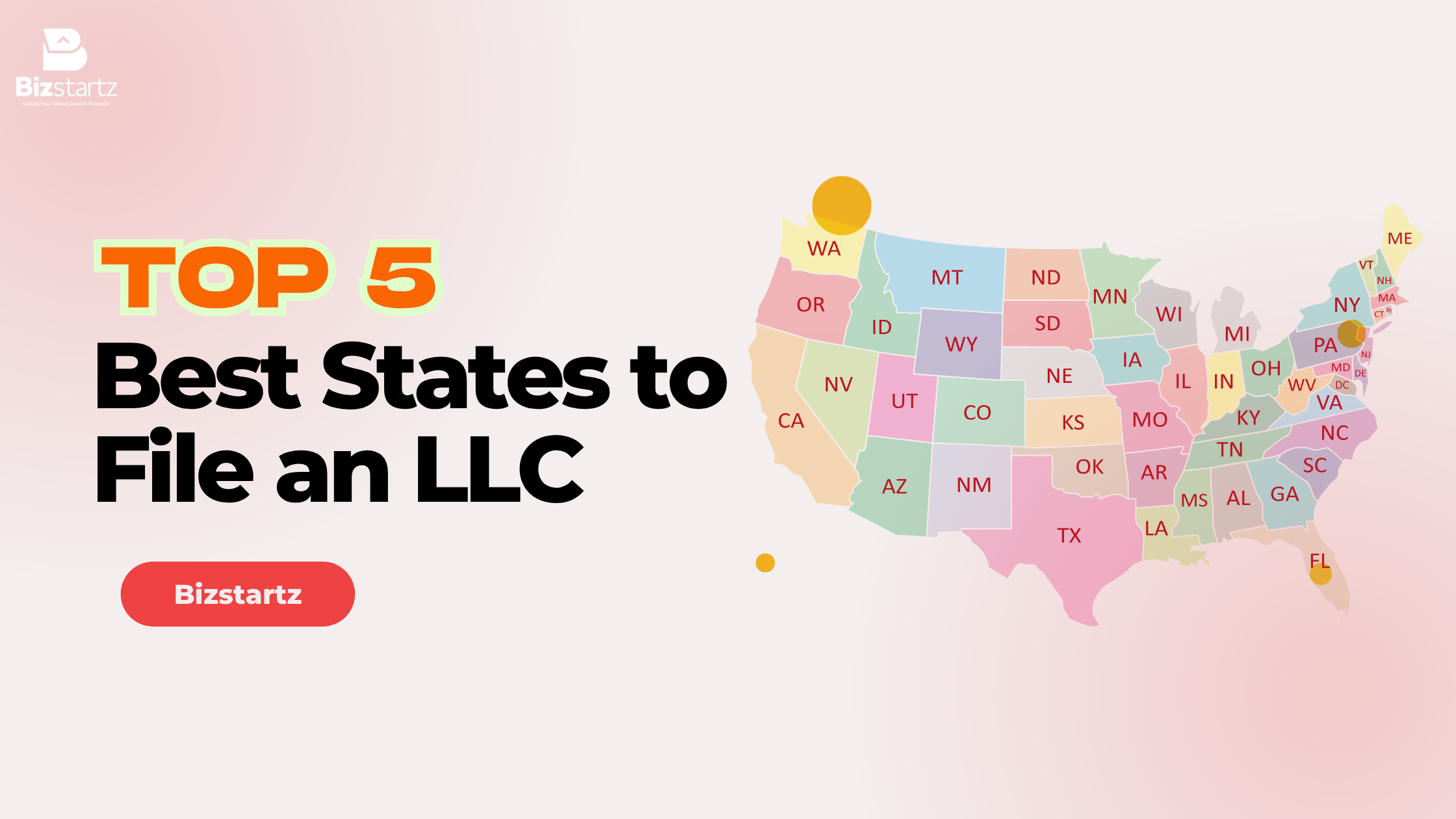
Top 5 Best States to File an LLC (2025 Guide)

Picking the best for your LLC has the potential to streamline or complicate several business-operational areas, including tax structure, expenses, privacy, and legal safeguards.

Though you may choose to form an LLC in any one of the fifty states, only a handful offer comparatively lower restrictions to limit businesses.

This article aims to highlight the five best states to file an LLC in 2025, emphasizing strategic advantages cost, tax structure, legal protections, privacy, and future goals of the business.

1. Delaware – Best for Large and Scalable Businesses

delaware

Delaware has for many years and continues to be one of the most popular choices in the US for business formation. Over 1 million businesses, including more than 60% of Fortune 500 companies, incorporate in Delaware.

What makes Delaware stand out from the rest is its focus on legal infrastructure, entrepreneurship friendly policies, and business owner legal protections.

Key Advantages:

Court of Chancery: Delaware’s Court of Chancery is a specialized court dedicated to corporate law. Experienced judges (not juries) with business backgrounds decide cases, which means quicker and more favorable resolutions.

No Sales Tax: Companies also benefit in terms of operating expenditure as Delaware does not charge taxes on sales of services and goods.

No State Income Tax (Applicable to Out-of-State Income): You do not have to pay state income tax if your LLC is not operating within Delaware.

Business Structure Flexibility: The management of Delaware LLCs is very flexible. They can be tailored to how you want your business structured.

Things to Consider:

  • You will incur additional fees if you have to register your business in another state.
  • Even if your business does not operate from Delaware, you still have to pay the Annual Franchise Tax and Registered Agent Fees.

Ideal for:

Businesses that plan on raising funds, getting investors, or going public. It works well for startups, high-growth companies, and integrated finance companies.

2. Wyoming – Privacy Leaders with Low Fees

wyoming

Wyoming is considered an ideal business haven, specifically designed for small businesses and online entrepreneurs.

This state offers low annual maintenance costs, no state income taxes, and strong privacy protections for businesses looking to keep their proceeds low while maintaining their confidentiality.

Key Advantages:

No State Income Tax: Businesses and individuals in Wyoming are not subject to personal or corporate state income taxes.

Strong Privacy Protections: The usage of nominee managers and members is permitted in Wyoming, while the state does not necessitate the public listing of LLC owners.

Low Filing and Annual Fees: As in most, the initial filing fee is $100, while the annual report fee drops to $60, depending on the value of business assets in the state.

Life Proxy: This feature is exclusive to Wyoming. It allows an anonymous third party to vote in place of an LLC member which increases anonymity.

Things to Consider:

  • If you conduct your business elsewhere (having clients, employees, or office), you’ll have to register in that jurisdiction as a foreign LLC.
  • However strong Wyoming’s privacy laws are, they may be subject to future regulatory scrutiny.

Best for:

Individuals who value privacy, remote employees, overseas entrepreneurs, online store operators, and low-cost, low-regulation investment zones.

3. Nevada – Best for Asset Protection and Zero State Taxes

nevada

Over the years, Nevada has gained enormous popularity as a business-friendly state because of its lack of state-level taxes, and strong legal protections for business owners.

Like Delaware it has an elegant business court system, and doesn’t require owners or managers to be published in public records.

Key Advantages:

Zero State Taxes: No state income tax applies to corporate income, personal income, and franchise taxes.

Strong asset protection: Laws for members of an LLC protects personal liability, lawsuits, and creditors in a legal environment offered by Nevada.

No Information Sharing with IRS: The state of Nevada provides additional privacy when compared to other states by not having an information sharing agreement with the IRS.

Business Court System: Familiar judges in corporate matters oversee business related courts set in Nevada expediting commercial litigation.

Points that need further consideration:

  • Increased scrutiny from regulators owing to abused predatory use by shell companies.
  • Covering the costs of setting up an entity and the annual operating costs are more expensive than Wyoming and other lower-cost states.
  • A registered agent is needed, and an annual business license fee has to be paid.

Best for:

Businesses in high-liability industries (e.g., finance, real estate), international entrepreneurs seeking U.S. presence, and owners focused on protecting assets from lawsuits and creditors.

4. Texas – Best for Business-Friendly Environment and Market Access

texas

What does Texas have to offer? It has the second largest economy in the U.S., a high population growth rate, as well as ideal conditions for forming an LLC tex. LLCs that plan to operate their business physically within the state will find it ideal.

Texas combines a low-tax environment with a pro-business government, making it one of the most attractive states for local and national entrepreneurs.

Key Advantages:

No Personal Income Tax: The personal state income tax for business owners and residents is ZERO.

Few Texas business taxes: Texas does not impose a personal income tax for individuals or business owners.

Reasonable Costs: Compared to states such as New York and California, LLC filing and maintenance costs are moderate.

Infrastructure and Talent: Texas cities such as Dallas, Austin, and Houston have renowned educational institutions as well as ample funding, making them tech hubs with access to sophisticated infrastructure and a skilled workforce.

Things to Consider:

  • Texas does charge a franchise tax which is simply a business based tax on revenue amount. That said, some companies earning below a certain threshold might be eligible for exclusion.

Ideal for:

Local players, service providers, retailers, logistics providers, and U.S. startups looking for cost-efficient operational centers.

5. Florida – Optimal for National and International Business Level Entrepreneurs

florida

Florida emerges as the most dynamic Miami and Tampa Bay cities affirm Florida’s position as a business powerhouse with a vibrant economy.

Florida is geographically well-positioned for international trade, most notably with Latin America and Europe. The state also has low tax policies, a rich variety of international markers, and a considerable number of small businesses and startups.

Key Advantages:

No Personal Income Tax: Residents and businesspersons in Florida enjoy the freedom of not having to deal with state personal income taxes.

Strong Asset Protection Laws: Limited liability prevents Florida LLC members from personal exposure, and the state provides a favorable environment for estate and wealth planning.

Business-Friendly Filing Processes: With a self-explanatory website, it is simple to file documents and administer LLCs in Florida.

International Access: Major ports, airports, and multicultural populations makes Florida a centerpiece of international trade and commerce.

Things to Consider:

  • Mandatory requirements and fees associated with annual reports are $138.75.
  • Florida’s corporate income tax is 5.5%. This normally does not affect standard LLCs that have pass-through taxation, but it’s still relevant to consider.
  • Some form of visibility regarding LLC members/managers is required.

Best for:

Founders from any part of the world who are looking to enter the real estate sector, engage in tourism or hospitality businesses, as well as any other online business serving clientele from North and South America.

Should You Create An LLC Outside Your Home State?

Delaware, Wyoming, and Nevada offer unique advantages, but forming an LLC outside your home state is generally not cost effective.

If you intend to do business in a different state such as serve local clients, hired employees, open an office, you need to register as a foreign LLC in that state and will have dual reporting and fee obligations.

Key Questions to Ask:

  • What is the geographic location of your customers and business operations?
  • Do you plan to have a physical belly button location or employees in a certain state?
  • What is your primary interest-those who exercise privacy or impose on the simplicity of asset protection?

Pro tip:

In the case of no U.S. presence, non-resident or international founders ought to consider Wyoming or Delaware as they are low cost plus offer legal protections, and are easy to maintain.

Final Thoughts

Deciding the state in which to file an LLC is crucial and strategic as it determines one’s legal protections, privacy, tax obligations, and business expansion, which have the potential to greatly affect the company’s growth.

Every discussed state poses unique advantages, and which one is best depends largely on your business model, location, and aspirations.

💼 Looking to Form an LLC?

With Bizstartz, you can form your US LLC from any part of the globe. We provide:

  • Business formation in all 50 states
  • EIN and ITIN submission
  • BOI compliance
  • Assistance with business banking
  • Trademark registration
  • Bookkeeping, business support, and administration

👉 Contact us now and get professional assistance setting up your U.S. business correctly.

Blog CTA

Frequently Asked Questions (FAQs)

1. Is it possible to create an LLC in a state I don’t reside in?

Yes. You may establish an LLC in any state in the USA irrespective of your residency. Even if you are outside the US. However, if your LLC does business in another state (for example, has clients or employees or an office), then most likely, you will have to register there as a foreign LLC. This usually means additional documents and fees.

Tip: Wyoming and Delaware are states often favored by foreign residents due to the cost and ease of doing business.

2. Which state offers the lowest prices to set up an LLC?

Wyoming is often viewed as the cheapest state to form an LLC because of the following:

  • Low filing fee of $100.
  • Annual report fee starting at $60.
  • No income tax for the state.
  • Less compliances and luxuries like privacy.

While other states like Montana and New Mexico do offer low costs, they do not have the same legal protections Wyoming has.

3. Which state do you think has the best privacy protection for LLC?

For LLC privacy, Wyoming and Nevada are the best states. They permit:

  • Anonymity for LLC ownership, meaning no public record of members or managers.
  • Nominee and proxy usage policy.
  • Policies on strong data privacy. No obligation to disclose ownership information to the IRS, this is exclusive to Nevada.

In case privacy is a priority for you, chances are Wyoming LLCs are cheap due to the lower costs in annual fees.

4. Describe the difference which is domestic and foreign registration of an LLC.

An LLC is considered domestic when it is registered in the same state the company is based in and operates.

Foreign LLC refers to a company that is registered in one state, but doing business in a different one. Needs to register and comply to requirements for both.

Let us assume that you setup an LLC in Delaware, but your operations are based in California. Then, you have to register the Delaware LLC as a foreign entity in California which requires paying fees for both states.

5. Non-U.S. Residents Where is the best state to form an LLC?

For non-U.S. residents, the information offered below are the most preferred states.

  • Wyoming: Outstanding privacy, low expense, and low maintenance.
  • Delaware: Appealing to investors and legal reputation.
  • Florida: Popular for easy accessibility, especially for Latin American entrepreneurs.

In these states, there are no residency and Social Security Number requirements for LLC formation, and companies such as Bizstartz LLC help with ITIN, EIN, and BOI compliance.

Is it Possible to Open a PayPal Business Account for Non-Residents

It’s 2023, and digital payment options are the backbone of international trade. As such, having an e-payment solution is critical for entrepreneurs, especially those operating internationally.

Every business owner today, including freelancers in India, eCommerce merchants in Nigeria, and even agency owners in Brazil, needs to access a reliable payment system.

Of all the payment systems, PayPal continues to be amongst the most recognized and utilized. But what happens if you’re not a resident of the US? Can you still open a US PayPal Business account?

The answer is yes, PayPal gives this opportunity to everyone, but it comes with having a specific set of requirements. This article will detail everything non-residents need to know in order to legally open a PayPal Business account in the United States.

What are the motivations for non-residents opening a U.S. PayPal Business Account?

Many entrepreneurs outside the US are keen on opening a U.S.-based PayPal Business account for the following reasons:

1. U.S. represents true global trust and credibility.

Many international clients/customers perceive businesses operating from U.S., and having a U.S. PayPal account, as more professional and more trustworthy. Thus, a PayPal Business account located in the U.S. increases legitimacy, and reduces hesitancy for customers making online payments.

2. Access To More Relavant Features

Merchants with a U.S. PayPal account have access to more functions than merchants operating from other countries. Such functions include recurring billing, shop integrations with Shopify and WooCommerce, developer API integration, and simplified payment receiving.

3. Access To Higher Account Limit

Most non US PayPal accounts have very low initial limits, or are very easy to flag for “suspicious activity”. On the other hand, U.S. PayPal Business accounts are known for offering higher limits on sending, receiving, and withdrawal after going through the verification process.

4. PayPal Accounts Eliminate Extra Fees

Generally, business U.S. PayPal accounts incur also significantly lower transaction fees, especially on payments made in United States dollars, or for funds linked via a U.S. business bank account. This difference can result in considerable savings over time due to lower operating costs.

5. Connecting Other Financial Tools With PayPal

There are multiple platforms such as Stripe, Square, Amazon, and Etsy that require US PayPal or Bank accounts, or would work better with one. A U.S. PayPal Business account opens opportunities to connect your business with some of the most advanced U.S. services and platforms.

Is It Really Possible for Non-Residents to Open a U.S. PayPal Business Account?

Yes. It is indeed possible for non-U.S. residents to legally open a PayPal Business account. However, they cannot do so as individuals. You will need to set up a U.S business with the appropriate documents and ensure that PayPal can verify your identity and your business.

PayPal enforces rigorous KYC (Know Your Customer) and AML (Anti-Money Laundering) rules. That means your account must meet U.S. compliance standards irrespective of your nationality.

This is very possible, and non-resident business people achieve this every year as long as they follow the right procedures.

What You Need: Requirements for Non-Residents

Paypal Business Account

This is a comprehensive checklist of requirements that you need to open a PayPal Business account as a non-resident:

1. Form a U.S. Company (LLC or Corporation)

The first step is to formally incorporate a business in the U.S, which is usually a Limited Liability Company (LLC). You do not have to reside in the U.S. to possess a U.S company. States like Delaware, Wyoming and New Mexico are especially welcoming to non-resident incorporators.

  • Delaware is known for its expeditious processing of LLCs (Limited Liability Companies) as well as it’s wide array of business friendly laws.
  • Wyoming’s claim to fame is the anonymity it provides as well as low annual fees.
  • New Mexico is a cost-effective state that does not need annual report filings.

The next step after forming a business entity is the issuance of Articles of Organization, which serves as evidence of the business’s existence.

2. Obtaining an EIN or Employer Identification Number (EIN)

The business equivalent of a Social Security Number, an EIN, is issued by the Internal Revenue Service (IRS). The following require an EIN:

  • Opening a U.S. business bank account.
  • Filing taxes, even if the amount is zero.
  • Registering for business accounts with Paypal and Stripe.

Foreign business owners can submit applications by fax, postal mail, or through a service provider. This process can be expedited by Bizstartz.

3. USPS Business Address

A physical office is not a requirement. A virtual business address, or that of the registered agent in the state of formation, is sufficient. This address will be used for all official business communication and for verifying the business with Paypal.

Note: Avoid using PO boxes. PayPal typically requires that a real street address be used, as opposed to a PO box.

4. Needed US Phone Number Services

A US phone number is required to set up two factor authentications, for notification from PayPal, and for customer service communications. Services where you can acquire numbers are:

  • Google Voice (when used with VPN)
  • VoIP providers like Grasshopper also provide phone numbers.
  • Skype Number
  • Twilio

5. US Business Bank Account

To withdraw funds from PayPal, a US checking account is mandated. Fintech companies such as:

allow non residents to open business accounts without having to step foot in the US. Free of charge, these firms, along with others, provide business bank accounts that are backed by the FDIC and have seamless payment integration with PayPal.

6. ID of Government with Validity

To validate your identity on PayPal, some form of accountable identification is needed. Usually a passport or a drivers license or a national identification issued by the country of one’s residence suffices.

Identification must bear name of profile in PayPal with no changes at all.

Step-by-Step Guide: How to Open a U.S. PayPal Business Account as a Non-Resident

This is the sequence crafted within the preceding steps in order to attain the goal:

Step 1: Build Your Company Based in The States

Settle on a state like Delaware or Wyoming then proceed to draft Articles of organization go solo or enlist the assistance of formation companies like Bizstartz who do the paperwork along with compliances for you.

Step 2: Apply for Your EIN

Once your LLC is set up, apply for your EIN with the IRS. Currently, processing with fax applications takes anywhere from 2-5 weeks, while filing agents can expedite this to 1-3 business days.

Step 3: Open a U.S. Business Bank Account

With your EIN, you can now obtain a business checking account from a digital bank like Mercury or Relay, which supports foreign owners. This account will be connected to your PayPal for withdrawal purposes.

Step 4: Register for PayPal Business

Go to paypal.com and do the following:

  • Choose “United States” from the dropdown menu.
  • Type in your business name in the U.S along with the EIN and business address.
  • Input your phone number and email associated with the U.S.
  • Fill in your personal details (Full name, country of citizenship, passport ID).
  • Choose your payment preferences and finish the first verification steps.

Step 5: Submit Verification Documents

These documents will most likely be requested by Paypal:

  • Articles of Organization (proof of business)
  • EIN confirmation letter (Form CP 575)
  • Valid ID (passport)
  • Proof of address (utility bill, lease, or virtual office confirmation)

You will be able to submit these documents over the PayPal Resolution Center once you are prompted.

Step 6: Link Your U.S. Bank Account

Once your account has been confirmed, move to ‘Wallet‘ and select ‘Link a Bank Account‘ to add your U.S. business account. As a means of verification, PayPal will initiate two nominal payment deposits.

Common Problems Non-Residents Face (And How to Avoid Them)

1. Knowing Payment Verification

It is possible that PayPal does take some time to review documentation. It is wise to submit clear scans, complete all processes, and align your documents with your business as well as ID records.

2. Limitation Of Accounts

PayPal has the right to place a hold on an account if they believe that large transactions are being processed or some documents do not align during the initial stages. One way to mitigate this risk is to begin transacting on a more intimate level that allows for the building of trust.

3. Misinformation

Make sure that the name of the business, its address, the EIN and banking information is the same on PayPal, the bank, as well as on the documents used to set the business up.

4. Unsupported Regions

If you are from a high-risk region or PayPal banned region such as (Iran, North Korea and certain parts of Africa) you could face restraining obstacles. Nevertheless, if you form a U.S compliant company with compliant documents this gives you a way to facilitate the legal opening and business management.

Alternatives If PayPal Isn’t an Option in Your Country

If you’d like alternatives as to how to deal with PayPal not being an optional tool in your region, I suggest:

  • Stripe Atlas: Incorporate your U.S. company and gain access to Stripe’s payment gateway.
  • Payoneer: Offers global payment solutions and integrates with Amazon, Fiverr, and other platforms.
  • Wise Business: Allows local currency withdrawals from USD with low conversion fees.
  • Revolut Business: Operates in Europe and globally, offering multi-currency accounts.
  • Skrill: E-wallet alternative with more accessible country restrictions.

paypal business

Final Thoughts

It’s 100% feasible to start a non-residents’ PayPal Business account, but the process isn’t casual or quick.

Creating a legitimate U.S. business, compiling appropriate documents, and ensuring compliance with PayPal’s procedures have to be meticulously followed.

Nevertheless, you’ll have powerful tools after the setup: sending, receiving, and managing payments internationally under a trusted U.S. business brand.

Want to Skip the Hassle?

At Bizstartz, we assist clients in forming U.S. companies, obtaining EINs, opening business bank accounts, and setting up compliant PayPal Business accounts for entrepreneurs worldwide.

From freelancers and startup founders to e-commerce sellers, we can guide you through every step.

👉 Start your U.S. business journey with Bizstartz today!

Get Started Now

How to Open a Stripe Account as a Non-US Resident (2025 Guide)

In today’s digital world, integrating online payment capabilities is crucial for entrepreneurs, freelancers, SaaS founders, and eCommerce merchants.

A strong competitor in this sector is Stripe. It is a payment processing service known for its API, capacity to scale worldwide, and seamless integration with contemporary websites and applications.

For those not living in the United States, especially in unsupported countries, the question arises: Am I eligible to use Stripe?

The answer is yes but with a more thoughtful approach than most. In this guide, we’ll show you how to set up a Stripe account as a non-US resident without connections to the US, step by step.

🌍 Can Non-US Residents Use Stripe?

Supported are businesses from 45 countries, more so in US, Canada and UK, most of Europe, Australia, and select regions in Asia. Stripe however does not support many huge markets in Africa, The Middle East, South Asia, and South America.

So, what if you are located in an unsupported country such as Nigeria, Pakistan, or Bangladesh?

You will not be able to create a Stripe account with your local business. Though, it is completely legal to incorporate a U.S. company and subsequently open a Stripe account while residing outside the U.S. This practice is not only legal, but is also very popular amongst many international entrepreneurs and startups.

By forming an LLC in the U.S., you will be able to get a Stripe account as well as become a U.S. online business and enjoy all the perks that come with it, without having a Social Security Number (SSN), visa, or even residing in the U.S. or having U.S. citizenship.

✅ Requirements To Open A Stripe Account As A Non-Us Resident

As a non-resident, there are a few requirements that you will need to gather for opening a Stripe account. Consider this as preparing the legal and financial framework of your business in the U.S.

Let’s go through the checklist of what is required from you:

1. A US Based Limited Liability Company (LLC)

This is the legal entity that you will form under which your Stripe account will operate. An LLC must be formed in one of the U.S. states like Delaware, New Mexico, or Wyoming. These states are preferred due to their low annual fees, easy registration and protection of privacy.

Setting up a Limited Liability Company allows you to create the following:

  • Your official registered business name
  • Assets are protected
  • Possibility to sign agreements or receive financial funds

2. Tax Identification Number (EIN)

The EIN is issued by Financial Revenue Service which serves as the company’s tax document number. It acts like the Business Identity Because Digits Identifier for social security or social identity. In order to avail such services, you need:

  • Open Business accounts in the U.S
  • Acquire securities for statutory registration with Stripe
  • Enlist as a taxpayer resident of the U.S, if eligible for tax benefits.

It normally takes 1-2 working weeks to obtain an EIN and there is no requirement of possessing a SSN.

3. Business Address in the U.S

Postal needs claim a business address in America to validate services provided. You can:

  • Use registered agent’s address (included on most LLC formation packages).
  • Use a virtual mailbox from providers like iPostal1, Earth Class Mail, or Anytime Mailbox.

Ensure this is the same for every unified statement or join declaration document under print or on platforms of choice.

4. American Business Mobile Number

Some services require phone verification, including Stripe. You can obtain a virtual U.S. number through platforms such as:

  • OpenPhone
  • Skype Number
  • Google Voice (if you have a U.S. IP or VPN)
  • Sonetel

Choose a number that you can easily access for future verifications.

5. Account with US Bank

You will require a business bank account based in the United States to access your Stripe payouts. The good news is that you can open such an account without visiting the United States physically. Consequently, many modern fintech companies offer non-resident remote business banking:

  • Mercury: Best for new businesses, no monthly charges
  • Relay: Fast account registration
  • Wise Business: Provides foreign currency accounts along with routing numbers from the United States

These accounts allow you to maintain the required account and routing numbers that Stripe needs to process your payouts.

6. Government issued identification (Passport or National ID)

Stripe will request you to verify your identity for your account. This is done to ensure that there is no impersonation or fraudulent activity concerning the businesses that are set on stripe.

Ensure that your ID is:

  • Legible and not out of date
  • Corresponds to your name as per the document

Stripe has additional requirements depending on your country, they might require you to take a photo of yourself while verifying your identity.

Step-by-Step: How to Open a Stripe Account as a Non-US Resident

Stripe Account

Follow this strategy to set up your Stripe account even if you are located in a non-supported country:

Step 1: Form Your US LLC

Choose a state like Wyoming or Delaware and register your LLC. You can file directly with the state yourself, but most international founders use agencies like Bizstartz that take care of everything, including:

  • State filing
  • Registered agent service
  • EIN application
  • Operating Agreement (which you need to get for bank account approval)

Step 2: Get a US Address and Phone Number

Purchase a virtual business address as well as a phone number. You will use this information to complete your Stripe and bank applications. Check that you can receive mail or messages through these services.

Step 3: Apply for Your EIN

If using a service Bizstartz, they will apply for your EIN directly. By yourself, you need to complete IRS Form SS-4 and either fax or mail it.

Tip: While filling out the SS-4, make sure you check box 9a for “LLC” and leave the SSN/ITIN section blank if you do not have one.

Step 4: Open a U.S. Business Bank Account

After acquiring your LLC documents and EIN, now you can proceed to apply for a U.S. business bank account. Among the different options available, Mercury has great favorable conditions. In order to open an account, they require the following:

  • LLC documents
  • EIN confirmation letter
  • Business website or explanation of your business

Once accepted, you will obtain U.S. banking details you can attach to Stripe.

Step 5: Register for Stripe

Go to https://stripe.com and select “Start Now”. Choose:

  • Country: United States
  • Business Type: LLC
  • Business EIN & address
  • Personal verification: Upload your passport or ID

Verification of identity and business will take place within Stripe’s system. Most accounts seem to be accepted within minutes to a matter of days.

Step 6: Integrate Stripe with Your Website

Connect Stripe with the platform once the account is active:

  • E-commerce platforms: Shopify, WooCommerce, Wix
  • SaaS: Custom integration via Stripe API
  • Freelancers: Opt for Stripe invoicing or utilize payment links

And with that, you can now facilitate payment interactions with customers from across the globe!

Expert Tips to Ensure Stripe Approval and Longevity

Use consistent information throughout your EIN, LLC, bank, and Stripe account to help verification flags being raised on the accounts.

Add an LLC-use business website to be covered professional-wise and during the approval, Stripe may choose to check it.

Refrain from engaging with adult entertainment, inventory-free dropshipping, and cryptocurrency activities. Only participate if properly certified.

Never use a VPN that shows a different location as it may flag your account, Stripe scans IPs for checking suspicious behavior.

Be cautious of maintaining account health, too many chargebacks or disputes can lead to frozen accounts.

Is a US Visa, SSN, or ITIN Required to Open a Stripe Account?

Not at all. A U.S. visa, Social Security Number (SSN), or Individual Taxpayer Identification Number (ITIN) is not necessary to open a Stripe account through a U.S. LLC.

  • Identity verification (passport)
  • A business based within the U.S.
  • U.S. business bank account

This is fully legitimate and compliant with American law. This is how thousands of digital entrepreneurs and remote businesses successfully operate.

Stripe Competitors For Countries Without Support

If you’re unable to set up a U.S. company at the moment, you might want to consider the following:

  • Payoneer: Has a wider county support and integrates with Amazon and Fiverr.
  • Wise Business: Provides accounts with different currencies and international transfers.
  • Paddle: Excellent for SaaS; manages compliance, billing, and tax.
  • 2Checkout (Verifone): Accept international payments and works with most platforms.

All these options are stripes, even though they do not have nearly the same developer resources and effortless API integration.

Open a Stripe Account Today

As a non-US resident, opening a Stripe account may feel like a daunting task. However, with the right approach, it’s completely within reach.

Creating a US LLC and getting an EIN alongside a business bank account while verifying your identity allows the full power of Stripe to be unlocked without stepping foot on American soil.

If you’re planning to start or scale your online business, this would be one of the best decisions you could make.

Are You All Set to Go?

At BizStartz, we assist non-American entrepreneurs with:

  • Forming U.S. LLCs
  • Getting an EIN
  • Creating U.S. bank accounts
  • Setting up Stripe accounts
  • Managing compliance including BOI and bookkeeping

👉 Click here to launch your U.S. company and Stripe account now

Stripe

Frequently Asked Questions (FAQs)

Without a business, am I able to open an account with Stripes?

Absolutely not. Having an operational business is a prerequisite for Stripe. As a non-resident, the best step is to register an US LLC.

What is the average cost for setting it all up?

Average pricing is as follows:

  • LLC creation: $150 to $500 depending on state and provider
  • EIN: Free (if DIY) or part of service package
  • Virtual address & phone line: $10 to $30 a month
  • Bank account: Free to open with services like Mercury

Am I able to withdraw funds to my local bank?

Certainly. Frauds can be sent from an American bank account to a local currency bank using Wise or Payoneer.

Is it permissible to operate a US LLC while outside the US?

Absolutely yes. Legally, foreign citizens are allowed to establish and operate companies registered in the US entirely online.

How to Start an LLC in Nevada | Step-by-Step Guide

Starting a Limited Liability Company (LLC) in Nevada is ideal for business owners due to the strong privacy that it provides, state tax benefits, and comprehensive asset protection.

Whether you’re a domestic citizen or a non-resident entrepreneur, the Formation Policies of Nevada in conjunction with the legal framework of the state and the nurturing ecosystem for business allow for effortless establishment and growth of new ventures in the state.

This tailored guideline provides an all-inclusive insight into the processes involved in forming an LLC in Nevada with clear instructions pertaining to name selection, post-formation compliance, and other pertinent tasks.

Why form an LLC in Nevada?

Nevada is widely regarded as one of the most favorable regions for doing business due to their absence of vaulted state taxes combined with unparalleled levels of privacy, and great entrepreneurship policies that the state offers.

In detail, the reasoning why the State of Nevada is able to draw in so many new LLC’s during the year.

1. There is no State Income Tax

Along with a handful of other states, Nevada does not levy taxes income or business profit tax on individuals or corporations. A business ultimately gets to pocket a larger portion of its revenue which is beneficialagdagan sa. This proves useful to entities such as LLC’s that file under the owner’s individual tax return.

2. Strong Privacy Protections

In contrast with other states, Nevada does not mandate including the names of members or managers of the LLC in the Articles of Organization. This means you can establish and run your business with a high level of anonymity, particularly beneficial for investors, online entrepreneurs, or public figures who value privacy.

3. Comprehensive Asset Protection Laws

Nevada represents one of the most protective jurisdictions in the United States in relation to personal liability. For instance, as far as charging orders are concerned, they are the only recourse available to creditors seeking to pursue an LLC’s member’s interest. This secures personal properties from business obligations or litigation.

4. Absence of Minimum Capital Requirements

A single founder, side-hustler, or self-funded startups will find it easy to establish a Nevada LLC since there are no capital restrictions.

5. Easy Business Administration

You can design how you want to run your company because a Nevada LLC can either be member-managed or manager-managed. Ownership is also less restrictive, thus allowing any individual, corporation, or even foreign nationals to be members.

6. No Operating Agreement Filing Requirement

In Nevada, you can draft your Operating Agreement and does not have to submit it to the Secretary of State. This gives you the option to privately tailor the internal governance document without worrying about public disclosure.

Step-by-Step Guide to Starting a Nevada LLC

Nevada LLC

Step 1: Select an Appropriate Name for the LLC.

Getting the name right is the first step in your process; it is equally critical for marketing purposes, legal compliance checks, and branding.

🧾 LLC Name Guidelines for the State of Nevada

  • Your LLC name must end with “Limited Liability Company” or the abbreviations “LLC” or “L.L.C.
  • The name must be distinguishable and not deceptively similar to other names in the states’ databases.
  • As with any existing business, terms such as “Bank,” “Insurance,” “Trust,” or “Attorney” cannot be included without explicit licenses or permission.
  • Any misleading references like “federally affiliated” or “state affiliated” should not be present.

🔎 Name Availability Checking Procedures:

By visiting the Nevada Business Name Search Tool, you can easily conduct a name search free of charge.

📌 Optional: Reservation of the Name

If documents cannot be filed immediately, names can be reserved for 90 days at a fee of $25. This helps secure claims over business names while documents are being drafted.

Procedure 2: Designate a Registered Agent in Nevada

A Registered Agent is an individual or business that will accept service of process, legal documents and other government correspondence on behalf your LLC.

✅ Registered Agent Requirements:

  • Possesses a physical street address in Nevada (No P.O. Boxes)
  • Must be reachable during standard working hours
  • Can be a resident or a commercial Registered Agent service

🛡️ Why This Role is Critical:

Inability to keep a Registered Agent continuously may cause problems for your LLC in good standing, missing notices, legal documents, or worse scenario be administratively dissolved. If you don’t have a Nevada address, use of a professional Registered Agent services is necessary.

The average cost of a Registered Agent ranges from $50 to $150 annually and may include compliance and document scanning.

Step 3: Complete the Articles of Organization

These are the documents that legally formalizes your LLC by stating it with the Secretary of State of Nevada.

📝 What to Include in the Articles:

  • Title for your LLC
  • Full legal name and address of the Registered Agent in Nevada
  • Decide if LLC will be managed by members or managers.
  • Full legal name and address of each manager or managing member.
  • Dissolution date if: (i) not perpetual.
  • Purpose of the business (generally optional, but good to have)
  • Include and/or business contact email and physical address.

📤 Filing Methods:

  • Over the Internet using the Nevada SilverFlume Portal.
  • By mail or by hand to:

Secretary of State

202 North Carson Street

Carson City, NV 89701

💵 Filing Fee: $75

Ordinary processing runs 5-7 business days, but can be expedited at an additional cost.

Step 4: Initial List and Apply for a State Business License

Nevada, unlike many other states, requires two additional documents at the time of setup:

📄 Initial Managers or Members List

  • Names and addresses of all managers or members must be provided.
  • Must be completed within 30 days of filing the Articles of Organization.
  • Fee: $150

📜 Application for Nevada State Business License

  • Only needed for most businesses operating in Nevada.
  • Renew annually.
  • Fee: $200

Both documents can be filed online with your Articles of Organization.

🚨 Note Well: Your LLC status will remain inactive until both the Initial List and the Business License fees are submitted and paid.

Step 5: Formulate an Operating Agreement

Although not mandatory, it is sensible for every LLC, particularly those with several members, to draft an Operating Agreement due to its practical value.

📃 Sections to Include in an Operating Agreement:

  • Various ownership interests and their Voting power
  • Responsibilities assigned to members and managers
  • Allocation of income and losses
  • Voting procedures and scheduling of meetings
  • Member addition or removal procedure
  • Exit or dissolution strategy

⚖️ Legal Protection:

An Operating agreement provides proof for the existence of an LLC separate from its owners marking a shield against personal liability. It may also serve as a control device for future disputes among members.

Step 6: Register for an EIN (Employer Identification Number)

Most LLCs are required to obtain an EIN or Federal Tax ID from the IRS.

Tasks Accomplished with an EIN:

  • Set up a United States business bank account.
  • Submit federal tax documents.
  • Request personal credit.
  • Employ staff.
  • Engage with payment management systems such as Stripe and PayPal.

💡 How to Submit an Application:

  • Residents of the US: IRS provides an online application portal that offers immediate access to services (free).
  • Non-Residents of the US: Form SS-4 must be submitted via fax or post. No need for a SSN or ITIN.

Step 7: Set up a Business Bank Account.

Separating personal from business finances helps you utilize legal protections and manage your money in a sophisticated manner.

🏦 Additional Requirements:

  • EIN Confirmation Letter
  • Business Documents
  • A valid passport issued by a government agency or a non-expired identification card
  • A passport or driver’s license issued by the government
  • An invite to a business launch in Nevada.
  • Nevada business license.

Some online banks such as Mercury, Relay and Wise permit international grantees to open accounts without needing them to be physically present in the country. Others prefer that you visit a US branch in person.

Step 8: Maintain Compliance with State Regulations

After forming your LLC, ensure you complete ongoing yearly requirements to maintain good standing.

✅ Ongoing requirements:

1. Update the Annual List of Managers or Members

  • Complete with the anniversary of your LLC registration.
  • Fee: $150

2. Nevada State Business License Renewal

  • Renewed every year.
  • Fee: $200

3. Registered Agent Maintenance

  • Make sure your agents are current and active.

4. BOI Report (FinCEN Requirement)

  • Beginning January 1, 2024, the majority of newly established LLCs will be required to submit a Beneficial Ownership Information (BOI) report to FinCEN within a period of 90 days following the formation of the company.
  • No payment is required to file the documents, but noncompliance incurs fiscal penalties.

5. LLC Capitals and Taxes

  • Though Nevada does not impose an income tax, as a business owner, you will incur federal tax obligations. In addition, you may be required to collect sales tax if you provide taxable goods or services.

🚀 Are You Ready to Start Your LLC In Nevada?

An LLC in Nevada comes with a lot of legal protection, great privacy, and flexibility, although the compliance and paperwork require considerable effort.

In Bizstartz, we help both domestic and foreign clients design and manage their LLCs in Nevada and across USA.

Our all-inclusive package for a Nevada LLC consists of:

✅ Bizstartz helps with forming an LLC in Nevada.

✅ Business License.

✅ Bank Account (U.S Bank) Setup.

✅ Resume agent.

✅ Obtain an EIN (Federal ID).

✅ Filing of the BOI Report.

✅ Drafting the operating agreement.

✅ Assisting with the business license application.

👉 Get Started With Your Nevada LLC Today

📞 Free Consultation With Our Professionals.

Blog CTA

Frequently Asked Questions (FAQs)

Can non-U.S. residents start a Nevada LLC?

Of course. Foreign citizens and corporations can fully own (100%) a Nevada limited liability company (LLC). It is not necessary for you to have a U.S. address, citizenship or residency.

Does a Nevada LLC protect personal assets?

Indeed. One key benefit of a Nevada LLC is the legal entity separation between the business and the owners personal items. Usually, creditors will not have any access to your personal belongings to meet business debts.

Is Nevada more preferable than Wyoming or Delaware?

It depends on your goals:

  • Nevada: Great for privacy, strong asset protection, and no income taxes.
  • Delaware: Ideal for startups planning to raise venture capital.
  • Wyoming: Cheaper than Nevada with similar privacy benefits.

Is it possible to manage a Nevada LLC from another state or even another country?

Absolutely. Your Nevada LLC may be managed from anywhere on the planet. Keep in mind though, if you are doing business in another state, you might have to apply for foreign LLC status in that state.

How to Start an LLC in Delaware | Step-by-Step Guide

The Formation of a Limited Liability Company (LLC) in Delaware would strategically benefit many entrepreneurs, business owners, and even international business investors, owing to the pro-business laws, flexible structure, and privacy policies the state provides.

Whether you wish to develop a U.S. based eCommerce brand or plan to launch a tech startup, the formation of an LLC in Delaware is considered the, “golden standard”.

In this extensive guide, I will take you through the entire process along with the reason to start an LLC in Delaware with legal requirements, and other administrative details that every business owner must be informed about.

Why Choose Delaware for Your LLC?

Delaware is famous as the go to state to create an LLC as well as a Corporation. This is not just some rumor that is going around for some hype purposes. In fact, there are federally acknowledged benefits that differ for both U.S citizens and non U.S citizens. Here’s some of the reasons:

1. Business Friendly Laws:

Delaware provides you with one of a kind court services to address your issues. The Court of Chancery deals with business disputes and is extremely efficient at it. Businesses do not use juries which makes the proceedings much easier. Judges, who are known as Chancellors, are also known for their incredible skills in corporate law. This allows for faster solutions and trustworthy legal decisions.

2. Anonymity And Privacy:

Delaware as a state does not allow the members or managers of the LLC to disclose their names publicly. This feature is astonishing for business owners Wishing to keep the ownership undisclosed.

3. No Minimum Capital Requirement

Delaware is more flexible than other legal jurisdictions because it does not impose any minimum charges for starting an LLC. You can establish your business without any significant initial investment.

4. Favorable Tax Policies

  • No income tax levied on LLCs that do business outside Delaware
  • No sales tax collected in Delaware
  • No tax levied on trademarks or patents.

5. Global Recognition

Delaware is known to have well developed business laws. In relations to doing business with Delaware entities, investors, banks, and venture capitals are familiar with Delaware corporate structures and this may facilitate ease in funding and expansion.

Step-by-Step Guide to Starting an LLC in Delaware

Start an LLC in Delaware

In this part of the document, we describe how a US citizen, a foreign citizen residing outside of the US, or a digital nomad LLC can set up an LLC in Delaware without physically going to the state.

Step 1: Choose a Name for Your LLC

The first step which is also the easiest task to accomplish is to ensure that you have an LLC title that no other LLC company is registered under in Delaware.

✅ Conditions for an LLC Name in Delaware:

  • Includes the phrase “Limited Liability Company” or its abbreviations “LLC” or “L.L.C.
  • Shall not include any word suggesting a linkage to a governmental monitoring agency “FBI”, “Treasury”.
  • Name should not be identical to any other active registered entities in the state of Delaware.

🔍 Instructions for determining the availability of a name:

Delaware Entity Name Search tool helps in confirming if the desired name is already taken or not. Consider matching domain name if there are plans for online dealings.

📝 Pro Tip:

If you want to hold off on filing, you can reserve your name for up to 120 days for a small fee.

Step 2: Designate a Delaware Registered Agent Manager

A Delaware registered agent picks up any legal and government documents regarding Delaware LLC.

✅ Considerations:

  • Users must register in Delaware with a street address.
  • Must be present during usual office hours.
  • Cannot make use of a P.O. Box.

Physically based registered agents are only permitted if they have a business address in Delaware. Most business owners buy professional registered agents at a rate of $50-150 annually.

🛡️ Importance:

A business could lose its good standing status or miss important milestones if a legal document is not forwarded or a registered agent is unreachable.

Step 3: Submit the Certificate of Formation

Delaware requires the filing of a Certificate of Formation with the Division of Corporations to create an LLC.

🧾 Required Information Includes:

  • The name of the LLC
  • Name and address of the registered agent
  • (Optional) Purpose, duration, and date of formation and emergence of the LLC in question.

📤 How to file:

  • Online via the Delaware Document Upload Service
  • By mail to:

Delaware Division of Corporations
401 Federal Street, Suite 4
Dover, Delaware 19901

💵 Filling Fee: $90 (2025)

The estimate is 3-5 business days for standard processing but expedited services are available.

Step 4: Draft an Operating Agreement

An operating agreement is not required for a Delaware based LLC but it is vital for an internal governance document.

What It Covers:

  • Roles and responsibilities of members and managers
  • Voting procedures and decision-making rules
  • Profit-sharing and capital contributions
  • Procedures for adding/removing members
  • Rules for dissolution or exit

Why Its Important:

An Operating Agreement reduces chances of conflicts by providing internal controls within members of the LLC. It may be needed by banks or investors for either account opening or credit extension.

Even solo members of the LLC will find it handsomely on this document in order to differentiate business assets and personal assets.

Step 5: Obtain an EIN from the IRS

An Employer Identification Number (EIN) is a number that identifies your business for tax purposes. It’s issued by the IRS, which is similar to how people have Social Security Numbers- so does each company have one.

Why You Need an EIN:

  • To open a business bank account in any US state.
  • If you intend to hire.
  • For filing taxes at the federal level.
  • When applying for business credit.

How to Apply:

  • For citizens of the United States: Apply online at the IRS EIN Portal.
  • For non citizens: Must fill out Form SS-4. Submitting it by fax or mail. Foreign individuals do not have access to the online system.

Delays aren’t uncommon, but the IRS usually provides an EIN same day for applications made online. If you’re submitting it through fax or mail, expect it to take a few weeks.

Step 6: Stay Compliant with Delaware Annual Requirements

As soon as you form your LLC, ensure that you do not lose good standing with the LLC by meeting its ongoing obligations in a timely manner.

🧾 Annual Franchise Tax:

  • Flat fee of $300
  • Due by June 1 each year
  • No annual report is required for LLCs (unlike corporations)

🏢 Registered Agent Maintenance:

  • Keep your Registered Agent and their address current.

Failure to pay the franchise tax or maintain an agent will lead to losing good standing and incurring penalties, or the worst losing the LLC all together.

Step 7: Open a U.S. Business Bank Account

Having a business bank account for a company helps in personal liability protection as well as building business credit while separating personal finances from the business.

📄 What You’ll Need:

  • Certificate of Formation
  • EIN (IRS letter)
  • Operating Agreement
  • Valid identification (passport or driver’s license)
  • Proof of Address (for non-US residents, a utility bill or similar may be required).

Some US banks require in-person visits while others like Mercury and Relay allow international founders to remotely open business accounts.

Steps That Are Optional But Recommended

🔒 Submit a BOI Report (FinCEN Requirement)

According to the Corporate Transparency Act, starting January 1, 2024, Limited Liability Companies (LLCs) must submit a report of beneficial ownership information (BOI) to FinCEN within 90 days of formation.

The report incorporates:

  • The personal information of all beneficial owners
  • Details of the company applicant
  • Identification (passport, driver’s license, etc.)

Non-compliance penalties can be severe – up to $500 for each day of violation.

📜 Apply for Business Licenses

If your LLC is going to operate in Delaware or the rest of the United States, you might require:

  • State and local business licenses
  • Sales tax permits
  • Foreign qualification if the business is outside of Delaware

Need Expert Help Starting Your Delaware LLC?

Bizstartz has been helping entrepreneurs from all over the world start and maintain their Delaware LLCs. We specialize in assisting with EINs, providing registered agent services, and BOI reporting and banking services.

These are some of the services we offer:

✅ Formation of a Delaware LLC

✅ Providing Registered Agent Services

✅ Assisting in Filing for an EIN Application (for domestic and foreign founders)

✅ Drafting Operating Agreements

✅ Filing BOI Reports

✅ Opening a Business Bank Account in the U.S.

✅ Sending Reminders for Annual Compliance

✅ Receive Personalized Service For Your Delaware LLC Today.

📞 Or schedule a no-cost initial discussion with our specialists.

Blog CTA

Frequently Asked Questions (FAQs)

Is A Foreigner Able To Apply For A Delaware LLC?

Of Course. The state of Delaware is very foreigner friendly as it does not restrict ownership. There is no requirement of citizenship or even a US address.

Is There A Requirement Of Having An Address And Social Security Number From The US?

Not At All. LLCs may utilize the address of a registered agent and SSNs for obtaining EINs are not mandatory, only an application through Form SS-4 is the requirement.

Does Delaware have advantages over other states regarding LLCs?

Delaware is best suited for holding companies, online businesses, and startups where privacy and legal flexibility is a concern. Delaware is not the only business-friendly state.

If you operate a business in another state, such as California or New York, you’d have to register your Delaware LLC there as well, adding more costs and paperwork.

How to Start an LLC in Wyoming | Step-by-Step Guide

Forming an LLC in Wyoming remains among the best in the entire United States. Entrepreneurs all over the world are looking forward to setting up an LLC in Wyoming due to the additional features like low fees, privacy guarantees, and a favorable atmosphere for setting up and operating businesses.

As a freelancer or even a fully fledged business owner, setting up your LLC in Wyoming can be beneficial for you in a myriad of ways.

This guide comprehensively covers everything you need from choosing a name to maintaining compliance in order to form an LLC in Wyoming so that you can successfully start your business.

Why Consider Wyoming for Your LLC?

For those considering forming an LLC, Wyoming is one of the best places due to the unparalleled features they offer. Here is why we think Wyoming is the perfect state for LLC formation:

1. Zero State Income Tax

State tax doesn’t affect individuals and corporations in Wyoming. This implies that LLCs are not taxed on income at the state level, which means significant profits for the business. Entrepreneurs are always looking for ways to avoid taxes, and this feature is greatly beneficial.

2. Strong Asset Protection Laws

The law governing Limited Liability Companies (LLC) in Wyoming have adequate asset protection for the members as well as the managers. For instance, Wyoming has “Charging Order” protection which limits creditors to obtaining only a distribution owed to the LLC member, rather than the able to seize LLC assets completely. This protection enables the shielding of assets from business debts and lawsuits, which is beneficial.

3. Low Fees and Minimal Paperwork

With a very low incorporation fee of $100, Wyoming is a very favorable state for starting a LLC compared to other states within the US. This fee, coupled with reasonable annual fees, makes maintaining a LLC in Wyoming conducive for startups and smaller businesses.

4. Superior Privacy Protections

Wyoming has the unique feature of not requiring the disclosure of names for members or managers of the LLC included in the formation documents. This is unlike several other states that require business owner information, which is later transformed into public records.

5. Easy Access for Non-Residents

One does not need to be a resident or citizen of the US in order to form a Wyoming LLC, thus making it extremely popular amongst non-American entrepreneurs as well as international travelers. The accommodating policies and services of Wyoming aid a foreign business person looking to start a company in America.

6. Flexible Management Structure

With the lack of restriction on member an manager structure, Wyoming LLCs have the benefit of member-managed or manager-managed structure where you control how you wish to operate your company.

Guide to Setting Up a Wyoming LLC

LLC in Wyoming

Step 1: Elaborate your LLC

The name of your Wyoming LLC is not only the cornerstone of your brand, but also serves legal as well as marketing functions. Therefore, it must be chosen wisely.

  • Uniqueness: Wyoming requires your LLC’s name to be distinct from all existing business entities registered in the state. This avoids confusion and protects your brand.
  • Naming Laws: It is mandatory to use the words ” Limited Liability Company“, “LLC” or “L.L.C.” at the end of your name. Names that suggest any form of government agency, L.L.C. provide misleading information to the general public without proper founding documents cannot be lawfully accepted.
  • Checking Availability: You are advised to first conduct a business name availability check on Secretary of State of Wyoming’s website using its business name search tool.
  • Business name registration: Wyoming allows you to reserve the name free of charge for a period of a hundred and twenty (120) days through the name reservation application form after paying a 50 dollar fee.

Social Media and Branding: Check if your LLC has its mems domain name and social media handles available to the public which will ensure that all marketing material will now be consistent.

Step 2: Designate an Agent in Wyoming

This is any entity or single individual in charge of receiving legal documents such as service of process, tax notices and any other compliance documents needing legal attention as they become due and require action.

  • Physical Presence: A Street address (no P.O. boxes) is required of the registered agent in Wyoming.
  • Who Can Be an Agent: A registered agent can either be an individual residing in Wyoming, a member of the LLC, or a professional registered agent.
  • Benefits of Hiring a Service: Registered agents are convenient because they provide confidentiality (your address is not available to the public) and help you stay organized by ensuring that no important documents are overlooked.
  • Service Fees: Registered agents charge between $100 and $300 annually on average.

Step 3: Articles of Organization Associated with the LLC

This is the legal documentation that constitutes your LLC.

Filing Methods: You may file your Articles of Organization with the Secretary of State of Wyoming online, or submit a hard copy by post.

Required Information:

  • Title of LLC
  • Registered agent’s name and address
  • Address of the principal office (outside Wyoming is acceptable)
  • Organizer’s declaration (II of the filing) is a signature form and ID of the person filing.

Filing Fee is $100 if done online and $102 if done by post.

Processing Time: If filings are done online, they will take one working day, otherwise, submissions posted may take around 5-10 working days.

Tip: Ensure accuracy and completeness of submission to avoid complications like delays and rejection of applications.

Step 4: Develop an Operating Agreement (Greatly Suggested)

As an internal document, an Operating Agreement is important, even if it legally isn’t required in Wyoming.

Goals: It outlines governance for your LLC, divides ownership shares, divides profit, and assigns member responsibilities, among others. It also specifies how new members may be added or existing members removed.

Benefits:

  • Clearly outlines expectations, helping prevent conflicts.
  • Strengthens your LLC’s standing with lenders, clients, investors, and other business partners.
  • Supports maintaining personal asset protection by proving business and member separation.

Customization: Operating agreements can be as complicated or as straightforward as necessary for multi-member and single-member LLCs.

Step 5: Secure an EIN (Employer Identification Number)

An LLC’s federal ID is its EIN, which is issued by the IRS.

Reasons:

  • For business bank account registration.
  • For employee recruitment and payroll management.
  • For administration of federal taxes or merchant account registration.

Application Process:

  • U.S. residents can apply for free through the IRS website.
  • Non-U.S. residents must submit IRS Form SS-4 via fax or mail.

Free: There are no charges for issuing an EIN.

Step 6: Meet Additional Compliance Obligations

To keep your LLC in good standing, you’ll have to complete the following tasks each year:

Annual Report:

  • Deadline: By the first of the month in which your LLC was founded.
  • Filing Method: Online via the Wyoming Secretary of State’s Portal.
  • Fee: Minimum $60 or 0.0002 of your Wyoming assets (whichever is more).
  • Goal: Maintains current Wyoming state record for your LLC.

Registered Agent Updates

  • Update the contact information for your registered agent.
  • If there’s an agent change, submit a Statement of Change to the state.

Business licenses & permits

  • You might require additional licenses or permits from the state or municipality based on your business operations. Verify prerequisites with local government offices.

Optional Considerations

Open a Business US Bank Account

Keeping business and personal finances separate is crucial for liability protection and accurate record-keeping.

  • Documents Needed: Articles of Organization, EIN, Operating Agreement.
  • US Banking Institutions: Most of them require personal presence, but some grant remote account opening for LLCs registered in Wyoming.
  • Non-local Business Owners: Additional documents such as an ITIN may be required from some banks.

Apply for a Virtual Address or Mail Forwarding Service

A virtual office or a mail forwarding service can assist you if you don’t reside in Wyoming and wish to keep your personal address concealed by:

  • Offering you a sophisticated professional business address.
  • Safeguarding the receipt of your mail and packages.
  • Sending your correspondence to any location of your choice anywhere around the globe.

How We Simplify Wyoming LLC Formation at Bizstartz

Both existing and aspiring entrepreneurs can easily start their businesses in Wyoming with the help of Bizstartz, which assists clients in the US and across the globe.

Here’s everything we manage for your Wyoming LLC:

  • Filing for LLC Formation
  • Registered Agent Services
  • EIN Application (SSN optional)
  • Operating Agreement Templates
  • Virtual Address and Mail Forwarding Services
  • Annual Report Fling & Reminders
  • Tax and Bookkeeping Services
  • Non-Resident ITIN Applications

Having a Bizstartz consultant enables you to set up your Wyoming LLC digitally, irrespective of whether you are a nomad, an eCommerce entrepreneur, a tech startup founder, or a business consultant.

👉 Get started with your LLC today at Bizstartz or reach out for a complimentary consultation!

Blog CTA

Conclusion

The combination of affordability, legal protections, strong privacy measures, and low asset-protecting costs makes starting an LLC in Wyoming particularly enticing.

From eCommerce and consulting to technology startups, businesses from all sectors will find ample opportunities in Wyoming.

If you wish to receive unparalleled pro support from the initial filing through gaining an EIN and maintenance compliance for your Wyoming LLC.

Bizstartz is ready to assist you. Let us take care of the bureaucracy and paperwork while you shift your focus on expanding your new Wyoming LLC business.

Frequently Asked Questions (FAQs)

Can I form a Wyoming LLC if I don’t live in the U.S.?

Absolutely. Wyoming is friendly towards non-residents and does not require US residency or citizenship to set up an LLC.

How long does it take to form an LLC in Wyoming?

Online submissions are usually accepted on the spot or within one business day. Postal applications take about 5 to 10 days for processing.

What are the annual fees for maintaining a Wyoming LLC?

$60 minimum annual report fee or based on the value of the assets in Wyoming. Additional fees for registered agents apply.

Does Wyoming protect my privacy as an LLC owner?

Yes indeed, there is no requirement to publicly disclose LLC members and managers in Wyoming, therefore your privacy remains protected.

Can I convert my existing business to a Wyoming LLC?

This is possible, you can file for conversion or create a new LLC and obtain the assets, it is best to speak to a tax or legal consultant for the best advice.