How to Form a US LLC from Nigeria in 2025

Are you a Nigerian entrepreneur, freelancer, or startup founder aiming to grow your business internationally?

Setting up a Limited Liability Company (LLC) in the United States is one of the simplest ways to gain international credibility, receive payments via Stripe and PayPal, open a US business bank account, and receive global clients.

The good news is that you don’t need to live in the US, hold a US passport, or even need a visa to open a US LLC. Everything is 100% remote and we are here to help you out.

In this blog, we’ll discuss how one can form a US LLC from Nigeria, the documentation required, thorough step-by-step instructions, ideal states for registration, expenses, taxes, and compliance.

What US LLC Benefits are there for Nigerians?

Living in Nigeria does not limit the perks one can get when opening a US LLC. Here are some reasons to consider:

1. Global Business Identity

A business registered in the US provides undeniable trust and credibility to potential clients from different parts of the world. US businesses are seen as reputable and trustworthy, especially for online service providers, SaaS companies, eCommerce businesses, and agencies.

2. Availability of US Payment System

Having a US LLC comes with benefits such as:

  • Stripe: which allows you to accept credit and debit payments from practically anywhere in the world.
  • PayPal Business: a verified US business account.
  • Mercury & Relay: US bank accounts tailored for remote business founders.
  • Wise: offers international transfers in USD without any unnecessary complications.

These businesses tend to blacklist Nigerian companies because of local restrictions, but they accept US LLCs.

3. Access to International Selling Platforms

Having a US LLC allows you to conveniently sell on platforms such as Amazon, Etsy, Shopify, and Upwork without the hassle of needing a US business account or bank.

4. Tax Optimization

LLC’s offer pass-through taxation which is advantageous because foreign-owned LLCs will not be subjected to US taxes unless they have US sourced revenue.

5. Investor-Friendly

If funding needs to be raised, investment companies and venture capitalists from the US prefer these companies that are formed in Wyoming or Delaware.

Step-by-Step: How to Create a U.S. LLC from Nigeria

LLC from Nigeria

Let’s simplify the entire process into easy steps:

1. Selecting the Best State for Your LLC Registration

As a foreigner doing business in the U.S., not all states will be beneficial for you. We recommend the following states for Nigerian entrepreneurs:

Wyoming

  • Low startup cost ($100 filing fee)
  • No state income tax
  • High privacy protection
  • Minimal reporting requirements

Delaware

  • Preferred by tech startups and venture capitalists
  • Excellent legal framework for corporations and LLCs
  • Higher annual fees but ideal for raising funds

Florida

  • Great for e-commerce or service businesses
  • Popular among non-residents due to straightforward laws

💡 Bizstartz Tip: If you don’t plan to raise VC money, Wyoming is the most cost-effective and easiest state to maintain.

2. Choosing a Business Name for Your LLC

The name of your LLC must be unique and satisfy the following criteria:

  • It is not already in use in your chosen state.
  • It includes “LLC,” “L.L.C.,” or “Limited Liability Company.”
  • It does not contain restricted words like “bank,” “insurance,” etc.

You can check name availability through the Secretary of State’s website, or you can leave it to Bizstartz to do the checks and reserve the name for you.

3. Choose a Registered Agent

A Registered Agent is a person or company based in the U.S. that:

  • Receives official greetings and legal correspondence for your LLC
  • Holds an office location in the state of formation

As a Nigerian resident, you cannot act as your own registered agent, so you will have to make use of one.

Bizstartz offer reliable Registered Agent services in all 50 states and these are included in our LLC formation packages.

4. Submit Articles of Organization

This document officially establishes your LLC. It contains:

  • LLC name and address
  • Profile of the Registered Agent
  • Allocation of roles (member-managed or manager-managed)

We complete the filing with the state government. Upon approval, you will be issued a Certificate of Formation (or Certificate of Organization) which confirms your business registration.

Here is the processing time based on region.

  • Wyoming: 1–2 business days
  • Delaware: 3–5 business days
  • Florida: 2–3 business days

5. Obtain an EIN (Employer Identification Number)

An EIN is like a business tax ID issued by the IRS (Internal Revenue Service). It’s required to:

  • Open a U.S. business bank account
  • File tax returns
  • Hire employees
  • Apply for Stripe, PayPal, or Amazon Seller account

As a non-resident, applying for form SS-4 via fax or mail is necessary. Don’t worry, Bizstartz can handle the EIN process for non-U.S. residents.

The IRS no longer issues EINs instantly online for foreigners; processing time is around 7–15 business days.

6. Open a U.S. Business Bank Account

To set up a U.S. business bank account, you will need to provide the following:

  • LLC Certificate
  • EIN Letter
  • (Optional) Business address
  • Valid passport

Remote friendly banks have eliminated the need to travel to open US business accounts. Businesses in Nigeria can use the following banks without the need of traveling:

  • Mercury: Ideal for startups and e-commerce
  • Relay: Free account, great for small businesses
  • Wise: Multi-currency account, low conversion fees

Bizstartz assists clients in setting up these accounts within Nigeria.

7. Obtain a U.S. Business Address (Optional)

Payment processors and marketplaces sometimes require real U.S. addresses and not just a Registered Agent.

A virtual address in the U.S. can:

  • Receive and forward mail to Nigeria.
  • Increase trustworthiness on invoicing and business listings.
  • Serve as the bank and billing address.

We offer U.S. virtual business addresses as optional add-ons.

8. Ensure Compliance is Up to Date

Staying compliant with U.S. regulations is a must even after forming the LLC. These are some of the items that need attention:

📅 Annual Report

Most States mandate filing an Annual Report for a fee to keep the LLC active.

  • Wyoming: $60/year
  • Delaware: $300/year
  • Florida: $138.75/year

💵 Franchise Tax

Some states levy an annual franchise tax, for example Delaware does even if no profits are reported.

📝 BOI Report Filing

  • Starting January 1, 2024 all LLCs are required to electronically submit a Beneficial Ownership Information (BOI) Report to FinCEN.
  • This is a one-time report unless ownership changes.

🧾 Federal Tax Filing (Form 5472 + 1120)

If you have a single-member foreign-owned LLC, you need to file:

  • Form 5472 plus Pro Forma 1120 annually with the IRS
  • Regardless of whether your LLC had zero income.
  • Deadline: April 15 every year.

Bizstartz offers compliance services so you don’t incur fines and penalties.

📄 Documents You Need to Start from Nigeria

You don’t need a visa, SSN, or U.S. address. Just these:

Requirement Details
Passport Valid Nigerian international passport
Company Name Must be unique
Business Description Brief summary of your activity
Nigerian Address & Email For correspondence
Funds To cover registration and service fees

That’s it! We handle the rest.

💰 Cost to Form a U.S. LLC from Nigeria

Here’s a breakdown of estimated costs for Nigerian founders in 2025:

Service Cost (USD)
State Filing Fee (e.g., Wyoming) $100
Registered Agent (1 year) $50 – $100
EIN Application $95 – $150
BOI Report Filing $50
U.S. Virtual Address (optional) $60 – $120
Bizstartz LLC Formation Package Starting at $199

We offer all-in-one packages to save time and money, no hidden fees, no confusion.

Ready to Start Your U.S. Business from Nigeria?

It’s now your turn because thousands of Nigerian entrepreneurs have already built global brands leveraging U.S. LLCs.

A U.S. LLC enables you to expand your business and earn in USD whether you are launching a SaaS product, selling online, freelancing, or running an agency.

Contact Bizstartz today so we can walk you through the entire process including formation, EIN, compliance, banking and allow you to concentrate on growing your business.

Blog CTA

🙋‍♂️ Frequently Asked Questions (FAQs)

1. Can I form a U.S. LLC from Nigeria without traveling?

Yes! Registration and banking can both be done remotely.

2. Can I use my LLC to open Stripe, PayPal, and Amazon?

Absolutely. Verified accounts can be created post EIN and bank setup so payments can be accessed.

3. Am I required to have a U.S. address in order to open a U.S. business bank account?

Not exactly. Foreign founders can open accounts at Mercury and Relay with the use of Registered Agent information and other required documentation.

4. Which taxes will I be liable to pay?

  • No U.S. taxes if there is no U.S. sourced income
  • You are still required to submit Form 5472 and BOI report
  • You could be taxed in Nigeria according to local laws concerning foreign earnings.

5. Full process done take how long?

  • LLC registration: 1-5 days (depends on the state)
  • EIN: 1-2 weeks (for non-U.S. citizens)
  • Bank account: 2-5 days after EIN

Total time: 2-3 weeks on average.
5 US States Without Sales Tax in 2025

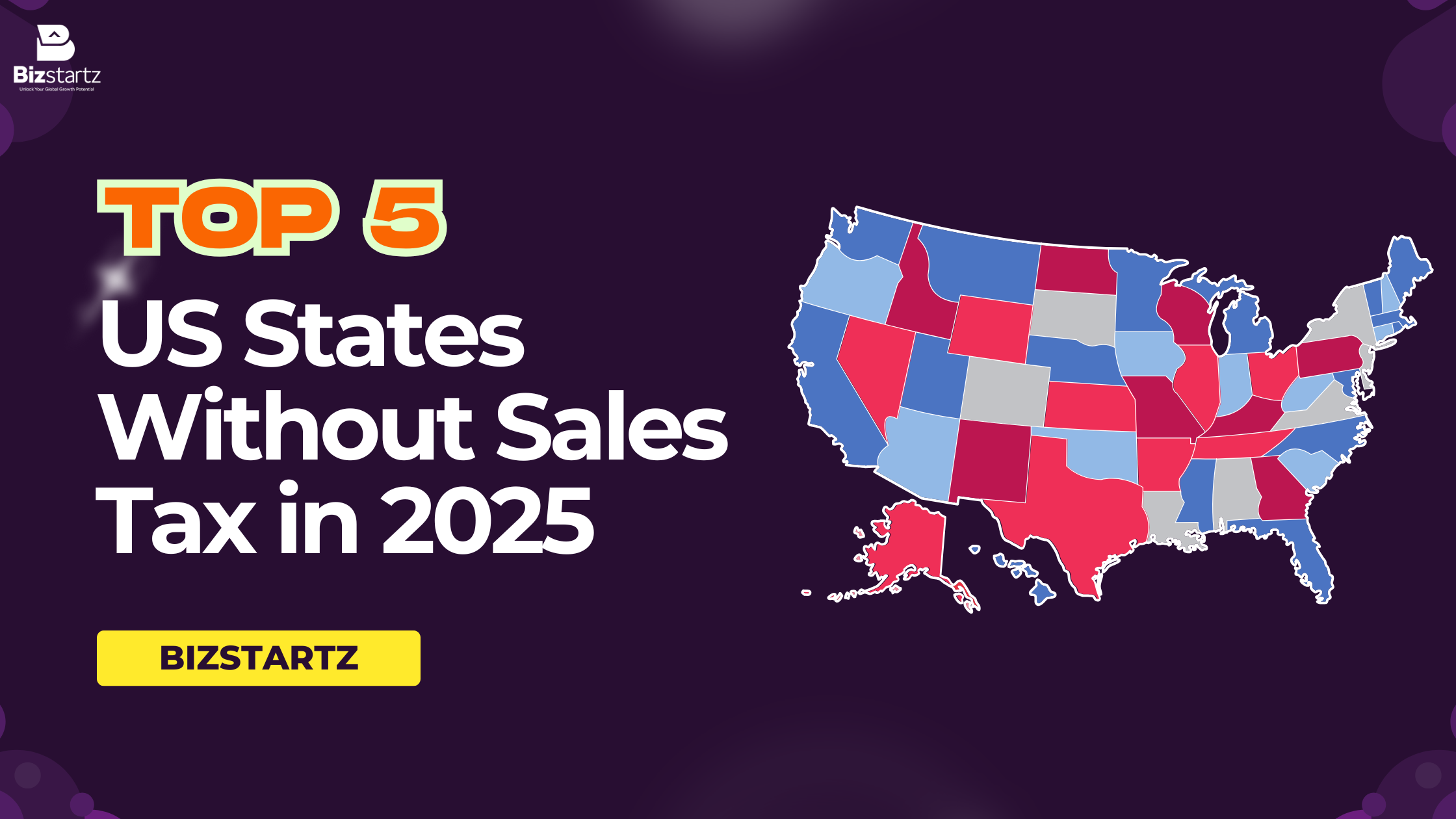
Sales tax is one of the basic forms of collecting revenue in the United States. While most states have both a State tax and Local tax on goods and services, there are five states that do not charge a state level sales tax in 2025.

These states are Alaska, Oregon, Montana, New Hampshire, and Delaware. These states offer various benefits to businesses and consumers.

If you are a shopper hoping to save money or an Entrepreneur picking a state for incorporation, knowing these states will help a lot.

🏔️ 1. Alaska

  • Statewide Sales Tax: ❌ None
  • Local Sales Tax: ✅ Yes, up to 7.5% depending on the municipality
  • Other Relevant Taxes: Excise taxes (fuel, alcohol, tobacco), hotel/lodging taxes

Overview

Alaska

Alaska, similar to Wyoming, is often considered a tax haven. While there is no state level sales tax, there are many boroughs and municipalities that enforce local sales taxes.

Around 89 jurisdictions in Alaska do so, with 1% to 7.5% rates.

Why It Matters

For consumers, certain areas in Alaska can feel like a tax-free zone whereas other areas still resemble a sales-tax state. Tourists can also encounter taxes related to lodging and alcohol in places that cater to tourists.

From a business perspective, Alaska may be appealing because the state has no income or sales tax. However, businesses operating in multiple jurisdictions face the challenge of local tax tracking which is often complicated and riddled with more variety than standardization seen in other regions.

Key Consideration

Businesses must take into consideration economic nexus. Selling into other states as a tax-free Alaska based company comes at the cost of having to collect and remit sales taxes.

💼 2. Delaware

  • Statewide Sales Tax: ❌ None
  • Local Sales Tax: ❌ None
  • Business Taxation: ✅ Gross Receipts Tax on business revenue

Overview

Delaware


Delaware enjoys the perk of having no state or local sales tax which makes it a shopper’s dream and a preferred state for business incorporation.

However, instead of traditional sales tax, the state imposes gross receipts tax on businesses which is essentially a tax on total sales revenue of a company regardless of whether it turns a profit or not.

Why It Matters

Purchasing goods in Delaware offers consumers tax-free purchases which is a big advantage for high-ticket items like electronics, vehicles, or jewelry. Many individuals from bordering states travel to Delaware specifically for tax-free shopping.

Delaware’s legal environment for businesses, ease of formation, strong privacy protections, and over 60% of Fortune 500 companies being incorporated there makes it very attractive for businesses.

Key Consideration

The lack of sales tax could be beneficial, but gross receipts tax could be a concerning factor for high revenue, low margin businesses such as wholesalers or retailers. Before incorporating or expanding to Delaware, it is important to understand how this tax will influence business operations.

🏞️ 3. Montana

  • Statewide Sales Tax: ❌ None
  • Local Sales Tax: ✅ Only in designated resort areas capped at 3%
  • Other Relevant Taxes: Income tax, property tax, fuel tax

Overview

Montana

Montana is one of the few states that do not have a general sales tax and does not plan on adopting one. However, certain resort towns that are frequented by tourists are allowed to charge a local option sales tax which ranges from 1% to 3% depending on the locality.

Why It Matters

For most residents and businesses, Montana has a retail environment that is truly tax-free. It is a great state for shoppers in the market for something big. Not having a sales tax minimizes the workload for local businesses as well.

However, tourists in areas like Whitefish or Big Sky may encounter resort taxes on lodging, prepared meals, or recreational activities.

Key Consideration

If you are a business located in or around a resort area, you will have to incorporate the resort sales tax into your pricing and reporting. For eCommerce businesses, selling from Montana does not exempt you from collecting taxes on out of state customers if economic nexus thresholds are reached in their states.

🗻 4. New Hampshire

  • Statewide Sales Tax: ❌ None
  • Local Sales Tax: ❌ None
  • Other Relevant Taxes:
    • 8.5% Meals & Rentals Tax
    • 5% Interest & Dividends Tax (phasing out)
    • Excise taxes on gasoline, tobacco, etc.

Overview

New Hampshire

New Hampshire takes pride in having no sales tax or income tax. This reputation has served as a lasting benefit for both shoppers and small business owners. However, the state does collect revenue through certain taxes like the Meals and Rentals Tax that applies to hotel and restaurant meals.

Why It Matters

Residents from Massachusetts and Maine frequently travel across the border to New Hampshire for tax-free shopping, making it an economic win for them. Retailers also have to pay lower total transaction costs.

New Hampshire is appealing to businesses because it has a straightforward tax system, although some service providers are burdened with collecting the Meals & Rentals Tax.

Key Consideration

New Hampshire’s no income and sales tax reputation is even bolstered by the fact that the 5% Interest & Dividends Tax is being phased out and will be eliminated by 2027. New Hampshire is still burdened with some industry specific taxes that can be quite high depending on the line of business.

🌲 5. Oregon

  • Statewide Sales Tax: ❌ None
  • Local Sales Tax: ❌ None (with very rare exceptions)
  • Other Relevant Taxes:
    • Corporate Activity Tax (CAT)
    • Excise taxes on fuel, alcohol, cannabis

Overview

Oregon

Oregon stands out for having no state or local sales tax, and voters have rejected attempts to implement one nine times. Instead, the state has to rely on income taxes and the newly introduced Corporate Activity Tax (CAT) from 2020.

Why It Matters

For major purchases, Oregon is a true retail paradise and has positioned itself as a shopping hub for tourists from neighboring states like Washington, which is one of the highest sales tax states in the country.

Businesses in Oregon no longer have to deal with the complex issues of sales tax collection, which greatly eases operations, particularly for smaller retailers and service providers. However, the Corporate Activity Tax applies to businesses with over $1 million in Oregon-sourced revenue and is charged a flat plus marginal rate.

Key Consideration

While retail shopping may be easier, the corporate retail tax remains a burden, as does the high state income tax.

🧾 Understanding the Broader Impact

✅ For Consumers

Lower Total Costs: Notably on high-value items such as electronics, appliances, and vehicles.

Shopping Tourism: People frequently travel to these states for the specific purpose of shopping tax free.

Budget Tracking: No hidden fees or surcharges, what you see is what you pay.

✅ For Businesses

Easier Compliance: No need to deal with confusing state sales tax regulations.

Competitive Pricing: Businesses are able to pass savings to customers or keep better margins.

Delaware and New Hampshire are especially attractive for legal and tax strategies regarding incorporation.

🚨 Main Warning Remarks

No sales tax doesn’t mean no taxes, gross receipts, excise, income, and other targeted taxes may apply.

Due to the economic nexus laws after the Wayfair decision in 2018, even businesses in these tax-free states might have to collect sales tax from customers in other states.

📊 Quick Comparison Table (Expanded)

State State Sales Tax Local Sales Tax Notable Additional Taxes Best For
Alaska No Yes (1%–7.5%) Excise, lodging, fuel Nature-focused businesses, remote work
Delaware No No Gross receipts tax Incorporation, holding companies
Montana No Yes (Resort-only) Resort tax, fuel tax Retail, outdoor recreation
New Hampshire No No Meals & rental tax, excise Border retail, ecommerce
Oregon No No Corporate Activity Tax, excise taxes Retail, high-margin businesses

✏️ Final Thoughts

Living, shopping, or doing business in one of the five states without a sales tax in 2025 can be helpful, but there are pros and cons to consider.

Consumers will have an easier time saving money during purchases and businesses will be able to operate more efficiently. However, these states still pay for services with gross receipts, income, and excise taxes.

Be it an individual contemplating a large purchase or a business owner planning key initiatives, grasping the complete tax landscape is important.

Blog CTA

❓ Frequently Asked Questions (FAQs)

1. Are these five states completely tax-free?

No, as these states do not have a sales tax, it doesn’t make them tax free. For instance:

  • Delaware has a gross receipts tax on businesses.
  • Alaska has local sales taxes and excise taxes.
  • Montana has resort-area taxes in certain tourist towns.
  • New Hampshire has meals and rental taxes.
  • Oregon has a Corporate Activity Tax on businesses.

Each state has its unique tax system to provide public services.

2. Can I shop from these states and not pay sales tax?

Not really. Most states have what is called an economic nexus tax. This was put in place after the Supreme Court ruling of Wayfair vs. South Dakota in 2018. This means:

  • For online sellers, it didn’t matter where the seller was located. They now have to collect taxes based on where the buyer lives.
  • Even if the seller is located in a tax-free state, like Oregon or Montana, if the buyer lives in a state that charges sales tax, then taxes will be charged.

3. Which state is best for incorporating a business if I want to avoid sales tax?

This answer varies, depending on your business model.

  • If you are looking for good legal protections along with flexible corporate laws, your best option will be Delaware.
  • New Hampshire and Oregon are great options for retail or service based businesses that operate locally.
  • Montana is great for people selling physical products or needing to register a vehicle.
  • Remote or resource based businesses may do well in Alaska, although it is very remote.

However, you must consider other factors like where your customers are, nexus limits, and income taxes.

4. Do tourists get any perks in these states for no sales tax?

Yes, but with some exceptions.

In these five states, tourists can shop and save a lot of money. But:

  • Some towns in Alaska and Montana have local or resort-area taxes.
  • In New Hampshire, meals and lodging are taxed at an 8.5% rate.
  • In Oregon, businesses might raise their prices due to the Corporate Activity Tax which means they could be using tax-free prices.

Tourists will still find these states very appealing when shopping for big items like electronics and jewelry.

5. What about these states in the future?

As of 2025, there is no serious legislative movement in any of these five states to implement a statewide sales tax. In fact:

  • Oregon voters have rejected sales tax proposals nine times.
  • New Hampshire’s political culture strongly opposes broad-based taxes.
  • Montana and Delaware have also consistently resisted sales tax measures.

It is possible that Oregon’s voters might change their minds in the future, but as of now, these states are unlikely to adopt a sales tax anytime soon.

How to Get a US Visa as a Startup Founder

For a long time, the United States has been the world leader for innovation and new businesses.

Founders from all corners of the world dream of establishing their companies in the U.S., starting from Silicon Valley to New York City because of its robust startup ecosystem, remarkable access to venture capital, a world-class talent pool, and an extensive consumer base.

However, one of the most vital and often baffling steps to launching operations in the U.S. is obtaining the right visa. Unlike other countries, the United States does not have a dedicated visa for solely entrepreneurs.

Starting from nationality to company structure, growth stage, investment, and personal background, there are several immigration options for startup founders.

In this detailed guide, we will discuss on getting a US visa as a startup founder, covering their requirements, advantages, disadvantages, and strategic tips to enhance your chances of success.

Why The Right Visa Is Critical For Founders

Before going through the types of visas, it is crucial to highlight the impact of choosing the wrong visa for foreign entrepreneurs:

  • Legal Permission to Work: Without a valid visa, you cannot legally work in the U.S, even in your own company.
  • Access to Funding: Investors often shy away from financing foreign founders who do not have a legal entity based in America.
  • Business Operations: With a visa, you are able to open a U.S. bank account, hire employees, sign contracts, and even lease office space.
  • Pathway to a Green Card: A few visa options may offer pathways to permanent residency, which can provide long-term security for you and your family.
  • Family Immigration: Some visas grant your spouse and children the ability to accompany you and also work or study in the U.S.

Rejections, delays, and even bans can result from choosing the wrong visa, incomplete documentation, or a combination of both. This is why a well-planned strategy is crucial.

Best U.S. Visa Options For Startup Founders

Startup Founder

Most sought and achievable visa pathways for international startup founders are as follows.

1. International Entrepreneur Parole (IEP)

Ideal For: Founders of early stage startups that have backing from a U.S. investor or government funding.

The International Entrepreneur Parole program enables foreign startup founders to come to the U.S. for mobility purposes through an immigration policy specifically designed for them. While it is not a formal visa, it operates as one and currently stands as one of the most favorable options for founders.

Eligibility Criteria:

  • You need to have at least a 10% ownership stake in a U.S. startup for it to qualify.
  • You must have formed the company in the last 5 years.
  • The company must demonstrate capability for scaling quickly and generating jobs.
  • The business must have received either:
    • At least $250,000 in investment from qualified U.S. investors, or
    • At least $100,000 in grants or awards from government entities at the federal, state, or local level.

Benefits:

  • No limits on annual submissions, nor a lottery system.
  • Immediate family members can accompany you.
  • Renewable for an additional two and a half years.

Challenges:

  • Does not grant visa or legal immigration status, only a form of entry called “parole.”
  • No direct path to permanent residency.
  • Requires extensive documentation for funding and traction.

2. O-1 Visa (Individuals with Extraordinary Ability)

Ideal For: Founders who are well-recognized and have achieved significant success in their field.

O-1 visa is reserved for people with exceptional talent in the sciences, business, education, or athletics. Its increasingly popular among startup founders who have achieved some significant milestones like getting venture funding or media coverage.

Eligibility Criteria:

You must demonstrate extraordinary ability by receiving at least three out of eight awards, such as:

  • Awards that are national or international.
  • Substantial media coverage.
  • Key executive or founder of a recognized venture.
  • Making important original contributions in their field.
  • Invited to judge other’s work in competitions or panels.
  • High salary or compensation.

Benefits:

  • Work in the U.S. for up to three years with no limit on extensions.
  • Work for your own company as long as it’s properly structured.
  • Green Card application is also accepted.

Challenges:

  • Requires strong documentation, letters of recommendation, evidence of acclaim.
  • High evidentiary threshold.
  • Your company acting as your sponsor can mean needing to prove an employer-employee relationship.

3. E-2 Visa (Treaty Investor Visa)

Ideal For: Founders from treaty countries wishing to actively manage a US startup.

E-2 visa enables citizens of treaty countries to enter and work in the U.S. for substantially investing in a business.

Eligibility Criteria:

  • Must be a citizen of a treaty country. Canada and the UK are eligible, but India is not.
  • Must invest a significant amount of money into a U.S. business – usually over $100,000.
  • You need to hold a minimum of 50% equity in the company and have operational control.
  • The business must be tangible, functioning, and not marginal (i.e., it should earn more than what is needed to sustain you and your family).

Benefits:

  • Short processing times.
  • Renewed indefinitely as long as business remains operational.
  • Spouse eligible to apply for a work permit.
  • Great for self-funded bootstrap founders.

Challenges:

  • Restricted to citizens from certain countries.
  • Requires verification of active investment and business proposal.
  • No direct route to Green Card, visa must be changed later on.

4. H-1B Visa (Specialty Occupation)

Ideal For: Technical or professionally experienced founders who wish to be employed by their own startup.

The H-1B visa is a well-known work visa issued to professionals in specialized industries such as IT, engineering, finance, and several others. Founders are able to self-sponsor through their startups, although this comes with additional compliance burdens.

Eligibility Criteria:

  • Must possess at least a bachelor’s degree or comparable experience in a specific area.
  • The job position must be associated with such degree.
  • You have to show an independent board or some other higher authority to prove the employer-employee relationship.

Benefits:

  • You have dual intent for Green Card application and are eligible to apply for one later.
  • Permits 6 years of total employment (first 3 years + an additional 3 year extension).
  • Ead permits spouses to study or work while on H-4 visa.

Challenges:

  • If not applying with a cap exempt entity, you will be subject to a random lottery system.
  • Founder-employment relationship documentation is extremely complicated.
  • The filing windows are limited to every April and must begin preparation months in advance.

5. L-1 Visa (Intra-Company Transfer)

Ideal For: Founders who operate a business outside the U.S. and wish to establish a branch in the country.

Multinational companies use the L-1 visa to transfer executives, managers, and specialized knowledge employees to the U.S.

Eligibility Criteria:

  • Must have worked continuously for the foreign company for one year within the last three years.
  • Must be assigned to an affiliate, branch, or subsidiary in the U.S.
  • There must be an existing U.S. entity or they should be setting up a new office.

Benefits:

  • Established founders and their spouses will greatly benefit through fast track processing.
  • Can lead to a Green Card under EB-1C category.
  • Dependents holding L-2 visas can accompany the principal holder and the spouses are allowed to work.

Difficulties:

  • Need evidence of actual business activities outside the country and detailed plans for expanding into the U.S.
  • New offices have a 1-year renewal grace period for showing growth.
  • Considerable paperwork, business plans, leases, lists of employees, etc.

How to Choose the Right Visa as a Founder

Choosing the right visa depends on several factors:

Factor Best Visa Options
You have U.S. investor funding IEP, O-1
You’re a recognized expert in your field O-1
You’re investing your own capital E-2
You’re expanding an existing company L-1
You want a work visa with dual intent H-1B, O-1
You’re from a treaty country E-2
You plan to eventually get a Green Card O-1, H-1B, L-1

Tips for a Successful Visa Application

Navigating the process of getting a visa for the U.S can be difficult. However, the following tips can boost your chances:

1. Hire an Immigration Attorney

Always seek professional help. An immigration attorney can create a roadmap for both the right visa to apply for, as well as collecting the documents needed for USCIS.

2. Incorporate a U.S. Entity First

Most visa types require a U.S. business to exist. With services like Bizstartz, you can register your U.S. LLC or C-Corp and also get an EIN, Registered Agent, and BOI filing.

3. Prepare a Strong Business Plan

Outline your product, target market, revenue model, hiring roadmap, and funding strategy. For E-2 and L-1 visas, this information is crucial.

4. Build Your Public Profile

To support the O-1 application, it is advantageous to hold deals, awards, speaking engagements, or media features that highlight your work and its impact.

5. Keep Clean Records

Make sure to have updated and organized financial statements, tax filings, cap tables, contracts, proof of investment, and company emails. The more accessible and orderly your documents are, the better.

Concluding Remarks

Even though the U.S. does not have a specific startup visa, there are many options for determined business owners who want to expand their business. Each visa option has its advantages and disadvantages, and the optimal selection is dependent on your current status, business model, funding, and long-term plans.

At Bizstartz, we help international entrepreneurs with company formation services in the USA, applying for EINs, compliance setup, and connecting them to other service providers like immigration lawyers.

Prepared to Start Operating in the U.S.?

Let us help you with taking the first step. We can assist you from the formation of LLC or C-Corp, obtaining an EIN and other issues.

👉 Start Your U.S. Company Today

Top 7 Best Stripe Alternatives in 2025

Stripe has been making life easier for accepting payments online for a long time. It’s famous for its easy to use APIs, quick onboarding, and supports subscription billing and international payments.

But it is not the ideal choice for everyone. Business owners may find Stripe’s documentation-heavy approach difficult to navigate. Account freezes, limited support for certain sectors, regions, or industries, and sparse customer service can all pose challenges for businesses.

With more and more impressive features like flexible pricing and better niche support, 2025 is shaping up to be a stronger year for competition against Stripe.

In this guide, we break down the Top 7 Best Stripe Alternatives in 2025, looking at everything from geography and use cases to pricing and integrations.

1. PayPal

Best for: Small businesses, freelancers and marketplaces.

Overview: PayPal started out as a simple peer-to-peer payment tool and has transformed into one of the largest online payment processors. Its wide acceptance, ease of use, and trust from millions makes it easy for consumers around the globe to use PayPal.

PayPal can act as a payment processor, invoicing platform, and checkout system all at once due to its wide range of business tools.

Why Consider It Over Stripe: With PayPal, the setup process is usually faster and less complicated because it doesn’t need a lot of developer work to start accepting payments. It does tend to be more forgiving with some high-risk sectors, and the buyer and seller protection features are helpful if disputes come up.

Key Features:

  • Receive funds through PayPal, credit cards, Venmo, or Pay Later.
  • Transfers to bank accounts are instant (in supported regions).
  • All-in-one invoicing.
  • Integration with Shopify, WooCommerce, and thousands of other shopping carts and platforms.

Pros:

  • Recognized brand with good user trust.
  • Quick and easy to set up.
  • Decent coverage in most countries.

Cons:

  • Higher fees for transactions involving cross-border or currency conversion.
  • Less flexibility to tailor the system to your needs compared to other more developer-focused systems.
  • Some accounts may be suspended in high-risk situations, causing sudden account freezes.

2. Square

Best for: Physical stores like retail shops, resturants, and other service providers.

Overview: Square is recognized as one of the largest in-person payment processors. They offer popular sleek hardware as well as Point of Sale (POS) software that doesn’t charge a monthly fee. This makes Square ideal for hybrid businesses operating online and offline.

They also offer additional services like staff management, appointment booking, and comprehensive sales reporting.

Why Think About It Instead of Stripe: If you have a business that is primarily offline or does a mix of in-person and online sales, Square has a stronger ecosystem than Stripe. It serves as an all-in-one solution for business management, instead of just a payment processor.

Key Features:

  • Free POS app and a simplified business overview.
  • E-commerce integrated sales features.
  • Customer engagement tools and loyalty programs, including gift cards.
  • Bank deposits with zero friction and reporting in real-time.

Pros:

  • Very straightforward and easy to use.
  • Great for individual entrepreneurs and small businesses.
  • No setup fees or long-term contracts.

Cons:

  • Mostly supported in the US, Canada, Australia, the UK, and Japan (limited international support).
  • Not suitable for high volume purely online or digital businesses.

3. Adyen

Best for: Global e-commerce, enterprise solutions, and large-scale businesses.

Overview: Used by some of the world’s largest companies, Uber, Spotify, and Microsoft, Adyen is a global payments platform.

It offers fully integrated payment processing for every channel a sale occurs; online, in-app, or in-store, and provides unified commerce optimization. Businesses that need to grow internationally will benefit the most from Adyen due to its extensive customization options and global acquiring capabilities.

Why Adyen Is Better Than Stripe: Adyen allows companies to use one payment provider across different regions, enabling businesses to streamline operations.

For fast-growing companies, Adyen’s fraud detection, support for local payment methods, and clear pricing structure make it a better option than Stripe.

Main Features:

  • Over 150 currencies can be paid in.
  • Risk management and fraud controls built in.
  • Real-time analytics and reporting.
  • Cards, wallets, bank transfers and local payment methods supported.

Pros:

  • Business specific needs can be adjusted significantly.
  • Outstanding coverage for doing business internationally.
  • Complete support for compliance and security requirements.

Cons:

  • Need technical assistance for setup.
  • Better for high volume transactions.
  • Setup may take longer than average.

4. Wise (formerly TransferWise)

Best For: International freelancers, global businesses, and remote teams

Overview: Wise is not a traditional competitor to stripe, and stripe does not compete with wise, but wise is a powerful tool for facilitating cross border payments.

Freelancers, contractors, and businesses that operate internationally require services that help them send and receive payments easily and without exorbitant conversion costs. Wise meets these needs with its low fee structure and transparent exchange rates.

Why Consider It Over Stripe: For certain regions, Stripe’s international payouts can take a long time and come with high fees. Wise has a better approach for handling multi-currency payments and global banking.

Key Features:

  • Charges the real exchange rate (no markup).
  • Get multi-currency accounts to obtain local bank details in USD, EUR, GBP, and others.
  • Business accounts with batch payment as well as expense tracking features.
  • Direct integration with accounting tools like Xero.

Pros:

  • Low fees and fast transfers.
  • Transparent pricing.
  • Great for global payroll and supplier payments.

Cons:

  • Lack of support for credit card processing or payment gateways.
  • Inappropriate for e-commerce checkout.

5. Braintree (A PayPal Company)

Best for: SaaS, mobile apps, and recurring billing

Overview: Braintree provides advanced payment solutions for businesses that require more than what PayPal offers. It is designed specifically for subscription services, mobile applications, and platforms needing multi-currency payment processing.

Why Consider It Over Stripe: Provides wider native support for digital wallets and advanced features like smart fraud prevention, secure tokenization, and customer vaults.

Key Features:

  • Payments via cards, PayPal, Venmo, Apple Pay, and Google Pay are accepted.
  • Global currencies and local payment methods are supported.
  • Recurring billing and a customer vault for subscription-based businesses.
  • Strong developer documentation and SDKs.

Pros:

  • Ideal for mobile and subscription-focused businesses.
  • PayPal’s infrastructure backs them.
  • Compliant with PCI DSS and has strong fraud prevention tools.

Cons:

  • Somewhat harder to integrate than Stripe.
  • May need additional developer resources.

6. Razorpay

Ideal Users: Startups in India, SaaS Companies, and online merchants.

Overview: Razorpay, one of India’s leading payment gateways, equips businesses with comprehensive tools for payment processing, subscriptions, automation, and capital. It supports more than 100 payment methods which makes it easier for Startups and digital businesses to thrive in India.

Why Consider It Over Stripe: Stripe’s services in India are still rudimentary. Razorpay’s extensive integration with UPI, local wallets, and Indian banking makes it a more useful option for businesses within the country.

Key Features:

  • UPI, credit/debit card, EMI, net banking, and wallet payments accepted.
  • Instant settlements alongside split payments and route APIs.
  • Subscription management with auto-renew.
  • Integrations including Shopify and WooCommerce.

Pros:

  • Designed specifically for Indian companies.
  • Advanced financial tools alongside a comprehensive dashboard.
  • Streamlined onboarding for startups.

Cons:

  • Currently only available in India.
  • Customer support tends to be less responsive during busy times.

7. Authorize.Net (A Visa Solution)

Best for: Nonprofits and B2B businesses, established companies

Overview: Authorize.net is an older payment processing system with many years of experience. It is great for conventional businesses that need consistent service, fraud protection, and recurring billing. Its acceptance of ACH, eChecks, and credit cards makes it great for B2B and nonprofit organizations.

Why Consider It Over Stripe: For businesses with older systems or complex billing needs, Authorize.Net is the best option since it provides ACH payment support and recurring billing that is more flexible than Stripe.

Key Features:

  • Automatic billing and invoicing.
  • Fraud detection and address verification tools.
  • Virtual terminal for manual entries.
  • PCI DSS compliance and secure data handling.

Pros:

  • Trusted brand with extensive track record.
  • Strong support for online and offline payments.
  • Excellent fraud detection tools.

Cons:

  • Monthly gateway fees and setup charges.
  • Outdated UI compared to modern platforms.

Final Thoughts: Which Stripe Alternative Is Right for You?

The best Stripe alternative ultimately depends on your specific needs, whether it’s global payouts, in-person sales, recurring billing, or high-risk industry support. Here’s a quick comparison to help you decide:

Platform Best For Unique Benefit
PayPal Freelancers & marketplaces Fast setup and global reach
Square Local retailers and service providers In-person + online commerce integration
Adyen Enterprises & global brands Unified global payments & fraud tools
Wise Global freelancers & remote teams Low-cost international transfers
Braintree SaaS & mobile apps Advanced developer tools & wallet support
Razorpay Indian startups Localized payment support with instant payouts
Authorize.Net B2B & traditional businesses ACH & invoicing with legacy support

Choosing the right payment processor is more than just comparing fees, it’s about finding a solution that aligns with your business model, geographic footprint, and long-term goals.

Need Help Picking the Right Payment Gateway?

At Bizstartz, we assist entrepreneurs from all over the world establish US companies, open bank accounts, set up Stripe accounts, and even PayPal, Adyen, and more. If you’re lost choosing the right platform, our experts can guide you step by step through the process.

👉 Reach out to us today and take your payment processing to the next level in 2025 and the years to come!

Can an International Student Start a Business in the USA

As we know, the US is a well-known center for entrepreneurs and innovation. There’s a good reason why many international students feel inspired to start new businesses or ventures during their studies.

But this leads to many questions such as: Is it legal for an international student on an F-1 visa to start a business in the US?

The situation is a little tricky. International students can create a business entity within the United States, however, their engagement in the business activities will be based on their visa situation and work permit eligibility.

This is a comprehensive guide to all the legal, structural, and practical steps that a international student must take to start a business in the USA in a legal and successful way.

Understanding Limitations of a Visa

Most international students in the U.S. hold an F-1 Student Visa which is a non-immigrant visa given for full-time academic study. The primary purpose of this visa is education, not work, activity or business.

✅ What You Can Do on An F-1 Visa:

  • Form a business entity such as an LLC or Corporation in the US.
  • Hold shares or equity in a US company.
  • Earn passive income through channels like dividends or profit distributions.
  • Appoint US managers or employees to run the business on your behalf.
  • Keep your status as an investor or silent partner as long as you don’t participate in the daily operations or decision making while on F-1 status.

❌ What You Cannot Do:

  • Work for your own company even if it is unpaid, do not volunteer your services.
  • Oversee the business operations, make decisions, act on behalf of the company in any transactions like signing documents or dealing with clients.
  • Help run your business (such as through designing, advertising, or software development) without the correct employment permission.
  • Breach your visa regulations (terms of stay) which may result in removal from the country or problems applying for visas in the future.

Why It Matters:

U.S. immigration law has a problem with people abusing the system. They do not allow any form of work, even volunteering to help run the company, without approval via an appropriate visa.

If you attempt to assist your company while on an F-1 visa, you will likely face severe consequences, such as deportation or a permanent ban from re-entering the country.

How to Legally Form a U.S. Business as a Student

International Student in the USA

Despite your visa status limiting your involvement, ownership is not restricted. You can incorporate a company in America as a foreigner, even as a student.

Most Common Company Types:

📌 LLC (Limited Liability Company)

  • This is the simplest and most adaptable form of a business for new companies.
  • Can be listed as single-member or multi-member LLC.
  • Does not incur a corporate tax.
  • Ideal for passive owners.

📌 C Corporation

  • A company that is taxed on profits at the corporate level.
  • Ideal for businesses seeking venture capital or angel investment.
  • Mandatory for share issuance and onboarding investors.

📌 Why Choose Delaware or Wyoming?

  • Delaware is famous for startups because of its strong corporate laws and the preference of investors.
  • Wyoming is best known for privacy, low maintenance fees, and low cost of doing business.
  • Bizstartz uses your goals to determine the best state to set up your business.

What You’ll Need to Start:

  • A Valid Passport
  • Business address in the US or a registered agent (we provide this)
  • Company name and business structure
  • EIN
  • Operating Agreement or Corporate Bylaws
  • Physical US address or a virtual office (not required but recommended)

Important: No SSN is required to form a company or get an EIN. Business Start USA takes care of EIN issuance for non-residents which is fast and hassle-free.

Work Authorization: How to Legally Engage with Your Business

If you want to transform your idea into a startup and want to get your hands dirty, you will need work authorization from USCIS. Here are some options:

🔸Curricular Practical Training (CPT)

  • This option is open to F-1 students who are pursuing a degree.
  • This must be related to your coursework in some way.
  • Can be full-time or part-time.
  • Some universities permit CPT for entrepreneurs provided that their business aligns with their field of study (for instance, Business or Computer Science).

✅ Example: If you are pursuing a degree in Business Administration and create a marketing platform, your university may provide CPT for you to intern at your startup.

🔸Optional Practical Training (OPT)

  • Applicable for up to 12 months following program completion.
  • STEM graduates are eligible for a 24-month extension.
  • You may work for your own company as long as the position is relevant to your area of study.

✅ Example: A Computer Science graduate can work at a tech startup they founded, as long as it is compliant with his degree and OPT regulations.

🔸H-1B Visa Sponsorship

  • Your business is allowed to sponsor you for an H-1B provided it has an adequate corporate structure.
  • You have to prove that there is supervision of some sort over you, by a board for example, to show that there is an employer-employee relationship.
  • H-1B is a lottery-based visa with strict eligibility and filing requirements.

🔸 Other Options

  • O-1 Visa: For individuals with extraordinary ability in their field.
  • International Entrepreneur Parole (IEP): A temporary stay for founders of startups with high-potential ventures.
  • Change of Status: A modification to a different visa type such as F-1 to E-2 investor visa with adequate preparations.

Funding and Banking for Your Business

Legally starting a business is not the only thing that matters. You need to be able to receive payments and need capital for your business.

💳 Applying for a Business Bank Account in The U.S

  • A US address, business documents, and EIN are required.
  • Some banks may require an ITIN or in-person visit, while others allow remote account opening.
  • Bizstartz works with fin-tech banks that do not require SSN or US residency for international founders to open accounts.

💰 Raising Capital

International students are legally able to receive investments or loans for their business.

You can gather funds from:

  • Family and friends
  • Angel investors and venture capitalists
  • University startups and incubators, as well as business accelerators

📉 Common Mistakes to Avoid

  • Combining personal finances with business expenses
  • Using a personal account for business dealings
  • Receiving payment for work done while on an F-1 visa (without proper authorization)

Compliance: Safeguard Your Status and Your Business

Keeping immigration and tax obligations in check are vital for staying in business. Here are some major rules:

🛡️ Immigration Compliance

  • Always ask your DSO (Designated School Official) before starting or engaging in any business activity for your school.
  • Refrain from volunteering or working for free without knowing your visa restrictions.
  • Maintain documentation of applicable work permission and your job title.

🧾 Tax Compliance

  • Complete federal and state filings annually for your business.
  • FinCEN may require you to file a Beneficial Ownership Information (BOI) report.
  • If you don’t possess an SSN, you can apply for an ITIN to file personal taxes.
  • With tax consultancy and BOI filing, Bizstartz helps keep your business compliant.

Final Thoughts: International Students, Yes, You Can Start a Business in the USA

Although there are some restrictions, international students are allowed to start and own a business in the United States. It is critical to know what is permitted under your visa, what work authorization might be necessary, if any, and how to keep your business compliant.

Becoming an entrepreneur as an international student not only can be done, but it can also pave the way toward a future brimming with innovation, impact, and untold opportunities.

Blog CTA

Start Your U.S. Business with Bizstartz

At Bizstartz, we assist international students and global entrepreneurs with:

  • Forming LLCs or Corporations in all 50 states
  • Obtaining EINs and ITINs with or without an SSN
  • Providing Registered Agent and BOI filing
  • Setting up U.S. business bank accounts remotely
  • Explaining visa and compliance issues

👉 Are you ready to properly set up your U.S. business?

We offer hassle-free, rapid, and fully compliant services at Bizstartz, so go ahead and get started today.

5 LLC Tax Benefits in 2025

Limited Liability Companies, or LLCs, keep winning the popularity contest among American business owners, and 2025 is no exception. The structure blends solid legal protection with a tax setup that feels less like a math problem and more like common sense.

Freelancers piecing together side hustles, investors juggling several projects, and even foreign entrepreneurs eyeing the U.S. market all find something useful in an LLC. Knowing how the tax rules fit into the picture can save headaches down the road.

How Are LLCs Taxed?

At its core, an LLC talks to the IRS as though it simply borrowed a partnerships one-word summary: pass-through. The company itself never settles up on income tax; the dollars, whether gains or losses, slide right onto the members personal returns.

Single-Member LLCs end up as what accountants call a disregarded entity. The sole owner tacks income and related costs onto Schedule C of Form 1040 and moves on with life unless a corporate tax status is chosen.

Multi-Member LLCs flip the script and default to partnership treatment. The entity files Form 1065 for the files-as-a-team crowd and hands out K-1s so each member can plug their slice into its own return.

Every owner slides the Schedule K-1 figures right onto their personal income tax form and that number becomes part of their financial story for the year.

Electing Corporate Tax Treatment

A single LLC can be dressed up for taxes in different outfits.

S Corporation: The owners pay themselves what the IRS calls a reasonable salary, drop any leftover profits into dividend baskets, and poof-the dividends slip out from under self-employment tax.

C Corporation: The business turns into its own tax-paying creature, facing a straight-line 21% bite (2025 and beyond). When cash finally flows back to owners as dividends, it gets taxed a second time at the shareholder level.

That wardrobe change is something plain vanilla corporations cant pull off without jumping through extra hoops.

✅ Pro Tip: Slap IRS Form 2553 onto the desk to ask for S-Corp treatment, or ship Form 8832 if you want the C-Corp look. Either move resets the tax clock.

LLC Tax Benefits for Foreigners

TAX Benefits

People living outside U.S. borders still praise the LLC because it writes them a passport into Americas business playground while avoiding many double-tax pinches.

Four reasons foreigners keep circling back to U.S. LLCs in 2025:

No U.S. Taxes on Foreign-Sourced Income

Picture this: a digital artist in Berlin opens an American LLC that sells e-books to clients in Europe and Asia. Because the business never steps foot on U.S. soil-no office, no employees, not even a Postal Service mailbox-the federal tax man looks the other way. The revenue flows in, the tax bill stays at zero, and the owner pockets the full amount.

Simplified Ownership

U.S. paperwork lets a non-American own the whole pie and never asks for a Green Card or passport. That ease of entry makes the LLC roof both roomy and inviting.

Limited Liability Protection

If the digital shop accidentally zips out a defective product and winds up in court, the owner’s personal stash-homes, cars, even that rare baseball card collection-stays under lock and key. The LLC draws a line between business troubles and private assets, and that firewall works for owners living a continent away.

Compliance is Required-But Manageable

Foreign-owned Single-Member LLCs must file:

Form 5472 (Foreign-Owned U.S. Disregarded Entity)

Pro forma Form 1120

Failure to file can result in penalties of $25,000 or more, so staying compliant is crucial.

Attractive for E-commerce & SaaS

Many global Amazon sellers, Shopify entrepreneurs, and SaaS founders form U.S. LLCs to:

  • Access U.S. payment gateways like Stripe and PayPal
  • Establish U.S. bank accounts and credit cards
  • Improve credibility with international clients and vendors

⚠️ Note: Depending on your home country’s tax treaties with the U.S., you might still be liable for taxes in your country of residence.

5 LLC Tax Benefits

Here are five tax advantages U.S. tax pros never stop mentioning, especially as 2025 rolls in.

1. Pass-Through Taxation: (No Double Taxation)

Run a classic C-corporation and profits take a two-step whack: once at the company level and again when dividends hit your pocket. An LLC skips that dance. Earnings simply slide through to you, once bitten, never shy.

Example:

C-corps face a flat 21% federal chop, no debate. If you pocket $100,000 after payrolls, first Uncle Sam grabs $21,000 and the rest might get nabbed again during April’s tax day.

2. Qualified Business Income (QBI) Deduction

Thanks to the Tax Cuts and Jobs Act, owners of pass-through companies, including most LLCs, can knock up to 20% off their taxable income. In 2025-persistent tax code math-still no need to calculate that by hand.

Key Details:

  • Available to owners of pass-through businesses (sole proprietors, partnerships, and S-corps).
  • Income limits apply, but the deduction can significantly lower the effective tax rate.
  • For joint filers in 2025, the threshold is approximately $364,200 (indexed for inflation).

Example:

If your LLC earns $100,000 in qualified income, you may be able to deduct $20,000, reducing your taxable income to $80,000.

3. S-Corp Election to Shrink Self-Employment Tax

LLC owners can elect to be taxed as an S Corporation, which allows them to:

  • Pay themselves a reasonable salary (subject to payroll taxes)
  • Take additional income as distributions, which are not subject to self-employment tax

This strategy is best for LLCs making $75,000+ annually, as it helps reduce the 15.3% self-employment tax.

Example:
An LLC owner earns $100,000. If they take $60,000 as salary and $40,000 as distribution, they pay employment tax only on the salary portion—saving over $6,000 annually.

4. Electing C-Corporation Tax Status

Most people like the simple pass-through tax picture, yet an LLC can swap to C-Corp treatment anytime. The upside?

  • A steady, no-nonsense 21% corporate tax rate.
  • Profits can sit in the company for future projects instead of vanishing into owner pockets.
  • Money bosses in venture capital circles trust C-corps more, so funding moves a lot faster.

Who really digs this option?

Fast-growing startups that want every dollar to fuel growth and aren’t ready to hand out checks to owners.

5. Estate Planning Made Easier

LLCs can be structured as family-owned entities, allowing you to:

  • Transfer ownership interests to heirs gradually over time
  • Use the lifetime gift tax exemption ($13.61 million per person in 2025)
  • Retain control over the business through voting rights, even as you transfer non-voting shares

Why it matters:

Once the 2026 deadline hits, the exemption will chop in half. Anyone with wealth they care about must act well before the midnight bell. It’ll be taxes first, bedtime stories later.

Final Thoughts

Plenty of small-business owners still love the limited-liability company, even in 2025. Its blend of legal cover, simple upkeep, and smart tax treatment keeps people coming back. Whether you live in America or run a firm from halfway around the world, an LLC usually beats any other starter structure.

✅ Summary of LLC Tax Benefits:

Tax Benefit Description
Pass-through taxation Avoid double taxation, profits flow to your personal return
QBI deduction Deduct up to 20% of qualified business income
S-Corp election Reduce self-employment taxes through distributions
C-Corp election Use flat 21% tax rate and retain earnings
Estate planning Transfer ownership to heirs while maintaining control

How Bizstartz Can Help

Bizstartz is built for founders who want all those perks without the guesswork. We file LLC papers in every U.S. state and handle all the busy work after that.

Our lineup includes:

  • EIN and ITIN applications
  • An on-duty registered agent
  • BOI reports, which are required throughout 2024 and 2025
  • Opening doors to U.S. banks that welcome new companies
  • Year-round bookkeeping and tax compliance
  • Trademark filings and a few extra services people often need

Pick us to set up your U.S. LLC, and well walk you through the tax moves that fit your plans.

Blog CTA

What is a Sole Proprietorship?

Many people who decided to try running their own company for the first time wont waste time and money on complicated setups. A sole proprietorship is, by design, the simplest and least expensive way to begin; almost anyone in the United States can start one by opening a bank account and keeping track of sales.

In this comprehensive guide, we’ll explain what a sole proprietorship is, how it works, the advantages and disadvantages of choosing this model, and step-by-step instructions on how to set one up. 

Whether you’re launching a freelance career, selling products online, or starting a local service business, understanding the ins and outs of a sole proprietorship can help you make an informed decision.

What is a Sole Proprietorship?

A sole proprietorship is a type of unincorporated business that is owned and operated by a single individual. It is not a separate legal entity like a corporation or a limited liability company (LLC). Instead, the business and the owner are legally considered the same person. 

This means the owner receives all profits but is also personally responsible for all debts and liabilities incurred by the business.

Sole proprietorships are the most common form of business structure in the U.S., especially among freelancers, consultants, gig workers, online sellers, and service-based entrepreneurs. It offers a straightforward path to entrepreneurship with minimal red tape.

Since there’s no legal separation between the owner and the business, all business income, losses, and taxes flow directly to the owner’s personal tax return. This is known as pass-through taxation, and it simplifies tax filing compared to more complex business entities.

Key Features of a Sole Proprietorship

1. Single Ownership

Controls entirely with one person, who decides, hires, spends, and occasionally panics solo. No silent investors or boardroom ballots slow things down-or speed them up, depending on your outlook.

2. No Legal Separation

Courts and statute books treat the business and its founder as twins without separate birth certificates. That unity turns convenient during tax season but exposes personal assets to creditors, vendors, or the occasional lawsuit that spills over the counter.

3. Pass-Through Taxation

Net earnings from a sole proprietorship appear on the owner’s Form 1040, Schedule C, so no separate business return shows up in the IRS queue. This one-line pass-through system can feel tidy, yet the profits absorb whatever rate the taxpayer already pays on wages or interest income.

4. Ease of Setup

Launching a sole proprietorship takes minutes rather than weeks. Most jurisdictions ask nothing more than a local business license unless a distinctive trade name is used, in which case a quick DBA filing covers the naming requirement.

5. Low Start-Up Costs

There are no state incorporation fees, no annual franchise taxes, and certainly no board minutes to generate. A city permit or a modest bond may still be required, yet even those charges usually total far less than the smallest legal retainer.

Pros and Cons of a Sole Proprietorship

Sole Proprietorship

Every form of business organization carries its own steel and soft spots. A sole proprietor wakes up, hangs out a shingle, and is instantly the chief, counsel, and janitor of that entity, which is liberating and confining at once.

Pros

✔️ Simplicity and Ease of Formation

Simplicity reigns. No formation paperwork means same-day approvals for anyone willing to open a bank account and start invoicing.

✔️ Full Control

Absolute ownership confers unilateral decision-making authority, meaning no boards, no partners, and no dilatory approval chains. An entrepreneur can pivot overnight without a sacrificial meeting agenda.

✔️ Tax Advantages

Sole proprietorship income is reported on the owner-s individual return, neatly sidestepping the double-taxation trap that ensnares C corporations. One tax bill rather than two is always a welcome arithmetic shortcut.

✔️ Minimal Paperwork

Lack of mandated annual reports, board minutes, or state-level compliance drudgery means fewer late nights hunched over filing software. The time saved, however unscientific, can feel like extra breathing room for strategic thinking.

✔️ Flexibility

A founding solo operator can quietly swap the business line into an LLC, S Corp, or even a C Corp as growth dictates, usually with no statutory prescript compelling any specific order. The structure is a moving target as long as owners notify the IRS and applicable state agencies.

⚠️ Cons

Unlimited Personal Liability

Creditors and litigants see you, not an abstract corporate veil, whenever money is owed, and that direct line often includes non-business assets. Your home, personal savings, or next-years-minivan become equity in the judgment ledger the moment a suit drumroll begins.

Difficulty in Raising Capital

Pledging a chunk of personal equity is easy in theory, harder in practice, yet venture checks are usually inked on a stock certificate. Lenders also squint at schedules C and see a single signature tethered to everything the bank might ever need to seize.

Limited Business Continuity

A sole proprietorship ceases to function the instant its owner dies or voluntarily withdraws, creating a hard stop for financial, legal, and operational matters. Because no pre-built chain of succession exists, heirs often scramble to make sense of what survives, and estate-planning lawyers may be called in at the last minute.

Credibility Issues

Vendors, lenders, and even casual customers sometimes peg sole props as the risky cousin of LLCs or corporations, which can color their willingness to commit resources. That perception lingers even when the on-paper numbers are solid, and it may take extra pitches to overcome the mental hurdle.

How to Start a Sole Proprietorship in the U.S.

Opening a sole proprietorship is one of the quickest ways to jump into business. Still, you don’t want to skip the basics or end up in the tax mans crosshairs.

1. Pick a Business Name

You can operate your business under your legal name (e.g., “Maria Lopez”) or select a trade name that better reflects your services (e.g., “Maria’s Marketing Solutions”). 

Selecting something other than your legal name usually means filing a DBA (Doing Business As). In many places, people still call it a fictitious name, so don’t let that jargon throw you.

Before you settle on anything:

  • Search your states official database to see if another business is already using it.
  • Run a quick domain check because a .com that matches your name is worth grabbing.
  • Peek at the U.S. Patent and Trademark Office to dodge any future headaches.

2. Register Your DBA (If Using a Trade Name)

In most states, if you’re not using your full legal name, you must register your trade name (DBA) with a county clerk or your state’s business office. 

This registration doesn’t provide legal protection like a trademark or LLC but is necessary for legal and tax purposes.

Some states require publishing a notice in a local newspaper to complete the DBA process.

3. Obtain Necessary Business Licenses and Permits

Even though sole proprietorships don’t require state registration, you may still need to obtain:

  • General business license for operating legally in your city or county.
  • Zoning permits for a physical location.
  • Sales tax permits if you’re selling products.
  • Professional licenses if your business falls under a regulated industry (e.g., real estate, cosmetology, legal advice, healthcare, etc.).

Each city and state has its own requirements, so it’s best to check with your local government or a trusted service provider like Bizstartz.

4. Apply for an EIN (Employer Identification Number)

As a sole proprietor, you’re not required to have an EIN unless you:

  • Have employees
  • Operate as a retirement plan administrator
  • File excise tax returns

However, having an EIN is a smart idea for separating your personal and business identities. It’s free and easy to get from the IRS and is often required to:

  • Open a business bank account
  • Apply for business credit
  • Work with certain vendors and platforms

5. Open a Business Bank Account

Keeping your business and personal finances separate is essential for accurate accounting and tax filing. A business bank account also helps present a more professional image to clients and vendors.

You’ll usually need:

  • Your EIN or SSN
  • A DBA certificate (if applicable)
  • Proof of business address

Bizstartz can help you open a U.S. business bank account remotely, even if you’re a non-resident.

6. Set Up Accounting and Record-Keeping

Maintaining clear financial records is crucial for monitoring your business performance and preparing for tax season. At minimum, track:

  • Revenue and expenses
  • Receipts and invoices
  • Mileage logs (if using a vehicle)
  • Home office expenses

Consider using accounting software like QuickBooks or Wave, or outsourcing your bookkeeping to professionals.

Tax Responsibilities of a Sole Proprietor

Operating as a sole proprietor offers an appealing degree of simplicity at tax time, yet several obligations follow the independence.

Income Tax: The full stream of revenue-profiteer or loss-must be logged on Schedule C and filed alongside the familiar Form 1040.

Self-Employment Tax: Social Security and Medicare premiums-totaling roughly 15.3 percent-cling to the owners bottom line and are calculated via Schedule SE.

Estimated Taxes: If the Internal Revenue Service anticipates a $1,000 liability or greater, the taxpayer is obliged to mail quarterly vouchers lest underpayment penalties accrue.

State and Local Taxes: Jurisdictions beyond Washington may impose sales levies, franchise fees, gross receipts, or their own fiscal tolls.

Consultation with a seasoned accountant or a dedicated filing outfit such as Bizstartz can shield the owner from late surprises and slip-ups.

When Should You Move Beyond a Sole Proprietorship?

A pair of sneakers launch well from a backyard stand, yet growth that strains capacity or invites liability may warrant a shift to an S-corporation, LLC, or other more protective framework.

Switching to a limited-liability company or a corporate charter may warrant consideration when several markers arise:

  • A steady uptick in earnings spurs the instinct to protect personal assets from judgment.
  • Outside investors or equity partners view a formal entity as an admission ticket.
  • Stakeholders-trading customers, lenders, even curious suppliers-often read substance into a suffix such as Inc. or LLC.
  • Employees expect payroll schedules backed by an underpinning structure, not a casual side gig.
  • Courts and registries are wired to defend whatever name an Article of Organization or Corporate Charter enshrines.

An LLC fuses liability insulation with pass-through earnings treatment; a corporation ratchets up formalities and opens the door to public-share sales.

Formation shops such as Bizstartz can navigate the paperwork maze: Articles, EIN, BOI filings, and initial banking relationships.

Blog CTA

Final Thoughts.

The sole proprietorship remains the low-friction entry point for nearly every freelancer or weekend creator, inviting minimal paperwork and no filing fees.

That convenience unravels the moment a client sues or a vendor demands payment, since owners ordinarily stake their personal fortune on business claims.

Bizstartz focuses exclusively on non-resident founders who intend to launch U.S. companies. New entrepreneurs, seasoned executives, and everyone in between find tailored road maps that span formation, compliance, and growth.

Ready to launch your business?

👉 Get in touch with Bizstartz and let us help you start your sole proprietorship or form an LLC today.

10 Benefits of Forming an LLC in the US

It’s clear that forming a business in the United States comes with a plethora of opportunities, both as a legal citizen of the country or even as a foreign national. The United States has the most developed consumer market, provides a multitude of legal seals of protection, supplies capital, all which serves as a foundation for creating and expanding a business.

United States possesses many forms of business structures, of which the most common is Limited Liability Company or LLC. There are a multitude of operational, tax related, and legal benefits of forming an LLC which together make it the most suitable option for startups and businesses that are looking for growth.

In this article, we will discuss the concept of an LLC, summarize its 10 benefits of forming an LLC in the US.

What Is an LLC?

In essence, an LLC is a type of legal business organization that marries together the liability shield of a corporation with tax benefits of a sole proprietorship or a partnership, which are easier to manage. This means that, you as an individual, do not lose your personal valuables, but at the same time, running the business remains simple.

Unlike corporations, LLCs do not require extensive record keeping, formal operating agreements, or annual meetings. At the same time, they provide robust personal liability protection for lawsuits, debts, and other legal issues concerning the business.

Want to save money and pay as little tax as possible? LLCs also have a lot of flexibility when it comes to taxation. In its default state, an LLC is a pass-through entity, which means profits and losses are passed to the owners and declared via personal tax returns.

To benefit from certain tax strategies, however, LLCs can also choose to be taxed as an S Corporation or C Corporation.

LLCs are perfect for online entrepreneurs, international founders wishing to do business in the United States, freelancers, and small business owners.

10 Key Benefits of Forming an LLC

1. Limited Personal Liability

One of the top reasons that entrepreneurs decide to have an LLC is the limited liability it has to offer. If your business ever gets sued or goes into debt, legally speaking, your personal assets such as your house, savings, car and investments are usually protected and not at risk.

This is due to the fact that LLCs offer limited liability. A without a doubt claim cannot be made on your personal belongings in accordance to settle business debts. This is very critical for businesses with clients, customers, employees, or sensitive information to protect.

On the other hand, sole proprietorships, along with general partners, bear the financial responsibility for business-related debts, which may completely obliterate their financial stability.

2. Greater Tax Flexibility

Tax Flexibility

LLCs are regarded as one of the most flexible taxation structures available. By default, an LLC with one member is taxed as a sole proprietorship and LLC with more than one member will be taxed as a partnership.

In both situations, the company does not incur any tax liability at the entity level. Rather, the profits and losses flow to the members’ tax returns and not the other way around.

Furthermore, LLCs have the option of being taxed as a C or S Corporations by filing IRS Form 8832 or 2553 respectively. This could decrease self-employment taxes or allow more efficient reinvestment of profits depending on the structure and income of the business.

This versatility is a powerful asset overlooked by corporations and sole proprietorships, giving prime reason why LLC’s are usefully strategized for optimal tax purposes.

3. Easy and Affordable Formation

Forming an LLC is usually easy and inexpensive. The procedure usually requires the following steps:

The process in most states allows you to complete the steps online within a few business days. There is less paperwork compared to forming a corporation, and there is less maintenance workload after the LLC is established.

For LLCs, annual state fees are typically lower than those for corporations, and there is no need to issue stock or conduct shareholder meetings.

4. No Citizenship or Residency Requirement

An LLC can be formed by virtually anyone, regardless of their geographical location, which is one of the greatest benefits of an LLC. Forming an LLC in the United States does not require one to be a citizen or resident.

The flexibility provided makes LLCs appealing to international entrepreneurs, freelancers, e-commerce merchants, and service providers seeking to enter new markets, utilize US payment gateways, or establish themselves in the global economy.

A non-resident can set up an LLC, procure an EIN, establish a U.S. business account, and manage everything from overseas with sufficient support.

5.Credibility and Professionalism

A limited liability company enhances your business esteem. Customers, vendor and partners look at you as a contracted person rather than a freelancer or non-formal business because of the registered business “LLC” affixed at the tail of your company name.

This professional image can assist you:

  • Earn trust with clients and customers
  • Gain vendor accounts or wholesale contracts
  • Obtain collaborators, investors or partners
  • Open accounts with merchant and payment processors.

Service providing entrepreneurs and online shops reported improved trust and customer inflow after registering themselves as LLC.

6. Flexible Ownership Structure

LLC’s provide the finest flexibility concerning ownership and control. You may have:

  • Single owner (single-member LLC)
  • Multiple owners (multi-member LLC)
  • People, corporations, or other LLCs can be registered as members.

The type of structure chosen, member managed or manager managed governs control; each member is entitled to a vote based on the passed operating agreement.

This flexibility is ideal for family businesses, start-ups, and investment groups who want more complicated division of ownership or profit sharing.

7. Privacy Protection in Some States

Particular states in the U.S like Wyoming, Delaware and New Mexico permit the creation of LLCs without disclosing the owners’ identities.

Such anonymity is beneficial if;

  • You want to separate work and personal life
  • You currently live in a country where entrepreneurship is discouraged
  • You prefer to keep your business activity to yourself
  • You want to protect one’s intellectual property or digital assets

At Bizstartz, our clients are privacy-oriented owners which prefer having their details concealed while legally protecting them under U.S. jurisdiction. Therefore, we helped them form LLCs in privacy-friendly states.

8. Access to the U.S. Financial System

Having an LLC formed allows you to tap into the entire financial ecosystem of the U.S which includes, but is not limited to:

  • U.S. business bank accounts
  • Credit cards and loans
  • Payment processors (Stripe, PayPal, Square)
  • Accounting software and merchant tools

This is particularly crucial for international entrepreneurs and online businesses that actively need to receive payments in U.S. dollars, pay for services from subcontractors, and build a business credit profile.

Possessing an EIN along with a U.S. LLC allows you to easily obtain a bank account in the US, improving the accessibility to ‘scalable’ tools for your growing business.

9. Reduced Compliance Burdens

LLCs Have Many Advantages Over Other Types of Business Organizations Compared To Corporations, They Have Lighter Formalities And Compliance Requirements That Include:

  • Conducting annual meetings is optional
  • Issuance of stocks is not mandatory
  • Complex corporate by laws are not required
  • Minimal reporting every year in most states

These factors reduce the administrative workload for small business owners and entrepreneurs. These individuals tend to prefer an LLC as it enables them to focus on actually running their business with minimal red tape.

Though some states impose an annual fee or franchise tax, the compliance burden is light, especially with the help of professional services like Bizstartz.

10. Drawbacks to Investors and Business Associates

Many angel investors and strategic partners are more than willing to invest in or partner with LLCs, particularly at an early stage, despite the fact that venture capital firms prefer to work with incorporated companies due to their equity structuring.

An LLC offers you a legal framework which you can scale into, and later switch to a C Corporation when the need arises. It also allows you to establish custom agreements amongst the partners, thereby facilitating the inclusion of other co-founders or advisors.

An LLC can, if correctly structured, serve as an effective platform for scaling in the long term and raising capital.
Final Considerations

Final Thoughts

An entrepreneur or a freelance worker will greatly benefit from a US based LLC, as it provides ease of taxation, legal protection, added credibility, and access to some of the largest financial systems in the world.

No matter if you are an American freelancer or a global entrepreneur, this structure can drastically change how you launch, grow, and protect your business.

At Bizstartz, we simplify U.S. LLC formation for residents and non-residents, ensuring it is done accurately and within the legal framework. Our packages come complete with:

  • LLC Formation
  • EIN Application
  • Registered Agent Services
  • ITIN Assistance
  • Beneficial Ownership Information (BOI) Filing
  • U.S. Business Bank Account Setup
  • Bookkeeping & Compliance Support
  • Trademark Registration

Want to kick start your U.S. business today?

👉Go ahead and book a free consultation or simply get started now with Bizstartz.

Blog CTA

Frequently Asked Questions (FAQs)

1. Is it possible for a non-U.S. resident to set up an LLC?

Absolutely. You don’t have to be a citizen or resident of the U.S. to set up an LLC. With proper documentation, you can set up an LLC from almost any part of the world, provided you have a registered agent in the U.S. At Bizstartz, we help international entrepreneurs set up compliant US LLCs, so you can focus on other important tasks.

2. Am I required to live in the U.S. to operate an LLC?

No. An LLC can be operated from anywhere around the world. Numerous overseas owners if an LLC manage their businesses remotely through emails, video conferences, and cloud software. They can market their products and services globally, employ remote staff, and manage everything from their home country.

3. Who is a registered agent and do I need one?

Yes, a registered agent is required for the formation of an LLC in the U.S. This is an individual or a business that can accept service of process and other communications from the government on behalf of your LLC. Bizstartz offers registered agent services in all states which makes them great partners for LLC that operate in multiple states.

4. Am I required to pay U.S. taxes if I am a foreign LLC owner?

It depends whether each of your LLC’s activities gives rise to income sourced from the United States or has a fixed place of business in America. If your LLC has no customers, employees, or even a physical presence in the U.S., you might not pay taxes. That said, there are some forms that need to be submitted to the IRS. Personally, I can assess your situation and provide the right advice with the help of our tax advisors.

5. Is it true that having an LLC qualifies me to open a bank account in the US?

That is correct. Opening a business bank account with a U.S. bank requires an EIN and some form of legal business entity, such as an LLC. Having an LLC allows you to open bank accounts with U.S. banks and fintechs that work with non-US founders, which allows access to ACH transfers, cards, and credit lines.

How Much Does It Cost to Start an LLC in 2025

Creating a Limited Liability Company (LLC) is one of the most popular business structures in the United States as it offers a unique combination of flexibility, personal liability protection, and simpler operational setup compared to a corporation.

Nonetheless, the overall cost of setting up an LLC and subsequently maintaining it differs according to the state, the service providers, and the individual business requirements.

For efficient budgeting with no unexpected expenses, this article details all the potential cost to start an LLC in 2025.

1. State Filing Fees (Mandatory, One-Time)

Every business entity proposed by law requires a fixed initial investment before commencement, and in the case of an LLC starting it is the State Filing Fee, which ranges from $35 in Montana to around $500 in Massachusetts.

This fee is a one-off payment made to the state government by an entrepreneur in the initial stage of business formation as part of registering a business in his/her name.

📍 Cost Range:

  • Low end: $35 (Montana)
  • High end: $500 (Massachusetts)
  • National average: ~$130 – $132

📝 Notes:

  • Every state sets its own fee, and the amount does not necessarily reflect the quality of service received or one’s expected speed of processing.
  • Additional fees of $25-100 may also be added due to rushed filing requests in certain states called expedited processing.
  • Regardless of whether an LLC application is rejected, later decisions by an applicant to alter the primary offered structures of an LLC, alongside universally accepted foundational assumptions, lead to irrevocable final expenditures.

If you were to start an LLC in Kentucky instead of Texas, you’d pay $300 in Texas and only $40 in Kentucky. This demonstrates how the state you form your LLC in can impact your costs significantly.

2. Annual/Biennial Report Fees (Mandatory, Recurring)

Most states have an ongoing compliance requirement where an LLC has to file annual or biennial reports to maintain good standing as a business entity. Reports minimally confirm information such as the business address, members, or registered agent.

💵 Cost Range:

  • Low end: $0 (e.g., Arizona, Ohio)
  • High end: $800 (California franchise tax)
  • Typical range: $20–200 annually

💡 Things to Know:

  • There could be a late filing penalty.
  • Some jurisdictions will suspend or dissolve your LLC for non-compliance.
  • Nevada needs both a business license and an annual report which increases your cost.

These repetitive and recurring expenses, just like initial filing fees, are vital to maintaining your LLC and if overlooked, may mean penalties or loss of status.

3. Registered Agent Fees

registered agent

A registered agent is an individual or service that must receive official correspondence like mail, legal notices, and other business-related correspondence intended for the LLC. Every LLC is legally mandated to have a registered agent. Although, it is possible to be one’s own registered agent, a lot of business owners prefer hiring professionals.

💵 Cost Range:

  • $0 (If you opt to be your own agent)
  • $200-$300 each year for professional services

✅ Reasons for paying for a registered agent:

  • Prevents your private address from appearing in public databases.
  • Provides assurances in the legal handling of mail and monitoring legal compliance.
  • Enables flexible working hours. No need to be available during standard business hours 9 am-5 pm.
  • Useful for in-state or out-of state residents who conduct business in multiple states or those living abroad.

There is often other mail sent that professionals handle, and they take care of compliance alerts, document storage, and mail forwarding, making these services smart investments for many entrepreneurs.

4. Optional Startup Costs and Add-Ons

Other than state filing fees, compliance costs, and additional optional incurred fees may be encountered depending on the business structure and who assists you.

📌 Name Reservation:

  • A few states grant the right to individuals seeking to file an LLC permit to block allocation of the company name in advance.
  • Cost: $10-$50
  • Advantages: Makes sure the selected are ready for the document drafting process.

📄 Operating Agreement:

  • The document formalizing the framework, responsibilities, and governing principles for your LLC.
  • Cost: $0 for DIY or $50-$300+ if you hire someone.
  • Not legally required but all too often advisable, including for single-member LLCs.

🆔 EIN (Employer Identification Number):

  • Needed by the IRS for tax reporting and when opening bank accounts.
  • Cost: Obtaining through IRS.gov is free.
  • Service fees: Formation companies charge $50-$100.

⚖️ Legal or Formation Service:

  • Companies such as LegalZoom, ZenBusiness, Bizstartz, and Incfile can file on your behalf.
  • Cost Range: $0-$350, not including state fees.
  • Filing, operating agreements, and EINs as well as compliance alerts and other services may be offered.
  • Some give out registered agent services free for the first year.

🧑‍⚖️ Attorney Help:

  • A small business attorney can assist with custom legal recommendations or contracts.
  • Cost Range: $1,000-$2,500+, depending on the complexity of work and where the work is done.

5. Business Licenses And Permits

You may need local or state business licenses to complement your LLC depending on the industry and their location. A restaurant or contractor or even a daycare may, for example, need extra permits.

💵 Cost Range:

  • $50-$500+, based on industry and location.
  • Recurring license renewal and inspections may be needed for some industries.

Note: Forming an LLC does not in itself guarantee that you have the right to operate. Check with your local city or county government for local licensing requirements.

6. Publication Requirement (State-Specific)

LLCs currently forming in Arizona and Nebraska remain as the only states to still require the publication of a legal notice in local newspapers.

🧾 Typical Cost:

  • Between $30-150 dependent on the newspaper and county fees.

This may not be one of the most well known costs, however, it is a cost that must be taken into account if you are forming in one of the states that requires this. Other services can take care of this requirement for you.

7. Typical Cost Scenarios for Year 1

Different methods of forming an LLC incur differing costs.

Type of LLC Formation Estimated Year 1 Cost
DIY Only $130–$300
DIY + Registered Agent + Licenses $300–$600
Professional Formation + Registered Agent $500–$900
Full Legal/Attorney Assistance $1,000–$2,500+

These estimates have been provided alongside a full legal, first year of compliance, operating agreement, and EIN.

8. Annual Costs Starting Year 2

The completion of the formation of an LLC marks the beginning of perpetual and recurrent fines for a company who’s strive for absolute compliance has been non stop.

Expected Annual Costs:

As dictated by the regulations of whichever state the LLC first registers:

  • Annual report/biennial fee: $20-$800 depending on the state.
  • Registered agent (if applicable): $100-300/yr.
  • Business licenses renewal: $50–$200 depending on locality.
  • Franchise taxes (such as in CA, DE, NY): Varies, can be significant.

Just as important are recurring costs that put the LLC out of compliance.

9. Best & Worst States for LLC Formation (Cost-Wise)

🟢 Low-Cost States:

  • Montana: $35 filing and $0 annual report
  • Kentucky: $40 filing and $15 annual report
  • Arizona: $50 filing with no annual report

These states are favorable to entrepreneurs focused on decreasing initial and ongoing expenses.

🔴 High-Cost States:

  • California: $70 filing plus $20 biennial and $800 franchise tax
  • Massachusetts: $500 filing and $500 annual report
  • Illinois: $150 filing, $75 annual report, and other fees

These states tend to be the most logical for local businesses but less so for remote entrepreneurs.

10. Cost-Saving Tips

DIY: File directly with the Secretary of State’s office and skip formation service fees.

Act as your own registered agent: Saves $100 to $300 per year, provided availability is maintained and an address is publicly listed.

Compare formation companies: Some charge as little as $0 + state fees (e.g., IncFile or Bizstartz).

Do not pay for additional services: Skip things like LLC seals and deluxe binders for documents unless absolutely essential.

Protect yourself: Ensure to pay the annual payment on time to avoid late fees or higher grievance costs.

Blog CTA

✅ Conclusion: What Should You Budget?

Expense Type Estimated Cost Range
Filing fee (one-time) $35–$500
Registered agent (optional) $0–$300/year
Annual report $0–$800/year
EIN (IRS) Free (or $50–$100 via service)
Legal help (if needed) $1,000–$2,500
Formation service (optional) $0–$350+
Licenses & permits $50–$500+

Total first-year costs:

  • Basic DIY: ~$130–$300
  • Standard LLC with some services: $300–$900
  • Full-service legal route: $1,000–$2,500+

If you’re considering completing your LLC in 2025, our prices are unmatched. Bizstartz completes your LLC formation with fast processing, expert assistance, and ancillary services all in one location like EIN procuring, BOI filings, and Acting as a Registered Agent.

👉 Contact us today so we can schedule your free consultation and get the ball rolling!

How to Register a Non-Profit Organization in the USA: A Step-by-Step Guide

Initiating a nonprofit organization in the United States can greatly enhance the impact that you have within your community.

Starting from education and healthcare to social justice and environmental sustainability, you can leverage your passion into a legally recognized nonprofit entity.

Nonprofits are able to earn political and social sympathies, apply for monetary grants, receive tax-exempt donations, and engage volunteers to propel the cause.

In this complete guide, we will assist you through every step to register a non-profit organization in the USA. We will guide you through all the steps, from obtaining an IRS 501c3 tax-exempt status to incorporating long-term compliant strategies.

What is a Nonprofit Organization?

A non-profit organization (NPO) is a legal entity created for the benefit of the general public or society that does not seek to make profit from the revenues generated by its owners or investors.

Nonprofit businesses are different from their for-profit counterparts in that a surplus income should be reinvested in a nonprofit’s activities, especially its core mission.

In the United States, nonprofits are organized as:

  • Charitable organizations (food banks, shelters, and disaster relief services)
  • Religious organizations (churches, mosques, and temples)
  • Educational institutions (e.g., schools, literacy programs)
  • Social welfare organizations
  • Civic leagues and advocacy groups

Most nonprofits seeking charitable donations tend to apply for a 501 (c) (3) class under the Internal Revenue Code because it gives them the ability to operate as a tax-exempt organization.

This status makes an organization less liable to pay federal income taxes and makes it more appealing for contributors to donate since the funds are tax-deductible, thus maximizing fundraising capabilities.

Step 1: Define Your Goals and Mission

Non-Profit

Creating a strong framework around your organization begins with a powerful mission. This clearly explains why the organization exists and what change it is fighting for. Here are some things to think of while defining your mission and objective:

The Mission Statement: Summarize your objectives and values in one to two powerful sentences. For instance, To eliminate illiteracy amongst children by providing them access to books and education.

Vision Statement: This is desirably the best future you would like to achieve through your organization.

Goals and Objectives: You should be able to set targets that are proportionate in scope and time.

Target Population: This should be the community or the people that your organization seeks to serve.

This step is foundational for your organization, as a mission statement will be needed for IRS applications, marketing materials, grants, and even legal documents. It provides the basis for many organizational documents which greatly improves cohesiveness within the organization and facilitates coordination with external supporters.

Step 2: Choose a Name for Your Nonprofit

Naming your organization is a critical decision as it encapsulates mission-driven branding, publicity, and legal registration. This profoundly impacts the way the public perceives the organization and positions them in search engines. To help further refine this idea, consider the following:

Distinctiveness: Ensure that the name proposed is not confusingly similar to any other name already registered within that jurisdiction. A business name search provided by a state will assist in verifying the name’s availability.

Restrictions: Names that suggest a partnership with government offices or use federally restricted words such as “bank,” “federal” or “insurance” without authorization are not permitted in most states.

Strategic objectives: The name should denote the aim of the organization and be easy to recall.

Domain Name Availability: Obtaining a domain name and corresponding email ensures unification across all platforms.

After selecting a name, it is recommended to reserve the name with your state while completing formation documents so the name isn’t registered by others.

Step 3: Incorporating within Your State

Incorporating refers to the formal process of establishing your nonprofit as a corporate entity. This step offers liability protection to your board members, and is needed to apply for federal tax-exempt status.

Steps to Incorporate:

Draft and File Articles of Incorporation: This document should be submitted to your state’s business filing agency (usually the Secretary of State). It should state in full your organization name, mission, address, registered agent, and the incorporators.

Add IRS-Compliant Language: If you wish to apply for 501c3, your Articles must include purpose and dissolution clauses required by the IRS.

Payment of the Filing Fee: The range is between $30 and $125 depending on state costs.

Once approved, your nonprofit will get a Certificate of Incorporation complete with legal recognition as a registered entity.

Step 4: Apply for an EIN (Employer Identification Number)

An EIN or an Employer Identification Number is issued by the IRS for an organization’s tax and banking identification and is analogous to a social security number. This number will be necessary in order to:

  • Set up a non-profit banking account.
  • Pay staff members.
  • Submit federal and state taxes.
  • Request permits or grants.

Obtaining the EIN through the IRS website is free and straightforward. The application takes less than 15 minutes to complete online. After registration, your organization will retain the EIN for its entire existence.

Step 5: Form and Conduct the Initial Meeting

Bylaws are the governing documents for your organization, establishing the internal rules and policies for the operation of the organization. Important components of bylaws are:

  • Composition of the board of directors
  • Responsibilities and terms of the officers
  • Meeting procedures
  • Voting procedures
  • Rules on conflicts of interest

Once the bylaws are completed, an organizational meeting of the board of directors should be called. Every member must:

  • Adopt the bylaws
  • Appoint first officers (President, Secretary, Treasurer, etc.)
  • Endorse the application for 501(c)(3) status.
  • Perpetuate the opening of the non-profit organization’s bank account.

Ensure to capture all of the decisions above in the meeting minutes, within the official documents of the non-profit organization.

Step 6: Apply for 501(c)(3) Exemption Status

In order to be considered as a federally recognized tax-exempt organization, an application for 501(c)(3) must be made with the IRS. This is advantageous for non-profit organizations since it also exempts them from federal income tax and provides the ability to obtain tax-deductible donations.

Select the appropriate form for your organization:

Form 1023: The one-size-fits-all, long application framework applicable to organizations expecting to receive more than $50,000 in gross receipts. It demands prospective financial statements, descriptive accounts of the organization’s programs, and details on the governance structure to be supplied alongside the application. The fee for processing the application is $600.

Form 1023–EZ: This is available for organizations which have gross receipts under $50,000 and assets under $250,000. The form is shorter, takes less time to process, and has a filing fee of $275.

As a minimum, you will need to provide the following:

  • Articles of Incorporation
  • Bylaws
  • Confirmation of EIN
  • Description of activities
  • Financial information

The review from the IRS may take between 2-6 months depending on how complicated it is. After the approval, you will receive a Determination Letter stating your tax-exempt status.

Step 7: Register Fundraising with Your State (If Required)

In several states, registering with the state charity office, which is usually under the Attorney General’s office, becomes a compulsion if your nonprofit seeks to invite public donations.

The requirements tend to be :

  • Submit an application for a proposed solicitation of charity
  • Provision of statements of finance or form 990 of the IRS
  • Payment of mandatory fees or renewal charges

The rules enforced from state to state differ significantly. It should be noted that some impose an added requirement of annual reporting and updates.

Registration neglect may incur fines or a withdrawal of fundraising privileges. If you are hoping to fundraise across various states, you might want to consider adopting a platform that offers unified registration services.

Step 8 Ensure that all policies related to compliance are consistently followed

Once all is set in place for the operation of the nonprofit, ensuring that all of the rules and reports are met will help your organization remain in good standing.

Federal compliance:

  • Form 990/990-EZ/990-N: Submission is required on an annual basis and serves as an information return to the IRS based on income received.
  • Employment Taxes: If you have workers, you must pay the relevant taxes on their wages and withhold the appropriate payments.
  • Recordkeeping: Summaries of meetings alongside receipts for donations and other expenditures should be kept.

State Compliance:

  • Renew the corporate status yearly (Annual Report or Statement of Information)
  • Renew charitable registrations
  • File renewals for state tax exemptions, if relevant

Not following these steps may lead to the organization being penalized or losing its tax-exempt eligibility.

Optional But Recommended Steps

Open a Business Bank Account

Avoid commingling your organization’s bank account with personal or other financial accounts. This helps preserve the legal standing of your nonprofit and provides visibility to donors and auditors.

Apply for State Tax Exemption

For income, sales, or property tax exemption at the state level, check with the state tax authority as some states have a distinct application requirement.

Obtain Licenses and Permits

You might also require depending on your activities:

  • Local business permits
  • Sales tax approval
  • Special permits for fundraising or raffle events

Final Thoughts

Attention to detail, adherence to legal requirements, and unwavering commitment to your mission is key in establishing and managing a registered nonprofit organization in the U.S. Incorporation, gaining tax-exempt status, and maintaining annual filings all build credibility and trust, which are vital for long-term organizational success.

We support aspiring changemakers with their vision and assist them to bring their nonprofit ideas to life, alongside other services. We’re proud to offer:

  • Nonprofit registration in any U.S. state
  • EIN registration
  • Drafting bylaws or board resolutions
  • Preparation of IRS Form 1023 and 1023-EZ
  • Assistance with state charitable registration

Contact Bizstartz today and let us guide you through each step of launching your non-profit.

Non-Profit Organization

Frequently Asked Questions (FAQs)

1. Non Profit Organization Registration

The entire procedure takes anywhere from 2 to 6 TH months based on the degree of difficulty your application poses and the wait times of both your state and the IRS. Your state’s incorporation will take around 1 or 2 weeks, but IRS approval for 501 (c) (3) status could take a couple of months.

2. Is an attorney necessary for starting a nonprofit?

An attorney’s aid may come in handy due to the intricate legal frameworks. Most nonprofits, however, either on their own or through professional services such as Bizstartz, successfully register. We offer step-by-step strategies to walk you through the process at a minimal cost.

3. Are salary payments to myself allowed in a none profit organization?

Permitted. Non profits are also able to pay reasonable salaries to staff, including founders. This can be done provided that all compensations are consistent and reasonable per IRS regulations. The board needs to have full control over all salaries as well and have them documented and approved.

4. What are the differences between Form 1023 and Form 1023-EZ?

Form 1023 is a standard application which comes with a detailed form for tax exempt status. Each organization wishing to receive over 50,000 dollars in revenue yearly is obliged to fill it out.

It contains many details, providing an elaboration on the methodical activity of organization, thus taking a lot of time to review. Form 1023-EZ, on the other hand, is a streamlined online document intended for less demanding organizations, hence has shorter document handling periods.

5. Can a foreign national start a nonprofit in the U.S.?

Of course. For aged non-citizens, there is an option of creating and managing a non-profit organization in the United States as long as they possess a physical address in the United States and an available registered representative. Additionally, an EIN is more easily acquired without a social security number in most situations.