
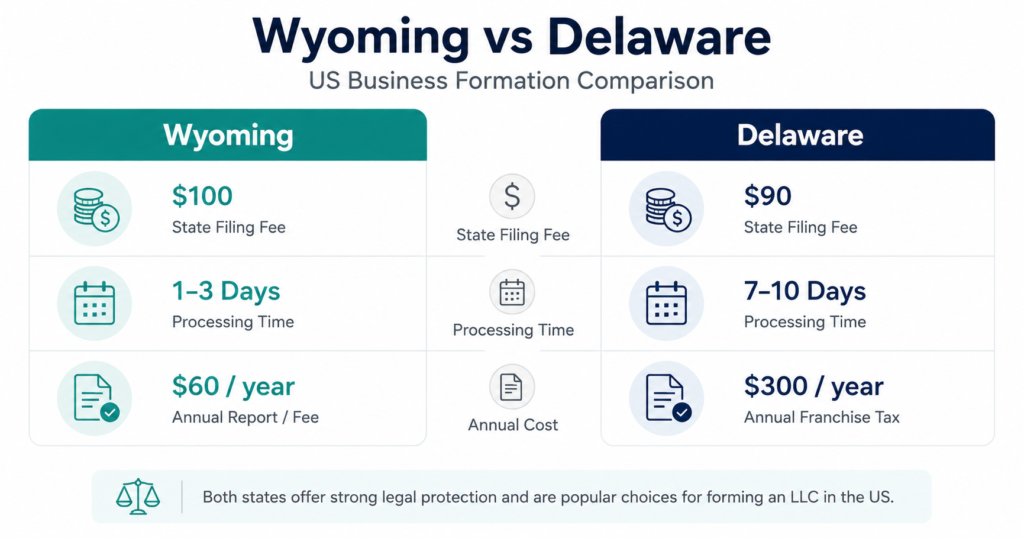
Wyoming charges $60/year for its LLC annual report ($62 if you pay online). Delaware charges a flat $300/year franchise tax due June 1 — no annual report required for LLCs.
Wyoming’s report is due on the first day of your LLC’s anniversary month. Miss it and Wyoming adds a $50 late penalty. Delaware’s June 1 deadline is fixed regardless of when you formed.
For non-residents running lean online businesses, Wyoming saves $240/year with no state income tax on either side. Delaware’s advantages — investor credibility, flexible corporate law — matter most if you’re raising venture capital. For bootstrapped founders from India, Nigeria, Pakistan, UAE, or the Philippines, Wyoming’s lower ongoing cost is the practical default. Understanding how these fees fit into your broader Tax Filing obligations is essential before you commit to either state.
According to the Wyoming Secretary of State (wyobiz.wyo.gov), Wyoming LLCs with no Wyoming-located assets above $300,000 pay a flat $60 annual report fee. Online filing adds a $2 card processing fee, making the total $62 per year. The annual report is due on the first day of the LLC’s anniversary month. Missing this deadline triggers a $50 late penalty. As of 2026, this remains the standard fee for the vast majority of non-resident-owned Wyoming LLCs, which typically hold no Wyoming assets.
Wyoming vs Delaware LLC: Side-by-Side Cost and Feature Comparison
Wyoming costs $60/year in state fees; Delaware costs $300/year. For most non-resident founders, that $240 annual difference compounds into a meaningful cost with zero operational benefit unless you are raising US venture capital.
| Factor | Wyoming | Delaware | Non-Resident Note |
|---|---|---|---|
| One-time formation fee | $100 ($102 online) | $90 base ($110 incl. county fee) | Both filed remotely; no US visit needed |
| Annual state fee | $60/yr ($62 online) — Wyoming Secretary of State | $300/yr flat franchise tax — Delaware Division of Corporations, due June 1 | Franchise tax: a state-level business tax, separate from federal income tax |
| Annual fee due date | First day of anniversary month | June 1 every year | Missing Wyoming’s date triggers a $50 late penalty |
| Registered agent (RA) | Mandatory — $50–$300/yr | Mandatory — $50–$300/yr | Non-residents cannot act as their own RA in either state |
| Total annual cost | $110–$360/yr | $350–$600/yr | RA is a recurring cost beyond the state fee |
| State income tax | Zero — no corporate, personal, or distribution tax | No state income tax on income with no Delaware nexus; non-residents with no Delaware clients or operations face minimal practical exposure | Non-residents with no Delaware activity face limited risk, but the exposure is not zero |
| Formation processing | ~1–3 business days; no expedited option | ~10 business days; expedited available | Wyoming is faster for founders who need quick EIN applications |
| Member privacy | Members not required on public filings | Members not required on public filings | Privacy comparable at state level in both |
| Court system | Wyoming state courts — adequate for small business | Delaware Court of Chancery — most respected US business court | Required by most US venture capital investors |
| Investor credibility | Accepted by small business partners | Required by institutional investors | If you plan to raise US VC funding, Delaware is the standard |
Annual fee and franchise tax
Wyoming charges $60 per year, collected by the Wyoming Secretary of State via wyobiz.wyo.gov. As of 2026, paying online adds $2, making it $62. Delaware charges a flat $300 annual franchise tax to the Delaware Division of Corporations, due June 1 — five times Wyoming’s minimum fee.
Wyoming’s $60 applies when your Wyoming-located assets stay at or below $300,000. Most non-resident founders operating globally hold no Wyoming assets, so $60 remains the standard figure.
State income tax exposure
Wyoming imposes zero state income tax at every level — no corporate tax, no personal income tax, no tax on LLC distributions. For a founder in Lagos, Karachi, or Manila paying tax only in their home country, Wyoming adds no state-level tax layer.
Delaware does not tax income with no Delaware nexus. Non-residents with no Delaware clients or operations face minimal practical exposure, but the risk is not zero. As of 2026, non-residents operating entirely outside Delaware and with no Delaware-sourced activity generally do not trigger Delaware income tax liability — but this is a facts-and-circumstances determination, not a blanket exemption.
Privacy, court system, and investor credibility
Both Wyoming and Delaware keep member names off public LLC filings, so privacy at the state level is equivalent. The real difference is the Delaware Court of Chancery — the US court system most experienced with corporate disputes. US venture capital firms and institutional investors routinely require Delaware formation as a condition of funding.
For a founder building a bootstrapped SaaS or service business, Wyoming’s lower annual cost wins. For a founder planning a US fundraising round, Delaware’s credibility is not optional.
Banking and Payment Reality for Non-Resident LLC Owners
Your LLC state — Wyoming or Delaware — has zero effect on which bank will accept you, which payment processor you can use, or how long your EIN takes. These are federal and platform-level decisions.
Mercury bank: who can and cannot apply
Mercury is a fintech (not a bank — deposits are FDIC-insured via Choice Financial Group and Column N.A.) that accepts non-residents with an EIN, passport, and LLC documents. But five countries are fully prohibited as of 2026: Pakistan, Nigeria, Philippines, Nepal, and Bangladesh. Founders from these countries cannot open Mercury accounts — applying wastes time and triggers a permanent record of rejection.
India and UAE are not on Mercury’s prohibited list. Founders from both countries can apply, subject to standard KYC review.
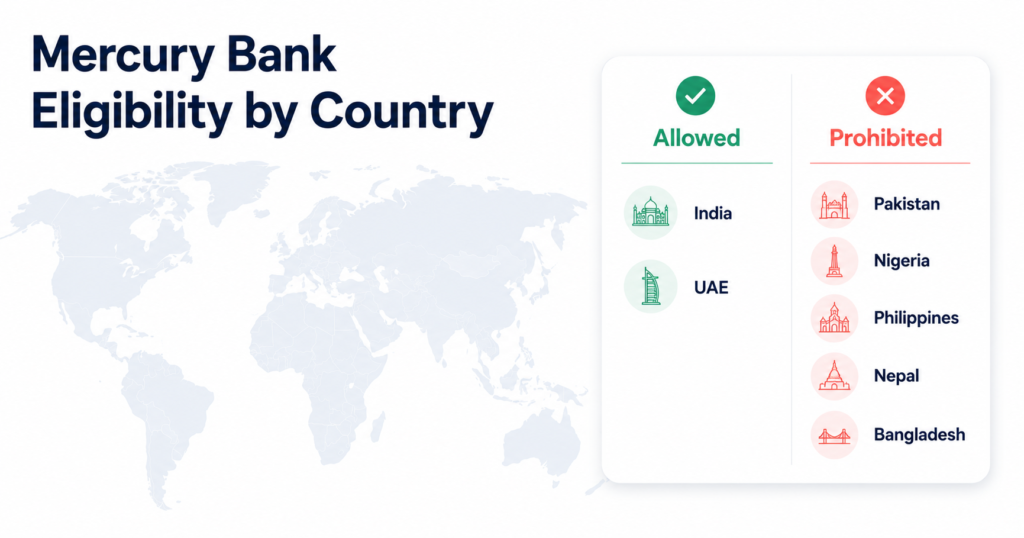
As of 2026, Mercury — a US fintech whose deposits are FDIC-insured via Choice Financial Group and Column N.A. — prohibits account applications from founders domiciled in Pakistan, Nigeria, Philippines, Nepal, and Bangladesh. This is a hard block, not a soft rejection: the same application cannot be resubmitted. Founders from India and UAE are not on Mercury’s prohibited list and may apply with an EIN (Employer Identification Number), passport, and LLC documents, subject to standard KYC review.
EIN timeline: the real bottleneck before banking starts
No US bank account opens without an EIN (Employer Identification Number — your LLC’s federal tax ID). Non-residents without an SSN apply via IRS Form SS-4. According to the IRS, non-residents using fax with a return fax number receive their EIN in approximately 4 business days. Via mail, the IRS timeline is approximately 4 weeks. The IRS sets this timeline — your state of formation has no influence.
Pakistani founders face an additional obstacle: IRS international phone lines frequently disconnect during hold. Fax is the only reliable method.
Stripe access by country — what your LLC state cannot change
Stripe eligibility follows where your business is legally registered, not where you live. A US LLC means US-registered — which is exactly why founders from restricted countries form one.
- Pakistan: Stripe unavailable to Pakistan-registered businesses. A US LLC is the standard route to Stripe access.
- Nigeria: No direct Stripe; in-country access is Paystack (Stripe-owned). A US LLC gives full USD Stripe.
- India: Stripe moved to invite-only in May 2024. Self-serve signup is unavailable. A US LLC gives full USD Stripe.
- UAE and Philippines: Stripe is fully available.
Wise Business as an alternative for blocked countries
Wise Business provides US routing and account numbers usable for receiving USD payments. Wise Business is not a bank — deposits are held at FDIC-insured partner banks. For founders from Pakistan, Nigeria, Philippines, Nepal, and Bangladesh who cannot access Mercury, Wise Business is the primary functional alternative.
Brex is not a realistic option for most non-residents: Brex requires at least one US-based founder or investor.
FinCEN BOI and Federal Tax Obligations: What Non-Residents Must Know
BOI filing status for US-formed LLCs
US-formed LLCs — including those owned by non-residents from India, Nigeria, Pakistan, UAE, or the Philippines — are exempt from BOI (Beneficial Ownership Information) reporting. FinCEN’s interim final rule, effective March 26, 2025, removed this requirement for all domestically created entities. Only foreign-law entities registering to do business in a US state must file. This exemption applies equally to Wyoming and Delaware LLCs. Re-verify at fincen.gov before acting — this remains an interim rule pending finalization.
Most competitor guides — including those from doola, ZenBusiness, Northwest Registered Agent, Bizee, and Firstbase — still describe BOI as required for non-resident LLC owners. That is incorrect under the FinCEN interim final rule effective March 26, 2025.
According to FinCEN’s interim final rule, effective March 26, 2025, US-formed LLCs — including those owned by non-residents from India, Nigeria, Pakistan, UAE, or the Philippines — are exempt from BOI (Beneficial Ownership Information) reporting under the Corporate Transparency Act. As of 2026, only foreign-law entities registering to do business in a US state are required to file. This exemption applies equally to Wyoming LLCs and Delaware LLCs. Verify current status at fincen.gov, as this remains an interim rule pending finalization.
Form 5472: the filing most non-residents miss
The $25,000 penalty comes first, then the explanation. Under IRC 6038A, failure to file Form 5472 costs $25,000 per form per year. After 90 days from IRS notice, an additional $25,000 applies per 30-day period — with no maximum cap.
Form 5472 is required for any foreign-owned single-member US LLC with reportable transactions. Capital contributions and distributions between you and your LLC both count as reportable transactions. Zero US income does not eliminate this filing obligation. A founder from Lagos who contributes $5,000 to their Wyoming LLC and files nothing faces a $25,000 penalty — not a warning.
Form 5472 is filed with a pro-forma Form 1120 annually. Your tax professional must know this combination is required. Be aware that the US Tax Filing Deadline for these federal obligations falls on April 15, with extensions available — missing it compounds your exposure.
Federal tax obligations for non-resident LLC owners
A single-member US LLC owned by a non-resident is a disregarded entity by default — meaning income flows to you personally and the LLC files no separate income tax return unless you elect corporate treatment.
US federal income tax applies only to ECI (income effectively connected to a US trade or business) or US-source FDAP income. Foreign-sourced income is generally not subject to US federal tax. If you have ECI, you file Form 1040-NR. Self-employment tax of 15.3% does not apply to non-resident aliens performing services outside the US.
Neither Wyoming nor Delaware changes any of this. Federal obligations are identical regardless of state.
Which State Should You Choose? Recommendations by Country and Founder Type
Pakistan and Nigeria founders
Wyoming is the correct choice. Stripe is unavailable to Pakistan-registered businesses, and Nigeria-registered businesses access Stripe only via Paystack — a US LLC fixes both. Mercury prohibits Pakistan- and Nigeria-domiciled founders entirely. Use Wise Business instead: Wise Business provides US routing and account numbers for receiving USD payments. Wyoming’s $60/yr annual cost versus Delaware’s $300/yr matters more when banking options are already constrained.
India founders
Choose Wyoming. Stripe moved India to invite-only in May 2024 — that restriction applies regardless of whether you form in Wyoming or Delaware. Mercury does not list India as prohibited, so India-domiciled founders can apply. Wyoming’s $60/yr annual cost reduces overhead during the Stripe wait period, which can stretch months.
UAE and Philippines founders
Wyoming suits most founders from both countries. Stripe is available in UAE and the Philippines. Mercury does not prohibit UAE-domiciled founders. However, Mercury prohibits Philippines-domiciled founders — use Wise Business instead. Wyoming’s lower annual cost suits lean operations without US venture capital plans.
Amazon FBA sellers (any country)
Choose Wyoming. Amazon does not require Delaware formation for seller accounts. Wyoming has zero state income tax and a $60/yr annual report fee. Delaware’s $300/yr franchise tax adds recurring cost with no operational benefit for marketplace sellers. Founders comparing state-level costs across all options may also find it useful to review Annual Tax Filing for New Mexico LLC Owners — New Mexico is another zero-franchise-tax state sometimes considered alongside Wyoming.
Founders seeking US venture capital
Delaware is required. Most US institutional investors expect Delaware formation specifically because of the Delaware Court of Chancery — a specialized business court that provides the legal predictability investors rely on for deal structuring. The $300/yr franchise tax is the cost of accessing US institutional capital. No other state substitutes for this use case.
UK and Canada founders
Wyoming works for most. Stripe is available in both the UK and Canada. Mercury does not list UK or Canada as prohibited. Choose Delaware only if raising US institutional capital.
The Hidden Cost Non-Residents Discover After Formation
Wyoming’s $60 annual report fee is real. But it is not your total annual cost. Every Wyoming LLC must have a registered agent — a US-based person or service receiving legal documents on your behalf. Non-residents cannot act as their own registered agent in any US state. Registered agent services cost $50–$300 per year. Your real annual Wyoming cost is $110–$360, not $60.
Delaware has the same registered agent requirement. Add the $300 flat annual franchise tax, and Delaware’s recurring cost reaches $350–$600 per year — significantly higher than Wyoming for most non-resident founders.
Wyoming also records the name of whoever files the annual report. If you file it yourself, your name becomes part of the public Wyoming Secretary of State record. A registered agent or nominee service filing on your behalf keeps your name off that record.
Mercury rejections are often permanent — the same application cannot be resubmitted. Founders from Pakistan, Nigeria, and the Philippines face a hard block, not a soft rejection: Mercury lists all three countries as prohibited. India and UAE founders can apply but must pass KYC review. Apply only after your EIN (Employer Identification Number — your US business tax ID) is confirmed in writing.
The most commonly missed federal obligation is Form 5472. Foreign-owned single-member LLCs must file Form 5472 annually, even with zero US income — a capital contribution from you to your LLC counts as a reportable transaction. The penalty under IRC 6038A is $25,000 per form per year, with no maximum cap.
Common Mistakes Non-Resident Founders Make When Choosing a State
The most common error: believing that choosing Wyoming versus Delaware affects Stripe access. It does not. Stripe eligibility is determined by where your business is legally registered — the US. A founder from Lagos or Karachi forming a US LLC gains Stripe access because the LLC is a US entity. State choice is irrelevant to that outcome.
The second mistake: assuming Delaware’s prestige justifies the cost. The Delaware Court of Chancery is valuable only when raising US venture capital. For e-commerce, freelancing, or SaaS with no US VC plans, Delaware’s $300 annual franchise tax delivers nothing Wyoming’s $60 annual fee cannot. That $240 annual difference buys nothing for most bootstrapped non-resident founders.
The third mistake is acting on outdated BOI (Beneficial Ownership Information) filing guides. Per FinCEN’s interim final rule effective March 26, 2025, US-formed LLCs are exempt from BOI reporting. The requirement now applies only to foreign-law entities registering in a US state. Most competitor guides — including those from doola, ZenBusiness, Northwest Registered Agent, Bizee, and Firstbase — still describe BOI as required. They are wrong under the FinCEN interim final rule effective March 26, 2025. Verify at fincen.gov before acting.
What is not optional: Form 5472. A foreign-owned single-member LLC with any reportable transaction — including capital contributions — must file Form 5472 annually. Missing it triggers a $25,000 IRS penalty per form under IRC 6038A. If you are unsure how your LLC’s income is classified, reviewing Form W-9 Explained in Detail clarifies the withholding and tax identification framework that underpins these federal obligations.
Frequently Asked Questions
Is the Wyoming LLC annual report fee really just $60?
Yes. According to the Wyoming Secretary of State, Wyoming LLCs with no Wyoming-located assets above $300,000 pay a flat $60 annual report fee. Online filing via wyobiz.wyo.gov adds a $2 card processing fee, making the total $62. Registered agent service — mandatory for non-residents — costs $50–$300 per year separately. As of 2026, $60 remains the standard figure for non-resident-owned Wyoming LLCs.
Can I open a US bank account with a Wyoming LLC if I am not a US resident?
It depends on your country. Mercury accepts India- and UAE-domiciled founders with an EIN (Employer Identification Number — US business tax ID), passport, and LLC documents. As of 2026, Mercury prohibits Pakistan-, Nigeria-, and Philippines-domiciled founders entirely. Wise Business is the reliable alternative for those three countries. You must obtain your EIN before applying to any bank.
Does forming a Wyoming or Delaware LLC give me access to Stripe in Pakistan or Nigeria?
Yes — because the US LLC is US-registered, not because of which state you chose. Stripe eligibility is based on where your business is legally registered — the US is fully supported. Pakistan-registered businesses cannot access Stripe directly; a US LLC resolves this. Nigerian businesses access Stripe only via Paystack (Stripe-owned); a US LLC gives full USD Stripe. Wyoming versus Delaware does not affect Stripe eligibility.
Do I need to file a FinCEN BOI report for my Wyoming or Delaware LLC as a non-resident?
No. Under the FinCEN interim final rule effective March 26, 2025, US-formed LLCs — including those owned by non-residents — are exempt from BOI (Beneficial Ownership Information) reporting. This is an interim rule; verify current status at fincen.gov. Direct your compliance effort toward Form 5472 instead.
How long does it take to get an EIN as a non-resident after forming my LLC?
Approximately 4 business days via fax with a return fax number, or approximately 4 weeks via mail, using IRS Form SS-4. According to the IRS, state of formation does not affect this timeline. You cannot open a US bank account until your EIN is confirmed in writing.
Is Delaware better than Wyoming if I want to raise money from US investors?
Yes. Most US venture capital investors require Delaware formation specifically because of the Delaware Court of Chancery, which provides established, predictable business law. Wyoming is adequate for small businesses but is not accepted by most institutional investors. If US VC funding is your goal, Delaware’s $300 annual franchise tax is the correct trade-off.
What is the total annual cost of a Wyoming LLC versus a Delaware LLC for a non-resident?
Wyoming: $60 state annual report fee plus $50–$300 registered agent equals $110–$360 per year total. Delaware: $300 state franchise tax plus $50–$300 registered agent equals $350–$600 per year total. Both Wyoming and Delaware require a registered agent — non-residents cannot serve as their own.
What is Form 5472 and does it apply to my Wyoming or Delaware LLC?
Form 5472 is an IRS information return required for foreign-owned single-member US LLCs with reportable transactions — including your initial capital contribution. It applies even if your LLC earned zero income. Under IRC 6038A, the penalty for failure to file is $25,000 per form per year, with no maximum cap. State choice does not affect this obligation.
Why does Wyoming charge $60 for an annual report when Delaware charges $300?
Wyoming and Delaware use different fee structures. According to the Wyoming Secretary of State, Wyoming’s $60 annual report fee is a flat administrative filing charge. Delaware’s $300 annual franchise tax is a state business tax — a separate legal mechanism. Wyoming’s fee is lower because Wyoming’s revenue model relies on volume of formations rather than higher per-entity fees. As of 2026, Wyoming’s $60 minimum applies to the vast majority of non-resident-owned LLCs that hold no Wyoming-located assets.
What happens if I miss the Wyoming LLC annual report deadline?
Missing the Wyoming annual report deadline — the first day of your LLC’s anniversary month — triggers a $50 late penalty, according to the Wyoming Secretary of State. If the report remains unfiled, Wyoming can administratively dissolve your LLC, which requires a reinstatement fee and process to reverse. Delaware’s June 1 franchise tax deadline carries different consequences: late payment accrues interest at 1.5% per month.
Conclusion
Wyoming costs $60/year in annual report fees ($62 online) versus Delaware’s flat $300/year franchise tax — a $240/year difference. As of 2026, total annual running costs are: Wyoming $110–$360/year versus Delaware $350–$600/year, including registered agent in both cases.
Banking determines your real choice more than state fees. Mercury is prohibited for founders based in Pakistan, Nigeria, and the Philippines — use Wise Business instead. India and UAE founders may apply to Mercury subject to standard KYC checks.
Stripe access comes from having a US LLC, not from which state you chose. Wyoming and Delaware both qualify.
The BOI reporting exemption for US-formed LLCs is under a FinCEN interim final rule effective March 26, 2025 — verify current status at fincen.gov before filing. Mercury country prohibitions also change; confirm live before applying.
Choose Delaware only if raising US venture capital. Wyoming is the lower-cost default for every other situation.
Bizstartz forms Wyoming LLCs for $199 plus the $100 Wyoming state fee. EIN filing for non-residents is included. If you want to understand How to Stop Paying US Tax as a Non-Resident LLC Owner, Bizstartz handles LLC formation and EIN filing so your structure is compliant from day one.
Related Guides
- Wyoming vs Delaware LLC for Non-Residents: Annual Fees, Franchise Tax, and Banking Reality
- Top 5 States for Forming an Anonymous LLC
- Delaware Business Entity Search: A Complete Guide for Entrepreneurs and Investors
Compare the real year-one cost of every popular state in our state cost breakdown, then file with us.
🎯 Ready to start? Claim your free consultation and we'll map out your US LLC formation strategy — EIN, banking, and the right state for your country.
