You can form a US LLC while living in Thailand, and the banking works. Thailand is on neither Mercury’s sanctioned nor its prohibited list, and it is not on Relay’s 31-country list either (both checked 29 September 2026).
The Bank of Thailand also publishes that a Thai individual may invest in an overseas business entity they hold at 10% or more “without limit”, which is a far more permissive starting point than several countries in this series have.
Most guides in this series are exercises in damage control. Indonesia, Vietnam, Cambodia, Myanmar and the Philippines are all on Mercury’s prohibited list, and those articles spend most of their length on what is left after the front door closes. Thailand is the outlier in its own neighbourhood. The front door is open.
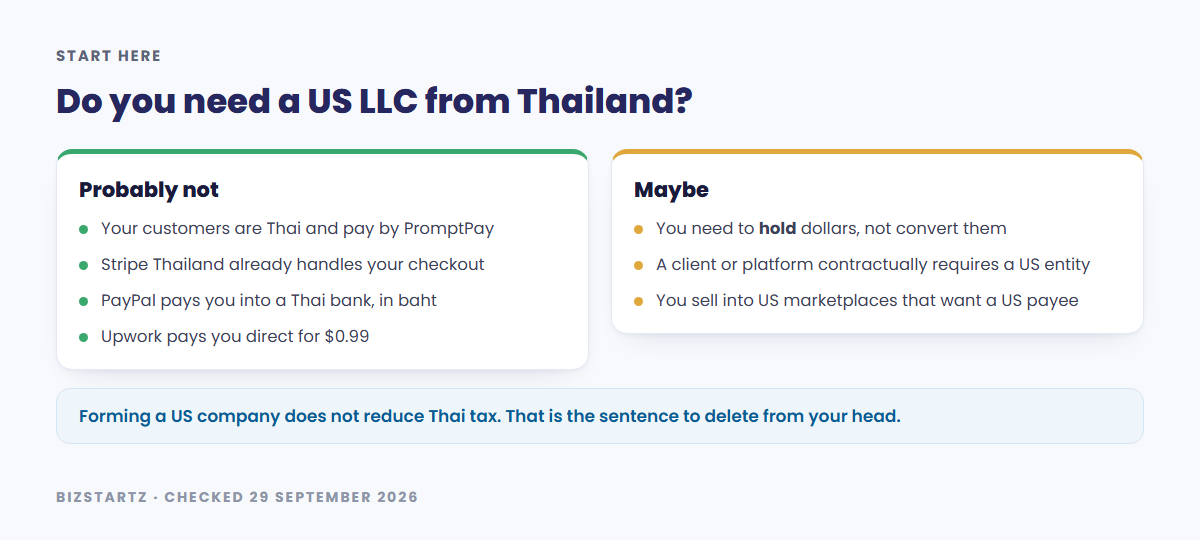
Which makes the honest question a different one. Not whether you can, but whether you should bother. Stripe is fully live in Thailand and charges 1.65% on PromptPay. PayPal pays a Thai account out to a Thai bank in baht, with no fee above 5,000 THB.
Upwork pays Thai freelancers directly for 99 cents. If you came here because someone told you a US company is how a Thai founder gets paid in dollars, that person was describing a different country.
Two Thai-side facts are worth knowing before you spend anything. Wise, the provider most people assume is the fallback, has paused issuing account details to customers in Thailand. And Thailand taxes foreign income you bring into the country, which a US LLC does nothing to change.
In this guide: Do you actually need one? · Who it genuinely helps · Banking from Thailand · What Thai law says about owning it · Thai tax · The US side · What it costs · Questions Thai founders ask · Who this suits
Do you actually need a US LLC from Thailand?
For a large share of people reading this, no. Work through these four before you pay anyone a formation fee, because in Thailand most of them already cover how you get paid.
Stripe is fully live in Thailand, and PromptPay undercuts cards
Thailand sits in Stripe’s main supported-country list with a direct sign-up link. No “preview” tag, no invite-only, no extended network (stripe.com/global, checked 29 September 2026).
Stripe Thailand’s published rates are 3.65% + ฿10.00 per successful domestic card charge and 4.75% + ฿10.00 for international cards, with a further 2% where currency conversion is involved. PromptPay is 1.65% (Stripe Thailand pricing, checked 29 September 2026).
That PromptPay line is the one to sit with. A Thai Stripe account can settle a Thai customer at 1.65%. A US Stripe account cannot accept PromptPay at all, so the same customer arrives as an international card at 4.75% + ฿10.00 instead. Routing Thai buyers through a US LLC is not a neutral choice; it roughly triples what you pay to collect, and it removes the method many of them would have reached for first.
PayPal Thailand withdraws to a Thai bank, in baht, free above 5,000 THB
A Thai PayPal account transfers its balance to a local bank account in THB. PayPal’s Thai fee schedule shows no fee for withdrawals of 5,000 THB or more where no currency conversion is involved, and 50.00 THB where the withdrawal is below that (PayPal Thailand fees, checked 29 September 2026).
On the receiving side, Thai commercial transaction rates are 3.90% plus a fixed fee domestically and 4.40% plus a fixed fee internationally, the fixed fee being 11.00 THB when you receive in baht or 0.30 USD when you receive in dollars (PayPal Thailand merchant fees, checked 29 September 2026).
So the money reaches your bank without a US entity in the chain. What it does not do is stay in dollars — converting costs a markup over PayPal’s base rate — and that distinction is the one that actually decides this. More on it below.
Upwork pays Thai freelancers directly, for 99 cents
Thailand is supported for Upwork’s Direct to Local Bank withdrawals, with a $5 minimum and a $10,000 limit per transfer, at a flat $0.99 withdrawal fee (Upwork: Direct to Local Bank fees and timing, checked 29 September 2026).
If freelancing income was your reason for wanting a US company, that reason just cost you 99 cents to remove.
Wise works for sending, but has paused issuing account details in Thailand
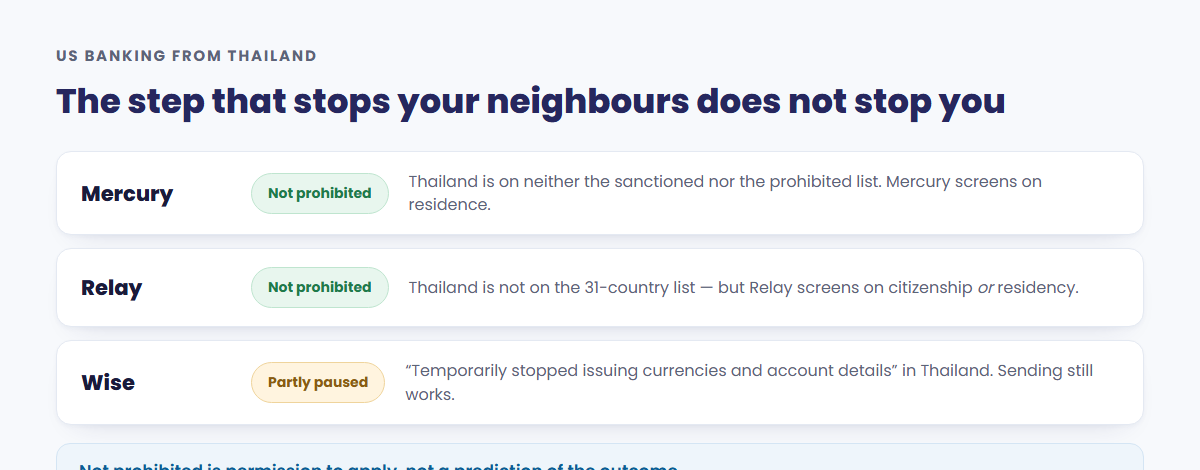
This one is regularly quoted the wrong way round, so read it carefully. Thailand appears on Wise’s list of countries where you can hold money, but carries an explicit footnote: “Thailand, we’ve temporarily stopped issuing currencies and account details for customers in Thailand” (Wise: where do I need to live to hold money with Wise, checked 29 September 2026).
That is a pause on balances and account details, not on Wise itself. Wise’s own help centre states that “Wise Payments (Thailand) Ltd. is licensed by the Bank of Thailand (BoT) to provide Electronic-Fund Transfer, E-Money, Money Transfer Agent, and FX E-Money services” (Wise: which countries can I send money from, checked 29 September 2026). Transfers work. Holding a multi-currency balance with USD account details as a Thai customer is the part that is paused.
The word “temporarily” is Wise’s, not ours, and we have no information about when it lifts. Do not build a plan on it lifting.
Who a US LLC genuinely helps from Thailand
Three cases come through that list intact. None of them is about tax.
You need to hold dollars, not convert them
Every Thai route in the section above ends in baht. PayPal converts at a markup over its base rate. Stripe adds 2% where conversion is needed. Upwork’s local payout converts. If you pay US suppliers, US contractors or US ad platforms in dollars, you are converting USD into THB and straight back into USD, and paying twice for the privilege.
A US bank account in the LLC’s name ends that loop. Of everything on this page, this is the argument we find hardest to talk a founder out of. Notice what kind of argument it is, though. It is about where your cash sits, not about what you owe, and nothing in it lowers a Thai tax bill by a single baht.
It is also the easiest one to size. Multiply what you convert in a year by the spread you pay. If that number is smaller than the annual cost of running a US entity plus a Thai tax adviser to sit behind it, the LLC loses on arithmetic and you can stop here.
A client or platform contractually requires a US entity
Some US buyers will only contract with a US company, usually for procurement reasons rather than tax ones. If that is a written requirement from someone who is already paying you, it is a legitimate reason to form one.
Ask them exactly what they need first. In our experience the real requirement is very often a US bank account to pay into, or a completed tax form, not a US company at all. Our comparison of Form W-8BEN and Form W-9 covers which one you would actually be signing.
Amazon: Thailand registers, but we could not find THB on the payout lists
Thailand is accepted for Amazon seller registration, the T entries on Amazon’s accepted-countries list run “Taiwan, Tajikistan, Tanzania, Thailand, Timor-Leste, Togo…” (Seller Central: accepted countries, checked 29 September 2026).
The payout side reads differently. We could not find Thailand or THB among the supported bank-account currencies for the Amazon Currency Converter for Sellers — the only T entries we retrieved were Taiwan/TWD and Türkiye/TRY (Seller Central: supported bank accounts, checked 29 September 2026).
We are not turning that into “Amazon cannot pay you in Thailand.” Our read of that page was partial, third-party payment providers exist, and Amazon’s tables change. But this is the one place in this guide where the answer plausibly flips, so ask Amazon directly how a Thailand-registered seller receives disbursements before you decide either way.
If the answer is that they cannot pay a Thai bank account, a US LLC with a US bank account becomes a real solution to a real problem rather than a solution looking for one.
Banking a US LLC from Thailand: the step that stops your neighbours does not stop you
Do this check anyway, before you spend anything. An LLC with no bank account cannot receive a cent, and the order in which you do these steps decides how much you waste if the answer is no.
Mercury does not prohibit Thailand
Mercury’s help centre states it is “unable to open accounts for founders living in any of the countries and regions listed below”, and that “this is based on your country of residence, not your citizenship or nationality”.
Its list runs to four sanctioned countries and regions and 48 prohibited ones. Thailand appears on neither (Mercury: prohibited countries, checked 29 September 2026; we have the full breakdown in Mercury’s prohibited countries list).
Look at who else is on that list, though: Cambodia, Myanmar, Vietnam, Indonesia and the Philippines. Thailand is ringed by countries whose founders are shut out, and it is not one of them. That single difference is why the Indonesia and Philippines guides are mostly about workarounds and this one is not.
Relay does not prohibit Thailand either, but its test is broader
Relay states it “cannot open a Relay Account for any business owner who holds citizenship or residency in one of the following countries”, and lists 31. Thailand is absent (Relay: prohibited countries, checked 29 September 2026; full list in our Relay prohibited countries guide).
Note the wording, because it matters more here than it looks. Relay screens on citizenship or residency, while Mercury screens on residence alone. A Thai national living in Thailand clears both.
But if you hold a second citizenship from one of Relay’s 31, or a co-owner does, Relay can decline where Mercury would not. Relay does add that “exceptions can apply based on Thread Bank’s case-by-case review” and asks you to contact its team before applying if you think yours might qualify.
What “not prohibited” does and does not mean
Not being on a list is not approval. Both providers still run their own checks and decline applications for their own reasons. Country policies also move, and you do not have to look far for the evidence: Wise’s Thailand pause is in this same guide, three sections up. What you have here is a good starting position, not an outcome.
Ask in writing before you form anything. Our guide to opening a US bank account as a non-resident covers the application itself, and the US payment and banking access by country table compares providers side by side.
What Thai law says about owning the US company
We form US companies. We are not Thai lawyers or Thai tax advisers, and nothing below tells you what you owe or what you are permitted to do. It sets out what the Bank of Thailand and the Revenue Department publish, with sources, so you can take the right questions to someone qualified, and it is honest about where the published material runs out.
This is the section most English-language guides skip entirely, and it is the one where countries differ most. Home-country exchange control can range from an outright prohibition on residents investing abroad to a permission with no ceiling at all, and the country you are in decides which guide you should have been reading.
Next door in Malaysia, for instance, whether you may fund a foreign investment freely turns on whether you hold domestic ringgit borrowing. Thailand’s published position is one of the more permissive in this series, and we want to be precise about why rather than let you assume it.
The Bank of Thailand permits direct investment abroad without limit
On the Bank of Thailand’s own exchange control page, under direct investment abroad, the rule for individuals reads:
“A Thai individual is allowed to invest in an overseas business entity whose shares are held by that person by not less than 10%, or invest in or lend to its overseas affiliated business entities without limit.”
Portfolio investment sits in a separate, capped bucket: “transfers to non-residents for purpose of portfolio investment are allowed up to USD 5 million per person per calendar year” where you are not going through an onshore agent. Both from the BOT’s Exchange Control Regulation page, read 29 September 2026.
Here is our reading, flagged as a reading rather than advice. A single-member LLC that you own entirely is 100% held by you, which is comfortably “not less than 10%”.
On the face of the BOT’s table that places it in the direct-investment row, permitted without limit, not in the USD 5 million portfolio row. That is a materially better starting position than most of the countries in this series.
But the BOT page is a summary table, not the operative instrument. It summarises underlying notifications we did not retrieve, and we could not confirm from it how “overseas business entity” is defined, or whether a US LLC that is disregarded for US federal tax purposes counts as one for this purpose. Have someone qualified confirm which notification applies to you before you rely on it.
The documentation threshold you will meet in practice
The place this becomes concrete is at your bank counter, not in a rulebook. The BOT states that “for transactions in an amount equivalent to USD 200,000 or above, the authorized banks need to request the customers to submit supporting documents except for the case where the authorized banks have performed the Know Your Business (KYB) process on the customers.”
Below that figure your bank has less to ask for. Above it, expect to document what the transfer is for. Ask your own bank what it wants before you send anything, because banks apply their own policies on top of the BOT’s minimum.
What we could not establish, stated plainly
We are not going to fill these gaps with guesses.
- Whether you must register or report owning the LLC. We found the USD 200,000 documentation threshold that applies to transfers, and nothing establishing a standing registration duty on the individual for holding a foreign company. Our failure to find such a rule is not evidence that none exists. Ask.
- Whether Thailand attributes a foreign company’s undistributed profit to you. Several commercial sites assert Thailand has no controlled-foreign-company regime for individuals. Not one of them was the Revenue Department or the Revenue Code, so we are not repeating the claim. Put it to a Thai tax adviser as a question, not as a settled point.
- Whether you may hold a foreign-currency account abroad in the LLC’s name. The BOT page we read covers foreign currency deposit accounts held in Thailand with authorized banks. It said nothing we could rely on about accounts held abroad.
Anyone who answers these three for you off the top of their head, especially anyone selling you a company, is guessing. The questions are listed in full at the end of this guide so you can take them to someone who will not.
Thai tax, and the one sentence to delete from your head
A US LLC does not avoid Thai tax and does not avoid Thai reporting. If a formation provider has told you otherwise, that is the point to stop the conversation.
Here is what the Revenue Department itself publishes. A resident “means any person residing in Thailand for a period or periods aggregating more than 180 days in any tax (calendar) year”, and “a resident of Thailand is liable to pay tax on income from sources in Thailand as well as on the portion of income from foreign sources that is brought into Thailand” (Thai Revenue Department: personal income tax, read 29 September 2026).
Read that against what a US LLC actually is. A single-member LLC owned by a non-US person is disregarded for US federal tax purposes. Whether it owes US tax turns on whether its income is effectively connected with a US trade or business, and many non-resident owners serving clients from outside the United States conclude that it is not (IRS: taxation of nonresident aliens). That conclusion is the whole basis of the “zero tax” pitch on formation websites.
It is also a statement about the United States and nothing else. The money you bring into Thailand is still foreign-sourced income received by a Thai resident, and section 41 does not care which flag is on the entity that paid it.
What changed in 2024, and what has not changed since
Thailand reinterpreted the remittance rule with effect from 1 January 2024. Departmental Instructions Por.161/2566 and Por.162/2566 treat foreign-sourced income brought into Thailand as assessable in the year of remittance regardless of the year it was earned, with income earned before 1 January 2024 carved out under Por.162/2566 (KPMG: further guidelines on foreign-sourced income brought into Thailand). We could not open the Revenue Department’s own Thai-language text of either instruction, so treat the summary above as a professional firm’s reading rather than ours.
You will also find a lot written about a relaxation that would exempt foreign income remitted in the year it is earned or the year after. As far as we could establish on 29 September 2026, it is a draft and not law.
Forvis Mazars Thailand describes it as “being drafted” and notes it “will require approval by the Cabinet before it can be enacted”, with the 1 January 2024 rule remaining the one in force (Forvis Mazars: Thailand considering easing tax rules on foreign-sourced income).
We found no Royal Gazette publication of it. We could not search the Gazette directly, so confirm the current position with a Thai tax professional rather than with this page — including this page.
We have deliberately not printed Thai tax rates here. The rate bands we found came from advisory firms rather than a Revenue Department page we could read, and a rate you act on should come from someone who has seen your numbers.
The US side: steps, filings, and the treaty Thailand actually has
- Confirm the bank and the platform first. It costs nothing and it is the step most likely to change your mind.
- Choose a state. Wyoming charges $100 to file Articles of Organization, and its annual report licence tax is “$60 or two-tenths of one mill on the dollar ($.0002) whichever is greater based on the company’s assets located and employed in the state of Wyoming” (Wyoming Secretary of State fee schedule, effective 1 July 2026). Delaware is the usual alternative and costs more to keep: 6 Del. C. § 18-1107(b) sets a flat $400 annual tax due 1 June. We compare the rest in best states to file an LLC as a non-resident.
- Appoint a registered agent in that state, and keep the renewal paid. A lapsed agent is how a company quietly falls out of good standing.
- Get the EIN without an SSN. Step by step in how to get an EIN without an SSN.
- Open the US account, then apply to the platform you formed the company for.
Form 5472, every year, whether or not you owe anything
A single-member LLC owned by a non-US person is a foreign-owned US disregarded entity. Each year it files a pro forma Form 1120 with Form 5472 attached, even at zero US tax and zero revenue. “A penalty of $25,000 will be assessed on any reporting corporation that fails to file Form 5472 when due and in the manner prescribed”, with a further $25,000 if the failure continues more than 90 days after IRS notification (IRS Instructions for Form 5472). Our guide to Form 5472 for foreign-owned US LLCs covers the filing itself.
Put that number beside the conversion spread you calculated earlier. A dormant LLC you stop paying attention to is not free — it is a $25,000 exposure sitting in a drawer.
There is a US–Thailand income tax treaty
Thailand is on the IRS’s list of US income tax treaty partners, with an Income Tax Treaty and a Technical Explanation both dated 1996 (IRS: United States income tax treaties A to Z and the Thailand treaty documents page, both checked 29 September 2026). The IRS pages do not state an entry-into-force date, so we are not asserting one.
That puts Thailand in a better position than Malaysia, which has no US treaty at all. Be careful what you conclude from it, though. A treaty gives you a framework for reduced rates on US-source income and a route for resolving where profit belongs, it does not exempt you from Thai tax, does not remove the Form 5472 filing, and does nothing for a structure whose entire premise is that it pays no US tax in the first place. There is no reduced rate to claim against zero. Raise the treaty explicitly with advisers on both sides rather than assuming it helps.
One filing you can stop worrying about
Beneficial ownership reporting no longer applies to companies formed in the United States. FinCEN “formally exempted entities previously known as ‘domestic reporting companies’ from the CTA’s reporting requirements”, and its final rule of 11 August 2026 states that “U.S. companies are exempt from BOI reporting requirements and therefore, are no longer required to file BOI reports” (FinCEN: beneficial ownership information, checked 29 September 2026). If a provider is still charging you for BOI filing on a US LLC, ask why.
What it costs, end to end
Only figures we could source today:
| Item | Amount | Source |
|---|---|---|
| Wyoming formation | $100 | WY SOS fee schedule, effective 1 July 2026 |
| Wyoming annual report licence tax | $60 minimum, or $.0002 per dollar of Wyoming assets, whichever is greater | WY SOS fee schedule |
| Delaware annual LLC tax | $400, due 1 June | 6 Del. C. § 18-1107(b) |
| EIN | $0 from the IRS | IRS |
| BOI report | $0 — no longer required for US-formed companies | FinCEN, final rule 11 August 2026 |
| Form 5472 late-filing penalty | $25,000, plus $25,000 if uncorrected 90 days after IRS notice | IRS Instructions for Form 5472 |
Four things are missing from that table on purpose, because we could not price them honestly for your case: registered agent renewal, US tax preparation, the wire and conversion cost of moving dollars to Thailand, and a Thai tax adviser’s annual fee.
The last of those usually decides the whole question, and it is the only one you can get quoted for nothing this week. Get two quotes before you form anything.
Then hold the total up against what you already pay. Stripe Thailand at 1.65% on PromptPay and Upwork at $0.99 a withdrawal are hard numbers to beat once you attach a fixed annual cost to the alternative.
Questions Thai founders ask
Can I open a US LLC from Thailand without going to the US?
Yes. You can register the company, get an EIN without an SSN, open a US business account with a provider that accepts Thailand-resident owners, and file its US returns without visiting the United States. What you cannot do remotely is skip the Thai side, section 41 and the Bank of Thailand’s rules apply to you where you live.
Will Mercury or Relay open an account for someone living in Thailand?
Thailand is on neither Mercury’s sanctioned nor its prohibited list, and that screening is based on country of residence rather than citizenship (checked 29 September 2026). Relay’s 31-country list does not include Thailand either, though Relay screens on citizenship or residency. Neither is a guarantee of approval, both run their own checks, and policies change.
Why can’t I get Wise account details in Thailand?
Wise’s own help page says it has “temporarily stopped issuing currencies and account details for customers in Thailand”. It does not give a reason or an end date. Wise still operates in Thailand for transfers, through a Bank of Thailand-licensed entity. If your plan depended on Wise account details, check that page again before you build around it.
Do I need a US LLC to use Stripe in Thailand?
No. Thailand is in Stripe’s main supported-country list with a direct sign-up link, and Stripe Thailand handles PromptPay at 1.65%, which a US Stripe account cannot accept at all. A US account only starts to make sense if your customers are mostly outside Thailand and you need to settle in dollars.
Does a US LLC reduce my Thai tax?
No, and you should treat anyone who says otherwise as a reason to walk away. The Revenue Department taxes a Thai resident on foreign-sourced income brought into Thailand. Which entity earned it abroad does not change that, and a US LLC adds US filing obligations rather than removing Thai ones.
Am I allowed to own a foreign company as a Thai resident?
The Bank of Thailand publishes that “a Thai individual is allowed to invest in an overseas business entity whose shares are held by that person by not less than 10% … without limit”. Our reading is that a wholly owned US LLC falls inside that permission rather than the USD 5 million portfolio-investment cap. That page is a summary of underlying notifications we did not retrieve, so confirm it with a Thai lawyer or your bank before relying on it, and see the questions below.
Is the new Thai tax exemption on remitted income in force yet?
Not as far as we could establish on 29 September 2026. The exemption for foreign income remitted in the year it was earned or the following year has been drafted but still needs Cabinet approval and publication in the Royal Gazette, and we found no Gazette publication. The 1 January 2024 rule is the one in force. Since this is precisely the kind of thing that changes without a headline, ask a Thai tax professional for today’s position rather than trusting any article, this one included.
Who this suits, and where to start
It can make sense if you genuinely need to hold and spend dollars rather than convert them, a paying US client contractually requires a US entity, or you sell on Amazon and have confirmed with Amazon that a Thai bank account cannot receive your disbursements. In each of those, you should already have a Thai tax adviser’s annual fee quote in hand.
It probably does not if your customers are Thai and pay by PromptPay, Stripe Thailand already handles your checkout, Upwork or PayPal already pays you to a Thai bank, or your case rests on a tax outcome nobody qualified has confirmed for your facts. Thailand is one of the countries in this series where the infrastructure to get paid already exists at home, and that is a good problem to have.
Start with the checks that cost nothing, in this order. Confirm which platform you actually need and whether it already serves Thailand. Ask Mercury or Relay in writing whether they will take an owner resident in Thailand. Take the questions below to a Thai tax adviser and get an annual fee quote. Register the company last, once the other three have answers. Every step before it can be reversed by walking away; that one cannot.
Questions to take to a Thai tax adviser
- If I own a US LLC that is disregarded for US federal tax, is its profit my assessable income under section 41 when I remit it, or only what it actually pays out to me?
- Does the answer change if the profit stays in the LLC’s US bank account and is never remitted to Thailand?
- Does it change if the LLC pays me a fee for services rather than distributing profit?
- Does Thailand apply any controlled-foreign-company or attribution rule to an individual who owns a foreign entity, and is there Revenue Department guidance on US LLCs specifically?
- Has the draft decree exempting income remitted in the year earned or the following year been published in the Royal Gazette yet, and does it apply to my facts?
- Under Por.161/2566 and Por.162/2566, what records do I need to keep to evidence when income was earned as against when it was remitted?
- Does the 1996 US–Thailand treaty do anything for me if the LLC pays no US tax, and what should I put on a Form W-8BEN?
- What will you charge me annually to handle this, and does that cost leave the LLC worth having?
Questions for a Thai lawyer or your own bank
- Does the Bank of Thailand’s “not less than 10% … without limit” permission cover a 100%-owned US LLC, and under which notification?
- Is there any registration or notification I owe the BOT or my bank for holding the company, as opposed to for transferring money to it?
- What supporting documents will you want for outward transfers to fund it, and does the USD 200,000 threshold change anything for amounts below it?
- May I hold a foreign-currency account abroad in the LLC’s name as a Thai resident, and are there conditions on bringing money back?
If a US company does fit your case, Bizstartz forms US LLCs for non-resident founders and handles the EIN and bank application steps (US company formation). The Thai side needs Thai professionals, and on the remittance question that is not a formality. If it does not fit, we would rather you kept the money.
Checked on 29 September 2026. Every provider list, fee schedule and regulator page linked above was read on that date. Mercury’s, Relay’s and Wise’s country lists are the ones most likely to have moved since, so re-read all three before you act on anything here.
This guide was researched with the help of AI tools. Every fee, legal and availability claim links to the source it came from, and those sources were read on 29 September 2026. Where we could not confirm something — including whether Thailand applies controlled-foreign-company rules to individuals, whether holding a foreign company triggers any Thai reporting duty, and whether the draft remittance exemption has been gazetted — the text says so instead of guessing. Bank policies and tax rules in this area change without notice; check the linked sources again before you act.
🎯 Ready to start? Claim your free consultation and we'll map out your US LLC formation strategy — EIN, banking, and the right state for your country.

Ready to start your company?
Bizstartz handles formation, EIN, banking and compliance for founders worldwide.