Form 5472 for Foreign-Owned US LLCs: Who Files, When & Penalties

If you own a US LLC from outside the United States, Form 5472 is probably the most important — and most overlooked — filing on your calendar. Since 2017, foreign-owned single-member LLCs that are treated as “disregarded entities” must file Form 5472 each year, and missing it carries a $25,000 penalty that escalates. This guide explains who has to file, what counts as a reportable transaction, the exact address it goes to, and how to fix it if you have already missed a year.

If you are still setting up, our US LLC guide covers formation before you reach this filing stage.

What Is Form 5472?

Form 5472 is the IRS “Information Return of a 25% Foreign-Owned US Corporation or a Foreign Corporation Engaged in a US Trade or Business.” In plain terms, it is an information return that reports transactions between your US entity and its foreign owner or other related parties. It does not by itself calculate tax — it is a disclosure form. You can read the official overview on the IRS Form 5472 page.

The distinction between an information return and a tax return matters more than it sounds. A tax return says how much you owe. An information return says what happened. You can owe absolutely nothing in US tax and still face a five-figure penalty for not describing the nothing correctly — which is exactly the trap most first-year founders fall into.

Why a Single-Member LLC Suddenly Has to File

This is the part that surprises founders. A single-member LLC is normally a “disregarded entity” the IRS ignores for income tax. But under regulations effective from 2017, a foreign-owned single-member LLC is treated as a corporation for the limited purpose of Form 5472 reporting. The goal was transparency: the US wanted visibility into money flowing between foreign owners and their US shells. So even if your LLC owes no US income tax, you may still have to file this information return.

Who Must File

You generally must file Form 5472 if all three are true:

  • Your US LLC is owned (directly or indirectly) by a non-US person or company;
  • It is a single-member, disregarded entity (or a 25%+ foreign-owned corporation); and
  • It had at least one “reportable transaction” during the year.

For most foreign-owned LLCs, the third point is automatically met — funding the company is itself a reportable transaction (see below).

Multi-Member LLCs File Something Different

Form 5472 is for disregarded entities and foreign-owned corporations. If your LLC has two or more members, it is a partnership by default and it goes down a different road entirely: Form 1065, with a Schedule K-1 issued to each member. Foreign partners can also bring withholding obligations under Forms 8804 and 8805.

This catches founders who add a co-founder mid-year. Adding a second member changes your federal filing obligation from a pro forma 1120 plus 5472 to a partnership return — and the partnership deadline is March 15, a month earlier than the one you had diarised. If you are planning to bring in a partner, decide before year end and tell whoever does your filing.

What Counts as a “Reportable Transaction”?

Reportable transactions are broad. They include money and value moving between you and the LLC, such as:

  • Capital you contribute to the LLC (funding the bank account);
  • Distributions the LLC pays back to you;
  • Loans between you and the LLC;
  • Payments for services, rent, royalties or the sale of property between related parties.

Even the act of forming and funding your LLC typically creates a reportable transaction in year one — which is why almost every foreign-owned LLC ends up filing Form 5472, including those that made little or no profit. The mistake many first-year founders make is assuming “no revenue” means “no filing.” In reality the very first wire you send from your personal account to your new company’s bank account is a reportable contribution, so the filing requirement is triggered before you have earned a single dollar.

A useful mental test: if money or value moved between you (or anyone related to you) and the company, it is probably reportable. Money moving between the company and an unrelated customer or supplier is ordinary business activity and is not what this form is about.

Movement Reportable on 5472?
You wire $2,000 in to open the business bank account Yes — capital contribution
You take $500 out for yourself Yes — distribution
You lend the company money and it repays you Yes — both directions
The company pays you for services you performed Yes — related-party payment
A customer in Germany pays the company $5,000 No — unrelated third party
The company pays Amazon its seller fees No — unrelated third party
You pay the state filing fee from your personal card Yes, in substance — you funded a company expense

That last row is the one people miss. Paying company costs from a personal card is a contribution in substance even though no wire ever hit the business account. It is also the reason a clean separation between personal and business money makes this filing dramatically easier.

The Nine Parts of Form 5472 — and Which Ones Apply to You

The form looks intimidating because it was designed for large multinationals. A single-member LLC owned by one person abroad touches very little of it.

Part Covers Typical non-resident LLC
I The reporting corporation — your LLC Complete
II The 25% foreign shareholder — you Complete
III Related party details Complete
IV Monetary transactions with foreign related parties Often left blank by a disregarded entity — Part V is the relevant one
V Transactions of foreign-owned US disregarded entities This is your part. Describe the contributions and distributions
VI Nonmonetary and less-than-full-consideration transactions Only if you transferred property rather than cash
VII Additional information (Section 267A, FDII, Section 385) Rarely applicable
VIII Cost sharing arrangements Not applicable
IX Base erosion payments (Section 59A) Not applicable

For a typical one-owner LLC that took in some capital and paid out a distribution, the real work is Parts I, II, III and V. That is a couple of pages of identification plus two dollar figures.

The Pro Forma 1120 — What to Fill In and What to Leave Blank

Form 5472 cannot be filed on its own. A disregarded entity attaches it to a pro forma Form 1120, which acts purely as a cover sheet. “Pro forma” here means you are not reporting income on it — you are using the form as an envelope.

On that 1120 you complete only the identifying details: the LLC’s name, its address, its EIN, the tax year dates, and the boxes identifying the type of return. The income statement, deductions, balance sheet and tax computation schedules are left empty. Write “Foreign-owned US DE” across the top of the form so the IRS routes it correctly, and do not sign it as though it were an income tax return being filed for a corporation.

Two consequences worth understanding. First, filing a pro forma 1120 does not make your LLC a corporation or elect corporate taxation — it changes nothing about how you are taxed. Second, because it is not a real income tax return, it cannot go through ordinary e-file channels along with your personal taxes.

How and When to File

  • Attach Form 5472 to a “pro forma” Form 1120 as described above.
  • You must have an EIN. The form cannot be filed without one — see our guide to getting an EIN without an SSN if you do not have one yet.
  • Deadline: generally April 15 for the prior calendar year, with an extension to October 15 available by filing Form 7004 on time.
  • Where: foreign-owned disregarded entities use a dedicated destination, not the normal 1120 address.
Channel Destination
Fax 855-887-7737 — send at 300 DPI or higher, or it may be unreadable and treated as not filed
Mail Internal Revenue Service, 1973 Rulon White Blvd, M/S 6112, Attn: PIN Unit, Ogden, UT 84201

Confirm both against the current Instructions for Form 5472 before you send — IRS destinations change, and a correctly completed form sent to the wrong place is still a late filing. Keep the fax confirmation or postal receipt; with a form carrying this penalty, evidence of the send date is worth more than the filing itself.

Filing an Extension with Form 7004

If April is going to slip, Form 7004 buys you six months — to October 15 for a calendar-year filer. Two conditions: it must be filed by the original due date, and it goes to the same dedicated fax number or address as the 5472 package, not to the general 1120 destination.

An extension of time to file is not an extension of time to pay anything you might owe elsewhere, but for a pro forma filing with no tax on it, the extension is genuinely just breathing room. If you are unsure whether you will make April, file the 7004 — it costs nothing and removes the risk.

The $25,000 Penalty for Getting It Wrong

The penalty for failing to file Form 5472, or filing it late or incomplete, is $25,000 per form. It does not stop there. If the failure continues more than 90 days after the IRS notifies you, an additional $25,000 applies for each 30-day period the failure persists. There is no small-company exemption and no first-year grace period.

Read that escalation clause carefully, because it changes what you should do with an IRS letter. The single worst response to a notice about a missing 5472 is to set it aside and think about it. Ninety days after notification the meter starts running in $25,000 increments.

The Record-Keeping Requirement Nobody Mentions

The same $25,000 penalty applies to failure to maintain the records the regulations require. It is a separate obligation from filing the form: you must be able to substantiate the related-party transactions you reported.

In practice this is not burdensome for a small LLC. Keep bank statements for every year, a simple ledger of transfers between you and the company, and copies of each filed 5472 and pro forma 1120. Keeping a folder per tax year with those three things in it satisfies the requirement and takes minutes a month.

Common Myths

  • “My LLC made no money, so I don’t file.” Wrong — Form 5472 is about reportable transactions, not profit. Funding the LLC counts.
  • “It’s a disregarded entity, so there’s nothing to do.” Wrong — disregarded for income tax, but specifically required to file 5472.
  • “I can e-file it with my personal taxes.” Not through the usual route — the pro forma 1120 plus 5472 is filed separately by fax or mail.
  • “My LLC never had a bank account, so there were no transactions.” Rarely true. If you paid the state fee or the registered agent from your own card, you funded the company.
  • “Filing an 1120 means I’ll be taxed as a corporation.” No. A pro forma 1120 is an envelope for the 5472 and changes nothing about your tax treatment.
  • “My registered agent handles this.” Almost never. Registered agent service covers service of process and state mail, not federal information returns. Check what you actually bought.

A Simple Year-One Example

Say you form a Wyoming LLC in March, wire in $2,000 to open the bank account, pay the $102 state filing fee from your personal card, and later take a $500 distribution to yourself. You earned modest revenue from foreign clients and have no US office. For income tax, your disregarded LLC may owe nothing. For reporting, your year looks like this:

Date Movement Amount Reportable
March State filing fee paid from personal card $102 Yes — contribution
April Wire from personal account to open business account $2,000 Yes — contribution
June–Nov Client payments received from customers abroad $8,400 No — unrelated parties
September Distribution to yourself $500 Yes — distribution
Reported in Part V $2,102 in, $500 out

Two numbers on one part of one form, attached to a nearly empty 1120, faxed by April 15. Profit was irrelevant — the transfers triggered the filing. That is the entire obligation, and it is why the $25,000 penalty is so galling when it lands: the work avoided was about twenty minutes.

What If You Already Missed a Year?

If you discover you should have filed Form 5472 for a past year, do not ignore it — the penalty grows and the IRS can assess it automatically. The usual path is to file the late return as soon as possible and, where appropriate, attach a reasonable-cause statement explaining why it was missed.

A reasonable-cause statement is a short written explanation of why the failure happened despite ordinary business care — not an apology and not a plea. What tends to help is specificity: what you understood at the time, what changed, when you discovered the error, and what you have put in place so it does not recur. What tends not to help is “I did not know,” standing alone. Because abatement is fact-specific and the amounts are large, this is the moment to bring in a cross-border tax professional rather than improvising.

Filing voluntarily before the IRS contacts you is materially better than waiting. Once a notice arrives you are inside the 90-day window that starts the escalating penalty, and your negotiating position is considerably weaker.

Other Filings That Often Travel With It

Form 5472 rarely sits alone. Depending on your situation you may also encounter:

  • Form 1040-NR — your own personal US return, if you have income effectively connected to a US trade or business;
  • Your state’s annual obligation — separate from anything federal. Wyoming, for example, requires an annual report with a $60 minimum fee, and missing it eventually dissolves the company;
  • Form 7004 — the extension described above;
  • BE-13 or related BEA surveys — a Bureau of Economic Analysis requirement that can apply to new foreign-owned US entities. It is not an IRS form and is widely unknown, which is exactly why it is worth asking about;
  • Your home country’s reporting — many countries require disclosure of a foreign company you control. India’s FEMA and ODI rules are a common example. Check both sides of the border, because only one of them is covered by any US filing.

Our US tax filing service covers the federal side of this for non-resident owners if you would rather not assemble it yourself.

How to Stay Compliant

  1. Keep a simple ledger of every transfer between you and the LLC throughout the year;
  2. Never pay company costs from a personal card once the business account exists — it keeps your Part V figures clean;
  3. Get your EIN early so you are ready to file;
  4. Diarise April 15 — and file Form 7004 the moment it looks tight;
  5. Keep the proof of filing alongside the return itself;
  6. Use a cross-border accountant if your transactions go beyond simple contributions and distributions.
When What
Throughout the year Log every transfer between you and the company
January Total the year’s contributions and distributions
By April 15 File 5472 + pro forma 1120 — or file Form 7004
By October 15 Final deadline if you extended
State deadline Annual report, separately — check your state’s date

Frequently Asked Questions

Does Form 5472 mean I owe US tax? Not by itself. Form 5472 is an information return; whether you owe income tax is a separate question that depends on effectively connected income and tax treaties.

My LLC was dormant — do I still file? If any reportable transaction occurred, including the capital you put in to open the bank account, you file. Truly zero transactions in a year is rare.

Can my accountant file it for me? Yes, and for anything beyond simple contributions and distributions, a cross-border accountant is strongly recommended.

Is Form 5472 the only thing I file? It is the core federal information return for a foreign-owned single-member LLC, but your home country may have its own reporting on the foreign company too — check both sides.

Can I e-file the 5472? Not as part of a normal personal e-file. The pro forma 1120 plus 5472 goes by fax or mail to the dedicated destination.

What if my LLC has two members? Then 5472 is generally not your form — a multi-member LLC files Form 1065 with K-1s, due March 15.

Do I file one 5472 per owner? One form per related party with reportable transactions. A single owner with a single set of transactions files one.

Is the $25,000 penalty ever waived? It can be abated for reasonable cause, but that is fact-specific and never guaranteed. Filing late and voluntarily is far better than being found.

Does filing a pro forma 1120 make me a corporation? No. It is a cover sheet for the 5472 and does not change your tax classification.

What if I formed the LLC in December and did nothing? If you funded it at all — including paying the state fee yourself — you likely have a reportable transaction for that short first year.

Bottom Line

For a foreign-owned LLC, Form 5472 is an annual obligation you cannot ignore — file it with a pro forma Form 1120 by April 15, report every related-party transaction, keep the records behind it, and avoid a $25,000 penalty that compounds every 30 days once the IRS notices. Make sure your structure and EIN are sorted first with our US LLC guide.

This guide is general information about IRS procedure, not tax or legal advice. Filing destinations, deadlines and penalty amounts change — verify against the current Instructions for Form 5472 and speak to a cross-border tax professional about your own circumstances.
How to Open a US Business Bank Account as a Non-Resident

Opening a US business bank account for non-residents is very achievable in 2026 — and for most foreign founders it no longer requires a flight to the United States. The key is to use the right type of provider with the right documents, in the right order. This guide explains what banks and fintechs actually expect, which providers serve which founders, and what to do when an application is declined.

You’ll need a US company and an EIN first; if you haven’t formed yet, start with our US LLC guide.

Two Paths: Fintech vs Traditional Banks

There are two routes to a US business account, and they suit very different founders.

  • Fintech / online banking platforms (such as Mercury, Brex, Wise or Payoneer) are built for remote founders. They onboard you online, with no US visit, and are the realistic option for most non-residents.
  • Traditional banks (Chase, Bank of America and similar) usually require the owner to appear in person at a branch with US identification, which makes them impractical from abroad unless you are travelling to the US anyway.

For nearly everyone reading this, a fintech platform is the answer — so the rest of this guide focuses on the online route to a US business bank account for non-residents. The good news is that this route has matured enormously: what once required a US visit, a US address and a personal tax number can now be done from your laptop in your home country, provided your paperwork is in order.

“Is It a Real Bank Account?”

This is the first question most founders ask, and the answer deserves precision. Most of these platforms are not themselves banks — they are financial technology companies that hold your money at partner banks and give you a genuine US account number and routing number on that bank’s rails.

The practical consequences are what matter. Your account number works for ACH, domestic wires, Stripe payouts and Amazon disbursements exactly like a traditional business account, because it is running on a real bank’s infrastructure. Funds held at the partner bank are typically eligible for FDIC insurance on a pass-through basis. What you do not get is a branch, a relationship manager, or the ability to walk in and sort out a problem in person. For a remote software or e-commerce business, that trade is usually irrelevant. If your business genuinely needs cash deposits or in-person service, no amount of remote onboarding will substitute for a traditional bank.

Which Provider Suits Which Founder

These platforms are not interchangeable. They differ in who they will accept, what they are optimised for, and what they cost. Eligibility rules and pricing change frequently, so treat this as a map of the landscape and confirm the current position on each provider’s own site before applying.

Provider Best for Watch out for
Mercury Startups and software businesses wanting a primary US operating account with a clean dashboard Maintains a list of countries and business types it will not serve — the single most common reason a well-prepared non-resident application fails
Wise Business Receiving in several currencies and converting home cheaply Positioned as a multi-currency account rather than a full operating bank account; some platforms treat it differently for payouts
Payoneer Marketplace sellers — Amazon, Upwork, Fiverr — and founders in countries other platforms decline Fee structure on conversions; more of a payments account than a bank account
Relay Founders who want multiple sub-accounts for bookkeeping discipline Narrower feature set than Mercury for financing and treasury
Brex Funded startups with meaningful spend Historically oriented to venture-backed companies; a small bootstrapped LLC may not be the target customer
Airwallex Cross-border businesses collecting in many currencies Eligibility varies by region; onboarding expectations can be heavier
Chase / Bank of America Founders who will physically travel to the US In-person visit, US identification and often a US address; not a remote option

Most non-resident founders end up with two accounts rather than one: an operating account where revenue lands and expenses are paid, plus a multi-currency tool for converting and sending money home. That pairing is the standard stack, not a sign that something went wrong.

The Country Question — the Thing That Actually Decides This

Founders spend days perfecting documents and then get declined for something no document can fix: their nationality or country of residence. Every one of these platforms maintains a list of restricted and prohibited jurisdictions driven by sanctions exposure and anti-money-laundering risk appetite, and those lists are updated without notice.

This is why “my friend in Dubai got approved at Mercury in a day, why was I declined?” has a boring answer that has nothing to do with your business. A founder in one country can be an instant approval and a founder in another an automatic decline, with identical LLCs, identical EINs and identical paperwork.

Two practical rules follow. First, check eligibility before you assemble an application — our breakdown of which US banks and payment platforms non-residents can actually use maps this by country and is the fastest way to avoid a wasted week. Second, when a platform’s list excludes you, that is a routing problem, not a verdict on your company. Payoneer and Wise have historically served a broader set of countries than the startup-focused platforms, which is why they are so often the answer for founders in South Asia and West Africa.

What You Need to Open the Account

Whichever route you take, prepare this paperwork in advance:

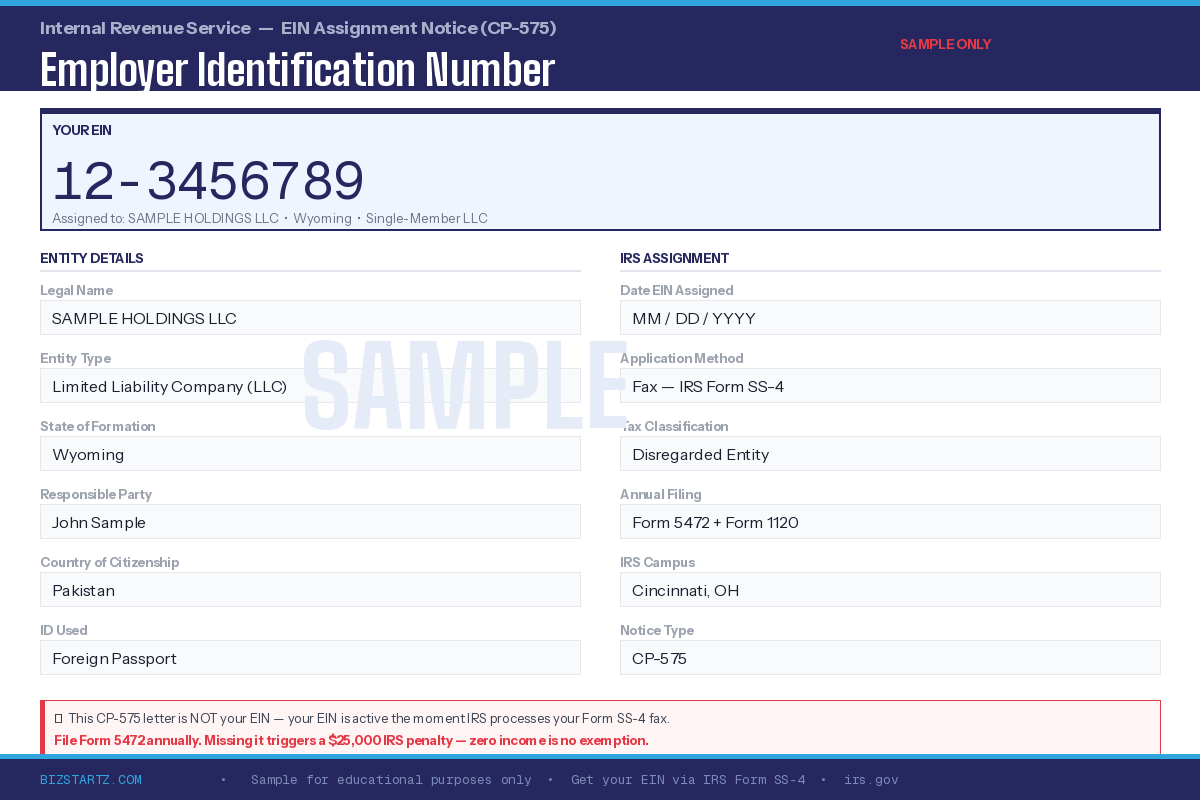
  • Your EIN confirmation (the IRS CP 575 letter or the faxed approval). You cannot open a business account without it — see our guide to getting an EIN without an SSN;
  • Formation documents — your Articles of Organization (or Certificate of Formation);
  • An Operating Agreement showing ownership;
  • A valid passport for each owner;
  • Proof of address (a utility bill or bank statement, sometimes from your home country);
  • A clear description of your business and expected transaction volumes.

Getting Proof of Address Right

Address proof causes more re-submissions than anything else on that list, because founders send whatever they have to hand. What compliance teams want is narrower than that: a document issued by a third party, in your own legal name, showing the address you entered on the application, dated within the last three months.

A utility bill, a bank statement or a government letter normally qualifies. A mobile phone top-up receipt, a screenshot of an app, a bill in a parent’s or spouse’s name, or a document with a different transliteration of your name normally does not. If your utilities are genuinely in a family member’s name — common in a great many countries — a recent bank statement in your own name is the reliable substitute. Send a full-page scan or clear photograph, not a crop, and leave the issuing letterhead and date visible.

Which Address Do You Put on the Application?

This trips up almost everyone. There are three addresses in play and they serve different purposes:

  • Your registered agent’s address is for legal service of process. It is not your operating address, and using it as one — with nothing else to support it — is a recognised decline reason;
  • A US business address from a mail-forwarding service can serve as your company’s US presence, provided it is a real street address rather than a PO box. Many platforms and banks reject PO boxes outright;
  • Your own residential address abroad is what you give as the personal address of the owner, and it is entirely normal for it to be outside the US. Your address proof must match this one.

The consistent pattern that gets approved: a real US street address for the company, your genuine home address for you personally, and documents that match each.

Step-by-Step: Opening From Abroad

  1. Form your LLC and get your EIN. These are prerequisites for every provider.
  2. Choose a provider that accepts your country. Fintech eligibility varies by country and changes over time — check the current eligibility list before applying.
  3. Apply online. Upload your formation documents, EIN letter, passport and address proof.
  4. Pass identity and compliance checks. Providers run KYC (Know Your Customer) and anti-money-laundering screening; answer business-purpose questions clearly and consistently.
  5. Fund and start using the account. Once approved you receive account and routing numbers, often within a few business days.
  6. Connect your payment stack. Add the account to Stripe, PayPal or your marketplace as the payout destination, and only then start driving revenue through it.

The order matters more than it looks. Applying for a payment processor before the bank account exists means Stripe approves you with nowhere to send money, and changing payout details shortly after approval is itself a mild risk signal. Bank account first, processor second.

What These Accounts Cost

Most founder-focused fintech accounts have no monthly fee and no minimum balance, earning money instead on card interchange and currency conversion. Watch for these costs:

  • Wire-transfer fees (incoming domestic wires are often free; international wires may carry a fee);
  • Currency-conversion spreads when moving money to your home currency;
  • Occasional card-issuance or expedited-shipping fees.

Compared with traditional banks — which often impose minimum balances and monthly maintenance charges — the fintech route is usually cheaper for a small remote business. The cost that actually matters to most non-residents is not the monthly fee but the conversion spread, because it applies to every dollar you eventually move home. A platform with no monthly fee and a poor exchange rate can be considerably more expensive than one that charges a small fee and converts near the mid-market rate. Work out the annual cost on your real payout volume rather than comparing headline fees.

A Note on Eligibility

Online banking platforms restrict or prohibit certain countries and business types for compliance reasons, and these lists are updated regularly. If one provider declines or does not serve your country, another may still accept you. Always confirm current eligibility on the provider’s own site rather than relying on older guides — what was open last year may be closed this year, and vice versa.

Business type matters as much as geography. Cryptocurrency trading, gambling, adult content, firearms, pharmaceuticals, money services and multi-level marketing sit on most prohibited lists regardless of where the owner lives. Dropshipping and general e-commerce are usually fine but attract closer scrutiny, so describe them precisely.

Receiving and Sending Money

Many non-resident founders pair a primary business account with a multi-currency tool such as Wise or Payoneer to receive client payments in different currencies and convert at competitive rates. Payment processors like Stripe and PayPal then connect to your US account to collect customer payments and pay out into it. A typical stack looks like: Stripe (collect) → US business account (hold) → Wise (convert and send home).

One warning on the last step. Moving money from your company to yourself is a distribution, and for a foreign-owned single-member LLC every such transfer is a reportable transaction on Form 5472. That is not a reason to avoid paying yourself — it is a reason to keep the transfers legible, on a regular schedule rather than as scattered ad-hoc withdrawals.

Personal vs Business Account — Keep Them Separate

Always open a dedicated business account in the LLC’s name, not your personal account. Mixing personal and business money (“commingling”) can undermine the liability protection your LLC is supposed to give you, and it makes your IRS filings — including Form 5472 for foreign-owned LLCs — much harder to prepare. Clean books start with a clean account.

How Long Approval Takes

For a clean application with all documents in order, fintech approval typically takes anywhere from a few minutes (automated) to a few business days (manual review). If a provider asks follow-up questions, answer quickly and precisely — slow or inconsistent replies are the main reason a straightforward application drags on for weeks. Have your formation documents, EIN letter and passport ready as PDFs before you start so you are never the bottleneck.

Five Tips to Get Approved the First Time

  1. Apply only after the EIN arrives. Trying to open a US business bank account for non-residents without an EIN is the number-one cause of rejection.
  2. Make every detail match. The legal name, address and ownership must be identical across your formation documents, EIN letter and application.
  3. Describe your business plainly. “Software development services for European clients” beats a vague “consulting.”
  4. Use a real, reachable email and phone. Compliance teams may contact you.
  5. Have a back-up provider in mind. If one declines for country or industry reasons, apply to another rather than arguing.

Common Reasons Applications Get Declined

  • No EIN yet — the single most common blocker;
  • Mismatched details between your formation documents, EIN letter and application;
  • A restricted country or high-risk industry;
  • Vague business descriptions that fail compliance review;
  • A registered-agent address used as the “operating” address with no other supporting information;
  • A PO box given as the business address;
  • Address proof in someone else’s name or older than three months;
  • Name transliteration differences between your passport and your formation documents.

What to Do When You Are Declined

A decline is common and usually recoverable, but the instinctive responses — reapplying immediately, or arguing — both make things worse. Work through it in order:

  1. Read what they actually said. Compliance decisions rarely come with detail, but the wording usually distinguishes “we do not serve your country” (final for that provider) from “we could not verify your information” (fixable).
  2. Do not reapply the same day. A second identical application shortly after a decline is a negative signal in itself. Fix the cause first.
  3. Check the fixable list. Name mismatch, stale or mismatched address proof, PO box, vague business description, missing operating agreement — these account for the large majority of recoverable declines.
  4. If it is a country restriction, change provider, not paperwork. No amount of documentation overrides a prohibited-jurisdiction list. Move to a platform that serves your country.
  5. Never use someone else’s identity to get approved. Putting a US friend or relative on the account as the apparent owner is bank fraud, it contradicts your EIN record, and it typically ends in a frozen account with the funds inside it.

If you have been declined more than once and cannot tell why, the problem is usually a mismatch you cannot see between three documents. That is the point at which a second pair of eyes on the paperwork saves weeks — it is a large part of what our bank account assistance actually does.

After You’re Approved: Keep the Account in Good Standing

Getting approved is the start, not the finish. Fintech and bank compliance teams continue to monitor accounts, and the fastest way to get frozen is to look inconsistent. Use the account only for genuine business activity, keep your incoming and outgoing payments roughly in line with the volumes you described at sign-up, and update the provider if your business model changes materially. If they ask for a follow-up document — an invoice, a contract, a refreshed proof of address — send it promptly.

Three specific patterns trigger reviews on otherwise healthy accounts: a sudden order-of-magnitude jump in volume with no explanation, regular round-number transfers to personal accounts that look like structuring, and a business that quietly changes into something on the prohibited list. All three are avoidable by telling the provider what is happening before it happens. Founders who treat compliance requests as routine keep their accounts open for years; founders who ignore them risk a sudden freeze that is far more disruptive than the original onboarding.

Also keep the company itself alive. A US bank account attached to an LLC that has been administratively dissolved for missing its state annual report is a problem waiting to surface at the next periodic review.

US Business Bank Account for Non-Residents: FAQ

Can I open one without visiting the US? Yes. Remote-friendly fintech platforms onboard non-residents entirely online — no branch visit required.

Do I need an SSN or ITIN? No. An EIN plus your passport and formation documents is the standard set; a personal US tax number is not required.

Is it a “real” bank account? Fintech platforms partner with US banks, so you get genuine US account and routing numbers that work with Stripe, PayPal, ACH and wires.

How much money do I need to start? Most founder accounts have no minimum balance, though keeping a small buffer helps your first transactions clear smoothly.

Can I open an account before forming the LLC? No. Every provider needs the entity and its EIN first.

Do I need a US address? A real US street address helps and is required by some providers. A PO box is generally not accepted; a mail-forwarding street address usually is.

Can I have more than one account? Yes, and most non-resident founders do — an operating account plus a multi-currency account for conversions.

What if my country is restricted everywhere I try? Marketplace-oriented platforms such as Payoneer serve a wider country list than startup-focused ones. Check by country before applying.

Will opening a US bank account make me liable for US tax? No. A bank account is not what creates US tax liability; where your income is effectively connected is the question that matters.

How long until I can accept payments? With the EIN in hand and clean documents, days rather than weeks — then a further day or two to connect Stripe or your marketplace.

Bottom Line

A US business bank account for non-residents is within reach: form your company, get your EIN, gather documents that match each other, and apply to a remote-friendly platform that actually serves your country. Check the country question before anything else, keep every detail consistent, and you’ll usually be approved within days. Begin with the right foundation in our US LLC guide.

Provider eligibility, country restrictions and fees change frequently and without notice. Confirm the current position on each provider’s own site before applying; nothing here is financial or legal advice.

How to Get an EIN Without an SSN (2026): A Non-Resident’s Guide

You can get an EIN without an SSN — a Social Security Number is not required to obtain a US federal tax ID. Every year thousands of non-resident founders form a US company and request an EIN (Employer Identification Number, the IRS’s nine-digit tax ID for businesses) without ever setting foot in the United States. The catch is that the fast online application is closed to applicants who lack an SSN or ITIN, so you have to know the manual path. This 2026 guide walks through exactly how it works — the line-by-line form entries, the three filing channels and their real turnaround times, and the mistakes that add weeks to your wait.

If you are still deciding on a structure first, our overview of the US LLC explains why most non-residents start there before applying for an EIN.

What an EIN Is — and Why You Need One

An EIN is to your business what an SSN is to a person: a permanent federal identification number. The IRS uses it to track your entity, and almost every other provider asks for it. You will need an EIN to:

  • Open a US business bank account;
  • Apply for Stripe, PayPal or other payment processors;
  • Hire US contractors or employees;
  • File required IRS returns such as Form 5472 for foreign-owned LLCs;
  • Apply for business licences and wholesale accounts.

In short, your company is barely functional until it has one — which is why getting an EIN without an SSN is one of the first things foreign founders sort out after formation.

Why You Don’t Need an SSN to Get an EIN

The IRS issues EINs to “responsible parties” who may be individuals or entities, US or foreign. The online EIN assistant simply requires the responsible party to enter an SSN or ITIN (Individual Taxpayer Identification Number) for instant verification — which is why it is restricted to people who have one. It is a limitation of the online tool, not of EIN eligibility itself. Foreign founders apply on paper instead, and the IRS has a dedicated process for exactly this situation.

The authority for this sits in the IRS’s own instructions. The Instructions for Form SS-4 direct you to “enter ‘foreign’ or N/A on line 7b if the responsible party doesn’t have and is ineligible to obtain an SSN or ITIN.” That single sentence is the whole basis of the non-resident route — there is no special programme to apply to and no waiver to request.

EIN vs ITIN vs SSN — Don’t Confuse Them

Number Belongs to Needed to get an EIN?
EIN A business
SSN A US citizen/resident individual No
ITIN A non-resident individual (for personal tax) No

You do not need an ITIN or an SSN to be issued an EIN. People often apply for an ITIN unnecessarily — for most founders, the EIN alone is enough to operate. See the section on whether you also need an ITIN further down before you spend money on one.

How to Get an EIN Without an SSN: Step by Step

The whole process runs on a single form, Form SS-4, the Application for Employer Identification Number.

  1. Form your US entity first. You generally need a registered company (an LLC or corporation) before the EIN makes sense. Keep your Articles of Organization handy.
  2. Complete Form SS-4. Fill in the legal name, mailing address, entity type and reason for applying. A foreign address is completely fine.
  3. Handle line 7b — the SSN/ITIN field. This is the line that trips people up. If the responsible party has no SSN or ITIN, write “Foreign” in box 7b. This is the IRS-approved entry for non-resident applicants.
  4. Submit by phone, fax or mail. International applicants have all three channels available; each has a very different turnaround, covered below.
  5. Receive your EIN. Phone can be same-call, fax is generally about four business days, and mail takes roughly four weeks.

Form SS-4 Line by Line for a Non-Resident

Most rejected and stalled applications come down to two or three boxes filled in the way a US resident would fill them. This is what each line means when you are applying from abroad for a foreign-owned LLC.

Line What it asks What a non-resident enters
1 Legal name of entity Exactly as it appears on your Articles of Organization — including “LLC”. Any mismatch here is the most common cause of trouble later at the bank.
2 Trade name / DBA Leave blank unless you have actually registered one.
3 Executor, administrator, trustee Leave blank.
4a–4b Mailing address Your registered agent’s US address or your own foreign address. This is where the paper EIN letter goes, so use an address you can actually receive post at.
5a–5b Street address Only if different from line 4. A foreign address is acceptable — enter city, province and country, and do not abbreviate the country.
6 County and state where principal business is located The US state of formation (for example, Sheridan County, Wyoming).
7a Name of responsible party Your own full legal name as it appears on your passport. This must be a real human being with control over the entity — not your formation agent.
7b SSN, ITIN or EIN of responsible party “Foreign” (or “N/A”). This is the line the whole guide exists for.
8a–8c Is this an LLC? Members? Organised in the US? “Yes”, the number of members, and “Yes”.
9a Type of entity A single-member LLC with a foreign owner normally ticks “Other” and writes “Foreign-owned US disregarded entity”. A multi-member LLC is a partnership by default.
10 Reason for applying “Started new business” for most founders. Tick “Banking purposes” only if that is genuinely the sole reason.
11 Date business started Your formation date from the state.
12 Closing month of accounting year December, unless you have a specific reason to differ.
13 Expected number of employees Zero in all three columns if you have no US staff. Do not guess high — it can trigger employment-tax filing expectations.
14 Employment tax election Leave blank if you have no employees.
16 Principal activity Be specific and plain: “e-commerce retail”, “software development”, “digital marketing services”.
17 Principal merchandise or services One line describing what you actually sell.
18 Has the applicant ever received an EIN? “No” for a newly formed entity.
Third Party Designee Someone authorised to receive the EIN for you Optional — see the section below. Requires their name, address, phone and fax.
Signature Name, title, date, phone, fax Sign it. An unsigned SS-4 is returned without being processed. Include a fax number if you want the reply by fax.

Print and sign the form rather than typing a signature into the PDF — a wet signature on a faxed form causes fewer questions.

The Three Filing Channels, and How Long Each Really Takes

The EIN is free through every channel, so the only thing you are choosing is speed and hassle. Details below are drawn from the current Instructions for Form SS-4 — always confirm on the IRS page before you send anything, because these details do change.

Channel Where it goes Typical turnaround
Phone (international applicants only) +1 267-941-1099, 6:00 a.m. – 11:00 p.m. Eastern, Monday to Friday. Not toll-free. Same call, in many cases
Fax 304-707-9471 from outside the US (855-215-1627 if you are faxing from inside the US) About 4 business days
Mail Internal Revenue Service, Attn: EIN International Operation, Cincinnati, OH 45999 About 4 weeks

The phone channel is the one most guides get wrong. The IRS stopped issuing EINs by telephone to domestic applicants years ago, which is why you will read “you cannot get an EIN by phone” all over the internet. That is true for US residents and false for you: the international line still exists precisely because foreign applicants cannot use the online tool.

Calling the IRS from Your Time Zone

The line runs 6:00 a.m. to 11:00 p.m. Eastern. That window is more generous than it looks from Asia, but it does cross midnight in most of the countries our clients call from. Approximate local equivalents during US daylight saving (roughly March to November — shift each by one hour in the US winter):

Your location Line opens Line closes
Nigeria (WAT) 11:00 a.m. 4:00 a.m. next day
UAE (GST) 2:00 p.m. 7:00 a.m. next day
Pakistan (PKT) 3:00 p.m. 8:00 a.m. next day
India (IST) 3:30 p.m. 8:30 a.m. next day
Nepal (NPT) 3:45 p.m. 8:45 a.m. next day
Philippines (PHT) 6:00 p.m. 11:00 a.m. next day

Have the completed SS-4 in front of you before you dial — the agent works through the form in order and will ask you to read the answers back. Expect to be asked to confirm your name as responsible party and to spell the entity name. Write down the EIN when the agent gives it to you, then ask how the confirmation letter will be sent.

How to Fax if You Have No Fax Machine

Almost nobody in Karachi, Lagos or Kathmandu owns a fax machine, and this is where founders stall for weeks. You do not need hardware — any of the online fax services will send a PDF to a US fax number for a small fee, usually a couple of dollars or a short free trial. Practical points:

  • Send the signed SS-4 as a single clean PDF, portrait orientation, at a normal scan resolution;
  • Include a brief cover page with the entity name and your fax number for the reply;
  • Keep the transmission confirmation — it is your only evidence of the send date;
  • If you want the EIN faxed back, your own receiving fax number must be on the form. A service that gives you an inbound number is worth the extra dollar, because a faxed reply arrives days before the posted letter;
  • Do not send the same application twice. Duplicate submissions can produce two EINs for one entity, which is genuinely painful to unwind.

Documents and Details You’ll Need

  • The exact legal name and address of your US company;
  • The responsible party’s full legal name and foreign address;
  • Your entity type (most non-residents check “LLC” and report the number of members);
  • A reason for applying — usually “Started new business.”

You do not need a US address, US phone number, ITIN or SSN. If you do not have a US phone number, you can leave that field blank or use your international number.

Who Counts as the “Responsible Party”

The IRS wants a named human being who actually controls the entity — the person who can direct its funds and assets. For a single-member LLC that is you, the owner. For a multi-member LLC it is one of the members, typically whoever manages the company.

Two rules matter here. First, the responsible party cannot be a nominee. Using a formation agent, a friend with an SSN, or any stand-in as the responsible party in order to unlock the online application is not a shortcut — it puts false information on a federal form and creates an entity whose IRS record does not match its owner. It also tends to surface later, at exactly the wrong moment, when a bank compares your formation documents against the EIN letter. Second, the online tool limits applicants to one EIN per responsible party per day; that limit is irrelevant to you if you are filing on paper, but it explains a lot of confusing advice you will read elsewhere.

Using a Third-Party Designee

If you would rather not handle the IRS directly, you can authorise a third-party designee on Form SS-4 to receive the EIN on your behalf. Many formation services offer this. Remember two things: the EIN itself is always free from the IRS — you are paying only for the service — and the responsible party should still be you, the true owner, not the agent. A designee’s authority also ends once the EIN is issued; it is not an ongoing power of attorney.

What Arrives, and What to Do With It

The IRS confirmation is a letter called the CP 575. If you applied by fax you will normally receive a faxed cover sheet carrying the EIN first, with the CP 575 following by post. This letter is the document your bank, Stripe, Amazon and Payoneer will all eventually ask for.

Save it in three places the day it arrives — a cloud drive, your own device, and a copy with whoever handles your bookkeeping. The IRS does not re-issue the CP 575. If you lose it, the replacement is a different document called a 147C letter, which you request by calling the same international line and asking for EIN verification. A 147C is accepted everywhere the CP 575 is, so a lost letter is an inconvenience rather than a disaster — but it is another two to four weeks you will not want to spend.

If Nothing Arrives

Silence is the normal failure mode, not rejection. If you faxed and have heard nothing after roughly two weeks, or posted and heard nothing after six, call the international line, confirm whether the application was received, and ask whether an EIN was already assigned before you resend anything. Applications most often go quiet for mundane reasons: an unsigned form, an illegible fax, a missing line 7b entry, or an entity name that does not match state records.

Resist the urge to file a fresh SS-4 as a fix. If an EIN was already issued, a second application creates a duplicate record attached to the same company, and correcting that takes considerably longer than the wait you were trying to shorten.

Common Mistakes That Cause Delays

  • Leaving box 7b blank. The IRS may reject or stall the application — write “Foreign.”
  • Paying a “fee” to the IRS. The EIN is free. You only pay if you hire a third party to file for you.
  • Using a US-resident fax/mail address. Non-residents must use the international filing destination in the instructions.
  • Applying before the company exists. Form your LLC or corporation first.
  • Name mismatches. The name on Form SS-4 must match your formation documents exactly.
  • Forgetting to sign. An unsigned SS-4 is not processed, and you will not be told why.
  • Overstating employees on line 13. Entering a number when you have no US staff invites employment-tax notices you then have to answer.
  • Filing twice out of impatience. Duplicate EINs for one entity are far harder to fix than a slow first application.

Do You Also Need an ITIN?

Usually not, and this is where founders waste the most money. An ITIN is a personal tax number for an individual who has a US filing obligation of their own. It is not a prerequisite for an EIN, a bank account, or a payment processor.

You generally look at an ITIN only when you personally have to file a US return — for example if you have income effectively connected to a US trade or business, or you need to claim a treaty benefit. Getting the EIN first and revisiting the ITIN question at tax time, with an accountant who knows your country’s treaty position, is the cheaper order of operations for most people.

What You Can Do Once You Have an EIN

An EIN unlocks the rest of your US business setup: opening a US business bank account, applying for Stripe or PayPal, hiring contractors, and meeting IRS filing duties. Store the IRS confirmation letter somewhere safe — banks and processors frequently ask to see it, and the IRS does not casually re-issue it.

It also starts your compliance calendar. A foreign-owned single-member LLC generally has to file Form 5472 with a pro forma Form 1120 each year, and that filing is impossible without an EIN — which is the real reason to apply early rather than waiting until a bank asks. Your state has its own annual obligations on top: in Wyoming that is an annual report with a $60 minimum fee.

How Long It Takes and What It Costs

The EIN is free, so the only variable is speed. The method you choose decides how long you wait:

Method Typical turnaround Notes
Phone (international line) Same call, when available Agent reads the EIN to you; confirm hours first
Fax ~4 business days Most reliable quick option for non-residents
Mail 4 weeks or more Slowest; use only if fax is not possible

Plan your timeline backwards from when you need a bank account or Stripe. If you are on a deadline, fax — and apply as soon as your formation documents are issued, because there is nothing else to wait for. Note that the turnaround clock starts when the IRS opens your application, not when you send it, and that processing slows noticeably around the April filing season.

Frequently Asked Questions

Can I get an EIN without an ITIN too? Yes. Neither an SSN nor an ITIN is required. Write “Foreign” on line 7b.

Is the EIN really free? Yes — the IRS never charges for an EIN. Third-party filing services charge for convenience only.

How long is an EIN valid? Indefinitely. It is tied to your entity for life and is not re-issued each year.

Can I open Stripe with just an EIN? Generally yes — an EIN plus your formation documents and a US business bank account is the standard stack for non-resident founders.

Can I really get an EIN by phone as a foreigner? Yes. The international line on +1 267-941-1099 exists for applicants without an SSN or ITIN, even though the IRS no longer issues EINs by phone to US residents.

Do I need a US address or US phone number? No. A foreign address and foreign phone number are both acceptable on Form SS-4.

Can my formation agent be the responsible party? No. The responsible party must be a person who genuinely controls the entity. An agent can be listed as third-party designee instead.

I lost my CP 575 — what now? Call the international line and request a 147C letter. It serves the same purpose and is accepted by banks and processors.

Do I need an EIN before opening a bank account? Yes, in practice. Every US bank and fintech that serves non-resident LLCs asks for the EIN and the IRS letter as part of onboarding.

Does having an EIN mean I owe US tax? No. An EIN is an identifier, not a tax liability. Whether you owe US tax depends on where your income is effectively connected and on any treaty between your country and the US.

Bottom line: you can absolutely get an EIN without an SSN — file Form SS-4 with “Foreign” in box 7b, call the international line or fax it, and you will have your federal tax ID in days rather than months. Start with the right structure using our US LLC guide, or let us handle the EIN application for you as part of formation.

This guide is general information about IRS procedure, not tax or legal advice. Form numbers, filing destinations and processing times change — verify the current details on IRS.gov or speak to a cross-border tax professional about your own situation.

Which US Banks and Payment Platforms Can Non-Residents Actually Use?

A US LLC does not just make you look professional. It unlocks the payment and banking platforms that block your home country outright. This page shows exactly which platforms you can use from India, Pakistan, Nigeria, the UAE, and the Philippines — directly, and through a US LLC. Every row is checked against each provider’s own policy.

Last verified: July 2026. Payment and banking rules change often. We re-check this page every quarter, and we mark the date so you know how current it is.

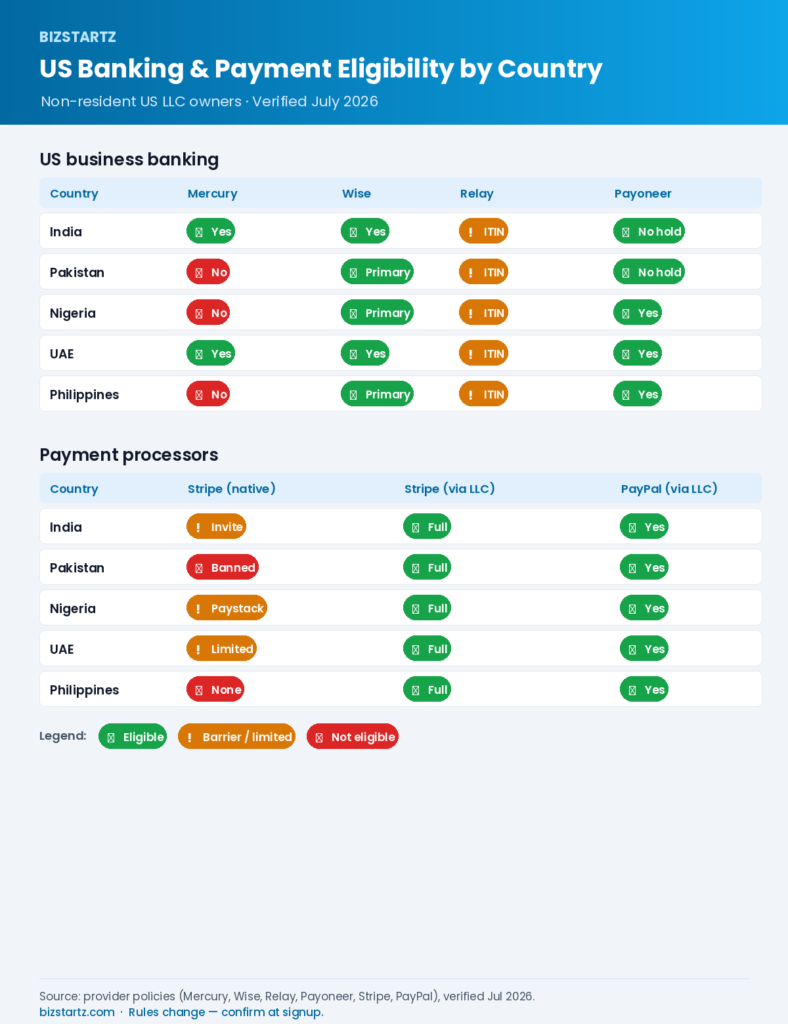
Eligibility matrix showing which US banks (Mercury, Wise, Relay, Payoneer) and payment processors (Stripe, PayPal) non-resident founders in India, Pakistan, Nigeria, UAE, and the Philippines can use in 2026

Banking: which US business account you can actually open

Most non-residents assume any US fintech will take them once the LLC exists. That is not true. Two of the popular options block entire countries, and one needs a document most non-residents do not have. Here is the honest picture.

Legend: ✅ Yes — eligible  ·  ⚠️ Hard / Limited — a real barrier  ·  ❌ No — not eligible.

Your country Mercury Wise Business Relay Payoneer (receiving)
India ✅ Yes — standard KYC ✅ Yes ⚠️ Hard — needs ITIN ✅ Yes — no INR balance
Pakistan ❌ No — prohibited ✅ Yes — primary route ⚠️ Hard — needs ITIN ✅ Yes — no PKR balance
Nigeria ❌ No — prohibited ✅ Yes — primary route ⚠️ Hard — needs ITIN ✅ Yes
UAE ✅ Yes — standard KYC ✅ Yes ⚠️ Hard — needs ITIN ✅ Yes
Philippines ❌ No — prohibited ✅ Yes — primary route ⚠️ Hard — needs ITIN ✅ Yes

What each banking option really means

Mercury. You need your EIN, a passport, and your formation documents. Mercury prohibits founders based in Pakistan, Nigeria, the Philippines, Nepal, and Bangladesh (per Mercury’s prohibited-countries policy, confirmed 31 May 2026). India and UAE founders may apply under standard KYC. One detail competitors miss: Mercury still blocks Nigeria and the Philippines even though the FATF removed them from its grey list in late 2025. Mercury does not follow FATF automatically. Approvals also tightened through 2025. A brand-new LLC with no revenue is sometimes rejected, so apply with a clear business description.

Wise Business. This is your main account when Mercury blocks your country. Wise accepts founders from all five markets, subject to KYC review. You need an active LLC and a verified EIN. Wise may ask for a CP575 letter, a 147C letter, or an IRS-stamped SS-4. The EIN number alone is often not enough. The one-time fee for US account and routing numbers is about $31, with no monthly fee. Wise is not a bank and is not FDIC-insured, so move large balances to your home bank. See our full Wise Business setup guide for a US LLC.

Relay. This is the hardest option for non-residents. Relay accepts an SSN or an ITIN, not an EIN on its own. Without an ITIN, most non-residents cannot pass verification. Relay also expects a physical US address and a real US operating presence. Consider it only after you already hold an ITIN.

Payoneer. This is a receiving account, not a bank account. It works in all five markets. You collect USD, EUR, or GBP, then withdraw to your local bank. You cannot hold a balance inside India, Pakistan, or Bangladesh — the money must be withdrawn. The FX markup is about 2%, higher than Wise at roughly 0.5%. Use it for marketplace payouts like Amazon, Upwork, and Fiverr, not as your main account.

Payment processors: Stripe and PayPal by country

This is the real reason most founders form a US LLC. Your home country decides your native access. A US LLC removes that limit almost entirely.

Your country Stripe (native) Stripe (via US LLC) PayPal Business (via LLC)
India ⚠️ Limited — invite-only ✅ Yes — full USD ✅ Yes — via linked US bank
Pakistan ❌ No — banned ✅ Yes — full USD ✅ Yes — via linked US bank
Nigeria ⚠️ Limited — Naira via Paystack ✅ Yes — full USD ✅ Yes — via linked US bank
UAE ⚠️ Limited — some features ✅ Yes — full USD ✅ Yes — via linked US bank
Philippines ❌ No — not native ✅ Yes — full USD ✅ Yes — via linked US bank

Stripe and PayPal, the honest version

Stripe. A US LLC with an EIN, a US bank, and a US address gives you full USD Stripe. But Stripe checks where you live, not only where the LLC sits. Enter your registered agent address as the business address. Never enter your Karachi, Lagos, or Manila home address on the application. Native Stripe is invite-only in India, limited in the UAE, and pays out only in Naira via Paystack in Nigeria. It is banned in Pakistan and not natively available in the Philippines. Compare the two processors in our Stripe vs PayPal guide for non-residents.

PayPal. You open PayPal Business with the LLC’s EIN, not your personal ITIN. PayPal rejects the ITIN for business setup. You must link a US bank first, such as Mercury or Wise. Your country decides how you withdraw, not whether you can open the account. Full setup takes about 2 to 6 weeks, and most of that is the EIN wait. See the step-by-step in our PayPal for a US LLC without an SSN guide.

The stack we recommend, by country

India. Mercury, plus Wise, plus full Stripe and PayPal through the LLC. Both Mercury and Wise accept Indian founders, so banking is straightforward. Start with forming your US LLC from India.

Pakistan. Wise as your main account, plus Stripe and PayPal through the LLC. Mercury is closed to Pakistan. Stripe is banned in-country, so the US LLC is the only legal route to card payments. See how to form a US LLC from Pakistan.

Nigeria. Wise, plus full USD Stripe through the LLC. Mercury is closed to Nigeria. Native Stripe only pays out in Naira through Paystack, which limits USD business. See how to form a US LLC from Nigeria.

UAE. Mercury, plus Wise, plus Stripe. UAE founders already have decent access — the same banking options as India — but the LLC removes Stripe’s feature limits and gives clean USD banking. Read our LLC formation overview to start.

Philippines. Wise as your main account, plus Stripe and PayPal through the LLC. Mercury is closed to the Philippines. Compare your options on our US bank account hub.

Still deciding where to register? Your state choice does not change Stripe, Mercury, or Wise eligibility — those depend on your country, not Wyoming versus Delaware. See our best states to file an LLC guide for the cost math.

Frequently asked questions

Can I use Stripe without a US LLC in Pakistan or the Philippines?
No. Stripe does not operate in Pakistan and is not native in the Philippines. A US LLC with an EIN and a US bank is the legal route to full Stripe.

Which US bank works if Mercury rejects my country?
Wise Business. It accepts founders from India, Pakistan, Nigeria, the UAE, and the Philippines, subject to KYC. You need an active LLC and a verified EIN.

Does PayPal accept an ITIN?
No. PayPal Business needs the LLC’s EIN, not your personal ITIN. Link a US bank such as Mercury or Wise before you apply.

Is Payoneer a US bank account?
No. Payoneer is a receiving account for marketplace and B2B payments. You cannot hold a balance in India, Pakistan, or Bangladesh, and it is not FDIC-insured.

How long until my payment stack works?
Plan for 2 to 6 weeks from formation. Most of the wait is the EIN, which takes about 4 business days by fax or up to 4 weeks by mail for non-residents.

Get your country mapped in one call

Not sure which stack fits your country and business model? Book a free banking check and we will map the exact platforms you can use, in the right order, for your situation.


This article is for informational purposes only and is not legal or tax advice. Rules and fees change; verify with the official source or consult a licensed CPA or attorney for your specific situation.

doola Alternative for Non-Residents: What They Skip (2026)

Forming a US LLC takes one to two business days with most services. The harder part begins after formation — when your bank rejects you, or your home country regulator asks questions you were never warned about.

According to doola.com/pricing, doola Starter costs $297/year as a recurring subscription, not a one-time fee. That subscription includes formation, EIN assistance, and a registered agent. What it does not include: a warning that Mercury prohibits Pakistan, Nigeria, and Philippines-domiciled founders, or guidance on India’s FEMA overseas investment obligations.

If you are searching for a doola alternative built specifically for non-residents, this comparison is for you. Bizstartz is built exclusively for non-residents. This page compares both services honestly — crediting doola where it genuinely wins, and naming exactly where non-residents are left without guidance. For a full breakdown of how US LLCs work for non-residents, see the LLC page.

The Recurring Cost Reality: What doola Actually Costs Over Three Years

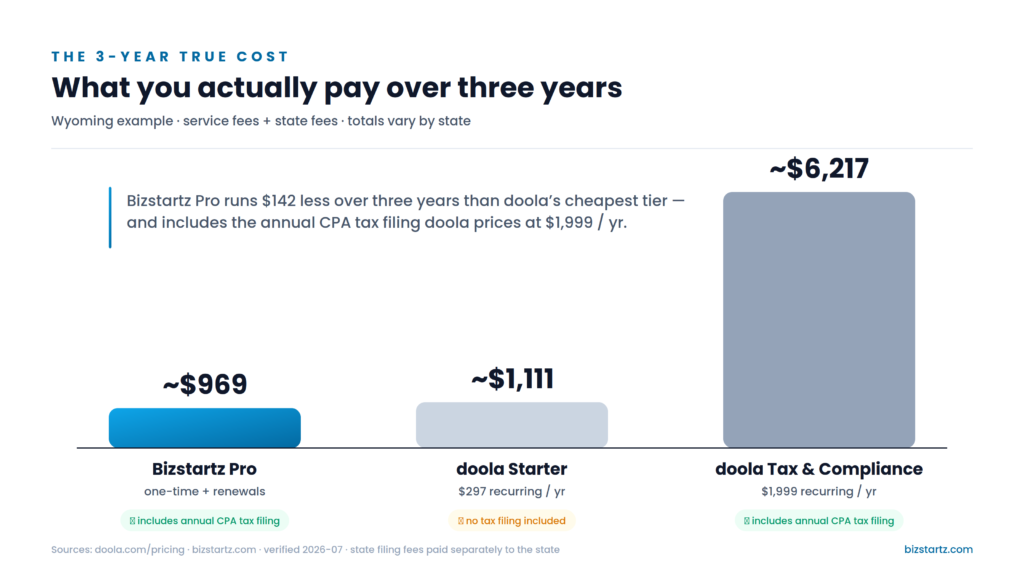
doola’s plans are annual subscriptions. Bizstartz’s formation fee is one-time, but Bizstartz is not free after Year 1 either — annual CPA tax filing, registered agent renewal, and the state annual fee apply from Year 2 (roughly $285/year in Wyoming, varying by state). The real difference is not one-time-versus-recurring; it is that doola’s cheapest tier excludes tax filing, while Bizstartz’s annual cost includes it for a fraction of doola’s tax-inclusive tier.
3-year cost comparison of Bizstartz vs doola for non-residents — Bizstartz Pro ~$969 with CPA tax filing vs doola Starter ~$1,111 without, Wyoming example

Year 1 vs Year 2: The Number doola’s Homepage Does Not Emphasize

doola Starter costs $297 in Year 1, $297 again in Year 2, and $297 in Year 3 — $891 over three years for registered agent and compliance reminders, with no tax filing included. Bizstartz Pro is $299 once to form, then roughly $285/year from Year 2 in Wyoming — but that annual figure includes CPA-handled US tax filing (Form 5472/1120), which doola Starter does not. Comparing like for like: Bizstartz at ~$969 over three years includes tax filing; doola Starter at ~$1,111 does not.

For founders in India, Pakistan, or Nigeria, each annual renewal is a fresh USD conversion. Exchange rates fluctuate — the INR, PKR, or NGN cost of that renewal will differ every year.

True Cost Comparison: Bizstartz One-Time vs doola Annual Subscription

Bizstartz plans are charged once. State fees are separate for both services.

Bizstartz Pro doola Starter doola Tax & Compliance
Formation fee $299 one-time $297/year $1,999/year
Year 2+ (Wyoming) ~$285/yr (CPA tax filing + RA renewal + $60 state) $297 + $60 state $1,999 + $60 state
Includes annual US tax filing? Yes (CPA) No Yes
3-year total (Wyoming) ~$969 ~$1,111 ~$6,217

Figures use Wyoming and vary by state (Delaware’s $300/yr franchise tax raises every row). Bizstartz’s Year-2+ cost covers annual CPA tax filing (Form 5472/1120), registered agent renewal, and the state annual fee. Both services have recurring costs — the difference is that doola’s cheapest tier excludes tax filing entirely, while doola’s tax-inclusive tier costs roughly six times more than Bizstartz over three years.

Over three years in Wyoming, Bizstartz Pro (~$969, including annual CPA tax filing) costs less than doola Starter (~$1,111, which excludes tax filing) — and far less than doola’s tax-inclusive tier (~$6,217). New Mexico has no annual report and no annual fee — the lowest ongoing state cost for non-residents with no US operations.

Your 3-Year Total Depends on Your State

The service cost is the same in every state — Bizstartz Pro ($299 one-time) plus annual CPA tax filing and registered agent renewal (currently around $225/year, reviewed annually). Only the state fee changes:

  • New Mexico — $50 to file, no annual report, no annual fee. Lowest ongoing cost.
  • Wyoming — $100 to file, $60/year. Low and privacy-friendly.
  • Delaware — $90 to file, $300/year franchise tax. Highest ongoing; choose only if raising US venture capital.

To estimate your 3-year total: take the Bizstartz service cost (~$749 over three years for Pro plus two renewals), then add your state’s filing fee and two years of its annual fee. In Wyoming that is roughly $969; in New Mexico, less; in Delaware, more.

According to doola.com/pricing, doola’s plans are annual recurring subscriptions — not one-time formation fees. The doola Starter plan costs $297 per year, totaling $891 over three years for registered agent service and compliance reminders, plus state fees separately. By contrast, Bizstartz Pro charges a one-time fee of $299 plus state fees. Over three years in Wyoming, Bizstartz Pro totals roughly $969 including annual CPA tax filing, versus roughly $1,111 for doola Starter without tax filing, or roughly $6,217 for doola’s tax-inclusive tier. Both services recur; founders in India, Pakistan, or Nigeria also absorb currency-conversion costs on each renewal.

What You Get at Each Price Point — Honestly

doola’s upper tiers include services Bizstartz does not offer. doola’s Tax & Compliance tier at $1,999/year adds federal and state tax filing plus a 1:1 tax consultation. doola’s Business-in-a-Box tier at $2,999/year adds bookkeeping, monthly financial statements, and quarterly tax support. These are real deliverables — not padding.

If you need a US accountant to file your annual returns, doola’s higher tiers bundle that cost. If you already have a trusted accountant or your LLC has no US tax obligation in Year 1, paying $297/year for registered agent and compliance reminders is the only comparison that matters — and Bizstartz Pro at $299 once covers formation plus registered agent for the first year.

What doola Does Not Tell You: Country-by-Country Operational Gaps

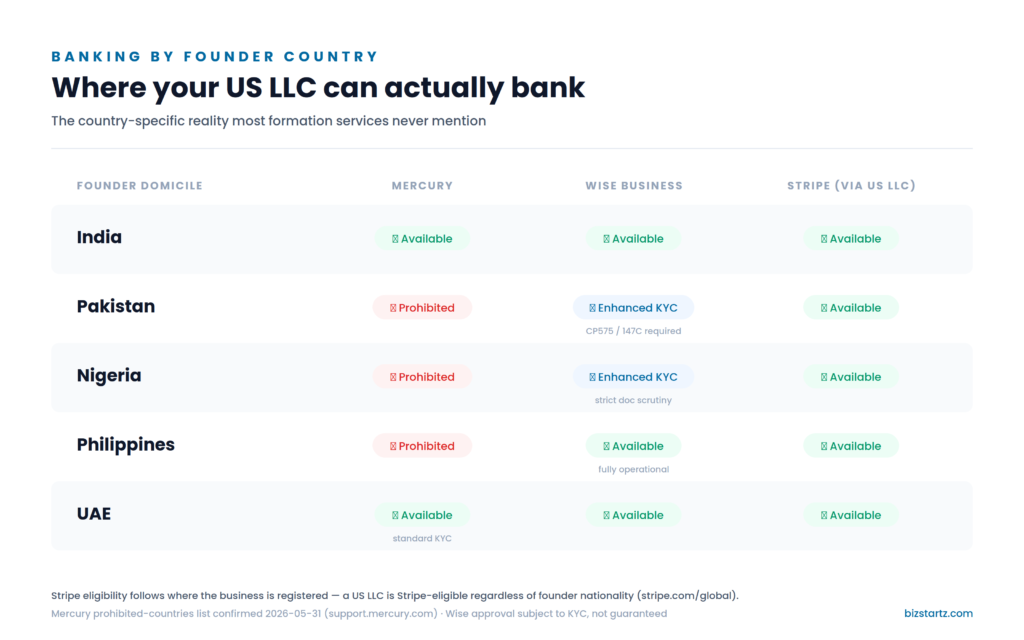
doola’s bank account guidance defaults to Mercury. As of 2026, Mercury prohibits Pakistan, Nigeria, Philippines, Nepal, and Bangladesh-domiciled founders (confirmed 2026-05-31). For founders from these countries, Mercury is not an option — full stop.
US business banking options by founder country — Mercury prohibits Pakistan, Nigeria, Philippines founders; Wise and Stripe available via US LLC

India: FEMA, ODI, TCS, and the Compliance Layer doola Does Not Cover

A US LLC is an unlisted entity. Under the FEMA (Overseas Investment) Rules 2022, any Indian resident acquiring membership interest in an unlisted foreign entity is making an ODI — Overseas Direct Investment. Your Authorised Dealer (AD Category-I) bank must obtain a Unique Identification Number (UIN) from RBI before you remit a single rupee. Remitting without a UIN is a FEMA contravention; the penalty can reach 3x the amount involved.

TCS — Tax Collected at Source — applies at 20% on LRS (Liberalised Remittance Scheme) remittances above INR 10 lakh per PAN per financial year for investment/other purposes. Budget 2026 did not change this rate. TCS is adjustable against your income tax via ITR, but you must plan the cash flow impact upfront.

Every year by December 31, you must file an Annual Performance Report (APR). US LLC ownership and foreign bank accounts must also appear in Schedule FA of your Indian income-tax return. Non-disclosure risks scrutiny under the Black Money Act. doola covers none of this.

Pakistan: Mercury Will Decline Your Application — Here Is What to Do Instead

According to Mercury’s prohibited-countries list (confirmed 2026-05-31), Pakistan-domiciled founders cannot open a Mercury account. Wise Business is the alternative. Approval requires enhanced KYC — the EIN number alone may not suffice. Wise may require a CP575, 147C, or IRS-stamped SS-4. Activating US account details costs approximately $31. Approval is not guaranteed.

Nigeria: Mercury Prohibition, Wise KYC Reality, and the Banking Path That Works

Mercury prohibits Nigeria-domiciled founders (confirmed 2026-05-31). Nigeria was removed from the FATF grey list on October 24, 2025 — this improves the broader compliance environment but does not change Mercury’s internal policy. Wise Business with enhanced KYC is the primary path. Address verification and business-evidence scrutiny is strict; prepare documentation before applying.

Philippines: Mercury Is Blocked, Wise Is Fully Operational

Mercury prohibits Philippines-domiciled founders (confirmed 2026-05-31). Wise operates fully in the Philippines — local account and card since May 2024, PHP account details since February 2025. Wise is the strongest banking path for Philippines founders.

UAE: Mercury Is Open — What to Verify Before Applying

Mercury does not list UAE as prohibited (confirmed 2026-05-31); standard KYC applies. Stripe is available in the UAE. The primary decision for UAE founders is whether to use doola’s in-house tax filing or engage Bizstartz alongside a separate US CPA.

The Non-Resident EIN Reality: Why ‘We Handle It’ Is Not Enough

Every formation service says they handle your EIN (Employer Identification Number — your LLC’s 9-digit federal tax ID). None of them explain what happens after.

Why Non-Residents Cannot Use the IRS Online EIN Tool

The IRS online EIN application requires an SSN (Social Security Number) or ITIN (Individual Taxpayer Identification Number). Most non-residents have neither. Understanding What is an ITIN Number matters here — an ITIN is a tax-processing number issued by the IRS to individuals who are not eligible for an SSN, and it can unlock the online EIN tool for non-residents who already hold one. That means the IRS online tool is not an option for most non-residents — you must use Form SS-4 by fax, mail, or the IRS international phone line at 267-941-1099 (Monday–Friday, 6 a.m.–11 p.m. Eastern).

Practitioner reality: that phone line has significant congestion. Fax is the more reliable path.

Form SS-4 by Fax: The Correct Numbers and Routing Logic

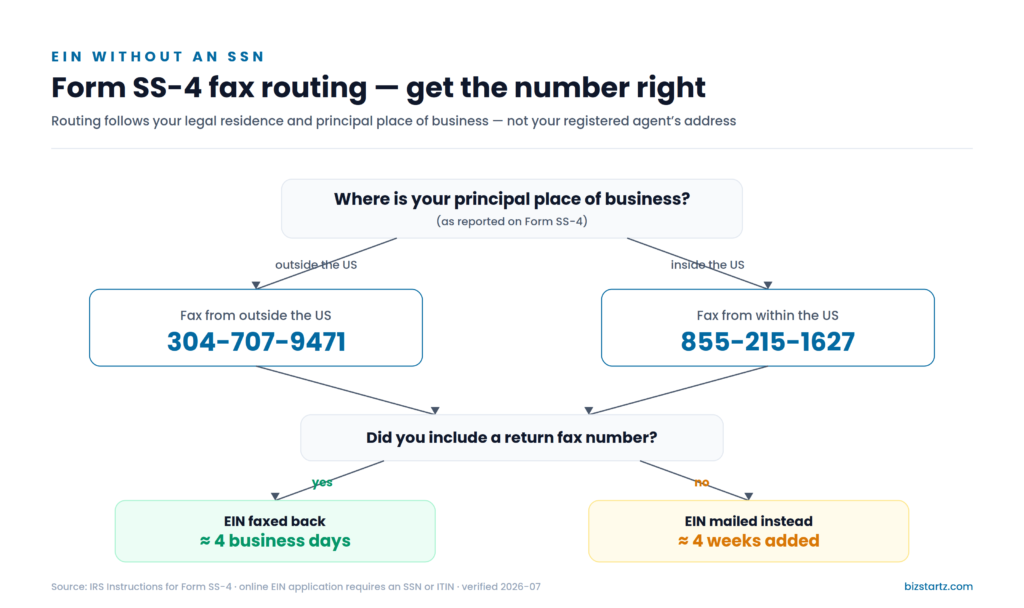
Form SS-4 fax routing depends on your legal residence and principal place of business — not your LLC’s registered agent address.

For founders in India, Pakistan, Nigeria, the Philippines, or the UAE whose legal residence and principal place of business remain in their home country, the correct fax numbers are:

  • From outside the US: 304-707-9471
  • From within the US: 855-215-1627

According to the IRS, if you include a return fax number on your SS-4, the IRS faxes back a cover sheet with your EIN in approximately 4 business days. Without a return fax number, the IRS mails the EIN — adding approximately 4 weeks.

Always include a return fax number.

IRS Form SS-4 fax routing for non-residents — 855-215-1627 within US, 304-707-9471 outside US, EIN in about 4 business days with return fax
According to the IRS, non-residents cannot use the IRS online EIN application portal — it requires an SSN or ITIN that most non-resident founders do not hold. The reliable path is Form SS-4 by fax — 855-215-1627 from within the US, or 304-707-9471 from outside the US — with routing based on the applicant’s legal residence, not the registered agent’s address. When a return fax number is included on the SS-4, the IRS returns the EIN in approximately 4 business days. Without a return fax number, the IRS mails the EIN, adding approximately 4 weeks to the timeline.

CP575, 147C, and Why Your Bank Account Is Still Not Open

This is where most founders stall — and where formation services go silent.

Your EIN is usable immediately for bank accounts. However, according to the IRS, a new EIN takes up to approximately 2 weeks to enter IRS permanent records. Until then, it cannot pass TIN matching or be used to e-file.

The CP575 confirmation letter — which many banks and platforms request — arrives by mail 2–6 weeks after EIN issuance. CP575 is not EIN issuance itself. The IRS issues CP575 once and never reissues it.

If you lose your CP575, request a 147C letter from the IRS Business & Specialty Tax Line at 800-829-4933.

Wise Business may require the CP575, 147C, or an IRS-stamped SS-4 before approving your account. The EIN number alone may not satisfy Wise’s compliance review. If you need to provide tax identification documentation to a US platform or bank, understanding Form W-9 Explained in Detail will clarify what each document certifies and when it applies.

Where doola Genuinely Wins: An Honest Assessment

In-House CPA and Tax Filing: A Real All-in-One Advantage

doola’s Tax & Compliance plan at $1,999/year covers federal and state tax filing plus a 1:1 tax consultation — a genuine all-in-one for US-side obligations. The Business-in-a-Box plan at $2,999/year adds bookkeeping, monthly financial statements, synchronized workflows, and estimated quarterly tax support.

This matters because the IRS imposes a $25,000 penalty per Form 5472 per year for failure to file — doola’s in-house CPA handles that US-side exposure directly. Neither doola plan covers India-side obligations: FEMA/ODI compliance, APR filings, and Schedule FA disclosures require a qualified Indian CA working independently. Pakistan, Nigeria, and Philippines founders must resolve banking separately regardless of which formation service they use.

MCP Integration: Formation from AI Clients

In April 2026, doola launched a Model Context Protocol (MCP) integration allowing formation to be initiated from AI clients such as Claude and Replit via conversational workflows. For technical founders already working inside those environments, this is a genuine differentiator.

It does not resolve Mercury’s prohibition on Pakistan, Nigeria, and Philippines-domiciled founders, India-side FEMA/ODI requirements, or EIN fax routing for non-residents without a US presence.

Formation Speed and Virtual Address

doola states formation filings are typically submitted within 1–2 business days. A virtual US business address is included with the Starter plan — useful for bank documentation requirements. doola also offers a Formation Money-Back Guarantee, though it applies only to errors caused by doola’s own service, not state processing delays or banking rejections.

Comparison Table: Bizstartz vs doola Across 10 Dimensions

# Dimension Bizstartz doola Winner Why It Matters for Non-Residents
1 Pricing $199 / $299 / $699 one-time + state fees $297 / $1,999 / $2,999 per year + state fees Bizstartz Bizstartz Pro ~$969/3yr incl. annual CPA tax filing; doola Starter ~$1,111/3yr excl. filing; doola Tax & Compliance ~$6,217/3yr
2 Non-resident EIN Documents SS-4 fax routing (855-215-1627 within US / 304-707-9471 outside US); ~4 business days with return fax Assists with EIN; no documented country-specific fax routing Bizstartz Wrong fax number = weeks of delay or no EIN
3 Mercury prohibition warnings Explicitly warns Pakistan, Nigeria, Philippines, Nepal, Bangladesh founders; routes to Wise Defaults to Mercury; no prohibition warnings documented Bizstartz Applying to Mercury from a prohibited country risks a permanent ban
4 India FEMA / ODI / TCS / Schedule FA Covers all four compliance layers Not documented Bizstartz Skipping ODI reporting is a FEMA contravention — penalty up to 3× the amount involved
5 Stripe access by founder country Explains US LLC registration = Stripe-eligible regardless of founder location Not documented for specific non-resident countries Bizstartz Pakistan and Nigeria founders cannot access Stripe on a home-country entity
6 State selection for non-residents Wyoming ($100 + $60/yr), Delaware ($90 + $300/yr), New Mexico ($50, no annual fee) with non-resident cost context Supports multiple states; depth not documented Bizstartz New Mexico has zero annual fees — the lowest ongoing cost for founders with no US operations
7 In-house tax filing and CPA Not included Tax & Compliance ($1,999/yr): federal + state filing + 1:1 consultation doola Founders who need managed US tax compliance benefit from doola’s bundled CPA service
8 Platform technology / MCP Not documented MCP integration launched April 2026 (Claude, Replit) doola AI-assisted formation workflows reduce manual data entry friction
9 Registered agent Included Included Tie Every US state requires a physical street address — PO boxes are not accepted
10 Wise Business guidance for Mercury-prohibited founders Documents ~$31 activation fee, CP575/147C requirement, enhanced KYC for Pakistan/Nigeria Not documented Bizstartz Without a CP575 or 147C letter, Wise verification stalls — sometimes for weeks

How to Read This Table

India founders: rows 4 and 8 are your highest-stakes rows — FEMA/ODI compliance and platform technology. Pakistan, Nigeria, and Philippines founders: rows 3 and 10 determine whether you get a working US bank account at all. UAE founders: rows 1 and 7 are most relevant — pricing structure and whether you need bundled tax support. Every founder should read row 2 (EIN routing) and row 6 (state fees) before choosing any service.

Who Should Choose Which Service: Routing by Founder Country

India Founders: Formation + Country-Specific Guidance + Separate Indian CA

Choose Bizstartz for formation. Your US LLC triggers FEMA/ODI obligations — a separate qualified Indian CA must handle the Annual Performance Report (APR), Unique Identification Number (UIN) registration, and Schedule FA disclosure. Neither Bizstartz nor doola covers Indian-side compliance. doola’s Tax & Compliance plan at $1,999/yr is a valid option for US-side federal tax filing — but only after your Indian CA has addressed FEMA/ODI. Sequence matters: India-side first, US-side second.

Pakistan, Nigeria, Philippines Founders: Mercury Will Decline You — Start with Wise

Choose Bizstartz. According to Mercury’s prohibited-countries list (confirmed 2026-05-31), Mercury prohibits Pakistan, Nigeria, and Philippines-domiciled founders. doola defaults to Mercury — that path ends in a decline. Wise Business is the correct route: Wise accepts EIN-holding US LLC owners from all three countries, subject to enhanced KYC. According to Wise, activating US routing and account numbers costs approximately $31 USD one-time, and you must provide a CP575 or 147C IRS confirmation document. Stripe eligibility is unaffected by your bank choice — a US LLC is Stripe-eligible regardless of which account you hold.

UAE Founders: Mercury Is Open — Decision Is Cost vs In-House Tax Filing

Mercury does not list UAE as prohibited. Stripe is available in the UAE. The real decision is cost: Bizstartz Pro at $299 once, plus a separate US CPA, versus doola Tax & Compliance at $1,999/yr. UAE founders with no US-effectively-connected income and a straightforward structure often pay less total with Bizstartz plus a standalone CPA.

Tech-Forward Founders (Any Country): doola’s MCP Integration Is a Real Differentiator

doola launched a Model Context Protocol (MCP) integration in April 2026, enabling formation from Claude and Replit. That is a genuine advantage for developers. It does not resolve Mercury’s country prohibitions or India-side FEMA/ODI obligations — formation speed is irrelevant if banking and compliance gaps remain.

Any Non-Resident Prioritizing Lowest 3-Year Cost: Bizstartz

Over three years in Wyoming, Bizstartz Pro totals ~$969 including annual CPA tax filing; doola Starter totals ~$1,111 without tax filing; doola’s tax-inclusive tier totals ~$6,217. Bizstartz delivers tax-inclusive compliance at the lowest three-year cost. Recurring USD payments also compound currency-conversion costs for India, Pakistan, and Nigeria founders — on both services. If you are also evaluating other formation services, the Best EasyFiling Alternative guide compares Bizstartz against another popular non-resident formation platform on the same dimensions.

Frequently Asked Questions

doola says it handles the EIN. Why does it take weeks for my bank account to open?

doola assists with the EIN application, but IRS processing is outside any service’s control. According to irs.gov, non-residents who fax Form SS-4 (855-215-1627 from within the US, or 304-707-9471 from outside) with a return fax number receive the EIN in approximately 4 business days. The CP575 confirmation letter — a separate physical document — arrives by mail 2–6 weeks later. Wise Business may require the CP575 or a 147C letter before approving your account, not just the EIN number itself. That document delay is why bank opening lags behind formation.

I am from Pakistan. doola mentions Mercury as a banking partner. Will Mercury accept me?

No. According to support.mercury.com, Mercury prohibits Pakistan-domiciled founders (confirmed 2026-05-31). Applying after formation results in a decline that is often permanent. According to wise.com, Wise Business accepts Pakistan-resident owners of US LLCs with an EIN, subject to enhanced KYC — but approval is not guaranteed. Plan your banking path before you form, not after a Mercury rejection.

I am an Indian resident. Do I need to do anything in India before sending money to my US LLC?

Yes — and this is a gap doola does not address. Under the FEMA (Foreign Exchange Management Act) Overseas Investment Rules 2022, acquiring membership interest in a US LLC is generally an ODI (Overseas Direct Investment) transaction because a US LLC is unlisted. Your AD Category-I bank must obtain a UIN (Unique Identification Number) from RBI before you remit funds. Remitting without a UIN is a FEMA contravention. LRS (Liberalised Remittance Scheme) remittances above INR 10 lakh per PAN per financial year attract 20% TCS for investment purposes. You must also disclose US LLC ownership in Schedule FA of your Indian ITR annually. Consult a qualified Indian CA before remitting.

doola’s Starter plan is $297. Is that a one-time fee?

No. According to doola.com/pricing, doola plans are annual recurring subscriptions — the Starter plan is $297 every year ($891 over three years), and does not include tax filing. Bizstartz’s formation fee is one-time (Basic $199, Pro $299, Premium $699), but Bizstartz is not cost-free after Year 1: annual CPA tax filing, registered agent renewal, and the state annual fee apply from Year 2 — roughly $285/year in Wyoming, varying by state. The honest comparison over three years in Wyoming: Bizstartz Pro ~$969 including CPA tax filing, versus doola Starter ~$1,111 excluding it. For managed US tax filing, doola’s equivalent tier runs roughly $6,217 over three years.

I am from Nigeria. Can I use Stripe with a US LLC even though Stripe does not support Nigerian businesses?

Yes. According to stripe.com/global, Stripe eligibility is determined by the country where the business is legally registered, not the founder’s nationality. A US LLC is US-registered and Stripe-eligible. Your Nigerian domicile does not affect this. According to support.mercury.com, Mercury prohibits Nigerian founders — the banking path is Wise Business, which provides US routing and account numbers usable for Stripe payouts, subject to enhanced KYC. Approval is not guaranteed.

Does doola cover my India-side FEMA and ODI obligations as part of its tax filing service?

No. doola’s tax services cover US federal obligations — Form 5472, Form 1065, Form 1040-NR. They do not cover India-side FEMA compliance, ODI UIN registration, Annual Performance Report (APR) filings due December 31 each year, or Schedule FA disclosure in your Indian ITR. US-side and India-side compliance are independent — both apply simultaneously. You need a qualified Indian CA for the India side regardless of which US formation service you use.

Is BOI reporting required for my US LLC as a non-resident owner?

Currently, no. According to FinCEN, per FinCEN’s interim final rule effective March 26, 2025, all US-formed entities — including LLCs formed by non-residents — and their beneficial owners (BOI refers to Beneficial Ownership Information reporting under the Corporate Transparency Act) are exempt from BOI reporting. Only entities formed under foreign law that register to do business in a US state must file. This is an interim rule; the final rule is still pending. Verify current status before relying on this exemption.

According to FinCEN, the interim final rule effective March 26, 2025 exempts all US-formed entities — including LLCs formed by non-resident founders from India, Pakistan, Nigeria, the UAE, and the Philippines — from BOI (Beneficial Ownership Information) reporting under the Corporate Transparency Act. As of 2026, only entities formed under foreign law that register to do business in a US state must file a BOI report. This is an interim rule; the final rule remains pending, and founders should verify current FinCEN guidance before relying on this exemption.

Which is cheaper over three years: doola Starter or Bizstartz Pro?

In Wyoming over three years, Bizstartz Pro totals roughly $969 including annual CPA tax filing (Form 5472/1120), registered agent renewal, and state fees. doola Starter totals roughly $1,111 but excludes tax filing. doola’s tax-inclusive Tax & Compliance tier totals roughly $6,217. Bizstartz is the lowest three-year cost for tax-inclusive compliance; exact totals vary by state.

The Bottom Line: Is Bizstartz the Right doola Alternative?

doola is a competent all-in-one platform. Its in-house CPA, MCP integration, and bookkeeping tiers are genuine advantages for founders who want one vendor for everything. Over three years in Wyoming, Bizstartz Pro totals about $969 — including CPA-handled annual US tax filing — versus about $1,111 for doola Starter, which excludes tax filing, or about $6,217 for doola’s tax-inclusive tier. Both services recur; Bizstartz’s edge is tax-inclusive compliance at the lowest annual cost.

For Pakistan, Nigeria, and Philippines founders: according to Mercury’s prohibited-countries list, Mercury will decline you. Bizstartz routes you to Wise Business before you form — not after rejection.

For India founders: FEMA and ODI obligations exist independently of any formation service. Bizstartz covers this gap. Non-resident founders who need an ITIN to access the IRS online EIN tool or satisfy US tax withholding requirements should review How to Apply for an ITIN Number before completing their formation.

Neither service can guarantee bank account approval — that decision belongs to Mercury or Wise. Neither replaces a qualified Indian CA for FEMA/ODI compliance or a US CPA for complex tax situations.

Start with the plan built for your country.

Wyoming LLC Filing Fee: What Non-Residents Actually Pay

The Wyoming LLC filing fee is $100 by mail — or $102 online due to a card processing fee charged by the Wyoming Secretary of State. That $100 is the floor, not the full cost.

Non-residents also pay for a registered agent (a US-based person or company that receives legal documents on your behalf), typically $50–$150 per year. Add an EIN (Employer Identification Number — your federal business tax ID) procurement service and a formation service fee. For a full picture of what non-residents pay across every stage, see the complete guide to US LLC formation for non-residents.

Total year-one cost for a non-resident runs $349–$500+, not $100. This article breaks down every cost line, in order, with real numbers.

According to the Wyoming Secretary of State, the Articles of Organization filing fee for a new Wyoming LLC is $100 by mail. Filing online via the Wyoming Secretary of State’s e-filing portal (wyobiz.wyo.gov) adds a card processing fee, bringing the online total to $102. This fee applies equally to US residents and non-residents — nationality does not change the state charge.

Wyoming LLC filing fee $100 state charge versus $349 to $500 real year-one cost for non-residents

Wyoming LLC Filing Fee: The Official State Charge

The Wyoming LLC filing fee is $100 by mail or $102 online. This is set by the Wyoming Secretary of State.

Articles of Organization: $100 by mail, $102 online

The Wyoming LLC filing fee is $100 to file your Articles of Organization — the founding document that legally creates your LLC with the state. Filing online via the Wyoming Secretary of State online filing portal adds a card processing fee, bringing the online total to $102.

This fee applies to all filers — resident or non-resident. Your nationality does not change the state charge.

What the $100 covers — and what it does not

The Wyoming LLC filing fee covers state registration only. It does not include:

  • A registered agent (a US-based person or company that receives legal documents on your behalf)
  • An EIN (Employer Identification Number — your US federal business tax ID)
  • Any formation service fees

Wyoming imposes no separate publication requirement and no general state business license fee for most LLCs — unlike New York or Arizona. Confirm current processing timelines directly with the Wyoming Secretary of State before filing, as standard and expedited turnaround times are subject to change.

Wyoming LLC Total Cost Breakdown for Non-Residents

Year-one cost for a non-resident forming a Wyoming LLC typically runs $349–$500+ when all mandatory and service fees are counted. To compare what other states charge at formation, see the breakdown of US LLC formation cost across popular non-resident states.

Year-one formation costs (one-time)

Most non-residents see only the Wyoming LLC filing fee and miss what sits beside it. The full year-one stack looks like this:

Cost Item Amount
Wyoming state filing fee (online) $102
Bizstartz Basic formation service $199
Registered agent (first year) $50–$150
EIN service (IRS fee is $0; service fee varies) Confirm at checkout

Year-one minimum: $349+ before optional EIN service fees.

Wyoming LLC true year-one cost breakdown — $102 state filing fee, formation, registered agent, EIN, totaling $349 or more

A registered agent is a person or company with a Wyoming street address who receives legal mail on behalf of your LLC. According to Wyoming state law, every Wyoming LLC is required to maintain one — this is not optional.

Year-two and ongoing annual costs

This is where non-residents from India, Nigeria, the UAE, and elsewhere are often caught off-guard. Formation is one-time. Compliance is every year.

According to the Wyoming Secretary of State, Wyoming’s annual report fee is a minimum $60 ($62 if filed online), due on the first day of your LLC’s anniversary month — required even if the LLC has zero income. For LLCs with Wyoming assets above $300,000, the annual fee scales at $0.0002 per dollar of Wyoming assets. An LLC with $500,000 in Wyoming assets pays $100.

Recurring Cost Annual Amount
Wyoming annual report fee $60 minimum ($62 online)
Registered agent renewal $50–$150

Year-two minimum: $110–$210 per year. Budget for this before you form.

According to the Wyoming Secretary of State, every Wyoming LLC must file an annual report and pay a minimum fee of $60, due on the first day of the LLC’s anniversary month. This fee applies regardless of whether the LLC has any US income or business activity. For LLCs with Wyoming-based assets exceeding $300,000, the fee scales at $0.0002 per dollar of assets. Failure to file can result in administrative dissolution of the LLC.

What Non-Residents Pay That US Residents Do Not

The Wyoming LLC filing fee is $100 for every founder. What changes is what comes on top of it — non-residents carry mandatory costs that US residents with a Wyoming address can avoid.

Registered agent: mandatory cost, not optional

US residents living in Wyoming can serve as their own registered agent for free. Non-residents cannot. Wyoming law requires a registered agent with a physical Wyoming street address — PO boxes are not accepted. Hiring a professional registered agent service costs $50–$150 per year. This is a structural legal requirement, not an upsell.

EIN for non-residents: fax or mail, no same-day option

An EIN (Employer Identification Number — the IRS federal tax ID required to open a US business bank account) is free directly from the IRS. But how you obtain it depends on residency.

US residents can call the IRS and receive an EIN the same day. Non-residents without a US Social Security Number or ITIN (Individual Taxpayer Identification Number — an IRS-issued ID for non-residents who do not have an SSN) cannot use the IRS phone application. According to the IRS, non-residents must submit IRS Form SS-4 either:

  • By fax — processing takes approximately 4 business days
  • By mail — processing takes 4–6 weeks

The EIN itself is free from the IRS. Service fees apply only if you hire a formation service to handle the submission on your behalf. For the full process, see how to get an EIN as a non-resident.

Non-residents applying for an EIN for a Wyoming LLC cannot use the IRS online portal — it requires a US Social Security Number (SSN). According to the IRS, non-residents must submit IRS Form SS-4 by fax (approximately 4 business days) or by mail (4–6 weeks). The EIN itself carries no IRS fee. Without an EIN, a non-resident cannot open a US business bank account with Mercury, Brex, or Relay.

How Founders in Pakistan, Nigeria, India, and UAE Use Wyoming LLCs

A Wyoming LLC gives non-resident founders a US legal entity. What that entity unlocks depends on your country of residence — a Wyoming LLC does not override platform-level country restrictions.

Pakistan: Wyoming LLC as the gateway to US payment infrastructure

Stripe is unavailable to Pakistan-based businesses operating without a US entity. A Wyoming LLC gives Pakistani founders a US legal entity to apply for Stripe using a US business address and EIN. According to Stripe’s supported countries list, Pakistan is not a supported country for direct Stripe merchant accounts. Mercury also prohibits Pakistan-domiciled founders — Wise Business is the reliable banking alternative. Without a US LLC structure, US payment rails remain closed entirely.

Nigeria: Wyoming LLC paired with Wise for USD payments

Stripe does not directly support Nigerian-registered businesses. Access in Nigeria runs through Paystack — Stripe’s Nigerian acquisition. A Wyoming LLC enables Nigerian founders to use US-facing payment infrastructure to receive USD. Mercury prohibits Nigeria-domiciled founders, so use Wise Business for US banking instead — have your passport, Articles of Organization, EIN letter, and proof of address ready before applying.

India: Wyoming LLC formation while Stripe access remains invite-only

Stripe in India moved to invite-only in May 2024. Forming a Wyoming LLC gives Indian founders a US-registered entity that is fully Stripe-eligible for a USD merchant account. Mercury does not prohibit India-domiciled founders, so Indian owners can apply for Mercury with an EIN, passport, and LLC documents.

UAE: Full Stripe and Mercury access with a Wyoming LLC

Stripe is available to UAE residents. A Wyoming LLC combined with a US business bank account gives UAE founders full US banking and payment access. Mercury requires an EIN, passport, and LLC formation documents — no US address is needed for the applicant. Brex requires a US-based founder or institutional investor; most non-resident LLC owners do not qualify regardless of which state their LLC is formed in.

Frequently Asked Questions

Is the Wyoming LLC filing fee really just $100, or will I pay more as a non-resident?

The Wyoming LLC filing fee set by the Wyoming Secretary of State is $100 by mail or $102 online (the extra reflects a card processing fee). Non-residents also pay a registered agent service ($50–$150 per year), an EIN procurement fee if using a formation service, and a formation service fee — Bizstartz Basic starts at $199 plus state fees. Realistic year-one total: $349–$500+.

How long does it take to form a Wyoming LLC after I pay the filing fee?

Wyoming Secretary of State processing times vary. Confirm current standard and expedited turnaround at wyobiz.wyo.gov. After LLC approval, an EIN via IRS fax takes approximately 4 business days. Plan for Wyoming processing time plus at least 4 additional business days before your EIN arrives.

Can I pay the Wyoming LLC filing fee with a Pakistani, Nigerian, or Indian bank card?

The Wyoming Secretary of State accepts credit card payments via the online filing portal. International Visa and Mastercard are generally accepted for the $102 online filing. No US bank account is required to pay state formation fees. Confirm current accepted payment methods at wyobiz.wyo.gov before filing, as payment policies may change.

Do I have to pay the Wyoming annual report fee every year even if my LLC has no US income?

Yes. According to the Wyoming Secretary of State, every Wyoming LLC must file an annual report regardless of activity or income. The minimum fee is $60 ($62 online), due on the first day of your LLC’s anniversary month. Missing this filing can result in administrative dissolution of the LLC.

I am in Nigeria — will forming a Wyoming LLC let me accept Stripe payments?

Not directly. Stripe does not directly support Nigerian-registered businesses — Nigerian access is through Paystack. A Wyoming LLC does not override Stripe’s country-level restrictions, but a US LLC is US-registered and therefore Stripe-eligible for a USD merchant account. Wise Business provides US routing and account numbers for receiving USD payments, which Nigerian founders with a Wyoming LLC can use as an alternative.

Can I be my own registered agent for a Wyoming LLC if I live outside the US?

No. Wyoming law requires a registered agent with a physical Wyoming street address. Non-residents living outside the US cannot self-appoint as their own registered agent. A professional registered agent service ($50–$150 per year) is a mandatory ongoing cost.

Does the Wyoming LLC filing fee include an EIN?

No. The $100 Wyoming state fee covers only the Articles of Organization filing. An EIN (Employer Identification Number — the IRS federal tax ID required to open a US bank account) is a separate IRS process. According to the IRS, non-residents obtain an EIN via fax in approximately 4 business days, or by mail in 4–6 weeks. The EIN itself is free from the IRS.

Is a Wyoming LLC legitimate for a non-US resident, or do I need to be in the US to use it?

Wyoming law does not require LLC members or managers to be US residents or citizens. Non-residents can legally own and operate a Wyoming LLC from abroad. The LLC must maintain a Wyoming registered agent and meet US federal tax obligations — including IRS Form 5472 if the LLC has reportable transactions with a foreign owner.

How does Wyoming’s filing fee compare to other states popular with non-residents?

Wyoming’s $100 filing fee is competitive. Founders weighing their options should review how Delaware LLC formation compares — Delaware charges $90 to file for LLCs but adds a $300 annual franchise tax. New Mexico charges $50 to file with no annual report fee. For non-residents, Wyoming and New Mexico are frequently the lowest total-cost options in year one.

Conclusion

The Wyoming LLC filing fee is $100 by mail or $102 online — that is the Wyoming Secretary of State fee only. Non-residents pay more when the full cost stack is counted.

Year-one costs typically run $349–$500+: the $100 state fee, a registered agent ($50–$150 per year), EIN service (approximately 4 business days via IRS fax), and a formation service — Bizstartz Basic starts at $199 plus state fees. The $60 minimum annual report fee recurs every year, regardless of LLC income.

A Wyoming LLC enables access to Mercury, Wise, and Stripe — but your country of residence still controls eligibility. Nigerian and Pakistani founders face platform-specific restrictions that a Wyoming LLC does not override on its own.

Bizstartz handles Wyoming LLC formation and EIN filing for non-residents — Basic starts at $199 plus the $100 Wyoming state fee. Registered agent and EIN service inclusions vary by tier — confirm at checkout. Next steps: how to get an EIN as a non-resident, Wyoming LLC banking options for non-residents, and Wyoming LLC annual report and compliance requirements.

Wise Business Account for Non-Resident US LLC Owners: What You Actually Need to Know

Non-residents can open a Wise Business account for a US LLC, but two prerequisites must be met first. Your LLC must be active, and your EIN (Employer Identification Number — the IRS-issued 9-digit federal tax ID) must be verified. As of 2026, Wise begins KYC review only after both are confirmed.

Activating US routing and account numbers costs a one-time $31 USD fee. There are no ongoing monthly subscription fees for US business profiles.

For founders based in Pakistan, Nigeria, or the Philippines, Wise is the primary US banking path. According to support.mercury.com (confirmed 2026-05-31), Mercury prohibits founders domiciled in all three countries.

Wise accepts applicants from each, though approval is not guaranteed and may require enhanced documentation. Understanding the full landscape of Bank Account options for non-resident LLC owners is essential before you begin any application.

Wise’s own signup pages never disclose the EIN requirement or country-specific restrictions. This guide fills that gap.

Non-residents opening a Wise Business account for a US LLC must have two documents before KYC review begins: an active LLC and a verified EIN (Employer Identification Number, the 9-digit federal tax ID issued by the IRS via Form SS-4).

According to Wise, acceptable EIN proof includes the CP575 letter, a 147C letter, or an IRS-stamped SS-4. The one-time fee to activate US routing and account numbers on Wise Business is $31 USD. There are no ongoing monthly fees for US corporate profiles.

As of 2026, Wise’s signup pages do not disclose the EIN requirement to non-residents.

 Can a Non-Resident Open a Wise Business Account for a US LLC?

Yes, but only after an active US LLC and a verified EIN (Employer Identification Number) are in place. Wise Business requires both before KYC review begins.

 Yes, but only after your LLC and EIN are ready

Wise Business requires both documents before KYC review begins. Wise’s signup pages do not disclose this to non-residents. Most founders discover the EIN requirement only after starting the application.

Obtaining an EIN is free directly from the IRS via Form SS-4. According to irs.gov, non-residents without an SSN or ITIN must apply by fax (approximately 4 business days with a return fax number) or by mail (approximately 4 weeks). The IRS may add delays during high-inventory periods.

Wise may also require an official IRS confirmation document the CP575, a 147C letter, or an IRS-stamped SS-4 — not just the EIN number itself.

The CP575 arrives by physical mail 2–6 weeks after EIN issuance. If you need faster proof, request a 147C by calling the IRS Business & Specialty Tax Line, the IRS faxes it to you directly.

Wise is an MSB, not a bank standard balances are not FDIC-insured

Wise is a licensed Money Services Business (MSB), not a bank. Standard account balances are NOT FDIC-insured by default. According to wise.com, FDIC pass-through insurance applies only via the opt-in Interest feature, currently provided through JPMorgan Chase N.A., and requires a US profile address plus a verified SSN or EIN.

As of 2026, the Interest feature remains entirely unavailable in New York and Alaska. Most non-resident LLC owners do not meet these conditions and will not qualify.

As of 2026, Wise Business is a licensed Money Services Business (MSB)  not a bank. According to wise.com, standard Wise Business balances are NOT FDIC-insured.

FDIC pass-through insurance is available only via the opt-in Interest feature, provided through JPMorgan Chase N.A., and requires a US primary address plus a verified SSN or EIN.

The Interest feature is unavailable in New York and Alaska. Non-resident US LLC owners who lack a US address or SSN typically do not qualify for FDIC coverage through Wise.

What You Need Before Applying: LLC and EIN Sequencing

Wise Business will not approve an application without a legally formed, active US LLC. Most guides skip what must happen before you even open the Wise signup page.

Step 1: Form your US LLC

Any non-US resident can own a US LLC remotely no visit to the United States is required. Your LLC must be active and in good standing before you apply to Wise Business.

Every LLC needs a Registered Agent: a person or company with a physical street address in the state of formation. No US state accepts a PO box as a Registered Agent address.

Step 2: Obtain your EIN via Form SS-4

An EIN (Employer Identification Number the US federal business tax ID) is mandatory for Wise Business verification. As of 2026, non-residents without an SSN or ITIN cannot use the IRS online EIN tool.

Two options: fax Form SS-4 to the IRS (~4 business days with a return fax number) or mail it (~4 weeks). According to the IRS, delays can extend during high-inventory periods.

Wise Business account may require more than just your EIN number. According to Wise documentation, acceptable proof includes the CP575 letter, a 147C letter, or an IRS-stamped SS-4. The CP575 arrives by physical mail 2–6 weeks after EIN issuance.

If you need faster proof, call the IRS Business & Specialty Tax Line to request a 147C — the IRS faxes it directly to you. Founders who sell physical goods online should also check whether dropshipping requires an EIN before proceeding with their Wise application.

 Step 3: Gather your Wise application documents

Prepare your LLC formation documents, EIN confirmation letter, passport, and proof of address. As of 2025–2026, Wise tightened KYC requirements for foreign-owned US LLCs. Approval is not guaranteed. Verification takes days to multiple weeks plan for this in your launch timeline.

Total time from starting LLC formation to an active Wise Business account: typically 3–8 weeks for non-residents.

Country-by-Country Eligibility: Who Can Use Wise Business with a US LLC

Eligibility varies significantly by founder country of domicile. Mercury prohibits founders from five countries outright. Wise accepts applicants from each, subject to KYC review. The breakdown below is accurate as of 2026.

India and UAE: Wise and Mercury both viable

As of 2026, Mercury  does not list India or UAE as prohibited countries. Founders from both countries can apply to Mercury or Wise Business with standard KYC. Having two viable options provides flexibility apply to Mercury first for FDIC-insured deposits via Choice Financial Group and Column N.A., then use Wise Business as a backup if Mercury declines.

Pakistan: Wise is your primary path Mercury is PROHIBITED

According to Mercury’s prohibited-countries list (confirmed 2026-05-31), Mercury PROHIBITS Pakistan-domiciled founders. Wise Business accepts Pakistan-resident US LLC owners with an EIN, subject to enhanced KYC. Approval is not guaranteed.

One critical point: a Pakistan-registered personal Wise account does NOT include US routing and account numbers. Those details come only through the US LLC business profile.

Nigeria: Wise is your primary path, Mercury is PROHIBITED

According to Mercury  prohibited-countries list (confirmed 2026-05-31), Mercury PROHIBITS Nigeria-domiciled founders. Wise generally accepts Nigeria-resident US LLC owners with an EIN, subject to enhanced KYC. As of 2026, address and business-evidence scrutiny for Nigerian applicants is reportedly strict.

Approval is not guaranteed, prepare strong documentation before applying.

Philippines: Wise is your strongest option, Mercury is PROHIBITED

According to Mercury’s prohibited-countries list (confirmed 2026-05-31), Mercury PROHIBITS Philippines-domiciled founders. Wise Business account  accepts Philippines-resident US LLC owners with standard KYC. Wise has operated fully in the Philippines since May 2024, including local account details and a card. For Philippines founders, Wise Business is the clearest US banking path available.

OFAC-sanctioned countries and Brex

OFAC comprehensive sanctions cover Iran, Cuba, and North Korea — no US fintech can serve founders domiciled there. Syria’s comprehensive sanctions were revoked effective July 1, 2025 (EO 14312), but individual fintech policies may still restrict Syrian applicants.

According to Mercury prohibited-countries list (confirmed 2026-05-31), Nepal and Bangladesh are PROHIBITED by Mercury; Wise is the alternative path, verify current eligibility at signup.

Brex requires at least one US-based founder, so most non-resident sole owners do not qualify regardless of nationality. Nepal-based founders looking for a structured starting point can follow the steps outlined for How to Open a US Business Bank Account from Nepal before applying to Wise.

As of 2026, Mercury prohibits US LLC owners domiciled in Pakistan, Nigeria, the Philippines, Nepal, and Bangladesh from opening accounts (confirmed 2026-05-31). For founders from these five countries, Wise Business is the primary US banking path after forming a US LLC and obtaining an EIN (Employer Identification Number) from the IRS.

Wise Business account accepts applicants domiciled in all five countries subject to KYC review, though approval is not guaranteed. Pakistan and Nigeria founders face enhanced KYC scrutiny; Philippines founders face standard KYC. Brex requires at least one US-based founder and is not a realistic option for most non-resident sole owners.

What Wise Business Actually Gives You and What It Does Not

Wise provides real US banking infrastructure for non-residents, with specific costs and limitations that Wise’s own product pages do not state plainly.

What you get: US routing number, account numbers, multi-currency wallets

Activating US routing and account numbers on Wise Business costs a one-time $31 USD fee. There is no ongoing monthly subscription for US corporate profiles.

Once active, you can receive USD via ACH (electronic fund transfers) for free. According to Wise’s pricing page, receiving USD via domestic wire or SWIFT wire costs $6.11 flat per transaction, compared to the $15–30 fee traditional banks typically charge for the same transfer.

Beyond USD, Wise Business provides multi-currency wallets for holding, converting, and sending in other currencies.

What you do not get: FDIC insurance on standard balances

Wise is a licensed  (Money Services Business (MSB)), not a bank. Standard Wise Business balances are safeguarded in segregated accounts but are NOT FDIC-insured.

Wise’s product page mentions FDIC coverage, but according to wise.com, that applies only via the opt-in Interest feature, which requires a US primary address and a verified SSN or EIN, and is unavailable in New York and Alaska. Most non-resident founders do not qualify.

If FDIC insurance matters to you: Mercury deposits are FDIC-insured via Choice Financial Group and Column N.A. Relay deposits are FDIC-insured via Thread Bank. However, Mercury prohibits founders domiciled in Pakistan, Nigeria, and the Philippines, making Wise Business the primary US banking path for those founders.

Stripe eligibility: it comes from your US LLC, not your bank

According to Stripe, eligibility is determined by where your business is legally registered — not your bank account or founder nationality. A US LLC is US-registered and therefore Stripe-eligible whether you bank with Wise, Mercury, or Relay.

This matters especially for founders from Pakistan, Nigeria, and the Philippines, where Stripe is unavailable or severely restricted for locally registered businesses. The US LLC is what unlocks Stripe, not the banking choice. Founders who want a step-by-step walkthrough of How to Create a US Stripe Account after their LLC and EIN are in place will find the Stripe guide covers each step once their Wise Business account is active.

Wise Business vs Mercury vs Brex: Honest Comparison

Most founders discover Mercury’s country bans or Brex’s founder requirements only after applying. The comparison below shows eligibility before you waste an application. All data confirmed as of 2026.

Comparison table: non-resident US LLC owners

Dimension Wise Business Mercury Brex
Non-resident LLC owner eligible Yes, with EIN — subject to KYC review; approval not guaranteed Yes, with EIN — standard KYC; approvals tightened in 2025 Requires at least one US-based founder; most non-residents do not qualify
Pakistan founder Accepted with enhanced KYC; approval not guaranteed Prohibited (confirmed 2026-05-31) Requires US-based founder
Nigeria founder Accepted with enhanced KYC; approval not guaranteed Prohibited (confirmed 2026-05-31) Requires US-based founder
Philippines founder Accepted with standard KYC; Wise fully operational in the Philippines since May 2024 Prohibited (confirmed 2026-05-31) Requires US-based founder
India founder Accepted with standard KYC Accepted; standard KYC Requires US-based founder
UAE founder Accepted with standard KYC Accepted; standard KYC Requires US-based founder
FDIC insurance Not FDIC-insured by default; pass-through FDIC coverage only through the optional Interest feature (most non-residents are not eligible) FDIC-insured through partner banks Brex Cash is not a traditional FDIC-insured bank account
US routing & account numbers Yes — available after one-time $31 USD activation fee Yes — included at no additional cost Yes — included
Wire receiving fee $6.11 flat fee per domestic wire or SWIFT wire; ACH transfers are free Varies by transaction type; check current Mercury pricing Varies by transaction type; check current Brex pricing
Stripe compatibility Yes — eligibility depends on the US LLC, not the bank account Yes — eligibility depends on the US LLC, not the bank account Yes — eligibility depends on the US LLC, not the bank account
Best for Founders from restricted countries (Pakistan, Nigeria, Philippines) needing a US account alternative Non-resident founders from supported countries seeking a fintech banking solution Venture-backed startups with US presence and US-based founders
Monthly fee $0 $0 $0
EIN required Yes Yes Yes
International transfers Excellent multi-currency support Supports USD-focused international banking Available, primarily startup-focused

Wise Business Account for US LLC: Non-Resident Guide

For Pakistan, Nigeria, and Philippines founders: According to Mercury’s prohibited-countries list (confirmed 2026-05-31), Mercury is PROHIBITED for founders domiciled in all three countries. Wise Business is the primary path after obtaining your LLC and EIN.

For India and UAE founders: Both Wise Business and Mercury are viable. Mercury offers stronger FDIC deposit protection if approved, but Mercury declines in 2025 are often permanent.

Relay offers FDIC-insured deposits via Thread Bank. Verify non-resident eligibility directly before applying.

Common Wise Business Rejection Reasons and How to Avoid Them

Applying before your LLC is legally formed will result in an immediate rejection. Wise requires a registered, active entity  not a pending one.

Applying without an EIN or official IRS confirmation document

Your EIN  number alone may not satisfy Wise’s compliance review. According to Wise, an official IRS confirmation document  the CP575 letter, 147C letter, or IRS-stamped SS-4 may be required during business verification.

The CP575 arrives by physical mail 2–6 weeks after EIN issuance. If you need proof faster, request a 147C from the IRS Business & Specialty Tax Line by phone, the IRS faxes it to you directly. Do not apply to Wise before you have one of these documents in hand.

Insufficient business activity evidence, especially for Pakistan and Nigeria founders

As of 2025–2026, Wise tightened KYC requirements for foreign owners of US LLCs. Applications without clear business activity evidence face higher rejection risk.

Pakistan and Nigeria founders face enhanced KYC scrutiny specifically. Approval is not guaranteed for either country. Prepare documentation before applying: an operational website, active client contracts, invoices, or digital service records. A vague business description is a common reason applications stall or fail.

Verification typically takes days to multiple weeks, same-day approval is not realistic. A rejected Wise application does not block you from applying to Relay.

However, according to Mercury  prohibited-countries list, Mercury prohibits Pakistan, Nigeria, and Philippines founders entirely, regardless of application quality Wise is the primary path for founders domiciled in these countries.

Frequently Asked Questions

Can I open a Wise Business account without a US LLC?

Yes, Wise Business serves locally registered businesses in many countries. But for a US-entity account with US routing and account numbers, you need a US LLC and an EIN  (Employer Identification Number — US business tax ID). Form the LLC first, then apply. Wise will ask for your LLC formation documents and EIN during verification.

Do I need an EIN to open a Wise Business account for my US LLC?

Yes. Wise requires an EIN to verify your US business. According to the IRS, non-residents without an SSN must apply via Form SS-4 by fax (~4 business days) or mail (~4 weeks). Wise may also require the CP575, 147C, or IRS-stamped SS-4 — not just the EIN number itself.

Is Wise Business FDIC-insured for non-residents?

Standard Wise Business balances are NOT FDIC-insured. According to wise.com, the Interest feature provides pass-through FDIC coverage via JPMorgan Chase N.A., but requires a US address plus SSN or EIN, and is unavailable in New York and Alaska. Most non-residents do not qualify. Mercury offers FDIC-insured deposits via Choice Financial Group and Column N.A. for eligible founders.

I am from Pakistan, can I use Wise Business for my US LLC?

Yes. Pakistan-resident owners of US LLCs with an EIN are accepted, subject to enhanced KYC. Approval is not guaranteed. According to Mercury’s prohibited-countries list (confirmed 2026-05-31), Mercury prohibits Pakistan-domiciled founders  making Wise Business your primary US banking path.

I am from Nigeria, can I use Wise Business for my US LLC?

Wise generally accepts Nigeria-resident owners of US LLCs with an EIN, subject to enhanced KYC. Address and business-evidence scrutiny is reportedly strict. According to Mercury’s prohibited-countries list (confirmed 2026-05-31), Mercury prohibits Nigeria-domiciled founders, Wise Business is your primary option.

I am from the Philippines, which US banking option should I use?

Wise Business is your strongest option. According to Mercury  prohibited-countries list (confirmed 2026-05-31), Mercury prohibits Philippines-domiciled founders. Philippines-resident US LLC owners are accepted with standard KYC. Wise has been fully operational in the Philippines since May 2024. You need your LLC and EIN before applying.

Does my choice of bank affect my Stripe eligibility?

No. According to Stripe, eligibility depends on where your business is legally registered — not your bank or founder nationality. A US LLC is US-registered and Stripe-eligible whether you bank with Wise Business, Mercury, or Relay. A verified EIN is required to fully activate Stripe on a US LLC account.

How much does it cost to receive USD payments into Wise Business?

ACH receiving is free. According to Wise’s pricing page, receiving USD via domestic or SWIFT wire costs a flat $6.11 per transaction. Activating US routing and account numbers requires a one-time $31 USD fee.

How long does it take to get everything ready for a Wise Business application?

EIN via fax takes approximately 4 business days. Wise KYC review takes days to multiple weeks. If Wise requires the CP575, that document arrives by mail 2–6 weeks after EIN issuance request a 147C instead for faster proof. Total timeline from LLC formation to an active Wise Business account is typically 3–8 weeks for non-residents.

What is the difference between Wise Business and Mercury for a non-resident US LLC owner?

According to Mercury, deposits are FDIC-insured via Choice Financial Group and Column N.A., but Mercury prohibits Pakistan, Nigeria, Philippines, Nepal, and Bangladesh-domiciled founders (confirmed 2026-05-31). Wise Business accepts founders from those countries, though standard balances are not FDIC-insured. Mercury approvals tightened in 2025 and declines are often permanent. Brex requires at least one US-based founder and is not realistic for most non-resident sole owners.

Conclusion

Wise Business is a viable US banking path for non-resident LLC owners,but preparation matters. Your LLC must be active and your EIN issued before you apply. Pakistan, Nigeria, and Philippines founders cannot use Mercury; Wise Business is the primary route. India and UAE founders can apply to both Wise Business and Mercury.

As of 2026, standard Wise balances are not FDIC-insured. Mercury offers FDIC coverage via partner banks for eligible founders. The Wise Business one-time US account activation fee is $31; receiving USD via wire costs $6.11 per transaction; ACH is free.

KYC approval is not guaranteed. Pakistan and Nigeria founders face enhanced scrutiny. Verification takes days to multiple weeks.

Bizstartz Pro ($299 + state fees) includes LLC formation and EIN filing via Form SS-4  so you arrive at Wise Business with every document required. Founders invoicing US clients will eventually be asked for a tax form  see Form W-9 Explained in Detail to understand when a W-9 applies and when a W-8 is the correct form for non-residents instead.

Related Guides

Been declined, or not sure which platform accepts your country? See our US bank account assistance.

PayPal Business Account for US LLC Without SSN (2026 Guide)

When it comes to setting up a Business PayPal account with a US LLC, PayPal’s setup page tells you to “fill in your business details and tax info — it’s that easy.” For non-residents owning a US LLC (Limited Liability Company), that description skips the hard parts entirely.

A US LLC can open a PayPal Business account using an EIN (Employer Identification Number a 9-digit federal tax ID issued by the IRS). Non-residents do not need an SSN.

According to IRS processing guidelines, non-residents applying via Form SS-4 by fax receive their EIN in approximately 4 business days to 1 week; Mail applications take approximately 4 weeks.

Total setup LLC formation through PayPal activation typically runs 2–6 weeks depending on the EIN method chosen. Everything covered here falls under the broader Bank Account setup process for non-resident LLC owners.

Your country of residence affects how you withdraw funds from PayPal, not whether you qualify to open the account. Founders from India, Pakistan, Nigeria, UAE, and the Philippines all face different withdrawal constraints once the account is live.

This guide covers exact requirements, EIN timelines, KYC friction points, banking options for linking to PayPal, and country-specific withdrawal barriers that PayPal’s own documentation never mentions.

Non-residents forming a US LLC can open a PayPal Business account using an EIN (Employer Identification Number a 9-digit federal tax ID issued by the IRS) instead of an SSN. As of 2026, the IRS does not allow non-residents without an SSN to use the online EIN portal.

The fastest alternative is IRS Form SS-4 submitted by fax, which the IRS processes in approximately 4 business days to 1 week. Mail applications take approximately 4 weeks. PayPal rejects an ITIN as a substitute for an EIN during business account setup.

What You Need Before Opening a PayPal Business Account

PayPal’s signup page says “it’s that easy”  but that describes the US-resident experience. Non-resident LLC owners face additional document and verification requirements before PayPal will activate a business account.

Five Core Requirements for Non-Resident LLC Owners

Requirement What It Is Non-Resident Note
LLC Formation Documents Articles of Organization issued by the state where the LLC is formed Must show the LLC name exactly as registered with the state
EIN (Employer Identification Number) 9-digit federal tax ID issued by the IRS (free when obtained directly from the IRS) Non-residents can apply using Form SS-4 via fax (approximately 4 business days) or mail (approximately 4 weeks). The IRS online EIN application requires an SSN or ITIN.
US Business Address Physical street address associated with the business in the state of formation A registered agent’s address is generally acceptable. PO Box addresses are not accepted.
US Bank Account Business checking account used for receiving and transferring funds Fintech banking solutions such as Wise Business and Relay provide US routing numbers and are generally accepted.
Government-Issued ID Passport or national identification document used for KYC (Know Your Customer) verification Non-US passports are accepted for PayPal Business account verification and other financial compliance checks.


FATCA (Foreign Account Tax Compliance Act) FATCA.irs.gov may create reporting obligations for non-residents earning US-sourced income through a US LLC. This is not tax advice  consult a qualified tax professional before opening the account.

Per FinCEN’s interim final rule, which became effective March 26, 2025, US-formed LLCs are exempt from BOI (Beneficial Ownership Information) reporting. Only foreign-law entities registering in a US state must file. This is an interim rule re-verify at FinCEN.gov before acting.

EIN vs ITIN: Which Does PayPal Require, and When?

PayPal requires the LLC’s EIN at signup not your personal ITIN (Individual Taxpayer Identification Number). Founders from India, Nigeria, Pakistan, and the UAE sometimes try to substitute an ITIN when their EIN is delayed. PayPal rejects this at account creation. The EIN is the LLC’s tax identity; your ITIN is yours personally. For opening the account, the EIN is what you need.

When PayPal Asks for Your ITIN Later

Here is the part most guides skip. An EIN opens the account, but it does not always keep it open. PayPal must file Form 1099-K with the IRS once your account crosses reporting thresholds, and that filing requires a verified personal tax ID for the account’s beneficial owner an SSN or, for non-residents, an ITIN.

You will not be asked at signup. The request usually arrives later, triggered by transaction volume, a KYC review, or logins from multiple countries. If PayPal requests a personal tax ID and you cannot provide one, the account is limited and funds can be held until you supply it.

The practical move: open with your EIN now, and apply for your ITIN in parallel rather than waiting for a freeze. Founders processing meaningful volume should treat the ITIN as a near-term requirement, not an optional extra. If you need to understand the tax documentation tied to your LLC’s EIN, Form W-9 Explained in Detail covers how the LLC’s tax identity is used in practice.

Step-by-Step: How to Open a PayPal Business Account for Your US LLC

Step 1  Form Your LLC and Get Your EIN

File your LLC with your chosen state first. As of 2026, Delaware charges $90 in state fees and processes in approximately 10 business days. Wyoming charges $100 in state fees and processes in 1–3 business days online.

Once your LLC is active, apply for an EIN (Employer Identification Number your US business tax ID) using IRS Form SS-4. According to the IRS, non-residents cannot use the online EIN application tool  it requires an SSN.

Fax your completed SS-4 with a return fax number; the IRS issues your EIN in approximately 4 business days. Mail takes approximately 4 weeks. On Form SS-4, non-residents write “FOREIGN” in the space for the responsible party’s SSN/ITIN (line 7b) a wrong or blank entry here is the most common rejection cause, and it delays every step that follows.

Step 2  Open a US Business Bank Account

paypal

PayPal requires a linked US bank account to verify your LLC. Mercury Bank accepts non-resident founders with an EIN, passport, and LLC formation documents. As of 2026, Mercury typically opens in 2–5 business days; deposits are FDIC-insured via partner banks Choice Financial Group and Column N.A.

However, as confirmed in May 2026, Mercury prohibits founders domiciled in Pakistan, Nigeria, Philippines, Bangladesh, and Nepal. Founders from India and UAE may apply under standard KYC. If Mercury rejects you or is unavailable for your country, Wise Business provides US routing and account numbers as an alternative.

Confirm current PayPal-Wise linking compatibility at PayPal’s help center and Wise’s community forums before relying on this route, as compatibility can change. Founders based in Nepal navigating this exact banking gap can find a detailed walkthrough in How to Open a US Business Bank Account from Nepal.

Step 3 Create and Verify Your PayPal Business Account

Go to paypal.com  and create your account. Use your LLC’s legal name exactly as it appears on your formation documents  any mismatch triggers manual review. PayPal’s KYC process typically requests your EIN confirmation letter, Articles of Organization, and a government-issued ID.

New business accounts may be subject to a rolling reserve where PayPal holds a percentage of incoming funds for a set period before releasing them. Verify PayPal’s current rolling reserve policy at paypal.com before relying on your PayPal balance for operating expenses. Plan your cash flow accordingly from day one.

Total timeline: 2 weeks minimum using EIN fax and Mercury. Expect 6+ weeks if you apply for EIN by mail.

PayPal Business Account Fees for US LLC Owners

Opening a PayPal Business account costs nothing, there is no monthly fee and no minimum balance. According to PayPal’s published merchant fee schedule, the costs come from transactions.

Transaction Fees: Card vs Bank-Funded Payments

Every transaction carries a percentage fee plus a fixed amount that varies by currency received.

Payment Method Fee Notes
Credit or Debit Card (customer pays by card) 3.49% + fixed fee Higher processing rate; card network costs are passed on to the merchant.
PayPal Balance or Linked Bank Account (ACH) 2.99% + fixed fee Lower processing rate; recommended when available to reduce transaction costs.
International / Cross-Border Transaction +1.50% additional fee Added on top of the standard processing fee (either card or ACH rate).

All percentages are as of 2026 per PayPal’s published fee schedule.Verify current rates at paypal-business-fees before quoting clients  PayPal updates fee structures without prior notice.

According to PayPal’s published merchant fee schedule (rates as of 2026), a US LLC PayPal Business account charges 3.49% plus a fixed fee on card-funded transactions, and 2.99% plus a fixed fee on PayPal balance or bank-funded (ACH) transactions. International or cross-border transactions carry an additional 1.50% fee on top of the base rate.

A Nigerian founder receiving $1,000 from a UK client paying by card pays approximately $34.90 (3.49%) plus $15.00 (1.50% cross-border) approximately $50 total.

Standard ACH withdrawal to a linked US bank account is free and settles in 1–3 business days. Verify current rates at paypal-business-fees  before relying on these figures.

A Nigerian founder receiving $1,000 from a UK client paying by card pays roughly $34.90 (3.49%) plus the cross-border surcharge of $15.00 (1.50%)  approximately $50 on that single payment.

Cross-Border and Withdrawal Fees

Withdrawing USD to a linked US bank account via ACH is free and settles in 1–3 business days. Instant withdrawal to a debit card and currency conversion spread rates vary  verify current figures at PayPal’s merchant fee disclosure page before transferring large amounts.

PayPal supports 25 currencies. Invoicing in USD avoids conversion fees on the PayPal side entirely.

Founders from Pakistan, Nigeria, Philippines, Bangladesh, and Nepal cannot use Mercury  those countries are prohibited as of 2026. They must withdraw PayPal USD balances via Wise Business instead. Wise charges its own conversion margin; always check Wise’s live rate before transferring large amounts.

Banking Reality: Mercury vs Wise for PayPal Verification

Mercury Bank: Full US Account, Country Restrictions Apply

Mercury is a fintech  not a bank  that holds deposits at FDIC-insured partner banks Choice Financial Group and Column N.A. For PayPal verification, Mercury provides a genuine US business bank account that PayPal recognizes without issue.

As of May 2026, Mercury prohibits founders domiciled in Pakistan, Nigeria, Philippines, Bangladesh, and Nepal. If you apply from a prohibited country, expect a permanent rejection. India and UAE founders are not on the prohibited list and may apply, subject to standard KYC checks.

To apply, you need your EIN (Employer Identification Number, your US business tax ID), passport, and LLC formation documents. Approval typically takes 2–5 business days.

As of May 2026, Mercury Bank  a US fintech that holds deposits at FDIC-insured partner banks Choice Financial Group and Column N.A. prohibits non-resident founders domiciled in Pakistan, Nigeria, Philippines, Bangladesh, and Nepal from opening business accounts. Founders from India and UAE are not on Mercury’s prohibited list and may apply subject to standard KYC review.

Mercury requires an EIN (Employer Identification Number), a valid passport, and LLC formation documents. Approval typically takes 2–5 business days. Mercury is frequently used to satisfy PayPal’s requirement for a linked US bank account.

Mercury Bank business account dashboard for non-resident US LLC


Wise Business: Faster Setup, PayPal Compatibility Not Guaranteed

Wise  Business provides real US routing and account numbers, making it the primary alternative for founders Mercury has blocked. Wise Business typically opens faster than Mercury.

The limitation: PayPal may classify Wise as a non-bank payment service during account verification, not a traditional bank account. Some founders link Wise to PayPal Business successfully; others face rejection during the verification step.

Confirm current PayPal-Wise linking status at PayPal’s help center and Wise’s community forums before relying on this route.

Wise Business US routing and account numbers for PayPal linking

If PayPal rejects your Wise account during verification, you have fewer fallback options  plan for this before applying.

Brex and Relay: Why Most Non-Residents Don’t Qualify

Brex requires at least one US-based founder or investor. Non-resident sole owners are disqualified at the application stage  not during review.

Relay is a fintech with multi-account features, backed by Thread Bank. Confirm Relay’s current non-resident eligibility at relay.fi before applying  eligibility requirements can change.

For most non-residents, the practical stack is: Mercury for banking where eligible, Wise as the fallback, and PayPal layered on top for payments. Non-residents who also want to accept card payments through a separate processor should review How to Create a US Stripe Account to understand how Stripe fits alongside PayPal in this setup.

PayPal Access by Country: What Non-Resident Founders Must Know

A US LLC PayPal Business account is a US account governed by US PayPal terms. Your home country affects how you withdraw funds not whether the account operates.

Pakistan and Nigeria: PayPal Restrictions and Workarounds

PayPal is not available in Pakistan for personal accounts. Pakistani founders with a US LLC can operate a US PayPal Business account but cannot link a Pakistani bank account for withdrawals. Use Wise Business (USD account) as your withdrawal destination. Mercury is prohibited for Pakistan-domiciled founders as of 2026.

Nigeria was removed from the FATF grey list on October 24, 2025, but PayPal remains heavily restricted for Nigerian personal accounts. Nigerian founders can operate a US LLC PayPal Business account. Withdrawals to Nigerian bank accounts face limitations  use Wise Business as your banking alternative. Paystack (Stripe-owned) handles in-country Nigerian payments. Mercury is prohibited for Nigeria-domiciled founders as of 2026.

India, UAE, Philippines, Brazil, Mexico: Access and Constraints

Indian founders can operate a US LLC PayPal account without restriction. According to Stripe’s published policy, Stripe moved to invite-only for India-registered businesses in May 2024 — a US LLC gives full USD Stripe processing without waiting for an invite.

Mercury is not prohibited for India-domiciled founders. Confirm current RBI compliance requirements for inbound PayPal payments to US LLC accounts with a qualified professional.

UAE founders have full PayPal access and Stripe is available in the UAE. Mercury is not prohibited for UAE-domiciled founders.

Philippines founders have PayPal access and Stripe is available. Mercury is prohibited for Philippines-domiciled founders as of 2026 use Wise Business instead.

Brazil and Mexico founders have PayPal access and Stripe is available in both countries.

Bangladesh founders should note Mercury is prohibited as of 2026. Confirm current PayPal availability in Bangladesh at PayPal’s country availability page before proceeding.

Country Comparison Table

Country PayPal Personal Account US LLC PayPal Account Mercury Eligibility Stripe Availability Recommended Alternative
Pakistan Not Available Accessible Prohibited Not Available Wise Business
Nigeria Restricted Accessible Prohibited Available via US LLC Wise + Paystack
India Available Accessible Eligible Invite-Only (as of May 2024) Wise / Mercury
UAE Available Accessible Eligible Available Mercury / Wise
Philippines Available Accessible Prohibited Available Wise Business
Brazil Available Accessible Confirm Availability Available Wise
Mexico Available Accessible Confirm Availability Available Wise
Bangladesh Confirm Availability Confirm Availability Prohibited Available via US LLC Wise Business

Table last updated: June 2026. Verify current country restrictions at PayPal’s country availability page and Mercury’s eligibility documentation before applying.

Keeping Your PayPal Account in Good Standing

What Triggers PayPal Account Holds

PayPal holds funds when something looks unusual. The most common triggers: a sudden spike in transaction volume, elevated chargeback rates, transactions from high-risk regions, and a business description that doesn’t match your LLC documents.

Founders with customers in Nigeria, Pakistan, or other closely monitored regions face extra scrutiny. PayPal may freeze funds and request documentation before releasing payment  sometimes with no prior warning.

Mismatched business descriptions cause more holds than most founders expect. Your LLC Articles of Organization, PayPal account profile, and website must all describe the same business activity. Any inconsistency flags a manual review.

Keep chargebacks low by issuing refunds proactively rather than waiting for disputes to escalate  PayPal’s standard chargeback threshold is publicly documented at paypal.com; verify the current figure before relying on it.

If a rolling reserve applies to your account, plan cash flow using a separate USD account such as a Wise Business or Mercury account  as a buffer. Do not rely on your PayPal balance for operating expenses during your first 90 days.

Documents to Keep Accessible

PayPal can request re-verification at any time. Keep these three documents ready:

– EIN confirmation letter (CP-575): The IRS mails this 2–6 weeks after EIN issuance. It is not the EIN itself,  do not confuse processing time with confirmation letter arrival.
– LLC Articles of Organization: Your state-issued formation document.
– Passport: The same passport used during initial PayPal registration.

Delayed responses extend holds. Respond to PayPal verification requests within 24–48 hours where possible.

Never use a business PayPal account for personal transactions. PayPal’s Acceptable Use Policy treats this as a violation  repeated personal use risks permanent account suspension.

EIN confirmation letter CP-575 sample for US LLC PayPal verification

Frequently Asked Questions

Can I open a PayPal Business account for my US LLC if I live in Pakistan?

Yes, a US LLC PayPal Business account is a US account, fully accessible to Pakistani founders. Mercury Bank prohibits Pakistan-domiciled founders as of 2026, so use Wise Business to hold and withdraw your USD instead. Withdraw PayPal funds to your Wise USD account via the linked routing and account numbers.

Do I need an SSN or an EIN to open a PayPal Business account for my LLC?

You need an EIN (Employer Identification Number the LLC’s 9-digit federal tax ID issued by the IRS), not an SSN. Non-residents cannot obtain an SSN. An ITIN (Individual Taxpayer Identification Number) does not substitute for an EIN during PayPal Business account setup PayPal rejects the ITIN for this purpose.

How long does it take to set up an LLC, EIN, and PayPal account as a non-resident?

Minimum timeline: LLC formation (1–10 business days by state) + EIN by fax (~4 business days per IRS processing guidelines) + PayPal account creation (1–2 business days) = roughly 2 weeks total. If you apply for your EIN by mail, add 4 weeks, pushing the total to 6+ weeks.

Will PayPal accept my Wise USD account as a linked bank account?

Wise provides US routing and account numbers, but PayPal may classify Wise as a non-bank payment service during verification, some founders link it successfully, others face rejection. Mercury Bank links reliably for PayPal verification, but Mercury prohibits founders from Pakistan, Nigeria, Philippines, Bangladesh, and Nepal as of 2026.

What fees will PayPal charge my US LLC for receiving payments?

According to PayPal’s published fee schedule (as of 2026): card-funded transactions cost 3.49% + a fixed fee; PayPal balance or bank-funded payments cost 2.99% + a fixed fee; international transactions add a 1.50% cross-border fee.

Standard ACH withdrawal to a linked US bank account is free and settles in 1–3 business days. Verify current rates at paypal.com/us/webapps/mpp/merchant-fees before relying on these figures.

Can I use PayPal for my US LLC if I am based in Nigeria?

Yes, a US LLC PayPal Business account is a US account that Nigerian founders can operate. Mercury Bank prohibits Nigeria-domiciled founders as of 2026; Wise Business is your primary banking alternative. For accepting payments inside Nigeria, Paystack (Stripe-owned) is the standard local option.

Can I use PayPal for my US LLC if I am based in India?

Yes account, and Mercury Bank does not prohibit India-domiciled founders as of 2026. According to Stripe’s published policy, Stripe moved to invite-only for India-registered businesses in May 2024 — a US LLC gives full USD Stripe access without that restriction. Confirm current RBI compliance requirements with a qualified professional.

Do I need to file a FinCEN BOI Report before opening a PayPal account?

Per FinCEN’s interim final rule, which became effective March 26, 2025, US-formed LLCs are exempt from BOI (Beneficial Ownership Information) reporting. BOI filing status has no bearing on PayPal account opening. This is an interim rule  re-verify at FinCEN.gov before acting.

Is Stripe better than PayPal for my US LLC if I am based in Nigeria?

Stripe does not directly support Nigerian-registered businesses — Paystack (Stripe-owned) handles in-country Nigerian payments. For a US LLC billing US customers, both Stripe and PayPal Business are accessible to Nigerian founders. Because Mercury is prohibited for Nigeria-domiciled founders as of 2026, pair either platform with Wise Business as your banking layer.

How do I withdraw money from my US LLC PayPal account as a non-resident?

Withdraw to a linked US bank account via ACH  this is free and settles in 1–3 business days. For founders whose country prohibits Mercury (Pakistan, Nigeria, Philippines, Bangladesh, Nepal), use Wise Business as your USD account destination. Wise provides US routing and account numbers that PayPal can send ACH transfers to, then convert or hold funds in Wise.

Conclusion

A US LLC gives non-residents the legal foundation PayPal Business requires. Your EIN (Employer Identification Number US business tax ID) replaces the SSN PayPal expects. According to IRS processing guidelines, Form SS-4 submitted by fax delivers that EIN in roughly 4 business days  the fastest path available to non-residents as of 2026.

For banking, founders from Pakistan, Nigeria, Philippines, Bangladesh, and Nepal cannot use Mercury  it prohibits their country of residence as of May 2026. Wise Business is the direct alternative. Indian and UAE founders may apply to Mercury, subject to standard KYC checks.

According to PayPal’s published merchant fee schedule (as of 2026), PayPal charges 3.49% on card-funded transactions, 2.99% on bank-funded transactions, and an additional 1.50% cross-border fee on international payments. Verify current rates at paypal.com PayPal updates fee structures without prior notice.

Bizstartz handles LLC formation and EIN acquisition via the Pro plan ($299 + state fees). Founders who also need to understand their dropshipping EIN obligations before formation can review Do I Need an EIN for Dropshipping for context on how the EIN requirement applies across business models.

Bizstartz does not open PayPal accounts on your behalf. PayPal’s KYC verification and account holds are controlled entirely by PayPal. Consult a qualified professional for FATCA and KYC compliance questions.


Related Guides

Been declined, or not sure which platform accepts your country? See our US bank account assistance.

How to Form a US LLC from Pakistan (And Actually Get Paid)

Stripe is banned in Pakistan. Every Pakistani freelancer or founder who tries to collect USD payments hits this wall immediately. A US LLC (Limited Liability Company) registered under US state law is the legitimate path around it. For a full overview of how LLCs work for non-residents, see the LLC page.

But forming the LLC is only step one. Most guides skip what happens next: Mercury, the popular US fintech, prohibits Pakistan-domiciled founders at the country level. Wise Business, which provides real US routing and account numbers, is the workable alternative.

The EIN (Employer Identification Number) irs.gov — your LLC’s 9-digit US tax ID — takes approximately 4 business days via IRS fax for non-residents. According to the IRS, non-residents without a US Social Security Number must submit Form SS-4 by fax or mail; the online portal is unavailable to them. No SSN required. No US travel required.

Bizstartz formation starts at $199 plus state fees, up to $699 for the Premium plan. This guide covers exact steps, real banking options, and Pakistan-specific mistakes — nothing generic.

Facts last verified: August 2026.

Stripe does not operate in Pakistan — this is a country-level restriction, not an account verification issue. As of 2026, no Pakistan-registered business can access Stripe under any circumstances. The only legitimate workaround is forming a US LLC (Limited Liability Company), opening a Wise Business account to obtain a real US routing number, and using the LLC’s registered agent address — not a Pakistani personal address — on the Stripe application. Stripe checks founder domicile in addition to LLC registration state.
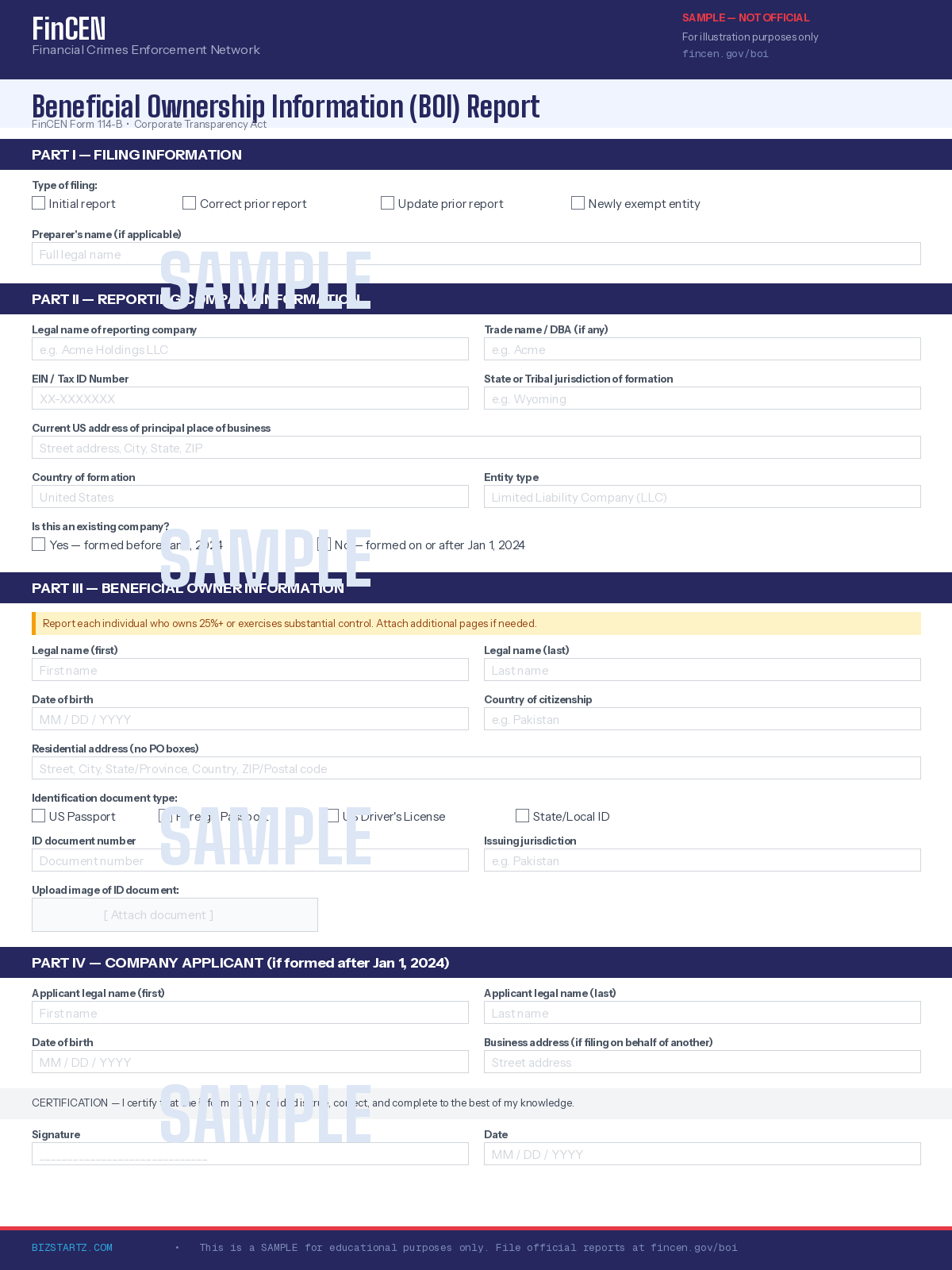
Non-residents applying for an EIN (Employer Identification Number) from Pakistan cannot use the IRS online portal — it requires an SSN or ITIN. According to the IRS, the only options for non-residents are fax (Form SS-4 by fax takes approximately 4 business days with a return fax number), mail (approximately 4 weeks), or the IRS international phone line. IRS international lines frequently disconnect during hold, making fax the only dependable route for Pakistani founders.

As of 2026, the IRS requires all foreign-owned single-member US LLCs to file Form 5472 plus a pro-forma Form 1120 annually, regardless of revenue. Missing this filing triggers a $25,000 penalty per form per year. An additional $25,000 penalty applies for every 30-day period after 90 days from an IRS notice — with no cap and no minimum income threshold. A Pakistani founder who contributed startup capital to their LLC and filed nothing still owes $25,000.

Can a Pakistani Citizen Form a US LLC?

Any non-US person can legally own a US LLC. No US state requires citizenship or residency for LLC ownership, and the entire process is completed remotely.

No Citizenship or Residency Requirement

Any non-US person can legally own a US LLC. No US state requires citizenship or residency for LLC ownership. You form it entirely remotely — no US visit needed.

To get your EIN (Employer Identification Number — the 9-digit federal tax ID issued by the IRS), you file IRS Form SS-4. According to the IRS, non-residents use a valid foreign passport as identification. An SSN is not required.

Why Pakistani Founders Actually Form US LLCs

Stripe is not officially available to businesses registered in Pakistan. As of 2026, this is a country-level restriction — not an account issue, not a verification problem. No Pakistan-registered business can access Stripe under any circumstances.

A US LLC (Limited Liability Company) with a US bank account and US address is the legitimate path to Stripe access. That is the primary reason Pakistani founders form US LLCs — not abstract credibility, not market access. Payment processing.

What You Need Before You Start

Before filing, have these ready:

Valid Pakistani passport: unexpired, used as your IRS identification
Business name: must be unique in your chosen state
Formation state: Wyoming ($100 state fee, about $102 online with card) and New Mexico ($50, no annual report) are common choices
Registered agent: a person or company with a physical street address in your formation state who receives legal documents on your LLC’s behalf; according to every state’s filing authority, PO boxes are not accepted

You cannot use a Pakistani address as your registered agent address. You need a US-based registered agent service from day one.

Payment Platform Reality for Pakistani LLC Owners

As of 2026, Stripe is unavailable in Pakistan, Mercury excludes Pakistani-domiciled founders at the country level, and Wise Business is the most reliable primary banking path for Pakistani LLC owners. For the full picture across every major platform and country, see our verified US bank & payment platform access by country matrix.

Stripe: Banned in Pakistan — What Changes With a US LLC

how to form a us llc from pakistan


stripe.com is not available to Pakistan-registered businesses. A US LLC changes that — but only if your application is set up correctly.

Stripe checks founder domicile, not just LLC state. A Pakistani personal address on your Stripe application triggers rejection, even with a valid US LLC and verified EIN (Employer Identification Number — your 9-digit federal tax ID). The full setup required: US LLC + Wise Business US routing number + US business address (your registered agent’s address) + no Pakistani address on the application. Stripe also requires a verified EIN before fully activating payment processing.

Wise Business: The Realistic Primary Banking Path

Wise Business provides a real US routing number and account number, usable for receiving USD payments. This makes it the honest primary banking path for Pakistani founders.

Wise accepts a Pakistani passport, EIN, and LLC documents for onboarding. Once active, Wise supports multi-currency USD payments and gives you the US banking details Stripe requires.

Mercury: Pakistan Is on the Prohibited List

Mercury bank account prohibits Pakistan-domiciled founders at the country level. This is not a documentation problem. No amount of paperwork fixes a country-level ban.

Applying to Mercury as a Pakistani founder wastes time and creates a permanent rejection record. As of 2026, Mercury’s prohibited countries list has tightened and declines are often permanent. Do not attempt Mercury.

PayPal Business and Brex: The Real Status

PayPal has never launched in Pakistan. Residents cannot open a PayPal account, receive money into a PayPal balance, or withdraw funds using a Pakistani address, phone number, or bank account. The only PayPal-owned service that reaches Pakistan is Xoom — a remittance rail that delivers money from abroad into Pakistani bank accounts. Xoom is not a PayPal account and cannot be used to accept business payments.

A US LLC changes this. PayPal Business eligibility follows where the business is registered, not where the owner personally lives. A properly formed US LLC with an EIN, a US business address, and a US bank account can hold a PayPal Business account — registered to the LLC’s US details, never to a Pakistani address. Wise Business remains the more reliable primary rail for receiving USD; treat PayPal Business as a secondary channel.

Brex requires at least one US-based founder or US institutional investor. Pakistani non-residents do not meet this requirement and are ineligible. Option A (Wise Business) provides a real US routing number and accepts Pakistani passports. Option B (Brex) requires a US-based founder or institutional investor — Pakistani non-residents are ineligible.

EIN Without an SSN: Fax vs Mail for Pakistani Applicants

An EIN (Employer Identification Number — the 9-digit federal tax ID issued by the IRS) is free to obtain directly from the IRS. Pakistani founders cannot use the IRS online portal.

As of 2026, the IRS online EIN portal requires an SSN (Social Security Number) ssa.gov/number or ITIN (Individual Taxpayer Identification Number) irs.gov — Pakistani founders have neither. According to the IRS, non-residents must submit Form SS-4 by fax, mail, or international phone line. Fax with a return fax number takes approximately 4 business days. Mail takes approximately 4 weeks. The IRS international phone line is unreliable for Pakistani callers — international connections frequently drop during hold.

Why Pakistani Founders Cannot Apply Online

The only options for non-residents are fax, mail, or the IRS international phone line — all using IRS Form SS-4. Your Pakistani passport is sufficient identification. Leave the SSN field blank and note your country of citizenship instead. No SSN is needed.

Fax: 4 Business Days — The Only Practical Choice

Fax with a return fax number: approximately 4 business days to 1 week. This is the only route that keeps your timeline intact for Wise Business account opening and Stripe setup.

However, IRS fax lines fail regularly. A failed transmission means no EIN and no confirmation — the IRS does not notify you of the failure. Bizstartz monitors fax confirmation and resubmits if the transmission does not go through. Without that monitoring, founders often wait a week before realizing nothing was received.

Mail: 4 Weeks — Avoid This

Mail processing takes approximately 4 weeks. That delays your bank account opening and Stripe activation by a full month. For any founder waiting to receive payments, this is not viable.

One more distinction worth knowing: the CP-575 paper confirmation letter arrives 2–6 weeks after your EIN is issued. That letter is not EIN issuance — your EIN exists the moment the IRS processes your Form SS-4 fax. You can use it immediately. Waiting for the CP-575 before applying for banking costs Pakistani founders weeks unnecessarily.


Step-by-Step: How to Form a US LLC from Pakistan

Step 1: Choose Your State — Wyoming or New Mexico

Wyoming costs $100 to file with the Wyoming Secretary of State (about $102 online with card) and $60 minimum annually. New Mexico costs $50 to file with the New Mexico Secretary of State and requires no annual report. Wyoming has no state income tax and strong privacy protections.

Delaware has a $90 Certificate of Formation filing fee (standard filings commonly total about $110) plus a flat $300 annual franchise tax due June 1. Choose Delaware only if you plan to raise from US venture capital investors. Most Pakistani founders without US investor plans choose Wyoming — the annual savings compound fast.

Option A (Wyoming): $100 state fee (about $102 online with card), $60 annual minimum, no state income tax, 1–3 business day processing.
Option B (New Mexico): $50 filing fee, no annual report required, slower name availability verification.
Option C (Delaware): $90 filing fee (commonly about $110 all-in), $300 annual franchise tax due June 1, preferred by US venture capital investors only.

Step 2: Appoint a Registered Agent and File Articles of Organization

Every US LLC requires a registered agent — a US-based person or service that receives legal documents on your behalf — with a physical street address in the state of formation. According to every state’s filing authority, a PO box does not satisfy this requirement. Pakistani founders have no US address, so a registered agent is mandatory, not optional.

Bizstartz appoints your registered agent and files your Articles of Organization with the Secretary of State. Wyoming processes in approximately 1–3 business days. Delaware takes approximately 10 business days, with expedited options available.

Step 3: Get Your EIN by Fax — Approximately 4 Business Days

An EIN (Employer Identification Number — the US federal business tax ID) is free from the IRS. Non-residents without a US Social Security Number must submit IRS Form SS-4 with a Pakistani passport by fax. Turnaround is approximately 4 business days with a return fax number. Do not use mail — it adds roughly 4 weeks. Pakistani founders cannot reliably use the IRS international phone line; international calls frequently disconnect during hold. Fax is the only dependable option.

Step 4: Open a Wise Business Account

Wise Business provides a real US routing number and account number usable for receiving USD payments. You need your EIN, Pakistani passport, and LLC operating agreement to apply. Do not apply to Mercury — as of 2026, Pakistan is on Mercury’s prohibited countries list.

Applications are declined and rejections are often permanent. Founders in neighboring markets face the same wall: Nigerian founders hit an identical Mercury country-level ban — see How to Form a US LLC from Nigeria — and the process for How to Form a US Company from Nepal covers comparable Wise Business onboarding steps worth reviewing.

Step 5: Apply for Stripe Using Your LLC Details

Stripe checks founder domicile during application. Entering your Pakistani personal address triggers rejection. Use your registered agent’s US address as your business address. Use your Wise Business US routing number as the bank account. Stripe requires a verified EIN to fully activate payment processing — apply only after your EIN is confirmed.

Bizstartz Basic: $199 + state fees. Pro: $299 + state fees. Premium: $699 + state fees.

US Tax Obligations for Pakistani LLC Owners

As of 2026, no US-Pakistan tax treaty exists. Pakistani founders receive zero treaty relief on US withholding taxes.

No US-Pakistan Tax Treaty: What This Means

Most countries have bilateral tax treaties with the US that reduce withholding rates on passive income. As of 2026, Pakistan has no such treaty with the US. According to the IRS, the standard 30% withholding rate on US-source FDAP income (dividends, royalties, and certain passive income) applies in full to Pakistani founders. Plan your revenue structure accordingly.

Single-Member LLC: No US Federal Income Tax (But Filing Still Required)

A single-member foreign-owned LLC is a disregarded entity for US federal tax purposes. According to the IRS, if your LLC earns no ECI (Effectively Connected Income — income tied to active US business operations), you owe no US federal income tax.

But filing obligations exist regardless of tax owed. If your LLC has any reportable transactions — including capital contributions from you or distributions back to you — you must file Form 5472 plus a pro-forma Form 1120 annually with the IRS.

One filing you can skip entirely: BOI. Under FinCEN’s interim final rule effective March 26, 2025, all US-formed entities — including LLCs owned by non-US residents — are exempt from beneficial ownership information (BOI) reporting. If a formation service quotes you a fee for BOI filing on a US-formed LLC, that filing no longer applies.

Form 5472: The $25,000 Penalty Pakistani Founders Miss

Form 5472 is an IRS information return required for all foreign-owned US LLCs with reportable transactions. As of 2026, according to the IRS, missing Form 5472 costs $25,000 per form per year. If the IRS sends a notice and you still don’t file within 90 days, an additional $25,000 penalty applies for every 30-day period after that. There is no cap.

Zero income does not eliminate this obligation. Pakistani founders commonly assume a dormant LLC requires no US filings. That assumption is wrong and expensive. A founder who contributed $5,000 to start their LLC, earned nothing, and filed nothing still owes $25,000.

An ITIN (Individual Taxpayer Identification Number — a personal US tax ID for non-residents) is not required to form your LLC. You may need one later if you file a US personal tax return on IRS Form 1040-NR.

What Most Pakistan LLC Guides Don’t Tell You

Five facts that competitors such as doola, ZenBusiness, Northwest Registered Agent, Bizee, and Firstbase rarely disclose upfront:

As of 2026, Mercury’s prohibited countries list includes Pakistan. Applying creates a permanent rejection record — not a temporary one. No competitor guide discloses this. Skip Mercury entirely and use Wise Business instead.

Stripe checks founder domicile, not just LLC registration state. A Pakistani home address on the Stripe application triggers rejection even with a valid US LLC and EIN (Employer Identification Number — your 9-digit federal tax ID). Use your US LLC’s registered address, not your Pakistan address, when completing the Stripe business profile.

Pakistan was removed from the FATF (Financial Action Task Force) grey list in October 2022. That removal matters for country-level sanctions, but banking friction at US fintechs remains elevated for Pakistani nationals as of 2026. Compliance teams at many platforms apply additional manual scrutiny regardless of FATF status. Expect longer review periods and prepare thorough documentation upfront.

Many Pakistani founders believe their EIN is delayed when it has already been issued. The IRS issues your EIN when it processes your Form SS-4 fax — typically within 4 business days to one week. The CP-575 paper confirmation letter arrives by mail 2–6 weeks later. That letter is not your EIN. Your EIN is already active the moment IRS processing is complete. Waiting for the CP-575 before applying for banking costs Pakistani founders weeks unnecessarily.

No US-Pakistan tax treaty exists. While countries such as the UK, Germany, and India have bilateral tax treaties with the US that reduce withholding rates, Pakistan has none. The full 30% withholding rate on US-source passive income applies to Pakistani founders with no reduction available.

Common Mistakes Pakistani Founders Make

Mercury prohibits Pakistan-domiciled founders at the country level. This is not a documentation problem — applying creates a permanent rejection record on your account. Use Wise Business as your primary banking path instead.

Stripe checks founder domicile, not just LLC registration. A Pakistani home address on your Stripe application triggers rejection even with a valid US LLC and EIN (Employer Identification Number — US business tax ID). Enter your registered agent’s address as the business address. Never enter your Karachi or Lahore address.

For your EIN, always use IRS fax — not mail. Fax returns your EIN in approximately 4 business days. Mail takes approximately 4 weeks. Every week without an EIN is a week you cannot open a bank account or activate Stripe.

The most expensive mistake: assuming zero income means zero filing obligations. As of 2026, the IRS requires Form 5472 plus a pro-forma Form 1120 every year for foreign-owned single-member LLCs with reportable transactions — including capital contributions made at formation. The penalty for missing this filing is $25,000 per form per year, with no income threshold. A founder who contributed $5,000 to start their LLC and filed nothing owes $25,000 — not zero.

Frequently Asked Questions

Can I get Stripe with a US LLC if I live in Pakistan?

A US LLC alone does not unlock Stripe. You also need a Wise Business US routing number, a US business address (your registered agent’s address), and no Pakistani personal address on the Stripe application. Stripe checks founder domicile — applying with a Pakistani address causes rejection regardless of LLC status.

Will Mercury accept my US LLC application if I live in Pakistan?

No. As of 2026, Mercury excludes Pakistan at the country level — this is not a documentation problem. Applying creates a permanent rejection record on file. Use Wise Business instead to receive USD payments.

How long does the EIN take for Pakistani applicants?

Approximately 4 business days via IRS fax; approximately 4 weeks via mail. According to the IRS, always use fax. Your Pakistani passport is sufficient — no SSN required. The CP-575 confirmation letter arrives separately by mail 2–6 weeks later but is not EIN issuance; your EIN is active the moment IRS processing is complete.

Do I need to pay US taxes on income earned through my US LLC?

If your single-member LLC has no US-effectively-connected income, you owe no US federal income tax. However, according to the IRS, you must still file Form 5472 plus a pro-forma Form 1120 annually. Missing Form 5472 triggers a $25,000 penalty per year — zero income is no exemption. As of 2026, there is no US-Pakistan tax treaty.

Which US state should a Pakistani founder choose?

Wyoming suits most Pakistani founders: $100 state fee (about $102 online with card) with the Wyoming Secretary of State, $60 minimum annual fee, no state income tax, strong privacy. Choose Delaware ($90 filing, $300 annual franchise tax due June 1) only if you plan to raise from US venture capital. Delaware costs more with no benefit if US investors are not in the picture.

Can I use PayPal Business with my US LLC from Pakistan?

No — PayPal has never launched in Pakistan. Residents cannot open an account, receive into a PayPal balance, or withdraw using a Pakistani address, phone number, or bank account. A US LLC changes this: PayPal Business eligibility follows where the business is registered, so a US LLC with an EIN, a US business address, and a US bank account can hold a PayPal Business account — registered to the LLC’s US details, never to a Pakistani address. Wise Business remains the more reliable primary rail for receiving USD.

What happens if I miss the Form 5472 filing deadline?

According to the IRS, the penalty is $25,000 per missed filing. An additional $25,000 applies per 30-day period after 90 days from an IRS notice. There is no cap and no minimum income threshold — a zero-revenue LLC faces the same $25,000 penalty as a profitable one.

How much does it cost to form a US LLC from Pakistan through Bizstartz?

Bizstartz Basic is $199 plus state fees; Pro is $299 plus state fees; Premium is $699 plus state fees. Wyoming’s state fee is $100 (about $102 online with card); Delaware is $90; New Mexico is $50. PKR equivalent fluctuates with the exchange rate — confirm the conversion at time of payment.

How is Bizstartz different from doola, ZenBusiness, or Northwest Registered Agent for Pakistani founders?

Bizstartz is built specifically for non-residents from countries including Pakistan, India, Nigeria, and the UAE. Unlike doola, ZenBusiness, Northwest Registered Agent, Bizee, and Firstbase, Bizstartz explicitly discloses Mercury’s Pakistan restriction upfront and handles EIN fax monitoring with resubmission — a step most generic formation services skip.

Does Pakistan’s removal from the FATF grey list help with US banking?

Pakistan was removed from the FATF grey list in October 2022. As of 2026, this removal has not eliminated banking friction at US fintechs. Compliance teams at platforms such as Mercury, Brex, and Relay continue to apply heightened manual review to Pakistani nationals. FATF status affects country-level sanctions, not individual fintech compliance policies.

Conclusion

Pakistani founders can form a US LLC remotely — no SSN, no US address, no travel required. Your Pakistani passport is sufficient to begin.

Stripe is unavailable to Pakistan-registered businesses. A US LLC, funded through Wise Business and anchored by a registered agent address, is the legitimate path. As of 2026, Mercury’s approvals have tightened — treat Wise Business as your primary account from day one.

Your EIN arrives via IRS fax in approximately 4 business days. File Form 5472 annually with the IRS. The penalty for missing it is $25,000 per year with no income threshold. Zero revenue does not mean zero filing obligation.

Banking friction for Pakistani founders remains elevated despite Pakistan’s FATF grey list removal in October 2022. Document requirements at Wise Business can change — verify current requirements before applying.

This article is for informational purposes only and is not legal or tax advice. Rules and fees change; verify with the official source or consult a licensed CPA or attorney for your specific situation.

Related Guides

We have formed US companies for founders across South Asia, West Africa and the Gulf — see how Khukuri House expanded into the US, or start your own.

Wyoming vs Delaware LLC for Non-Residents: Annual Fees, Franchise Tax, and Banking Reality

Wyoming vs Delaware LLC for Non-Residents

Wyoming charges $60/year for its LLC annual report ($62 if you pay online).

Delaware charges a flat $300/year franchise tax due June 1 no annual report required for LLCs.

Wyoming’s report is due on the first day of your LLC’s anniversary month. Miss it and Wyoming adds a $50 late penalty. Delaware’s June 1 deadline is fixed regardless of when you formed.

For non-residents running lean online businesses, Wyoming saves $240/year with no state income tax on either side. Delaware’s advantages  investor credibility, flexible corporate law matter most if you’re raising venture capital. For bootstrapped founders from India, Nigeria, Pakistan, UAE, or the Philippines, Wyoming’s lower ongoing cost is the practical default. Understanding how these fees fit into your broader Tax Filing obligations is essential before you commit to either state.

According to the Wyoming Secretary of State (wyobiz.wyo.gov), Wyoming LLCs with no Wyoming-located assets above $300,000 pay a flat $60 annual report fee. Online filing adds a $2 card processing fee, making the total $62 per year. The annual report is due on the first day of the LLC’s anniversary month. Missing this deadline triggers a $50 late penalty. As of 2026, this remains the standard fee for the vast majority of non-resident-owned Wyoming LLCs, which typically hold no Wyoming assets.

wyoming sos

Wyoming vs Delaware LLC: Side-by-Side Cost and Feature Comparison

Wyoming costs $60/year in state fees; Delaware costs $300/year. For most non-resident founders, that $240 annual difference compounds into a meaningful cost with zero operational benefit unless you are raising US venture capital.


Factor Wyoming LLC Delaware LLC Non-Resident Note
One-Time Formation Fee $100 ($102 online) $90 base ($110 incl. county fee) Both can be formed remotely; no U.S. visit required
Annual State Fee $60/year ($62 online) $300/year flat franchise tax Franchise tax is a state-level business tax separate from federal taxes
Annual Fee Due Date First day of the LLC’s anniversary month June 1 every year Missing Wyoming’s due date triggers a $50 late penalty
Registered Agent (RA) Mandatory — $50–$300/year Mandatory — $50–$300/year Non-residents cannot serve as their own registered agent in either state
Estimated Total Annual Cost $110–$360/year $350–$600/year Registered agent fees are additional recurring costs
State Income Tax No corporate, personal, or distribution tax No state income tax on income without Delaware nexus Non-residents with no Delaware operations generally face limited state tax exposure
Formation Processing Time Approximately 1–3 business days Approximately 10 business days (expedited options available) Wyoming is generally faster for founders needing a quick EIN application
Member Privacy Members not listed on public filings Members not listed on public filings Similar privacy protection in both states
Business Court System Wyoming state courts Delaware Court of Chancery Delaware’s court system is highly regarded for business disputes
Investor Credibility Widely accepted for small businesses Preferred by institutional investors and venture capital firms Delaware is the standard choice for startups seeking VC funding


wyoming vs delaware llc as non resident

 Annual fee and franchise tax

Wyoming charges $60 per year, collected by the Wyoming Secretary of State via wyobiz.wyo.gov. As of 2026, paying online adds $2, making it $62. Delaware charges a flat $300 annual franchise tax to the Delaware Division of Corporations, due June 1  five times Wyoming’s minimum fee.

Wyoming’s $60 applies when your Wyoming-located assets stay at or below $300,000. Most non-resident founders operating globally hold no Wyoming assets, so $60 remains the standard figure.

State income tax exposure

Wyoming imposes zero state income tax at every level no corporate tax, no personal income tax, no tax on LLC distributions. For a founder in Lagos, Karachi, or Manila paying tax only in their home country, Wyoming adds no state-level tax layer.

Delaware does not tax income with no Delaware nexus. Non-residents with no Delaware clients or operations face minimal practical exposure, but the risk is not zero. As of 2026, non-residents operating entirely outside Delaware and with no Delaware-sourced activity generally do not trigger Delaware income tax liability but this is a facts-and-circumstances determination, not a blanket exemption.

Privacy, court system, and investor credibility

Both Wyoming and Delaware keep member names off public LLC filings, so privacy at the state level is equivalent. The real difference is the Delaware Court of Chancery  the US court system most experienced with corporate disputes. US venture capital firms and institutional investors routinely require Delaware formation as a condition of funding.

For a founder building a bootstrapped SaaS or service business, Wyoming’s lower annual cost wins. For a founder planning a US fundraising round, Delaware’s credibility is not optional.

Banking and Payment Reality for Non-Resident LLC Owners

Your LLC state Wyoming or Delaware  has zero effect on which bank will accept you, which payment processor you can use, or how long your EIN takes. These are federal and platform-level decisions.

Mercury bank: who can and cannot apply

Mercury is a fintech (not a bank  deposits are FDIC-insured via Choice Financial Group and Column N.A.) that accepts non-residents with an EIN, passport, and LLC documents. But five countries are fully prohibited as of 2026: Pakistan, Nigeria, Philippines, Nepal, and Bangladesh. Founders from these countries cannot open Mercury accounts  applying wastes time and triggers a permanent record of rejection.

India and UAE are not on Mercury’s prohibited list. Founders from both countries can apply, subject to standard KYC review.

As of 2026, Mercury a US fintech whose deposits are FDIC-insured via Choice Financial Group and Column N.A. prohibits account applications from founders domiciled in Pakistan, Nigeria, Philippines, Nepal, and Bangladesh. This is a hard block, not a soft rejection: the same application cannot be resubmitted. Founders from India and UAE are not on Mercury’s prohibited list and may apply with an EIN (Employer Identification Number), passport, and LLC documents, subject to standard KYC review.

EIN timeline: the real bottleneck before banking starts

No US bank account opens without an EIN ein.com (Employer Identification Number  your LLC’s federal tax ID). Non-residents without an SSN apply via IRS Form SS-4. According to the IRS, non-residents using fax with a return fax number receive their EIN in approximately 4 business days. Via mail, the IRS timeline is approximately 4 weeks. The IRS sets this timeline your state of formation has no influence.

Pakistani founders face an additional obstacle: IRS international phone lines frequently disconnect during hold. Fax is the only reliable method.

Stripe access by country what your LLC state cannot change

Stripe eligibility follows where your business is legally registered, not where you live. A US LLC means US-registered  which is exactly why founders from restricted countries form one.

– Pakistan: Stripe unavailable to Pakistan-registered businesses. A US LLC is the standard route to Stripe access.
– Nigeria: No direct Stripe; in-country access is Paystack (Stripe-owned). A US LLC gives full USD Stripe.
– India: Stripe moved to invite-only in May 2024. Self-serve signup is unavailable. A US LLC gives full USD Stripe.
– UAE and Philippines: Stripe is fully available.

Wise Business as an alternative for blocked countries

Wise Business wise.com provides US routing and account numbers usable for receiving USD payments. Wise Business is not a bank  deposits are held at FDIC-insured partner banks. For founders from Pakistan, Nigeria, Philippines, Nepal, and Bangladesh who cannot access Mercury, Wise Business is the primary functional alternative.

Brex is not a realistic option for most non-residents: Brex requires at least one US-based founder or investor.

FinCEN BOI and Federal Tax Obligations: What Non-Residents Must Know

BOI filing status for US-formed LLCs

US-formed LLCs  including those owned by non-residents from India, Nigeria, Pakistan, UAE, or the Philippines are exempt from BOI (Beneficial Ownership Information) reporting. FinCEN’s interim final rule, effective March 26, 2025, removed this requirement for all domestically created entities.

Only foreign-law entities registering to do business in a US state must file. This exemption applies equally to Wyoming and Delaware LLCs. Re-verify at fincen.gov before acting this remains an interim rule pending finalization.

Most competitor guides  including those from doola, ZenBusiness, Northwest Registered Agent, Bizee, and Firstbase still describe BOI as required for non-resident LLC owners. That is incorrect under the FinCEN interim final rule effective March 26, 2025.

According to FinCEN’s interim final rule, effective March 26, 2025, US-formed LLCs including those owned by non-residents from India, Nigeria, Pakistan, UAE, or the Philippines are exempt from BOI (Beneficial Ownership Information) reporting under the Corporate Transparency Act.

As of 2026, only foreign-law entities registering to do business in a US state are required to file. This exemption applies equally to Wyoming LLCs and Delaware LLCs. Verify current status at fincen.gov, as this remains an interim rule pending finalization.

Form 5472: the filing most non-residents miss

The $25,000 penalty comes first, then the explanation. Under IRC 6038A, failure to file Form 5472 costs $25,000 per form per year. After 90 days from IRS notice, an additional $25,000 applies per 30-day period  with no maximum cap.

Form 5472 is required for any foreign-owned single-member US LLC with reportable transactions. Capital contributions and distributions between you and your LLC both count as reportable transactions. Zero US income does not eliminate this filing obligation.

A founder from Lagos who contributes $5,000 to their Wyoming LLC and files nothing faces a $25,000 penalty not a warning.

Form 5472 is filed with a pro-forma Form 1120 annually. Your tax professional must know this combination is required. Be aware that the US Tax Filing Deadline for these federal obligations falls on April 15, with extensions available missing it compounds your exposure.

Federal tax obligations for non-resident LLC owners

A single-member US LLC owned by a non-resident is a disregarded entity by default meaning income flows to you personally and the LLC files no separate income tax return unless you elect corporate treatment.

US federal income tax applies only to ECI (income effectively connected to a US trade or business) or US-source FDAP income. Foreign-sourced income is generally not subject to US federal tax. If you have ECI, you file Form 1040-NR. Self-employment tax of 15.3% does not apply to non-resident aliens performing services outside the US.


Neither Wyoming nor Delaware changes any of this. Federal obligations are identical regardless of state.

Which State Should You Choose? Recommendations by Country and Founder Type

Pakistan and Nigeria founders

Wyoming is the correct choice. Stripe is unavailable to Pakistan-registered businesses, and Nigeria-registered businesses access Stripe only via Paystack a US LLC fixes both. Mercury prohibits Pakistan- and Nigeria-domiciled founders entirely. Use Wise Business instead: Wise Business provides US routing and account numbers for receiving USD payments. Wyoming’s $60/yr annual cost versus Delaware’s $300/yr matters more when banking options are already constrained.

India founders

Choose Wyoming. Stripe moved India to invite-only in May 2024  that restriction applies regardless of whether you form in Wyoming or Delaware. Mercury does not list India as prohibited, so India-domiciled founders can apply. Wyoming’s $60/yr annual cost reduces overhead during the Stripe wait period, which can stretch months.

UAE and Philippines founders

Wyoming suits most founders from both countries. Stripe is available in UAE and the Philippines. Mercury does not prohibit UAE-domiciled founders. However, Mercury prohibits Philippines-domiciled founders use Wise Business instead. Wyoming’s lower annual cost suits lean operations without US venture capital plans.

Amazon FBA sellers (any country)

Choose Wyoming. Amazon does not require Delaware formation for seller accounts. Wyoming has zero state income tax and a $60/yr annual report fee. Delaware’s $300/yr franchise tax adds recurring cost with no operational benefit for marketplace sellers. Founders comparing state-level costs across all options may also find it useful to review Annual Tax Filing for New Mexico LLC Owners New Mexico is another zero-franchise-tax state sometimes considered alongside Wyoming.

Founders seeking US venture capital

Delaware is required. Most US institutional investors expect Delaware formation specifically because of the Delaware Court of Chancery a specialized business court that provides the legal predictability investors rely on for deal structuring. The $300/yr franchise tax is the cost of accessing US institutional capital. No other state substitutes for this use case.

UK and Canada founders

Wyoming works for most. Stripe is available in both the UK and Canada. Mercury does not list UK or Canada as prohibited. Choose Delaware only if raising US institutional capital.

The Hidden Cost Non-Residents Discover After Formation

Wyoming’s $60 annual report fee is real. But it is not your total annual cost. Every Wyoming LLC must have a registered agent a US-based person or service receiving legal documents on your behalf. Non-residents cannot act as their own registered agent in any US state. Registered agent services cost $50–$300 per year. Your real annual Wyoming cost is $110–$360, not $60.

Delaware has the same registered agent requirement. Add the $300 flat annual franchise tax, and Delaware’s recurring cost reaches $350–$600 per year significantly higher than Wyoming for most non-resident founders.

Wyoming also records the name of whoever files the annual report. If you file it yourself, your name becomes part of the public Wyoming Secretary of State record. A registered agent or nominee service filing on your behalf keeps your name off that record.

Mercury rejections are often permanent  the same application cannot be resubmitted. Founders from Pakistan, Nigeria, and the Philippines face a hard block, not a soft rejection: Mercury lists all three countries as prohibited. India and UAE founders can apply but must pass KYC review. Apply only after your EIN (Employer Identification Number  your US business tax ID) is confirmed in writing.

The most commonly missed federal obligation is Form 5472. Foreign-owned single-member LLCs must file Form 5472 annually, even with zero US income  a capital contribution from you to your LLC counts as a reportable transaction. The penalty under IRC 6038A is $25,000 per form per year, with no maximum cap.

Common Mistakes Non-Resident Founders Make When Choosing a State

The most common error: believing that choosing Wyoming versus Delaware affects Stripe access. It does not. Stripe eligibility is determined by where your business is legally registered  the US. A founder from Lagos or Karachi forming a US LLC gains Stripe access because the LLC is a US entity. State choice is irrelevant to that outcome.

The second mistake: assuming Delaware’s prestige justifies the cost. The Delaware Court of Chancery is valuable only when raising US venture capital. For e-commerce, freelancing, or SaaS with no US VC plans, Delaware’s $300 annual franchise tax delivers nothing Wyoming’s $60 annual fee cannot. That $240 annual difference buys nothing for most bootstrapped non-resident founders.

The third mistake is acting on outdated BOI (Beneficial Ownership Information) filing guides. Per FinCEN’s interim final rule effective March 26, 2025, US-formed LLCs are exempt from BOI reporting. The requirement now applies only to foreign-law entities registering in a US state.

Most competitor guides  including those from doola, ZenBusiness, Northwest Registered Agent, Bizee, and Firstbase  still describe BOI as required. They are wrong under the FinCEN interim final rule effective March 26, 2025. Verify at fincen.gov before acting.

What is not optional: Form 5472. A foreign-owned single-member LLC with any reportable transaction including capital contributions must file Form 5472 annually. Missing it triggers a $25,000 IRS penalty per form under IRC 6038A. If you are unsure how your LLC’s income is classified, reviewing Form W-9 Explained in Detail clarifies the withholding and tax identification framework that underpins these federal obligations.

Frequently Asked Questions

Is the Wyoming LLC annual report fee really just $60?

Yes. According to the Wyoming Secretary of State, Wyoming LLCs with no Wyoming-located assets above $300,000 pay a flat $60 annual report fee. Online filing via wyobiz.wyo.gov adds a $2 card processing fee, making the total $62. Registered agent service mandatory for non-residents costs $50–$300 per year separately. As of 2026, $60 remains the standard figure for non-resident-owned Wyoming LLCs.

Can I open a US bank account with a Wyoming LLC if I am not a US resident?

It depends on your country. Mercury accepts India- and UAE-domiciled founders with an EIN (Employer Identification Number US business tax ID), passport, and LLC documents. As of 2026, Mercury prohibits Pakistan-, Nigeria-, and Philippines-domiciled founders entirely. Wise Business is the reliable alternative for those three countries. You must obtain your EIN before applying to any bank.

Does forming a Wyoming or Delaware LLC give me access to Stripe in Pakistan or Nigeria?

Yes. Stripe eligibility is based on where your business is legally registered the US is fully supported. Pakistan-registered businesses cannot access Stripe directly; a US LLC resolves this. Nigerian businesses access Stripe only via Paystack (Stripe-owned); a US LLC gives full USD Stripe. Wyoming versus Delaware does not affect Stripe eligibility.

Do I need to file a FinCEN BOI report for my Wyoming or Delaware LLC as a non-resident?

No. Under the FinCEN interim final rule effective March 26, 2025, US-formed LLCs  including those owned by non-residents are exempt from BOI fincen.gov/boi (Beneficial Ownership Information) reporting. This is an interim rule; verify current status at fincen.gov. Direct your compliance effort toward Form 5472 instead.

How long does it take to get an EIN as a non-resident after forming my LLC?

Approximately 4 business days via fax with a return fax number, or approximately 4 weeks via mail, using IRS Form SS-4. According to the IRS, state of formation does not affect this timeline. You cannot open a US bank account until your EIN is confirmed in writing.

Is Delaware better than Wyoming if I want to raise money from US investors?

Yes. Most US venture capital investors require Delaware formation specifically because of the Delaware Court of Chancery, which provides established, predictable business law. Wyoming is adequate for small businesses but is not accepted by most institutional investors. If US VC funding is your goal, Delaware’s $300 annual franchise tax is the correct trade-off.

What is the total annual cost of a Wyoming LLC versus a Delaware LLC for a non-resident?

Wyoming: $60 state annual report fee plus $50–$300 registered agent equals $110–$360 per year total. Delaware: $300 state franchise tax plus $50–$300 registered agent equals $350–$600 per year total. Both Wyoming and Delaware require a registered agent  non-residents cannot serve as their own.

What is Form 5472 and does it apply to my Wyoming or Delaware LLC?

Form 5472 is an IRS information return required for foreign-owned single-member US LLCs with reportable transactions including your initial capital contribution. It applies even if your LLC earned zero income. Under IRC 6038A, the penalty for failure to file is $25,000 per form per year, with no maximum cap. State choice does not affect this obligation.

Why does Wyoming charge $60 for an annual report when Delaware charges $300?

Wyoming and Delaware use different fee structures. According to the Wyoming Secretary of State, Wyoming’s $60 annual report fee is a flat administrative filing charge. Delaware’s $300 annual franchise tax is a state business tax  a separate legal mechanism. Wyoming’s fee is lower because Wyoming’s revenue model relies on volume of formations rather than higher per-entity fees. As of 2026, Wyoming’s $60 minimum applies to the vast majority of non-resident-owned LLCs that hold no Wyoming-located assets.

What happens if I miss the Wyoming LLC annual report deadline?

Missing the Wyoming annual report deadline the first day of your LLC’s anniversary month triggers a $50 late penalty, according to the Wyoming Secretary of State. If the report remains unfiled, Wyoming can administratively dissolve your LLC, which requires a reinstatement fee and process to reverse. Delaware’s June 1 franchise tax deadline carries different consequences: late payment accrues interest at 1.5% per month.

Conclusion

Wyoming costs $60/year in annual report fees ($62 online) versus Delaware’s flat $300/year franchise tax —a $240/year difference. As of 2026, total annual running costs are: Wyoming $110–$360/year versus Delaware $350–$600/year, including registered agent in both cases.

Banking determines your real choice more than state fees. Mercury is prohibited for founders based in Pakistan, Nigeria, and the Philippines  use Wise Business instead. India and UAE founders may apply to Mercury subject to standard KYC checks.

Stripe access comes from having a US LLC, not from which state you chose. Wyoming and Delaware both qualify.

The BOI reporting exemption for US-formed LLCs is under a FinCEN interim final rule effective March 26, 2025  verify current status at fincen.gov before filing. Mercury country prohibitions also change; confirm live before applying.

Choose Delaware only if raising US venture capital. Wyoming is the lower-cost default for every other situation.

Bizstartz forms Wyoming LLCs for $199 plus the $100 Wyoming state fee. EIN filing for non-residents is included. If you want to understand How to Stop Paying US Tax as a Non-Resident LLC Owner, Bizstartz handles LLC formation and EIN filing so your structure is compliant from day one.

Related Guides

Compare the real year-one cost of every popular state in our state cost breakdown, then file with us.