You can form a US LLC while living in Morocco, and the account side works: Morocco is on neither Mercury’s sanctioned nor its prohibited list, and it is absent from Relay’s 31-country applicant list (both checked 12 October 2026).
But the reason to do it is not the one most guides give. Stripe genuinely does not serve Morocco. The binding constraint on a Moroccan freelancer or online seller is not American at all, it is the Office des Changes allowance that caps what you may spend abroad from a Moroccan card at 20,000 dirhams a year for e-commerce.
Most guides in this country series are exercises in damage control. Stripe is already live in Thailand, Malaysia and Mexico, so the honest answer there is usually “you probably do not need this.” Morocco is the opposite case. The payments gap is real.
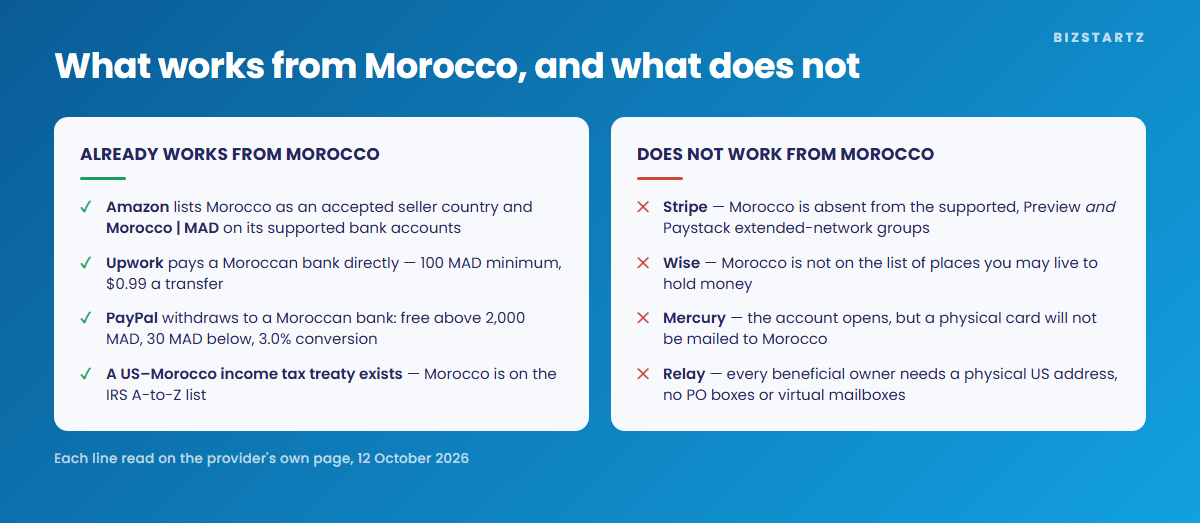
What is also real, and almost never said, is how much already works. Amazon pays Moroccan sellers in dirhams. Upwork pays Moroccan freelancers direct to a local bank for 99 cents. PayPal withdraws to a Moroccan bank account. And there is a US–Morocco income tax treaty, which Nigeria, Malaysia, Nepal and the UAE do not have. Morocco is not cut off from everything. It is cut off from one specific thing, and you should know which before you spend anything.
Two details will decide this for you, and both are below: Mercury will open your account but will not mail you a physical card, and Relay asks every owner for a physical US address, which is what actually closes that door.
In this guide: What Morocco blocks, and what it does not · The 20,000 dirham ceiling · Banking from Morocco · The US–Morocco tax treaty · The US side · What it costs · Questions Moroccan founders ask · Who this suits
What Morocco actually blocks, and what it does not
Work through these five before you pay a formation fee. Three of them probably already cover how you get paid.
Stripe does not serve Morocco — and the African extended network does not cover you either
Morocco appears nowhere on Stripe’s country list. Not in the fully supported group, not under a “Preview” label, and not in the Paystack-backed “Extended network” group either (stripe.com/global, checked 12 October 2026).
That last point is the one to read twice. Stripe’s extended network does reach Africa, but its members are exactly Côte d’Ivoire, Ghana, Kenya, Nigeria and South Africa.
If you have read advice written for a Nigerian or Kenyan founder and assumed it transfers, it does not. For comparison, UAE, Malaysia, Singapore, Thailand, Mexico and Brazil all sit in Stripe’s main supported list with a plain sign-up link.
So if you need card checkout on your own website and your buyers are international, this is a genuine gap, and a US LLC with a US Stripe account is a genuine answer to it. Our guide to opening a Stripe account as a non-US resident covers what that application looks like.
But Amazon pays Moroccan sellers in dirhams
This is the fact that most often removes the reason for the company entirely, and we have not seen it stated anywhere else in English.
Morocco is accepted for Amazon seller registration, it appears in the M entries on Amazon’s accepted-countries list, which run “Mexico Micronesia Moldova Mongolia Montenegro Morocco Mozambique Myanmar” (Seller Central: accepted countries, read 12 October 2026).
And unlike Thailand or Malaysia, Morocco appears on the payout side too. The supported bank-account table for the Amazon Currency Converter for Sellers carries a row reading “Morocco | MAD” (Seller Central: supported bank accounts, read 12 October 2026). We found no THB or MYR row on that same table, which is why our guide for Malaysian founders has to send sellers off to ask Amazon directly.
If Amazon was your reason for wanting a US company, check your own Seller Central disbursement settings before you form one. You may already be able to take the money in dirhams.
Upwork pays Moroccan freelancers direct to a local bank
Morocco is supported for Upwork’s Direct to Local Bank withdrawals, with a minimum of 100 MAD. Upwork’s published cost is “$0.99 USD (plus incoming fees at some banks)” per withdrawal (Upwork: Direct to Local Bank fees and timing, read 12 October 2026).
If freelance platform income was your reason, that reason costs 99 cents to remove.
PayPal withdraws to a Moroccan bank — the “send-only” reputation is out of date
Read this one carefully, because it is the single most misreported fact about Moroccan payments, and the old answer has been repeated for years.
PayPal‘s own Moroccan fee schedule lists a withdrawal-to-bank-account fee in dirhams: no fee where no currency conversion is involved and the withdrawal is above 2,000.00 MAD, and 30.00 MAD where it is below that (PayPal Morocco fees, read 12 October 2026, the page is served in Arabic).
Receiving personal transactions shows as no fee where no conversion is involved. Currency conversion puts Morocco in PayPal’s Middle East and Africa group at 3.0% over the base exchange rate. There is no notice on that page saying Moroccan accounts cannot receive or cannot withdraw.
On how the money actually reaches you, we are relying on secondary sources and we will say so. PayPal’s user agreement refers to withdrawal “to a Moroccan bank account with the bank partner of PayPal”, which points to a named partner rather than any Moroccan bank.
Electronic Payments International reported on 14 November 2024 that Attijariwafa Bank and PayPal launched a service letting Moroccan merchants withdraw PayPal funds to an Attijariwafa account in dirhams and other currencies.
A press release dated 16 September 2025 announced a CASHPLUS partnership for instant MAD withdrawals through the CASHPLUS Mobile app. Those are a trade publication and a company announcement, not PayPal’s own pages, so treat the route as less settled than the fee lines and ask your own bank which option it supports.
We have deliberately not printed a Moroccan commercial receiving percentage. The fee table we read was not labelled per-country for that row, and we could not isolate a Morocco-specific merchant rate we would stand behind.
Wise does not list Morocco for holding money
Morocco does not appear on Wise’s list of countries where you can hold money (Wise: where do I need to live to hold money with Wise, read 12 October 2026). The M entries on that page are Macao, Malaysia, Malta, Martinique, Mayotte and Monaco.
That is an allowlist, not a blocklist — it names the countries where holding money is available. Monaco is there and Morocco is not, so this is not a half-read page. The practical consequence: do not build a plan on getting Wise USD account details as a Moroccan resident.
Wise Business onboarding a US LLC whose owner lives in Morocco is a separate question settled at verification, and we found no Wise page that answers it. Our Wise business account for a US LLC guide covers that application.
The real constraint is Moroccan: the 20,000 dirham e-commerce ceiling
This is the section other English-language guides skip, and it is the one that actually decides whether a US LLC changes your life or just adds a filing obligation.
We form US companies. We are not Moroccan lawyers, Moroccan tax advisers or exchange-control specialists, and nothing below tells you what you are permitted to do. It sets out what the Office des Changes has published, with the source, so you can take the right question to someone qualified.
What changed on 1 January 2026
The Office des Changes published a new General Instruction for Foreign Exchange Transactions (IGOC 2026). Its release is dated Rabat, 31 December 2025, and states that it is the instruction “the provisions of which will enter into force on January 1, 2026” (Office des Changes: Publication of the General Instruction for Foreign Exchange Transactions 2026, with the figures in the linked release PDF, both read 12 October 2026).
Dirham figures first, with an approximate dollar figure in brackets. We have not taken a live rate for this page; the brackets assume roughly 9 to 10 dirhams to the dollar, so check the day’s rate rather than trusting our arithmetic.
| Allowance | IGOC 2026 | Previously |
|---|---|---|
| E-commerce, Moroccan individuals (including Moroccans residing abroad) | 20,000 dirhams (roughly USD 2,000–2,200) | 15,000 dirhams |
| E-commerce, start-ups certified by the Digital Development Agency (ADD) | 2,000,000 dirhams | 1,000,000 dirhams |
| Investment abroad, ADD-certified technology start-ups | Up to 10 million dirhams per year | Subject to a three-year activity requirement |
| Minimum annual allowance, newly created companies | 50,000 dirhams | — |
| Personal travel, overall ceiling | 500,000 dirhams per calendar year (100,000 basic plus 400,000 supplementary) | — |
All five figures are quoted from the Office des Changes’ own release PDF, read 12 October 2026. The wording on the individual e-commerce allowance is: “The maximum allowance for Moroccan individuals, including Moroccans residing abroad, is raised to 20.000 dirhams”, “up from 15.000 dirhams”.
Why 20,000 dirhams is the number that decides this
Sit with that ceiling for a moment, because it is not a theoretical limit. It is the practical annual cap on what you can spend abroad from a Moroccan card on the things an online business runs on: advertising, software subscriptions, hosting, domains, stock images, freelancers, supplier samples.
Roughly two thousand dollars a year. One serious month of Meta or Google ads can consume it. A modest SaaS stack, a design tool, an email platform, a CRM, a hosting bill, can consume it before you have bought a single ad.
That is the honest case for a US LLC from Morocco, and it is a strong one. A US company with its own US bank account earns dollars abroad and spends them abroad. The money never needs to arrive in Morocco and convert back out, so the e-commerce allowance never becomes the thing that stops your advertising mid-month.
Notice what kind of argument that is. It is about operating capacity, not about tax. Nothing in it reduces a Moroccan tax bill, and anyone telling you otherwise is selling something.
The ADD route, if you qualify for it
If your company is a technology start-up certified by the Digital Development Agency, the picture is different by three orders of magnitude. The release states that ADD-certified technology start-ups “may now invest abroad up to 10 million dirhams per year, without the requirement to demonstrate three years of activity”, and raises their e-commerce allowance to 2,000,000 dirhams.
If you are a certified start-up, this is worth a conversation with your bank before you look at any foreign structure, because 2,000,000 dirhams of e-commerce headroom may remove the problem you came here to solve. We did not verify what ADD certification requires or how long it takes, that is a question for the ADD and for a Moroccan adviser.
A widely repeated error worth correcting
You will find law-firm notes and news summaries presenting the 10-million-dirham figure as a general ceiling for any Moroccan investing abroad. It is not. The Office des Changes’ own release ties it specifically to technology start-ups certified by the ADD.
If you are an individual freelancer without ADD certification, the 10 million figure has nothing to do with you, and a plan built on it is built on someone else’s summary of a document they did not quote.
What we could not establish, stated plainly
We are not going to fill these gaps with guesses, and you should be sceptical of any formation provider who does.
- Whether a Moroccan individual needs prior Office des Changes authorisation to hold shares in a US LLC. The release we read does not say. What we can tell you is the shape of the framework: the IGOC governs foreign exchange transactions including investment abroad, the mechanism is an allowance system rather than a blanket permission or prohibition, and ADD-certified technology start-ups have an explicit investment-abroad route at 10 million dirhams a year. Whether an uncertified individual has a route, and on what terms, is not a question we are going to answer for you. It is the first question to put to your bank’s service des changes or to a Moroccan adviser.
- Whether the 400,000 dirham supplementary travel allowance is calculated on 30% of income tax paid. We have seen this stated. The release PDF we read gives the 400,000 figure with no calculation basis attached, so we are not printing one. It may appear in the full IGOC instruction rather than the press release.
- Whether the ADD investment provision also waives audited financial statements. Our quote confirms the waiver of the three-year activity requirement. We have seen audited statements mentioned too, but we did not read it, so we are not asserting it.
- Moroccan tax on a foreign company’s income. We found nothing we could source properly on how Morocco treats a resident individual’s income from a foreign entity, or whether it attributes undistributed profit. We are not guessing at it. Take it to a Moroccan accountant.
- Payoneer’s availability in Morocco. Payoneer’s “where we operate” page returned a 404 when we checked on 12 October 2026, and we found no Payoneer page naming Morocco. Our own Payoneer for a US LLC guide lists Payoneer’s receiving currencies as USD, EUR, GBP, JPY, AUD, CAD, HKD, SGD, AED and MXN, with no MAD among them. We could not confirm either way whether Payoneer serves Moroccan individuals, and our failure to find a page is not evidence that none exists. Ask Payoneer directly.
Questions for your bank’s exchange desk or a Moroccan adviser
- As an individual resident in Morocco, am I permitted to hold shares in a foreign company, and does that require prior authorisation from the Office des Changes under IGOC 2026?
- Which allowance, if any, applies to money I send abroad to establish or fund a US LLC — and is that different from the 20,000 dirham e-commerce allowance?
- If my US LLC earns abroad and never remits to Morocco, does any Moroccan declaration or reporting duty still arise for me?
- What supporting documents will this bank want for an outward transfer to fund a foreign company?
- Do I qualify for ADD certification, and would the 2,000,000 dirham e-commerce allowance solve my problem without a foreign entity?
- How is income I receive from a foreign company I own treated for Moroccan income tax, and does Morocco attribute profit the company has not distributed?
- What will you charge me annually to handle this, and does that cost leave the LLC worth having?
Banking a US LLC from Morocco
Do these checks before you spend anything. An LLC with no bank account cannot receive a cent, and the order you do things in decides how much you waste if an answer comes back no. The full comparison sits in our US business bank account for non-residents guide, and the side-by-side table is in US payment and banking access by country, note that table does not have a Morocco row yet.
Mercury: the account opens, the physical card will not be mailed
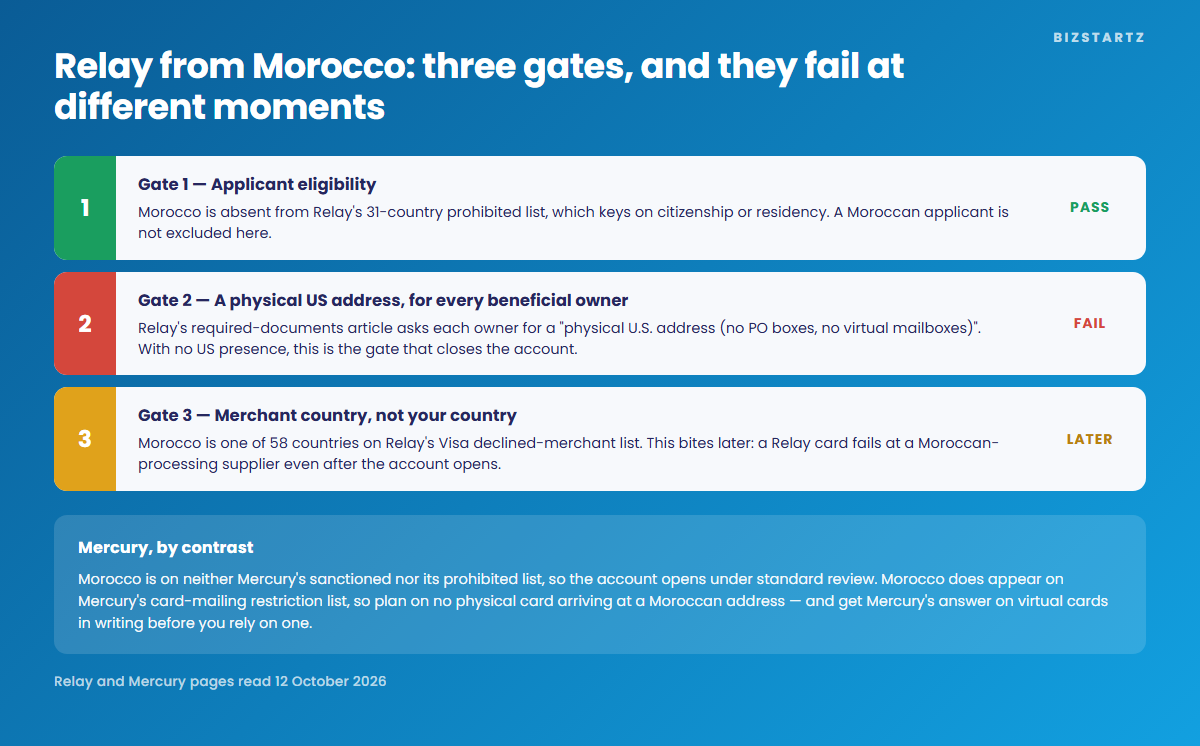
Mercury states it is “unable to open accounts for founders who live in, or businesses that operate or do business in – any of the countries and regions listed below. This is based on your country of residence, not your citizenship or nationality.” Morocco does not appear on that list (Mercury: prohibited countries, read 12 October 2026; the full breakdown is in our Mercury prohibited countries list).
Cards are a separate article with a separate list, and the distinction matters more than almost anything else on this page. Mercury’s card page carries two lists:
- Under “Restricted issuance of physical and virtual cards”: “We are unable to mail physical cards or issue virtual cards to users who reside in the following countries”. That list has 32 entries and includes Nigeria, Vietnam and Lebanon. Morocco is not on it.
- Under “Restricted countries for mailing cards”: “We are also unable to mail physical cards to the following countries”. That list has 15 entries — Algeria, Cambodia, China, Croatia, India, Indonesia, Kosovo, Kuwait, Morocco, Nepal, Pakistan, Philippines, Somalia, South Sudan, Sri Lanka.
Both from Mercury: restricted countries for card issuance, read 12 October 2026.
So: Morocco is on the mailing-only list and absent from the physical-and-virtual list. Mercury will not post a plastic card to a Moroccan address. Virtual card issuance is not restricted for Morocco by that article.
Be precise about what that second sentence does and does not mean, because getting it wrong sends you to an account you cannot spend from. Mercury’s page does not say “virtual cards are available in Morocco.” It says virtual cards are unavailable in 32 other countries, and Morocco is not among them. That is an absence of a restriction, not a promise.
Ask Mercury in writing whether it will issue you a virtual card before you rely on being able to spend from the account, and do it before you pay a formation fee rather than after. The same page showed a live notice on 12 October 2026 that card shipments to seven other countries were “currently paused”, which tells you how often this moves.
Relay: three separate gates, and they fail at different moments
Relay comes up constantly in this conversation and the public advice about it is a mess. There are three distinct restrictions and they are routinely confused with one another.
Gate one, applicant eligibility. Relay states it “cannot open a Relay Account for any business owner who holds citizenship or residency in one of the following countries”, and lists 31. Morocco is absent (Relay: prohibited countries, read 5 October 2026; full list in our Relay prohibited countries guide). Note the test is citizenship or residency, which is broader than Mercury’s residence-only test. A Moroccan passport is not a bar here.
Gate two, the address — and this is the one that actually closes the door. Relay’s required-documents article asks, for every beneficial owner, for a “Physical U.S. address (no PO boxes, no virtual mailboxes)”. For an LLC it asks for a “U.S. business address and phone number (physical address, no PO boxes)”.
If your legal address is a registered agent’s, you must additionally supply “an operational business address where actual business activity occurs”, and that operational address “cannot be another Registered Agent address” (Relay: required documents and organization details by entity type, Relay’s own page shows it updated 11 August 2026; read 12 October 2026).
For a founder living in Morocco with no US presence, that is decisive regardless of gate one. A virtual mailbox is explicitly excluded, and a registered agent’s address will not serve as the operational one.
If no owner has a physical US address, treat Relay as unavailable, not because of your nationality, but because of an address requirement you cannot satisfy. Our guide to the different ways to get a US address explains which types exist and, importantly, which are the virtual-mailbox kind that Relay refuses.
One thing that requirement does argue for: Relay also states it “cannot support sole proprietors without a valid SSN or a physical U.S. address.” If you were weighing a company against simply banking as yourself, the entity is the side with a path.
Gate three, where your suppliers process. This one has nothing to do with you and everyone misses it. Relay cards are “automatically declined at merchants processing in the countries and territories listed below”, a restriction Relay attributes to “Visa’s international transaction policies” and states plainly is “set by Visa, not by Relay.”
That list runs to 58 countries and territories, and Morocco is on it, alongside Hong Kong, Turkey, Cyprus, Malta, Lithuania, Macao and Jordan (Relay: countries where Relay cards are not accepted, Relay’s own page shows it updated 11 August 2026; read 12 October 2026).
This keys off where the merchant processes payments, not where you live. So the trap is not the application, it is holding a Relay card and trying to pay a Moroccan-processing supplier, host or SaaS vendor with it. If a meaningful share of your suppliers process in Morocco, a Relay card is the wrong tool even if you clear the first two gates.
Two of Relay’s own pages we cite here carry an 11 August 2026 update date. Treat all three lists as live documents and re-read them before you act.
What “not prohibited” does and does not mean
Not being on a list is not approval. Both providers run their own checks and decline for their own reasons, and country policies move without announcement. What Morocco has here is a reasonable starting position on Mercury, a hard address blocker on Relay, and a card restriction on both that bites in different places.
The US–Morocco income tax treaty: a real advantage, carefully stated
Morocco is on the IRS’s list of US income tax treaty partners. The M section of that list contains exactly four entries, Malta, Mexico, Moldova and Morocco, and the Morocco page lists two documents, an Income Tax Treaty and a Technical Explanation, both dated 1977 (IRS: United States income tax treaties A to Z and the Morocco treaty documents page, both read 12 October 2026). The IRS pages state no signature or entry-into-force date, so we are not asserting one.
This genuinely distinguishes Morocco, and the African comparison is the sharp one. Of the African countries we checked on that same IRS list on 12 October 2026, Egypt, Morocco, South Africa and Tunisia appear, while Algeria, Ghana, Kenya and Nigeria do not.
We checked eight African countries rather than all of them, so we are not claiming Morocco is one of only four on the continent; we are telling you which eight we looked at and what we found. Outside Africa, Malaysia, Nepal and the UAE are also absent. Thailand and Pakistan, for the record, are on the list, so do not read this as Morocco being unique.
Now be careful what you conclude from it, because a treaty is routinely oversold.
What a treaty can do: provide reduced withholding rates on US-source passive income such as dividends, interest and royalties; give a framework for permanent-establishment questions, meaning whether you are treated as carrying on business in the United States at all; and offer a route for resolving where profit belongs when two tax authorities disagree.
What it does not do: it does not exempt a foreign-owned US disregarded entity from filing Form 5472, which is an information return and not a tax; it does not reduce Moroccan tax; it does not override the Office des Changes; and it gives you nothing at all if your structure’s entire premise is that it already pays no US tax. There is no reduced rate to claim against zero.
Raise the treaty explicitly with advisers on both sides rather than assuming it helps you, and see our comparison of Form W-8BEN and Form W-9 for which form you would actually be signing.
The US side, kept short
The steps are commodity and other pages here own the detail.
- Confirm the bank and the platform first. It costs nothing and it is the step most likely to change your mind. For Morocco, that means asking Mercury about a virtual card in writing.
- Choose a state. Costs and tradeoffs are in what a Wyoming LLC actually costs and LLC prices by state.
- Appoint a registered agent and keep the renewal paid — a lapsed agent is how a company quietly falls out of good standing. See what a registered agent is.
- Get the EIN without an SSN. Step by step in how to get an EIN without an SSN.
- Open the US account, then apply to the platform you formed the company for. Options are compared in payment processors for US LLCs.
Form 5472, every year, whether or not you owe anything
A single-member LLC owned by a non-US person is a foreign-owned US disregarded entity. Each year it files a pro forma Form 1120 with Form 5472 attached, even at zero US tax and zero revenue. ”
A penalty of $25,000 will be assessed on any reporting corporation that fails to file Form 5472 when due and in the manner prescribed”, with a further $25,000 if the failure continues more than 90 days after IRS notification (IRS Instructions for Form 5472).
That is the number to weigh against the 20,000 dirham allowance you are trying to escape. A dormant LLC you stop paying attention to is not free — it is a $25,000 exposure sitting in a drawer. Our guide to Form 5472 for foreign-owned US LLCs covers the filing, and if you are already late, what to do if you have never filed Form 5472 covers that instead.
The broader US position is in US tax filing requirements for international founders. If you have been told a US LLC means paying no tax anywhere, read how the non-resident US tax position actually works before you believe it.
What it costs
Only figures we could source, with the source named:
| Item | Amount | Source |
|---|---|---|
| Delaware annual LLC tax | $400, due 1 June | 6 Del. C. § 18-1107(b) |
| EIN | $0 from the IRS | IRS |
| Form 5472 late-filing penalty | $25,000, plus $25,000 if uncorrected 90 days after IRS notice | IRS Instructions for Form 5472 |
| Upwork withdrawal to a Moroccan bank | $0.99 per withdrawal, minimum 100 MAD | Upwork, read 12 October 2026 |
| PayPal withdrawal to a Moroccan bank | No fee above 2,000.00 MAD; 30.00 MAD below, where no conversion is involved | PayPal Morocco fees, read 12 October 2026 |
| PayPal currency conversion, Middle East and Africa | 3.0% over the base exchange rate | PayPal Morocco fees, read 12 October 2026 |
State filing and annual fees vary and we have not re-verified a Wyoming figure on today’s date, so take those from our Wyoming cost page and LLC prices by state rather than from this table.
Four things are missing on purpose, because we could not price them honestly for your case: registered agent renewal, US tax preparation, the cost of moving dollars in and out, and a Moroccan adviser’s annual fee. The last of those often decides the whole question and it is the only one you can get quoted for nothing this week. Our own pricing covers the formation side.
Questions Moroccan founders ask
Can I form a US LLC from Morocco without travelling to the US?
Yes. You can register the company, get an EIN without an SSN, and file its US returns without visiting the United States. What you cannot do remotely is skip the Moroccan side, the Office des Changes allowance framework applies to you where you live, and a US entity does not switch it off.
Why can’t I just use Stripe in Morocco?
Because Morocco is not on Stripe’s country list in any form, as of 12 October 2026, not supported, not “Preview”, and not in the Paystack-backed extended network that covers Côte d’Ivoire, Ghana, Kenya, Nigeria and South Africa. This is the clearest genuine gap in the Moroccan payments stack and the most legitimate reason on this page to want a US company.
Will Mercury send me a debit card in Morocco?
No. Morocco is on Mercury’s “Restricted countries for mailing cards” list, so a physical card will not be posted to a Moroccan address. Morocco is not on Mercury’s separate list of countries where it cannot issue virtual cards either, but Mercury does not affirmatively state that virtual cards are available in Morocco, so ask in writing before you assume you can spend from the account. Both lists read 12 October 2026.
Can I open a Relay account from Morocco?
Morocco is not on Relay’s 31-country applicant list, so your nationality and residence are not the obstacle. The obstacle is the address: Relay requires a “Physical U.S. address (no PO boxes, no virtual mailboxes)” for every beneficial owner. If no owner has one, treat Relay as unavailable in practice. Separately, Morocco is one of 58 countries on Relay’s merchant list, so a Relay card is declined at merchants that process in Morocco.
How much can I spend abroad from a Moroccan card?
For e-commerce, the Office des Changes raised the allowance for Moroccan individuals, including Moroccans residing abroad, to 20,000 dirhams, up from 15,000, under IGOC 2026 which entered into force on 1 January 2026. For ADD-certified start-ups the e-commerce allowance is 2,000,000 dirhams. If your advertising or software spend runs past the individual figure, that is the constraint a US LLC with a US bank account is genuinely good at removing.
Am I allowed to own a US company as a Moroccan resident?
We are not going to answer that, and you should be wary of a formation provider who does. The IGOC governs foreign exchange transactions including investment abroad, and it works through allowances rather than a blanket yes or no. ADD-certified technology start-ups have an explicit route to invest abroad up to 10 million dirhams a year. For an uncertified individual, the release we read does not state the position. Put it to your bank’s service des changes or a Moroccan adviser before you form anything.
Is the 10 million dirham figure my investment limit?
Almost certainly not. Several law-firm and news summaries report it as a general ceiling for any Moroccan investing abroad. The Office des Changes’ own release ties it to technology start-ups certified by the Digital Development Agency. If you are not ADD-certified, that figure is not about you.
Does a US LLC reduce my Moroccan tax?
Nothing we found supports that, and we could not source how Morocco treats a resident’s income from a foreign company well enough to tell you anything useful about it. What we can say is that a US LLC adds US obligations — Form 5472 every year, at a $25,000 penalty for missing it. Treat “form a US LLC and pay no tax” as a sales pitch until a Moroccan accountant has looked at your facts.
Does the US–Morocco tax treaty help me?
It might, and it is a real advantage over several countries in this series — Nigeria, Malaysia, Nepal and the UAE are all absent from the IRS treaty list, as are Algeria, Ghana and Kenya. The IRS lists Morocco with an Income Tax Treaty and Technical Explanation, both dated 1977. But a treaty mainly affects withholding on US-source passive income and permanent-establishment questions. It does not remove the Form 5472 filing, does not touch Moroccan tax, and does nothing for a structure that already pays no US tax, because there is no reduced rate to claim against zero.
Can Amazon pay me in Morocco without a US company?
Possibly yes, and this is worth checking before you spend anything. Morocco is accepted for Amazon seller registration, and a “Morocco | MAD” row appears on Amazon’s supported bank-account list for the Amazon Currency Converter for Sellers (both read 12 October 2026). That is a better position than Thailand or Malaysia, where we found no row for the local currency on that table. Confirm it in your own Seller Central disbursement settings, since Amazon’s tables change and your account settings are the only answer that binds.
Who this suits, and where to start
It can make sense if you need card checkout on your own site and Stripe’s absence is blocking you; your advertising, software or supplier spend abroad runs past the 20,000 dirham e-commerce allowance; or a paying US client contractually requires a US entity. The first two are the strong Moroccan cases, and they are stronger than the equivalent cases in most other guides in this series.
It probably does not if you sell on Amazon and the MAD payout row covers you; Upwork already pays you to a Moroccan bank for 99 cents; PayPal withdrawals are enough for your volume; you are an ADD-certified start-up with 2,000,000 dirhams of e-commerce headroom; or your case rests on a tax outcome nobody qualified has confirmed for your facts.
Start with the checks that cost nothing, in this order.
- Work out your actual annual spend abroad. If it is comfortably under 20,000 dirhams, the strongest argument on this page does not apply to you.
- Check your Amazon disbursement settings and your Upwork withdrawal options. One of them may already solve it.
- Ask Mercury in writing whether it will open the account and issue a virtual card to an owner resident in Morocco.
- Take the seven questions above to your bank’s exchange desk and a Moroccan adviser, and get an annual fee quote.
- Form the company last, once the other four have answers. Every step before it can be undone by walking away. That one cannot.
If a US company does fit your case, Bizstartz forms US LLCs for non-resident founders and handles the EIN and bank application steps — see our services. The Moroccan side needs Moroccan professionals, and on the exchange-control question that is not a formality. If it does not fit, we would rather you kept the money.
Checked on 12 October 2026. Every provider list, fee schedule and regulator page linked above was read on that date, except Relay’s applicant list which was read on 5 October 2026. Mercury’s card lists and Relay’s three lists are the ones most likely to have moved since — Relay’s own pages showed an 11 August 2026 update date when we read them, so re-read them before you act on anything here.
Ready to start? Book a free consultation and we will map out your US LLC formation, EIN, banking and the right state for your country.

Ready to start your company?
Bizstartz handles formation, EIN, banking and compliance for founders worldwide.