A US LLC from Canada will probably cost you money and buy you nothing, if you live there. That is a harder line than we take in any other guide in this series, and it has nothing to do with banking: Stripe lists Canada in its main supported-country list, Mercury and Relay each prohibit dozens of countries and neither names Canada, and Canada is on the IRS treaty list.
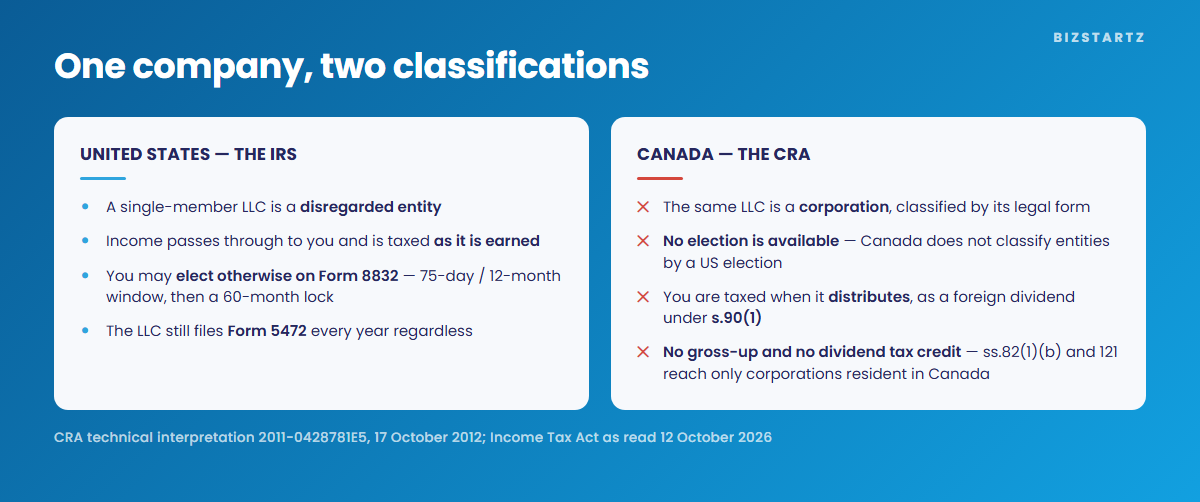
The problem is that Canada and the United States disagree about what your LLC is. The IRS treats a single-member LLC as disregarded, as though it were you. The Canada Revenue Agency treats it as a corporation. Everything that goes wrong afterwards goes wrong because of that one disagreement.
Elsewhere in this series the honest answer is usually “you probably do not need this.” Here it is closer to “this probably costs you money, every year, for nothing.”
And we are going to be straight about something else. We form US companies for a living. For most of the people who find this page, we are telling you not to buy what we sell.
In this guide: Resident, or just Canadian? · Can you? Yes · Why Canada calls it a corporation · What the mismatch does · Article IV(6) · The three suggested fixes · When it still makes sense · What it costs to keep · Questions Canadians ask · Where to start
First: are you a resident of Canada, or a Canadian?
Settle this before you read another word, because a large share of people searching this question are Canadian citizens who do not live in Canada, and almost everything below is about residence, not passports.
Canada taxes on residence. CRA’s own Income Tax Folio S5-F1-C1, Determining an Individual’s Residence Status says a resident individual “is subject to Canadian income tax on his or her worldwide income from all sources,” and that residence “is always a question of fact to be determined by taking into account all of the circumstances of the individual” (read 12 October 2026).
Read what that test actually weighs: facts and ties, where you live, where your spouse and dependants are, what you keep in Canada. A passport is not one of the factors. Citizenship is simply not the thing being measured.
So there are two readers here, and they get opposite answers:
- You live in Canada. The rest of this article is written for you, and its conclusion is mostly no.
- You hold a Canadian passport but live in Dubai, Lisbon, Bangkok or Austin. The CRA classification problem below is largely not yours. You are an ordinary non-resident founder, and our guides for the country you actually live in are the relevant ones. If you are unsure whether you have ceased Canadian residence, that is a question for a Canadian accountant before you form anything, getting it wrong in that direction is expensive in a different way.
Everything from here assumes you are resident in Canada.
Can you? Yes, and that is the least interesting part of the answer
Most pages competing for this search spend their length here, because this is the part where the answer is yes and the next step is a checkout button. It takes one table.
| The question people arrive with | Answer on 12 October 2026 |
|---|---|
| Can a Canadian resident form a US LLC? | Yes. No state requires US residence or citizenship to be a member. |
| Do I need a US LLC to get Stripe? | No. Canada is in the main “Global availability” list on stripe.com/global. no preview label, no invite-only, no extended-network caveat. The list opens “Stripe is currently supported in the following countries/regions, with more to come.” |
| Will Mercury take a founder living in Canada? | Canada is on neither of its lists. Mercury says it is “unable to open accounts for founders who live in, or businesses that operate or do business in,” the countries it names: 4 sanctioned, 48 prohibited. Its C entries are Cambodia, Cameroon, Central African Republic, Congo (the Democratic Republic of the), Congo (the) and Croatia. It also states the policy “is based on your country of residence, not your citizenship or nationality.” Not being listed is not approval. (Mercury: prohibited countries.) |
| Will Relay? | Canada is not among its 31 prohibited countries (its C entries are Cambodia, Central African Republic, Congo (Democratic Republic) and Cuba), and the page says “Relay also permits businesses based internationally” (Relay: prohibited countries). But Relay asks every beneficial owner for a physical US address, which you do not have — see our breakdown of Relay’s prohibited countries. |
| Is there a US–Canada tax treaty? | Yes. “Canada – Tax treaty documents” is on the IRS treaty A-to-Z list. The whole point of this article is that the treaty does not rescue you. |
Mercury’s list is in our Mercury prohibited countries guide, the Stripe comparison is in opening a Stripe account as a non-US resident, and the application itself is in opening a US business bank account as a non-resident.
So: the rails work. Which is exactly why the rails are not the decision.
The thing that actually decides it: Canada calls your LLC a corporation
The United States lets you choose what your company is for tax purposes. Canada does not let you choose, and does not accept your American choice.
On the US side, the IRS states that “For income tax purposes, an LLC with only one member is treated as an entity disregarded as separate from its owner” (page last reviewed 10 October 2026). Form 8832 exists so you can elect out of that. The election is a feature of the US system.
Canada has no equivalent election. It looks at what the thing is under the law that made it, and sorts it into a Canadian category.
What CRA actually said, and where we found it
The clearest statement we could find is CRA external technical interpretation 2011-0428781E5, dated 17 October 2012, signed by an Assistant Director of CRA’s Income Tax Rulings Directorate. Someone asked CRA how a US-state LLC would be taxed in Canada if it were treated as a partnership in the US, and alternatively if it were treated as a C corporation. CRA’s answer, verbatim:
“USLLC will be taxed in Canada as a corporation regardless of its designation in the US.”
And in its general comments: “the USLLC is considered a corporation under Canadian tax law despite the treatment available under US tax law.”
Its stated reason, in full, is one sentence: “This is CRA’s position and there is some supporting jurisprudence.” The letter names no case. We could not establish which decisions it meant, so we are not going to name any on its behalf.
In the same letter, CRA treated the separate question of whether the LLC is resident in Canada as a question of fact. Hold that thought — it comes back below, and it is the worst scenario on this page.
Here is the part we could not do, and we think you should know about it
We went looking for a CRA publication stating this, an income tax folio, an interpretation bulletin, a guide, a technical news issue. We did not find one.
What we checked: the Income Tax Folio index, including the Series 5 international and residency chapters, for an entity-classification chapter. There is none we could locate. We read Income Tax Technical News No. 31R2 (16 May 2006) directly, because it comes up in searches on this topic; it does not mention LLCs at all, and covers social security taxes and the foreign tax credit, single-purpose corporations holding US real property, and the foster-care exemption. We looked for a canada.ca page carrying the position in CRA’s own publishing voice and found nothing.
So draw the line precisely, because the distinction matters:
- There is a CRA document stating the position, a severed letter from the Rulings Directorate, quoted above.
- There is, as far as we could establish, no CRA publication stating it. Severed letters are released under access-to-information requests and republished by commercial tax services; CRA does not post them on canada.ca, and CRA’s own archival language warns that such answers may not represent its current position.
Dozens of Canadian accounting and law firm pages state the LLC-is-a-corporation position in near-identical words. That agreement is professional consensus, and consensus is worth respecting. It is not the same thing as a citation, and a page that presents it as one is doing you a quiet disservice.
Why no published list exists, CRA was asked, and said no
This is the piece that made the absence make sense to us.
At the 2022 International Fiscal Association conference, CRA was asked directly, in Question 8 of the CRA Roundtable, “will the CRA publish and maintain an online list of foreign entities that the CRA has classified for reference purposes?”
CRA said no. It answered that it “would not be in a position to publish and maintain an online list” of “foreign entity or arrangement classifications,” because classification is done case by case. It added that it would consider confirming a classification through an advance income tax ruling.
In the same answer it set out its two-step method: first “Determine the characteristics of the foreign entity or arrangement under applicable foreign law,” then “Compare these characteristics with those of recognized categories of entity or arrangement,” while examining “the nature of the relationship between the various parties that are involved.” (CRA document 2022-0926431C6, 17 May 2022.)
So the missing publication is not an oversight, and its absence is not evidence that the position is soft. CRA was invited to publish its classifications and declined on principle. The position is real, it is applied, and it is deliberately not on a list you can look up.
Both CRA documents quoted above were read on 12 October 2026 on taxinterpretations.com, a commercial archive of CRA severed letters, because that is where severed letters live. We would rather tell you that than imply we read them on canada.ca.
What the mismatch actually does to you
We form US companies. We are not Canadian accountants, and nothing in this section tells you what you owe. It sets out the provisions, quoted from the Income Tax Act, so that you can take the right questions to someone qualified, and it is explicit about where our sourcing stops.
One correction before the detail, because the usual version of this story is written for a reader who may not be you. The standard telling is: the US taxes you on the business income as it is earned, Canada waits for the distribution, and you get taxed twice. That is one case. It is not the common case for a Canadian consultant or agency with US clients, where there may be no US tax at all. So split them.
Case one: there is no US tax, and the problem is on the Canadian side
If your LLC has no US trade or business and no US-source income, a Toronto consultant invoicing American clients for work done in Toronto is the archetype, you may owe nothing in the United States. That is the entire basis of the “zero tax LLC” pitch, and our guide to whether a non-resident pays US tax on a US LLC sets out what decides it.
Now look at what happens when the money reaches you. Section 90 of the Income Tax Act, marginal note Dividend from non-resident corporation, reads:
“In computing the income for a taxation year of a taxpayer resident in Canada, there is to be included any amount received by the taxpayer at any time in the year as, on account or in lieu of payment of, or in satisfaction of, a dividend on a share owned by the taxpayer of the capital stock of a non-resident corporation.”
And here is the part that is almost never spelled out. The gross-up and dividend tax credit, the machinery that stops the same profit being taxed at the company and again in your hands, does not reach this. Section 121, Deduction for taxable dividends, computes the credit on amounts “required by subparagraph 82(1)(b)(i) to be included in computing the individual’s income for the year.” And the gross-up in section 82(1)(b) operates on dividends from corporations resident in Canada. A US LLC that CRA treats as a non-resident corporation is not one of those.
So the shape of it, in the no-US-tax case: the money comes into your Canadian income with no foreign tax to credit, because none was paid, and without the integration mechanism a Canadian corporation’s dividend would have carried. We are deliberately printing no rates here, and you should be wary of anyone who prints you a percentage for this without knowing your province, your income and your facts.
One honest gap. Section 90(1) is written in terms of a dividend on a “share … of the capital stock” of a corporation. An LLC issues membership interests, not shares. We did not verify how that bridge is made in the legislation, and we are not going to assert it. Put it on your accountant’s list.
Case two: there is US tax, and the credit has to match on three axes
If your LLC does have US-source or effectively-connected income, you will have paid US tax personally, because the US disregarded the company. Then the question is whether Canada gives you credit for it. Section 126(1), Foreign tax deduction, opens:
“A taxpayer who was resident in Canada at any time in a taxation year may deduct from the tax for the year otherwise payable under this Part by the taxpayer an amount equal to such part of any non-business-income tax paid by the taxpayer for the year to the government of a country other than Canada …”
Three conditions are visible on the face of that text, and we are claiming only these three:
- the tax must be paid by the taxpayer;
- it must be paid for the year — the same year as the Canadian tax it is reducing;
- it must be non-business-income tax (section 126(2) is the separate credit for business-income tax).
Now set that against a classification mismatch. The US taxes you in the year the business earns. Canada, having decided the LLC is a separate corporation, has nothing in your income that year.
By the time Canada does include something, on a distribution, possibly years later, you are not paying US tax “for the year” on that amount, and what Canada is taxing is a dividend rather than business income. All three conditions come under pressure at once, and they come under pressure by design, not by accident.
We are not telling you the credit fails for you. We are telling you where the statute puts the test, which is more than the pages selling you the company will do. Take your actual numbers and your actual years to a cross-border accountant.
Passive income: your LLC is a foreign affiliate, and that opens a whole regime
Once Canada calls the LLC a corporation, a second set of rules switches on, and the thresholds are low enough that essentially every reader of this page clears them.
Section 95(1) defines a foreign affiliate as “a non-resident corporation in which, at that time, (a) the taxpayer’s equity percentage is not less than 1%, and (b) the total of the equity percentages in the corporation of the taxpayer and of each person related to the taxpayer … is not less than 10%.” A controlled foreign affiliate includes “a foreign affiliate of the taxpayer that is, at that time, controlled by the taxpayer.”
If you are the sole member of your LLC, you are at 100%. You own a controlled foreign affiliate.
That is the gateway to the foreign accrual property income rules, which exist to tax certain passive income without waiting for a distribution. The definition in section 95(1) opens: “foreign accrual property income of a foreign affiliate of a taxpayer, for any taxation year of the affiliate, means the amount determined by the formula …”, note that FAPI is defined only by reference to a foreign affiliate, which is why the classification decides whether the regime engages at all.
We read the definitions. We did not read the whole FAPI regime, and we are not going to summarise a hundred pages of the Act we did not read. What matters for your decision is the gateway: if your LLC holds investments, interest-bearing balances or royalties rather than running an active business, this is in scope and it is your accountant’s question, not a blog’s.
The annual Canadian filing nobody quotes you for: Form T1134
This one is concrete, dated and checkable, and it is missing from almost every page selling Canadians a Wyoming LLC.
Section 233.4 of the Income Tax Act, marginal note Reporting entity, makes a Canadian-resident taxpayer a reporting entity for a year if it is a taxpayer “of which a non-resident corporation is a foreign affiliate at any time in the year.” Subsection 233.4(4) then requires that entity to “file with the Minister for the year or period a return in prescribed form” “in respect of each foreign affiliate of the entity in the year or period,” and it sets the deadline: “within 10 months after the end of the year or period.”
The prescribed form is T1134, Information Return Relating to Controlled and Non-Controlled Foreign Affiliates. Note that the canada.ca page offers the form but does not say who must file it or when — the obligation and the deadline are in the Act, which is why we quoted the Act.
Miss it and section 162(7), Failure to comply, imposes “a penalty equal to the greater of $100 and the product obtained when $25 is multiplied by the number of days, not exceeding 100, during which the failure continues.” Do that arithmetic yourself rather than taking ours: $25 × 100 days caps it at $2,500, with a $100 floor.
Where the failure is “knowingly or under circumstances amounting to gross negligence,” section 162(10) applies a much larger penalty, computed as “($500 × A × B) – C” where A is “the lesser of 24 and the number of months … during any part of which the return has not been filed,” B is 2 if you have also failed to answer a formal demand and 1 otherwise, and C is the penalty already applied under 162(7). We are printing the formula rather than a headline maximum, because the formula is what the statute says.
Stack that against the US side, where a foreign-owned single-member LLC files a pro forma Form 1120 with Form 5472 attached every year regardless of revenue. You have bought yourself an annual filing obligation in two countries to own one company that, for many readers, replaces nothing.
And the worst case: the LLC might be resident in Canada
Here is the scenario that turns an expensive mistake into a serious one, and it follows from CRA calling the LLC a corporation.
Section 250(4), Corporation deemed resident, deems a corporation resident in Canada where — for one incorporated after 26 April 1965 — “it was incorporated in Canada.” Your Wyoming LLC was not. So it is not deemed resident in Canada. But nothing in section 250 deems a foreign-incorporated corporation to be non-resident either; subsection 250(6) runs the other way only on specified conditions.
Which leaves residence to the common-law test of where central management and control actually sits. If you are the only member and the only manager, and every decision gets made at your kitchen table in Mississauga, that is a question of fact — and CRA treated exactly that question as one of fact in the 2012 letter quoted above.
A corporation resident in Canada is taxable in Canada on its worldwide income. We are not telling you that is your outcome. We are telling you that “I incorporated it in Wyoming” is not an answer to it, and that any provider who waves this away has not read section 250.
The treaty does not rescue this, and Article IV(6) is why
Canada and the United States do have a treaty, and the treaty does contain a provision written for exactly this kind of mismatch. Read it closely and you will see it was written for the other guy.
First, a sourcing trap worth flagging, because we fell into it. Article IV(6) is not in the obvious copies of the treaty. Finance Canada’s consolidated page for the 1980 Convention as amended by the 1983, 1984, 1995 and 1997 Protocols has Article IV ending at paragraph 5.
The PDF the IRS offers is described as the treaty plus Protocols 1 through 4, dated 1980, also no paragraph 6. Paragraph 6 was added by Article 2(2) of the 2007 Protocol, the Fifth Protocol. Anyone citing “Article IV(6)” against the 1980–1997 text is citing a document that does not contain it.
We read it in two places on 12 October 2026 and they agree word for word: the 2007 Protocol as published by the US Treasury, and Finance Canada’s consolidation that includes the 2007 Protocol. Here it is in full:
“6. An amount of income, profit or gain shall be considered to be derived by a person who is a resident of a Contracting State where:
(a) the person is considered under the taxation law of that State to have derived the amount through an entity (other than an entity that is a resident of the other Contracting State); and
(b) by reason of the entity being treated as fiscally transparent under the laws of the first-mentioned State, the treatment of the amount under the taxation law of that State is the same as its treatment would be if that amount had been derived directly by that person.”
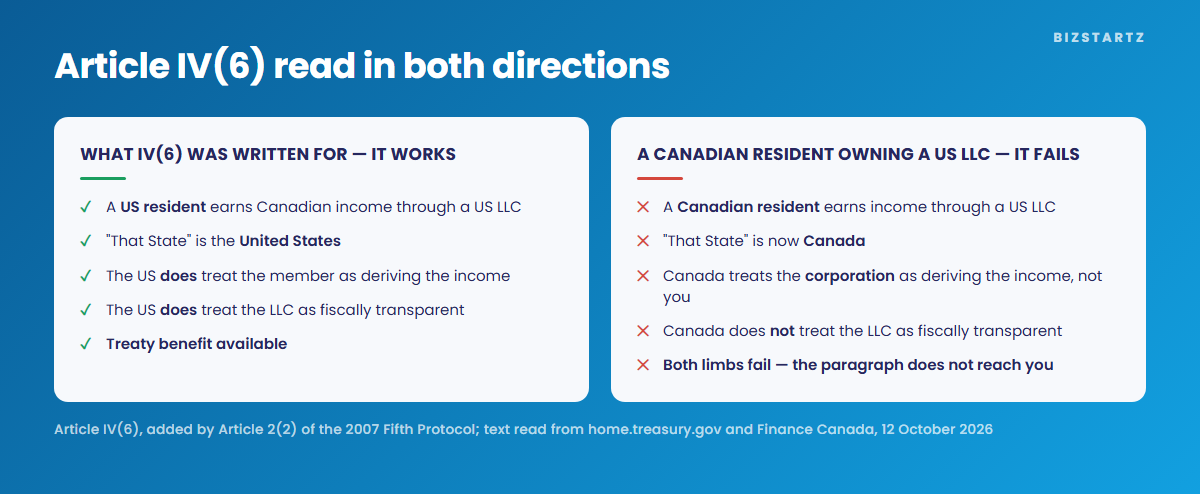
Both limbs turn on the law of “that State” and “the first-mentioned State”, meaning the country where the person claiming the benefit is resident. Now substitute yourself in.
You are resident in Canada, so “that State” is Canada. Limb (a) asks whether Canada considers you to have derived the amount through the entity. It does not; Canada considers the corporation to have derived it. Limb (b) asks whether the entity is treated as fiscally transparent under Canadian law such that the treatment is the same as if you had received the amount directly. It is not, and it is not the same.
Both conditions fail on the paragraph’s own wording. The provision is drafted symmetrically and works in one direction only: it helps the taxpayer whose own country of residence is the one treating the entity as transparent. That is a US resident earning Canadian income through a US LLC. It is not you.
Article IV(7), added by the same provision, is the mirror-image denial rule, it provides that an amount “shall be considered not to be paid to or derived by a person who is a resident of a Contracting State” in two defined mismatch situations. It is not a rescue either.
If someone has told you the treaty solves the LLC problem for Canadians, ask them which paragraph, then read it against the two limbs above.
What people suggest instead, and what each one actually changes
Three fixes circulate. We are not recommending one, the right answer depends on facts we cannot see, and on Canadian consequences we did not verify and will not guess at. Here is what each changes on the side we could source.
| Option | What it changes on the US side | What we did not verify |
|---|---|---|
| Elect corporate treatment for the existing LLC (Form 8832) | The LLC stops being disregarded for US federal tax and is taxed as a corporation, so both countries then call it a corporation. Form 8832’s domestic default rule is “Disregarded as an entity separate from its owner if it has a single owner,” and the election is how you leave it. Timing is constrained: an election “cannot take effect more than 75 days prior to the date the election is filed, nor can it take effect later than 12 months after the date the election is filed.” And it locks: “the entity generally cannot change its classification by election again” “during the 60 months after the effective date of the election.” (Form 8832, Rev. 12-2013.) | Whether this cures the Canadian problem. We verified the US mechanics only. We did not verify the Canadian treatment of a US LLC that has elected corporate status, and we are not going to assume alignment follows automatically. Also unpriced: US corporate filing and, potentially, withholding on distributions. |
| Use a US C-corporation instead of an LLC | No classification mismatch to begin with — both countries treat a state-law corporation as a corporation. This is also what US investors expect if that is your reason for being here. See an LLC taxed as a C-corp and why a non-resident cannot own an S corp. | The full Canadian cost of holding a US corporation as a Canadian resident, including the foreign affiliate reporting that still applies. A C-corp does not remove your T1134 obligation — it is still a non-resident corporation. |
| Just use a Canadian corporation | Nothing on the US side, which is often the point. A Canadian corporation is inside the system the integration machinery was built for, and it is what your Canadian accountant already knows how to file. | Whether it meets whatever requirement sent you looking for a US entity. If a US client contractually requires a US company, this does not solve that. Incorporation and annual costs vary by province and we did not price them. |
Notice what is not on this list: “form the LLC and sort the tax out later.” The 60-month lock on the 8832 election and the 10-month T1134 deadline are both reasons to decide before you file, not after.
When a US LLC is still the right answer for a Canadian
Three cases survive, and only one of them is common.
You are not resident in Canada
This is the big one, and it is why the residence section is at the top of this page rather than the bottom. If you hold a Canadian passport but you are tax-resident somewhere else, the CRA analysis above is largely not about you.
You are an ordinary non-resident founder and the decision turns on the country you actually live in. Confirm your residence status with a Canadian accountant first if there is any doubt, a departure that was never properly completed is its own expensive problem.
A US client or platform contractually requires a US entity
Some US buyers will only contract with a US company, usually for procurement reasons rather than tax ones. If that is a written requirement from someone already paying you, it is a real reason, and a reason to ask whether a corporation serves you better than an LLC, given everything above.
Before you spend anything, ask them precisely what they need. In our experience the actual requirement is very often a US bank account to pay into, or a particular tax form, not a US company. On the form: a US entity signs a Form W-9, while you personally would sign a Form W-8BEN. That distinction matters more than people think.
As we set out on that page, the IRS instructions say a foreign person “may not provide a Form W-9,” and item 3 of the form’s certification is that “the payee is a U.S. person,” signed under penalties of perjury, so signing one when you are a Canadian resident individual is a false certification, not a shortcut. If their system genuinely cannot accept a W-8, that is a concrete problem an entity solves.
You are moving to the United States, or already live there
If you are relocating, the classification mismatch has a shelf life. Form it with the move in mind and with advice on both sides about the timing, because forming before you cease Canadian residence and distributing after are different transactions.
What is not on this list: Stripe access, which you already have. Mercury, which does not prohibit you. And “lower taxes,” which is a claim about the United States wearing a Canadian costume.
If holding US dollars rather than converting them is your reason, price it as arithmetic. Ask your own bank what a US-dollar business account and the conversion spread cost you in a year, then set that against the annual total in the next section. That is a quote you can get this week, and it decides the question more often than anything on this page.
What it costs to keep, on both sides
Only figures we could source, with the source named.
| Item | Amount | Source |
|---|---|---|
| Wyoming formation | “Articles of Organization*/Continuance/Domestication …$100.00” | WY Secretary of State fee schedule, effective 1 July 2026 |
| Wyoming annual report licence tax | “$60 or two-tenths of one mill on the dollar ($.0002) whichever is greater based on the company’s assets located and employed in the state of Wyoming” | Same schedule |
| Delaware annual LLC tax | $400, due 1 June | 6 Del. C. § 18-1107(b) |
| EIN | $0 from the IRS | IRS |
| Form 5472 non-filing penalty | “A penalty of $25,000 will be assessed on any reporting corporation that fails to file Form 5472 when due and in the manner prescribed.” A further $25,000 “if the failure continues for more than 90 days after notification by the IRS,” and that additional penalty applies “with respect to each related party for which a failure occurs for each 30-day period (or part of a 30-day period)” the failure then continues. | IRS Instructions for Form 5472 |
| T1134 non-filing penalty | “the greater of $100 and the product obtained when $25 is multiplied by the number of days, not exceeding 100, during which the failure continues”; more for knowing or grossly negligent failures | ITA ss. 162(7) and 162(10) |
The state fees are small, and that is the hook. Our Wyoming LLC cost breakdown and state comparison for non-residents have the rest of the US figures. One disclosure about that table: the Delaware figure is the statutory one in 6 Del. C. § 18-1107(b) and comes from our existing record rather than a fresh read on 12 October 2026, unlike every other line.
Deliberately not priced, because we cannot price them honestly for your case: a registered agent’s renewal (see what a registered agent does), US tax preparation for the pro forma 1120 and Form 5472, covered in our Form 5472 guide and US tax filing requirements for international founders, and a Canadian cross-border accountant’s annual fee for the T1134 and the mismatch analysis.
That last one is the number that decides this, and it is the only one you can get quoted for free this week. Get two quotes. Then compare them against what the LLC actually replaces, which for most Canadian readers of this page is nothing.
Questions Canadian founders ask
Does a US LLC lower my Canadian tax?
That is not a question we will answer for you, and you should be sceptical of anyone selling you a company who does. What we can tell you is that the structure the pitch relies on, a disregarded entity paying no US tax, is not a structure Canada recognises. CRA treats the LLC as a corporation. Take your facts to a cross-border accountant.
Why does Canada treat my LLC as a corporation when the IRS does not?
Because Canada classifies a foreign entity by looking at what it is under the law that created it and matching it to a Canadian category, rather than by accepting a US election. CRA described that two-step method in its 2022 IFA roundtable answer. CRA document 2011-0428781E5 states the result: “USLLC will be taxed in Canada as a corporation regardless of its designation in the US.”
Is there a CRA page I can read that says this?
Not that we could find, and we looked hard. There is a CRA severed letter that says it in those words, and there is a 2022 CRA roundtable answer declining to publish a list of its foreign entity classifications at all. There is no income tax folio, interpretation bulletin or technical news issue stating it that we could locate on canada.ca. The many firm pages asserting it agree with each other, which is consensus rather than a citation. We think you are better off knowing that than being handed a confident claim.
Doesn’t the Canada–US treaty fix this? What about Article IV(6)?
Read the paragraph and substitute yourself in. Both of its limbs depend on the law of the state where you are resident treating the entity as fiscally transparent. Canada does not. The paragraph was built for a US resident earning Canadian income through a US LLC, which is the opposite fact pattern. It is also not in the 1980–1997 consolidated treaty at all — it arrived with Article 2(2) of the 2007 Fifth Protocol.
Do I need a US LLC to use Stripe in Canada?
No. Canada is in Stripe’s main supported-country list with no preview or extended-network caveat (checked 12 October 2026). If a US company was going to be how you got Stripe, that reason is gone.
Will Mercury open an account for someone living in Canada?
Canada is on neither Mercury’s sanctioned nor its prohibited list as read on 12 October 2026, and Mercury says the policy is based on residence rather than citizenship. That is a good starting position, not an approval — Mercury runs its own checks and declines for its own reasons.
What extra filings does a Canadian LLC owner have?
Two annual sets, one in each country. In the US, a pro forma Form 1120 with Form 5472 attached, regardless of revenue. In Canada, Form T1134 for each foreign affiliate, due within 10 months after your year end under section 233.4(4) of the Income Tax Act, because a wholly owned US LLC that Canada calls a corporation is a controlled foreign affiliate. Confirm your own position with your accountant.
I am a Canadian citizen living abroad. Does any of this apply to me?
Largely not, if you are genuinely non-resident for Canadian tax purposes. Canada taxes on residence, and CRA’s residence folio treats the question as one of fact about your circumstances — it does not weigh citizenship at all. If you are not certain you have ceased Canadian residence, resolve that with a Canadian accountant before forming anything, because the answer changes which half of this article is about you.
Can I fix an LLC I already formed?
There are options and none of them is free. Electing corporate treatment on Form 8832 changes the US classification but locks you out of changing again for 60 months after the effective date, and we did not verify what it does on the Canadian side. Dissolving has its own consequences. If the company is already formed and already has a year behind it, the T1134 deadline is a live date, not a theoretical one. This is the point at which a cross-border accountant is cheaper than a decision.
Where to start, and the questions to take with you
Start with the checks that cost nothing, in this order.
- Settle your residence status. Everything else depends on it.
- Find out what actually requires a US entity, in writing, from the client or platform that triggered this. Ask whether they need a US company or a US bank account and a tax form.
- Get two quotes from Canadian cross-border accountants for the annual work, using the questions below. This is the step that usually ends the discussion.
- Register the company last. Every step before it can be undone by walking away. That one cannot.
Questions to take to a cross-border accountant
- Given how I actually operate, does CRA treat my US LLC as a corporation — and is there anything in my facts that would change that?
- Where is the LLC resident for Canadian purposes? If central management and control sits at my desk in Canada, what follows, and what records should I be keeping to support the position you recommend?
- When does Canada include the LLC’s income in my income — on earning, or on distribution — and under which provision?
- Section 90(1) speaks of a dividend on a share of capital stock. My LLC issues membership interests. How does that work, and does it change the characterisation?
- If I pay US tax personally because the LLC is disregarded there, will I get a credit under section 126, given the same-taxpayer, same-year and non-business-income-tax conditions in 126(1)?
- Is my LLC a controlled foreign affiliate, and is any of its income FAPI? What does that mean for timing?
- Do I have to file a T1134, from which year, and by what date? Am I already late?
- Would electing corporate treatment in the US on Form 8832 improve my Canadian position, worsen it, or change nothing — and what does the 60-month lock commit me to?
- Compared with a Canadian corporation doing the same work, what does this structure cost me in tax and in compliance over the next three years?
- What will you charge me annually to handle this, and does that cost leave the LLC worth having?
Questions for the provider, before you form anything
- Mercury: will you open an account for an LLC whose sole owner is resident in Canada?
- Relay: I have no physical US address for myself or the business. Can you open an account, or is that a decline?
- The client or platform that triggered this: do you need a US entity, or a US bank account and a W-9?
- Whoever is selling you the company: which CRA document supports what you just told me about Canadian tax?
If a US company genuinely fits your case, Bizstartz forms US LLCs and C-corps for non-resident founders and handles the EIN and bank application steps — see our services and pricing, and how to get an EIN without an SSN for that step. The Canadian side needs a Canadian cross-border accountant, and on the classification question that is not a formality.
If it does not fit — and for a Canadian resident it usually does not — we would rather you kept the money and the two annual filings.
Checked on 12 October 2026. Every statute, treaty text, CRA document, IRS page, fee schedule and provider list linked above was read on that date. Mercury’s and Relay’s country lists and Stripe’s availability list move without notice, so re-read those three on the day you act.
🎯 Ready to start? Claim your free consultation and we'll map out your US LLC formation strategy — EIN, banking, and the right state for your country.

Ready to start your company?
Bizstartz handles formation, EIN, banking and compliance for founders worldwide.